Slashdot Mirror
Domain: wikimedia.org
Stories and comments across the archive that link to wikimedia.org.
Comments · 6,832
-
Re:The problem is....
Actually, it looks like HDMI does not support compressed video, only uncompressed. Your cable video signal may be overcompressed, but from your cable box (or whatever is decoding your cable signal) to your TV, the HDMI cable is transferring those artifacts uncompressed so there is no further loss in quality. Of course, the data rate of uncompressed video is determined by the resolution and color depth which your cable video signal is probably not maxing out, especially given deep color support in more recent revisions of HDMI.
-
Re:What the article doesn't mention
Would you rather have your OS X or iTunes look like this? While these colors make the Amiga desktop stand out from the black-and-white Mac or C64 GEOS of the day, it's also extremely garish:
http://upload.wikimedia.org/wikipedia/en/b/b3/Amiga_Workbench_1_0.png
(zoom 300% to recreate the old 14 inch look of Amiga)Ick. Well at least it could do preemptive tasking.
-
Re:And who is going to kill 80 million people?
These four guys, messrs. W, F, P and D (as always). Sheesh.
-
Re:Cool, it's like Intel Upgrade Service for a bra
I wonder if this or similar genes could be responsible for "above average" intelligence in some people. It would seem to explain why the majority of people seem to maintain their seemingly low average.
Not quite sure what you mean by that - but the intelligence of the majority, as measured by IQ, has been consistently increasing for generations now, it is called the Flynn Effect.
-
Re:They're gonna feel like...
[citation needed]
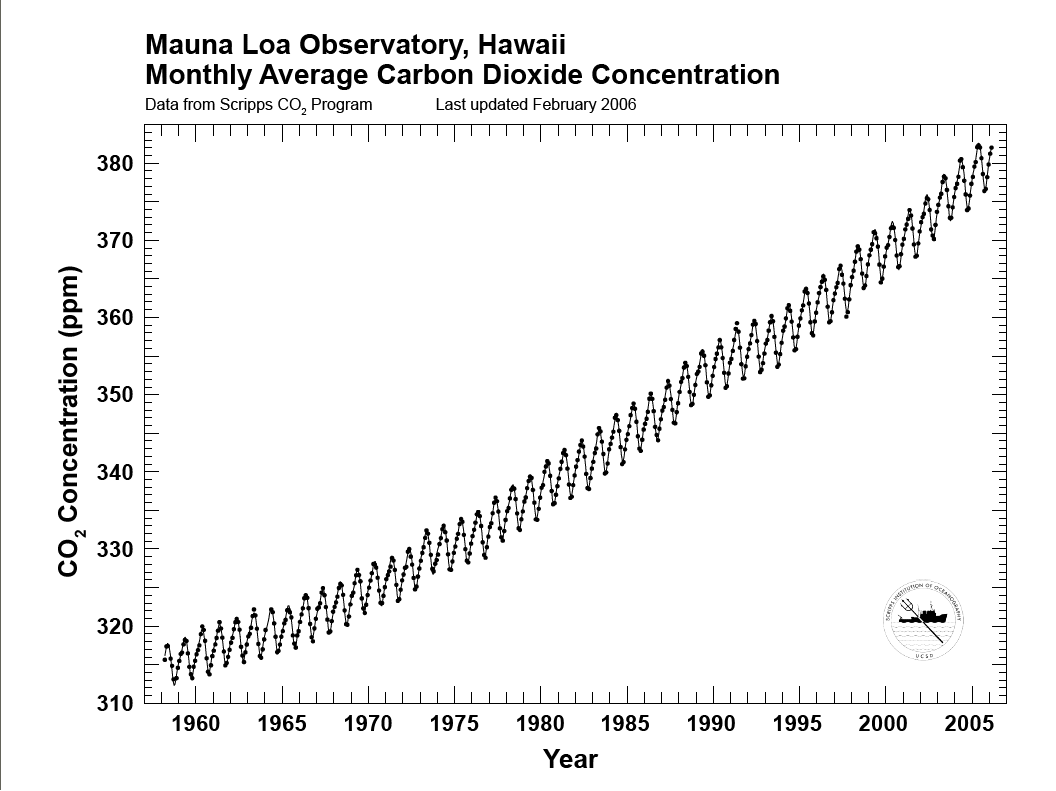
Global temps cooled and stayed there for 40 years during the post-WW2 economic boom. When carbon dioxide emissions were rising, and atmospheric co2 was rising, temps decreased.
I can go on... the warming-at-altitude problem. Greenhouse-based warming is supposed to heat the mid troposphere faster than the surface. But that's not what is happening. The troposphere is warming much slower than the surface.
The 2500 IPCC scientists who are "all in agreement"? Yeah, quite a few of those aren't scientists. And quite a few scientists didn't agree but got counted anyway.
I'm not saying AGW is impossible. It sure as hell isn't an undisputed fact. And guys like you frothing at the mouth... is that "sticking it to the man"? Toeing the AGW line is so NOT punk rock.
-
Re:Sad, actually
If we wanted to build a Saturn V rocket today it could not be done. The original design is gone.
GOD DAMN IT. I really, really wish people would quit perpetuating this wildly incorrect urban legend. The original design details, down to the very last nut and bolt, are on file at the Marshall Space Flight Center. Absolutely nothing at all is "gone". Source.
The experts that had been working with rocket engines since the late 1940s worked on the Saturn V. Today there is nobody that knows anywhere near as much about rocket engines left. While the main engines for the Shuttle are somewhat of a marvel, I doubt they could be reproduced today either. The people resources simply aren't there - it would take 10 years of experimentation and learning about rockets.
Also ridiculously incorrect. You truly don't believe that the Space Shuttle Main Engines could be "reproduced" today? You're completely unaware of the fact that they've been continually "reproduced" since the beginning of the program, right? That they're rebuilt between missions, and that the design has improved and evolved over the life of the program? That as of right now there are in fact nine fully-built spare ones in storage at KSC? The engineers didn't just build a bunch of them in 1980 and then zap themselves with the Men In Black flashy-thing--SSMEs have been constantly built for the past almost thirty years. If my tone is coming across as a little coarse, it's because I'm having a hard time understanding how you could have a highly-moderated post to Slashdot when thirty seconds of research would refute almost everything you just said.
The reason why building a Saturn V today from the old plans is impossible has nothing to do with "cheaper labor" or "people that didn't mind getting their hands dirty" or whatever stupidness you wrote. Rather, you can't build a Saturn V today because a Saturn V isn't just a bunch of tanks with engines strapped to it--it's half of a complex launch system, with the other half being the Apollo CSM that sits on top of it. A Saturn V is an end-to-end system designed around the IBM-produced instrumentation unit, two tons of analog and basic digital computers and instrumentation. It's not that you can't build it--it's that building it wouldn't make any sense. You'd need to completely de-Apollo the rocket for it to work right, and guess what? That's exactly what NASA has been doing, although the political will to make it happen is sorely lacking.
Please educate yourself before you spout off such a mixture of urban legend and outright incorrect craziness.
-
Re:Sad, actually
If we wanted to build a Saturn V rocket today it could not be done. The original design is gone.
GOD DAMN IT. I really, really wish people would quit perpetuating this wildly incorrect urban legend. The original design details, down to the very last nut and bolt, are on file at the Marshall Space Flight Center. Absolutely nothing at all is "gone". Source.
The experts that had been working with rocket engines since the late 1940s worked on the Saturn V. Today there is nobody that knows anywhere near as much about rocket engines left. While the main engines for the Shuttle are somewhat of a marvel, I doubt they could be reproduced today either. The people resources simply aren't there - it would take 10 years of experimentation and learning about rockets.
Also ridiculously incorrect. You truly don't believe that the Space Shuttle Main Engines could be "reproduced" today? You're completely unaware of the fact that they've been continually "reproduced" since the beginning of the program, right? That they're rebuilt between missions, and that the design has improved and evolved over the life of the program? That as of right now there are in fact nine fully-built spare ones in storage at KSC? The engineers didn't just build a bunch of them in 1980 and then zap themselves with the Men In Black flashy-thing--SSMEs have been constantly built for the past almost thirty years. If my tone is coming across as a little coarse, it's because I'm having a hard time understanding how you could have a highly-moderated post to Slashdot when thirty seconds of research would refute almost everything you just said.
The reason why building a Saturn V today from the old plans is impossible has nothing to do with "cheaper labor" or "people that didn't mind getting their hands dirty" or whatever stupidness you wrote. Rather, you can't build a Saturn V today because a Saturn V isn't just a bunch of tanks with engines strapped to it--it's half of a complex launch system, with the other half being the Apollo CSM that sits on top of it. A Saturn V is an end-to-end system designed around the IBM-produced instrumentation unit, two tons of analog and basic digital computers and instrumentation. It's not that you can't build it--it's that building it wouldn't make any sense. You'd need to completely de-Apollo the rocket for it to work right, and guess what? That's exactly what NASA has been doing, although the political will to make it happen is sorely lacking.
Please educate yourself before you spout off such a mixture of urban legend and outright incorrect craziness.
-
Re:Econ 101
So what you're saying is that virtual dollars are constantly being created and destroyed in Economic Space? Forming the basis for a theory of Economic Vacuum Energy? Which itself is a part of Quantum Economics?
-
Re:Do they not already have restrictions?
I don't know any people that think physical discipline is immoral as long as it's not done at the drop of a hat.
I agree with you except on this point. Physical discipline should not just be avoided; it is never acceptable. See Wikipedia article on the anti-corporal punishment movement and the book For Your Own Good: Hidden Cruelty in Child-Rearing and the Roots of Violence . Of course, those sources should be taken with a grain of salt as they are clearly strong supporters of one position... but they are people who have carefully considered physical discipline of children and would find "immoral" a bit weak to describe it.
That said, it sounds like you are in favor of better methods of parenting anyway.
-
Re:Last Digit?
All real transcendental numbers are irrational, since all rational numbers are algebraic.
from Wikipedia's article on transcendental numbers.
-
Re:Last Digit?
All real transcendental numbers are irrational, since all rational numbers are algebraic.
from Wikipedia's article on transcendental numbers.
-
Re:Bailey–Borwein–Plouffe formula
They used Bellard's formula. Here's the original article.
-
Re:So, what is the digit in decimal?
Not quite true. See Bellard's formula and Bailey's formula on which it is based.
-
Bailey–Borwein–Plouffe formula
Bailey–Borwein–Plouffe formula lets you calculate the n-th digit of pi without calculating the n-1 digits.
I wonder what formula was used to calculate the digit here.
-
That is incorrect
As this small picture will show you , being color blind don't mean you see the color as *black* wiki color blind of american flag each type of our color detector cells see actually a wide spectrum, and it overlaps. So depending on the "red" used in those lens for glasses, you will see gray stuff, or even green stuff if the absorption is not a pure red line.
-
Re:No cross platform support either
Linux has a much higher installed base than that, but many of the platforms it's installed on are not desktops or handhelds that do a lot of browsing. If you look at servers, Linux pulls down somewhere from 20-40% according to most surveys. I wouldn't be surprised if the total OS installed base is closer to 10% than to 1% for Linux (as a percentage of all machines).
That figure's not really relevant to the issue at hand, though.
The numbers I posted are for web usage. If a significant number of people are spoofing their clients in non-standard ways, the numbers could be skewed; still, there are lots of different sites that show fairly similar distributions. Note that if someone has both a Linux desktop and a Windows desktop but for some reason uses the Linux desktop exclusively for browsing (or vice-versa) that will be reflected in the stats; that seems reasonable if you're discussing what percentage of the audience you're excluding with single-OS solutions.
http://www.atinternet-institute.com/en-us/internet-users-equipment/operating-systems-april-2010/index-1-2-7-197.html
http://stats.wikimedia.org/wikimedia/squids/SquidReportOperatingSystems.htm
http://getclicky.com/marketshare/global/operating-systems/
http://www.webmasterpro.de/portal/webanalyse-systeme.htmlThe exact numbers vary, but the ballpark seems relatively steady.
-
Mozilla releases a Windows botnet
Mozilla Unleashes the Kraken https://secure.wikimedia.org/wikipedia/en/wiki/Kraken_botnet. I just wonder if this is somehow a 'Freudian slip', just to remind the world of how vulnerable the competition is?
-
Re:Read beyond the summary.
I'm half-way tempted to go into the DRM business. If you're being paid buckets of money to build something that you know won't work it never matters if you fail. Wouldn't that be nice?
It's great work, if you can get it. Rovi Corp (formerly Macrovision Corp) has a net worth of well over 3 Billion Dollars.
-
Re:College Policy?
How about an Honor Code?
-
Re:first scan
This is an iris scan.
-
Re:Luddite victims.
Playing the devils advocate... the tragedy that was 9/11 is up-to what, ~20K deaths and counting from over 90 countries. That figure puts the tragedy at around the annual death toll for sexually transmitted diseases on the US death toll lists. I don't think I am alone in saying that it would have been more positive and beneficial for the average American to prevent more lives being lost, decrease the US led future terrorist recruitment drive and instead invest several trillion US dollars into the other top 10 preventable diseases on that list that are going to kill Americans every year, anyay.
-
Re:Luddite victims.
Playing the devils advocate... the tragedy that was 9/11 is up-to what, ~20K deaths and counting from over 90 countries. That figure puts the tragedy at around the annual death toll for sexually transmitted diseases on the US death toll lists. I don't think I am alone in saying that it would have been more positive and beneficial for the average American to prevent more lives being lost, decrease the US led future terrorist recruitment drive and instead invest several trillion US dollars into the other top 10 preventable diseases on that list that are going to kill Americans every year, anyay.
-
Re:...and carrageen, and dulse.
seaweed != algae in my book.
There are several different types. You're probably thinking of green algae or Cyanobacteria. Many seaweeds are brown algae.
-
Re:This is a tough one
-
Re:This won't be in the public domain
There is no way to "create" a work into the public domain.
I call bullshit. This is the first time EVER (seriously) I've read anything like that and I think I know quite a lot about IP and licensing.
Do you know of any US law that forbids the author from WAIVING his/her copyrights? What happens after he/she waives the rights? The work should be instantly in the public domain! Refute my arguments, please.
There's no law saying you can't waive your own copyright, but it's an open question of interpretation whether you can or not. Read about it here. (Summary: If Alice says she waives her copyright on something and Bob uses it, the law may or may not protect Bob if Alice turns around and sues him anyway. To use an extreme analogy, it's impossible to give legally valid permission for someone else to murder you. Another part of the problem, apparently, is that the "public domain" isn't a legally recognized entity; it's just the term we use to describe absence of copyright. The law places copyright on your work automatically and it might be impossible, as with the murder example, for your declaration to stop the law from doing so.)
Hence, so-called "public domain–equivalent licensing" is used as a workaround. You can see this in the Wikipedia template that users use to place their own photos and such into the public domain: "I, the copyright holder of this work, hereby release it into the public domain. This applies worldwide. In case this is not legally possible, I grant any entity the right to use this work for any purpose, without any conditions, unless such conditions are required by law." Creative Commons also has two lengthier documents meant to achieve essentially the same thing, although their Attribution license is nearly equivalent in practice.
-
Re:Previous condition
Like hell we are seeing outbreaks of smallpox. That is a ludicrous statement.
The last natural case was 26 October 1977. The last public outbreak in Europe was in Yugoslavia, killed 135 people and caused a declaration of martial law and enforced quarantine of parts of that country.
In 1979 two people in England were exposed to a lab sample of the vaccine; one died. The director of the laboratory committed suicide immediately thereafter. The laboratory was decommissioned immediately thereafter.
If we had another outbreak the response to it would massive beyond any mistake. Think martial law, closed borders and grounding of all aircraft.
Donald Ainslie Henderson led the WHO program that finally achieved eradication.
Here is a picture of him holding his Presidential Medal of Freedom award.
http://upload.wikimedia.org/wikipedia/en/thumb/4/4f/DAHenderson.jpg/461px-DAHenderson.jpg
There is a god chance now that polio might be eradicated. If the anti-vaccine morons don't screw it up.
-
Re:Well I don't think it'll be a problem like that
There is lots and lots of power to be had from nuclear sources. No it isn't a 1:1 replacement for oil but that's ok, we can deal with that.
Nuclear and renewable sources may be able to replace oil as an energy source, but oil is also used as a manufacturing material. If the price of plastics jumps 10x because of an oil increase, then we will be unlikely to maintain our current way of life. I know about bioplastic, but I don't know at what point it becomes economically viable - maybe it will never be viable for the kind of mass market, use it everywhere, approach that we currently have to plastics.
It'll be a gradual thing, an increase in prices as supplies dwindle and/or harder to reach deposits are tapped.
You are assuming that as supply tails off, the cost will increase gradually, presumably linearly and over many decades. Unfortunately the dynamics of oil pricing are more complex than that. When the U.S. hit peak oil in 1970, Bretton Woods collapsed, the stock market crashed, the OPEC countries flexed their new muscle with the 1973 oil crisis and then instability in Iran led to the 1979 oil crisis. During these times, the cost of oil did not increase linearly, it was more like exponential - see the Wikipedia graph.
-
Re:Well I don't think it'll be a problem like that
There is lots and lots of power to be had from nuclear sources. No it isn't a 1:1 replacement for oil but that's ok, we can deal with that.
Nuclear and renewable sources may be able to replace oil as an energy source, but oil is also used as a manufacturing material. If the price of plastics jumps 10x because of an oil increase, then we will be unlikely to maintain our current way of life. I know about bioplastic, but I don't know at what point it becomes economically viable - maybe it will never be viable for the kind of mass market, use it everywhere, approach that we currently have to plastics.
It'll be a gradual thing, an increase in prices as supplies dwindle and/or harder to reach deposits are tapped.
You are assuming that as supply tails off, the cost will increase gradually, presumably linearly and over many decades. Unfortunately the dynamics of oil pricing are more complex than that. When the U.S. hit peak oil in 1970, Bretton Woods collapsed, the stock market crashed, the OPEC countries flexed their new muscle with the 1973 oil crisis and then instability in Iran led to the 1979 oil crisis. During these times, the cost of oil did not increase linearly, it was more like exponential - see the Wikipedia graph.
-
Re:Go Nuclear
Worse, none have even shown that the respective technology has the potential to become safe and inexpensive.
Excuse me? You think nuclear energy is unsafe? Are you criminally insane?
Do you know how many people have died worldwide from nuclear accidents in the past twenty years?
Hint: it's in the single digits.
Do you know how many people have died from oil rig explosions in the past twenty years? Natural gas explosions? Coal mining accidents? Pollution from coal plants?
The only big nuclear disaster in human history is Chernobyl. It killed 56 people directly, and arguably 4000 people indirectly due to long-term radiation. Coal mining kills 5000 people each year. Coal pollution kills 24000 people each year in the United States alone.
To call nuclear power unsafe in light of the (easily verifiable) facts to the contrary is the height of irresponsibility.
-
Re:Will the publisher...
Interesting. I wonder if this would also apply to the "Windows tax".
-
Re:For what purpose?
CCTV isn't very effective in stopping crime either.
Can't see any mention of CCTV in that link.
-
Re:This is why we vote Pirate
The government is fully aware of how the purpose of a protest can be undermined in the public eye if it turns violent. Agents provocateur are a problem, as are the other staged events that sections of the establishment pull at things like the London G20 protests.
Remember the picture from G20 of a masked dude putting an object through the window of a bank? Ever notice how there was a semicircle of cameramen around him? That incident stunk of being staged.
-
Re:For what purpose?
And this makes it ok to monitor social networking accounts how? You can't stab or punch someone with a tweet. What are the they going to watch for? Terrorist activity? Paedophiles? Bad words?
CCTV isn't very effective in stopping crime either.
The purpose of such mass monitoring schemes is not preventing crime. It's just not reasonable to expect so. And even if it did, the tiny percentage of crimes that can be prevented does not justify such intrusive measures.
-
Re:Docks
https://secure.wikimedia.org/wikipedia/en/wiki/PDMI
You will find this at the bottom of the Dell streak, and most likely the Samsung Galaxy Tab as well. And i suspect the Toshiba Folio 100 may also sport such a connector.
-
Mobile Phones taught us to accept bad voice
The VOIP world has spent a lot of time arguing about codecs, and is a MOS score less than 3.9 adequate for toll quality, and the IP PBX business was having to convince customers that 8kbps G.729 codecs were good enough for business, you didn't need full 64kbps G.711 uncompressed voice. Fortunately, cell phones became universal a few years back, so customers got used to low-bandwidth sound, compression, and cheap little microphones with road noise and passing trucks in the background, and somehow the MOS scores just stopped mattering so much. At least most of us don't have passing trucks to deal with when we're at our desks, though the rack of routers behind me is annoyingly loud. The real problem has become how to avoid multiple rounds of codecs on calls between people on separately managed VOIP systems, especially if one's a mobile phone using GSM codecs and the other is a PBX using G.729 codecs, which do different kinds of damage to the voice signal.
However, Mr. AC, unless you're in China, my guess is that your third-world country is using GSM, so at best you'd be using one of the AMR codecs, which still start off by sampling the voice at 8k samples/sec, and are therefore limited to 4KHz audio, just like telco phones running on T1 or E1 lines. They may be using the better flavors of GSM codec at 12.2kbps, as opposed to 6.7kbps or 5.9 or whatever, but that's how much damage they've done to the sound after it was already digitized.
-
Re:Just empty talk
Amen. Not to mention that the EU has a history of bending over backwards for lobbyists, evil Orwellian shit and selling out its citizens' privacy to foreign nations.
So this declaration feels less like "Oi! Stop drafting that treaty!" and more like "Oi! Stop drafting that treaty without giving us a chance to add some juicy bits!". -
Re:Just empty talk
Amen. Not to mention that the EU has a history of bending over backwards for lobbyists, evil Orwellian shit and selling out its citizens' privacy to foreign nations.
So this declaration feels less like "Oi! Stop drafting that treaty!" and more like "Oi! Stop drafting that treaty without giving us a chance to add some juicy bits!". -
Re:About Fucking Time
Add the Australian prime ministers to that list... all in return for US led trade agreements that only end up shafting ordinary Australians whilst greasing the palms of a select few. Let's hope future elections have more independents - hung parliaments are the only thing preventing the UK/Aussie Prime Ministers from getting down on both knees at a time, it seems.
-
Re:About Fucking Time
Add the Australian prime ministers to that list... all in return for US led trade agreements that only end up shafting ordinary Australians whilst greasing the palms of a select few. Let's hope future elections have more independents - hung parliaments are the only thing preventing the UK/Aussie Prime Ministers from getting down on both knees at a time, it seems.
-
Re:Tutorial on solar cell spectral response
"Blue does have higher energy per photon, but the spectrum has far fewer photons there."
Just because it has far fewer photons does not mean it's not a much more viable source. In fact:
http://commons.wikimedia.org/wiki/File:SunLightSpectrum-280-2500nm.PNG
Exactly. Take a look at that curve: "blue" is the part to the left of the peak, where it drops off abruptly below about 475 nm, on the far left side of the curve. Power is the integral of the curve-- what fraction of the power in the spectrum is to the left of 475 nm?
There is more power in blue getting through out atmosphere than any other wavelength.
Integrate.
(It will also help if you plot the spectrum in terms of photons per square meter per unit energy, versus energy (in eV), since, like the eye, solar cells are quantum devices, and this is actually the response function. In fact, if you plot the spectrum this way, instead of the more common W/m2/nm, you can then calculate the optimum bandgap of a solar cell directly.)
To ignore it is the dumbest thing one could do.
Solar cells don't "ignore" blue. As a general thing, solar cells respond to all photons more energetic than their bandgap cut-off. So, they don't "ignore" the blue at all; they respond to it fine. (They do tend to "ignore" the UV, since it is absorbed too shallowly to efficiently convert. But the glass covers will cut off UV anyway, and there's not a lot of UV below the atmosphere even if it were used.)
Optimum single-layer solar cell bandgap, for terrestrial spectrum below the atmosphere, is about 1.4-1.5 eV. (look it up.) That corresponds to a wavelength of about 825-890 nm.
Fewer photons only means you need less surface area to acquire the same amount of energy.
Integrate.
-
Re:Tutorial on solar cell spectral response
"You can't see the "wavelength gap where it doesn't pick up light"-- that's in the infrared, below the ability of your eyes to see. If you could see in that wavelength, though, the semiconductor would be transparent."
In the field, I have equipment that I can wear and allow me to see a 'representation' of IR light across different wavelengths. It's quite accurate.
"Blue does have higher energy per photon, but the spectrum has far fewer photons there."
Just because it has far fewer photons does not mean it's not a much more viable source. In fact:
http://commons.wikimedia.org/wiki/File:SunLightSpectrum-280-2500nm.PNG
There is more power in blue getting through out atmosphere than any other wavelength. To ignore it is the dumbest thing one could do. Fewer photons only means you need less surface area to acquire the same amount of energy. This is how we're powering our remote fodder production sheds.
-
Re:While I congratulate the designers...
[...](single engine in the rear - I forgot what they're called.).
The rear engine / rear propeller is simply referred to as a 'pusher prop' configuration. Often pusher prop light planes are configured with a canard wing.
-
Re:Once again Microsoft abandons innovation
I think the mere definition of monopoly doesn't agree with you on this point. Google has a monopoly but it isn't on search, it's on advertising. For a monopoly to exist you need to have "sufficient control over a particular product or service to determine significantly the terms on which other individuals shall have access to it". source
Google can not do this for internet search. People are always free to go to another search engine. Don't believe me? Click Here. Compare that to the ISP example where someone may want to go to another ISP, but can not because they don't live in that small town. Or people wanted to buy a mac but could not because their company was built around Windows only software.
Unless there is something Google is doing to specifically control your ability to freely choose what you type into the browser then it's not a monopoly in the search arena. Internet advertising however is a monopoly granted by the sheer volume of traffic that goes through Google. In this case if you wish to advertise online you almost have little other alternative due to a lack of market exposure provided by many other advertising agencies. -
Green goo?
When I skimmed the summary I thought it was gray goo time already. On closer reading, however, it appears that the molecules still need to be given a push to reassemble. The article doesn't answer the question of how much energy is needed to remove the surfactant.
-
Re:Wow.. these kids are pretty trusting...
I was pointing out that there's no connection between the Prussian military inspired school system and the caste system in India, where there wasn't any special training as such. Members of each caste passed on knowledge of their profession from father to son. If anything, ancient India followed the Gurukul system, where students lived with their teachers away from family while they learned, and also performed daily chores for the teacher-a far cry from the military inspired setup of the Prussians that came about much later.
-
Feargal Sharkey and the Music Industry
I know this is
Feargal Sharkey is not the UK Music Industry. He was a singer in the 80s and early 90s, who had a top-ten hit in the UK singles chart. He then became a middle-management guy for a record label or two and then in 2008 founded the (cleverly-named) organisation UK Music of which he is the CEO.
UK Music is another lobby group for the UK music companies. Basically, it is 7ish people who managed to get the big initials in the UK music business (BPI, PRS, PPL, BAC&S etc.) to agree to found (and presumably fund) it. From what I've heard/seen, it sends Feargal around the country to give talks and public appearances, but only when there is little risk of him getting any serious opposition (he pulled out of a Cambridge Union debate with Rick Falkvinge etc. at the last minute). Looking at their website, they don't seem to do much else. Also, it is my impression that nobody within the major lobbying groups takes him that seriously either (i.e. within the BPI/MPA). His offer of "a truce" is particularly amusing as he has neither the power, authority or influence to "call off" any of the lobbyists attacks on technology; the DEAct, ACTA (I wonder if he has even heard of it, even the relevant UK minister hadn't heard of it) or any of the restrictive licensing policies in place.
Anyways, on the subject of what he said... the idea of the "music industry being at war with technology" strikes me as rather amusing - something like a child standing on a beach throwing stones into the sea; they take every splash as a victory, but perhaps now the water is flooding into their wellington boots they call for a truce... the water doesn't care. Similarly, technology isn't really fighting music; and certainly the technology industry isn't - if it did, I think the music industry would lose rather quickly (total music industry is worth about $60bn - very rough estimate - compared with Google's $40bn, MS's $90bn, Apple's $50bn etc.). In the UK, the recorded music industry is under £1bn a year out of the £1tr GDP... it really is quite tiny.
-
Feargal Sharkey and the Music Industry
I know this is
Feargal Sharkey is not the UK Music Industry. He was a singer in the 80s and early 90s, who had a top-ten hit in the UK singles chart. He then became a middle-management guy for a record label or two and then in 2008 founded the (cleverly-named) organisation UK Music of which he is the CEO.
UK Music is another lobby group for the UK music companies. Basically, it is 7ish people who managed to get the big initials in the UK music business (BPI, PRS, PPL, BAC&S etc.) to agree to found (and presumably fund) it. From what I've heard/seen, it sends Feargal around the country to give talks and public appearances, but only when there is little risk of him getting any serious opposition (he pulled out of a Cambridge Union debate with Rick Falkvinge etc. at the last minute). Looking at their website, they don't seem to do much else. Also, it is my impression that nobody within the major lobbying groups takes him that seriously either (i.e. within the BPI/MPA). His offer of "a truce" is particularly amusing as he has neither the power, authority or influence to "call off" any of the lobbyists attacks on technology; the DEAct, ACTA (I wonder if he has even heard of it, even the relevant UK minister hadn't heard of it) or any of the restrictive licensing policies in place.
Anyways, on the subject of what he said... the idea of the "music industry being at war with technology" strikes me as rather amusing - something like a child standing on a beach throwing stones into the sea; they take every splash as a victory, but perhaps now the water is flooding into their wellington boots they call for a truce... the water doesn't care. Similarly, technology isn't really fighting music; and certainly the technology industry isn't - if it did, I think the music industry would lose rather quickly (total music industry is worth about $60bn - very rough estimate - compared with Google's $40bn, MS's $90bn, Apple's $50bn etc.). In the UK, the recorded music industry is under £1bn a year out of the £1tr GDP... it really is quite tiny.
-
Re:You can't have it both ways.
Our PRIMARY export right now is "entertainment".
No it isn't. Not by a long shot.
The most recently available number for total hollywood studio revenues is $42.3 billion in 2007.
Total US exports were a hair over $1 trillion in 2009.So even if every single cent hollywood made came from exports, they would still be a drop in the bucket.
-
Re:From my experience
Can you explain what you mean by "any controls and monitors should be separated by an aisle where you have desks and computers"?
I currently work at a place like that. No, not a nuke plant, but the kind of place that has a very distinct and obvious physical air gap firewall between the production/engineering network and gear and the IT and internet network equipment. As in, not only can you can not browse facebook or read email viruses on production gear, its physically separate. We do have some cubes with wiring for both, such as mine, but those cube dwellers are those very few considered cluefull enough to be safe.
This makes things like IOS upgrades and the equivalent kind of interesting, since they originally come from the inet.
-
Re:Cue increase in accidents
And America hasn't? Check again.
I know you were only kidding, but history is read too selectively sometimes and a lot of people don't even know facts like this.





.jpg)