Slashdot Mirror
Domain: wikipedia.org
Stories and comments across the archive that link to wikipedia.org.
Stories · 7,048
-
Lots of Pure Water Ice At Mars North Pole
brink2012 writes "Planum Boreum, Mars' north polar cap contains water ice 'of a very high degree of purity,' according to an international study. Using radar data from the SHARAD (SHAllow RADar) instrument on board the Mars Reconnaissance Orbiter (MRO), French researchers say the data point to 95 percent purity in the polar ice cap. The north polar cap is a dome of layered, icy materials, similar to the large ice caps in Greenland and Antarctica, consisting of layered deposits, with mostly ice and a small amount of dust. Combined, the north and south polar ice caps are believed to hold the equivalent of two to three million cubic kilometers (0.47-0.72 million cu. miles) of ice, making it roughly 100 times more than the total volume of North America's Great Lakes, which is 22,684 cu. kms (5,439 miles). The study was done by researchers at France's National Institute of Sciences of the Universe (Insu), using the Italian built SHARAD radar sounder on the US built MRO. SHARAD looks for liquid or frozen water in the first few hundreds of feet (up to 1 kilometer) of Mars' crust by using subsurface sounding. It can detect liquid water and profile ice. Mars southern polar cap was once thought to be carbon dioxide ice, but ESA's Mars Express confirmed that it is composed of a mixture of water and carbon dioxide. The study on Mars north polar cap appears in the journal Geophysical Research Letters, published by the American Geophysical Union." -
Barack Obama Sworn In As 44th President of the US
Just before noon today, Eastern time, Barack Obama was sworn in before the US Capitol building as the 44th President of the United States (Whitehouse.gov has already been updated to reflect the new President), and offered an inaugural address which outlined some of the challenges that the country currently faces, both within the country's borders and abroad. Obama's election has been called "a civil rights triumph," and his candidacy has inspired perhaps the most visible political involvement of young voters of any candidate since John Kennedy. Here's your chance to discuss the newest occupant of the White House and what you'd like to see happen over the course of his presidency. -
Chu's Final Breakthrough Before Taking Office
KentuckyFC writes "While preparing for the job of US Secretary of Energy in the incoming Obama administration (and being director of the Lawrence Berkeley National Laboratory and a Nobel Prize winner to boot), Steven Chu has somehow found time to make a major breakthrough in the world of atom interferometry. One measure of an interferometer's sensitivity is the area that its arms enclose. Chu and colleagues have found a way to increase this area by a factor of 2,500 by canceling out the noise introduced by lasers, which work as beam splitters sending atoms down different arms (abstract). One thing this makes possible is the use of different types of atoms in the same interferometer, allowing a new generation of tests of the equivalence principle. (This is the assumption that the m in F=ma and the m's in F= Gm1.m2/r^2 are the same thing). Let's hope he's got equally impressive breakthroughs planned for his encore as US Secretary of Energy." -
Dvorak Layout Claimed Not Superior To QWERTY
Michael Pyne sends in an article published at Reason Online 13 years ago, dismantling the entrenched myth that the Dvorak keyboard layout is a superior technology to QWERTY. The odd thing is that this 13-year-old article recaps research (refereed and published in a respected economics journal) 19 years ago. While we have discussed Dvorak many times over the years, I don't believe we have dug into this convincing-sounding refutation of the Dvorak mythology. The article is in the context of arguing against the conventional wisdom of "first mover advantage" — that the first product to market gains a large entrenchment benefit, such as VHS vs. Beta, MS-DOS vs. anything, etc. It's very much a pro-markets piece. -
Dvorak Layout Claimed Not Superior To QWERTY
Michael Pyne sends in an article published at Reason Online 13 years ago, dismantling the entrenched myth that the Dvorak keyboard layout is a superior technology to QWERTY. The odd thing is that this 13-year-old article recaps research (refereed and published in a respected economics journal) 19 years ago. While we have discussed Dvorak many times over the years, I don't believe we have dug into this convincing-sounding refutation of the Dvorak mythology. The article is in the context of arguing against the conventional wisdom of "first mover advantage" — that the first product to market gains a large entrenchment benefit, such as VHS vs. Beta, MS-DOS vs. anything, etc. It's very much a pro-markets piece. -
Belkin's Amazon Rep Paying For Fake Online Reviews
remove office writes "I recently discovered that Belkin's lead online sales rep, Michael Bayard, has been secretly paying internet users to review his company's products favorably on Amazon.com and other websites like Newegg, whether or not they've ever used the devices. Bayard instructed the people he was paying to 'Write as if you own the product and are using it... Mark any other negative reviews as "not helpful" once you post yours.' Ironically, he was using Amazon's own Mechanical Turk service to hire his fraudsters. Did he honestly think he wouldn't get caught? Are Slashdotters aware of other examples of other such blatant astroturfing on behalf of a large tech company like Belkin?" -
Ubuntu 9.04 Daily Build Boots In 21.4 Seconds
Pizzutz writes "Softpedia reports that Ubuntu 9.04 Boots in 21.4 Seconds using the current daily build and the newly supported EXT4 file system. From the article: 'There are only two days left until the third Alpha version of the upcoming Ubuntu 9.04 (Jaunty Jackalope) will be available (for testing), and... we couldn't resist the temptation to take the current daily build for a test drive, before our usual screenshot tour, and taste the "sweetness" of that evolutionary EXT4 Linux filesystem. Announced on Christmas Eve, the EXT4 filesystem is now declared stable and it is distributed with version 2.6.28 of the Linux kernel and later. However, the good news is that the EXT4 filesystem was implemented in the upcoming Ubuntu 9.04 Alpha 3 a couple of days ago and it will be available in the Ubuntu Installer, if you choose manual partitioning.' I guess it's finally time to reformat my /home partition..."
-
Mapping the Moon Before Galileo
ClockEndGooner writes "The BBC has posted an interesting piece on a British contemporary of Galileo who observed the surface of the moon and drew up a more complete set of lunar maps before the much celebrated Florentine. The first lunar cartographer, Thomas Harriot, who also made an early visit to the Jamestown colony in Virginia, observed the moon with an early telescope and mapped his observations five months before Galileo. Noted British astronomer, Sir Patrick Moore, is quoted in the article: 'I'm sorry Harriot isn't better known over here... after all, we all know Galileo. But Harriot was first... and his map of the Moon is better than Galileo's.' Harriot's achievement may not have been as well known, since he deliberately kept a low profile as two of his friends were imprisoned in the Tower of London for political crimes." -
The Origins of Pong
Gamasutra is running a feature about the origins and development of Pong, and how it helped to kick start the gaming industry. Quoting: "... games found their way onto even the earliest mainframes, starting the ongoing trend of implementing video games wherever a viable platform presented itself. The first known instance of an actual implementation was Alexander Douglas's 1952 creation of OXO (also known as Naughts and Crosses), a simple graphical single-player-versus-the-computer tic-tac-toe game on the EDSAC mainframe at the University of Cambridge. Although more proof of a concept than a compelling gameplay experience, OXO nevertheless set the precedent of using a computer to play games. The first known precursor of Pong debuted in 1958 on a visitors' day at the Brookhaven National Laboratory in Upton, New York. It was there that William Higinbotham and Robert Dvorak demonstrated Tennis for Two, a small analog computer game that used an oscilloscope for its display." -
The Origins of Pong
Gamasutra is running a feature about the origins and development of Pong, and how it helped to kick start the gaming industry. Quoting: "... games found their way onto even the earliest mainframes, starting the ongoing trend of implementing video games wherever a viable platform presented itself. The first known instance of an actual implementation was Alexander Douglas's 1952 creation of OXO (also known as Naughts and Crosses), a simple graphical single-player-versus-the-computer tic-tac-toe game on the EDSAC mainframe at the University of Cambridge. Although more proof of a concept than a compelling gameplay experience, OXO nevertheless set the precedent of using a computer to play games. The first known precursor of Pong debuted in 1958 on a visitors' day at the Brookhaven National Laboratory in Upton, New York. It was there that William Higinbotham and Robert Dvorak demonstrated Tennis for Two, a small analog computer game that used an oscilloscope for its display." -
Open Firmware Released For Broadcom Wireless
mcgrof writes "Linux developers have announced the release of a reverse-engineered open source firmware for Broadcom 4306 and 4318 wireless hardware, licensed under the GPLv2. 'Although the base firmware is not fully 802.11 compliant, e.g., it does not support RTS/CTS procedure or QoS, we believe that someone could be interested in testing it. The firmware does not require the kernel to be modified and it uses the same shared memory layout and global registers usage of the original stuff from broadcom to ease loading by the b43 driver.' You can go check out and download the firmware at the Italian Universita' Degli Studi Di Brescia Open FirmWare for WiFi networks project page. This is a good example of clean room reverse engineering design where one group worked on specifications while another worked on the the driver and the firmware. Kudos to the specification writers and bcm43xx development team for their hard work." -
Synchrotron Gets Sci-Fi Writer In Residence
kandela writes "CBC News is reporting that Nebula and Hugo award winning author Robert J. Sawyer is to become the first-ever writer in residence at the Canadian Light Source synchrotron facility (see also their media release). Sawyer will spend two months at the facility, where he is hoping to be inspired by the everyday grind of scientists, 'I spent a lot of time visiting science labs over the years, but it's always the VIP tour,' he said in an interview Wednesday. 'You are in and you are out in a couple of hours, and everyone has shown you all the things they want you to see but none of the day-to-day grind of the work as well. I want to get the flavour of that.' As a scientist who has worked at synchrotron facilities (and occasional sci-fi writer myself (page 4)), I'm excited to see what a professional can do with that environment for inspiration." -
Synchrotron Gets Sci-Fi Writer In Residence
kandela writes "CBC News is reporting that Nebula and Hugo award winning author Robert J. Sawyer is to become the first-ever writer in residence at the Canadian Light Source synchrotron facility (see also their media release). Sawyer will spend two months at the facility, where he is hoping to be inspired by the everyday grind of scientists, 'I spent a lot of time visiting science labs over the years, but it's always the VIP tour,' he said in an interview Wednesday. 'You are in and you are out in a couple of hours, and everyone has shown you all the things they want you to see but none of the day-to-day grind of the work as well. I want to get the flavour of that.' As a scientist who has worked at synchrotron facilities (and occasional sci-fi writer myself (page 4)), I'm excited to see what a professional can do with that environment for inspiration." -
Synchrotron Gets Sci-Fi Writer In Residence
kandela writes "CBC News is reporting that Nebula and Hugo award winning author Robert J. Sawyer is to become the first-ever writer in residence at the Canadian Light Source synchrotron facility (see also their media release). Sawyer will spend two months at the facility, where he is hoping to be inspired by the everyday grind of scientists, 'I spent a lot of time visiting science labs over the years, but it's always the VIP tour,' he said in an interview Wednesday. 'You are in and you are out in a couple of hours, and everyone has shown you all the things they want you to see but none of the day-to-day grind of the work as well. I want to get the flavour of that.' As a scientist who has worked at synchrotron facilities (and occasional sci-fi writer myself (page 4)), I'm excited to see what a professional can do with that environment for inspiration." -
DIRECT Post-Shuttle Plan Pitched To Obama Team
FleaPlus writes "Popular Mechanics reports that a 'renegade' group including NASA engineers has met with President-Elect Obama's space transition team to present information on the DIRECT architecture for launching NASA missions after the Space Shuttle is retired. According to the group, DIRECT's Jupiter launch system will be safer, less expensive, better-performing, and be ready sooner than the Ares launch system NASA is currently developing, while still providing jobs for much of the existing shuttle workforce. Meanwhile, it's expected that current NASA head and adamant Ares supporter Michael Griffin will be replaced by a new NASA administrator." -
Spiraling Magnetic Signal Shows Up In the Cosmic Background
pln2bz writes "Astronomers looking for confirmation for emissions from early stellar formation in the cosmic microwave background radiation instead found a signal indicating large amounts of unaccounted-for spiraling magnetic fields in space, but without any accompanying infrared emissions. The discovery possibly dredges up the claims of plasma cosmologists like Eric Lerner, who claim that the intergalactic medium is a strong absorber of the CMB with the absorption occurring in a fog of narrow filaments. These filaments are the result of plasma's natural tendency, as observed within the plasma laboratory and in novelty plasma globes, to form braided, ropelike structures which are collimated by coiled magnetic fields." -
Spiraling Magnetic Signal Shows Up In the Cosmic Background
pln2bz writes "Astronomers looking for confirmation for emissions from early stellar formation in the cosmic microwave background radiation instead found a signal indicating large amounts of unaccounted-for spiraling magnetic fields in space, but without any accompanying infrared emissions. The discovery possibly dredges up the claims of plasma cosmologists like Eric Lerner, who claim that the intergalactic medium is a strong absorber of the CMB with the absorption occurring in a fog of narrow filaments. These filaments are the result of plasma's natural tendency, as observed within the plasma laboratory and in novelty plasma globes, to form braided, ropelike structures which are collimated by coiled magnetic fields." -
Panasonic Working On 2-Terabyte SD Cards
An anonymous reader writes "SD cards with a theoretical maximum capacity of 2TB are in development by Panasonic and the SD Association, it has been announced. The technology is called 'Secure Digital Extended Capacity', or 'SDXC', and Panasonic has announced it will soon show off a 64GB SDXC card. Using the new technology, read/write speeds are set to hit 300MBps. SanDisk and Sony are using the same standard to develop Extended Capacity cards in Sony's Memory Stick Pro and Memory Stick Micro range. SDXC utilises Microsoft's new exFAT file system — AKA 'FAT 64' — which first appeared in Windows Vista SP1, and has a theoretical file size limit of 16 exbibytes." Reader xlotlu adds a note about the "proprietary exFAT file system, which is available for licensing under NDA. There are currently no specific patents on exFAT, but its legal status is uncertain since it's based on FAT. The FAT patents have been previously upheld in court." -
Panasonic Working On 2-Terabyte SD Cards
An anonymous reader writes "SD cards with a theoretical maximum capacity of 2TB are in development by Panasonic and the SD Association, it has been announced. The technology is called 'Secure Digital Extended Capacity', or 'SDXC', and Panasonic has announced it will soon show off a 64GB SDXC card. Using the new technology, read/write speeds are set to hit 300MBps. SanDisk and Sony are using the same standard to develop Extended Capacity cards in Sony's Memory Stick Pro and Memory Stick Micro range. SDXC utilises Microsoft's new exFAT file system — AKA 'FAT 64' — which first appeared in Windows Vista SP1, and has a theoretical file size limit of 16 exbibytes." Reader xlotlu adds a note about the "proprietary exFAT file system, which is available for licensing under NDA. There are currently no specific patents on exFAT, but its legal status is uncertain since it's based on FAT. The FAT patents have been previously upheld in court." -
The Illuminati Project Pushes For Dark Skies In 2009
An anonymous reader writes "2009 is the 400th anniversary of Galileo's observations of Venus, Saturn and Jupiter published in Sidereus Nuncius ('Starry Messenger'). To improve scientific literacy, the NOAO and NASA are promoting dark-sky initiatives in 2009 to draw attention to the problem of light pollution which obscures nearly all night sky colors and objects except for the moon and a few bright stars and planets. Project Illuminati is a Flickr project by James Cann to showcase the beauty of light pollution to raise awareness and educate fellow Earthmates to lower energy consumption and become more curious about our place in the universe." -
Russia's Mars Mission Raising Concerns
eldavojohn writes "Space.com has a blog on Russia's Phobos-Grunt project designed to explore the planet further. He voices concerns about part of this exploration that is dubbed LIFE (Living Interplanetary Flight Experiment) and backed by The Planetary Society that involves sending several samples of Earth's hardiest microbes to see if they can survive the round trip voyage. Space.com's correspondent Leonard David did some legwork to ensure that The Outer Space Treaty of 1967 was being upheld as it prevents cross-contamination between planets and receives some interesting responses from experts on this mission. The Phobos-Grunt mission will also deploy a Chinese sub-satellite 'Firefly-1,' which will attempt to figure out how water on Mars disappeared. Unfortunately, The United States is not taking part in Phobos-Grunt." -
Russia's Mars Mission Raising Concerns
eldavojohn writes "Space.com has a blog on Russia's Phobos-Grunt project designed to explore the planet further. He voices concerns about part of this exploration that is dubbed LIFE (Living Interplanetary Flight Experiment) and backed by The Planetary Society that involves sending several samples of Earth's hardiest microbes to see if they can survive the round trip voyage. Space.com's correspondent Leonard David did some legwork to ensure that The Outer Space Treaty of 1967 was being upheld as it prevents cross-contamination between planets and receives some interesting responses from experts on this mission. The Phobos-Grunt mission will also deploy a Chinese sub-satellite 'Firefly-1,' which will attempt to figure out how water on Mars disappeared. Unfortunately, The United States is not taking part in Phobos-Grunt." -
The Perils of Simplifying Risk To a Single Number
A few weeks back we discussed the perspective that the economic meltdown could be viewed as a global computer crash. In the NYTimes magazine, Joe Nocera writes in much more depth about one aspect of the over-reliance on computer models in the ongoing unpleasantness: the use of a single number to assess risk. Reader theodp writes: "Relying on Value at Risk (VaR) and other mathematical models to manage risk was a no-brainer for the Wall Street crowd, at least until it became obvious that the risks taken by the largest banks and investment firms were so excessive and foolhardy that they threatened to bring down the financial system itself. Nocera explores the age-old debate between those who assert that the best decisions are based on quantification and numbers, and those who base their decisions on more subjective degrees of belief about the uncertain future. Reliance on models created a 'false sense of security among senior managers and watchdogs,' argues Nassim Nicholas Taleb, who likens VaR to 'an air bag that works all the time, except when you have a car accident.'" -
Image of Popeye Enters Public Domain In the EU
Several readers wrote in to mention that the copyright on the image of the character Popeye expired in the EU as the year began, 70 years since the death of its creator Elzie Segar. The US will have to wait until 2024, 95 years after Segar's death. Only Popeye's image is free of trademark in the EU; the name "Popeye" is still under copyright by King Features Syndicate. Popeye made his first appearance in a comic strip in 1929 and became hugely popular in the 1930s. The Times claims that Popeye now moves $2.8B of merchandise per year. Le Monde's coverage (in Google translation) mentions the real-life people in Segar's early experience who inspired some of the Popeye cast of characters. Popeye himself was based on the prize fighter Frank "Rocky" Fiegel. -
Apple IIe Emulator Released For the Wii
fortapocalypse writes "Yohanes Nugroho just released WiiApple, an Apple IIe Emulator for Wii. While the sound doesn't work, some games are playable (he shows a screenshot of Epyx Winter Games as well the execution of a program he wrote in BASIC). He's also released the source code. Using WiiApple requires the Homebrew Channel, which we have discussed in the past." -
India Sleepwalks Into a Surveillance Society
An anonymous reader writes "ZeroPaid has a fascinating roundup of news stories surrounding the latest surveillance laws passed in India, including a first-hand account of someone writing from inside India. The legislation in question is the Information Technology Act's amendment bill 2006, which was recently passed in the Indian parliament. Things you can't do with the new legislation include surfing for news in Bollywood and looking up porn on the internet. The legislation also allows all transmissions over the internet to be monitored for any form of lawbreaking and permits a sub-inspector to break into your house to make sure you aren't browsing porn on your computer." -
Do the SSL Watchmen Watch Themselves?
StrongestLink writes "In an intriguing twist on the recent Comodo CA vulnerability discussed here last week, security researcher Mike Zusman today revealed that three days prior to StartCom's disclosure of a flaw in a Comodo reseller's registration process, he discovered and disclosed an authentication bypass flaw to StartCom in their own registration process that allowed an attacker to submit an authorized request for any domain. During a month which was marked by the continuing paradigm shift to SSL-verified holiday shopping, the Chain of Trust continues to run off the gears, and Bruce Schneier is even commenting publicly that SSL's site validation mission isn't even relevant. What lies ahead for the billion-dollar CA industry?" -
Is the Yellowstone Supervolcano About To Blow?
An anonymous reader writes "Apparently, Yellowstone National Park has been having a very unusual number of earthquakes. Many of the most recent tremors have been deeper underground, an ominous sign. Combine that with a rapid rise in elevation over the past three years, and the possibility that earthquake activity from surrounding areas could trigger such an eruption on its own, and you've got the possible warning signs of a supervolcano eruption that would wipe out half to 2/3 of the continental US, plunge global temperatures, and wipe out a very significant chunk of world food sources. Here's a little more info to make your New Year brighter!" -
The Slippery Legal Slope of Cartoon Porn
BenFenner writes "Two out of the three Virginia judges involved with Dwight Whorley's case say cartoon images depicting sex acts with children are considered child pornography in the United States. Judge Paul V. Niemeyer noted the PROTECT Act of 2003, clearly states that 'it is not a required element of any offense under this section that the minor depicted actually exists.'" -
Leap Second To Be Added Dec 31, 2008
ammorris writes "Don't be the laughingstock of your friends when you shout 'Happy New Years' a second too early ... The International Earth Rotation and Reference Systems Service has announced that a leap second will be added on December 31, 2008 at 23h 59m 60s, meaning that this year will be exactly one second longer. The last leap second occurred Dec 31, 2005; they are added due to fluctuations in the rotational speed of the earth. You can read all about leap seconds on Wikipedia." -
Smart Spam Filtering For Forums and Blogs?
phorm writes "While filtering for spam on email and other related mediums seems to be fairly productive, there is a growing issue with spam on forums, message-boards, blogs, and other such sites. In many cases, sites use prevention methods such as captchas or question-answer values to try and restrict input to human-only visitors. However, even with such safeguards — and especially with most forms of captcha being cracked fairly often these days — it seems that spammers are becoming an increasing nuisance in this regard. While searching for plugins or extensions to spamassassin etc I have had little luck finding anything not tied into the email framework. Google searches for PHP-based spam filtering tends to come up with mostly commercial and/or more email-related filters. Does anyone know of a good system for filtering spam in general messages? Preferably such a system would be FOSS, and something with a daemon component (accessible by port or socket) to offer quick response-times." -
Michael Meeks Says OO.o Project is "Profoundly Sick"
unassimilatible writes "Michael Meeks, who works full time developing OpenOffice, writes in his blog that the project is 'profoundly sick.' 'In a healthy project we would expect to see a large number of volunteer developers involved, in addition — we would expect to see a large number of peer companies contributing to the common code pool; we do not see this in OpenOffice.org. Indeed, quite the opposite we appear to have the lowest number of active developers on OO.o since records began: 24, this contrasts negatively with Linux's recent low of 160+. Even spun in the most positive way, OO.o is at best stagnating from a development perspective.'" -
XBMC Running On an Atom-Based MID
reborn writes "Someone's got XBMC running on one of those MIDs. This one is a Compal Jax10. It runs Linux and is powered by an Intel Atom processor clocked at 800Mhz along with Intel's GMA500, which is basically a licensed PowerVR SGX GPU. Except for the better GPU (and its screen and keyboard, of course), it is similarly specced as some of the lower-end netbooks. XBMC would make a great portable media player, given its ability to play media off the network and virtually all file formats, but in the end it depends on the price-point of these MIDs. Here's the video." -
XBMC Running On an Atom-Based MID
reborn writes "Someone's got XBMC running on one of those MIDs. This one is a Compal Jax10. It runs Linux and is powered by an Intel Atom processor clocked at 800Mhz along with Intel's GMA500, which is basically a licensed PowerVR SGX GPU. Except for the better GPU (and its screen and keyboard, of course), it is similarly specced as some of the lower-end netbooks. XBMC would make a great portable media player, given its ability to play media off the network and virtually all file formats, but in the end it depends on the price-point of these MIDs. Here's the video." -
XBMC Running On an Atom-Based MID
reborn writes "Someone's got XBMC running on one of those MIDs. This one is a Compal Jax10. It runs Linux and is powered by an Intel Atom processor clocked at 800Mhz along with Intel's GMA500, which is basically a licensed PowerVR SGX GPU. Except for the better GPU (and its screen and keyboard, of course), it is similarly specced as some of the lower-end netbooks. XBMC would make a great portable media player, given its ability to play media off the network and virtually all file formats, but in the end it depends on the price-point of these MIDs. Here's the video." -
XBMC Running On an Atom-Based MID
reborn writes "Someone's got XBMC running on one of those MIDs. This one is a Compal Jax10. It runs Linux and is powered by an Intel Atom processor clocked at 800Mhz along with Intel's GMA500, which is basically a licensed PowerVR SGX GPU. Except for the better GPU (and its screen and keyboard, of course), it is similarly specced as some of the lower-end netbooks. XBMC would make a great portable media player, given its ability to play media off the network and virtually all file formats, but in the end it depends on the price-point of these MIDs. Here's the video." -
AMD Phenom II Available To Distributors This Week
jdb2 writes "Fudzilla reports that AMD's Phenom II is already available to distributors, and will be available to sell to consumers in the week of the 29th of December. The Phenom II is AMD's consumer version of its 'Shanghai' 45 nanometer SOI process Quad-core Opteron chip and will reportedly ship in 3 and 2.8 gigahertz flavors corresponding to the model numbers '940' and '920' respectively. This first release will be packaged as a Socket AM2+ part which only supports DDR2 memory. The following month AMD is reportedly going to release a new '9x5' series of Socket AM3 versions which support DDR3 memory — these will be backward compatible with Socket AM2+ . This may be an inflection point for AMD if the Shanghai architecture lives up to the performance numbers from preliminary reports and if so it will no doubt also be a welcome belated Christmas present for the already salivating hordes of Tech Junkies." -
AMD Phenom II Available To Distributors This Week
jdb2 writes "Fudzilla reports that AMD's Phenom II is already available to distributors, and will be available to sell to consumers in the week of the 29th of December. The Phenom II is AMD's consumer version of its 'Shanghai' 45 nanometer SOI process Quad-core Opteron chip and will reportedly ship in 3 and 2.8 gigahertz flavors corresponding to the model numbers '940' and '920' respectively. This first release will be packaged as a Socket AM2+ part which only supports DDR2 memory. The following month AMD is reportedly going to release a new '9x5' series of Socket AM3 versions which support DDR3 memory — these will be backward compatible with Socket AM2+ . This may be an inflection point for AMD if the Shanghai architecture lives up to the performance numbers from preliminary reports and if so it will no doubt also be a welcome belated Christmas present for the already salivating hordes of Tech Junkies." -
Can the Auto Industry Retool Itself To Build Rails?
knapper_tech writes "The scope of the auto industry troubles continues to increase in magnitude. The call to retool and develop new vehicles has been made several times already, but with all of the challenges from labor prices and foreign competition, how exactly can the industry retool itself to be more competitive? In light of superior competition facing losses, there doesn't seem to be enough room in the industry moving forward. In the context of finding a new place in the auto industry, the future isn't bright. Calls for no disorderly collapse of the cash-strapped big three and a reluctant congress can only point to an underlying lack of direction. However, consider two other standing economic challenges. The airlines have continued to struggle due to fuel prices and heightened security. Consumers backed off of SUV's due to high fuel prices, and while those prices have eased in the face of global recession, the trend will pick up again with growth in China and India leading the fight for resources. In short, things are moving less, and the industries that support the movement are in need of developing new products while consumers are in need of a cheaper method of transportation." Read on for the rest of knapper_tech's thoughts. knapper_tech continues:
"Looking abroad, it's clear the US has far less invested in local and regional rail systems. With regard to high-speed rail systems, the US is conspicuously behind. France's TGV is moving people at 574km/h. China operates the world's first commercial maglev line while the famous Japanese Shinkasen goes without mentioning. In the US there is only one line in operation between DC and Boston with a few more planned as a result of the 2008 election in California.
The traditional barrier to implementation of rail systems is the initial investment costs, but in the context of economic stimulus, such investment sinks are actually desirable. The auto industry has clearly taken note with proposals from companies like Caterpillar for huge new infrastructure projects.
A friend who recently bought a house observed that real-estate prices are on the rise nearer to city centers, where the fallout of mortgage problems and expensive, time-consuming drives from the suburbs can be avoided. Recalling the huge number of urban revitalization plans and efforts to increase the viability of older city centers, it seems as though many municipal governments would also be in line to gain from the added density of rail systems and increased activity they can support in downtown areas.
Putting it all together, it seems like now would be a good time to direct the industrial capacity of the automotive and supporting industries to developing local and regional, high-speed rail systems to provide a more efficient and effective infrastructure basis for US cities while essentially creating a new market where competition from foreign car manufacturers will not be a problem. At the same time, a huge labor force would be required. The task would call for engineers for development, factory workers for manufacturing, operators, and maintenance workers. Caterpillar still gets to sell construction equipment. The inevitable stream of stores popping up around stations would provide new commercial areas. Last-mile bus and taxi services would also have a new place. The list goes on.
Besides the savings in fuel, the US could also gain international prestige and possibly help lead China and India away from our mistakes, helping to stem the rising demand for oil globally and avoiding the attendant international tension. Climate change is yet another win in this scenario.
It seems like we're not exactly headed in that direction, and I'm curious to see what Slashdot readers think of all this. What pieces need to be in place to make the investments pay off? What are additional resources that are required? Can the industries really make such a change of direction? Do we have everything we need in the US? How would such systems work out long term? Would the initial investments be able to pick up fast enough to stimulate the economy?" -
Can the Auto Industry Retool Itself To Build Rails?
knapper_tech writes "The scope of the auto industry troubles continues to increase in magnitude. The call to retool and develop new vehicles has been made several times already, but with all of the challenges from labor prices and foreign competition, how exactly can the industry retool itself to be more competitive? In light of superior competition facing losses, there doesn't seem to be enough room in the industry moving forward. In the context of finding a new place in the auto industry, the future isn't bright. Calls for no disorderly collapse of the cash-strapped big three and a reluctant congress can only point to an underlying lack of direction. However, consider two other standing economic challenges. The airlines have continued to struggle due to fuel prices and heightened security. Consumers backed off of SUV's due to high fuel prices, and while those prices have eased in the face of global recession, the trend will pick up again with growth in China and India leading the fight for resources. In short, things are moving less, and the industries that support the movement are in need of developing new products while consumers are in need of a cheaper method of transportation." Read on for the rest of knapper_tech's thoughts. knapper_tech continues:
"Looking abroad, it's clear the US has far less invested in local and regional rail systems. With regard to high-speed rail systems, the US is conspicuously behind. France's TGV is moving people at 574km/h. China operates the world's first commercial maglev line while the famous Japanese Shinkasen goes without mentioning. In the US there is only one line in operation between DC and Boston with a few more planned as a result of the 2008 election in California.
The traditional barrier to implementation of rail systems is the initial investment costs, but in the context of economic stimulus, such investment sinks are actually desirable. The auto industry has clearly taken note with proposals from companies like Caterpillar for huge new infrastructure projects.
A friend who recently bought a house observed that real-estate prices are on the rise nearer to city centers, where the fallout of mortgage problems and expensive, time-consuming drives from the suburbs can be avoided. Recalling the huge number of urban revitalization plans and efforts to increase the viability of older city centers, it seems as though many municipal governments would also be in line to gain from the added density of rail systems and increased activity they can support in downtown areas.
Putting it all together, it seems like now would be a good time to direct the industrial capacity of the automotive and supporting industries to developing local and regional, high-speed rail systems to provide a more efficient and effective infrastructure basis for US cities while essentially creating a new market where competition from foreign car manufacturers will not be a problem. At the same time, a huge labor force would be required. The task would call for engineers for development, factory workers for manufacturing, operators, and maintenance workers. Caterpillar still gets to sell construction equipment. The inevitable stream of stores popping up around stations would provide new commercial areas. Last-mile bus and taxi services would also have a new place. The list goes on.
Besides the savings in fuel, the US could also gain international prestige and possibly help lead China and India away from our mistakes, helping to stem the rising demand for oil globally and avoiding the attendant international tension. Climate change is yet another win in this scenario.
It seems like we're not exactly headed in that direction, and I'm curious to see what Slashdot readers think of all this. What pieces need to be in place to make the investments pay off? What are additional resources that are required? Can the industries really make such a change of direction? Do we have everything we need in the US? How would such systems work out long term? Would the initial investments be able to pick up fast enough to stimulate the economy?" -
Can the Auto Industry Retool Itself To Build Rails?
knapper_tech writes "The scope of the auto industry troubles continues to increase in magnitude. The call to retool and develop new vehicles has been made several times already, but with all of the challenges from labor prices and foreign competition, how exactly can the industry retool itself to be more competitive? In light of superior competition facing losses, there doesn't seem to be enough room in the industry moving forward. In the context of finding a new place in the auto industry, the future isn't bright. Calls for no disorderly collapse of the cash-strapped big three and a reluctant congress can only point to an underlying lack of direction. However, consider two other standing economic challenges. The airlines have continued to struggle due to fuel prices and heightened security. Consumers backed off of SUV's due to high fuel prices, and while those prices have eased in the face of global recession, the trend will pick up again with growth in China and India leading the fight for resources. In short, things are moving less, and the industries that support the movement are in need of developing new products while consumers are in need of a cheaper method of transportation." Read on for the rest of knapper_tech's thoughts. knapper_tech continues:
"Looking abroad, it's clear the US has far less invested in local and regional rail systems. With regard to high-speed rail systems, the US is conspicuously behind. France's TGV is moving people at 574km/h. China operates the world's first commercial maglev line while the famous Japanese Shinkasen goes without mentioning. In the US there is only one line in operation between DC and Boston with a few more planned as a result of the 2008 election in California.
The traditional barrier to implementation of rail systems is the initial investment costs, but in the context of economic stimulus, such investment sinks are actually desirable. The auto industry has clearly taken note with proposals from companies like Caterpillar for huge new infrastructure projects.
A friend who recently bought a house observed that real-estate prices are on the rise nearer to city centers, where the fallout of mortgage problems and expensive, time-consuming drives from the suburbs can be avoided. Recalling the huge number of urban revitalization plans and efforts to increase the viability of older city centers, it seems as though many municipal governments would also be in line to gain from the added density of rail systems and increased activity they can support in downtown areas.
Putting it all together, it seems like now would be a good time to direct the industrial capacity of the automotive and supporting industries to developing local and regional, high-speed rail systems to provide a more efficient and effective infrastructure basis for US cities while essentially creating a new market where competition from foreign car manufacturers will not be a problem. At the same time, a huge labor force would be required. The task would call for engineers for development, factory workers for manufacturing, operators, and maintenance workers. Caterpillar still gets to sell construction equipment. The inevitable stream of stores popping up around stations would provide new commercial areas. Last-mile bus and taxi services would also have a new place. The list goes on.
Besides the savings in fuel, the US could also gain international prestige and possibly help lead China and India away from our mistakes, helping to stem the rising demand for oil globally and avoiding the attendant international tension. Climate change is yet another win in this scenario.
It seems like we're not exactly headed in that direction, and I'm curious to see what Slashdot readers think of all this. What pieces need to be in place to make the investments pay off? What are additional resources that are required? Can the industries really make such a change of direction? Do we have everything we need in the US? How would such systems work out long term? Would the initial investments be able to pick up fast enough to stimulate the economy?" -
Thai Premier Spams Nation, Prompts Consumer Outcry
patiwat writes "Newly installed Thai Prime Minister Abhisit Vejjajiva's first act was to send a spam SMS to tens of millions of Thai cell phone subscribers. The message, signed 'Your PM,' urged people to help him solve the Thai political crisis and respond with their postal code at a charge of 3 baht (10 US cents). The new premier was criticized for violating privacy regulations." -
Thai Premier Spams Nation, Prompts Consumer Outcry
patiwat writes "Newly installed Thai Prime Minister Abhisit Vejjajiva's first act was to send a spam SMS to tens of millions of Thai cell phone subscribers. The message, signed 'Your PM,' urged people to help him solve the Thai political crisis and respond with their postal code at a charge of 3 baht (10 US cents). The new premier was criticized for violating privacy regulations." -
Judge Rules Fox Has Copyright Claim To Watchmen
fermion writes "According to the NYT, a judge has decided that Fox owns the copyright to Watchmen, not Warner. Is this an example of copyright law becoming so complex that companies can abuse the court system to prevent competition, or just extreme incompetence by Warner? In the current business environment, either explanation is believable. Yet it is unbelievable that seasoned producers would spend hundreds of millions of dollars to create a movie that they can't even release. It seems the judge didn't want to bring this to a jury, and maybe daring Warner to appeal, or Fox to settle." The article says that Fox acquired movie rights to the Watchmen story in the late 1980s, but budget disputes and personnel changes have muddied the waters; Wikipedia has a bit more on the "development hell" which has plagued the film project. -
Linux 2.6.28 Promises Year-End Presents
darthcamaro writes "Little penguins all around the world are waiting for Penguin-Master Linus Torvalds to deliver some Glogg inspired Xmas cheer in the form of the new 2.6.28 kernel. Among the innovations in 2.6.28 are ext4 as stable, wireless USB drivers, better KVM support and the GEM graphic memory management technology. 'We now have a proper memory manager for video memory, the GEM [Graphics Execution Manager] memory manager,' Greg Kroah-Hartman said. 'This gives Linux much better graphics performance than it previously had.'" -
Linux 2.6.28 Promises Year-End Presents
darthcamaro writes "Little penguins all around the world are waiting for Penguin-Master Linus Torvalds to deliver some Glogg inspired Xmas cheer in the form of the new 2.6.28 kernel. Among the innovations in 2.6.28 are ext4 as stable, wireless USB drivers, better KVM support and the GEM graphic memory management technology. 'We now have a proper memory manager for video memory, the GEM [Graphics Execution Manager] memory manager,' Greg Kroah-Hartman said. 'This gives Linux much better graphics performance than it previously had.'" -
Software-Generated Paper Accepted At IEEE Conference
schlangemann writes "Check out the paper Towards the Simulation of E-commerce by Herbert Schlangemann, which is available in the IEEEXplor database (full article available only to IEEE members). This generated paper has been accepted with review by the 2008 International Conference on Computer Science and Software Engineering (CSSE). According to the organizers, 'CSSE is one of the important conferences sponsored by IEEE Computer Society, which serves as a forum for scientists and engineers in the latest development of artificial intelligence, grid computing, computer graphics, database technology, and software engineering.' Even better, fake author Herbert Schlangemann has been selected as session chair (PDF) for that conference. (The name Schlangemann was chosen based on the short film Der Schlangemann by Andreas Hansson and Björn Renberg.)" -
Crackpot Scandal In Mathematics
ocean_soul writes "It is well known among scientists that the impact factor of a scientific journal is not always a good indicator of the quality of the papers in the journal. An extreme example of this was recently uncovered in mathematics. The scandal is about one El Naschie, editor in chief of the 'scientific' journal Chaos, Solitons and Fractals, published by Elsevier. This is one of the highest impact factor journals in mathematics, but the quality of the papers in it is extremely poor. The journal has also published 322 papers with El Naschie as (co-)author, five of them in the latest issue. Like many crackpots, El Nashie has a kind of cult around him, with another journal devoted to praising his greatness. There was also a discussion about the Wikipedia entry for El Naschie, which was supposedly written by one of his followers. When it was deleted by Wikipedia, they even threatened legal actions (which never materialized)." -
As Christmas Bonus, Google Hands Out "Dogfood"
theodp writes "You know times are tough when the best place to work in America replaces holiday bonuses with a request for unpaid labor. Blaming the economic crisis, Google management has canceled the traditional cash holiday bonus — reportedly as much as $20K-$30K per Googler — and substituted an unlocked Google Android cell phone, retail price $400. An accompanying email calls for employees to celebrate the 'chance for us to once again dogfood a product and make it even better!'" Update: 12/23 01:09 GMT by KD : A reader pointed out that comments to the article note a couple of inaccuracies: the Android phone being offered is an unlocked dev model, which goes for $400; and the reporter may have confused holiday bonuses with performance bonuses. The former have traditionally been in the range of $1,000, according to two comments. -
Water Detected At Record Distance From Earth
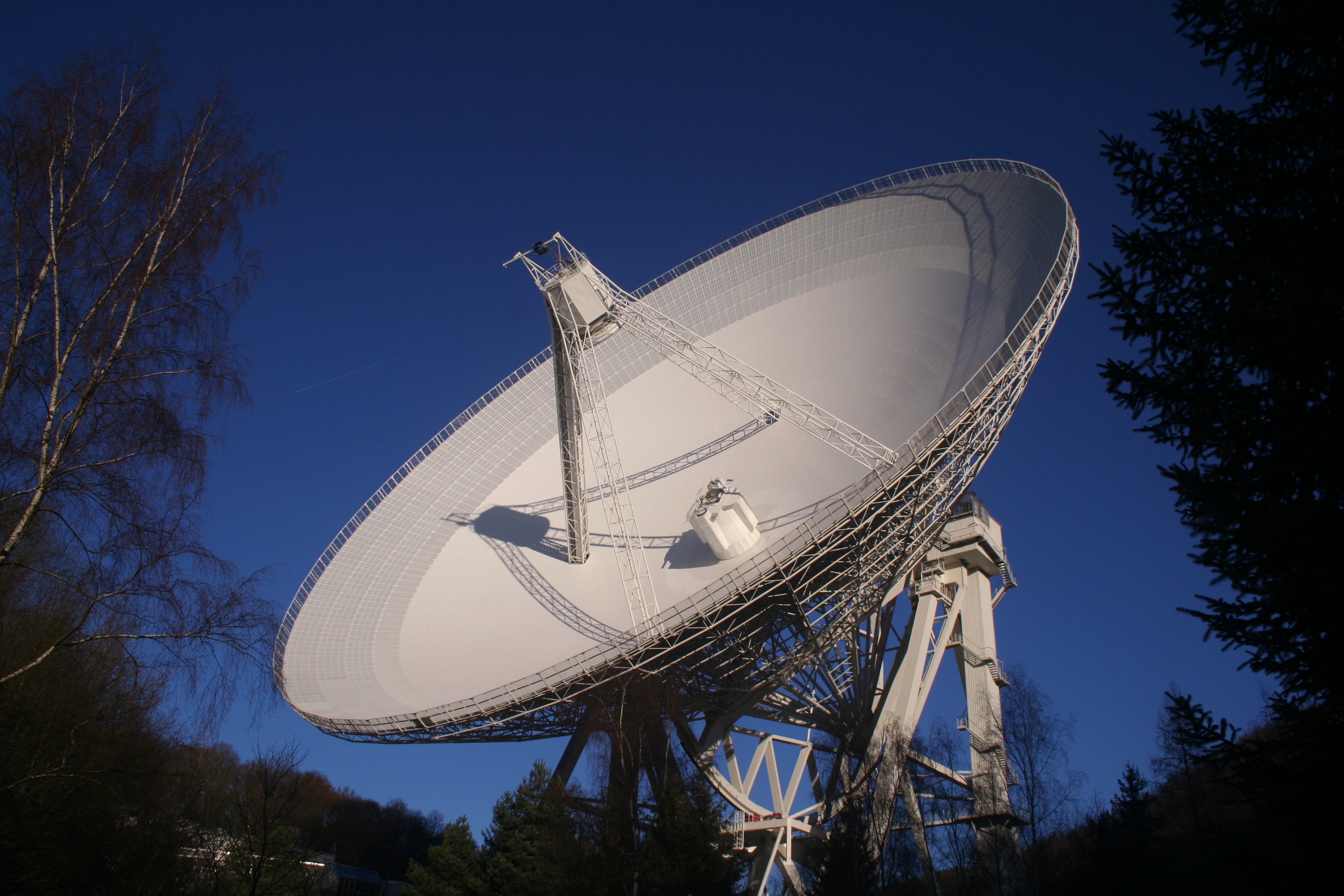
Matt_dk writes with news that scientists have detected water in a galaxy 11.5 billion light-years from Earth. Evidence came in the form of emissions from water masers around a quasar at the center of the galaxy. Detection at such a large distance was made possible by a closer, intervening galaxy which acted as a gravitational lens. "'We were only able to discover this distant water with the help of the gravitational lens,' said Violette Impellizzeri, an astronomer with the Max-Planck Institute for Radioastronomy (MPIfR) in Bonn, Germany. 'This cosmic telescope reduced the amount of time needed to detect the water by a factor of about 1,000,' she added. The astronomers first detected the water signal with the Effelsberg telescope. They then turned to the VLA's sharper imaging capability to confirm that it was indeed coming from the distant galaxy. The gravitational lens produces not one, but four images of MG J0414+0534 as seen from Earth. Using the VLA, the scientists found the specific frequency attributable to the water masers in the two brightest of the four lensed images. The other two lensed images, they said, are too faint for detecting the water signal. The radio frequency emitted by the water molecules was Doppler shifted by the expansion of the Universe from 22.2 GHz to 6.1 GHz."