Slashdot Mirror
Domain: wikipedia.org
Stories and comments across the archive that link to wikipedia.org.
Stories · 7,048
-
Japan Plans a Moonbase by 2030
Aglassis writes "The Japanese Aerospace Exploration Agency (JAXA) announced at a conference that they are planning to build a Moonbase by 2030. Since JAXA doesn't currently have a 100 ton-class heavy lift rocket or a human transportation system perhaps now is a good time for JAXA to join in with NASA on the Project Constellation rocket program." -
Will Pretty PCs Make Vista More Attractive?
Yesterday's post about a concerted effort on Microsoft's part to beautify computers by means of a comprehensive set of design guidelines drew more than 500 comments. Read on for today's Slashback summary which highlights a few of the most interesting reader insights on the project. blamanj summed up many others' comments with this snarky contribution:Well, they finally realized that nobody's going to buy it because of the operating system.
(Whether that's true or not is up for debate; certainly a lot of people may prefer Vista to Windows XP.)
Stavr0 writesMicrosoft wants 'PCs to be objects of pure desire.'
I desire my PC to be pure of spyware, security flaws and instability.
Reader melted was one of the first to dismiss the PC-prettification project as a lost cause:
Those OEMs couldn't "beautify" anything if their life depended on it. If they could, they'd already do so. The best they can do is steal Apple's 3-year-old designs.
Others, too, described Microsoft's aesthetic guidelines as a clear response to the widely hailed industrial design from Apple; reader Dan East offers a compact formulation of that idea:
MS is just trying to grab a few sales away from Apple at the expense of the OEMs. Why not? MS doesn't have anything to lose on this one — the OEMs are the ones taking the risk.
"The Mac isn't a good comparison," though, says reader dada21, who writes
I'm not sure I agree with the "Be like a Mac!" comparison. For most PC manufacturers, having their own "look and feel" has been part of what has given them a strong brand name. Sure, Microsoft wants to grab some of that brand recognition beyond just the bootup splash screen (and the desktop look and feel), but I also think this will create more than just brand recognition for Microsoft — I believe it will also produce an interesting "playing field" for companies beyond the Big Four (Dell, Gateway, HP/Compaq, Toshiba). Consider the smaller OEMs and white box companies — by providing a standardized look and feel, this will open the door of opportunity for many more companies. Sure, the big guys probably don't WANT this (they want to keep their look and feel in order to keep their branding strong), but it could create a new competitive atmosphere by giving smaller companies a foot in the door to compete on the look and feel front.
I've always loved third-party cases and keyboards and monitors moreso than the Big Four for the same reason that I've always liked clones — they've pushed the envelope before the big guys did. The downside is that the clones never seemed to sell well in the corporate environment nor in the newb home environment; the clones were just powerhouse sellers for us geeks. By having Microsoft "dictate" what they want to see, we may actually see more third parties offering competition to the Big Four, which in turn could see prices drop a bit more, which could push more legal Microsoft products into the fray.
All around, there are some Mac-branding similarities, but I don't really think that is Microsoft's desired goal to miMac (mimic the Mac, in my vernacular). I think it is just a good idea that will help the little(r) guys, and still give the big guys a chance to offer different products that the market can choose from.
According to reader linguae, a bit more mimicking might be a good idea:
Macs are worth the price . When I showed my parents and siblings my Mac and fooled around with it for a few days, they fell in love with it. They were sold on buying a Mac, and they are now saving up for a iMac. The problem is that cheaper PCs are good enough for 90% of the market. Windows XP "just works" now (as long as you keep an eye on security), and Vista will be far better than XP (insert "it's a copy of OS X here"; say what you want, but Vista is still better than XP). Perhaps they haven't had exposure to OS X; my parents were sold on the Mac within a few days. Perhaps they still must have a Windows PC for their jobs (and they don't know that Intel Macs can run Windows natively). Or, perhaps that money is an issue for most people.
Reader MojoRilla phrased his response in the form of a "Dear John" letter, writing
A bit more positively, reader meburke points out that "real design considerations" go beyond the shape of the box, and provides links to a few sites which should be of interest to anyone who designs anything at all for others' use:Dear Microsoft,
It seems that you are doing a lot of things lately to tell me what I want out of your products. Vista's new UI, and now these fancy industrial design specs.
Guess what? I couldn't care less what the shape of my PC is. It is under the desk with my UPS, sub woofer and trash can. And I have no need for a fancy new desktop UI, especially one that takes resources away from what I actually want to do with my computer, like photo and video editing.
What I want is excellent software, compatible with open standards, for a reasonable price. You used to deliver this. When you delivered virtual memory and preemptive multitasking, you were ahead of Apple. Now you seem way behind. And also, I want you to support open standards so that I can use other products with others that haven't paid you a licensing fee, such as open source. I'm not a sheep to lock in. Hello Linux and OSX.
And your prices are far from reasonable. The fact that I can't transfer a OEM Windows license from one PC to another is rubbish. The fact that you want $399 for the standard edition of office, which I have paid you for several times over the years is robbery. I was happy with the functionality of office five years ago. Why should I need to buy it again? Hello, Open Office.
I'm not a sheep, Microsoft. You used to be innovative. Now you are all about marketing. Its been fun, but we're breaking up!
Many thanks to the readers (especially those quoted above) whose comments informed this discussion.As a starting point, I'd like to suggest designers read, "A Whole New Mind" by Daniel Pink, and check out some articles at danpink.com. Furthermore, I suggest visiting IDEO. Pay special attention to their "method card" deck. Lastly (for purposes of this discussion) I suggest visiting mcdonough.com. The common thread in all this is design. William McDonough says that the need for regulation indicates a failure in design.
The design of the product goes way beyond just cosmetics. There is only so much you can do with an enclosure for a PC board, but there is LOTS you can do with the system as a whole. Case modding is just a place to start. Functional design improvements are being made in everything from the input devices to really innovative interfaces.
The IDEO method cards are different from the "Creative Whack Pack" or "Thinkertoys" cards, in that they redefine the product design domain. The jobs of the future are going to be design jobs requiring both high creativity and high technical ability. If someone in India or China can do your job as well and cheaper than you, or if a computer can do your job better and faster, your job is obsolete.
-
Blackboard Patenting Educational Groupware
chizz writes "Online learning provider Blackboard announced the other day that it has patented the Learning Management System (LMS). The very same day it went after Desire2Learn for Patent infringement in a truly Salt Lake City kinda way. A great many educators are a bit shook up by this, and are stockpiling prior art all over the place. " -
Extending and Embedding PHP
Sebastian Bergmann writes "PHP is a widely-used general-purpose scripting language that is especially suited for Web development. The interpreter that executes programs written in the PHP programming language has been designed from the ground up to be easily embeddable (for instance into the Apache Web Server) and extendable. This extensibility is one of the reasons why PHP became the favourite "glue" of the Web: functionality from existing third-party libraries (database clients or image manipulation toolkits, for instance) can be made available through PHP with the ease of use you expect from a scripting language." Read the rest of Sebastian's review. Extending and Embedding PHP author Sara Golemon pages 448 publisher SAMS rating 9 reviewer Sebastian Bergmann ISBN 067232704X summary The new standard work on extending and embedding PHP.
"Extending and Embedding PHP" by Sara Golemon, a long-time contributor to the PHP project, remedies the fact that the internals of PHP are far from being as well documented as the rest of PHP. It brings writing extensions for PHP "to the masses", so to speak.
After a short introduction that makes the reader familiar with terms like PHP Extension, Zend Extension, Userland, and Internals that are used throughout the book, Chapter 1 ("The PHP Life Cycle") opens with an overview of how the PHP Interpreter works and what parts (TSRM, Zend Engine, SAPI, "PHP") it comprises.
Chapter 2 ("Variables from the Inside Out") shows how PHP handles and stores variables internally. The reader learns how to distinguish types, set and retrieve values, as well as how to work with symbol tables. It is in this chapter that the fundamental unit of data storage in PHP, the so-called zval (short for Zend Value) is discussed.
Chapter 3 ("Memory Management") builds upon the previous chapter and discusses more advanced operations on zvals, for instance creating and dealing with copies of a zval or the destruction of a zval when it is no longer needed. To this extent, the Zend Memory Manager is discussed as well as underlying principles such as Reference Counting and Copy-on-Write, for instance.
Chapter 4 ("Setting Up a Build Environment") guides the reader through setting up an environment, either on *NIX or on Microsoft Windows, for the development and debugging of PHP and PHP extensions.
After these first four chapters, the reader is ready to go about writing his or her first PHP extension. Chapter 5 ("Your First Extension") takes the reader through the steps necessary to write and build a simple working PHP extension. The following chapters build upon the knowledge gained here, so that the reader can ultimately implement or change any type of PHP feature.
Chapter 6 ("Returning Values") explains how to pass values (by value, by reference, and through their parameter stack using references) from internal (C-level) functions or methods to userland (PHP-level).
Chapter 7 ("Accepting Parameters") deals with the mechanisms involved in accepting parameters from userland calls to an internal function or method. This includes the discussion of the zend_parse_parameters() API which makes the parameters that are passed to the internal function or method as indirect zval references usable in your C-code. The handling of optional and arbitrary numbers of parameters is explained as well as the usage of type hinting and its arg_info API.
Chapter 8 ("Working with Arrays and Hash Tables") explains the Zend Engine's HashTable API, which is used to store any piece of data of any size, in detail. Its different data storage mechanisms supported are introduced and compared. To quote from the book, "A HashTable is a specialized form of a doubly linked list that adds the speed and efficiency of vectors in the form of lookup indices". Since these structures are used heavily throughout the Zend Engine and PHP and its extensions, a good understanding of this API is vital for any aspiring PHP extension developer.
Chapter 9 ("The Resource Data Type") introduces the reader to the first complex data type (excluding the Array data type that was discussed in the previous chapter, which is just a collection containing primitive data types like strings or numbers). A resource can be, for instance, a connection to a database. It allows the PHP extension developer to "connect abstract concepts like opaque pointers from third-party libraries to the easy-to-use userspace scripting language that makes PHP so powerful".
Chapters 10 ("PHP 4 Objects") and Chapter 11 ("PHP 5 Objects") delve into the last data type supported by the Zend Engine: objects. Sara Golemon dedicates one chapter each to the respective APIs of PHP 4 and PHP 5 because of the huge advancements that were introduced in PHP 5 and that totally changed the APIs.
After the previous chapter, all data types supported by the Zend Engine have been discussed and the book revisits a topic discussed earlier in the book: that of the PHP Interpreter's life cycle. Chapter 12 ("Startup, Shutdown, and a Few Places in Between") explains how to add state to a PHP extension by using thread-safe globals. Along the way, concepts such as internal and external (super) globals as well as thread safety are discussed.
Chapter 13 ("INI Settings") shows how a PHP extension can be made ready for runtime configuration through php.ini settings.
The next three chapters ("Accessing Streams", "Implementing Streams", and "Diverting the Stream") make the reader familiar with yet another important API of PHP: the Streams API. All file input/output in PHP userspace is processed through PHP's Streams Layer. This layer, that was introduced in PHP 4.3, is what makes working with files, compressed files, and remote files, for instance, seamlessly in PHP. The reader learns how to work with streams as well as how to expose streamable resources, whether remote network input/output or local data sources, using the Streams API, thus avoiding the need to reimplement all the tedious bits and pieces that are normally associated with this.
Chapter 17 ("Configuration and Linking") builds upon the tools and techniques introduced in Chapter 4 and adds the GNU autotools (autoconf, automake, and friends) to the reader's set of tools. These tools, if used correctly, allow the extension to be built in environments that the extension author does not know or has no access to.
Chapter 18 ("Extension Generators") takes a look at ext_skel (which comes with the source distribution of PHP) and PECL_Gen (which can be obtained, as the name suggests, from PECL, the PHP Extension Community Library). These two tools automate most of the steps described in the previous chapter and take a lot of tedious work out of the extension writer's hands.
Starting with simple embedding examples, the reader learns in Chapter 19 ("Setting Up a Host Environment") and Chapter 20 ("Advanced Embedding") how the PHP Interpreter can be embedded into almost any other application.
The book concludes with the "Zend API Reference", "PHP API Reference", "Extending and Embedding Cookbook", and "Additional Resources" appendixes. The first two are a great resource for both novice and experienced PHP extension writers (even for people working on PHP and the Zend Engine itself). The third features a collection of common use code snippets while the last one points the reader into the direction of PECL by suggesting a couple of existing extensions to look at and learn from.
Since the topic of this book is to extend the PHP Interpreter using extensions written in the C programming language (or to embed it into an application that is written in C), a good understanding of C syntax, its datatypes, and pointer management is important to get the most out of this book.
Being a contributor to the PHP project for about six years now, I have been looking forward to this book. True, there is always the source code of the PHP Interpreter as a source of information on how "things work". But although being the ultimate reference, reading the source code cannot replace a thoughtfully structured and well written guide that gets you started. If you are looking for such a guide, look no further: you will find it in this excellent book.
Although it deals with a very technical topic, "Extending and Embedding PHP" is readable and the many code examples are easy to follow. The reader profits from the knowledge of the author, who has been involved in the PHP project as a core developer for over four years now and is also the author and maintainer of a dozen PHP extensions that are available through PECL. The book covers both major versions of PHP that are currently used, PHP 4 and PHP 5, and it will continue to serve its purpose when PHP 6 comes out next year.
Sebastian Bergmann spends his free time with the development of Free Software, is a member of the PHP and Gentoo Linux development teams and author of a variety of PHP software projects such as PHPUnit."
You can purchase Extending and Embedding PHP from bn.com. Slashdot welcomes readers' book reviews -- to see your own review here, read the book review guidelines, then visit the submission page. -
Vinod Khosla Talks Ethanol
IamTheRealMike writes "Vinod Khosla, venture capitalist and co-founder of Sun, has a new obsession these days. Ethanol is the fuel touted by many as an alternative to dwindling oil stocks, but is it all it's cracked up to be? Whilst Khosla is an avid supporter of ethanol as an alternative fuel (video link) his optimistic views have been rigourously challenged by Robert Rapier, an oil industry insider who is also engaged in a quest to discover alternatives. Recently the two debated via phone the merits of an ethanol economy, and Mr Rapier has now written up a report of the debate. What will be powering our cars 10 years from now?" -
Parexel Destroys Immune Systems, Not Liable
A reader writes: "The four TGN1412 test victims learned recently that they have no detectable t-cells, which makes it "likely" (read certain) they will suffer from numerous diseases and truncated lifespans. It has been determined that Parexel was negligent in its aftercare of the victims. The victims have already suffered severe injuries such as gangrene requiring the amputation of all toes and three fingers (without toes you cannot remain standing or walk, btw) and endured unimaginable agony. But it seems Parexel, despite having the moral responsibility for the outcome of its incompetence and the financial ability to pay proper restitution (estimated yearly revenue of $750 million) is ignoring the victims and using the legal system to avoid liability. The lessons are that $4000 is not worth risking your life over, that that is what you are doing if you are foolish enough to volunteer for medical testing whatever promises you receive not withstanding, and that if you are so foolish you will be left to die by the company responsible without legal recourse should things go wrong. In other words, only an ignorant would sign up for medical testing. I predict a decline in voluntary test subjects, and a rise in the use of prisoners and other 'disposable' human subjects." -
Cheyenne Mountain Shutting Down
WilliamSChips writes "The United States military has announced that they are shutting down the facility at Cheyenne Mountain, home to the high-tech NORAD which tracks every object in the sky. NORAD's operations will be moved to the nearby Peterson Air Force base. The mountain facility is being placed on standby in case they need it again." From the article: "The Cheyenne Mountain center, at the eastern foot of the Rockies near the base of Pikes Peak, was constructed underground in the mid-1960s. Fearing nuclear attacks at the time, the United States built sites such as the Cheyenne Mountain complex. The Navy prepared a floating White House aboard the communications cruiser USS Northampton, in case the president needed to be evacuated from U.S. soil. Another protective bunker was created near White Sulphur Springs, W.Va., for members of Congress." -
Inverting Images for Uninvited Users
Yesterday's story about a creative approach to dealing with uninvited (and unwanted) users on a private wireless network -- by intercepting and modifying the images received downstream -- provoked some thoughtful comments on open wireless networks, and a storm of analogies about networks and property generally. Read on for some of the most interesting comments in the Backslash summary of the conversation.Several readers offered comments on the methods of network interference suggested in the examples linked from the story, or offered other creative ways to impede network freeloaders. First, reader blantonl offers some insight into implementing the same image-flipping technique:
For those that are struggling to understand how the author of this article is accomplishing his approach, here is some further information.
The author obviously has a Linux server in his house, that is running DHCPD
To selectively send some clients to some locations, and others to the normal internet, he assigns an IP address on a different network to clients that don't have MAC Addresses that he knows about.
Forwarding on to sites of his choice is done by using IPTables, which is a utility that allows you to configure the packet filtering components of the Linux TCP/IP Stack. In this instance, the Linux box is just functioning as a firewall, and he is selectively sending requests from certain IP addresses to different hosts of his choosing.
Finally, the Up-side-down and blurry-image conversions is accomplished by sending page requests from those before-mentioned IP addresses to a proxy server, which in this case is Squid — and then allowing the proxy server to run a script which calls an ImageMagick command called mogrify which allows you to resize an image, blur, crop, despeckle, dither, draw on, flip, join, re-sample, and much more.
(Writing "I'm paranoid - I work in information security," reader hab136 points out some potential vulnerabilities in the system as described.)
As to the actual methods of annoyance, jpellino writes
Upside down is cute, but blurry is just too fantastic. You know they were on the horn to the vendor after punching every monitor control and several loud screaming matches and an expensive service call for a monitor that then worked just fine on the bench... As a webmaster I can now say April 1 just got very far away...
Reader Sloppy also admires the "blurry-net" approach ("That's subtle and I love it"), but suggests that image manipulation is only for starters
And perhaps the ultimate in annoyance-as-warning, reader Midnight Thunder writesThe next step is to spy on them and see what websites they visit, and then insert some fake content one day. For example, if they use it to read CNN, insert a casual story about a nuclear weapon getting used in the Middle-East or South Asia, or a story about the president of USA selecting a new vice-president due to the assassination last week ("What?! I didn't hear about that!"), or the CDC in Atlanta is investigating the recent rash of improbable claims about the dead returning to life to feast on the flesh of the living, etc. If they visit Slashdot, then the jig is probably up, but maybe it would be great to have a story where a security study found Windows98 to kick OpenBSD's ass and then a bunch of comments where everyone agrees that the findings pretty much match their own experience, along with complains about "how is this news for nerds?!"
Not all uninvited users are actually unwanted users, though, at least for some readers. Reader Elektroschock writesI suppose you could also add a frame to every page and then sell advertising space. Since you probably know a bit about your neighbour it is much easier make targeted advertising. Of course you could always make the top frame read:
"This is borrowed bandwidth. Have you thought about getting your own connection."
Oh and make sure it is flashing. Actually you could make it so that the whole content flash.
Similarly, trewornan writesSorry, I am a supporter of open networks. I think the freifunk olsr-protocol approach of open wireless networks is best. We don't need internet providers and we don't need internet providers which leak our communication data to the governments and endanger the freedom of the net. The net should be a net and wireless technology is great for the creation of a real P2P internet.
I cannot support any action against people who use your network. It is against my understanding of hacker ethics. When you don't like it then close your network. But no childish games please.
I may even say that I find it unethical to exclude your neighbours from using your network but I respect your opinions. When your network is open it means: Be free to use it. Not: You can use it but I will fuck up or intercept your communication.
I chose to leave my wireless network open so that if someone nearby needed a connection it would be available for them. If someone was to impose an unreasonable load on the network I might do something about it but so far (12 months) I've had about half a dozen people connect and download relatively small amounts of data - my guess is they were checking email. Why would I object to that? No . . . why would *you* object to that? The way I see it it's a chance to do something nice for other people, why not get yourself some good karma.
Even without that sort of altruism, many readers feel that, as geekoid puts it,
Not so fast, goes an argument exemplified in another comment from R2.0:[By]leaving it open he is inviting other people to connect.
Some computer says to the router "Hey, can I come in?" and the router says "Sure." Now, the moment you put something up, like needing a password, then you are no longer inviting people in.
- Computer says "Hey, can I come in" router says "Sure, if you know the password."
- Or you can encrypt it; Computer says "Hey, can I come in?" the router says "KE*jd7638JDEJE*834899(&^&#nd&#&bd*e#"
Yes, the computer is "asking" the router "permission," and the router is "granting permission" — the only problem is, the words we use to describe these actions may appear to be descriptive of thinking and volition, but they really mean neither. Computers and routers simply CANNOT give "permission" in any legal or moral sense.
To use the yard analogy that seems to be popular for these threads, lets supposed your neighbor's massively retarded child asks your massively retarded child for permission for his Daddy to use your yard, and your child agrees. Neighbor then comes over and stages a cookout on your lawn, or for that matter just walks across it.
When you confront him, he says "But my kid asked your kid, and he said yes." This is binding? Common sense and the law would say no, yet you would allow devices with an order of magnitude less analytical power than a retarded child to give and receive similar permissions.
Repeat after me folks: devices cannot give and receive permission for human actions without those permissions expressly being granted via some other means.
A traffic light doesn't give you permission to cross the street; the government (that you studied to get your license) gives you permission to cross the intersection when a light is green, and denies it when red.
Your ID badge doesn't ask permission to enter your building, and the security system doesn't grant permission; YOU ask for permission by presenting the badge, and your employer grants it by programming said system to accept your request.
Closer to the typical small-time network admin, perhaps, bennomatic writes
Various forms of the same disagreement surfaced in various corners of the discussion: squiggleslash, for instance, writesIf I leave my bike outside unlocked for 10 minutes, am I giving explicit permission to anyone who sees it that they can take it? No. Am I allowing it to happen through negligence? Sure, but call it what it is; it's still stealing, or at least trespassing.
Even something as amorphous as bandwidth is a limited resource. To paraphrase the head of the commerce committee, an open wireless connection is not a dump truck you can just load up with as much as you like; it's a tube!
The figurative "visibility" of an open wireless network also isn't enough to convince reader R2.0 that it's fair game for passers by. He writes:[I]t makes sense that no implied permission is given by simply having your router be unsecured, given "unsecured" is the default configuration of most off-the-shelf routers.)
It really isn't an issue in practice. If you want to use someone else's network, all you have to do is ask them. With 802.11, you're close enough to be able to do so. There's no reason not to ask, other than knowing that "No" is likely to be the answer. And I think that's why people tell themselves the myth that somehow they have implied permission simply because the "door" was left unlocked.
So the router is "visible," with an option to make it invisible. Big deal. My garden is visible from the street, but I can put a tarp around it to obscure its existence. What you are saying is that, unless I put a tarp up around my garden, everyone has a right to use it.
Wireless networks may make themselves conspicuous, but that does not confer an invitation to use them. The connection between "visible" and "inviting" is not legally or morally valid. (I am excepting the concept of "attractive nuisance," but I don't think open routers will come under that area of liability)
Reader 4e617474 fired the next volley in this battle of analogies:
No, actually we're saying that if your garden pelts us with carrots and peas as we walk past on the public street, we're at liberty to catch them and consume them. Only if you place anti-vegetable-flight netting around your garden (or stop planting vegetables that lend themselves to comparison to an unsecured WAP) does it become incumbent upon us to behave as good citizens.
Hey! Analogies are fun! Somebody compare Internet privacy law to hunting and fishing licenses!
Readers like ShawnDoc make a case persuasive for discouraging bandwidth borrowing on the basis of enlightened self-interest.
If someone uses your connection for illegal activity (downloading Meet the Fockers, kiddie porn) it will be your IP address that the RIAA/MPAA/FBI will trace. Good luck convincing them it wasn't you. You might be able to do it, but it will take up time and money (lawyers) to clear your name. And in the case of kiddie porn or other criminal act, expect every computer, PDA, and cell phone in your home to be confiscated to be analyzed for incriminating data. The second problem is you are allowing strangers access to not only your Internet connection, but also your LAN. I have multiple computers and put files in shared folders so I can access them from different machines. I don't want some strange to have access to those files, or worse, have their computer be infected with a worm/virus that propagates across the network.
Thanks to all the readers whose comments informed this conversation, and in particular to those whose comments are quoted above. -
Wikimania'06 Kicks Off Next Week
Vivek writes "Following on the heels of its first international conference, the Wikimedia Foundation is ready to kick off the second Wikimania 2006 International Conference next week (August 4-6) in Cambridge, MA. Last-minute Registration is still open and volunteer positions are available. Among the prominent speakers this year are Jimmy Wales and Lawrence Lessig. Other conference events include hack fests, parties, film festivals, field trips and more!" -
Wikimania'06 Kicks Off Next Week
Vivek writes "Following on the heels of its first international conference, the Wikimedia Foundation is ready to kick off the second Wikimania 2006 International Conference next week (August 4-6) in Cambridge, MA. Last-minute Registration is still open and volunteer positions are available. Among the prominent speakers this year are Jimmy Wales and Lawrence Lessig. Other conference events include hack fests, parties, film festivals, field trips and more!" -
Wikimania'06 Kicks Off Next Week
Vivek writes "Following on the heels of its first international conference, the Wikimedia Foundation is ready to kick off the second Wikimania 2006 International Conference next week (August 4-6) in Cambridge, MA. Last-minute Registration is still open and volunteer positions are available. Among the prominent speakers this year are Jimmy Wales and Lawrence Lessig. Other conference events include hack fests, parties, film festivals, field trips and more!" -
Light-Weight Software Process for ISO 9000?
Disgruntled Software Engineer asks: "I work for a large engineering firm and it was recently decided in our company to have our software be ISO 9000 compliant. There exists a software development process in my organization, but it is extremely heavy-weight -- over two-dozen documents totaling 200 pages each! My team doesn't even have the time to read such a process, much less abide by it. I have been tasked by my team in creating a more light-weight process for our team to follow so that our software can pass the audit that is coming soon, but reading through the convoluted ISO website is not helping, and a 'plain English translation' that I found of the standard contains a bulleted list that is 17 pages long! I have not been able to get any idea of how to design a light-weight software engineering process that is ISO 9000 compliant with all of these extremely verbose documents and somewhat odd requirements. Also, the software that my team produces is more for research than for productization, and the dynamic nature of research does not mix well with the rigidity of a software process. What are the bare-minimum set of requirements for ISO 9000 software engineering compliance? What are some tips for designing a process that is light-weight and causes minimal damage in terms of efficient software development? Do you have any interesting experiences or wisdom regarding ISO 9000 and software engineering?" -
Slashback: AMD/ATI, Tokamak Fusion, Laptop Privacy
Slashback tonight brings some clarifications and updates to previous Slashdot stories including: An inside look at the AMD/ATI merger, school admins backing down on cell phone invasion policies, a new launch date for Scotty's ashes, a second test for China's Tokamak fusion device, Forbe's missed the mark on IBM destruction of evidence, Skype for Mac 1.5 released, and the courts rule that customs can still rifle through your laptop - Read on for details.An inside look at the AMD/ATI merger. Spinnerbait writes "HotHardware spent some sit-down time with a few folks close to the AMD and ATI merger, asked some probing questions and received a few insightful answers in return. They dug in deep with AMD Execs, learned all there is to know currently and even got a hint of what the future might hold for the dynamic duo (no pun intended), now joined as one. A tighter coupling of the CPU and GPU is in our future perhaps?"
School admins back down on cell phone invasion policy. Reverberant writes "In a follow up to earlier coverage about school admins wanting access to students' cellphones, Framingham officials have decided to hold off on the policy for now because they need school committee approval. The head of the school policy committee has 'no interest in bringing it up.'"
New launch date for Scotty's ashes. wolfdvh writes "The BBC reports that Star Trek actor James Doohan, who played the engineer Scotty in the original TV series, will now have his remains blasted into space in October. The actor's ashes were supposed to be sent into orbit last year, but the flight was delayed as tests were carried out on the rocket."
Second test for China's Tokamak fusion device. Haxx writes "The first plasma discharge from China's experimental advanced superconducting research center dubbed 'artificial sun' is set to occur next month. The discharge, expected about Aug. 15, will be conducted at Science Island in Hefei, in east China's Anhui Province. The experiment will test the world's first Tokamak fusion device of this kind. The new device will be an upgrade of China`s first superconducting Tokamak device. The plasma discharge will draw international attention since some scientists are concerned with risks involved in such a process"
Forbe's missed the mark on IBM destruction of evidence. An anonymous reader writes "It turns out that Forbes.com was wrong and, based on analysis of Pacer no motion has been filed against IBM for destruction of evidence. Shortly following from a major collapse in SCO's share price, a recent article Slashdot reported Forbes.com's claim that a motion had been filed against IBM for destruction of evidence. In fact, Groklaw, the main site covering the SCO vs. IBM lawsuit, now reports that SCO has filed no motions of this type whatsoever in March."
Skype for Mac 1.5 released. Billy C writes "A few weeks after warez versions made the rounds on the Internet, the official Skype for Mac with video is here." While still only a preview version, brave users can now give it a shot.
Courts rule customs can rifle through your laptop. monstermagnet writes "On Monday, a unanimous three-judge panel of the Ninth Circuit Court of Appeals held that the files of a person's laptop may be searched at U.S. borders [PDF] without probable cause or even reasonable suspicion."
-
Web Services and Open Source at OSCON
I spend a lot of time with my head buried in code, and every time I pick my head up it feels like the future is closer than I thought. So I like coming to OSCON. A week of looking ahead leaves me more confident I won't get future shock anytime soon. OSCON, like all conferences, is aimed at corporations, the intangible entities that send humans as their proxies. But open source has its roots in individuals working outside the corporation for their community of programmers. Are the two cultures coming together, or colliding? And how will the "open source ideal" evolve, as the chief social act of programming changes from trading disks of source code to processing each others' data and mashing up web APIs?
I'm an open-source programmer who's lucky enough to be paid by a corporation. Between sessions this week I'm working on turning Slash's metamoderation into a plugin, making Slash more useful for other site admins. I'm a human first and employee second. And I'm concerned about how the community based around this software ideal of not welding shut the car's hood is going to hold together.
Markets aren't designed for goods with zero cost of reproduction, but because property is such a powerful tool for efficiency and prosperity, societies have been artificially constructing markets for creative works since even before the founders wrote up their support for "science and the useful arts." Often, markets in ideas work pretty well.
There have been three societal "bow shocks" in the collision between programming and capitalism. The first hit in 1976 when Bill Gates insisted that charging for software made sense. The second was in the late 90s when open source proved better than corporate hierarchy at certain types of development. And then there's the one that's about to hit now, when web services and interoperability concerns obviate open source licenses.
There's a growing understanding here that web services are big: that the laptops and desktops of the future will rely not on software goods that have been bought for those machines, but software services that run on a server a thousand miles away. Google calls its Ajax web services "the world's largest platform."
Yesterday, Tim O'Reilly hosted a stimulating all-day series of panels and talks on web services and "Web 2.0" generally. The most interesting part of the discussion was about tying web services together. Web mashups are hot. It's hard to look at a list of websites offering an API -- Google Maps, Yahoo Geocoding, eBay, craigslist, Flickr, YouTube -- and not start thinking about great ways to combine them. Interoperability plus programming creativity equals... well, something pretty neat, we're hoping.
But a web services API doesn't necessarily offer the freedom that might seem analogous to open source, which is why Tim is also putting out the call for an "open services" definition. Flickr offers its corporate API to some sites, and refuses to permit it to others. Zooomr was judged to be too much of a potential competitor, so Zooomr users don't get to copy the photos they've uploaded to Flickr. [Update: Sorta. Read that comment thread to see important context for Flickr's decision. To be clear, given that context, Tim thinks Flickr found a good answer, and I tend to agree.]
As Flickr says, and they have a very good point, "why should we burn bandwidth and CPU cycles sending stuff directly to [a potential competitor's] server?" That makes sense from a corporate point of view, but a user who's uploaded a thousand of their photos might be puzzled why it's no longer exactly "their" data. Is that a right that user should have, or not? I ran into Julian Cash, who vehemently argues that it is; he's started MoveMyData.org to try to build a client-side way for users to route around APIs, to suck down "their" data and maybe reupload it to other sites. No code yet, but he's looking for volunteers.
AttentionTrust goes even further, starting off its manifesto with "you own your attention and can store it wherever you wish." That's something I hadn't considered before but it has an interesting ring to it. They have a Firefox extension I haven't tried yet (does it work? post comments).
Interoperability is a concern even without the web. Yesterday morning, Danese Cooper got a half-hour to grill Bill Hilf, Microsoft's General Manager of Platform Strategy, on Microsoft's relationship with open-source. Some think that's the same relationship as the butcher to the hog, and Bill's job is to persuade them Microsoft has no such intentions.
Asked directly, in the context of embrace-extend-extinguish and web APIs that can be crushed at any time, "why should we trust Microsoft?", Bill's answer was to look at the company's actions: "consistent action, over time, in the right direction."
I sat down with him afterwords to probe into this a little more (with someone from Waggener Edstrom standing nearby). He has some examples of Microsoft working with open-source projects like JBoss and SugarCRM, but I asked for specifics of how we know Microsoft isn't going to try to kill more-directly competing projects like Mono or OpenOffice by eliminating interoperability, possibly with patents, at any random time in the future. The only real sign I got was the Covenant Not to Sue (over patents) that came with the OpenXML format earlier this year. That's a step in the right direction. I don't think it's a terribly big one.
I asked if we'd see more steps from Microsoft disavowing patents as weapons against open-source projects. Obviously that's a big risk for a company to take, but one that's probably necessary to convince skeptics Microsoft is friendlier than the butcher. While Bill couldn't make any promises, he affirmed the CNS was "not a one-off... and not just to placate people." I'll keep an eye out for more action in the right direction.
Exciting as the opportunities are for different projects' software working together, one thing's for sure: the remote sites that run their algorithms and store your data leapfrog open source licensing. The server a thousand miles away can run software with its hood welded shut, with no obligations to the open-source community that come along with the benefits. Today, while some companies are trying to build goodwill with that community, there is nothing like a GPL for web services. No one's discovered a legal foundation that would establish open services, openly shared web services, with the same kinds of rights that we insist on in open-source code. No one's even sure what "open services" might mean, indeed, there's no consensus that we even need such a thing.
Even the FSF is unable to decide how v3 of the GPL should read. And I'm not smart enough to know if the GPL is even the right tool for this. Maybe tacking clever licensing terms on top of copyright's restriction is a temporary hack whose time has passed (you know, like the RIAA). Maybe the next hack to build a community of software sharing and tinkering will have to be totally different.
I don't think I know the answers but maybe one of you does. If you have thoughts about the open-source community in the age of capitalism, please post them to this story. If you're at OSCON and want to chat about it, email me (or AIM 'jamiekzoo' if you catch me online). At the end of the week, I'll have more updates on what's happening here -- it's not all philosophy and futurism.
-
Will Image Installs Benefit Vista Adopters?
Yesterday's post on the upcoming Windows Vista's image-based installer drew more than 450 comments. Some readers praised the change as sensible, even overdue, and others drew distinctions between various ways "image-based" software installations are implemented in real life, both in the Windows and Unix worlds, and supplied objections to the switch. Read on for some of the most interesting comments in the Backslash summary of the discussion.Reader MarkByers calls the article "stupid":
The final linked article starts with this dubious sounding statement:
To this, mwalleisa points out that "When talking about using Symantec Ghost (or other), the author is referring to Windows XP installations, not Vista.""The bottom is about to fall out of the market for imaging tools like Symantec Ghost ... The Vista install DVD is, in fact, just one big system image."
But then immediately contradicts itself by pointing out:
"But this flexibility only extends to the installation of Windows itself. To clone a full system with apps installed, Symantec Ghost or a similar utility must be used to create that image."
People don't use Ghost to make a copy of an unconfigured fresh install of Windows, they configure it first, then Ghost it. This new installer will have no effect whatsoever on sales of Ghost, or any other imaging software. After such a terrible start to the article, I'm not sure it's even worth reading the rest.
neonprimetime had a different objection:
This wasn't a Pros & Cons. It was a love-fest [for] the new image-based install process. Everything he wrote in that article was happy go lucky, no cons in sight.
- "This means that the image isn't a bit-for-bit image of your disk layout, and hence you can apply the image to a new system without destroying the contents of the hard drive."
- "Vista is hardware-agnostic, so you can use a single system image as a source for multiple hardware platforms, even if they have quite different hardware configurations.
- "When capturing a system to a WIM file you can specify exclusions. For example, you can have a work directory on the system with temporary data.
- "Interestingly you can have as many images contained within one WIM file as you think you can manage, and any one of them can be marked as bootable."
brunes69 mocks the article's introduction ("However, all this is about to change. Windows Vista is based entirely around Microsoft's Windows Imaging Format (or WIM), a file-based imaging standard rather than a sector-based. this means that the image isn't a bit-for-bit image of your disk layout, and hence you can apply the image to a new system without destroying the contents of the hard drive."), writing
Along similar lines, namityadav wondersWow how revolutionary.
Oh, hang on a second while I untar this archive ....
So is this revolutionary install concept an exact copy of what we see in Ubuntu?
When it comes to installing an OS, not everyone wants a one-size-fits-all install which can later be trimmed; "[C]opying a bunch of files is the right way," contends reader radarsat1, who doesn't look forward to the change in Windows' installer:Damn it, one of the things that always annoys me about Windows is that it's not as simple as copying a bunch of files. This is mostly due to their inane and outdated drive lettering scheme.
Reader yagu has a related complaint about the difficulty of installing Windows as an equal player along with other OSes:In Linux (or any Unix), I can move my installed system to a different drive or partition just by copying it. I can install an entire system within a folder of another system. All I have to do is change my drive mounts, add some symlinks, or use chroot, and I can put the entire system anywhere and it's as if nothing changed.
When my Dad bought a new hard drive because his old one was dying, we tried in vain to copy his old system over to the new drive. First we tried imaging it using "dd" on a liveCD, but that didn't work. Then we tried making a new filesystem and using "cp" to just copy the whole thing. That didn't either. We didn't want to spend money on Norton Ghost, just for a one-time thing.. He ended up having to re-install and re-activate XP, re-install all his MS Office software he'd had some trouble with installing in the first place, and finally setting up a whole new system. Just because he wanted to replace his drive!
That, compared to the number of times I've moved my Linux system without a single hitch... I can't believe people put up with this crap. Now instead of keeping things simple, they're moving even further away from a file-based approach?
This reminds me of other Microsoft installs I've done over the years, and it smacks of such disdain for the rest of the OS universe. Nowhere in the article, nor can I find evidence anywhere else is there an accomodation for an install where XP is just another OS. I remember my first experience with this, when I installed a Win98 on a Linux box, and not only did Win98 not offer a dual boot, it (seemingly) gladly removed my Linux MBR and formatted my partition without asking if it was okay, and without saying it had done so. That was quite a surprise.
Reader dreamchaser sticks up for Microsoft's decision not to make multi-OS systems easy to create:Does anyone know if there is a way to do this? (Though, knowing XP can point to more than one OS to boot, I'm guessing Microsoft is more gentle if there is a pre-existing Windows OS there.)
I've googled for dual-boot information, it looks to be similar to what I already know.
Just to play Devil's Advocate here, but why SHOULD they facilitate the use of other OSes? Look at the customers who make up 99% of their base:
kailoran points out one big difference, which is a pretty persuasive one to anyone who doesn't care to have Microsoft dictate the layout of their hard disk:- Home users who buy a machine with Windows pre installed. No worries about dual boot here.
- Corporate users who load a custom Windows image on new machines. No worries about dual-boot here either.
Also, if it really is just an image it would be a simple matter to just load it onto a partition then set up dual boot using GRUB. Anyone who feels they need dual-boot probably already knows how to do it. Most modern Linux distros do a pretty good job of it for newbs too.
Very very very few people NEED dual boot. Some do. Most do not. From Microsoft's point of view, why should they facilitate it when the people who really need it (i.e. developers) will have no problem either setting up dual boot or using virtualization?
The thing is that unlike the Windows' MBR, grub can actually be configured to run the other OS if the user wants. Most distros auto-detect and add the appropriate configs, so that there's zero effort needed.
An image-based install from Microsoft isn't completely new; Aslan72 says he "hated it when it was called RIS," writingInstalling Windows just nukes the existing MBR and the only thing you can do is run Windows, or start searching for a rescue CD/floppy.
I'm partly responsible for an image that goes on around 5-600 machines at a Midwestern University College lab. We tried RIS when it was out, but although it was cool, it was simply not practical. The savings of having 'one' image really didn't outweigh the impracticality of it taking 2-3 hours per workstation per lab.
This is no different; currently it doesn't support multicasting and so although it's 'revolutionary' (read: RIS) it still doesn't beat the ability to push down and image to a workstation is less than 20 minutes...oops, did I say a workstation, I meant a lab.
It still won't beat Ghost any time soon, IMO.
To that complaint about multicasting, reader gruhnj writes
Windows Deployment Services, the replacement for RIS that will be coming out around the same time Vista ships, does exactly that. RIS only does the OS install well. Once you create your master image, you can place that onto a WDS server and multicast it out to as many computers as you have bandwidth. My current image when run deployed with imageX comes in at 25% less space (both images on max compression) and deploys in aprox 12 min for the image copy, plus the normal mini-setup time.
Ghost aint going away, but it will be eaten away from at the bottom with WDS.
Elsewhere, readers discussed the image formats and metadata in greater depth: To EXMSFT's query "I don't believe TAR includes ACL and metadata information related to the filesystem. Or does it?", reader pavon says "They can be," and provides some details:
The tar file format, like most unix things has undergone several revisions and branches. In POSIX.1, a new format, called the Pax Interchange Format, was created as a backwards compatible extension of the tar format, that allowed for storing of arbitrary metadata. How this metadata is used is naturally left up to the system's implementation of tar and pax. I don't know how widely these extensions are used. I know that in Mac OS 10.4, metadata including resource forks are supported, but I think they implemented them using thier normal flat-file hacks (._myfile holds metadata for myfile), and not the pax extensions. This man file has a little more information.
There are complexities beyond simple metadata capabilities, though. An anonymous reader points out that
There's even more to think about besides ACLs. There are a lot of components in Windows and not all of them come with every version (Home, Media Center, Server, etc.) plus computer vendors want to customize by adding software or changing the default configurations of apps. Many of these components need to be installable as runtime as well as during install, and some components may be incompatible or require complex logic to integrate (for example, installing a component might require adding a new user or group to the system).
What you see during a Vista install is only a small part of the new world of the Vista installer.
Many thanks to all the readers who took part in the discussion, especially those quoted above. -
Prey Review
Built with the Doom 3 engine and touting numerous innovations on the First Person Shooter genre, Prey is a study in contradictions. While it delivers on many interesting twists and environmental elements, the low difficulty and hackneyed character design drains some of the novelty from the experience. Despite frustratingly similar corridors and brain-dead enemies, the quality of the innovation somehow combines with the touchstones of retro-gaming to create that ephemeral quality: fun. Much better than Doom 3, and with the new-car smell that Quake 4 was lacking, Prey is a fully functional refit of the corridor-shooter genre. Read on for my impressions of Human Head's latest.- Title: Prey
- Publisher: 2K Games
- Developer: Human Head Studios
- System: PC (360)
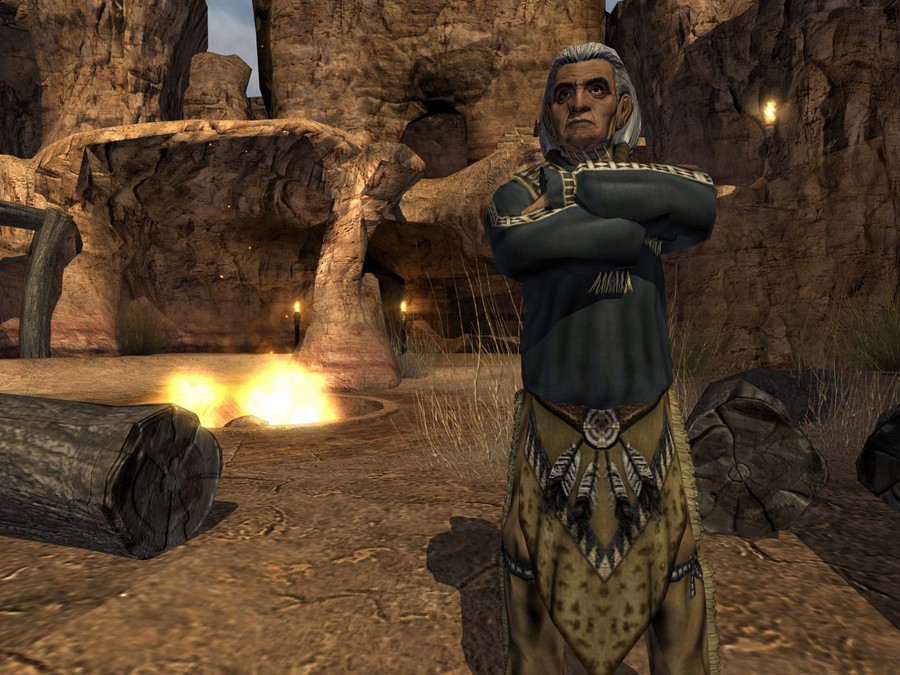
Instead of the protagonist's racial background being a footnote, or something you only find in the manual, Human Head brings a version of Native American spirituality to the fore by tying it directly into gameplay elements. Tough-guy Tommy doesn't believe in 'that crap' when the game starts, but soon enough he's leaving his body to walk about as a being of pure spirit (which comes in mighty handy around auto-turrets). This 'out of body' experience means that, for all intents and purposes, Tommy can't die. When you do deplete your health bar, instead of reloading the game you're taken to a grim-looking plateau and given the chance to fight for your life. Your spirit-bow is quite adept at taking out the bad spirits surrounding the place, and every one you destroy returns a little health or spirit energy. After a set time span, you're sucked back down and out into the living world to face your foes again. It was great not having to worry about saving and reloading, but after the third or fourth time the simple shoot-the-spirits game got a little old. It would have been great if the spirit world had become a tougher place further into the game. And while the occasional chat with your dead grandfather was enjoyable from a plot perspective, the lack of gameyness to your trips into ancient New Mexico disappointed. The designers took us on an in-game spiritual journey, but there was very little to actually 'do' as that journey progressed.
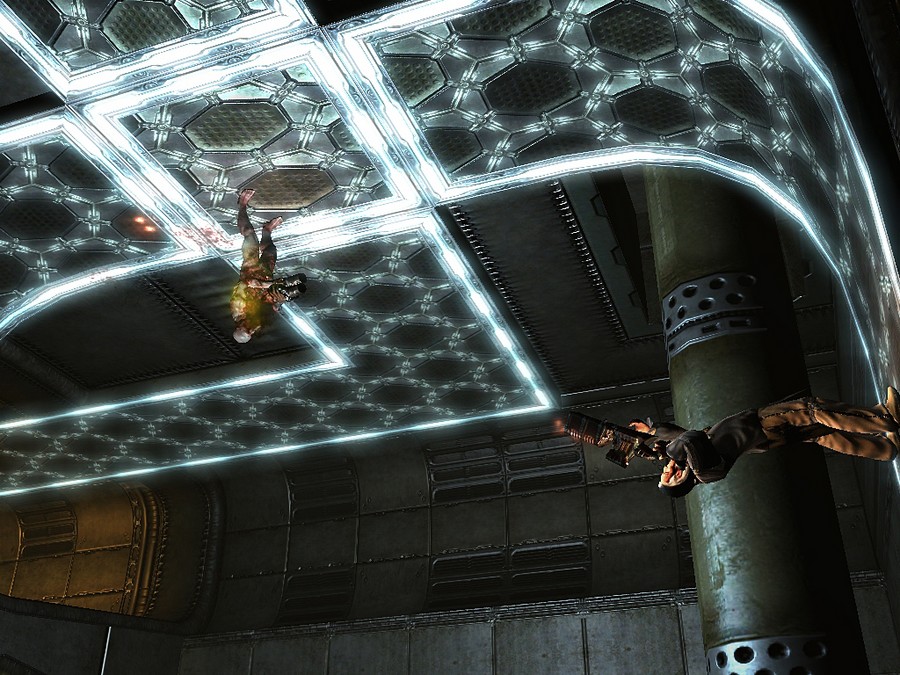
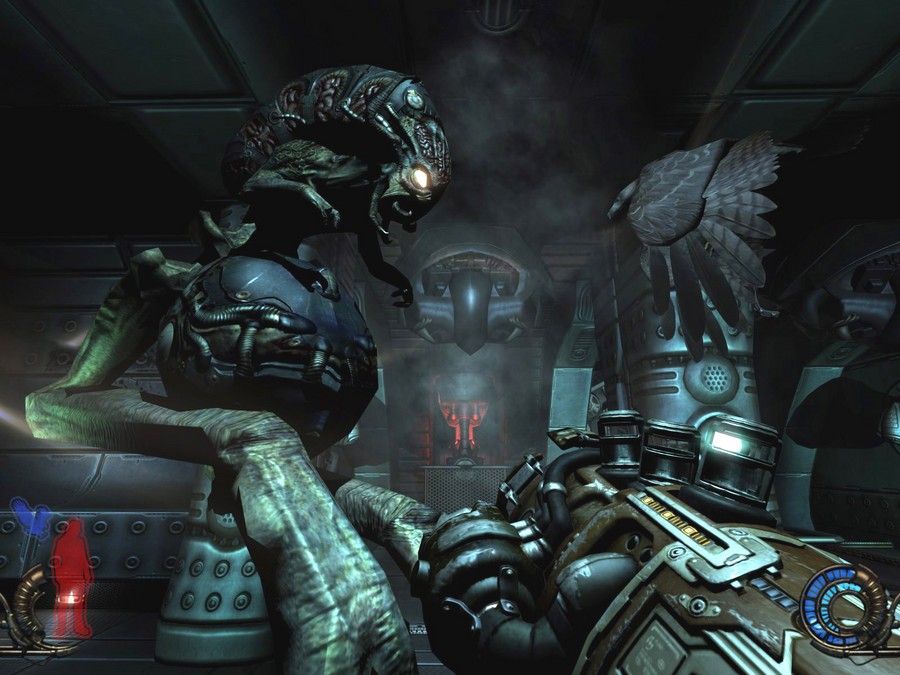
While there are spirits in the game, most of the shiny comes from alien technology. Portals are a great tweak to time and space, and already look like they're going to be a permanent fixture in FPS gaming. Opponents and some simple switches can throw open oval passageways to 'someplace else'. Not just a loading gimmick or gag, the portals physically link areas that are otherwise inaccessible. Early in the game they do a bit of showing off by walking you past a glass box with a small rock in it. You're left wondering what exactly it is, as it has no obvious purpose. Just a few moments later, though, you're stepping through a portal onto a rocky spheroid inside a glassy enclosure. It's a cheap trick, but effective at getting across the technology's potential. The gravity flipping trick is a more straightforward puzzle element, requiring you to alternate the orientation of 'down' in order to gain access to various surfaces in a room. In most cases it's fairly simple to see what's going on, but there are several great Escher-esque moments that require you to exercise your three dimensional thinking skills. The 'undying protagonist', gravity-flipping, and already adopted-portals are all great gimmicks, and I find myself actually hoping that I'll be seeing copycat game mechanics in future FPS titles.Unfortunately, the overall vision of the game falls somewhat short of the greatness it was striving for. The techno-organic (read: drawn on a trapper-keeper) motif that your surroundings and enemies display begins to look exactly like every other game made with the Doom 3 engine after you've killed your tenth identical bad guy. So far, every game we've seen made with this technology have been visually arresting, but more or less artistically bankrupt. Prey, at least, takes the gooey look to its fullest; many of your weapons are actually alive, and some were formerly pieces of enemies. As you're walking along, your weapon might hiss at you menacingly. This little touch is so clever and appreciated that it makes the boring sameness of the enemies and corridors that much more drab.
Even more frustrating is the ease with which most veteran FPS players will complete this title on 'Regular' mode. There's a solid fifteen hours or so of gameplay here, but for the first half of the game you're probably going to find yourself trying to remember what the spirit world looks like. The second half is more challenging, but only at a level the first half should have ramped up to. That said, I would far and away rather games be too easy than too hard; it's a lot of fun to finish a game and I think a lot of modern titles don't keep that in mind when gauging difficulty. The challenge level felt as though they were purposefully teaching you as you went; the integration of new elements into your knowledge of the game world was accomplished at a brisk but digestible pace. Just the same, once the game really got rocking I found myself hoping for more intelligent baddies to fight; not every bad guy can be from F.E.A.R., I guess.Visually, Prey acquits itself well against its contemporaries. The Doom 3 engine is still a solid platform to wrap a game around, and the dark-n-moody atmosphere it fosters was fairly appropriate considering the setting. The 'generic alien squishiness' did get old after a while, though. Even more annoyingly, the alien designs felt uninspired on first brush and just kept hanging around throughout the game. There just aren't that many types of baddies to face in this title. While I'm not looking for a menagerie to start hunting me down, I would have liked a little more variety; the ground-level grunt was particularly boring. The spiritual children, at least, were interesting from a background standpoint. Encountered in a few choice areas, their creepy appearance and haunting laughter was one of the few genuine chill-inducing elements of the game. Aurally, there wasn't much beyond those laughing children to look forward to. Forgettable music and fairly standard moans and groans from your enemies dog your steps through the game. Weapons sounds were serviceable; while not anything amazing, they did lend a passable feeling of weight and power to your arsenal. My favorite audio element was actually the occasionally overheard snippets of radio broadcasts from Earth. Quiet moments could be spent preparing for your next run by listening to (real-life radio host) Art Bell receive calls from bewildered humans experiencing the alien invasion on the ground. The only real humour in the game, the vignettes were well written and produced, and well worth the time it took to listen.
Prey, with its retro-inspired corridor shooting and tired alien antagonists, could have fallen victim to retread gameplay and genre boredom. Instead, Human Head has managed to lift the simple shooter out of mundanity by give us some new things to see and do while we're mowing down generic baddies. A serviceable plot and a spiritual twist, on top of new-tech portals and gravity flipping, is just enough to make everything old seem somehow a little bit new. The 'classic' shooter is something I'm starting to get tired of, but with Prey at least one more title has made aiming and shooting fun enough to recommend. If you're a fan of the FPS genre, especially the early work of id software, you're going to have fun with the new toys given to us by Human Head Studios. -
Prey Review
Built with the Doom 3 engine and touting numerous innovations on the First Person Shooter genre, Prey is a study in contradictions. While it delivers on many interesting twists and environmental elements, the low difficulty and hackneyed character design drains some of the novelty from the experience. Despite frustratingly similar corridors and brain-dead enemies, the quality of the innovation somehow combines with the touchstones of retro-gaming to create that ephemeral quality: fun. Much better than Doom 3, and with the new-car smell that Quake 4 was lacking, Prey is a fully functional refit of the corridor-shooter genre. Read on for my impressions of Human Head's latest.- Title: Prey
- Publisher: 2K Games
- Developer: Human Head Studios
- System: PC (360)
Instead of the protagonist's racial background being a footnote, or something you only find in the manual, Human Head brings a version of Native American spirituality to the fore by tying it directly into gameplay elements. Tough-guy Tommy doesn't believe in 'that crap' when the game starts, but soon enough he's leaving his body to walk about as a being of pure spirit (which comes in mighty handy around auto-turrets). This 'out of body' experience means that, for all intents and purposes, Tommy can't die. When you do deplete your health bar, instead of reloading the game you're taken to a grim-looking plateau and given the chance to fight for your life. Your spirit-bow is quite adept at taking out the bad spirits surrounding the place, and every one you destroy returns a little health or spirit energy. After a set time span, you're sucked back down and out into the living world to face your foes again. It was great not having to worry about saving and reloading, but after the third or fourth time the simple shoot-the-spirits game got a little old. It would have been great if the spirit world had become a tougher place further into the game. And while the occasional chat with your dead grandfather was enjoyable from a plot perspective, the lack of gameyness to your trips into ancient New Mexico disappointed. The designers took us on an in-game spiritual journey, but there was very little to actually 'do' as that journey progressed.
While there are spirits in the game, most of the shiny comes from alien technology. Portals are a great tweak to time and space, and already look like they're going to be a permanent fixture in FPS gaming. Opponents and some simple switches can throw open oval passageways to 'someplace else'. Not just a loading gimmick or gag, the portals physically link areas that are otherwise inaccessible. Early in the game they do a bit of showing off by walking you past a glass box with a small rock in it. You're left wondering what exactly it is, as it has no obvious purpose. Just a few moments later, though, you're stepping through a portal onto a rocky spheroid inside a glassy enclosure. It's a cheap trick, but effective at getting across the technology's potential. The gravity flipping trick is a more straightforward puzzle element, requiring you to alternate the orientation of 'down' in order to gain access to various surfaces in a room. In most cases it's fairly simple to see what's going on, but there are several great Escher-esque moments that require you to exercise your three dimensional thinking skills. The 'undying protagonist', gravity-flipping, and already adopted-portals are all great gimmicks, and I find myself actually hoping that I'll be seeing copycat game mechanics in future FPS titles.Unfortunately, the overall vision of the game falls somewhat short of the greatness it was striving for. The techno-organic (read: drawn on a trapper-keeper) motif that your surroundings and enemies display begins to look exactly like every other game made with the Doom 3 engine after you've killed your tenth identical bad guy. So far, every game we've seen made with this technology have been visually arresting, but more or less artistically bankrupt. Prey, at least, takes the gooey look to its fullest; many of your weapons are actually alive, and some were formerly pieces of enemies. As you're walking along, your weapon might hiss at you menacingly. This little touch is so clever and appreciated that it makes the boring sameness of the enemies and corridors that much more drab.
Even more frustrating is the ease with which most veteran FPS players will complete this title on 'Regular' mode. There's a solid fifteen hours or so of gameplay here, but for the first half of the game you're probably going to find yourself trying to remember what the spirit world looks like. The second half is more challenging, but only at a level the first half should have ramped up to. That said, I would far and away rather games be too easy than too hard; it's a lot of fun to finish a game and I think a lot of modern titles don't keep that in mind when gauging difficulty. The challenge level felt as though they were purposefully teaching you as you went; the integration of new elements into your knowledge of the game world was accomplished at a brisk but digestible pace. Just the same, once the game really got rocking I found myself hoping for more intelligent baddies to fight; not every bad guy can be from F.E.A.R., I guess.Visually, Prey acquits itself well against its contemporaries. The Doom 3 engine is still a solid platform to wrap a game around, and the dark-n-moody atmosphere it fosters was fairly appropriate considering the setting. The 'generic alien squishiness' did get old after a while, though. Even more annoyingly, the alien designs felt uninspired on first brush and just kept hanging around throughout the game. There just aren't that many types of baddies to face in this title. While I'm not looking for a menagerie to start hunting me down, I would have liked a little more variety; the ground-level grunt was particularly boring. The spiritual children, at least, were interesting from a background standpoint. Encountered in a few choice areas, their creepy appearance and haunting laughter was one of the few genuine chill-inducing elements of the game. Aurally, there wasn't much beyond those laughing children to look forward to. Forgettable music and fairly standard moans and groans from your enemies dog your steps through the game. Weapons sounds were serviceable; while not anything amazing, they did lend a passable feeling of weight and power to your arsenal. My favorite audio element was actually the occasionally overheard snippets of radio broadcasts from Earth. Quiet moments could be spent preparing for your next run by listening to (real-life radio host) Art Bell receive calls from bewildered humans experiencing the alien invasion on the ground. The only real humour in the game, the vignettes were well written and produced, and well worth the time it took to listen.
Prey, with its retro-inspired corridor shooting and tired alien antagonists, could have fallen victim to retread gameplay and genre boredom. Instead, Human Head has managed to lift the simple shooter out of mundanity by give us some new things to see and do while we're mowing down generic baddies. A serviceable plot and a spiritual twist, on top of new-tech portals and gravity flipping, is just enough to make everything old seem somehow a little bit new. The 'classic' shooter is something I'm starting to get tired of, but with Prey at least one more title has made aiming and shooting fun enough to recommend. If you're a fan of the FPS genre, especially the early work of id software, you're going to have fun with the new toys given to us by Human Head Studios. -
Simon Phipps on the Process of Opening Java
twofish writes "Simon Phipps, the chief open-source officer at Sun Microsystems, has reaffirmed Sun's commitment to Open Source in an interview with computerworld. The focus of the interview is Simon's efforts to fully open source Java. He points out that many problems need to be resolved before Java can be open sourced — ownership, legal, access, encumbrances and relationships with Java licensees. It took Sun a full five years to solve these issues with Solaris. However Simon predicts that it won't take anything near this amount of time to complete the task with Java. Of course, one of the other concerns for OS Java is the resulting incompatible versions and breaking of the Java WORA model (Gosling himself has always been particularly concerned about incompatible forks resulting in the introduction of an open source version of Java) and this opens up additional problems for the open source Java model." -
Do You Like Your Workflow or BPM Software?
Dukhat asks: "I am really interested in firsthand experiences with these kinds of products and in unbiased reviews, since Google primarily gives me marketing information and vague overviews of how BPM is good for business. I have already looked at an earlier article on work-flow patterns, which gave me a few products to look at. I am trying to compile a short list of work-flow and BPM software to evaluate, but I am having a hard time determining which products are even worth evaluating. The situation is worsened by the fact that work-flow tools are often bundled with CRM or Business Intelligence packages. I am not dead set on using a big package, but I need to know more about their real world pros and cons before I can decide whether to build it myself instead. I am looking at both BPM and work-flow software, since some BPM software can also do work-flow, but it may be more worthwhile to just use a rules engine for automated processes and use a specialized work-flow tool." Dukhat has a fairly long list of software choices that he needs to whittle down. What packages would you recommend and why? "Here are some of the goals we have that we are trying to solve with work-flow/ BPM software:- To be able to understand the path of a process without perusing in and out of a lot of functions.
- To be able to report on how long each step in each process takes.
- To be able to see exactly where in the process software errors occur and be able to skip over failed steps so that we can come back and fix them later.
- To be able to integrate with our issue tracking system, billing system, and CRM software. We definitely will have to write some webservices here.
- To be able to give process managers in different departments the ability to tweak certain processes without giving them full access to all processes.
Here is a list of packages that I have assembled so far: Please help me narrow these down. Thanks!" -
Electric Cars and Their Discontents
The most hotly contested issue raised by yesterday's post about the lithium-ion battery-powered Tesla roadster is only tangentially related to the car itself; instead, it's the energy generation and storage required for electric cars more generally to operate. Read on for the Backslash summary of the conversation, including several of the comments that defined the conversation.A typical comment about the global impact of switching from gasoline to electric cars on a wide scale comes from reader dbIII, who comments:
"Until something replaces Coal power plants as the main method of generating electricity, you're just replacing one evil for the other."
"With better battery storage it doesn't matter much where the electricity comes from and when - the car could be charging up with solar power in the carpark in the day or with wind when it is blowing, or off-peak when the base load stations are running as low as they can but no-one wants to use the electricity."
"Battery power isn't about saving energy anyway, it's often about shifting the pollution to a big facility that can handle it instead of having heavy pollution control equipment to move about. The first hybrid car I saw, back in 1987, embodied this principle and was designed to work at an underground mine. Above ground it ran on fuel, but below ground you wanted to minimize the air pollution as much as possible so it ran on batteries."
The continued existence of the earth as a habitable planet aside, what about the car itself, and in particular its power source?
Jah-Wren Ryel has a quibble with the terminology used the linked article, writing
"This car is not a true Tesla Car. If it were, it would have no batteries at all. Instead it would gets it energy from some kind of wireless source like microwave power transmission or even the Earth's magnetic field."
Many readers worried about exploding batteries; glowworm was "left wondering if this car is involved in an accident if the batteries will vent like the recent Slashdot articles suggest. Exploding Dells, fires on planes, and soon at an intersection near you... cars venting more flame than the Batmobile."
Reader nSinistrad_D provides reason to think such explosions are unlikely:"Looks like the company that is manufacturing the batteries has replaced graphite with a 'Lithium Titanium Oxide' that they've tested and claim doesn't have the smoking, venting, or explosive problems of normal lithium ion batteries. Here is a link to a rather informative article about the battery technology that will be used in the Tesla. ... I mean, based on the stuff I've read about the founders of the company and a lot of the people who have invested in it (i.e. Elon Musk, Larry Page, Sergey Brin, etc.) I feel I'll wait and see before passing any judgement."
Reader artifex2004 is skeptical: "Here in Texas, where I suspect temperatures exceed battery design, I think this idea will bomb spectacularly. Seriously, though, Li-ion? I shudder to think of how those will get disposed of, eventually."
And Reader Moofie has a tongue-in-cheek solution if the batteries ever go critical: "Maybe you could design a clever little nozzle to get a boost from your on-fire battery packs. That'd be AWESOME."
It's not just safety, of course, that matters to drivers, but practicality for other reasons:
Reader iamlucky13 writes: "15 minutes on the charger might get you another 15-20 miles. And 220 volts at 70 amps is a pretty hefty 15 kilowatts, so to have a dozen cars sitting at the local McDonalds charging is going to be draining about 180 kW from their coinpurse. That is a serious amount of juice. Also, I'm skeptical that you'll be getting 250 miles at 70 mph. If I remember right, electric motor efficiency and power typically increase with load, but fall off with speed, which makes them awesome for say, a 0-60 run in 3 seconds, but marginal at best for high speed cruising. That 250 mile range estimate is probably at significantly lower speeds."
"Big rigs generally run around 5 mpg, but it varies quite a bit around that number depending on the truck, the load, and the speed. Few truckers drive at the most efficient speed because it increases the labor costs significantly."
"If you're suggesting running commercial trucks on electricity, forget it for the foreseeable future. It's definitely been considered. Not only is there the conflicting speed issues I mentioned above, but you run up against the energy density limitations of batteries fast. Assuming the numbers from the article are correct (I doubt it...something isn't quite adding up according to my gut) and unrealistically taking the charge/discharge at 100% efficiency, it's storing up 194 MJ. Gasoline holds about 120 MJ/gallon, so the 1000 pounds of batteries (according to the Tesla website) are equivalent to about 1.5 gallons of gas (6.3 pounds/gal). Divide that an efficiency of around 30% and you've got a 32:1 energy density ratio in favor of gasoline. For a truck to haul the equivalent of 150 gallons of fuel (actually diesel, not gas, but close enough), it would need about 30,000 pounds of batteries. But then you have to go farther and take into account that 2/3's of its cargo capacity has been replaced fuel, so you need to make 3 times the number of trips. And you've got a lot of trucks either sitting idle recharging or having their 30,000 pounds of batteries swapped out every few hundred miles."
"Obviously these are really rough numbers, but other engineers have already looked at the idea in more detail and rejected it."
"I'm not trash-talking the Tesla. It looks like a lot of fun, but like all sports cars, it's a toy and not a good comparison for commercial trucking. Most of a car's weight is itself, be it gas or electric. Most of a truck's weight is it's cargo."
"For the record, I think electric can work extremely well for short range commuting (5-10 miles on city streets), but if you travel far, you'll realistically be looking at gas."
As to the exact number of batteries in the car, reader wbean provides a good reason why it should be exactly 6831: "The motor is going to need a lot higher voltage than a laptop. This means that the batteries have to be organized in series/parallel banks. 6831 is a plausible number since it is 23 x 11 x 3 x 3 x 3. This gives you a lot of flexibility in arranging the banks. You could have 99 banks of 69 batteries in series, presumably giving you something like 345 volts. That sounds about right for a DC motor."
Of course, battery technology is the real crux of the issue; balancing safety, weight, volume and energy density is a tough problem, and as reader loose electron puts it,
"Whoever comes up with a significant advance in battery technology will . Li-Ion batteries have excellent amp-hour ratings for their size, but like all other batteries are still pretty limited."
"Acceleration/Torque for electric cars is not a problem. High performance capabilities are there if you want them. However, you are playing battery energy against performance against distance, and all electrics, or fuel-electric hybrids have been designed to be 'green' in their approach. (Any Hummer owners want an environmentally aware vehicle?)"
"Right now the weakest link in many electronic systems is the energy source. A good solution there and you can be a very wealthy person."
hotspotbloc suggests " a different type of hybrid," one with:- "enough batteries for ~50 miles.
- a small (100cc) biodiesel engine running at a fixed and preset RPM connected to a small generator. The engine would be set to run at the peak of its power curve.
- a small ~10L fuel tank
- and
- an AC charging circuit"
"This is a really old idea. I saw something like this (on a much larger scale) on an USCG cutter (WLB-389) that was built in 1943. Two diesels -> two generators -> one electric motor. Worked great and it could double as a light ship."
Finally, several readers' comments focused on the merits of the particular electric car, rather than only as the embodiment of its constituent technologies.
fermion was one of a handful who talked about the car as a sportscar per se, writing:
"I would wager that this vehicle is more like a Lotus Elise, or a Corvette, or even a S2000, all of which can be had for under 50K. Any performance benefits over those sports cars can be attributed to the natural advantage of this car, namely that you can go from 0-60 without switching gears, and it is easier to get it perfectly balanced without an engine. Anyway, The true test of a sports cars, as opposed to just a fast car, is the handling, which was not mentioned in review. Without proper handling, it becomes a Mustang at 30K."
"Which is to say we are still in the same world, in which low volumes and other issues cause electric cars to be 50%-100$ higher than traditional cars. All that seems to have happened here is that an electric car has been targeted to the high end market and priced accordingly. It is kind of like taking the hummer, putting a cheap truck base on it, calling it an H2, and pretending that it still has the dubious value of the original."
"Oh well, I suppose if they can build a sedan for 35K I would be impressed. We would also have to look at maintenance cost of the vehicle, which would be dominated the battery replacement. A sports car car easily run 20 cents/mile in maintenance. Knowing that laptop batteries can only handle a couple hundred charge cycles, one can image where the long term maintenance cost could approach three or four time that amount."
"I wish we had electric cars. I think the technology is there, and the pricing could be reasonable. But even companies that could be using the electric car to revive themselves, for instance Mazda and Ford, still seem to be married to the antiquated internal combustion engine."
ChronosWS largely agreed with this, writing that "cars like the Porsche Carerra and the Bugatti Veyron (mentioned in a related article) are consummate sports cars -- they exemplify not only speed but styling, handling and quality expected of a car with their price tag. Cars such as the Corvette, especially the most recent incarnation, do so relatively inexpensively. But regardless, 0-60 acceleration is not the most important statistic, and often isn't an important statistic at all except to people who don't know better (I refer the undereducated to the more useful 0-100-0 or 0-150-0 tests, as well as relevant agility tests such as emergency lane change, slalom and skid pad.) Electric cars will be desirable when they meet the following conditions met [by] existing cars:"
- "price (under 30k)
- features (styling, interior, gizmos)
- convenience (fueling in under 5 minutes)"
Thanks to all the readers who took part in the conversation, in particular those quoted above. -
Indian Government Lifts Ban on Blogs
iDope writes "The Department of Telecommunications of the Government of India has lifted the ban on blogs (reported previously on Slashdot) following pressure from the Indian blogger community and the media. Even with the lifting of the ban several bloggers from BloggersCollective are getting ready to file a Public Interest Litigation (PIL) (similar to a Class Action Lawsuit in US) in the Supreme Court of India against the Government censorship of the Internet." -
Card Locks Thwarted by Shopping Club Card
hal9000(jr) writes "A recent column ('Social Engineering, the Shoppers' Way') on darkreading.com shows how easy it is for a pen test team to walk into a supposedly secure facility using a shoppers club card because the man trap feature was enabled. Man-traps allow people to enter an outer door but not an inner door similar to ATM kiosks. Once inside, of course, they had the run of the place." Lessons: after writing down your password, eat your sticky notes rather than leave them on the monitor. -
Indian Scientists Develop Vaccine for Bird Flu
William Robinson writes "Indian Scientists have succeeded in developing a vaccine against the bird flu disease that has affected poultry business in many parts of the world. This was formally announced, and ICAR Director-General Mangala Rai described this as a big step forward in tackling the highly pathogenic avian influenza, commonly called the bird flu. Indonesia, who has recently reported their 42nd victim of bird flu, will now have one less thing to worry about." -
The Dangers of Open Content
gihan_ripper writes "Recently released open movie Elephants Dream found itself in hot water with Catalonians after accidentally using an offensive word instead of 'Català' in the subtitle menu. The cause? Designer Matt Ebb had used Wikipedia to look up the Catalan word for Catalan on a day when the entry had been vandalized. He writes about this experience on the Elephant Dream blog. We may have scoffed at John Seigenthaler over his criticisms of Wikipedia, but it gives us pause for thought when we to heavily on Wikipedia." -
Should freedb's Data Be Public Domain?
Horar asks: "There's been a lot of recent fuss over freedb. My position is that freedb was just not free enough, and I would like to find a way to bring all the data into the public domain, just as MusicBrainz has done with much of their data. I had not thought that this would be possible until I received advice from various parties suggesting that it was. So now I ask Slashdot if this is true? Can the freedb data legally be brought into the public domain at this time, and if so how? Most importantly, would it be 'The Right Thing To Do'?" -
Geographic Mapping of Emotions
datafr0g writes "New Scientist has an overview of a project that maps emotional responses to geographic locations. Emotions are read from an individual using a Galvanic Skin Response Sensor. This data is combined with that from a GPS Receiver and the results can be viewed with mapping software such as Google Earth to show where the emotional highs and lows of the day traveling were spent. Points of significance on the map could also be tagged with more info by the user, which could make the information even more useful for town planners, architects, etc. From the project site: 'Bio Mapping is a research project which explores new ways that we as individuals can make use of the information we can gather about our own bodies. Instead of security technologies that are designed to control our behaviour, this project envisages new tools that allows people to selectively share and interpret their own bio data.'" I like the concept of architecture designed with emotion in mind, but galvanic skin response might not be the most accurate way to read "emotion" -- it might show that joggers are just as happy as sunbathers. -
Wikipedia and the Collective Hive Mind?
devv_null asks: "This morning on my drive to work, I was listening to the latest podcast of the Philosophers Zone. The topic of the program was 'Is a free market in ideas a good idea?'. It featured author and speaker Jaron Lanier, who in May published an article Digital Maoism. He highlighted Wikipedia as an example of the one of the worst kinds of 'collective intelligence' and using the 'wisdom of the crowd' to average facts about the world and include them in a massive, lifeless document. Being a habitual Wikipedia user, I could only disagree with his take on the web enterprise. While it shouldn't be considered the ultimate source of knowledge on the web, I think it's ideal in many cases to use as a starting point. Apparently, Lanier thinks a Google search results page is better." So, what is your take on this issue? -
Wikipedia and the Collective Hive Mind?
devv_null asks: "This morning on my drive to work, I was listening to the latest podcast of the Philosophers Zone. The topic of the program was 'Is a free market in ideas a good idea?'. It featured author and speaker Jaron Lanier, who in May published an article Digital Maoism. He highlighted Wikipedia as an example of the one of the worst kinds of 'collective intelligence' and using the 'wisdom of the crowd' to average facts about the world and include them in a massive, lifeless document. Being a habitual Wikipedia user, I could only disagree with his take on the web enterprise. While it shouldn't be considered the ultimate source of knowledge on the web, I think it's ideal in many cases to use as a starting point. Apparently, Lanier thinks a Google search results page is better." So, what is your take on this issue? -
Wikipedia and the Collective Hive Mind?
devv_null asks: "This morning on my drive to work, I was listening to the latest podcast of the Philosophers Zone. The topic of the program was 'Is a free market in ideas a good idea?'. It featured author and speaker Jaron Lanier, who in May published an article Digital Maoism. He highlighted Wikipedia as an example of the one of the worst kinds of 'collective intelligence' and using the 'wisdom of the crowd' to average facts about the world and include them in a massive, lifeless document. Being a habitual Wikipedia user, I could only disagree with his take on the web enterprise. While it shouldn't be considered the ultimate source of knowledge on the web, I think it's ideal in many cases to use as a starting point. Apparently, Lanier thinks a Google search results page is better." So, what is your take on this issue? -
What if Game Graphics Never Aged?
An anonymous reader writes "If you've heard of Procedural Synthesis, you already think it's amazing. It's been used to create some extraordinary visuals in tiny packages, like .kkrieger, which is less than 96 Kilobytes big but still has graphics that look like like a modern PC title. Beyond that, there's even more that Procedural Synthesis might be able to do; what if your old video games never aged, never looked out-of-date? Imagine putting Halo 2 into your Xbox 360 only to have it automatically upgraded to look like Halo 3 in graphical quality. This article examines the unexpected way that Procedural Synthesis might impact gaming in the generation after the Xbox 360, PS3, and Nintendo Wii." -
What if Game Graphics Never Aged?
An anonymous reader writes "If you've heard of Procedural Synthesis, you already think it's amazing. It's been used to create some extraordinary visuals in tiny packages, like .kkrieger, which is less than 96 Kilobytes big but still has graphics that look like like a modern PC title. Beyond that, there's even more that Procedural Synthesis might be able to do; what if your old video games never aged, never looked out-of-date? Imagine putting Halo 2 into your Xbox 360 only to have it automatically upgraded to look like Halo 3 in graphical quality. This article examines the unexpected way that Procedural Synthesis might impact gaming in the generation after the Xbox 360, PS3, and Nintendo Wii." -
Genetic Reason for Your Gadget Habit
You can't help it if you need to get the latest gadgets. Well... perhaps it's not quite such a serious medical affliction, but scientists have found a genetic basis for some folks' burning desire to have the latest and greatest. There's even a name for it - neophilia. Apparently, some of us have elevated levels of a cellular enzyme, monoamine oxidase A, and are more in need of stimulation from new things. -
The Energy of Empty Space != Zero
Raindeer writes "Lawrence Krauss (well-known physicist and author of The Science of Star Trek) invited a group of 21 cosmologists, experimentalists, theorists, and particle physicists and cosmologists. Stephen Hawking came; three Nobel laureates, Gerard 'tHooft, David Gross, Frank Wilczek etc. He wrote about the conclusions of this session in Edge; in short: 'there appears to be energy of empty space that isn't zero! This flies in the face of all conventional wisdom in theoretical particle physics. It is the most profound shift in thinking, perhaps the most profound puzzle, in the latter half of the 20th century. And it may be the first half of the 21st century, or maybe go all the way to the 22nd century. Because, unfortunately, I happen to think we won't be able to rely on experiment to resolve this problem.'" -
Another Ornithopter Takes Off
mnmn writes "Ornithopters have been around for a while, but a professor at the Toronto Institute for Aerospace Studies has made progress with his. It flew for 14 seconds and covered a third of a kilometer. However it landed with a bit of a crash. Interestingly it uses a glow jet turbine from RC aircraft." -
The U.S.'s Net Wide For 'Terrorist' Names
Yesterday's report of name-based blocking of money transfers as a result of U.S. Treasury policies intended to reduce the flow of money to Middle Eastern terrorists drew more than 800 comments. Western Union money transfers were at the heart of the linked Associated Press article, but as some of these comments point out, that's not the only case of interference in electronic financial transactions based on the names of the participants, akin to the use of the much-derided no-fly list. Read on for the Backslash summary of the conversation.Several readers concentrated not just on the undesirability of government snooping on money transfers in the first place, but on the unintended but likely side-effects of heavy-handed government oversight of conventional money-transfer methods; as the AP article explained, there are ways to route around large-scale commercial services like Western Union, including informal networks called "hundis" or "hawalas." Reader quantaman calls increased control on conventional money-transfer services "worse than useless," writing:
"From what I can gather from the article this policy is actually harming security.
... If law abiding people are avoiding official institutions what makes them think that terrorists are stupid enough to use them?
More than that, by driving additional people to the hawalas it circumvents existing security measures. For starters, it means that more money (even the legit stuff) is moving around and they have no idea where it went. Also the additional people using the hawalas will mean they are more developed for the terrorists [to] use them. Additionally, when you uncover a hawala network it will be that much harder to pick out the terrorists, since you've added all these false positives. And finally, for the terrorists who would have used official institutions in the past since it was easy and the hawalas weren't developed, now you no longer have a money trail you can inspect later on.
All this security measure does is inconvenience and alientate a whole bunch of people while making the world a little less safe."
No matter how legitimate the ends to which it will be put, high-handed interference with the transfer of money isn't popular for other reasons, too. Reader ColourlessGreenIdeas writes "I know of a charity that works with (mostly Christian) organisations in the West Bank. Their usual way of getting money to their partners is to fly into Israel with a big bundle of money. Otherwise it tends to get massively delayed by U.S. banks."
(And at least one reader points out reason to suspect that Western Union in particular might have been willing to turn over information on its customers even in the absence of Treasury regulations.)
The Treasury regulations on which the name-filtering is based are clearly imperfect, but not quite as simplistic as certain comments painted them. Responding to the claim in the AP article that "Western Union prevented [taxi driver Abdul Rahman Maruthayil] from sending $120 to a friend at home last month because the recipient's name was Mohammed," reader lecithin says "Not true. They prevented him from sending the cash because his name was Sahir Mohammed. A bit of a difference. Perhaps a Sahir Mohammed has some links to 'bad guys'? Well, it happens here in the U.S. too. There are plenty of stories regarding people being put on the 'do not fly' list due to circumstances like this as well."
Reader bwcarty, too, calls "FUD" on claims that the list is indiscriminant or exclusively targets those with Arab names, writing "I work for a division of a large financial firm, and we are required to download a list of Specially Designated Nationals from the Treasury Department and compare names from it against new accounts and transfers. The list includes lists of suspected terrorists, and they're not all Arabic (think Irish Republican Army)."
Reader rhsanborn offers a similar account of the regulations and why they affect one-time transfers so significantly:"... They aren't blocking people because they have some generic Arab name. They are blocking people who have names that match the Federal list of suspected terrorists. As someone mentioned above, something like Sahir Mohammed. Probably a perfect match for the list.
We too have to run periodic checks against the names in that database. If a match comes up, we have people individually check other information to confirm that it is an actual match (e.g. same name, different birthday).
We have open accounts with these people though, so we have a significant amount of time to deal with these. Western Union has a very short period of time because it is a one time transaction that happens relatively quickly."
Several readers related personal experience with the no-fly list, and a few pointed out some of its better-known shortcomings, such as a Soundex-based name database which has the potential to needlessly flag passengers like Senator Ted Kennedy and the former Sex Pistol Johnny Lydon (though as dan828 points out, Lydon has never actually been stopped because of the list).
Many readers denounced as racist the use of common Arab names to justify interference in money transfers. One response to that claim comes from reader mrxak, who offers a more innocuous explanation, namely imperfect information and a limited pool of names, which will inevitably contain variations of commonly used names. Such a system, he argues, is therefore based on pragmatism — not necessarily racism." Arguing that a similar system would pose just as much risk for "John Smiths" on the list as for those with Arab names, mrxak concedes the need for "a better system," and asks "but what kind of system would work?"
To this, reader eln had a ready answer: "Maybe a system where you gather a little more information about suspected terrorists other than their name before throwing them on some sort of list that prevents anyone with that name from doing all sorts of normal tasks. ... [O]f all of the pieces of information that can be used to identify a person, his name is probably the one that's most easily falsified. So, instead of doing some actual police work and gathering some actual evidence against an actual person, we decide to cast a wide net, and end up catching a lot of innocent people while actually decreasing our chances of catching the actual bad guy."
Jah-Wren Ryel's answer to the same question is more radical -- Ryel suggests that perhaps "none at all" is the best approach. He asks "What makes you think that any system could work?" Rather than spending money on elaborate surveillance or other intelligence-gathering efforts, Ryel says, "spend it on emergency services instead. ... No matter how many tax dollars you throw at the problem, terrorism is a tactic that can not be fully countered." Rather than concentrating on the prevention of terrorist acts, he argues, the most intelligent use of resources is on "the infrastructure that minimizes the damage. Better hospitals, better fire departments, better 'first responder' teams. That way, we get the benefit of the money spent regardless of if a terrorist blows up a building or an earthquake knocks it down."
The Israeli response to recurring attacks illustrates that these approaches may be in large part reconcilable; infrastructure improvements and intelligence gathering can certainly coexist, details of their implementation aside. The effectiveness of the pre-emptive side of any nation's approach to minimizing terrorist attacks, though, is slightly different from its approach to "fighting terror" in a broad sense.
On that note, reader karlandtanya describes measures such as the U.S. policies subjecting what might otherwise be private financial transactions to automated scrutiny as "effective, but still unfair," categorizing the use of name-based interference as what Bruce Schneier has described as "security theater." Karlandtanya writes, cynically, that in reaction to perceived security threats, "we present the appearance of security measures. Going overboard and causing outrage is just part of the salesmanship." To combat terror in a literal sense, he writes, "[t]he solution is, of course, the perception of security."
Thanks to all the readers whose comments informed the conversation, in particular to those whose comments are quoted above. -
Barcodepedia - a Social Network Barcode DB
Thor Larholm writes "Barcodepedia is a community-based online barcode database, where everybody can contribute whichever barcodes they have lying around on their crowded desks simply by holding it in front of your webcam. The database is completely free to use, and everyone is invited to participate. The site should be available in French, Russian, German and Swedish within a week, so get all your friends and go to your local store with a laptop for massive fun. Donations of cuecats and other specialized scanners are welcomed." Anyone who's read Bruce Sterling's book Shaping Things may immediately think of Sterling's concept of "spimes" — for those who haven't, Sterling's 2006 SXSW address explains a bit, too. (It's easy to create your own barcodes, too — and then, not quite as easily, you can use them to control your house.) -
Futurama Star Billy West Answers Slashdot Questions
So. You had some brilliant, whacky, and insightful questions for Futurama star Billy West last week. Today we have his brilliant, whacky, and insightful answers. Thanks go to long-time Slashdot reader Kevin Day for arranging the interview, but the real thanks goes to Billy, who was so excited about doing this that he and I ended up talking about Slashdot via cell phone -- and he caught me while I was at a local lumberyard, thinking about plywood, not Slashdot or Futurama. I wish I'd recorded the conversation. It was totally surreal. But reading Billy's answers -- and using your imagination -- will give you a good idea of what it was like. :)
1) Question number plz99
(Score:5, Interesting)
by ak_hepcat
Who are some of your favorite voice actors to work with, obviously not limited to just the Futurama cast, and what are your favorite moments or stories with them?
Billy: I love the group of voice actors I'm privileged to work with every day. I don't give a shit what ANYONE says -- these people are all trained actors. The best I've ever seen. I will get back to the question after this not so brief announcement. Celebrities are not superlatives in our field of expertise. If celebrities that are schnoring in on our field started out trying to do what we do and were held to the standards we started out upholding, a great many of them would've never made it. It's easy for a celebrity to audition for a character who looks and sounds just like him or her. Now the studio creates characters based upon who they had in mind for the role in the first place, like a rigged fight. There is no magic, no transformation or sonic alchemy, no voices we've never heard before and no chance for most journeymen who are voice artisans to work in animated features. The general consensus is "Why?" Kids and adults pay no mind to whether Brad Pitt, David Schwimmer or Spade or Will Smith is blessing the project with their "magic" talent. For the characters they play, it could be my brother in law or the plumber. It is what it is and it will never change. This is because the folks in question know that every other huge movie is now a CGI movie. It eliminates the need for on-camera performers including stars and celebrities. Being a star or celeb does not equal the God-given gifts of those in the real craft. I'm waiting for the professional athletes to "eminent domain" us. But in general, I enjoy and respect these folks at the work they do best.
Now, back to our originally scheduled question!
All of the VO's (the usual subjects) I get to play with ARE my favorites. Every day one of us raises the bar and inspires everyone else, I think. I don't ever want to stop learning or getting better. I learn every day from all my peers. Women and men. Their unique and perfectly defined voice characterizations leave me in amazement. Most can do impressions if they are called upon to perform sound-a-likes, craft original characters with upwards of hundreds of personalities and sounds. Don't forget about killer instincts. I witness it everyday.
Fave moments--
When I was doing Futurama we'd be recording and it was so hard to continue once because John Di Maggio couldn't stop bursting out into laugher every half hour or so. He'd get hung up on something wickedly funny from the script and it would set him off. Matt G. and David X enjoyed it even when I plunged in and started my nonsense riffing. We had to be shushed repeatedly. Then all in the room would start up at some point later when the "call-back to the joke fever" set in. It was so funny to see John in the corner of the room with his bead buried in a pillow so his thunderous guffawing couldn't be heard! Too many stories to mention...
2) Re:Question number plz99
(Score:5, Interesting)
by dr_dank
This leads to a bigger question: does Billy actually get to work with his castmates? Especially on an ensamble show like the Simpsons, its extremely common to have voice actors record their bits at different studios or at different times of day.
When the cast of the Simpsons did "Inside the Actors Studio" a couple of years ago, they joked that that was one of the few times in the run of the series that the cast was all in the same room together at the same time. --
Billy: In a cartoon show we work with almost all the actors and sometimes the whole cast would be present. There are exceptions when people have other work or time constraints that keep them from being at the session. Sometimes they will work with one or two actors to play scenes off each other and sometimes a performer records solo.
I have a question. If all the Simpsons could show up for the "Actors Studio" with no problem, why couldn't they......... I'm just being silly.
3) Well...
(Score:5, Interesting)
by Black Parrot
Leela or Amy?
Billy: Leela. She has more sweater meat than Amy. Uh..I think. That was Fry not me!
4) Hank vs. Billy
(Score:5, Funny)
by Lev13than
In a cage match of you vs. Hank Azaria, who would win? How about your characters vs. Hank's characters? What if it was in jello instead of a cage?
Billy: I know that would be FUN! Can you imagine me and Hank in a cage pissing circles around each other with voices? Yeow!
5) New Series: Writers
(Score:5, Interesting)
by justinstreufert
Billy --
We've heard a lot about the original voice actors who are returning to Futurama. This is great, and I believe it is absolutely essential to the success of the new season. However, what about the other staff? Are the writers of the Fox episodes returning for the new season? Is there anyone who isn't coming back to the show who you'll miss?
Thanks! Can't wait for the new season!! Can I be cryogenically frozen until 2008?
Billy: Outside of the voices, I don't know if ALL the writers and artists are on board, but I'm guessing most of them are.
Greetings from the year 3000. It still sucks! BTW you can be cryogenically frozen. Walt Disney was. They trot him out every year for "Disney on Ice."
6) "Pirates"
(Score:5, Interesting)
by TheRequiem13
How you you (not your employers) feel about consumers downloading episodes of Futurama and watching them on their personal computers or portable media player of choice?
In particular, I mean those that pay for cable TV, but don't enjoy being bombarded with ads interupting the shows every 5 minutes, and find major network schedules highly restrictive.
Billy: I was always poor, but I was pretty much raised to try to pay for everything that I wanted and don't recall ever conscientiously wanting something for nothing. Of course, it depends on an individual's situation. We're all in the same boat no matter what happens. We all wish on the same stars. I do know that a lot of advantages in technology are spurred forward as an answer to a company's perceived infringement on their product. Then there's another advance to make the former technology obsolete and on and on. But you will ALWAYS have to buy SOMETHING no matter how you feel about it. Unless you're just a dyed in the wool crook. I always hope everyone finds their happiness in a way that hurts no one. Thanks for your question.
7) Writing
(Score:5, Interesting)
by captnitro
Do/did you ever get to work with the writers on material, or improvise something on your own that makes it into the show? It seems like separating the inherent humor of many of the voices (Zoidberg comes to mind) and the way they speak, and the written material itself, would be hard.
Billy: I don't work as a writer along with the writers on the show. But I do offer ad-libs or different ways of talking for the characters. That's easy for me to do. I just want to bring as much to the table as possible. We all do.
8) The Web
(Score:5, Interesting)
by ThePolkapunk
You're one of the few actors I know of with a web site that includes the actor's involvement. How important do you think this has been in your career and continued fame? Do you think this will become important for all successful actors to have?
How important do you feel the internet has been in the success of Futurama? I know there are tons of references to fan postings and web sites on the Futurama DVDs. Do you think Futurama episodes online contributed to the continuing success of Futurama after it was cancelled? I'm sure there are plenty of people who weren't significantly exposed to Futurama until the episodes began making their way online...
Billy: I wanted to be able to talk to everyone that was into what I do. My guests are very smart, not war-like or malcontents, they're funny and imaginative and great people in general. I post all the time. I have never posted on anyone else's website ever. My page is where I say what I want to say. Every now and then a sniper from the Internet's grassy knoll breezes in, barges onto my site, takes a dump on the carpet and runs. "Just because."
I hate to say it, but it's mostly a very FEW 1st, 2nd or 3rd time posters. They show up with a full metal jacket of either a Howard Stern agenda or a Ren and Stimpy agenda. This tiny group of people harasses me about the Stern show and the time I spent there. It began 13 years ago and ended 10 years ago. I'm all done there. Most folks from the Stern groups thank me for making them laugh back then, and for that I am forever grateful to them. All I did for ten years was explain over and over why I left. Same thing with a very FEW but active spastic dogs with an R&S boner that came on basically to pick a fight with me.
I won't take any shit from anyone, but they would also attack my guests trying to get to me. I was very upset over that aberrant behavior. I can tell an innocent post from a loaded one. What do you think I am? Iggorrrent?
As far as the return of Futurama, I think it had everything to do with the Internet and the voluminous amount of fans around the world. That and the DVD sales. It was because of you all that the show is back!
Thank you for the question.
9) Futurama Flavored Humor
(Score:5, Interesting)
by eldavojohn
What exercises (if any) do you use to warm up your voice when you perform? Is it just something you're naturally good at or do you go through daily techniques and practicing like a musician or singer?
Billy: I never had any vocal training. I guess I was just a freak. I did things then the same way as I do now. With cosmic abandon. Think I share this with a lot of other VO's. I just found myself in the church chorus and in public school it was the glee club and school plays. I don't think a lot about it. It's in the head mostly and you try like the devil to replicate the sound that originates there. The voice somehow always finds new places to go to accommodate your ideas. There was a time when it was a little difficult to do the blood-curdling screams and those high pitched "genderless" voices. So I went to the best guy in the biz. Gary Catonah is a "voice-builder" who showed me the very precise vocal exercises to build up the little-used muscles around the throat. It was like a miracle! I wound up even better vocally than I'd ever seen before!
Little known fact: I did an entire season of Futurama with one vocal chord because the other one had constricted up into itself. I think it was collateral damage from a nasty, nasty flu I had caught. I saw a doctor and squared it away but it took a long time.
10) Your projects
(Score:5, Interesting)
by AiY
I saw something a few months back about a project you were trying to get off the ground called "Billy Bastard - Amateur Human Being." It sounded like a great premise and promised me something better than most television. Any updates? Air dates? General info?
Billy: Billy Bastard was what I was 21 years ago when I was cross-addicted to alcohol and cocaine. A very volatile mix.
I would wind up in the most bizarre situations and have NO recollection for the most part of what had gone down. I was a fierce rock n' roller and had just gotten into radio in Boston. I've been clean for 21 years now, but I had written down stuff that happened. It was tragic until I read it to a friend here and there. They would break up with laughter. To me it wasn't funny, but they reminded me that if it all happened to someone else -- I would be in hysterics as well.
I guess "Seinfeld" was pitched 100 times before someone saw a diamond on the floor and had the sense to pick it up.
A few people have seen the 11 minute pilot, but we couldn't work anything out so far. We'll keep pitching it until we meet the right folks for this.
Myself, Jim Gomez, Bill Wray and Dave Guppel believe in it strongly and I think it's really funny. My VO friends, the incomparable Jim Cumings, the mighty voice of Moe La Marche, and the facile and talented lightning in a bottle Rob Paulsen were so gracious to add their magic to this show.
I will always post relevant bulletins as to where we are with the project. I won't hold a press conference if I get a great meeting with someone.
11) Leave it at the beep
(Score:5, Funny)
by El_Smack
What's the message on your answering machine?
Billy: Ocean's 11...uh, I mean chapter 11--no!
I left witty little voices on my machine, but I would come home to 16 hang ups. Callers checking in and out just to hear the message and end the call. Nowadays it's just "Hi. Please leave a message" in a deep friendly disarming voice.
-----
Thanks for making this fun for me, guys,
B-dub -
9th Annual ICFP Programming Contest Gears Up
Tom7 writes "This year's ICFP Programming Contest is now open for early registration. This is an annual open competition in which hundreds of teams vie to complete a 3-day programming task over the internet. The organizers have promised that this year's contest will be "very different from past competitions" and will have a theme of "computational archaeolinguistics." In addition to prize money, the winner's programming language is declared the "programming language of choice for discriminating hackers;" previous winners have used Cilk, Haskell, C++ and O'Caml. How will your favorite language fare?" -
9th Annual ICFP Programming Contest Gears Up
Tom7 writes "This year's ICFP Programming Contest is now open for early registration. This is an annual open competition in which hundreds of teams vie to complete a 3-day programming task over the internet. The organizers have promised that this year's contest will be "very different from past competitions" and will have a theme of "computational archaeolinguistics." In addition to prize money, the winner's programming language is declared the "programming language of choice for discriminating hackers;" previous winners have used Cilk, Haskell, C++ and O'Caml. How will your favorite language fare?" -
9th Annual ICFP Programming Contest Gears Up
Tom7 writes "This year's ICFP Programming Contest is now open for early registration. This is an annual open competition in which hundreds of teams vie to complete a 3-day programming task over the internet. The organizers have promised that this year's contest will be "very different from past competitions" and will have a theme of "computational archaeolinguistics." In addition to prize money, the winner's programming language is declared the "programming language of choice for discriminating hackers;" previous winners have used Cilk, Haskell, C++ and O'Caml. How will your favorite language fare?" -
9th Annual ICFP Programming Contest Gears Up
Tom7 writes "This year's ICFP Programming Contest is now open for early registration. This is an annual open competition in which hundreds of teams vie to complete a 3-day programming task over the internet. The organizers have promised that this year's contest will be "very different from past competitions" and will have a theme of "computational archaeolinguistics." In addition to prize money, the winner's programming language is declared the "programming language of choice for discriminating hackers;" previous winners have used Cilk, Haskell, C++ and O'Caml. How will your favorite language fare?" -
Elastic Tabstops — An End to Tabs vs. Spaces?
An anonymous reader writes "Along with Vi versus Emacs, the tabs versus spaces argument must rank as one of the classic holy wars among coders. Here's an attempt to solve it by making tabstops expand or shrink to fit their contents. The concept's pretty cool to use, so be sure to have a play with the demo!" -
Undetectable Rootkits Through Virtualization?
techmuse writes "eWeek has an article about a prototype rootkit that is implemented using a virtual machine hypervisor running on top of AMD's Pacifica virtualization implementation. The idea is that the target OS, or software running on it, would not be able to detect the rootkit, because the OS would be running virtualized on top of the rootkit. The prototype is supposed to be demonstrated at the Syscan conference and the Black Hat Briefings over the next month." -
Ask Futurama Star Billy West About...?
In case you haven't heard, Futurama is coming back — in like 2008, so don't go channel-flipping in hope quite yet. This is the first interview Billy West (who voices Fry, Prof. Farnsworth, Zapp Brannigan, Zoidberg, and other Futurama characters) has done since the announcement. Realize, too, that Billy has also been the voices of Ren and Stimpy and hundreds of other animated characters over the years, and old-school Howard Stern fans will remember that part of his career, too. Ask Billy about anything you like; we'll send him 10 top-moderated questions (and maybe he'll answer a few extra ones of his choice, too). We expect to post his answers Wednesday, the day after Freedom Day's 21st Century predecessor, the 4th of July (which, sadly, is not known for nude hot tub parties). Meanwhile, to tide you over, here's a little MP3 voice montage Billy did in his home studio just for Slashdot. -
Ask Futurama Star Billy West About...?
In case you haven't heard, Futurama is coming back — in like 2008, so don't go channel-flipping in hope quite yet. This is the first interview Billy West (who voices Fry, Prof. Farnsworth, Zapp Brannigan, Zoidberg, and other Futurama characters) has done since the announcement. Realize, too, that Billy has also been the voices of Ren and Stimpy and hundreds of other animated characters over the years, and old-school Howard Stern fans will remember that part of his career, too. Ask Billy about anything you like; we'll send him 10 top-moderated questions (and maybe he'll answer a few extra ones of his choice, too). We expect to post his answers Wednesday, the day after Freedom Day's 21st Century predecessor, the 4th of July (which, sadly, is not known for nude hot tub parties). Meanwhile, to tide you over, here's a little MP3 voice montage Billy did in his home studio just for Slashdot. -
Ask Futurama Star Billy West About...?
In case you haven't heard, Futurama is coming back — in like 2008, so don't go channel-flipping in hope quite yet. This is the first interview Billy West (who voices Fry, Prof. Farnsworth, Zapp Brannigan, Zoidberg, and other Futurama characters) has done since the announcement. Realize, too, that Billy has also been the voices of Ren and Stimpy and hundreds of other animated characters over the years, and old-school Howard Stern fans will remember that part of his career, too. Ask Billy about anything you like; we'll send him 10 top-moderated questions (and maybe he'll answer a few extra ones of his choice, too). We expect to post his answers Wednesday, the day after Freedom Day's 21st Century predecessor, the 4th of July (which, sadly, is not known for nude hot tub parties). Meanwhile, to tide you over, here's a little MP3 voice montage Billy did in his home studio just for Slashdot. -
More Clues About Blue Origin's Space Plans
FleaPlus writes "Blue Origin, the secretive company started by Amazon.com founder Jeff Bezos, has recently released a number of new details about their suborbital launch plans and their private desert launch facility. The vehicle will be fully reusable, and similar in many ways to the vertical-takeoff-and-landing DC-X. The details were part of a 229-page environmental impact statement the company filed to comply with federal regulations. The company plans to start launching test vehicles later this year, with commercial operations beginning in 2010." -
Supercomputer Models Sun's Corona Dynamics
gihan_ripper writes "Researchers from San Diego are using supercomputers to accurately predict the shape of the Sun's corona, based on magnetic field data from the photosphere. It is hoped that this model will enable us to predict Coronal Mass Ejections. When CMEs reach the Earth, they produce geomagnetic storms and can wreak havoc with communcations, GPS, and power networks. In the decade or so, the researchers hope to be able to predict CME collisions with the Earth and determine their impact." -
Supercomputer Models Sun's Corona Dynamics
gihan_ripper writes "Researchers from San Diego are using supercomputers to accurately predict the shape of the Sun's corona, based on magnetic field data from the photosphere. It is hoped that this model will enable us to predict Coronal Mass Ejections. When CMEs reach the Earth, they produce geomagnetic storms and can wreak havoc with communcations, GPS, and power networks. In the decade or so, the researchers hope to be able to predict CME collisions with the Earth and determine their impact." -
Billions Donated to Charity
Anonymous Philanthropist writes " Warren Buffet , the world's second-richest man, announced over the weekend that he will soon donate 85% of his entire net worth, weighing in at around $37 Billion, to charities, with over 80% of it going to the Bill and Melinda Gates Foundation. This makes it the single largest monetary donation in history."