Slashdot Mirror
Domain: wikipedia.org
Stories and comments across the archive that link to wikipedia.org.
Stories · 7,048
-
Shadow of the Colossus To Become a Movie
Sockatume writes "SCE's critically acclaimed Shadow of the Colossus is set to become a feature film. The cult boss-rush game will be adapted by Justin Marks, who also wrote the recent Chun-Li movie. A friend of the writer reports that the studio hopes to turn it into an LotR-style fantasy blockbuster, expanding upon the side characters in the original game's minimalistic and solitary storyline. This won't be the game's first trip to Hollywood, however. 2007's Reign Over Me featured characters playing the game, at the suggestion of editor Jeremy Roush." -
New Discovery May End Transplant Rejection
mmmscience writes with this excerpt from the Examiner: "Big news in the medical world: scientists in Australia have found a way to stop the body from attacking organ transplants, greatly decreasing the possibility of organ rejection. ... When a new tissue is introduced, one's immune system kicks into overdrive, sending out cells known as killer T cells to attack and destroy the unknown tissue. ... Professor Jonathan Sprent and Dr. Kylie Webster from Sydney's Garvan Institute of Medical Research focused on a different type of T cells — known as regulatory T cells (Treg) — in this study. Tregs are capable of quieting the immune system, stopping the killer T cells from seeking out and attacking foreign objects." -
Watching the IPRED Watchers In Sweden
digithed writes "In response to Sweden's recent introduction of new laws (discussed here recently) implementing the European IPRED directive, a new Swedish Web site has been launched allowing users to check if their IP address is currently under investigation. The site also allows users to subscribe for email updates alerting them if their IP address comes under investigation in the future, or to report IP addresses known to be under investigation. This interesting use of people power 'watching the watchers' is possible because the new Swedish laws implementing the IPRED directive require a public request to the courts in order to get ISPs to forcibly disclose potentially sensitive private information. Since all court records are public in Sweden, it will be easy to compile a list of addresses currently being investigated." -
Happy 40th Birthday, Internet RFCs
WayHomer was one of several readers to point out the 40th birthday of an important tool in the formation of the Internet, and a look back at it by the author of the first of many. "Stephen Crocker in the New York Times writes, 'Today is an important date in the history of the Internet: the 40th anniversary of what is known as the Request for Comments (RFC).' 'RFC1 — Host Software' was published 40 years ago today, establishing a framework for documenting how networking technologies and the Internet itself work. Distribution of this memo is unlimited." -
New Fundamental Law of Network Economics
intersys writes "A new fundamental law of economics has been formulated by Rod Beckstrom, former Director of the National Cyber Security Center. In Words: The value of a network equals the net value added to each user's transactions (PDF) conducted through that network, valued from the perspective of each user, and summed for all. It answers the decades-old question of 'how valuable is a network.' It is granular and transactions-based, and can be used to value any network: social, electronic, support groups, and even the Internet as a whole. This new model or law values the network by looking from the edge of the network at all of the transactions conducted and the value added to each. One way to contemplate the value the network adds to each transaction is to imagine the network being shut off and what the additional transactions' costs or loss would be. Beckstrom's Law replaces Metcalfe's law, Reed's law, and other concepts which proposed that the value of a network was based purely on the size of the network (and in the case of Metcalfe's law, one other variable)." -
Greg Bear To Write Halo Trilogy
SailorSpork writes "Many gaming websites are reporting that Hugo and Nebula award winning sci-fi author Greg Bear will be writing a 100,000-year prequel trilogy to the Halo series, focusing on the Forerunners and presumably the construction of the Larry Niven knock-offs. Will he be able to balance the needs of his hard sci-fi fanbase with the Halo fans' need for a soft introduction to 'chapter books?' Despite my sarcasm, as someone who considers both of them guilty pleasures, I am actually really looking forward to seeing how he handles this." -
Greg Bear To Write Halo Trilogy
SailorSpork writes "Many gaming websites are reporting that Hugo and Nebula award winning sci-fi author Greg Bear will be writing a 100,000-year prequel trilogy to the Halo series, focusing on the Forerunners and presumably the construction of the Larry Niven knock-offs. Will he be able to balance the needs of his hard sci-fi fanbase with the Halo fans' need for a soft introduction to 'chapter books?' Despite my sarcasm, as someone who considers both of them guilty pleasures, I am actually really looking forward to seeing how he handles this." -
Pinning Down the Spread of Cell Phone Viruses
walrabbit writes "Wang et al (2009) (from Albert-László Barabási's lab) modeled the spread of mobile phone viruses based on anonymised call and text logs of 6.2 million customers spread over 10,000 towers. Their simulations shows that the spread is dependent on the market share of a particular handset, human mobility and mode of spread: bluetooth or MMS or hybrid. 'We find that while Bluetooth viruses can reach all susceptible handsets with time, they spread slowly due to human mobility, offering ample opportunities to deploy antiviral software. In contrast, viruses utilizing multimedia messaging services could infect all users in hours, but currently a phase transition on the underlying call graph limits them to only a small fraction of the susceptible users. These results explain the lack of a major mobile virus breakout so far and predict that once a mobile operating system's market share reaches the phase transition point, viruses will pose a serious threat to mobile communications.' You can read the full text (PDF) and supporting online information (PDF) (with interesting modelling data and diagrams)." (Also summed up in a short article at CBC.) -
Obama Calls For Nuke-Free World
jamie points out news that President Obama has put out a call for a world free of nuclear weapons at a speech in Prague today. He acknowledged that it was a long-term goal, perhaps not something that can be accomplished in his lifetime, but promised to encourage the US Senate to ratify the Comprehensive Test Ban treaty. According to the BBC, he also stated his desire to "negotiate a new treaty to end the production of fissile materials for nuclear weapons," and to hold a global summit within the next year to work out agreements for preventing the spread of nuclear weapons. Obama said, "As the only nuclear power to have used a nuclear weapon, the United States has a moral responsibility to act. We cannot succeed in this endeavor alone, but we can lead it." His speech came less than a day after North Korea's launch of a long-range rocket. -
Appeals Court Rules Against Google On Keyword Ads
Eric Goldman writes "The Second Circuit Court of Appeals ruled against Google in Rescuecom v. Google (PDF), a trademark infringement lawsuit over Google's keyword advertising practices. The court said: 'The Complaint's allegations that Google's recommendation and sale of Rescuecom's mark to Google's advertisers, so as to trigger the appearance of their advertisements and links in a manner likely to cause consumer confusion when a Google user launches a search of Rescuecom's trademark, properly alleges a claim under the Lanham Act.' While this result hampers Google's ability to end trademark lawsuits early, the case is still at an early stage and Google could still win." -
Believing In Medical Treatments That Don't Work
Hugh Pickens writes "David H. Newman, M.D. has an interesting article in the NY Times where he discusses common medical treatments that aren't supported by the best available evidence. For example, doctors have administered 'beta-blockers' for decades to heart attack victims, although studies show that the early administration of beta-blockers does not save lives; patients with ear infections are more likely to be harmed by antibiotics than helped — the infections typically recede within days regardless of treatment and the same is true for bronchitis, sinusitis, and sore throats; no cough remedies have ever been proven better than a placebo. Back surgeries to relieve pain are, in the majority of cases, no better than nonsurgical treatment, and knee surgery is no better than sham knee surgery where surgeons 'pretend' to do surgery while the patient is under light anesthesia. Newman says that treatment based on ideology is alluring, 'but the uncomfortable truth is that many expensive, invasive interventions are of little or no benefit and cause potentially uncomfortable, costly, and dangerous side effects and complications.' The Obama administration's plan for reform includes identifying health care measures that work and those that don't, and there are signs of hope for evidence-based medicine: earlier this year hospital administrators were informed by the Centers for Medicare and Medicaid Services that beta-blocker treatment will be retired as a government indicator of quality care, beginning April 1, 2009. 'After years of advocacy that cemented immediate beta-blockers in the treatment protocols of virtually every hospital in the country,' writes Newman, 'the agency has demonstrated that minds can be changed.'" -
Harvard Law's Nesson Says P2P Is "Fair Use"
eldavojohn writes "Ars has been covering the story of Charlie Nesson (alias 'Billion Dollar Charlie') of Harvard Law who's tangoing with the RIAA in court. His approach has been revealed in e-mails on his blog and has confused everyone from Lawrence Lessig to the EFF. His argument is simple: file-sharing is legal as it is protected by fair use. I dare say that even the most avid file-sharers among us would be a bit skeptical of this line of reasoning." -
What Would It Look Like To Fall Into a Black Hole?
CNETNate writes "A new video simulation developed by Andrew Hamilton and Gavin Polhemus of the University of Colorado, Boulder, on New Scientist today, shows what you might see on your way towards a black hole's crushing central singularity. Hamilton and Polhemus built a computer code based on the equations of Einstein's general theory of relativity, and the video produced allows the viewer to follow the fate of an imaginary observer on an orbit that swoops down into a giant black hole weighing 5 million times the mass of the sun, about the same size as the hole in the centre of our galaxy. The research could help physicists understand the apparently paradoxical fate of matter and energy in a black hole." -
Huge German Donation Marks Wikipedia's Evolution
Raul654 writes "In December, we discussed the German Federal Archive's agreement, at the urging of Wikimedia Deutschland, to donate 100,000 pictures to Wikipedia under the Creative Commons Attribution-ShareAlike license. At the time that was the largest picture donation ever to Wikipedia, and thought to be largest in the history of the free culture movement. Now Wikimedia Deutschland has reached a similar agreement with the Saxon State and University Library, which will donate 250,000 pictures to Wikipedia under CCA-ShareAlike. On a not-unrelated note: Microsoft has announced that it will discontinue its Encarta encyclopedia." -
Graphic Artists Condemn UK Ban On Erotic Comics
mdwh2 writes "Graphic artists, publishers and MPs have condemned the UK's Coroners and Justice Bill, which will criminalize possession of sexual depictions that appear to show someone under 18 (the age of consent is 16 in the UK), as well as adults where the 'predominant impression conveyed' is of someone under 18, and even if they are merely drawn as being present whilst sexual activity took place between adults. The definitions could include Lost Girls, Watchmen, and South Park. The Comic Book Alliance has launched a petition against the law." -
Toilet Sausage Chef Causes Prison Unit Evacuation
An inmate's attempt to cook sausage in his toilet filled his unit with smoke, and caused an evacuation at a Washington prison. 130 inmates were evacuated when smoke was spotted coming from a sewer vent pipe. The smoke was traced back to the inmate's cell and he admitted to trying to heat up sausage in the stainless steel toilet. Toilet sausage? And I thought Pruno was disgusting. -
Strip-Search Case Tests Limits of 4th Amendment
langelgjm writes "The US Supreme Court has agreed to review a case involving the strip-searching of a 13 year-old girl who was accused of possessing prescription-strength ibuprofen on school grounds, in violation of the school's zero-tolerance drug policy. The case has gained national attention because of the defining role it will play in determining which, if any, parts of the Constitution apply on school grounds. In Morse v. Frederick, the Supreme Court has already upheld the right of school administrators to restrict students' free speech at school-sponsored events that take place off school property. The school described the strip-search as 'not excessively intrusive in light of [the student's] age and sex and the nature of her suspected infraction.' The Supreme Court's last decision about searches on school property dealt only with searching a student's purse. Incidentally, the girl was found not to be in possession of any drugs, illegal or otherwise." -
Richard Stallman Warns About Non-Free Web Apps
An anonymous reader writes "Richard Stallman has published an article which warns about the 'Javascript trap' posed by non-free AJAX-based applications. The article calls for a mechanism which would enable browsers to identify freely-licensed Javascript applications and run modified version thereof. 'It is possible to release a Javascript program as free software,' Stallman writes. 'But even if the program's source is available, there is no easy way to run your modified version instead of the original ... The effect is comparable to tivoization, although not quite so hard to overcome.'" -
Reasonable Hardware For Home VM Experimentation?
cayenne8 writes "I want to experiment at home with setting up multiple VMs and installing sofware such as Oracle's RAC. While I'm most interested at this time with trying things with Linux and Xen, I'd also like to experiment with things such as VMWare and other applications (Yes, even maybe a windows 'box' in a VM). My main question is, what to try to get for hardware? While I have some money to spend, I don't want to, or need to, be laying out serious bread on server room class hardware. Are there some used boxes, say on eBay to look for? Are there any good solutions for new consumer level hardware that would be strong enough from someone like Dell? I'd be interested in maybe getting some bare bones boxes from NewEgg or TigerDirect even. What kind of box(es) would I need? Would a quad core type processor in one box be enough? Are there cheap blade servers out there I could get and wire up? Is there a relatively cheap shared disk setup I could buy or put together? I'd like to have something big and strong enough to do at least a 3 node Oracle RAC for an example, running ASM, and OCFS." -
Reasonable Hardware For Home VM Experimentation?
cayenne8 writes "I want to experiment at home with setting up multiple VMs and installing sofware such as Oracle's RAC. While I'm most interested at this time with trying things with Linux and Xen, I'd also like to experiment with things such as VMWare and other applications (Yes, even maybe a windows 'box' in a VM). My main question is, what to try to get for hardware? While I have some money to spend, I don't want to, or need to, be laying out serious bread on server room class hardware. Are there some used boxes, say on eBay to look for? Are there any good solutions for new consumer level hardware that would be strong enough from someone like Dell? I'd be interested in maybe getting some bare bones boxes from NewEgg or TigerDirect even. What kind of box(es) would I need? Would a quad core type processor in one box be enough? Are there cheap blade servers out there I could get and wire up? Is there a relatively cheap shared disk setup I could buy or put together? I'd like to have something big and strong enough to do at least a 3 node Oracle RAC for an example, running ASM, and OCFS." -
Reasonable Hardware For Home VM Experimentation?
cayenne8 writes "I want to experiment at home with setting up multiple VMs and installing sofware such as Oracle's RAC. While I'm most interested at this time with trying things with Linux and Xen, I'd also like to experiment with things such as VMWare and other applications (Yes, even maybe a windows 'box' in a VM). My main question is, what to try to get for hardware? While I have some money to spend, I don't want to, or need to, be laying out serious bread on server room class hardware. Are there some used boxes, say on eBay to look for? Are there any good solutions for new consumer level hardware that would be strong enough from someone like Dell? I'd be interested in maybe getting some bare bones boxes from NewEgg or TigerDirect even. What kind of box(es) would I need? Would a quad core type processor in one box be enough? Are there cheap blade servers out there I could get and wire up? Is there a relatively cheap shared disk setup I could buy or put together? I'd like to have something big and strong enough to do at least a 3 node Oracle RAC for an example, running ASM, and OCFS." -
US Nuclear Sub Crashes Into US Navy Amphibious Vessel
Kugrian writes "Showing that it's not just the British and the French who have trouble seeing each other on the high seas, a US Nuclear submarine yesterday crashed into a US Navy heavy cruiser. The USS Hartford, a nuclear-powered attack submarine, was submerged as it crashed into the USS New Orleans in the strait of Hormuz, resulting in the spillage of 95,000 litres of diesel fuel. Both vessels were heading in the same direction when the collision occurred in the narrow strait and were subsequently heading to port for repairs. A spokesman for the 5th Fleet said that the USS Hartford suffered no damage to its nuclear propulsion system." According to the USS New Orleans' Wikipedia page, it's actually an amphibious transport dock. -
Australia's Vast, Scattershot Censorship Blacklist Revealed
mask.of.sanity writes "Australia's secretive Internet filter blacklist held by its communications watchdog has been leaked, revealing the government has understated the amount of banned Web pages by more than 1000. Multiple legitimate businesses and Web sites have been banned including two bus companies, online poker sites, multiple Wikipedia entries, Google and Yahoo group pages, a dental surgery and a tour operator. Andrew Twaits, CEO of Betfair, a billion-dollar business blocked by the blacklist, was furious the government has potentially annexed tens of millions of dollars in revenue after the Betfair.com gambling site was blacklisted. The blacklists were reportedly leaked by a Web filter operator to wikileaks which has published the full list of banned URLs. Outraged privacy advocates say the government has effectively lied about the amount of URLs included in the blacklists, totaling more than 2300, and the type of content which it would ban. The leak follows a series of attacks on the watchdog in which irate users successfully lobbied for web sites to be banned, only to be threatened with an $11,000 fine for publishing the link contained in the PR response. It was also revealed the watchdog can ban Web sites at a whim, with no accountability." -
CP80's Cheryl Preston Suggests "CyberSecurity" Group At ICANN
Beezlebub33 writes "A new petition has been filed under the GSNO (Generic Names Supporting Organization) of ICANN to create a new constituency the CyberSafety Constituency. Existing constituencies include 'Commercial and Business,' 'gTLD,' 'Registrars,' 'Non-commercial,' etc. The new proposed one on CyberSafety is in the 'interest of balancing free speech and anonymity with the values of protection and safety in developing Internet policy within ICANN.' If that doesn't raise red flags all by itself, consider that the person submitting it is Cheryl B. Preston. She's listed in the petition with the organization Brigham Young University, but she's part of CP80. She's suggested limiting content on port 80 to the 'right' things, and other stuff can go on other ports, so it can be appropriately filtered by the authorities. Guess who gets to decide what goes on which ports?" -
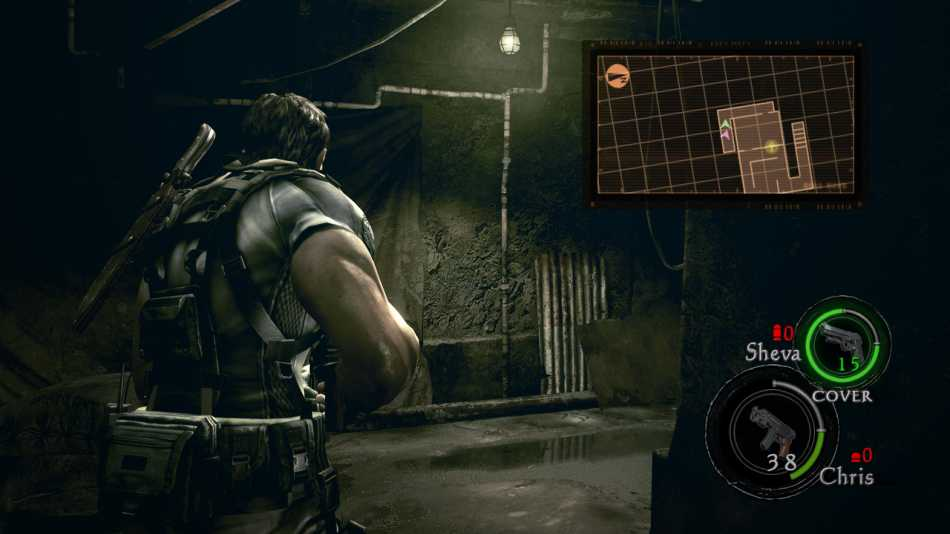
Review: Resident Evil 5
The Resident Evil series has been a pillar of the survivor-horror genre for over a decade, with over 40 million copies sold and several books and movies to show for it. Resident Evil 4 was one of the most highly acclaimed games of 2005, and the lengthy development period given to its successor shows how important it was to Capcom to maintain that level of quality. More than that, the gameplay changes made to Resident Evil 5 make it clear that they're not simply trying to replicate success, but to really establish what they want the series to be. For better or for worse, the series is being pushed toward a bit more action, and the co-op element is almost a necessity. Read on for the rest of my thoughts.- Title: Resident Evil 5
- Developer: Capcom
- Publisher: Capcom
- System: Xbox 360, PS3
- Reviewer: Soulskill
- Score: 7/10
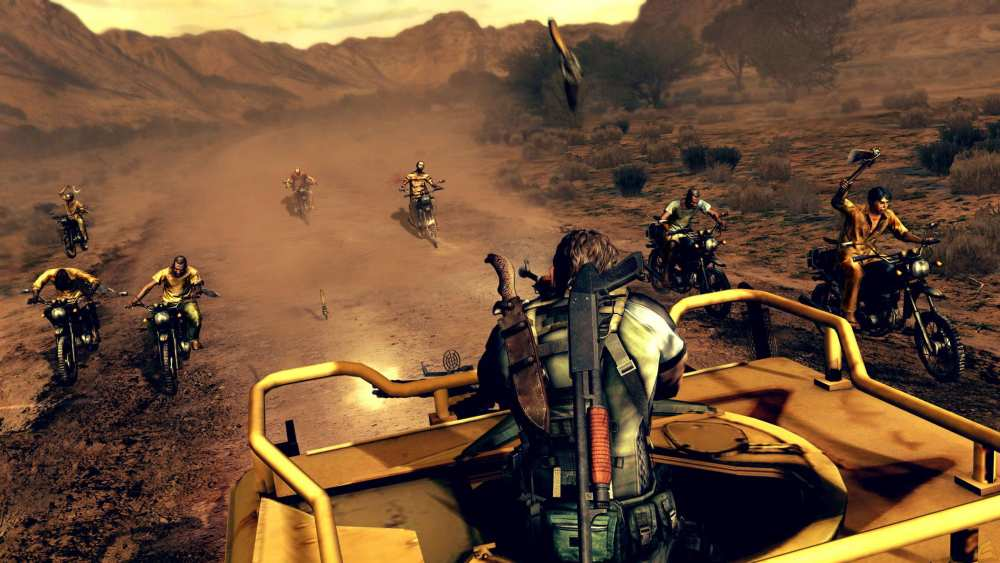
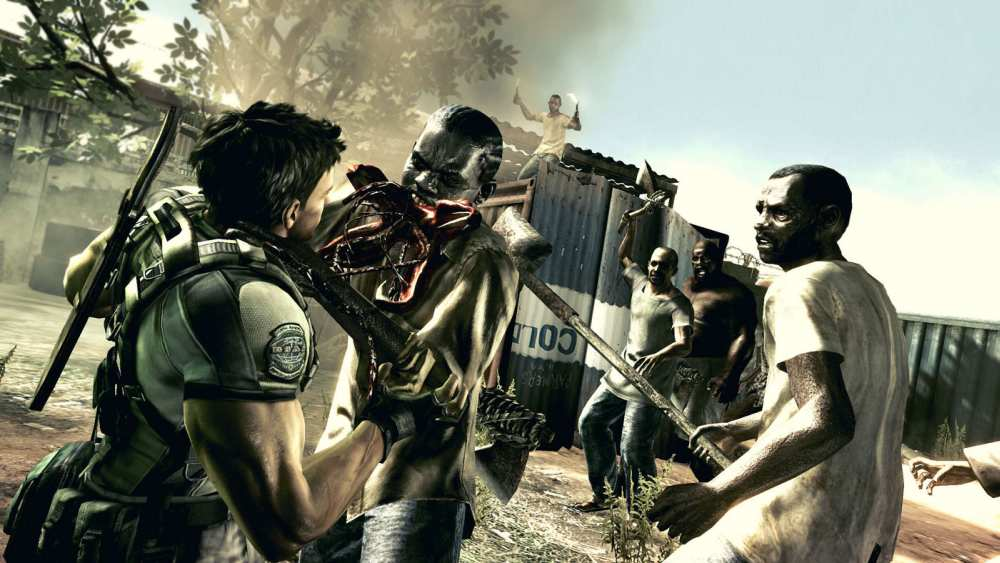
Resident Evil 5 starts you off as Chris Redfield, a familiar face from earlier in the series, as he chases down a bio-terrorism threat in Africa. As you soon find out, there is a New and Improved Las Plagas parasite, which sends its unwitting hosts into a zombified and suggestible state. The new breed is, on the whole, smarter, faster and more dexterous. While some zombies are content to swing their fists or throw an empty bottle at you, others will fight complex gun battles, using cover, deadly accuracy, and aspects of the environment to try and take you out. You'll still meet the shambling, growling hordes you're used to, but there's a much greater range of bad guys than before. They essentially fill any role an uninfected human might in a traditional action game. Newcomers to the series probably won't give this a second thought, but long-time fans may be bothered by it.
Accompanying you on your journey is Sheva Alomar, a young African woman in the Bio-terrorism Security Assessment Alliance (BSAA) who quickly becomes Chris' loyal partner. This is the foundation of the game's focus on co-op play, since a second player can take control of Sheva and work in tandem with you, either locally or over Xbox Live. For solo players, Sheva is controlled by the game's AI, to generally favorable results. Chris and Sheva each have their own inventory space, and you can shuffle items, guns, and ammunition between them as necessary. They back each other up in fights; when a zombie grabs and holds you, your partner can come to your aid and knock the zombie away. If you are close to death, your partner can resuscitate you.
The AI does a pretty good job at being where you want it, coming to your aid when you need it, and doing a respectable amount of damage to your enemies. It has no qualms about running itself out of ammo, but you can give it more or tell it to pick up more off the ground. The one major problem is that you can't really set up a plan with your AI partner. You can't tell them to stay here and cover you while you advance to a different spot, and you can't direct them toward a particular threat. The enemy AI is by turns intelligent and quite stupid. They'll chase you anywhere, scaling ladders quickly or jumping between rooftops, and they'll duck behind walls for cover. Unfortunately, they also have a habit of running up to you and standing still for five seconds before deciding to attack. You can also just run through big groups of some enemies without a scratch. It's probably necessary for the sake of letting the player have a chance to survive, but it's not believable stupidity, and makes it feel like they're just giving you something at which to throw your extra ammunition. Boss AI is almost nonexistent; they usually play out more like scripted encounters. For some of them, this works well.
The difficulty in fighting any of the game's enemies is strictly tied to how you control your character. Capcom made the decision to forbid movement while using your weapon in Resident Evil 5. If you don't like the idea of being unable to "run and gun," you should definitely try the demo first to see how it plays. The effect it has on gameplay is to make shooting your guns something that takes more thought and planning. Firing for extended periods becomes a dangerous proposition because zombies tend to come from all directions. If you stand still long enough, one will eventually come up behind you and attack. It makes situations where you're frantically firing into a group of onrushing enemies all the more tense, knowing that death may be creeping up on you unseen. Oh, and for whatever reason, Capcom decided to prevent you from moving while brandishing your knife as well. I can understand stopping to aim a gun, and maybe having your feet stop moving while actually swinging a blade, but why can't you walk and hold a knife at the same time? Perhaps they just didn't feel it was worth the time to code the changes for an infrequently used weapon. Either way, trying to hit things with your knife is annoying and often useless.
That said, Capcom didn't balance the stationary firing restriction with more responsive aiming. Even at the highest level of sensitivity, the controls are quite clunky to use when enemies are surrounding you. They did implement a button combo that flips you 180 degrees, and this helps to some extent. However, it's still fairly slow, and you almost always need to spend extra time finding your target after spinning around. Worse is when there are zombies to your right or left; button combos that flip you 90 degrees to one side or the other would have been quite welcome, but you're not given that option. Many similar games have implemented a tracking system for nearby enemies, either as dots on a mini-map or arrows on a HUD. Not so in Resident Evil 5; you're often forced into simply panning slowly around the room to see if anything is heading toward you.
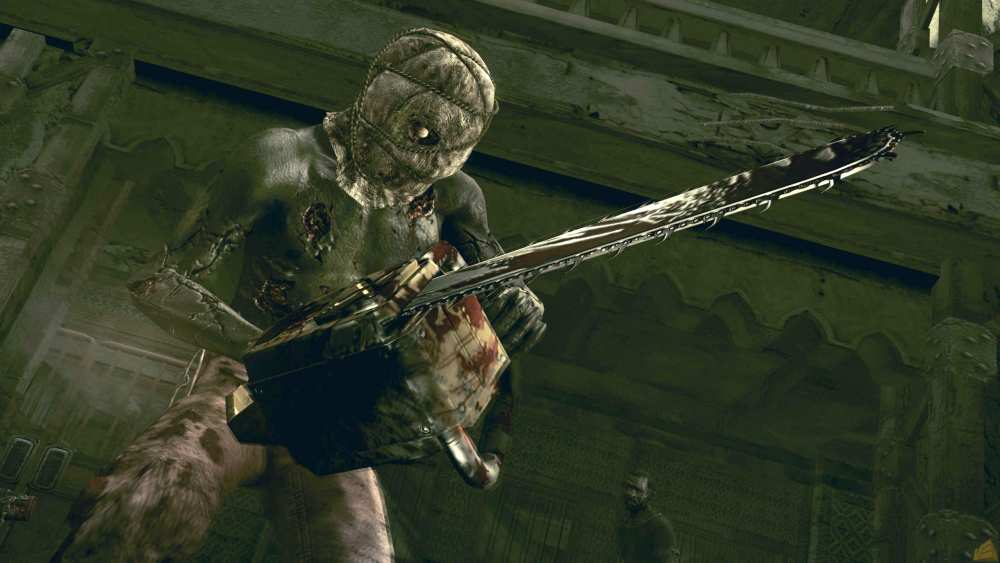
You'll also get to deal with a several types of enemies — such as dogs, spiders, and some bosses — who sometimes move more quickly than you can track them. They don't pose a huge threat to your character by themselves, but they often grab and hold you, allowing other, more dangerous enemies to get close. Those have their own associated problems — for one, a few of the more difficult enemies will just outright kill you if they get within melee range. While this makes sense from a realism perspective, it can be frustrating given the slowness of the movement system, and the requirement that you stop to deal damage. Add to this the huge amount of damage some of them can take, and you end up with regular enemies that feel tougher than the end-of-level bosses.
The boss encounters themselves are hit and miss. Resident Evil 5 makes gratuitous use of Quick-Time Events both during fights and in cut scenes. As the boss prepares to smash you with some tentacled appendage, you'll have a window of a second or so to press a button or get killed. This works decently when you're actually able to control your character, and it's used as part of a normal fight. In one of the later chapters, you get to fight a giant spider that's hanging onto a big, circular platform. As you attack the legs holding it in place, you dodge the ones that are free to swipe at you. It's a lot of fun. Unfortunately, many of the other QTEs are simply distracting. It's used continually in cut scenes to, presumably, keep the player engaged as the game characters are forced into decisions about fighting or dodging. But there's no real consequence to those actions; it's either linearly continue the scene or die (and start again very close to where you died).
One thing you'll notice is that many of the boss fights are just variations on a theme: chase bad guy, catch bad guy, watch bad guy turn into nigh-invulnerable, many-tentacled super zombie. But he has a weak spot! Some of these fights work better than others, and there are more original battles scattered throughout the game as well. For example, a battle with a hulking monstrosity that looks like a troll from Lord of the Rings is unique, but quite simple. The fight scenes with the mastermind who's orchestrating all these events (or, as I call him, "Neo") are more complex and interesting, but tend to suffer from QTEs that rely on fast movement, which is not the game's strong point.
The game ships with over 50 cut scenes of varying length. They're quite impressive to watch, and fans of the Resident Evil story won't be disappointed. They do an amazing job of developing the plot and tying the various levels together in a logical way. The scenes are framed and rendered in such a way that they look like movie footage shot by an actual camera, and it's done well. Monsters, characters, and explosions all look amazing. The story itself isn't high drama, but it's entertaining and serviceable — it's what you'd probably expect from a high-budget zombie flick. The big plot twist is depressingly predictable, but it sets up a cool fight. The settings and scenery during actual gameplay are excellent as well. You're taken through modern slums, primitive villages, underground labs, and a variety of other locales. There's quite a lot of detail, and Capcom took care to make everything colorful and interesting to look at.
Resident Evil 5 is a game that gets much better when you have somebody to play with. As I mentioned earlier, the AI is reasonable, but it doesn't compare to having another human to watch your back or help you kill something. The movement and aiming issues become much less problematic when playing with a friend, since you can stand back to back and limit the area one person has to cover. Once you've defeated the main campaign, you also open up Mercenaries mode, which can be played solo or with a friend. Much like in the previous games, you're dropped into a level with plenty of ammo and plenty of zombies to fight. You have a time limit, but glowing pillars scattered around the map will add time to the clock, and enemies will get stronger as the round goes on. The primary campaign forces you to manage your ammunition fairly strictly — if your accuracy isn't great you can expect to run out of bullets frequently — so being able to just fight without worrying about it makes Mercenaries even more entertaining.
The inventory and weapon selection systems are dominated by ammunition limits. Since you aren't given much of any one type of bullet, you're forced to carry around several different guns. These guns and their associated ammo don't leave much room for healing items, grenades, or proximity bombs, so those are used sparingly. You get the standard shooter-game implements — pistols, shotguns, machine guns, rifles — and the lack of ammo will force you to switch between them fairly often. It can be annoying, especially when you're restricted to a pistol or machine gun when you want to use something more powerful. They also give you a few more impressive weapons as the game goes on, but those are used less frequently. Regardless of the ammunition situation, the weapons themselves are nicely designed. You'll have a broad array of tools for the situations you're given, and each gun has a distinct feel.
It wouldn't be a Resident Evil 5 review without mentioning the concerns of racism that were raised when it was revealed that the game would be set in Africa. To put it bluntly: it's a non-issue. The plot is a natural development of moving the Resident Evil story to a new continent. They make it clear that the zombified people are victims, and that the real evil is the corporation behind the experiments.
Whether or not you enjoy Resident Evil 5 is likely to be dependent on how much you like the controls and whether or not you have a buddy you can play with. The plot is cheesy, but in an entertaining way, and it's basically shown to you as a movie interspersed with gameplay. Fans of the story will be pleased — there are tons of unlockable visuals and bits of information. If you were hoping for a more traditional survival game, you may be disappointed. The action is definitely ramped up, and there aren't really any scary moments. However, it's definitely a worthy addition to the Resident Evil franchise, and the amount of care and effort Capcom put into this game is quite evident.
-
Intel CPU Privilege Escalation Exploit
Eukariote writes "A paper and exploit code detailing a privilege escalation attack on Intel CPUs has just been published. The vulnerability, uncovered by security researchers Joanna Rutkowska (of Blue Pill fame), Rafal Wojtczuk, and, independently, Loic Duflot, makes use of Intel's System Management Mode (SMM). Quote: "The attack allows for privilege escalation from Ring 0 to the SMM on many recent motherboards with Intel CPUs. Rafal implemented a working exploit with code execution in SMM." The implications of this exploit are severe." -
Intel CPU Privilege Escalation Exploit
Eukariote writes "A paper and exploit code detailing a privilege escalation attack on Intel CPUs has just been published. The vulnerability, uncovered by security researchers Joanna Rutkowska (of Blue Pill fame), Rafal Wojtczuk, and, independently, Loic Duflot, makes use of Intel's System Management Mode (SMM). Quote: "The attack allows for privilege escalation from Ring 0 to the SMM on many recent motherboards with Intel CPUs. Rafal implemented a working exploit with code execution in SMM." The implications of this exploit are severe." -
Activists Use Wikipedia To Test Aussie Net Censors
pnorth writes "Editors at Wikipedia have removed a link to a blacklisted web site that sat uncontested for over 24 hours in the main body of the Australian regulator's own Wikipedia entry. The link, which directs readers to a site containing graphic imagery of aborted foetuses, was inserted into ACMA's Wikipedia entry by a campaigner against Internet filtering to determine whether Australia's communications regulator had a double-standard when it came to censoring web content. The very same link motivated the regulator to serve Aussie broadband forum Whirlpool's hosting company with a 'link deletion notice' and the threat of an $11,000 fine. Last night, the link became the subject of 'warring' between several Wikipedia administrators in the lead up to its removal, with administrators saying they didn't want to be used to prove a point." -
The Emerging Science of DNA Cryptography
KentuckyFC writes "Since the mid 90s, researchers have been using DNA to carry out massively parallel calculations which threaten encryption schemes such as DES. Now one researcher says that if DNA can be used to attack encryption schemes, it can also protect data too. His idea is to exploit the way information is processed inside a cell to encrypt it. The information that DNA holds is processed in two stages in a cell. In the first stage, called transcription, a DNA segment that constitutes a gene is converted into messenger RNA (mRNA) which floats out of the nucleus and into the body of the cell. Crucially, this happens only after the noncoding parts of the gene have been removed and the remaining sequences spliced back together." (More below.) KentuckyFC continues: "In the second stage, called translation, molecular computers called ribosomes read the information that mRNA carries and use it to assemble amino acids into proteins. The key point is that this is a one way process. Information can be transferred from the DNA to the protein but not back again because during the process various details are lost, such as the places where the noncoding sequences have been removed. The new idea behind DNA cryptography is to exploit this to encrypt a message. The message is encoded in the sequence of bases in the DNA (A for 00, C for 01, G for 10, T for 11, for example) and then processed. The resulting protein is then made public. The key, which is kept private, is the information necessary to reassemble the DNA from the protein, such as the position of the noncoding regions (abstract)." -
Amazon Sued Over E-Book DRM Patent
I Don't Believe in Imaginary Property writes "Discovery Communications, the parent company of the Discovery Channel, is alleging that Amazon's Kindle e-book reader infringes upon their patent for DRM-encumbered e-books (Discovery's complaint, PDF). The patent in question was filed back in 1999 and issued in 2007 — coincidentally one day after Kindle 1.0 went on the market — and has claims for DRM implemented with a great many particular symmetric key ciphers and key exchange algorithms, (the patent has 171 claims). Unlike most software patents, this one goes into quite a lot of detail about how the encryption is to be performed. But it will still be interesting to see if it can pass the 'machine or transformation' test now that In Re Bilski is being accepted as precedent. After all, it seems like all of these encryption and e-book distribution schemes could be run on a general-purpose PC, so is the 'invention' actually tied to a 'particular machine or apparatus' just because an e-book 'viewer' (not to mention 'home system', 'library', and 'kiosk') happens to be specified in the patent's claims? Or can the encryption of an e-book be claimed as some kind of 'transformation' when the law in that area is especially murky — when no one knows how In Re Bilski may affect the precedent of In Re Schrader?" -
World-First VDSL2 Demo Gets 500Mbps Data Transfers
pnorth writes "Ericsson has achieved data transfer rates of more than 500Mbps in what it said is the world's first live demonstration of a new VDSL2-based technology. The demonstration achieved data rates of more than 0.5 Gbps over twisted copper pairs using 'vectorized' VDSL2. Vectoring decouples the lines in a cable (from an interference point of view), substantially improving power management, and reduces noise originating from the other copper pairs in the same cable bundle." -
New Form of "Mobius" Carbon Predicted
KentuckyFC writes "We've seen carbon nanotubes, buckyballs, and chickenwire. Now materials scientists have created a computer model of a Mobius strip fashioned from strips of graphene — a molecule that would have a single surface and only one edge. (Other groups have made Mobius-like organic molecules but never out of carbon sheets.) The model allows the researchers to determine the physical and chemical properties of the molecules and how these depend on the number of twists in the strip. The team says, for example, that 'Mobius carbon' should be stable to temperatures of at least 500 Kelvin (abstract). But the most exciting prediction is that strips with an odd number of half twists should have a dipole moment that would cause them to self-organize into a crystal. That implies that there's a new type of carbon made entirely of Mobius strips ready to be made by any chemists with a good supply of graphene (maybe these guys)." -
Service Via Facebook Shouldn't Always "Count"
Frequent Slashdot contributor Bennett Haselton writes "A New Zealand court has allowed a plaintiff to serve papers on a defendant via Facebook, following a similar ruling from an Australian court last year. But as these rulings do not necessarily mean, as Facebook announced in a press release, that the courts have endorsed Facebook 'as a reliable, secure and private medium for communication.' The trend could lead to abuses if courts start taking 'Facebook service' too seriously." For more of the many words written by Bennett, hop on that curiously named link right below.A New Zealand court has ruled that a plaintiff can serve papers on a defendant via a message sent to their Facebook account. Last December, an Australian court ruled that a company could serve papers on a couple after failed attempts to reach them by regular mail and e-mail. Facebook responded to the ruling with a statement that said, "We're pleased to see the Australian court validate Facebook as a reliable, secure and private medium for communication. The ruling is also an interesting indication of the increasing role that Facebook is playing in people's lives." I think there are two interesting questions here: (1) Is that really how courts view service via Facebook? And (2) What will happen if courts do begin to view service via Facebook that way?
As to the first question — the court's endorsement of service via Facebook does not mean that they think the service is necessarily secure or reliable. Courts often let you serve papers on a party in a court case via means that are less reliable than normal channels, provided that you've exhausted the more reliable means first. When I was trying to earn my way into heaven by suing spammers in Small Claims court, some states allowed corporations to be served by serving the papers on the Secretary of State in the corporation's home state, but only if you could prove that you had tried and failed to serve the corporation at their registered address. In cases where I served the Secretary of State, it's unlikely that the defendant ever even saw the papers (since the only thing the Secretary of State could do with them was forward them to the defendants' address on file, where I'd already tried to locate them), but it still "counted" because I had exhausted the regular means of serving the documents. Sometimes when serving an individual, if the sheriff couldn't reach someone at home, a judge would sign an order allowing the legal papers to be stuck to their front door (which is neither "secure" nor "reliable"), but only after the sheriff had been unable to deliver it to them in person. So a court's endorsement of Facebook as a means of service doesn't necessarily mean the court thinks that the means of service is reliable. It just means it's a good last resort when conventional methods haven't worked.
Facebook is not, after all, secure or reliable, although these limitations are not the fault of Facebook itself. By "not reliable," I don't mean that it loses or mis-routes messages — I've never seen that happen — but that you have no idea whether someone has signed in to read a message, or deleted it by accident, or lost it among all the other messages that they received. As for whether it's "secure," like most services, the greatest weakness in Facebook's security is in the 'forgot your password' feature — if you compromise someone's e-mail account, then you can have a password reset link sent to their e-mail address and compromise their Facebook account as well. So your Facebook account is only as secure as your e-mail account, and e-mail accounts are usually vulnerable in their own "forgot your password" feature, which often lets you access someone's e-mail account just by knowing their birth date, their zip code, and the answer to an easy question like "Who is your favorite fictional character?" And in any case, obtaining "service" via Facebook doesn't preclude the possibility that the person you served on Facebook was an impostor, or another person who happened to have the same name.
What would really change the game would be if courts started ruling that service via Facebook was valid even without first attempting to serve a party via mail or other means. I had my own experience with a case like this in 2000, when programmers Matthew Skala and Eddy Jansson released a program called "CPHack" which could decode the encrypted list of sites blocked by a program called Cyber Patrol, so that people who owned copies of the program could use CPHack to decrypt the list of blocked sites. (One of the more controversial aspects of such blocking software is that the list of blocked sites is hidden from purchasers of the program.) A judge granted Cyber Patrol a ruling forbidding the authors from distributing the program, and ordering anyone hosting a mirror copy of the program to remove it as well. That same day, I received a copy of the ruling via e-mail from Cyber Patrol's lawyer, ordering us to remove the mirror from the Peacefire site. I asked a lawyer if that was considered valid service (this was back when I still thought that a legal question like that always had an objective answer, as opposed to the question of "valid service" being an entirely subjective one that depended on what judge you happened to get), and he said that I shouldn't take any chances and should take the mirror down anyway, which we did. Dozens of other mirror sites, which had sprung up in anticipation of the legal controversy, were also served with papers, although the overseas ones mostly ignored them.
So this was very different from a ruling made by the 9th Circuit Court of Appeals two years later, allowing a Las Vegas casino to serve an offshore company via e-mail because regular methods had failed. The court in that case wrote, "When faced with an international e-business scofflaw playing hide-and-seek with the federal court, e-mail may be the only means of effecting service of process." But I was a domestic scofflaw whose mailing address was publicly known (in the WHOIS registration for the Peacefire site). What was the rationale for allowing me to be served by e-mail?
Unfortunately I think it's probably just a case where the rules were vague enough that the judge felt entitled to bend them to achieve an outcome that he wanted. The 9th Circuit didn't leave much doubt as to the level of objectivity in their ruling on e-mail service either, in calling the defendant an "international e-business scofflaw."
And these are the two main reasons why I think that allowing electronic "insta-service" via e-mail or Facebook — in cases where parties have not first tried to serve papers via regular means — would erode the rights of the little guy. First, in most of the cases I can think of where a powerful plaintiff was playing "whack-a-mole" with multiple defendants by using electronic service of process to shut down new sites as fast as they were springing up, the goal they were trying to achieve was (a) futile, if half the mirror sites were overseas anyway, and (b) ultimately incompatible with civil liberties. (Why shouldn't people have the right to decrypt the list of sites blocked by Cyber Patrol? After the ACLU got involved on appeal, a higher court ultimately ruled that mirror sites could not be ordered to take down CPHack. The HD DVD encryption key controversy is another well-known example.) In cases where a plaintiff has a legitimate claim against multiple sites — for example, sites that are violating the plaintiff's copyright by hosting unauthorized copies of content that they own — most service providers already publish an e-mail address where copyright owners can send a DMCA takedown notice, and where the copyright owner is risking large statutory financial penalties if they send a takedown notice that turns out to be baseless. There are no similar protections to prevent abuses of the system through electronic service of other kinds of legal notices.
The other reason this trend could work against the average person, is that any vague rule that is not consistently followed by different judges, puts non-lawyers at a disadvantage in court. Partly because it may confuse non-lawyers who hear that e-mail service was allowed in one case, and think that's part of "the rules," and then find that e-mail service was disallowed in another case, and wonder how "the rules" could allow it in one case but not in another, all the while laboring under the mistaken impression that there actually are "rules" which unambiguously determine whether or not e-mail service is allowed, when the truth is that it's just up to each individual judge. But also because every ambiguity in the rules is another opportunity for the judge's prejudices to influence the outcome. I do not think that most judges are prejudiced against people based on race or gender, but I doubt you could find any legal professional who thinks that most judges would take a case equally seriously regardless of whether it was brought by a professional lawyer or by a layperson representing themselves. (At one point in my spammer-suing career, I had only about a 50-50 chance of my motions even being read.)
So, let's not get carried away applauding judges for being "hip" and "with it" for allowing service via e-mail or Facebook. And if they start allowing it more frequently, can we at least ask that they pick one rule and stick with it? -
Traveling With Tom Bihn's Checkpoint Flyer
Some people care about bags; obsession is a better word. (See the Bags subforum of the Every Day Carry Forums for evidence.) How are the straps attached? Is that 1050 denier, or 1600? Makers like Crumpler, Ortlieb and Maxpedition inspire impressive brand-loyalty, but probably no bag maker has customers more enthusiastic than Tom Bihn's. (There really is a Tom Bihn, too -- he's been designing travel bags since he was a kid; now he has a factory with "all the cool toys" to experiment with designs and materials.) When I started looking for a protective case for my MacBook Pro, I discovered that a few of my coworkers were part of the Bihn Army, and after some Tupperware-style evangelism I was convinced to buy a few items from the Bihn line-up: a backpack (used); then a messenger bag (new); then a mid-sized briefcase, used, which is now my portable filing cabinet. (Take this bias for what you will; I stuck with my previous messenger bag for more than a decade.) For a just-completed trip to Israel, which I couldn't quite make in true one-bag travel fashion, I brought along one of the newest Bihn Bags — the Checkpoint Flyer — and found it to be worth its (considerable) price. Read on for my review.
Overview:
The Checkpoint Flyer was one of the earliest bags released (perhaps the first) to take advantage of one TSA effort to slightly reduce the hassle of getting through airport security in the era of picayune and fickle rules about everything from nail clippers to shoes to shampoo. The TSA program, by outlining certain requirements, lets travelers skirt one annoying consequence of traveling with a laptop: instead of removing a laptop at the security line and putting it into a bin to be scanned, a passenger with a bag meeting certain requirements (essentially, it must provide an x-ray viewing window free of obstructions such as metal zippers) can send it through without first removing the laptop. I've seen at least one laptop dropped and damaged by a passenger who was trying to put it into a bin, which has to be infuriating. There's still plenty of security theater to go around, but anything that keeps computers in padded carriers until necessary and as long as practical is a good thing. If we're lucky, checkpoint friendly may become the norm instead of a novelty; that may be the closest to friendly you'll find at a TSA counter.
Bihn bags are made by the waterfront in Seattle, Washington, on an bright, quiet, surprisingly small factory floor. Tom Bihn himself, when time allows, is happy to show visitors the small factory and tiny showroom, open one day each week so locals and dedicated Bihnophiles can actually try the various bags on for size. (Otherwise, the company is essentially a catalog store, taking orders by phone and online.) I visited the factory to pick up an all-black Flyer for review; front panels in bright red or silver are also available, and I grudgingly admit these look fine, but my personal taste in luggage holds black to be the One True Bag Color. Even before Seattle was slammed by weeks of paralyzing snow, the Bihn factory was rushing to fill holiday orders, and had run short of shoulder straps, so I needed to supply my own from a different bag. The Checkpoint Flyer has a briefcase-style handle, but a shoulder strap is up to the buyer to choose (and purchase); this enhances choice, but it also pushes a $220 bag to just under $250, shipping inclusive but before taxes, if you include the most basic factory-supplied strap. It's slightly more for the shoulder-gripping Absolute shoulder strap ($30), one of which I cannibalized from a different bag. Bihn points out reasonably that many purchasers already own a bag with an appropriate strap, so he'd rather not force them to buy another, but I wish the "real" (and most obvious) price instead included a strap, and users who already have one could choose a discounted price by eliminating it from the package.
Clever design (and a few gripes):
Bags that meet the TSA's specs for going through airport scanners are allowed to fit any of three categories: a sleeve or pouch style; a bi-fold (clamshell); or a three-part folder. The Flyer is of the three-part variety, comprising a semi-rigid laptop shell of closed-cell foam, a main compartment suitable for papers, or clothes, power adapters, etc, and a thinner outer section with two pockets big enough for things like plane snacks, paperback books, and small electronic items. In normal use (that is, when not going through an airport X-ray machine) the laptop compartment is snugged between the other two sections; the laptop section also has a briefcase-style handle, which slips through an opening in the junction of the outermost sections, to be grasped at the same time as the handle on the main compartment. The laptop shell is also removable (making the bag much slimmer), and replaceable with a different size shell; one shell is included in the price of the bag. Mine's sized to hold a 15.4" last-generation PowerBook Pro.
With two Fastex buckles released, the bag's compartments lay flat: the laptop container at one end, followed by the main compartment and then the outermost layer. For the crucial security line process that it's built for, that means a traveler puts the bag on the scanner's conveyor belt, looses the buckles, and unfolds the bag like a garment carrier. Reassembly is just as simple and nearly as fast, but requires a warning: carrying by the handles works fine even without the Fastex buckles refastened -- not so with the shoulder strap, because the laptop container is liable to slip down and dangle in the fashion of a Jacob's ladder. Yes, I did this, and Yes, it was embarrassing.
The materials facing the outside world are 500 denier Cordura, and 1050 denier ballistic nylon; a lighter-weight fabric called Dyneema (still very strong) lines the inside compartment and its pockets. For ease of finding the small items that shift during flight, I'd prefer this was in the bright yellow ("Solar") version of Dyneema that is used for some Bihn products (or in red), but a white-grid-on-grey isn't bad.
The main compartment — not the laptop shell — is well sized to hold a medium-sized packing cube. I bought some cheap ones from eBags; though I'm new to the concept, I am a convert: for me at least, the value of a packing cube as an inner, organizing layer far exceeds its price.
There are pockets everywhere. The two outside pockets (which are not symmetrical; my little mind was briefly bothered) are probably where cellphones, MP3 players, snacks and keys will end up for most people. The back of the bag (the part closest to the user when carrying it) features a two-pocket design that Tom Bihn told me he's especially pleased with, and which will show up in more Bihn products in the future. There's a wide open-topped pocket to the left, big enough for magazines or small file folders (a good place to stash reading material for the security line or the flight). For slipping over a rolling case's handle, there's also a slot ordinarily closed by a zipper. Unzip, slip over, and roll away -- but lose the use of the pocket as a pocket. To the right, there's a smaller open-topped pocket, intended for maps, boarding passes, etc. Open pockets are convenient, but I'll admit always make me long for snaps, velcro, zippers, toggles, or some other way to close them unless their contents are actually poking out the top. The convenience is nice, though, and the sizes are well chosen; just bear in mind that these pockets *aren't* meant for documents like passports, where loss by pickpocketing could be a trip-wrecking nightmare rather than just a bother.
My gripes are small, but I did develop a few peeves. The biggest of these: I craved a different spot to attach the shoulder strap. There are exactly two attachment points, both on the top edge of the bag, facing the outer pockets. I'd like to see a matching set of these on the other side of that same edge. I'm no bag designer, and perhaps having the attachment points where they are is structurally or functionally important; if that's not the case, I think the bag would ride more comfortably if the strap attached on the inner (body-side) edge rather than the outer. I'd also like to see a zipper (or even snaps) for the big flap pocket on the back; I was afraid to put anything more valuable than a magazine in here for long, especially when I used the bag as a shopping tote in a crowded market. There are two tiny external pockets on each side, where some bags have an expandable mesh to hold things like a bottle of water. These edge pockets on the Checkpoint Flyer are seemingly indestructible -- but I'm not sure what they're for, since they're too small for even the slim water bottles I've tried, and too shallow to carry a flashlight. If they were a tad bigger or more expandable, they'd do a lot toward making this a better every-day, do-everything bag as well as a superb travel briefcase. (To be fair, that's how I used it anyhow, with water bottle stashed inside.)
In use:
Some pictures of the Flyer make it resemble a bundle of presents stacked not-quite evenly, with middle and outer compartments riding up and out a bit (one reason I wish the shoulder strap met the bag on closer to the body); I find that unless the bag is stuffed very full, it doesn't look quite that bulgy. Looking slimmer can prove useful, especially when a bag is perhaps on the threshold between small (as in "a small personal item") and not-so-small; ever-tighter airline restrictions favor a bag that looks slender enough not to draw attention to itself. For that reason, and because I knew I'd be carrying a backpack travel bag as well, I tried at first to pack mine so that it looked like a conventional computer case. In the end, I chose to be at least a bit cruel to both bag and back, but even with the bag comfortably stuffed, had zero problems getting it onto any of my flights (full-sized jets, some fully booked, but none fancy enough to have computers taking up the foot room) or under the seat in front of me.
People vary in what they "need" for travel; I enjoy pointing out this guy, who eschews bags altogether — I can't match him by a long shot: my modest goal is to generally not check any luggage. I took notes on what I carried in the Checkpoint Flyer (this leaves out the stuff in my eBags Weekender backpack), because "one change of clothing" or "toiletry kit" can mean considerably different things to different people. (Skip ahead if you hate detailed packing lists.)
In the main compartment, I was able to stuff the following without straining the zipper: 1) eBags medium packing cube, holding, bundle-wrapped: khakis (size 34/32), 1 pair cotton boxer shorts, 2 pairs of cotton ankle socks, one cotton t-shirt, and 1 button-up oxford shirt 2) baggie with a small assortment of toiletries: 2 toothbrushes; 2.7 oz toothpaste container; 2 oz small lexan bottle, full of Dr. Bronner's soap; 2.7 oz. stick deodorant; 2oz bottle of shampoo; toenail clipper 3) zippered pouch (thrift-store find) containing an extendable ethernet cord; AC adapter and cord for Eee laptop; 2 USB keys; lexan spoon; gum; and a few odds and ends. 4) travel document pouch containing passport; extra gum; boarding passes (three flights each way); 1-page travel manifest, printed in minuscule characters which are readable for me; and some cash.
In the smaller outside pocket, I stashed Sony noise canceling headphones (in their pouch); a 1 oz. container (plastic cylinder) with a few aspirin; and a 3 oz plastic cylinder of almonds. In the other, slightly larger pocket, I had a small trip journal (approx. 3x5"); compact camera wrapped in a hiking sock (replaced by a small LowePro case toward the end of my trip); 3 pens, 1 mechanical pencil; batteries in a flat pack which can hold 8 AAs; my house key (on built-in key strap); and a Zebra AA headlamp. I put a few business cards in one of the small flat zippered pockets, and nothing in the other.
In the large open pocket on the back, I kept a bit of reading material (a few paperbacks for the plane); and a few scraps of paper for note-taking. The smaller open pocket next to this I usually kept empty, except while actually waiting in lines to board a plane or a bus, at which point it's the most convenient place for boarding passes and schedules.
In the center (laptop) compartment, rather than the MacBook Pro, I had an Eee 10" laptop, running Ubuntu Linux 8.10. The MacBook Pro-sized space is much bigger than the Eee, so I also squeezed in a neoprene sleeve. I went with this because my Eee has a more powerful battery than my Mac, gets better wireless reception, and is quite a bit lighter and handier.
For three weeks, I used the bag daily, to carry a notebook, map, pen and pencil, cell phone, guidebook (sometimes two), and usually either a fleece or a light jacket; with those few things, the inherent volume of the pockets and compartments meant that it looked about the same as it would have empty. I did not remove the laptop compartment (an oversight -- this would have actually made it slimmer and lighter), and in this state the Checkpoint Flyer is a bit stiff compared to a courier bag, but still quite comfortable. On several days, it turned into an impromptu market bag, too, and easily held more than 20 pounds of groceries (cheap, delicious oranges, bread, pastry and olives were all tempting), although I had to keep the main compartment unzipped to hold that much.
In a pinch, though, the fabric and seams seem content to carry anything you can coax the zipper around. For a two-night weekend trip to see Petra, I stuffed in books (a thin hardback and two thin paperbacks), travel documents and money, travel journal, 2 pens, 1 pencil, a small digital camera, AA batteries and a case for them, headphones in a case, tiny MP3 player, cell phone, house keys, toiletries, headlamp, and enough clothing for the trip (scarf, 2 t-shirts, 2 oxford shorts, 2 pairs of boxer shorts, 2 pairs of socks, 1 pair of clean pants) along with some snacks (2 huge oranges, a handful of candy, 100 grams of pistachios and pine nuts, 100 grams of dried fruit). Here, too, I left the laptop case attached, but used it as a storage spot for socks and underwear, while my laptop was safe in Jerusalem. While in Petra itself, the bag started out with my water bottle, camera, scarf, hat, gloves, more snacks, and travel documents. Over the course of the day, I squeezed in my jacket and a few postcards, too -- this made the main compartment bulge, but only slightly.
The big question, though, is how it actually worked out in the airport. The answer is a happy "As expected, with caveats." Flying from Seattle, the Flyer was fantastic; with my bomb-free shoes and thoroughly dead belt in a plastic bin, I unfastened the buckles and laid the Checkpoint Flyer out on the X-ray machine conveyor belt. Not a blink from the personnel here, either; the "checkpoint-friendly" campaign seems to have trickled through. On the other side of the inspection line, I refolded and refastened the bag, and that was that.
However, "checkpoint friendly" is not a universal language. On transferring planes in Madrid, I was asked to remove my laptop and place it in a bin by itself. And on leaving Israel, I got the attention from Ben Gurion Airport's security forces that I'd been warned about as a young(ish) male traveling solo with no checked baggage. Both my backpack and the Checkpoint Flyer were put under several kinds of electronic scrutiny, my passport was given a very close eye, and I was given a several-minute exit interview by three different people, before I even reached the check-in line for my flight. (Where did I stay? With whom, spelled how, and how did I know them? Was I absolutely certain that no one had given me a package to carry, not even a small one? Is this really all my luggage, for a multi-week trip? What was my business in Israel, precisely?) At this stage, my laptop was opened and run through an X-ray machine, as were my backpack and the otherwise packed Flyer. After ticketing and an exit stamp on my passport, I went through another set of machines, where there was a several-minute inspection of my bags, and again there was no option to keep the laptop in the bag. Perhaps one day! In the meantime, US domestic travelers can revel in one small nicety.
Oh, and the Checkpoint Flyer handles rain like you'd expect from a bag out of Seattle. For reasons that do not here bear examination, I ended up taking a very long walk through empty parts of Haifa for much of one Saturday night, during which time it mostly alternated between drizzle and downpour. Even for someone used to living in Seattle, this was a wet night to walk. And though the Checkpoint Flyer was in no way protected from the rain, all it did in that ongoing rain was get very wet -- on the outside. The fabric is tight enough that most of the water just rolled off; none of the paper, food, or clothing I had stuffed in there at the time saw a drop of rain, and after an hour or so in my hotel room I couldn't tell it had ever been wet. So I had zero worries about walking in milder rain over the weeks that followed.
Upshot:
The Checkpoint Flyer is not the most comfortable shoulder bag I've ever carried, even with the Absolute shoulder strap -- but it is the most comfortable bag I've found with its degree of protection and travel convenience. Based on an admittedly small sample set, it also the most comfortable bag I know that can be considered a briefcase, and the only checkpoint-friendly bag with an interchangeable laptop case. Soft messenger bags like my Super Ego -- which so far wins my personal "most comfortable" award -- can't be considered in the same category without adding some sort of substantial laptop sleeve or shell. These shells exist (for most Bihn bags, you can order a carrier called a "Brain Cell" to fill this role), but for plane travel they suffer in comparison because of their bulk, and because most such holders don't allow for in-bag airport inspection (when that's an option at all).
Still, you could have a Hershey bar every day for a year for the price of a Checkpoint Flyer. There are (low-end, but credible) laptops that cost less than this bag. Meanwhile, there are now a rash of cheaper "checkpoint friendly" bags from quite a few vendors, and more are on the way: I've seen one clamshell design on sale for less than $20, delivered. Does that mean the Bihn bag is overpriced? My opinion: pricey here does not mean overpriced. The quality and flexbility of the Checkpoint Flyer make it the current king carry-on laptop bags, and I suspect that most of the ones bought now will still be in use in 2019. -
Traveling With Tom Bihn's Checkpoint Flyer
Some people care about bags; obsession is a better word. (See the Bags subforum of the Every Day Carry Forums for evidence.) How are the straps attached? Is that 1050 denier, or 1600? Makers like Crumpler, Ortlieb and Maxpedition inspire impressive brand-loyalty, but probably no bag maker has customers more enthusiastic than Tom Bihn's. (There really is a Tom Bihn, too -- he's been designing travel bags since he was a kid; now he has a factory with "all the cool toys" to experiment with designs and materials.) When I started looking for a protective case for my MacBook Pro, I discovered that a few of my coworkers were part of the Bihn Army, and after some Tupperware-style evangelism I was convinced to buy a few items from the Bihn line-up: a backpack (used); then a messenger bag (new); then a mid-sized briefcase, used, which is now my portable filing cabinet. (Take this bias for what you will; I stuck with my previous messenger bag for more than a decade.) For a just-completed trip to Israel, which I couldn't quite make in true one-bag travel fashion, I brought along one of the newest Bihn Bags — the Checkpoint Flyer — and found it to be worth its (considerable) price. Read on for my review.
Overview:
The Checkpoint Flyer was one of the earliest bags released (perhaps the first) to take advantage of one TSA effort to slightly reduce the hassle of getting through airport security in the era of picayune and fickle rules about everything from nail clippers to shoes to shampoo. The TSA program, by outlining certain requirements, lets travelers skirt one annoying consequence of traveling with a laptop: instead of removing a laptop at the security line and putting it into a bin to be scanned, a passenger with a bag meeting certain requirements (essentially, it must provide an x-ray viewing window free of obstructions such as metal zippers) can send it through without first removing the laptop. I've seen at least one laptop dropped and damaged by a passenger who was trying to put it into a bin, which has to be infuriating. There's still plenty of security theater to go around, but anything that keeps computers in padded carriers until necessary and as long as practical is a good thing. If we're lucky, checkpoint friendly may become the norm instead of a novelty; that may be the closest to friendly you'll find at a TSA counter.
Bihn bags are made by the waterfront in Seattle, Washington, on an bright, quiet, surprisingly small factory floor. Tom Bihn himself, when time allows, is happy to show visitors the small factory and tiny showroom, open one day each week so locals and dedicated Bihnophiles can actually try the various bags on for size. (Otherwise, the company is essentially a catalog store, taking orders by phone and online.) I visited the factory to pick up an all-black Flyer for review; front panels in bright red or silver are also available, and I grudgingly admit these look fine, but my personal taste in luggage holds black to be the One True Bag Color. Even before Seattle was slammed by weeks of paralyzing snow, the Bihn factory was rushing to fill holiday orders, and had run short of shoulder straps, so I needed to supply my own from a different bag. The Checkpoint Flyer has a briefcase-style handle, but a shoulder strap is up to the buyer to choose (and purchase); this enhances choice, but it also pushes a $220 bag to just under $250, shipping inclusive but before taxes, if you include the most basic factory-supplied strap. It's slightly more for the shoulder-gripping Absolute shoulder strap ($30), one of which I cannibalized from a different bag. Bihn points out reasonably that many purchasers already own a bag with an appropriate strap, so he'd rather not force them to buy another, but I wish the "real" (and most obvious) price instead included a strap, and users who already have one could choose a discounted price by eliminating it from the package.
Clever design (and a few gripes):
Bags that meet the TSA's specs for going through airport scanners are allowed to fit any of three categories: a sleeve or pouch style; a bi-fold (clamshell); or a three-part folder. The Flyer is of the three-part variety, comprising a semi-rigid laptop shell of closed-cell foam, a main compartment suitable for papers, or clothes, power adapters, etc, and a thinner outer section with two pockets big enough for things like plane snacks, paperback books, and small electronic items. In normal use (that is, when not going through an airport X-ray machine) the laptop compartment is snugged between the other two sections; the laptop section also has a briefcase-style handle, which slips through an opening in the junction of the outermost sections, to be grasped at the same time as the handle on the main compartment. The laptop shell is also removable (making the bag much slimmer), and replaceable with a different size shell; one shell is included in the price of the bag. Mine's sized to hold a 15.4" last-generation PowerBook Pro.
With two Fastex buckles released, the bag's compartments lay flat: the laptop container at one end, followed by the main compartment and then the outermost layer. For the crucial security line process that it's built for, that means a traveler puts the bag on the scanner's conveyor belt, looses the buckles, and unfolds the bag like a garment carrier. Reassembly is just as simple and nearly as fast, but requires a warning: carrying by the handles works fine even without the Fastex buckles refastened -- not so with the shoulder strap, because the laptop container is liable to slip down and dangle in the fashion of a Jacob's ladder. Yes, I did this, and Yes, it was embarrassing.
The materials facing the outside world are 500 denier Cordura, and 1050 denier ballistic nylon; a lighter-weight fabric called Dyneema (still very strong) lines the inside compartment and its pockets. For ease of finding the small items that shift during flight, I'd prefer this was in the bright yellow ("Solar") version of Dyneema that is used for some Bihn products (or in red), but a white-grid-on-grey isn't bad.
The main compartment — not the laptop shell — is well sized to hold a medium-sized packing cube. I bought some cheap ones from eBags; though I'm new to the concept, I am a convert: for me at least, the value of a packing cube as an inner, organizing layer far exceeds its price.
There are pockets everywhere. The two outside pockets (which are not symmetrical; my little mind was briefly bothered) are probably where cellphones, MP3 players, snacks and keys will end up for most people. The back of the bag (the part closest to the user when carrying it) features a two-pocket design that Tom Bihn told me he's especially pleased with, and which will show up in more Bihn products in the future. There's a wide open-topped pocket to the left, big enough for magazines or small file folders (a good place to stash reading material for the security line or the flight). For slipping over a rolling case's handle, there's also a slot ordinarily closed by a zipper. Unzip, slip over, and roll away -- but lose the use of the pocket as a pocket. To the right, there's a smaller open-topped pocket, intended for maps, boarding passes, etc. Open pockets are convenient, but I'll admit always make me long for snaps, velcro, zippers, toggles, or some other way to close them unless their contents are actually poking out the top. The convenience is nice, though, and the sizes are well chosen; just bear in mind that these pockets *aren't* meant for documents like passports, where loss by pickpocketing could be a trip-wrecking nightmare rather than just a bother.
My gripes are small, but I did develop a few peeves. The biggest of these: I craved a different spot to attach the shoulder strap. There are exactly two attachment points, both on the top edge of the bag, facing the outer pockets. I'd like to see a matching set of these on the other side of that same edge. I'm no bag designer, and perhaps having the attachment points where they are is structurally or functionally important; if that's not the case, I think the bag would ride more comfortably if the strap attached on the inner (body-side) edge rather than the outer. I'd also like to see a zipper (or even snaps) for the big flap pocket on the back; I was afraid to put anything more valuable than a magazine in here for long, especially when I used the bag as a shopping tote in a crowded market. There are two tiny external pockets on each side, where some bags have an expandable mesh to hold things like a bottle of water. These edge pockets on the Checkpoint Flyer are seemingly indestructible -- but I'm not sure what they're for, since they're too small for even the slim water bottles I've tried, and too shallow to carry a flashlight. If they were a tad bigger or more expandable, they'd do a lot toward making this a better every-day, do-everything bag as well as a superb travel briefcase. (To be fair, that's how I used it anyhow, with water bottle stashed inside.)
In use:
Some pictures of the Flyer make it resemble a bundle of presents stacked not-quite evenly, with middle and outer compartments riding up and out a bit (one reason I wish the shoulder strap met the bag on closer to the body); I find that unless the bag is stuffed very full, it doesn't look quite that bulgy. Looking slimmer can prove useful, especially when a bag is perhaps on the threshold between small (as in "a small personal item") and not-so-small; ever-tighter airline restrictions favor a bag that looks slender enough not to draw attention to itself. For that reason, and because I knew I'd be carrying a backpack travel bag as well, I tried at first to pack mine so that it looked like a conventional computer case. In the end, I chose to be at least a bit cruel to both bag and back, but even with the bag comfortably stuffed, had zero problems getting it onto any of my flights (full-sized jets, some fully booked, but none fancy enough to have computers taking up the foot room) or under the seat in front of me.
People vary in what they "need" for travel; I enjoy pointing out this guy, who eschews bags altogether — I can't match him by a long shot: my modest goal is to generally not check any luggage. I took notes on what I carried in the Checkpoint Flyer (this leaves out the stuff in my eBags Weekender backpack), because "one change of clothing" or "toiletry kit" can mean considerably different things to different people. (Skip ahead if you hate detailed packing lists.)
In the main compartment, I was able to stuff the following without straining the zipper: 1) eBags medium packing cube, holding, bundle-wrapped: khakis (size 34/32), 1 pair cotton boxer shorts, 2 pairs of cotton ankle socks, one cotton t-shirt, and 1 button-up oxford shirt 2) baggie with a small assortment of toiletries: 2 toothbrushes; 2.7 oz toothpaste container; 2 oz small lexan bottle, full of Dr. Bronner's soap; 2.7 oz. stick deodorant; 2oz bottle of shampoo; toenail clipper 3) zippered pouch (thrift-store find) containing an extendable ethernet cord; AC adapter and cord for Eee laptop; 2 USB keys; lexan spoon; gum; and a few odds and ends. 4) travel document pouch containing passport; extra gum; boarding passes (three flights each way); 1-page travel manifest, printed in minuscule characters which are readable for me; and some cash.
In the smaller outside pocket, I stashed Sony noise canceling headphones (in their pouch); a 1 oz. container (plastic cylinder) with a few aspirin; and a 3 oz plastic cylinder of almonds. In the other, slightly larger pocket, I had a small trip journal (approx. 3x5"); compact camera wrapped in a hiking sock (replaced by a small LowePro case toward the end of my trip); 3 pens, 1 mechanical pencil; batteries in a flat pack which can hold 8 AAs; my house key (on built-in key strap); and a Zebra AA headlamp. I put a few business cards in one of the small flat zippered pockets, and nothing in the other.
In the large open pocket on the back, I kept a bit of reading material (a few paperbacks for the plane); and a few scraps of paper for note-taking. The smaller open pocket next to this I usually kept empty, except while actually waiting in lines to board a plane or a bus, at which point it's the most convenient place for boarding passes and schedules.
In the center (laptop) compartment, rather than the MacBook Pro, I had an Eee 10" laptop, running Ubuntu Linux 8.10. The MacBook Pro-sized space is much bigger than the Eee, so I also squeezed in a neoprene sleeve. I went with this because my Eee has a more powerful battery than my Mac, gets better wireless reception, and is quite a bit lighter and handier.
For three weeks, I used the bag daily, to carry a notebook, map, pen and pencil, cell phone, guidebook (sometimes two), and usually either a fleece or a light jacket; with those few things, the inherent volume of the pockets and compartments meant that it looked about the same as it would have empty. I did not remove the laptop compartment (an oversight -- this would have actually made it slimmer and lighter), and in this state the Checkpoint Flyer is a bit stiff compared to a courier bag, but still quite comfortable. On several days, it turned into an impromptu market bag, too, and easily held more than 20 pounds of groceries (cheap, delicious oranges, bread, pastry and olives were all tempting), although I had to keep the main compartment unzipped to hold that much.
In a pinch, though, the fabric and seams seem content to carry anything you can coax the zipper around. For a two-night weekend trip to see Petra, I stuffed in books (a thin hardback and two thin paperbacks), travel documents and money, travel journal, 2 pens, 1 pencil, a small digital camera, AA batteries and a case for them, headphones in a case, tiny MP3 player, cell phone, house keys, toiletries, headlamp, and enough clothing for the trip (scarf, 2 t-shirts, 2 oxford shorts, 2 pairs of boxer shorts, 2 pairs of socks, 1 pair of clean pants) along with some snacks (2 huge oranges, a handful of candy, 100 grams of pistachios and pine nuts, 100 grams of dried fruit). Here, too, I left the laptop case attached, but used it as a storage spot for socks and underwear, while my laptop was safe in Jerusalem. While in Petra itself, the bag started out with my water bottle, camera, scarf, hat, gloves, more snacks, and travel documents. Over the course of the day, I squeezed in my jacket and a few postcards, too -- this made the main compartment bulge, but only slightly.
The big question, though, is how it actually worked out in the airport. The answer is a happy "As expected, with caveats." Flying from Seattle, the Flyer was fantastic; with my bomb-free shoes and thoroughly dead belt in a plastic bin, I unfastened the buckles and laid the Checkpoint Flyer out on the X-ray machine conveyor belt. Not a blink from the personnel here, either; the "checkpoint-friendly" campaign seems to have trickled through. On the other side of the inspection line, I refolded and refastened the bag, and that was that.
However, "checkpoint friendly" is not a universal language. On transferring planes in Madrid, I was asked to remove my laptop and place it in a bin by itself. And on leaving Israel, I got the attention from Ben Gurion Airport's security forces that I'd been warned about as a young(ish) male traveling solo with no checked baggage. Both my backpack and the Checkpoint Flyer were put under several kinds of electronic scrutiny, my passport was given a very close eye, and I was given a several-minute exit interview by three different people, before I even reached the check-in line for my flight. (Where did I stay? With whom, spelled how, and how did I know them? Was I absolutely certain that no one had given me a package to carry, not even a small one? Is this really all my luggage, for a multi-week trip? What was my business in Israel, precisely?) At this stage, my laptop was opened and run through an X-ray machine, as were my backpack and the otherwise packed Flyer. After ticketing and an exit stamp on my passport, I went through another set of machines, where there was a several-minute inspection of my bags, and again there was no option to keep the laptop in the bag. Perhaps one day! In the meantime, US domestic travelers can revel in one small nicety.
Oh, and the Checkpoint Flyer handles rain like you'd expect from a bag out of Seattle. For reasons that do not here bear examination, I ended up taking a very long walk through empty parts of Haifa for much of one Saturday night, during which time it mostly alternated between drizzle and downpour. Even for someone used to living in Seattle, this was a wet night to walk. And though the Checkpoint Flyer was in no way protected from the rain, all it did in that ongoing rain was get very wet -- on the outside. The fabric is tight enough that most of the water just rolled off; none of the paper, food, or clothing I had stuffed in there at the time saw a drop of rain, and after an hour or so in my hotel room I couldn't tell it had ever been wet. So I had zero worries about walking in milder rain over the weeks that followed.
Upshot:
The Checkpoint Flyer is not the most comfortable shoulder bag I've ever carried, even with the Absolute shoulder strap -- but it is the most comfortable bag I've found with its degree of protection and travel convenience. Based on an admittedly small sample set, it also the most comfortable bag I know that can be considered a briefcase, and the only checkpoint-friendly bag with an interchangeable laptop case. Soft messenger bags like my Super Ego -- which so far wins my personal "most comfortable" award -- can't be considered in the same category without adding some sort of substantial laptop sleeve or shell. These shells exist (for most Bihn bags, you can order a carrier called a "Brain Cell" to fill this role), but for plane travel they suffer in comparison because of their bulk, and because most such holders don't allow for in-bag airport inspection (when that's an option at all).
Still, you could have a Hershey bar every day for a year for the price of a Checkpoint Flyer. There are (low-end, but credible) laptops that cost less than this bag. Meanwhile, there are now a rash of cheaper "checkpoint friendly" bags from quite a few vendors, and more are on the way: I've seen one clamshell design on sale for less than $20, delivered. Does that mean the Bihn bag is overpriced? My opinion: pricey here does not mean overpriced. The quality and flexbility of the Checkpoint Flyer make it the current king carry-on laptop bags, and I suspect that most of the ones bought now will still be in use in 2019. -
Kremlin-Backed Nashi Admits Cyberattacking Estonia
An anonymous reader writes "Russia's Kremlin-based youth movement Nashi admits being responsible for 2007 cyberattacks against Estonia. An interesting point is that when you DDoS the systems, it's not the fault of some people who want to crash it but instead the systems' for blocking their users due to technical limitations. So if I shot someone to death it's not my fault for shooting them, but theirs instead because of technical limitations of their body." -
Kremlin-Backed Nashi Admits Cyberattacking Estonia
An anonymous reader writes "Russia's Kremlin-based youth movement Nashi admits being responsible for 2007 cyberattacks against Estonia. An interesting point is that when you DDoS the systems, it's not the fault of some people who want to crash it but instead the systems' for blocking their users due to technical limitations. So if I shot someone to death it's not my fault for shooting them, but theirs instead because of technical limitations of their body." -
The First Phone Call Was 133 Years Ago
magacious writes "March 10 is the 133rd anniversary of the first telephone call. It occurred between Alexander Graham Bell and his assistant Thomas Watson back on this day in 1876. But there is some debate about whether Bell is actually the rightful owner of the crown for such invention. Having worked on the idea of transmitting speech using electricity for some time, Bell filed his patent on 14 February 1876, either just before or just after his main rival for the title of inventor of the telephone, Elisha Gray, filed his own. Bell won the patent and Gray died in obscurity." -
China's New Military Space Stations Coming Soon
WindBourne writes "China will be launching 2 new space stations this next year. One is for their civil program (as run by the military), while the second is openly for the military. It appears that there will be multiples of the military version to be launched in 2010, and that they are developing the same US Air Force Manned Orbiting Laboratory (MOL) that was canceled in 1969. In addition, it appears that China is accelerating their timelines on a number of the earlier space announcements." -
Norton Users Worried By PIFTS.exe, Stonewalling By Symantec
An anonymous reader writes that "[Monday] evening, on systems with Norton Internet Protection running, users began to see a popup warning about an executable named PIFTS.exe trying to access the internet. The file was shown to be located in a non-existent folder inside the Symantec LiveUpdate folder. There were several posts about this to the Norton customer forums asking for help or information on this mysterious program. The initial thread received several thousand views and several pages of replies in a few short hours before being deleted. Several subsequent posts to the Norton forum were deleted much more quickly. These actions — whether actively covering up, or simply not well thought through — have spurred people to begin crafting conspiracy theories about the purposes of this PIFTS program. I for one am blocking the program until more information becomes available." The current top link on Google for "PIFTS.exe" links to one of these deleted questions on Norton's support boards, which sounds innocent enough: "I searched this forum but did not see PIFTS.exe. Any idea what this is?" -
The Shadow Factory
brothke writes "The Shadow Factory: The Ultra-Secret NSA from 9/11 to the Eavesdropping on America is the third of James Bamford's trilogy. Bamford started this with The Puzzle Palace in 1982 and Body of Secrets: Anatomy of the Ultra-Secret National Security Agency in 2001. The Shadow Factory is likely the last book Bamford will find the NSA cooperative to, given his often harsh treatment of the agency and its directors. It is also doubtful that former NSA Director Lt. Gen. Michael Hayden will grant Bamford additional dinner invitations, given his portrayal of Hayden as a weakling who could not stand up to Dick Cheney and other in the Bush administration." Read below for the rest of Ben's review. The Shadow Factory: The Ultra-Secret NSA from 9/11 to the Eavesdropping on America author James Bamford pages 416 publisher Doubleday rating When sticking to facts: 9. When digressing: 2 reviewer Ben Rothke ISBN 0385521324 summary Good overview of the NSA post-9/11, but some of the author's biases get in the way The book can be summed up with two basic themes: The top management of the NSA and CIA has not made the fundamental changes needed post 9/11, as the politicking and inter-agency squabbles are seemingly alive and well. Bamford's other premise continues to be his contempt towards Israel.
Often bands produce abysmal releases in order to fulfill contractual requirements. In some ways, The Shadow Factory is reminiscent of that; at almost half the size of Body of Secrets, and 2/3 the size of The Puzzle Palace. When the book sticks to the facts and avoids conspiracy theories, it is a fascinating read.
If nothing else, Bamford knows how to turn often mundane aspects of wiretapping and supercomputers into a gripping read. Divided into five interwoven sections, the book starts out with a fascinating account of how two of the 9/11 hijackers lived the American dream, all the while planning their devious acts. Had there been some semblance of interagency cooperation and shared databases, Khalid Al-Midhar and Nawaf al-Hazmi would have been identified in seconds.
Not only that, in the book, Bamford writes that many of the 9/11 terrorists set-up shop within miles of the NSA headquarters in Maryland, communicated with their counterparts in the Middle East, at the same time the NSA was searching the world over for them. Bamford makes the NSA seem like the keystone cops searching for these terrorists, while they were literally a par 5 away.
A number of the chapters details the Bush administration forays into its illegal wiretapping adventures and how Counsel Alberto Gonzales and Chief of Staff Andrew Card manipulated a sick and barely lucid Attorney General John Ashcroft into signing on to the program.
It has long been known that Bamford has no love lost for Israel. His previous books have incorrectly written of the details around Israel's attack of the Liberty, a US Navy technical research ship, which was sailing in the Mediterranean Sea during the Six-Day War.
The book details how Israeli high-tech data mining and surveillance companies such as Comverse, Verint, NICE and more have become indispensable to the US intelligence community. Bamford asserts that the vast majority of surveillance of telephone transmissions are done via technology from Israeli companies. He then makes the jump that the American intelligence community is placing itself as risk and that the Israeli companies will access this same information.
Such conspiracy theories are tired and old. For the longest time, there were claims that every Check Point FireWall-1 had a backdoor which the Mosad could tap into. Some years ago, the NSA even sent out a memo denying that fact, as it was getting in the way of firewall deployments at the agency.
As to Bamford's assertion of Israeli control of American intelligence, it makes great fodder for the conspiracy theory community, but lacks any sort of real evidence. What Bamford does is show that many of the founders of these companies are graduates of programs from the Israeli military, served in the same intelligence corps unit and therefore, guilty by some sort of association.
Irrespective of Bamford's deep hostility towards Israel, there is not the slightest indication that the American intelligence community was forced to purchase these Israeli products. They purchased these due to their superior capabilities produced by one of its closest allies. What Bamford fails to mention, is that Israeli and US intelligence groups have a long history of mutual cooperation. Much of the US success in its war against terror and monitoring of Iran are only due to help from Israel.
If the Shadow Factory is meant to be a critique of the NSA, then Bamford's unsubstantiated allegations about Israel and the Mosad show the agency to be a bastion of utter incompetency. Irrespective of problems with management at the NSA, it is utterly incredulous that the Mosad could single-handedly undermine the entire US intelligence effort, filling it with back doors and secret agents.
Bamford seems to be confused on his approach to the NSA. On one side, the NSA are the smartest guys in the room, successfully, surreptitiously and often illegally monitoring nearly every telephone call on the planet. They push supercomputers to the envelope and optimize ever CPU cycle. Yet simultaneously, these smart guys are simply pawns of a small group of Israeli intelligence agents who have managed to develop and get their software on various NSA projects.
In his review of the book in the New York Times, Christopher Dickey sums it up best when he writes of Bamford's habit of such conspiracy theories that "it's a fair bet that Bamford will find a way to work the bloodbath at the Taj Mahal hotel into the long NSA narrative that he began with "The Puzzle Palace" in 1982, followed up with "Body of Secrets" in 2001, and may well continue with paperback updates and further sequels after the present book. These are the kinds of details, or coincidences, that Bamford loves. In "The Shadow Factory" he piles one on top of another — events, addresses, room numbers — in a slapped-together text that often blends facts with speculation to evoke a pervasive atmosphere of conspiracy".
When Bamford is able to stick to the facts, which is about 2/3 of the book, he paints a frightening picture of the threats that the US is facing. Equally frightening was the response of the Bush administrations to the threats and attacks, which in some cases turned mince meat out of the Constitution. Bamford writes of Dick Cheney's attempt to give the President significant more control, while ignoring the need for separation of powers. There are many other such instances in the book. Yet when Bamford takes off his hat of reason and attempts to connect invisible dots, Christopher Dickey's observation should be kept in mind.
Seemingly on the brink of failure, the events of 9/11 recycled the NSA. For the astute reader who is able to discern between fact and fiction, The Shadow Factory is a fascinating read into an agency that still exists in the shadows. With a budget larger than the GDP of some countries, and a workforce that spans the globe, the NSA has long existed and thrived in the shadows that Bamford often describes so well.
Ben Rothke is the author of Computer Security: 20 Things Every Employee Should Know.
You can purchase The Shadow Factory: The Ultra-Secret NSA from 9/11 to the Eavesdropping on America from amazon.com. Slashdot welcomes readers' book reviews -- to see your own review here, read the book review guidelines, then visit the submission page. -
The Shadow Factory
brothke writes "The Shadow Factory: The Ultra-Secret NSA from 9/11 to the Eavesdropping on America is the third of James Bamford's trilogy. Bamford started this with The Puzzle Palace in 1982 and Body of Secrets: Anatomy of the Ultra-Secret National Security Agency in 2001. The Shadow Factory is likely the last book Bamford will find the NSA cooperative to, given his often harsh treatment of the agency and its directors. It is also doubtful that former NSA Director Lt. Gen. Michael Hayden will grant Bamford additional dinner invitations, given his portrayal of Hayden as a weakling who could not stand up to Dick Cheney and other in the Bush administration." Read below for the rest of Ben's review. The Shadow Factory: The Ultra-Secret NSA from 9/11 to the Eavesdropping on America author James Bamford pages 416 publisher Doubleday rating When sticking to facts: 9. When digressing: 2 reviewer Ben Rothke ISBN 0385521324 summary Good overview of the NSA post-9/11, but some of the author's biases get in the way The book can be summed up with two basic themes: The top management of the NSA and CIA has not made the fundamental changes needed post 9/11, as the politicking and inter-agency squabbles are seemingly alive and well. Bamford's other premise continues to be his contempt towards Israel.
Often bands produce abysmal releases in order to fulfill contractual requirements. In some ways, The Shadow Factory is reminiscent of that; at almost half the size of Body of Secrets, and 2/3 the size of The Puzzle Palace. When the book sticks to the facts and avoids conspiracy theories, it is a fascinating read.
If nothing else, Bamford knows how to turn often mundane aspects of wiretapping and supercomputers into a gripping read. Divided into five interwoven sections, the book starts out with a fascinating account of how two of the 9/11 hijackers lived the American dream, all the while planning their devious acts. Had there been some semblance of interagency cooperation and shared databases, Khalid Al-Midhar and Nawaf al-Hazmi would have been identified in seconds.
Not only that, in the book, Bamford writes that many of the 9/11 terrorists set-up shop within miles of the NSA headquarters in Maryland, communicated with their counterparts in the Middle East, at the same time the NSA was searching the world over for them. Bamford makes the NSA seem like the keystone cops searching for these terrorists, while they were literally a par 5 away.
A number of the chapters details the Bush administration forays into its illegal wiretapping adventures and how Counsel Alberto Gonzales and Chief of Staff Andrew Card manipulated a sick and barely lucid Attorney General John Ashcroft into signing on to the program.
It has long been known that Bamford has no love lost for Israel. His previous books have incorrectly written of the details around Israel's attack of the Liberty, a US Navy technical research ship, which was sailing in the Mediterranean Sea during the Six-Day War.
The book details how Israeli high-tech data mining and surveillance companies such as Comverse, Verint, NICE and more have become indispensable to the US intelligence community. Bamford asserts that the vast majority of surveillance of telephone transmissions are done via technology from Israeli companies. He then makes the jump that the American intelligence community is placing itself as risk and that the Israeli companies will access this same information.
Such conspiracy theories are tired and old. For the longest time, there were claims that every Check Point FireWall-1 had a backdoor which the Mosad could tap into. Some years ago, the NSA even sent out a memo denying that fact, as it was getting in the way of firewall deployments at the agency.
As to Bamford's assertion of Israeli control of American intelligence, it makes great fodder for the conspiracy theory community, but lacks any sort of real evidence. What Bamford does is show that many of the founders of these companies are graduates of programs from the Israeli military, served in the same intelligence corps unit and therefore, guilty by some sort of association.
Irrespective of Bamford's deep hostility towards Israel, there is not the slightest indication that the American intelligence community was forced to purchase these Israeli products. They purchased these due to their superior capabilities produced by one of its closest allies. What Bamford fails to mention, is that Israeli and US intelligence groups have a long history of mutual cooperation. Much of the US success in its war against terror and monitoring of Iran are only due to help from Israel.
If the Shadow Factory is meant to be a critique of the NSA, then Bamford's unsubstantiated allegations about Israel and the Mosad show the agency to be a bastion of utter incompetency. Irrespective of problems with management at the NSA, it is utterly incredulous that the Mosad could single-handedly undermine the entire US intelligence effort, filling it with back doors and secret agents.
Bamford seems to be confused on his approach to the NSA. On one side, the NSA are the smartest guys in the room, successfully, surreptitiously and often illegally monitoring nearly every telephone call on the planet. They push supercomputers to the envelope and optimize ever CPU cycle. Yet simultaneously, these smart guys are simply pawns of a small group of Israeli intelligence agents who have managed to develop and get their software on various NSA projects.
In his review of the book in the New York Times, Christopher Dickey sums it up best when he writes of Bamford's habit of such conspiracy theories that "it's a fair bet that Bamford will find a way to work the bloodbath at the Taj Mahal hotel into the long NSA narrative that he began with "The Puzzle Palace" in 1982, followed up with "Body of Secrets" in 2001, and may well continue with paperback updates and further sequels after the present book. These are the kinds of details, or coincidences, that Bamford loves. In "The Shadow Factory" he piles one on top of another — events, addresses, room numbers — in a slapped-together text that often blends facts with speculation to evoke a pervasive atmosphere of conspiracy".
When Bamford is able to stick to the facts, which is about 2/3 of the book, he paints a frightening picture of the threats that the US is facing. Equally frightening was the response of the Bush administrations to the threats and attacks, which in some cases turned mince meat out of the Constitution. Bamford writes of Dick Cheney's attempt to give the President significant more control, while ignoring the need for separation of powers. There are many other such instances in the book. Yet when Bamford takes off his hat of reason and attempts to connect invisible dots, Christopher Dickey's observation should be kept in mind.
Seemingly on the brink of failure, the events of 9/11 recycled the NSA. For the astute reader who is able to discern between fact and fiction, The Shadow Factory is a fascinating read into an agency that still exists in the shadows. With a budget larger than the GDP of some countries, and a workforce that spans the globe, the NSA has long existed and thrived in the shadows that Bamford often describes so well.
Ben Rothke is the author of Computer Security: 20 Things Every Employee Should Know.
You can purchase The Shadow Factory: The Ultra-Secret NSA from 9/11 to the Eavesdropping on America from amazon.com. Slashdot welcomes readers' book reviews -- to see your own review here, read the book review guidelines, then visit the submission page. -
US Forgets How To Make Trident Missiles
Hugh Pickens writes "The US and the UK are trying to refurbish the aging W76 warheads that tip Trident missiles to prolong their life and ensure they are safe and reliable but plans have been put on hold because US scientists have forgotten how to manufacture a mysterious but very hazardous component of the warhead codenamed Fogbank. 'NNSA had lost knowledge of how to manufacture the material because it had kept few records of the process when the material was made in the 1980s, and almost all staff with expertise on production had retired or left the agency,' says the report by a US congressional committee. Fogbank is thought by some weapons experts to be a foam used between the fission and fusion stages of the thermonuclear bomb on the Trident Missile and US officials say that manufacturing Fogbank requires a solvent cleaning agent which is 'extremely flammable' and 'explosive,' and that the process involves dealing with 'toxic materials' hazardous to workers. 'This is like James Bond destroying his instructions as soon as he has read them,' says John Ainslie, the co-ordinator of the Scottish Campaign for Nuclear Disarmament, adding that 'perhaps the plans for making Fogbank were so secret that no copies were kept.' Thomas D'Agostino, administrator or the US National Nuclear Security Administration, told a congressional committee that the administration was spending 'a lot of money' trying to make 'Fogbank' at Y-12, but 'we're not out of the woods yet.'" -
Google Earth Uncovers Secret UK Nuke Base
thefickler writes "Gone are the days when governments could easily hide top secret bases. These days it's a weekend pastime to see who can find top secret facilities using Google Earth. Now it's the UK government's turn to be outraged after a secret facility was revealed by a British tabloid. The facility is said to be located in Faslane on the River Clyde in Scotland. This nuclear base was previously blurred out by the request of the British Government. However, with the latest update provided via Google Earth, many of the blurred out locations were accidentally revealed." Update: 3/08 at 14:24 by SS: Multiple readers have pointed out that the issue here is not the location of the base — it's simply that details of buildings and objects within the base (such as the location of a pair of nuclear submarines) are accidentally visible after the UK government specifically requested they be blurred out. -
Solar Power Pre-Deployment To Afghanistan?
dAzED1 writes "My little brother is heading for training at 29 Palms as a Navy Corpsman with FMF. He gets a [Sailor|Soldier|Marine]'s pay, so while he can't afford gadgets, I can; since he'll be in a LAR unit, I was thinking of getting him a small video camera, an iPod, and some sort of solar recharger. Whatever he takes, he'll have to be able to carry in his pack, which is already going to be heavy with his medic gear. Other than the weight issue, I am having problems finding a solar recharger that doesn't get wildly differing reviews as to basic quality. He'll have plenty of sun and few clouds, but it needs to be lightweight, effective, and robust. With price not being much of a concern, what would you suggest for accomplishing this? Advice on a small robust video camera would be appreciated as well." -
Solar Power Pre-Deployment To Afghanistan?
dAzED1 writes "My little brother is heading for training at 29 Palms as a Navy Corpsman with FMF. He gets a [Sailor|Soldier|Marine]'s pay, so while he can't afford gadgets, I can; since he'll be in a LAR unit, I was thinking of getting him a small video camera, an iPod, and some sort of solar recharger. Whatever he takes, he'll have to be able to carry in his pack, which is already going to be heavy with his medic gear. Other than the weight issue, I am having problems finding a solar recharger that doesn't get wildly differing reviews as to basic quality. He'll have plenty of sun and few clouds, but it needs to be lightweight, effective, and robust. With price not being much of a concern, what would you suggest for accomplishing this? Advice on a small robust video camera would be appreciated as well." -
Solar Power Pre-Deployment To Afghanistan?
dAzED1 writes "My little brother is heading for training at 29 Palms as a Navy Corpsman with FMF. He gets a [Sailor|Soldier|Marine]'s pay, so while he can't afford gadgets, I can; since he'll be in a LAR unit, I was thinking of getting him a small video camera, an iPod, and some sort of solar recharger. Whatever he takes, he'll have to be able to carry in his pack, which is already going to be heavy with his medic gear. Other than the weight issue, I am having problems finding a solar recharger that doesn't get wildly differing reviews as to basic quality. He'll have plenty of sun and few clouds, but it needs to be lightweight, effective, and robust. With price not being much of a concern, what would you suggest for accomplishing this? Advice on a small robust video camera would be appreciated as well." -
Can SSDs Be Used For Software Development?
hackingbear writes "I'm considering buying a current-generation SSD to replace my external hard disk drive for use in my day-to-day software development, especially to boost the IDE's performance. Size is not a great concern: 120GB is enough for me. Price is not much of a concern either, as my boss will pay. I do have concerns on the limitations of write cycles as well as write speeds. As I understand, the current SSDs overcome it by heuristically placing the writes randomly. That would be good enough for regular users, but in software development, one may have to update 10-30% of the source files from Subversion and recompile the whole project, several times a day. I wonder how SSDs will do in this usage pattern. What's your experience developing on SSDs?" -
Oklahoma, Vatican Take Opposite Tacks On Evolution
nizcolas writes "Notable evolutionary biologist, author, and speaker Richard Dawkins was recently invited to speak on the campus of the University of Oklahoma as part of the school's celebration of Charles Darwin. However, Oklahoma lawmakers are working to silence Dawkins with the passage of House Bill 1015 (RTF), which reads in part: '... the University of Oklahoma ... has invited as a public speaker on campus, Richard Dawkins of Oxford University, whose published opinions, as represented in his 2006 book "The God Delusion," and public statements on the theory of evolution demonstrate an intolerance for cultural diversity and diversity of thinking and are views that are not shared and are not representative of the thinking of a majority of the citizens of Oklahoma ...'" Pending legal action, Dawkins is set to speak tonight at 7 pm. (Luckily, we no longer live in the era of Bertrand Russell's court-ordered dismissal on moral grounds from the College of the City of New York.) And reader thms sends word of the Vatican's Darwin conference (program): "The conference, marking the 150th anniversary of the publication of "The Origin of Species," has been criticized by advocates of Creationism or Intelligent Design for not inviting them. The Muslim creationist Harun Yahya, most famous for his Atlas of Creation, also complained about not being invited." -
ISS's Node 3 Might Be Named "Colbert"
Panzor writes "NASA is running a contest to name the new addition to the space station, Node 3. The polls are open until March 20. The selection that is getting the most votes is 'Suggest your own,' and the leading name besides the official four (Earthrise, Legacy, Serenity, and Venture) is 'Colbert.' Comedian Stephen Colbert suggested on the air that fans write in his name. On March 5th, his vote count passed that of Xenu and Colbert pronounced himself Scientology's 'Galactic Overlord.'"