Slashdot Mirror
Domain: wolframalpha.com
Stories and comments across the archive that link to wolframalpha.com.
Comments · 947
-
Re: FP!
Electric motors are not like ICEs. Electric motors generate peak torque at stall (that's 0 rpm in case you didn't know).
According to Wolfram Alpha, the formula for torque you'd use if you've got rpm is t=Ia, with a being rpm converted to rad/s. 0rpm=0rad/s.
At 0rpm, for all possible values of I, torque will be 0Nm (Newton-meters).
So, according to what you just said, the peak torque of an electric motor is 0Nm.
I've got an offended gearhead across the room who is trying to figure out what you might mean, and confirmed when I asked: offer an electric engine that, when compared to an internal combustion engine of similar cost (including cost to run), comes out better in its output stats and in energy efficiency..and gearheads will want it, especially if it's coming out better.
I am told that this is safe to say overall about any kind of engine when it comes to gearheads--it could be a magic box that runs on nonsensoleum and they won't care if it works better and they can fix it.
This isn't a complaint, it's just simple facts: Most of us want a car with sufficient range and pickup, and the best car we can get for our money. (And no, renting when I want a longer range isn't feasible. My experience with rental cars is that this depends on if they've got a car, and the fleet is a lovely selection of poor handling. Though there is a dealership locally that'll rent me any Chevy...)
-
Re: Really ?
For biological purposes, Mars is a vacuum, not 1/10th that of Earth. http://www.wolframalpha.com/in...
-
Re:This is why we can't have nice things
So if there are 10 people and food for 9
Except in fact there are 10 people and food for 11.
Lower the mortality rate and you get exponential growth
No you don't, you get a corresponding reduction in birth rates.
-
Re:Sure ...
-
Re:dirt cheap rocket launches
Being conservative, it costs less than 25c/kg of energy to place something into orbit. One megaton of whatever would cost $250,000 to put into orbit. Being even more conservative and adding in a multiplication fudge factor of 100 (you have to place the container as well as efficiency losses) raises that number to $25million, orders of magnitude less expensive than the development of an asteroid mining colony.
-
Re:Infinity
An equation that uses Divide by zero might go to "max limit" or to zero (in practical terms), based on preceding values. It will not suddenly say; "Sorry, the resultant value is indeterminable".
Using an function where its undefined is fundamentally invalid.
lets say I define function:
f(x,y) = 1+ x/y; for all y in R such that y>0; for all x in R such that x>=0
If I call this function f(-4,2) same thing. Its not defined, its NOT defined for xbased on preceding values
Its not hard to completely break this.
Consider sin(1/x)
http://www.wolframalpha.com/in...
See what that does? It doesn't merely shoot off to infinity; its clearly bounded between 1 and -1. But nor does it have a clear value at x=0; its limit is undefined at 0.
http://www.wolframalpha.com/in...
Limit does not exist.
It does go towards a finite number, it doesn't go to plus or minus infinity. Its JUST not defined. Don't ask for a value there because there isn't one is the ONLY correct answer.
The point is, a function is defined on an interval. If there is somewhere where its undefined, it is an error to ask it for a value there. If you are interested in where the function is going, then don't ask it for a value, as it where it going (ie take a limit). But don't be too surprised when you find out there isn't a limit either.
And don't forget that lots of real world functions have values that don't line up with their limits.
f(x) = { 2x for all x in R, such that x != 5; 5 if x = 5 } this is a perfectly valid function. The limit of f(x) as x->5 = 10 from the left, and the right; but f(5) = 5.
You are technically correct but IMHO practically wrong. I'm talking about "real use" such as in animation, graphing and financial.
I can't imagine a scenario in financial where division by zero should ever be fudged.
I can't imagine a scenario in graphing where division by zero should ever be fudged.
In amimation; yes; sometimes you take shortcuts to correctness for performance, but honestly handling division by zero properly tends to be an optimization. You are usually dealing with a vertical line (infinite slope), or a the intersection of a line parallel to a plane or something; and you can and should handle it correctly easily.Can you cite an example where not handling a case where division by zero is going to occur properly makes sense to you? Rather than just hand waving that examples exist, can you acutally provide one? Because I can't think of one.
-
Re:Infinity
An equation that uses Divide by zero might go to "max limit" or to zero (in practical terms), based on preceding values. It will not suddenly say; "Sorry, the resultant value is indeterminable".
Using an function where its undefined is fundamentally invalid.
lets say I define function:
f(x,y) = 1+ x/y; for all y in R such that y>0; for all x in R such that x>=0
If I call this function f(-4,2) same thing. Its not defined, its NOT defined for xbased on preceding values
Its not hard to completely break this.
Consider sin(1/x)
http://www.wolframalpha.com/in...
See what that does? It doesn't merely shoot off to infinity; its clearly bounded between 1 and -1. But nor does it have a clear value at x=0; its limit is undefined at 0.
http://www.wolframalpha.com/in...
Limit does not exist.
It does go towards a finite number, it doesn't go to plus or minus infinity. Its JUST not defined. Don't ask for a value there because there isn't one is the ONLY correct answer.
The point is, a function is defined on an interval. If there is somewhere where its undefined, it is an error to ask it for a value there. If you are interested in where the function is going, then don't ask it for a value, as it where it going (ie take a limit). But don't be too surprised when you find out there isn't a limit either.
And don't forget that lots of real world functions have values that don't line up with their limits.
f(x) = { 2x for all x in R, such that x != 5; 5 if x = 5 } this is a perfectly valid function. The limit of f(x) as x->5 = 10 from the left, and the right; but f(5) = 5.
You are technically correct but IMHO practically wrong. I'm talking about "real use" such as in animation, graphing and financial.
I can't imagine a scenario in financial where division by zero should ever be fudged.
I can't imagine a scenario in graphing where division by zero should ever be fudged.
In amimation; yes; sometimes you take shortcuts to correctness for performance, but honestly handling division by zero properly tends to be an optimization. You are usually dealing with a vertical line (infinite slope), or a the intersection of a line parallel to a plane or something; and you can and should handle it correctly easily.Can you cite an example where not handling a case where division by zero is going to occur properly makes sense to you? Rather than just hand waving that examples exist, can you acutally provide one? Because I can't think of one.
-
Re:Infinity
However,... if I were programming an animation and it's following a path y= 2/x, I'm going to have a smooth motion along screen at position 2 until I get to Zero.
No. You aren't.
http://www.wolframalpha.com/in...
What do you think it should do at 0?
Does it make practical sense that if X = 0, then X =
Certainly not here. And in general no. Dividing by "nearly zero" is generally just as bad as dividing by zero. If X is approaching zero division by x is approaching an infinity.
No matter what data type you are using you are going to blow past its MIN/MAX; you are propagating error into the significant digits, etc. 10^80
Unless you are literally trying to plot a hyperbola or something, odds are if you are dividing something large by 0.0000000001 you are probably doing something wrong somewhere.
And there are countless other examples where its just nonsensical. Lets say you are doing a test and have a running tally of pass vs fail... and you haven't made any fails yet... so 5 pass, 0 fail... 5/0 is an error; so we'll just display 5/0.00000001 because that's a 'reasonable facsimile' right?
-
Re:Infinity
I'd like to understand why we can't do the same trick we do with sqrt(-1) on (1/0) and call it "zeplex". Example:
1/0 = Ê' (some applicable symbol)
A zeplex number is composed of a real part and a zereal part: a + bÊ'
Then:
Ê'/Ê' = 1
0*Ê' = 0And so on.
It can't be just the asymptotic nature, because it doesn't seem to hold complex from being a valid concept. I.e.: http://www.wolframalpha.com/in...
-
Re:Infinity
When you have 0/0, you hit two "obvious" but contradictory rules in basic algebra:
Rule one: anything multiplied by zero is zero
Rule two: anything divided by itself is oneUgh no, just no.
"Rule one: anything multiplied by zero is zero"Yes, this is called, amongst other things, the zero property of multiplication. However 0/0 is not a multiplication and the rule is not relevant, and there is no conflict.
Secondly your "rule two" is not actually rule of algebra. There is no rule x/x = 1.
There is an identity rule for division: anything divided by one is itself (x/1 = x) but there is no rule that says x/x = 1
You can derive "rule two" from the identity rule for multiplication x*1 = x --> x/x = 1
However, that transformation always stipulates that x 0 because division by zero is undefined.
Mathematicians have no issue determine which rule has precedence, because neither rule applies to 0/0.
There is no conflict. Division by zero is specifically "undefined".Consider the equation; x/x.
http://www.wolframalpha.com/in...
The graph of the function is a horizontal line at y=1, with a discontinuity at 0. (if x=0, x/x=0/0) So 0/0 should be 1 right? Because everywhere else on the graph x/x = 1??
http://www.wolframalpha.com/in...
Now consider the equation 2x/x.
http://www.wolframalpha.com/in...
As x approaches 0 (lim x->0) from either the left or right the limit of the equation is 2. A graph of the function is horizontal line at y=2, with a discontinuity at 0. But every where else 2x/x = 2. So shouldn't 2(0)/0 = 0/0 = 2? So 0/0 should be 2 right?
http://www.wolframalpha.com/in...
Neither. Its not defined.
Now consider the equation 1/x.
http://www.wolframalpha.com/in...
As x approaches 0 from the left it goes to negative infinity. As x approaches 0 from the right it goes to positive infinity. This graph doesn't even suggest a value for 0/0? Is it + infinity? Or - infinity?
I can write a function that makes 0/0 look like it should be anything I want.
0/0 is undefined. It doesn't violate any rules of algebra. It's a rule of algebra that division by 0 is undefined. -
Re:Infinity
When you have 0/0, you hit two "obvious" but contradictory rules in basic algebra:
Rule one: anything multiplied by zero is zero
Rule two: anything divided by itself is oneUgh no, just no.
"Rule one: anything multiplied by zero is zero"Yes, this is called, amongst other things, the zero property of multiplication. However 0/0 is not a multiplication and the rule is not relevant, and there is no conflict.
Secondly your "rule two" is not actually rule of algebra. There is no rule x/x = 1.
There is an identity rule for division: anything divided by one is itself (x/1 = x) but there is no rule that says x/x = 1
You can derive "rule two" from the identity rule for multiplication x*1 = x --> x/x = 1
However, that transformation always stipulates that x 0 because division by zero is undefined.
Mathematicians have no issue determine which rule has precedence, because neither rule applies to 0/0.
There is no conflict. Division by zero is specifically "undefined".Consider the equation; x/x.
http://www.wolframalpha.com/in...
The graph of the function is a horizontal line at y=1, with a discontinuity at 0. (if x=0, x/x=0/0) So 0/0 should be 1 right? Because everywhere else on the graph x/x = 1??
http://www.wolframalpha.com/in...
Now consider the equation 2x/x.
http://www.wolframalpha.com/in...
As x approaches 0 (lim x->0) from either the left or right the limit of the equation is 2. A graph of the function is horizontal line at y=2, with a discontinuity at 0. But every where else 2x/x = 2. So shouldn't 2(0)/0 = 0/0 = 2? So 0/0 should be 2 right?
http://www.wolframalpha.com/in...
Neither. Its not defined.
Now consider the equation 1/x.
http://www.wolframalpha.com/in...
As x approaches 0 from the left it goes to negative infinity. As x approaches 0 from the right it goes to positive infinity. This graph doesn't even suggest a value for 0/0? Is it + infinity? Or - infinity?
I can write a function that makes 0/0 look like it should be anything I want.
0/0 is undefined. It doesn't violate any rules of algebra. It's a rule of algebra that division by 0 is undefined. -
Re:Infinity
When you have 0/0, you hit two "obvious" but contradictory rules in basic algebra:
Rule one: anything multiplied by zero is zero
Rule two: anything divided by itself is oneUgh no, just no.
"Rule one: anything multiplied by zero is zero"Yes, this is called, amongst other things, the zero property of multiplication. However 0/0 is not a multiplication and the rule is not relevant, and there is no conflict.
Secondly your "rule two" is not actually rule of algebra. There is no rule x/x = 1.
There is an identity rule for division: anything divided by one is itself (x/1 = x) but there is no rule that says x/x = 1
You can derive "rule two" from the identity rule for multiplication x*1 = x --> x/x = 1
However, that transformation always stipulates that x 0 because division by zero is undefined.
Mathematicians have no issue determine which rule has precedence, because neither rule applies to 0/0.
There is no conflict. Division by zero is specifically "undefined".Consider the equation; x/x.
http://www.wolframalpha.com/in...
The graph of the function is a horizontal line at y=1, with a discontinuity at 0. (if x=0, x/x=0/0) So 0/0 should be 1 right? Because everywhere else on the graph x/x = 1??
http://www.wolframalpha.com/in...
Now consider the equation 2x/x.
http://www.wolframalpha.com/in...
As x approaches 0 (lim x->0) from either the left or right the limit of the equation is 2. A graph of the function is horizontal line at y=2, with a discontinuity at 0. But every where else 2x/x = 2. So shouldn't 2(0)/0 = 0/0 = 2? So 0/0 should be 2 right?
http://www.wolframalpha.com/in...
Neither. Its not defined.
Now consider the equation 1/x.
http://www.wolframalpha.com/in...
As x approaches 0 from the left it goes to negative infinity. As x approaches 0 from the right it goes to positive infinity. This graph doesn't even suggest a value for 0/0? Is it + infinity? Or - infinity?
I can write a function that makes 0/0 look like it should be anything I want.
0/0 is undefined. It doesn't violate any rules of algebra. It's a rule of algebra that division by 0 is undefined. -
Re:Infinity
When you have 0/0, you hit two "obvious" but contradictory rules in basic algebra:
Rule one: anything multiplied by zero is zero
Rule two: anything divided by itself is oneUgh no, just no.
"Rule one: anything multiplied by zero is zero"Yes, this is called, amongst other things, the zero property of multiplication. However 0/0 is not a multiplication and the rule is not relevant, and there is no conflict.
Secondly your "rule two" is not actually rule of algebra. There is no rule x/x = 1.
There is an identity rule for division: anything divided by one is itself (x/1 = x) but there is no rule that says x/x = 1
You can derive "rule two" from the identity rule for multiplication x*1 = x --> x/x = 1
However, that transformation always stipulates that x 0 because division by zero is undefined.
Mathematicians have no issue determine which rule has precedence, because neither rule applies to 0/0.
There is no conflict. Division by zero is specifically "undefined".Consider the equation; x/x.
http://www.wolframalpha.com/in...
The graph of the function is a horizontal line at y=1, with a discontinuity at 0. (if x=0, x/x=0/0) So 0/0 should be 1 right? Because everywhere else on the graph x/x = 1??
http://www.wolframalpha.com/in...
Now consider the equation 2x/x.
http://www.wolframalpha.com/in...
As x approaches 0 (lim x->0) from either the left or right the limit of the equation is 2. A graph of the function is horizontal line at y=2, with a discontinuity at 0. But every where else 2x/x = 2. So shouldn't 2(0)/0 = 0/0 = 2? So 0/0 should be 2 right?
http://www.wolframalpha.com/in...
Neither. Its not defined.
Now consider the equation 1/x.
http://www.wolframalpha.com/in...
As x approaches 0 from the left it goes to negative infinity. As x approaches 0 from the right it goes to positive infinity. This graph doesn't even suggest a value for 0/0? Is it + infinity? Or - infinity?
I can write a function that makes 0/0 look like it should be anything I want.
0/0 is undefined. It doesn't violate any rules of algebra. It's a rule of algebra that division by 0 is undefined. -
Re:Infinity
When you have 0/0, you hit two "obvious" but contradictory rules in basic algebra:
Rule one: anything multiplied by zero is zero
Rule two: anything divided by itself is oneUgh no, just no.
"Rule one: anything multiplied by zero is zero"Yes, this is called, amongst other things, the zero property of multiplication. However 0/0 is not a multiplication and the rule is not relevant, and there is no conflict.
Secondly your "rule two" is not actually rule of algebra. There is no rule x/x = 1.
There is an identity rule for division: anything divided by one is itself (x/1 = x) but there is no rule that says x/x = 1
You can derive "rule two" from the identity rule for multiplication x*1 = x --> x/x = 1
However, that transformation always stipulates that x 0 because division by zero is undefined.
Mathematicians have no issue determine which rule has precedence, because neither rule applies to 0/0.
There is no conflict. Division by zero is specifically "undefined".Consider the equation; x/x.
http://www.wolframalpha.com/in...
The graph of the function is a horizontal line at y=1, with a discontinuity at 0. (if x=0, x/x=0/0) So 0/0 should be 1 right? Because everywhere else on the graph x/x = 1??
http://www.wolframalpha.com/in...
Now consider the equation 2x/x.
http://www.wolframalpha.com/in...
As x approaches 0 (lim x->0) from either the left or right the limit of the equation is 2. A graph of the function is horizontal line at y=2, with a discontinuity at 0. But every where else 2x/x = 2. So shouldn't 2(0)/0 = 0/0 = 2? So 0/0 should be 2 right?
http://www.wolframalpha.com/in...
Neither. Its not defined.
Now consider the equation 1/x.
http://www.wolframalpha.com/in...
As x approaches 0 from the left it goes to negative infinity. As x approaches 0 from the right it goes to positive infinity. This graph doesn't even suggest a value for 0/0? Is it + infinity? Or - infinity?
I can write a function that makes 0/0 look like it should be anything I want.
0/0 is undefined. It doesn't violate any rules of algebra. It's a rule of algebra that division by 0 is undefined. -
Did you forget to adjust for inflation?
That sum of money would be approximately $13,500 in today's money by my estimate.
Does the car still run?
-
Re:pretty weak
Don't think so:
-
Re:America's response
http://www.wolframalpha.com/in...
That is an incredibly bad MPG number...
Now if it was 800,000 rd/hhd, that would be a different story.
-
Re:America's response
http://www.wolframalpha.com/in...
That is an incredibly bad MPG number...
Now if it was 800,000 rd/hhd, that would be a different story.
-
Re:a microscopic black hole won't hurt you
It's denser than that. The Schwartzschild radius of a black hole with a mass around 10^15 kg (a rough guess) is about 10^-12 meters (about a picometer). Give or take a few orders of magnitude. Wolfram Alpha has a convenient Schwartzschild radius calculator. The evaporation time for a black hole that big is 10^30 seconds.
The smaller a black hole is, the denser. The number you give is for a star-sized black hole. There isn't any known way to form grain-of-sand sized black holes, though they might have formed in the very early universe. In which case one could be wandering through the solar system at this very minute....
-
Re:Nothing wrong with Socialism.
It's funny how socialism has such a bad reputation in 'merica. It's automatically equated to "evil" Commmunism.
Of the top 10 most prosperous countries, half are socialist countries. Norway, Denmark, Finland, Sweden, and Netherlands. Of the top 10 most happiest countries, the majority are socialist countries.
It's funny how much happier people are when they don't have worry about things such as primary and university education, housing, health care, insurance, transportation, etc. It's also interesting how that correlates to a more productive society, making the country in general more prosperous.
Denmark often ranks in the top 5 year after year on both lists. While they have a 60% income tax, the people still manage to have more money in their pocket than the typical American. Why? The costs of their necessities are ridiculously low because it's distributed amongst the entire population. Their net income is higher than a typical American who has to eat the high costs of living (for the typical American, almost 50% of your income goes immediately into housing [rent, mortgage, etc.], then tack on health insurance, car insurance, loan debt, etc.) While Americans are racking up quarter million dollar debts just to go to school, Danes get paid to get a Master's Degree at University. Or rather, they're getting their collective investment returned to them when they go to school.
ACA is a good step forward. If everyone pays for health insurance, the costs will come down. You'd think fiscal conservatives would be all over that. Well, they were when Romney did it, but then suddenly were against it "just because."
What size is the population of the countries you are talking about? Norway 5.0 million, Denmark 5.6, Finland 5.4, Sweden 9.5, Netherlands 16.8 million.
How many are in the US... 318 million. We have states (California 38.8 million Texas 26.6 Florida 19.89 and New York 19.7)with larger populations than the largest of these countries Netherlands, in fact 22 states have a larger population that Norway hell there are more people in New York City than Norway.How homogeneous culturally and racial are these countries? Very.
You are comparing tiny homogeneous groups of wealthy countries to a large continent spanning ethnically and culturally diverse mass that is the US.
Apples and Oranges.
You would be better off comparing the US (318 million) to all of Western Europe (397.5 million). Only that isn't a fair comparison either as Europe has a several thousand year head start on its development of infrastructure, its road system for example first started by the Roman Empire.
-
Re:Tipping point?
A tiny board with 2-3 chips. Most of the inside of that 2.5" drive chassis is empty air.
That's because of the mSATA format. You can already buy a 1 TB mSATA drive. On raw size alone you can fit 7.1 of those into the same space as a 3.5" hard drive.
They just need to get the cost down. Storage solutions in the future will be trays of those chips in a 1U-4U form factor with fans in front and some CPU and networking connections. No more 'hot swap' hard drive 3.5" form factors, just swap an entire blade of SSD chips.
-
Re:There's only three plants.
Dammit, I can't edit my posts. Slashdot, fix your stupid comment system.
$.35 per cubic meter, not gallon. I'm an idiot. That would work out to 264 gallons for $.35. A bargain.
-
Not much of a coincidence
The two numbers Phi and Pi are actually related by trigonometry, so it is hardly surprising that they would show up in a ratio concerning the rotation of stars.
If you divide a circle into 5 sections of 2*Pi/5 each you will get the five points of a pentagon, whose dimensions are all based on phi relationships [i.e. the Golden Mean]. Thus one can state:
2 * cos (Pi / 5) = Phi or
2 * sin (Pi / 5) = sqrt ( 3 - Phi )or even better:
Pi = 5 arccos (Phi / 2)
that is,
Phi = 1 - 2 * cos (3 * Pi / 5)
So it is not entirely strange that the simple harmonic motion of a star could be expressed as some ratio of Phi.
It's all numbers, numbers all the way down.
-
Re:Just like knifes, Morphine, Bitcoin...Tsk, tsk, tsk. Someone fell asleep in pharmacology. Heroin IS stronger than morphine because it has higher lipophilicity. That means it crosses the blood, brain barrier more readily. That means it gets into the tissues better, to the site of action better, and is a better painkiller. Kind of like codeine except you get better than 10% conversion to morphine so it doesn't suck when the times comes to actually do it's thing.
tldr; Heroin is morphine in a ninja suit. It sneaks past your body's barriers and totally owns your mu-receptors.
-
Re:Use proper units
Correct. The ancient Martian ocean was the same size as 39 Texases, or 8,700 Rhode Islands. Or you could measure the volume with, of course, Olympic swimming pools. 7.91 trillion of them.
-
Re:Use proper units
Correct. The ancient Martian ocean was the same size as 39 Texases, or 8,700 Rhode Islands. Or you could measure the volume with, of course, Olympic swimming pools. 7.91 trillion of them.
-
Re:Use proper units
Correct. The ancient Martian ocean was the same size as 39 Texases, or 8,700 Rhode Islands. Or you could measure the volume with, of course, Olympic swimming pools. 7.91 trillion of them.
-
not as lulzy as one would expect...
Shouldn't he be typing that into Wolfram Alpha?
-
Re:Question
-
Pointless Interview
This article is pointless. Take this insightful question. Why bother asking Stephen when you can just do this?
-
Re:Wolfram Alpha
Hmm, seems it will still take a while
-
Wolfram Alpha
I am not sure if we will get some personal answers out of this guy, I guess he will just forware every single question into one of these websites that claim to know everything. Serioudly, though, what do you think of Elon Musk's fear of A.I., and when do you think that Wolfram Alpha will become self aware?
-
Re:2x power
Black holes that small would be hard to see. And if created by advanced civilizations with LHC-sized accelerators, very rare. And then these black holes would evaporate via Hawking radiation quite rapidly (on astronomical time scales).
You are way off. Macroscopic black holes, for all intents and purposes, do not evaporate.
A Earth-mass black hole will take 10^50 years to evaporate. (The age of the universe is ~10^10 years).If you want a black hole that evaporates within a reasonable time, like the age of the universe, you are looking at 10^11 kg. That is tiny compared to a planet, somewhat comparable to the Great Pyramid of Giza.
-
Re:About time.
Interesting -- that does seem surprisingly small. Had to check it out myself
Cool stuff! -
Re:...and single-handedly responsible
...believing they'll ride on a dragon's back and live in a magical castle, we give them therapy and some pills.
I recently returned from a vacation, and drove home from the airport to return to my house filled with small robots, vision-enabled game consoles, and mechanized automatons of all kinds. I guess I need some pills.
Sci-fi nerds think they'll ride on a spaceship and live on Mars
No, I don't think I will live on Mars, but I think that some human will, someday. The ultimate distinguishing feature of a human is the extent to which it modifies itself and its environment, so I find it perfectly reasonable to expect that the hostilities of another planet can be overcome with the right technology. There will need to be advances in several fields (rocketry, communications, biotech, medicine, and logistics, to name a few offhand), but we're close.
To make an analogy, if we were walking from New York to Los Angeles, we've probably hit the California state line by now. The road ahead is still going to take a lot of effort, and it's still going to take a long time. We're not done yet, and everybody knows it. There is some uncertainty as to exactly how long it will take to make those last few steps, but perhaps it's time to start thinking about what we'll do when we finally arrive at our destination.
I dream about the leisure society with basic income and healthcare for all, because we already have the technology and resources to do so.
Interesting. Are you actually an expert in what it takes to have a "leisure society with basic income and healthcare for all", and do you understand the sheer amount of resources required to make that happen? And you want that to happen for all people... Let's do some math*.
If we all split everything equally, then every human gets 71,538 square meters. That's it. That's your whole life. From that area's resources, you must derive your "basic income and healthcare" using today's technology.
Of course, much of that is ocean, which really means you only get around 24,000 square meters of land If you want to use the ocean's resources, you'll have to build suitable boats from the resources on the land. About a third of of that area, though, is practically devoid of easily-accessible resources since it's desert. That leaves only about 16,000 square meters of usable land with resources.
Do realize that's a square patch of land about 415 feet on each side. It's roughly double the area of a FIFA-sanctioned international match soccer field, and that is your whole fair share of non-desert land.
Looking toward your "healthcare" need, you only have about 2000 square meters of arable land, most of which overlaps your 5000 square meters of grassland.
For illustration, that's a square patch 146 feet on each side. 1.6 times the size of an Olympic swimming pool, and that's going to feed you (fairly) for your whole life. If you need to grow raw materials for your medicinal needs, that will come out of your food supply. If your "leisure society" includes grilling a steak in the summer, you're going to have to devote quite a lot of your farmland to rais
-
Re:...and single-handedly responsible
...believing they'll ride on a dragon's back and live in a magical castle, we give them therapy and some pills.
I recently returned from a vacation, and drove home from the airport to return to my house filled with small robots, vision-enabled game consoles, and mechanized automatons of all kinds. I guess I need some pills.
Sci-fi nerds think they'll ride on a spaceship and live on Mars
No, I don't think I will live on Mars, but I think that some human will, someday. The ultimate distinguishing feature of a human is the extent to which it modifies itself and its environment, so I find it perfectly reasonable to expect that the hostilities of another planet can be overcome with the right technology. There will need to be advances in several fields (rocketry, communications, biotech, medicine, and logistics, to name a few offhand), but we're close.
To make an analogy, if we were walking from New York to Los Angeles, we've probably hit the California state line by now. The road ahead is still going to take a lot of effort, and it's still going to take a long time. We're not done yet, and everybody knows it. There is some uncertainty as to exactly how long it will take to make those last few steps, but perhaps it's time to start thinking about what we'll do when we finally arrive at our destination.
I dream about the leisure society with basic income and healthcare for all, because we already have the technology and resources to do so.
Interesting. Are you actually an expert in what it takes to have a "leisure society with basic income and healthcare for all", and do you understand the sheer amount of resources required to make that happen? And you want that to happen for all people... Let's do some math*.
If we all split everything equally, then every human gets 71,538 square meters. That's it. That's your whole life. From that area's resources, you must derive your "basic income and healthcare" using today's technology.
Of course, much of that is ocean, which really means you only get around 24,000 square meters of land If you want to use the ocean's resources, you'll have to build suitable boats from the resources on the land. About a third of of that area, though, is practically devoid of easily-accessible resources since it's desert. That leaves only about 16,000 square meters of usable land with resources.
Do realize that's a square patch of land about 415 feet on each side. It's roughly double the area of a FIFA-sanctioned international match soccer field, and that is your whole fair share of non-desert land.
Looking toward your "healthcare" need, you only have about 2000 square meters of arable land, most of which overlaps your 5000 square meters of grassland.
For illustration, that's a square patch 146 feet on each side. 1.6 times the size of an Olympic swimming pool, and that's going to feed you (fairly) for your whole life. If you need to grow raw materials for your medicinal needs, that will come out of your food supply. If your "leisure society" includes grilling a steak in the summer, you're going to have to devote quite a lot of your farmland to rais
-
Re:...and single-handedly responsible
...believing they'll ride on a dragon's back and live in a magical castle, we give them therapy and some pills.
I recently returned from a vacation, and drove home from the airport to return to my house filled with small robots, vision-enabled game consoles, and mechanized automatons of all kinds. I guess I need some pills.
Sci-fi nerds think they'll ride on a spaceship and live on Mars
No, I don't think I will live on Mars, but I think that some human will, someday. The ultimate distinguishing feature of a human is the extent to which it modifies itself and its environment, so I find it perfectly reasonable to expect that the hostilities of another planet can be overcome with the right technology. There will need to be advances in several fields (rocketry, communications, biotech, medicine, and logistics, to name a few offhand), but we're close.
To make an analogy, if we were walking from New York to Los Angeles, we've probably hit the California state line by now. The road ahead is still going to take a lot of effort, and it's still going to take a long time. We're not done yet, and everybody knows it. There is some uncertainty as to exactly how long it will take to make those last few steps, but perhaps it's time to start thinking about what we'll do when we finally arrive at our destination.
I dream about the leisure society with basic income and healthcare for all, because we already have the technology and resources to do so.
Interesting. Are you actually an expert in what it takes to have a "leisure society with basic income and healthcare for all", and do you understand the sheer amount of resources required to make that happen? And you want that to happen for all people... Let's do some math*.
If we all split everything equally, then every human gets 71,538 square meters. That's it. That's your whole life. From that area's resources, you must derive your "basic income and healthcare" using today's technology.
Of course, much of that is ocean, which really means you only get around 24,000 square meters of land If you want to use the ocean's resources, you'll have to build suitable boats from the resources on the land. About a third of of that area, though, is practically devoid of easily-accessible resources since it's desert. That leaves only about 16,000 square meters of usable land with resources.
Do realize that's a square patch of land about 415 feet on each side. It's roughly double the area of a FIFA-sanctioned international match soccer field, and that is your whole fair share of non-desert land.
Looking toward your "healthcare" need, you only have about 2000 square meters of arable land, most of which overlaps your 5000 square meters of grassland.
For illustration, that's a square patch 146 feet on each side. 1.6 times the size of an Olympic swimming pool, and that's going to feed you (fairly) for your whole life. If you need to grow raw materials for your medicinal needs, that will come out of your food supply. If your "leisure society" includes grilling a steak in the summer, you're going to have to devote quite a lot of your farmland to rais
-
Re:...and single-handedly responsible
...believing they'll ride on a dragon's back and live in a magical castle, we give them therapy and some pills.
I recently returned from a vacation, and drove home from the airport to return to my house filled with small robots, vision-enabled game consoles, and mechanized automatons of all kinds. I guess I need some pills.
Sci-fi nerds think they'll ride on a spaceship and live on Mars
No, I don't think I will live on Mars, but I think that some human will, someday. The ultimate distinguishing feature of a human is the extent to which it modifies itself and its environment, so I find it perfectly reasonable to expect that the hostilities of another planet can be overcome with the right technology. There will need to be advances in several fields (rocketry, communications, biotech, medicine, and logistics, to name a few offhand), but we're close.
To make an analogy, if we were walking from New York to Los Angeles, we've probably hit the California state line by now. The road ahead is still going to take a lot of effort, and it's still going to take a long time. We're not done yet, and everybody knows it. There is some uncertainty as to exactly how long it will take to make those last few steps, but perhaps it's time to start thinking about what we'll do when we finally arrive at our destination.
I dream about the leisure society with basic income and healthcare for all, because we already have the technology and resources to do so.
Interesting. Are you actually an expert in what it takes to have a "leisure society with basic income and healthcare for all", and do you understand the sheer amount of resources required to make that happen? And you want that to happen for all people... Let's do some math*.
If we all split everything equally, then every human gets 71,538 square meters. That's it. That's your whole life. From that area's resources, you must derive your "basic income and healthcare" using today's technology.
Of course, much of that is ocean, which really means you only get around 24,000 square meters of land If you want to use the ocean's resources, you'll have to build suitable boats from the resources on the land. About a third of of that area, though, is practically devoid of easily-accessible resources since it's desert. That leaves only about 16,000 square meters of usable land with resources.
Do realize that's a square patch of land about 415 feet on each side. It's roughly double the area of a FIFA-sanctioned international match soccer field, and that is your whole fair share of non-desert land.
Looking toward your "healthcare" need, you only have about 2000 square meters of arable land, most of which overlaps your 5000 square meters of grassland.
For illustration, that's a square patch 146 feet on each side. 1.6 times the size of an Olympic swimming pool, and that's going to feed you (fairly) for your whole life. If you need to grow raw materials for your medicinal needs, that will come out of your food supply. If your "leisure society" includes grilling a steak in the summer, you're going to have to devote quite a lot of your farmland to rais
-
Re:...and single-handedly responsible
...believing they'll ride on a dragon's back and live in a magical castle, we give them therapy and some pills.
I recently returned from a vacation, and drove home from the airport to return to my house filled with small robots, vision-enabled game consoles, and mechanized automatons of all kinds. I guess I need some pills.
Sci-fi nerds think they'll ride on a spaceship and live on Mars
No, I don't think I will live on Mars, but I think that some human will, someday. The ultimate distinguishing feature of a human is the extent to which it modifies itself and its environment, so I find it perfectly reasonable to expect that the hostilities of another planet can be overcome with the right technology. There will need to be advances in several fields (rocketry, communications, biotech, medicine, and logistics, to name a few offhand), but we're close.
To make an analogy, if we were walking from New York to Los Angeles, we've probably hit the California state line by now. The road ahead is still going to take a lot of effort, and it's still going to take a long time. We're not done yet, and everybody knows it. There is some uncertainty as to exactly how long it will take to make those last few steps, but perhaps it's time to start thinking about what we'll do when we finally arrive at our destination.
I dream about the leisure society with basic income and healthcare for all, because we already have the technology and resources to do so.
Interesting. Are you actually an expert in what it takes to have a "leisure society with basic income and healthcare for all", and do you understand the sheer amount of resources required to make that happen? And you want that to happen for all people... Let's do some math*.
If we all split everything equally, then every human gets 71,538 square meters. That's it. That's your whole life. From that area's resources, you must derive your "basic income and healthcare" using today's technology.
Of course, much of that is ocean, which really means you only get around 24,000 square meters of land If you want to use the ocean's resources, you'll have to build suitable boats from the resources on the land. About a third of of that area, though, is practically devoid of easily-accessible resources since it's desert. That leaves only about 16,000 square meters of usable land with resources.
Do realize that's a square patch of land about 415 feet on each side. It's roughly double the area of a FIFA-sanctioned international match soccer field, and that is your whole fair share of non-desert land.
Looking toward your "healthcare" need, you only have about 2000 square meters of arable land, most of which overlaps your 5000 square meters of grassland.
For illustration, that's a square patch 146 feet on each side. 1.6 times the size of an Olympic swimming pool, and that's going to feed you (fairly) for your whole life. If you need to grow raw materials for your medicinal needs, that will come out of your food supply. If your "leisure society" includes grilling a steak in the summer, you're going to have to devote quite a lot of your farmland to rais
-
Re:Stop trying to win this politically
I didn't claim they were identical. I claimed that what differences were left were due to the distance from the star.
You managed to repeat yourself about seven times without saying what you meant. You are clearly confused about the subject, but it's nice how you can turn that around and claim it as someone else's problem.
It's good we're talking about just Venus now, because mentioning any other planets would make absolutely no sense. Mars' atmospheric pressure is
What is more, if you look at the temperature of Venus by altitude, you'll find that if you go up in Vensus' atmosphere by about a mile... call it the difference between Los Angeles and Denver... temperatures become tolerable for humans.
Before you say something like this you might want to verify it. Because if by "about a mile" you meant "about 50 kilometers" You would have been a lot closer to being right.
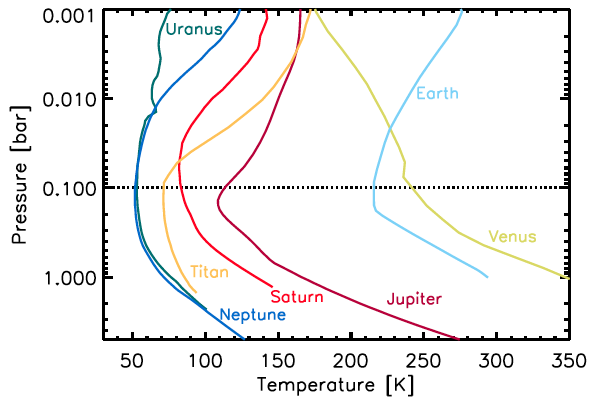
But wait, there's more! We are now saying that the temperature at the same pressure (1 atm was given) should only depend on the distance to the star. Clearly, given the graph in the previous post, this would be a coincidence; the temperature profiles look nothing alike. But let's just see if the math works out. Venus is 339 K at 1 atm pressure, Earth is 288 K. So never mind about any of this pesky atmospheric physics stuff, in order to work out the temperature of one, we just need to know the temperature of the other and the ratio of their distances from the source. Starting with Earth...oh dear. That doesn't work out at all. Well I am sure it will work the other way around. Oh no! I'm afraid it's not looking good for this theory.
Which is good, because chemical composition makes a huge difference. Venus reflects most of the light that hits it; less than 10% reaches the surface. It also wouldn't make sense to throw out everything we know about atmospheric physics based on one data point. Why don't you take a minute to read about the reality of Venus' atmosphere, rather than spitting out mis-remembered and false talking points?
-
Re:Stop trying to win this politically
I didn't claim they were identical. I claimed that what differences were left were due to the distance from the star.
You managed to repeat yourself about seven times without saying what you meant. You are clearly confused about the subject, but it's nice how you can turn that around and claim it as someone else's problem.
It's good we're talking about just Venus now, because mentioning any other planets would make absolutely no sense. Mars' atmospheric pressure is
What is more, if you look at the temperature of Venus by altitude, you'll find that if you go up in Vensus' atmosphere by about a mile... call it the difference between Los Angeles and Denver... temperatures become tolerable for humans.
Before you say something like this you might want to verify it. Because if by "about a mile" you meant "about 50 kilometers" You would have been a lot closer to being right.
But wait, there's more! We are now saying that the temperature at the same pressure (1 atm was given) should only depend on the distance to the star. Clearly, given the graph in the previous post, this would be a coincidence; the temperature profiles look nothing alike. But let's just see if the math works out. Venus is 339 K at 1 atm pressure, Earth is 288 K. So never mind about any of this pesky atmospheric physics stuff, in order to work out the temperature of one, we just need to know the temperature of the other and the ratio of their distances from the source. Starting with Earth...oh dear. That doesn't work out at all. Well I am sure it will work the other way around. Oh no! I'm afraid it's not looking good for this theory.
Which is good, because chemical composition makes a huge difference. Venus reflects most of the light that hits it; less than 10% reaches the surface. It also wouldn't make sense to throw out everything we know about atmospheric physics based on one data point. Why don't you take a minute to read about the reality of Venus' atmosphere, rather than spitting out mis-remembered and false talking points?
-
Re:They should all be fired!
Well, if the terrorists were also able to obtain an equal amount of antimatter, they could liberate about the same amount of energy as you would get from burning 4 gallons of gasoline. You'd also have to worry about 6360 decays per second, which is about as much radiation as you emit. Pu-239 emits quite a bit of radiation per decay, a total of 207.1 MeV of various neutrons, gamma rays, and fission fragments, which is about
The big question though would be, if you made a miniature fission bomb out of it, what would the yield be? Sorry to disappoint, folks, but this is probably not possible. "A spherical untampered critical mass is about 11 kg (24.2 lbs), 10.2 cm (4") in diameter". Calculating the compression required to make the sample mass critical would be nontrivial, but it's well into the "diamond anvil" range, and far beyond what is possible with explosives. Plutonium compresses relatively well, for a metal, but not that well.
So, in order to avoid the biggest health risks associated with this sample, I recommend that you not eat it.
-
Re:They should all be fired!
Well, if the terrorists were also able to obtain an equal amount of antimatter, they could liberate about the same amount of energy as you would get from burning 4 gallons of gasoline. You'd also have to worry about 6360 decays per second, which is about as much radiation as you emit. Pu-239 emits quite a bit of radiation per decay, a total of 207.1 MeV of various neutrons, gamma rays, and fission fragments, which is about
The big question though would be, if you made a miniature fission bomb out of it, what would the yield be? Sorry to disappoint, folks, but this is probably not possible. "A spherical untampered critical mass is about 11 kg (24.2 lbs), 10.2 cm (4") in diameter". Calculating the compression required to make the sample mass critical would be nontrivial, but it's well into the "diamond anvil" range, and far beyond what is possible with explosives. Plutonium compresses relatively well, for a metal, but not that well.
So, in order to avoid the biggest health risks associated with this sample, I recommend that you not eat it.
-
Re:They should all be fired!
Well, if the terrorists were also able to obtain an equal amount of antimatter, they could liberate about the same amount of energy as you would get from burning 4 gallons of gasoline. You'd also have to worry about 6360 decays per second, which is about as much radiation as you emit. Pu-239 emits quite a bit of radiation per decay, a total of 207.1 MeV of various neutrons, gamma rays, and fission fragments, which is about
The big question though would be, if you made a miniature fission bomb out of it, what would the yield be? Sorry to disappoint, folks, but this is probably not possible. "A spherical untampered critical mass is about 11 kg (24.2 lbs), 10.2 cm (4") in diameter". Calculating the compression required to make the sample mass critical would be nontrivial, but it's well into the "diamond anvil" range, and far beyond what is possible with explosives. Plutonium compresses relatively well, for a metal, but not that well.
So, in order to avoid the biggest health risks associated with this sample, I recommend that you not eat it.
-
Re:Who is this for?
People will find ways to use it. I remember multiple points in my life where I would get some new piece of technology (RAM, CPU speed, disk space, bandwidth, etc.) and remark that I couldn't possibly utilize it fully. Inevitably, I always reached a point where I was not only utilizing it, but I was aching for more.
A good historical example is streaming video. I never imagined watching movies and TV shows online when I had a 14.4 Kbps modem as a kid. Once broadband became popular, however, everyone started doing it - to the point where many people I know have dropped TV subscriptions entirely because they can just stream everything.
One thing that could immediately become mainstream in the future: nightly, off-site backups. Transferring 1 TB of data over a 10Gbps line takes just under 15 minutes.
-
Re:more NOS and less lense flare
I was going to be all, "Oh yeah, it's gonna take.."
-
12,125 PSI pressure at that depth
12,125 PSI pressure at that depth. Surface pressure is 14.7 PSI.
1) Source for ocean depth pressure at 8145m.
2) Source for atmospheric pressure at earth's surfaceIt's totally dark down there. No light except the occasional bioluminescence. It's like an off-world environment. Makes me wonder where else life can exist.
-
Re:100 TB @ 100 MBit/s == 12.5 days
For nontrivial math, I don't always trust Google's interpretation of the question to be the same as mine. That page is a little short on details of what it's actually doing. On the other hand, WolframAlpha is really good about showing its work. I just always forget that it's there.
In either case, yeah, I like doing it the hard way. Or as I call it, "learning" or "practicing".
-
Re:4896?
Choose a sauce (1 of 3)
Choose a cheese (1 of 2)Choose 1, 2 or 3 toppings out of the 18 remaining
= 4896On wolfram
(Captcha: Instruct) -
Re:light speed
So, about 25 MPH (that's 40 km/h or 11m/s for the rest of you). First Harvard and Rowland got it down to 17 m/s and then Lene Vestergaard Hau figured out how to stop and restart it entirely.
TL;DR: Mission accomplished.