Slashdot Mirror
Domain: wolframscience.com
Stories and comments across the archive that link to wolframscience.com.
Comments · 96
-
Key Aim
Another (perhaps the most important) goal for this type of research is a bit more subtle than replacing the Hypothesis->Experiment->Analysis->Hypothesis sequence (Scientific Method) by computers. There will still be many experiments for which human insight is the best tool for deciding a possibly fruitful idea. However, humans (i.e. grad students, who often might suggest 'workhorse' as a better nominative) are not only slower at data analysis, we are severely limited in our abilities to 'see' patterns and correlations in very high dimension data. This has traditionally limited hypotheses to extensions/reworkings of the proposed process at work in a single experiment. If computers have access to both the data and a weighted list of most likely hypotheses for subsets of the entire oeuvre on a specific subject, they could run statistical classification and pattern matching algorithms to suggest new hypotheses based on immense amounts of information. Some of these may involve a large number of variables or inputs, but there are two very significant possibilities that make this research (and certainly other projects involved in similar applications) highly significant:
1) These complicated hypotheses could still be tested relatively easy by human scientists because most computer suggestion systems for new hypothesis possibilities would likely suggest a few tests that would help to support/disprove these new hypotheses.
2) Even more simplification comes from the fact that experiments may not need to be repeated nearly as much as they do now in order to make a hypothesis -- there is an incredible amount of data already gathered, and typical AI/pattern matching algorithms keep some of the data back for testing later. If the system finds a possible hypothesis on some level, experiments as to that concepts validity have essentially already been done in a virtual sense.
3) If the somewhat positivist version of current thought in physics http://www.toequest.com/, mathematics, chaos theory, complexity theory, cellular automata http://www.wolframscience.com/nksonline/toc.html, etc. is even vaguely valid, it is quite possible that, despite the complexity and dimensionality of the input data, the 'best' hypotheses developed even by purely automated means might still be simple and elegant and/or even yield insight into possible explanatory processes rather than just statistical indicators. This would be a valuable and beautiful victory for humanism and the importance of science as a truly elegant description of the world around us. -
Re:Just another point of viewSpeaking of turbulence, I am not an expert, but I remember reading about the problem of turbulence in Wolfram's "A New Kind Of Science" book about it. He approached the problem from a CA point of view and got some interesting results. here is the chapter on it.
At the same time, I have to say it is Wolfram, the self proclaimed pioneer and genius, who wrote a book full of proofs that start with "I am quite convinced..." or "It seems to me...". But nevertheless some of the stuff he did is quite interesting. I think fluid flow is one those things.
-
Re:That's a pretty bold statement...
For starters mathematics isn't a science - it tells us nothing about the physical world, mathematics is a tool, nothing more, nothing less. I have the highest esteem for mathematics, but it's not science.
Stephen Wolfram and many other mathematicians would disagree. Mathematics has moved on since you took Calculus 101.
Recent work on complex systems indicates that mathematical fundamentals have a more direct influence on the shape of the physical world than the current generation of physicists accepts. This is expected because mathematics is formulated using our experiences of the physical world. Wolfram's book was righly criticised in Nature and is extremely long winded. However, it is the most significant book which attempts to demonstrate this direct influence which is not written by Mandlebrot.
Many physicists think that mathematics is nothing more than a tool, albeit an essential one. The closest analogy to this assertation that I can think of would be a technician describing a physics textbook as 'just a tool' because he is using it to force down a switch on a broken oscilloscope. In this situation, the textbook reveals how the oscilloscope is constructed but it can also be used to get things working. -
Re:What happens to these kids?
Remember that Sarah chick from Ireland that was a "crypto prodigy"? Yeah, she fell off the radar something hard. Never published, never pokes up in discussion forums, etc.
Hey, she's been busy.
http://www.wolframscience.com/summerschool/2003/pa rticipants/flannery.html
"At present she is working for Wolfram Research." -
Re:Even open source software is a bad idea
terminals which print out an ink ballot
That's part of the push for open source voting systems - you have a hard copy for verification.
The crux of the problem with electronic voting system is: How do you
A) Guarantee the anonymity of a particular voter from the voting machine?
B) Allow a voter to later confirm that their vote was, in fact, part of the final tally?
One way I thought of was to use the reproducable "random" numbers produced by cellular automata algorithms as concieved by Stephen Wolfram can be used to provide a repeatable, random, verifiable identifier that can tie a voter to a vote without any obvious marks on the voting stub at all.
One of the beauties of this system is that, even with partial data, you can still do a reasonable validation of the accuracy of a run of votes from a particular machine. (easily audited, hard to spoof, and easy to verify results thereafter) -
Over 200 papers cite NKS, 1000s cite earlier work
Hey buddy, over 200 scientific papers cite NKS: http://www.wolframscience.com/reference/bibliogra
p hy.html
Wolfram's earlier papers on cellular automata have literally thousands of citations.
What have you produced lately? -
Re: Wolfram
In closing I have nothing against the work Wolfram has done. It's the way he treats it that irks me.
-
Re:differential equations?
Complex behavior from simple rules is different. A simple model could include the concept that the earth orbits the sun rather than vice versa, while simple rules could be as simple as, "look at your predecessor and his neighbors who are all either black or white, and based on their colors, choose a color for yourself from the set {black, white} (256 rules total)."
More here:
http://www.wolframscience.com/nksonline/chapter-3 -
Provable != Science. THINK Godel, Aristotle...
What are all these comments about 'science' being demonstrated by provable theories/laws/etc? A quick search of the posts revealed not one mention of Godel's Incompleteness Theorem. If that theorem does not give one pause for thought, then one is profoundly ignorant. It's impact? Well:
a) NOT everything that is true is provable. There might be a God and that God may well have designed the universe. A scientist might poo-poo the concept as a religious loop hole. But a scientist should also know that there will be non-God related truths that will not be provable. Will those be poo-poo'ed as well? Or are those acceptable because there aren't religious overtones?
b) Arguments that we get unforeseen complexity without design are flawed. The complexity is unforeseen, but simple experiments suggest that there is design i.e. the simple intial rules. There have to be some rules and where did those come from? The source may be undeterminable from within this system (universe).
Most posts seem to be a knee-jerk reaction against religion. But religion, philosophy, and science cannot help but be profoundly intertwined. Anyone who has excelled in any of those fields knows this.
Rather than condemn Intelligent Design off-hand, read about it. Think about it. (Can you see where it's roots are? Maybe Aristotle , Aristotle
.) Then at least you can condemn it intelligently. -
No No No
We need to be thanking Stephen Wolfram, the inventor of CELLULAR automata
-
Kelly told more of the people story
But the world changed while he was writing Out of Control largely due to the exaggerated importance placed on Mitchell, Hraber and Crutchfield's 1993 paper which cast aspersions on Langton's lambda and implicitly on the whole notion of "border of order--edge of chaos".
Wolfram's reunification of his own old Class 3 and Class 4 under his more recent Principle of Computational Equivalence goes even further in a direction I'd rather see us retreat from.
I actually read the book by Johnson reviewed here for contrast while I was wading through Wolfram's tome. Emergence now sits among a very small pile of books I keep on my desk in case I need to refer to them. A New Kind of Science also sits on my desk, but mainly to elevate my iBook, especially since Wolfram made the whole book I available online. I had to grab Out of Control off the living room bookshelf, but it still ranks as my favourite from the '90s. -
Re:Like programming?
Uhhhh, yeah!
-
Re:MODERATORS - plagiarism / karma whore
-
Re:He'd post AC
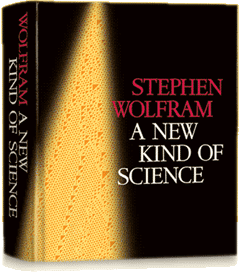
See also: A New Kind of Science"
-
Re:3rd body problem?
-
Conflating professionsIn this respect, Marconi was much more of a craftsman and businessman than a scientist.
I wonder how you would classify Edison, with 1368 patents to his name but no formal scientific pedagogy.
A lot of scientists incorporate & turn into businessman/scientist - eg Benjamin Franklin, Dr. Stephen Wolfram ( Founder of Mathematica ), Dr. R & Dr. A ( invented the RSA cryptographic scheme, Carl Sagan, and a whole lot of people in biotech.
The skillsets to be both seem conflicting - businessmen need a Machiavellical sense of brutal realism, while scientists are pursuing truths in the gentler idealic realm of Plato.
-
Re:We are still far from "the end of physics"
Probably the most useful recent summary is: Irreversibility precedes reversibility.
As always, a more comprehensive presentation is on my TODO list.
-
Re:Is it meTo me, it makes more sense that the real workings of the universe would be incredibly simple rather than complex.
-
Re:Lisence
I don't see any kind of Commons license mentioned.
Looks like a standard (non-free) copyright page. -
Re:fantasy? ya rightIt's quite possible, though perhaps not in the immediate future.
Read A New Kind of Science.
Although that work barely mentions nanotechnology, it shows that the key to making such 'fantasy' assemblers will be encoding the entire behavior in a relatively simple set of rules and a particular initial condition. Once a basic molecular assembly structure is in place, the rest is just a 'simple matter of programming.'
-
I just purchased my first ebook last week
I purchased the previously
-
Er, no.
Well, yes and no. At the low end, any non-famous band cutting their own CDs is something of a novelty exercise and are not likely to make any actual money off the matter.
But: the way that bands actually get famous is for people -- lots of people, in places other than just the band's home city -- to hear their music. MP3 distribution can only get you so far; ideally you really want college radio DJs playing your stuff, and telling their listeners where to get it. For that, you need CDs. Pressing and distributing your own CDs is an incredible waste of time and money; cdbaby very cleverly automates the process and makes it quite affordable.
And: while basically nobody buys novelty-press books (unless the author is a multimillionaire self-promoting blowhard), lots of people buy indy-band music. Enough to make a living on? Probably not. Enough to buy the occasional new instrument? Hell yes. -
So marriage explains it?
That must be the reason for the lackluster book A New Kind of Science by Stephen Wolfram.
-
My opinion
Computing is already helping biology, like with protein folding. This is only going to get stronger.
Biology may help build better computers, either by "growing" things like media, or with nanotechnology indistinguishable from biology being used to grow chips.
However, the "ultimate" convergance of a biological computer is not going to happen, except perhaps in an isolated sense where it can be made cheaper to grow a computer. The problem with biological computing is that generally we want to compute, not be awed by the biology. (Far, far too many people when trying to imagine the future get sidetracked by the "awe" factor, but the "awe" factor is not a long-term factor.)
"Pure" biological computing has an unavoidable disadvantage vs. non-biological computing: It's biological. Which is to say, you need an infrastructure to keep the biological part alive, which the non-biological solution does not need. This is an intrinsic flaw which can not be overcome except by leaving the biological realm. By the time we could build the "biopacks" seen in Voyager, we'll be able to build something much better that isn't biological. The part of the system keeping the biopack not only alive, but in the quite-likely narrow environment it will actually "work" in, would be better spent on actually doing the computation.
Biological systems are astonishingly redundent, but that's just not necessary for non-living systems, where cracking the system open, repairing it, and reassembling it and expecting it to work isn't that big a deal. Do you think twice about repairing your car that way? Since it is of no particular consequence if a computer "dies" briefly, there's just no need for the astonishingly complex low-level redundency and healing capabilities in living systems.
A pure, 50-50 convergance is a chimera. Both fields will be helping each other, computing probably helping biology more then the opposite, but total convergance is not going to happen. "Every discipline inevitably thinks of itself as the most fundamental." Computer science isn't exempt, and I know biologists feel that way. But a dispassionate examination shows there are fundamental differences such that the only way they are going to "merge" is if biology ends up being redefined to be the same as "nanotechnology" and includes things that we do not currently consider "biological".
Which will probably happen, but it's not the sense you're asking about right now.
BTW, "genetic" computing is mostly a side-show. It's practical significance is virtually nil. It looks cool, but it's slow as all hell and unreliable to boot. (What, slow you say? Yeah, it takes forever to set up the problem. Sure, it runs quickly after that, but it's disingenuous to dismiss the setup time, which while certainly possible to accelerate, will almost by definition take longer then checking the answer directly.) Current machines can already stomp the performance of any pure genetic computer you can imagine. (Note this very distinct from a machine that some genes may grow; be sure you know what these terms mean before you criticize this post, all you budding Slashdot biological computing experts.
A lot of other existing "biological computing" is mostly a side-show too; cute, but it takes some serious trips into fantasy-land to come up with a practical application that will actually beat the non-biological competition.
To the extent you care about my opinion, and remember, you asked, I would not advise getting too far involved in this field.
(Now it's entirely possible that in the process of researching a pure biology computer that something interesting could be learned. I also think pure quantum computers are impossible but the research is useful and useful hybrid solutions will be developed, so the research is not a waste. But on a personal level, I would still not want to actively pursue something that's unlikely to be possible.) -
A new kind of science
A lot of people are saying "Nothing new here, these are just gene feedback loops," "this will pale in comparison to the power of sillicon" and "when can I customise my own bizarre pet."
They're missing the point.
I think that the most exciting thing about this research thrust to make packages of genes that you can plug into a genome and expect to see it work is that it is concurrant with Stephen Wolframs's A New Kind of Science.
Sure Wolfram claims to have invented everything from Mathamatica (fair enough) to Occam's Razor (at one point he sagely counsles us to use simpler cellular autonoma to get the desired result and forget the more complicated ones), but the exciting thing is that the book does give interesting examples of how to use cellular autonoma to solve real world problems which are poorly suited to math.
The cellular autonoma that he proposes operate by looking at their ancestor cell and the cells which surround them and then looking up a table of rules to determine what properties they will have. We can do this now with real cells using short range hormones and making the output something like turning on a Green Fluroescent Protein gene.
Wolfram is trying to use a computer with one or two processors to simulate an exponentially growing colony of cells. this means that he runs out of computing resources at an ever increasing rate.
With real cells, the processing power grows with each iteration, because each new cell takes care of its own housekeeping. Just add nutrient.
So borrow the book, read it and then you can see the revolution on your hands if we manage to produce something as dumb as non-motile procaryotes which are able to take the average of the hormonal output of their three nearest cells and then change colour.
-
Original paper
If you want more than the Space.com article, read the PDF preprint entitled "Lack of observational evidence for quantum structure of space-time at Planck scales".
Just so people understand what's going on here, this work affects the many (untested) theories that posit some kind of "quantum of distance". There are two basic reasons that people are considering these types of theories:
- At very short distance scales, the two great physical theories of general relativity and quantum mechanics (the Standard Model) are incompatible. Something interesting must occur on the scale of the Planck length = 10^-35 meters.
- Many physicists have an intuitive distaste for the infinite amount of information required to specify the location of a single particle, in a truly continuous universe. Some view the universe as some kind of cellular automaton, again giving rise to a discrete grid and "quantum of distance". Proponents here would be (maybe) Feynman, Fredkin, and (most recently) Wolfram.
Anyway, what the current work does is put a bound on the "graininess" of space. Pretty clever, if correct.
-
This method......and what seemed like an exhausting list of others was covered in lengthy detail in Stephen Wolfram's "A New Kind Of Science" (IIRC, in the section on perception and analysis - but referred to in myriad ways throughout the volume).
Now, I know I will either be flamed or derided for bringing up the mention of this text. I don't claim to be an expert on it (in fact, the scope and breadth of the reading convinced me that one time through is no where near enough - I will probably re-read it several more times in my life). I also know that his work both extrapolates and builds upon previous work - he mentions this repeatedly throughout the book.
If you are at all interested in this sort of thing (and let me tell you this, his book covers much more than just using compression algorithms to determine patterns created by biological processes), you owe it to yourself to read, in full, the book at least once.
-
Is anything really random...?Or is it just that the "universe" and everything in it is defined by a massive Turing machine cellular automata that has been running for a very, very long time?
I know I am going to be flamed for this, but this very topic is discussed at extreme length in Stephen Wolfram's book, "A New Kind of Science". He specifically goes on end about a particular one-dimensional cellular automata, "rule 110" (IIRC), which seems to produce randomness, but which is based off of a small handful of simple rules, and a base starting condition of a single black pixel. He demonstrates in excruciating detail how, no matter how complicated you make a system, that all such systems can be brought back to the set of simple one-dimensional CAs. He demostrates how Turing machines can be set up (via initial starting conditions - not just a single pixel) which use these same CA to perform Turing machine calculations - thus these same CA can, in theory, execute (albeit very slowly) and emulate any current computer or program in existance today. He names this "the principle of computational equivalence".
He explores at great length how systems that are seemingly random can actually be simulated by these self-same CAs, which are based on simple sets of rules - blowing away the time-held notion that complexity arises from an underlying complex ruleset. It stands to reason that given the ruleset, and a result output from the CA, one can work back to the initial starting conditions - the problem arises in that we may only have the initial conditions, figuring out that ruleset is (probably) impossible.
He explores our current methods of perception and analysis, and shows how while our current methods of analysis show that something is random, as humans using our senses we have an affinity for picking out what look to be like patterns - he seems to make the point (unless I have misinterpreted him - which is very likely) that it isn't our senses decieving us, it is our methods of analysis that are incomplete. He also presents ideas and thoughts on how we can overcome these limitations.
The book is much more than that, however - I have read articles dismissing the work as everything from a form of plagerism (at worse) to restating others thoughts (at best). I do not believe this is the case. While it is true many others in the past have played with CAs, what Wolfram has done is go that extra step, building on these ideas and bringing them all together under one umbrella of thought. He acknowledges this throughout the book.
Anyone interested in these topics and others tangent to them owes it to themselves to read Wolfram's book and come to their own conclusions. I honestly believe he is on to something, which could have profound effects in the future (perhaps far in the future, but much sooner if we read it and understand it now).
Other related links:
Collection of Reviews on ANKOS
Stephen Wolfram's Web Site
ANKOS Web Site -
This was predicted by Wolfram's Cellular Automata
After having read Stephen Wolfram's A New Kind of Science, I see more and more how amazing his book is. This DNA-fractal mechanism is exactly what he talks about in his book when he explains how all this complexity we see in life and the universe itself actually arise from much simpler structures which simply apply a simple computation over and over again (in this case, like a Fractal Computation) to obtain complex behavior.
If such patterns are indeed found in DNA, it will only provide more evidence to support Wolfram's theories (and I trully hope a Nobel prize is waiting for him). -
This behavior is predicted by Celullar Automata
This pattern of behavior (where two completelly different things show the same underlying behavior and/or explanation) is exactly one of the things that Stephen Wolfran is trying to explain in his book A New Kind of Science (see amazon link and reviews here)
Basically, everything in the universe can be explained as a huge network of nodes, where all these node do is computations following very simple rules. From such simple rules we get all the laws of physics, human behavior, chaotic behavior, and in this case the behavior of an earthquake and Internet traffic. -
Re:REAL Artificial Intelligence?
slashkitty: I see a fundamental difference between scripted intelligence (which evidently is perceived as 'real') and artificial intelligence with reasoning.
I would dare saying that one could emulate Real Intelligence through a complex algorithm, which is one of Stephen Wolfram's arguments in his A New Kind of Science. Intelligence is a complex function on many levels, one of which is what is perceived. And am waiting for an AI-bot that not only Seems to reason, but actually knows it's reasoning.
Interesting project of yours, by the way. -
Re:Not likelyYou are assuming no infinite regression of causes. There is no reason to believe that the universe did not exist forever. Really: Why must it be bounded by a beginning or end?
I thing the Wolfram book A New Kind of Science talks about it. I'm not up on cutting edge theories of everything, so we'll see what happens in the next 50 years. But keep in mind this kind of theory goes against all knowledge ever directly observed - all things have a beginning, all things have an end. As it stands this exact moment, there are plenty of reasons (data like Doppler shifts) to believe the Universe is expanding forever and only theory to describe why there will be a Big Crunch.
-
ANKOS to the rescue!
I'm only on chapter 4 of Wolfram's opus 'A New Kind of Science' but reading about the Riemann Hypothesis just screams out connections with Wolfram's work. ANKOS is littered with these odd little diagrams of cellular automata, many of which exhibit prime number relationships.
-
ANKOS to the rescue!
I'm only on chapter 4 of Wolfram's opus 'A New Kind of Science' but reading about the Riemann Hypothesis just screams out connections with Wolfram's work. ANKOS is littered with these odd little diagrams of cellular automata, many of which exhibit prime number relationships.
-
When you've been developing it for 15 years
I don't expect it is too hard to get it to do whatever you want it to do.
Theo has been a key member of the Mathematica development team since day one.
Early on he was looking at defining its graphical user interface using Mathematica itself, and it isn't all that far from GUI to Web site and book design. -
Our bodies DO compute
Every second of every day, our genetic material and their supporting machinery regulate an inimaginable number of complex chemical pathways by carrying out the entire range of sensing, analysis and control. If they didn't, we'd just be a mush of amino acids.
Machinery that regulate chemical processes in our bodies are an inherent part of the processes themselves. In fact, it's productive and enlightening to think of biological systems as computational and chemical processes within them as algorithms. Researchers like Prof. Erik Winfree at Caltech are beginning the difficult process of applying this insight into research.
Due to the difference between the environment that DNA computers require and the environment supported by the modern infrastructure we have built for computing, the type of DNA computers studied in today's laboratories will never replace the silicon chip. Also, unlike quantum computing, DNA computing does not offer exponential growth in computing power with the number of elements used. However, DNA computing may find a niche in bioinformatics by offering a way to probe, analyze and ultimately control complex biological processes in vitro.
Hence, research into DNA computing may offer us a way to understand, interact with, and ultimately control nature's algorithms in biological systems.
The challenge for computation over the next century is to overcome barriers in the shrinking of circuit size for conventional computers, create practically useful quantum computers, apply conventional and quantum computers along with experimentation to understand the role of computation in complex processes (notably biological systems), and use the understanding gained to create a unified architecture for computation that will allow us to embed synthetic algorithms into every complex dynamic system we design and create and extend our control to the atomic level. When that happens, nanotechnology will finally fulfill its promise.
Stephen Wolfram, Erik Winfree, Hideo Mabuchi, Jeff Kimble, John Preskill, Bill Goddard, Isaac Chuang are leaders on the bleeding edge of computation. There are many many others I don't know about.
On that note, I will end my foray into wild speculation.
-
Re:Don't read this post
Hey, I admitted up front that I had not "read" ANKOS (as in, "think about and consider the subtlties of every single word the author has written") because to do otherwise and claim I HAD read the book would generate 10 times the number of negative comments saying, impossible, the reviewer is just blowing smoke. It was meant as a flag to take the review that follows with a grain of salt, altho I ***do*** think what I wrote is a pretty good summary of what a reader will find when they pick up ANKOS for the first time. The release of ANKOS is news - lots of people have been waiting lots of years to see it. Wait until a true "reviewer" has really "read" ANKOS and it's no longer a current event - hey, journalistically it's a damned-if-you-do-and-damned-if-you-don't situation. At least I was up front with what the true situation was and produced something (I think) worthwhile as an orientation to ANKOS. The real next step, as pointed out elsewhere in these posts, is to go straight to the horse's mouth and for Slashdot to interview Wolfram...his contact info is here.
-
Hermit Syndrome
I guess if you spend 20 years studying one topic, it inevitably becomes the answer to the universe. From the ANKOS web site
And in fact what I've discovered is that some of the very simplest imaginable computer programs can do things as complex as anything in our whole universe.
I think Feynman and Hawking would disagree. Quantum mechanics is proving classical computers can't exactly simulate even the tiniest building block, the atom.
things in our universe somehow follow rules that can be represented by traditional mathematical equations. The basic idea that underlies A New Kind of Science is that that's much too restrictive, and that in fact one should consider the vastly more general kinds of rules that can be embodied, for example, in computer programs.
Anything that can be done in a computer program can be expressed mathematically.
Point being, it is not the answer to everything Wolfram seems to tout it to be. And I have not even seen the book. But I'm sure it's an exhaustive study of a fascinating subject. -
Re:INTERVIEW WOLFRAM!
Now THIS is a really good idea. Taco, Timothy...or anybody else that just wants to go straight to The Big Guy...the contact info for Wolfram is here...
-
The proof is in the criticisim
The critics of great ideas, like those of Erich von Daniken , Noam Chomsky and Emmanuel Goldstein all say the same things about them that you say about Stephen Wolfram and this new breakthrough.
So now who's the crank?
Ooops! wrong article sorry!
-
Ahem...
This means he's almost certainly a crank.
The critics of great minds, like Erich von Daniken, Noam Chomsky and Emmanuel Goldstein all say the same things about them that you say about Stephen Wolfram.
So now who's the crank?
Thank you -
link:http://www.wolframscience.com
Hey, look there is this search engine called google.
In addition to the amazon page with sample content is
http://wolframscience.com
which has sample content and links the other links you might want handed to you if you're a slashot wanker. -
Re:A shallow review of a shallow book
Agreed. Incidentally, I have high hopes for A New Kind of Science. Undoubtedly, it'll contain more than its share of speculation. But, hopefully, the majority will be well-supported by verifyable experimental results.
-
Re:A shallow review of a shallow book
Agreed. Incidentally, I have high hopes for A New Kind of Science. Undoubtedly, it'll contain more than its share of speculation. But, hopefully, the majority will be well-supported by verifyable experimental results.
-
Un Anticipated ConsequencesThis all seems to be fall out and unanticipated consequences of various things:
1) the various quantum tunneling experiments, where the Mozart 40th Symphony was transmitted through solid metal at several times the speed of light. There is a good link here. There was even a NOVA special or something on that (see that transcript here, - info about 2/3rds into the material)
2) maybe something involving the research of Steven Wolfram (developer of Mathematica), as seen in his forth coming book A New Kind of Science, which is very geeky, very bizarre, and right up this alley, and is supposed to be a rethinking of the very fundamentals of how science works. My head hurts already. This book is due for publication in January 2002, and is well worth pre-ordering.
-
Dragon Systems, Wolfram
Jim and Janet Baker founded Dragon Systems in 1982. (Course they did eventually sell to Lernout and Hauspie.) Stephen Wolfram founded Wolfram Research in 1987. Stephen Wolfram is about to introduce his new book to the world that will revolutionize all of science. In essence, by founding his company he funded his own research and created the tools he needed to complete it. And these are examples just off the top of my head, I'm not saying they're anywhere near the best.