Slashdot Mirror
Domain: wordpress.com
Stories and comments across the archive that link to wordpress.com.
Stories · 597
-
E-Books Are Only 6% of Printed Book Sales
An anonymous reader writes "MIT's technology blog argues that e-book sales represent 'only six pecent of the total market for new books.' It cites a business analysis which calculates that by mid-July, Amazon had sold 15.6 million hardcover books versus 22 million e-books, but with sales of about 48 million more paperback books. Amazon recently announced they sell 180 e-books for every 100 hardcover books, but when paperbacks are counted, e-books represent just 29.3% of all Amazon's book sales. And while Amazon holds about 19% of the book market, they currently represent 90% of all e-book sales — suggesting that e-books represent a tiny fraction of all print books sold. 'Many tech pundit wants books to die,' argues MIT's Christopher Mims, citing the head of Microsoft's ClearType team, who says 'I'd be glad to ditch thousands of paper- and hard-backed books from my bookshelves. I'd rather have them all on an iPad.' But while Nicholas Negroponte predicts the death of the book within five years, Mims argues that 'it's just as likely that as the ranks of the early adopters get saturated, adoption of e-books will slow.'" -
6.5-Foot-Long Anaconda Found In a Toilet
An anonymous reader writes "You open your eyes in the morning and go to the toilet. Raising the lid you see there is a snake. What would you do? Put the lid back? This is what the 73-year-old Polish citizen did when she saw a 6.5-foot-long reptile peering up out of her toilet." -
Game Publishers Using Stealth P2P Clients
An anonymous reader writes "TorrentFreak has shed some light on the dark practice of installing stealth-mode P2P clients during game downloads and using unsuspecting gamers' PCs as 'bandwidth slaves.' The clients operate in the background and largely go unnoticed until problems arise that are caused by overactive uploading/seeding. While the Akamai NetSession Interface and Pando Media Booster are specifically called out, there appear to be other offenders as indicated in the comments left by TorrentFreak readers. A publisher called Solid State Networks is putting out a call for an industry-wide 'best practices' effort to promote transparency, control and privacy on behalf of gamers who are otherwise being abused for their bandwidth without their consent." -
Will Amazon Put Advertisements In eBooks?
destinyland writes "A book editor at Houghton Mifflin argues ebook advertising is 'coming soon to a book near you.' (Paywalled unless you go through Google.) Amazon has filed a patent for advertisements on the Kindle, and the book editor joins with a business professor in the Wall Street Journal to make the case for advertisements in ebooks. Book sales haven't increased over the last decade, and profits are being squeezed even lower by ebooks. According to another industry analyst, Amazon is being pressured to make ebook sales more profitable for publishers, partly because Apple offers them more lucrative terms in Apple's iBookstore. One technology blog notes that Amazon's preference seems to be keeping book prices low, and wonders whether consumers would accept advertising if it meant that new ebooks were then free. Meanwhile, Ralph Lauren has confused the issue even more by publishing a 'shoppable' children's storybook online, prompting a fierce reaction from one blog: 'I hope it's the last. Books are one of the last refuges in our world from the constant cry by advertisers to spend money and fill our lives with unnecessary things.'" -
Possible Issues With the P != NP Proof
An anonymous reader writes "We previously discussed news that Vinay Deolalikar, a Principal Research Scientist at HP Labs, wrote a paper that claimed to prove P is not equal to NP. Dick Lipton, a Professor of Computer Science at Georgia Tech, analyzed the idea of the proof on his blog. In a recent post, he explains that there have been many serious objections raised about the proof. The post summarizes the issues that need to be answered in any subsequent development, and additional concerns are raised in the comment section." -
WordPress Creator GPL Says WP Template Must Be GPL'd
An anonymous reader writes "Matt Mullenweg (the creator of open source blog software WordPress), after review by various legal experts, is sticking to his guns that themes and plugins that 'extend' WordPress violate the GPL if they are not themselves distributed under the GPL. Matt has gone so far as to post this on Twitter. According to Matt, the premium template called Thesis should be under the GPL and the owner is not happy about it. WordPress is willing to sue the maker of Thesis theme for not following GPL licensing. The webmasters and Thesis owners are also confused with new development. Mark Jaquith wrote an excellent technical analysis of why WordPress themes inherit the GPL. This is why even if Thesis hadn't copy-and-pasted large swathes of code from WordPress (and GPL plugins) its PHP would still need to be under the GPL." -
UK Police Threaten Teenage Photojournalist
IonOtter writes "In what seems to be a common occurrence, and now a costly one, Metropolitan Police in the UK still don't seem to be getting the message that assaulting photographers is a bad idea. UK press photographer Jules Matteson details the event in his blog, titled The Romford Incident. The incident has already been picked up by The Register, The Independent, and the British Journal of Photography, which contains an official statement from the Metropolitan Police." -
ITER Fusion Reactor Enters Existential Crisis
deglr6328 writes "The long beleaguered experimental magnetic confinement fusion reactor ITER is currently in what some are calling the worst crisis of its 25 year history. Still existing only on the paper of thousands of proposed design documents, the latest cost estimates for the superconducting behemoth are soaring to nearly 20 billion USD — roughly twice the estimates from as recently as a few years ago. Anti-nuclear environmentalist organizations have seized upon the moment as an opportunity to use the current global economic crisis as a means to push for permanently killing the project. If ITER is not built, the prospect of magnetic confinement fusion as a technique to reach thermonuclear breakeven and ignition in the laboratory would be in serious question. Meanwhile, the largest laser-driven inertial confinement fusion project, the National Ignition Facility, has demonstrated the ability to use self-generated plasma optical gratings to control capsule implosion symmetry with high finesse, and is on schedule to achieve ignition and potentially high gain before the end of the year." -
Why Beatrix Potter Would Love a Digital Reader
destinyland writes "In 1906, children's book author Beatrix Potter tried creating her own new, non-book format for delivering her famous fairy tales. 'Intended for babies and tots, the story was originally published on a strip of paper that was folded into a wallet, closed with a flap, and tied with a ribbon.' This article includes a link to actual images from one of Potter's strange wallet-sized stories — 'The Story of A Fierce, Bad Rabbit' — plus an image showing you exactly what Beatrix Potter thought 'a fierce, bad rabbit' would look like!" -
EU To Monitor All Internet Searches
Xemu writes "The European Parliament is issuing a written declaration about the need to set up an early warning system to combat sexual child abuse. However, the substance of the declaration is to extend the EU data retention directive to search engines, so that all searches done on for example Google will be monitored. If you are a citizen concerned about the right to privacy and freedom on the Internet, you can help by sending e-mail to the MEPs from your country and explaining the issue to them." -
Apple Blindsides More AppStore Developers
For a while now Apple has said it doesn't want "widget-like" apps in the store; but where is the boundary of that fuzzy statement? The developers of My Frame, of which three versions had already been approved for the iPhone/iPad, found out that they had already crossed it when Apple informed them their app would be pulled. My Frame had options to overlay data on whatever photo was displaying: a Twitter stream, weather, etc. When one of the developers wrote to Steve Jobs on a whim to ask what unwritten rule their app had violated, Jobs wrote back: "We are not allowing apps that create their own desktops. Sorry." "I see now why people are so angry at the 'murky' nature of the App Store, and I'm starting to agree with them. My Frame was approved by Apple 3 times (once for each version we released), and ... now, at version 1.2 they decide it's to be removed? How can a company be prepared to invest into a platform that can change at any time, cutting you off and kicking you out, with no course of action but to whine on some no-name blog[?] There is no alternative platform, despite what others may say about Android, it's immature and their app store(s) are a wild west nightmare. It really is Apple's way or the highway...." A few blogs have picked up the story. -
iPhone's PIN-Based Security Transparent To Ubuntu
ndogg writes "Security experts found that the iPhone 3GS has very little security, even with a PIN set up. They plugged one into Ubuntu 10.04, and it was automounted with almost all of the iPhone's data exposed. This has been reported to Apple, but the company seems to be having difficulty reproducing the problem." -
Sudden Demand For Logicians On Wall Street
An anonymous reader writes "In an unexpected development for the depressed market for mathematical logicians, Wall Street has begun quietly and aggressively recruiting proof theorists and recursion theorists for their expertise in applying ordinal notations and ordinal collapsing functions to high-frequency algorithmic trading. Ordinal notations, which specify sequences of ordinal numbers of ever increasing complexity, are being used by elite trading operations to parameterize families of trading strategies of breathtaking sophistication. The monetary advantage of the current strategy is rapidly exhausted after a lifetime of approximately four seconds — an eternity for a machine, but barely enough time for a human to begin to comprehend what happened. The algorithm then switches to another trading strategy of higher ordinal rank, and uses this for a few seconds on one or more electronic exchanges, and so on, while opponent algorithms attempt the same maneuvers, risking billions of dollars in the process." -
Why We Still Need OSI
ChiefMonkeyGrinder writes "In response to a comment on yesterday's blog, Simon Phipps writes about the old rivalry between the Free Software Foundation and the Open Source Initiative (OSI). 'I have been (and in plenty of ways still am) a critic of OSI, as well as a firm supporter and advocate of the FSF. I believe OSI should be a member organisation with a representative leadership. ... But the OSI still plays a very important and relevant role in the world of software freedom.' For instance: Licence approvals have become a much more onerous process, with the emphasis on avoiding creation of new licences, updating old or flawed ones, and encouraging the retirement of redundant ones. It would be great to see the stewards of some of the (in retrospect) incorrectly approved licences ask for their retirement." -
First Full Science Results From Herschel
davecl writes "Today the first full science results from the Herschel Space Observatory were released, including results ranging from the formation and evolution of galaxies to the detailed physics of star formation. Details can be found from The European Space Agency, the BBC, and the Herschel mission blog that I help maintain. Briefer reports, covering rather more of the science, can also be found under the #eslab2010 hashtag on Twitter." -
SEC Proposes Wall Street Transparency Via Python
An anonymous reader writes "A US federal agency is considering the use of computing languages to specify legal requirements. 'We are proposing that the computer program be filed on EDGAR in the form of downloadable source code in Python. ... Under the proposed requirement, the filed source code, when downloaded and run by an investor, must provide the user with the ability to programmatically input the user's own assumptions regarding the future performance and cash flows from the pool assets, including but not limited to assumptions about future interest rates, default rates, prepayment speeds, loss-given-default rates, and any other necessary assumptions.' Does this move make sense? If the proposed rule is enacted, it certainly will bring attention to Python or other permitted languages. Will that be a good thing?" The above quotes were pulled from pages 205 and 210 of the dense, 667-page proposal document (PDF). Market expert and professor of finance Jayanth R. Varma says it's a good idea. -
Mexico Will Shut Down 25.9 Million Cell Phones
Several months ago, as a way to prevent the use of cellular phones in criminal activities, the government of Mexico started a program to require all phone owners to register cell phones in their own names. The registry associates each phone with the listed owner's Clave Unica de Registro de Poblacion (CURP) [CURP, in English], which is supposed to be a unique ID for every Mexican citizen. Now, as nanahuatzin writes, Yesterday the timeline to register the cell phones expired, and there are [approx 26] million cell phones yet unregistered (English translation of the Spanish original). While the procedure is simple, sending a text message with the CURP to a special number, most people do not want to register: some are wary of the uses to which the government will put the data; others did not understand or did not know the procedure. So far, only 69% have registered, most of them in the last few days, while the system to register has been oversaturated. So in an unprecedented move for any country, the Mexican government is announcing the shutdown of 25.9 million cell phone lines. Meanwhile, as a measure of protest, hundreds of people have registered their cell phones in the name of the president of Mexico, Felipe Calderon Hinojosa, to show how pointless is the registry." -
Arduino Assisted Mind-Controlled Television
andylim writes "Dcept905, aka Paul, has interfaced an EEG headset and an Arduino with an IR LED to control his television set with thought alone. 'I have finally gotten around to re-writing some of my old code and re-recording a proper demo of controlling physical objects using thoughts by interfacing an EEG headset with an Arduino. While this technology is interesting and exciting, before anyone sees this as an endorsement for this particular EEG headset, I strongly recommend reading my full review of the device.'" -
DoD Report On 32 "Nuclear Accidents"
natebjones writes "Remember the time the US Air Force accidentally dropped a nuclear bomb on a family in South Carolina? [This DoD report lists] that and 31 other nuclear accidents including: nuclear bombs inadvertently falling through bomb bay doors; the accidental firing of a retrorocket on an ICBM; the vast dispersal of radioactive debris; and the loss of enriched fissile material and nuclear bombs (which are 'still out there somewhere')." -
First Impressions of the 11th Doctor Who
Mirk writes "The first episode of Doctor Who's new series 5 has just aired on BBC1 in the UK. This is an important episode for the show because so much has changed: Matt Smith plays the new Doctor, replacing David Tennant, and Karen Gillan portrays a new companion, Amy Pond. Maybe most important, Russell T. Davies is replaced as showrunner by Stephen Moffat, who is known for acclaimed Doctor Who scripts including The Empty Child and Blink. Here is an early review of the new Doctor, companion, showrunner, and series." -
Planck Mission Releases Images of Galactic Dust
davecl writes "The Planck satellite has released its first new science images, showing the large scale filamentary structure of cold dust in our own galaxy. This release coincides with the completion of its first survey of the entire sky a couple of weeks ago. There's lots more work to be done, and more observations to be made, before results are ready on the Big Bang, but these images demonstrate Planck's performance and capability. More information is available on the Planck mission blog (which I maintain)." -
Programming the Commodore 64: the Definitive Guide
Mirk writes "Back in 1985 it was possible to understand the whole computer, from the hardware up through device drivers and the kernel through to the high-level language that came burned into the ROMs (even if it was only Microsoft BASIC). The Reinvigorated Programmer revisits R. C. West's classic and exhaustive book Programming the Commodore 64 and laments the decline of that sort of comprehensive Deep Knowing." -
Ex-Sun Chief Dishes Dirt On Gates, Jobs
alphadogg writes "Former CEO of Sun Microsystems Jonathan Schwartz has taken to his personal blog, provocatively titled 'What I couldn't say ...,' to dish some industry dirt and tell his side of the story about the demise of Sun. He has already hinted at plans to write a book, and a new post suggests a tell-all tome could indeed be in the offing. 'I feel for Google — Steve Jobs threatened to sue me, too,' Schwartz writes, apparently referring to Apple's patent lawsuit against HTC, which makes Google's Nexus One smartphone. As for Bill Gates, Schwartz says he was threatening regarding Sun's efforts in the office software space." -
The Value of BASIC As a First Programming Language
Mirk writes "Computer-science legend Edsger W. Dijkstra famously wrote: 'It is practically impossible to teach good programming to students that have had a prior exposure to BASIC: as potential programmers they are mentally mutilated beyond hope of regeneration.' The Reinvigorated Programmer argues that the world is full of excellent programmers who cut their teeth on BASIC, and suggests it could even be because they started out with BASIC." -
European Parliament Declaring War Against ACTA
An anonymous reader writes "The European Parliament is preparing to take on ACTA. A joint resolution (DOC) has been tabled by the major EP parties that threatens to go to court unless things change. The EP is calling for public access to negotiation texts and rules out further confidential negotiations. Moreover, the EP wants a ban on imposing a three-strikes model, assurances that ACTA will not result in personal searches at the border, and an ACTA impact assessment on fundamental rights and data protection." -
Whatever Happened To Programming?
Mirk writes "In a recent interview, Don Knuth wrote: 'The way a lot of programming goes today isn't any fun because it's just plugging in magic incantations — combine somebody else's software and start it up.' The Reinvigorated Programmer laments how much of our 'programming' time is spent pasting not-quite-compatible libraries together and patching around the edges." This 3-day-old article has sparked lively discussions at Reddit and at Hacker News, and the author has responded with a followup and summation. -
Whatever Happened To Programming?
Mirk writes "In a recent interview, Don Knuth wrote: 'The way a lot of programming goes today isn't any fun because it's just plugging in magic incantations — combine somebody else's software and start it up.' The Reinvigorated Programmer laments how much of our 'programming' time is spent pasting not-quite-compatible libraries together and patching around the edges." This 3-day-old article has sparked lively discussions at Reddit and at Hacker News, and the author has responded with a followup and summation. -
UK Bill Would Outlaw Open Wi-Fi
suraj.sun writes with this excerpt from ZDNet about another troubling aspect of the UK's much-maligned Digital Economy Bill: "The government will not exempt universities, libraries and small businesses providing open Wi-Fi services from its Digital Economy Bill copyright crackdown, according to official advice released earlier this week. This would leave many organizations open to the same penalties for copyright infringement as individual subscribers, potentially including disconnection from the Internet, leading legal experts to say it will become impossible for small businesses and the like to offer Wi-Fi access. 'This is going to be a very unfortunate measure for small businesses, particularly in a recession, many of whom are using open free Wi-Fi very effectively as a way to get the punters in. Even if they password protect, they then have two options — to pay someone like The Cloud to manage it for them, or take responsibility themselves for becoming an ISP effectively, and keep records for everyone they assign connections to, which is an impossible burden for a small cafe,' said Lilian Edwards, professor of Internet law at Sheffield University." Relatedly, an anonymous reader passes along a post which breaks down the question of whether using unprotected Wi-Fi is stealing. -
Free Netbook From Microsoft, Then Things Got Weird
paiute writes "Matt Karolian, a Marketing Communications major at Emerson College in Boston 'won' a netbook in a Microsoft re-tweet competition (whatever that is). Then the prize arrived, and it was not exactly the high-quality major award he had expected from Microsoft." -
Amazon Surrenders To Macmillan On eBook Pricing
CuteSteveJobs writes with a followup to news we discussed on Saturday of a disagreement between Amazon and Macmillan Publishers over ebook pricing: "Amazon has thrown in the towel and announced it will now sell books at Macmillan's increased prices; up to $14.99 from $9.99. Said Amazon in a statement: 'We will have to capitulate and accept Macmillan's terms because Macmillan has a monopoly over their own titles, and we will want to offer them to you even at prices we believe are needlessly high for e-books.' Macmillan has sensed Apple's iBooks opens the way for higher prices. Perhaps the question should be: do we even need publishers like Macmillian? Publishers have long managed to keep their old business model chugging along nicely despite the Internet; Academics are still forced to give up copyright (PDF) of their work in exchange for publication. Textbook publishers have a history of unethical practices like frequent edition changes, unjustifiable price increases and bribing teachers. For that matter, why do the RIAA's members still control the music business? Why do these dinosaur publishing businesses still manage to thrive despite the Internet?" -
The Economy of Wikileaks
StefanBerlin writes "Wikileaks is fast becoming one of the most politically important platforms on the Web. In this interview Julian Assange, the spokesperson, talks about its current situation and about the financial and economic background of Wikileaks. He also talks about why they cancelled the planned auction of the emails of Hugo Chavez's former speechwriter in Venezuela, and about Wikileaks' plans for a subscription model that could possibly solve the site's financial problems once and for all." -
Lego Router
An anonymous reader writes "The successor to the Lego computer is the Lego router, a case for the Linksys WRT54GL made entirely out of LEGO bricks. Check out the blog for all the details on how it was built, and to download the plans to make your own!" -
Lego Router
An anonymous reader writes "The successor to the Lego computer is the Lego router, a case for the Linksys WRT54GL made entirely out of LEGO bricks. Check out the blog for all the details on how it was built, and to download the plans to make your own!" -
The Environmental Impact of PHP Compared To C++ On Facebook
Kensai7 writes "Recently, Facebook provided us with some information on their server park. They use about 30,000 servers, and not surprisingly, most of them are running PHP code to generate pages full of social info for their users. As they only say that 'the bulk' is running PHP, let's assume this to be 25,000 of the 30,000. If C++ would have been used instead of PHP, then 22,500 servers could be powered down (assuming a conservative ratio of 10 for the efficiency of C++ versus PHP code), or a reduction of 49,000 tons of CO2 per year. Of course, it is a bit unfair to isolate Facebook here. Their servers are only a tiny fraction of computers deployed world-wide that are interpreting PHP code." -
Yes, Google Does De-List Pages; But When?
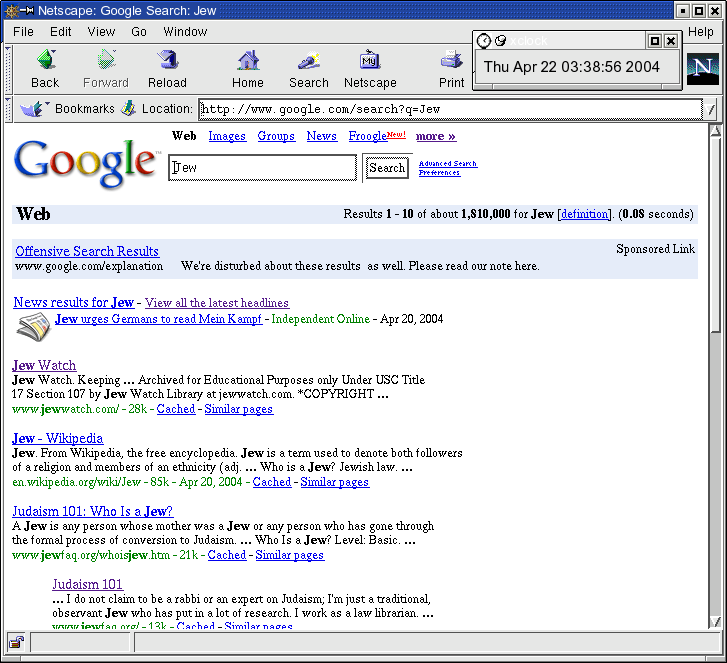
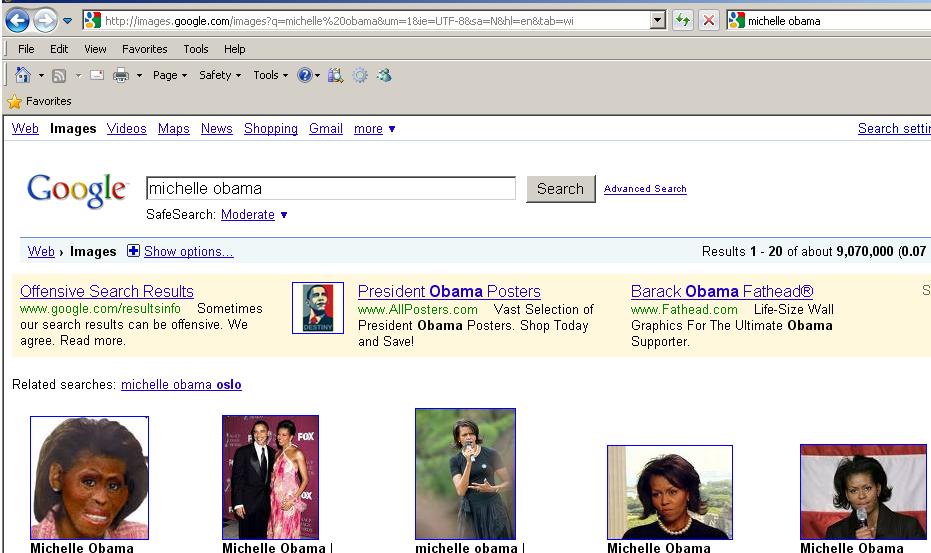
Frequent Slashdot contributor Bennett Haselton writes "Google finds itself inserting a disclaimer once again above some offensive search results. But the disclaimer still leads many to believe (incorrectly) that Google doesn't tamper with search results even in cases of 'harmful' or 'offensive' material. We know that Google has in fact de-listed some pages at the request of offended parties. What is their real policy on the issue?" Read on for Bennet's essay.In 2004, when Google users discovered that the top search result for the word "Jew" was the anti-semitic site Jew Watch, Google ran a disclaimer in the space usually reserved for ads, explaining that their results only reflected the reality of link counts on the Web, and that they did not endorse any Web sites which appeared at the top of their listings. Now the disclaimer has been dusted off again, as the top result on Google Images for "Michelle Obama" is a picture of a monkey's face with Michelle's hairdo. (Ironically, it looks as if the original image would have fallen out of the rankings, if it hadn't been for a follow-up blog post about the controversy, which itself now comes up as the first result.)
I first heard about the controversy from Dennis Prager's column in which he takes a New York Times columnist to task, because the columnist complained about "racially offensive images of the first couple" that come up in Google searches. Prager was unable to find any examples from Googling "first couple" or "Michelle and Barack Obama pictures," so he concluded that the NYT columnist "wildly exaggerated, if not made up" his claims. I tried Google Image searches for "first couple," "Barack Obama," and some other terms, and I couldn't find anything controversial either. However, it only took 10 seconds to enter "first couple google images controversy" on the regular Google Web search and find multiple blog posts explaining what all the fuss was about. Back to Google 101 for Dennis.
Many of the blog posts refer to Google's disclaimer about not tampering with search results. Those on one side are urging Google to make an exception and "fix" the results, while others sagely observe that Google just reflects reality, it doesn't create it.
All of this punditry is starting from a premise that's wrong. Google has actually removed pages from their search results — not because the pages were illegal or because the webmasters were search engine spamming, but because of the page's "offensive" content. In the "Chester's Guide" incident, a councilman in Chester, England discovered that one of the search results for "chester guide" was a satirical page titled "Chester's guide to picking up little girls." Although the page itself was obviously just someone's idea of sick humor, a Chester city councilman (who admitted that he hadn't looked at the page, saying that the title told him everything he needed to know) urged Google to remove the page from their index. Google at first refused, but later manually blacklisted the page to prevent it from appearing in their search results.
Whether or not you think this was the right decision, probably depends on what you think is the purpose of Google. If Google's purpose is to return the most useful results, then it made sense to remove the link, as Danny Sullivan of Search Engine Watch argued at the time, since it almost certainly was not a useful result for people searching for "Chester Guide." On the other hand, if the primary purpose of Google is to reflect the reality of what pages on the Web feature certain words most prominently (combined with all the other factors that Google weighs, of course), then the results shouldn't be altered.
But more people should at least realize that it happened. The Google disclaimer doesn't precisely say that they never blacklist pages or modify search results ("Google reserves the right to address such requests individually"), but it seems to give most people the impression that that's the case. According to that crudest of Googling techniques for which novice searchers are so frequently lampooned, there appear to be about 400 times as many stories on the Web about the Google "Jew Watch" controversy (where Google stood their ground) as there are stores about the "Chester's Guide" incident (where Google caved).
And Google-number-three Matt Cutts posted on his blog back in March explaining why Google does not remove "offensive" pages from search results; over a hundred comments followed, debating the pros and cons of the position, but none of them mentioned the Chester incident or any other case where Google actually had removed pages except as a result of a court order. One isolated comment from "Anonymous" said:
This is not quite true. I know of at least one web site that was de-listed for containing illegal content and/or promoting illegal activity.
which may or may not have been a reference to the Chester Guide incident. And that was it.
Is this a lot of hay to be making over something that happened years ago? Well, for one thing, I doubt if it happened just once. Consider that the Chester Guide incident involved a public declaration of outrage by a city council, and a public statement from Google, and still hardly anyone knows that it ever happened. If other incidents occurred without those high-profile elements, it would be even harder to discover them now. We'll probably never know how many such incidents took place, unless someone sues Google (maybe the owner of a blacklisted website, or maybe the victim of a RipOffReport hatchet job wondering why that site hadn't been blacklisted long ago), subpoenas Google for a list of cases where pages were de-indexed, and publishes the list if it's not sealed by a court order.
But whether it was one time or a handful, consider that political candidates like Arnold Schwarzenegger and Al Franken got asked during their campaigns about things they did 20 years earlier, and it's fair to ask a candidate about their past, because it's the same person standing in front of you now. Why did you do that? Have you stopped? Why?
And in the big scheme of things, Google is probably more powerful than a single US senator or the governor of California. So, can't we ask? What are their real rules about page removal? Have those rules changed since the Chester's Guide controversy? Can they even tell us what their rules are, or do they consider it a trade secret?
It is well known, of course, that Google censors some results in their search engines branded for different markets like China and even in liberal democracies like Germany. But nobody would call that a slippery slope towards censorship in the US version of Google, because the censorship in the Chinese and German versions is done at the behest of the governments there. On the other hand, Google does admit that they will de-index pages which include credit card numbers or social security numbers (which are all too easy to find on the Web). This might not seem like a controversial position, but even this act of voluntary self-censorship may be dipping their toe in the water further than it seems. Most people do consider their credit card information more private than their home address. But surely there are people like J.D. Salinger who less about the privacy of their credit card number (which is easily changeable) than their home address (which isn't). If someone finds Salinger's address and posts it on the Web, should Salinger be able to demand that Google de-index the page? Why should Google cater to the majority who want to keep their credit card number secret, but not to the minority who care more about keeping their address secret? Another commenter on Matt Cutts's blog post asked:
"hi. I have a question. My mom 'googled' herself and it shows some of her medical problems. She wants/needs these pages removed from search engines."
Again, why shouldn't that be considered at least as private as a credit card number?
And finally, even Google's decision to display an "offensive results" disclaimer, for some results but not for others, raises the same "Where do you draw the line?" questions as the issue of page removal. The Michelle Obama monkey picture gets a disclaimer. But search for 'george w bush' and the first row includes a photoshopped (I think!) image of Bush flipping off the press. Does that warrant a disclaimer as well? (Maybe that's considered less unfair because, even though the picture is fake, it does depict something that actually happened.) The first image result for "bristol palin" is a photo of her engaged in underage drinking — a real photo, but probably unfair to call it the single most relevant photo of her on the Web.
So while Google might consider credit cards and social security numbers and search engine spam to be on one side of a "bright line," and everything else is served up without alteration, I think the line is blurrier than that, for at least those three reasons: (a) credit cards and SSNs are less private than some other that things that Google serves up anyway; (b) Google has unambiguously removed some content that fell outside that bright line, as in the Chester's guide incident, and (c) they make other "slippery slope" judgment calls about search results all the time (as in the question of when to show the disclaimer). So I hope that Google someday comes out with a more complete answer to the question. What is their real policy on what they will remove? The Chester's guide incident — would they do that sort of thing if the same situation came up today, or have their rules changed? If they want to go really deep, then is there a general set of principles from which their rules follow — explaining why, for example, they treat credit card numbers as more private than sensitive medical information? (Google did not respond to my request for comment, either through official channels or the unofficial back channels of friends who work there.)
I hope Google gives an answer some day. Even just to say, "It's a classified internal policy and that's all we're going to tell you." But once and for all, the answer is not "Google doesn't remove content just because it's 'offensive' or 'harmful.'"
Meanwhile, a modest suggestion about the disclaimer displayed above the search results: Put it where people will actually see it, in a separate line below the ads, but above the search results. Right now the link to the disclaimer is displayed as one of three ads across the top, and people don't look at the ads. But hey, people do buy ads, so if you push the disclaimer down a bit where people will read it, you also free up space for 50% more ad revenue!
-
Herschel's First Science Results, Eagle Nebula
davecl writes "Over the next three days, many new science results will come out from Herschel. The first of these, a view deep inside the stellar nursery of the Eagle Nebula, finds a huge amount of activity, revealing new stars and filaments of dust that could not have been detected by previous telescopes. Also open today is OSHI, the online showcase of Herschel images where all the new science images will be found. Herschel news also available on the Herschel Mission Blog." -
Israeli Border Police Shoot US Student's Laptop
zerothink writes "American student Lily Sussman, 21, upon entry into Israel from Taba (Egypt, Sinai) caught Israeli border police in grumpy mood — after two hours of questions and searching through her belongings they decided to put three bullets through her laptop. Explanation? 'I'm sorry but we had to blow up your laptop.' Haaretz also covered the story." All three bullets missed the hard disk. -
WordPress.com Implements the Twitter API
This morning Matt Mullenweg announced on his blog that WordPress.com has enabled posting and reading blogs via the Twitter API. Now any Twitter app that supports a custom API URL (Tweetie is one such) can be used to either post updates to a WordPress.com blog, or to read updates from blogs to which one has subscribed. Dave Winer calls the move by Automattic, WordPress.com's parent company, "deeply insidious," and notes that 10 years ago he did a similar thing in his Manila blogging platform when the Blogger API came out. Winer opines that Automattic's move has made the Twitter API into an open standard, due to WordPress.com's large base. Winer notes (in a comment on the above-linked post), "The fun starts if they [WordPress] relax some of the limits of the Twitter API and fix some of the glaring problems." -
The Perl 6 Advent Calendar
An anonymous reader writes "Larry Wall wasn't joking when he said that Perl 6 would be ready by Christmas. Perhaps not this Christmas, but that hasn't stopped a group of people (including head Rakudo developers Patrick Michaud and Jonathan Worthington) from putting together an Advent Calendar, featuring one cool Perl 6 feature every day until Christmas. Topics currently covered include how to get and build Rakudo (the most actively developed and progressed implementation of Perl 6) and the new Metaoperators. For those wondering when Perl 6 will be finished: Rakudo will be having its official 'production release' (dubbed Rakudo Star) April 2010." -
The Perl 6 Advent Calendar
An anonymous reader writes "Larry Wall wasn't joking when he said that Perl 6 would be ready by Christmas. Perhaps not this Christmas, but that hasn't stopped a group of people (including head Rakudo developers Patrick Michaud and Jonathan Worthington) from putting together an Advent Calendar, featuring one cool Perl 6 feature every day until Christmas. Topics currently covered include how to get and build Rakudo (the most actively developed and progressed implementation of Perl 6) and the new Metaoperators. For those wondering when Perl 6 will be finished: Rakudo will be having its official 'production release' (dubbed Rakudo Star) April 2010." -
The Perl 6 Advent Calendar
An anonymous reader writes "Larry Wall wasn't joking when he said that Perl 6 would be ready by Christmas. Perhaps not this Christmas, but that hasn't stopped a group of people (including head Rakudo developers Patrick Michaud and Jonathan Worthington) from putting together an Advent Calendar, featuring one cool Perl 6 feature every day until Christmas. Topics currently covered include how to get and build Rakudo (the most actively developed and progressed implementation of Perl 6) and the new Metaoperators. For those wondering when Perl 6 will be finished: Rakudo will be having its official 'production release' (dubbed Rakudo Star) April 2010." -
Herschel Spectroscopy of Future Supernova
davecl writes "ESA's Herschel Space Telescope has released its first spectroscopic results. These include observations of VYCMa, a star 50 times as massive as the sun and soon to become a supernova, as well as a nearby galaxy, more distant colliding starburst galaxies and a comet in our own solar system. The spectra show more lines than have ever been seen in these objects in the far-infrared and will allow astronomers to work out the detailed chemistry and physics behind star and planet formation as well as the last stages of stellar evolution before VYCMa's eventual collapse into a supernova. More coverage is available at the Herschel Mission Blog, which I run." -
Engaging With Climate Skeptics
In the wake of the CRU "climategate" leak, reader Geoffrey.landis sends along a New York Times blog profile of Judith Curry, a climate scientist at Georgia Tech. "Curry — unlike many climate scientists — does not simply dismiss the arguments of 'climate skeptics,' but attempts to engage them in dialogue. She can, as well, be rather pointed in criticizing her colleagues, as in a post on the skeptic site climateaudit where she argues for greater transparency for climate data and calculations (mirrored here). In this post she makes a point that tribalism in science is the main culprit here —- that when scientists 'circle the wagons' to defend against what they perceive to be unfair (and unscientific) attacks, the result can be damaging to the actual science being defended. Is it still possible to conduct a dialogue, or is there no possible common ground?" -
Tag Images With Your Mind
blee37 writes "Researchers at Microsoft have invented a system for tagging images by reading brain scans from an electroencephalograph (EEG). Tagging images is an important task because many images on the web are unlabeled and have no semantic information. This new method allows an appropriate tag to be generated by an AI algorithm interpreting the EEG scan of a person's brain while they view an image. The person need only view the image for as little as 500 ms. Other current methods for generating tags include flat out paying people to do it manually, putting the task on Amazon Mechanical Turk, or using Google Image Labeler." -
Ubuntu Reaching Out To 16,000 Anime Lovers
shadowmage13 writes "After months of planning, I am happy to announce finally that the Ubuntu Massachusetts Local Community Team will be preparing a booth at the upcoming 2010 Anime Boston convention. We need support from the community to secure a booth and print materials, including copies of the Ubunchu! manga. I really believe the Anime fandom is a perfect match for Ubuntu, as they are by nature very much in line with open source and remix culture." -
Giving Touch-Screen Buttons Depth and Height With Pneumatics
blee37 writes "Researchers at Carnegie Mellon demonstrate 'popping out' touch screen buttons to become physical buttons using pneumatics. The idea is to combine the dynamic reconfigurability of touch screen buttons with the tactile feedback of real buttons. The technology could be applied where tactile feedback is currently lacking, such as in car navigation systems, ATMs, or cell phones." -
EU Telecom Deal Finished — No Three Strikes
a_n_d_e_r_s writes "The battle was hard, but the final text of the agreement ensures that people in the EU are not disconnected from the Internet without a chance to get a fair and impartial hearing beforehand. The important part is: 'Accordingly, these measures may only be taken with due respect for the principle of presumption of innocence and the right to privacy. A prior fair and impartial procedure shall be guaranteed, including the right to be heard of the person or persons concerned, subject to the need for appropriate conditions and procedural arrangements in duly substantiated cases of urgency in conformity with European Convention for the Protection of Human Rights and Fundamental Freedoms. The right to an effective and timely judicial review shall be guaranteed.' This means that if someone is accused of copyright infringement, they can't just be disconnected from Internet. It lets the accused get a chance to disagree and take it to court first. The urgency clause means that a computer can be disconnected if it is part of an ongoing DDoS attack. Next, this has to be implemented into the EU nations' own laws, so the final ruling on how this will be implemented is not out yet. But, overall, it looks like a great success in stopping informal three-strikes disconnections." -
Microsoft's Lost Decade
theodp writes "Newsweek's Daniel Lyons (that's Fake Steve to you) explains why Steve Ballmer is no Bill Gates, arguing that what most hurt Microsoft was BillG's decision to step down as CEO in January 2000: 'Gates was a software geek. He understood technology. Ballmer is a business guy.' And the problem with putting non-techies in charge of tech companies, concludes Lyons, is that they have blind spots. So while Microsoft's revenues nearly tripled from $23B to $58B on Ballmer's watch, says Lyons, the company became bureaucratic and lumbering, slowing down while the rest of the world — including Google, Apple and Amazon — sped up." -
Masten Qualifies For $1 Million Space Prize
RobGoldsmith writes "Masten Space Systems successfully qualified for first place in level two of the Northrop Grumman Lunar Lander Challenge Wednesday. Flying a brand new vehicle named XA-0.1E (nicknamed Xoie), Masten demonstrated their ability to build, debug and fly a vehicle on a very short timeline. " Reader lessgravity points out a video of the craft completing its mission. Apparently, the team was given an extra shot at the challenge on Friday after having trouble during their scheduled attempts on Wednesday and Thursday, which didn't please John Carmack, founder of rival team Armadillo Aerospace. -
D&D On Google Wave
Jon Stokes at the Opposable Thumbs blog relates his experience using Google Wave as a platform for Dungeons and Dragons — the true test of success for any new communications technology. A post at Spirits of Eden lists some of Wave's strengths for gaming. Quoting: "The few games I'm following typically have at least three waves: one for recruiting and general discussion, another for out-of-character interactions ('table talk'), and the main wave where the actual in-character gaming takes place. Individual players are also encouraged to start waves between themselves for any conversations that the GM shouldn't be privy to. Character sheets can be posted in a private wave between a player and the GM, and character biographies can go anywhere where the other players can get access to them. The waves are persistent, accessible to anyone who's added to them, and include the ability to track changes, so they ultimately work quite well as a medium for the non-tactical parts of an RPG. A newcomer can jump right in and get up-to-speed on past interactions, and a GM or industrious player can constantly maintain the official record of play by going back and fixing errors, formatting text, adding and deleting material, and reorganizing posts."