Slashdot Mirror
Domain: y-windows.org
Stories and comments across the archive that link to y-windows.org.
Comments · 67
-
Re:Yet another reason to avoid Apple products
-
Untrue
Your observation that in todays networks latency is more important than bandwith is correct. But if you benchmark recent cairo/XRENDER against VNC you will find no difference.
It is true that some widget libraries like GTK, and especially ECLIPSE SWT use round-trips excessively, making them unusable in network environments..
I think it's a library problem, not X. "Succcessors" like http://y-windows.org/ for example promote server-side widgets instead, essentially using expensive round-trips for everything.
X11 is the only technology allowing individual applications to direct their output to remote screens. But they have to be written with this in capability mind. If you use a widget library which makes use of cairo/XRENDER, there shouldn't be a problem at all.
-
Re:Competition is good, baby!
You mean like http://www.y-windows.org/ ?
From that page
I've got tired with the state of desktop GNU/Linux. Most of the problems that I see with it can be traced back to the underlying window system, X.
I regularly see a number of problems with desktop Linux, having been using it for 15 years or so, but few of them had anything to do with X11. A number of them had to do with ALSA, or CUPS or broken APIC or DPMS support. X worked fine for me. Especially its keyboard management which let me enter exotic characters much more easily than on any other platform, Windows or MacOS (the latter being by far the worst).
Also
In-server widgets means there can be exactly one current language, one complex input method system for languages that require them, and one set of accessibility features.
This has fail written all over it. You definitely want several current languages in many cases.
I don't think this project is going to gather many followers.
-
Re:Competition is good, baby!
You mean like http://www.y-windows.org/ ?
-
Re:Thank you!
It was done long ago.
-
Y windows; drivers
There's another project called Y Windows, which also aims to replace X with something that has less historical cruft.
The real question in my mind is whether this kind of thing does anything to address the big problems users are really encountering. Of course, not every open source project has to make large numbers of users happier. But the author of Y Windows says, for example, "I've got tired with the state of desktop GNU/Linux. Most of the problems that I see with it can be traced back to the underlying window system, X. So I decided to write its successor... "
For me as an end-user, the big issues are simply hassles with xorg not correctly recognizing LCD screens, so that it sets them to an inappropriate resolution, or the image appears offset. I have close to zero interest in gaming, so personally I just use the onboard video of my mobo, with only 2-d driver features, but the impression I get from people who do care about gaming (or fancy WMs) is that the big issue is drivers, not the internal structure of X.
As far as programming, the structure of X also seems like kind of a non-issue. Sure, X's APIs are heinously ugly, but almost nobody uses them directly.
The advantages listed by the article are things like a more manageable code base, a smaller memory footprint, and elimination of rendering artifacts. To me, none of those seem like major issues that I was all that worried about.
-
Re:Anything else out there?
I know you are joking here, but how about Y-Windows? It hasn't been worked on for some time, but if the legacy code is the issue, Y-windows might be a good fresh start. http://www.y-windows.org/ -Itsme
-
Re:So when do we get its successor?
You should really look at the Y Window System. The project is long dead, but the website is still up: http://www.y-windows.org/faq.html. IIRC, it was written by an undergrad student as a thesis. He also wrote a long document explaining how worked and covered the design decisions in a very in-depth manner. The document may no longer be available, however.
I don't know if it's possible to get it running. I tried for a little while and made some progress on Debian, but I was never able to produce anything like the screen shot on the website. It's interesting to look into, though. -
Re:When can we expect X12?
-
its a shame, y-windows may follow
i find it a shame that these projects, which seem to be the only things that could save us from x11 (along with its 16-bit code), are going downhill from negligence.
its all complicated code that's hard to contribute too, mixed with slow progress that will lose fans. ive been looking at y-windows ever since it appeared on slashdot a couple years ago, but its seemed to have died down almost to the point of giving up.
it'd be nice if groups like Trolltech or Red-hat could fund these groups, to help one of the more important aspects of the open source desktop that is sublimely promised within the next decade. -
Re:Desktop Integration, X, GTK/QT, /etc, etc
"A single, unified, high quality toolkit is needed, that makes development on Linux as attractive as it is on Windows or Mac OS X. While choice is good, sometimes it can cause more problems than it solves. Perhaps a solution such as Y Windows (http://www.y-windows.org/ [y-windows.org]) may help.
To emphasise the problems facing developers.. GTK looks terrible. QT is nice, but it's a fully blown development environment. Most OSS QT apps are KDE apps, which places a dependency on KDE, which is also undesirable. Developing GUI apps on Linux is far from ideal." - by AlasdairCake (670654) on Sunday July 17
You have not heard of, or tried, Kylix?
Screenshot:
http://www.lugs.ch/linux/about/screenshots/didi-ky lix.png
It's got years of maturity from its years as "Borland Delphi" on Win16/Win32, & was well received & awarded in most Linux trade rags if not all upon its release!
It also ports code from Win32 to Linux VERY easily by comparison to other platforms, and is a full-blown "RAD" development toolset.
(I've used them ALL on Win16/Win32 @ some point in the last 12 years now, & nothing touches Delphi for buildspeed, capability, &/or speed of the
APK
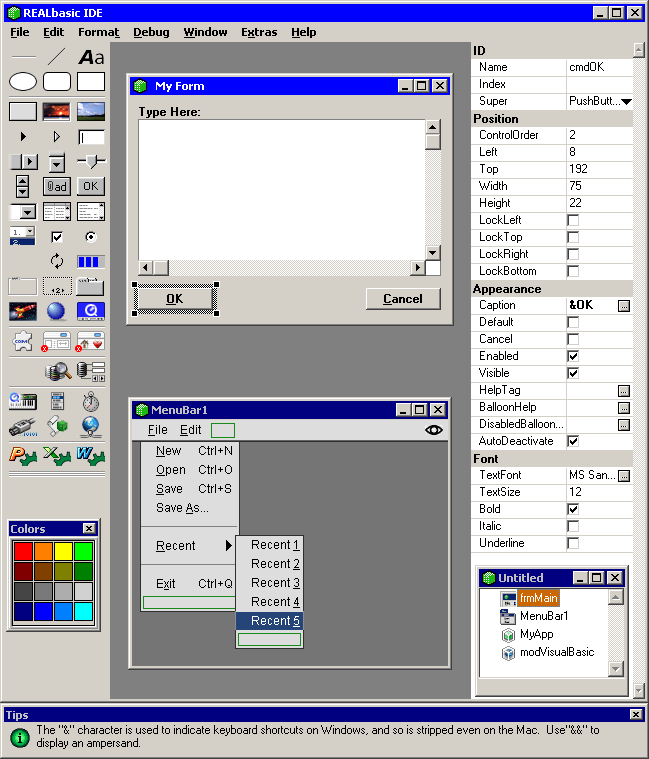
P.S.=> Plus, there is a new tool out there that creates std. single-.exe type code from a single codebase for MacOS X, Linux, &/or Win32 platforms called "RealBasic" that looks & sounds (in theory, & from screenshots of it I have seen) great as well... this one, however admittedly, I have not tried hands-on, myself!
Screenshot:
http://rb.thevbzone.com/Intro_IDE1.png
apk -
Re:Desktop Integration, X, GTK/QT, /etc, etc
2. Developing on the Desktop
At present, there are simply too many widget toolkits and desktop environments present. Motif, GTK, QT, KDE, Gnome.. and none of these are strong enough for there to be a clear winner. They are all tied to X, and perhaps that in itself is a problem.
A single, unified, high quality toolkit is needed, that makes development on Linux as attractive as it is on Windows or Mac OS X. While choice is good, sometimes it can cause more problems than it solves. Perhaps a solution such as Y Windows (http://www.y-windows.org/) may help.
To emphasise the problems facing developers.. GTK looks terrible. QT is nice, but it's a fully blown development environment. Most OSS QT apps are KDE apps, which places a dependency on KDE, which is also undesirable. Developing GUI apps on Linux is far from ideal.
The Linux platform is excellent when developing non-gui based programs. It's an excellent server based platform. But as a desktop solution, it's weak. I use Linux every day, and I can tell you, I fully understand why people hesitate to adopt it - despite the fact it's free.
Well actually things aren't so rosy in Windows either. In fact these days there really isn't that much unification among all the apps as far as gui widget goes either. For instance, every version of MS Office draws its own widgets (regardless of platform) and many apps have this ridiculous idea that they should be skinned (ie media players). Programs like Symantec antivirus for home have really awful self-drawn UIs.
Things in Linux aren't really that bad at all. I have a very consistant look and feel on my linux desktop. I can't remember the last time I used an app that didn't integrate well as far as look and feel or any other thing goes. Freedesktop.org has really had a positive impact.
I think the obstacles to Linux adoption are in areas other than this. Areas like software installation, OS configuration. -
Re:Desktop Integration, X, GTK/QT, /etc, etc
While bootsplash vaguely attempts to hide startup messages from the user, they can still press Esc. But it's still there.
It's still there on a Mac too...Then we have configuration. Configuration is handled almost always using plain text files on the filesystem. Every application handles its configuration differently, with most choosing a semi-structured format. XML may go some way towards solving this, but it's no registry. People also resist XML - it's easy to read, easy to tweak, but not as easy to manage by hand as semi-structured files are. However on the flip side, it's much easier to parse and edit.
Mac OS uses
Look to Mac OS X. Perhaps by adopting Launchd, and implementing a "Registry like" configuration system, may help.
The only problem with Linux config files is they proliferation of formats, not the fact that they're text files.At present, there are simply too many widget toolkits and desktop environments present. Motif, GTK, QT, KDE, Gnome.. and none of these are strong enough for there to be a clear winner. They are all tied to X, and perhaps that in itself is a problem.
You're right that there are too many toolkits...A single, unified, high quality toolkit is needed, that makes development on Linux as attractive as it is on Windows or Mac OS X. While choice is good, sometimes it can cause more problems than it solves. Perhaps a solution such as Y Windows (http://www.y-windows.org/) may help.
...but throwing out X is not the solution! That's way too much backwards compatibility to throw out. Besides, Xorg is in the process of solving most of X's perceived problems anyway.
We do need to merge (and/or deprecate) some toolkits, though. I have some hope for gtk-qt, but it's more of a workaround than a true solution. -
Desktop Integration, X, GTK/QT, /etc, etc
The biggest problem facing Linux is the complete lack of integration between the different components. It's no single flaw, it's a collection of small problems, some which would require massive shifts in thinking to fix.
The biggest problems I see facing Linux are:
1. A lack of integration between desktop components, and between GUI world and Console/Kernel world.
X is to Linux as Win 3.1 was to Dos. The Linux console rules, even as a desktop operating system. While bootsplash vaguely attempts to hide startup messages from the user, they can still press Esc. But it's still there. And the SysV init procedure still asks questions of me - for example harddrake2 runs each time the machine starts. If it detects new hardware, woohoo, Console!
Then we have configuration. Configuration is handled almost always using plain text files on the filesystem. Every application handles its configuration differently, with most choosing a semi-structured format. XML may go some way towards solving this, but it's no registry. People also resist XML - it's easy to read, easy to tweak, but not as easy to manage by hand as semi-structured files are. However on the flip side, it's much easier to parse and edit.
Neither Mac OS X or Windows handles startup or configuration in the way Linux does. It would be an almost impossible task to write a GUI to manage all the disparate Linux components as elegantly as Mac OS X or Windows does.
Linux needs some integration, some elegance. Hardware detection should happen in the background, configuration should happen within a GUI. More of a Windows approach would be nice.
A device management framework is needed, to detect devices, manage hotplug events, store details of present hardware, and to fetch and store hardware configuration options. This should include graphics card options.
It should be trivial for a user on any Linux distribution to manage hardware.
Look to Mac OS X. Perhaps by adopting Launchd, and implementing a "Registry like" configuration system, may help. Here's a thought - make the configuration system have a "storage API" for storing/retrieving configuration data. Users can then select where the configuration data gets stored. XML Files. Database. You name it.
2. Developing on the Desktop
At present, there are simply too many widget toolkits and desktop environments present. Motif, GTK, QT, KDE, Gnome.. and none of these are strong enough for there to be a clear winner. They are all tied to X, and perhaps that in itself is a problem.
A single, unified, high quality toolkit is needed, that makes development on Linux as attractive as it is on Windows or Mac OS X. While choice is good, sometimes it can cause more problems than it solves. Perhaps a solution such as Y Windows (http://www.y-windows.org/) may help.
To emphasise the problems facing developers.. GTK looks terrible. QT is nice, but it's a fully blown development environment. Most OSS QT apps are KDE apps, which places a dependency on KDE, which is also undesirable. Developing GUI apps on Linux is far from ideal.
The Linux platform is excellent when developing non-gui based programs. It's an excellent server based platform. But as a desktop solution, it's weak. I use Linux every day, and I can tell you, I fully understand why people hesitate to adopt it - despite the fact it's free. -
Re:Y Windows
Mark's is linked off the website but RSI means he doesn't develop much these days.
Mine is linked from here http://www.y-windows.org/pipermail/y-devel/2005-Fe bruary/001903.html
And Andrew doesn't seem to have linked his publicly.
Phil -
Re:Why isn't this already out?
DON'T ask on the y-devel mailing list, "Is Y-Windows still alive?" The developers are very cranky, especially about such questions. Basically, the answer is "We're busy, and it doesn't seem as important to us anymore. So, if we get bored, we'll do alittle work." The actual reply however, is much more caustic. Here is the archive of a full discussion of the state of Y.
Also, there seems to be some awfully weird licensing kind of stuff going on there lately... The developers have been claiming that someone "stole" the source code to Y, and warning people against "pirated" versions... That sent all kinds of red flags up in my head. And here is the archive of the discussion of the "stolen" source code (see Y-windows update) -
Re:Why isn't this already out?
DON'T ask on the y-devel mailing list, "Is Y-Windows still alive?" The developers are very cranky, especially about such questions. Basically, the answer is "We're busy, and it doesn't seem as important to us anymore. So, if we get bored, we'll do alittle work." The actual reply however, is much more caustic. Here is the archive of a full discussion of the state of Y.
Also, there seems to be some awfully weird licensing kind of stuff going on there lately... The developers have been claiming that someone "stole" the source code to Y, and warning people against "pirated" versions... That sent all kinds of red flags up in my head. And here is the archive of the discussion of the "stolen" source code (see Y-windows update) -
Re:Why isn't this already out?
Yeah wasn't there a Y windows in the works at one point.
You mean this?
Fresco was the other big contender.
The Linux Kernel is so flexable in how you can customize it for the hardware situation, its a shame you can't do the same thing for X.
Modern X actually does let you plug-in, plug-out all kinds of useless^H useful crap. It has actually matured into a fairly decent system, network transparency or no.
Where this article falls flat is on trying to make us believe that any of what we're seeing is "new". We've seen it all before, just with fewer cheap effects (e.g. the "wobbly windows"). -
Y Windows
I recall seeing this a while ago Y Windows
-
Re:Python? Ruby? Squeak?
Why do they all manage X Windows? C# is like somebody coming up with Y Windows and hyping that we should all write apps for Y Windows even if it were only cosmetically different.
They only get away with it because they are Microsoft, not because there's any sense in making a -
Re:Linux Desktop Thoughts...
I have much reading to do.
That will be fun. This actually is some cool stuff.
Without dissuading you, let me predict some of the things you're going to find.
But my gut instincts tell me I think I would prefer things be low level
X is low level. X provides an abstract interface for drawing lines, images, etc., receiving and distributing events, etc. All of those input boxes, scroll bars, icons, etc. have nothing to do with X, X is just the technology used to draw them.
There's fundamentally nothing wrong with X. On the contrary X has demonstrated itself to be an extremely flexible, extensible API which can support all sorts of windowing systems. Just about any specific complaint you can make about, say, KDE or GNOME is a problem that arises somewhere from the toolkit (GTK or QT) up.
Probably the biggest "problem" with X is the fact that it's so low level that it allows applications (or, more commonly, toolkits) to implement anything they like, which means that X cannot enforce a common look and feel. If everyone were to use the same toolkit, then all apps could be made to behave the same. So, what tends to happen is that developers get frustrated with the profusion of toolkits and decide we need The One True Toolkit, and begin to write it.
What they actually end up doing, of course, is building Yet Another Toolkit.
So, to address the problem you want to address, I think you *don't* want to provide anything very low level. You need to provide both the low-level stuff (down to the hardware -- oops, got lots of drivers to write) and the toolkit level, and make sure that either your toolkit is so good that no one will be tempted to reach beneath it, or that there are no visible seams to reach through.
I would like to get away from GTK and QT anything
Meaning you want to write The One True Toolkit, right?
The idea is to entice a new breed of Linux user without years of Bash and X experience.
Frankly, I think to accomplish this goal, you're better off starting with GNOME or KDE and polishing it up so that no bash or X experience is necessary.
Also, if you're really serious about this, you should look in to the Y Window System.
-
Re:Cygwin
Y was a failed attempt at replacing X.
-
Re:missing opensource Linux/XFree86 driverNo, I really think that having an open source driver is important. It can be adapted to other kernels (and even other free OSes), or hacked if needed. For example, experimental window systems (like http://fresco.org/ or http://www.y-windows.org/ for example) could re-use some portions of an open-source driver.
Likewise, an opensource driver can be ported to other architectures (eg PowerPC, Sparc, AMD64) or major kernel updates (with driver ABI changes). For binary drivers, you need the good will of the hardware maker.
So for me at least binary only drivers are always a problem. I want opensource (or free, i.e. libre) software.
-
Re:Educate me.
Sounds like y windows.
How do things like rollovers and cursor changes work then? I wonder if this could be incorporated into X or toolkits directly via some sort of event-masking system, e.g. ALL_EYE_CANDY_EVENTS vs. YO_IM_ON_A_MODEM_SO_CHILL_OUT_WITH_THE_USELESS_EVE NTS -
Re:cool to see it get fixes
another site to check out is: y-windows. You'll find that the goal of this project is to build a new gui server-client model much like X but with a built in set of widgets (extendable with a canvas widget). You still have a client server model, but with a standardized toolkit, and with it being re-built from the ground up one of the goals is to have better hardware acceleration (I.E. one thing being thrown around is a desktop built entirely in Cairo or a Vector based desktop, this may be the same thing, I dunno that much about svg). The project is moving slowly at the moment but I spent some time with it in the past and it is progressing so its something interesting to look at for the distant future.
-kaplanfx -
Y-Windows--the X killer
It's called Y-Windows.
-
What about Y
X has it's flaws. This sounds good but doesn't have any implementation. But we seem to forget about our little fledgeling, the Y-Window system. I'm sure they could use some help.
-
No, they don't
If they come up with something totally new, they get slammed for a steep learning curve.
No, they don't. When something new and cool comes up, it's praised. That's pretty much describing the Linux kernel right there.
Reviewers go on tirades and whitepapers are written about how the TCO is too high because of the training necessary, etc.
That's a bit misleading. The TCO arguments have to do with server and network administration, not desktop Linux (i.e., KDE/GNOME).
As far as desktop reviewers, they go on tirades because often the applications are superficially easy to use, and they look familiar because of the ripped-off Microsoft interfaces, but because Linux and XFree86 are very fundamentally different under the hood, things happen that you don't expect, or you have to do things in weird ways that contradict the interface.
Keeping an interface similar allows for an easier migration of people who've been using Windows for years (office people). Thus, less training is needed and the migration costs are lower.
No, what it does is make Linux on the desktop a cheap Windows clone, but worse because it's only a superficial imitation. Too many things about Linux are different from Windows. I really don't understand why people don't attempt to come up with something new. If the creative designers of Linux came up with something intuitive and creative like OS X but with a unique interface paradigm, Linux on the desktop would have its own identity. Right now, it has about 20 conflicting identities all trying to look like a certain other big identity which most Linux users hate anyway.
Honestly, I've never seen any attempts to infuse something new, cool, and creative into desktop Linux. It's always, "Windows has a taskbar? Well, we'll have a taskbar you can move all around and add applets to and put pointless system monitors on!" "Windows has an integrated filesystem/HTML browser? We'll have one with endless sidetabs and buttons and toolbar icons!" "Windows has a start menu? We'll have a start menu with a hundred menu items with redundancies like 'System' and 'Preferences' and 'Control Panel' as well as pointless subgroups called 'More Programs'"!
I don't get it. -
It's called Y-Windows
Y-Windows. A replacement for X that is fully hardware-accelerated and can upgrade its own drivers without a restart.
If people want to beat Microsoft with this technology, Y is the place to go and help out. -
No, wrong
One thing you have to realize is that most users _want_ their desktop to do more.
People want their _apps_ to do more.
KDE and GNOME need to concentrate on creating a good application-launching and task-switching mechanisms (hint--start menus and taskbars are interface abominations proven time and time again) and a good file manager. Then they create a wonderful API to develop on top of that and let third-party app developers do the rest.
This bullshit where GNOME is adding P2P and blogging, and KDE thinks it has to have 20,000 sidebar buttons and configuration panels on everything is completely ridiculous and unnecessary. All that stuff is supposed to be taken care of by the app writers. The desktop needs to just stay a desktop. Unfortunately, KDE and GNOME were never aiming for just that, and it seems the developers will never learn. So I just sit and wait until something like Y-Windows hurries up and finishes so I can never see XFree86 and its hacky desktop emulator projects again. -
Now here's the sad part
Despite all the +5 upmods in this article describing very valid criticism of poorly programmed desktop emulators like KDE, nothing will change.
I've been saying for YEARS how Linux desktop environments are jokes, are bloated, are slower than Windows, and more. I've been knocked down as troll, modbombed, told my opinions are flat-out wrong, and been called a "Microsoft shill" more times than I can count. The fact is a large part of the Linux community will never leave its little shell and realize the truth of things. They're too busy circle-jerking over the latest version of KDE because it "sure shows Microsoft."
All your criticisms are valid, but nothing will change. We'll continue to get bigger and slower versions of KDE and GNOME and XFree86. Nobody wants to change, because a lot of Linux users fear change. We just HAVE to still be able to run xclock, right? Heaven forbid we move off of old technology and try something new.
Linux is always getting feedback like this from users, but developers ignore it. The community will tell you "so where's your patch?" or "don't criticize a volunteer effort." The developers don't seem to have any sense of sanity when it comes to mature, professional desktop design. It's still the same hacky, silly, amateurish attitude from 1998 when these projects first began. I mean, compare the "feel" of using OS X to the "feel" of using KDE. This subtlety is what volunteer hackers working on 20 more sidebar buttons for Konquerer lack.
It's become a penis size contest. "Microsoft has Win32? We'll have Xlib, GTK, WxWindows, QT, Mono, etc. etc.!" The idealistic "freedom of choice" absolutist mentality was a neat idea for the magazines in the late 90s when Linux was a poster child, but that era has died and gone and now it's about RESULTS. No, you don't need two desktop environments. Any sane individual would see that we have wasted over half a decade in spreading our efforts across two desktop emulators when Linux needs one really good one. Think in terms of a project manager--would you have your teams working on two projects that do the exact same damn thing in order to give your customers "choice" between them? No, you'd combine efforts to make the single product you put out extremely good, so the user WON'T NEED to choose anything else. Because in all honesty, copping out to the choice excuse is just laziness being justified with ideology. "But this is how we've done it since the late 90s! It's all about choice!"
Everyone wants to reinvent the wheel. Everyone wants to do things a different way. The result is this massively huge mess of desktop incompatibility that looks completely unprofessional to everyone outside the niche communities that embrace it because it's "not M$." When someone like me brings up the need for standards, there is always the requisite freedesktop.org reference, even though fd.o has done jack-shit to bring KDE and GNOME together. When exactly does this mysterious combining of standards occur? It's all hype to shrug off criticism.
Think of all the time that's been wasted. We could have developed one incredible development library, running underneath one incredible desktop environment. Commercial apps might have existed by now because they would know they could put out a binary installer (you know, since there would be a binary installation/uninstallation API instead of relying on whatever hacky package manager exists on the command-line) that would always be able to install and run on the environment. You know how you can run Office 95 even today on XP? Companies need that kind of assurance, as do consumers.
It would be one thing if people just admitted where things really are. "We do have a lot of redundancies and amateurish approaches to these solutions, but someday we do plan to get there." That would at least be respected. But no, it's "KDE and GNOME blow OS X and Windows out of the water! There is absolutely no reason to use anything else! -
Re:xorg changes
Let us know when you've finished implementing the replacement.
Yes, because you can't bring up criticism of anything unless you're a programmer. That'll bring these projects to the masses.
Don't forget the network transparency.
Y-Windows.
Please also make sure it's at least as fast as XFree86 (not an easy task)
XFree86 is NOT fast. Holy christ.
, as extensible as X11 (which now makes effective use of hardware features that were undreamed-of 20 years ago)
Congratulations, you got the ability to change resolutions on the fly and are just getting around to translucency! Meanwhile, OS X and Windows are already moving onto full 3D acceleration.
, as easy to program with as GTK and Qt
GTK and QT are far from easy to program, and they are one of some 20 libraries for developing apps. Instead of just one library.
, as portable as XFree86 and supports as many video cards as XFree86.
You're right. Nobody should ever replace anything because you might end up supporting less video cards on your first release! Let's stick with broken technology.
Making it easier to configure would be good, but X.org will probably beat you to that.
I seriously doubt it. After decades of XFree86 development, we've got what--XConfigurator?
Making it less resource-intensive would be good, also
So much for those "fast" claims.
but the various projects working on making X servers that run on tiny hardware platforms will probably beat you to that, too.
Yeah, there are about 50 "various projects" always working on something. We'll wait and see when the 1.0 releases come out, shall we?
Anyway, happy hacking!
Next. -
Sorry, but
XF86 isn't broken, it isn't slow when compiled right either(okay only gentoo does it right all the time).
It is quite broken. You know when they added multi-moniter support, it broke the extension for hardware video? To get around it, they hacked it so it only works on the primary screen.
How about how Xine has to simulate a keypress every so often to prevent the screensaver from coming on? That, my friends, is a hack.
It has several advanced features that no other GUI system uses. Transparent network support at the top of the list.
That doesn't make up for anything. Fans always bring this up. "B-but, it's network-transparent!" Y-Windows is network transparent too.
That's right you don't have to load a whole desktop to use one app you can just load the app.
Uh, hello? I have to install both entire desktop libraries and base packages. That's what I was talking about. Read, learn, comprehend. I have to install KDE's base system to be able to run some app that happened to be coded for KDE. Instead of implementing one sane development library, a bunch of idealists have decided the more choice, the better--having absolutist views and applying them to everything is why Linux is still only at 1% of usage on Google Zeitgeist. The nearest is OS X up about 4 points (so much for that article declaring that Linux desktop usage would surpass the Mac...). -
Had enough of X ?
Try Y
I am still prototyping Z -
Want X dead? Y-Windows is the answer
Y-Windows
Their IRC channel is active, and they're already working on the widgets. They plan a 1.0 release within a year. Full hardware-acceleration, network transparency, and a complete replacement of X with a user-level X-compatibility layer. The PDF describes all the reasons why they're replacing X. Stuff even I didn't know. -
The blame game
Those are being done on the X level in the new x.org server. Not GNOME's problem.
Anything is better than KDE's completely hilarious, amateurish icon label dropshadows. They don't even fade out gracefully. How did anyone think that should be something to include in an official release?
Someday, just someday, I'd like to see hardware acceleration. The Y-Windows boys are already planning it. -
The hell? Linux isn't different at all
Linux is different because 1) there's now a huge pool of free (beer) GUI software so users can give it a real shot
So instead of buying applications, they have to download and/or compile them. It's still getting a whole bunch of new applications that are mere shells of the commercial implementations they're trying to emulate. You may as well not even consider them in the equation.
2) even before those apps came along, there were plenty of text-only apps that met the needs of Unix users of the day. Those were available for BeOS, too, but the users who wanted the ultimate GUI didn't care whether bison and nn were available.
Linux is different because it has the same GNU text apps that all the other UNIX-clones have?
The only, ONLY way Linux is different is that it is Open Source. The hacky desktop emulators Linux has are completely horrible, yet nobody will change them, except innovative people like those hacking on Y-Windows. Otherwise, Linux is just a haven for anti-"M$" zealots who think computer operating systems are something to actually expend energy being religious over. To the rest of the world that actually has a life, there are more important things to consider--like getting their work done (as opposed to spending four hours getting godawful XMMS not to skip with a standard soundcard). -
Re:yummy...
What about Y-Windows? Does that count as "making a new one"? I remember a few X-server discussions back, that X11 is a standard, and so changing that would be a rather lengthy process, despite the numerous pitfalls and lack of 'features' that x-server has. *shrug*
-
What the Linux desktop needs is very simple
- Binary installation/uninstallation API. Adobe's not gonna give you RPMs, sorry. Give them a desktop installer so that you can pop in an Autoplay CD and get to work.
- Innovation. People here bitch about Microsoft, then rip them off by stealing their taskbar, "start menu", integrated filesystem and net browser, and so forth. Taskbars are one of the most horrible developments in application design that it sickens me that Linux desktop developers think you "have" to have it because Microsoft has it. Start menu? That's even worse. God, please come up with something new and intuitive! We don't have to keep having a penis-size match with Microsoft all the time. They will always win in this area if all we do is keep chasing their tails. "Integrated browser? We'll have an integrated browser with 20 different sidebar buttons! Taskbar? We'll have a taskbar with 20 different panel applets!"
- One sane programming library. Having choice when programming desktop APIs absolutely is detrimental to desktop progress. This idealistic, absolutist attitude that whenever you have endless choices, it is good, is BAD. We need an API on the level of Cocoa or
- The removal of X. X has been a thorn in the side of desktop development for two long. The Y-Windows paper describes why, and why they are creating a replacement from scratch. It will also be network-transparent and integrated. This hack of emulating a desktop on top of a library on top of a window manager on top of a graphics server is completely amateur and unprofessional.
- Finally, an ATTITUDE CHANGE. Linux zealots kill Linux adoption, and have done more damage to the community than ever realized. This is absolute truth. You anti-social people out there who take out your insecurities on newbies who dare try out your beloved religion--I mean, operating system--need to get a life.
All in all, the Linux desktop need cut back on the information overload. People don't have time to keep track of all the knowledge required to use Linux as a desktop, and the horrible ways people emulate desktops on Linux actually contributes to the difficulty of Linux, not its ease-of-use. It's fine for Granny who will do nothing but use e-mail and the internet, because you can set everything up for her, but the average user who actually buys news hardware and drivers, installs new applications and removes them, does homework, and all the other things the average computer user does these days will have tough times compared to the much easier Windows XP. - Binary installation/uninstallation API. Adobe's not gonna give you RPMs, sorry. Give them a desktop installer so that you can pop in an Autoplay CD and get to work.
-
Visuses on Linux - can it be done?I posted a comment on BBC website - maybe its bad luck, but they *never* post my comments
Nevertheless some guy wrote this:
"Anyone that thinks Linux or Apple Macs are invunerable to viruses and worms really need to wake up and smell the binary. There are just as many flaws in Linux systems as Windows, and there are many Mac based viruses. There are also java-based attacks that can affect many different types of system. The only real answer is to get a firewall and antivirus system, and learn how to use it!"
My reply to that (unposted) was that it would be very difficult for a worm/virus to propagate under Linux. Specially if all "servers" are switched off. Simply because Linux is the opposite of Windows - there is no homogeneity
Steve Lake, Reading, UK
With Linux we have:- Different Kernel versions (2.2,2.4,2.6), patched versions, hardened versions
- Different commercial and free distributions (Red Hat, Mandrake, Gentoo, Debian, Slackware).
- Different packaging managers (rpm,apt,yum,portage,or none build from source code)
- Different set of libraries (XFree w/wo Nvidia acceleration,gcc, all with different versions)
- Different Window-Managers (none just console,fvwm,FluxBox,Gnome,KDE,Enlightenment)
- Different mail-client - if we are assuming a mail-enabled virus here - (mutt,pine,sylpheed,evolution,kmail,web browser-clients)
Any biologist would reinstate that if you have a species which is highly homogeneous (and the analogy here is Windows-XP) it is in great danger of being wiped out to extiction by some common plague (worm/viruses). The thing most people hate about Linux - is what protects it from widespread attack (dependencies,lack of homogeneity)
Linux makes you more security-aware anyway. It endorses/teaches that practice instead of you just setting your (often innefectual) "Windows-Update" on auto. Ok there is no such thing as a 100% secure system, but there is something at least 10x more secure than Windows: Linux
For how much longer are you Window users going to put up with all this? -
MOD PARENT UP TO 6---Don't just ignore that link!!
That page really opened my eyes about the HCI interaction. I have sent the link to the Y Windows Development mailing list in the hopes that maybe Y Windows will incorporate these principles. Who knows? Maybe Y Windows will eventually beat out Mac OS...
-
Re:Better question
What is it about the concept of competition that you don't understand?
What is it about the concept of a unified standard do you not understand? How will commercial vendors ever feel safe coding for a moving target that consists of at least five widget toolkits, two competing desktop environments, and several different package managers?
With one binary installation/uninstallation API for the desktop, you could safely install and uninstall applications, complete with Autoplay CD installers.
Or do you just think that the best way forwards for society is by supporting monopolies such as Micros
Monopolies aren't illegal, so I support whatever is the best idea. Although I find it amusing one must take an extremist view one way or the other in your eyes--either I'm all for endless choice no matter how detrimental, or I'm all for one evil monopoly controlling everything.
Sorry, I just want one, sane, unified desktop with a sane API in the vein of -
I always hear this
I can't count how many times I've heard how the toolkits don't use X efficiently.
Well, when the hell is it going to get fixed? I've been hearing this problem for years.
Y-Windows seems to fix all the problems with X anyway. I can't wait for 1.0. -
Sorry, but
Nobody's gonna take you seriously if you tell them, "Oh, Linux software is easy to install, let me show you! Fire up the command line and type 'urpmi' or 'apt-get'..."
I seriously wonder why nobody has implemented binary installation/uninstallation routines for the Linux desktops yet. What's the damn holdup? Users need to be able to buy a Linux application from a store, take it home, and stick in a CD to get an autoplay installer.
Of course, to get that truly working well, you'd want a sane, robust programming library in the likes of
Get a sane library that retains backwards compatibility on the level of Windows (for a simple example, try loading up an RPM you got 5-7 years ago and see how well it goes...compared to Windows which still runs 95 and even most 3.1 apps happily) along with a sane installation/uninstallation routine so that the desktop can actually keep track of its own components, and things would really change, and I would stop using Windows as my main desktop.
Then, of course, we should do all this on Y-Windows when 1.0 comes out. -
Why?
People stay on Windows because:
- It's easy to use (before someone chimes in with their anecdotal "this happened to me once" situation, yes, for the majority of people Windows is very easy to use)
- Easy to download and install drivers.
- As a result, easy to go down to Wal-mart and buy a new printer and have it work in less than a minute.
- Endless software, including lots of freeware. There's more software for Windows because Windows is easier to develop for, with no endless list of competing, inconsistent toolkits that exist simply to reinvent the wheel yet again and introduce another "choice"
- Old software still works. I can run my Windows 3.1 programs in XP if I wanted to. Linux distros are still a bit of a moving target. I can't guarantee an RPM I got five years ago will still work, can I? Meanwhile, I can run a Windows app from 10 years ago with no problems.
If you honestly think the reason that 95% of the marketshare is using Windows is simply because of Photoshop, you're deluded. OS X has Photoshop as well, but look at its share compared to Windows.
Note that despite all this, Linux can catch up and defeat Windows. But it has to abandon XFree86, implement things like binary installation/uninstallation APIs, one sane toolkit that is a joy to program for (i.e., like -
Re:Your boss is almost right
To say X is 12 years behind the times is a lil contradictory.
It works, people are glad with it - I for one.
And well done you Microsoft-Lovers that is how MS repays you all: TCPA
True that there are ppl who feels X should evolve
I really wished I had known about Linux ages ago and not MS technologies
I am sure I would be more employable (Java,Oracle,Perl,Ansi C, VA Smalltalk
To have accumulated C#,MS Office VBA,ASP,Transact-SQL for me its nothing short of an embarrasment. -
Re:We need a new toolkit...
If you're going to do a next generation toolkit system, then do it right: start by creating a network protocol for it.
*cough*Y-Windows*cough*
They seem to be working on a widget set to go with their protocol. I agree that this is the way to go. Someone will hack $WIDGET_LIBRARY to use the protocol, and we can unify the look and feel. This is a lot more elegant than hacks like GTK-QT because they must all interface to the one widget set to rule them all.
Abstraction. Because the widgets are implemented on top of a protocol, widget libraries simply have to all talk the same protocol. This means that it doesn't matter what the widget library itself looks like, what language it's implemented in, what object paradigm it uses, or anything else: the look and feel will still be the same. This is markedly different from the current situation with GTK, QT, and all other Unix widget sets, each of which implements its own look and feel. A client/server architecture can, and should, abstract out the look and feel of the widget set.
You're right, it is a significantly different approach, but as I said above, this is not completely incompatible with current widgets.
-
You're kidding, right?Could we get a few examples of Linux just playing catch-up and not being "Innovative"?
- Taskbar
- Start menu (I'm sorry, "big giant K" menu)
- Integration of the file browser and internet browser, shamelessly stolen from Windows 98--you know, the OS everyone still bitches about around here six years later
- Minimize, Maximize, and Close buttons, often in the same exact places
- Mono project
- Text shadows under icon labels (poorly done, I might add)
- A trashcan, which not only rips off Windows but also Mac. Before you bother (and I know someone will), note that it doesn't matter if Windows also ripped it off--you asked what Linux was ripping off and not innovating.
- Christ, man...I could go on and on but I'm at work right now.
The entire Linux desktop movement blindly follows the Windows paradigm for desktops like a happy little dog. Why not DO SOMETHING DIFFERENT?! Get that taskbar the hell out of there--they don't facilate spacial navigation and are horrible. Get that Start menu-ripoff out of there--Start menus are extremely poor program launchers. That integrated browser doesn't belong--it has absolutely no reason for existing and adds seconds to my loading of the Home folder (and you guys call Windows XP slow).
The only "innovation" KDE and GNOME can profess is having tons more pointless applets running on their panels, and running a lot slower than Windows on the same hardware. That's absolutely it and nothing more. Other than that, they offer nothing more than what Windows offers, and they don't even have a chance of eating OS X's dust.
You asked, I answered. Linux needs something completely new with its OWN IDENTITY--something that sits alongside Windows and OS X in having its own identity. KDE and GNOME are awful, horrible, and very, very bad. Personally, I'm looking forward to Y-Windows, which plans to replace the failed experiment that is X with something modern and better, while retaining the advantages that X had like network-transparency. No more endless "extensions" that conflict with each other! No more non-integrated desktops, where you're having to install TWO desktop environments just to be able to run each other's apps.
The Linux desktop is the perfect example of fragmentation run amok, holding back progress and adoption. Hell, very basic things still don't exist. The day you finally implement a binary installation/uninstallation routine so that someone can stick in a CD and run an autoplay installer that properly creates its shortcut icons and so on will be the day more apps will start coming out for Linux. Not to mention using just ONE library instead of multiple "toolkits" doing the widget work that should be done by the desktop anyway. Man, like I said, I could go on and on for pages... -
Case in point...
Not only the fact that it took so damned long for something like RandR to appear, but we STILL don't have true alpha-blending and transparencies.
I'm sorry folks, but other GUIs have had this forever. Windows 2000 supported it directly back in the late '99 betas.
The Linux kernel makes incredible strides constantly. Mozilla and Firefox can't seem to stop putting out minor version updates, to the joy of all. But XFree86? It takes five fucking years to get major new features that should have been there from the beginning. People bitch at Microsoft for Windows not having certain things integrated in from the beginning, claiming it's impossible to truly hack things in that weren't designed that way from the ground up, yet we wait on hands and knees for the next "extension" to come along. Why the incredible difference in development pace compared to other open source projects? KDE and GNOME are putting out new releases all the time.
The Y-Windows paper even talks about how the extensions are conflicting with each other now (i.e., Xinerama and XVideo). Why do we do this to ourselves? Let's get some real development going! First step is making the development of X more open, or contributing to projects like Y which intend to start over and include an X compatibility layer for older apps. Personally, I'm looking forward to Y. -
Y Windows
Website for those interested.
The PDF there describes all the reasons they're replacing X, and they make sense. They're planning to get a 1.0 release out the door within a year. It's going to be vector-based, hardware-accelerated and so on.
I think it will eventually be the superior technology to X, which is so riddle with extensions that they're conflicting each other now.