Slashdot Mirror
Domain: youtube.com
Stories and comments across the archive that link to youtube.com.
Stories · 2,039
-
Robotic Arm With Home-Brewed, Open Source Voice Control
First time accepted submitter aonsquared writes "A couple of months ago I managed to scoop up a cheap (£30) robot arm with a USB interface from Maplin (I'm in the UK). Following a wrist injury which left me without the use of my right hand for 4 weeks, I decided to build it for a little hacking project. Using Linux, libusb and other freely available tools, I have enabled the robot arm to respond to my voice commands. I've posted a full tutorial and downloadable source code, as well as a demonstration video. Hopefully, open-source voice recognition as well as devices like the Kinect (which has spawned hundreds of different cool hacks) can someday revolutionise the way we interact with computers and machines." -
Are Folding Containers the Future of Shipping?
swellconvivialguy writes "Earlier this year Maersk ordered 20 super-size container ships—each to have '16 percent larger capacity than today's largest container vessel, Emma Maersk.' But instead of embracing the bigger/more-is-better mentality, Staxxon, a NJ-based startup, has engineered a folding steel container (it folds like a toddler's playpen), which is designed to make shipping more efficient by 'reducing the number of container ship movements.' No one has yet succeeded in the marketplace with a collapsible container, but Staxxon has made a point of learning from the mistakes of others." -
Star Wars: The Old Republic Launch Date Announced
BioWare announced today that their upcoming MMO, Star Wars: The Old Republic, will launch on December 20 in North America, and December 22 in Europe. They've released a new trailer for the game, and reiterated that they'll be throttling logins early on to prevent server instability. Gamasutra recently spoke with SW:TOR project lead James Ohlen about finishing up the game and preparing it for launch. He said, "We're also focused on game balance for combat, for itemization, for the social systems. We've been running a lot of tests, we're getting a lot of feedback on the game. And when we get that feedback, we use it to make tweaks and changes. We're not making major changes now, we're just making changes that we can." -
Inferno OS Running On Android Phones
New submitter Digi-John writes "Employees at Sandia National Labs have put the Inferno OS on Android-based phones, replacing the default Java UI. Applications are written in Limbo rather than Java. The full announcement is at the bitbucket repository, and a short video demonstrates some of its capabilities." -
An Easy Recipe For Quantum Dots
An anonymous reader writes "Semiconductor nanocrystals, better known as quantum dots, might find their way into solar cells, cancer tests, and all sorts of other products. Making them is surprisingly easy, if you have the right equipment, but it's not cheap. A team of reporters from Chemical and Engineering News visited Johns Hopkins and learned how to make the pricey particles (YouTube video). They have produced a slick video that explains the whole process." -
Gut-Check Time For Windows 8, Microsoft
theodp writes "GeekWire reports that, for better or worse, the upcoming week is shaping up as one of the most pivotal in Microsoft's history, as the software giant makes its pitch for Windows 8 at two important conferences. First, Microsoft will be huddling with hardware and software developers beginning Tuesday at its sold-out BUILD conference ('BUILD will show you that Windows 8 changes everything'), where it's rumored that Samsung will unveil a Windows 8 tablet. And on Wednesday, CEO Steve Ballmer and other execs will be holding the company's annual Financial Analyst Meeting, which was delayed from its traditional summer date to allow the company to put its Windows 8 strategy in context for Wall Street. So, are we about to finally see the realization of Microsoft's vision for Information at Your Fingertips (Part 2), which Bill Gates introduced with a hokey video at Comdex 1994?" -
Gut-Check Time For Windows 8, Microsoft
theodp writes "GeekWire reports that, for better or worse, the upcoming week is shaping up as one of the most pivotal in Microsoft's history, as the software giant makes its pitch for Windows 8 at two important conferences. First, Microsoft will be huddling with hardware and software developers beginning Tuesday at its sold-out BUILD conference ('BUILD will show you that Windows 8 changes everything'), where it's rumored that Samsung will unveil a Windows 8 tablet. And on Wednesday, CEO Steve Ballmer and other execs will be holding the company's annual Financial Analyst Meeting, which was delayed from its traditional summer date to allow the company to put its Windows 8 strategy in context for Wall Street. So, are we about to finally see the realization of Microsoft's vision for Information at Your Fingertips (Part 2), which Bill Gates introduced with a hokey video at Comdex 1994?" -
Moxie Marlinspike's Solution To the SSL CA Problem
Trevelyan writes "In his Blackhat talk on the past and future of SSL (YouTube video) Moxie Marlinspike explains the problems of SSL today, and the history of how it came to be so. He then goes on to not only propose a solution, but he's implemented it as well: Convergence. It will let you turn off all those untrustable CAs in you browser and still safely use HTTPS. It even works with self-signed certificates. You still need to trust someone, but not forever like CAs. The system has 'Notaries,' which you can ask anonymously for their view on a certificate's authenticity. You can pool Notaries for a consensus, and add/remove them at any time." -
Like a Redstone Cowboy
neonsignal writes "Machine creations in Minecraft are becoming increasingly complex as people build on each other's ideas. Some notable examples include a Rubik's cube simulator, a 5-channel music sequencer, a 3D color printer, a 16-bit processing unit, and Conway's Game of Life. My own recent contribution is the world's slowest Universal Turing Machine. I'm now waiting for someone to implement Tetris in Redstone logic." -
Like a Redstone Cowboy
neonsignal writes "Machine creations in Minecraft are becoming increasingly complex as people build on each other's ideas. Some notable examples include a Rubik's cube simulator, a 5-channel music sequencer, a 3D color printer, a 16-bit processing unit, and Conway's Game of Life. My own recent contribution is the world's slowest Universal Turing Machine. I'm now waiting for someone to implement Tetris in Redstone logic." -
Like a Redstone Cowboy
neonsignal writes "Machine creations in Minecraft are becoming increasingly complex as people build on each other's ideas. Some notable examples include a Rubik's cube simulator, a 5-channel music sequencer, a 3D color printer, a 16-bit processing unit, and Conway's Game of Life. My own recent contribution is the world's slowest Universal Turing Machine. I'm now waiting for someone to implement Tetris in Redstone logic." -
Like a Redstone Cowboy
neonsignal writes "Machine creations in Minecraft are becoming increasingly complex as people build on each other's ideas. Some notable examples include a Rubik's cube simulator, a 5-channel music sequencer, a 3D color printer, a 16-bit processing unit, and Conway's Game of Life. My own recent contribution is the world's slowest Universal Turing Machine. I'm now waiting for someone to implement Tetris in Redstone logic." -
Like a Redstone Cowboy
neonsignal writes "Machine creations in Minecraft are becoming increasingly complex as people build on each other's ideas. Some notable examples include a Rubik's cube simulator, a 5-channel music sequencer, a 3D color printer, a 16-bit processing unit, and Conway's Game of Life. My own recent contribution is the world's slowest Universal Turing Machine. I'm now waiting for someone to implement Tetris in Redstone logic." -
Like a Redstone Cowboy
neonsignal writes "Machine creations in Minecraft are becoming increasingly complex as people build on each other's ideas. Some notable examples include a Rubik's cube simulator, a 5-channel music sequencer, a 3D color printer, a 16-bit processing unit, and Conway's Game of Life. My own recent contribution is the world's slowest Universal Turing Machine. I'm now waiting for someone to implement Tetris in Redstone logic." -
Like a Redstone Cowboy
neonsignal writes "Machine creations in Minecraft are becoming increasingly complex as people build on each other's ideas. Some notable examples include a Rubik's cube simulator, a 5-channel music sequencer, a 3D color printer, a 16-bit processing unit, and Conway's Game of Life. My own recent contribution is the world's slowest Universal Turing Machine. I'm now waiting for someone to implement Tetris in Redstone logic." -
Like a Redstone Cowboy
neonsignal writes "Machine creations in Minecraft are becoming increasingly complex as people build on each other's ideas. Some notable examples include a Rubik's cube simulator, a 5-channel music sequencer, a 3D color printer, a 16-bit processing unit, and Conway's Game of Life. My own recent contribution is the world's slowest Universal Turing Machine. I'm now waiting for someone to implement Tetris in Redstone logic." -
A Custom Objectionable Word List Ate My Homework
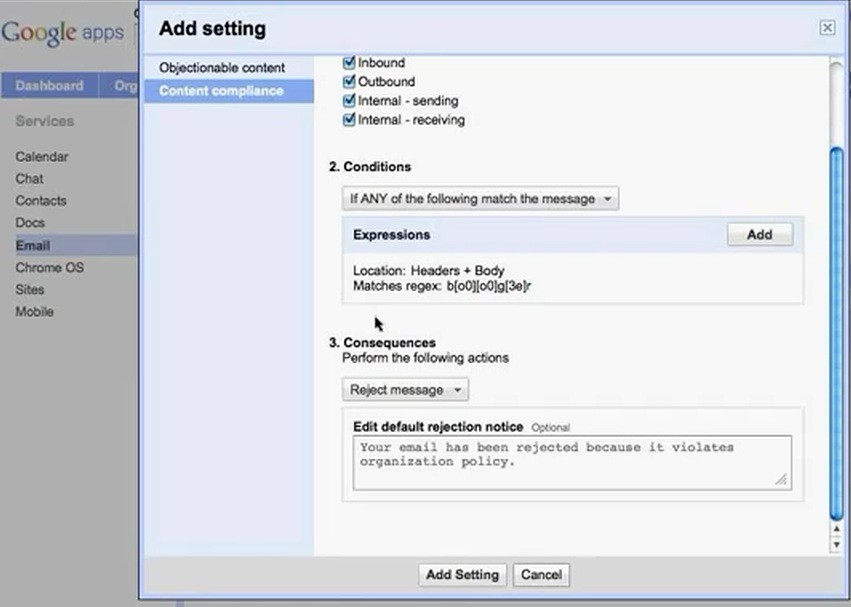
theodp writes "Among the first three schools using Chromebooks for Education is the Merton Community School District, which decided to go Chromebook after the Wisconsin Dept. of Public Instruction (WDPI) issued a news release (created using PDFMaker for Word) announcing that all Wisconsin schools can have access to Google Apps for Education by simply downloading a Google Consent Form (Microsoft Word format, oddly) from the WDPI website, completing & signing it, and submitting it to Google. And to help get the schools going, a separate Wisconsin Google Apps for Education website aims to jumpstart things with weekly webinars, the first of which — Getting started with the Google Apps for Education Control Panel — shows school officials how they can sandbox 'Naughty Students' and filter objectionable content. While Google illustrates how a list of 'custom objectionable words' can be used to flag and/or block students' e-mail with some cute examples — different spellings of 'booger' and a regex to block variants like 'b00g3r' — things get considerably nastier in the real world, as this NSFW custom objectionable word list used by the North Canton City Schools shows." -
Samsung Cites 2001: A Space Odyssey In Apple Patent Case
suraj.sun and several other readers sent word that Samsung is using a clip from Stanley Kubrick's 2001: A Space Odyssey as an example of prior art in its defense against Apple's patent infringement claims. "In a clip from that film lasting about one minute, two astronauts are eating and at the same time using personal tablet computers. ... As with the design claimed by the D'889 Patent, the tablet disclosed in the clip has an overall rectangular shape with a dominant display screen, narrow borders, a predominately flat front surface, a flat back surface (which is evident because the tablets are lying flat on the table's surface), and a thin form factor." Samsung also supplied a clip from 1970s British TV series The Tomorrow People. -
Microsoft Patches 1990s-Era 'Ping of Death'
CWmike writes "Microsoft on Tuesday issued 13 security updates that patched 22 vulnerabilities in Internet Explorer, Windows, Office and other software, including one that harked back two decades to something dubbed 'Ping of Death.' While other patched vulnerabilities we more serious, one marked 'CVE-2011-1871' brought back memories for nCircle's Andrew Storms. 'This looks like the Ping of Death from the early-to-mid 1990s,' he said. 'Then, when a specially-crafted ping request was sent to a host, it caused the Windows PC to blue screen, and then reboot.' Two decades ago, the Ping of Death (YouTube video demonstration) was used to bring down Windows PCs remotely, often as a way to show the instability of the operating system." -
L.A. Artist Contemplates Future Traffic Flow, With Hot Wheels
John3 writes "American artist Chris Burden is finishing up his latest work titled Metropolis II for display this fall in Los Angeles. There's a fascinating five minute documentary on YouTube about his miniature city and the traffic that flows through it. He comments 'The idea that a car runs free, those days are about to close.' Whether you agree or disagree, he certainly has built one of the coolest Hot Wheels layouts I've ever seen." -
Making Graphics In Games '100,000 Times' Better?
trawg writes "A small Australian software company — backed by almost AUD$2 million in government assistance — is claiming they've developed a new technology which is '100,000 times better' for computer game graphics. It's not clear what exactly is getting multiplied, but they apparently 'make everything out of tiny little atoms instead of flat panels.' They've posted a video to YouTube which shows their new tech, which is apparently running at 20 FPS in software. It's (very) light on the technical details, and extraordinary claims require extraordinary evidence, but they say an SDK is due in a few months — so stay tuned for more." John Carmack had this to say about the company's claims: "No chance of a game on current gen systems, but maybe several years from now. Production issues will be challenging." -
Getting the Latest Rover To Mars
derGoldstein writes "New Scientist has a great video up detailing every step of how the latest Mars rover will reach its target and get deployed. It's drastically different than the bouncing air-bag delivery system previously used (YouTube video)." -
The Loudness Wars May Be Ending
Hugh Pickens writes "Mike Barthel reports on a technique called brick-wall limiting, where songs are engineered to seem louder by bringing the quiet parts to the same level as the loud parts and pushing the volume level of the entire song to the highest point possible. 'Because of the need to stand out on radio and other platforms, there's a strategic advantage to having a new song sound just a little louder than every other song. As a result, for a period, each new release came out a little louder than the last, and the average level of loudness on CDs crept up (YouTube) to such a degree that albums actually sounded distorted, as if they were being played through broken speakers.' But the loudness wars may be coming to an end. Taking advantage of the trend towards listening to music online — via services like Pandora, Spotify, and Apple's forthcoming iCloud — a proposal by audio engineer Thomas Lund, already adopted as a universal standard (PDF) by the International Telecommunications Union, would institute a volume limit on any songs downloaded from the cloud, effectively removing the strategic advantage of loudness. Lund's proposal would do the same thing for any music you could buy. 'Once a piece of music is ingested into this system, there is no longer any value in trying to make a recording louder just to stand out,' says legendary engineer Bob Ludwig, who has been working with Lund. 'There will be nothing to gain from a musical point of view. Louder will no longer be better!'" -
Atlantis' Final Reentry Over Cancun, Mexico
astroengine writes "Once again, videographer Noe Castillo has captured space shuttle history through his camera lens. On June 1, 2011, he witnessed the final reentry of space shuttle Endeavour. Now he's released a video via his YouTube account showing the final reentry of Atlantis... and the final reentry of any space shuttle." Many other cameras were trained on Atlantis yesterday, including one from the ISS, which captured the re-entry from the other side. Thierry Legault caught Atlantis transiting the sun for the last time, and NASA has pictures and video of the landing. -
Atlantis' Final Reentry Over Cancun, Mexico
astroengine writes "Once again, videographer Noe Castillo has captured space shuttle history through his camera lens. On June 1, 2011, he witnessed the final reentry of space shuttle Endeavour. Now he's released a video via his YouTube account showing the final reentry of Atlantis... and the final reentry of any space shuttle." Many other cameras were trained on Atlantis yesterday, including one from the ISS, which captured the re-entry from the other side. Thierry Legault caught Atlantis transiting the sun for the last time, and NASA has pictures and video of the landing. -
Linux Receives 20th Birthday Video From Microsoft
moonbender writes "The Linux kernel has received birthday wishes from an unexpected direction — a video animation from Microsoft. Quoting The H: 'The video picks up on the strained relationship between Microsoft and Linux by displaying the phrase "Microsoft Vs. Linux" and then showing Tux, the Linux mascot, turning his back on the offer of a birthday cake from Microsoft. After a brief outline of the history between Microsoft and Linux, the video ends with a conciliatory gesture: Tux accepts the birthday cake in his igloo and the video ends with "Happy Birthday" and the editing of the initial phrase to "Microsoft and Linux?' The Linux Foundation has more stuff celebrating the kernel's 20th birthday." -
Apple Patents Portrait-Landscape Flipping
theodp writes "On Tuesday, the USPTO granted a patent to Apple for Portrait-landscape rotation heuristics for a portable multifunction device (USPTO), which covers 'displaying information on the touch screen display in a portrait view or a landscape view based on an analysis of data received from the one or more accelerometers.' Perhaps the USPTO Examiners didn't get a chance to review the circa-1991 Computer Chronicles video of the Radius Pivot monitor before deeming Apple's invention patentable. Or check out the winning touchArcade trivia contest entry, which noted the circa-1982 Corvus Concept sported a 15-inch, high-resolution, bit-mapped display screen that also flipped between portrait and landscape views when rotated, like our friend the iPhone. Hey, everything old is new again, right?" -
Apple Patents Portrait-Landscape Flipping
theodp writes "On Tuesday, the USPTO granted a patent to Apple for Portrait-landscape rotation heuristics for a portable multifunction device (USPTO), which covers 'displaying information on the touch screen display in a portrait view or a landscape view based on an analysis of data received from the one or more accelerometers.' Perhaps the USPTO Examiners didn't get a chance to review the circa-1991 Computer Chronicles video of the Radius Pivot monitor before deeming Apple's invention patentable. Or check out the winning touchArcade trivia contest entry, which noted the circa-1982 Corvus Concept sported a 15-inch, high-resolution, bit-mapped display screen that also flipped between portrait and landscape views when rotated, like our friend the iPhone. Hey, everything old is new again, right?" -
App Uses Facial Profiling To Identify Perps
Hugh Pickens writes "Emily Steel writes that a new iPhone accessory that uses a picture of the person's face or iris to identify them will help police units identify suspects and look up their criminal record. To scan a person's iris, police officers can hold the special iris-scanning camera on device, called MORIS, about 5 to 6 inches away from an individual's irises. After snapping a high resolution photo, the MORIS system analyzes 235 unique features in each iris and uses an algorithm to match that person with their identity if they are in the database. To use the facial recognition system an officer takes a photo of a person at a distance of about 2 feet to 5 feet that analyzes about 130 distinguishing points on the face (video), such as the distance between a person's eye and nose, then scans the database for likely matches. Bernard Melekian says challenges remain in developing guidelines for the proper use of the mobile recognition technology for police work. 'If the purpose is to determine instantly an individual's identity and determine whether they are wanted or have serious criminal history, that is not only a desirable use, it is an important use,' says Melekian. 'To simply collect information on individuals to add to the database would not in my opinion be a desirable use of the technology.'" The range of offenses for which conviction (and sometimes mere arrest) now triggers the collection of DNA samples is expanding; I suspect that iris information, seemingly less intrusive to collect, will soon enough become part of applications for passports, driver's licenses, and concealed carry permits. -
Sub-Centimeter Positioning Coming To Mobile Phones
Oooskar writes "SLAM (Simultaneous Localization and Mapping), a technique invented by NASA, defines the concept of building a 3D-map of the environment and simultaneously computing the position within it. Based on SLAM, Swedish startup 13th Lab has implemented real-time sub-centimeter local 3D-positioning by using only the sensors, most importantly the camera, already present in most mobile devices (demo video). The technology will be made available as a software platform for developers (sign up for beta). A first application demonstrating the technology has just been released for the iPad2. The technology should be available on other devices with similar computational power soon." -
In Robot Soccer, US Team RoMeLa Dominates Robocup 2011
Narmacil writes "U.S. Team RoMeLa has swept Robocup 2011, winning first place in both the kid size and teen size divisions. (Video) CHARLI, America's first full size autonomous humanoid, managed to also make the high score record for the teen size division. DARWIN, the kid-sized robot, beat the Darmstadt Dribblers, the previous world champs, and continued on to the finals to win out." There must be joy in Blacksburg today. -
Sound-Based System Promises Chipless Phone Payment
CWmike writes "While near-field communication gradually emerges to turn mobile phones into payment devices, startup Naratte is introducing a system it claims can do roughly the same thing without adding a chip to the handset. On Monday, Naratte introduced Zoosh, a technology that lets phones exchange transaction information via inaudible sound waves. As with NFC, the phone user would just put the phone near to a point-of-sale terminal to redeem a coupon or make a purchase. NFC provides short-range radio communication between phones and point-of-sale devices so users can just tap or point their phones at the device to make a purchase. NFC uses specialized chips, which are already built into a few phones such as the Google Nexus S sold by Sprint Nextel, and are expected in more handsets in the future. Zoosh involves software that utilizes the speaker and microphone in a handset to send and receive audio signals with another device, similar to the way early modems exchange data by sending tones through the handsets of desk phones cradled in coupler devices. The company has posted a video that shows how it works. Between this and barcodes (which Starbucks says is working well already, thank you very much), is NFC already irrelevant?" -
Google and Slooh To Broadcast Lunar Eclipse
An anonymous reader writes "Today Google and Slooh, the online Space Camera, are broadcasting a live online feed of the total lunar eclipse starting at 2:00 PM EDT. The live feed can be accessed at Slooh's Mission Interface and also as a featured video stream on Google's channel on YouTube. Live audio narration by astronomy experts will accompany the live feed. This online astronomy collaboration will allow people all over the world to watch this rare celestial event." -
Austin's Alamo Drafthouse Theater Gives Texters the Boot
Hugh Pickens writes "Ever been annoyed during that nail-biting darkened hallway scene by someone turning on their phone to send a text? Well, don't mess with Texas or you may end up on the screen in a public service announcement. Alamo Drafthouse, a local chain of dine-and-screen movie theaters in Austin, Texas, has long waged a war against impolite moviegoers booting out customers who talk or text during performances. Phoebe Connelly writes that according to Tim League, the Drafthouse's founder, a woman was recently warned twice about texting during a screening, and then, in accordance with company policy, was escorted out without a refund. 'I don't think people realize that it is distracting,' says League. 'It seems like nothing, but if you spend as much time as I do at the movies, you realize the entire theater sees it and it pulls you out of the movie experience. It's every bit as intrusive as talking.' The irate customer called up the Alamo Drafthouse and left a profanity-laced (and perhaps slightly inebriated) message decrying the theater's policies, but the theater got the last laugh as they took the audio of the woman's voicemail, transcribed it, and turned it into an in-house preview [tl: Note, YouTube video contains some profanity] that warns theatergoers against cell phone use during movies. 'Part of what we're trying to do is have a comedic message about what to us is a very serious issue,' says League, declining to give any more details about the woman at the center of the recent PSA." -
Mexican Cartels Build Mad Max Narco Tanks
Hugh Pickens writes "Not content with building their own submarines, using bazookas, rocket-propelled grenades or land mines, drug cartels are now building armored assault vehicles, complete with gun turrets, inch-thick armor plates, firing ports and bulletproof glass. The monsters look like a cross between a handmade assault vehicle used by a Somali warlord and something out of a post-apocalyptic Mad Max movie, and have already appeared in several confrontations with Mexican authorities. A look inside a captured 'monster' truck (YouTube video) reveals that in addition to swiveling turrets to shoot in any direction, they have hatches and peepholes for snipers, their spacious interiors can fit as many as 20 armed men, and they are coated with polyurethane for insulation and to reduce noise. Still Patrick Corcoran writes that the armored vehicles are not a game changer. 'While the "narco-tanks," as the vehicles are often called, make for great blog fodder and provide entertaining videos, seeing their rise as a significant escalation in Mexico's drug war would be wrongheaded,' writes Corcoran. 'In the end, the "tanks" are a sexy narrative, but these mistaken notions about the criminals' "military might" not only inflate the power of Mexico's groups far beyond any reasonable assessment, they also obscure the problem, and its potential solutions.'" -
Why Apple's DUI Checkpoint App Ban Is Stupid
hookskat writes "Reason.tv Editor in Chief Nick Gillespie reacts to Apple's decision to ban DUI Checkpoint Apps from the App Store, writing: 'Let me add something even more damning of this latest development in corporate cave-ins to legally protected free speech and I'm gonna bold it for emphasis: Some police departments actually supply the data used in such apps because they reduce the number of drunk drivers on the roads! Somehow, I'm thinking that Steve Jobs circa 1984...would have told U.S. senators sending threatening letters about computer-based info sharing to take a hike. Or at least to spend time on, I don't know, creating a freaking budget for the country rather than worrying about regulating something that helps reduce impaired driving.' Last month, after RIM caved on the same question, Reason.tv released this video on the subject of banning DUI checkpoint apps." -
Arduino Music Controllers With Horns, Finally
An anonymous reader writes "Patrick Flanagan serves as the token human in robot percussion group Jazari. In this video Flanagan controls his bots with a Wiimote and a custom Arduino controller made from arcade buttons, zebra wood, and springbook horns. Due to production costs and environmental concerns, we haven't seen many new musical instruments made from dead animals in this century, but who knows? Maybe 2k11 is the year music device makers go stone-age." -
Homeland Security Running NBC-Owned PSAs
An anonymous reader writes "A few months ago, Homeland Security's ICE (Immigration & Customs Enforcement) group started placing an anti-piracy video PSA on various domains that it had seized. What it didn't say was who created the PSA. A Freedom of Information Act request by Techdirt has revealed that the videos are actually created & owned by NBC Universal, but nowhere does Homeland Security publicly admit this. As Techdirt writes: 'Could you imagine how the press would react if, say, the FDA ran PSAs that were created and owned by McDonald's without making that clear to the public? How about if the Treasury Department ran a PSA created and owned by Goldman Sachs? So, shouldn't we be asking serious questions about why Homeland Security and ICE are running a one-sided, misleading corporate propaganda video, created and owned by a private company, without mentioning the rather pertinent information of who made it?'" -
Compressed Time at the Australia Telescope Compact Array
epaell writes "I've been playing a little bit with time-lapse and video editing over the last week while Duty Astronomer at the CSIRO's Australia Telescope Compact Array (ATCA) near Narrabri in country New South Wales (Australia). Playing with video is all quite a new experience for me but I had fun putting this together and thought others may enjoy it. I've captured a number of videos of and around the telescope and attempted to highlight not only the instrument and the skies but also some of the wildlife we encounter on a daily basis while observing there. It also includes an obligatory video of cockatoos taking a hayride on one of the dishes and the frogs in the control room that are our constant companions during long observing sessions :-) I recommend switching from 360p to 1080p and setting on full-screen mode to get the full effect of the video." -
Harnessing the Energy of Galloping Gertie
FatLittleMonkey writes "You've all seen the footage of Galloping Gertie, the infamous Tacoma Narrows bridge. This is due to a type of turbulence called Wake Galloping, caused by airflow creating lift on the lee-side of cylinders (or cables on suspension bridges.) Now researchers in South Korea have developed a way of harnessing the turbulence to generate electricity. Their device works most efficiently at wind speeds too low for conventional wind turbines." -
Largest DNA-Based Computational Circuit Created
angry tapir writes "Researchers from the California Institute of Technology have built [abstract] what they claim is the world's largest computational circuit based on DNA (deoxyribonucleic acid), using a technology that they said could easily scale to even greater complexity." Adds reader cwmike: "The researchers formed 130 different synthetic DNA strands that can be used to compose logic circuits. From this source material, they created one 74-molecule, four-bit circuit that can compute the square root of any number up to 15 and round down the resulting answer to the nearest integer. In their setup, the multi-layered strands of DNA are fashioned (see video) into biochemical logic gates that can perform the basic Boolean AND, OR and NOR operations executed by today's transistor-based computer processors." -
Researcher Claims Magnets Can Affect Blood Viscosity
BuzzSkyline writes "A few minutes in a high magnetic field (1.3 Tesla) is enough to thin blood by 30%, potentially leading to a new drug-free therapy to prevent heart attacks. The powerful field causes blood cells to line up in chains that flow much more easily than randomly-scattered individual cells, according to research scheduled to appear this month in the journal Physical Review E." I can't help thinking of Penn & Teller's look at magnets-as-medicine, though at least the idea here described sounds testable and doesn't rely on the power of suggestion. -
Doom Ported To the Web
kripkenstein writes "Ever since Id Software released the Doom source code under the GPL, it's been ported to platform after platform. Now, you can play Doom compiled to JavaScript on the web, using standard web technologies like Canvas and without any plugins. If your browser has trouble running it, here's a screencast." The translation was accomplished using Emscripten, a Javascript backend for LLVM. As per the GPL, full source code is available. Pretty neat. -
World's Largest Amateur Rocket Prepares For Second Attempt
Plammox writes "Last year, non-profit, volunteer-based Copenhagen Suborbitals failed at launching what they call the world's largest amateur rocket, because of a frozen LOX-valve. This year, the sea launch platform 'Sputnik' has become self-propelled, eliminating the need for their home-built submarine(!). Sputnik is on its way into the Baltic Sea right now and a launch attempt is expected on Friday. However, one of the founders warns that even if ignition should occur, it might very well look like this." -
Sprint Pushes FPS NOVA With Firmware — and Users Can't Remove It
theodp writes "If you could change the way wireless companies did things, what would you do?' asked Sprint CEO Dan Hesse. How about stopping the use of Sprint's firmware updates to download apps that aren't wanted and can't be removed, Dan? Sprint confirmed to CNET's Elinor Mills that those strange apps she was shocked to find on her Android phone — sci-fi shooter N.O.V.A. and Blockbuster — with a long list of permissions that couldn't be uninstalled had been sneakily downloaded onto her phone during a firmware update. 'Sprint does offer a variety of partner applications that are optimized for use on our wireless phones,' a Sprint representative explained in an e-mail. 'From time to time, we will provide new apps to our customers in conjunction with a software maintenance release. Also, Sprint, in conjunction with Google, is taking steps to develop a technical solution that would allow customers to remove any unwanted applications that have been preloaded or pushed in an over-the-air software update.'" Asking first would be a nice non-technical solution. -
Microsoft Promo: a PC and Xbox In Every Dorm Room
theodp writes "Can Microsoft woo students into trying Windows 7 PCs? Well, starting on May 22nd, Microsoft will try to do so by giving away free Xbox 360 4GB consoles to high-school or college students who purchase new Windows 7 PCs priced at $699 and up. A Guess Who's Coming to College? teaser video for the promotion features a Halo Spartan's HS graduation ceremony." -
Explosion At Foxconn Factory Kills 2, Injures 16
arielCo writes "There are several reports in the news about an explosion in a Foxconn factory in Chengdu that manufactures the iPad 2, killing two workers and injuring another 16. 'The Chengdu Municipal government said the explosion occurred in Foxconn's "polishing plant" at around 7 p.m. Experts say it is likely a cleaning stage at the end of the production process after devices are assembled.' There's a short amateur video of the ensuing fire, taken during the evacuation. Apple said they are working with Foxconn to investigate." -
Volunteer 'Cyber Scouts' Censor Web In Thailand
societyofrobots writes "Since the military coup of 2006, Thailand's media freedoms have continually been downgraded. A growing tactic among the ruling elite is to accuse the political opposition of insulting the king, allowing for censorship and political imprisonment of those who dare speak out. In 2010, web censorship began to reach the scales of China and Iran. Now, Thailand has formed a group of volunteers called Cyber-Scouts to patrol the web looking for comments deemed to insult the monarchy. AFP also has a video." -
Erasing CDs By Using 150,000 Volts of Electricity
ryzvonusef writes "One enterprising individual has created the most secure way to wipe out Compact Discs, by using a step-up transformer and creating a 150,000 Volt pd, whilst a CD rotates in the middle. The sparks arc through the metal in the CD and evaporates it, ripping it all off as the CD rotates. The CD is rendered transparent and unreadable. This may be the most secure method to remove data on conventional recordable CDs used in offices." -
Is Sugar Toxic?
a_hanso tips an article by Gary Taubes in the NYTimes Magazine that evaluates claims from Dr. Robert Lustig's virally popular lecture on the negative effects of sugar on peoples' health. (YouTube video of the lecture.) Taubes discusses the science behind the claims and the odd willingness of people to accept Lustig's arguments without further inspection. Quoting: "When I set out to interview public health authorities and researchers for this article, they would often initiate the interview with some variation of the comment 'surely you’ve spoken to Robert Lustig,' not because Lustig has done any of the key research on sugar himself, which he hasn’t, but because he’s willing to insist publicly and unambiguously, when most researchers are not, that sugar is a toxic substance that people abuse. In Lustig’s view, sugar should be thought of, like cigarettes and alcohol, as something that’s killing us. This brings us to the salient question: Can sugar possibly be as bad as Lustig says it is?"