Slashdot Mirror
Domain: zeroto60times.com
Stories and comments across the archive that link to zeroto60times.com.
Comments · 23
-
Re:Need for speed?
2017 Tesla Model S 0-60 in 5.0, 1/4 mile in 13.6.
Numbers quoted by above poster are for P100D variant (modified), a car which starts at $135,000.
2017 Corvette starts at $55,000.Yes, if you have limitless money, electric cars are pretty cool.
-
Re:This is BIG news - If you want to know more..
I've seen your comments throughout the discussion on this article. I've read each of them, given them some thought, and reached a conclusion.
You're an idiot.
No, really: let me prove it to you:
1. Let's assume you know what you're talking about.
2. By that assumption, then we can test whether any propulsion system is impossible by seeing if its thrust/power ratio is such that there is a velocity where you can obtain a change in velocity such that the change in kinetic energy is greater than the energy input of the system using static/low-velocity tests.
3. Take a 2016 Toyota Corolla LE, which has a curb weight of 2,855 lbs, or a mass of 1295 kg.
4. Said Toyota Corolla LE can accelerate 0--60 mph (26.8 m/s) in 9.2 s.
5. The average acceleration over that 9.2 s is then 26.8 m/s / 9.2 s = 2.91 m/s^2.
6. The observed force output of the 132 hp engine is then 1295 kg * 2.91 m/s^2 = 3.77 kN.
7. It's uncertain just how much fuel was consumed in that acceleration, so for generosity, let's assume that a car that is nominally rated at 29 mpg (city) only averages 1 mpg over this acceleration. (The real consumption rate is certainly better than this, so we're using a worst-case scenario.)
8. The distance covered in accelerating 0--60 mph in 9.2 s is 0.5 * 2.91 m/s^2 * (9.2 s)^2 = 123.4 m = 0.077 mi.
9. The quantity of fuel consumed in this distance is 0.077 mi / 1 mpg = 0.077 gal *2.75 kg/gal = 0.212 kg.
10. The total energy available in this amount of fuel is 0.212 kg * 46.4 MJ/kg = 9.84 MJ.
11. The average power consumption in this test is then 9.84 MJ/9.2 s = 1.07 MW (obviously not all transferred to the car's motion; otherwise that would be ridiculous. Regardless, this is the average rate of energy consumption in this example.)
12. The force/power ratio is 3.77 kN / 1.07 MW = 3.52 N/kW. (Note that this is three orders of magnitude higher than the thruster in this article.)
13. Using your formula for calculating over-unity, we reach that point for a thrust of 3.77 kN for 1.07 MW at v = P/F = 1.07 MW / 3.77 kN = 284 m/s.
14. This value is much less than c, so by your arguments, the 2016 Toyota Corolla LE is an over-unity device.
15. The 2016 Toyota Corolla LE exists, functions, and, as all owners of this model can attest, is not a perpetual motion machine.
16. By contradiction, our assumption that you know what you're talking about is false.Therefore, you are an idiot.
qed.Or, you know, you could always ask a real physicist and he or she will point out that your equations aren't really applicable anywhere except some very distinct circumstances, and that the quoted thrust/power ratios are not necessarily constant. You know, like the way the universe actually works?
-
Re:PLEASE...make a sports car again!!
Mid 5 to mid 4 0-60 times. You're off by a couple seconds. http://www.zeroto60times.com/v...
-
Re:With stock tires on my local road?
A '72 Z28 Camaro is around 4 seconds
You're just a stoned kid posting from mommy's basement after imbibing too many of ol' dad's rubbish stories about muscle cars of yore.
Facts: 1972 was the beginning of the end for F-bodies. All engines were detuned even by Chevy standards, the biggest and most powerful could shove a Z28 to 100kph in around 7.5 seconds. That's an entire metric FUCK-TONNE of difference, kid. -
Re:Coal power cars make little sense
Its misleading to specify torque at zero rpm, your power is zero because there is no movement.
What does movement have to do with anything? Do you even know what torque is? Here, let me help you with that. In a nutshell, it's force. There's all kinds of forces in the world that don't result in movement. Lucky for you. You're sitting in a chair, aren't you? Demonstrating an instance of force without movement all by yourself. Amazing, isn't it. Forces get applied before movement starts.
nice try lol. You must be homeschooled or something. With no movement the static force gives no acceleration - might as well say a section of a tree trunk is providing thousands of pounds of thrust and make a free energy machine. Or gear down a hobby servo motor ten billion times and 'prove' you can generate more torque than any tesla with a 1.5V AAA battery. Or you may realize you lack a basic grasp of physics. Electric motors have higher torque than internal combustion motors of a similar size only at lower speeds.
All of the above cars you mention can beat the tesla in some or many of what people would call performance specifications, such as acceleration...
Tesla P85D 0-60 mph 3.2 s Audi S8 0-60 mph 3.9 s Yes, the sports cars can beat it. It's a SEDAN. A five door liftback sedan. For crying out loud... And for the record, the curb weight of the Audi is 4685 lbs. The curb weight of the Model S is 4647 lbs. The Model S is lighter than the gasoline car in the same class and price bracket.
The tesla 60 gets a 0-60 of 5.9 seconds but acceleration isn't the only performance metric. The 208 (60) to 270 (85D) mile range puts it at the bottom of the list. Handling and braking are also important - its a fact you can get a comparable performing vehicle for less money if you forgo electric.
Efficency isn't hard to see - in the case of pollution its co2/distance. coal power to charge your battery isn't going to be any better for the environment than economy fossil fuel cars. Its not my opinion, a simple google search would show you this if you took off your fanbois goggles.
Really? Truly? Sorry, those links are probably too hard for you. They require you to calculate the efficiencies yourself by dividing. Here, let me help you.
2012 Coal 33.8% 2012 Internal Combustion 32.8%
Coal is more efficient. Not a lot, but it is. It's definitely not radically worse, or even slightly worse. So shifting from petroleum to coal for transportation is a gain, made better by the fact below about the efficiency of electric motors in transportation applications.
Lmao you have no idea - your link shows the power plant effciency, not the transmission losses, charging losses or the efficiency of the electric vehicle. By that logic gas vehicles are 100% efficient as they require no power plant for recharging. http://shrinkthatfootprint.com... you can get the same or better emissions with a economy gas car and far better co2/mile emissions from a modern diesel vehicle, in the vast majority of locations that people live around the entire planet, and at less than half the cost. Not to mention that site is highly biased toward electric cars and if anything have overestimated things. People would buy them if they got the crazy subsidy electric vehicles get, if you could get one new for 5-10k usd instead of 15-20k usd people would line up around the block.
-
Re:Coal power cars make little sense
Its misleading to specify torque at zero rpm, your power is zero because there is no movement.
What does movement have to do with anything? Do you even know what torque is? Here, let me help you with that. In a nutshell, it's force. There's all kinds of forces in the world that don't result in movement. Lucky for you. You're sitting in a chair, aren't you? Demonstrating an instance of force without movement all by yourself. Amazing, isn't it. Forces get applied before movement starts.
All of the above cars you mention can beat the tesla in some or many of what people would call performance specifications, such as acceleration...
Tesla P85D 0-60 mph 3.2 s
Audi S8 0-60 mph 3.9 s
Yes, the sports cars can beat it. It's a SEDAN. A five door liftback sedan. For crying out loud... And for the record, the curb weight of the Audi is 4685 lbs. The curb weight of the Model S is 4647 lbs. The Model S is lighter than the gasoline car in the same class and price bracket.Efficency isn't hard to see - in the case of pollution its co2/distance. coal power to charge your battery isn't going to be any better for the environment than economy fossil fuel cars. Its not my opinion, a simple google search would show you this if you took off your fanbois goggles.
Really? Truly? Sorry, those links are probably too hard for you. They require you to calculate the efficiencies yourself by dividing. Here, let me help you.
2012 Coal 33.8%
2012 Internal Combustion 32.8%Coal is more efficient. Not a lot, but it is. It's definitely not radically worse, or even slightly worse. So shifting from petroleum to coal for transportation is a gain, made better by the fact below about the efficiency of electric motors in transportation applications.
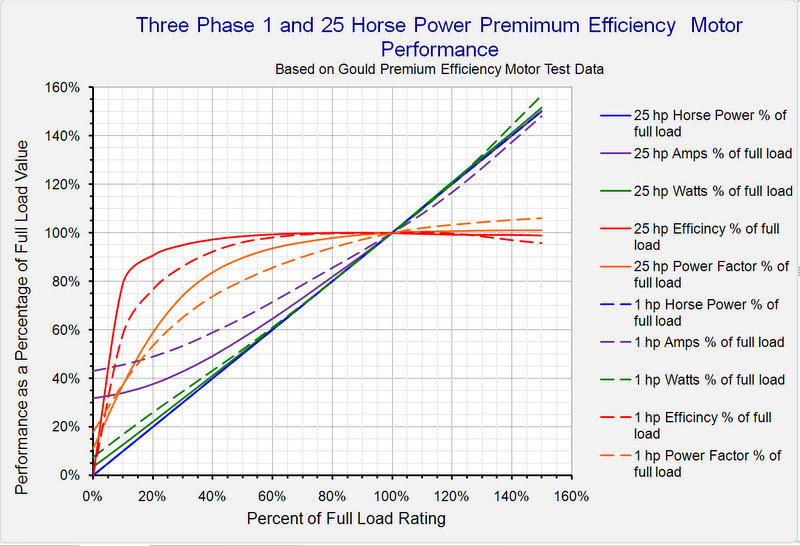
Also you are highly misinformed with electric motors, they are often 80-95% efficient when very lightly loaded and are near 50% efficient at peak power at half the no load speed - these are basic facts even a high school student should know.
Really? I guess you haven't made it to high school yet. I'll just describe the graph for those who won't follow the link. At 10% load the tested 25 horse power premium efficiency motor hits 80% efficiency. At 40% load, it hits 97% efficiency and it never drops below that, all the way out to 160% of its rated load.
and yes 10, 20, 30, 40 years from now we will replace our industrial electrical power production with better sources, but cars last 10 years at best. So right now the wrong thing to do is buy electric if you care about pollution.
My infernal combustion car is 14 years old, thanks. Right now, if you care about pollution, and can afford the gasoline-competitive electric cars (either of them), you can also afford to cover your roof in solar panels from one end to the other. I can't, just yet, but someday I will. At which point I won't care what "industrial power production" is doing.
Then again I don't suppose facts are your thing.
I replied with links. With numbers. You didn't. You should stop typing now.
-
Re:0-60 time...
http://www.zeroto60times.com/A... says 5.0-5.8s, but that totally feels like 3.4 seconds after you realize you paid $114k (starting price) for it instead of getting a P85 for $105k (starting).
-
Re:Raise the Price
Where you erred:
1) As you noted (but didn't factor into your figures) maintenance difference is hardly just oil changes. In reality, electric drivetrains have a tenth as many moving parts. They don't even have a transmission, for crying out loud, have you priced what it costs to replace a transmission? Just replacing a timing belt can cost a fortune. One can't so readily discount maintenance, it's a huge portion of operating costs.
2) If you drive the car until you totally run it into the ground, the average car will be driven a lot more than 250k miles (we're just going to go with your above erroneous figure - more on that in a second). If you sell it, you're selling a more expensive vehicle. And beyond that, as vehicles age, generally the most important aspect as to how well it holds its value is what it costs to operate it (energy costs + maintenance). Once all the luxury is gone, cars come down to simply how much does it cost to get you from point A to point B.
3) 37 cents per kilowatt hour is an absurd electricity price. The US national average residential rate in 2013 was $0.1226/kwh. 37 cents per kilowatt hour is even over double the *California* average rate. Beyond that, EVs can sometimes get even cheaper power due to off-peak rates.
4) The audi a6 quatro isn't even close to the performance of the Tesla Model S (depending on the details, more on that below).
5) The MSRP on a new TDI quattro (the one that gets nearly 30MPG - the gasoline ones don't) is $57.5k. The base Model S is $59.9k, roughly the same price - *before* incentives. And has a slightly better 0-60. But the performance Model S, which blows the Quattro out of the water with practically supercar-level acceleration plus has a bigger battery pack, is only about $10k more (again, not counting tax incentives/rebates/etc). Beyond all this, I'd argue that the Model S is simply a nicer car, period, all issues of driving/efficiency aside.
-
Re:Raise the Price
Where you erred:
1) As you noted (but didn't factor into your figures) maintenance difference is hardly just oil changes. In reality, electric drivetrains have a tenth as many moving parts. They don't even have a transmission, for crying out loud, have you priced what it costs to replace a transmission? Just replacing a timing belt can cost a fortune. One can't so readily discount maintenance, it's a huge portion of operating costs.
2) If you drive the car until you totally run it into the ground, the average car will be driven a lot more than 250k miles (we're just going to go with your above erroneous figure - more on that in a second). If you sell it, you're selling a more expensive vehicle. And beyond that, as vehicles age, generally the most important aspect as to how well it holds its value is what it costs to operate it (energy costs + maintenance). Once all the luxury is gone, cars come down to simply how much does it cost to get you from point A to point B.
3) 37 cents per kilowatt hour is an absurd electricity price. The US national average residential rate in 2013 was $0.1226/kwh. 37 cents per kilowatt hour is even over double the *California* average rate. Beyond that, EVs can sometimes get even cheaper power due to off-peak rates.
4) The audi a6 quatro isn't even close to the performance of the Tesla Model S (depending on the details, more on that below).
5) The MSRP on a new TDI quattro (the one that gets nearly 30MPG - the gasoline ones don't) is $57.5k. The base Model S is $59.9k, roughly the same price - *before* incentives. And has a slightly better 0-60. But the performance Model S, which blows the Quattro out of the water with practically supercar-level acceleration plus has a bigger battery pack, is only about $10k more (again, not counting tax incentives/rebates/etc). Beyond all this, I'd argue that the Model S is simply a nicer car, period, all issues of driving/efficiency aside.
-
Electric motor vs Gasoline Engine
You do realize that you're putting up a 420 horsepower engine up against the 145 HP motor in a volt? It also looks like they've gotten better with the volt:
Chevy volt: 8.9
Ford Mustang: 4.5Electric motors are good, but they're only about twice as good as their horsepower rating would imply up against a gasoline engine, much less one optimized for 0-60 times.
-
Electric motor vs Gasoline Engine
You do realize that you're putting up a 420 horsepower engine up against the 145 HP motor in a volt? It also looks like they've gotten better with the volt:
Chevy volt: 8.9
Ford Mustang: 4.5Electric motors are good, but they're only about twice as good as their horsepower rating would imply up against a gasoline engine, much less one optimized for 0-60 times.
-
Re:Diesel is a better solution
I recently hired a car and it was a Diesel, the first I've ever driven (VW Golf 2.0 Tdi bluemotion). I was amazed at the performance, it had excellent acceleration,
I think you might be getting models confused, but it looks like a typical VW Golf diesel does 0-60 in about 10 seconds, which isn't amazing, but it's not horrible, either.
Cars like that would work perfectly well in the USA, and be a lot easier to park as well.
'Parking difficulty' is really only a concern (in the USA) in the middle of an extremely crowded urban area. People who live in those places do tend to buy smaller cars, if they have them at all.
No wonder GM and Ford are dying.
They aren't, Ford has been profitable since 2009 at least
-
Re:money?
which means I was looking at a higher price point than a lot of people,
Well that's why people aren't following you to all buy EVs.
No, that doesn't explain it, because there are plenty of other people who buy new cars. In fact, the article is all about new car purchases.
Incidentally, your post motivated me to check out the Leaf's 0-60 time, which appears to be 7.9 seconds, which is indeed fairly reasonable. So now we're just looking at price.
It's actually even a little better than that -- not that 7.9 seconds is wrong, but the acceleration feels even zippier than the number expresses, partly because it's front-loaded as compared to ICE vehicles with similar 0-60 times and partly because it feels really cool to accelerate like that in near silence.
Put it this way... my teenage kids' friends think my LEAF is more awesome than their dads' BMWs and Audis, even though those cars are actually more capable in virtually every respect (and more expensive!). All it takes is me putting the pedal all the way down once and they're sold. And it's not because they care a bit about "saving the planet".
-
Re:money?
which means I was looking at a higher price point than a lot of people,
Well that's why people aren't following you to all buy EVs.
Incidentally, your post motivated me to check out the Leaf's 0-60 time, which appears to be 7.9 seconds, which is indeed fairly reasonable. So now we're just looking at price. -
Re:Saw one for the first time.
Actually the torque drops of gradually. The induction motor has a lot more high speed torque than a lot of other electric cars. I have both a Prius and a Model S P85. In my Prius the low end torque is great but it rapidly drops off and is quite pathetic at higher speeds. Similarly my father's Fisker Karma has great torque up to around 40MPH where it starts to get rather anemic. My Tesla Model S on the other hand still has plenty of torque at freeway speeds. It's a fairly flat torque curve. I think this may be due to the fact that Tesla is using an induction motor instead of synchronous motors. If I punch it at a green light I'm usually doing 45 by the time I reach the other side of the intersection and it just keeps going. It will do a quarter mile in 12.4 seconds and 0-60 in 4.2 seconds or less (some have gotten as low as 3.9 seconds). http://www.zeroto60times.com/Tesla-Electric-Cars-0-60-mph-Times.html
The torque is insane. I've driven up some steep grades like Kingsbury Grade near Lake Tahoe and the car handles it like it's nothing.
-
Re:Five Star
Braking systems have become so effective that, for the average driver, response time negates any difference between passenger vehicles.
As a mechanic, I'm curious as to what you mean by that.
FWIW, the first time you crest a hill on the interstate at speed, only to find a complete blockage less than 50 yards from your current position, you'll eat those words (and hopefully nothing else).
I don't think I've seen a car made in the past decade or so that had a 0-60 time slower than 8 seconds
Toyota Corolla, Honda Civic.
2013 Toyota Corolla S 0-60 mph 8.5 (barely over 8)
I looked up Civics, and was surprised to see that pretty much every model on the chart was slower than the Corolla. That was moderately unexpected, considering the "ricer" angle.
Smart Fortwo
Aw, c'mon - that's not a car, it's a glorified golf cart.
-
Re:Five Star
Yes, but what is the 0-60mph rating of that BMW 320i? 7-12 seconds
http://www.zeroto60times.com/BMW-Bimmer-0-60-mph-Times.htmlThe Tesla Model S is 3.9-5.9 seconds
Oh, and that's a 7 seater. With way better build quality. Way more features. And way nicer handling.
To this day, I can't understand why 0-60 times are a selling point for anything other than exotic sports cars... All it tells me is that idiots can crash into my vehicle that much quicker.
-
Re:Five Star
Yes, but what is the 0-60mph rating of that BMW 320i? 7-12 seconds
http://www.zeroto60times.com/BMW-Bimmer-0-60-mph-Times.htmlThe Tesla Model S is 3.9-5.9 seconds
Oh, and that's a 7 seater. With way better build quality. Way more features. And way nicer handling.
-
Re:Testla is good...
The fastest the lotus elise did was a 4.3 0-60 and a 12.8 sec quarter mile. The roadster did a 3.7 0-60 and a 12.8 sec quarter mile.
The lotus elise costs around 75-100K, while the tesla cost ~100K
Low performance, my ass. It blows the doors off the elise. The ONLY place that the elise can beat it is top speed (155 mph vs 125 mph). -
Re:Sounds legit. Ater all, what could go wrong?
And on the other end of the scale, Formula 1 cars regularly decelerate and turn at over 5G. It's amazing what all that downforce can do.
http://en.wikipedia.org/wiki/Formula_One_car#Performance
http://www.zeroto60times.com/F1-0-60.html -
Re:Porsche 911?
Faster that which porsche 911?
http://www.zeroto60times.com/Porsche-0-60-mph-Times.html
Faster than any Pre1990 Porsche? Yes, I guess so. That would be pretty impressive if it were 1990. Really, 4.4s is still very impressive, for any car. But...
1993 Porsche 911 Turbo 3.6 0-60 mph 4.3 Quarter mile 12.5
1995 Porsche 911 Turbo 0-60 mph 3.8 Quarter mile 12.3
1997 Porsche 911 Turbo 0-60 mph 3.6 Quarter mile 12.1
1997 Porsche RUF CTR-2 0-60 mph 3.4 Quarter mile11.2
2011 Porsche 911 Turbo S 0-60 mph 2.9 Quarter Mile 10.6There are a lot of Porsche 911 variants out there. A large fraction of the modern ones list sub 4.4s times.
(0-60 times often have largeish error bars)
Hmm, a bunch of $120k+ 911 Turbos and a $300k RUF. I think maybe you are looking at the wrong cars for comparison. According to Porsche's own website, the 2012 911 Carrera does 0-60 in 4.6 seconds, MSRP of $82k. So the Model X would be both quicker to 60 and cheaper. Looks like you have to step up to the $96k Carrera S to beat the 4.4s 0-60 time.
-
Porsche 911?
Faster that which porsche 911?
http://www.zeroto60times.com/Porsche-0-60-mph-Times.html
Faster than any Pre1990 Porsche? Yes, I guess so. That would be pretty impressive if it were 1990. Really, 4.4s is still very impressive, for any car. But...
1993 Porsche 911 Turbo 3.6 0-60 mph 4.3 Quarter mile 12.5
1995 Porsche 911 Turbo 0-60 mph 3.8 Quarter mile 12.3
1997 Porsche 911 Turbo 0-60 mph 3.6 Quarter mile 12.1
1997 Porsche RUF CTR-2 0-60 mph 3.4 Quarter mile11.2
2011 Porsche 911 Turbo S 0-60 mph 2.9 Quarter Mile 10.6There are a lot of Porsche 911 variants out there. A large fraction of the modern ones list sub 4.4s times.
(0-60 times often have largeish error bars)
-
Re:Standard Calculus
" i doubt it was doing 0-60 in 6.8, unless mommy and daddy paid a load of cash to make it go faster.."
Article says he has a 2000 Toyota Celica GTS. Some sites say it does do 0-60 in 6.8 or close to it:
0-60 in 6.6
0-60 in 7.2
0-60 in 6.5
So I don't think a 0-60 in 6.8 is completely out of the range of possibility, especially if the kid spent a few dollars in mods to make it a bit faster, and since we're talking about a car that his parents (or someone) spent $$$$ on a GPS tracker years ago it's clear the family has money to spend.