Slashdot Mirror
Search
Search the archive with full-text matching across story titles, bodies,
and comments. Phrases are quoted; or, -word,
and parentheses behave as in a web search. Queries must be at least
3 characters.
Stories · 13,059
-
NASA Begins Planning the First Human Mission To Cislunar Space (blastingnews.com)
MarkWhittington writes: With the first launch of the heavy-lift Space Launch System drawing nigh (for no later than November 2018), NASA is already trying to plan the first crewed space mission beyond low-Earth orbit for the early 2020s. However, budget uncertainties plus a couple of congressional mandates are causing uncertainty for the launch manifest for the SLS.
-
Dell's Next Rev for Project Sputnik: Ubuntu 14.04 On XPS 13 Developer Edition (hothardware.com)
MojoKid writes: Also known as "Project Sputnik," Dell came up with the idea of offering developers a variant of their XPS 13 notebook running Linux and launched its first models over three years ago. Now in its 5th generation, Project Sputnik is still going strong today with the latest models combining Ubuntu 14.04 with Intel's Skylake processors. To kick off its newest generation of Developer Edition laptops, Dell is offering three Core i7 XPS 13 configurations, including two that feature 16GB of RAM. Dell said it also plans to add a Core i5 option to the Developer Edition lineup sometime down the line. Dell is seeing increased interest from customers and in addition to the XPS Developer Edition, Dell offers Ubuntu on its Precision 5510, 3510, 7510, and 7710 mobile workstations, as well as its Precision M3800. Cost of entry into Developer Edition territory runs $1,550. What that gets you is a 13.3-inch QHD+ (3200x1800) InfinityEdge touch display powered by an Intel Core i5-6560U processor, 8GB of LPDDR3 1866 RAM, and Intel Iris Graphics 540.
-
GNU Project Introduces Gneural Network AI Package (gnu.org)
jones_supa writes: The GNU free software project is introducing a new neural network computation package called Gneural Network. The GNU project has been impressed by the work of Google, IBM, AlphaGo and Watson on the field of artificial intelligence. However, the GNU project sees that the fact that only companies and labs have access to this technology can represent a threat: "First of all, we cannot know how money driven companies are going to use this novel technology. Second, this monopoly slows down Progress and Technology." This is why the author, Jean Michel Sellier, decided to create Gneural Network and release it under the GNU GPL license. In the current release (version number humbly set to 0.0.1), it is a very simple feedforward network which can learn very simple tasks such as curve fitting, but the development team plans to deliver more advanced features very soon. They are already spending efforts to implement a network of LSTM (long short term memory) neurons for recurrent networks and deep learning. Learning reinforcement techniques are also planned.
-
Amazon Working On Education Platform To Offer Free Learning Materials (techcrunch.com)
An anonymous reader writes: E-commerce giant Amazon is planning to launch a new education platform which would enable educators to upload, manage, share, and discover open education resources. Earlier this month, the company quietly opened an Amazon Education Wait List to allow educators to be alerted about the availability of the platform. The website currently reads, "The future of education is open. Someday soon, educators everywhere will have free and unlimited access to first-class course materials from a revolutionary platform. Get on the wait list to be notified when the platform is available for all schools and classrooms!" The webpage, do note, could be related to some other project. This isn't the first time Amazon has shown interest in the education sector. In 2013, it acquired TenMarks, a company that offers mathematics learning materials. Amazon, which lets you purchase or rent books for Kindle, is also a major name in the publishing world. Over the years, Apple, Google, and Microsoft have also become increasingly interested in seeing their hardware and software in classrooms.
-
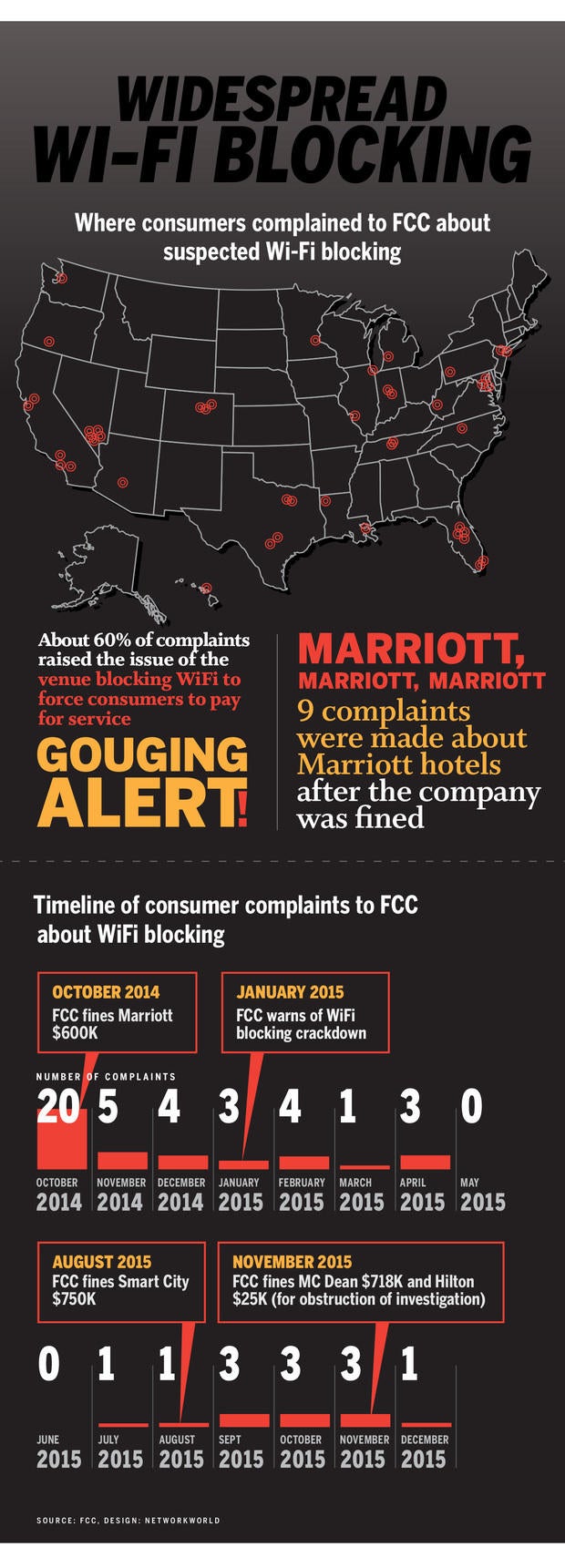
Wi-Fi Hotspot Blocking Persists Despite FCC Crackdown (networkworld.com)
An anonymous reader writes: An examination of consumer complaints to the FCC over the past year and a half shows that the practice of Wi-Fi hotspot device blocking continues even though the agency has slapped organizations such as Marriott and Hilton more than $2 million in total for doing this. Venues argue they need to block hotspots for security reasons, but the FCC and consumers say the organizations are doing this to force people to pay for pricey Internet access.
"Consumers who purchase cellular data plans should be able to use them without fear that their personal Internet connection will be blocked by their hotel or conference center," FCC Enforcement Bureau chief Travis LeBlanc said in a statement. "It is unacceptable for any hotel to intentionally disable personal hotspots while also charging consumers and small businesses high fees to use the hotel's own Wi-Fi network. This practice puts consumers in the untenable position of either paying twice for the same service or forgoing Internet access altogether." Consumers have filed many complaints about Wi-Fi hotspot blocking to the FCC. -
Pentagon Office Planning 'Avatar' Fighters and Fighter-Launched Drone Swarms (washingtonpost.com)
schwit1 writes: High over Alaska last summer, the Pentagon experimented with new, secret prototypes: Micro-drones that can be launched from the flare dispensers of moving F-16s and F/A-18 fighter jets. Canisters containing the tiny aircraft descended from the jets on parachutes before breaking open, allowing wings on each drone to swing out and catch the wind. Inch-wide propellers on the back provided propulsion as they found one another and created a swarm.
-
U.S. Military Spending Millions To Make Cyborgs A Reality (cnn.com)
mmell writes: The U.S. military is spending millions on an advanced implant that would allow a human brain to communicate directly with computers. If it succeeds, cyborgs will be a reality. The goal of the proposed implant is to "open the channel between the human brain and modern electronics" according to DARPA's program manager, Phillip Alvelda. In January, DARPA announced it plans to spend up to $62 million on the project, which is part of its Neural Engineering System Design program. The implant would be small -- no larger than one cubic centimeter, or roughly the size of two stacked nickels -- according to DARPA. The implantable device aims to convert neurons in the brain into electronic signals and provide unprecedented "data-transfer bandwidth between the human brain and the digital world," according to a DARPA statement announcing the new project. DARPA sees the implant as providing a foundation for new therapies that could help people with deficits in sight or hearing by "feeding digital auditory or visual information into the brain." A spokesman for DARPA told CNN that the program is not intended for military applications.
Ordinarily, such a headline might be considered sensationalist reporting and a batch of sci-fi -- except DARPA is involved. I can remember when internetworking computers was a radical concept until DARPA came up with some serious sci-fi style communications protocols to make it all work. With only $62 million budgeted (so far), we can only hope that it'll be a while before they succeed -- but then again, this is DARPA we're talking about. -
Hacker May Have Discovered Plans For A Tesla P100D (jalopnik.com)
One computer wiz claims to have hacked into Tesla's firmware and discovered a reference to a juicier battery. Self-proclaimed white hat hacker, Jason Hughes, says he discovered a secret in Tesla's firmware 7.1, but he didn't want to tell the world outright what he discovered, so he made Tesla Motors Club forum-members work for it by obfuscating the secret with a hash. TheSHA256 hash, a one-way function, would either require forum members to guess and check to decrypt this code, or to look it up in a hash directory. Forum member LuckyLuke decrypted Hughes' hash and discovered its meaning: P100D. P100D is the nickname given to Tesla's upcoming 100-kWh battery pack that would give the Model S a range of 300 miles or more. In response to a fellow forum-member decrypting his secret code, Hughes responded on Twitter. On the forum, Hughes had some additional information to mention, saying: There have been references to the P100D in firmwares as early as 2 months ago. They finally added the badges to 2.13.77. I mucked it up a bit by adding a crappy background (it's a PNG with transparency in the firmware)... There are quite a few things that are in the firmware that I'm not prepared to share publicly. Just like the P100D has been in there for months with my lips mostly sealed. I don't want to spoil all of Tesla's surprises.
-
Samsung Galaxy S7's Moisture Warning Prevents Charging When Wet (hothardware.com)
MojoKid writes: The Samsung Galaxy S7 and S7 Edge don't officially launch for a few more days, but some carriers appear to have shipped pre-orders early and some phones are already in consumers' hands. One early Galaxy S7 Edge owner appears to have tested his phones' water-resistance already and uncovered another new feature in the process. The user submerged his Galaxy S7 Edge in water and snapped a photo, then about four hours later plugged the phone into its fast charger and a warning popped-up on screen that stated, "Moisture detected in charging port", and the phone wouldn't charge. The user dried the phone and let it sit for a while, and it eventually started to charge again, but it wouldn't quick charge any longer. Frustrated, the user RMA'd the phone and plans to send it back to T-Mobile. The Galaxy S7 is IP68 rated, which means it is sealed against dust and can handle continuous submersion in up to 1 meter of water. However, the water detection feature that's apparently built into the Galaxy S7 is a good idea. Though the devices are IP68 rated, a few drops of water in the charging port could easily cause a short when the phone is plugged in.
-
Oregon Set To Become First Coal-Free State (huffingtonpost.com)
New submitter daubney writes: Oregon lawmakers have approved legislation to eliminate coal from the state's electrical supply by 2035, the first U.S. state to do so. The bill, called the Clean Electricity and Coal Transition plan, commits the state to doubling its use of renewable energy, including solar and wind, to 50 percent by 2040. The bill, passed this week by both legislative branches, now heads to Gov. Kate Brown. Brown said in a statement that the legislation "equips Oregon with a bold and progressive path towards the energy resource mix of the future." Today, roughly one-third of Oregon's power is produced from coal, according to the Oregon Department of Energy. The measure makes Oregon the first state to eliminate coal by legislative action, The Associated Press reports. According to the National Conference of State Legislatures, Oregon is matched only by Hawaii, with a 100 requirement by 2045, Vermont, with a 75 percent target by 2032, and California and New York, with 50 percent goals by 2030.
-
A Phone App Helps Day Laborers Attack Wage Theft (nytimes.com)
An anonymous reader writes with this story from the New York Times, excerpting "After three years of planning, an immigrant rights group in Jackson Heights is set to start a smartphone app for day laborers, a new digital tool with many uses: Workers will be able to rate employers (think Yelp or Uber), log their hours and wages, take pictures of job sites and help identify, down to the color and make of a car, employers with a history of withholding wages. They will also be able to send instant alerts to other workers. The advocacy group will safeguard the information and work with lawyers to negotiate payment." Adds the submitter: "Although I completely support the app, personally, I see this encountering some significant legal challenges. Hope they've lawyered up." Though the use case is different, this is similar in spirit to "cop watch" apps, like Cell411 and the ACLU's Mobile Justice. (And of course there's Periscope.)
-
Anonymous Hacks Donald Trump's Voicemail and Leaks the Messages (betanews.com)
Mark Wilson writes: In the run-up to the presidential election, few days go by when Donald Trump isn't hitting the headlines for something he's said or done. The bombastic billionaire looks set to become the Republican candidate, and his journey towards the White House is littered with offense and controversy, and back in December Anonymous declared war on him. The loose collective of hackers and activist made its declaration after Trump announced plans to ban Muslims from entering the U.S. One of the first strikes in Anonymous' war sees the group hacking the businessman's voicemail and leaking the messages. The messages appear to show that Trump had a surprisingly cosy relationship with the more left-leaning section of the media than one might imagine.
-
Mozilla Jumps On IoT Bandwagon (thestack.com)
mikejuk writes: Mozilla has been clarifying some of its plans to convert the Firefox OS project into four IoT based projects. At a casual glance, this seems like a naive move that is doomed to failure. Project Link is a 'user agent' for the smart home, that helps the end user set preferences for device interaction, and automates those connections for the user in a secure environment. Next, Project Sensor Web will be a pilot project for crowdsourcing a pm2.5 sensor network. Project Smart Home is focused on bridging the gap in IoT smart home providers between completely boxed solutions like Apple HomeKit, and completely DIY solutions like Raspberry Pi. Finally, Project Vaani is a voice interface for IoT access, which Mozilla credits as the 'most natural way to interact with connected devices.' With Firefox losing market share and projects like Firefox OS, Thunderbird, Shumway, and Persona closing down, perhaps Mozilla should try and find its way back to core concerns. All four of the projects need significant AI expertise and a powerful cloud computing resource neither of which Mozilla is likely to be able to afford.
-
Microsoft Losing Ground On Windows Store and UWP For Gaming
Vigile writes: Microsoft has big plans to try and merge the experiences of the Xbox One and Windows for gaming but the push back from the community and from major developers and personalities is mounting. Earlier this week PC Perspective posted a story that detailed the controversy around DX12 performance analysis without an exclusive full screen mode, changes to multi-GPU configurations and even compatibility issues with variable refresh that crop up from games from the Windows Store. Microsoft's only official response so far as been that it is listening to feedback and plans to address it with upcoming changes. Now today, Epic's Tim Sweeney has posted an editorial at The Guardian with an even more dramatic tone, saying that UWP (Unified Windows Platform) "can, should, must and will, die..." Clearly the stakes are being placed in the ground and even damage control from Phil Spencer on Twitter isn't likely to hold back angry PC users.
-
Pirates Hacked Shipping Firm's CMS To Plan Attacks, Find Valuable Cargo (softpedia.com)
An anonymous reader writes: Verizon's most recent Data Breach Digest includes a curious hacking case. Apparently a group of sea pirates have hired a hacker who uploaded a Web shell to a shipping company's CMS that allowed them to download cargo inventories and ship routes. They then used this information to attack ships, equipped with a barcode reader (and weapons of course), searching specific crates, emptying all the high-value cargo, and making off with the loot within minutes of launching their attacks.
-
Google Says Angular 2 Will Support Python, Java (thenewstack.io)
An anonymous reader writes: Google will release a faster beta version of Angular 2 in about two weeks, with a smaller version targeted for April. "We're improving our ability to handle different languages," says Google's Brad Green, noting that 213 contributors are currently working on Angular. "Our plan is to have versions that will work with many server-side technologies, from Java to Python." Microsoft has already demonstrated how it's building Angular into ASP.NET and Google is also working with the Drupal team. But Green says they'll also continue supporting Angular 1 for at least another year, until a majority of users have transitioned to the new syntax. Google says there are currently 21.3 million developers using Angular 1, compared to just 300,000 using Angular 2. "We've got a ways go to," Green admitted.
-
New Findings Deepen the Mystery of Fast Radio Bursts
An anonymous reader writes: Last week, it was reported that the mystery of fast radio bursts were solved, and that they were due to the merger of a neutron star with another collapsed object, well outside of our galaxy. However, not only was that analysis fundamentally flawed, but a new paper out today identifies fast radio bursts that repeat, a dealbreaker for the merger scenario. Instead, it's thought that these events come from the evolution of young neutron stars, as the data show an extragalactic but non-transient origin for these bursts. Planned follow-up observations plan on identifying the source locations as well as their true nature, and discerning whether all fast radio bursts have the same origin, or whether there are multiple different classes.
-
Microsoft To Unify PC and Xbox One Platforms (theguardian.com)
New submitter Serzen writes: According to The Guardian, Microsoft is planning to end fixed console hardware for the Xbox One as a move towards one ecosystem running Unified Windows Applications. The head of the company's Xbox division, Phil Spencer, said that the Universal Windows Platform would be central to the company's gaming strategy. "That is our focus going forward," he told reporters. "Building out a complete gaming ecosystem for Universal Windows Applications." What this could mean is that the Xbox One becomes more like a PC, with Microsoft releasing updated versions at regular intervals with more powerful processors and graphics hardware. In theory, because games will be written as UWAs, older titles will remain compatible with the new machines.
-
Renewable Energy Shows Strong Gain In U.S. (arstechnica.com)
WheezyJoe writes: According to the US Energy Information Administration, solar, wind, and gas dominate new US generating capacity in 2016. This year is notable because it will see the first new nuclear plant brought online in 20 years, contributing 1.1 GigaWatts to the grid. But that contribution will be dwarfed by renewable power sources, which together account for nearly two-thirds of 2016's new capacity. Part of the boom in renewables came because the tax incentives for their installation were in danger of expiring, so utilities rushed to get projects through the pipeline ahead of the end of the year. 9.5GW of capacity is expected to come online from solar -- more than the past three years combined. Another 6.8GW is expected from planned additions of wind power, largely spread across the Great Plains. Of new fossil fuel plants, the vast majority are going to be burning natural gas; there are no planned additions of coal plants.
-
South Korea Plans Moon Landing By 2020 (examiner.com)
MarkWhittington writes: The Korean Herald has reported that the South Korean Ministry of Science, ICT and Future Planning has started a lunar exploration program, allocating funding to place a probe in orbit around the moon and a small lander and rover on the surface of the moon by 2020. The United States and the government of South Korea have also made a space cooperation agreement, fueling speculation that NASA will participate in the South Korean moon shot.