Slashdot Mirror
Search
Search the archive with full-text matching across story titles, bodies,
and comments. Phrases are quoted; or, -word,
and parentheses behave as in a web search. Queries must be at least
3 characters.
Stories · 3,462
-
Despite Push From Tech Giants, AP CS Exam Counts Don't Budge Much In Most States
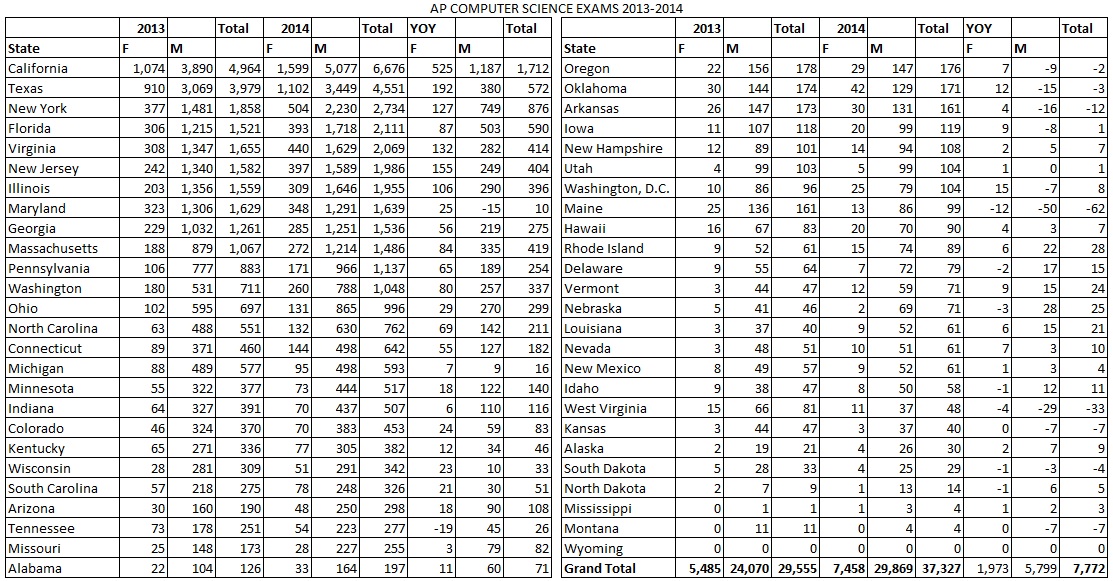
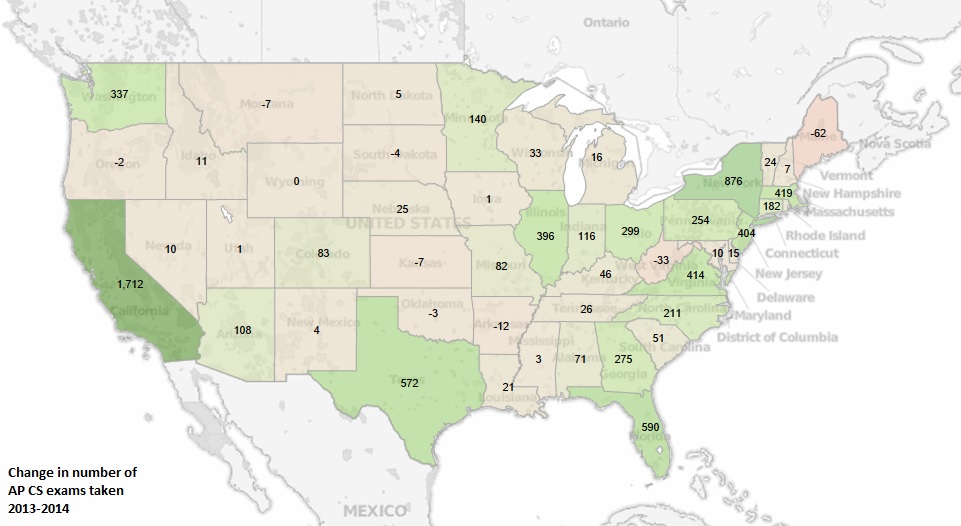
theodp (442580) writes "Well, the College Board has posted the 2014 AP Computer Science Test scores. So, before the press rushes out another set of Not-One-Girl-In-Wyoming-Took-an-AP-CS-Exam stories, let's point out that no Wyoming students of either gender took an AP CS exam again in 2014 (.xlsx). At the overall level, the final numbers have changed somewhat (back-of-the-Excel-envelope calculations, no warranty expressed or implied!), but tell pretty much the same story as the preliminary figures — the number of overall AP CS test takers increased, while pass rates decreased despite efforts to cherry pick students with a high likelihood of success. What is kind of surprising is how little the test numbers budged for most states — only 8 states managed to add more than 100 girls to the AP CS test taker rolls — despite the PR push by the tech giants, including Microsoft, Google, and, Facebook. Also worth noting are some big percentage decreases at the top end of the score segments (5 and 4), and still-way-too-wide gaps that exist between the score distributions of the College Board's various ethnic segments (more back of the envelope calcs). If there's a Data Scientist in the house, AP CS exam figures grabbed from the College Board's Excel 2013 and 2014 worksheets can be found here (Google Sheets) together with the (unwalkedthrough) VBA code that was used to collect it. Post your insight (and code/data fixes) in the comments!"
-
Kmart Says Its Payment System Was Hacked
wiredmikey writes Kmart is the latest large U.S. retailer to experience a breach of its payment systems, joining a fast growing club dealing successful hack attacks. The company said that on Thursday, Oct. 9, its IT team detected that its payment data systems had been breached, and that debit and credit card numbers appear to have been compromised. A company spokesperson told SecurityWeek that they are not able to provide a figure on the number of customers impacted. The spokesperson said that based on the forensic investigation to date, no personal information, no debit card PIN numbers, no email addresses and no social security numbers were obtained by the attackers.
-
Scientists Coax Human Embryonic Stem Cells Into Making Insulin
First time accepted submitter kwiecmmm writes A group of Harvard scientists reported that they have figured out how to turn embryonic stem cells into beta cells capable of producing insulin. This discovery could cure diabetes. From the article: "'It's a huge landmark paper. I would say it's bigger than the discovery of insulin,' says Jose Olberholzer, a professor of bioengineering at the University of Illinois. 'The discovery of insulin was important and certainly saved millions of people, but it just allowed patients to survive but not really to have a normal life. The finding of Doug Melton would really allow to offer them really something what I would call a functional cure. You know, they really wouldn't feel anymore being diabetic if they got a transplant with those kind of cells.'"
-
Indonesian Cave Art May Be World's Oldest
sciencehabit writes The world's oldest cave art may not lie in Europe but rather halfway around the globe in Indonesia, according to a new study. The images date to around 40,000 years ago, making them a similar age to cave paintings from Western Europe that represent the world's oldest known cave art. The findings suggest that humans were producing figurative art by around 40,000 years ago at opposite ends of the Pleistocene Eurasian world. Further research is needed to investigate whether rock art was an integral part of the cultural repertoire of the first modern human populations to reach Southeast Asia from Africa, or whether these practices developed independently in different regions.
-
US Remains Top Country For Global Workers
Nerval's Lobster writes The Boston Consulting Group and The Network recently surveyed 200,000 people in 189 countries to figure out the global willingness to work abroad. Their conclusion? People will indeed set down professional roots in another country—although younger workers seem far more willing to expatriate than their older peers. Where do the majority of global workers want to head? The United States, which 42 percent of respondents listed as their top potential work destination, followed by the U.K. (37 percent), Canada (35 percent), Germany (33 percent), Switzerland (29 percent), and France (29 percent). But citizens in the United States seemed a bit more reluctant to return the favor—less than 50 percent said they either lived abroad or would consider doing so for work. That's in sharp contrast to countries such as France, where a significant majority of citizens seemed willing to explore jobs in other nations. Of course, those who work in tech already know that globalization is a huge issue.
-
Fuel Efficiency Numbers Overstate MPG More For Cars With Small Engines
whoever57 writes: All official numbers for fuel economy in the EU typically overstate the miles-per-gallon figure that drivers can expect to achieve in typical driving. A recent study confirmed this once again. However, what the study also found was that MPG figures are more unrealistic for cars with smaller engines than for cars with larger engines. Actual MPG figures achieved based on typical drives for cars with small engines could be as much as 36% under the official number, while those cars with 3-liter engines would typically achieve 15% less than the official figure. These discrepancies need to be accounted for if we're going to be serious about regulating fuel efficiency. But then, we should be using gallons-per-mile instead of miles-per-gallon, too.
-
Tesla Is Starting a Certified Preowned Program
cartechboy writes Most luxury automakers have a Certified Previously Owned (CPO) program. Tesla isn't like a normal luxury automakers, in fact, it's not really like any automaker out there. It doesn't have franchises and it sells its own vehicles through its network of galleries. Now, it plans to create its own CPO program. There are a great deal of Model S sedans out there currently under lease contracts. When those cars are ready to come back, Tesla has guaranteed that it will purchase them for a figure that falls somewhere between 43 and 50 percent of the original purchase price. This is exactly how Tesla's going to create its CPO fleet. Tesla seems to do everything in an unconventional manner, so we'll have to see if its CPO program behaves like every other automaker's, or if it's different somehow as well.
-
Complain About Comcast, Get Fired From Your Job
ub3r n3u7r4l1st writes When you complain to your cable company, you certainly don't expect that the cable company will then contact your employer and discuss your complaint. But that's exactly what happened to one former Comcast customer who says he was fired after the cable company called a partner at his accounting firm. Be careful next time when you exercise your first amendment rights. From the article: At some point shortly after that call, someone from Comcast contacted a partner at the firm to discuss Conal. This led to an ethics investigation and Conal’s subsequent dismissal from his job; a job where he says he’d only received positive feedback and reviews for his work. Comcast maintained that Conal used the name of his employer in an attempt to get leverage. Conal insists that he never mentioned his employer by name, but believes that someone in the Comcast Controller’s office looked him up online and figured out where he worked. When he was fired, Conal’s employer explained that the reason for the dismissal was an e-mail from Comcast that summarized conversations between Conal and Comcast employees. But Conal has never seen this e-mail in order to say whether it’s accurate and Comcast has thus far refused to release any tapes of the phone calls related to this matter.
-
Lennart Poettering: Open Source Community "Quite a Sick Place To Be In"
An anonymous reader writes "Free software programmer Lennart Poettering has been part of his fair share of controversy in the open source community, and his latest essay may raise the most eyebrows yet. Poettering takes on the idea that the community is one big happy family and has some harsh words for the loudest and most obnoxious members. He says in part: "I don't usually talk about this too much, and hence I figure that people are really not aware of this, but yes, the Open Source community is full of a#@&oles, and I probably more than most others am one of their most favourite targets. I get hate mail for hacking on Open Source. People have started multiple 'petitions' on petition web sites, asking me to stop working (google for it). Recently, people started collecting Bitcoins to hire a hitman for me (this really happened!). Just the other day, some idiot posted a 'song' on youtube, a creepy work, filled with expletives about me and suggestions of violence. People post websites about boycotting my projects, containing pretty personal attacks. On IRC, people /msg me sometimes, with nasty messages, and references to artwork in 4chan style. And there's more. A lot more."
-
How Computer Vision Algorithms Cope With Detecting Human Figures In Art
KentuckyFC writes The human visual system has evolved to recognize people in almost any pose under a vast range of lighting conditions. But abstract art pushes this ability to its limits by distorting the human form. In particular, Cubism seeks to represent three-dimensional objects on a two-dimensional plane by juxtaposing snapshots from different angles. The result is that a Cubist picture contains many 'fragments of perception' of the same object. That's why it is often hard for people to recognize the human figures that these pictures contain. Now a group of computer scientists have tested how computer vision algorithms fare at the task of spotting human figures in Cubist art. They compared a variety of different algorithms against humans in trying to spot human figures in 218 Cubist paintings by Picasso. Humans easily outperform all the algorithms at this task. But some algorithms were much better than others. The most successful were based on so-called "deformable parts models" that recognize human figures by looking for body parts rather than the entire form. Interestingly, the team says this backs up various studies by neuroscientists suggesting that the human brain works in a similar way.
-
WSJ: Google X Display Team Works Toward Bezel-Free Modular Displays
The Wall Street Journal reports in a paywalled article that a team under Pixel Qi founder and OLPC co-founder Mary Lou Jepsen at Google's skunkwork labs Google X is working on modular video displays that could be expanded by snapping them together "like Lego." Ars Technica, TechSpot, The Verge, and several others summarize the claims made by "three people familiar with the project"; here's a snippet from TechSpot's version: Even in the home and office, the use of multiple displays isn’t uncommon but just like with larger implementations often used for advertising purposes, screen bezels are always a problem. Bezels are less visible from a distance but up close, they pretty much ruin the experience. The scope and target audience for the project is unclear at this hour as we are told the project is currently in an early stage. One of the biggest challenges is figuring out how to stitch images together across screens, both electronically and through software.
-
Euclideon Teases Photorealistic Voxel-Based Game Engine
MojoKid writes Not many would argue that current console and PC graphics technologies still haven't reached a level of "photo-realism." However, a company by the name of Euclideon is claiming to be preparing to deliver that holy grail based on laser scanning and voxel engine-based technologies. The company has put together a six-minute video clip of its new engine, and its genuinely impressive. There's a supposed-to-be-impressive unveil around the two minute mark where the announcer declares he's showing us computer-generated graphics rather than a digital photo — something you'll probably have figured out long before that point. Euclideon's proprietary design purportedly uses a laser scanner to create a point cloud model of a real-world area. That area can then be translated into a voxel renderer and drawn by a standard GPU. Supposedly this can be done so efficiently and with such speed that there's no need for conventional load screens or enormous amounts of texture memory but rather by simply streaming data off conventional hard drives. Previously, critiques have pointed to animation as one area where the company's technique might struggle. Given the ongoing lack of a demonstrated solution for animation, it's fair to assume this would-be game-changer has some challenges still to solve. That said, some of the renderings are impressive.
-
Device Allows Paralyzed Rats To Walk, Human Trials Scheduled Next Summer
An anonymous reader writes "A new technique pioneered by scientists working on project NEUWalk at the Swiss Federal Institute for Technology (EPFL) have figured out a way to reactivate the severed spinal cords of fully paralyzed rats, allowing them to walk again via remote control. Human trials are scheduled for next summer. "We have complete control of the rat's hind legs," EPFL neuroscientist Grégoire Courtine said. "The rat has no voluntary control of its limbs, but the severed spinal cord can be reactivated and stimulated to perform natural walking. We can control in real-time how the rat moves forward and how high it lifts its legs."
-
Fukushima Radiation Still Poisoning Insects
sciencehabit writes: Eating food contaminated with radioactive particles may be more perilous than previously thought — at least for insects. Butterfly larvae fed even slightly tainted leaves collected near the Fukushima Daiichi Nuclear Power Station were more likely to suffer physical abnormalities and low survival rates than those fed uncontaminated foliage, a new study finds. The research suggests that the environment in the Fukushima region, particularly in areas off-limits to humans because of safety concerns, will remain dangerous for wildlife for some time. In other lingering radiation news, reader Rambo Tribble writes: Forest detritus, contaminated in the aftermath of the 1986 Chernobyl disaster (abstract), is decaying at a much slower rate than normal, building up and creating a significant fire risk. This, in turn, is creating a real potential for the residual radioactive material to be distributed, through smoke, over a broad area of Europe and Russia. Looking at different possible fire intensities, researchers speculate, "20 to 240 people would likely develop cancer, of which 10 to 170 cases may be fatal." These figures are similar to those hypothesized for Fukushima.
-
CDC: Ebola Cases Could Reach 1.4 Million In 4 Months
mdsolar sends this report from the NY Times: Yet another set of ominous projections about the Ebola epidemic in West Africa was released Tuesday, in a report from the Centers for Disease Control and Prevention that gave worst- and best-case estimates for Liberia and Sierra Leone based on computer modeling. In the worst-case scenario, Liberia and Sierra Leone could have 21,000 cases of Ebola by Sept. 30 and 1.4 million cases by Jan. 20 if the disease keeps spreading without effective methods to contain it. These figures take into account the fact that many cases go undetected, and estimate that there are actually 2.5 times as many as reported. ... In the best-case model — which assumes that the dead are buried safely and that 70 percent of patients are treated in settings that reduce the risk of transmission — the epidemic in both countries would be 'almost ended' by Jan. 20, the report said.
-
The Site That Teaches You To Code Well Enough To Get a Job
HughPickens.com writes Wanna be a programmer? Klint Finley reports that software developer Katrina Owen has created a site called Exercism.io where students can learn to craft code that's both clear and efficient and get a lot of feedback on what they're doing right and what they're doing wrong. Exercism is updated every day with programming exercises in a variety of different languages. First, you download these exercises using a special software client, and once you've completed one, you upload it back to the site, where other coders from around the world will give you feedback. Then you can take what you've learned and try the exercise again. The idea was to have students not only complete the exercises, but get feedback. Exercism.io now has over 6,000 users who have submitted code or comments, and hundreds of volunteers submit new exercises or translate existing ones into new programming languages. But even Owen admits that the site is a bit lacking in the usability department. "It's hard to tell what it is just by looking at it," she says. "It's remarkable to me that people have figured out how to use it."
-
NSA Director Says Agency Is Still Trying To Figure Out Cyber Operations
Trailrunner7 writes: In a keynote speech at a security conference in Washington on Tuesday, new NSA Director Mike Rogers emphasized a need to establish behavioral norms for cyber war. "We're still trying to work our way through distinguishing the difference between criminal hacking and an act of war," said Rogers. "If this was easy, we would have figured it out years ago. We have a broad consensus about what constitutes an act of war, what's an act of defense." Rogers went on to explain that we need to better establish standardized terminology and standardized norms like those that exist in the realm of nuclear deterrence. Unfortunately, unlike in traditional national defense, we can not assume that the government will be able to completely protect us against cyber-threats because the threat ecosystem is just too broad.
-
Massive Study Searching For Genes Behind Intelligence Finds Little
An anonymous reader writes: It's been taken for granted that science would, one day, figure out what parts of our DNA make us smart (or not). But a huge new study done by a group of almost 60 researchers using genome data on over 100,000 people has come up empty-handed. The scientists first looked for differences in the genome that correlated with academic achievement. After narrowing it down to 69 individual sites, they gave cognitive tests to separate group of 24,000 people and looked for evidence of difference at those same locations (abstract). Most of the sites weren't significantly different from chance — the (already weak) genetic influence of genes on height has an effect 20 times greater. On top of that, the three gene locations that did seem to have a stronger correlation weren't involved in development of the nervous system.
-
UN Study Shows Record-High Increases For Atmospheric CO2 In 2013
Figures released Tuesday by a United Nations advisory body reveal that 2013 saw new recorded highs for both carbon dioxide and methane, as well as the largest year-over-year rise in carbon dioxide since 1984, reflecting continuing worldwide emissions from human sources but also the possibility that natural sinks (oceans and vegetation) are near their capacity for absorbing the excess. From the Washington Post's account: The latest figures from the World Meteorological Organization’s monitoring network are considered particularly significant because they reflect not only the amount of carbon pumped into the air by humans, but also the complex interaction between man-made gases and the natural world. Historically, about half of the pollution from human sources has been absorbed by the oceans and by terrestrial plants, preventing temperatures from rising as quickly as they otherwise would, scientists say. “If the oceans and the biosphere cannot absorb as much carbon, the effect on the atmosphere could be much worse,” said Oksana Tarasova, a scientist and chief of the WMO’s Global Atmospheric Watch program, which collects data from 125 monitoring stations worldwide. The monitoring network is regarded as the most reliable window on the health of Earth’s atmosphere, drawing on air samples collected near the poles, over the oceans, and in other locations far from cities and other major sources of pollution. The new figures for carbon dioxide were particularly surprising, showing the biggest year-over-year increase since detailed records were first compiled in the 1980s, Tarasova said in an interview. The jump of nearly three parts per million over 2012 levels was twice as large as the average increase in carbon levels in recent decades, she said.
-
Home Depot Confirms Breach of Its Payment Systems
itwbennett writes: Home Depot confirmed Monday that its payment systems had been breached, potentially affecting any customers who shopped at its stores in the U.S. and Canada since April. There's no evidence yet that debit card PINs had been compromised, the company said, though it is still figuring out the scope and scale of the attacks. Home Depot is offering a free year of identity protection services for anyone who used a payment card in one of their stores since the beginning of April.