Slashdot Mirror
Search
Search the archive with full-text matching across story titles, bodies,
and comments. Phrases are quoted; or, -word,
and parentheses behave as in a web search. Queries must be at least
3 characters.
Stories · 13,059
-
First Government Office in the US To Accept Bitcoin As Payment (orlandosentinel.com)
Long-time Slashdot reader SonicSpike quotes the Orlando Sentinel: If cash, check or credit card seems too old-fashioned, Seminole County, Florida Tax Collector Joel Greenberg said this week his office will begin accepting bitcoin as payment for new IDs, license plates and property taxes starting next month. Greenberg said accepting bitcoin and bitcoin cash as a payment method will promote transparency and accuracy in payment.
"There's no risk to the taxpayer," said Greenberg, who has often raised eyebrows since his 2016 election by moves including encouraging certain employees with concealed-weapons permits to carry a firearm openly as a security measure. "Blockchain technology is the future of the whole financial industry."
A spokesperson for a neighboring county's tax collector said they had no plans to follow the move. "Frankly, I think the currency is so volatile that I donâ(TM)t think it makes sense."
And an official at a nearby county said bitcoin payments were "not on our to-do list", adding that no one in the county had requested the ability to pay their taxes in bitcoin. -
Floating Pacific Island Is In the Works With Its Own Government, Cryptocurrency (cnbc.com)
An anonymous reader quotes a report from CNBC: Nathalie Mezza-Garcia is a political scientist turned "seavangelesse" -- her term for an evangelist in favor of living off the grid -- and on the ocean. Mezza-Garcia spoke with CNBC's Matthew Taylor about what she sees as the trouble with governments, and why she believes tech startups should head to Tahiti. This seavangelesse is a researcher for the Blue Frontiers and Seasteading Institute's highly-anticipated Floating Island Project. The project is a pilot program in partnership with the government of French Polynesia, which will see 300 homes built on an island that runs under its own governance, using a cryptocurrency called Varyon.
"Once we can see how this first island works, we will have a proof of concept to plan for islands to house climate refugees," she said. The project is funded through philanthropic donations via the Seasteading Institute and Blue Frontiers, which sells tokens of the cryptocurrency Varyon. The pilot island is expected to be completed by 2022 and cost up to $50 million. As well as offering a home for the displaced, the self-contained islands are designed to function as business centers that are beyond the influence of government regulation. -
Utilities, Tesla Appeal Federal Rollback of Auto Emissions Standards (arstechnica.com)
A coalition of utilities and electric vehicle makers, including Tesla, are petitioning the EPA to reconsider its recent plan to roll back auto emissions standards. In April, the EPA said that it would relax greenhouse gas emissions standards that had been put in place for model year 2022-2025 vehicles. Ars Technica reports: The National Coalition for Advanced Transportation (NCAT) represents 12 utilities as well as Tesla, electric truck maker Workhorse, and EV charging network EVgo. NCAT earlier this month asked the Second Circuit Court of Appeals in Washington, DC to review the EPA's latest efforts to relax the Obama-era fuel economy standards.
The coalition challenge to the EPA follows a similar challenge made by 17 states, including California. The utilities' efforts show that they're interested in protecting one of the major projected avenues for growth in electricity demand. Electricity consumption has stagnated in the U.S. as efficiency measures take effect and, in some states, solar panels make it easier for residents to buy less electricity from the local utility. -
Elon Musk Pitches 150 MPH Rides In Boring Company Tunnels For $1 (engadget.com)
An anonymous reader quotes a report from Engadget: At The Boring Company Information Session not all of the talk centered on flamethrowers. Elon Musk and project leader Steve Davis described many details of their visions for an underground network that could alleviate traffic problems in big cities. Musk said "we're not suggesting this to the exclusion of other approaches," but did take a moment to call out flying taxi solutions (like Uber Elevate) right off the bat due to danger and noise.
Earlier in the evening Musk retweeted an LA Metro tweet that said it's coordinating with The Boring Company on its test and said the two will be "partners" going forward. Much of what Musk discussed about how his concept in-city Loop would work has been answered in concept videos and the company's FAQ, but he specifically said that the plan is for rides that cost a $1, and carry up to 16 passengers through hundreds of tunnels to those small, parking space-size tunnels located throughout a city. Test runs in the loop have already hit a couple of hundred miles an hour, and Musk's plan is for vacuum Hyperloop tubes between cities that enable travel in pressurized carts at up to 300 MPH. That's compared to 150 MPH in the in-city Loop carts, all without slowing down due to traffic or anything else. The main concern is hitting speeds that are still comfortable for people inside. The timeframe for when the "weird little Disney ride in the middle of LA" will be available to the public is unclear. -
Canonical Shares Desktop Plans For Ubuntu 18.10 (ubuntu.com)
Canonical's Will Cooke on Friday talked about the features the company is working on for Ubuntu 18.10 "Cosmic Cuttlefish" cycle. He writes: We're also adding some new features which we didn't get done in time for the main 18.04 release. Specifically: Unlock with your fingerprint, Thunderbolt settings via GNOME Control Center, and XDG Portals support for snap.
GNOME Software improvements
We're having a week long sprint in June to map out exactly how we want the software store to work, how we want to present information and to improve the overall UX of GNOME Software. We've invited GNOME developers along to work with Ubuntu's design team and developers to discuss ideas and plan the work. I'll report back from the sprint in June.
Snap start-up time
Snapcraft have added the ability for us to move some application set up from first run to build time. This will significantly improve desktop application first time start up performance, but there is still more we can do.
Chromium as a snap
Chromium is becoming very hard to build on older releases of Ubuntu as it uses a number of features of modern C++ compilers. Snaps can help us solve a lot of those problems and so we propose to ship Chromium only as a snap from 18.10 onwards, and also to retire Chromium as a deb in Trusty. If you're still running Trusty you can get the latest Chromium as a snap right now. In addition, Ubuntu team is also working on introducing improvements to power consumption, adding support for DLNA, so that users could share media directly from their desktop to DLNA clients (without having to install and configure extra packages), and improved phone integration by shipping GS Connect as part of the desktop, the GNOME port of KDE Connect. Additional changelog here. -
Ads Are Coming To Facebook Stories (techcrunch.com)
Facebook Stories has reached 150 million daily active users after launching nearly 14 months ago. So what's the next logical step after reaching such a milestone? Advertisements. According to TechCrunch, Facebook Stories will start testing its first ads today in the U.S., Mexico and Brazil. From the report: They're 5- to 15-second video ads users can skip, and while there's no click-through or call to action now, Facebook plans to add that in the coming months. Advertisers can easily extend their Instagram Stories ads to this new surface, or have Facebook automatically reformat their News Feed ads with color-matched borders and text at the bottom. Facebook also plans to give businesses more metrics on their Stories performance to convince them the feature is worth their ad dollars.
-
Google Chrome To Remove 'Secure' Indicator From HTTPS Pages in September (bleepingcomputer.com)
Google announced Thursday it plans to drop the "Secure" indicator from the Chrome URL address bar -- starting with Chrome v68, set for release in July -- and only show a lock icon when the user is navigating to an HTTPS-secured website. From a report: The move is scheduled to take effect with the release of Chrome 69, scheduled for September, this year. Emily Schechter, Product Manager for Chrome Security, said the company is now comfortable making this move as a large chunk of Chrome's traffic is now via HTTPS. Since most traffic is HTTPS anyway, it's not necessary to draw the user's attention to the "Secure" indicator anymore.
-
Faster Flights Are Coming With New Satellite Tracking Technology (bloomberg.com)
An anonymous reader shares a report: The company that provides the U.K.'s air-traffic control service is taking a 10 percent stake in Aireon, a U.S. firm that's building a satellite-based tracking system and will offer commercial services to controllers starting next year. Aireon plans to use a constellation of 66 Iridium Communications. Next satellites in low Earth orbit to track aircraft. Iridium has 50 in orbit already, 47 of which are operational. Each carries equipment to offer aircraft position data to ground controllers.
Iridium plans to launch five additional satellites on May 22 from California, completing its full network later this year. Aireon said 70 percent of the world's airspace lacks satellite tracking or airline surveillance coverage, including most oceans and parts of Africa and Latin America. -
NYC Announces Plans To Test Algorithms For Bias (betanews.com)
The mayor of New York City, Bill de Blasio, has announced the formation of a new task force to examine the fairness of the algorithms used in the city's automated systems. From a report: The Automated Decision Systems Task Force will review algorithms that are in use to determine that they are free from bias. Representatives from the Department of Social Services, the NYC Police Department, the Department of Transportation, the Mayor's Office of Criminal Justice, the Administration for Children's Services, and the Department of Education will be involved, and the aim is to produce a report by December 2019. However, it may be some time before the task force has any sort of effect. While a report is planned for the end of next year, it will merely recommend "procedures for reviewing and assessing City algorithmic tools to ensure equity and opportunity" -- it will be a while before any recommendation might be assessed and implemented.
-
Investors Have Placed $1 Billion in Cryptocurrency Offerings Rampant With Red Flags For Fraud (cnbc.com)
Investors have sent $1 billion into digital coin projects that flash warning signs for fraud, The Wall Street Journal reported Thursday. The revelation comes a day after the SEC created its own fake ICO to teach investors a lesson. From a report: In a review of 1,450 digital coin offerings, the Journal said it found 271 bore red flags such as plagiarized documents or fake executive information. Investors have already claimed losses of up to $273 million in these projects, the newspaper said, according to lawsuits and regulatory actions. The coin sales, or "initial coin offerings," give investors the chance to buy into a new digital token while letting developers get easy access to funding. The process may be a little too easy for many projects that are unproven or outright scams.
Coin offerings have raised roughly $9.8 billion in the two years through mid-March, according to financial research firm Autonomous Next. The Journal found widespread plagiarism in 111 projects' online whitepapers, including word-for-word copies of marketing plans and technical features. -
YouTube Unveils New Streaming Service 'YouTube Music,' Rebrands YouTube Red (gizmodo.com)
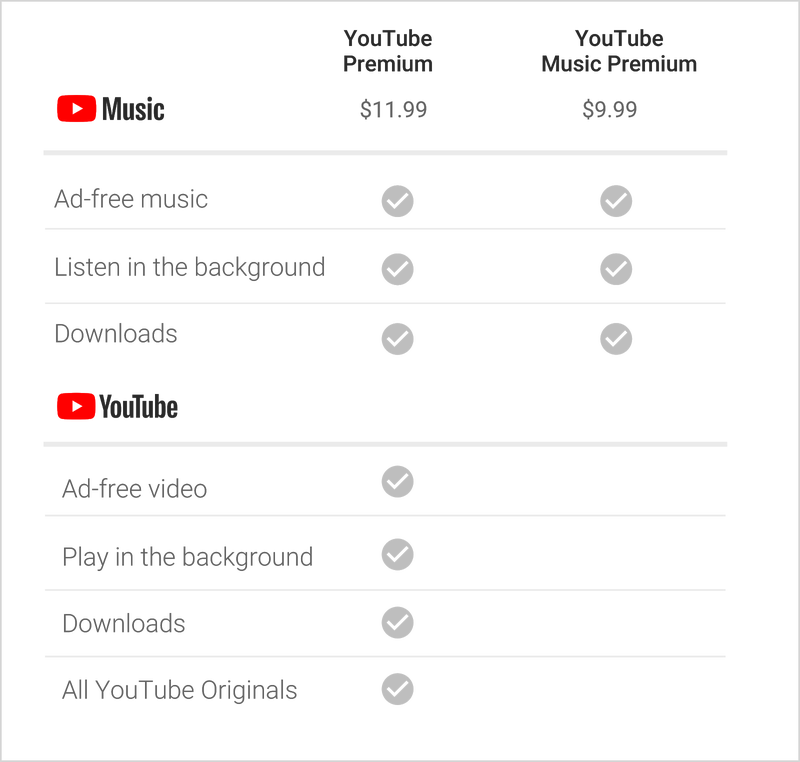
An anonymous reader quotes a report from Gizmodo: YouTube Music, a streaming music platform designed to compete with the likes of Spotify and Apple Music, officially has a launch date: May 22nd. Its existence will also shift around YouTube and Google's overall media strategy, which has thus far been quite the mess. YouTube Music will borrow the Spotify model and offer a free, ad-supported tier as well as a premium version. The paid tier, which will be called YouTube Music Premium, will be available for $9.99 per month. It will debut in the U.S., Australia, New Zealand, Mexico, and South Korea before expanding to 14 other countries.
One of the selling points for YouTube Music will be the ability to harness the endless amount of information Google knows about you, which it will use to try to create customized listening experiences. Pitchfork reported that the app, with the help of Google Assistant, will make listening recommendations based on the time of day, location, and listening patterns. It will also apparently offer "an audio experience and a video experience," suggesting perhaps an emphasis on music videos and other visual content. From here, Google seems to be focused on making its streaming strategy a little less wacky. Google Play Music, the company's previous music streaming service that is still inexplicably up and running despite teetering on the brink of extinction for years, will slowly be phased out according to USA Today. Meanwhile, the paid streaming subscription service, known as YouTube Red, is being rebranded to YouTube Premium and will cost $11.99 per month instead of $9.99. (Pitchfork notes that existing YouTube Red subscribers will be able to keep their $9.99 rate.) YouTube Premium will include access to YouTube Music Premium. Here's a handy-dandy chart that helps show what is/isn't included in the two plans. -
Sony Ends Production Of Physical Vita Games (kotaku.com)
Sony is ending physical production of Vita games, news outlet Kotaku reports. Although the hardware manufacturer says digital distribution will continue, this move will mark the end of physical cards for the maligned portable game system, Kotaku added. From a report: Sony's American and European branches "plan to end all Vita GameCard production by close of fiscal year 2018," the company told developers today in a message obtained by Kotaku. The message asks that all Vita product code requests be submitted by June 28, 2018, and that final purchase orders be entered by February 15, 2019. Sony's 2018 fiscal year will end on March 31, 2019.
-
Microsoft To Launch a Line of Lower-Cost Surface Tablets With 10-inch Displays By Second Half of 2018, Report Says (bloomberg.com)
Microsoft plans to launch a line of lower-cost Surface tablets as soon as the second half of 2018, Bloomberg reported Wednesday. These devices should help Microsoft improve its market share in the iPad-led hybrid machines market, the outlet noted. From the report: Microsoft has tried this before. The software giant kicked off its consumer-oriented hardware push in 2012 with the launch of the original Surface RT. At the time, it was priced starting at $499. After the tablets didn't resonate with consumers and product reviewers, Microsoft pivoted to the more-expensive Surface Pro, a line which has gained steam and likely contributed to demand for a pro-oriented iPad, which Apple launched in 2015.
The new tablets will feature 10-inch screens -- around the same size as a standard iPad, but smaller than the 12-inch screens used on the Surface Pro laptop line. The new Surfaces, priced about $400, will have rounded edges like an iPad, differing from the squared off corners of current models. They'll also include USB-C connectivity, a first for Surface tablets, a new charging and syncing standard being used by some of the latest smartphones. The tablets are expected to be about 20 percent lighter than the high-end models, but will have around four hours fewer of battery life. (The current Surface Pro can last 13.5 hours on a single charge.) -
Fedora-Based Linux Distro Korora Halts Development (betanews.com)
Korora, a Fedora-based Linux distro, halted its development this month, BetaNews' Brian Fagioli spotted Wednesday. The announcement would irk many, as Korora consistently received positive feedback from critics and users alike. News outlet ZDNet once described Korora as "Fedora++", while Slashdot readers, too, spoke highly of the distro.
At the same time, the announcement should come as little surprise to anyone who has been tracking Korora's work. In a blog post, Korora team wrote: Korora for the forseeable future is not going to be able to march in cadence with the Fedora releases. In addition to that, for the immediate future there will be no updates to the Korora distribution. Our team is infinitesimal (currently 1 developer and 2 community managers) compared to many other distributions, we don't have the luxury of being able to dedicate the amount of time we would like to spend on the project and still satisfy our real life obligations. So we are taking a little sabbatical to avoid complete burn out and rejuvenate ourselves and our passion for Korora/Fedora and wider open source efforts. The team had expressed similar concerns earlier this year: For the past few years Korora has released a new version in line with each Fedora version. That means that approximately twice a year we prepare, test and create 5 different ISO versions. This is as well as, among other things, developing new projects, supporting existing releases and planning the future versions. As each team member has different skills some tasks, such as development, can only be done by one person. All this is done in our spare time along side our job, family and personal responsibilities. For a very small team, currently 3 people plus the occasional input from others, this is a lot of work. It means that often Korora has to take a back seat when real life intrudes. This isn't the first time Korora had to abruptly pause its development. In 2007, Christopher Smart, who kickstarted Korora (at the time based on Gentoo Linux), had discontinued the project -- only to revive it three years later. -
In a Poll, 43% of Millennials in 36 Countries Say They Plan To Leave Their Jobs Within Two Years (qz.com)
A poll by Deloitte with more than 10,000 millennials across 36 countries found that 43% of them are planning to leave their jobs within two years, while only 28% are looking to stay beyond five years.
-
Kaspersky Lab Moving Core Infrastructure To Switzerland (securityweek.com)
wiredmikey writes: As part of its Global Transparency Initiative, Russia-based Kaspersky Lab today announced that it will adjust its infrastructure to move a number of "core processes" from Russia to Switzerland. The security firm has faced challenges after several governments have banned Kaspersky software over security concerns, despite no hard evidence that Kaspersky has ever colluded with the Russian government. As an extension to its transparency initiative, announced in October 2017, the firm is now going further by making plans for its processes and source code to be independently supervised by a qualified third-party. To this end, it is supporting the creation of a new, non-profit "Transparency Center" able to assume this responsibility not just for itself, but for other partners and members who wish to join. Noticeably, Kaspersky Lab does not link the move specifically to the effects of the U.S. ban, but sees wider issues of global trust emerging.
-
Lenovo Teases a True All-Screen Smartphone With No Notch (cnet.com)
An anonymous reader quotes a report from CNET: Notches, it seems, are the new black. Originally seen -- and often criticized -- on the Essential PH-1 and iPhone X in 2017, the trend of adding notches to Android phones has only accelerated this year as phone makers look to maximize the screen size. But the Lenovo Z5 is going the other way: It's truly all-screen, and notch-free. At least, that's according to a sketch shared last Friday by Lenovo VP Chang Cheng on Weibo, a Twitter-like platform in China. Cheng's teaser post says (according to Google Translate) that the Lenovo Z5 is the company's new flagship phone. Besides that, the post leaves it pretty vague.
All-screen phones look cool, but they challenge the manufacturer to find a place to put front cameras, sensors and other hardware. That's why we see bezels on some phones and notches on others. It's not clear what Lenovo plans to do with the front camera on the Lenovo Z5. Cheng's post claims that "four technological breakthroughs" and "18 patented technologies" were made for the phone, but doesn't go into details. One of the first smartphones to launch with an edge-to-edge display was the Xiaomi Mi Mix. It launched with next to no bezel or notch, leaving many to wonder where the earpiece would be. What Xiaomi managed to do was use what it calls "cantilever piezoelectric ceramic acoustic technology." Basically, it's a component that converts electrical energy into mechanical energy to transfer to the phone's internal metal frame, which then vibrates to create sound. It's possible the Z5 relies on a similar technology, or bone conduction technology found in many headphones and some smartphones.
Aside from the front-facing camera and ambient light sensors, the other components that are typically found on the front of smartphones are relatively easy to drag-and-drop to different locations. For example, the speakers in the Z5 are likely bottom facing and the navigation controls are almost certainly software based. The question is whether or not it's worth having a true all-screen smartphone if it means there's no front-facing camera, ambient light sensors, or stereo speakers. -
AMD Integrates Ryzen PRO and Radeon Vega Graphics In Next-Gen APUs (zdnet.com)
The three biggest PC OEMs -- Dell, HP, and Lenovo -- are now offering AMD Ryzen PRO mobile and desktop accelerated processing units (APUs) with built-in Radeon Vega graphics in a variety of commercial systems. There are a total of seven new APUs -- three for the mobile space and four for the desktop. As AMD notes in its press release, the first desktops to ship with these latest chips include: the HP Elitedesk G4 and 285 Desktop, the Lenovo ThinkCentre M715, and the Dell Optiplex 5055. ZDNet's Adrian Kingsley-Hughes writes about what makes Ryzen PRO so appealing: Ryzen PRO has been built from the ground up to focus on three pillars -- power, security and reliability. Built-in security means integrated GuardMI technology, an AES 128-bit encryption engine, Windows 10 Enterprise Security support, and support for fTPM/TPM 2.0 Trusted Platform Module. One of the features of Ryzen PRO that AMD hopes will appeal to commercial users is the enterprise-grade reliability that the chips come backed with, everything from 18-moths of planned software availability, 24-months processor availability, a commercial-grade QA process, 36-moth warranty, and enterprise-class manageability.
There are no worries on the performance front either, with the Ryzen PRO with Vega Graphics being the world's fastest processor currently available for ultrathin commercial notebooks, with the AMD Ryzen 7 PRO 2700U offering up to 22 percent more productivity performance than Intel's 8th-generation Core i7-8550U in testing carried out by AMD. AMD has also designed the Ryzen PRO processors to be energy-efficient, enabling up to 16 hours of battery life in devices, or 10.5 hours of video playback. The Ryzen PRO with Vega Graphics desktop processors are also no slouches, opening up a significant performance gap when compared to Intel Core i5 8400 and Core i3 8100 parts. AMD also announced that it is sampling its second-generation Threadripper 2900X, 2920X and 2950X products. "For Threadripper Gen2 you can expect a refresh of the current line-up; an 8-core Threadripper 2900X, a 12-core Threadripper 2920X and of course a 16-core Threadripper 2950X," reports Guru3D.com. "AMD will apply the same Zen+ tweaks to the processors; including memory latency optimizations and higher clock speeds."
AMD has something for the datacenter enthusiasts out there too. Epyc, AMD's x86 server processor line based on the company's Zen microarchitecture, has a new promo video, claiming more performance, more security features, and more value than Intel Xeon. The company plans to market Epyc in an aggressive head-to-head format similar to how T-Mobile campaigns against Verizon and AT&T. Given Intel Xeon's 99% market share, they sort of have to... -
Google Will Make Its Paid Storage Plans Cheaper (theverge.com)
An anonymous reader shares a report:Google is rolling out new changes to its storage plans that include a new, low-cost storage plan and half off the price of its 2TB storage option, the company announced today. It's also converting all Google Drive paid storage plans to Google One, perhaps in part because you'll now have one-tap access to Google's live customer service.
Google One will get a new $2.99 a month option that gets you 200GB of storage. The 2TB plan, which usually costs $19.99 per month, will now cost $9.99 a month. Finally, the 1TB plan that costs $9.99 a month is getting removed. The other plans for 10, 20, or 30TB won't see any changes. -
Supreme Court Strikes Down Federal Law Prohibiting Sports Gambling (espn.com)
The Supreme Court has struck down a 1992 federal law that effectively prevented most states from legalizing sports betting, clearing up a legal gray area and opening a door for state governments to join in what has become a lucrative industry. From a report: The court ruled 6-3 to strike down the Professional and Amateur Sports Protection Act (PAPSA), a 1992 law that barred state-authorized sports gambling with some exceptions. It made Nevada the only state where a person could wager on the results of a single game.
States that want to offer legal sports betting may now do so, and New Jersey plans to be first. Delaware, Mississippi, New York, Pennsylvania and West Virginia are among the states expected to quickly get into the legal bookmaking game.