Slashdot Mirror


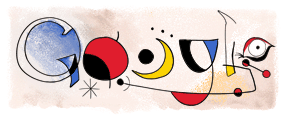
Google Violates Miro's Copyright?

Anonymous Coward writes "In a homage to Joan Miro on his birthday, Google changed its logo as to spell out the word "Google" in Miro's style. Google has a history of changing its logo in order to commemorate events and holidays of particular significance. In this case, the homage was not well received by the Miro family or the Artists Rights Society which represents them, as reported by the Mercury News. According to Theodore Feder, president of the ARS, "There are underlying copyrights to the works of Miro, and they are putting it up without having the rights". The ARS demanded that Google removed the logo, and Google complied, though not without adding that it did not believe it was in violation of copyright. The ARS has raised similar complaints regarding Google's tribute to Salvador Dali in 2002. "It's a distortion of the original works and in that respect it violates the moral rights of the artist," Feder said." It seems to me that the art world has a glorious history of incorporating prior art into modern creations. It's amusing to me that ARS doesn't understand that.
102 of 651 comments (clear)

  1. This is what I think about ARS by layer3switch · · Score: 4, Funny

    ARS-holes

    There you have it.

    --
    "Don't let fools fool you. They are the clever ones."
    1. Re:This is what I think about ARS by Mick+Ohrberg · · Score: 5, Insightful

      Indeed. In addition - could the Google logo be considered a parody? IIRC, you can make parodies without infringing on copyrights. Weird Al does this a lot, though I get the impression that he does ask first out of courtesy. I think the paridy factor is the whole reason Coolio is unable to take action against Weird Al for Amish Paradase (a parody of Gangsta's Paradise that Weird Al claims he got permission from the record company to do, but Coolio claims he never gave permission).

      --

      Quidquid latine dictum sit, altum sonatur.

    2. Re:This is what I think about ARS by Mr+Z · · Score: 5, Insightful

      I wouldn't say it's a parody, but rather a homage. That said, unless they incorporated his art directly, I don't see how copyright applies. You can't copyright a style. If Google's logo was incorporating art that wasn't Google's, they either need to license it or make a case for "fair use."

      --Joe
    3. Re:This is what I think about ARS by Alystair · · Score: 5, Informative

      You know it's personal when they submit an email address in the content of a slashdot article ;)

    4. Re:This is what I think about ARS by gaijin99 · · Score: 4, Funny

      Agree. Copyright covers a specific arrangement of words, or a specific image. An image that is similar to a copyrighted image is not a copyright violation.

      Now, maybe if his family had patented his artistic style they could claim Google violated their patent. Hmmm... I wonder if I could patent an artistic style and exploit the US patent system for my own profit. To heck with business model patents, can you imagine owning the patent for slasher flicks?

      --
      "Mission Accomplished" -- George W. Bush May 1, 2003
    5. Re:This is what I think about ARS by Schraegstrichpunkt · · Score: 3, Informative

      Parody isn't a legal exception to copyright in all jurisdictions (e.g. Canada), sadly.

    6. Re:This is what I think about ARS by nihaopaul · · Score: 4, Funny

      Dear Theodore Feder,

      I am disappointed in your act towards google in the tribute they done for miro, in-fact i wasn't aware who miro was until i saw the tribute and done some research, its people like you and companies like yours that shame artists like those. i hope you can sleep at night knowing that you had the chance to help educate millions of people, but took it away with one FOUL swoop.

      sux2bu(TM)

      Paul

      _Legal Notes_
      sux2bu(TM) is a trademark of nihaopaul, reproduction, use or storage of sux2bu(TM) without prior written consent will result in a banana being shoved up your arse by a family member. by reading this digital transmission you agree to comply with these terms set forth

    7. Re:This is what I think about ARS by KDR_11k · · Score: 3, Insightful

      The difference is that Weird Al clearly made a parody while this logo doesn't have anything funny about it.

      --
      Justice is the sheep getting arrested while an impartial judge declares the vote void.
    8. Re:This is what I think about ARS by linvir · · Score: 4, Funny

      No, Google were obviously trying to masquerade their logo as official work of Joan Miró in order to trick his devoted fans into using their search service. It's the only possible explanation, and it's only right that they be stopped!

    9. Re:This is what I think about ARS by hoppo · · Score: 2, Interesting

      It doesn't matter (and the parody argument wouldn't hold water anyway). A copyright gives you protection for a specific piece of work -- a script, a character, a painting, a piece of code, etc. If Google copied elements of specific paintings, the Miro family's attorneys *might* have a case. However, if they use ownership of a "style" of work as the basis of their argument, Google will likely win if they were to take this to trial.

      Holders of copyrights have used that to stake ownership claims to which they are not entitled. This is not because of the law. Most people, upon receiving a cease and desist letter, will comply with the terms either immediately or after some correspondence. They either can't be bothered with going to court or are afraid of the consequences. A copyright holder can take advantage of this, by having a lawyer send out a threatening letter accusing the "offender" of some copyright violation. When the "offender" backs down, the holder gains ownership not through endorsement of the law, but through simple bullying.

    10. Re:This is what I think about ARS by Fulcrum+of+Evil · · Score: 2, Insightful

      So I'm guessing that they trademarked his name, so that even when his art goes out of copyright, you won't be able to sell it under the Escher name, because it will still be trademarked (they don't expire).

      Sure you can. 'This is a copy of a work by M C Escher' is a statement of fact.

      --
      "We returned the General to El Salvador, or maybe Guatemala, it's difficult to tell from 10,000 feet"
    11. Re:This is what I think about ARS by niktemadur · · Score: 2, Informative

      I think the parody factor is the whole reason Coolio is unable to take action against Weird Al for Amish Paradise

      Man oh man, that's a knee-slapper if I ever heard one. Does anybody remember that Gangsta's Paradise is a straight out rip-off of Stevie Wonder's Pastime Paradise, from the 1975 album Songs In The Key Of Life? I mean, to what absurd lengths can these people go in believing their own hype and revisionist history?

      The lack of originality in pseudo-musicians gunning for the Top Forty is a sight to behold. I don't mind hip-hop sampling a drum here and/or a bass there, but to use the full recycled arrangement as some sort of personal karaoke... once may be cute, twice is tiresome, three or more instances is bulls**t. But hey, if the formula works and you're gettin' paid, go for it, right?

      However, the prize of hypocrisy goes to the Rolling Stones who, from one of their two hundred room estates in the english countryside, slapped a lawsuit against The Verve for Bittersweet Symphony, even as the Stones bought their estates by ripping off dozens of old-time blues artists without paying a single cent in royalties to them.

      --
      Lil' Thindime, lilting a lacrimose lament, krashes the kwaint konfines of Kokonino Kounty
    12. Re:This is what I think about ARS by poot_rootbeer · · Score: 2, Informative

      The difference is that Weird Al clearly made a parody while this logo doesn't have anything funny about it.

      Being funny is not a requisite condition of parody. The term is broad enough that it covers many different forms of appropriating style or content, for a variety of purposes.

  2. Its all about the money by IntelliAdmin · · Score: 5, Insightful

    I doubt any of the original artists would have a problem with it. It seems that it is family's that are interested in the financial gain from complaining to Google about it. This tiny excerpt from the article explains it all: "In September, the Authors Guild sued Google for reproducing works..." Come on! The Google symbol in the likeness of an artist is honoring them. It would only help increase the value's of their works, and peoples awareness of them. They just see Google as a big money pit they can take from.

    1. Re:Its all about the money by baptiste · · Score: 5, Insightful

      It is so sad when people try to do something nice (i.e. a tribute) only to be smacked down by money hungry trusts and estates who have no concept of the greater good. I think Google's logo art is an awesome thing. They gain nothing from it, yet it raises awareness of people, places, and causes. I'm all for copyrights and trademark protection when it comes to trying to protect an authors original work, but come on. A tribute that would stay up 1-2 days honoring the artist and they make this big a deal over it? Sigh - this world gets more screwed up by the day

    2. Re:Its all about the money by Lumpy · · Score: 4, Interesting

      All of the out and out WHORING of this fantasy called "intellectual property" is done by the family members and rarely if ever done by the real artists (tools like Metallica as the exception here)

      Look at Yoko Ono, she is wringing the Jhon Lennon Rock dry getting every last drop of blood out of it, and this is the Modus Operandi of almost every single artists family that recieves the goldmine that was their parent's or Spouses. One of the biggest to do this was the wife of Martin Luther King Jr. She demanded money from every photo of him or fil clip of him shwon anywhere, now that she is gone the feeding frenzy will probably go into overtime with the family.

      This is why copyrights need a solid HARD limit that aftera short X years of the death of the creator all of it goes into public domain and free tomatoes get passed out to the public to pelt the family that was whoring the creativity of the artist or person...

      Ok that last part is probably not going to fly but it would be a detterent.

      ARS = spoiled brats that really need to have it all taken away from them and made to sit in a corner until they can come out and play with everyone else in society nicely.

      --
      Do not look at laser with remaining good eye.
    3. Re:Its all about the money by tverbeek · · Score: 4, Insightful
      This is an example of why (IMHO) copyrights should immediately expire along with the creator (unless they have a dependent child or spouse, in which case they'd last a fixed term, as the law was originally written). This whole doctrine that works of art should provide financial support to the grown children of the creator is wrong-headed, and the notion that these property heirs and their children and grandchildren should have creative control over these works is absurd.

      Copyright-enforced royalties should be a kind of pension for creators, offering some financial security to people who've spent their lives creating works of art (visual, literary, musical, etc). Retirement pensions don't keep paying out after someone dies (except to a surviving spouse), because the person who earned them no longer needs them. Likewise, when I die, why should my sisters or my nieces and nephew start getting money from the things I've created? And more importantly, why should they have the right to authorize what's done with copies of them?

      I'm a staunch supporter of copyright in principle - people who indiscriminately "share" tunez, warez, and videoz with strangers on the net can go suck on a shotgun as far as I'm concerned - but I think copyright has been hammered and stretched and twisted over the course of the past century into some kind of hereditary entitlement and corporate welfare scheme. Maybe if modern copyright law weren't so obviously aimed at giving money to people who didn't earn it, it'd be easier to persuade people to respect it.

      --
      http://alternatives.rzero.com/
    4. Re:Its all about the money by flogic42 · · Score: 2, Informative

      Google's use is obviously within the bounds of Fair Use. In particular, transformative works that cannot be substituted for the original and do not detract from profits on the original (except as criticism might deter buyers) are protected under fair use. Obviously, for example, you don't need Disney's permission to write a book analyzing Disney. If you did, copyright law would be in blatant conflict with the first amendment. Quite frankly the first amendment is infinitely more important than anyone's ability to make a buck. And, in this particular case, Google's tribute was only serving to publicize the artist. It would be impossible to argue that their fair use detracted from the profits of the copyright holders.

      --
      Check out my women's designer clothing store.
    5. Re:Its all about the money by arminw · · Score: 2, Interesting

      .....to assert the artist's "moral rights"....

      How does anybody in our relativism wracked society decide what what "morals" are and that artists or anybody else for that matter has such a thing as "moral" rights? Exactly WHO decides what is moral? We have lgislatures and courts decide what's LEGAL, that's all.

      --
      All theory is gray
    6. Re:Its all about the money by drsmithy · · Score: 3, Insightful
      This is why copyrights need a solid HARD limit that aftera short X years of the death of the creator all of it goes into public domain and free tomatoes get passed out to the public to pelt the family that was whoring the creativity of the artist or person...

      There is no justifiable reason whatsoever for copyright to last a second past the creator's death.

      Copyright - if it must exist at all - is fundamentally an economic tool (it exists for no other reason than to artificially restrict information to increase its scarcity, and hence value) and as such should have its terms tied to the economic success (or lack thereof) of the protected work. Copyright terms need to be linked to "return on investment" for the system to work in the modern world.

      Successful work -> copyright expires quickly -> creator has to generate more works to keep the money flowing -> higher net benefit to society.

    7. Re:Its all about the money by Paradise+Pete · · Score: 4, Insightful
      There is no justifiable reason whatsoever for copyright to last a second past the creator's death.

      If that were the case I'd start looking over my shoulder if I came up with something really popular.

    8. Re:Its all about the money by blibbler · · Score: 3, Insightful

      > There is no justifiable reason whatsoever for copyright to last a second past the creator's death

      How about the situation:
      company x wants to make a book based on novel by author Y. Y refuses, company X kills Y. Should company X be able to make a movie without any access rights issues? (This is not an unheard of situation)
      What about Author z wishes to provide for Zs family, so writes a book on deathbed. should this book become public domain when Z dies? It would defeat the purpose of Zs actions (this is also not an unheard of situation)

      Companies and organizations can hold copyright. Generally this copyright is held for a fixed period of years (as companies do not have to "die"). Should companies' copyrights be protected more than humans (whose copyrights would expire when they die?

      > Successful work -> copyright expires quickly -> creator has to generate more works to keep the money flowing -> higher net benefit to society.

      How do you propose to measure success? Very few movies ever show a profit. This is not because they don't make money for the studio, but because it makes tax sense to calculate it that way. Many of the wealthiest people in the world pay less income tax than a regular person earning $50,000. It isn't because they are not earning an income, but because they can pay very creative accountants. Income is a lot simpler to measure than "economic success".

    9. Re:Its all about the money by Kadin2048 · · Score: 2, Insightful

      I think there are valid legal reasons for making the maximum copyright term equal to the life of the author plus (either) eighteen or twenty-one years. In Common Law, it used to be a fairly strict rule that you couldn't create a legal instrument relating to real property (so a deed, covenant, trust, etc.) with a term of more than the life of someone alive at the time of creation plus 21 years. The idea being that this way you couldn't have basically 'landed gentry,' who had perpetual and un-dissolvable property holdings. The "life plus 21 years" was picked I believe because 21 is the age of majority (well it was, until they changed it to 18), thus it's basically guarantees that the trustee's heirs will be legal adults. So it's possible to create a trust that will last through your lifetime, and see your children through to adulthood, but you can't lock stuff up for eternity.

      It seems that some states have actually softened these laws, which is frankly unfortunate (and suspicious; I wonder who paid for that), but I think it's a good model for Intellectual Property in the same way that its reasoning was valid for real property.

      In fact, I think it's more valid for IP than RP: I could think of some valid reasons for wanting to protect real property in a trust for multiple generations, but few valid ones for IP that don't hugely impact the public's interest. It would allow a creator of some valuable piece of IP to use it for personal gain throughout their lifetime, and also to know that their children would be supported by it at least until they became adults -- which is a valid motivation, and taking this away would I think lessen the incentive to create -- but it wouldn't lock it up for the centuries-plus terms that we have now.

      Also, I think we should give a substantial consideration to harmonizing the laws between corporate-owned and privately created works; anything created "by a corporation" has to be created by an individual -- legal 'entities' do not sit down in front of Microsoft Word and type things. Anything created by IBM, for instance, had its origins in the brain of a human being or group of human beings, and the maximum copyright term ought to be the same as it would be had it been created privately by that person. (The copyright would still be owned by the corporation, the term would just be affected.) Alternately, perhaps a fixed term of 50 years could be chosen if the company preferred, to make accounting easier.

      At any rate, I think we've clearly gone overboard in the present system, there is no justifiable reasons for creating IP portfolios that support generations of leech-like descendants, in the same way that aristocratic families used to live off of perpetuity bonds underwritten by the Crown. There's a reason why we don't allow the latter anymore, we shouldn't allow the former either.

      --
      "Ladies and gentlemen, my killbot features Lotus Notes and a machine gun. It is the finest available."
    10. Re:Its all about the money by spyowl · · Score: 2, Insightful
      Maybe if modern copyright law weren't so obviously aimed at giving money to people who didn't earn it, it'd be easier to persuade people to respect it

      Oh you'll respect it alright when the anti-terrorism unit shows up at your door, destroys your equipment and nails your ass in prison for 20 years.
    11. Re:Its all about the money by john82 · · Score: 5, Funny

      "In other news, a New York law firm has filed a class-action lawsuit against the estate of Spanish surrealist artist Joan Miro and a group calling itself the Artists Rights Society. The suit was filed on behalf of millions of seven to nine year old children world wide. The firm, Dewey, Cheatham & Howe, claim that numerous pieces by the late artist infringe on the implied copyrighted works of elementary school children who, owing to their age, have been by and large drawing in a flat linear style mimiced by Miro. In filing the suite, DCH released a statement saying that Miro had knowingly been copying the works of children for years without proper attribution or remuneration."

    12. Re:Its all about the money by NeutronCowboy · · Score: 2, Insightful
      Copyright-enforced royalties should be a kind of pension for creators, offering some financial security to people who've spent their lives creating works of art (visual, literary, musical, etc).

      I'm sorry, but what? No one, in any business except the one of copyrighted works, gets to derive a pension from work they have done earlier. As a matter of fact, copyrighted works are the only legal construct that allows someone to derive income from something that has not only been sold, resold and sold again, but has been done in the past (sometimes decades). By your logic, should the fact that I'm working right, creating software, writing fixes, entitle me to receive a pension 50 years down the line from the people who use my work right now?

      This entire idea that people can somehow retire and still get paid for work that they used to is ludicrous. If you want to retire on the income you've generated by working, fine. Be my guest. I really don't care how you arrive at that result. But don't expect me to subsidize your retirement in the Bahamas, just because you did some work earlier.

      I'm all for copyright. It does have a place indeed. But to twist this into some form of retirement plan is an insult to everyone who actually has to save money to retire. Furthermore, behind these types of uses for copyright is another ludicrous idea: that somehow, your work was so awesomely awesome and groundbreaking that you get to control how it gets used - regardless of how many previous ideas and methods you copied, used or abused to create your work. In short, it's the idea that writing a book or a song somehow results in something doesn't draw on anything else in the world - which is complete and utter crap. The only reason people can create stuff is because they use things and ideas that are already around them. It's the only way to create something that actually matters.

      Let me repeat this: there is a place for copyright. There has to be a way that people can derive an income from creating works of art or software. But copyright is not a natural right, nor does more copyright result in more creativity. On the contrary - there is a very quick limit when copyright starts to inhibit creativity. So to people who think that copyright should be a way to subsidize retirement - go suck on a shotgun indeed.

      --
      Those who can, do. Those who can't, sue.
    13. Re:Its all about the money by professionalfurryele · · Score: 2, Insightful

      "Do you channel Joseph Stalin twenty-four hours a day, or just when you're posting to Slashdot?"

      Hate to point it out but you are the one proposing an increase of state powers above the ideal level (zero). By giving government the power to grant temporary monopolies you are in fact expanding the state. What sounds more Stalinist to you?

      Can you think of a good reason for companies to hold copyrights?

      I can, for example to allow a group of individuals to produce a work that a single individual could not, or to add value to copyrighted work to increase the incentive to produce it, by giving companies the ability to buy and sell government mandated monopolies. I question the latter reason, the former is one in the primary reason we allow companies to exist in the first place.

      Perhaps you could contribute your reasons, instead of invoking the booogie man.

  3. I wonder whose "rights" they're more interested in by Anonymous Coward · · Score: 2, Interesting

    The artists, or their shareholders.

    Either way, they can kiss my ARS.

  4. Could it be? by koweja · · Score: 5, Funny

    Is it possible that the visual art world is more interested in money than art and expression? I can't believe it.

    1. Re:Could it be? by maggot+the+shrew · · Score: 3, Interesting

      Well, the art world like everyone else is trying to make a living off their trade. In this case, like most others of its ilk, it's a family who never contributed one ounce of effort who are trying to make a buck off of a dead relative.

      That is the nature of capitalism.

    2. Re:Could it be? by tverbeek · · Score: 4, Interesting
      ...it's a family who never contributed one ounce of effort who are trying to make a buck off of a dead relative. That is the nature of capitalism.

      Don't blame capitalism for this. (Capitalism has enough on its head.) This absurdity is based on ye olde principle of hereditary property and privilege, which easily pre-dates the whole mercantile economic system that capitalism is based on. And capitalism would work just fine (arguably much better) without it.

      --
      http://alternatives.rzero.com/
  5. 'Intellectual property' concept is going too far by unity100 · · Score: 5, Insightful

    Well, it seems that after some 50 years or so, we wont be able to use any shape, image, saying, metaphor or the like without consulting an intellectual property expert and acquiring appropriate rights, the way things going.

  6. It's about money. Always. by Rosco+P.+Coltrane · · Score: 4, Insightful

    It seems to me that the art world has a glorious history of incorporating prior art into modern creations. It's amusing to me that ARS doesn't understand that.

    It's not that they don't understand, it's more that they're trying very hard to make everybody else forget that fact. They, as well as certain **AAs, behave like rabid dogs protecting their food, so that they have grounds to claim money for the use of this or that piece of art whenever possible and not be contested.

    --
    "A door is what a dog is perpetually on the wrong side of" - Ogden Nash
  7. spotlight by gravesb · · Score: 5, Interesting

    Since I had never heard of the artist until Google used an interpretation of her art as its logo, this seems like it would be a good thing for artists. I have never understood the knee jerk reaction to anything that could possibly be explotive. Its just free publicity in this case, and you would think the family would see that.

    --
    http://bgcommonsense.blogspot.com
    1. Re:spotlight by Rosco+P.+Coltrane · · Score: 4, Funny

      I had never heard of the artist until Google used an interpretation of her art

      It doesn't look like your knowledge of Miro has improved much since Google educated you.

      Miro is a man...

      --
      "A door is what a dog is perpetually on the wrong side of" - Ogden Nash
    2. Re:spotlight by east+coast · · Score: 4, Informative

      Joan is a he not a she.

      But I agree. How much value, both monetary and artistically, did Miro's work lose over this? None is my guess, frankly. While I do support the right to the works of Miro by the current copyright owners I can't see how a simple logo can distort the value of the original works. Although I will say it did make the point as I knew immediately that it was meant to represent Miro when I had seen it on Google originally.

      --
      Dedicated Cthulhu Cultist since 4523 BC.
    3. Re:spotlight by Rosco+P.+Coltrane · · Score: 2, Funny

      maybe he was a woman?

      He was a surrealist remember. Ceci n'est pas une man...

      --
      "A door is what a dog is perpetually on the wrong side of" - Ogden Nash
  8. PR by gEvil+(beta) · · Score: 2, Insightful

    How many people wouldn't have encountered Miro's work if they hadn't seen it on Google's site? Now how many of those people wouldn't have known who's work it was had ARS not filed a complaint with Google. While their complaint seems semi-valid (though, personally, I doubt it would have held up in court), it seems that in effect this ends up being a big PR move. We now have lots of people who weren't familiar with Miro's work, who now recognize it because of the complaint.

    --
    This guy's the limit!
  9. Moral Rights by TubeSteak · · Score: 5, Informative
    "It's a distortion of the original works and in that respect it violates the moral rights of the artist,"
    That struck me as a very European viewpoint. However, I went to google and found out that the U.S.A. has similar thoughts (and laws) on the matter.

    I can't vouch for this particular article, but similar information shows up on other sites. http://www.carolinaarts.com/902fenno.html
    Many European countries have long recognized artists' personal or "moral" rights in their works of art. Among these rights are the rights of "integrity" (the right to prevent distortion or mutilation of an author's work) and "attribution" (the right of the author to be recognized as the author). These "moral" rights (termed "droit moral" in Europe) spring from a belief that an artist in the process of creation injects his or her spirit into the work. Moral rights are intended to protect the honor and reputation of the artist.

    In 1990, Congress enacted the "Visual Artists' Rights Act" (the "Act") to provide protection for artists' moral rights in selected categories of works of art in the United States. The Act is limited in scope, protecting only works of "visual art" that are created on or after June 1, 1991. [Insert what is and isn't protected]

    Subject to "fair use" rights and other limitations, the Act provides the author of a work of visual art the right to:

    • Prevent any intentional distortion, mutilation, or other modification of that work which would be prejudicial to his or her honor or reputation;
    • Prevent any intentional or grossly negligent destruction of a work of recognized stature;
    • Claim authorship of the work;
    • Prevent the use of his or her name as the author of any work of visual art that (s)he did not create; and
    • Prevent the use of his or her name as the author of the work of visual art in the event of a distortion, mutilation, or other modification of the work that would be prejudicial to his or her honor or reputation.
    ...
    Since moral rights are intended to protect the honor and reputation of the artist, the Act only protects the rights for the lifetime of the artist. ...
    --
    [Fuck Beta]
    o0t!
    1. Re:Moral Rights by Thorsten+Timberlake · · Score: 2, Informative

      So, is that text about the specific work, ie. the actual painting if we're talking Dali or Miro?

      Today, art is very much about reference and association (sorry, no, it's not really about the pretty pictures) so if an artist can get the courts word that by referencing his/her work you are mutilating or distorting it and you are prohibited from this practice, art will effectively be at a dead end (and will end up being about the pretty pictures, which would be so very boring imo...)

      Also, I can think of a few existing works of art that could be in trouble under these rules, such as Robert Rauschenberg's "Erased de Kooning Drawing" (an important work too!) and some others that would be obscure to mention here (I think RR got both permission and the drawing from de Kooning, though).

      Anyway, these google logos are all artistic interpretations of the works of an artist, they honour the artist and should be well within what's allowed.

  10. Why would they care? by expressovi · · Score: 2, Funny

    Why would they care? Google has a very small user base, I doubt anyone saw it...

    --
    i agree
  11. Re:'Intellectual property' concept is going too fa by Intron · · Score: 4, Funny

    To whom it may concern,

    Your use of colored rectanglular windows violates the copyrights of the Mondrian estate. Please refrain from any use of colored rectangles on your site in the future. If you wish to consider licensing the use of these images, the per-rectangle license is quite reasonable. Please contact us at the address listed.

    Thank you

    --
    Intron: the portion of DNA which expresses nothing useful.
  12. They don't understand copyrights by Matt+Perry · · Score: 3, Informative
    According to Theodore Feder, president of the ARS, "There are underlying copyrights to the works of Miro, and they are putting it up without having the rights"
    He's thinking of patents. Copyrights only cover a specific creation of a work. If Google's work was created entirely by them then there's no legal issue here, no matter what ARS thinks. Feder needs to talk to a lawyer before making public statements like that. It only makes him look woefully ignorant of the law (and greedy at the same time).
    --
    Slashdot: Failed Car Analogies. Amateur Lawyering. Anecdote Battles.
  13. Moral rights in the US? by Peyna · · Score: 2, Insightful

    Moral rights in copyrighted works are pretty slim in the US if existent at all. We're supposed to have them as a condition to signing a treaty, but for the most part we really don't. Anything that comes up looking like moral rights ends up being weasled through the Lanham Act rather than copyright law.

    --
    What?
  14. Fair use? by vidarlo · · Score: 4, Interesting
    I thought there was something named fair use? Which translated into common sense?

    This sounds like complete crap. Such an logo will increase peoples knowledge about the artist, and thus increase the popularity of the artist, and make images more worth. I doubt anyone would tear down their Miro paintings and put up a print of the google logo instead...

    The copyright holders should see that google links this to a search on the artist, which probably generates more knowledge about the artist, and more interest for his works. I'd guess there where firms that would pay millions to have their style on the google logo, and a link from the logo to a search of their company name...

    1. Re:Fair use? by xigxag · · Score: 5, Insightful

      Just to follow up on my own point, Google being barred from doing a Miró-like logo is the same as if, not only were you not allowed to draw an unuathorized Charlie Brown, Linus or Snoopy, but you couldn't even sketch an anonymous character in a "Peanuts-esque" style. Taking that to an extreme, future sitcom writers could get sued for writing scripts that veered too close to "Seinfeldian" humor. Fast food joints could get hauled into court for having processed meat chunks that were too "McNuggetty." Future presidents could be impeached for aping an authoritarian swagger that was too "Bushist."

      Hmm, objection withdrawn, Your Honor.

      --
      There are two kinds of people: 1) those who start arrays with one and 1) those who start them with zero.
  15. Re:'Intellectual property' concept is going too fa by itzdandy · · Score: 2, Insightful

    i see the point that's trying to be made BUT have to make a quick counter point.

    google did not just happen to make a logo that looked like miro's style and use it. your comment implies to me that(though exagerated) every idea, shape, color, etc will be taken and one would have to dig deep to make sure that your 'fresh' idea is not too similar to an old one.

    instead good DID look at miro's work and made an effort to emulate that work in their logo, though they were giving homage the made an effort to copy. btw i also think that this is ok as long as there is no financial reward from this copy, as it is pay homage! thank you google for being aware and respectful of art and artist.

    maybe the ARS should joint the RIAA and MPAA to complete the axis of evil!

  16. ARS = stupid by Lazy+Jones · · Score: 4, Interesting
    Google's use of Miró's style was a tribute to his art and most likely got millions of users interested in his works and his life. Even if pathetic organizations like ARS are only really interested in raking in the money made from dead artists' works (and not in the honor of the artists, apparently), they should understand that this helps even them make more money.

    But kudos to ARS for reminding us that Miró is dead and all the money made from his works goes to some greedy people who have contributed nothing. Miró himself donated many of his works in the hope that he would not be forgotten, but apparently ARS sees no value in keeping that spirit alive. They'd rather have people forget about him than allow anyone to use his "copyrighted" (by them) style for free.

    --
    "I love my job, but I hate talking to people like you" (Freddie Mercury)
  17. money! by itzdandy · · Score: 4, Insightful

    this is nothing more than selfishness at work!(ok, maybe some greed!)

    paying respect to a dead artist is perfectly acceptable and should be encouraged! this has been happening for 'EVER' and many many many of the most famous artists are only famous now because their work has been emulated and now integrated into modern culture.

    no exploitation is happening here, just good ol' respect!

  18. Sheesh! by tedgyz · · Score: 2, Insightful

    "Lighten up Francis!"

    The stupid ARS should be happy Miro got all that attention. What exactly do they expect? I guess we can add ARS to the same list as RIAA and MPAA - self-defeating, money-grubbing idiots.

    --
    "No matter where you go, there you are." -- Buckaroo Banzai
  19. CEASE AND DESIST by vortex2.71 · · Score: 5, Funny

    Dear Unity100,

    As the legal representative of "PatentRight" a conglomerate of over fifty major multinational companies that have organized to protect their joint legal rights against patent and copyright violation, we hereby inform you that your April 23, 2006 posting to Slashdot (http://slashdot.org/ is in violation of five of our clients patent and copyright holdings. Please remove your post immediately: "Well, it seems that after some 50 years or so, we wont be able to use any shape, image, saying, metaphor or the like without consulting an intellectual property expert and acquiring appropriate rights, the way things going." Violations include:

    1) The use of "Well" in this context is owned by the American Groundwater Corporation.
    2) Bicentenial Celebrations Inc. owns a copyright for the use of "50 years".
    3) While "shape, image, saying, metaphor" is not explicitly governed by previous copyright or patent filings, SISM (Systemically Integrated Seismology Measurments, LLC) does own rights to the SISM acronym and has the legal right to slogans which attempt to infringe on this acronym.
    4) Several patent law firms are currently in arbitration to decide the legal owners of "Intellectual Property Experts" and your use of this phrase here will not be tolerated.
    5) "apropriate rights" is held by Planned Parenthood.

  20. Re:420 by Xiroth · · Score: 2, Informative

    I doubt it's the artist who is suing, considering that he's been dead for more than 20 years. It's just his money-grubbing family.

  21. Re:'Intellectual property' concept is going too fa by itzdandy · · Score: 4, Funny

    To whem it may concern,

    Your use of such a 'warning message' violates the copyrights held by myself on sending such warning messages. in the future if you wish to send such a warning letter you may wish to license the use of specific statements such as "please refrain from" and "your use of XXXX violates the copyrights of"

    additionally, my firm maintains a patent on the method of ending such warning letters with false friendlyness and we are currently not licensing the use of the "Thank you" message at this time.

    Thank you

    ©2005 Warning letters and label Co.
    ®the "To whem it may concern," opening is a registered trade mark of Warning letters and label Co.

  22. Re:Wish Groucho Marx could type up the response by DerGeist · · Score: 4, Interesting

    In case anyone is curious, the letter can be found here.

  23. Oh, when will these "artists" grow up? by bcarl314 · · Score: 3, Funny

    Come on. Maybe I'm a little old fashioned (I am over 20) but I would certainly consider having google make a rendition of my work to (assumedly) celebrate my birthday (or other event) an honor. But I guess if your an "artist" going for the "I'm poor, struggling and not recognized for my talent" approach, this could be devestating to your "morals".

    If google really wanted to get all pissy about this, they should just laugh and say "ha ha" it's a parody on your art work and therefore protected! Ha ha you're a funny artist!

  24. What about the Olympics? by fuzzy12345 · · Score: 3, Interesting
    When Google did its homage to the Winter Olympics, it did a bunch of winter sports, rather than the perhaps more obvious trick of rearranging the five rounded letters in its name into the Olympic Rings logo. I wonder why?

    The obvious conclusion is that Google knows which IP holders not to mess with, and which ones it can probably mess with.

    --

    Everybody's a libertarian 'till their neighbour's becomes a crack house.
    1. Re:What about the Olympics? by mrchaotica · · Score: 4, Insightful
      The obvious conclusion is that Google knows which IP holders not to mess with, and which ones it can probably mess with.
      And the less obvious, but also less stupid, conclusion is that copyright law is different from trademark law.

      In other words, the organization that owns the Olympics logo would have had a legitimate complaint, while the ARS most emphatically does not.
      --

      "[Regarding the 'cloud,'] ownership was what made America different than Russia." -- Woz

  25. Re:It should be about courtesy by maggot+the+shrew · · Score: 5, Insightful

    I don't think anybody should have to ask permission to use elements of a dead artist's work which are over 65 years old. Miro's contribution to popular culture is pervasive. There is no basis for restricting wholesale reproduction of his works outside of the obscene length of time we allow for copyright in the West. Much less should we be allowed to restrict the use of simple elements and basic tributes of extremely common, influential, and well publicized art.

  26. ARS is for ARSloch by iggymanz · · Score: 4, Informative

    Joan Miro himself borrowed and altered some things from other surrealists. Everyone write to president Dr. Theodore Feder at

    Artists Rights Society
    536 Broadway, 5th Floor
    (at Spring St.)
    New York, NY 10012
    Tel: 212-420-9160
    Fax: 212-420-9286

    or drop him a line at tfeder AT arsny DOT com

  27. but they didn't use HIS art by acvh · · Score: 4, Insightful

    they created their own, in a style that was influenced by him.

    imagine if Manet had been able to copyright French Impressionism, or Picasso cubism, or Renoir portraits.

    1. Re:but they didn't use HIS art by dhasenan · · Score: 2, Insightful

      No; it's a stylistic derivative, but not a derivative of the content. Copyright doesn't cover style; trademarks, on the other hand, do. I don't know if anyone has trademarked a style of art in the US, but if they have, I'm packing my bags.

    2. Re:but they didn't use HIS art by Anonymous Coward · · Score: 2, Insightful

      which is why google stated that they didn't believe it was a violation? They seemingly removed it for some combination of reasons such as:

      1. It wasn't worth going to court.
      2. They no longer wanted to have a tribute to him.
      3. They wanted to respect the ARS.

      If I was them I would probably have gone with 1 and 2.

    3. Re:but they didn't use HIS art by chgros · · Score: 2, Insightful

      imagine if Manet had been able to copyright French Impressionism
      You mean Monet, not Manet (I know, it's confusing)

  28. One more reason to keep on piratin'! by FatSean · · Score: 2, Insightful

    You shit out a picture and you and your family own it or anything like it for enternity? Bullshit. One more reason I don't feel bad about copy-right infringement. They cry that no art will be produced without pay...I say this is a blatant lie. There are countless artists out there struggling to be seen. Many produce their works with no expectation of payment.

    --
    Blar.
  29. Re:It should be about courtesy by pla · · Score: 5, Insightful

    While I agree with the above post, IMHO, Google should have the courtesy of asking permission from the controlling body.

    Why? Why should they need to ask permission to use the style of a dead artist in their logo?

    Miro, like him or not, contributed something to our shared culture. We ALL have the right (morally, not necessarily legally) to make use of that contribution. In this case Google did a tribute to him, which makes the complaints all the more offensive, but I would say the same thing if they had created their "normal" logo, purely out of commercial self-interest, from his style.


    Miro family: Get out of the shadow of your one famous ancestor and do something with your lives. The modern world doesn't need de facto aristocracies. Make a name for yourselves, or fade into oblivion. Don't expect society to let you rest on the long-dead laurels of a relative who did accomplish something.

    Theodore Feder and the Artists Rights Society: You spout non-stop self-aggrandizing BS about how much your members contribute to our culture, then deny us access to that same culture. You disgust me as the worst kind of hypocrits. Just cease to exist.

  30. Let me get this straight... by thewiz · · Score: 4, Insightful

    1. Google puts up company logo in the artistic style of Joan Miro to honor him.
    2. Miros and ARS family tells Google to take it down as it is violating copyrights.
    3. The net says "WTF?"
    4. Profits from publicity? (NOT)

    Shouldn't it be:

    1. Google puts up company logo in the artistic style of Joan Miro to honor him.
    2. Web surfers Google "Joan Miro".
    3. More people find they like his art and buy some.
    4. Profit goes to his family and everyone's happy.

    Sounds like they are being penny-wise and pound-foolish.

    --
    If "disco" means "I learn" in Latin, does "discothèque" mean "I learn technology"?
  31. Never heard of him until Google by lancejjj · · Score: 3, Insightful

    Admittedly, I was never much into the arts as a kid. But last week I noticed the Google logo and was interested in what or who Google was celebrating.

    I clicked on the link and learned all about Joan Miro and his art. After that initial click I become more interested and did some additional research above and beyond what Google offered.

    If Google lifted actual elements of Miro's work, then yeah, I'd say it could be a copyright problem. But it's likely a problem that could be easily solved completely in private and without public beratement.

    I'd be surprised if the recognition of Miro on Google doesn't result in substaintial financial gains for Miro's license holders, and I'd be shocked if the Miro family approved the public berating of Google by what appears to be a politically inept ARS president, Theodore Feder.

  32. Estate of Miro vs. Google by Netssansfrontieres · · Score: 2, Informative

    I thought it was wonderful to see the Miro pic on Google; it made me smile.

    I'm saddened by the response, and - along with near-all Slashdotters - am nauseated by litigation taking over from innovation. And, that Joan Miro, being dead and all, cannot benefit from this; the only benefits inure to people who never lifted a brush, or a finger, in support of Miro.

    HOWEVER: there is a little wrinkle (note: IANAL). A right that is not defended can be argued to have lapsed. Thus, if the agency and the estate of Miro hadn't at least rattled their sabres and expressed annoyance ... then some future, less-benevolent Miro-ripoff would be able to point to the earlier inaction as precedent.

    THUS: if I'd been in the seat of the defenders of Miro's estate, I would also have sent of a cease-and-desist letter - and hoped that the whole matter would go away. And, Google (which is chock full-o-lawyers at the exec levels now) surely needs to create new form letters asking for non-commercial permission to exhibit content.

    1. Re:Estate of Miro vs. Google by mrchaotica · · Score: 4, Informative
      I thought it was wonderful to see the Miro pic on Google; it made me smile.
      First of all, it wasn't a "Miro pic." It was a Google pic done in a Miro-esque style, which is why the ARS has no legitimate claim to begin with.
      HOWEVER: there is a little wrinkle (note: IANAL). A right that is not defended can be argued to have lapsed. Thus, if the agency and the estate of Miro hadn't at least rattled their sabres and expressed annoyance ... then some future, less-benevolent Miro-ripoff would be able to point to the earlier inaction as precedent.
      I'm not a lawyer either, but from what I understand, that reasoning applies to trademarks but not copyrights or patents.
      And, Google (which is chock full-o-lawyers at the exec levels now) surely needs to create new form letters asking for non-commercial permission to exhibit content.
      Google doesn't have to ask permission for a damn thing, because it was their own content that they were exhibiting!
      --

      "[Regarding the 'cloud,'] ownership was what made America different than Russia." -- Woz

  33. Re:'Intellectual property' concept is going too fa by kfg · · Score: 5, Insightful

    . . .google did not just happen to make a logo that looked like miro's style and use it.

    "Style" is not something that can be copyrighted. Only works can be copyrighted.

    See ragtime, blues, jazz, boogie woogie, rock & roll, etc., as opposed to Maple Leaf Rag, Sweet Home Chicago, Take Five, Roll 'em Pete and Purple Haze.

    The former are styles, the latter are works. You can copyright Take Five. You cannot copyright 5/4 time.

    In fact, the Google logo was their own creative work that they own the copyright on. It was just in emulation of Miro's style, not a copy of one of his works.

    The claim of any "moral" rights is so assinine I almost don't know what to say about it. The law does not recognize "moral" rights. It grants a monopoly on copying and may impose monetary recompense against losses incured by such copying. Without the law the artist has absolutely no rights whatsoever, except maybe to be a dickhead.

    And I wonder just what sort of monetary losses the Miro heirs feel they have suffered by Google making an original work in tribute to Miro?

    KFG

  34. Re:'Intellectual property' concept is going too fa by russ1337 · · Score: 5, Funny

    Dear Itzdandy,

    Use of comical parody, being your post on /. on Sunday 23 Day of April in the year 2005, is a violation of the parody copyright with which our company holds.

    If you wish to make a parody of someones post, we are able to licence this to you at a reasonable cost.

    Regards,

    Parody Inc.

  35. Try it with a font by Yer+Mum · · Score: 2, Interesting

    I doubt that Google could get away with slapping a bitmap representation of a copyrighted font or something very close to a copyrighted font on its front page, any particular reason why an artist should be any different? He only died 23 years ago too; there's no room for confusion as to the length of copyright on his works.

  36. Copyright is not a moral right. by j0nb0y · · Score: 2, Insightful

    Copyright is not a moral right. Copyright is not a natural right. Copyright is not a human right.

    Copyright is a capitalist construct that was created to provide an incentive to
    create artistic works.

    --
    If you had super powers, would you use them for good, or for awesome?
  37. Astoundingly stupid by Toby+The+Economist · · Score: 4, Insightful

    I'm...speechless.

    Let's get this straight.

    *The* most popular search engine in the world, with billions of hits per day, puts *your* work on its front page.

    Billions of people who've never heard of you before will now find out about you.

    And you say...

    "TAKE IT DOWN AT ONCE!!"

    I've seen stupid, but then there's *STTTTTTTTTTTTTTTTTTUPID*.

    1. Re:Astoundingly stupid by Peyna · · Score: 3, Interesting

      Well, it's actually a good argument. The question is the reach of moral rights in the US, but aside from that take a look at Monty Python for example. Their works were put on TV in the US after being chopped to pieces, edited, censored, etc. So, sure it put their skits in front of millions of people; however, what it put in front of those people was NOT something they created, but a bastardization of it. So then instead of a million more fans, they've got a million people that think Monty Python is something that it isn't.

      So, Miro is saying that Google has created the impression that he created the logo for them and perhaps that is not something he would have done and doesn't want his name associated with it. IF such moral rights exist in the US, then he might stand a chance. US courts have not been very receptive to the idea in the past, even with the VARA in existence.

      --
      What?
    2. Re:Astoundingly stupid by Microlith · · Score: 2

      Worse yet, it's not even YOU. It's your descendants and some unrelated society that are bitching.

    3. Re:Astoundingly stupid by mean+pun · · Score: 3, Insightful
      Billions of people who've never heard of you before will now find out about you.

      This may come as a shock here on /., but there are people that consider Miro more culturally important and rightly famous than Google. They probably even think that if you haven't heard of Miro by now you're not worth talking to anyway, you uncultured barbarian. I know, I know: totally deluded, the lot of them, but there you have it.

      Not that even that point of view excuses the attitude of ARS.

  38. Boycot Miró! by GromBulk · · Score: 2, Funny

    Don't buy his work!
    He's evil!

  39. Re:It should be about courtesy by dhasenan · · Score: 5, Interesting

    One glaring question is whether Google actually used Miro's images in its logo. Since Miro didn't ever paint a Google logo, the only issue is one of style. Style is trademarkable, not copyrightable; but copying other artists' styles is such a common practice in art that it's more noteworthy to see an original style than to see a copied (albeit altered) style.

    Now, if the logo uses portions of Miro's work, then the portions used are likely too insignificant to count as an actual copyright infringement.

    Also, Miro died in 1983. I'm not sure of the specific works involved, though his _Carbide Lamp_ looks vaguely similar, and _Catalan Landscape_ (though with a different color scheme). However, the eye is not drawn or colored as Miro would have done, and the lines all seem straighter and more angular than Miro usually used.

    While I'm no art critic, the fact that I cannot tell that the style is supposed to be similar without someone pointing it first is rather indicative.

    Next, someone's going to claim copyright on Platonic forms and charge people for using them in lectures or sculptures. Hold on while I copyright individual pixels.

  40. The Miro Estate was greedy long before this. by jettoki · · Score: 2, Informative

    Ever been to a travelling exhibition of Miro's work? Tickets run somewhere in the area of $10+. This is an obscene cost for an artist who, quite frankly, had little impact on the course of commercial art. I saw the Ghent Altarpiece, one of the most significant works ever painted, for like $4.

    I didn't even want to see the Miro exhibit, but I was forced to pay the price of admission so I could walk by the whole damn thing and find the El Grecos in the back of the gallery.

    I understand the problems that the Miro Estate face -- I'll be inheriting a similar body of copyrights from my own father -- but Jesus Christ, people. One of my father's works was featured in a political cartoon (non-parody), and my family loved it. We didn't spit on the cartoonist. And under U.S. law, you do not have to protect your trademarks from non-commercial tributes in order to maintain them. These people are just a bunch of greedy snivellers.

  41. Re:It should be about courtesy by JazzCrazed · · Score: 5, Insightful

    copying other artists' styles is such a common practice in art that it's more noteworthy to see an original style than to see a copied (albeit altered) style.

    Agreed whole-heartedly! As a visual artist, myself, it is nigh impossible to create something that isn't influenced by established styles. In fact, that was part of my education at Pratt Institute in NYC - learning the styles and accomplishments of Miro and countless others, and incorporating some of their ideas in clever, new executions. Likely, this sort of thing is more subtle than Google's outright references, but that could easily be argued as a subjective perception.

    If somebody made a visual reference or "quotation" of my work, I would be flattered, to say the least. I guess Google's main mistake was verbally attributing the inspiration for the restyled logo to Joan Miro. But in my opinion as an artist, this was a best-intentioned and visually witty tribute.

  42. Re:It should be about courtesy by Mr+Z · · Score: 2, Interesting

    If copyrights worked they way they used to, those works would've been out of copyright, for more than 35 years. But, with the latest copyright extensions, I believe his works are protected for 70 years after his death, which would put that at, oh, the end of 2053.

    --Joe
  43. bullshit by penguin-collective · · Score: 2, Insightful

    Artistic styles cannot be copyrighted or patented. In limited cases, people can get design patents or trademarks, but I seriously doubt that that would apply here. Furthermore, it's not like Miro was the only person to have drawn in that style.

    ARS and the Miro family seem particularly stupid in this case because Google probably gives them a lot more exposure for free than they have received in a long time.

  44. Connect the Dots by Doc+Ruby · · Score: 2, Insightful

    Miro died in 1983, after a lifetime spent capitalizing handsomely (and well-deservedly) on his art. Under the original US copyright laws, he and his "estate" would have had until 2000 to benefit exclusively from the right to reproduce his works. That limited time was certainly more than sufficient to to promote the progress of science and useful arts.

    Even though artists like Miro would produce their art regardless of protections or capitalization, driven by their "muse" that compels them to communicate in their medium as much as the rest of us are compelled to communicate by talking and handwaving. And like lawyers are compelled to communicate through C&D letters and invoices.

    Popular art like Miro's has always quickly become part of the folk vocabulary of its culture. An early effect of that acceptance is usually enough saleability that the artist can make money quickly, supporting more art. In the centuries since the Constitution recognized a limited monopoly compromise with freedom for practical operation of a free society in an scarcity economy, the time required for adequate compensation has shrunk vastly, with reproduction and compensation technology and techniques far beyond most could then imagine. Recognition of the contribution of the people who codify such art into our folk culture has been completely eclipsed by concessions to the experts who codify art from "high" through "pop" through "commercial" and protect all its product franchises in perpetuity.

    --

    --
    make install -not war

  45. Re:ARS Nearly Right by tomstdenis · · Score: 3, Insightful

    You can't copyright a style.

    Furthermore, don't you think "Miro Style" is not just an extension of pre-existing styles?

    This is how society works. One generation building on the work of the past.

    That said, Google is not in the art business, nor is that their permanent logo. It should be viewed as an event of limited importance at best. If it truly was an homage then they should just say thanks and go on their fucking way.

    Instead they're "fancy" artists [or in this case the family of] who think they invented art all by their lonesome.

    Tom

    --
    Someday, I'll have a real sig.
  46. My future portfolio... by Kadin2048 · · Score: 5, Funny

    U.S. Patent 123,456,789: "Method for incorporating a teenage girl in a shower in a horror movie."
    U.S. Patent 123,456,788: "Method for killing off annoying characters first."
    U.S. Patent 123,456,787: "Method for splitting up and covering more ground this way (and sending that fat kid into the basement by himself)."

    I can feel the money rolling in already.

    --
    "Ladies and gentlemen, my killbot features Lotus Notes and a machine gun. It is the finest available."
    1. Re:My future portfolio... by nmb3000 · · Score: 3, Funny

      U.S. Patent 123,456,788: "Method for killing off annoying characters first."

      So that's why Anakin didn't die until the 3rd movie. Lucas didn't want to get sued!

      It makes so much more sense now.

      --
      "What do you despise? By this are you truly known." --Princess Irulan, Manual of Muad'Dib
      /)
    2. Re:My future portfolio... by Lectrik · · Score: 3, Funny
      Anakin doesn't die in the 3rd movie.


      Geez, thanks for the spoiler warning.
      Next thing you know, you're gonna tell us the monkey dies at the end of King Kong
      --
      --- As to make my comment seem, by comparison, more intelegent... doodie doodie doodie poop poop poop!
  47. Re:BHACs by Anonymous Coward · · Score: 2, Interesting

    Ironically when I checked out the ARS website the first thing I see is Warhol's Venus. Apparently Warhol's estate is represented by ARS. Fortunately for him Botticelli was not

  48. Corporate logos are not really an honor by pal · · Score: 2, Insightful
    You know, of course Google has the right to put just about anything in their logo, and where ever you draw the line, that's great. But they do have some kind of issue with respect. Because frankly, putting people/things in your corporate logo is really not that much of an honor.

    They did this on MLK day, with an image of Dr. King that is frankly absurd. I posted about it and put together a similar McDonalds logo at the time:

    http://iheartteriyaki.blogspot.com/2006/01/on-icon s-and-logos.html

  49. As an artist... by Ralph+Spoilsport · · Score: 2, Interesting
    I feel qualified to comment, and I feel the ARS organisation is basically a bunch of parasites that exude bullshit at ever corner in this regard.

    First off, Dali and Miro are both DEAD. They don't give a flying fuck one way or the other. It is an utter absurdity for them to asume some kind of a mantle of "assumed artistic intention", when the artist is dead as a herring. Does their hagiographic activity have rights in perpetuity? Will we have to deal with these soul sucking tourdes for the next 5,000 years? 500 years? 50 years?

    I would argue that these jackasses have No Rights. I would argue that an artist has control over his work and images of his as long as he is alive. When he dies, his inheritors own the work, but they do not own the rights over images of the work, BECAUSE THEY DIDN'T MAKE THE STUFF, and they have fewer rights over the work for that reason.

    This reminds me of the parasites who run the John Cage estate who sued a musician who put a few minutes of silence on his record in homage to John Cage... Cage has been dead for a while, and 4'33" was composed over 50 years ago. Much the same is going here with Miro and Picasso.

    I detest this world of Intellectual Property where coporate parasites and lawyers earn more by merchandising the dead than the artists did in the first place. When I die, I am going to set my work free in my will.

    RS

    --
    Shoes for Industry. Shoes for the Dead.
  50. The funny part by sterno · · Score: 5, Insightful

    What's totally hilarious about this is what ultimately the google logo thing brings more attention to the artist's work. You go to google one day, the logo looks funky, and you wonder why. So you click the logo and are now finding out all about Miro, etc.

    Not only is this not any obvious violation of copyright law, but IT HELPS THEM. It's free freaking advertising for the artist and presumably could lead to better returns on sales of the art, etc. Whiners.

    --
    This sig has been temporarily disconnected or is no longer in service
  51. Re:'Intellectual property' concept is going too fa by Catskul · · Score: 4, Funny

    Dear Russ one three three seven,

                Your use of of the concept of the "running gag", as patented by me, is in violation of "running gag" patent which I hold. You too can make use of this concept with four easy payments of $19.95 plus s/h to

    1337 beowulf cluster lane,
    Doesitrunlinux, VA, 3133t

              Thanks,
              TiredRunningGags.com

    --

    Im not here now... Im out KILLING pepperoni
  52. Weird Al vs Coolio by John+Straffin · · Score: 3, Informative

    From http://www.al-oholicsanonymous.com/faq/#coolio:

    9. What's the beef with Coolio?

    Added: 8/12/03

    The story goes like this. Al wanted to do a parody of Coolio's 'Gangstas Paradise' called "Amish Paradise". He tells his record label to get permission. They do. Al records and releases the song. Coolio then hears the song and says he never gave permission for it and wasn't happy about it. Al figures there was a communications breakdown somewhere and sends Coolio a public and sincere apology for the mixup saying he wouldn't have done the song if there was no permission. Coolio doesn't respond. This all took place back in the day of 1996, and by now, it's old boring news.

    --
    My contempt for the behavior and beliefs of the two major political parties cannot be adequately expressed in 120 chara
  53. I think the article summary is wrong... by Jugalator · · Score: 3, Interesting

    This isn't about copyrights, it's about moral rights.

    I doubt they're saying an art style is copyrighted, but I do believe they're using their rights to preserve "work integrity". The Berne Convention says:

    Independently of the author's economic rights, and even after the transfer of the said rights, the author shall have the right to claim authorship of the work and to object to any distortion, mutilation or other modification of, or other derogatory action in relation to, the said work, which would be prejudicial to his honor or reputation.

    I do believe this feels pretty nutty though, so don't believe I'm thinking this sounds like great news and intelligence at work on a high level. :-)

    --
    Beware: In C++, your friends can see your privates!
  54. Moral rights by alexo · · Score: 2, Informative


    > The claim of any "moral" rights is so assinine I almost don't know what to say about it.
    > The law does not recognize "moral" rights.


    Doesn't it?

  55. Free Publicity!? Sue them! by JacksBrokenCode · · Score: 5, Insightful
    From TFA, "Google's logo allegedly incorporated images from Miro's "The Escape Ladder," 1940, "Nocture," 1940, and "The Beautiful Bird Revealing the Unknown to a Pair of Lovers," 1941."

    Having looked at The Escape Ladder, Nocturne, and The Beautiful Bird..., I don't see where they "incorporated images" directly from any of these paintings. Certainly the style is the same, but that is the purpose of the tribute.

    The sad part is I'd never heard of Miro before and usually enjoy learning from the little sporadic tidbits Google provides. It would be a shame if Google decided to stop including artists because ARS is over-protective. I could understand their point if Google was trying to profit from using Miro's art in any way, but it just seems to be a fun way to raise awareness.

    Does anyone else find it ironic that you can't buy advertising on Google's front-page and people who get some free publicity on one of the most-visited pages on the 'net are complaining.

  56. Re:Wish Groucho Marx could type up the response by Piquan · · Score: 3, Informative

    And the REAL story (or at least, more real than the one those letters spell) can be found here.

    While Marx's letter makes it sound like Warner Brothers was upset about the use of the word "Casablanca", that's not really how it happened. That's just what Groucho wanted the public to THINK happened.

  57. Re:'Intellectual property' concept is going too fa by complete+loony · · Score: 4, Funny
    Dear Catskul,

    Your attempt to get the "last word" on this highly moderated "running gag" is in violation of the "last word" patent which I hold.

    However no action is required on your part. The posting of this notification is sufficient to transfer the "last word" to another party.

    Any further attempts by you or anyone else to obtain the "last word" in this "running gag" will be met with laughter and derision.

    Regards,

    Last Words Inc.

    --
    09F91102 no, 455FE104 nope, F190A1E8 uh-uh, 7A5F8A09 that's not it, C87294CE no. Ah! 452F6E403CDF10714E41DFAA257D313F.
  58. Comment removed by account_deleted · · Score: 4, Insightful

    Comment removed based on user account deletion

  59. J.K. Rowling was also sued at one time... by Monimonika · · Score: 2, Interesting

    This one's old, but the site below reviews a book called "The Legend of Rah and the Muggles." The book was written by Nancy K. Stouffer, who decided to sue J.K. Rowlings for the use of the word "muggle" and for supposedly taking similar storytelling elements of writing, too. Hah! Read it and cringe along with the reviewer. The part about the treatment of burns by the book's characters gave me goosebumps (you have to read it to believe it). http://www.magespace.net/mugrev.html

  60. Re:BHACs by drakaan · · Score: 2, Insightful
    I see it a bit differently. ARS is interested in copyright because they have some vague idea that there's a copyright problem or they're being deprived of revenue somehow.

    Before seeing the Miro-ized logo (and clicking on it), I had no idea who Joan Miro was, although I recognized the style of painting from the logo. *Because* of the logo, I took 15 minutes out of my day and looked up some of his other work...

    The next day I read an article about ARS telling google to take the logo down (or else), and I find that I suddenly care a lot less about who Joan Miro is or what particular works he might have created.

    It's one thing to get upset when another artist uses your work to their benifit. I can see talk of copyright violation over that. It's another thing when someone creates a small homage to an artist, replete with a link to a vast repository of articles about said artist, which will be viewed by at least 60% of all people who use a search engine, and start crying foul.

    It's an extremely disappointing and myopic reaction to what amounts to free advertising. I even took another 15 minutes out of my day to tell that to ARS.

    Just my opinion...

    --
    "Murphy was an optimist" - O'Toole's commentary on Murphy's Law