 Slashdot Mirror
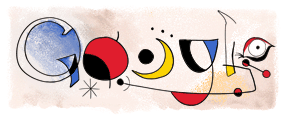
Google Violates Miro's Copyright?
Anonymous Coward writes "In a homage to Joan Miro on his birthday, Google changed its logo as to spell out the word "Google" in Miro's style. Google has a history of changing its logo in order to commemorate events and holidays of particular significance. In this case, the homage was not well received by the Miro family or the Artists Rights Society which represents them, as reported by the Mercury News. According to Theodore Feder, president of the ARS, "There are underlying copyrights to the works of Miro, and they are putting it up without having the rights". The ARS demanded that Google removed the logo, and Google complied, though not without adding that it did not believe it was in violation of copyright. The ARS has raised similar complaints regarding Google's tribute to Salvador Dali in 2002. "It's a distortion of the original works and in that respect it violates the moral rights of the artist," Feder said." It seems to me that the art world has a glorious history of incorporating prior art into modern creations. It's amusing to me that ARS doesn't understand that.
ARS-holes
There you have it.
"Don't let fools fool you. They are the clever ones."
I doubt any of the original artists would have a problem with it. It seems that it is family's that are interested in the financial gain from complaining to Google about it. This tiny excerpt from the article explains it all: "In September, the Authors Guild sued Google for reproducing works..." Come on! The Google symbol in the likeness of an artist is honoring them. It would only help increase the value's of their works, and peoples awareness of them. They just see Google as a big money pit they can take from.
The artists, or their shareholders.
Either way, they can kiss my ARS.
Is it possible that the visual art world is more interested in money than art and expression? I can't believe it.
Well, it seems that after some 50 years or so, we wont be able to use any shape, image, saying, metaphor or the like without consulting an intellectual property expert and acquiring appropriate rights, the way things going.
Read radical news here
It seems to me that the art world has a glorious history of incorporating prior art into modern creations. It's amusing to me that ARS doesn't understand that.
It's not that they don't understand, it's more that they're trying very hard to make everybody else forget that fact. They, as well as certain **AAs, behave like rabid dogs protecting their food, so that they have grounds to claim money for the use of this or that piece of art whenever possible and not be contested.
"A door is what a dog is perpetually on the wrong side of" - Ogden Nash
Since I had never heard of the artist until Google used an interpretation of her art as its logo, this seems like it would be a good thing for artists. I have never understood the knee jerk reaction to anything that could possibly be explotive. Its just free publicity in this case, and you would think the family would see that.
http://bgcommonsense.blogspot.com
I thought it was a fine tribute to a great artist. The estate should be honored.
CDE open sourced! https://sourceforge.net/projects/cdesktopenv/
How many people wouldn't have encountered Miro's work if they hadn't seen it on Google's site? Now how many of those people wouldn't have known who's work it was had ARS not filed a complaint with Google. While their complaint seems semi-valid (though, personally, I doubt it would have held up in court), it seems that in effect this ends up being a big PR move. We now have lots of people who weren't familiar with Miro's work, who now recognize it because of the complaint.
This guy's the limit!
I can't vouch for this particular article, but similar information shows up on other sites. http://www.carolinaarts.com/902fenno.html
[Fuck Beta]
o0t!
Why would they care? Google has a very small user base, I doubt anyone saw it...
i agree
To whom it may concern,
Your use of colored rectanglular windows violates the copyrights of the Mondrian estate. Please refrain from any use of colored rectangles on your site in the future. If you wish to consider licensing the use of these images, the per-rectangle license is quite reasonable. Please contact us at the address listed.
Thank you
Intron: the portion of DNA which expresses nothing useful.
This clearly falls into what should be considered acceptable fair use.
The lawyers have taken over the country ( world ) and are even more dangerous then the government(s) they are manipulating.
---- Booth was a patriot ----
Slashdot: Failed Car Analogies. Amateur Lawyering. Anecdote Battles.
Moral rights in copyrighted works are pretty slim in the US if existent at all. We're supposed to have them as a condition to signing a treaty, but for the most part we really don't. Anything that comes up looking like moral rights ends up being weasled through the Lanham Act rather than copyright law.
What?
This sounds like complete crap. Such an logo will increase peoples knowledge about the artist, and thus increase the popularity of the artist, and make images more worth. I doubt anyone would tear down their Miro paintings and put up a print of the google logo instead...
The copyright holders should see that google links this to a search on the artist, which probably generates more knowledge about the artist, and more interest for his works. I'd guess there where firms that would pay millions to have their style on the google logo, and a link from the logo to a search of their company name...
Assembling etherkillers for fun an profit
i see the point that's trying to be made BUT have to make a quick counter point.
google did not just happen to make a logo that looked like miro's style and use it. your comment implies to me that(though exagerated) every idea, shape, color, etc will be taken and one would have to dig deep to make sure that your 'fresh' idea is not too similar to an old one.
instead good DID look at miro's work and made an effort to emulate that work in their logo, though they were giving homage the made an effort to copy. btw i also think that this is ok as long as there is no financial reward from this copy, as it is pay homage! thank you google for being aware and respectful of art and artist.
maybe the ARS should joint the RIAA and MPAA to complete the axis of evil!
But kudos to ARS for reminding us that Miró is dead and all the money made from his works goes to some greedy people who have contributed nothing. Miró himself donated many of his works in the hope that he would not be forgotten, but apparently ARS sees no value in keeping that spirit alive. They'd rather have people forget about him than allow anyone to use his "copyrighted" (by them) style for free.
"I love my job, but I hate talking to people like you" (Freddie Mercury)
Dont even put the word google on there at all, in any font as a protest..
But i am sure somone has copyrighted 'blank space'
The world has gone nuts, and i want off the ride.
---- Booth was a patriot ----
It's more like free marketing support, not like stealing property.
I don't get why they don't understand that. If nobody even KNOWS about an artist, how could he sell his works? I'd even pay a lot of money - if I had any - to be the replacement of the google logo for just 20 minutes (just guess the hits/public notice you would gain from that).
Also, they (google) don't use the image to improve their own product, but to hail the original artists (I think the even explained on a website what the logo change meant - as they usualy do). If this does harm to a copyright, I say, F*CK copyright. Do it now, and do it properly.
Don't like this new world we (some people) are heading to.
This makes me think of the response Groucho Marx typed up when some weinerdog lawyer tried to stop his new film from being called "A Night in Casablanca" because the name "Casablanca" had already been used in a movie title. Not so much the situation but Groucho's description of how he imagined the lawyer himself.
This sig, aah-ah, is comin' like a ghost-sig...
this is nothing more than selfishness at work!(ok, maybe some greed!)
paying respect to a dead artist is perfectly acceptable and should be encouraged! this has been happening for 'EVER' and many many many of the most famous artists are only famous now because their work has been emulated and now integrated into modern culture.
no exploitation is happening here, just good ol' respect!
"Lighten up Francis!"
The stupid ARS should be happy Miro got all that attention. What exactly do they expect? I guess we can add ARS to the same list as RIAA and MPAA - self-defeating, money-grubbing idiots.
"No matter where you go, there you are." -- Buckaroo Banzai
Dear Unity100,
As the legal representative of "PatentRight" a conglomerate of over fifty major multinational companies that have organized to protect their joint legal rights against patent and copyright violation, we hereby inform you that your April 23, 2006 posting to Slashdot (http://slashdot.org/ is in violation of five of our clients patent and copyright holdings. Please remove your post immediately: "Well, it seems that after some 50 years or so, we wont be able to use any shape, image, saying, metaphor or the like without consulting an intellectual property expert and acquiring appropriate rights, the way things going." Violations include:
1) The use of "Well" in this context is owned by the American Groundwater Corporation.
2) Bicentenial Celebrations Inc. owns a copyright for the use of "50 years".
3) While "shape, image, saying, metaphor" is not explicitly governed by previous copyright or patent filings, SISM (Systemically Integrated Seismology Measurments, LLC) does own rights to the SISM acronym and has the legal right to slogans which attempt to infringe on this acronym.
4) Several patent law firms are currently in arbitration to decide the legal owners of "Intellectual Property Experts" and your use of this phrase here will not be tolerated.
5) "apropriate rights" is held by Planned Parenthood.
I doubt it's the artist who is suing, considering that he's been dead for more than 20 years. It's just his money-grubbing family.
To whem it may concern,
Your use of such a 'warning message' violates the copyrights held by myself on sending such warning messages. in the future if you wish to send such a warning letter you may wish to license the use of specific statements such as "please refrain from" and "your use of XXXX violates the copyrights of"
additionally, my firm maintains a patent on the method of ending such warning letters with false friendlyness and we are currently not licensing the use of the "Thank you" message at this time.
Thank you
©2005 Warning letters and label Co.
®the "To whem it may concern," opening is a registered trade mark of Warning letters and label Co.
btw i also think that this is ok as long as there is no financial reward from this copy
Does it matter whether or not there was financial reward? As long as the work wasn't presented as the artist's and only in the artist's style, what standing do they have?
The recent Dan Brown suit would probably be precedent supporting Google.
The idiots are the people who pay any attention to these timewasters. Let them try and bring lawsuits if they want to.
Well, it seems that after some 50 years or so, we wont be able to use any shape, image, saying, metaphor or the like without consulting an intellectual property expert and acquiring appropriate rights, the way things going.
That's unfettered free market libertarianism for you: feudalism in disguise. swear fealty to your corporate masters. they believe in the common good, it's just that they measure "common" with dollars.
must... stay... awake...
Then I found out the artist was suing google because they got their works out to a wider audience, and I thought "fuck off, Miro"
Then you found out wrong, nobody was suing google over it, especially not the dead artist Miro, idiot.
The revolution will not be televised... but it will have a page on Wikipedia
No problemo. Google will be happy to let unknown artists fall into complete obscurity and stop its laudable attempt to educate its millions of daily users about art history.
Come on. Maybe I'm a little old fashioned (I am over 20) but I would certainly consider having google make a rendition of my work to (assumedly) celebrate my birthday (or other event) an honor. But I guess if your an "artist" going for the "I'm poor, struggling and not recognized for my talent" approach, this could be devestating to your "morals".
If google really wanted to get all pissy about this, they should just laugh and say "ha ha" it's a parody on your art work and therefore protected! Ha ha you're a funny artist!
Since when can an artist's style be copyrighted? Artists have been copying other artists' styles since the dawn of history. If I want to paint in the style of Miro or Norman Rockwell, there isn't a damn thing they can do about it.
Mea navis aericumbens anguillis abundat
the style. Money grubbing estates of dead artists are the worst thing ever. Google should've stood their ground and kept it up. Miro probably would've been cool with it. Dali? Dali probably would've objected for some reason OTHER than copyright. He was an odd bird.
My kindergartener can do that.
Write a frivolous lawsuit, I mean.
i suppose this is the only debatable issue here. if some item is of very similar design, or in other words is a blatant copy then it should not be legal unless it is a parody as these are protected by law(in the US anyway)
i feel that the profit part is important because paying respect to an artist should always be allowed but using an artist work for profit should require some license on the work.
i say this in another post but i will say it again here, google intentionally copied miro's style here and it is obvious. has this been for profit then maybe the family could throw a fit! but since it was comemorating the artist then that is ok/good. i do feel that the holder of the copyright(the family?) has the right to have google take it down if they feel and it is reasonable that the image was an offense to the artist.(unless it was a parody!)
just my side though. what do you think?
Slashdotting Google? That's cruel!
Did they rip off the actual work, or did they borrow the style from the artists? Last I checked, borrowing the style is legal. I guess this means that pretty much all anime is in for a lawsuit fest if this be the case...
Fifty years? That's way too far off!
-- This and all my posts are in the public domain. I am a lawyer. I am not your lawyer, and this is not legal advice.
The obvious conclusion is that Google knows which IP holders not to mess with, and which ones it can probably mess with.
Everybody's a libertarian 'till their neighbour's becomes a crack house.
I don't think anybody should have to ask permission to use elements of a dead artist's work which are over 65 years old. Miro's contribution to popular culture is pervasive. There is no basis for restricting wholesale reproduction of his works outside of the obscene length of time we allow for copyright in the West. Much less should we be allowed to restrict the use of simple elements and basic tributes of extremely common, influential, and well publicized art.
Sorry, but you have it 180 degrees backwards. This is not a 'free market'; it is exactly the opposite. It is a market corrupted by an unsupervised government agency that is granting undeserved monopolies.
Joan Miro himself borrowed and altered some things from other surrealists. Everyone write to president Dr. Theodore Feder at
Artists Rights Society
536 Broadway, 5th Floor
(at Spring St.)
New York, NY 10012
Tel: 212-420-9160
Fax: 212-420-9286
or drop him a line at tfeder AT arsny DOT com
What makes you think there's a misunderstanding? It's deliberate, and it's a good idea. Typefaces shouldn't be copyrightable. Design patents are sufficient, if not too much protection.
Really, no protection should be offered at all, unless it's pretty clear that doing so will yield a greater public benefit than the public cost of granting the protection. Just creating something isn't enough to warrant rights in the creation.
In the typeface field, it seems that there's plenty of creation going on with the natural incentives in the field. This means there's no need for us to add artificial incentives such as copyright; they wouldn't produce a benefit, and they would produce a harm. If typeface designers ever need more of an incentive, then we can reconsider the matter. It's the same reason why we should not grant copyrights for architectural works, or not grant patents for software and business methods.
As for fonts in the US, it is argued that software fonts are actually a computer program which happens to output noncopyrightable letter shapes, and that thus the program is copyrightable. Personally, I think there are serious merger issues to be considered, and in any event there's just the one case on the subject, IIRC. I wouldn't put money on either side.
-- This and all my posts are in the public domain. I am a lawyer. I am not your lawyer, and this is not legal advice.
they created their own, in a style that was influenced by him.
imagine if Manet had been able to copyright French Impressionism, or Picasso cubism, or Renoir portraits.
Let's assume Google made money out of this, just for argument's sake.
Did Miro ever paint the word "Google"? If not, how is this a "blatant copy"? This is an original work, just in someone's style. Why should it need a license?
Why should an artist worry "Is this too close to someone's work, will I get sued?". Art builds on what comes before it (as does much of everything). Why even risk the killing of changes in the art world?
You shit out a picture and you and your family own it or anything like it for enternity? Bullshit. One more reason I don't feel bad about copy-right infringement. They cry that no art will be produced without pay...I say this is a blatant lie. There are countless artists out there struggling to be seen. Many produce their works with no expectation of payment.
Blar.
While I agree with the above post, IMHO, Google should have the courtesy of asking permission from the controlling body.
Why? Why should they need to ask permission to use the style of a dead artist in their logo?
Miro, like him or not, contributed something to our shared culture. We ALL have the right (morally, not necessarily legally) to make use of that contribution. In this case Google did a tribute to him, which makes the complaints all the more offensive, but I would say the same thing if they had created their "normal" logo, purely out of commercial self-interest, from his style.
Miro family: Get out of the shadow of your one famous ancestor and do something with your lives. The modern world doesn't need de facto aristocracies. Make a name for yourselves, or fade into oblivion. Don't expect society to let you rest on the long-dead laurels of a relative who did accomplish something.
Theodore Feder and the Artists Rights Society: You spout non-stop self-aggrandizing BS about how much your members contribute to our culture, then deny us access to that same culture. You disgust me as the worst kind of hypocrits. Just cease to exist.
1. Google puts up company logo in the artistic style of Joan Miro to honor him.
2. Miros and ARS family tells Google to take it down as it is violating copyrights.
3. The net says "WTF?"
4. Profits from publicity? (NOT)
Shouldn't it be:
1. Google puts up company logo in the artistic style of Joan Miro to honor him.
2. Web surfers Google "Joan Miro".
3. More people find they like his art and buy some.
4. Profit goes to his family and everyone's happy.
Sounds like they are being penny-wise and pound-foolish.
If "disco" means "I learn" in Latin, does "discothèque" mean "I learn technology"?
Admittedly, I was never much into the arts as a kid. But last week I noticed the Google logo and was interested in what or who Google was celebrating.
I clicked on the link and learned all about Joan Miro and his art. After that initial click I become more interested and did some additional research above and beyond what Google offered.
If Google lifted actual elements of Miro's work, then yeah, I'd say it could be a copyright problem. But it's likely a problem that could be easily solved completely in private and without public beratement.
I'd be surprised if the recognition of Miro on Google doesn't result in substaintial financial gains for Miro's license holders, and I'd be shocked if the Miro family approved the public berating of Google by what appears to be a politically inept ARS president, Theodore Feder.
Its not like they were trying to make any money off Miro, distribute his work under the table, or anything...
And they get bitchslapped?
I don't know what the bringers of the lawsuit were smoking, as I have recently seen many other people smoking the same brand.
Would they have felt any better if Google had offered to give them front page publicity for a handsome fee instead? ( paid to Google, of course... ).
Some people seem kinda weird these days, and don't seem to think anything is worth something unless they had to pay handsomely for it.
Personally, I appreciate all the blessings that come my way, my most treasured blessings I paid not a penny for.
"Prove all things; hold fast that which is good." [KJV: I Thessalonians 5:21]
Dear ARS,
I for one was intrigued by Google's reformatted logo. As a regular Google user, I have come to appreciate the periodic changes Google makes to commemorate events, dates, or occasions with their logo.
When Google emulated Joan Miro's artistic with their logo a few days, I was similarly intrigued. While I enjoy visual arts, I admit I am completely novice in art history. Sure, like the average layperson, I've heard of Dali. But I had never heard of Joan Miro prior to Google's recognition.
And I liked what I saw. I searched through a few of the links, viewed a few of the images posted thereon, and enjoyed what I saw.
Now, I see that Joan Miro's legacy is apparently in the hands of those who would do everything possible to limit the distribution of that style of artwork. I certainly understand the concept of copyrighting actual works. But the idea that you also have the right to stop people to even imitate? And in this case, it's not even as if Google was imitating with the intent to claim the style was of their own invention. Instead, they went out of their way to point those interested to information about the actual creator.
By your reasoning, it would be illegal to impersonate John Wayne, Dick Clark, Jerry Lee Lewis, or other notable and memorable performers whose style was an integral part of their allure. Surely, Jey Leno isn't breaking the law by saying "nice lady" in Lewis' Nutty Professor style while mocking France during a weekly opening monolgue on the Tonight Show. Instead, to all but the most idiotic, we are all reminded yet again how powerful and influential an artist the original Jerry Lee Lewis was.
It's a shame we cannot consult Joan Miro about whether or not this is "acceptable." I for one have no doubt it is "legal," and even "moral."
But as long as organizations like yours are the ones controling Joan Miro's legacy and the effect Miro's artwork has on the world, I can promise you I will avoid it. To do otherwise would be to forward an organization whose behavior I consider contrary to the wishes of the typical artist, as well as contrary to greater good the art world tries to offer soceity as a whole.
You have pushed many people away from Joan Miro's work. Congratulations. as this seems to have been your real motive.
Butt-headed art critics.
because there is a difference between a similar work that is influenced by an original and similar work that is an attempt to copy an original.
the guys who made the google logo very clearly found some of miro's work and did their best to make the google logo look like it. in fact all of the combiniations of shapes in this google/miroesque logo are cut and paste work with a little photoshop magic and not an original, inspired by work.
i dont believe that a 'shape' and color can be a style that is copyright but only the very specific method of combining the shapes and colors and maintaining that consistency throughout the work that is the art. google basically did a cut-and-paste job. BUT it was not a 'pirate job' like the ARS claims as it was comemorative.
I thought it was wonderful to see the Miro pic on Google; it made me smile.
... then some future, less-benevolent Miro-ripoff would be able to point to the earlier inaction as precedent.
I'm saddened by the response, and - along with near-all Slashdotters - am nauseated by litigation taking over from innovation. And, that Joan Miro, being dead and all, cannot benefit from this; the only benefits inure to people who never lifted a brush, or a finger, in support of Miro.
HOWEVER: there is a little wrinkle (note: IANAL). A right that is not defended can be argued to have lapsed. Thus, if the agency and the estate of Miro hadn't at least rattled their sabres and expressed annoyance
THUS: if I'd been in the seat of the defenders of Miro's estate, I would also have sent of a cease-and-desist letter - and hoped that the whole matter would go away. And, Google (which is chock full-o-lawyers at the exec levels now) surely needs to create new form letters asking for non-commercial permission to exhibit content.
As a creative professional I am appalled by the reaction of Dali's and Miro's estate with regard to Google paying tribute, and, yes, generating FREE public awareness (as in advertising) for an artist's works. I'm sorry but imitation is the purest form of flattery. It is done over and over again in art, architecture, and music, and has been done for centuries. You don't see Mario Botta, or Richard Meier, or the estate of Corbusier suing other architects for 'borrowing' design elements to put in their own designs. And, you can't tell me that architecture isn't a 'visual medium' in the built form. These people should be ashamed of themselves. Clearly, they are money grubbing scumbags!
There have been some comments about fair use in the thread. Let me just say that this type of activity does not fall under fair use. Fair use applies to using the 'actual' artwork for non-profit purposes, i.e., education and the like. This falls under imitation, where the style used to depict something is borrowed from another artist. There's absolutely NOTHING wrong with that, or there would have been only one impressionist artist, only one jazz musician, and only one music video because everyone else that ever made a work in the same style would have been sued. It's utterly ridiculous!
If my understanding is correct, parodies, especially disrespectful parodies, are very well protected from problems with copyright infringement.
Any strange "modern" art (Is it still called that?) just has to be an open invitation to all sorts of vile parody.
Miro, Miro on the wall,
who's the dumbest paint of all?
There's a difference between abusing a work for purposes its creator would never want (your "Blacklung Cigarettes for kids") and Google parodying its logo to mark holidays and special events.
And what's with the knee-jerk free software reaction? Once again, way off in left field. Nobody thinks free software developers are in it for the money.
DATABASE WOW WOW
. . .google did not just happen to make a logo that looked like miro's style and use it.
"Style" is not something that can be copyrighted. Only works can be copyrighted.
See ragtime, blues, jazz, boogie woogie, rock & roll, etc., as opposed to Maple Leaf Rag, Sweet Home Chicago, Take Five, Roll 'em Pete and Purple Haze.
The former are styles, the latter are works. You can copyright Take Five. You cannot copyright 5/4 time.
In fact, the Google logo was their own creative work that they own the copyright on. It was just in emulation of Miro's style, not a copy of one of his works.
The claim of any "moral" rights is so assinine I almost don't know what to say about it. The law does not recognize "moral" rights. It grants a monopoly on copying and may impose monetary recompense against losses incured by such copying. Without the law the artist has absolutely no rights whatsoever, except maybe to be a dickhead.
And I wonder just what sort of monetary losses the Miro heirs feel they have suffered by Google making an original work in tribute to Miro?
KFG
You can't patent art! Just FYI for the record. You can copyright art, but you cannot patent it.
Dear Itzdandy,
/. on Sunday 23 Day of April in the year 2005, is a violation of the parody copyright with which our company holds.
Use of comical parody, being your post on
If you wish to make a parody of someones post, we are able to licence this to you at a reasonable cost.
Regards,
Parody Inc.
This is not just about borrowing images online. Painters in the Renaissance copied from each other frequently. The free, open exchange of information contributed to the flourishing art of the period. This is documented. This is not simply a matter of parody, as in the case of Duchamp, but of open borrowing. In fact, copying great works is part of the training of many representational artists, including myself. As a painter, the idea of my work being analyzed for copyright infringement gives me a chill.
I doubt that Google could get away with slapping a bitmap representation of a copyrighted font or something very close to a copyrighted font on its front page, any particular reason why an artist should be any different? He only died 23 years ago too; there's no room for confusion as to the length of copyright on his works.
I understand you're being sarcastic, but this kind of crap is the exact opposite of the unfettered free market concept. I agree that most corporations talk up 'free markets' but they usually mean 'take out all the other guys advantages but protect my markets from competition', but your post seems to imply that the very concept of 'free markets' is a sham, which I don't agree with.
Copyright is not a moral right. Copyright is not a natural right. Copyright is not a human right.
Copyright is a capitalist construct that was created to provide an incentive to
create artistic works.
If you had super powers, would you use them for good, or for awesome?
Well, it seems that after some 50 years or so, we wont be able to use any shape, image, saying, metaphor or the like without consulting an intellectual property expert and acquiring appropriate rights, the way things going.
As a matter of fact, if you intend to use any "shape, image, saying, metaphor or the like" as a basis of your commercial activity, consulting an intellectual property attorney will be a wise thing to do on this very day. Not in 50 years from now, but even 50 years ago. Just as consulting a corporate lawyer is a very good thing to do just before you incorporate, to avoid costly mistakes.
I mean, people: don't exaggerate. If you want to have the law protecting your rights, you must pay the lawyers. In Soviet Russia, there was no law, there were no rights and it's not just another "Soviet Russia" joke. Personally I'd rather have it the Western way with all its annoyances.
...software patents on a programmer's coding style?
Stop the world; I need to get off.
I'm not a lawyer, but isn't Google's use of the style considered a parody, and aren't parodies of copyrighted works considered protected speech?
'style' may not be the proper word. anyway, i have done some googling and the google logo has cut and pasted the second o simbol. the first o looks very nearly but not exactly like another image and the eye at the end that is part of the E is cut-and-paste. both Gs and the L seem to be original.
so google has in fact used unique elements in this logo, though not the whole logo is made of these.
it is an arguement to no end though as i feel google is in the right and suspect you do as well. the logo is comemorative and not a theft of intelectual property. it provides to product or advertising. it is simply comemorative.
It was probably meant in homage. But Google should respond that it was a parody to show how greed is preventing people from knowing, let alone enjoying, an artist's work. And then tell ARS to go pound sand and stop violating the moral rights of the artist.
Who is this Theodore Feder guy?
"But in addition to providing access to top-quality art images --for a fee-- Feder is involved in protecting the artists themselves from copyright infringement, illicit use or piracy of their works. He founded the Artists Rights Society in 1986 to preserve artists' interests while also providing "reputable publishers and producers of commercial goods" with a clearinghouse for rights and permissions." link [bolding added]
Sounds more like this guy is more concerned about protecting his cash flow.
I'm...speechless.
Let's get this straight.
*The* most popular search engine in the world, with billions of hits per day, puts *your* work on its front page.
Billions of people who've never heard of you before will now find out about you.
And you say...
"TAKE IT DOWN AT ONCE!!"
I've seen stupid, but then there's *STTTTTTTTTTTTTTTTTTUPID*.
Don't buy his work!
He's evil!
haha, somehow I think google can take it... :-P
Actually, typefaces are copyrighted and copyrightable. Let me explain why. Typefaces are a different animal in that the shape of the letters and how they are constructed can only be done one way. This is why they can be copyrighted. It's not the computer program that creates them that instills the copyright. It's the specific shape of the letters that makes them able to be copyrighted. BUT, it's also this specific copyrightable shape that makes it easy for other fontographers to create variants (small changes in the shapes of the letters) that closely resemble the work being mimicked and then copyright those variants for themselves. This shape being copyrighted protects the font no matter what creates or where it is used. It's the same thing as copyrighting a company logo. Trust me, I do identity design for a living!
One glaring question is whether Google actually used Miro's images in its logo. Since Miro didn't ever paint a Google logo, the only issue is one of style. Style is trademarkable, not copyrightable; but copying other artists' styles is such a common practice in art that it's more noteworthy to see an original style than to see a copied (albeit altered) style.
Now, if the logo uses portions of Miro's work, then the portions used are likely too insignificant to count as an actual copyright infringement.
Also, Miro died in 1983. I'm not sure of the specific works involved, though his _Carbide Lamp_ looks vaguely similar, and _Catalan Landscape_ (though with a different color scheme). However, the eye is not drawn or colored as Miro would have done, and the lines all seem straighter and more angular than Miro usually used.
While I'm no art critic, the fact that I cannot tell that the style is supposed to be similar without someone pointing it first is rather indicative.
Next, someone's going to claim copyright on Platonic forms and charge people for using them in lectures or sculptures. Hold on while I copyright individual pixels.
A dream where I don't have to wait until 65 years after the death of the artist in order to pay him or her a tribute without having to first ask the family permission.
I mean, sheesh -- this boils down to one simple effect: unless the artist died a long time before I was born, then I can't pay tribute to anybody by imitating the style of their work. All the artists that are alive when I'm alive: forget it. Unless they died when I was 10 and I live to at least 75, they're off-limits. I can't base my work on anyone else's, even stylistically, or on a general idea. The whole current generation of art is essentially off-limits to me in any kind of derivative fashion, even if I'm adding in a little of my own creativity. Nope, it's derivative, so prohibited, without getting permission.
It'll be a pretty depressing world if I have to someday say to my child: sorry, no, you can't draw that picture like that, because somebody already did something like that, and they've only been dead for 50 years, not the requisite 65+. We might get in trouble with their family if you publically display that artwork, and I can't afford the legal hassle of a copyright dispute case.
That's the world the ARS is advocating.
And I expect a call from the lawyers of the family of Martin Luther King, Jr. for the title of this post, complaining that I've violated his "moral right" to the idea of having a dream and expressing it with that turn of phrase.
"You know mom, google really brought a lot of attention to Miro and his paintings (+$), if we were to throw a fake lawsuit at them and leak it to the press, Miro's paintings would be even more well known and controversial (+$)."
"Go right ahead dear."
Art(Controversy) == (+$)
http://en.wikipedia.org/wiki/Nude_Descending_a_St
It seems to me that the art world has a glorious history of incorporating prior art into modern creations.
The art world does have a glorious history of using prior content to define current content. Its the business world thats the problem here.
Ever been to a travelling exhibition of Miro's work? Tickets run somewhere in the area of $10+. This is an obscene cost for an artist who, quite frankly, had little impact on the course of commercial art. I saw the Ghent Altarpiece, one of the most significant works ever painted, for like $4.
I didn't even want to see the Miro exhibit, but I was forced to pay the price of admission so I could walk by the whole damn thing and find the El Grecos in the back of the gallery.
I understand the problems that the Miro Estate face -- I'll be inheriting a similar body of copyrights from my own father -- but Jesus Christ, people. One of my father's works was featured in a political cartoon (non-parody), and my family loved it. We didn't spit on the cartoonist. And under U.S. law, you do not have to protect your trademarks from non-commercial tributes in order to maintain them. These people are just a bunch of greedy snivellers.
... but in this case I have to wave the FAIR USE flag really high (even though ARS would want us all to WAIVE it); I simultaneously hum a tune to myself that will remain inaudible to you for specific reasons pertinent to the internet and my inability to send audio through Slashdot at this time. Can you guess the tune?
The dangers of knowledge trigger emotional distress in human beings.
"Free market" is just a particular economic scheme which has a rather restricted applicability domain and a great number of flaws, many of which, if not addressed by external controls, would lead to rapid devolution of any "pure" free-market scenario into some form of feudalism. In that the parent poster is quite right. That is independent from the fact that the current creeping corporatism is approaching fedualism on its own in a different way.
There is a story by some guy about something related that mentions running out of new ideas , but due to copy restrictions I can't mention the specific story, the writer, or even any details about the story without violating somebody's IP rights.
(sarcasm flag for the humor impaired!)
The family is still a bunch of greedy fuckwits.
That's our life, the big wheel of shit. - The Fat Man, Blue Tango Salvage
copying other artists' styles is such a common practice in art that it's more noteworthy to see an original style than to see a copied (albeit altered) style.
Agreed whole-heartedly! As a visual artist, myself, it is nigh impossible to create something that isn't influenced by established styles. In fact, that was part of my education at Pratt Institute in NYC - learning the styles and accomplishments of Miro and countless others, and incorporating some of their ideas in clever, new executions. Likely, this sort of thing is more subtle than Google's outright references, but that could easily be argued as a subjective perception.
If somebody made a visual reference or "quotation" of my work, I would be flattered, to say the least. I guess Google's main mistake was verbally attributing the inspiration for the restyled logo to Joan Miro. But in my opinion as an artist, this was a best-intentioned and visually witty tribute.
If copyrights worked they way they used to, those works would've been out of copyright, for more than 35 years. But, with the latest copyright extensions, I believe his works are protected for 70 years after his death, which would put that at, oh, the end of 2053.
--JoeProgram Intellivision!
Doesn't copyright law protect derivative work? You cant resell pictures from Life Magazine, but you can use them to make a collage and sell that? It's something like that...'cause I'm pretty sure you can use less than 30 seconds of video for almost anything, no matter who owns it.
If you can copyright a new style, then I'm gonna go see if anyone has copyrighted stick-figure drawings. If they haven't, I'm rich. If they have, I'm screwed.
Knowing Google's lust for data collection, the Soviet Union is still alive and well inside the psyche of Sergey Brin....
To be honest, and I'm afraid to admit this, before I saw the image on the google website I had no idea who Joan Miro was. This being the case, I looked at the img src and saw miro.gif so I searched for Miro and now I know who it is. I rather like the style. So in the end, I think google was trying to get the style out there for teenagers who'd never heard of Miro, in an attempt to pay homage to a wonderful artist and to try to raise awareness of who Miro was. So what's the families problem?
Artistic styles cannot be copyrighted or patented. In limited cases, people can get design patents or trademarks, but I seriously doubt that that would apply here. Furthermore, it's not like Miro was the only person to have drawn in that style.
ARS and the Miro family seem particularly stupid in this case because Google probably gives them a lot more exposure for free than they have received in a long time.
To ARS:
Now that Mercury News has a reproduction of the Google logo, I think just to be consistent with your copyright claim, you should request them to remove the offending article.
To Merucy News:
If you ever receive a request from ARS for removing the article, it's time to give them a smack down for interfering with freedom of the press
To Google:
May I suggest you cached that front page to your system. IIRC, court has ruled that web caching is not a copyright violation.
Copying only the style of a work is NOT COPYING THE WORK!
"[Regarding the 'cloud,'] ownership was what made America different than Russia." -- Woz
While I do support the right to the works of Miro by the current copyright owners
I don't. Miro has been dead for a long time. His works should have passed into the public domain by now; that's, after all, the whole purpose of copyright: to create a body of high quality public domain works. The fact that this work (and a lot of other) is still protected by copyright has more to do with corrupt politics than anything else.
This is quite ironic given Miro's socialist beliefs and, in particular, his desire that his art get the widest audience and ownership possible - hence his issuing prints of his paintings in very large numbers. You can still buy small prints of his for very reasonable prices (considering that the man was a bit of a genius).
I call copyright on the "Splattered-paint" graphic!
Muhuhuahahaha! Now I can make billions and boss around large companies os that they will change every single thing I don't like to please my every whim!
Knowing Google's lust for data collection, the Soviet Union is still alive and well inside the psyche of Sergey Brin....
Once a big fan of google, this type of behavior is bugging me. There may or may not be a copyright violation here (depending on specific similarities of the expressions), but there is certainly a disrespect of the moral rights of the artist. Let's say a google made a "tribute" to tiger woods by making the google words out of him, or paid a tribute to U2 by playing "one" when you went to the site. Do you think this would be ok? Miro's a big deal, though perhaps not to the ignorant masses. Google appropriates good will from Miro at Google's discretion, not necessarily the other way around (i.e. think Miro on Enron's homepage and you understand why the family might be pissed). I think should set up a porn site, perhaps www.oogle.com, and use the same fonts and colors as google (as a tribute to their fantastic business savy) and see if google gets pissed off. Take of your rosy googles and think about what's going on her folks.
um, in case you don't know this... Dali and Miro are dead. dead people don't have rights.
I know I haven't posted here in awhile, but this story just "hit" me at the wrong time. I am so sick and tired of this mentality where everyone seems so greedy to always look how to "get over" on others to profit.
First off, there have been MANY artists over time using the same or similar styles. Should all the art that has been inspired by Picasso be destroyed?
I am very sure that Miro's "style" was inspired by others.
If we follow this example then we will have no or few new artists/art.
On a Lighter but serious note.. My style of web design is to have a menu located on the left side of the browser with pop-up submenus via mouse rollover. Perhaps I should sue ARS for using My style without permission - LOL
and though I like the 'style' (how the fsck can you copyright a 'style' anyway!?!?) I'll remember this whenever I see it now.
My letter (I attempt to avoid grandstanding, because that sort of thing bounces right off an unreceptive listener):
Dr. Feder,
I understand that your charter is to protect the work of the artists you represent. However, I think it would benefit you to recognize cases where limited unauthorized use of their work actually benefits the artist, without losing any revenue or giving up any control, and enriches society as a whole.
As you are probably aware, Google frequently adapts its logo to commemorate people and events. Because Google is such a highly trafficked website, these tributes serve only to draw attention to the people or events being commemorated. Millions of people who have never heard of Joan Miro (such as myself) were exposed to an example of his style, and were given the opportunity to learn more about him. Google had nothing to gain financially from this, and you had everything to gain from the massive publicity.
Now my only impression of Joan Miro is that the rights to his works are controlled by an organization that contributes to the increasingly litigious nature of our country, by trying to control even reasonable, flattering, non-commercial uses of their artists' work.
Sincerely,
Moral Rights are not as protected in the US as they are in the European community. The law you cite, VARA, only applies to signed and numbered works of which less than 250 are created. Moral rights are a part of the Berne Convention, but in the US are reflected in defamation and trade law rather than copyright.
The Olympics five ring configuration is a registered, and legally recognized, trademark. That's a very different thing than an artistic style.
now we need to go OSS in diesel cars
To Whom It May Concern,
Your use of consonants and/or vowels violates the copyrights held by my client Sony Pictures Digital Inc., owner of the popular Wheel of Fortune gameshow. In the future, if you wish to use consonants and/or vowels you may wish to license the use of specific letters including, but not limited to, "E" and "T" from my client.
Additionally, my client maintains a patent on the terms "buy", "spin", "Pat", and "White".
Please cease and desist using consonants and/or vowels and/or the terms mentioned above without prior approval. Thank you.
©2006 Veni, Vidi & Vici, LLC.
The idea of Dali's works being defended on those grounds is priceless in light of the fact that several artists, including Picasso, were pissed at Dali for the same thing.
Then again, when was the last time you saw a group of artists and real appreciation for anything in the same room together?
I scream. You scream. I assume that means we're both acquainted with the problem. We proceed.
Spaniard?
Wikipedia leaves it very clear: Joan Miro was a Catalan, not a Spaniard.
Joan Miró i Ferrá (April 20, 1893 - December 25, 1983) was a Catalan painter, sculptor and ceramist born in Barcelona (Catalonia, Spain).
Peace
Miro died in 1983, after a lifetime spent capitalizing handsomely (and well-deservedly) on his art. Under the original US copyright laws, he and his "estate" would have had until 2000 to benefit exclusively from the right to reproduce his works. That limited time was certainly more than sufficient to to promote the progress of science and useful arts.
Even though artists like Miro would produce their art regardless of protections or capitalization, driven by their "muse" that compels them to communicate in their medium as much as the rest of us are compelled to communicate by talking and handwaving. And like lawyers are compelled to communicate through C&D letters and invoices.
Popular art like Miro's has always quickly become part of the folk vocabulary of its culture. An early effect of that acceptance is usually enough saleability that the artist can make money quickly, supporting more art. In the centuries since the Constitution recognized a limited monopoly compromise with freedom for practical operation of a free society in an scarcity economy, the time required for adequate compensation has shrunk vastly, with reproduction and compensation technology and techniques far beyond most could then imagine. Recognition of the contribution of the people who codify such art into our folk culture has been completely eclipsed by concessions to the experts who codify art from "high" through "pop" through "commercial" and protect all its product franchises in perpetuity.
--
make install -not war
In the US, actually, they're not. Let me explain why.
Typefaces are a different animal in that the shape of the letters and how they are constructed can only be done one way. This is why they can be copyrighted.
Actually, that's two excellent arguments for why typefaces are uncopyrightable.
First, we have the utility doctrine.
17 USC 102(a) tells us that only original works of authorship are eligible for copyright. One general class of works in 102(a) are pictorial, graphic, and sculptural works (PGS works). A definition is provided in section 101:
This definition results in PGS works being copyrightable only if they have no useful function, or if any useful function they have is independent and seperable from the copyrightable part of the work.
For example, imagine a bicycle rack that consists of a fairly ordinary rack that has been engraved with decorative elements. You couldn't copyright the entire thing, since the design of the rack portion is functional -- it has to function as a bike rack, and it was designed with that functionality in mind. The engraving could be protected, but nothing would stop someone from making an exact copy of the rack, minus the engraving, and selling them, etc.
Typeface is a graphic work, but it has a utilitarian function in that the letter 'A' in a typeface has to communicate to readers the idea of the letter 'A'. It has to be recognizably an 'A', as opposed to a random squiggle that no one will understand. This means the utility doctrine is in play. In order for there to be anything copyrightable about the typeface, there will have to be some part of it that is seperable from the shape of the letters corresponding to the alphabet, and which can exist independently of the letter shape.
The thing is, that's impossible. If you have the letter 'A' in Helvetica, let's say, you cannot strip out the 'A' part of it and have anything left! Since this is going to be true of everything in the typeface, there's simply no creative work on which to hang a copyright.
This goes a long way toward explaining why the Copyright Office will reject registrations for typeface copyrights.
The other reason is the merger doctrine. Caselaw and section 102(b) tell us that copyright is never allowed for an idea; rather, copyrights are only allowed for creative expressions. The idea/expression dichotomy basically tells us that you cannot copyright the idea of a murder mystery in which the butler did it. On the other hand, you could copyright a specific novel in which the butler did it; the copyright would not preclude anyone from going back to the underlying idea and writing another novel. Since the ideas are usually somewhat vague, it's assumed that there are many possible expressions. You could put a hundred mystery authors to the test, and get a hundred very different novels all involving how the butler did it. The dividing line between idea and expression is not a bright line, however. And in cases where there isn't literal infringement, courts often have to look into the similarities between works, and figure out whether it's due to them both using the same idea (which is okay) or wheth
-- This and all my posts are in the public domain. I am a lawyer. I am not your lawyer, and this is not legal advice.
I think there is an important lesson to learn from this incident, in regards to Google's motivations. When the Department of Justice tried to acquire tons of search-engine usage information from Google, they fought hard at the expense of a drastic decline in their stock price. When the Miro family contacted Google over their recent logo, they promptly removed it.
Without trying to debate whether Google's DoJ battle was over their own privacy, or the privacy of their users. And, without trying to debate whether the Miro family over-reacted or not. An underlying message that can be derived from all of this is - Google is on the side of its users and/or the underdog. Google didn't really need to remove the image legally. Furthermore, it would have been automatically removed by the next day anyway. Nonetheless, they acted promptly over the concerns of the Miro family. In my not-so-humble opinion, some of those other corporations that handed over information to the DoJ without a blink would also have likely ignored the Miro family entirely - for the remaining 12 hours or so.
So, I think this little incident, no matter which side you are on, proves an elusive point. Google may not be perfect, but there is certainly a level of well-intended thinking and compassion behind Google's corporate reactions to pressing and not-so-pressing issues.
it is an arguement to no end though as i feel google is in the right and suspect you do as well. the logo is comemorative and not a theft of intelectual property. it provides to product or advertising. it is simply comemorative.
Even with a bit of cut and paste it is still fair use.
In fact it's even a recognized art form, called "collage."
Ice, Ice, baby!
All right stop collaborate and listen.
KFG
Google just made a $600 mil profit for the first quarter (and their IPO single handedly held the massively overpriced Bay Area real estate market aloft and priced more up and coming artists out of San Francisco). Yet nearly 100% of artists struggle to make a buck. next time you think about evil copyright holders thing about that. You can say that the artist is dead and has been for 2 decades, so the continued copyright can not "promote arts", however the length of the copyright increases the value of the art in the artist's lifetime. By degrading this copyright, implicitly future copyrights are degraded.
It's another reason why copyright shouldn't extend past an artists death.
Copyright is to encourage the creation of NEW works, not support the museums of OLD works. Google created a new work in the style of Miro and ARS are trying to claim some right over it, in effect using copyright to block creation of a new work. Meanwhile Miró is dead and dead artists don't paint much.
Why should copyright be inheritable, while possessions like money, have an inheritance tax slapped on them? What right does his family have to claim rights over his works?
U.S. Patent 123,456,789: "Method for incorporating a teenage girl in a shower in a horror movie."
U.S. Patent 123,456,788: "Method for killing off annoying characters first."
U.S. Patent 123,456,787: "Method for splitting up and covering more ground this way (and sending that fat kid into the basement by himself)."
I can feel the money rolling in already.
"Ladies and gentlemen, my killbot features Lotus Notes and a machine gun. It is the finest available."
So I guess http://pantsonfire.multiply.com/photos/hi-res/5/1? xurl=%2Fphotos%2Fphoto%2F5%2F1my version of Andy Warhol's Marylin Monroe painting is copyright infringement too.
It's apparently not just in the style of, but a rip-off of a few of his paintings, which to me sounds fishy at best and copyright violation at worst.
"Google's logo allegedly incorporated images from Miro's ``The Escape Ladder,'' 1940, ``Nocture,'' 1940, and ``The Beautiful Bird Revealing the Unknown to a Pair of Lovers,'' 1941."
Before you rip on it as being some style issue, read the FA, because it says right in there that it is actually using Miro's real works.
stuff |
My roommate's theory is that the family was upset because Google was trying to use Miro's birthday as an excuse to celebrate 420 with some stoner imagery. The google logo change seems to be always for major events or people and Joan Miro is not an artist known to most people.
Adobe, various Photoshop filter providers, and all users of Photoshop who have ever used artistic filters, are being sued in a class action suit on behalf of all visual artists for violating their copyrights in the use of brushes, plastic wrap, frescos, mosaics, tiles, pencils, stained glass, spray paint, charcoal, sponge, and anything else that might possibly be used by a real artist and can be reproduced in Photoshop.
They did this on MLK day, with an image of Dr. King that is frankly absurd. I posted about it and put together a similar McDonalds logo at the time:
http://iheartteriyaki.blogspot.com/2006/01/on-icon s-and-logos.html
First off, Dali and Miro are both DEAD. They don't give a flying fuck one way or the other. It is an utter absurdity for them to asume some kind of a mantle of "assumed artistic intention", when the artist is dead as a herring. Does their hagiographic activity have rights in perpetuity? Will we have to deal with these soul sucking tourdes for the next 5,000 years? 500 years? 50 years?
I would argue that these jackasses have No Rights. I would argue that an artist has control over his work and images of his as long as he is alive. When he dies, his inheritors own the work, but they do not own the rights over images of the work, BECAUSE THEY DIDN'T MAKE THE STUFF, and they have fewer rights over the work for that reason.
This reminds me of the parasites who run the John Cage estate who sued a musician who put a few minutes of silence on his record in homage to John Cage... Cage has been dead for a while, and 4'33" was composed over 50 years ago. Much the same is going here with Miro and Picasso.
I detest this world of Intellectual Property where coporate parasites and lawyers earn more by merchandising the dead than the artists did in the first place. When I die, I am going to set my work free in my will.
RS
Shoes for Industry. Shoes for the Dead.
I don't know. Those people who believe they have the rights the article speaks about can be pretty persistent about it. Personally, I don't believe in those rights and am prepared to go to jail or war to defend the rights that I would have to give up in order for them to have those rights.
The inventor of art brut -art painted as if from a primal background - very interesting stuff. Miro was one of my favs, until I saw Dubuffet& num=30&hl=en&lr=lang_en&c2coff=1&sa=X&oi=images&ct =title
http://images.google.com/images?q=Jean+Dubuffet++
..........FULL STOP.
If they are after financial gain, then they are still being stupid.
I only found out about Miro through Google's logo change. I may have been motivated into buying a print from what I saw of it. Now the only thing that comes into mind when I think of Miro are the idiotic self-righteous arrogance of his representatives.
This is the family objecting to the misuse of the artist's moral rights. They simply do not want arbitrary businesses associating themselves with the artist's work. This is not about the family wanting money, it's about the family not wanting Google to associate itself with Miro.
I'd rewrite that as: "This is not about the family wanting money, it's about the family not wanting Google to associate itself with Miro, without forking over a buttload of money"
This would be a complete non-issue if a pallet load of Benjamins mysteriously appeared up on their doorstep. I know it, Google knows it, the family knows it, and I think you're daft if you believe otherwise. This is precisely why this has bupkis to do with an artist's moral rights, and the want to protect a famed, deceased artist's works from besmirchment, and why this has everything to do with a money grubbing family doing their best to rape and extort any value from the only claim to fame that has had the honor to grace their name. Furthermore, anyone who essentially believes that a someone, even if it is a company saying, "Hey, look here, we think this dead artist guy is pretty cool, maybe you want to know more about him, so you'll like him as much as we do!" is even loosely associating themselves with that dead artist guy... well, they're barking mad.
Constitutional rights may be respected, repealed, or modified; but they must never be ignored.
Sure, you did work to manifest it into the physical realm, but once there, you have no power to yank it back out again. Intellectual property laws helps people have the delusion they own it lock stock and barrel, to do with whatever they please, and for that reason alone they should be abolished. The fact is intellectual property law is wrapped up in too many metaphysical theories that scientists these days refuse to examine.
Now you could argue who profits more, Google or the other party, thereby evaluating how much and in which direction money should flow. But this is extremely difficult.
Windows is like decaf - it tastes like the real thing, but it won't get you through the day.
What's totally hilarious about this is what ultimately the google logo thing brings more attention to the artist's work. You go to google one day, the logo looks funky, and you wonder why. So you click the logo and are now finding out all about Miro, etc.
Not only is this not any obvious violation of copyright law, but IT HELPS THEM. It's free freaking advertising for the artist and presumably could lead to better returns on sales of the art, etc. Whiners.
This sig has been temporarily disconnected or is no longer in service
True. But you can probably still patent it.
One might ask the same about birds. What ARE birds? We just don't know.
and if i was google next year i would have a completely blank logo linked to the phrase
"money hungry copyright bastards" on the correct date.
Any person using FTFY or editing my postings agrees to a US$50.00 charge
Sorry to inform the computing world about this, but Ellsworth Kelly owns Red, Green and Blue. Please switch all of your monitors to grayscale immediately, or send a check for $10,000 c/o the ARS - Artists Ripoff Society.
Just another group of sue happy lawyers (which are not necessarily bad/nor good)
...
No, I'd say that groups of sue happy lawyers are pretty much uniformly bad. Matter of fact, that's what makes lawyers (and other creatures, such as dogs and piranha) so dangerous. They relatively easy to defend against one-on-one, but when they get together in packs
The higher the technology, the sharper that two-edged sword.
Despite recent claims to the contrary, wars do not merely decide who's left, they decide what's moral. Some would have you believe that "ethnic cleansing" is about genetics, but it's really about morality. Being wracked by relativism is a detriment to our society's capability to wage war.
Or claim it as a trademark.
KFG
Dear Russ one three three seven,
Your use of of the concept of the "running gag", as patented by me, is in violation of "running gag" patent which I hold. You too can make use of this concept with four easy payments of $19.95 plus s/h to
1337 beowulf cluster lane,
Doesitrunlinux, VA, 3133t
Thanks,
TiredRunningGags.com
Im not here now... Im out KILLING pepperoni
Companies cave in because they believe they have better things to do than to try the issue in court. I wonder if the lack of case law this results in will come back to bite them.
That is hilariously petty, on the part of the Miro family.
They should be more appreciative of the acknowledgment, not spitefully ungrateful.
I think I've finally decided that copyright should die with the artist. I'm so sick of family trying to squeeze the last nickel out of the corpse of someone creative. Here's a situation where countless people who may not be familiar with Miro might be tempted to look into his work because of a funny little logo, but of course, the family hears "Google" and sees dollar signs. In all the world of intellectual property, so little of the concern is actually for the innovator, for the artist, the creative person. It's almost always some holding company or great-grandson who brings the lawsuit or complaint. If the laws on intellectual property were to change tomorrow, making it illegal to transfer a copyright to anybody but the creator, it wouldn't stop one little bit of innovation, and the innovators would still get rewarded for their genius. But all this nonsense with people trying to patent broad concepts and bastard children of great artists turning the work into the equivalent of cartons of soap would come to an end.
You are welcome on my lawn.
Google can talk, now? What did it say, exactly?
What if the state of the authors life is unknown?
Under U.S. copyright law, 17 USC 302(e), after 95 years, the onus falls on the copyright owner to prove the date of the author's death if the estate has not kept the Copyright Office's records up to date.
From http://www.al-oholicsanonymous.com/faq/#coolio:
9. What's the beef with Coolio?
Added: 8/12/03
The story goes like this. Al wanted to do a parody of Coolio's 'Gangstas Paradise' called "Amish Paradise". He tells his record label to get permission. They do. Al records and releases the song. Coolio then hears the song and says he never gave permission for it and wasn't happy about it. Al figures there was a communications breakdown somewhere and sends Coolio a public and sincere apology for the mixup saying he wouldn't have done the song if there was no permission. Coolio doesn't respond. This all took place back in the day of 1996, and by now, it's old boring news.
My contempt for the behavior and beliefs of the two major political parties cannot be adequately expressed in 120 chara
It's not the first time (in Spanish). It's seems that they have the rights for any non realistic eye.
Actually, why should copyrights outlive the death of the creator anyway?
How else can an author with terminal cancer provide for his or her family? For this case, I believe in fixed-term heritable copyright, not life-plus.
Dear Russ1337
Sending cease & desists letters on 2006 referring to something that couldn't happen on Sunday 23 Day of April in the year 2005, because 23 of April 2005 was Saturday, being it an obvious typo, is a violation of the "mistaken written date" copyright that I hold.
If you wish to make typos in your letters, please write me and ask for rates.
Regards,
sslayer
Dear Russ, Use of the incorrect date in threatening lawsuites on Sunday 23 Day of April in the year 2005, is in violation of the copyright with which our company holds. If you wish to make a parody of someones post, we are able to licence this to you at a reasonable cost. Regards, Mislabeled Parody Inc.
No smoking sigs indoors.
I took the liberty to add you to my friends.
ich bin der musikant
mit taschenrechner in der hand
kraftwerk
Perhaps this was actually a well-crafted move. Just think about it: Publicity for having your artist honored by Google: very good. Publicity for having your artist honored by Google and THEN getting publicity for complaining about it: priceless. Somehow though, I doubt they're so clever and insidious. - Sam
Your use of the "letter" layout for your post is in violation of my company's copyright, and by extension, the DMCA. Also, the appearance of the . HTML value, which corresponds to the "period" symbol, in your post is in violation of our patent describing a "method of delimiting linguistic information transported across a network".
Our legal team will be in contact with your ISP, mother, dog and 3rd grade English teacher in order to deal with this issue.
Regards,
SCO
Life of the author plus 70 years
How much money will you wager that Congress will not attempt to extend copyright terms again in the late 2010s, perhaps to harmonize with Mexico's life plus 100 years?
Statistically (intuitively), it would be in the companies' best interest, since alot of cases that are settled out of court would be tossed out court faster than Michael Jackson in church. By settling, companies save money by not going to trial, but they lose that favorable ruling in suits that are obviously frivolous.
But, saving money by settling is pretty much unnescessary, since if yo try to sue someone and lose, you can be held liable for the defendant's legal costs. So, why would companies settle instead of winning the case, and then countersuing to be reinbursed for the costs of defending themselves in a frivolous lawsuit? I dunno.
-----
Whiners, eco-freaks, welfare-mongers, and burn-outs Beware! I have the almighty blessing of the +7 I Don't Give A Damn rune!
Knowing Google's lust for data collection, the Soviet Union is still alive and well inside the psyche of Sergey Brin....
I thought they put that up for 4/20...
OEÉæÁÄZÝÈA OEÉæé_CX
It is cases like this that lead me to wonder why one should pay any attention at all to copyright claims. Customarily one could take the position that copyright is an attempt to reach a balance between society and the temporary holder of a copyright. But increasingly the demands of the copyright industry are getting outrageous. Initially we had a 14 year government enforced monopoly wih the option of one 14 year extension. Now copyright is essentially eternal. It increases in length faster than the passing of time. Now they add this sort of outrage, The descendants of the original artist (who died in 1983, over 20 years ago) look for a litigious opportunity to enrich themselves when no original work is being copied.
Copyright has been bent past the breaking point by many different events and actions. The legitimate case for copyright is hopelessly drowned out by despicable claims like this.
Greetings Mr Feder,
I have never written an email like this. Not the kind of activist-minded person you may portray me to be, to conveniently classify me, so as to justify whatever you want, to keep believing with a clean conscience...
Ecology and nature: a profound subject worthy of many lifetimes of study.
Where would you you place the 'Joan Miro-inspired logo action' against Google within the natural order of things? (sorry to be ironically writing this from G-Mail)
As illustrious as Mr Miro has been, his artistic accomplishments celebrated high and low, his work revered and cherished by millions in some of the planet's most famous museums.
The fact is that an artist inspires many others with their creative work, just as they themselves were able to incorporate and take what many others before them had created.
After their passing (we all do die at one point), it appears that a system is now in place to wring every possible drop of juice from this tantalizing 'lemon' for the benefit of those who didn't have any of the creative talent above-mentioned whatsoever, but are very intent on making all the possible profits from it for legal reasons.
And you, as an instrument of this very desire to regulate, obfuscate, prevent at all cost, you must undoubtedly not have a very clear conscience on the true contributions of what artists created to the common good, when all it appears you have become by doing so is to be a mere meaningless pawn in a useless fight against the spreading of human culture and ideas throughout the world, which you must have no illusions will ultimately prevail FOR THE GREATER GOOD OF ALL, IRRESPECTIVE OF FINANCIAL GAIN.
Rather than seeing the good of such things, you are seemingly becoming fixated on legal issues which arguably may be reminding the student of nature of carrion-eating behaviour.
I am sure you are a fine human being with much appreciation for all great things in life.
Isn't it time you reconciled this view by rejecting the type of despicable actions taken in the name of someone who died... more than half a century ago?
Understanding that this type of nefarious philosophy and beliefs may be so deeply engrained in the system, it comes as a surprise that anyone would want to have their names associated with it, quoting some fuzzy legal documents as justification.
Sadly, as the natural selection of species has taught us, the branches that manage to survive are those which adapt best to their environment and changing conditions.
It would appear that the branch you represent has not yet grasped the profound change that has taken place with the advent of a globalized networked culture where the antiquated copyright restrictions you invoke are just going to be left a footnote in some legal history books, due to the overwhelming, unstoppable tide of incorporation of ideas and styles into a common melting pot of this new human culture. (which might ultimately also be our best chance in preventing more conflicts and wars)
At the very least, and to save face, you should issue an apology for such uncool behavior, which as we all know, were the artist in question to be alive, would -in all likelihood- never have happened. There was nothing to go and fight about. 'Inspired by Miro' was just such a beautiful tip of the hat. You had to spoil it....
How very sad. Wake up, smell the coffee already.... (and yes, I own a great deal of copyrights and intellectual property myself, please do not lecture me on my rights and legal remedies availble to me, as I have several lawyers on retainer, and who are very capable of doing the same when I need to hear it.)
Have a pleasant day contemplating how long you can hold the gates before the savages get in. Part of you, unknowingly may already have become one of us 'savages'. You might just be in denial about it. Been there, done that.... but please make sure that this type of action is not what YOU will be remembered for.
There's still time for you to change and see the possible error in your ways.( legal or not; last I checked, it was called ETHICS)
Z.
I guess you are right: If most americans don't know someone, he/she cannot be considered 'major'. Hopefully Google will listen to your advice, and instead of celebrating Miro's birthday, they'll celebrate Britney Spears', Jessica Simpsons' or Doctor Phils'.
I dont understand why this comment has been modded down.
Moderation is not about agreeing with soemones statements, it is about qualifying them in the context of the article.
The view that Google should have asked permission is justified.
The view that Google should be able to use the style of the artist freely is also justified.
Both type of comments deserve positive moderation!!!!
Repeat after me: We are all individuals
I have never heard anything so stupid in my entire life. It actually makes me quite enraged that there are people this petty in the world. Enraged but not suprised. No doubt the RIAA are glad to have the heat taken off them for once.
All the lawyerese aside, what you're saying is companies like Linotype, Adobe, etc. that sell purported copyrighted fonts are in fact breaking the law? How's that work? How can they sell a font that technically has no intellectual property rights associated with it? How are text-based company logos trademarked every day if that's the case? Especially those like IBM, SGI, and those that consist solely of stylized type? I'm definitely not saying your wrong, your argument speaks for itself, but there are hundreds of cases where your argument seems to have fallen flat on its face in practice. Just want to continue the discussion (if you have the time) and better educate myself, really. I have a few lawyer friends and it is always fascinating to hear how so many common practices are actually not legal at all.
Please note that this is the Artists RIGHTS Society, not Artists Society, As with other organizations more concerned with rights than creative works, it is populated by those concerned primarily with the licensing, copyright, and monitoring of creative works, rather than the creators of those works.
In other words, lawyers.
Specifically, lawyers looking to take a cut off the top, a piece of the action, as part of an umbrella licensing organization. Sound familiar?
I think the star in the logo was probably what the idiots thought was copied from "Nocturne" (so it seems that the lines intersecting in a point and arranged roughly in the form of a star is now copyrightable), The squishy round simple closed curve intersecting with another curve and colored in black on one side and red on the other (wow! so unique!) comes from several of Miro's works - including "Nocturne" and "Le Bel Oiseau...". The eye looks most to me like one in "Le Bel Oiseau" - but not all that much. I can't figure out what is alleged to be stolen from "L'echelle de L'evasion".
I think the imagination gene in the Miro family is being admirably conserved, though not admirably used.
So does this mean Nickelback could get a patent on sucking?
And in order to do more securely do that perhaps Google should spin off a seperate entity that looks after their portal for them who has nothing but could be sued (for nothing).
I'm sick of money grabbing greedy folks.
Only partially true. Many civil law countries (e.g., France, Germany) have long recognized moral rights. The Internet makes these issues far more interesting.
Remarkable that inventiveness ever was given the representation by those who repress with threats. Such things do far more damage that emulation. Imitation is the highest form of flattery and threats only taint the works.
A short answer is that fonts are subject to copyright just about everywhere other than the United States. In the US, the Copyright Office does not accept registrations of fonts. However, since the US is signatory to the Berne Convention, foreign font copyrights are enforceable in the US.
Skipping my previous post, could you comment on this:
Font Licensing and Protection Details
nice. btw that song is a copyright violation on the baseline. underpressure! i dont know if that was intentional
This isn't about copyrights, it's about moral rights.
:-)
I doubt they're saying an art style is copyrighted, but I do believe they're using their rights to preserve "work integrity". The Berne Convention says:
Independently of the author's economic rights, and even after the transfer of the said rights, the author shall have the right to claim authorship of the work and to object to any distortion, mutilation or other modification of, or other derogatory action in relation to, the said work, which would be prejudicial to his honor or reputation.
I do believe this feels pretty nutty though, so don't believe I'm thinking this sounds like great news and intelligence at work on a high level.
Beware: In C++, your friends can see your privates!
> The claim of any "moral" rights is so assinine I almost don't know what to say about it.
> The law does not recognize "moral" rights.
Doesn't it?
This whole thing is a gas. Copyright violation, my ass.
Steve Magruder, Metro Foodist
btw that song is a copyright violation on the baseline.
Well, d'oh! That's why I used it. Have you seen the Saturday Night Live bit? If not find a copy of the show Vanilla Ice was on. You'll like it.
KFG
didnt know 'rob vanwinkle' did a saturday night live. ill try to pvr it
I can hardly believe the lemmings around here posting about Google doing this for altruistic purposes. Let me shake up you lemmings with a couple of facts:
Life Insurance in Canada
If we take enough of their children away in dumptrucks they will consider leaving us alone.
Dear russ1337,
It has come to our attention you are infringing on our copyright for 'a method of communication of ideas and/or concepts.' We are not interested in licensing this copyright at this time. Please refrain from any communication with any third party (Such as your employer/spouse/roommate) until further notice.
Bob, Bob, Bob, and Bob Submarine Copyrights Inc.
How to enable garbage collection on a system without protected memory: #define malloc() ((void *) rand())
It is obviously not a copyright violation, but a work which is done in his style to honor the artist. What the fuck is ARS thinking? Can you imagine what uproar would be caused if every living artist (mainly cinemataography and music) who got spoofed were to sue everyone who spoofed their work? Matt Groening would be sued left and right, as would Seth McFarlane, Lloyd Bridges, Weird Al, and anyone pretty much anyone who submits any works to Dr. Demento and Bob Rivers, and of course many, many porn producers.
ARS members and officials who complained about Google's google doodle should be ashamed of themselves. I know they aren't, based on the "art" many of their members produce, but they should be. Heck, if it weren't for spoofs, many people would never learn of the original works and would never get interested in them. They should THANK google for the doodle of that day. Fucking shortsighted bastards.
The Christian Right is Neither (Christian nor right). See: Matthew 23, Matthew 25, Ezekiel 16:48-50
I don't know. If I woke up one morning to find the unique artistic style of a deceased relative being adopted by a company like Google I might be a little upset. Here is why:
Maybe I'm concerned that some of the huge numbers of people who visit Google may believe that in some way my relative approved of Google, or that if they were dead before Google arrived, that the estate approves of Google and regards them as something harmonious with the values my relative held dear.
It matters _not_ one single iota whether or not Google approves of my relative. They may well do so and regard such a logo treatment as a token of their respect and admiration. That is not the point.
The point is that such a relationship is purely one way. It could be that my relative would _not_ have approved of a large American corporation that colludes with repressive regimes in order to make a profit.
In fact my relative may have taken the exact opposite stance against such corporations in their life and as such the risk of someone mistaking the situation goes beyond that of a mild inconvenience and becomes something that must be withdrawn immediately. Even if that means calling the lawyers. That's what the estate does - ensuring the values and worth of the individual is not compromised as that in itself would compromise their work.
Of course it's difficult to suggest such a position to the groupthink of a community like Slashdot - but it is a perfectly sound position to have.
Just a thought.
his body was left in a charred mess and he ended up in a powersuit with a ventilator but he didn't die.
note: i'm known as plugwash most places but i screwd up registering that here somehow in the past and now can't register
He's dead. Dead people don't have any rights, even if they were fucking artists. Someone should kick this moron from ARS in the head and groin until he understands this.
cheap labor conservatives - they want to keep you hungry enough to be thankful for minimum wage.
it seems the concept of "fair use" needs to be refined somewhat
It looks like google displayed their name with a new font. As it turns out you can't copyright a font (nor patent it). You can trademark the name of a font (or not in MS's case, but not the shape of the glyphs (characters) themselves. That's the reason you see a font named "times new roman" and it looks just like "times roman". (The hints that are what make a font look good as it is redered are separate from the shape and a different story.) Of course IANAL (I just ended up learning more about fonts and IP than you'd think was necessary working on a publishing system).
Having looked at The Escape Ladder, Nocturne, and The Beautiful Bird..., I don't see where they "incorporated images" directly from any of these paintings. Certainly the style is the same, but that is the purpose of the tribute.
The sad part is I'd never heard of Miro before and usually enjoy learning from the little sporadic tidbits Google provides. It would be a shame if Google decided to stop including artists because ARS is over-protective. I could understand their point if Google was trying to profit from using Miro's art in any way, but it just seems to be a fun way to raise awareness.
Does anyone else find it ironic that you can't buy advertising on Google's front-page and people who get some free publicity on one of the most-visited pages on the 'net are complaining.
Funny that Derrida did it all the time and was quite well accepted... even picasso was known to do what google had done... isn't capitalism wonderfull!
All the lawyerese aside
As I'm about to demonstrate, you probably should have paid more attention to what I said -- and didn't say -- instead of just dismissing it as 'lawyerese.'
what you're saying is companies like Linotype, Adobe, etc. that sell purported copyrighted fonts are in fact breaking the law?
No.
First, and I'm surprised to have to tell you this, since you said you were a 'fontographer,' there is a difference between a font and a typeface. A typeface is a group of letterforms. It exists in the air, as it were; a typeface is not an object so much as it's like a platonic ideal. A font, on the other hand, is traditionally a specific instance of a typeface. Where Helvetica is a typeface, no matter where you encounter it, a specific set of lead type for Helvetica Italic 12 is a font.
More recently, as computers entered the field of typesetting, we've wound up with little programs called fonts. These programs are capable of outputting type. Sometimes, quite like a traditional font, since they were bitmaps and each computer font file only output a specific face in a specific size. More commonly nowadays, the computer fonts can output type in a face in any size, and sometimes even several faces as well.
A typeface is uncopyrightable in the US because of the utility doctrine discussed earlier. A traditional lead font is uncopyrightable in the US for exactly the same reason (it's not a graphic work, but it is sculptural).
But a computer program is not a PGS work. And a computer program may be copyrightable even if the output of the program is not. Computer fonts are programs. They are literary works, rather than PGS works, so the utility doctrine doesn't apply. Of course, merger could be an issue, but there's so little caselaw for computer fonts to begin with that we haven't seen it come up in any significant way.
In any event, it's hardly against the law to sell something merely because it is uncopyrightable. I can go into any bookstore and find copies of poems, plays, and novels that have no copyright at all. I cannot imagine why you would think that it would be illegal to sell computer fonts even if they were not copyrightable.
How are text-based company logos trademarked every day if that's the case?
Trademarks and copyrights have absolutely nothing to do with one another. They apply to different subject matter, have different policy goals in mind, have different laws that function differently, etc.
Copyrightability of typefaces one way or another would have no bearing whatsoever on whether a logo consisting entirely of text could be a trademark.
I'm definitely not saying your wrong, your argument speaks for itself, but there are hundreds of cases where your argument seems to have fallen flat on its face in practice.
You probably shouldn't be saying I'm wrong, since it appears that you haven't understood a word I've been saying.
As for that other page, it's substantially correct, and echoes what I've been saying.
-- This and all my posts are in the public domain. I am a lawyer. I am not your lawyer, and this is not legal advice.
This was covered in Barrapunto, the Spanish /. clon, last week. The Miró family is notorious for doing things like this; contributing very little to his memory, while filling their pockets with the fruit of the work they didn't do. The morons want to take credit for someone doing something resembling something someone else did decades ago. There are so many levels of indirection that it's hard to follow, but that's the truth.
To do list for Windows
However, since the US is signatory to the Berne Convention, foreign font copyrights are enforceable in the US.
No they're not. Copyrights are not extraterritorial, and Berne, which is not self-executing, doesn't change this.
For example, if you are a British citizen, and you write a book in the UK, on which you get a UK copyright, Berne would require the US to grant you a US copyright on the book to go along with your UK one.
Since you cannot copyright a font in the US, having a foreign copyright on a font means absolutely nothing over here.
-- This and all my posts are in the public domain. I am a lawyer. I am not your lawyer, and this is not legal advice.
If you wish to make a parody of someones post,
Dear Russ1337,
Your use of egregious grammatical errors is in violation of a patent held by Slashdot, by way of its parent company OSTG, Inc.
Sincerely,
CmdrTaco
violates the moral rights of the artist
:)
Law doesn't work with morality. It's either a copyright violation or it isn't. You can't sue someone for not being moral enough to your freaking rights.
Maybe Miro was upset by the free advertisement. I mean, imagine hundreds of thousands of people learning who your are and recognize your works, and all that on your birthday, TERRIBLE right?
Just in case: if Google has a shortage of "logo" events, I don't mind advertising my sites on my birthday and I won't even sue anyone
Reminds me of when apple code-named one of their early powerPC machines Sagan. The astronomer's estate threw a hissy fit and so, supposedly, apple changed the code name to BHA--butt-head astronomer.
I disagree. There is more in the world than just money. Copyright exists as a right, even above being an "Intellectual property". It's an edge case, certainly, but consider if some person or group wants to make a special limited run of some thing, to be given only to a specific circle. Copyright control gives them the right to dictate that.
If someone else were to start giving away copies without respecting the wishes and rights of the creator, there would be "damage" even if no money changed hands. I'll grant that most often copyright is simply used as a negotiating tool for monetary compensation, it is still, fundamentally, a right of the owner that can be dispensed as they wish.
Information wants to be free.
Entertainment wants to be paid.
You just want to be cheap.
If someone else were to start giving away copies
To clarify: I agree with the concept of First Sale and a person's right to control their property. I'm referring to someone making new copies.
Information wants to be free.
Entertainment wants to be paid.
You just want to be cheap.
Morally, yes.
Legally, you'll still have to find and defend some small island, create your own nation, and... most importantly... Don't sign any paperwork with a postmark from Berne, Switzerland.
Information wants to be free.
Entertainment wants to be paid.
You just want to be cheap.
Never said I was a fontographer. As for the questions in my second post, I was simply playing devil's advocate in order to get some more information. Again, never said you were wrong, and just asked for a comment on the UNESCO document.
Very clear now, and makes perfect sense. Sorry if I ruffled your feathers in the process.
That is the Picasso quote that has been going through my mind reading this thread.
I would argue that these jackasses have No Rights. I would argue that an artist has control over his work and images of his as long as he is alive. When he dies, his inheritors own the work, but they do not own the rights over images of the work, BECAUSE THEY DIDN'T MAKE THE STUFF, and they have fewer rights over the work for that reason.
Thanks to the Sony Bono copyright extension, they do have rights, and will for a long time to come.
You may feel that it is a bad idea for them to have these rights. I agree with you. I think that the day on which we gave up our original 14 years (plus 14 years more with renewal) of copyright protection was one of the worst days ever in terms of promoting creation of new content in the United States.
Now, their rights may not apply. It seems to me that they are pretty clearly complaining about creation of a work in the same *style*, which copyright certainly does not cover. But they do indeed retain rights.
Any program relying on (nontrivial) preemptive multithreading will be buggy.
There may or may not be a copyright violation here (depending on specific similarities of the expressions), but there is certainly a disrespect of the moral rights of the artist.
Well, someone's "moral rights" are subjective, so I can't argue with you on this. Your sense of morality is offended by this. All I can say is that mine is not.
Let's say a google made a "tribute" to tiger woods by making the google words out of him, or paid a tribute to U2 by playing "one" when you went to the site. Do you think this would be ok?
How does this have anything to do with what Google did? They created a new artwork with similar style to Miro's work. They did not copy verbatim a song and play it. Lots of people create works in the style of other people all the time, and *even* indicate the style of the person that they are creating it in.
think should set up a porn site, perhaps www.oogle.com, and use the same fonts and colors as google (as a tribute to their fantastic business savy) and see if google gets pissed off.
And that would be trademark infringement and have nothing to do with copyright law, and I would support you being sued in this case.
Any program relying on (nontrivial) preemptive multithreading will be buggy.
INAL, but shouldn't that be a patent? Or did your company copyrighted the "parody" word? Ops... Am I violating it?!?!? Oh... Who owns the copyright on "violating" around here?
Rethinking email
Maybe not theoretically, but I recall a model car painting kit with a picture of a Porsche in it, and in the fine print it said that the name Porsche, the horse logo, and "the distinctive design" of their cars are copyright of Porsche.
Stop! Dremel time!
The 20th century Dada artist Marcel DuChamp took what many consider to be the most famous painting in the world, Leonardo DaVinci's "Mona Lisa", made a few small changes to it (such as adding a moustache and manipulating the hairline on Ms. Lisa's forehead), and titled it "L.H.O.O.Q."
http://www.google.com/search?q=lhooq
The title, when read quickly, sounds very similar to a phrase which translates roughly (ie: a pun/colloquialism) as "she has a hot ass" in French. It's not clear if DuChamp was challenging the boundaries of art simply for personal pleasure or to challenge the status quo (or both), but he certainly pissed off some people with his ideas and artwork.
Clearly, Google was not attempting to make some sort of grand social or artistic statement with their logo design and it certainly falls within the boundaries of legal use. If I painted that exact logo on a 4 foot by 8 foot canvas and sold it on the open market for $100,000, nobody could say a word. The lawyers are just jumping on it because they see dollar signs. Google backed down quickly because they don't feel like wasting money on legal costs to prove that they are not in the wrong, although they (and everyone else) knows Google didn't violate any copyrights.
I suspect that someone at Google digs Miro and wanted to introduce a few (million) people to Miro's work. Who doesn't click on the Google logo when it is an unusual one? I always do. It's like stopping for a few minutes to check out a show about bee colonies or Napoleon on the discovery/history channel. Google has a forum for giving millions of people the opportunity to learn a little more about the world via their creative logos. It really is a very clever and simple public service that lacks any ulterior motives and I think that it would be difficult to prove otherwise.
Regardless, whether due to a controversial work like DuChamp's L.H.O.O.Q. or an innocuous work like Google's Miro inspired logo design, you can always depend upon someone to be outraged at an homage to any great artist of the past. The people representing Miro have shown not just Miro but all of Google's millions of users a great disservice with their attack.
Doubtless, Miro is turning over in his grave thanks to these snooty, money-gobbling pricks.
You know, before Google did this, I didn't even know who "Miro" was.
Now, I know to urinate on anything I see with the name "Miro" on it.
Thankyou Google !
Wanna fight ? Bend over, stick your head up your ass, and fight for air.
I just wonder how stupid people in the ARS really are? How can you sell, say, prints of a famous artist if no one knows he/she exists? Little things like that googlized homage is free advertising.
I suppose art is only meant for the elitist few. It's a shame
If art is to exist to be seen, then the ARS should foster cooperation with Google to bring art to a wider audience.
Your attempt to get the "last word" on this highly moderated "running gag" is in violation of the "last word" patent which I hold.
However no action is required on your part. The posting of this notification is sufficient to transfer the "last word" to another party.
Any further attempts by you or anyone else to obtain the "last word" in this "running gag" will be met with laughter and derision.
Regards,
Last Words Inc.
09F91102 no, 455FE104 nope, F190A1E8 uh-uh, 7A5F8A09 that's not it, C87294CE no. Ah! 452F6E403CDF10714E41DFAA257D313F.
A large company like Google can't get away with snarky comments like that.
The Miro family spurned years of free advertising, though.
I personally love his works and nearly 30 years ago I adopted his style for a number of oil paintings I did. I also seriously considered buying a Miro print from a gallery in Adelaide. I am glad I passed that one up as I found out later the woman running the gallery would lift the prints from art books! My wife binned my paintings soon after my marriage :( I'm not bitter though, they probably were crap and I'm still married.
Slashdot: Where nerds gather to pool their ignorance
To clarify: I agree with the concept of First Sale and a person's right to control their property. I'm referring to someone making new copies.
Interesting. If you truly agree with a person's right to control his property, then you agree that the person has a right to recreate, share, or sell his property or the recreations thereof. There are many people who think the government should control whether a person is allowed to create, distribute, or sell his property or duplicates thereof.
For example, someone who believes in property rights, as you do, would agree that it is my right to produce and sell duplicates of a tree stump in my yard that happens to function as a chair, regardless of any copyrights or patents related to chairs of that appearance or other physical characteristics. By contrast, an artist, engineer, or lawyer who did not believe in property rights might not only insist that I do not duplicate or sell my tree stump, but might insist that the government steal my property from me or destroy it, claiming that it infringed his so-called "intellectual property".
Another perspective: If a person claims that his intellectual property was stolen, someone who believes in property rights would not be inclined to take the claimant seriously unless the theft required a bonesaw.
Comment removed based on user account deletion
It's not true that Google gets nothing out of its logo changes. You like the logo changes, right? It makes Google more appealing to you. So you're more likely to use Google. So Google makes more money.
/. zeitgeists, I guess anti-Copyright wins. Or maybe it's just Google.
It's surprising that this community seems so hot to jump all over an artist's case like this (even a dead artist), in defense of a corporation. If there were a war between the anti-Copyright and anti-corporate (open source sorts of things)
I mean, when it comes down to it, whose side are you on, the corporation or the artist? Would you be as pissed off if Google was appropriating Chuck Close's style and he didn't like it? What's the diff? The family doesn't like it. Do you think they're making millions off Joan Miro's art? SERIOUSLY? Maybe they're trying to protect what they see as the artist's reputation and dignity, and that the Google logo could be construed as a form of endorsement of the corporation by that artist. Are you really the kind of people who will attack an artist for being against such a thing? Very disappointing.
Would you be as mad at the artist's reps if the corporation in question were Microsoft? Or Coke?
Let's have a hypocrisy check here.
...it said that the name Porsche, the horse logo, and "the distinctive design" of their cars are copyright of Porsche.
You sure that wasn't trademark?
Certainly, one cannot copyright a single word (like the name "Porsche") but one can trademark it.
Phiwum's law: anyone that names an obvious law after himself and then puts it in his own sig is just pathetic.
http://www.penny-arcade.com/comic/2005/12/05
Mr. Feder-
/me
I wanted to take a moment to voice my opinion regarding your recent
comments about Google's tribute to the very fine Joan Miro. Google has a
long history of utilizing styles and artwork to depict holidays, important
events and to commemorate events and people. This is a tribute in Miro's
name, and you, Mr. Feder, have muddied it in an attempt to put an artist
above art. This is not only silly, but in my opinion very offensive. It
is akin to a flag image on the Fourth of July being considered "a
distortion of the original work" and a violation of American "moral
rights". What kind of ridiculous world do you live in where this makes
sense? Shame on you, Mr. Feder, and your tribunal at ARS, for making such
a commitment to insanity.
Sincerely,
These people are not Miro, they are just living off his back.
vermin like this deserve to be laughed into history
Its a pity as Miro's work is groovy and deserves the publicity.
For similar see also Kandinsky at the Tate gallery london 22 June - 1 October 2006. Plenty of images online last time I looked.
Facts are history now plebs have politics for religion on social media.
I have no idea who Miro is, and personally, I would be thankful that the biggest search engine in the world is highlighting this guy, for numskulls like myself to discover his work.. Perhaps they just want a payout from Google. ah the American legal system, I can just imagine the $$$ symbol in the lawyers eyes...
Furthermore, is style even objectifiable? I don't believe there is some general standard on measuring style. I know that artists are categorized by similarities in their art (e.g. impressionism, cubism, etc.), but this is not a general measure that could be used to compare any two pieces of art. Even if someone or some group laid down measures of style (angularity, color palette, symbolic components, placement, etc ad infinitum), who would come up with the algorithm that, given these measures, could determine the percentage difference needed to deem the artwork a derivative? The creative space available to artists is virtually infinite. The nature of art is creation, of pushing boundries, and laying down measures of style is the antithesis of this: those stylistic measures would be immediately rendered irrelevant by some artist that would purposely step outside of them simply because they exist.
LS
There is a fine line between being a cultivated citizen and being someone else's crop. - A. J. Patrick Liszkie
The Case of The Da Vinci Code Is Solved. Fortunately, sanity prevailed, and the judge ruled in favor of Dan Brown and his publisher.
But yes, some authors do try to patent generic story lines and architectures. It didn't stick this time, but who knows how similar cases will end up a few years from now?
Dear Mr Catskul:
You are hereby commanded to cease your public "beating a dead horse" until such time as you have obtained a license to the relevant patent 937,105,195, Method for Endlessly Prolonging Slashdot Threads, to which my company, LandruBek Holdings LLP, holds title. And jealously guards!
Cordially yours,
LandruBek, esq.
$META_SIG_JOKE
I don't need this shit
Green Velvet inc.
--- I am known for the ones who want to find me on the net. Is that a privacy risk or a privilege? One might wonder..
Some lawyers claim that copyright covers "Methods and Concepts", which could include an Artist's style I expect.
Reduce, reuse, cycle
So you're saying my theory's no good? Dang.
Sure in the past most art was comissioned by wealthy patrons. But today we have a middle class. People can afford to dabble in their art after hours, working a 'regular' job to make ends meet.
Blar.
U.S. Patent 000,000,001: "Method for incorporating a teenage girl in a bed."
...
This might generate a lot of income in licensing fees
(though they might be some published prior art...)
This one's old, but the site below reviews a book called "The Legend of Rah and the Muggles." The book was written by Nancy K. Stouffer, who decided to sue J.K. Rowlings for the use of the word "muggle" and for supposedly taking similar storytelling elements of writing, too. Hah! Read it and cringe along with the reviewer. The part about the treatment of burns by the book's characters gave me goosebumps (you have to read it to believe it). http://www.magespace.net/mugrev.html
I would do anything to have google commemorate me as an artist... Amazing. This is petty crap.
(Glad I got my copy of it while I could.)
"It's the height of ridiculousness to say for those 9 lines you get hundreds of millions."
Happy birthday!
"I'm going to sue you!"
Oh geez...
It's been a long time.
Although I believe in property rights, I understand that in order for valuable "intellectual" professions to be viable, there needs to be artificial restrictions to give value to the fruits of creators' labors.
Consider a farmer: a farmer needs no protection on his productions, because the product is physical. If people want more foodstuffs, there is no "short-circuit" method around either utilizing the farmer or doing it themself.
With non-physical goods, however, there is a short-circuit around an important part of the process. Once the artist or inventor has published, it is trivially easy to create many more copies, indirectly utilizing the products of the artist, but not directly involving them.
The "It's my copy and I can do with it what I like" stance is ideologically defensible, but it breaks down when it comes to practice. If we were to adopt such a stance, art and invention would have to be driven by patronage, in order to make it an endeavor worth undertaking (Some might say "Real artists do it for the art, not the money", but shouldn't that be up to the "Real artist" to decide?). If ideas were not protected, creators would still need to recoup the value of their time and investments. If copies are free, then the original would have to be sold for the thousands-to-millions invested.
Copyright is a compromise, and in my opinion, a necessary one in a society that values both continually advancing art and innovation and the idea of proportional compensation for work done.
Information wants to be free.
Entertainment wants to be paid.
You just want to be cheap.
Boycott Miro on Amazon. Post negative ratings, and make sure everybody knows that the people who own the rights to Miro's works don't deserve one dime.
If someone is passing you on the right, you are an asshole for driving in the wrong lane.
No, it was definitely copyright... that's why I remembered it. :)
Stop! Dremel time!
Because Campbell's Soup was happy with the free advertising.
But that was then, this is now. I'll bet Campbell's would be very upset if he were to paint those today.
Ignorance killed the cat. Curiosity was framed.
Then the box was lying to you.
l :
The word "Porsche" cannot be copyrighted.
Now, maybe the guy that wrote the text on the box made a stupid mistake, but regardless of what the box said, words (even neologisms) cannot be copyrighted.
From http://www.copyright.gov/help/faq/faq-protect.htm
Can I copyright the name of my band?
No. Names are not protected by copyright law. Some names may be protected under trademark law. Contact the U.S. Patent & Trademark Office, 800-786-9199, for further information.
How do I copyright a name, title, slogan or logo?
Copyright does not protect names, titles, slogans, or short phrases. In some cases, these things may be protected as trademarks. Contact the U.S. Patent & Trademark Office, 800-786-9199, for further information. However, copyright protection may be available for logo artwork that contains sufficient authorship. In some circumstances, an artistic logo may also be protected as a trademark.
Phiwum's law: anyone that names an obvious law after himself and then puts it in his own sig is just pathetic.
ARS is some kind of organization that is in bussiness because it claims it can protect 'artists rights'. It doesnt care if Miro's works get published or not. It doesn't care if Miro's work get increased profits due to mass exposure through Google (they wont get a cut from increased value of Miro's art work - presumably the heirs, their sales agents and auction house will benefit).
All that ARS will care is that a lot of artists hear that there is someone who is willing to stand up for their rights - even stand up to a Goliath like Google. This is free publicity. That is a win for ARS.