Slashdot Mirror


Microsoft Seeks Patent On Brain-Based Development

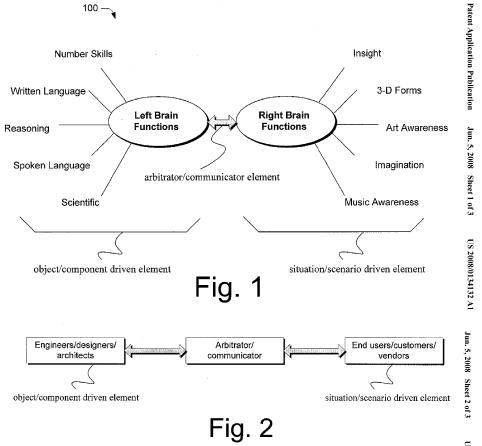
theodp writes "With its just-published patent application for Developing Software Components Based on Brain Lateralization, Microsoft provides yet another example of just how broken the patent system is. Microsoft argues that its 'invention' of having a Program Manager act as an arbitrator/communicator between a group of right-brained software users and left-brained software developers mimics 'the way that the brain communicates between its two distinct hemispheres.' One of the 'inventors' is Ray Ozzie's Technical Strategist. If granted, the patent could be used to exclude others from making, using, or selling the 'invention' for 17 years."
173 comments

  1. BOFH by AnotherBrian · · Score: 4, Funny

    So they just patented the concept of a manager. I really hope Microsoft enforces this one.

    1. Re:BOFH by Brian+Gordon · · Score: 1

      They're probably the only tech company who still uses it anyway. Or if they're not they should be. Let MS have it.

    2. Re:BOFH by Divebus · · Score: 1

      Ray Ozzie gets paid how much to do WHAT???

      --

      Most of the stuff on /. won't survive first contact with facts.
    3. Re:BOFH by l0cust · · Score: 2, Funny

      Hey! Continue ffs! I have tissues ready and who cares about some microsoft patents anyway..

      --
      Politicians and Pedophiles: Two groups of exploitive bastards who are most dangerous when they're thinking of children.
    4. Re:BOFH by Anonymous Coward · · Score: 0

      You can download this and other patents for free in PDF format from Patent Retriever - http://www.patentretriever.com/

  2. You say that as if it's a bad thing by JonTurner · · Score: 5, Funny

    If granted, the patent could be used to exclude others from making, using, or selling the 'invention' for 17 years
    Not sure I understand your point of view on this one. I consider any legal device that prohibits selling software like Microsoft's to be worthy of praise.
    1. Re:You say that as if it's a bad thing by moderatorrater · · Score: 5, Insightful

      Usually it's not the concept of Microsoft's software that's all that bad, it's the specific implementation. This makes sure that their implementation is always the only one out there.

      Also, patenting something based on the brain is ridiculous. Might as well patent "bi pedal motion", sue everyone in the world and get it over with.

    2. Re:You say that as if it's a bad thing by AsmCoder8088 · · Score: 5, Funny

      ...Might as well patent "bi pedal motion", sue everyone in the world and get it over with.

      Except that would only affect people with two legs, not everyone.

    3. Re:You say that as if it's a bad thing by arotenbe · · Score: 2, Funny

      ...Might as well patent "bi pedal motion", sue everyone in the world and get it over with. Except that would only affect people with two legs, not everyone. Yeah, people could avoid being sued by crawling around all day instead of walking.
      --
      Tomato wedge sperm darts that are Republican.
    4. Re:You say that as if it's a bad thing by NoobixCube · · Score: 2, Informative

      Won't be the only one out there, since software patents are only enforceable in a few countries. Someone in Europe will distribute a decent implementation of it.

      --
      Admit it. You post strawman arguments as AC so you get modded Insightful for refuting them, rather than Troll
    5. Re:You say that as if it's a bad thing by tepples · · Score: 1

      Someone in Europe will distribute a decent implementation of it. And then the server logs will get subpoenaed so that Microsoft can sue anyone with a U.S. IP address who downloads the implementation.
    6. Re:You say that as if it's a bad thing by ozmanjusri · · Score: 1
      Usually it's not the concept of Microsoft's software that's all that bad, it's the specific implementation.

      The concept is normally "borrowed" from someone else.

      It's only the implementation that's their own.

      --
      "I've got more toys than Teruhisa Kitahara."
    7. Re:You say that as if it's a bad thing by PopeRatzo · · Score: 3, Insightful

      But if it "mimics the way the brain works" isn't that evidence of prior art?

      I don't understand the world.

      --
      You are welcome on my lawn.
    8. Re:You say that as if it's a bad thing by MyDixieWrecked · · Score: 2, Insightful

      This makes sure that their implementation is always the only one out there.

      This is exactly how the patent system is broken. Patents on physical inventions leave room for competitors to invent their own version of the item, although the new inventor must create their own implementation that is sufficiently different. Patents on ideas and many business processes, especially this patent, are ridiculous. How can you patent a way of coming up with what software to right?

      And how exactly is this different from SOA (Service Oriented Architecture) in the software world? I mean, you have one system that processes some set of data and then, after making it into a new pre-defined data structure (e.g. XML), it pushes it into another system which performs some other method of processing on it and then can return the results into a final service that takes that data and persists the information in a database.

      The arbitrator/communicator element is essentially the primary orchestration element in SOA. The object/component driven element is essentially the portion that passes datastructures (XML) between systems. The situation/scenario driven element is just like the SOA as a whole when using choreography over orchestration.

      Also, as other people have mentioned in other posts, it does feel like this is a patent on having levels of management. This is especially like the feel of a Graphics/PrePress shop where the salespeople interact with the clients, pass on job tickets to the manager of the prepress department who then checks over the tickets and distributes work to the worker bees.

      --


      ...spike
      Ewwwwww, coconut...
    9. Re:You say that as if it's a bad thing by Zarf · · Score: 1

      But if it "mimics the way the brain works" isn't that evidence of prior art?

      I don't understand the world. It's only prior art if the prior artist can hire a lawyer.
      --
      [signature]
    10. Re:You say that as if it's a bad thing by Anonymous Coward · · Score: 0

      Welcome to America, center of the universe.

    11. Re:You say that as if it's a bad thing by Flywheel · · Score: 1

      It's only the implementation that's their own. Well often they go shopping instead of implementing it themselves - and usually they screw up, what used to be a perfectly good product.
      --
      Live long and prosper...
  3. it's ok they are all going on the B-Ark by RichMan · · Score: 1

    So are we putting prolific useless patent filers on the B-Ark along with those with their brains stuck somewhere between right and left?

    1. Re:it's ok they are all going on the B-Ark by simcop2387 · · Score: 2, Informative

      you misunderstood, as sad as it is, we're all descendants of the people from the B-Ark, we don't get to send one out

    2. Re:it's ok they are all going on the B-Ark by PopeRatzo · · Score: 1

      Speak for yourself!

      --
      You are welcome on my lawn.
  4. The patent office - retarding development? by TRAyres · · Score: 5, Interesting
    Essentially what this does is retard the development of obvious software for 17 years.

    I wonder if I can get a patent on a 'for' loop and then declare all software that uses it to be violating my patent?

    Fucking ridiculous.

    Only in America.

    1. Re:The patent office - retarding development? by ScrewMaster · · Score: 4, Insightful

      Only in America.

      Not hardly. The madness is spreading.

      --
      The higher the technology, the sharper that two-edged sword.
    2. Re:The patent office - retarding development? by Concerned+Onlooker · · Score: 1

      The key word here being "retard."

      --
      http://www.rootstrikers.org/
    3. Re:The patent office - retarding development? by iknowcss · · Score: 5, Interesting
      This is not a troll. Please realize that as you are reading my post.

      It is clear the system is broken, but of all the comments I've ever read on slashdot (as infrequently as that may be) what is the solution? I mean you can't just throw out the thing all together. Having no patenting system would make the whole market far too volatile. If you could start over and rebuild the whole thing, what would you do?

      My first thoughts where along the lines of something like:
      • Company 1 comes up with idea and puts a "patent hold" on it. No one else can find out about it.
      • Company 2 comes up with the same / similar idea and puts its own "patent hold" on it. Again, no one finds out.
      • Company 1 finishes its product and takes it to market. Company 2 is informed.
      • Companies 1 and 2 are given patents on the idea. No more companies may put a "hold" on the patent.
      • Company 1 and 2 battle it out, creating competition, but with some market stability.
      This way, no one company can sit on it. If they want to do something about what they've come up with, they can't just sit on it. They actually have to act on it, and to minimize their competition, they need to develop it as quickly as possible, effectively incentivising progress.
      --
      Life is rarely fair. Cherish the moments when there is a right answer.
    4. Re:The patent office - retarding development? by something_wicked_thi · · Score: 4, Funny

      > Cheap +5 Insightful: just say "All Americans suck because {insert generalization here}"

      All Americans suck because all generalizations are false.

    5. Re:The patent office - retarding development? by Shai-kun · · Score: 4, Insightful

      First of all we should get rid of software patents. They are ridiculous, like patents on math.

      --
      ...or so I've been told.
    6. Re:The patent office - retarding development? by Splab · · Score: 1, Insightful

      No!

      Patents on non obvious algorithms and Math are very valid and do give a great deal of advantage (plus it keeps a line of jobs for the true geeks). Patents on simple concepts however should be forbidden (not just for software)

    7. Re:The patent office - retarding development? by Anonymous Coward · · Score: 0

      Fails.

      Either the patent office is required to judge non-trivial implementations of the patent, or acquiring the non-hold-patent just requires whipping up a really quick tech demo.

      Also requires Trade Secret-like restrictions on people knowing about Company 1's work leaking it to Company 2.

      The easy solution is simple: Patents would cover only knowledge gained from examination of the patent or something implementing the patented technique. Think infectious Copyright... Want a legal reimplementation? Better clean-room it.

    8. Re:The patent office - retarding development? by giafly · · Score: 4, Interesting

      The patent system only makes any sense for protecting inventions. The problem with IT patents - and I've read a lot - is that 99% of them are bleeding obvious. So there's no problem with others finding out about them. Unless, as in this case, the patent is pseudo-scientific twaddle, in which case who cares?

      If you're serious, how about replacing the current invention standard for new patents by a jury of software programmers who are presented with the problem and asked to design a solution. If any of them gets close to any "invention" in the would-be patent, it's "obvious" and fails.

      --
      Reduce, reuse, cycle
    9. Re:The patent office - retarding development? by Anonymous Coward · · Score: 4, Insightful

      *Ahem.*

      "True geeks" are interested in ideas for their own sake; money---although a certain amount is necessary for survival, and a bit more is desirable for comfort & security---is a secondary concern. And it's obvious you know absolutely nothing about mathematical culture if you would seriously consider the notion of patenting a theory or its proof; mathematicians, perhaps more than anyone else, understand the wisdom of Ben Franklin's words: "As we enjoy great advantages from the inventions of others, we should be glad of an opportunity to serve others by any invention of ours; and this we should do freely and generously."

      +3 Insightful? WTF?

    10. Re:The patent office - retarding development? by hvm2hvm · · Score: 1

      That would be perfect if you could decide which patent ideas are trivial and which are not. In the end this delimitation cannot be made objectively because everybody has a different way of thinking.

      In the past there were no patents and science was going better. Sure, all the major accomplishments were credited to anyone else but the inventor.

      This, however, gives an interesting side-effect: when people created they knew there are little chances of getting rich from it, so they did it because they wanted to do it. It's different than all the patent trolls these days that rush to make something patent worthy for some quick bucks.

      --
      ics
    11. Re:The patent office - retarding development? by gnupun · · Score: 0

      Agreed. Patents are needed if programmers want to keep their jobs and prevent competitors from stealing their ideas and future income. However, trivial patents should not be allowed -- legally, a patent must be non-obvious before it is accepted.

    12. Re:The patent office - retarding development? by Znork · · Score: 1, Interesting

      I mean you can't just throw out the thing all together.

      Yes you can.

      Having no patenting system would make the whole market far too volatile.

      According to...? As demonstrated by...? Which would be bad because...?

      The whole software industry has shown over the last 30 years that patents aren't at all necessary for development; in fact they've rather indicated patents slow down progress. The free software movement is in the middle of demonstrating you don't even need copyright to encourage development.

      It's becoming fairly obvious that technological and innovative development is driven by need, necessity, competition and information accessibility. As a thought experiment; lock a smart innovator in a basement for ten years. What do you think he'll have invented when he comes out? Personally I'll bet most of the time it'll be something 9 years and six month out of date, independently invented five times in the first year and completely irrelevant to the world ten years later.

      A single innovative mind, or a single development group simply has no chance to beat a million monkeys banging away on their keyboards, as long as the monkey build on each others advances.

      If you could start over and rebuild the whole thing, what would you do?

      Rebuild it from scratch with the actual purpose in mind. The single most usable feature about the patent system is disclosure. The single most damaging feature is the monopoly nature. So at the very least have those two in mind as fundamental aspects that cannot be compromised.

      So to describe one possible example the same way you did:

      * Inventor A comes up with an idea and registers it. Now anyone can read about it.
      * Company B reads about the idea which solves a problem they're having. They start using it. They register their usage of the active patent and indicate the approximate savings/revenue/units sold derived from the patent.
      * Patent office pays Inventor A appropriate remuneration
      * Company C reads about the same idea, expands the idea, registers the expansion, and starts using it, again registering the approximate savings and revenue derived from the A part.
      * Patent office pays Inventor A appropriate remuneration
      * Company B reads about the expansion, incorporates the expansion, register their further use.
      * Patent office pays Inventor A and Company C appropriate remuneration
      * Etc.

      There are several possible objections to this; paperwork and difficulty to assess revenue derived from a specific part. Compare with todays system; today you can either get a) a license from the patent holder which may very well be the same paperwork plus the cost or b) get sued. Which is a whole lot more cost and paperwork. And which may end up with you not being able to use the invention at all. Compared to the usual tax reports this would be a minor reporting issue.

      Another objection would be the financing; first, the financing today may seem 'free', but the fact is it's exacted from the economy as a whole as a form of taxation on 'new' products, with licensing costs baked into the end price (in the best case. In the worst case we're paying by products not getting to the market at all). So we're paying in everything from high medical insurance costs to expensive environmentally improved technology.

      Financing of a innovation incentive system could be done in any of a number of ways; personally I'd prefer one that didn't penalize things we might actually want rapidly adopted like more efficient medicines or more energy efficient technology. A flat sales tax on the appropriate industry segment might be appropriate. Initially it could even be tuned to approximate current expenditure on patent licenses in the field to ease transition.

      Third would be the remuneration process; once you have an actual budget and an actual goal it becomes much easier to maximize the benefit of the funds available. Today nobody is responsible for the budget so we get the patent office granting p

    13. Re:The patent office - retarding development? by Inoen · · Score: 3, Insightful

      Unlike copyright, patents don't exist in order to protect inventors. They exist to encourage inventors to publish their inventions rather than keep them as trade secrets.
      A book (which is what the first copyright systems covered) is not very useful for the author unless it is published.
      Inventions on the other hand can (in many cases) be useful even if kept secret. This is why patents were invented - and why publishing is part of the patenting process.

    14. Re:The patent office - retarding development? by ultranova · · Score: 4, Insightful

      Patents on non obvious algorithms and Math are very valid and do give a great deal of advantage (plus it keeps a line of jobs for the true geeks).

      Every mathemathical truth is obvious, since it follows from the postulates. And every algorithm is obvious in hindsight.

      Patents on simple concepts however should be forbidden (not just for software)

      Simple to whom ? The patent examiner, who gets to read the obfuscated patent claim ?

      --

      Forget magic. Any technology distinguishable from divine power is insufficiently advanced.

    15. Re:The patent office - retarding development? by Ruie · · Score: 1

      Having no patenting system would make the whole market far too volatile. If you could start over and rebuild the whole thing, what would you do?

      The problem with patent system is that it tries to reward the invention before its worth has been proven and, on top of that, does it with granting specific legal rights (to exclude others) which is not a liquid tradable item.

      A much better system would be to grant the applicant a kickback from increases in government taxes that were made possible by the invention/activity.

      This would solve the problem of measuring worth (the applicant would have to prove they increased taxes - this is a much easier task than figuring out whether a gimmick X is worth 20 years patent protection), disentangle inventors and producers (old system was designed for the case when they are the same) and apply to non-patent cases as well (consider education for example).

      You can view this as regularization of existing practice of rewarding companies with tax breaks and grants.

    16. Re:The patent office - retarding development? by monkeythug · · Score: 3, Insightful

      So, just to be clear, you agree that, for example, the inventor of the Quicksort algorithm should have patented it? What about the inventor of the Binary chop search algorithm? Or how about line drawing algorithms such as this one: http://en.wikipedia.org/wiki/Bresenham's_line_algorithm

      All of these algorithms were arguably non-obvious at the time.

      --
      Don't you wish you hadn't wasted 3 seconds of your life reading this sig?
    17. Re:The patent office - retarding development? by PopeRatzo · · Score: 0, Troll

      Having no patenting system would make the whole market far too volatile.
      Why? Are you sure this is so or is this idea so ingrained (like the canard about how higher taxes mean a shrinking economy) that we just accept it as conventional wisdom?

      And as Shai-kun points out below, software patents are patently ridiculous. If we need an entire legal structure just to make sure a certain segment of society can get rich, maybe that's God's way of telling us that software engineers aren't supposed to get rich.

      Wrap your noodles around that for a while.
      --
      You are welcome on my lawn.
    18. Re:The patent office - retarding development? by PopeRatzo · · Score: 2, Insightful

      Patents are needed if programmers want to keep their jobs and prevent competitors from stealing their ideas and future income.
      This is the big lie.

      --
      You are welcome on my lawn.
    19. Re:The patent office - retarding development? by irtza · · Score: 1

      I am SO CONFUSED!

      Is that insightful for the first line or because of the "All Americans suck" line? If only all generalizations weren't false, then Americans wouldn't suck and I would know the reason why!

      --
      When all else fails, try.
    20. Re:The patent office - retarding development? by Anonymous Coward · · Score: 0

      This doesn't address the problem of what can and cannot be patented.

      A major problem with your system is arises in step 1. "Company 1 comes up with idea and puts a "patent hold" on it. No one else can find out about it."

      You cannot currently patent an idea, however the distinction between methods/processes etc. and ideas is being steadily eroded. The patent under discussion here is an example of this.

    21. Re:The patent office - retarding development? by Anonymous Coward · · Score: 0

      There are plenty of inventions which are "bleeding obvious" in hindsight, but didn't exist for some time. It's simple just to say we should only be allowed to patent complicated things, but I'd love to see you come up with a system of classification based on that.

    22. Re:The patent office - retarding development? by stony3k · · Score: 1

      You may want to read G. H. Hardy's "A Mathematician's Apology" for an insight into what drives a mathematician. Hint: it doesn't have much to do with job security.

      --
      Freedom is not worth having if it does not include the freedom to make mistakes. - Mahatma Gandhi
    23. Re:The patent office - retarding development? by dkleinsc · · Score: 1

      Actually, Microsoft beat you to something even more fundamental:
      http://www.theonion.com/content/node/29130
      (hint for the humor-impaired: consider the source)

      --
      I am officially gone from /. Long live http://www.soylentnews.com/
    24. Re:The patent office - retarding development? by Splab · · Score: 0

      No you are talking about hippies.

      You go live of the land while the rest of us pay off our mortgages and put food on the table of our children.

      and right back at you mr. +3 insightful.

    25. Re:The patent office - retarding development? by Anonymous Coward · · Score: 0

      NO!!
      (in the USA):
      Patent laws exclude "laws of nature, natural phenomena, and abstract ideas."

      Machines, man-made products, compositions of matter, and processing methods are patentable.

      Patents do not cover mathematics and mathematical algorithms, though the use of an algorithm in the process otherwise patentable does not prevent the whole from being patented.

      http://cyber.law.harvard.edu/fallsem98/final_papers/Lee.html#4

    26. Re:The patent office - retarding development? by menace3society · · Score: 1

      I agree: differential calculus was the last non-obvious thing mathematicians came up with.

      What's more, there are prizes for things like that. The reward for coming up with new abstract ideas is a whole mess of money and junkets from award-granting institutions. Clay Mathematics Institute Awards, Nobel Prizes, MacArthur Grants, and even cushy research Professorships all serve as a payoff for these kinds of things. You don't need patents on top off that.

    27. Re:The patent office - retarding development? by samkass · · Score: 1

      This is the big lie

      Really? You've never heard anyone say "I wish there was a free version of this software?" I've heard that a LOT, especially on SlashDot. And if companies go and spend lots of money to research and develop something, then the open source community goes and takes the best of it, re-codes and gives it away for free, the company is screwed. I think you'd have a better point if more innovation was coming from open source rather than commercial entities.

      --
      E pluribus unum
    28. Re:The patent office - retarding development? by samkass · · Score: 1

      Why do you make such a huge difference between software and physical objects? Any sufficiently non-obvious construct of human invention deserves a patent in exchange for publishing it to the world instead of keeping it secret. I don't see all that huge a difference between software and physical inventions in this respect.

      The goal is to encourage investment and sharing. Both benefit the industry and society immensely. Personally, I think the tech industry has done pretty darn well in the couple decades since software patents were explicitly legalized.

      --
      E pluribus unum
    29. Re:The patent office - retarding development? by Daniel+Dvorkin · · Score: 3, Insightful

      Microsoft, Oracle, Adobe, and most of the other well-known software companies became successful long before software patents were widespread. The appropriate way to protect software is through copyright, not patent. (As for "business method" patents like the one this story is about, they're not an appropriate subject for any kind of IP protection at all.) The major argument in favor of proprietary software has always been that the profit motive inspires developers to work harder and create better software than those who do it for free. If this is true, then it is the obligation of proprietary software companies to make products that live up to this idea.

      companies go and spend lots of money to research and develop something, then the open source community goes and takes the best of it, re-codes and gives it away for free

      You seem to think this is a trivial process. Trust me, it's not.

      --
      The correlation between ignorance of statistics and using "correlation is not causation" as an argument is close to 1.
    30. Re:The patent office - retarding development? by syukton · · Score: 1

      Who draws the line between simple concepts and non-obvious algorithms? What is obvious to me may not be to you, and what is simple to you may be very complicated for me.

      --
      Reinvent the wheel only at either a lower cost, greater effectiveness, or your own personal enrichment and satisfaction.
    31. Re:The patent office - retarding development? by Zarf · · Score: 1


      Only in America.

      To quote King George III: "They wrote it down? Don't they know they'll be awash in lawyers?"
      --
      [signature]
    32. Re:The patent office - retarding development? by Zarf · · Score: 1

      T
      • Company 1 comes up with idea and puts a "patent hold" on it. No one else can find out about it.
      • Company 2 comes up with the same / similar idea and puts its own "patent hold" on it. Again, no one finds out.
      • Company 1 finishes its product and takes it to market. Company 2 is informed.
      • Companies 1 and 2 are given patents on the idea. No more companies may put a "hold" on the patent.
      • Company 1 and 2 battle it out, creating competition, but with some market stability.
      I like it. Sort of a non-blocking "pre-patent" that isn't finalized until a real product is at market. Sort of like saying there can be no standard without a working implementation... nice.
      --
      [signature]
    33. Re:The patent office - retarding development? by Shai-kun · · Score: 1

      Why isn't copyright enough? All software is automatically copyrighted, you know. Why would we need patents as well?

      --
      ...or so I've been told.
    34. Re:The patent office - retarding development? by e4g4 · · Score: 1

      Ha! That's what he gets for not checking his inputs :P

      --
      The secret to creativity is knowing how to hide your sources. - Albert Einstein
    35. Re:The patent office - retarding development? by SL+Baur · · Score: 1

      My first thoughts where along the lines of something like:

      Company 1 comes up with idea and puts a "patent hold" on it. No one else can find out about it.

      Company 2 comes up with the same / similar idea and puts its own "patent hold" on it. Again, no one finds out.

      Company 1 finishes its product and takes it to market. Company 2 is informed.

      Companies 1 and 2 are given patents on the idea. No more companies may put a "hold" on the patent. And if in the meantime, Joe Hacker comes up with the same idea (after step 1) and publishes a program implementing it under the GPL before either steps 3 or 4?

      The whole model we have now is broken, especially with respect to software. But figure this in too - there are more educated people alive today than have ever existed before. Some stuff may deserve to be patentable, but the bar must be very, very, very high.
    36. Re:The patent office - retarding development? by Anonymous Coward · · Score: 2, Insightful
      The moderators have brought a return to sanity, I see. Really, you had it coming: by definition a geek is someone who values technical knowledge above more mundane things. And money, aside from the aforementioned survival & creature comforts (under which your mortgage and progeny fall), is a very mundane thing compared to knowledge. Do I sound like an idealist? Good. You'll find that most true believers in science are like me. No one's talking about "living of the land" (sic); we're talking about the rock-hard fact that the heart of the scientific enterprise is a free & unfettered exchange of ideas. By all means, use your skills to pay your bills. But don't confuse economic concerns with academic ones.

      If you don't care what Ben Franklin thought, despite the fact that he was Invention Personified, perhaps a more modern inventor's opinion would show you the light. I quote Donald Knuth, greatest living computer scientist:

      "I strongly believe that the recent trend in patenting algorithms is of benefit only to a very small number of attorneys and inventors, while it is seriously harmful to the vast majority of people who want to do useful things with computers ... When I think of the computer programs I require daily to get my own work done, I cannot help but realize that none of them would exist today if software patents had been prevalent in the 1960s and 1970s. Changing the rules now will have the effect of freezing progress at essentially its current level."
      Or, since your ignorance of mathematics leads me to believe that you won't value Prof. Knuth's opinion, perhaps these words from Doom/Quake uber-hacker John Carmack will be more convincing:

      "In the majority of cases in software, patents [affect] independent invention. Get a dozen sharp programmers together, give them all a hard problem to work on, and a bunch of them will come up with solutions that would probably be patentable, and be similar enough that the first programmer to file the patent could sue the others for patent infringement. Why should society reward that? ... The programmer that filed the patent didn't work any harder because a patent might be available, solving the problem was his job and he had to do it anyway. ... Yes, it is a legal tool that may help you against your competitors, but I'll have no part of it. It's basically mugging someone."
      Do you notice a trend? It seems to me that the only pro-patent people, other than lawyers, are those so small that they'd scramble to accrue continual profit from the mere one or two things they'll accomplish in a lifetime (other than buying a house and breeding). Much easier to sit on your ass and collect royalities while simultaneously discouraging innovation, than to continue working for the benefit of the world those munchkins will inherit one day, eh?

      Oh, we idealists! When will we get over our silly notions that life could be more than eating, shitting, fucking, dying, and collecting shiny coins?
    37. Re:The patent office - retarding development? by Anonymous Coward · · Score: 1, Interesting

      Good suggestion. It's a fantastic little book that you can find in any university library. I'd also recommend that anyone interested in this subject read a bit about the various philosophies of mathematics. Wikipedia's article is a good place to begin; Stanford's Encyclopedia of Philosophy is a good (if slightly technical) follow up.

      For me, the crux of the matter of patents & math is as follows. Many mathematicians have leanings towards Platonism, the belief that the objects of study are "real" in some ideal sense. We would no sooner try to patent the discovery of a new truth about these objects than a biologist would try to patent the discovery of a new microorganism! Instead, as with the biologist, the flash of discovery brings only a desire to share our new wonder with the world. Are there those who disagree? Certainly. But even for those who do, the notion of patenting a theory or proof is unthinkable, because mathematics, more than any other science, is about "standing on the shoulders of Giants" (Newton). No one's math exists in a vacuum, and attempting to isolate a theory from future research would only ensure its rapid death from disuse.

    38. Re:The patent office - retarding development? by volpe · · Score: 1

      Every mathemathical truth is obvious, since it follows from the postulates. You mean, like Fermat's Last Theorem?

    39. Re:The patent office - retarding development? by volpe · · Score: 1

      The appropriate way to protect software is through copyright, not patent. This is only true if you honestly believe that the true ingenuity lies not in coming up with a novel algorithm for solving some sophisticated problem, but in performing the undergrad-level task of implementing said algorithm in code.

    40. Re:The patent office - retarding development? by Jimmy_B · · Score: 1

      This is only true if you honestly believe that the true ingenuity lies not in coming up with a novel algorithm for solving some sophisticated problem, but in performing the undergrad-level task of implementing said algorithm in code.
      Sorry to burst your bubble, but there's nothing hard about algorithms. Coding up a large and complicated system, however, is very difficult. I don't care how cool your algorithm is; I care only about the program that contains it. And if the algorithm is patented, then there's only one such program, and it's probably shitty.
    41. Re:The patent office - retarding development? by Isca · · Score: 1

      Ok, so joe nobody comes up with a smart idea, and can only put a "patent hold" on it.

      Joe Nobody isn't a manufacturer, so he has to start shopping his invention around... and now company D who happened to hear about the presentation gave to Company C puts a "patent hold" on, along with companies g-Zz.

      Someone actually goes through the 2 years to engineer the product completely first, but within months someone else releases their version protected by the "patent hold".

      Now the original inventor has to fight in the courts saying "hey, they never actually came up with their own idea, they heard about it when I was trying to demonstrate it to Company A over here... And I just know some employee told this person blah blah blah....

      What sort of nightmare is that?

      No, the real solution is to look at what can be patented again. I think it's the whole obviousness test. If the method they are pattening is just a standard practice moved to a new medium without any specific new process, don't patent it. If it's an obvious extension onto an existing issue, like a new slightly changed formulation of an existing drug (like changing the dosage, for example) don't allow a patent. The patent system worked for nearly 200 years. It's only in the past 20 years that things really gone south. It's not perfect, but it's better than most anything else.

    42. Re:The patent office - retarding development? by H*(BZ_2)-Module · · Score: 1

      That is what drove a mathematician. Hardy is certainly not representative of your typical modern day mathematician. You should still read his book.

    43. Re:The patent office - retarding development? by volpe · · Score: 1

      Utter nonsense (and my bubble is intact, thank you very much). First, the statement that "there's nothing hard about algorithms", is inane merely by virtue of making such a generalization about all algorithms, as if all problems are equally hard to solve. Second, some algorithms are not at all obvious. Open a book sometime and look up the algorithms for certain concurrency primitives, or complicated data structures like red-black trees. Third, while coding up large and complicated systems is certainly labor-intensive, it's not innovative. Fourth, the fact that you don't care how cool an algorithm is shows that you've never had to solve a problem that someone else didn't already solve, because taking someone else's algorithm and translating it from pseudo-code to your favorite programming language is usually a fairly mechanical process. Thus, you haven't developed an appreciation for the problem-solving process. Fifth, the number of implementations that exist, or may exist, for a given algorithm, is not at all dictated by whether or not the algorithm is patented. Nor is the quality of the implementation(s). That's just a complete non-sequitur.

      Nice troll, though. Well done.

    44. Re:The patent office - retarding development? by Jimmy_B · · Score: 1

      Nice ad hominem, but you're talking nonsense yourself. You say that "the number of implementations that exist, or may exist, for a given algorithm, is not at all dictated by whether or not the algorithm is patented"; this is obviously false, because if an algorithm is patented, it is illegal for anyone but the patent holder to implement it. Of course patented algorithms have fewer implementations; that's the whole point of patenting it in the first place! Fewer implementations mean less competition which means lower quality. This is my thesis, and you haven't actually argued against it.

      The relative difficulty of algorithm design vs. implementation isn't really relevant, but writing software is not a matter of translating pseudocode. A typical program has one or two complex algorithms couched in thousands of trivial ones, and the few complex algorithms usually aren't what determines its quality. (And don't presume to know what my background is; I've designed and implemented plenty of original algorithms, plus both of the algorithms you used as examples.)

    45. Re:The patent office - retarding development? by volpe · · Score: 1

      There was no ad hominem in my reply.

      My allegedly false statement was not false. It's not illegal for people other than the patent holder to implement patented algorithms if said people license the algorithm from the patent holder, which happens all the time.

      Certainly, there are likely to be fewer implementations of an algorithm if an algorithm is patented. You said there was only one. Furthermore, your "thesis" is a non sequitur as well. Increasing the number of implementations of a given algorithm doesn't mean the subsequent implementations are higher quality than the first. Knock-offs in other areas are often lower quality than the original.

      As for what's relevant, the relative difficulty of algorithm design versus implementation is precisly what we're talking about, and it's what you commented on.

      I agree with you that writing software is not a matter of translating pseudocode, but implementing an algorithm basically is. I also agree with you about how much of a typical software system is comprised of complex algorithms. And I agree with you that the complex algorithms aren't what determines its *quality*, but they may very well be the entire purpose of the program.

      I won't presume to know what your background is, but I believe your self-assessment of your background is somewhat incongruous with silly blanket statements like "there's nothing hard about algorithms" and blatently false statements about the legality of plural implementations of a patented algorithm.

  5. I thought so ... by mmarlett · · Score: 1

    I thought Microsoft would do this, but I didn't think to patent it first. Crap. Just thinking that I probably owe it money now.

  6. Maybe... by MrKaos · · Score: 5, Funny

    The left brain doesn't know what the right brain is doing at Microsoft.

    --
    My ism, it's full of beliefs.
    1. Re:Maybe... by SlashWombat · · Score: 1

      Their next patent is: How to manage staff that appear to be brain dead.

      Looking like Microsoft Managers need something like that right now! They certainly appear to need something like that in the legal division. (I shudder when I imagine what a M$ "think tank" might look like.)

    2. Re:Maybe... by ELTaNiN · · Score: 1

      The left brain doesn't even know what itself is doing at Microsoft!!!

    3. Re:Maybe... by garlicbready · · Score: 1

      more to the point how this will affect split brain DNS?

    4. Re:Maybe... by ultranova · · Score: 1

      Their next patent is: How to manage staff that appear to be brain dead.

      Have an evil cleric rebuke them until they are commanded ? Microsoft Managers should be able to use half their manager level for that...

      --

      Forget magic. Any technology distinguishable from divine power is insufficiently advanced.

  7. prior art .... by taniwha · · Score: 2, Interesting

    it's called the videogame business ....

    1. Re:prior art .... by story645 · · Score: 1

      Forget that-it's called life.

      --
      open source modern art: laser taggi
  8. How telling, and how sad by Eternal+Vigilance · · Score: 4, Funny

    How sad that Microsoft considers metric-driven software development that connects users and developers a new invention. :-(

    "At Microsoft, these two halves of the brain come together in the colon."

    1. Re:How telling, and how sad by zappepcs · · Score: 1

      It's sad that you can't be modded +7, Funny AND Insightful

    2. Re:How telling, and how sad by YttriumOxide · · Score: 2, Interesting

      It's offtopic, but I actually agree fully... I'd love to see Slashdot's moderation system go to much higher numbers, and a few more mod points (but not too many more) be given out. e.g. Go to 15 instead of 5 as a maximum, and give out roughly twice as many mod points as currently. That way, each individual act of moderation has about 1/3 the value that it used to, but more people are given a "voice" in valuing posts.

      It would also allow for finer grained modifiers - I currently have Friends and Fans at +1, but under the system I propose here, I'd put fans at +1 and friends at +3.

      --
      My book about LSD and Self-Discovery
      Also on facebook as: DroppingAcidDaleBewan
    3. Re:How telling, and how sad by Zarf · · Score: 3, Insightful

      It's offtopic, but I actually agree fully... I'd love to see Slashdot's moderation system go to much higher numbers, and a few more mod points (but not too many more) be given out. e.g. Go to 15 instead of 5 as a maximum, and give out roughly twice as many mod points as currently. That way, each individual act of moderation has about 1/3 the value that it used to, but more people are given a "voice" in valuing posts.

      It would also allow for finer grained modifiers - I currently have Friends and Fans at +1, but under the system I propose here, I'd put fans at +1 and friends at +3.

      How about additional dimensions? +5 funny, +3 insightful, +7 interesting, -1 off topic, 0 overrated, -3 troll

      The result could be plotted on a 3D graph attached to each comment.
      --
      [signature]
    4. Re:How telling, and how sad by YttriumOxide · · Score: 1

      3D graph might be going a bit overboard - I prefer the UI to be "clean"... but the idea is basically there - under the system I was thinking, the post you describe would be a +11 in total, and the various moderations could be seen in the usual way when you get the detail of it.

      A further improvement could be that people's modifiers for type (e.g. +1 interesting, -1 funny etc) would only apply to those moderations that actually occurred. So, if a post had the moderations you give, and I down-valued "insightful" by 5 (for some unknown reason), it would still only lose 3 points since there are only 3 points worth of insightful to lose.

      Another idea would be for the personal type modifiers to be a percentage instead (and also able to "break the limit"), so if I assigned 300% to insightful, the post above would be +11, but to me would appear as +17 since I'm triple-counting insightfuls.

      --
      My book about LSD and Self-Discovery
      Also on facebook as: DroppingAcidDaleBewan
    5. Re:How telling, and how sad by zappepcs · · Score: 1

      I like that. It would be nice to be able to filter for only posts that are higher than some value, and/or modded in some category. For instance, let me filter for posts that are either > +7 or modded as funny/insightful. I'd like the 'also show post it is responding to' option as well in order to keep the context of the post at hand.

      Then I could read only those posts that I want when I've not got tons of time to read everything.

      Since we did go a bit off topic, I'd also like to see each thread's links. Say someone asks about something that causes posters to post 43 URLs of further information. I'd like to see those links herded onto a page by themselves (kind of like moderation is now) where I can use them without scrolling through all the comments. That is one of the important reasons for using slashdot and news aggregation sites. To find the knock on information that others have found useful without having to index the Internet on my own servers out in the garage... DOH!

    6. Re:How telling, and how sad by Repton · · Score: 1

      Yeah --- and then when you create your account here, you define your own projection down to one dimension so you can still sort threads!

      --
      Repton.
      They say that only an experienced wizard can do the tengu shuffle.
    7. Re:How telling, and how sad by Zarf · · Score: 1

      Yeah --- and then when you create your account here, you define your own projection down to one dimension so you can still sort threads!

      See! simple, easy, and to the point. Just make sure it's disruptive and keeps people from having a community experience.
      --
      [signature]
  9. Ugh by Foobar+of+Borg · · Score: 4, Insightful

    1) This is only an application. Any dumbass can file an application so long as he pays the fees.
    2) The poster doesn't even know how long patents last, let alone anything relating to what is *actually* wrong with the patent system.
    Just my two eurocents (since they hold their value better).

    1. Re:Ugh by Anonymous Coward · · Score: 1, Insightful

      The problem is what seems to be the big rubber stamp at the other end of the patent application. And, I strongly suspect any actual attempt to remove that rubber stamp would succeed in only getting it's utility removed from the small fry, and a few minor examples for the press releases. The fat cats will still have it. And, we will still have this problem.

    2. Re:Ugh by smaddox · · Score: 1

      Wow... You just insulted our entire economy...

      Harsh.. Just harsh...

      I find it odd that you claim the poster doesn't know how long patents last, yet you give no correction.

      On the topic of what is *actually* wrong with the patent system, I don't think it is the issues people on /. would lead you to believe.

      I believe the problem with the patent system is that their one goal should be to advance the state of the art. The monopoly is simple a means to the end. By offering a monopoly on the technology, you persuade people to publish the patent, and make the technology well known. The solution?

      Patents should be written in plain language, or at least require a section of them to be written thusly, so that people interested in using the technology can do so without studying law for 4 years. They should be written like a scientific paper - the sole goal of which is to communicate how to apply the method or process.

      As soon as a patent is submitted, it should immediately be available for the public to read it (not a year or two later).

      In order for a company to be able to renew a patent, it should have passed a number of requirements, including having released a working implementation of the method or process, or having licensed the technology to another company who has done so. If they fail these requirements, the patent would expire after 5 years (or some applicable length of time).

    3. Re:Ugh by Foobar+of+Borg · · Score: 1

      I find it odd that you claim the poster doesn't know how long patents last, yet you give no correction.
      That's because it is incredibly easy to find out (20 years from filing date (or from the priority date if it is a continuation or divisional application) since you apparently don't know yourself).

      On the topic of what is *actually* wrong with the patent system, I don't think it is the issues people on /. would lead you to believe.
      Well, that wins you a promotion to Brigadier General Obvious. You would get better information by discussing sex and dating on slashdot, rather than patents.
  10. Weebles wobble but they don't fall down by tepples · · Score: 1

    Yeah, people could avoid being sued by crawling around all day instead of walking. Doesn't stop this guy or these girls the woman in this video and this video.
  11. Wrong title by gmuslera · · Score: 5, Funny

    Microsoft should seek patent on brain-damaged development. At least with that one they will have the monopoly on prior art.

  12. Testing the limits? by TheNucleon · · Score: 4, Interesting

    I read some of the patent application. It's the standard format, but the subject matter is remarkable. I can only think that Microsoft is testing what they can get away with at the USPTO.

    If I had the money, I would patent the placement of pineapple on pizza in adjacent hexagonal cells to reduce juice runoff. I would have diagrams. It is novel, non-obvious, and I doubt there is prior art. Then we'd see if the folks in the USPTO are even reading these things.

    As a (small) stockholder of MSFT, I have to wonder, don't they have better things to do?

    --
    My comments are my own, and do not represent the views of my employer, my spouse, my children, or my cats.
    1. Re:Testing the limits? by Anonymous Coward · · Score: 1, Insightful

      It is novel, non-obvious Sphere packing is well studied. In fact, your particular method is colloquially known as orange packing, after a different fruit.
    2. Re:Testing the limits? by Anonymous Coward · · Score: 0

      Are you referring to "juice runoff" from when the pizza is sliced, i.e. ensuring that each piece of pineapple is some minimal distance from its slice's edges?

    3. Re:Testing the limits? by JAlexoi · · Score: 1

      >I would patent the placement of pineapple on pizza

      Oh, I wish that someone would patent the pizza in US, and forbid any PINEAPPLE topping pizza...
      Probably force US pizza makers to bake the real stuff...
      Not the heart attack pill.

  13. Real People by sugarmotor · · Score: 2, Interesting

    I find it remarkable that real people put their names to stuff like this.

    Anybody here know someone personally with a silly corporate patent like this one? Do they believe in their "work"?

    Stephan
    --
    http://stephan.sugarmotor.org
    1. Re:Real People by Anonymous Coward · · Score: 0

      I personally have lots of patents like this. I do not believe in software patents. I am however very loyal to my employer, and if they want to file patent applications on all my novel ideas then please, by all means, do so. I expect the current patent system to be changed within two years anyway.

    2. Re:Real People by Anonymous Coward · · Score: 0

      I personally have lots of patents like this. I do not believe in software patents. I am however very loyal to my employer, and if they want to file patent applications on all my novel ideas then please, by all means, do so. I expect the current patent system to be changed within two years anyway.
      Congratulations: you are officially Part Of The Problem(tm).

      I personally have denounced lots of Jews to the authorities. I do not believe in the Final Solution. I am however very loyal to the Nazi party, and if they want to gas all the Jews I identify then please, by all means, do so. I expect the Third Reich to fall to the Allies within two years anyway.

      (Oops, Godwin strikes again. Darn, you win.)
    3. Re:Real People by MrMr · · Score: 1

      Well, obviously the people at Microsoft Corporate thought that 'using your brain' was a completely novel and non-obvious idea worth being protected commercially.
      Says it all really.

  14. Metric? by tepples · · Score: 1

    How sad that Microsoft considers metric-driven software development that connects users and developers a new invention. :-( You say "metric-driven". Does this make inch-pound-driven software exempt from this patent? ;-)
    1. Re:Metric? by Eternal+Vigilance · · Score: 2, Funny

      Well, it certainly confirms their usual methodology is to just pound it out. ;-)

      "I'm nearly two kilometers tall."

  15. File + 20 vs. grant + 17 by tepples · · Score: 4, Informative

    The poster doesn't even know how long patents last A patent is renewable up to a total of twenty years after the day it was filed. The commonly quoted figure of 17 years after issue used to be law, but it is still reasonable because because it takes close to three years for a patent application to get through the patent office.
  16. You're not licesed to user your brain? by Anonymous Coward · · Score: 0

    So do I get this right? Unless we pay license fees, we're no longer authorized to use our brains because M$ got a patent on synchronizing brain hemispheres?

    1. Re:You're not licesed to user your brain? by Anonymous Coward · · Score: 0

      Unless we pay license fees, we're no longer authorized to use our brains because M$ got a patent on synchronizing brain hemispheres?
      Yeah! So pay your $699 license fee you cock-smoking tea-baggers!
  17. Microsoft Seeks Patent On Brain-Based Development by hidannik · · Score: 2, Funny

    ...which is a significant improvement over our established posterior-based development process.

  18. This must be patentable... by Genda · · Score: 2, Funny

    I think anyone who reads the article can plainly see that Microsoft has apparently invented a nearly perfect process for blowing their smoke up someones else's ass... I believe this makes them the proud inventors of the remote smoked ham... Bravo Gentlemen!

  19. When they market it... by icebike · · Score: 1, Funny

    Will it finally mean you can have a meaningful conversation with a Mac user which does not include chanting the mantra about how easy the Mac is to use because it only has one button on the mouse?

    --
    Sig Battery depleted. Reverting to safe mode.
  20. Two degrees of separation... by fahrbot-bot · · Score: 4, Funny
    invention ... mimics 'the way that the brain communicates between its two distinct hemispheres'

    Microsoft can pry my Corpus Callosum from my cold, dead brain. I think either God can claim or Darwin can demonstrate some sort of prior art here. Just need to schedule a court appearance for one of them...

    --
    It must have been something you assimilated. . . .
    1. Re:Two degrees of separation... by Anonymous Coward · · Score: 0

      The hell with that. Last thing we need is for MS to win that court cause because of a no-show.

    2. Re:Two degrees of separation... by calidoscope · · Score: 1

      Microsoft can pry my Corpus Callosum from my cold, dead brain.


      At first I read that as Corpus Cavernosa (saw that an article earlier today was submitted by a user with that nick - must be a dick). Then again, it might be that a typical MS manager has a corpus cavernosa where his/her corpus collosum should be.

      --
      A Shadeless room is a brighter room.
  21. Does the movie "Office Space" count as prior art? by jbeach · · Score: 1

    "Well I have to take the customers specs to the engineers...well I don't actually do it myself I either have my secretary do it --or it gets faxed directly to them. "LOOK--I'M A PEOPLE PERSON DAMMIT! I HAVE PEOPLE SKILLS! WHAT THE HELL IS WRONG WITH YOU PEOPLE!"

    --
    The Invisible Hand of the Free Market is what punches workers in the nuts.
  22. April Fools Joke by darkonc · · Score: 1
    It was actually posted on April 1, and it simply took this long to be processed and publicly posted.

    The reason why it's listed as having been filed on November 6 is that whomever filed it forgot to turn of the auto-predating feature. (Yeah, I know it's illegal, but we're talking about Microsoft, here).

    --
    Sometimes boldness is in fashion. Sometimes only the brave will be bold.
  23. Patent fees by imneverwrong · · Score: 1

    Perhaps to prevent proliferation of patent applications like this that just waste the examiners time, the patent system could charge fees that start at the marginal cost of examining a patent (e.g. $500), and then double after every n-th patent. That way Microsoft/Bigcorps who hold tens of thousands of patents will at least have to choose which applications to submit, and allows for a properly funded patents office. Who can then turn down applications like this one.

    1. Re:Patent fees by story645 · · Score: 1

      It costs something like $5,000-$10,000 to prep a patent, once legal fees are thrown in; a patent pricing scale is trivial in comparison.

      I'm still wondering how someone in legal vetted it- this doesn't seem remotely patentable as it's not a process, invention, or even an idea. It's just a person acting as go between, which yeah, has been around since the beginning or time or at least since civilizations started having brokers between their artisan classes and the buyers of such goods.

      --
      open source modern art: laser taggi
  24. Comment removed by account_deleted · · Score: 3, Interesting

    Comment removed based on user account deletion

  25. Let them patent it, and enforce the patent by melted · · Score: 5, Interesting

    The concept of program manager is the single most fucked up aspect of Microsoft culture, IMO. Basically, the assumption is that developers can not, on a fundamental level:

    1. Talk to each other directly
    2. Understand what the customer needs
    3. Deliver software on time

    Anyone with any brain at all sees immediately that all three assumptions are pure bovine excrement, but there's a large layer of well entrenched PM's at Microsoft, up to about 30% of each product team. 95% of these folks do absolutely nothing but (mis)communicate, hold meetings, "manage releases" (whatever the heck that means) and manage up. The remaining 5% are worth their weight in rare earth metals, but they're a tiny minority and they would be better used in a position of authority, like a Project Manager. Program manger has no reports and no authority over either development or test. Oftentimes they have no specialized education and no area expertise. They are randomly assigned to "areas" and told to "spec them out". Most of them even have to design UI, despite not having any usability or UI design experience (I'm sure that explains a lot). So they throw together a primitive spec, and the developer (who is typically an area expert) then spends a lot of time trying to politely explain how big a pile of flaming poo their spec is and why certain things need to be done differently to be even possible.

    The worst part is, PM role is typically considered something of a fast track to management. So you end up with a lot of people who have not a slightest idea what they're talking about making strategic decisions.

    So I say, let them have it. The rest of the world will just assume that their developers and testers have a brain. Seems to be a pretty safe assumption to make, most of the time.

    1. Re:Let them patent it, and enforce the patent by Anonymous Coward · · Score: 0

      Very true, I work there too :)

      On top of that our CEO is the most bitter, vindictive bad tempered CEO you ever could have.

    2. Re:Let them patent it, and enforce the patent by FreudianNightmare · · Score: 1

      ...developers can not, on a fundamental level: 1. Talk to each other directly 2. Understand what the customer needs 3. Deliver software on time . To be fair though, this does sound about right to me. And I speak as a developer here. Of course, this doesn't mean problem solved, since I would (turn and turn about) assume that management, of nearly every stripe can't:

      1: Talk to the customer without unrealistically inflating their expectations and WON'T talk to the developers to see if what they just promised is even possible.
      2: Understand what the customer might be able to get for a given amount of cash and time.
      3) Deliver software on time.

      I call it the 'Yes, but I've told the customer it will shoot lasers' syndrome.*

      Either way, the concept of Program Manager is hardly unique to MS. Sadly.

      *. Sadly, this doesn't work as derogatory if you work in a Laser laboratory.
      --
      'Speak softly and carry a beagle'
    3. Re:Let them patent it, and enforce the patent by Anonymous Coward · · Score: 0

      "I'm going to fucking kill Anonymous Coward!"
      -- Steve Ballmer, seconds before throwing another chair.

    4. Re:Let them patent it, and enforce the patent by atomicxblue · · Score: 1

      This probably explains the one single reason why open source software, after it has been out in the wild for a bit of time, generally produces code of much better quality. As a programmer, I would be completely lost if I did not know exactly what a function is going to do before I called it.

    5. Re:Let them patent it, and enforce the patent by Anonymous Coward · · Score: 0

      ...and manage up. Is that the new 'fsck up'? Because if it is, I like it!
    6. Re:Let them patent it, and enforce the patent by YttriumOxide · · Score: 1

      As a developer, I find I communicate well with other developers I work with; I understand the customer's need quite well (and thankfully they're usually pretty vague, so I have the luxury of fleshing out details myself); and ALWAYS deliver on time.

      My method for achieving the "always deliver on time" result is simply the Scotty method. Never underestimate it.

      --
      My book about LSD and Self-Discovery
      Also on facebook as: DroppingAcidDaleBewan
    7. Re:Let them patent it, and enforce the patent by monsterlemon · · Score: 1

      You seriously think the average developer is capable of #1 and #2?

      If your #1 means "amongst developers" then possibly - I'm not sure there would be an equal amount of listening or understanding going on though. And talking amongst themselves is not relevant to the patent anyway. I can't see why you would bother mentioning it anyway if that was what you meant, as it's the "talking to users" for which the patent suggests using the intermediary. And if you think that your average developer can usefully talk to users... well, remember that "Far Side" cartoon of owners talking to dogs and cats, and what the animals actually hear?

      #2 then. Um, no. Not for anything remotely complex, anyway. Nor for anything that involves any kind of UI (ooh, pretty much "everything" then).

      To be honest, your thinking that developers in general *are* capable of this stuff points at you being one of the ones who can't. Making a few assumptions, but it looks a lot like it (unless you're not a developer at all, or have only ever met really freakishly communicative and understanding ones). The reason I say this is that pretty much every developer I know who actually *is* capable of the kind of communication we're talking about is painfully well aware of how pisspoor most developers are at it.

      Of course, that's not to say that a "Program Manager" will be any better -- if the developers are left-brained and the users right-brained, what does that leave the PM? ;-)

      As for #3, who is?

  26. Karma Bedamned! by rts008 · · Score: 0, Offtopic

    I will shoot myself in the face before I accept MS's ideology.
    I'm happy with Kubuntu 8.04, so GO AWAY MS.
    Check my post history-I gave up on MS's bullshit long ago.

    --
    Down With Slashdot BETA!!! I've been around the corner and seen the oliphant; you can only abuse me from your perspecti
    1. Re:Karma Bedamned! by Anonymous Coward · · Score: 2, Funny

      You have a hotmail email address.

  27. Another patent by suck_burners_rice · · Score: 1

    I heard the CEO has just been awarded patent #093454509485, Method and Apparatus for the Reproduction of Human Life, because that process (now patented) mimics what he wishes could happen every time he logs on to the Internet on a lonely evening.

    --
    McCain/Palin '08. Now THAT's hope and change!
  28. Bwa? by Aphoxema · · Score: 1

    ... I don't understand what the summary said. Please, someone, explain for me.

    --
    "Most people, I think, don't even know what a rootkit is, so why should they care about it?"
    1. Re:Bwa? by Tubal-Cain · · Score: 2, Informative

      They patented managers.

    2. Re:Bwa? by Aphoxema · · Score: 1

      I thought that was already patented!

      --
      "Most people, I think, don't even know what a rootkit is, so why should they care about it?"
  29. PHB must be running MS by rts008 · · Score: 1

    This should not be an issue...Kill it before it breeds!
    Anything else is just excuses
    Quit enabling this shit, otherwise it is your own fault.

    --
    Down With Slashdot BETA!!! I've been around the corner and seen the oliphant; you can only abuse me from your perspecti
    1. Re:PHB must be running MS by awrowe · · Score: 1

      That was almost a haiku! Wish I had mod points.

      --
      A.I. Research. The peculiar science in which we know the question and we know the answer, but can't show the working
  30. The good new is... by jd · · Score: 1

    The application proves they have no brain, which means they have no proof of concept, which may make the patent invalid.

    --
    It's a small world and it smells funny; I'd buy another if it wasn't for the money; Take back what I paid (SoM)
  31. Wait a second... by catdevnull · · Score: 2, Insightful

    I thought the idea of the patent was to protect an invention--the method or design of the apparatus--not an idea. Ideas aren't worth jack; it's the invention that makes the idea come to reality that is the patentable item.

    This is just, excuse the expression, patently absurd.

    --

    I might know what I'm talkin' about, but then again, this is Slashdot...
  32. OH my God!! by LM741N · · Score: 1

    Does this mean that Microsoft owns the rights to my brain now???

  33. On the other hand... by plowfunkel · · Score: 0

    Microsoft applies for patents primarily to defend itself should it become the victim of a frivolous lawsuit. MS isn't a patent hawk, they make nearly all their money from selling software, but they are a constant target of patent lawsuits. Until the patent system is fixed, these defensive patents are completely acceptable.

    1. Re:On the other hand... by Anonymous Coward · · Score: 5, Insightful

      Is Microsoft only a victim?
      Haven't they implied on more than one occasion that Linux is violating X patents?

      That sure doesn't sound like a victim...

    2. Re:On the other hand... by awrowe · · Score: 1

      A patent is supposed to be protective, not defensive. The idea is that a patent allows the holder to exploit his/her idea for a certain amount of time without interference.

      Getting a patent and sitting on it without using it is abhorrent. It is basically saying 'I'm not going to use this idea, but I'm going to make sure no one else can either'. It isn't what the patents system was intended for.

      Defensive patents being perfectly acceptable? What a load of shit. All a defensive patent does is choke the market

      --
      A.I. Research. The peculiar science in which we know the question and we know the answer, but can't show the working
  34. A idea by ozonearchitect · · Score: 3, Funny

    They need to patent their OS releases... it mimics the way a human being takes a dump.

    1. Re:A idea by Spatial · · Score: 1

      *Hurf* There goes service pack three!

  35. I'm patenting the deliberate creation of shyte s/w by presidenteloco · · Score: 2, Insightful

    Business Process and Method:

    By creating bolloxed, over-complex software applications, interfaces, frameworks, and modules, the "wrong-minded" "development organization" thus enables an entire business
    eco-system engaged in the production of "for dummies" manuals, malware detection and security services, and IT support, which is needed to arbitrate between the shyte software, and the "right-brained" users.

    --

    Where are we going and why are we in a handbasket?
  36. Unfortunately you can patent business processes by MichaelCrawford · · Score: 2, Informative
    That's somewhat recent. And just plain wrong, but there it is.

    I think that can be done only in the US. Are there other countries that allow business process patents?

    --
    Request your free CD of my piano music.
  37. It's even funnier by Moraelin · · Score: 4, Interesting

    I read some of the patent application. It's the standard format, but the subject matter is remarkable. I can only think that Microsoft is testing what they can get away with at the USPTO.

    If I had the money, I would patent the placement of pineapple on pizza in adjacent hexagonal cells to reduce juice runoff. I would have diagrams. It is novel, non-obvious, and I doubt there is prior art. Then we'd see if the folks in the USPTO are even reading these things.


    You seem to assume that if they read it, they'd send you your pizza patent back and tell you to go fly a kite. That's actually incorrect. You'd probably just get the patent anyway. Heck, you could even patent the looks of a pizza.

    A patent attorney actually patented his son's way to swing in an oval shape on a swing. The patent office originally didn't want to let it through. The father argued that although there are a couple of patents on swing designs, none is about how to swing on one. He got the patent.

    IIRC, someone patented a cap with an american football goalpost on top, and a little ball on a spring to bob around between the posts. It's so stupid, it makes even a propeller beanie seem decent by comparison.

    Speaking of american football, there's IIRC a patent on a crochet "replica" of a helmet.

    A quick googling also produced this abomination of a hat that claims to be patented.

    Etc.

    So basically not only you would probably get a patent on that pizza layout, it wouldn't even be the worst you could do with patents. By far. All legal and with them actually reading it.
    --
    A polar bear is a cartesian bear after a coordinate transform.
    1. Re:It's even funnier by Anonymous Coward · · Score: 1, Funny

      The people who posted the ad must be missing a few numbers for their patent. Using the patent number supplied you get a patent issued Jan 17 1888.

    2. Re:It's even funnier by julesh · · Score: 1

      You seem to assume that if they read it, they'd send you your pizza patent back and tell you to go fly a kite. That's actually incorrect.

      Well, of course it is. The patent office can't advise you to do something that may involve infringing a patent.

    3. Re:It's even funnier by Anonymous Coward · · Score: 0

      Check these out:

      http://www.scribd.com/doc/49521/Worlds-Craziest-Patent?page=2

      Don't miss the five (yes, FIVE) patents on using a laser pointer to exercise your pet.

    4. Re:It's even funnier by Anonymous Coward · · Score: 0

      here's the stupid design patent.

  38. finally, a REAL reason to bash microsoft... by Anonymous Coward · · Score: 3, Informative
    Having a casual interest in what's inside my own head, I've done a little light reading about the left/right brain issue, i.e. lateralization of brain function. Even that small amount of light reading has taught me that the notion of there being "left brained" or "right brained" people is the result of no-brained journalists (redundant?) mischaracterizing the results of early functional brain-mapping research. Wikipedia says it well (emphasis mine):

    Popular psychology tends to make broad and sometimes pseudoscientific generalizations about certain functions (e.g. logic, creativity) being lateral, that is, located in either the right or the left side of the brain. Researchers often criticize popular psychology for this, because the popular lateralizations often are distributed across both hemispheres, [1] although mental processing is divided between them. ... Hines (1987) states that the research on brain lateralization is valid as a research program, though commercial promoters have applied it to promote subjects and products far out of the implications of the research. For example, the implications of the research have no bearing on psychological interventions such as EMDR and neurolinguistic programming (Drenth 2003:53), brain training equipment, or management training. One explanation for why research on lateralization is so prone to exaggeration and false application is that the left-right brain dichotomy is an easy-to-understand notion, which can be oversimplified and misused for promotion in the guise of science.[9] The research on lateralization of brain functioning is ongoing, and its implications are always tightly delineated, whereas the pseudoscientific applications are exaggerated, and applied to an extremely wide range of situations.

    A little more reading will also tell you that functional lateralization is far from exact; for example, while right-handers typically have speech centers located in the left hemisphere, lefties are more likely to have speech control divided between both hemispheres. Are there statistical tendencies in function lateralization? In so far as there are tendencies in function localization, yes. Furthermore, there's nothing wrong with saying that people have certain information-processing preferences. (Oh, and by the way, it's usually much easier to just ask people what their preferences are, rather than using one of those lame MBTI tests. Self-reported preferences don't automatically become "scientific" by assigning them alphanumerical codes.) However, the ideas that you can (1) infer properties of someone's neurological structure based on their job title, and (2) use said properties to devise an optimal communications strategy, are 100% grade-A #1 hogwash. The media's gross unwillingness (or, more likely, inability) to interpret basic research leads to all kinds of farces like this. (For example - the next time someone refers to that old chestnut about how we use only 10% of our brains, consider what the result of using 100% of your brain would be: a skull-fucking seizure. Med students, back me up! Or tell me off; I just want to know...)

    (begin microrant) But the worst exploiters of this pseudo-scientific garbage are educational consultants - you know, the ones who neurotic mothers pay (either directly, at clinics, or indirectly, through shitty-book sales) to have their children diagnosed as misunderstood geniuses. "Oh, my little Johnny! Sure, he gets Cs and Ds in every subject in school, but that's just because he's a special learner! He's a right-brained, visual-spatial prodigy with mild autism and extra cheese, just like Einstein! The teachers just don't know how to deal with him!" Here's a hint, folks: the more stringent the conditions under which someone's genius is supposed to manifest itself, the more likely that said genius is nothing more than neurotic maternal rationaliz

    1. Re:finally, a REAL reason to bash microsoft... by YttriumOxide · · Score: 1

      The parent post is probably one of the best posts I have ever read on Slashdot. Whoever you are, Mr AC, I tip my hat to you.

      (Note: Hat tipping did actually occur; I wear a black felt fedora, and was impressed enough to tip it in the direction of my computer when reading this post)

      --
      My book about LSD and Self-Discovery
      Also on facebook as: DroppingAcidDaleBewan
  39. Dear Mr. Ozzie - go screw yourself by spectecjr · · Score: 1

    I have so many fundamental objections to this... but ignoring the technical reasons (ie. it shouldn't be a patent, period)...

    I'm an engineer.

    I'm also a writer (of fiction, no less).

    I'm also an artist.

    I communicate well with others.

    I appreciate music. I have insight. I understand 3d forms.

    If this is how you, Mr. Ozzie, run your org, you can expect me never to consider working there. Ever. Because frankly, the idea of being pigeonholed as a bit-pusher annoys the hell out of me.

    You know what you get if you encourage your programmers to use the other side of their brains? Better, more well rounded, autonomous programmers who can get the job done better. The whole idea of segregating people into classes of "well, obviously, this guy is only fit to write code", and "well, obviously, this guy is only fit to be an artist" is frankly abhorrent to me.

    --
    Coming soon - pyrogyra
    1. Re:Dear Mr. Ozzie - go screw yourself by Anonymous Coward · · Score: 0

      I think the essential problem is that people who do have only one skill are fundamentally terrified of someone who could easily do their jobs and his own. It's much more comforting for them to say, "well, he's a coding genius, but he can't communicate worth a damn! Good thing I'm around to interpret for him!"

      In trying to debunk the myth of the socially-inept single-minded superprogrammer, I've learned that the only way to eradicate these stereotypes is to actively bypass insecure managers and "business analysts" and begin working with customers yourself. Just as most technical people are able to translate computerspeak into non-technical terms when given the chance... most customers are also better able to understand these translations than we give them credit for! (Even if it requires a little forethought, "talking down" shouldn't be something we're afraid of. Really, anyone who can't explain his job---at least on a functional level---to another human being probably doesn't understand it himself.) Eventually, the customer figures out that good people are good in multiple domains.

      (Three caveats: (1) it requires initiative on our (the engineers') part; (2) depending on your local business culture, the reactions of newly-clued managers and "business analysts" can get ugly; (3) as the customer learns how worthless the IT middleware staff are, you'll begin accruing new, unpaid responsibilities. The last can be nice for variety's sake, but since many of us are overworked as it is...)

      Alas, there's another side of the coin: "bad" people are also "bad" in multiple domains... in practice, poor communicators are almost always poor programmers, too. (Dijkstra was right! And I say "almost" always only because of the foreign language issue. Anyone who's never done tech interviews, let me tell you: it can be very difficult to determine if a foreign resident who's learning English really has all his/her marbles.) Since these programmers (and there are many of them) will always need the support of a manager and "business analyst" to ensure a minimum level of output, the latter needn't worry about losing their jobs just yet. Mediocrity can apparently flourish anywhere.

      It's funny, you know. I would have thought that Feynman had shattered the old cultural "scientist" archetype for good.

    2. Re:Dear Mr. Ozzie - go screw yourself by Daniel+Dvorkin · · Score: 1

      You're right, of course, but remember that this "business method" is clearly the invention of people who like the idea of pigeonholing. The reality is that most good software engineers (actually, most good engineers, period) are well-rounded people with a variety of social and artistic as well as technical skills. But most management-focused types have no technical skills at all, and few if any artistic skills -- social skills are all they've got, and so they have to pretend that they're something special and unique. Very often, the way to do that is for them to say, "You geeks over there, stay in your corner!"

      --
      The correlation between ignorance of statistics and using "correlation is not causation" as an argument is close to 1.
  40. Prior Art. by mikelieman · · Score: 4, Funny

    Tom Smykowski: Well-well look. I already told you: I deal with the god damn customers so the engineers don't have to. I have people skills; I am good at dealing with people. Can't you understand that? What the hell is wrong with you people?

    --
    Technology -- No Place For Wimps! Grateful Dead and Jerry Garcia Chatroom -- http://www.wemissjerry.org
  41. To be fair by semi-old-geek · · Score: 0

    Maybe they just "discovered" this method, it certainly would explain a lot of the software they have released over the years.

  42. Strange generalization by ZarathustraDK · · Score: 1

    Microsoft argues that its 'invention' of having a Program Manager act as an arbitrator/communicator between a group of right-brained software users and left-brained software developers mimics 'the way that the brain communicates between its two distinct hemispheres Ehh...so all software-users are right-brained while the developers are left-brained?

    Sure, there is a rough schism between humanists and engineers, but acting as a mediator between those is what the field of Human-Computer Interaction has been concentrating on for years.

    Microsoft is trying to patent my education, wtf?!
    --
    If you quote this signature there'll be 72 copies of Windows ME waiting for you in Heaven.
  43. Just wondering by Anonymous Coward · · Score: 0

    I'm going to be ignorant to the point of absurdity and ask what would happen if people disregard patent laws in the same way that people disregard copyright laws?

  44. MOD PARENT UP DAMMIT by Anonymous Coward · · Score: 0

    Damn it, where are my mod points when I need them? Kudos to you, AC, for actually knowing something about the subject (or doing a convincing impression thereof).

    I too am fed up with pseudo-neuroscientific bullshit. In fact, it's led me to change one of the key points of my philosophy: I used to oppose the death penalty. I still oppose its use for murderers and the like, but would wholeheartedly support its use on lazy journalists, who do far, far more damage to humanity than even the most prolific serial killer.

  45. Prior Art by dreamchaser · · Score: 2, Funny

    I am prior art, having served as a Program Manager on various occaisions. I would like to see them sue me over my resume.

    1. Re:Prior art by YttriumOxide · · Score: 1

      Your post and your sig make an interesting combination...

      --
      My book about LSD and Self-Discovery
      Also on facebook as: DroppingAcidDaleBewan
    2. Re:Prior art by MLease · · Score: 1

      What, are you suggesting He doesn't believe in Himself???

      -Mike

      --
      I'm sorry; I don't know what I was thinking!
  46. Prior art by Pedrito · · Score: 1

    Sorry, but I patented the brain when I created Adam and Eve. Prior art and all. Guess I'll have to smite them.

  47. important by Anonymous Coward · · Score: 0

    the patent must not be allowed..
    if allowed then the technology will remain where it is,the research on brain will continue and still many more ideas will join to it and it results in a best.. if patented locking the technology for going further..

  48. Makes sense by woohootoo · · Score: 1

    This is in case a right-brained person ever goes to work for Microsoft.

  49. defensive patent by Anonymous Coward · · Score: 0

    More than likely it'll just be used to make sure they don't excluded themselves. MSFT is big on defensive patents and they opened up allot of these types of patents to everyone for free. IBM does the same. They are another big defensive patenter.

  50. They would, but by GameboyRMH · · Score: 1

    After totaling up how much it would cost to buy the makers of (and patents for) skateboards, roller blades, scooters, pogo sticks, bicycles, unicycles, tricycles and Segways, they found it would be too costly at this point in time and decided to make it a future goal. Also it was noted that throwing a chair while on one of those vehicles would be quite difficult.

    --
    "When information is power, privacy is freedom" - Jah-Wren Ryel
  51. Require actual reduction to practice by putaro · · Score: 1

    Patents were originally about implementations. You had to send a little working model along with your patent application. Now, you can just dream up something and then file for a patent. Requiring actual reduction to practice would get rid of the patent trolls - if you've gone to the work of actually creating your invention, even in software, then you now have something you can sell and you don't need to go looking for people to smack with your patents.

    Actual reduction to practice by requiring inventors to submit an actual working model (could even be a computer simulation) or working source code, a smack down on trivial patents and fines for not disclosing prior art and lawsuits where the patent does not actual cover the device you're suing over.

    Oh, and if you get a software patent you have to disclose your source code and it is *not* copyrightable, that is, after the patent expires your source code is now public domain.

  52. two hemispheres of the ass talking by Anonymous Coward · · Score: 0

    The only two hemispheres talking are
    the ass of Microsoft, Balmer and Gates.

  53. Prior Art by Nefarious+Wheel · · Score: 1

    If this emulates the human brain, isn't there a body of prior art? Thousands of years of prior art in fact?

    --
    Do not mock my vision of impractical footwear
  54. Another totally pointless patent. by Organic+Brain+Damage · · Score: 1

    If you are competing with Microsoft, you better hope they always keep someone between developers and users. That'll make it easier for you to beat them. All you have to do is put your developers together with users and you'll have a competitive advantage.

    This is a patent on a dumb way to develop software. Nothing to see here, move along.

  55. This has always been my nightmare... by mrraven · · Score: 1

    Windows for brain steams. Brings a new meaning to blue screen of death.

    --
    Tired of all the isms, don't exploit people as an employer, or a government, mmmmK?
  56. Re: Microsoft Seeks Patent On Brain-Based Developm by Scarletdown · · Score: 1

    ...which is a significant improvement over our established posterior-based development process. Ah, so it is true. Their OS they they run in-house is really called BUTTIX.
    --
    This space unintentionally left blank.
  57. Call in the BOFH, I need to speak with him by Anonymous Coward · · Score: 0

    Kzzzzzzzzzzzrt!

  58. Patenting the process of "Data Processing" by Douglas+Goodall · · Score: 1
    In my youth, Data Processing was what they called using computers for business. Analysts invented ways to enhance business data flow. The analyst drew a flow chart. A programmer (coder) wrote some code that implemented the flow chart. At some point, the software was used, then they started the process again.

    I am pretty sure that there were people involved in this that were responsible overall for things getting done. Specifications and metrics may have been involved.

    I only have a limited ability with "Patent Speak", but from what I could read of the patent, it seems to me that it simply describes what has been going on since the fifties.

    Now I know that Microsoft wants complete control over computers and technology. I know that it bothers them that software can be written by just about anyone, especially without a degree or a license, or a union.

    From the look of this patent,and what I know about trusted computing and dot net, this looks like the most recent obvious ploy to create a world where only Microsoft can write software, only in their way (see components/objects), and only in a situation with an authorized manager, client, and developer, all of whom must stay rigidly in their roles at all times.

    What I would expect from them next is to push for a law that makes it illegal to create software in any other way than their patented client/manger/developer mechanism.

    I was unable to complete my read of the patent application because my bull-sh*t-o-meter went off and I became ill and had to throw up.

    There are some things that are not right in the world and they need to be fixed. Poverty, hunger... I fail to see how this patent will improve the quality of life on the planet.

    I mean, It's a Joke, Right?

  59. Did you notice how open-ended "metric" is? by ibsteve2u · · Score: 0

    I see a lot of "against a metric" in the patent application.

    Given Microsoft's increasingly common practice of failing to roll product out by their much-hyped target dates, it is no surprise to see that they stuck with a non-definition of measurement.

    Maybe they should invest more focus and money on project managers and developers and less in patent attorneys....'cuz the latter sure ain't giving them their money's worth.

    --
    Orwell: "In a Time of Universal Deceit, telling the Truth is a Revolutionary Act"
  60. Let them eat Patents by Anonymous Coward · · Score: 0

    I happy to let the most absurd or simplistic ideas be patented.
    The sooner the USPO patents themselves into irrelevance the better. The paper a patent is printed on will be worth more as recycling than a patent.

  61. PRIOR ART by shentino · · Score: 1

    topic says it all.

    MS, sorry, but god beat you to it.