 Slashdot Mirror
Major Flaws Found In Recent BitTorrent Study
Caledfwlch writes with a followup to news we discussed a couple days ago about a study that found only 0.3% of torrents to be legal. (A further 11% was described as "ambiguous.") TorrentFreak looked more deeply into the study and found a number of flaws, suggesting that the researchers' data may have been pulled from a bogus tracker. Quoting:
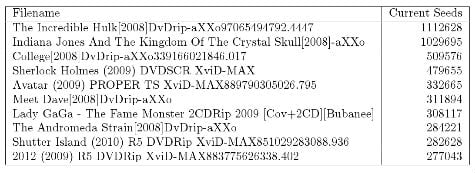
"Here's where the researchers make total fools out of themselves. In their answer to the question they refer to a table of the top 10 most seeded torrents. ... the most seeded file was uploaded nearly two years ago (The Incredible Hulk) and has a massive 1,112,628 seeders. The torrent in 10th place is not doing bad either with 277,043 seeds. All false data. We're not sure where these numbers originate from but the best seeded torrent at the moment only has 13,739 seeders; that's 1% of what the study reports. Also, the fact that the release is nearly two years old should have sounded some alarm bells. It appears that the researchers have pulled data from a bogus tracker, and it wouldn't be a big surprise if all the torrents in their top 10 are actually fake."
They also take a cursory look at isoHunt, finding that 1.5% of torrent files come from Jamendo alone, "a site that publishes only Creative Commons licensed music."
Does this really surprise anyone?
Stupidity only gets you so far, then you've gotta try
...good we know who did (paid) the study.
Lets simply go seeding instead of this discussion.
Nothing to see here.
Every few months when a WoW patch comes out and millions of computers torrent a few hundred MB. Hulk's got nothing on Night Elves.
Industry group ending in 'AA' pays to have study conducted that supports their views, doesn't care so much about accuracy.
News at eleven.
It's better to vote for what you want and not get it than to vote for what you don't want and get it.
- E. Debs
Moral of the story.... don't trust seedy research.
One major problem with Bit Torrent is that you only get easy access to what is "popular" at any given time. I've gotten some TV show episodes (not available in the US) downloaded in a reasonable amount of time when I start the download within 24 hours of the original show being aired... but try to get the same episode 30 days later and availability drops in a hurry. Despite all the pro-P2P propaganda about how it "democratizes" data, it's really more a mob-rule popularity contest for grabbing the shiniest download.
AntiFA: An abbreviation for Anti First Amendment.
RIAA Plants Seeds of Inaccuracy- News @ 11.
Turns out it was actually 0.003%*. Sorry for the confusion.
*All the legal transfers were of Ubuntu ISOs.
I smell stench of MPAA's money involved in this. inflate the numbers to make things look worse for them just like the riaa does
C'mon, does anyone really think that 99.7% of all torrent traffic is illegal? Everyone knows that the REAL number is 99.99%.
I need trepanation like I need a hole in the head.
enormous computing power to get info:
1) go to www.google.com - search for "most seeded torrents"
2) look at first link: www.spyware4u-fraudskytorrents.com and read Inedible Hulk, Batsman 4, Free's Willy ... 1,112,628, 1,122,421, 999,991
3) Copy and paste text into PowerPoint slide, edit a little, spell check, submit
4) Profit: Collect huge check for report as industry screams: WE HAVE PROOF POSITIVE!!!
Some country's laws may flag a torrent as illegal while other countries consider it as legal.
As an example, someone could be downloading a copyrighted song for backup purposes while owning a legitimate copy and these fools will automatically classify this kind of download an infringement.
We are supposed to believe the analysis of a biased entity over professional researchers?
What, exactly, are TorrentFreak's and Ernesto's qualifications to analyze the data? Do they have education or degrees that include statistical and/or numerical analysis of data?
Or, did they read it and decide that it can't possibly be true because they don't like the results? Is it not in their best interest to promote the idea that the study is flawed?
There is no "-1 offended" or "-1 you don't agree with me" mod options for a reason.
Guess which study the lobby groups (and consequently our politicians) are going to cite, and which one they will ignore?
It's too bad that there wasn't a way to attach this debunking to the original study, so that you would have to consciously ignore it. It will be really easy to lose these new findings in the shuffle.
This should not be surprising to anyone. Such studies are published mostly to keep laws up against file sharers, and companies (napster, piratebay and so on), so that ?PAA can justify their existence.
Oh Shazbot!
"All great wisdom is contained in .signature files"
What would you recommend?
A work that expires before its copyright never enters the public domain and thus enjoys eternal copyright protection.
Ars technica has actually asked the researchers about the issue. Here is the response from Paul Watters, one of the researchers:
Thank you for your enquiry regarding our research report "Investigation into the extent of infringing content on BitTorrent networks". As researchers, we not only stand by the findings that we have arrived at, but - having made our methodology public - we are providing other bona fide researchers to replicate and/or dispute our findings. Their results can in turn be assessed through the peer review process; this is the process that normal research activity takes.
You have raised some interesting points that are fundamental to the validitiy of any study in this area: the sampling strategy; verification of results and so on. We believe that our methodology was rigorously applied to the sample that we obtained. Over time, we will replicate the sampling process, so that we will gain better estimates of the population results. This is the fundamental tenet of statistical sampling.
Yog hurt by making fun of Yog pain.
Yog sad.
Yog hurt still.
1. The data is necessarily old. You can not do a study overnight and release the results the next day; you can not update the data during a test without having to start over. This data looks to be approximate 18 months old. A reasonable conclusion is that it reflects the situation of torrents 18 months ago... while this should be taken into account it certainly doesn't undermine the study.
2. They obviously did not check every file on the internet. In fact, according to Ars Technica, the "sample consisted of 1,000 torrent files" randomly selected from among the most active. It might be reasonable to question whether their sampling size was large enough to reduce the false positive rate... but who cares if the "The Hulk" wasn't the most downloaded movie at the time? If the most downloaded file appeared at the top of the random list it would be a sign of a sampling error.
3. Downloading copyrighted movies and music theft. It is stealing from the hard working men and women of the entertainment industries... it is stealing from every honest person who pays more for music/movies to offset the theft. Just because you feel invincible and entitled doesn't mean you are. I hope you are all prosecuted to make it clear that theft will not be tolerated.
I'm honestly not trying to troll of flamebait, but what difference does the "study" make whether it's correct or not? Those who use torrents are going to use them, those who don't will continue not to, and those who think torrent sites are the root of all evil will continue to think THAT way, too. If the amount of illegal activity is 10%, 50%, or 95%, authorities aren't going to lower their guns as long as there is ANY illegal activity.
I'm this guy. Now this type of fuck up sounds like the University of Ballarat.
All data can be manipulated to support any point of view, especially to support the POV of the financial backer. Bogus data is the best source of data, after all 98% of all torrent related "data" is inaccurate at best.
Did these researchers download any of these files to verify their validity? Did they launch any of these torrents to see how may seeds / peers actually appear in the list of the client and compare that against what the site says? Did they look at multiple sites? From all of the report's I've seen so far the answer is "well, no" for all of these.
These researchers know their data is crap, but will keep coming up with these terribly inaccurate reports as long as the money keeps coming from one side. If both sides were to fund a joint study, with mutually agreed upon criteria, we may get a slightly more accurate report, but that will never happen.
> uthorities aren't going to lower their guns as
> long as there is ANY illegal activity.
Just like speeding on highways. Right.