Slashdot Mirror


IBM Snags Patent On Half-Day Off of Work Notifications

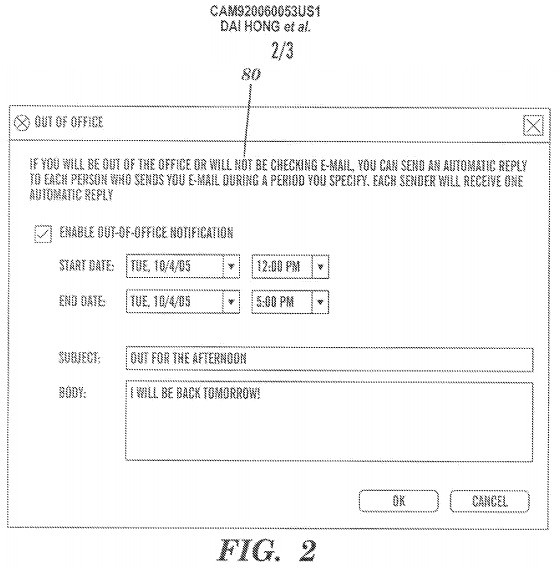
theodp writes "The USPTO appears to have lowered the bar on obviousness, awarding a patent to IBM Tuesday for its System for Portion of a Day Out of Office Notification. 'Out of office features in existing applications such as Lotus Notes, IBM Workplace, and Microsoft Outlook all implement a way to take a number of days off from one day to many days,' acknowledges purported patent reformer Big Blue. 'Yet, none of these applications contain the feature of letting a person take a half-day or in more general terms, x days and x hours off.' Eureka! And yes, the invention is every bit as obvious as you can imagine."
163 comments

  1. Huh by masternerdguy · · Score: 5, Funny

    Then I demand a patent on going to work.

    --
    To offset political mods, replace Flamebait with Insightful.
    1. Re:Huh by Anonymous Coward · · Score: 1

      Sorry, I already have the patent on "System for Portion of a Day Working". ....now back to reading my /. articles....

    2. Re:Huh by Forge · · Score: 2
      We have that where I work.

      I am not sure of the name of the package.. but it has a web interface that you can use to check how many days you have available and to apply for time off. I can use that to not just request a 1/2 day, but also to request just a few hours.

      Does this mean we (and whoever created our HR software) have to sue IBM? Or can we just ask for a cut when they start collecting license fees on this patent?

      --
      --= Isn't it surprising how badly I spell ?
    3. Re:Huh by networkBoy · · Score: 2

      We have it, in outlook.
      you simply schedule a half day meeting and tag it as OOO (makes it purple in the shared calendar .

      --
      whois gawk date unzip strip find touch finger mount join nice man top fsck grep eject more yes exit umount sleep dump
    4. Re:Huh by timeOday · · Score: 1

      That won't send out-of-office notifications to people who send you emails though. (Not that I would ever enable them for that situation myself).

    5. Re:Huh by Canazza · · Score: 5, Informative

      My outlook does exactly this, it's almost identical to the image they submitted...
      http://canazza.files.wordpress.com/2012/01/outofofficeobviously.jpg

      --
      It pays to be obvious, especially if you have a reputation for being subtle.
    6. Re:Huh by NicknamesAreStupid · · Score: 4, Funny

      I am writing a patent for taking portions of a day to slack off. The calendar will display all kinds of bullshit excuses, including writing a patent.

    7. Re:Huh by gstoddart · · Score: 1

      I am not sure of the name of the package.. but it has a web interface that you can use to check how many days you have available and to apply for time off. I can use that to not just request a 1/2 day, but also to request just a few hours.

      Our time entry system at work (again, no idea what the name is) allows us to simply enter a number of hours.

      We can enter decimals, so I've taken "1.25" hours of flex time before ... and I can separately access how much vacation and flex time I have. At a previous job, we accounted for our time in as little as 15 minute increments, and we could do that with our time tracking software as well ... this isn't new, or even novel.

      Seriously? A patent on accounting for time in less than one day increments?

      This is stupid, obvious, and has likely been done elsewhere countless times ... whatever moron at the patent office granted this should be forced to eat a stack of patent filings; staples, bindings, and all. I mean, really, what is it, "A system for accounting for actual hours worked and taken off in sub-hour increments ... with a computer".

      This is why software patents are incredibly stupid ... so many of them are "take well known solved problem, do it on a computer, profit" it's not even funny any more.

      --
      Lost at C:>. Found at C.
    8. Re:Huh by Anonymous Coward · · Score: 0

      Yeah...it's kind of been in Outlook since 2007: http://support.microsoft.com/kb/290846

    9. Re:Huh by CrankyFool · · Score: 5, Informative

      It's worth noting that while the USPTO just GRANTED the patent, it was filed back in 2006. I was all set to join the pile-on -- Outlook 2011 on the Mac has this feature -- but I can't recall Outlook, at least, having this feature back in 2006.

    10. Re:Huh by Anonymous Coward · · Score: 0

      Wish I had points for you. So few people here understand the system we have in the US. They hear one person say "it's broken" and they just pile on because it's the cool thing to do. Your clarity and reason is a breath of badly needed fresh air here.

    11. Re:Huh by datavirtue · · Score: 1

      Thank god for these inventions! The system wouldn't let me take a half day before.

      --
      I object to power without constructive purpose. --Spock
    12. Re:Huh by Canazza · · Score: 2

      Well, my screenshot was from Outlook 2007, so it's been around since then (released in Jan 07). The patent was filed in September 2006.
      My question is why it took 6 years to look at and grant the patent? We've now got countless mail clients that now use this as a standard feature.
      Have IBM been warning them they have a Patent Pending on this (or other, as yet ungranted) item? What happens to all these mail clients? How much will IBM be charging for use of this patent? What if they can't/wont pay up?

      --
      It pays to be obvious, especially if you have a reputation for being subtle.
    13. Re:Huh by datavirtue · · Score: 1

      That feature is going to have to be removed.

      --
      I object to power without constructive purpose. --Spock
    14. Re:Huh by Culture20 · · Score: 2

      But I was doing the same thing in 1995 with cron and vacation.

    15. Re:Huh by Hijacked+Public · · Score: 1

      I was doing the same thing 1994 with cron and vacation. You owe me some money.

      --
      "Sacrifice for the good of The State" - The State
    16. Re:Huh by yodleboy · · Score: 1

      thanks, I was about to post the same damn thing. I just used this feature last week for a partial day notification and was worried my head would explode when I read the summary! Not sure how far back this goes but as of Outlook 2007 it's there. LOL maybe IBM is still using Notes or some old version of Outlook.

    17. Re:Huh by Anonymous Coward · · Score: 0

      It Outlook does not have it implemented before the time it is filed, MS could be sued for infringement >:) `\(^^)/`

    18. Re:Huh by imahawki · · Score: 1

      Well, my screenshot was from Outlook 2007, so it's been around since then (released in Jan 07). The patent was filed in September 2006. My question is why it took 6 years to look at and grant the patent? We've now got countless mail clients that now use this as a standard feature. Have IBM been warning them they have a Patent Pending on this (or other, as yet ungranted) item? What happens to all these mail clients? How much will IBM be charging for use of this patent? What if they can't/wont pay up?

      Exactly! What the hell is wrong with the patent system!? Now pretty much EVERY tool has this and IBM will invariably end up basically being a troll, whether they intended to or not.

    19. Re:Huh by Biff+Stu · · Score: 4, Insightful

      Does this mean we (and whoever created our HR software) have to sue IBM? Or can we just ask for a cut when they start collecting license fees on this patent?

      No. It's a valid US patent.
      It means that IBM can sue whoever created your HR software and get an injunction to stop its sale in the US. Whoever makes your HR software would then need to fight IBM and a team of wicked sharp lawyers in court, and convince a bunch of dumb-fucks in East Texas, who have nothing better to do for three months than sit in a jury for $12 / day, that the patent isn't valid do to prior art or obviousness.

      Welcome to the giant cluster fuck that is the US patent system.

    20. Re:Huh by Theaetetus · · Score: 1

      My question is why it took 6 years to look at and grant the patent? We've now got countless mail clients that now use this as a standard feature.

      Patents usually get picked up for examination in about 2-3 years... The remainder is probably due to a bunch of rejections and corresponding narrowing of the claims.

    21. Re:Huh by tompaulco · · Score: 1

      Thank god for these inventions! The system wouldn't let me take a half day before.
      You must be on salary. You can't take a half-day off if you are on salary. If you worked at all, it was not a day off.

      --
      If you are not allowed to question your government then the government has answered your question.
    22. Re:Huh by Dog-Cow · · Score: 2

      What you wrote has nothing to do with the title, summary, nor article. Congratulations for displaying your illiteracy.

    23. Re:Huh by Darinbob · · Score: 1

      I can't afford the license fee, so I'll stay home today.

    24. Re:Huh by sjames · · Score: 1

      If it was actually in Outlook 2007, it had to have been under implementation in 2006, meaning it was already thought out.

      Then there's the incredible obviousness. All IBM did was take an existing feature and tweak the granularity a bit. Can I evade the patent by allowing any increment except for exactly half a day? (so you can take 3 hours 59 minutes or 4 hours 1 minute)

    25. Re:Huh by chrismcb · · Score: 1

      Outlook has had this feature or something similar to it going back to last century. You've almost always had the ability to set an appointment, for a length of time, and send an out of office reply during that appointment.

    26. Re:Huh by nilloc · · Score: 2

      Just because you were doing it, you didn't patent it. And you have nothing published to claim prior art.

    27. Re:Huh by EdIII · · Score: 1

      Why does anybody owe anybody any money at all for something so completely obvious? :)

      The fact that is has not been used before does not mean it was not extremely obvious on how to do it. If I needed to code an auto-responder for something specific like an out-of-office message it would have been by default from 01/10/2012 00:00:00 to 01/10/2012 11:59:59 if I stored it as a timestamp. Adding some dropdown boxes to add the time would make it work instantly since if statement, or SQL statement like between, would have supported it without modification.

      Duh.

      This sets a new low for completely obvious shit. I don't know any company that actually requires tracking half days off, or just a few hours off work like that and adjusting emails. I am willing to bet hard money that any company that actually needs to do so is already doing so with their in-house IT staff.

      If I was any company with a product like this I would sue to invalidate the patent before paying royalties on a patent so absurdly stupid.

    28. Re:Huh by EdIII · · Score: 3, Funny

      I work in IT :)

      You can't tell if I have taken a half a day off or not.

      Boss: Uh why were you not at the office between 12 and 4?
      Me: I had to go to the datacenter.
      Boss: For what?
      Me: The EPS conduits were all gunked up because the flux capacitor in the power converter was 3 degrees out of phase.
      Boss: Ok. Isn't that what happened to my laptop last week?
      Me: Yes, but this was not caused by porn.

    29. Re:Huh by Builder · · Score: 1

      Does your vacation booking software send out of office e-mails when you apply for time off ? If not, it has nothing to do with this.

    30. Re:Huh by Forge · · Score: 1

      It does. Both to get approval, then to notify those who must know I am out and finally an auto-response.

      --
      --= Isn't it surprising how badly I spell ?
  2. It's time by cmdr_klarg · · Score: 5, Insightful

    It's time for pitchforks and torches at the USPTO...

    --
    THE SOFTWARE, IT NO WORKY!!!
    1. Re:It's time by ByOhTek · · Score: 1

      Yeah, no kidding. Where I work we use MS Outlook/Exchange (formerly Oracle, I can't believe we could actually find something that's a downgrade from THAT, but we managed), MS Project and an open source vacation/leave request system. ALL of these have the features mentioned above, and have for YEARS.

      Ok, they don't have a drop-down box or something idiotic like that, if that is part of the patent, but for outlook/exchange, I set my away message to show up when I will leave the office (say, noon 2012-01-12), I block off that chunk of the day on my calandar (noon-6pm, just to be safe, so nobody schedules me for a late meeting, thinking I'll be back), In project, I mark '4' hours under 'vacation' and I put '4' in the 'hours' spot of our vacation request program for that day.

      I've been doing that for years. WTF is wrong with the patent system for granting this garbage?

      --
      Self proclaimed typo king, and inventor of the bear destroying coffee table (patent not pending).
    2. Re:It's time by Anonymous Coward · · Score: 0

      Sometimes I think the USPTO approves this kind of patent as a sort of protest; just to get attention and force Congress to give them rules allowing them to reject "obvious" inventions and reference prior art other than publications.

    3. Re:It's time by Anonymous Coward · · Score: 0

      It'll cost ya! I've patented the use of torches and pitchforks to protest the USPTO.

    4. Re:It's time by Gibgezr · · Score: 1

      Yup. The USPTO is officially broken. But how do we fix it? Replace it with an IP system that other countries agree to uphold, and thus force it upon the U.S.?

    5. Re:It's time by plover · · Score: 1

      No, that would just make them look as incompetent as they are. It wouldn't prove the idea of patenting software is stupid.

      I'm wondering if IBM isn't doing this to prove the USPTO is useless.

      In reality, they're probably just adding to their portfolio of fake valuables, so that when they lawyer-up they can claim "thousands" instead of "hundreds" of violations of their IP.

      --
      John
    6. Re:It's time by jc42 · · Score: 5, Informative

      Sometimes I think the USPTO approves this kind of patent as a sort of protest; just to get attention and force Congress to give them rules allowing them to reject "obvious" inventions and reference prior art other than publications.

      Actually, the Patent Office folks have explained this publicly in the past. Their motive isn't to get rules and definitions from Congress. They agree that such things should be the Patent Office's job. Their motive is to get Congress to fund the required work. Some years back, when Congress passed the laws that radically expanded what could be patented, Congress also cut back on Patent Office funding. The Patent Office can't do the "obvious" checking of patent applications, because they can't legally hire (and train) the people that the job has required for the past decade or so. The flood of patent applications has become an astronomical number.

      The Patent Office folks made it pretty clear back then that their only possible approach was something that historians will find familiar: Approve them all, and let the Courts sort them out. Essentially, funding for patent examination has been moved into the Private Sector, aka the lawyers. This has, of course, radically increased the cost of a patent application, because the court system simply wasn't designed for this sort of task, and patent lawyers cost a lot more than patent examiners.

      As long as our political system remains in its current "privatization is the way to go" state, this is not likely to change. And if you're complaining about the way that the current patent system is a dead weight on economic development, you should understand that that's exactly its function. A patent is a tool for limiting use of a bit of technology to someone who can afford to defend the patent. That's intentional, and it has always been used by the big guys against the little guys. The only way to fix it is to limit what can be patented. A decade back, the US Congress took exactly the opposite approach, and radically expanded what was patentable. They did this knowingly, to limit access to technology to the big guys (aka campaign contributors ;-). This isn't going to be fixed as long as the crowd that did that is still running the US Congress.

      (Well, OK, there's an outside chance that the courts might cancel those laws on obvious Constitutional grounds. Anyone want to make a wager on when that might happen, how much the appeal process will cost, or how many years it'll take? ;-)

      --
      Those who do study history are doomed to stand helplessly by while everyone else repeats it.
    7. Re:It's time by Anonymous Coward · · Score: 0

      those who make the rules a mostly laywers themself , you do the math ....

    8. Re:It's time by morgauxo · · Score: 1

      You say this is "something historians will find familiar". Great! So it was a temporary problem last time? When was that, how did it end, how long did it take? Any citation? I'd love to read about this, especially the part about how it got better.

    9. Re:It's time by oxdas · · Score: 1

      The USPTO gets most of the blame, but I you are pointing fingers in the wrong place. The USPTO tried repeatedly to deny these types of patents in the 80's and 90's and the courts kept forcing them to grant them. The courts were ordering the USPTO to issue these patents while giving the USPTO little guidance to determine what was and was not a software patent. Finally in 1994, I think the USPTO decided to just grant everything and let the courts figure it out because that was what was happening anyways. The Supreme Court didn't hear a software patent case from 1981 to 2008 and in those years the district courts essentially created software patents. When the Supreme Court finally opened its mouth in 2008, it didn't clear up anything. Part of the problem is Congress failing to fix the system, but most of the blame lies with the courts. While I wouldn't go so far as to say the USPTO is a victim here, they clearly have little real power over what gets patented.

    10. Re:It's time by jc42 · · Score: 1

      Maybe I was a bit too subtle. What I was thinking of was the old slogan "Kill them all and let God sort them out." You sometimes run across variants of this, all of the form "_____ them all and let _____ sort them out." It's sorta the ultimate trope for cynical characterization of someone else's attitude toward a problem.

      For the current topic, we might similarly suggest that the approach of the big corporations amounts to "Patent everything and let our teams or corporate lawyers sort it out in court."

      --
      Those who do study history are doomed to stand helplessly by while everyone else repeats it.
    11. Re:It's time by jc42 · · Score: 1

      Yeah; I thought of adding that to my comment. But then I decided to let someone else have the honor. ;-)

      --
      Those who do study history are doomed to stand helplessly by while everyone else repeats it.
    12. Re:It's time by Asic+Eng · · Score: 1

      [...] their only possible approach was something that historians will find familiar: Approve them all, and let the Courts sort them out.

      I don't see how that's the only possible approach. Seems to me, a far better approach would have been to check each thoroughly and accumulate a huge backlog. That would have created pressure to hire more examiners, and would have lowered the incentive to file more patents.

    13. Re:It's time by Theaetetus · · Score: 3, Informative

      The Supreme Court didn't hear a software patent case from 1981 to 2008 and in those years the district courts essentially created software patents.

      Not district courts - the US Court of Appeals for the Federal Circuit. Sometimes called the "12th Circuit". And during those two decades, the Supreme Court declined hearing a bunch of appeals because they thought the lower court's decision was correct.

    14. Re:It's time by Theaetetus · · Score: 1

      Actually, the Patent Office folks have explained this publicly in the past. Their motive isn't to get rules and definitions from Congress. They agree that such things should be the Patent Office's job. Their motive is to get Congress to fund the required work. Some years back, when Congress passed the laws that radically expanded what could be patented, Congress also cut back on Patent Office funding.

      ... the Patent Office is self-funded by application fees. It actually makes a profit, although those profits are seized by Congress rather than being re-invested.

      The Patent Office folks made it pretty clear back then that their only possible approach was something that historians will find familiar: Approve them all, and let the Courts sort them out.

      The rejection rate for patent application is in the 60-70% range depending on art group. Far cry from your suggested 0%.

      A decade back, the US Congress took exactly the opposite approach, and radically expanded what was patentable.

      Actually about 50 years ago, and specifically, they took the opposite approach to what you suggested: they declined to narrow what was patentable.

      There's very little you've said that's correct, and certainly none of your facts. Why should we listen to your conclusions?

    15. Re:It's time by icebrain · · Score: 1

      Yeah, no kidding. Where I work we use MS Outlook/Exchange (formerly Oracle, I can't believe we could actually find something that's a downgrade from THAT, but we managed),

      I see your Outlook, and raise you Lotus Notes.

      --
      The meek may inherit the earth, but the strong shall take the stars.
    16. Re:It's time by oxdas · · Score: 1

      I am certainly not in the heads of the Supreme Court. I do see an evolution of opinion on this issue over the decades. It does seem odd to me, however, that after a succession of decisions leading up to Diebold, they simply turn it off for 2 1/2 decades. During that time, the lower court continues to expand patentable material. From a lay observer, I have to wonder if technology and its legal consequences were changing so fast that the Supreme Court was waiting to see how the lower court would respond and what the consequences would be.

      That said, I support patents and copyrights, but I believe the courts have gone too far on software patents and Congress too far on copyrights.

    17. Re:It's time by ByOhTek · · Score: 1

      Being made by the company requesting the patent, it doesn't count as prior art...

      --
      Self proclaimed typo king, and inventor of the bear destroying coffee table (patent not pending).
    18. Re:It's time by icebrain · · Score: 1

      Being made by the company requesting the patent, it doesn't count as prior art...

      I was referring to the reference of Outlook/Exchange being worse ("a downgrade") than Oracle, and about Notes being even worse than both. Anyone who has used it will understand.

      --
      The meek may inherit the earth, but the strong shall take the stars.
    19. Re:It's time by ByOhTek · · Score: 1

      Oh. well then, you *woosh*ed me, as I've never used it.

      You should have at least gotten your *wooosh* in there. Bad slashdotter. No cookie.

      --
      Self proclaimed typo king, and inventor of the bear destroying coffee table (patent not pending).
    20. Re:It's time by Anonymous Coward · · Score: 0

      Then they get dinged because "they are not doing their job".

      People do what they get rewarded for doing. Don't blame the USPO for us electing people based on how well they lie to use instead of how well they compromise.

  3. Imagine.. by Anonymous Coward · · Score: 0

    Imagine being the guy that wrote this patent with a straight face. Must suck to be soulless.

    1. Re:Imagine.. by envelope · · Score: 5, Insightful

      He probably has a quota of patent applications he has to file.

      --

      appended to the end of comments you post, 120 chars
    2. Re:Imagine.. by lorenlal · · Score: 1

      He probably didn't have a straight face either.

    3. Re:Imagine.. by El+Torico · · Score: 5, Insightful

      It's probably a bunch of guys sitting around, trying to "one up" each other on who can get the most outrageous patent.

      --
      In the land of the blind, the one-eyed man is usually crucified.
    4. Re:Imagine.. by Mordok-DestroyerOfWo · · Score: 3, Funny

      It's probably a bunch of guys sitting around, trying to "one up" each other on who can get the most outrageous patent.

      I sense a new drinking game!

      --
      "Never let your sense of morals prevent you from doing what is right" - Salvor Hardin
    5. Re:Imagine.. by LordNimon · · Score: 1

      I think it's actually two women. I think this is one of them: http://www.linkedin.com/profile/view?id=858297

      The other doesn't appear to have a LinkedIn account.

      --
      And the men who hold high places must be the ones who start
      To mold a new reality... closer to the heart
    6. Re:Imagine.. by demonbug · · Score: 4, Funny

      It's probably a bunch of guys sitting around, trying to "one up" each other on who can get the most outrageous patent.

      I sense a new drinking game!

      Sorry, that was the second patent they filed.

    7. Re:Imagine.. by CFBMoo1 · · Score: 1

      Thanks for the smiles. I wish I had mod points.

      --
      ~~ Behold the flying cow with a rail gun! ~~
    8. Re:Imagine.. by Anonymous Coward · · Score: 0

      He is equine.

    9. Re:Imagine.. by Anonymous Coward · · Score: 0

      It doesnt matter when, or what - its currently Patents, SOPA - all this rubbish just makes me want to cry. Why does everyone want to ruin everything all the time. And why are the people in power allowed to be paid off with jobs and incentives. it never bothered me before, but today it hit me and literally almost makes me cry like a baby. there is no hope.

    10. Re:Imagine.. by Anonymous Coward · · Score: 0

      Imagine being the guy that wrote this patent with a straight face. Must suck to be soulless.

      If you are on the path of using your imagination: imagine being the guy who wrote this patent as a mockery - what a surprise to see how big idiots the USPTO can have to swallow it.

  4. Patent on asking to go to the bathroom, too? by DogDude · · Score: 4, Insightful

    I'm wondering if anybody knows if IBM has a patent on employees having to ask to go to the bathroom. That was one of the more unique aspects of working at IBM, in my experience.

    --
    I don't respond to AC's.
    1. Re:Patent on asking to go to the bathroom, too? by identity0 · · Score: 1

      Oh shit, that's how we can get them - patent the process of granting permission to go to the bathroom, then sue them and ask for a preliminary injunction from the judge.

      Watch them literally squirm in their seats, and not get any work done. They'll be putting in a lot of half-day off notices afterwards...

    2. Re:Patent on asking to go to the bathroom, too? by IwantToKeepAnon · · Score: 1

      I hereby claim all rights and patents to requesting sick leave. :-(

      Prior art:

            To: my boss
            From: me
            Date: today
            Subject: sick
                  Sorry boss, I have a cold and a bad headache so I can't come in today.

      --
      "Happy families are all alike; every unhappy family is unhappy in its own way." -- Anna Karenina by Leo Tolstoy
  5. I wonder by slackware+3.6 · · Score: 3, Funny

    if any one has patented the process of taking a crap yet?

    1. Re:I wonder by Anonymous Coward · · Score: 0

      I'd like then to patent at least 3 methods for wiping your ass. I'd be nice to see people to either paying royalties to you, or suffering the consequences.

  6. Prior art? by Anonymous Coward · · Score: 5, Informative

    I can already do this in Outlook, and have done so on several occasions... how is this new?

    1. Re:Prior art? by subsoniq · · Score: 1

      Yeah, Exchange 2007 introduced this in late 2006 when it released.

    2. Re:Prior art? by Anonymous Coward · · Score: 1

      Yeah, Exchange 2007 introduced this in late 2006 when it released.

      This patent was filed in September 2006. Maybe Microsoft will be paying royalties for using IBM's invention before long.

    3. Re:Prior art? by Anonymous Coward · · Score: 0

      Hence the lowering of the bar...

    4. Re:Prior art? by tjbp · · Score: 0

      It's not new. The patent was filed in September 2006.

    5. Re:Prior art? by Ptur · · Score: 1

      How? I don't see any way in Outlook to make it send out of office replies for every afternoon, for example....

    6. Re:Prior art? by Sarten-X · · Score: 4, Informative

      Despite the summary, the patent describes a particular specific application, where every aspect of the system is based around minute-granularity timestamps, rather than mere dates. The application also follows a particular architecture, which is all nicely explained in the actual patent itself. The half-day example was just mentioned for clarity, and does not affect the patent itself.

      --
      You do not have a moral or legal right to do absolutely anything you want.
    7. Re:Prior art? by SighKoPath · · Score: 1

      Exchange 2007 Beta 2 (which the release announcement states is feature complete) was out in July 2006. I don't think they'll be paying royalties.

    8. Re:Prior art? by hrimhari · · Score: 1

      That's not what the patent grants either. If it were, it could have had a stronger ground...

      --
      http://dilbert.com/2010-12-13
    9. Re:Prior art? by jank1887 · · Score: 1

      that was under 'first to invent' not 'first to file'. the current system will work the way you described. this patent however will require a trial with discovery and proving who invented it first.

    10. Re:Prior art? by Theaetetus · · Score: 2

      that was under 'first to invent' not 'first to file'. the current system will work the way you described. this patent however will require a trial with discovery and proving who invented it first.

      No, it won't. First-to-file vs. first-to-invent changes one procedure: interferences under 35 USC 102(g). Only about 20 occur per year, and it's when two independent inventors simultaneously apply for a patent on the same thing. It has nothing to do with prior art. Stop spreading FUD.

    11. Re:Prior art? by rastoboy29 · · Score: 1

      By Jove you're right, it's a brilliant invention!

      Seriously?

    12. Re:Prior art? by Anonymous Coward · · Score: 0

      that was under 'first to invent' not 'first to file'. the current system will work the way you described. this patent however will require a trial with discovery and proving who invented it first.

      No, it won't. First-to-file vs. first-to-invent changes one procedure: interferences under 35 USC 102(g). Only about 20 occur per year, and it's when two independent inventors simultaneously apply for a patent on the same thing. It has nothing to do with prior art. Stop spreading FUD.

      He's not spreading FUD, he's spreading misinformation.

  7. Duh by Anonymous Coward · · Score: 1

    I was going to state how even our in house payroll software lets us put in for portions of a days leave, but then I realised this is about automated out of office notifications - and I'd have to admit, obvious as it is most of the ones I've seen work with dates, not portions of dates.

  8. No, not really by Anonymous Coward · · Score: 0

    Outlook has had this for ages. You simply schedule a meeting for an arbitrary period of time and set the availability to 'out of office'. How is this any different?

    1. Re:No, not really by luis_a_espinal · · Score: 1

      Outlook has had this for ages. You simply schedule a meeting for an arbitrary period of time and set the availability to 'out of office'. How is this any different?

      People (from within and outside of your network) do not get an "out of office" auto reply if they send an e-mail to you at the time interval selected by scheduled meeting. Do they?

    2. Re:No, not really by djsmiley · · Score: 1

      Ok, zimbra (mail server app) has the ability to set, to the second! (i believe) your out of office message.

      So hm, yup, that'll send an out of office message, and you can set to to any text you like "Hi, i'm out of the office for the next 32 minutes and 42 seconds!"

      --
      - http://www.milkme.co.uk
    3. Re:No, not really by agallagh42 · · Score: 1

      People (from within and outside of your network) do not get an "out of office" auto reply if they send an e-mail to you at the time interval selected by scheduled meeting. Do they?

      Yeah, he's doing it wrong. In outlook, you use the Out Of Office Assistant to schedule the start and end time of your time out of the office. It can be scheduled down to the minute.

      For example, I can set up (in advance if necessary) an out of office autoresponder to start at 1pm on thursday and end at 10:30am the following tuesday.

      --
      Carpe Cerevisi - Seize the Beer
    4. Re:No, not really by kimvette · · Score: 1

      How is this any different?

      No one filed a patent for it until now.

      --
      The Christian Right is Neither (Christian nor right). See: Matthew 23, Matthew 25, Ezekiel 16:48-50
    5. Re:No, not really by blueg3 · · Score: 1

      The copy of Zimbra I'm using, at least, only has that option for whole days.

  9. Add Minutes, Too! by mtrachtenberg · · Score: 1

    I'll take my royalties at my Post Office Box.

    1. Re:Add Minutes, Too! by schroedogg · · Score: 1

      OK, then I call the unix timestamp patent! I'll be out until 1326267061 and not a second later.

  10. MS Office by pootypeople · · Score: 2

    I may not remember correctly, but doesn't Office 2007 and above have an option where you can set what time to enable/disable the out of office message? That would seem to cover this patent. When was the application made?

    What do folks at the USPTO do, exactly? You would think any reasonably-intelligent person would reject this on obviousness grounds and not even need to find prior art.

    1. Re:MS Office by nologin · · Score: 3, Informative

      Patent filing date is September 7th, 2006.

      Since Outlook 2007 does have this feature, it would be the likely candidate for prior art, since it would have been release somewhere in that time frame.

    2. Re:MS Office by Spad · · Score: 3, Informative

      Exchange 2007 RTM build date was December 2006, though the betas/RC would have obviously pre-dated that by a few months.

    3. Re:MS Office by Fnord666 · · Score: 1

      I may not remember correctly, but doesn't Office 2007 and above have an option where you can set what time to enable/disable the out of office message? That would seem to cover this patent. When was the application made?

      What do folks at the USPTO do, exactly?

      Filed: September 7, 2006

      --
      'The tyrant will always find pretext for his tyranny.' - Aesop's Fables
    4. Re:MS Office by jank1887 · · Score: 1

      Invented: ????

      US wasn't First-to-file yet.

    5. Re:MS Office by Theaetetus · · Score: 2

      Invented: ????

      US wasn't First-to-file yet.

      First-to-file doesn't change anything about prior art. All it does away with is interferences under 35 USC 102(g) where two independent inventors simultaneously file patent applications on the exact same invention. Previously, there was a big, expensive fight over who was really the first to invent. Now (actually, in a year when it gets implemented), the one with the first filing date will win.

      This is a rare procedure - there are currently about 20 interferences total per year... out of half a million applications filed. It's also very expensive, and requires a lot of back and forth before the application is even examined. So, you're a small inventor with a great new idea? Great, we'd like you to spend $20k up front just to establish that you were first before this other guy, even before we figure out whether it's patentable. Moving to first-to-file is a good thing.

      But it doesn't change a thing about prior art. And GP's point was that if Microsoft Office had this feature in 2007, that's not prior art for this application in 2006. Now maybe someone at Microsoft came up with the idea earlier but kept it secret for that year? Doesn't matter then, because secrets are not art. So, no publication, no product, no evidence? No prior art.

    6. Re:MS Office by Theaetetus · · Score: 1

      What do folks at the USPTO do, exactly? You would think any reasonably-intelligent person would reject this on obviousness grounds and not even need to find prior art.

      Hey, that guy looks guilty. The judge should convict him for murder on lookin'-guilty grounds and not even need to find evidence.

      It's the same thing - the PTO is a quasi-judicial body. They have to use evidence to support their determinations of obviousness. That evidence is one or more prior art references that, alone or in combination, teach or suggest each and every element of the claimed invention. If they don't provide that evidence, then all the "it's totally obvious, I just can't prove it" won't matter.

  11. Outlook Already Does this.. by Anonymous Coward · · Score: 0

    I have outlook 2010 and it already does this, unless I'm missing something...

    From the end of the Microsoft Documentation:

    If you selected the “Only send during this time range” option in step 4, the Out of Office Assistant feature will continue to run until the date and time set for the End Time in step 5 is reached.
    Otherwise, the Out of Office Assistant will continue to run until you repeat step 1 and select the “Do not send Out of Office auto-replies” option.

    The dialog in question even looks like the one in the patent...

  12. EJB Only? by Anonymous Coward · · Score: 0

    At least it seems that the patent is not that generic, their claims are specific to EJB.

  13. Where's the Patent Payoff? by mounthood · · Score: 3, Interesting

    Where's the payoff for the avalanche of poor patents? IBM isn't getting paid, the USPTO isn't better off, so are the politicians getting paid? Why is this system continuing? Two reasons I can see: protection for the largest companies against new start-ups, and getting foreign countries to adopt US Patent laws and extort their corporations. But is that really it, is that the whole game? IBM isn't full of idiots and the politicians are (always) working an angle, so why this continued patent madness?

    --
    tomorrow who's gonna fuss
    1. Re:Where's the Patent Payoff? by NotSanguine · · Score: 3, Insightful

      Where's the payoff for the avalanche of poor patents? IBM isn't getting paid, the USPTO isn't better off, so are the politicians getting paid? Why is this system continuing? Two reasons I can see: protection for the largest companies against new start-ups, and getting foreign countries to adopt US Patent laws and extort their corporations. But is that really it, is that the whole game? IBM isn't full of idiots and the politicians are (always) working an angle, so why this continued patent madness?

      The payoff is selling it as part of a portfolio of patents to cover other equally obvious stuff, like they're doing with Google now. Jeebus, our IP system is broken!

      --
      No, no, you're not thinking; you're just being logical. --Niels Bohr
    2. Re:Where's the Patent Payoff? by Cassini2 · · Score: 2

      Where's the payoff for the avalanche of poor patents?

      IBM will be sued the moment the PTO grants a similar patent application to another company, so they file first.

      As long as it passes the "will the PTO grant this?" threshold, IBM files it. They have to file it, because five years later someone else will attempt to patent the same feature. The PTO will issue the patent in due course, and sometime later a patent troll company will buy the patent and source code (like SCO). Presto IBM will be sued for billions of dollars for violating patents and copyright, for something that happened many years ago. To prevent this from happening, IBM files patents, such that the technology shows up in the PTO database of patents.

      The interesting thing is that this technology was probably present in email systems running from the 1970s. Nevertheless, IBM still felt the need to patent it.

    3. Re:Where's the Patent Payoff? by mounthood · · Score: 1

      The payoff is selling it as part of a portfolio of patents to cover other equally obvious stuff, like they're doing with Google now.

      Selling to the next sucker is one way to get paid, but that happens in every market and isn't special to patents. Maybe it's just momentum that keeps the system running: we've spent so much on patents we can't stop now! Like the housing boom where the market prices reinforce the system, and it doesn't stop until enough people say the emperor has no clothes, then it all crashes at once.

      --
      tomorrow who's gonna fuss
    4. Re:Where's the Patent Payoff? by mounthood · · Score: 1

      Protection against patent trolls is just an effect of the system, but how does the system payoff for IBM or the USA? Protection for IBM could also be bought by paying a few politicians to change patent law, but that isn't happening. So where's the payoff?

      --
      tomorrow who's gonna fuss
    5. Re:Where's the Patent Payoff? by Yogs · · Score: 1

      If you think IBM isn't getting paid a ton licensing its war chest of patents you're crazy. Estimates vary, but they are LARGE.

      And that's not even the primary reason companies go for patents, especially the stupid ones.

      The real reason to go for as many patents as possible is to have as many legal weapons as possible to bludgeon and gut any up and comers with a competing product. A protracted legal battle against a foe with those kinds of resources, even if won, will sink most companies.

    6. Re:Where's the Patent Payoff? by mounthood · · Score: 1

      If you think IBM isn't getting paid a ton licensing its war chest of patents you're crazy.

      Licensing fees paid will be in proportion to the number of patents and lawyers, but other large companies have to pay those fees, so why aren't they fighting to get the patent system fixed? Unless IBM (et al.) are extorting foreign companies, the system isn't a boon for the USA, and we should be seeing serious efforts to get the system fixed.

      The real reason to go for as many patents as possible is to have as many legal weapons as possible to bludgeon and gut any up and comers with a competing product.

      Protection for the largest companies against new start-ups is one advantage, but they get that protection from the politicians *much* cheaper then the current patent system.

      --
      tomorrow who's gonna fuss
    7. Re:Where's the Patent Payoff? by jank1887 · · Score: 2

      Inventors may get an award or bonus for a filed / granted patent. So that's a quantity over quality incentive. Patent lawyers get paid for getting patents filed, accepted, attacked, defended, etc. again, quantity over quality. In fact, patent lawyers make more when there is post-award litigation whether or not they're on the offense or defense. Even more quantity-over-quality incentive.

    8. Re:Where's the Patent Payoff? by Xarin · · Score: 2

      Making money off the patents for IBM is a nice benefit but I believe ultimately this is being driven by companies needing to cross license IP. I worked at a company where we cross licensed IP with IBM and whoever had a bigger stack of patents would not pay anything and the other company would pay based on the relative difference in size of the stacks. We had incentives for engineers to patent our IP so that our stack would be bigger and the negotiations would be more favorable.

    9. Re:Where's the Patent Payoff? by pieterh · · Score: 2

      IBM filing trivial patents for defensive reasons? Please, that's a joke. Filing a patent does not defend against attack from a troll. You cannot file all possible patents any more than you can claim all possible combinations of letters. A billion patents is still 0% of infinity.

      IBM file trivial patents because they make $$$ from patent licenses. The director of the USPTO, Dave Kappos, was chief patent lawyer at IBM. It is a pure case of regulatory capture. IBM *own* the US patent system, file 50% of all software patents, and use this as a mainstay of their business plan.

    10. Re:Where's the Patent Payoff? by mounthood · · Score: 1

      You're right that patent trolls can't be stopped by playing the patent game, but If we assume that "IBM *owns* the US patent system" why aren't we seeing competitors bribing politicians to change the rules? The lack of large companies demanding change suggests they're OK with the current system, but where's their payoff?

      --
      tomorrow who's gonna fuss
  14. Lotus Notes 8.5 does this... by Known+Nutter · · Score: 1

    I can add that IBM's Lotus Notes 8.5 -- released in 2009 -- already had the ability to specify hours of a partial day.

    --
    Beware of the Leopard.
    1. Re:Lotus Notes 8.5 does this... by digitalloving · · Score: 1

      The patent was filed in 2006.

    2. Re:Lotus Notes 8.5 does this... by blueg3 · · Score: 1

      One would hope that technology found in a patent filed in 2006 for improving a specific product would appear in that product some time after 2006, yes.

  15. 8 hours is half day at IBM by Anonymous Coward · · Score: 0

    AND now under the new system we will know who to drop down to part time list. P.S no benefits for part timers

  16. partial days off item by Independent_forever · · Score: 1

    what are they talking about? Outlook does this now...it's called setting the hours....maybe I am missing the exact feature this article refers to...

    1. Re:partial days off item by Anonymous Coward · · Score: 0

      Where would that be? I don't see anything about hours or scheduling of the Automatic Reply, Out of Office message (Outlook 2010).
      I can set that I am currently Out of the Office, or that I'm currently In the Office, and what message to send while I'm marked Out of Office.

    2. Re:partial days off item by Anonymous Coward · · Score: 0

      Its not the feature you don't understand, its the entire way the patent filing and award system works in the US. Reading the comments here, it appears that IBM filed the patent right around the same time that the very first betas of the first version of Outlook that (eventually) featured this capability started to appear. What no one has said yet was whether or not this feature appeared in those early betas or was suddenly added as soon as possible right after IBM filed the patent, hoping to "go back in time to kill its mother".

  17. I am being forced to work... by vikingpower · · Score: 1

    ...with IBM tools, at my current client project. Can I then file a patent for not going to work ?

    --
    Religous speak to God. Insane are spoken to by God. When all shut up, one can finally hear Shostakovich in peace
  18. Obvious question ... by tomhudson · · Score: 2

    if any one has patented the process of taking a crap yet?

    ... where would you want to take it to? Wouldn't you rather just flush it, like the rest of us?

    Or are you one of those "Emma, come 'n look at this - you ain't gonna believe it!" types?

    "Method and system for taking a crap."

    1. Eat food (see our related patent application for "Method and system for eating food";
    2. Wait. (period of time depends on food eaten and any contamination such as salmonella, see our related patents and our "brown paper" on "Montezuma's Revenge")
    3. Do what comes naturally.

    1. Re:Obvious question ... by nschubach · · Score: 4, Funny

      "Method and system for taking a crap on a computer."

      1. Eat food (see our related patent application for "Method and system for eating food";

      2. Wait. (period of time depends on food eaten and any contamination such as salmonella, see our related patents and our "brown paper" on "Montezuma's Revenge")

      3. Do what comes naturally on a computer.

      Excellent, I shall file this immediately.

      --
      Every time I start to have faith in humanity, I ruin it by driving to work between 7 and 8 am.
    2. Re:Obvious question ... by Tablizer · · Score: 1

      Hey, I already patented that algorithm. Pay up!

      // Software Patent Maker
        h = openFile("ordinary_behavior.txt");
        while (w = readNextWord(h)) {
          if (random(0.0,1.0) > 0.96) {
            w = w + " using a computer ";
          }
          print(w);
        }

    3. Re:Obvious question ... by Anonymous Coward · · Score: 0

      oh dear, that's Cannonical in trouble then.

    4. Re:Obvious question ... by Mr.+Shotgun · · Score: 1

      I am calling prior art on this one. Microsoft already did it with Windows ME's code base.

      --
      Of all tyrannies, a tyranny sincerely exercised for the (supposed) good of its victims may be the most oppressive
  19. The reason is quite simple by tweir · · Score: 2

    A good chunk of these BS/trivial patents stem from devs gaming the system.

    Many corporations, and I imagine IBM is one of them, have patent bounties that are paid out in a multi-tier system:
    - propose a patent application that passes the internal corporate review board: small $ bonus
    - get the patent app files: bigger $ bonus
    - have the patent granted: big $ bonus

    I've known a few devs who have made a nice chunk of change in annual bonuses because they've learned the system. From devs on the line, through management & in-house counsel, there is zero disincentive to filing these applications, and a lot of potential personal upside.

    1. Re:The reason is quite simple by Anonymous Coward · · Score: 0

      Yes, there is such a system. Just replace all of your "qualifiers + $" with "$100" at each tier, and you'd be correct. But, like most things, the payouts used to be much better "in the old days". Yes, I am an IBMer with multiple patents and have been doing it for about 10 years now.

  20. Partial costs? by Errol+backfiring · · Score: 1

    Did they only have to pay for half a patent also? The other half was off course bloody obvious.

    --
    Nae king! Nae laird! Nae yurrupiean pressedent! We willna be fooled again!
  21. Sanity by Anonymous Coward · · Score: 0

    from the linked jpg:

    Subject: Out for the afternoon
    Body: I will be back tomorrow!

    More like:
    Subject: Sanity is out for the afternoon
    Body: Sanity will NOT be back tomorrow!

  22. Seriously? by Anonymous Coward · · Score: 0

    The USPTO is allowing IBM to profit from the polar opposite of true innovation.

  23. Opportunity abounds by Anonymous Coward · · Score: 0

    Quick! Snap up the patents for minutes, seconds, milliseconds, microseconds...

  24. Can I patent "method for social masturbation" by h00manist · · Score: 1

    The patent office's real job is to keep all of society locked in their cubes, think of dumb things that produce nothing but will make a ton of money, forget that society even exists, and depend solely on food delivery and masturbation for survival. So, let us patent "method for masturbation." Yes, the traditional one. What, me invent something?

    --
    Build your own energy sources from scratch. http://otherpower.com/
  25. Not only obvious ... by PPH · · Score: 1

    ... but this is just a subset of existing integrated calendar/e-mail functionality.

    "I will be $planned_function from $begin_time_date to $end_time_date. $optional_custom_message"

    FFS, I implemented this with procmail and a couple of shell scripts fed off my PalmPilot schedule back in ancient times.

    --
    Have gnu, will travel.
  26. I don't care about existing art... by Syphonius · · Score: 1

    Even in 2006, this would have been an obvious solution for anyone in the field.

    1. Re:I don't care about existing art... by Theaetetus · · Score: 1

      The Patent Office is a quasi-judicial body, so unlike your gut feelings, they do have to care about existing art. They can't merely say something is obvious, they have to prove it, same as the government can't throw someone in jail without evidence based on a gut feeling that they're guilty.

    2. Re:I don't care about existing art... by Anonymous Coward · · Score: 0

      Obviousness, like innocence, should be the default finding. The applicant ought be required to prove innovation, just as the prosecution is required to prove guilt. The default finding is the one which does not require additional state action.

      Either way, we are bickering over the details of a system of slavery. Ownership of ideas is repugnant, regardless the skill or (in our case) incompetence of the implementation.

  27. Outlook by Anonymous Coward · · Score: 1

    You can specify to the HOUR when you will be out of office until.

    How does this not cover half days?

    Turn On Out of office message: January 4 @ 5pm
    Turn Off Out of Office Message: January 5 @ 12pm

    See what I did there? Genius!

  28. I just filed... by Anonymous Coward · · Score: 0

    I just filed a patent application about filing stupid patents...

      - We's gonna be rich, ma!

  29. Ridiculous but necessary by kawabago · · Score: 1

    If companies don't patent every possible angle of everything then a troll will get that patent and go on the attack. The patent office has lowered the bar to the point that everything and anything is patentable and MUST be patented for self protection. This patent is purely the fault of Congress for ignoring the patent offices downward spiral to economic zombie. Braaaaains! Braaaaaaaaains!

  30. Obvious? Really? by Dachannien · · Score: 1

    Because this:

    A system for generating an electronic notification containing a portion of a day out of office notice, comprising:

    • an application server node operably associated with a database server having an application data supporting personal information management (PIM) system, the application server node configured to execute a personal information management application, the application server node further configured to store the personal information management application;
    • an application programming interface (API) programmatically associated with the personal information management application for allowing requests for services to be transmitted to the personal information management application;
    • at least one of a rich client delegate and a remote enterprise Java bean (EJB) housing the API, the rich client delegate and the remote EJB are programmatically associated with the application server node and the personal information management application, the rich client delegate being configured to receive and transmit data to the API via a network;
    • at least one client computer operably associated with the application server node via the network, each client computer having a user interface (UI) that is programmatically associated with the personal information management application and the API such that a user may input date with timestamp to-the-minute data corresponding to an out of office time period into the UI and transmit the date with timestamp to-the-minute data from the client computer to the API; and
    • wherein one rich client delegate is programmatically supported by a business logic member, the business logic member being configured to receive the date with timestamp to-the-minute data entered by the user via the UI by way of the supporting business logic member, the rich client delegate further configured to transmit the date with timestamp to-the-minute data to the API of the remote EJB;
    • wherein the application server node further includes a mail transfer agent (MTA), the mail transfer agent being programmatically associated with the personal information management application and the API;
    • wherein the mail transfer agent includes three phases, (i) a receiving phase for the an Simple Mail Transfer Protocol (SMTP) server (ii) a handling phase for handling name resolution, group expansion and content analysis, and (iii) a delivering phase for performing local and external mail delivery, wherein the delivery phase includes a delivery extension member for allowing plug-ins to add new functionalities, the delivery extension member being programmatically associated with the personal information management application and the API;
    • wherein the MTA includes an out of office filter member, the out of office filter member being programmatically configured to be a plug-in to the delivery extension member, wherein the MTA includes an out of office service; and
    • wherein the rich client delegate and the remote EJB are configured to receive the transmitted data from the client computer and forward the data to the API.

    is clearly obvious?

  31. Cool! My patent is in the mail to the USPTO .. by roguegramma · · Score: 3, Funny

    .. a system to deliver quarter-day off notices ..

    --
    Hey don't blame me, IANAB
  32. Obvious? by Theaetetus · · Score: 1
    Linking to a single figure to show an invention is obvious is naive. Sure, that one figure may be obvious... but that's not what the patent claims. What the patent claims is:

    1. A system for generating an electronic notification containing a portion of a day out of office notice, comprising: an application server node operably associated with a database server having an application data supporting personal information management (PIM) system, the application server node configured to execute a personal information management application, the application server node further configured to store the personal information management application; an application programming interface (API) programmatically associated with the personal information management application for allowing requests for services to be transmitted to the personal information management application; at least one of a rich client delegate and a remote enterprise Java bean (EJB) housing the API, the rich client delegate and the remote EJB are programmatically associated with the application server node and the personal information management application, the rich client delegate being configured to receive and transmit data to the API via a network; at least one client computer operably associated with the application server node via the network, each client computer having a user interface (UI) that is programmatically associated with the personal information management application and the API such that a user may input date with timestamp to-the-minute data corresponding to an out of office time period into the UI and transmit the date with timestamp to-the-minute data from the client computer to the API; and wherein one rich client delegate is programmatically supported by a business logic member, the business logic member being configured to receive the date with timestamp to-the-minute data entered by the user via the UI by way of the supporting business logic member, the rich client delegate further configured to transmit the date with timestamp to-the-minute data to the API of the remote EJB; wherein the application server node further includes a mail transfer agent (MTA), the mail transfer agent being programmatically associated with the personal information management application and the API; wherein the mail transfer agent includes three phases, (i) a receiving phase for the an Simple Mail Transfer Protocol (SMTP) server (ii) a handling phase for handling name resolution, group expansion and content analysis, and (iii) a delivering phase for performing local and external mail delivery, wherein the delivery phase includes a delivery extension member for allowing plug-ins to add new functionalities, the delivery extension member being programmatically associated with the personal information management application and the API; wherein the MTA includes an out of office filter member, the out of office filter member being programmatically configured to be a plug-in to the delivery extension member, wherein the MTA includes an out of office service; and wherein the rich client delegate and the remote EJB are configured to receive the transmitted data from the client computer and forward the data to the API.

    And that's a lot more than that one single figure.

  33. Its not about being obvious by TheSkepticalOptimist · · Score: 1

    Just because other people can think of an invention does not mean the patent should not be filed. A patent is largely about someone creating something novel nobody has thought of, or more likely got their patent filed first in the case where the invention is easily repeatable.

    What should rule out a patent is previous art. If someone else implemented this feature prior to IBM filing for the patent, or it can be proven that someone else implemented this feature before an IBM product implemented the feature, then the patent is not valid. Maybe the patent office may not be doing due diligence on awarding patents in this case as I have seen examples of this in other products.

    I agree there is a problem with the current patent system, but every time someone complains about patents they usually don't have the right information. There is nothing about filing a patent which states the invention cannot be obvious. If nobody bothers to create a product using the idea, or nobody bothers to file an patent for it, then the its only obvious to the people that were to lazy make the idea a reality.

    --
    I haven't thought of anything clever to put here, but then again most of you haven't either.
    1. Re:Its not about being obvious by Theaetetus · · Score: 1

      Just because other people can think of an invention does not mean the patent should not be filed. A patent is largely about someone creating something novel nobody has thought of, or more likely got their patent filed first in the case where the invention is easily repeatable.

      What should rule out a patent is previous art. If someone else implemented this feature prior to IBM filing for the patent, or it can be proven that someone else implemented this feature before an IBM product implemented the feature, then the patent is not valid. Maybe the patent office may not be doing due diligence on awarding patents in this case as I have seen examples of this in other products.

      I agree there is a problem with the current patent system, but every time someone complains about patents they usually don't have the right information. There is nothing about filing a patent which states the invention cannot be obvious. If nobody bothers to create a product using the idea, or nobody bothers to file an patent for it, then the its only obvious to the people that were to lazy make the idea a reality.

      While I agree with your points, there is one thing - 35 USC 103 says that a patent cannot be obtained for an obvious invention. However, as you note, the Examiner can't simply reject a patent based on a gut feeling of obviousness. It must be proven through prior art publications, patents, or products. This prevents declaring something obvious using improper hindsight.

    2. Re:Its not about being obvious by JustNiz · · Score: 1

      You're right but you miss the real point.
      Companies like IBM, and especially Microsoft file patents already knowing they are without merit and that prior art exists.

      The root cause of the problem is with the US legal system, being so slow and expensive to come to a final decision on anything at all.

      For a small company suspected of being in breach of a patent, even a frivolous one, companies like IBM can generate so much bogus legal activity to totally bankrupt smaller competitors with ongoing legal costs alone, regardless of the merit of the actual patent or case.

      Ultimately they use a meritless patent claim and the fact that the legal system is so inefficient to force a decision on smaller competitiors to either face bankrupcy or agree to an ongoing licence agreement (so IBM or whoever can leech a year-on-year cut of the actual innovators profits for providing absolutely nothing of value in return).

      Basically the current system enables, rewards and even mandates that big companies conduct legalized extortion on smaller ones. Its exactly the equivalent of a mafia protection racket except its technically legal and even promoted by the system.

      The real point is that the current system is killing all innovation, entrepreneurialism and any chance for small startups to succeed in the US. That directly translates into the sick eonomy we are all now experiencing.

  34. That's not an invention. by Anonymous Coward · · Score: 0

    Subject says it all.

  35. A random thought on the patent system by Anonymous Coward · · Score: 0

    This is just a random thought: what if there were a limit to the quantity of patents that one entity's portfolio (individual or CORPORATION) could maintain. This would prevent all the ambiguous patents being filed. Yes I can hear it already: "But some inventors are on a roll and come up with all kinds of ideas!" So let them. If you have come up with 5 great ideas, assuming this is the limit, pick and choose what you think would be best monetized to make room for another. Possibly allow concurrent patents to exceed the limit, but only for a limited time. It could also have the fringe benefit of forcing companies to specialize again instead of T.V. makers also creating automobiles, bombs, drugs, and facial cream.

  36. Am I the only one? by Anonymous Coward · · Score: 0

    I feel like I've been taking crazy pills.

  37. Prior Art by MistabewM · · Score: 1

    Mdaemon all ready allows you to set notifications with a start time and end time.

    --
    "A learning experience is one of those things that says, 'You know that thing you just did? Don't do that.'" - DNA
  38. I have this feature from at least 2004 by tometzky · · Score: 1

    At work I've developed a system for exactly this in 2004. It was based on procmail. It is obvious.

  39. Rediculous Patents by Anonymous Coward · · Score: 0

    I want a patent on "1" and "0".

  40. "It's obvious" only after someone shows it to you by iliketrash · · Score: 1

    "And yes, the invention is every bit as obvious as you can imagine."

    The standard defense against this type of claim-without-support is that if it were obvious, and given that there are _lots_ of eyeballs on the subject matter, and given that it is highly useful, then someone would have already done it. Therefore, since nobody has done it before, it was not obvious.

    The "it's obvious" rant is almost universal when someone sees an idea that they (a) know is good, and (b) understand. As an inventor and generally creative type myself, I can't tell you how many times people will say that something is obvious once I have explained it clearly to them, even though had I not done so, they would never have made the same invention in their lifetime. The corollary is that there is a high probability that they will then believe that the idea was their own. I once showed a choreographer the ending to her dance with which she was struggling; after its first performance, someone congratulated her on her work, especially the ending, and she took full credit even though I was standing at her side at the time.

  41. Re:"It's obvious" only after someone shows it to y by catmistake · · Score: 1

    You remind me of the parable of Colombus going into a bar and being given grief for discovering new lands. "Anyone could have done that... its obvious" say the patrons. And Colombus then proceeds to challenge anyone there to stand an egg on end. The patrons try as they may, the egg always rolls to its side and never stands straight. "It's impossible" they say. "Not impossible!" says Colombus, as he smashes the bottom of the egg to force it to stand on end, "merely not obvious." And then, of course, the patrons say "well, anyone could have done that." And Colombus responds "but no one did." (I probably messed this up... I can't tell a story to save my life... slashdot, please correct as necessary, kthx)

  42. Re:"It's obvious" only after someone shows it to y by iliketrash · · Score: 1

    That's a great story. Thanks.
    OP

  43. Been there, done that... by Jerry · · Score: 1

    Four years ago I and the person who was going to replace me when I retired built a TimeRecs app that kept track of partial vacation or time off days for any dates and times in the future as well. It was build using APEX and dynamic HTML, so employees could access it with their browsers.

    --

    Running with Linux for over 20 years!

  44. Re:Obvious? Really? by Anonymous Coward · · Score: 0

    The standard for obviousness for the Slashdot echo chamber is "I sort of understood the vastly oversimplified summary"

  45. Re:Obvious? Really? by decrocher · · Score: 1

    I don't think it's clear, but it seems obvious. Is this anything more than a verbose description of a server sending OOO emails with some specific technologies mentioned?

  46. x days and x hours off by virtualonliner · · Score: 1

    I am going to patent "x days and x hours and x minutes off"

    oh wait...I can go even further to seconds...damnnn

  47. Re:"It's obvious" only after someone shows it to y by Anonymous Coward · · Score: 0

    So he cheated...

    Similar story, set on a basketball court: Melvin says to Poindexter, "I bet you can't make a basket with me guarding." Poindexter says "you're on", then whips out his brass knuckles, knocks out Melvin with an uppercut, and makes a basket at his leisure.

  48. Licencing by DarthVain · · Score: 1

    So in order to go to work I would have to pay you a licence fee? Fsck that I quit!

  49. Make sure to read original patent, not the comment by Anonymous Coward · · Score: 0

    IMHO, it is not as bad as it looks from the comments here. I've read the patent itself, and the patent is not on the feature as such, but on a very specific implementation of it, with rich clients (that's filed in 2006!) - so web implementations are clearly not covered, with EJBs (so any other implementation is not covered too), and with a dozen of other (IMHO rather stupid) things (like having MTA on the same node as application server). With all of this, IMHO patent is overspecific and stupid, rather than overgeneric and obvious, and overspecific and stupid patents (as a rule of thumb) are not harmful to anybody except that for the owner. It is just like if somebody will make a patent of hammering the nails of specific size with a microscope of such and such model - it is (likely) a valid patent (non-obviousness likely established by referring to going against existing teachings), but it is very unlikely to cause any practical harm.

    BTW, usually obviousness is treated as a matter of law, and not a matter of fact, so "jury in East Texas" probably won't be able to decide on obviousness (it is a matter of law decided by judge and appealed to CAFC if necessary).