 Slashdot Mirror
Bennett Haselton: Google+ To Gmail Controversy Missing the Point
To begin with, remember that on Facebook (which I no longer use, but which I keep up with) does allow you to search for other members' names and send them messages even if they have not yet accepted your friend request. Facebook users are generally not shy when it comes to complaining about problems with the site, but I've never heard Facebook users complaining about junk messages from strangers. (It's true that if you get a message from a user outside of your friends list, it gets routed to the "Other" folder of your Facebook inbox. But similarly, Google says that messages from strangers on Google+ will get routed to a Gmail user's "Social" tab of the inbox.)
So I expect the amount of actual unsolicited emails from Google+ users to Gmail users to be almost a complete non-issue, for the same reason that it's not an issue on Facebook. I assume the reason that Facebook users get so few junk messages, is that Facebook can limit the number of outgoing messages sent per day by any one account (although I don't know what that limit is), and can shut down accounts that are reported for abuse. Yes, a spammer could continually create new accounts to send more messages, but if you create too many Facebook accounts from the same IP address, and each account created from that IP address gets flagged for abuse, Facebook might start disallowing new accounts created from that IP. You could switch your IP address continually, but at a certain point, spammers must have decided that creating disposable Facebook accounts for spamming purposes wasn't worth the trouble, because the simple fact is that they don't do it. So Gmail users are not in danger of buried in spam from Google+ accounts. (By contrast, conventional email spam grew to unmanageable proportions because anybody with an email server could send out millions of messages per day, unless their provider cut them off.)
On the other hand, I think we should be more concerned about the fact that anyone who creates a Gmail address automatically has a Google+ account created for them. This doesn't just mean that any of Google's claims about the "number of Google+ users" are inflated, if they're including everyone who signs up for a Gmail account. (That's a valid complaint, but it's between Google and their shareholders, since the rest of us don't need to care how many users Google+ actually has.) More importantly, it means that all of those users become part of a public database that is searchable by name.
As a test, I went to Gmail.com and created a new user account, entering the first and last name "Zanzibar Higglesbrain" which I figured was probably unique. (Fan fiction authors: knock yourselves out.) Then I logged back in under my own Google+ account, went to the people search page, searched for "Zanzibar Higglesbrain", and found 1 match. (I didn't even need the exact name -- entering "Zanzibar Hi" into the people search box, listed Mr. Higglesbrain among the results.)
Now, when I created the Higglesbrain account, how much up-front notice was I given that I would be adding myself to a public database? I went through the normal signup process, viewed through the eyes of a novice -- after typing in Gmail.com, I was redirected to a page on accounts.google.com with the innocuous title "Create your Google Account", and entered my personal information. On the next page is the somewhat confusingly worded message (I've also posted a screen shot here):
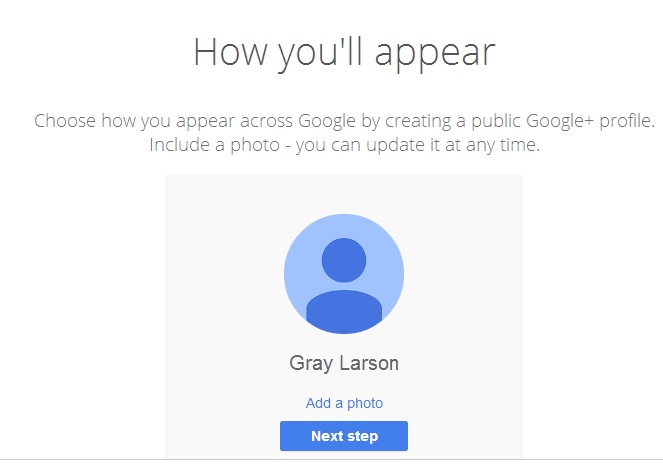
How you'll appear
Choose how you appear across Google by creating a public Google+ profile.
Include a photo - you can update it at any time.
[Link:] Add a photo
[Button:] Next step
This message is misleadingly worded because the phrase "by creating a public Google+ profile" implies that's something you can do, optionally, if you want to. It doesn't really disclose the fact that the profile is being created for you as a side effect of signing up for Gmail. The wording might be interpreted, rather, to mean that your profile will only be created if you upload a photo (which is not the case; your profile gets created regardless). And besides -- what if the user is a novice who went to Gmail.com because they saw all their friends using Gmail.com addresses, and have never even heard of "Google+"? If they haven't consented to their name being added to a publicly searchable database, it shouldn't be their responsibility to know what "Google+" is, so that they can object to their name being listed there.
After you click the "Next step" button, the final page in the account creation process says:
Welcome, [firstname]
Your new email address is [address]
Thanks for creating a Google Account. Use it to subscribe to channels on YouTube, video chat for free, save favorite places on Maps, and lots more.
Note what's conspicuously missing from this message: It doesn't mention Google+ at all, much less the fact that you have unwittingly "joined" it, where other users can find you.
I can think of a couple of scenarios where a user might object to their name being listed in a searchable user database, apart from just "on general principles". If you have a stalker in your past, and they find your name on Google+, it confirms for them that you're probably still alive, that you're probably active on the Internet, and that you're still going by the name that they knew you under. Or, if you have a very unique first name, anyone who knows it could search on Google+ to find your last name, even if you didn't want them to. Similarly, if you have a very unique last name, someone could use the search feature to find the names of your children and other relatives with the same last name, at least those of them that are using Gmail.
And this lack of user consent is a more serious problem on Gmail/Google+ than on Facebook, because most Facebook users create a profile with the general expectation that other Facebook users can find them. Some Facebook users had chosen not to make their accounts searchable -- and Facebook justifiably received a firestorm of criticism for removing that feature and forcing those users' profiles to become publicly searchable after all -- but the overwhelming majority of Facebook users had joined with the understanding that their profiles could be found by others. That's not a valid assumption about Gmail users -- if someone creates a Gmail.com email address, there's no reason to think that they believed they were joining a publicly searchable name database.
Google has tried to mollify people's concerns about emails from strangers on Google+, by specifying that anyone not already in your Google+ circles will only be able to send one message to your Gmail inbox, and will not be able to send more messages until you reply. But this misunderstands the privacy implications in, for example, the stalker scenario. If a stalker ex "Bob" really did find your name on Google+, they might try to tease out a reply by creating a Google+ account under the name of a friend "Alice" you and your ex had in common, and sending you a generic "How have you been doing lately?" message. Since that message probably won't raise any alarm bells (the message isn't asking for anything like a current address or phone number), you might not realize that just by replying, you've already done the damage (the stalker now knows your email address, plus the fact that it's still an actively used account).
Similarly, although you can modify your Gmail settings to prevent strangers on Google+ from messaging you, the ability to change a setting to fix a problem only helps a user if the user realizes when the problem is happening. For example, if the problem resulting from this new feature switch were a deluge of spam from strangers on Google+, then more and more users would get frustrated and look for information about how to stop the flood of spam, and most of them would find out about this setting and switch it off. But for combatting the stalker problem, this setting is useless, because by definition if a stalker finds you on Google+ (and tricks you into replying to a message and revealing your email address), you wouldn't know about that problem until the damage has already been done, at which point it's too late to solve it by changing a setting.
The only way to avoid this risk to people's privacy, would be for Google to ask Gmail users at the time they create a Gmail account: "Do you also want to create a Google+ account, yes or no? This means you will have a publicly searchable profile, and people who know your name will be able to find you." Some people would like to be found, some people would rather not be, and this would allow them to sort themselves properly.
But instead, we have an untold number of zombie Google+ accounts created whenever someone signs up for Gmail, which serve no purpose except to make it possible to find people who never confirmed that they wanted to be found -- all most likely for the reason given by Chris Taylor at Mashable, so that "Larry Page gets to claim increased Google+ user numbers on the next quarterly earnings call."
Who is Bennett Haselton, and why do we care what he says?
Just make it stop. I go to G-Mail to send mails, I go to Youtube to watch videos. If I wanted to socialize, I would have gone to Twitter/SnapChat/Facebook/MySpace (is there still such a thing?)/SecondLife... Google was famous for it's tools being simple, powerful and not forcing anything on the user. Good old days, eh?
Phonebooks weren't a huge problem. Will this really be a huge problem?
Do you wish to have an "unlisted number"? Don't use Gmail!
Frankly, unless they make an exception for commercial Gmail users, I see this as a good thing for other email providers and self-hosting.
One of the reasons i hate Google, along with Facebook and MS and Apple and many other software developers is the forced changes. If this is so good, why not explain your reasoning and allow for an opt-in? Why must we be forced into some sort of change that we don't want or didn't ask for? It's funny because there are so many Google fans and Apple fans and what have you, but these big monolithic software developers don't care who you are or what you want; they'll force changes on you to their own benefit and F you if you don't want it. /sigh. At least hosting a domain isn't all that hard; time to use my own email.
It's the easiest solution and works across all of Google if you simply check the god damn box on the profile page to disable listing/indexing your gmail addy by Google and if you didn't do it during the initial setup or soon after Google gave us the dashboard, you deserve what you get
God damn posting filter - saying I'd posted 47 minutes ago when trying for AC - /. is going to the nuking cockroaches
Mod me up/Mod me down: I wont frown as I've no crown
It seems that Mr. Bennett has truly missed the point. The point is that Google no longer intends to offer anybody a new "Gmail account". Henceforth they only offer a "Google+ account with email features."
In 2014 you should expect that Google will roll this change to their Google Voice product. They will stop offering a new "Google Voice account" and will only offer new "Google+ account with Hangout voice features". After that they will eventually stop offering new accounts for their other products and only offer "Google+ account with feature".
Look I don't like the change, but Apple no longer let's you create an Apple email account that isn't also an iTunes account and they have never let you create a FaceTime account that wasn't also an iTunes account.
In fact a common complaint on Apple forums for years has come from people who originally created separate Apple email and iTunes accounts and desperately want to merge them.
That's very naive. What it means is that Google collects more private data, meta data they can cross reference to target ads and still hand it over to the NSA upon request.
Watch those corners
Bennett Haselton
Age 5
All those slashdotter bemoaning google becoming evil or waxing eloquent about privacy issues or concerned about the victims of stalkers do not form a significant enough chunk of the population to matter. If they were year 2000 would have been the year of Desktop Linux.
sed -e 's/Chuck Norris/Rajnikant/g' joke > fact
My God! It's almost as if they had taken the names, phone numbers and addresses of millions of people and bound them into some sort of large book before distributing said book to everyone's home free of charge! Can you imagine the chaos such a thing might cause???
I started out with a Youtube account then google gave me other accounts and then it said it wanted to merge accounts it created and now I have multiple gmail, youtube, and g+ accounts and I don't know what just happened.
On the Gmail account I use on Slashdot, I had my nickname, which should be the only publicly visible name, set to "GameboyRMH." I couldn't leave the First Name and Last Name fields blank (they were separate back then) so I set them to "GameboyRMH" and "The Cool Guy."
Then one day last year my sister's giggling that I changed my username to "GameboyRMH The Cool Guy." WTF!? Turns out Google decided to expose what was in my real name fields to the public without my consent. At least my caution paid off.
"When information is power, privacy is freedom" - Jah-Wren Ryel
I use gmail because it has by far the best web-based interface I've seen.
Following Snowden's revelations I'd like to switch to something else. Preferably a paid-for commercial email service, but I'd be prepared to set up a server for a good open-source solution. Either way, it needs a good web interface, and my principal requirements are:
o Works well on a small screen (so doesn't try to display the message list and a message on the same screen)
o Is responsive
o Has fast search
Does anyone have any recommendations?
For me, Google blew it when they forcefully merged my gmail and youtube accounts. I've cut back on gmail as much as I can conveniently. But I still use it.
It's hard to leave when you don't have a place to go. I used to have a nice tree of email addresses, and used them to keep email sorted between business and personal, and such like. Then most of the free email providers ended their services, and now I'm down to gmail. yahoo, and hotmail. Oh, and bigfoot still sort of works. If you call frequent delays of more than 8 hours working. (Made it difficult to reset a password on a site that sent out password reset tokens that expired in 6 hours.) Anyway, bigfoot isn't a full blown email service, it's only a redirector.
I could run my own private little email server, but have been reluctant to do so. Apart from the sysadmin work, I'd have to deal with spam somehow. And as I'm using a free Dyndns name, there's no assurance my email address would be stable. (Paying doesn't do much more to assure permanence. Dyndns could always go out of business, or be bought and merged.) I used to have a "homeip.net" name, until Dyndns changed policies and killed half their free names. Now it's "dyndns.info". Guess I can live with that. Just don't force me into godaddy.
At least there is now duckduckgo for search engines. I don't use Google's search much anymore. But what alternatives are there for email these days? Apart from yahoo and hotmail, that is?
Intellectual Property is a monopolistic, selfish, and defective concept. It is "tyranny over the mind of man"
Sure, abolish privacy for everyone who holds a government position. They are working for the public anyway - aren't they.
Build your own energy sources from scratch. http://otherpower.com/
It's been so long ago since I had a land-line account, I can't remember if I was paying $8/month for service plus $6/month to not be listed, or the other way around.
Either way, it was possible for pay the phone company so that I did *not* show up in the phone book. Which I happily paid, as I'm one of those people with a unique name, and previously had a stalker.
Build it, and they will come^Hplain.
Then most of the free email providers ended their services, and now I'm down to gmail. yahoo, and hotmail.
I pay a few GBP a year for a hosted Linux shell account from a local IT firm. I can run whatever web sites I want from it, have it collect and/or forward e-mails and run any related systems I want, etc. It's not free, and neither are the handful of domains I own.
Because I own the domains, I'm paying for the hosting, and everything is set up with real, standardised tools, I can shift anything around any time I want. I can't be held hostage by any business having my data locked up in their proprietary system, or by any one technology that doesn't export things to someone else's alternative platform. This mostly doesn't matter, because I also get actual customer service from the IT guys in return for paying them actual money.
Personally, I download the mail to my main PC, where I run an actual e-mail program instead of relying on webmail. However, I could set up a local mail store on my home network or install any web front end I wanted on the hosted account if some other set-up became more useful.
None of this is rocket science, and there are plenty of hosting companies that will offer a similar basic plan for a modest fee (a small fraction of what I pay every year in, say, phone bills). I also pay a bit more than average to use a good ISP with solid technical specs, clueful people at the other end of the phone on the rare occasions anything does go wrong, things like a static IP address as standard, etc.
Basically, you just have to look beyond free-as-in-you're-the-product on-line services, absurdly cheap junk hosting, and mass market ISPs, and much of the frustration of the modern Internet goes away. It's just a shame that most people don't realise that, so the big name companies continue to dominate and there is a limited market for smaller-but-better services.
If you disagree, post your argument. (-1, Overrated) isn't your personal censorship tool for views you don't like.
This is the nature of the software as a service beast.
With traditional software (Windows OS is a good example), you have three choices, embrace the change, discontinue use of the product, or keep using old product and ignore change.
The 'ignore change' evaporates in software as a service model.
XML is like violence. If it doesn't solve the problem, use more.
In previous stories you've asked for specific writing tips. Here you are: stop using parenthetical asides. This doesn't contribute to your point: (although I don't know what that limit is).
If you want to make this point: conventional email spam grew to unmanageable proportion, you should move that before the conclusion of your paragraph. You should also tighten that sentence up to something like: Conventional email spam grew to unmanageable proportions because anybody with an email server could send out millions of messages per day.
That one change will make your paragraphs more focused, and easier to read. I hope that helps!
How the hell did this make it onto Slashdot. I have asked this question before but this is one of the most narcissistic blowhards to make onto slashdot in a long while.
Just the way he writes is so condescending so as to make me want to do the opposite of what he says. If he recommends 21% oxygen then I might give serious thought as to switching to argon.
I think that 90% of us can agree. G+ is a pile of dung being foisted upon us by some MBAs working at google. As for the spam thing. I just got 2 spam chat requests. I have never received a spam chat request before. Google quite simply is missing the point. Most people want to remain in contact with a small group of select friends. But a few narcissistic blow hards like this tool are so insecure that they think that the whole world is beating a path to their podium and thus they want things like FB and G+ to enable this mentally unstable behavior.
There is a reason why the term is Facebook Friend Whore and not Facebook-amazing-paragon-of-social-amazingness. The problem is that the social networks (Youtube included) are being deceived into thinking that these few unstable folks represent the rest of us; and thus are creating more and more features to enable their behavior. MySpace went straight for the heart of their own network when they primarily tailored their system to enable the worst behavior of rappers, highschool girls and whatnot; the result was that they drove away the regular users.
A simple example of only giving feedback to these self absorbed tampons of human beings is that facebook does not have a dislike button. This way a person might post the 800th picture of their dog being cute and find that the 20 likes are balanced by 120 dislikes. "Yeah you halfwitted oxygen sponge, we all hate your stupid dog now."
BTW I don't even know if Bennett Haselton has a dog; but I hate it now.
Seriously, Anonymous Coward wants to know if this account has enough klout to deserve an opinion? If you think that people's insights are only worthwhile because of their notoriety, your using the wrong account.
Maybe some of us care what he says because he has some good points?
you've already done the damage (the stalker now knows your email address, plus the fact that it's still an actively used account).
So stalkers know the email addresses. What can they do with that information? If they harass the victim they get blocked.
This sounds a little like the "what about the children" arguments.
It allows people to essentially e-mail you without having to know your e-mail address and without being able to send e-mail to you via SMTP.
Think about this for a minute. Spammers and fraudsters like it when they can use botnet-based bulk-mailing tools, because they can send mail quickly and there's no central place that can filter them without catching a lot of false positives. And the filtering fails because it's being done on the receiving end where it has to deal with a lot of unique senders. If I can only be reached through my G+ profile, that doesn't work. The spammer doesn't know my e-mail address, and G+ doesn't accept SMTP. He has to use Google's Web interface, which is harder to do through a botnet-based bulk-mailing system. And his mail will be intercepted and filtered at the sender, not the recipient. Google can identify a unique sender and spam-file them without affecting other senders. Google has an incentive to do this, too. Yes as an account holder I'm their product, but Google's always grasped one thing to a degree other sites haven't: I'm a product with legs. If they annoy me too much, I can get up and walk away. So Google's always tried to moderate how much their service functionality (as opposed to the UI, that's another matter) annoys people. Spammers and fraudsters don't provide any revenue to Google and they annoy Google's product, so Google's got good reasons to filter and spam-file anyone trying to abuse this system and the system makes it easy to do that without nearly as many false positives (which would also annoy their product) to worry about.
Overall I'd only be bothered by this if I were trying to maintain an e-mail address and online identity with no public presence at all. For that I wouldn't depend on any third-party service at all, I'd set up a server on Linode or AWS running my own e-mail software. Linode is $20/month for a minimum-sized server that'll easily handle the load and it took me an afternoon to completely set up e-mail for IMAP and inbound and outbound (authenticated SSL sessions only) SMTP for my domain including spam filtering.
You're confused. Betas are small tropicals. Gsharks would eat betas. Not the other way around.
No need to thank me, I'm here to help.
I've fallen off your lawn, and I can't get up.
creation process. It doesn't mention "public profile" anywhere. It doesn't join me G+ in a sneaky way like described in the article It does prompt me to "upgrade" though, but I don't have to actively avoid it, like some comments imply.
My name there is "- -" (dash as the first name, dash as the second name), can you find me on G+?
TEntireFA doesn't make much sense.
Industrial space for lease in Flatlandia.
I ended up deleting my google+ account over the stupid youtube integration. I'm sick of being bait and switched by that company. I don't WANT people on Google+ to go finding my gmail page, its for work. The invasions of privacy are getting too much to bear. I can't use my own name on Facebook anymore due to the horrible graph search and abuse of it by recruiters, and now google is trying to burn down whatever privacy I have left.
Excuse the Unicode crap in my posts. That's an apostrophe, and slashdot is busted.
I like to limit what social sites get in terms of monitoring my web activity and reporting it to all my Family and Friends all over the world, especially when I"m surfing porn.....
Paul E. Bahre