Slashdot Mirror
Domain: adobe.com
Stories and comments across the archive that link to adobe.com.
Comments · 2,498
-
Re:SVG not (yet?) for presentationAdobe SVG Viewer 3 also supports a SMIL 2 implementation of an audio element which can be synchronized with animations. This would allow you to synchronize your audio narration with your vector graphics animations.
Version 4 of Adobe SVG Viewer (renamed Adobe Image Viewer) also supports synchronization of video elements. Unfortunately Adobe Image Viewer only supports viewing SVG files that are embedded in Acrobat PDF files.
-
no, but Adobe LiveMotion does
no, but Adobe LiveMotion does
-
SVG Support & Mozilla
There is a Mozilla project working on SVG support, but it's not yet seriously usable.
It also suffers from a licensing problem: it uses libart, which is licensed under the LGPL, which (for some reason) means it can't be included as standard in mozilla builds.
There is also an Adobe plugin, which does claim to work with mozilla, but it crashes more often than not -
Re:For idiots like me -
Scalable Vector Graphics -- since it uses formulas (XML entities, really) for specifying where lines and shapes go instead of specifying location per-pixel, filesize will be small. Don't worry about XML verbosity preventing this, as SVG-files often are compressed.
The availability of libraries as Batik makes SVG-generation flexible and easy. One example: One project I was on concentrated on pulling numbers out of a database and visualising them as a graph. Filling a XML-document with values and applying XSLT we had instant SVG. Upside: Very scalable and interactive (our customer was very fond of "hotspots" on the graph). Downside: Lack of plugins. Fortunately, it was for their intranet.
As to impact, I do hope this catches on. I much prefer coding Java + SVG than Flash, if just for the fact that not having the Flash-plugin doesn't prevent my regular development with SVG. -
Doesn't surprise meDespite the constant protestations of many Slashdotters, I've never considered the RIAA to be the great evil monolith it's regularly protrayed as. The RIAA exists to protect its members' interests, but the music industry has always come from a more down-to-Earth, more open environment than, say, the MPAA and the movie industry, which has traditionally been dominated by large media groups.
When the Home Recordings Act was passed, it specifically made sure fair use rights were protected. The RIAA certainly didn't go to the same extremes as the MPAA did when the latter got the DMCA passed into law primarily to support its DVD system.
The RIAA has also always been on the right side of the free speech debate. Hilary Rosen has made numerous representations which, so far, have staved off any credible censorship of music. Beyond a token, meaningless, sop to critics of the "Parental Advisory" label, which has no meaning in law or practice - record shops can and do freely sell such content without checking ages - there's not even a rating system. That there isn't is a testiment to Rosen's abilities to keep music free and open.
Ironically, the worst law the RIAA has proposed to protect its members copyrights is also the most libertarian - a proposal that the RIAA be able to hack into computers it believes are being used by those who violate copyright laws. Clearly, it's a dumb law, but it's symptomatic of an industry that really doesn't want people imprisoned for illegally redistributing its stuff. It's a world away from certain software companies and the movie industry who feel that imprisoning someone who merely makes it easier to copy something is just and proper.
Give the group a break, people. It's made some mistakes. It's made presumptions about Napster, etc, users that it shouldn't have and proposed some pretty whacko solutions, but it isn't evil. The RIAA, on this subject, is seriously misguided. It deserves better than the treatment it gets.
-
Re:OperaShow compatibility
-
Re:NOT the metaverse.In addition to There there (sounds gamatically incorrect doesn't it?) are several other programs" Second Life, Project Entropia, and PlanetShift, the last of which is an open source effort. While some of these programs may share a component or two, such as physics engines, for the most part they have nothing in common in terms of overal design.
You have to dig a bit to tell one from the other, since superficially they have a lot in common. Some of these sacrifice copyright protection of 3D data in order to control bandwidth, in other words they cache stuff to your hard disk. Some allow for creation of new content dynamically, while others require content to be created offline and uploaded, while others don't allow end users to create content at all.
Another system, also open source, which is still in the design stage (with a working prototype though) is VOS. The people working on this are thinking in terms of a 3D metaverse that has properties similar to the web, in that a single "world" can pull element from multiple servers not co-located... sort of a 3D URL. Other concepts are the passing of text and other doucuments between 3D-VR entities. Eventually work like this will bring 3D-VR beyond the realm of game-play and make the notion of spending hours online "goggles on" seem like a more productive activity than it does today.
Finally, there is a totally different slant on this being taken by Adobe Atmosphere where their goal is to build 3D-VR into the web as a standard plug-in hopefully as prolific as Acrobat is today. Rather than replacing web based content or ignoring it as some of the products above tend to do, Adobe hopes to make 3D-VR a natural extension to existing web pages.
With so many programs taking radically different approaches and all about the same time-frame for release, it will be hard to say that this concept won't work, unless you are talking about a specific product.
None of these may turn out to be the Metaverse (in the Snowcrash sense), but from these first steps I think something like the Metaverse might arrise. Hopefully in the end it will not be run on a central set of servers somewhere, nor will one company have a copyright on the technology. I think either of those two factors will be the biggest limiting factor to thise technology.
-
You keep using that word...
Someone out there in the world makes a living as a Web accessibility consultant???
...I do not think it means what you think it means. They are talking about access for differently-abled persons, as covered by the Americans With Disabilities Act and equivalent foreign and international laws. See access.adobe.com for an example. -
Re:Degrading gracefully
"Degrading gracefully" (nice terminology) I would think would be part of whatever streaming model format was used. I've seen a couple of applications that use techniques like this, but they always failed with the interface. "There" seems to have done a much much better job on this than most previous attempts.
Adobe Atmosphere was a decent attempt at something metaverse like in terms of flexability, but I think it had two major flaws. One, the interface was just horrible, and two, it relied too heavily on existing web architecture. I think a true metaverse implementation will need to be removed from the web.
Although, if someone wanted to write an in-game web browser, I think that should be completely possible
but... I dont see that as happening anytime soon. -
Re:Good News
You can actually get real
Or you can use this nifty new tool to generate HTML sets, then read away on any number of devices - Plucker optimized for the Handera330 is a personal favorite, but... -
Re:Photoshop is not much more expensive than PSP
Photoshop Elements? What a joke!! Yeah, and my moped can kick the crap out of a Ducati SS800. Have you even used Photoshop Elements?
Real Photoshop is $610 per seat unless you want to get into volume licensing. -
Re:Photoshop is not much more expensive than PSP
Photoshop Elements? What a joke!! Yeah, and my moped can kick the crap out of a Ducati SS800. Have you even used Photoshop Elements?
Real Photoshop is $610 per seat unless you want to get into volume licensing. -
Photoshop is not much more expensive than PSP
and we spent several thousand dollars to placate them, instead of a few hundred for Paint Shop Pro.
Really? Jasc Paint Shop Pro starts at $82 for one seat. Adobe Photoshop Elements (Photoshop minus prepress) starts at $100 for one seat. Thus, unless you have a bunch of people working in prepress, Photoshop isn't much more expensive than PSP.
-
Re:Here are general directions that you can go to.
Well...since you brought up suggestions for implementation, I thought I'd throw out the quick-n-dirty implementation that I'm planning to make her life easier.
The requirements for my project are pretty simple since my mother only uses two forms in her billing (there are a myriad of other forms, but she doesn't see clients that necessitate the use of those forms).
So, my plan is to write a nice little palm app to handle the data entry component (easy to take to the office.) Then write a little "glue" component in C++ to use FDF to output PDFs which she can store instead of her word documents. Since creating PDFs basically solves all the nasty printing issues, it seemed like an easy way around a lot of the hassles that implementing it from scratch would entail.
If I were implementing a solution for a much more generalized segment of the psychological community, I might be inclined to include more database functionality like you suggested, but my mom doesn't need that. I might still use the FDF stuff...its pretty darn cool for anything that requires data be printed in a pre-defined format. -
They "open"ly tell you that they won't tell you.You wrote:
FYI, PDF is an open document format. Adobe released it a while back. Anyone can create or view PDFs without licensing or purchasing anything from Adobe.
Look closely at Appendix E of the PDF Reference Do you see the requirement to register all plug-in names with Adobe? Do they publish those anywhere?
And how did Adobe treat Dmitri Skylarov when he "opened" one of their PDF-compatible formats for them?
Or perhaps you'd like to become the first person to publicly document the PDF format's default encryption filter? Although the Reference encourages the use of it's first optional filter (an RSA-developed and patented algorithm), the default remains part of the spec, undocumented.
Does this seem "open" to you?
The goal of Adobe's PDF format has little to do with facilitating the open exchange of information and more to do with promoting the brand name of Adobe Systems Inc.
-Rick
-
CHECK OUT THE LINK ADOBE POSTED!
I don't know what's more unbelievable. That Adobe posted this link or that no one on
-Go to Adobe's press release.
-Scroll down to the last question.
-Click on the US Attorney's office link.
Something tells me that Sophy's going to be getting a lot of revenge real soon... LMAO! -
Re:What is going on here?
Err... http://www.adobe.com/aboutadobe/pressroom/pressre
l eases/200107/dmca.html It put in a space for some reason -
Re:Throw it out?
-
A Students' Perspective
I'm a film student at the moment, and at this point I've used most of the options out there-- my school's friendly like that. For what it's worth, here's some opinions.
You've basically got three choices in software when it comes to editing-- Premiere, Final Cut Pro, and Avid. Anybody that tells you that combining Photoshop and After Effects will suffice is apparently only interested in color correcting some darn pretty titles.
First off: Adobe Premiere. I've used it on both PCs and Macs, and it's the suite to which most "prosumers" will probably have access. Guess what? It sucks. Plain and simple. Sorry.
It will allow you to cut and paste and do your standard basic functions, but guess what: so does iMovie. It is the buggiest program that Adobe releases. It seems the only guaranteed feature of Premiere is that it will crash two minutes before it's done rendering, and corrupt your video files.
On some projects I've spent more time repeating steps due to crashes than it took to shoot the thing in the first place. Don't make the same mistake of using it.
Second: Avid. Probably out of most everybody's hands, because of cost, although it is the professional choice. Approximately 95% of television work and 80% of film features are edited on Avid, IIRC, but it's pricey to get the full hardware suite. They offer several levels of product-- Avid Xpress is the simplest, and will still run you $10,000. It's the only one I've used. It goes up to Avid Symphony, which is basically the same package, but with better hardware, more features, more possible video and audio tracks, etc.
My complaint with Avid is that it's not very user-friendly. Their dialogs tend to be tiny icons with no explanatory text. If you're going into the field, it's a system worth knowing, but the learning curve is high.
(Incidentally, Avid has just released a stand-alone software program to compete with Premiere and Final Cut, called Avid Xpress DV. Haven't used it, but it's apparently very similar to the rest of its family. So beware.)
And then there's Final Cut Pro. It's only available for the Mac. This is unfortunate, because IMHO, it's by far the best program out there. Easy to use, a wide array of features, moderate learning curve but decidely worth the hassle. Get yourself hooked up with a dual-1.25GHz G4 machine, and you can render scenes in less time than it takes to make a sandwich. This thing has color correction, titling, and just about anything else I've needed so far, within the framework of one program. No jumping around. Stable. Simply beautiful.
The final verdict? For the cost of the basic Avid, you could buy yourself two top-of-the-line Final Cut Mac workstations. Going from Premiere to FCP is a revelation, and I'd recommend it to anybody interested in the field. At home I'm a PC guy, and I've still got to say the Mac is the way to go.
Just be sure to buy yourself a two-button mouse, then you're all set. -
Re:Wow, those are some pretty pictures
I'm sorry, man, but that's just a load of shit. I have stopped counting the times that I've had to reboot my Jaguar workstation in the school's art lab after it failed to handle some bizarre error in Classic environment. It just gets worse with every release; you'd think that they'd want to provide something decent, considering that major apps like Quark still don't exist as OS X-native code.
I'm sorry, man, but that's just a load of shit... too. Apple has been very clear about the future of Classic - there will be very little improvement of the environment. Now, Quark is a special case (and I think you know that), but most apps work reasonably well under Classic. I used Photoshop 5.5 in Classic until 7 was released, and although it's not ideal (startup of Classic was an exercise in patience), it works. That was the typical experience I had with Classic apps.
The only time I ever have to reboot my Jag boxen is after a software update that requires reboot. (Dare I say it here?) My Macs are every bit as stable as my Linux boxen. Based on comments I've seen here and elsewhere, I doubt that that my experience with Jag is unique. It's a helluva bit more than a 'marginal gain in stability'.
I think it's horribly unfair to characterize that fact that Quark isn't native yet as somehow being Apple's fault. Quark are dragging their feet and are, in my opinion, solely responsible for the fact that they're not expected to have X native code any time soon. There was a bit of discussion about Quark over on macosx.com a little while back. The interesting thing is that "In a Macworld Online readers poll, 91 per cent of respondees said they are either considering an alternative to QuarkXPress or have already switched." The feeling I get from all of this is that the only reason that Quark hasn't switched to native is that they feel they don't have to. Their market position in DTP seems similar to Microsoft's in Desktop OS.
Have you looked at InDesign?
-
Photoshop is cheap, but GIMP is Free
sure they do! afterall, photoshop is free isnt it?
Photoshop Elements is neither Free nor free, in fact it costs $100, but GIMP is just as powerful and is both Free and free.
-
Re:Adobe SVG/Moz Plugin works fine for me...
AdobeSVG plugin for Mozilla on linux works fine for me.
Filter
. -
No, SVG is real nowThe 1.0 spec has been out for yonks already and there's an active SVG developer community out there.
Adobe has been distributing SVG viewer as part of the Acrobat 5 download for over a year now.
Nobody's waiting for Microsoft to innovate SVG or do their XDocs whatever thing; check these static examples generated from MS apps with SVGmaker: Excel, PowerPoint, Word, Project
For building SVG web applications its true that there aren't comprehensive IDE tools available yet, but that hasn't stopped developers from creating some definitive web apps with simple home grown tools (starting with a text editor since SVG is just XML).
Like this interactive logical diagram
Check this awesome mapping example
And this wonderful airport flight management app.
-
Re:svg-capable apps?
Adobe has an SVG plugin for Mozilla.
-
Re:So is this going to replace Flash?
The big difference between SVG and Flash is that SVG is an open specification, not one which is the property of a big company, Macromedia. Although there's never a guarantee that a big company will ruin its specification (HTML by Microsoft for example), it is not likely. SVG itself doesn't have audio capabilities, but SMIL has. In SVG you can incorporate SMIL to use audio. SVG has also some problems. It's XML, so it's text. This means that it can be quite a lot of data you have to send over the net. Or you can compress it (only zipping method which is supported by the 1.0 recommendation is gzip, this can have change), but then it should be decompressed. After this has been done, it should be parsed by the SVG viewer (like adobe's). Although there's still more support for SVG, there aren't much viewers available for SVG in browsers. Even Adobe's viewer hasn't been updated in a year! But on the longer term I'm sure SVG will be much larger than Flash. Macromedia was keen enough to jump in the hole when there was need for vector graphics. SVG came too late to make it as successfull as Flash instantly. I think the fact that Macromedia owns Flash, while SVG is an open, public standard, will make the difference.
-
Render, modeller, compositor
First thing, you should be careful with your terminology.
A modeller lets you create models and scenes. A renderer turns these scenes into 2D images. A compositor lets you turn these 2D images into other 2D images, and usually also lets you assemble them into single-file animation formats. Don't expect to do any "real" 3D work without at least one of each.
It's confusing because many modellers have renderers built in. They are usually inadequate for complex jobs. (Though, in fairness, one blockbuster 100% computer animated feature film has been made using Maya's built-in renderer, so it's not exactly useless.) However, thanks to the wonders of Open Source, the modeller is now the only part you have to buy.
Here's what I suggest:
- Get Maya Complete. This will cost money.
- Get Liquid, which will cost you nothing. This will export Maya to RenderMan(TM).
- Get Aqsis, which will cost you nothing. This is your renderer. It is RenderMan(tm) compliant, which is the de facto standard for communication between renderers and modellers.
- Get Cinelerra, which will cost you nothing. This is your compositor. (Available only for Linux, unfortunately, but it's free.)
If you find yourself making money with these, you can replace and augment bits if you find them not doing what you want. (For example, replace Aqsis with RDC or PRMan and replace Cinelerra with Shake or After Effects. You can even augment Maya with Houdini or SoftImage if you feel like spending money.)
The key here is to stick with standards so you can drop in replacements into your production line.
Good luck.
-
You're an idiot, and so are the moderators.
PDF isn't a very good format either because Adobe controls the spec. It isn't open.
Yes, this is why it isn't documented anywhere. You certainly can't create your own free PDF creation utility or anything.
Plz look around b4 u make assumptions.
- A.P.
-
SVGWhat might "kill" PDF is the sneaker-technology, SVG. As anyone who's done a lot of SVG knows, SVG is missing support for only one feature that would enable it to replace HTML and PDF -- support for text flow control. The 2.0 version of the SVG spec (4.2/2/2) will include rules for this support.
Since Adobe itself is heavily into SVG, it (SVG) is positioned to become the leading display document format. This is, in some ways, ironic, because most people think of SVG as an image format.
Consider:
- Autotrace will generate PS (PDF's older brother) and SVG (among other things)
- FOP will generate document output as PS, PDF, and SVG (among other things).
- Most vector graphics programs for Linux have some SVG support, and Sodipodi uses SVG as its native document format. Open/StarOffice will generate SVG as well.
-
Re:PDF is to XML, as Acrobat is to XDocs
If anything, XML will be the PDF-killer. Adobe trapped themselves into a corner when they devoted themselves to a proprietary file format instead of using XML.
XML COMES! XML CONQUERS! XML is the best thing since the sliced bread! XML RULES!
Ahem.
PDF isn't exactly a closed format. PostScript wasn't exactly a closed format either.
PostScript was designed from ground up to be a page description language. PDF was based on ideas from PostScript.
XML, on the other hand, was designed to mark up content in semantic way. The whole idea was NOT to make something that describes the layout, but rather the structure of the content. The layout was left for other technologies.
XML will definitely not displace PostScript or PDF as a page description language. As a content format it's a great thing, perhaps, but not as a print format.
-
No Open Office Visio replacement
There isn't really a good alternative to Visio of the same quality of open office. I believe Visio is the only missing piece for me to switch completely to Linux, because there are a lot of Word docs with embedded Visio diagrams that cannot be correctly rendered by Open Office. I wish Open Office had a Visio replacement. Perhaps the OOo Chart project will grow up to be that missing component.
Another minor quip is that there is no PDF export from Open Office that correctly renders document links and references as PDF links the way Adobe PDFMaker does it. Maybe it will come in some future OOo versions, however it doesn't seem very likely to happen soon. The announced PDF export feature seems to be just another link to printing to PDF via ghostscript.
There are also some attempts related to the KDE project worth evaluating.
-
Report is written in Word
Open with Acrobat Reader, File->Document Properties->Summary... reveals:
Title: Microsoft Word - 3DB823B-1ABD-0AA6.doc
Furthermore, the PDF file was created by http://createpdf.adobe.com - which allows one to upload files and have the processed into PDF - 15 for free, more for $$$.
Seems like they didn't find out that ghostview allows you to generate pdf files as well as view them...
-
Re:I could swear....
That is correct. Fonts (the files) themselves can be copyrighted but I not know if the ones that ship with the OS are. Just as an example, Adobe charges about $30 - $50 for recently released decorative fonts when purchased in individual packs. They get $8,999 (yes, that's right) for 2,750 ($3.27 per) fonts if you buy them in bulk. Imangine what the printing houses that publishers use to print their stuff have to pay for all of those fonts. Adobe is not the only one people use and the printing house has to have their own copy for their presses.
-
Re:I could swear....
That is correct. Fonts (the files) themselves can be copyrighted but I not know if the ones that ship with the OS are. Just as an example, Adobe charges about $30 - $50 for recently released decorative fonts when purchased in individual packs. They get $8,999 (yes, that's right) for 2,750 ($3.27 per) fonts if you buy them in bulk. Imangine what the printing houses that publishers use to print their stuff have to pay for all of those fonts. Adobe is not the only one people use and the printing house has to have their own copy for their presses.
-
There may be much more to thisI just posted this to my site. Please let me know if you have anything to add! DDOS Attack on Root DNS Systems Called Largest Ever
Those of you who actually took the time to read my essay, "Cyberwar: How Terrorists Could Defeat the U.S., and Why They Won't," (requires Acrobat 5, not 4.) might get chill running up your backs when you read this. I'm still sticking to my original thesis, however: The Internet won't be brought down by terrorists because corporations and governments need it, and the terrorists serve the interests of corporations and governments. Regardless, I hope this DNS attack isn't a prelude to a bigger operation. Note how they say that it just ran for an hour and then stopped! Note this story, which detailed the creation of attack zombies with P2P capabilities, allowing them to be targetted at will. Also note that a top infrastructure protection analyst was just killed by the Maryland area sniper! And within a couple of days we see the largest DDOS attack on root DNS systems ever!? (Long Pause) Keep a sharp eye out for weirdness, folks, something BIG might be coming down:
Here's what I wrote back on September 14, 2002:
Maybe the terrorists start taking out some or all of the thirteen root domain name server systems (I think there are still 13) or interrupting communications to those root servers [today's DDOS incident]. (Thankfully, a couple of these systems are located in places that have people with guns guarding them.) These root servers are used by thousands of other lower level domain name systems and receive about 300 million requests per day.
Domain name systems are used to translate human readable URLs, like www.cryptogon.com into machine usable IP addresses like 209.115.132.59. There is much concern about the root DNS systems. Many articles on this topic are easily accessible. Much of the concern, however, is focused on hackers DOSsing the root servers. Again, this misses the point.
What is the physical security like at the non-military root DNS facilities?
I've driven by one of the buildings hundreds of times because I used to live near it. It looks just like any other small office building. How long would this place hold up against a few armed terrorists who were willing to die TO BRING DOWN A ROOT DNS NODE? Think about it. The same goes for the data centers mentioned previously. Surely these places should have armed security. But even if they did, are they prepared to stop terrorists who have no intention of ever getting out alive?
Here's what just happened:
The heart of the Internet sustained its largest and most sophisticated attack ever, starting late Monday, according to officials at key online backbone organizations.
Around 5:00 p.m. EDT on Monday, a "distributed denial of service" (DDOS) attack struck the 13 "root servers" that provide the primary roadmap for almost all Internet communications. Despite the scale of the attack, which lasted about an hour, Internet users worldwide were largely unaffected, experts said.
FBI officials would not speculate on who might have planned or carried out the attack.
David Wray, a spokesman for the FBI's National Infrastructure Protection Center (NIPC), said the bureau is "aware of the reports and looking into it."
DDOS attacks overwhelm networks with an onslaught of data until they cannot be used. According to security experts, the incident probably was the result of multiple attacks, in which attackers concentrate the power of many computers against a single network to prevent it from operating.
"This was the largest and most complex DDOS attack ever against the root server system," said a source at one of the organizations responsible for operating the root servers.
-
Oh that After Effects magic"After Effects can't continue: magic spell failed on a topic (40::50)."
This error message has been known to show up in Adobe After Effects 4.0 and higher. Note that one of the solutions given by Adobe is to use version 4.1-- but apparently, that doesn't really work. If I remember correctly, this bug has appeared on coworkers workstations while using AE 4.1 or AE 5.0. Also, none of us use bitmaps...
I've never gotten this error message myself, so I don't know exactly what sort of magic is running this program, or what topics are failing. o_O
-
Re:Truth in advertising?
Postscript Printer Descriptions are not drivers, they're files that describe the characteristics of the printer -- available page sizes, number of trays, maximum imageable area, that sort of thing. They're not necessary for basic functionality, but you need them to take advantage of envelope feeders, duplexing, etc.
-
No Suitable Editors
Essentially your choices are Adobe Framemaker (~$800), Lyx (Open Source) and XMLmind (Freeware). There may be some others, but these are the ones I've looked at. These are the ones you can use like a WYSIWYG, but are more WYSIWYM (What you see is what you mean). For more info on WYSIWYM, look at Lyx's site.
DocBook is a great spec, but the editors suck for the most part. Lyx can't import DocBook in reliably, and your Docbook is stored as a lyx file (latex I think). Lyx's Docbook stuff can be a bear to set up, even on a system like RedHat where most of the software comes installed. I only recommend Lyx to people who have experience with Lyx, to someone who just wants to write docs, it tends to be more trouble than it's worth.
Framemaker will probably do everything you want and be a godsend with lots of nice features, but you'll pay for it, $800 for Win/Mac and ~$1300 for Unix.
XMLmind is pretty cool, it does Docbook well but is a little slow, it has a little bit of a learning curve, but is prolly the best Docbook editor I've found for free. It's not Open Source though. It is written in Java, so you might have some speed issues, depending on the platform you run it on. I've been recommending XMLmind to everyone I know that asks about Docbook, it has a tree view of the DOM as well as a WYSIWYM view with stylesheets applied on the fly. It has property editors and a pretty smart insert tool that follows the DTD, only allowing you to insert allowed tags into other tags. It feels like more of a programmer's tool than Framemaker, but it should be fairly easy for most WYSIWYG users to adjust.
<rant>
I don't understand why on God's green earth OpenOffice or Abiword or KOffice, or anyone else in the OpenSource world has neglected this area. It's been three years since the LDP went to DocBook, GNOME uses DocBook as their doc format. Why in the hell don't we have decent document writing tools when everyone is always screaming about the lack of documentation in the OpenSource world?
If we want more docs written, it needs to be easier to write them and shouldn't involve learning all about SGML or XML engines as well as a markup language to do it. DocBook is too big to keep in my head and I shouldn't have to think hard about how to write docs when my focus is the content I want to write for. Organizing technical info on a difficult subject is hard enough, stopping every five minutes to look up a DocBook tag or trying to better understand the structure is a huge barrier to getting the work done.
</rant>
But that's just my $.02 -
PDF alert!That link points to a pdf file. Pity the
Anyways Adobe has a pdf translation engine here. Just punch in the URL
-
Re:Color dimensions
Then why is it alway represented by a two dimensional pallet?
Always? 2 3 4 5 6 7 8 9 10 11 12 13 14
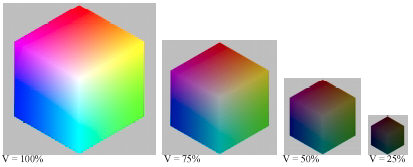
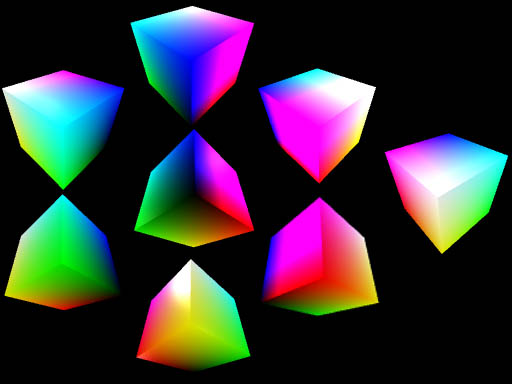
It is often represented two dimensionally because it is difficult to display it three dimensionally. Two dimensional displays most often display Hue and Saturation and completely discard Value.
Color can be coded as RGB (Red/Rreen/Blue) or HSV (Hue/Saturation/Value) or HSL (Hue/SaturationLightness) or YCbCr aka YUV aka YIQ (used in TV) or CMY (Cyan/Magenta/Yellow) or L*a*b* or XYZ. It always requires exactly three components. Note CMYK uses 4, but K is redundant, it improves the quality of ink printing.
it isn't "exact" either, since many humans are missing at least one of the dimensions.
That is precisely why I included the word "normal" in "normal human vision".
- -
Get advice from somewhere else
Actually I think
Might I suggest two general approaches?
First of all, talk to actual customers in fields where they spend money on this sort of thing. Use a group like the American Institute of Architects or the American Society of Mechanical Engineers to reach the people who actually *do* flythroughs and renderings and see what they want from such a product. You may also find that talking to folk at a second-string engineering school (Stevens or RPI rather than MIT or CMU) you'll be able to get plenty of eager beta testers as unlike the more famous places, they don't get as many offers but they've got plenty of brains.
A variation on that would be to check out reviews of products in magazines like Architectural Record, and further, write to the relevant editors (not phone, you want to make it clear that you weren't just bored and calling on a lazy whim) and see what they've got to say.
This page will give you a solid start on relevant organizations and variables.
Secondly, the current situation of having to use five different programs to finish the job is a little silly. I continue to be amazed by the frequency with which I hear somebody say that they do the sketching on paper or with something like Illustrator, then do the technical work in something like AutoCAD, drop in some people from Poser, then export to something like Maya, fix the resulting problems and render there, and then do final changes in Photoshop. Meanwhile stereolithography outputting is moved to something like Lightyear or Buildstation.
Might I suggest a rigorous NURBS implementation with an intuitive basic functionality such that an item can be rough generated with a PowerGlove/Glasstron UI and make it all the way through the process right to render, animation, and outputting of models. I know that it's a lot to ask but, hey, you *said* that you were ambitious. In fact, I suspect that if you can do a system such that you sell a $50 crippleware version through places like Download.com and the serious version elsewhere, you'ld be able to build your user set quickly and also get to market faster.
A side note is that the ability to generate objects for systems like Adobe Atmospherewould finalize the build once-use many times paradigm that I'm talking about. After all, how much overlap is there between these communities? I'ld say considerable, and if gamers can then use the objects they created for one part of their lives in another, they'll be happy campers.
Best of luck to you,
Rustin (former techie for Sweets, Arch. Record, Design-Build, This Old House, Index, Woodworker, etc.) -
Re:Word is Dead.Basically all you're saying is that the employees should just write copy, and some program should automatically set the type using some preset template (it isn't really relevant what format the copy is in; copy/type is a different distinction than structure/presentation as one deals with the English language and the other deals with programming language). This is exactly the way things have been done for a long time, it's just that many people have lost the distinction between copywriting and typesetting now that you can do it all at once in word processing apps.
Sometimes this is a good thing (when you want to get out a unique document very quickly) and sometimes it isn't (when people with no training in typesetting are sending out memos with four different fonts and underlined text). This semester I've forced myself to write all my papers in BBEdit and then set them in InDesign, and I must say that while it adds a few minutes to the process, by preventing yourself from getting lazy you get much better looking and consistent documents.
-
Re:But... whats up with the quoted price of InDesiAlthough a price tag of $399 is listed on that page, but it is for a different piece of software called GoLive. Adobe is selling the full version of the software (at this page) for $699, which is the value Apple marked on their site and mail-in voucher.
Of course, you can probably find the software a bit cheaper through places like macmall.com, CDW or Insight. But if you are already in a market for a new Mac, free is still much better than $699
-
But... whats up with the quoted price of InDesign
-
Don't waste the stamp.
Adobe has ported Photoshop 7.0 to OS X. Here's the link.
It's been out for a few months now.
-
Even funnier!
AFGA uses Adobe fonts in that document, and none of their own! See Rotis and Plantin.
-- pdffont reports these fonts:
JAFADN+ATRotisSerif
JAEPOI+Exlibris-Bold
Plantin-Italic
Symbol
JAIMNO+Exlibris-Bold
JAI NCD+ATRotisSerif
JAMJLC+ATRotisSerif
JAMKFK+Exli bris-Bold
JBBHAD+ATRotisSansSerif
JBBFNC+Exlibri s-Bold
JBBGBH+ATRotisSerif
(I couldn't get adobe's name out of the pdf, but I assume these trademarks are exclusive to adobe) -
Even funnier!
AFGA uses Adobe fonts in that document, and none of their own! See Rotis and Plantin.
-- pdffont reports these fonts:
JAFADN+ATRotisSerif
JAEPOI+Exlibris-Bold
Plantin-Italic
Symbol
JAIMNO+Exlibris-Bold
JAI NCD+ATRotisSerif
JAMJLC+ATRotisSerif
JAMKFK+Exli bris-Bold
JBBHAD+ATRotisSansSerif
JBBFNC+Exlibri s-Bold
JBBGBH+ATRotisSerif
(I couldn't get adobe's name out of the pdf, but I assume these trademarks are exclusive to adobe) -
Re:wow, MS is brilliant
We must not forget "Export to PDF".
There is a way you can create PDFs from *any* program, and with all free software too:
Adobe's free PostScript printer driver to output to PS
Then GhostScript and GhostView to quickly convert the PS to PDF format. -
Re:not TrueType, OpenTypeopentype overview
Yes, and would this switch be motivated by MS owning more patented IPR in it?
-
Re:An education in font terms woudl be nice first
So Andale Mono is not a mostly-sans font. But there exists at least one font which fits this description: Rotis is a very trendy font these days and has a whole range of fonts between entirely sans and entirely serif. The mostly-sans is called Rotis Semisans.
-
not TrueType, OpenTypeOpenType succeeds TrueType and Type1 fonts. It's a better format.
-Kevin