Slashdot Mirror
Domain: aerospaceweb.org
Stories and comments across the archive that link to aerospaceweb.org.
Comments · 158
-
Re: 940 mph? Boring... a .357 flies that fast
You can do mach 5 using a hydrogen-powered ramjet on a waverider airfoil, according to theory.
The design would seat a lot of passengers.
The Scottish Rocketry Society produced a waverider before NASA had even been satisfied the theory would work.
Nobody has come close to producing a commercially viable waverider of the necessary design.
-
Re: 940 mph? Boring... a .357 flies that fast
You can do mach 5 using a hydrogen-powered ramjet on a waverider airfoil, according to theory.
The design would seat a lot of passengers.
The Scottish Rocketry Society produced a waverider before NASA had even been satisfied the theory would work.
Nobody has come close to producing a commercially viable waverider of the necessary design.
-
Re: Hudson River
100m/s eh? I dont think so
Why not? 100 meters per second is about 225 miles per hour. Take off speeds are slower and cruising speeds are faster, so shortly after takeoff, 100 meters per second doesn't sound unreasonable.
-
Did he check the math?
Centripital force is
F = mv^2/r
or a = v^2/r
At a typical takeoff speed of 150 knots, the lateral acceleration needed to keep the plane centered on a round runway with a 1.5km radius is 3.97 m/s^2, or 0.40g. On a freeway you'd just tilt the roadway based on the expected transit speed (about 24 degrees for 0.40g). But with a circular runway, planes are going to be traversing every part of it at all speeds from 0 to 150 knots, so there's no single tilt which will eliminate the problem. Likewise, during the takeoff roll the required lateral force will increase with velocity. So you can't just tilt the wheel/joystick at a certain angle and hold it there while taking off. You have to constantly adjust it as your velocity increases.
If a plane has to make a no-flaps emergency landing at 200 knots (which also happened to be about the regular takeoff speed of Concorde), now you're talking a lateral force of 7.06 m/s^2, or 0.72g. Which brings us to why runways are straight in the first place. It's not because it's easier to design and build. It's because it's a stable travel path. If for whatever reason during takeoff or landing the plane's controls stop working, the plane will want to go straight. Making the runway straight means the plane naturally (and with a little luck) will stay on the runway. Making the runway round means if you lose that lateral force being applied by your control surfaces for whatever reason, the plane is guaranteed to depart the runway at speed. -
Re:Good, then we can scrap that stupid f-35
For comparison purposes, the F-16 has a mishap rate, per 100,000 flight hours of 4.14 (apparently making it the safest single-engine multirole fighter around). The two-engine F-15 has a lower rate, at 2.47; but the F/A-18, also two-engined, has a higher rate, at 4.9. Source. These three aircraft are all from roughly the same era, so teething problems should affect them equally.
-
Re:It is not a justification for more surveillance
How did we ever fly safely before we got groped and fondled?
We never did — passenger airplanes have always been a very attractive target for terrorists, because even a small explosion inside one would kill everyone aboard. Horrible death too, I might add — for the majority aboard, who survive the initial explosion without any injuries...
I do not like TSA, their groping and their confiscations of pocket-knives, etc, and I think it was an utter folly for Congress and Bush to nationalize airport security in 2001, but the GP made it sound like security is useless and that was just wrong.
If you want to strawman
What are you talking about? The "insightful" Joce640k did say, there is no need for airport security, because these explosions happened outside of the "sterile area"...
-
Re: I'll save you
Also show me a helicopter with a 500 mile range.
OK. I'll do a whole lot better than that. I'll show you one that set an unrefueled distance record of 1923.08 nautical miles 50 years ago. And it was a small, very unimpressive looking helicopter with no edgy experimental or radical qualities, and only cost $19,860 in 1966 dollars. The model is still being produced today, by the way.
Granted, one has to differentiate between useful operating radius and max ferry range (possibly skimping on fuel reserves). But it's very hard to pin down figures for operating radius vs useful load carried, and you didn't specify anything beyond "range".
-
Re:Meh.
> and a Miele design will hit an L/D ratio of ~14 at low Mach numbers
Link?
Since you missed it in the first post: http://www.aerospaceweb.org/de...
-
Meh.
Meh.
Hydrogen is a lot cheaper as a fuel, unless you source it stupidly, like they did in the article (they assumed no use of methane precursor, only electrolysis), and a Miele design will hit an L/D ratio of ~14 at low Mach numbers (e.g. Mach 2), which compares favorably with the Boeing 747 L/D ratio of 17 at Mach 0.85.
A Miele design will drop to an L/D ratio of about 7, but it takes going Mach 30 to get there. You can easily do an L/D ratio of 8, if you don't plan on going over Mach 5 with the thing -- and methane derived hydrogen fuel is far cheaper than jet fuel.
http://www.aerospaceweb.org/de...
My take-away on the article was: written by someone who doesn't want sonic booms (he states that the Concorde had booms as loud as 135 dB, but states in the same sentence that booms are 160 dB.
-
Re:The Apollo Engine
WHICH one?
Yeah, you figure in an earth to LEO vehicle that we'd be talking about a J2, or one of the LEM engines? Of course he's referring to the F1 engines.
Perhaps I need to explain here my dowmoddingest friends.
The J2 engine was not designed to be run at ground level. It's thrust nozzle was designed to run at altitude, with it's 27.5:1 expansion area ratio That's wide, and not efficient at sea level. In contrast, the F1 has a 16 to 1 ratio. Much more suited to lower altitude work. It's all related to the external pressure the rocket faces. Here's a pretty good explanation.
http://www.aerospaceweb.org/qu...
Anyone look at the ill fated Spacex launch? before it self disassembled, it was operating in an area beyond it's most efficient operation. You could see the much wider expansion of th exhaust.
Ideally, a rocket motor would adjust the throat to exhaust ratio for best efficiency, but that would be too expensive. Probably very heavy, and possibly complicated.
The J2 is designed to be restarted also.
There were some other engines on the Saturn V rockets also. The Aux Propulsion System or APS, provided roll control while using the J-2 engines. The APS used a single SE 7-1 engine, and three TR-204. engines. They were hypergolic engines. Here's a nice descriptive page: http://www.collectspace.com/ub...
So while the fellow who asaked the original question gets downmodded to 1, the caffeine fueled maniac who thinks he knows all about Rocket engines, is modded up to three. I'm catching a couple downmods to 0.
Anyone want to accept the challenge of explaning why anyone who obviously didn't know a lot about the Saturn would be referring to the J2 or APS engines - obvious specialty engines, and the rager who missed four of the engines on the Saturn V is modded as insightful?
Or does missing over half the engines on a rocket while acting like an expert qualify one as insighful on slashdot these days?
-
Re:Dogfights?! What year is it?!
On the plus side, the F-35 has an impressive GAU-12 25mm gun. It boasts a plentiful 180 rounds (F-35A internal gun), or 250 rounds (F-35B external mission pod). Given a rate of fire around 3600/min they ought to last even protracted battles.
Given the rate of fire it is emptied as fast as the usual LTE flatrate here. About 4secs to empty the big magazine.
-
Re:Dogfights?! What year is it?!
-
Re:So who did it first? MIT or Mythbusters?
No. Dimpling and pebbling to improve laminar flow have been known for many years by people and many hundreds of thousands of years by dolphins.
Dimpling and pebbling is there to disrupt laminar flow; to introduce a small, turbulent boundary layer in order to reduce wake drag. If you compare the streamlines of a ping pong ball to a golf ball, the flow is laminar longer around the ping pong ball, but the flow separates sooner, creating a larger wake. Here is a more thorough explanation.
That also raises the question: do the dimples really help everywhere on a car? I'd love to see some wind tunnel testing and CFD analysis of the Mythbusters' dimpled car. An 11% improvement is pretty significant, but there are lots of uncertainties: weight differences, center of mass differences, how aerodynamic the car was in the first place... I strongly suspect that, in general, it would be more helpful to only introduce dimples at strategic locations: i.e. the bumpers, undercarriage, and other body panels where the flow eventually separates.
Also, aren't dolphins pretty darn smooth?
-
Re:Oh how I love this game!
Maybe I can help.
Debunking the 9/11 Myths: Special Report - The Pentagon
Hunt the Boeing!
911 Debunked - Pentagon Flight 77 Photo Evidence
Pentagon & Boeing 757 Engine Investigation
Pentagon 9/11Debunking the 9/11 Myths: Special Report - Flight 93
9/11 investigators tell of piecing together mystery of Penn. crash
Direct Evidence
9/11: The Day of the Attacks
Response and Recovery - Shanksville, Pennsylvania -
Re:Americans
This will get you started.
Debunking the 9/11 Myths: Special Report - The Pentagon
Hunt the Boeing!
Pentagon 9/11
911 Debunked - Pentagon Flight 77 Photo Evidence
Pentagon & Boeing 757 Engine InvestigationIf that doesn't do it for you, I would suggest you keep digging.
-
Re:Fool question
I thought launches were supposed to be made as close to the equator as possible
technically you're right...
http://www.aerospaceweb.org/question/spacecraft/q0080.shtml
but i'm also pretty sure that politics, economics and bureaucratic red tape are just as significant in selection of a launch site. there was talk years ago about private launches from Australia, which a lot of people claimed was because of ideal launch conditions, but was actually because it was cheaper for the launch company. insurance is one of the largest costs in launching equipment into space. the united states government makes it very difficult and expensive for companies to even get approval to launch (even harder since 9/11). VA is within the USA so i can't give you a definite answer to your question, but i wouldn't mind betting that politics played a role.
the united states government doesn't want private enterprise to succeed in space because if they make it easy it will promote development of much more cost effective launch systems which will then open the floodgates... ultimately the US military loses the high ground it's held over everyone (except maybe russia) for the past half century
this will probably be waived off as conspiracy (and it is for the most part) but i believe that NASA's private launch initiatives are a ruse... i wouldn't be surprised if there are a few "accidental" launch failures to derail private launches in order to secure more funding for launches by NASA and USAF and slow down private space industry in general, especially as nasa and military budgets become more constrained in future.
http://www.spacefuture.com/archive/the_prospects_for_passenger_space_travel.shtml
http://www.spacefuture.com/archive/space_policy_space_tourism_and_economic_policy.shtml
http://www.spacefuture.com/lists/sf-discuss/December-1999/msg00002.html -
Probbably not the first
There is a well established legend (story, rumor?) that Yeager's supersonic flight was beaten by a couple of weeks by the F-86 prototype doing flight testing. The pilot, George Welch, was a test pilot for North American aviation and was doing tests including high speed dives before the X-1's supersonic flight. The aircraft was not instrumented to prove it at the time, but later it was conclusively shown that the F-86 would go supersonic in dives. Supposedly the Air Force hushed it all up at the time. Fascinating note in aviation history -- http://www.aerospaceweb.org/question/history/q0113.shtml.
-
Re:First? Perhaps first this year
It is a common misconception that Kittinger exceeded the speed of sound during his fall, but this was not the case. He did reach a peak velocity of 614 mph (988 km/h), however, a mark that still stands as the fastest speed ever reached by a human without a vehicle.
no idea how trustworthy aerospaceweb is.
-
Re:Not Breaking the Sound Barrier
From what I've read, "mach 1" is never higher than ~800mph regardless of altitude so he will in fact be falling faster than the speed of sound.
References:
http://www.grc.nasa.gov/WWW/K-12/airplane/sound.html
http://en.wikipedia.org/wiki/Speed_of_sound
http://www.aerospaceweb.org/question/atmosphere/q0112.shtml
http://www.engineeringtoolbox.com/elevation-speed-sound-air-d_1534.html
http://www.wolframalpha.com/input/?i=mach+1&a=*MC.mach+1-_*Formula.dflt-&f2=120000+ft&f=MachAlt.H_120000+ft -
Re:scientifically
In theory, yes. The type of design (a "waverider") places the hypersonic shockwave directly beneath the vehicle. Basically, you're surfing the shockwave. This reduces the stresses involved, improves stability and should allow considerably more control than could be achieved with the space shuttle (you have sufficient lift from a waverider to glide). Waveriders do have disadvantages - most designs only work at specific speeds, the wings have a habit of frying and they rely on cooling by radiation (only effective at high altitude).
Old wisdom on waveriders:
http://research.lifeboat.com/surf.htm
http://www.aerospaceweb.org/design/waverider/waverider.shtmlPublished theory:
http://www.waset.org/journals/waset/v79/v79-79.pdf
http://www.dept.aoe.vt.edu/~mason/Mason_f/ConfigAeroHypersonics.pdfMulti-speed waveriders:
http://www.springerlink.com/content/x75nh2154nuh5464/Amateur waverider research:
http://www.gbnet.net/orgs/staar/waveriders.htmlNB: The STAAR group beat NASA and the US DoD to the first working waverider airfoil, as noted on their site. Perhaps NASA's problem with their current design is that they're not threatening the engineers with bagpipe music.
-
Re:Could you use this on a submarine?
The reason it works for golf-balls and aircraft is it reduces form drag. Obviously, if you are talking about a pipeline, there is no form drag and therefore no benefit. Here is an article that explains the phenomena in good detail.
Likewise, when you're talking about streamlined shapes, boundary layer separation is not the main cause of drag. Rather the main cause of drag is friction (or skin drag). Making the surface more slippery would help reduce friction, though I suspect only if viscosity of the fluid impregnating the surface was less than the viscosity of the fluid (which i assume is the case in the article).
-
Re:Not an Aircraft - more like a MARV
Falcon airframe
Waveriders (you want to look at Viscous Waveriders, or maybe Osculating Cone)It looks closest (IMHO) to the Min CD variant of the Viscous Waveriders, but that is rated on the website at only Mach 14. The Mach 25 waverider design doesn't have the upturns at the back. The osculating cones method is also given at only Mach 6.
As for the uses, the aerospaceweb site also has some examples of potential use. It suggests that airframes designed for cruising at mach 20 may well be used for single-stage-to-orbit applications. I still think the vehicle is more likely to be used as a launchpad for a rocket, since it's reusable (as per White Knight) and likely to be much cheaper than either the shuttle's boosters or a conventional first stage.
-
Re:Not an Aircraft - more like a MARV
Falcon airframe
Waveriders (you want to look at Viscous Waveriders, or maybe Osculating Cone)It looks closest (IMHO) to the Min CD variant of the Viscous Waveriders, but that is rated on the website at only Mach 14. The Mach 25 waverider design doesn't have the upturns at the back. The osculating cones method is also given at only Mach 6.
As for the uses, the aerospaceweb site also has some examples of potential use. It suggests that airframes designed for cruising at mach 20 may well be used for single-stage-to-orbit applications. I still think the vehicle is more likely to be used as a launchpad for a rocket, since it's reusable (as per White Knight) and likely to be much cheaper than either the shuttle's boosters or a conventional first stage.
-
Re:America : Number Four!
Space planes are not a new idea. The SR-71, while it never flew in space, was still considered by many engineers to be proof that a space plane was possible.
"...NASA couldn't even make the Aerospike work either..."
"After we lost our German scientists, America went back to black powder and cannon to launch rockets."A gross characterization. Lockheed Martin made aerospike technology workable while developing Venture Star, a canceled successor to the Space Shuttle. They made three aerospike engines but only had the chance to test one of them (successfully) before the cancellation of the X-33 test vehicle. While the engine concept was sound there were budget issues, fuel tank failures, and political pressure to stay with the Space Shuttle.
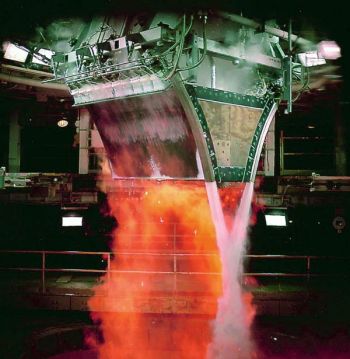
http://www.aerospaceweb.org/design/aerospike/figures/test02.jpg
Instead of pouring tons of cash into a 40 year of design like the Space Shuttle the US is embracing simpler, more affordable rocket technology. Commercial rocket launch companies like SpaceX can do it cheaper than NASA. They have a proven track record and are now building their first heavy class rocket.
For all the Space Shuttle's accomplishments it's initial purpose was to make the cost per pound of cargo cheaper, something it never did.
-
Re:Faceplant
Erm...
http://www.aerospaceweb.org/question/astronomy/q0262.shtml
You don't need to imagine a bulge. It's well documented.
As a thought experiment, if there's more water available and gravity continues to function the way is has for at least the past billion years or so, wouldn't you expect tides to rise at a faster rate closer to the equator?
-
Re:How does the livestream come through
1. Its a Pentagon. A five-sided polygon. A pentagram is a five-pointed star drawn with five straight strokes.
2. The video is not "classified" it's been out and available for years with stills from it available from 9-11-01 on
http://en.wikipedia.org/wiki/File:Pentagon_Security_Camera_2.ogv3. Wreckage from the 757-223 was clearly visible and photos are available if you look around.
http://en.wikipedia.org/wiki/File:Flight_77_wreckage_at_Pentagon.jpgWhen aircraft hit hard things they don't leave big pieces behind. I was involved in the salvage of a Piper PA-28 (N7731W) along with my grandfather and uncle. In that case the aircraft had a engine failure at about 90 mph while at 1000-1500 agl. There wasn't much left, when the 757-223 hit the Pentagon it was going over 500 mph and hit a reenforced concrete and steel building, it was lucky that even wheels and blade disk were found.
http://www.aerospaceweb.org/question/conspiracy/q0265.shtml
Also, when jet aircraft with a lot of fuel crash they burn, often hot enough to melt aluminum and composites.
Like the C-130 during Desert One, Pan Am Flight 1736 from 1977, the C-17 from Elmendorf in 2010, etc -
Re:There is more effective fuel - 8 times payload
-
Video proof its a rocket multi-stage
At
-
Helicopters vs airships
Mi-26 useful lifting capacity 20 tons, gross lift 50 tons
Hindenburg class airship - useful lifting capacity 10 tons, 252 gross tons
Goodyear blimps are four times smaller than Hinderburgs
Lifting 150 tons with airship, VTOL or heli, when lifting record is about 40 tons? Could you pass me that stuff you are smoking? It looks really good. -
Re:Don't think so
Good article with pictures of the hangar collapse here:
-
Some Buran Articles Online
There's a good history of Buran over at Astronautix. First the article about the craft itself, another (with a lot of overlap) about the project, then a short piece about the Buran Analogue. A very good write-up with several good photos (sad ones at the end) over at Aerospaceweb.
If you've got some time to kill, you can find a Buran mock-up sitting at the Baikonur Cosmodrome on Google Earth. Also the final resting place of the Buran that flew and the Energia reusable launch vehicle, but it's a little hard to locate.
-
Which one is it?
This page contains a list of the Buran airframes and their locations. This page has a photo of the OK-1K2 unfinished orbiter, this is the closest match to the photos shown in TFA. Aerospaceweb lists this orbiter as having been sold to the Technikmuseum Speyer in 2004, but I've recently been there and they have the OK-GLI atmospheric test bed on display, not OK-1K2.
-
Which one is it?
This page contains a list of the Buran airframes and their locations. This page has a photo of the OK-1K2 unfinished orbiter, this is the closest match to the photos shown in TFA. Aerospaceweb lists this orbiter as having been sold to the Technikmuseum Speyer in 2004, but I've recently been there and they have the OK-GLI atmospheric test bed on display, not OK-1K2.
-
Re:I've always wondered
If that were the real goal then tip-jet helicopters are more likely better suited to that one person utility flight role http://www.aerospaceweb.org/question/helicopters/q0141.shtml. Last time they tried them was near fifty years ago, likely with substantially better jet engine technology and composite materials they can do a much better job of them now.
-
Re:Worlds largets vs TFA
I was going to reply that although smaller, the higher-tech materials now available should result in a larger carrying capacity... but not so. The Hindenberg had a payload of 123.5 tons, whereas this new craft is limited to 1 measly ton. How can that be!?
-
Re:hmmm
Sonic booms are not legal over the majority of the United States and they don't routinely make them over urban areas, I lived in Portland for 14 years and there was never a sonic boom in the area there.
I've heard them, I lived near a high speed route for B-1Bs in the 1980s and they'd break the sound barrier on occasion.
http://www.aerospaceweb.org/question/planes/q0060b.shtml
http://www.kerncog.org/maps/MEAR_atlas/23MilitaryFlightOperationAreas.pdf
-
Re:I'm looking for an mp3 editing graphics suite
7 seat moped + Bitchin minivan + sub + jet = yes
and if that doesn't make sense to you then you are sadly mistaken.
-
Re:Yea
This is where the Fermi Paradox comes from. Our galaxy is only about 100,000 light years across. Sending something at 1% of the speed of light is not too far off our current capability. Sending something at 10% is not difficult to conceive.
Bollocks. The fastest man-made object had a velocity of about 150,000 mph -- 42 mps. That's
Until we do it, we have no firm evidence that it is possible -- not just physically possible, but socioeconomically and politically possible -- for a civilization to build anything faster.
A single Von Neumann probe
Which is also something that we have no evidence is a practical project for a civilization to build.
As usually interpreted, the "Fermi paradox" is a load of dingo's kidneys, which essentially boils down to "We don't see advanced alien civilizations doing what we imagine advanced alien civilizations would do. Therefore, there are no alien civilizations." I hope you see the leap in logic there.
-
Re:Oh noes
10% of the speed of light is 67 million miles per hour.
Helios 2 - fastest manmade object ever - went about 150,000 mph.
http://www.aerospaceweb.org/question/performance/q0023.shtmlSo, yeah even 1% of the speed of light would be 40x faster than anything else we've ever done.
-
Gotta wonder...
How many "missing" nukes lay on the bottom of the world's oceans? Just counting the ones we know about, there are at least a few, and you can bet that there are at least a few more we don't know about.
-
Speed of Sound, Terminal V and Drag
Interviewer: "Is that your crash helmet?"
Jose' Jimenez: " . . . oh I hope not."Using:
standard atmosphere http://www.desktopaero.com/stdatm.html
Mach/altitude tables http://www.aerospaceweb.org/question/atmosphere/q0112.shtml
g acceleration http://en.wikipedia.org/wiki/Terminal_velocity
and historical stuff on Col Joe.
At 35 seconds he'll have fallen from 120kft to 80kft, going 1126 ft/s. That's Mach 1 at sea level. At 80kft it's Mach 1.15, giving some room for drag error. 10 seconds later he'd cross from stratosphere to tropopause where Mach 1 is lowest, but since it's only a matter of ~6 ft/s, this just gives him room to fall farther if need be but not required. At 80kft the dynamic pressure will be around 55 lb/ft^2, so if fully loaded he weighs more than 165 lbs he'll still accelerate some, but not after the 45 second mark. If he's outfitted like Kittenger was, he'll weigh up towards 300 lbs, and would still accelerate for some time.At 30 seconds he'll be falling at 965 ft/s, or Mach 0.98, well within the narrow transonic region of highest pressure, "max Q". This is where aircraft prior to the Bell X-1 came apart due to the buffeting of turbulence combined with the growing bow shock pressure wave.
He can do it theoretically. The altitude is just about perfect for the attempt. I'm more concerned about whether he'll be able to keep from getting the piss kicked out of him at the Mach line. Sure, it'll be slight compared to what General Chuck punched through, but he's a damn sight slighter than the X-1. On the other hand Kittenger hit Mach 0.96 around 60kft and I see no report of this effect so maybe it's not a problem.
It may still be a problem to punch through though. There's a spike in the speed/drag curve that's greater or lesser depending on the drag characteristics (coefficient of drag of cD). If his outfit will be shaped to approximate a low cD body so much the better. Since he'll require some form of protection I doubt anyone would fault him for choosing a shape to fit his flight profile.
If he kept up his falling profile he's still slow to terminal velocity for the lower altitude, around 200 MPH, slower still if he's either braking or blacked out and spinning. Lower altitude here is taken to be where he could pop the chute and stay conscious even if he lost his mask, around 20 kft. At that altitude and speed a full open would be quite a jerk, but no more than airborne troops practice, and which I'm sure he's handled previously. If he's designing his chute to be able to be opened higher/faster should he need or want to, he'll include a drogue chute with a delay before the main, to slow him gradually to safe opening speed (especially helpful if spinning).
-
Re:What ever happened to Terminal Velocity?
The speed of sound seems to hit a minimum (over the range of altitudes he'll be falling through) in the Tropopause between 40 and 65000 ft (12 and 20000 m) at about 970 ft/s (295 m/s).
http://www.aerospaceweb.org/question/atmosphere/q0112.shtml
In The Long, Lonely Leap Kittenger claims a radar-checked top speed of 274 m/s which is getting pretty close to Mach 1 at at least some of the Baumgartner he'll be falling through. The extra 18000 ft (5500 m) he'll fall may be enough in the thin air up there to do it.
-
Re:no sound = no sound barrier
Oh, there will be lateral drift due to the wind at maximum altitude, versus the wind at every altitude below that.
For reference, the speed of sound is _slower_ at higher altitudes. There is a chart at http://www.aerospaceweb.org/question/atmosphere/q0112.shtml. And for him to achieve transonic speeds for parts of his body but not other parts, he'll be breaking the local sound barrier.
Breaking the sound barrier also produces a _profound_ braking effect: you wind up providing tremendous power to compress the medium in front of you. All that energy that goes into the shock wave and the turbulence as you pass through the medium and the "sonic boom" itself, is a continuing drain on your kinetic energy. So I suspect his speed will max out at or barely above the sound barrier, and he'll certainly slow more rapidly as he hits thicker air and experiences more drag, slowing all the way to his freefall velocity in the denser air. That depends a lot on the shape of his suit: I'd expect him to want a high drag suit for maximum fall time.
-
Re:It IS safe!
and who's going to try stopping a jet traveling Mach 2?
An anti aircraft missile. Like Stinger or other mach 2+ missiles.
-
Re:It IS safe!
and who's going to try stopping a jet traveling Mach 2?
The Air Force? Once they detect an unknown aircraft flying at that speed I'm pretty sure they're going to check it out.
-
Re: stopping drug traffickers
Of course this is a good deal for drug traffickers. With a 4,000 kg normal payload capacity and cocaine selling for $23,000 per kg you'd make almost 100 million in one trip, and who's going to try stopping a jet traveling Mach 2?
Any US or european 4th gen fighter guided to interception by AWACS plane can shoot down that nacro-Suhoi with BWR missiles. It's not exactly a stealth aircraft, you know...
-
Re: stopping drug traffickers
Of course this is a good deal for drug traffickers. With a 4,000 kg normal payload capacity and cocaine selling for $23,000 per kg you'd make almost 100 million in one trip, and who's going to try stopping a jet traveling Mach 2?
Any US or european 4th gen fighter guided to interception by AWACS plane can shoot down that nacro-Suhoi with BWR missiles. It's not exactly a stealth aircraft, you know...
-
Re:It IS safe!
-
Re:It IS safe!
"I'd go for this instead of a business jet. Far more fun and you don't have to worry if the engines fail - you can always use the ejection seat."
Sure, but of course it's your 5 million dollar jet you're ejecting from and not tax-payers, not to mention the bill the US gov't might hit you with for having to clean up the jet scattered over 10 acres.
Of course this is a good deal for drug traffickers. With a 4,000 kg normal payload capacity and cocaine selling for $23,000 per kg you'd make almost 100 million in one trip, and who's going to try stopping a jet traveling Mach 2? -
Re:It IS safe!
"I'd go for this instead of a business jet. Far more fun and you don't have to worry if the engines fail - you can always use the ejection seat."
Sure, but of course it's your 5 million dollar jet you're ejecting from and not tax-payers, not to mention the bill the US gov't might hit you with for having to clean up the jet scattered over 10 acres.
Of course this is a good deal for drug traffickers. With a 4,000 kg normal payload capacity and cocaine selling for $23,000 per kg you'd make almost 100 million in one trip, and who's going to try stopping a jet traveling Mach 2?