Slashdot Mirror
Domain: aerospaceweb.org
Stories and comments across the archive that link to aerospaceweb.org.
Comments · 158
-
Re:Nice try
Umm, if Mars has seen ice cap shrinkage why wouldn't Solar Cycles be the most likely cause of our current terrestrial warming (which hasn't happened in the last decade - thus the change of nomenclature to "climate change")?
Because there are much simpler explanations.
http://www.aerospaceweb.org/question/astronomy/q0230.shtmlThe term and certainly the concept of 'climate change' is not new, what's new is the claim that it's new. There's been a recent (last 6 months) surge of folks saying 'oh ho now it's climate change'. It's been well understood that the warming models predicted global warming and local change. The globe doesn't have climate, locales have climate. Many places like England will likely become much colder with increased ice melt if the thermohaline cycle stops.
O rly? It's believed that the northern U.S. was covered in a 5,000 foot thick ice cap (some time in the last 100k years). It created the 5 Great Lakes. What caused the atmosphere to warm so much as to see that completely disappear? It must have been very dramatic. I wonder, though, concerning the current state of glacial changes, has there been a change in precipitation in the areas that feed those shrinking glaciers?
Most likely CO2 build up from volcanic activity that wasn't scrubbed from the atmosphere due to substantially decreased vegetation.
Hard to grow trees under a mile of ice. Shifts in oceanic currents, particularly the thermohaline circulation from ice melt which changed the salinity likely helpded drive the rapid shift out of the ice age once the CO2 build up started the process.It's studies of the ice age ending that contributed to many of the current models, it's hardly a mystery and hardly an aspect that hasn't been taken into account.
Also, if Anthropogenic Global Warming were true, why hasn't recorded human history, vis-a-vis, the last 1,000 years or so, shown a consistent increase in global temperatures? It would be very easy to conclude that humans have been burning more wood over the prior year for the duration of their history (beginning prior to the last millennium) and that CO2 would also have been increasing year over year as well. But, there was a mini-ice age in the last millennium. That doesn't compute.
The mean population of the earth was substantially less prior to 1800's than it is now. Burning wood doesn't contribute to CO2, burning sequestered carbon like coal or oil does. That didn't happen in any quantity prior to 1900.
-
Re:So much raw data
Yeah, I just remembered looking at photos before the collapse of the building facade and wondering why damage from the engines hitting the building wasn't apparent. Now looking at it again, the right engine probably entered the same hole as the fuselage, and the left engine created its own hole closer to the ground.
-
Re:Someone has to build the vehicles
"So you are saying that dumping water from one ocean to another would potentially lead to the development of new technologies? "
"Potentially" is an important word in that sentence.
What's happened to the space technologies that have ALREADY been paid for? Do we have any idea? NASA and USAF sure seem to have invested a whole lot of money doing.... stufff... which they don't seem to want to talk about and which never quite gets 'finished'.
http://en.wikipedia.org/wiki/X-30
http://www.fas.org/irp/mystery/nasp.htm
http://www.aerospaceweb.org/design/waverider/examples.shtmlBut I'm sure it's all in the public interest.
"What happens if it becomes just as cheap to get into space as it does to fly a cargo jet around the country?"
Very little? Because you can grow, eg, corn and soy and cotton and cattle on Earth but you can't grow much in hard vacuum?
-
Re:Railroads
Your picture and description is excellent. But I suspect that the largest wind turbines might easily the width of a railroad track (something like 12 feet).
I think your suggestion to air lift might be interesting. If weight is not exceeded. If a heavy lift helicopter can lift about 45,000 kg
http://www.aerospaceweb.org/question/helicopters/q0284.shtmlThanks,
Jim -
Ozone layer + Solar Winds?
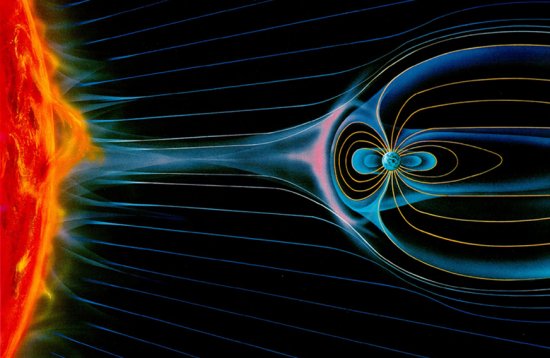
It might be coincidental, but the altitude of this phenomenon is the same altitude as the outer edge of the ozone layer. The northern latitudes are also the areas where the earth's magnetic field allows some solar wind particles to a interact with our atmosphere.
http://www.aerospaceweb.org/question/astronomy/magnetic-field/earth.jpg
A portion of the charged particles in the solar winds are protons - aka hydrogen ions. I think it's possible, but maybe not all that likely, that the water present at these altitudes is due to the interaction between the protons in the solar winds and the oxygen in the ozone layer. While much of the oxygen present is in the form of ozone, atomized and O2 forms are produced and destroyed in the normal processes of the ozone layer. Since water is much more stable, it is possible that water molecules may accumulate simply from the interaction of solar winds and the ozone present at that altitude and latitude. -
Closest Star is 3,900 years away
The barrier between us and the stars is not some insurmountable technology one, its a matter of money and willpower.
You sir, are confused.
The fastest man-made item http://www.aerospaceweb.org/question/spacecraft/q0109c.shtml reached 150,000 mph (41.67 mi/sec). Voyager 1, launched in 1977, is going only 38,500 mph as it leaves our solar system. The closest star to our solar system is about 4 light years away (5,800,000,000,000,000 miles away).
That works out to about 3,941 years to travel there at 150,000 mi/hr.
We definitely do not have the technology to accomplish or even begin that goal. We'd need a multi-generational ship, capable of growing food without sunlight. It would need to survive longer than any culture or nation has by far.
So perhaps you understand why we aren't planning to visit other stars at all now?
-
Re:Nobody Knows
I find it highly unlikely that a jet in mid journey above the ocean would be SO far below cruising speed to be anywhere close to "a very narrow margin above stall speed". We're not talking about a Cessna.
Let's run some numbers, because I'm curious myself. An aircraft's stall speed increases as air density decreases - the air is much thinner at 35000 ft.
(figures rounded for simplicity)
Wing area: 362 m^2
Weight: 120000 (empty) to 230000 (max takeoff) kg
35000ft is roughly 10600m. Plugging that into this calculator, we get 0.38 kg/m^3
I don't have numbers on the Airbus wing's lift coefficient with flaps up, so I'll estimate between 1 (conservative) and 1.5 (optimistic).The lift equation is Lift (in Newtons) = 0.5 * Density (in kg/m^3) * Area (in m^2) * LiftCoefficient * Velocity (in m/s)^2. One Newton is 0.10197 kilogram force.
With the Airbus at takeoff weight and a conservative lift coefficient, it has to be going 181 meters/second to generate 230000kg of force. With the Airbus at minimum weight and an optimistic lift coefficient, it has to be going 107 m/s to generate 120000kg of force.
The real numbers are probably somewhere in the middle, but either number is a good fraction of the cruising speed (0.86 mach at that altitude is 255 meters/second).
Ultimately, you stall when your wing exceeds a certain angle of attack, not when you go below a certain speed. Stall speed only refers to the speed at which a wing can no longer maintain 1G of lift (to maintain level flight). At speeds above stall speed, you can develop more and more G forces before you stall. Lift increases with the square of speed, so at twice stall speed you can pull 4 Gs before stalling. This is important because airframes are only built to take a certain number of Gs. I believe most airliners are built for +/- 2.5Gs (I don't have a reference for this and would love to see one). 2.5Gs means only 1.58 times stall speed - 181*1.58 = 285 m/s, 107*1.58 = 169 m/s. This speed where you are inherently protected against pulling more Gs than the structure will take is called "maneuvering speed", and if the pilot slowed down, this is likely the number they wanted to hit. It would be quite a ways above stall speed, even taking into account 30m/s gusts.
-
Re:Nobody Knows
I find it highly unlikely that a jet in mid journey above the ocean would be SO far below cruising speed to be anywhere close to "a very narrow margin above stall speed". We're not talking about a Cessna.
Let's run some numbers, because I'm curious myself. An aircraft's stall speed increases as air density decreases - the air is much thinner at 35000 ft.
(figures rounded for simplicity)
Wing area: 362 m^2
Weight: 120000 (empty) to 230000 (max takeoff) kg
35000ft is roughly 10600m. Plugging that into this calculator, we get 0.38 kg/m^3
I don't have numbers on the Airbus wing's lift coefficient with flaps up, so I'll estimate between 1 (conservative) and 1.5 (optimistic).The lift equation is Lift (in Newtons) = 0.5 * Density (in kg/m^3) * Area (in m^2) * LiftCoefficient * Velocity (in m/s)^2. One Newton is 0.10197 kilogram force.
With the Airbus at takeoff weight and a conservative lift coefficient, it has to be going 181 meters/second to generate 230000kg of force. With the Airbus at minimum weight and an optimistic lift coefficient, it has to be going 107 m/s to generate 120000kg of force.
The real numbers are probably somewhere in the middle, but either number is a good fraction of the cruising speed (0.86 mach at that altitude is 255 meters/second).
Ultimately, you stall when your wing exceeds a certain angle of attack, not when you go below a certain speed. Stall speed only refers to the speed at which a wing can no longer maintain 1G of lift (to maintain level flight). At speeds above stall speed, you can develop more and more G forces before you stall. Lift increases with the square of speed, so at twice stall speed you can pull 4 Gs before stalling. This is important because airframes are only built to take a certain number of Gs. I believe most airliners are built for +/- 2.5Gs (I don't have a reference for this and would love to see one). 2.5Gs means only 1.58 times stall speed - 181*1.58 = 285 m/s, 107*1.58 = 169 m/s. This speed where you are inherently protected against pulling more Gs than the structure will take is called "maneuvering speed", and if the pilot slowed down, this is likely the number they wanted to hit. It would be quite a ways above stall speed, even taking into account 30m/s gusts.
-
Emergency landings and fuel dumps
"That's why you see commercial jets dump or burn off fuel before an emergency landing."
Landing weight is a concern. However, they also dump fuel so there's less fuel to burn if the fuel tanks are breached in the landing attempt. In emergency landings that actually make it to the "landing" stage, fire and smoke kill more people than blunt force trauma due to impacts. In emergencies, aircraft without fuel dumping systems will prefer to circle, to burn up fuel with the engines. Only if they must land immediately will they skip that. (Contrary to expectations, not all emergencies require immediate landing. Stuck landing gear, for example.)
Sources:
* http://en.wikipedia.org/wiki/Fuel_dumping
* http://www.aerospaceweb.org/question/planes/q0054a.shtml
* http://www.aerospaceweb.org/question/planes/q0245b.shtml
* http://www.aerospaceweb.org/question/planes/q0245a.shtml -
Emergency landings and fuel dumps
"That's why you see commercial jets dump or burn off fuel before an emergency landing."
Landing weight is a concern. However, they also dump fuel so there's less fuel to burn if the fuel tanks are breached in the landing attempt. In emergency landings that actually make it to the "landing" stage, fire and smoke kill more people than blunt force trauma due to impacts. In emergencies, aircraft without fuel dumping systems will prefer to circle, to burn up fuel with the engines. Only if they must land immediately will they skip that. (Contrary to expectations, not all emergencies require immediate landing. Stuck landing gear, for example.)
Sources:
* http://en.wikipedia.org/wiki/Fuel_dumping
* http://www.aerospaceweb.org/question/planes/q0054a.shtml
* http://www.aerospaceweb.org/question/planes/q0245b.shtml
* http://www.aerospaceweb.org/question/planes/q0245a.shtml -
Emergency landings and fuel dumps
"That's why you see commercial jets dump or burn off fuel before an emergency landing."
Landing weight is a concern. However, they also dump fuel so there's less fuel to burn if the fuel tanks are breached in the landing attempt. In emergency landings that actually make it to the "landing" stage, fire and smoke kill more people than blunt force trauma due to impacts. In emergencies, aircraft without fuel dumping systems will prefer to circle, to burn up fuel with the engines. Only if they must land immediately will they skip that. (Contrary to expectations, not all emergencies require immediate landing. Stuck landing gear, for example.)
Sources:
* http://en.wikipedia.org/wiki/Fuel_dumping
* http://www.aerospaceweb.org/question/planes/q0054a.shtml
* http://www.aerospaceweb.org/question/planes/q0245b.shtml
* http://www.aerospaceweb.org/question/planes/q0245a.shtml -
Re:Hey, 50 years ago, they lost one, too!
-
Re:Dimples on golf balls don't reduce dragDimples increase surface drag, yes, but they greatly reduce what is almost always the most significant drag force, the drag caused by the flow separating from the ball.
The reason we don't use dimples on cars or planes is because the situation is reversed - the surface drag is the most significant factor, so it's better to have a mostly smooth surface.
This link explains it well.
-
more losses
5 February 1958: An Air Force B-47 Stratojet from Homestead AFB was on a simulated combat mission when the plane collided with an F-86 Sabre near Savannah, Georgia. The B-47 was carrying one Mk 15 hydrogen bomb without its core at the time of the accident. The plane made three unsuccessful landing attempts at Hunter Air Force Base before the weapon was jettisoned over the Atlantic Ocean to avoid the risk of a high explosive detonation at the base. The bomb was dropped several miles from the mouth of the Savannah River in Wassaw Sound off Tybee Island. Though an intensive nine-week search was launched using divers and sonar equipment, the weapon was never found. Another unsuccessful search was mounted in 2001, and reports of radiation detected less than a mile from shore led to speculation of the bomb's discovery in 2004. Further investigation concluded the radioactivity was naturally occurring and the weapon remains missing. http://www.aerospaceweb.org/question/weapons/q0268.shtml
-
Re:batshit my butt
why there was NO remainder of anything a passenger plane crash leaves in a crash site, and there were NO bodies, passenger belongings, pieces of bodies, ANYTHING but fairly intact TWO bodies in the scene.
Are you saying there were no bodies, or were you saying there were two?
Allyn E. Kilsheimer, CEO of KCE Structural Engineers (a company involved in providing emergency engineering and post-collapse assistance) said "I held parts of uniforms from crew members in my hands, including body parts."
Of course, once you reach the level of batshitness you've achieved, you can simply ignore his testimony by saying "they got to him too!"
And I'm sure you simply don't accept the claim that the remains of 184 people were identified; surely "they" got to all 102 DNA analysts, sample processors, logistics staff, and administrative personnel at the Armed Forces DNA Identification Laboratory. It's a DOD facility, after all.
Are you saying there was no debris from the plane? That's simply incorrect; hell, you can even see photos of a bunch of it at this batshit conspiracy site. And photos of the plane debris inside the building (where, in answer to your question about the lawn, most of it ended up, in agreement with conservation of momentum) can be seen at this somewhat less batshit crazy site. And some more photos here. And more photos, with amazingly detailed analysis, here
But I'm sure "they" got to the owners of all of those sites.
tell me where the hell did the 767's huge tail has vanished.
757. If you can't get that much right after being corrected, I don't see any point in talking to you further.
Like most of the plane, the tail and wings got shredded, and ended up inside the building. As Mete Sozen, a structural engineer who studied the impact in computer simulation, put it, "At that speed, the plane itself is like a sausage skin. It doesn't have much strength and virtually crumbles on impact."
It's like shooting an aluminum foil origami crane out of an air cannon at high speed, through a stack of steel cheese graters, and then demanding "where's the crane's tail? There must be a trick!"
please, spare the bullshit. as if the world has never seen a passenger liner crash.
Into a building? One as hardened as the part of the Pentagon that was hit? Please, name me one similar crash.
Oh, and by the way, regarding your original question about simulating the piloting of the crash, see this:
Brian also consulted with a pair of commercial airline pilots who decided to try this kind of approach in a flight training simulator. Although the pilots were not sure the simulator models such scenarios with complete accuracy, they reported no significant difficulties in flying a 757 within an altitude of tens of feet at speeds between 350 and 550 mph (565 to 885 km/h) across smooth terrain. The only issue they encountered was constant warnings from the simulator about flying too fast and too low. These warnings were expected since the manufacturer does not recommend and FAA regulations prohibit flying a commercial aircraft the way Flight 77 was flown. These restrictions do not mean it is impossible for a plane to fly at those conditions but that it is extremely hazardous to do so, and safety was obviously not a concern to the terroris
-
Re:batshit my butt
why there was NO remainder of anything a passenger plane crash leaves in a crash site, and there were NO bodies, passenger belongings, pieces of bodies, ANYTHING but fairly intact TWO bodies in the scene.
Are you saying there were no bodies, or were you saying there were two?
Allyn E. Kilsheimer, CEO of KCE Structural Engineers (a company involved in providing emergency engineering and post-collapse assistance) said "I held parts of uniforms from crew members in my hands, including body parts."
Of course, once you reach the level of batshitness you've achieved, you can simply ignore his testimony by saying "they got to him too!"
And I'm sure you simply don't accept the claim that the remains of 184 people were identified; surely "they" got to all 102 DNA analysts, sample processors, logistics staff, and administrative personnel at the Armed Forces DNA Identification Laboratory. It's a DOD facility, after all.
Are you saying there was no debris from the plane? That's simply incorrect; hell, you can even see photos of a bunch of it at this batshit conspiracy site. And photos of the plane debris inside the building (where, in answer to your question about the lawn, most of it ended up, in agreement with conservation of momentum) can be seen at this somewhat less batshit crazy site. And some more photos here. And more photos, with amazingly detailed analysis, here
But I'm sure "they" got to the owners of all of those sites.
tell me where the hell did the 767's huge tail has vanished.
757. If you can't get that much right after being corrected, I don't see any point in talking to you further.
Like most of the plane, the tail and wings got shredded, and ended up inside the building. As Mete Sozen, a structural engineer who studied the impact in computer simulation, put it, "At that speed, the plane itself is like a sausage skin. It doesn't have much strength and virtually crumbles on impact."
It's like shooting an aluminum foil origami crane out of an air cannon at high speed, through a stack of steel cheese graters, and then demanding "where's the crane's tail? There must be a trick!"
please, spare the bullshit. as if the world has never seen a passenger liner crash.
Into a building? One as hardened as the part of the Pentagon that was hit? Please, name me one similar crash.
Oh, and by the way, regarding your original question about simulating the piloting of the crash, see this:
Brian also consulted with a pair of commercial airline pilots who decided to try this kind of approach in a flight training simulator. Although the pilots were not sure the simulator models such scenarios with complete accuracy, they reported no significant difficulties in flying a 757 within an altitude of tens of feet at speeds between 350 and 550 mph (565 to 885 km/h) across smooth terrain. The only issue they encountered was constant warnings from the simulator about flying too fast and too low. These warnings were expected since the manufacturer does not recommend and FAA regulations prohibit flying a commercial aircraft the way Flight 77 was flown. These restrictions do not mean it is impossible for a plane to fly at those conditions but that it is extremely hazardous to do so, and safety was obviously not a concern to the terroris
-
Re:Where's the fire?
Hey moron, try reading this for explanation. Russia launches their rockets from Khazakstan, not Russia. The ESA doesn't even launch their rockets from Europe.
-
Re:With GMs luck.
Not as absurd as you might think, as you can use aluminum alloy to produce hydrogen...
And if that doesn't float your boat you can always use aluminum to enhance your rocket fuel...
Iron isn't quite as sexy, apparently it can help to enhance diesel fuel... -
Re:Stability concerns
I'm not sure this applies, but this particular arrangement of wheels has problems for planes (scroll down a bit): http://www.aerospaceweb.org/question/design/q0200.shtml. This motorcycle doesn't use a swivel caster, but could steering with the rear wheel cause the same problem at times?
-
Re:Turn it inside out.
It does depict them, you just aren't looking hard enough. On a traditonal rocket engine, the chamber is a bulbed or cylindrical chamber above the nozzle. It narrows down, then expands into a bell shape to allow the combusted hot gasses to expand and accelerate.
http://en.wikipedia.org/wiki/Image:Aerospikeprinciplediagram.gif
In the linked illustration on the right, look along the top edge of the aerospike, where the flames are coming from. All of the little canisters along both edges (where the flames come out) are combustion chambers. You just have a bunch of small ones instead of one large one. Compare that to the image on the left (a standard bell nozzle)--notice that you have a chamber at the top, which narrows down to a throat, and then opens back up. Basically, an aerospike does is cut off at the throat and turn the nozzle inside out. You then have an inner wall to expand against, with the outside atmosphere providing the outer wal.
Read this site for more: http://www.aerospaceweb.org/design/aerospike/main.shtml -
Re:From TFA
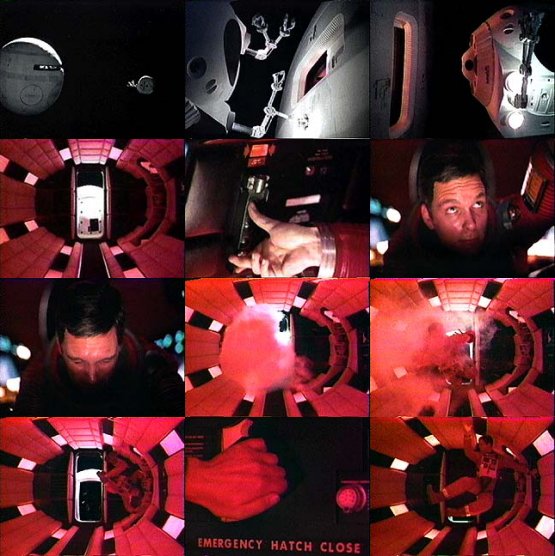
Additionally, in the book, HAL vents the atmosphere in the Discovery to prevent Bowman from returning as he did not have a full pressure suit. The scene never made it into the movie - I don't recall if it was shot and cut or never filmed at all. However it is the (unportrayed) reason that Dave Bowman is wearing his helmet again once he finally gets on board and through the famous "Daisy" scene.
-
Parallels and Perspective
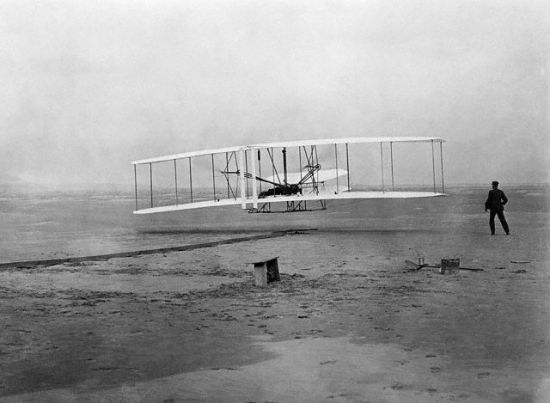
For a bit of perspective I wanted to see what progress looked like back in the early days of aviation.
http://www.aerospaceweb.org/question/history/top10/wright-flyer.jpg Here is the wrights' "space ship one"
http://www.dkimages.com/discover/previews/786/506847.JPG Here is what the aircraft started looking like 4 years after the Wright's first flight.
It took 30 years for Jet technology to appear, I wonder if it will be a similar amount of time before we get private orbital cabability. -
Re:SR-71 Blackbird
Mach 6 is closer to 4,000 mph (at around 100,000 ft) http://www.aerospaceweb.org/question/atmosphere/q0112.shtml
-
Re:Trust me, they will deliver...Despite what we in the west think about the Russians, I strongly believe they will deliver on this given their track record. I also know that when they finally deliver, the whole atmosphere will be met with very little fanfare unlike in the US.
That's because of a fundamental difference between Soviet/Russian space policy and American space policy. The Soviet space mission was always viewed as a military one, while the American space agency was a civilian organization. Therefore, there was always more fanfare around American launches, simply because NASA made itself more accessible to the public than the equivalent Soviet agency.
Now for those who might think this post is "flamebait", I'd like to remind them that the Soviet Union, much of which became today's Russia had and still has the biggest, heaviest and highest-capacity flying aircraft in service today. And this was put in service more than ten years ago...again, with little fanfare.Again, you're comparing apples and oranges. The AN-225 was originally envisioned as a special carrier for the canceled Buran space shuttle. Only one was ever built, and even it was in storage until 2000, at which point it was retooled into a conventional transport. To compare a custom-built transport originally built for a single purpose to a multi-use mass-produced jetliner is unfair. You may as well compare Formula 1 cars to Toyota Camrys.
-
Re:Great Works
Newton plagiarised it too (and I believe the date is uncertain and might be 1676).
"Bernard of Chartres used to say that we are like dwarfs on the shoulders of giants, so that we can see more, and things further off, than they could." -- John of Salisbury, 1159
"A dwarf standing on the shoulders of a giant may see farther than a giant himself." -- Robert Burton, 1621
"Dwarfs on the shoulders of giants see further than the giants themselves." -- Stella Didacus, 1622
"A dwarf on a giant's shoulders sees the farther of the two." -- George Herbert, 1651
(Courtesy of http://www.aerospaceweb.org/question/history/q0162b.shtml)
In any case, Newton's statement was intended ironically and as a venomous insult. Newton had been accused of plagiarising Hooke's work, and Newton was infuriated with envy that Hooke had been beating Newton to press in publishing work in optics and calculus. So Newton's implication was simply that Hooke was no giant. (He wasn't exactly a dwarf, either: Hooke is described by John Aubrey as "but of midling stature, something crooked".)
-
Re:Why Nova Scotia?
And who pays for this "free velocity"? The earth rotates. Therefore, there is a tangental velocity at the surface of the earth due to the rotation of the earth. This velocity varies (roughly) with the cos(latitude). At the equator, if you launch due east, you get the full effect of the earth's rotation. At the poles, you get none of it. Launching due west actually introduces a penalty, as you must overcome the rotation of the earth on ascent. Now it is probably clear why virtually all missions launch due east from their respective sites (notable exceptions: shuttle to ISS, since it is at a higher inclination). There are rare exceptions, like polar orbits and retrograde orbits.
a more thorough (albeit basic) explanation -
Re:Probably not significant
That's actually an excellent answer. There is an article about precisely that subject here: http://www.aerospaceweb.org/question/propulsion/q
0 039.shtml
One thing the article doesn't point out is that increasing the solidity of the propeller disc can have it's own consequences, and there is generally an optimum solidity (depending on various other factors) which results in the highest efficiency. -
Re:The Newton Irony
The page below provides evidence that "standing on the shoulder of giants" was a common turn of phrase since the 12th century. Newton's variant is particularly pithy, and was indeed in a letter to Hooke, but I don't see any reason to think that he was mocking Hooke.
http://www.aerospaceweb.org/question/history/q0162 b.shtml -
Re:It's curtains for them
This is not good. 58 seconds is roughly Max Q (or maximum dynamic pressure). Falling debris will impact the Shuttle with the greatest momentum at this point.
-
Ok ok, I feel stupid already.After reviewing the formula for speed of sound, it does depend more on temperature than on pressure. So the speed of sound is slower on Mars than on Earth. Mach 4 on Mars would be less than 1000 m/s.
http://www.aerospaceweb.org/question/atmosphere/q0 249.shtml -
Re:Impact
I was wondering, and my friend Google tells me (via http://www.aerospaceweb.org/question/atmosphere/q
0 249.shtml) it's around 240 m/s. -
Re:SA-12 aka S-300
I am going to make the assumption of Mach 6 == 660mph. See:
http://aerospaceweb.org/question/atmosphere/q0112. shtml
6 * 660mph -> 6373 kilometers an hour.
I dunno SA-12 radar range. From:
www.tscm.com/rdr-hori.pdf
and assuming an aircraft @ 100k feet, it should be visible from *way* beyond missile range (643km: we agree-ish). I'm going to say that's about 1/10th the speed of the plane, e.g. you have 6 minutes from the time you see it until it's overhead. Do you want to tail chase the plane? If not, make that firing decision quickly. @ 2.4k/s, your 200km missile has 83 seconds to make the intercept. But 200km is probably "fall out of the sky, no kinetic energy to make a maneuver" kinda range. Let's say you have 60 seconds. I wonder, though.
Takes 12.5 seconds from speed 0 when accelerating at a constant 40g (probably that's high: none of *my* missiles have motors that good for that long (boost is usually 5-6 seconds)) to reach 30,480m (100k feet). Oh dang, I see Wikipedia says 100g of accel. Well, that won't be for long with a 2,000kg missile w/ rocket motor efficiencies. I can't seem to get the math right for motor propellant specific impulses and whatnot, but you gotta be burning significant mass per second to hold that crazy speed (though I suppose it gets easier as mass goes down).
Lessee. Assume 100g == 1km/s^2. So top velocity in 2.5 seconds. Cover 3065m. You have 27,416m to go. Takes 11seconds at 2.5km/s. So changes to 13.5 seconds from 12.5 seconds. Not too different.
To me, it looks pretty dicey. I guess probably not awful if you have orders to shoot down everything, but what if the plane just goes into an altitude zoom when the missile lifts? 1770 m/s horizontal at 30km up vs the missile coming straight up? Who loses control effectiveness first (cannot maneuver)?
I think the plane wins, in general. I know I am the hand-waving winner. -
Re:Scramjets need an atmosphere
lommer gave a pretty solid explanation of what is going on with thrust reversers.
Reversal depends on the engine type (turbojet, turbofan, etc..) and the manufacturer. I've seen some information that one manufacturer blocks the bypass nozzle and redirects the flow out to reverse thrust. Pretty much, the fan still operates as usual but the bypass air is used and not the core flow (through the burner). It sounds like you have some mild confusion as to engine classes/terminology so I'll provide some details that might help clear things up plus a couple decent links with flowpaths.
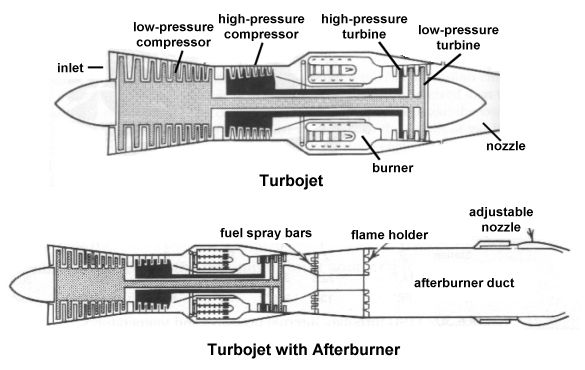
Turbojet describes a simpler turbomachine engine -> inlet, compressor, burner, turbine, nozzle http://www.aerospaceweb.org/question/propulsion/je t/turbojet.jpg
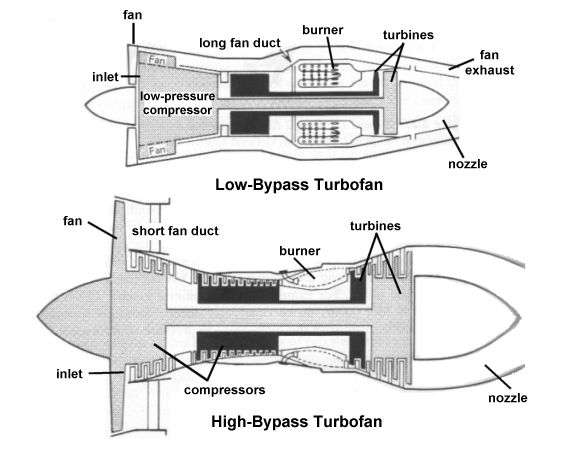
Turbofan describes a more complex engine -> inlet, fan, splitter, compressor, burner, hp turbine, lp turbine, nozzle... splitter, bypass duct, bypass nozzle http://www.aerospaceweb.org/question/propulsion/je t/turbofan.jpg
Turbofans are used nowadays on commercial aircraft because they have a significantly better fuel consumption. Engine thrust can be calculated using
Thrust = mass flow * (jet velocity - intake velocity)
You have two ways of increasing thrust: you can have a small mass flow and have a large Vjet (turbojet) or you can have a large mass flow and smaller Vjet (turbofan). The only way to produce a large Vjet is to burn more fuel. The term bypass ratio is used to compare the bypass air / core flow. The GE90 sports bypass ratio of 9. Bypass is difficult to deal with since increasing bypass ratio will reduce fuel burn BUT when in cruise, they have a ridiculous profile drag.
Ultimately, engine design is a complicated trade with multiple attributes at different mission segments matching vehicle thrust requirements, vehicle dimension needs, field conditions, maintainability, and noise and emissions regulations just make up a handful of the design concerns. So next time you fly, try getting a seat behind the engine and try to check things out. The design process is really quite amazing.
I'm going to stop here since I've written a lot. I'm just excited about having insightful things to say for once. -
Re:Scramjets need an atmosphere
lommer gave a pretty solid explanation of what is going on with thrust reversers.
Reversal depends on the engine type (turbojet, turbofan, etc..) and the manufacturer. I've seen some information that one manufacturer blocks the bypass nozzle and redirects the flow out to reverse thrust. Pretty much, the fan still operates as usual but the bypass air is used and not the core flow (through the burner). It sounds like you have some mild confusion as to engine classes/terminology so I'll provide some details that might help clear things up plus a couple decent links with flowpaths.
Turbojet describes a simpler turbomachine engine -> inlet, compressor, burner, turbine, nozzle http://www.aerospaceweb.org/question/propulsion/je t/turbojet.jpg
Turbofan describes a more complex engine -> inlet, fan, splitter, compressor, burner, hp turbine, lp turbine, nozzle... splitter, bypass duct, bypass nozzle http://www.aerospaceweb.org/question/propulsion/je t/turbofan.jpg
Turbofans are used nowadays on commercial aircraft because they have a significantly better fuel consumption. Engine thrust can be calculated using
Thrust = mass flow * (jet velocity - intake velocity)
You have two ways of increasing thrust: you can have a small mass flow and have a large Vjet (turbojet) or you can have a large mass flow and smaller Vjet (turbofan). The only way to produce a large Vjet is to burn more fuel. The term bypass ratio is used to compare the bypass air / core flow. The GE90 sports bypass ratio of 9. Bypass is difficult to deal with since increasing bypass ratio will reduce fuel burn BUT when in cruise, they have a ridiculous profile drag.
Ultimately, engine design is a complicated trade with multiple attributes at different mission segments matching vehicle thrust requirements, vehicle dimension needs, field conditions, maintainability, and noise and emissions regulations just make up a handful of the design concerns. So next time you fly, try getting a seat behind the engine and try to check things out. The design process is really quite amazing.
I'm going to stop here since I've written a lot. I'm just excited about having insightful things to say for once. -
Re:So a can of orange paint was out of the budget
Apparently, it takes about a thousand pounds (455kg) of paint to coat the external fuel tank. The paint does nothing but make the tank look pretty, so NASA opted to skip the paint and carry more cargo/supplies.
-
Re:Wings
It says here that a 747 requires about 87000 HP to fly at cruising speed and altitude (Mach 0.9, 40,000ft). It's moving about 350 passengers. They don't provide handy numbers and I'm too lazy to look it up, but if you were to find numbers for short-haul aircraft, which would be the main competition for the TGV, you'd probably find that the ratio of power required per passenger was even higher. So, aircraft are not more fuel efficient than trains, and if you look at the safety record for high speed railways (as a function of miles covered, passengers carried, and fatalities) you'd probably find it comparable or safer than air travel. A train crash involves sliding along the ground at high speed. An aircraft crash has that, plus a high speed impact with the ground.
-
aerospike engine
The problem you were pondering is not solved by a transmission. It's solved this way...
Aerospike Engines (how they work)
Aerospike Engine (history)
Linear Aerospike Engine (see the "efficient at all altitudes" section)
Rocket engines are more efficient (see: specific impulse)when the exhaust velocity of the escaping gas is higher. The shape of the bell of the "traditional" rocket nozle is static and thus operates at maximium efficiency at a particular altitude. The linear aerospike engine makes one side of it's bell continuously variable -- by using the air as one side of the nozle and taking advantage of the changing atmospheric pressure as the rocket ascends. The rocket engine will then have a continuously variable, uh, "transmission", to borrow the terminology of this discussion which beats a five-speed hands down. : )
The article summary, the RP/ZDNet press release rehash, and indeed the original press release itself are all very poorly written. -
Re:And so marches on the....Just so you know what we actually got for our money...
The US navy at one point had at least 699 F14's in service or on order (that sounds incredibly high, is it a typo on fas.org?), at a per-copy cost of $38,000,000, plus maintainence costs with exceed procurement costs over the lifetime of each aircraft. So figure $56,000,000,000.
Now here's a little quiz for your flight-sim jockeys out there. Guess how many bogeys the F14 shot down 34 year run, in total? Guess before you read the answer.
Answer: 4 jets and 1 helicopter.
-
We're talking rockets, not airplanes.
Nope, you're wrong -- or you're thinking about conventional aircraft.
A Saturn V launch leaves a very nice path to ground through the ionized gas (flame) and carbon smoke (rich-burning kerosene fuel) trail it's pouring out the back end. That's why the thing got hit in the first place. To quote from a web page on the strike: "As the rocket accelerated through the low-altitude rain clouds, it behaved much like a lightning rod. A bolt of electricity struck the vehicle and traveled to the ground along the column of ionized, electrically conductive gases in the rocket engine exhaust plume of the Saturn V."
(Actually it was hit twice; the first at an altitude of 6500 ft at 36 seconds into the launch, and again at about 14,500 ft at about 52 seconds) -
Actually...
>An airplane wing does not produce lift because it is angled downwards,
>it generates lift almost purely because of its shape.
Actually, you are quite mistaken.
I am an aerospace engineer. I have a BS in Aerospace Engineering and 16 years experience conducting flight test on a dozen aircraft ranging from Cessna- to 707-sized. I have also published papers on the process.
A wing produces lift according to this basic equation:
Lift = 0.5 * Coefficient of Lift * Density of the Air * Wing Area * Airspeed squared
This includes a few approximations since I can't type various symbols in plain test. You can look at the properly written equation here: http://www.aerospaceweb.org/question/aerodynamics/ q0015b.shtml
Coefficient of lift, part of that equation, is itself a direct function of Angle of Attack - the angle at which the chord of the wing meets the air. ("Chord" is defined, roughly, as a line between the front and back edges of the wing.)
The wing curvature, or camber as you correctly call it, is a contributor, but far from the only one, to the equation of lift coefficient versus angle of attack. A flat, or non-cambered, wing will produce zero lift at zero angle of attack. Increase the camber, up to a point, and you increase the lift at zero angle of attack. Or you can increase the angle of attack at zero camber to increase the lift. For that matter, you can spin a cylinder in an airflow and generate lift - zero camber, zero angle of attack (it's a circular cross section, so there's no angle!). So there are MANY factors influencing lift - any combination of these is possible; you just need to select which ones are most beneficial to a given design requirement.
As a matter of fact, the first documented equation to describe lift included only angle of attack and speed. It wasn't until decades later that careful observation of bird wing structure revealed the importance of camber. There's an intriguing story here about the Wright brothers and their development of the theory of lifting bodies, and how they overturned decades of established wisdom: http://www.first-to-fly.com/Adventure/Workshop/lif t_and_drift.htm
In a very simple and small wing (like most insects, which obviously can fly), it's almost ALL angle of attack, and no camber. Consider a dragonfly. The wings are perfectly flat. And the creature must create not only lift but also forward thrust with those wings. Quick and repetitive motions (as mentioned in this article) are perfect for this requirement. Camber has nothing to do with it, and camber, in fact, would impede the dragonfly, because the wing must also be capable of generating lift while moving backwards - and any effective camber is usually detrimental while going backwards. Finally, in the case of insects, the qualities of air are different at small scales (the so-called Reynolds Number effects) and lift operates somewhat differently from in large airplanes.
Consider also a dime-store balsa wood glider. In its cheapest form, the wing is completely flat. Yet it flies just fine. Or consider the paper airplane. It flies just fine with a slab of paper for a wing.
In short, you can take this article at face value regarding simple wings and lift. There are other wishful comments, but the aerodynamic description is quite fine. -
Re:It's still in the Milky Way
As far as I know Helios 1 and 2 were the fastest space crafts ever made
I was going to call bull-shit until I checked.
We have heard so much lately about the New Horizons spacecraft and how that is the fastest spacecraft every built. Turns out both are correct.
The New Horizons spacecraft to Pluto was moving faster than any spacecraft as it left orbit. The Helios spacecraft were moving faster only during their closest approach to the Sun.
An interesting write-up can be found here
http://www.aerospaceweb.org/question/spacecraft/q0 260.shtml/ -
Re:perfect golf ball
I also think it generates less drag, but I don't remember why.
Because the dimples create turbulence and thus a smaller low pressure wake on the backside of the ball as it's flying through the air. At least, that's how I understand it. You can read more about it here. http://www.aerospaceweb.org/question/aerodynamics/ q0215.shtml/ -
Re:here's a hint
Could you post a link to support this please? One would have thought that with the amount of redundant nuclear warheads floating around here, we could do a little better than 75,000 years.
Certainly. Mankind's fastest space probe is the Voyager I space probe. You can read that the speed is about 3.6 AU/year. Divide 272000 / 3.6 = 75000 years. You can find it on other sites too like this one that quotes 73,000 years. Of course, these are all chemical rockets.
It's been quite a while since I took basic physics in school, but if I remember correctly nuclear powered rockets didn't add any significant (in this context) amount of power. It'd probably still take >10000 years, though I don't have a quote on that. -
Re:Only 6 years
There's no innovation in OSS?
I should have said "There's no more innovation in proprietary software then OSS software (or vice versa)
Sure, maybe not on the desktop or with Samba but I certainly see it with Firefox. Firefox has had a lot of great things (like tabs) before IE does. In fact, IE is in a major state of catch up right now.
Interesting example - I think however you're in the wrong thread (you're looking for the Microsoft vs OSS innovation thread, this is the proprietary vs OSS innovation thread).
Firefox is mildly innovative, but the first browser (I think) that had tabs was Opera, and they borrowed them from other windowing software that used tabs, I think they first appeared in OS/2 as a minor innovation for preference dialogues.
So - you see, as Newtown (and someone else in this thread) pointed out: "If I have seen further [than certain other men] it is by standing upon the shoulders of giants." holds true for everyone.
Iironically, Newton probably borrowed & incrementally improved upon earlier saying from others. -
Re:Offensive weapon
While 20M pounds sounds like a lot of money, it's a significant amount less than a fighter jet. From a military standpoint, this is pretty cheap, especially if the volume of space it can cover is significant.
Also, I don't know how much power a good ham radio can transmit, but isn't it in the tens or hundreds of watts? That increases the output of the array I suggested by an order or two of magnitude. -
Re:Russian Philosophy
You mean like the N1. http://www.aerospaceweb.org/question/spacecraft/q
0 196.shtml "Though seemingly more complex, the Soviets believed this approach could be developed more quickly than Apollo and would allow them to beat the Americans by making the first lunar landing as early as September 1968. However, this plan turned out to be woefully optimistic. While some blame rests on the LK and LOK vehicles whose designs fell behind schedule, the ultimate failure of the Soviet manned lunar program rests squarely on the N1. At least nine examples of this enormous rocket were completed and four were launched on unmanned test flights. Unfortunately, all four failed in spectacular fashion." -
Re:Japan versus Existing Companies
I'm not a particular fan of Airbus, but let's be fair. They are starting to suffer from the same thing that has plagued Boeing - they have a lot of aircraft out there that are getting older in age. Two things that are hard to fight - numbers and time. I don't think it's surprising that we're going to see these issues crop up, especially when dealing with airlines that do not want to spend the time/money pre-empting these problems.
If you're referring to the nose wheel issue on the A320's, I believe there was an FAA notice out to airlines to fix a hydraulic issue on the nose wheels of these planes stemming from a 1999 incident on an America West flight, but Jet Blue had not fixed this particular plane yet. After this last one though, the FAA finally made the fix mandatory.
What I did find impressive about this whole thing after watching it on TV was the fact that the nose gear didn't simply snap off after hitting the runway. I think it speaks to the quality of modern airliner safety.
-
Re:SST/NASP never had a chance
I believe the OP was referring to the Boeing SST designed in the mid/late 60's. It was supposed to carry quite a few more passengers than the Concorde, and initially have variable geometry (swing) wings. The linked page indicates it was killed off by Congress for political reasons.
Your comment that this "wasn't even doable on a military budget" made me originally think of the XB-70, a still future-looking aircraft conceived in the 50's that was to fly its entire mission at Mach 3.
-
Depends on how you do itA traditional design of aircraft is not very good at hypersonic speeds - the Blackbird was a naff design - so you're really going to have to go Blended Wing or Waverider. Waverider is better for this type of design, as it simplifies supersonic and hypersonic airflows. Of those on the page I've linked to, the design they list as a long-range cruiser would seem to be the ideal shape for what is wanted here, and would scrape into the hypersonic category.
At Mach 10, you're talking a shade over 1 hour, 10 minutes. This assumes that the Australians (the only ones with a working Scramjet) can build a commercial version. If you're having to rely on a conventional ramjet, efficiency drops dramatically above mach 6.
The Americans abandoned the advanced passanger airliner project (which was blended-wing) in the late 90s, and there is no obvious indication that NASA has done much work on waveriders - some, mostly by being beaten to it by a bunch of Scots (and they were amateur rocket enthusiasts at that!) - but really not much. The US military seems to be much more interested in slow-moving ROVs and fully-automated robots, so don't look to them for producing anything worthwhile any time soon.
The Australians have the Scramjet, but nothing to speak of to put it on. The joint efforts by the Russians and the ESA to produce an orbiter seem to be stymied by the religious belief in rockets for everything. What we need is either someone who can get these two groups together (a particle accelerator might overcome the repelling forces) OR a non-aligned group with sufficient financial and intellectual backing to reverse-engineer from existing work a combined solution.
Last one to hypersonic mass transit is a chicken! -
Re:sources, please...
Read this and consider we're talking about an airship with a large internal volume. You'll never make a waverider out of a blimp (or a rigid-frame airship, for that matter).