Slashdot Mirror
Domain: af.mil
Stories and comments across the archive that link to af.mil.
Comments · 904
-
Re:fine book
The only one I have dealt with is
Ada 95: Problem Solving and Program Design (3rd Ed.) by Feldman and Koffman
And those of you out there who are thinking of reading that linked book and are looking to get ada for your system:
http://www.usafa.af.mil/dfcs/bios/mcc_html/adagide
This site is the AdaGIDE homepage and contains information on AdaGIDE only (my links to GNAT don't seem valid any longer).
-
This Article is BSTake this article with a (very large) grain of salt.
Predators do NOT carry Hellfire missiles in actual operation.
For the first time in any operation, the Predators, developed by General Atomics Aeronautical Systems in San Diego, are also armed with Hellfire anti-tank missiles, after successful trials this year.
First of all, the "trials" weren't meant to develop the Predator into a weapons system. Only Phase I of the testing is completed. Before Phase II, they have to re-engineer the Hellfire, since it was designed to be fired by low-flying helicopters. After Phase II, "This will complete the demonstration of the objectives we set down at the beginning of this process, to demo the technology, and prove its operational feasibility." The tests they did this year were in ideal conditions, fired at a stationary target.
I spent 2 weeks at Nellis AFB, NV this summer, where the 11th & 15th Reconnaissance Squadrons are the only units that fly the Predator. I saw them flying, up-close, the trailer they control them from, and footage from previous flights. I even talked to one of the pilots that flew one of the Hellfire test flights.
the US Air Force's 160th Special Operations Aviation Regiment
It doesn't take much to verify facts online nowadays. Like the fact that the 160th Special Operations Aviation Regiment is in the Army, not the Air Force. The US Air Force has NO regiments, they do have a variety of special operations assets though.
Despite the close normally work closely together. It would not be normal procedure, for example, for the SAS and Delta Force or Rangers, to run a joint patrol. Their methods and communications systems are different and their concept of operations do not easily merge.
Besides the obvious grammatical/editorial error in the first sentence, the SAS & American special ops troops work closely quite often. They're constantly deploying all over the world for training or operations.
I don't know how this kind of stuff gets printed by (supposedly) respected newspapers. The author (who's not just a reporter, but their defence editor) & source for this article are clueless.
Here is the official Air Force factsheet on the RQ-1 Predator
Here is the AF News article about the Hellfire tests -
This Article is BSTake this article with a (very large) grain of salt.
Predators do NOT carry Hellfire missiles in actual operation.
For the first time in any operation, the Predators, developed by General Atomics Aeronautical Systems in San Diego, are also armed with Hellfire anti-tank missiles, after successful trials this year.
First of all, the "trials" weren't meant to develop the Predator into a weapons system. Only Phase I of the testing is completed. Before Phase II, they have to re-engineer the Hellfire, since it was designed to be fired by low-flying helicopters. After Phase II, "This will complete the demonstration of the objectives we set down at the beginning of this process, to demo the technology, and prove its operational feasibility." The tests they did this year were in ideal conditions, fired at a stationary target.
I spent 2 weeks at Nellis AFB, NV this summer, where the 11th & 15th Reconnaissance Squadrons are the only units that fly the Predator. I saw them flying, up-close, the trailer they control them from, and footage from previous flights. I even talked to one of the pilots that flew one of the Hellfire test flights.
the US Air Force's 160th Special Operations Aviation Regiment
It doesn't take much to verify facts online nowadays. Like the fact that the 160th Special Operations Aviation Regiment is in the Army, not the Air Force. The US Air Force has NO regiments, they do have a variety of special operations assets though.
Despite the close normally work closely together. It would not be normal procedure, for example, for the SAS and Delta Force or Rangers, to run a joint patrol. Their methods and communications systems are different and their concept of operations do not easily merge.
Besides the obvious grammatical/editorial error in the first sentence, the SAS & American special ops troops work closely quite often. They're constantly deploying all over the world for training or operations.
I don't know how this kind of stuff gets printed by (supposedly) respected newspapers. The author (who's not just a reporter, but their defence editor) & source for this article are clueless.
Here is the official Air Force factsheet on the RQ-1 Predator
Here is the AF News article about the Hellfire tests -
Predator infoThe USAF's Predator page gives basics on the system.
There aren't many of these things. As of 1998, there were five units, each with four aircraft. A unit (ground equipment, 4 UAVs, and 55-person crew) costs $40 million, the USAF says. And it supposedly needs a 5000' paved runway, which seems excessive for something smaller than most light aircraft. It's not a robot; there's a pilot on the ground directly controlling the craft.
Here's the press release for the "Hellfire on a Predator" test. Probably hasn't been deployed yet.
Israel Aircraft Industries makes the most useful military UAVs. Theirs are smaller, with less range (which makes sense; their enemies are nearby), and are typically launched off a rail on a truck-mounted launcher, like a missile, then landed by parachute. The Israeli UAVs tend to be more autonomous; they assume they'll have serious jamming opposition and won't be able to maintain communications continuously. USAF UAVs are flown by a pilot with a joystick; Israeli UAVs tend to be controlled with a keyboard, carrying out a preplanned mission if they can't communicate
-
Re:No Interest
The Army is a
Aren't those mainly recruiting sites? Comparing the Air Force'sI really like one of the police departments in my area.
I thought it a bit strange at first that Metro considered itself a dot-com. Then again, I guess they figure it's easier to remember something short like that than something like www.lvmpd.co.clark.nv.us (which would stretch all across the trunk of their squad cars if they wanted it to be readable). The -
Re:Losing close friends sucks, yes - BUT.
Why was so much American money given to NORAD to buy guns?
Guns for the North American Aerospace Defense Command? You're not even responding to points in my post, but in the future should at least have supporting evidence when you post such rants. I think you're clueless and know you're clueless, so you post as an AC. Grow up.
-
Re:GNU's Army Will Be Out in FORCE!
Don't worry. I heard the air force is going to bring in the AEFB to contain the smell.
-
Why the strange tail?
Predator has the same strange looking tail. Anyone know why?
-
Re:How long before they decide Windows is free?
In 1999, Brazil spent 1.7% of it's GNP on defense. The same year, the USA spent 3.2%. Of course, the USA GNP per capital is much higher than the Brazilian, so that a bigger share of a bigger pie.
-
Re:30 milliseconds?
-
Re:30 milliseconds?
-
Facts about the gun (cool pictures!)
This page has info on the gas gun (range G) used in the test, including many many pretty pictures (a shame to slashdot it!). The range (pictured, of course) is only 1000 feet long, so that's why the scramjet portion of the flight was only 300 feet. They also show loading and firing of the beast, but with probably a different payload.
At 2.4 km/s, it looks like this test was fairly heavy. The launcher can launch a 4", 2kg target to 6 km/sec. -
Link to Arnold Press Release and pictures!
Here is a link to the AEDC press release with (fuzzy) pictures and video. -- mycr0ft
-
Gas gun: yes. Plus: link to videoAccording to this page at the Arnold AFB site, yes, it used a two stage light gas gun.
They even have this video clip, but it doesn't look like much, I warn ya.
-
Gas gun: yes. Plus: link to videoAccording to this page at the Arnold AFB site, yes, it used a two stage light gas gun.
They even have this video clip, but it doesn't look like much, I warn ya.
-
Satellite listIt took awhile, but I tracked down more information. There are four satellites going up:
- Sapphire from Stanford and Washington University at St. Louis, the "group of graduate schools" satellite
- PicoSat for the STP (Space Test Program) was built by Surrey Satellite Technology Limited, the "one from the Department of Defense"
- PCsat
- Starshine III
-
But the Streak Eagle was much higher back in 72!
I can understand the record for prop aircraft, but the F-15 Streak Eagle climbed to 98,425ft in 1972 when it set a time-to-climb record. See this for more details. On top of that, it just looks like it can go that high. The Helios, cool as it is, looks more like something that would be powered by rubber bands than high-tech electric stuff...
-
...along similar lines...
The US Air Force has been working on the Interactive Datawall (http://www.rl.af.mil/tech/programs/ADII/adii_dw.
h tml), which includes laser pointer tracking and voice recognition among other things.
Eventually they hope to have a portable version so various mil units can just cart them around to whatever theater they're needed in.
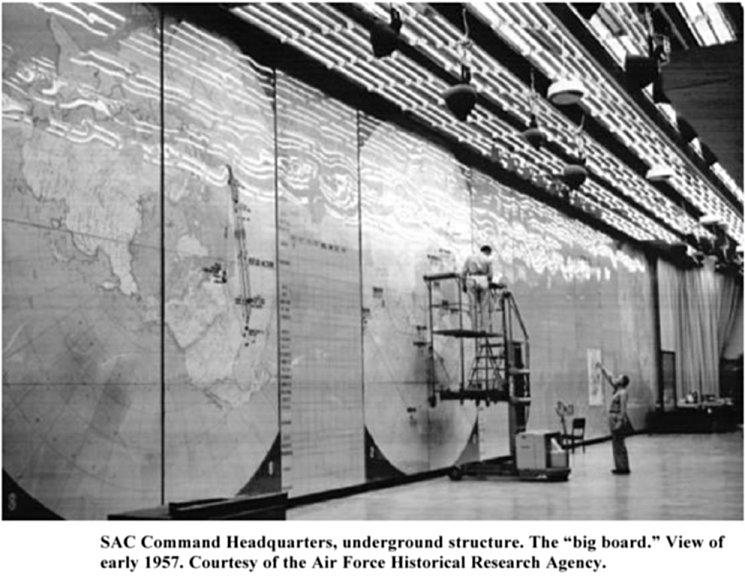
We've come a long way from LeMay's old "Big Board"... -
...along similar lines...
The US Air Force has been working on the Interactive Datawall (http://www.rl.af.mil/tech/programs/ADII/adii_dw.
h tml), which includes laser pointer tracking and voice recognition among other things.
Eventually they hope to have a portable version so various mil units can just cart them around to whatever theater they're needed in.
We've come a long way from LeMay's old "Big Board"... -
Re:Extreme Helicopter Capture!
I'd imagine they'd use something similar to the Fulton "Skyhook" nose recovery system. Film from the first US spy satellites, the Corona series, returned to Earth in capsules that were retrieved by C-130s as they parachuted down.
Specially designated JC-130s were used to test the concept in the 1960s. The system was also used to pick people up from the ground in-flight. The Air Force retired the system on its MC-130 Combat Talons in 1996.
There are some pretty good photos of Fulton equipped C-130s on this page. -
Re:Wrong
That said, assuming no wind, a plane at sea level flying at 350kia (Knots Indicated Airspeed) will have the same groundspeed as the same plane flying at 35,000ft 350kia.
Wrong. That only works for true airspeed, which generally does not get measured except by very advanced instruments. I refer you to the following page: http://www.elmendorf.af.mil/Units/90FS/instruments
Note the description of indicated airspeed vs. true airspeed:
For example, at sea level a TAS of 440 MPH will equal an IAS of about 440. At 20,000 feet, a TAS of 440 MPH will have an IAS of about 360. Thus, for a given TAS, indicated airspeed will decrease with altitude.
As altitude increases and true airspeed, and therefore, groundspeed remains constant, indicated airspeed drops due to the lesser air pressure. The true airspeed doesn't really matter, however. Indicated airspeed becomes much more important, as lift does not get produced as a function of speed, but rather a function of pressure. You can move a million miles an hour through a vacuum, and still produce absolutely no lift. Conversely, in an extremely dense atmosphere it takes much less speed to provide the same amount of lift (assuming constant gravity).
Look at it this way: If you have a rocket , and you propel yourself at sea level, your groundspeed and airspeed (assuming no wind) will stay pretty much the same. Now, if you leave the atmosphere and go into outer space, your groundspeed remains the same, but your airspeed drops to zero, since you have no air pressure. As you fall back to Earth, maintaining a constant groundspeed, your (horizontal) airspeed increases as ambient air pressure rises.
In any event, I think I have shown that indicated airspeed simply measures pressure, and not speed at all. If you want to convert that to true airspeed, you need to do some math involving altitude and temperature, but, like you said, for most pilots this serves no purpose since this only really tells you groundspeed +- wind, and nobody cares about that.
Not all airplanes are incapable of climbing out of the atmosphere the flight ceilings of most aircraft have more to do with the engines than the abilty to make lift.
I didn't really say that... I said not all airplanes can escape the atmosphere, implying that some perhaps can (or at least, could). But as you go higher, you need greater groundspeeds to produce the same amount of lift, and most engines will just not have the ability to produce that much thrust. -
JOVIAL!!!
-
JOVIAL!!!
-
auto rotation
Do you really think casual users of this kind of craft will have the skill to pull off an auto rotation maneuver?
-
What did they need a computer for?His site has the full design for a bot that runs on an onboard 486 and is controlled off a laptop with quake-style controls!
It looks like they put in a computer, then used it to emulate a really dumb R/C controller. Why?
Watching those things, it's clear what's wrong. People are driving them visually, which means too long a reaction time. They need some onboard smarts.
The idea here is to get inside the other guy's OODA cycle , so he's reacting to what you were doing, not what you are doing.
The first step is to get some onboard heading control. Put in some cheap rate gyros, then control orientation with a knob attached to an encoder. Want a 90 degree turn, spin the knob 90 degrees. That way, you'll get the desired heading on the first try.
Second, some kind of system that senses the opponent at close range and maintains position relative to them so the weapons can work would be a big win. Ancient though they are, the old Polaroid sonars would probably work. Use the piezo ones, not the electret ones; they're more rugged. And use separate send and receive sensors, so there's no minimum range. The idea is to make the weapons stay on a target long enough to have an effect.
-
Does "ArabMedia.com" sound unbiased to you?Ummm, yeah, I'd believe something I read regarding Israel on arabmedia.com.
Want to try reading some more reliable sources? According to this MIT "Nuclear Economics" course material:"Allegations that a large incident of HEU unaccounted for at the U.S. NUMEC facility in the 1960s was caused by theft of some 100 kg of HEU for transport to Israel, while never fully resolved, are probably incorrect.
See also Section III of this US Air Force paper, which says:In the 1990s when the NUMEC plant was disassembled, the Nuclear Regulatory Commission found over 100 kilograms of plutonium in the structural components of the contaminated plant, casting doubt on 200 pounds going to Israel.
-
Measuring the wrong thing
I am not dismissing the value of this work, but so long as developer & maintainer time is more valuable than processor time, when you choose a language, you should consider how well each language will make the developers' and (especially) the maintainers' jobs easier.
An example of how this can be considered is found in the appendices of "A Gentle Introduction to Software Engineering" (2,565 KB; MS Word format) by the Air Force's Software Technology Support Center (STSC). The appendices come from a document written in March 1996, so it's a little dated (predates the C++ standard, does not address Java, Python, or Perl), but the idea is there. (I like that it keeps repeating "Bad programmers can write bad code in any language, but a good language facilitates the production of good code by good programmers.".)
Including the performance achievable with each language is already in the formulation offered by STSC. The obvious caveat is that you look at the performance of benchmarks related to your application.
cb -
Re:I wonder if this has been demonstrated yet?
This is no different from the B2, since the flying wing concept produces inherently unstable aircraft. Without some serious fly-by-wire, both those planes would never fly.
Hmm...they didn't have fly-by-wire in 1948, when the YB-35 first took to the air. There was also a jet-powered conversion, the YB-49. There were some stability problems (especially when it came time to drop bombs), but the situation wasn't as bad as you put it.
-
Re:I wonder if this has been demonstrated yet?
This is no different from the B2, since the flying wing concept produces inherently unstable aircraft. Without some serious fly-by-wire, both those planes would never fly.
Hmm...they didn't have fly-by-wire in 1948, when the YB-35 first took to the air. There was also a jet-powered conversion, the YB-49. There were some stability problems (especially when it came time to drop bombs), but the situation wasn't as bad as you put it.
-
Incredible load
Compare that to the C-5 Galaxy, max wartime payload: 291,000 lbs (source: U.S. Air Force Online Encyclopedia). More than the biggest transport aircraft in the US! But easier to shoot down of course. -
Re:no its a valid alternate historical perspective
Some balloons DID make it to the states, but most failed to detonate. I think one DID detonate, but it landed in the middle of a ploughed field and caused no major damage. At the time, the farmer and authorities had NO IDEA wtf was going on.
It came down in Oregon. Killed six people. The only deaths as a result of an attack on the mainland during WWII. http://www.wpafb.af.mil/museum/history/wwii/jbb.h
t m -
And for all the military member who read /.
.. the only thing we walked away with from that movie was all the wincing and uncomfortable feeling in our stomachs at the thought that that Anti-American, communist, military hating asshole playing the all time greatest Hero Of the Air Force - General James H. Doolittle.
The worst part is now that whenever i think about or hear about the great things that General Doolittle did - i will have a mental image of that whining tree-hugging loser in my mind.
I wonder - he *HAS* to know that we all know that he HATES us.... and so i can't help but believe that in playing this role is a way to just piss the hell out of us.. every time we see the movie....
oh well. -
Re:My question is...
No, I see a bright light (when I'm not blinking). A bright light that may or may not be coming straight towards me. I don't even see the road ahead of me, or any potential obstacles. Is that really all that much safer for either of us?
So you are then saying that even though you see the light, you will just go ahead and pull out in front of the source of the light (motorcycle or otherwise) anyway? Wonderful. That not only makes you uninformed, but just another run of the mill idiot. Furthermore, if you honestly expect anyone to believe that a single headlight in DAYLIGHT is blinding you to the extent that you can't see other potential obsticals, then we should all be scared that you are on the road at all. Making us all safer? Look, the vast motorcycle public doesn't CARE if the people surrounded by a steel cage are safer. You are more than safe enough. If that bright light in your eyes causes you to (hopefully) slow down a bit and pay closer attention to the road, then, YES it makes us all safer.
Interesting. Any links? More importantly, is there anything showing that this is cause/effect and not just circumstancial?
From the NHTSA's own document, try this. This is a PDF document that sumarizes the report. Go to the fifth page, fifth paragraph. By their own admission, 54% of riders wearing helmets died in 1998, and 57% in 1997. On the sixth page, it goes through the stats, state by state. I won't ask so much of you to do the math yourself, so I did it for you. This 54% is from only 22 states and D.C. where states have mandatory helmet laws. To try to impress upon you the significance of this, it means that 45% of the states account for 54% of the deaths. Even worse is that we don't have statistics for the fatality rate in states without helmet laws. The NHTSA assumes that those riders in states without mandatory helmet laws were helmetless, in an effort to better their position of "helmets save lives." But anyone that actually rides will tell you that many riders wear them anyway, even if it isn't mandatory, which would add to the number of fatalities of helmeted riders.
Forward velocity of motorcycle at time of impact != downward velocity of head towards ground after impact.
No, you are correct, forward velocity at time of impact does not equal downward velocity of head on ground. But what about head against side of object being struck? The impact of body to ground is usually the second blow the rider receives, not the first. And even at the second blow, while I have no statistical data to back me up, my own common sense tells me that the force of head to ground on the second blow will be greater than 12mph, given that forward velocity on a highway would be between 45 and 70mph (depending on road being traveled), combined with the velocity of object being struck (read big steel car/truck), also at the same speed, the combined momentum alone would exceed that standard.
But that neither means that the helmet will help you "win" in your earlier example nor that it's a hinderance in this example.
Exactly my point, good sir. My position is neither for nor against helmets. What your original post concentrated on was your belief that all riders should be forced to wear helmets. I am only pointing out the fact that it is a fallacy to assume that a helmet will save the life of a rider. Maybe it will, maybe it won't. But it should be up to the individual rider to make that choice for him/herself. The last damn thing we need is a government agency playing the part of mother-knows-best. Wear it if you want to, your choice. Please understand, I am not criticizing you for your belief that riders should wear the brain buckets. I merely took offense at the unsaid implication that helmet use should be mandatory. And the furthering of the misconception that helmets save lives, a position that cannot be readily defended, even by the main government agency that wants to enforce this.
I'm assuming that now you're going to try to tell me about how you're safest riding your bike in shorts and a t-shirt?
Nothing could be further from the truth. Actually, it is a rare circumstance when I do not wear, at a minimum, a denim jacket or vest. Only on the hottest of days do I forsake my leather/denim. And never do I wear shorts on a bike. I agree with you on this point, wearing shorts on a bike is just stupid. But I still wouldn't outlaw the practice. However, you have to admit that Warning: potential sexist comment ahead! the biker babes look damn good in those tight shorts and halter tops. Look, you have your views, I have mine, and most likely we will have to agree to disagree.
Your friendly long-haired, Harley-riding computer geek...
-
Re:Oh, Hell, why not?The AV8B Harrier (a jet capable of Verticle Takeoff and Landing (VTOL), hovering, etc through the use of steerable jet exhaust nozzels) uses considerably less fuel when taking off like a conventional airplane than it does when taking off verticly. So much less in fact (I couldn't find numbers) that VTOL is almost never used except for nessisary training and operational necesity. This is because in an atmosphere, we can take advantage of Bernoulli's Principal to give us lift. Remember, there are four forces of flight: thrust, drag, lift, and weight (or stall spin crash and burn as a CFI I once knew used to say). You seem to be forgetting weight and lift. We're not talking about climbing stairs vs climbing a ladder here. We're talking about lifting something up with nothing but thrust and induced lift, if you stop applying force, it's going to fall. Still don't believe me, look at some numbers. Or do a search on Google for harrier VTOL fuel consumption.
Secondly, the X-15 (for which eight Air Force Pilots were awarded Astronauts wings as they entered the official minimum altitude for "space") was launched from under the wing of a B-52. And this was a program that started in he late fifties! Also, when the Shutle lands at Edwards Air Force Base in California, it's transported piggyback style back to Kennedy Space center in Florida by a specially modified NASA Boeing 747 Shuttle Carrier Aircraft. They have "launched" orbiters this way before for the purposes of approach and landing testing, so there must not be any unreasonable risks in seperation at those speeds / altitudes or with massive craft like those.
For your third point... um... either way, verticle or not, you're going to reach *vast* speeds and move huge amounts of air. One way or another, you want as aerodynamic a design as you can reasonably build.
Your fourth point... We definatly would not have been able to, if we had to strap a saturn V to a jet. But with a starting point of 60,000+ Ft, and 600+ MPH before you even light the engines, you don't need that large a rocket to push you the rest of the way, especially with more modern techlology tht we have today.
-
Re:Oh, Hell, why not?The AV8B Harrier (a jet capable of Verticle Takeoff and Landing (VTOL), hovering, etc through the use of steerable jet exhaust nozzels) uses considerably less fuel when taking off like a conventional airplane than it does when taking off verticly. So much less in fact (I couldn't find numbers) that VTOL is almost never used except for nessisary training and operational necesity. This is because in an atmosphere, we can take advantage of Bernoulli's Principal to give us lift. Remember, there are four forces of flight: thrust, drag, lift, and weight (or stall spin crash and burn as a CFI I once knew used to say). You seem to be forgetting weight and lift. We're not talking about climbing stairs vs climbing a ladder here. We're talking about lifting something up with nothing but thrust and induced lift, if you stop applying force, it's going to fall. Still don't believe me, look at some numbers. Or do a search on Google for harrier VTOL fuel consumption.
Secondly, the X-15 (for which eight Air Force Pilots were awarded Astronauts wings as they entered the official minimum altitude for "space") was launched from under the wing of a B-52. And this was a program that started in he late fifties! Also, when the Shutle lands at Edwards Air Force Base in California, it's transported piggyback style back to Kennedy Space center in Florida by a specially modified NASA Boeing 747 Shuttle Carrier Aircraft. They have "launched" orbiters this way before for the purposes of approach and landing testing, so there must not be any unreasonable risks in seperation at those speeds / altitudes or with massive craft like those.
For your third point... um... either way, verticle or not, you're going to reach *vast* speeds and move huge amounts of air. One way or another, you want as aerodynamic a design as you can reasonably build.
Your fourth point... We definatly would not have been able to, if we had to strap a saturn V to a jet. But with a starting point of 60,000+ Ft, and 600+ MPH before you even light the engines, you don't need that large a rocket to push you the rest of the way, especially with more modern techlology tht we have today.
-
Blow Up Asteroid with High-Intensity Laser
Well, we could remove them with high-power lasers. This has already been proposed, and is quite feasible:
In-depth article on ORION space debris removal project
Photonics Spectra discussion of ORION project
ORION summary
ORION details
Military Discussion of LISK-BROOM
High power laser ablation conference -
Re:The Predator UAV can already do this
I forgot to include this link as well for those who like to know more about these craft: Predator UAV Fact Sheet
-
The Predator UAV can already do this
Although the article primarily focuses on new UCAVs been developed for Suppression of Enemy Air Defenses and Precision Strike missions, the Air Force is currently working on a plan to convert their existing fleet of Predator Unmanned Aerial Vehicles from a reconnaissance to an anti-tank mission
In Febuary, the Predator successfully acquired, launched, and "destroyed" a target using a Hellfire-C anti-tank missile. Phase II, when approved, will contain further challenges for the Predator, to include firing at a higher operational altitude and moving targets.
The Predator has already proved itself a valuable assest in its primary role in locations such as Bosnia, it will be interesting to see how well the Predator can adapt to a more lethal mode.
More information can be found here: Predator missile launch test totally successful
-
Not the longest flight.
This shows that the 23 hour flight wasn't the longest. The Global Hawk has flown at least one other longer - 31.5 hours.
-
Similar (and not so similar) StuffJohn Walker (of Autodesk fame) has his own site at http://www.fourmilab.ch with a lot of nifty stuff. Amongst other things is his astronomy section, where he has the Earth and Moon Viewer, which allows you to see beautiful images of what the earth or moon look like at any time, and from various viewpoints (including from satellites), Solar System Live, which is a virtual orrery that shows you what positions the planets are in at any time, and Home Planet, which is a Windows program that combines the first two sites with a few other features. There's also a few public domain UNIX programs (w/ source), but they're a bit old (OpenWindows, anyone?) and will require a bit of tinkering to convert to run natively in KDE or Gnome. (If only I knew how to program well...)
If you get Home Planet, other useful things are NISTime (freeware time synch program from NIST) available here, and you can get two-line satellite tracking (TLE) info (also useful at the Earth and Moon Viewer site) from NORAD's satellite catalog here. It's all text files, and there are several that are designed for automated downloads for the real fanatics.
In general, everything is surprisingly simple, and it doesn't take much to, say, get the latest telemtry on Endeavor (STS-100) here, cut-and-paste it into a Home Planet satellite database (text file), and see exactly where the shuttle is.
-
Re: go Air Force"the 'Chair Farce' gets all the cool toys. (F-22, F-117A, et cetera.)"
Let's not forget the Tier II Predator , one of the most sophisticated pieces of technology in the USAF. Sitting in the air-conditioned offices of the 11th Reconnaissance Squadron at Nellis Air Force Base, flying a recon mission via satellite linkup half-way around the word. I guess it's a living.
Nothing against the jarheads-- I mean the USMC. You guys are great, and I'll stand behind you 100% in a fight.
-- -
Re: go Air Force"the 'Chair Farce' gets all the cool toys. (F-22, F-117A, et cetera.)"
Let's not forget the Tier II Predator , one of the most sophisticated pieces of technology in the USAF. Sitting in the air-conditioned offices of the 11th Reconnaissance Squadron at Nellis Air Force Base, flying a recon mission via satellite linkup half-way around the word. I guess it's a living.
Nothing against the jarheads-- I mean the USMC. You guys are great, and I'll stand behind you 100% in a fight.
-- -
Re: go Air Force"the 'Chair Farce' gets all the cool toys. (F-22, F-117A, et cetera.)"
Let's not forget the Tier II Predator , one of the most sophisticated pieces of technology in the USAF. Sitting in the air-conditioned offices of the 11th Reconnaissance Squadron at Nellis Air Force Base, flying a recon mission via satellite linkup half-way around the word. I guess it's a living.
Nothing against the jarheads-- I mean the USMC. You guys are great, and I'll stand behind you 100% in a fight.
-- -
Re: go Air Force"the 'Chair Farce' gets all the cool toys. (F-22, F-117A, et cetera.)"
Let's not forget the Tier II Predator , one of the most sophisticated pieces of technology in the USAF. Sitting in the air-conditioned offices of the 11th Reconnaissance Squadron at Nellis Air Force Base, flying a recon mission via satellite linkup half-way around the word. I guess it's a living.
Nothing against the jarheads-- I mean the USMC. You guys are great, and I'll stand behind you 100% in a fight.
-- -
Re:SR-71
Okay, we're both wrong.
According to this: "In the context of the F-22, supercruise is defined as the ability to cruise at speeds of 1.5 Mach, or greater, without the use of afterburner for extended periods in combat configuration."
-
Re:This is true
So what is it with those French programmers, anyway?
When I was working on the Systems Requirements for the EELV program, I recall that the Ariane 5 struck us all with a horrific sense of dread. This dread comes about when you realize that, no matter how hard you try, you cannot simulate all conditions that software must function in and all situations that it must respond to. The SRS (Software Requirements Specification) tries to cover all the bases, but while you can specify environments for hardware (temperature, humidity, acceleration, vibration, etc...), you cannot often provide a spec for all that might happen to software. In the Ariane 5 case, they changed the hardware; I believe that they upgraded to a new main booster whose horizontal velocity capability exceeded that of the previous booster, but they decided to re-use the software from the old one. When the rocket started going sideways, the value exceeded the bounds and the s/w crashed. Ahhh, here.
I am writing this for a reason: Engineers and software developers often scoff at requirements, preferring to design rather than focus on What they are Designing To. Without a proper SRS, you really don't know if you've covered all bases. Even with one you don't.
But this stuff ain't web pages, man, it's Serious Stuff! And a big portion of the budget needs to go into Requirements Development, at least 25% (actually I once read that the Japanese put 40% into up-front requirements and conceptualization, thus eating our lunch in the automotive industry).
What you don't spend in up-front requirements development you spend in test and verification. What you don't spend in either, well, you spend that in environmental clean-up, insurance costs, and lives.
Sounds like the Osprey folks should have paid a little more attention to their SRA (Systems Requirements Analysis).
Incidentally, while I Understand the massive cost savings (up front!) available through Object Oriented Systems Analysis (emphasis on reuse!), remember that there are no easy shortcuts, and be aware of the dangers inherent in cutting and pasting! -
Re:Atmospheric Friction
I have not seen the details of the jump but he will likely be using a drogue chute as did Joe Kittinger in the 50's.
A drogue chute is a small parachute that is deployed to slow the terminal velocity of a skydiver to a manageable level. If you have ever watched a tandem jump (skydiving instructor attached directly to the student at the shoulders and hips from the rear) you have seen a drogue chute. They are used because tandems present equal surface area but roughy double the mass (sometimes more) of a normail, sungle skydiver and tend to accelerate to un-manageable speeds. (The faster you travel, the more violent and "touchy" the body movements become having greater and greater effect on relative position in the air.)
In the case of Kittinger's space jump, his drogue was substantially larger than the main parachutes we use today but the density of the air is so thin that it needs to be very large to have any effect.
-
Re:not really
Btw: the page at the Wright Patterson Airforce Museum says 714 mph. I am suspecting that the discrepencies people are finding wrt supersonic or not and other details are artifacts of Cold War paranoia.
OpenSourcerers -
Re:Already Been Done (Project Excelsior)Yes, I know, following up my own post, but you just have to see this picture of Air Force Capt. Joeseph Kittinger jumping from the gondola of a baloon at 102,800 feet. The Picture pretty much speaks for itself.
This guy had some serious intestinal fortitude.
------------------------------------------------ ------------ -
Already Been Done (Project Excelsior)Uhmm, hate to burst their bubble, but this has already been accomplished.
In the 60's while testing Astronaut recovery/escape systems, the U.S. Air Force had someone jump from about that high up. He was testing a 3 stage parachute ( since it can't open all at once due the sheer force of the opening shock ) at the time. It was done somewhere over Arizona. They used a helium balloon to lift him up. There is even a video from a camera fixed in the balloon showing it.
And yes, he did break the speed of sound on the way down. 714 mph! Wheeee.
The AF Site
------------------------------------------------ ------------