Slashdot Mirror
Domain: amazon.com
Stories and comments across the archive that link to amazon.com.
Comments · 40,271
-
Re:brick and mortar stores
Yeah, show me a 4 foot by 8 foot sheet of wallboard, or a 50-gallon water heater on Amazon.
Didn't think so.
The wallboard is indeed nowhere to found, but you can get the water heater: http://www.amazon.com/Rheem-PR...
-
Re:Play it safe
Go to http://www.amazon.com/oc/echo/ AFFILIATE DELETED directly instead of trusting that URL above. While the URL above may be safe, we don't need to be teaching people to click on just any link if it's on a trusted source.
I see what you did there... (when you get a "ref=" part in an Amazon URL, it means it's an affiliate link.)
Nice cheap way to earn a few extra bucks by using your own affiliate link, I see, all in the guise of "web surfing safety".
-
Re:Tax collection for hire
Here's a great book explaining the issue, sold by amazon no less: Treasure Islands: Uncovering the Damage of Offshore Banking and Tax Havens
Worth every penny, and a must-read regardless of your political leanings.
-
Re:Coastal people live in their own universe
Studied some oceanography. The problem is not that beaches are transient. The problem is our idea of property. The problem is ports, seawalls, jetties. We want beach front property we can have a house on, a hotel on, a strip mall by. You can repair a beach. Just quit building within a few miles of it. It's a moving object. It will show back up once you give it the proper habitat. If you build houses and seawalls up the entire coast you will not have beaches. That means the beach disappears. The natural mechanisms that make beaches cannot do their jobs.
-
Re:brick and mortar stores
-
Looks like it might make a good speakerphone
If you actually scroll down the page a http://www.amazon.com/oc/echo you'll see it actually has two speakers, a "woofer" and a tweeter.
More interesting is the array of 7 mics. Should be possible to get some good positional audio capture and noise reduction that way.
I picked up an el-cheapo bluetooth speaker/mic a while ago, and it works decently enough. I can see people paying 10x more for a "premium" version of something like http://www.amazon.com/Wireless... I suppose... "Real" speakerphones for conference rooms with good NC and AEC are pretty expensive.
-
Looks like it might make a good speakerphone
If you actually scroll down the page a http://www.amazon.com/oc/echo you'll see it actually has two speakers, a "woofer" and a tweeter.
More interesting is the array of 7 mics. Should be possible to get some good positional audio capture and noise reduction that way.
I picked up an el-cheapo bluetooth speaker/mic a while ago, and it works decently enough. I can see people paying 10x more for a "premium" version of something like http://www.amazon.com/Wireless... I suppose... "Real" speakerphones for conference rooms with good NC and AEC are pretty expensive.
-
Re:Quick, let's steal their land and enslave them
"After all, that's what happened to virtually everybody else on Earth. Do you ever wonder why you have to work five days a week, until you're 67, and then you die within a few years of retirement? Who claims to own all the land in your country? When somebody sells a piece of land, how did they claim to own it in the first place? The people of the rainforest are being forced off their OWN land, where they have lived for tens of thousands of years, to be turned into wage slaves, working in factories. Wake up."
Insightful. It has been suggested the "Garden of Eden" story is really about the painful transition from hunting/gathering by tribes to agriculture managed by militaristic bureaucracies. Several groups of people have similar stories, some fairly recently as they were forced to convert to agriculture by being pushed off their native lands. This happened also in England with the "Enclosure acts".
http://en.wikipedia.org/wiki/E...Various pushed to "privatization" in the USA are the same old thing... And it is expanding to water rights, spectrum rights, endless copyrights, overly broad patents, and so on...
Related:
http://conceptualguerilla.com/...
http://www.whywork.org/rethink...
http://www.primitivism.com/ori...
http://www.amazon.com/Pandoras...
http://en.wikipedia.org/wiki/S...
http://en.wikipedia.org/wiki/W...
http://www.basicincome.org/bie...And the amazing:
http://www.youtube.com/watch?v...
http://www.amazon.com/Dont-Sle...
"A riveting account of the astonishing experiences and discoveries made by linguist Daniel Everett while he lived with the Piraha, a small tribe of Amazonian Indians in central Brazil. Daniel Everett arrived among the Piraha with his wife and three young children hoping to convert the tribe to Christianity. Everett quickly became obsessed with their language and its cultural and linguistic implications. The Piraha have no counting system, no fixed terms for color, no concept of war, and no personal property. Everett was so impressed with their peaceful way of life that he eventually lost faith in the God he'd hoped to introduce to them, and instead devoted his life to the science of linguistics. Part passionate memoir, part scientific exploration, Everett's life-changing tale is riveting look into the nature of language, thought, and life itself."Howard Zinn wrote about what parts of America were like before Columbus began the conquest (backed by profiteering organizations run for "the love of money"):
http://www.historyisaweapon.co...
"The Indians, Columbus reported, "are so naive and so free with their possessions that no one who has not witnessed them would believe it. When you ask for something they have, they never say no. To the contrary, they offer to share with anyone...." He concluded his report by asking for a little help from their Majesties, and in return he would bring them from his next voyage "as much gold as they need -
Re:Quick, let's steal their land and enslave them
"After all, that's what happened to virtually everybody else on Earth. Do you ever wonder why you have to work five days a week, until you're 67, and then you die within a few years of retirement? Who claims to own all the land in your country? When somebody sells a piece of land, how did they claim to own it in the first place? The people of the rainforest are being forced off their OWN land, where they have lived for tens of thousands of years, to be turned into wage slaves, working in factories. Wake up."
Insightful. It has been suggested the "Garden of Eden" story is really about the painful transition from hunting/gathering by tribes to agriculture managed by militaristic bureaucracies. Several groups of people have similar stories, some fairly recently as they were forced to convert to agriculture by being pushed off their native lands. This happened also in England with the "Enclosure acts".
http://en.wikipedia.org/wiki/E...Various pushed to "privatization" in the USA are the same old thing... And it is expanding to water rights, spectrum rights, endless copyrights, overly broad patents, and so on...
Related:
http://conceptualguerilla.com/...
http://www.whywork.org/rethink...
http://www.primitivism.com/ori...
http://www.amazon.com/Pandoras...
http://en.wikipedia.org/wiki/S...
http://en.wikipedia.org/wiki/W...
http://www.basicincome.org/bie...And the amazing:
http://www.youtube.com/watch?v...
http://www.amazon.com/Dont-Sle...
"A riveting account of the astonishing experiences and discoveries made by linguist Daniel Everett while he lived with the Piraha, a small tribe of Amazonian Indians in central Brazil. Daniel Everett arrived among the Piraha with his wife and three young children hoping to convert the tribe to Christianity. Everett quickly became obsessed with their language and its cultural and linguistic implications. The Piraha have no counting system, no fixed terms for color, no concept of war, and no personal property. Everett was so impressed with their peaceful way of life that he eventually lost faith in the God he'd hoped to introduce to them, and instead devoted his life to the science of linguistics. Part passionate memoir, part scientific exploration, Everett's life-changing tale is riveting look into the nature of language, thought, and life itself."Howard Zinn wrote about what parts of America were like before Columbus began the conquest (backed by profiteering organizations run for "the love of money"):
http://www.historyisaweapon.co...
"The Indians, Columbus reported, "are so naive and so free with their possessions that no one who has not witnessed them would believe it. When you ask for something they have, they never say no. To the contrary, they offer to share with anyone...." He concluded his report by asking for a little help from their Majesties, and in return he would bring them from his next voyage "as much gold as they need -
Re:Another Idiot Tempts the Fates
I could see it happening on Amazon eventually.
In case that link breaks, it's a list of the states to which sellers of both domestic and international wines are allowed to ship.
-
Re:Store Returns
A good source of info on this comes from Marty Goldberg and Curt Vendel. They've been researching all Atari history including the 'ET Dig' by talking to the actual employees and reviewing internal documents. Their book contains a details on what was sent to the dump, and even though the book came out before the dig it turns out they were 100% correct: http://www.amazon.com/dp/09855...
-
Re:Auditors, auditors
Zelman is a public company and I assume has a vigorous outside auditor.
Moneual, which committed the fraud, is not a public company. I would assume that their audit standards are lower.
Of course, even public companies can commit financial shenanigans.
http://www.amazon.com/Financia... -
Re:If they're going literal....
I'd still consider that to be excessive myself - but not outrageously so considering it was destruction of evidence, deliberate fraud for financial advantage, as well as likely refusing to comply with a relevant direct request from an appropriate deputized federal officer in the normal course of his duties.
Then maybe the prosecutors should have thrown bunch of those charges at him instead. There are so many laws on the books for so many things that some people speculate that everyone commits three felonies a day.
The courts are apparently completely ignoring the purpose, and, indeed the name of the law itself. We typically call it Sarbanes-Oxley, but that's only because it's shorter than the real name of the act, which is the Public Company Accounting Reform and Investor Protection Act of 2002. The law was enacted, according to the summary in the bill, "to protect investors by improving the accuracy and reliability of corporate disclosures made pursuant to the securities laws". Claiming it applies in this case is to ignore the clear intent of Congress for the entire law itself - why is parsing a few passages out of it even necessary?
-
"The Difference..." by Scott E. Page explains why
"...How the Power of Diversity Creates Better Groups, Firms, Schools, and Societies" http://www.amazon.com/The-Diff...
"In this landmark book, Scott Page redefines the way we understand ourselves in relation to one another. The Difference is about how we think in groups--and how our collective wisdom exceeds the sum of its parts. Why can teams of people find better solutions than brilliant individuals working alone? And why are the best group decisions and predictions those that draw upon the very qualities that make each of us unique? The answers lie in diversity--not what we look like outside, but what we look like within, our distinct tools and abilities.
The Difference reveals that progress and innovation may depend less on lone thinkers with enormous IQs than on diverse people working together and capitalizing on their individuality. Page shows how groups that display a range of perspectives outperform groups of like-minded experts. Diversity yields superior outcomes, and Page proves it using his own cutting-edge research. Moving beyond the politics that cloud standard debates about diversity, he explains why difference beats out homogeneity, whether you're talking about citizens in a democracy or scientists in the laboratory. He examines practical ways to apply diversity's logic to a host of problems, and along the way offers fascinating and surprising examples, from the redesign of the Chicago "El" to the truth about where we store our ketchup.
Page changes the way we understand diversity--how to harness its untapped potential, how to understand and avoid its traps, and how we can leverage our differences for the benefit of all." -
Your custom search results on Amazon.com
Your Recently Viewed Items and Featured Recommendations
Inspired by your browsing historyPredator Blowguns - 36in.
Cold Steel 4 Foot
Eagle Flight 12 Inch Eagle Flight
-
Your custom search results on Amazon.com
Your Recently Viewed Items and Featured Recommendations
Inspired by your browsing historyPredator Blowguns - 36in.
Cold Steel 4 Foot
Eagle Flight 12 Inch Eagle Flight
-
Your custom search results on Amazon.com
Your Recently Viewed Items and Featured Recommendations
Inspired by your browsing historyPredator Blowguns - 36in.
Cold Steel 4 Foot
Eagle Flight 12 Inch Eagle Flight
-
I have a friend that is a Steward and wrote a book
HI,
While focused on an academic audience of organizational scholars, I have a friend who was a Steward and has written an ethnographic book about Wikipedia:
http://www.amazon.com/gp/searc...
If you are more interested in accessible information he's also written an editorial regarding Wikipedia for Slate:
http://www.slate.com/articles/... -
War Stars
What the US badly needs is a museum for War Stars.
-
Re:Assumptions?
Im going to respond to this, and then drop myself from this thread. We can have our own flame war elsewhere. I think we both see the world so differently that we're not going to convince each other of much, and we'll bore the slashdot readers that are not us.
You say you don't want quotas and then you talk about what is and is not a good mix.
Not a contradiction. We're arguing different semantics here. Quota, as usually used in diversity, is a required number, a required percentage. We both agree that a required number is bad. I argue that you still must have metrics. Just as anything at your work, you need to see current status and are to be able to make adjustments. You differ on this part, which is fine, but I have no contradiction. if you want to argue that the definition of "quota" is does not, as commonly used, have a requirement, it's just a percentage measurement, then fine, but my argument is the same, with different words.
I am not my race or my sex.
You are not SOLELY your race or gender. I agree with that. But part of your personality is defined by that. Not 100%, and the percentage differs from individual to individual. But it does define a part of you. Your personality is based on those experiences you find so marvelous in yourself. Those experiences have as part other people in them. In this world, how people act towards you is defined by your race and gender. This is baked into humans, as we see chimps make clans and war and all that. We too make clans, sometimes based on race and gender. To argue otherwise, i feel, is a bit naive. A big part of how the world acts towards you is race and gender. A big part of your personality is therefore based on race and gender. Not all, but a chunk.
If you have a room full of people who have a myriad of qualities but all have the same "white male" qualities, then there is a huge part missing, because no one will have the parts that are black, or female. There's a hole there. You may not think the hole is important, that's fine. but others do. And you're arguing that hole doesn't exist, which i think is an error.
If you filled a room with white guys you are very unlikely to have even ONE guy like me.
As said before in both my grandparent post, and above, this is both true and irrelevant. You will have some common white male characteristics, to a varying degree with each man there, but none will have the black or Asian or female characteristics. We are trying to capture those missing experiences. That you have additional very cool features is good for some level of diversity, but not the types of experiences we're talking about.
I am no more my race then I am my height.
Ask a little person if height doesn't affect things. hard to drive a car, hard to shop, people act differently towards you. How people act towards you affects your personality. Ask a guy 6'8" on how to design airline seats. Your experiences help you design a world that fit more of us than one with just guys of normal height.
Race and gender are moronic ways to classify people.
True, but it's what humans do. If you want to solve real world problems you have to consider what humans actually do in this world, which means the moronic reaction to race and gender. In the US (which I'm assuming you're from for some reason) race is also tied tightly to socioeconomic stratum.
Race is totally meaningless
Tell that to Trayvon Martin's parents. Or the people of Ferguson Missouri. See above for what I believe should happen (race is meaningless) vs what has happened (Rodney King, poll tax, etc).
I've Bloviated way too long and beginning to wear out my welcome. Please read Bomb the Suburbs by William "Upski" Wimsatt if you can. It's about a white boy who at one point thought pretty much as you did, but then realizing that being a white guy gave him a tailwind that helped him over the years.
-
Biological Exuberance; Evolution & Homosexuali
http://www.amazon.com/Biologic...
"Homosexuality in its myriad forms has been scientifically documented in more than 450 species of mammals, birds, reptiles, insects, and other animals worldwide. Biological Exuberance is the first comprehensive account of the subject, bringing together accurate, accessible, and nonsensationalized information. Drawing upon a rich body of zoological research spanning more than two centuries, Bruce Bagemihl shows that animals engage in all types of nonreproductive sexual behavior. Sexual and gender expression in the animal world displays exuberant variety, including same-sex courtship, pair-bonding, sex, and co-parenting--even instances of lifelong homosexual bonding in species that do not have lifelong heterosexual bonding.
Part 1, "A Polysexual, Polygendered World," begins with a survey of homosexuality, transgender, and nonreproductive heterosexuality in animals and then delves into the broader implications of these findings, including a valuable perspective on human diversity. Bagemihl also examines the hidden assumptions behind the way biologists look at natural systems and suggests a fresh perspective based on the synthesis of contemporary scientific insights with traditional knowledge from indigenous cultures.
Part 2, "A Wondrous Bestiary," profiles more than 190 species in which scientific observers have noted homosexual or transgender behavior. Each profile is a verbal and visual "snapshot" of one or more closely related bird or mammal species, containing all the documentation required to support the author's often controversial conclusions.
Lavishly illustrated and meticulously researched, filled with fascinating facts and astonishing descriptions of animal behavior, Biological Exuberance is a landmark book that will change forever how we look at nature."Basically, for decades, even centuries, wildlife biologists have been making assumptions about the sexes of animals based on their interactions -- either than or consciously suppressing the data that shows homosexuality in the wild.
Of course, just because animals do something has never been a conclusive argument for why humans should do it, because humans are moral beings and make choices (a point my Ecology&Evolution Prof. Larry Slobodkin made in a course of philosophy and ecology/evolution). But love is so often rare and fleeting in this life, why go out of our way to make it more difficult for some people? Was the world really better off because of what was done to Alan Turing after he helped Britain survive WWII?
http://en.wikipedia.org/wiki/A...See also for references to some studies:
http://en.wikipedia.org/wiki/B...More discussion (which mentions the page you site):
"Is Sexual Orientation Determined at Birth?"
http://borngay.procon.org/view...And:
http://www.bbc.com/news/magazi...
"Paul Vasey's research in Samoa has focused on a theory called kin selection or the "helper in the nest" hypothesis. The idea is that gay people compensate for their lack of children by promoting the reproductive fitness of brothers or sisters, contributing money or performing other uncle-like activities such as babysitting or tutoring. Some of the gay person's genetic code is shared with nieces and nephews and so, the theory goes, the genes which code for sexual orientation still get passed down. -
Re:I'm sure I heard
When I used to live in the foothills of the Ozark Mountains some decades ago, there was a bird whose song I could hear right about dusk every night. It would sing the first few notes of "The Way You Look Tonight". I was even able to pick out the exact pitches on my chromatic harmonica. The song is in Eb and the bird was in perfect tune. Bb, Eb, F.
I never did find out what bird it was, and only lived there for a matter of months. There were so many songbirds around there, it really did sound like Messiaen sometimes. And then all of a sudden...it would get absolutely quiet. Then they'd come back little by little.
There was also a rooster that would wake me up at daybreak, but I didn't appreciate that nearly as much.
The last few times I was in Europe, I noticed a significant absence of songbirds (and birds in general, in fact). Of course there are pigeons all over the cities, but very few songbirds.
Regarding birds, and offtopic, if you want to read a really interesting book, I recommend A Feathered River Across the Sky: The Passenger Pigeon's Flight to Extinction, by Joel Greenberg. I'm not a birder or even much for nature, having grown up in downtown Chicago, but this book, which someone gave me as a gift, blew my mind. It's a hell of a story. Here, if anyone is interested:
http://www.amazon.com/Feathere...
It was so interesting that I'm thinking about reading another book that I heard was about the now-extinct passenger pigeon, The Silent Sky, which is actually about the last of the species that died in the early part of the 20th century..
-
Re:Tin Foil...
Right here. My new driver's license came with one.
-
Re:Tidal Current versus Deep Water Turbines
I sure hope they've read this book!
-
Re:End asymmetrical billing
Have you deployed to a data center recently? Like, any data center anywhere? Unless you're in with people doing really bizarre, high-download stuff.. How about how about Amazon's AWS:
Data Transfer IN To Amazon EC2 From Internet $0.00 per GB
You can saturate your download speed 24/7 and they won't charge you a penny, whereas "Data Transfer OUT" starts at $0.12/GB, past the first GB.
In any event, there's this thing called supply and demand, which says (among other things) that prices of products are set completely independently of their cost.
These prices are what determine costs, and where to most effectively allocate capital (being servers, households, or routers alike).
-
How much is fake?
How much is stuff set up to fail by three letter agencies in US/UK? And contrary to popular scare mongering, making a nuke is not easy, even a simple gun type assembly. Delivering it to the target is a another very large hurdle. For those interested, I do recommend this book
-
Gallium?!
A company on an Alibaba-owned Chinese Internet-trading platform even posted an ad for the sale of the rare metal gallium
Oh no! Not the "rare metal" gallium!
How could something so dangerous and rare be sold to the general public?
-
Consider the Haswell Celeron 2995U chromebooks.
Here's a refurbished Acer C720-2644 with 4GB of ram and a 16GB SSD for $209: http://www.amazon.com/Acer-Lap...
The same refurbished C720 with 2GB of ram usually goes for $150 on Amazon, but they just ran out of the refurbs.
By the way, it is easy to add more memory to these things: http://www.youtube.com/watch?v...
-
Bad Samaritans
I recently finished the book Bad Samaritans: The Myth of Free Trade and the Secret History of Capitalism by Ha-Joon Chang. He makes a very good point that the "free" trade agreements themselves are frequently against the public good and primarily benefit entrenched corporations at the expense of developing nations and, often the workers in developed nations. Because the field of economics has been captured by the neo-liberal wing (not liberals in the sense of the word as used in the US.. . think 1700s' liberal) it is essential that the people impacted by these policies, not just those who stand to benefit, have a voice in the process. [link to book; no, I do not get a cut http://www.amazon.com/Bad-Sama... ]
-
Re:Systemd?
So the versions that were really Unix - until the Unix certification programs kicked in - were Solaris and SCO. BSD based Unixes didn't count - whether they were the original BSDs, or OSF/1, or SunOS or Ultrix.
BSD certainly did count up until AT&T sued their ass and they removed the infringing code.
Read any literature on Unix from the '70s and it frequently refers to "BSD Unix." There's a reason this book isn't titled The Design and Implementation of the 4.3 BSD Almost-Like-It-But-Not-Officially-Unix Operating System.
-
Re:Now we can see
where Gates & Jobs got all their ideas from.
Actually, Jobs just brought people over to see the demo. No one actually saw any code.
Actually, according to Dealers of Lightning: Xerox PARC and the Dawn of the Computer Age, Xerox management instructed their developers to give Jobs a copy of the code. Which they did under protest, pointing out that Xerox were basically handing over the "crown jewels".
Xerox got a lot of Apple stock out of the deal.
-
Re:Now we can see
where Gates & Jobs got all their ideas from.
Actually, Jobs just brought people over to see the demo. No one actually saw any code.
Actually, according to Dealers of Lightning: Xerox PARC and the Dawn of the Computer Age, Xerox management instructed their developers to give Jobs a copy of the code. Which they did under protest, pointing out that Xerox were basically handing over the "crown jewels".
-
When is something well-known enough to not cite?
The biologist journal editor Ann Körner distilled her experience into the handbook Guide to Publishing a Scientific Paper , which I read a few months back. To warn against overciting, she notes how many young researchers today are likely to cite the original 1950s Crick and Watson paper, even though DNA is familair enough to treat as a given. Is it? I would have assumed journals would let you err on the side of caution and simply remove your citation if it were unnecessary, but apparently citing too much can block approval.
-
Dealers of Lightning Re:Xerox Alto window-based OA fun read... http://www.amazon.com/Dealers-Lightning-Xerox-PARC-Computer/dp/0887309895 excerpt from summary:
In the bestselling tradition of The Soul of a New Machine, Dealers of Lightning is a fascinating journey of intellectual creation. In the 1970s and '80s, Xerox Corporation brought together a brain-trust of engineering geniuses, a group of computer eccentrics dubbed PARC. This brilliant group created several monumental innovations that triggered a technological revolution, including the first personal computer, the laser printer, and the graphical interface (one of the main precursors of the Internet), only to see these breakthroughs rejected by the corporation. Yet, instead of giving up, these determined inventors turned their ideas into empires that radically altered contemporary life and changed the world.
-
Re:100 year old survival knowledge in PDF files???
"Electrolytic capacitors leak, electrodes corrode"
none of those are present in a Kindle.
Those were generic examples. A better one for a mobile device might have been that the contacts on the charging port wears out. Based on the rest of your post I'm skeptical that you know anything about the components used to make Kindles, but I didn't design it so I won't speculate further.
I apologize for the LCD/E-Ink confusion. But it doesn't make a difference because neither of them are designed to last for 100 years. According to the company, they expect that "over 90% of E Ink displays will last more than 10 years with typical usage", where "typical usage" is defined as room temperature. Kindles are rated for operation between 0 - 35 C (32 - 95 F), and discussion on Amazon suggests that this is a real limitation. That range is similar to what LCDs can handle. I suspect that both are limited by a chemical breakdown process (which would happen exponentially faster at higher temperatures) but I don't know enough about displays to say for sure.
you cant get more "temperature extreme" than what [Voyager 1] experiences. and it has "electronics" in it.
If you think that a space probe is in any way comparable to a consumer e-reader, then I'm afraid you don't understand anything at all about electronics or engineering. Had you kept reading on Wikipedia, you might have found stuff like this:
The Flight Data Subsystem (FDS) and a single eight-track digital tape recorder (DTR) provide the data handling functions.
The digital control electronics of the Voyagers were based on RCA CD4000 radiation-hardened, silicon-on-sapphire (SOS) custom-made integrated circuit chips, combined with standard transistor-transistor logic (TTL) integrated circuits.
Electrical power is supplied by three MHW-RTG radioisotope thermoelectric generators (RTGs). They are powered by plutonium-238
Voyager-1 was designed from the ground up for reliability in a hostile environment. I can't find a price for the hardware itself, but you can bet it was a more than $100, probably by several zeros. And even so, it's looking like the power supply will fail before it turns 100. A Kindle is nowhere near that level of reliability. It doesn't need it and nobody wants to pay for it.
-
Re:Then how is Earth 6000 years old?
That depends on if you're someone who takes every word literally (which is very precarious once you learn about the evolution of Biblical texts) or someone who is happy to take a large part of the Bible as metaphor. As an example, the beginning of Genesis famously states that the world took 6 days to create and that the 7th day was rest.
Only the most literal of readers would believe that it took six actual days; something that isn't even possible, since a "day" is a full revolution of the earth, and that wasn't even created on the first "day". It's metaphor, trying to explain how the world was created in stages.
Once can view the Garden of Eden story as metaphor as well, how the human psyche moved from an animal state of innocence (unable to comprehend advanced concepts like shame, guilt, etc.) and to a state where it can comprehend more complex ideas.
Then there's all of those laws; a lot of them pertain to sanitation so that you don't get sick or spread illness. When the Plague was ravaging Europe, the Jewish people had a much lower infection rate because they followed these rules.
Some parts of the Bible are pretty interesting and insightful, and even if it gets some things wrong in a scientific sense - especially if taken literally - some things may not be quite as wrong as a lot of people think.
I say this as a Pagan-ish type, by the way; I have no personal reason to put parts of the Bible in a positive light.
Once must also take into consideration that the people who put forth those ideas were doing the best they could with the knowledge they had. I'm sure that in 500 years people will look back at us and say, "Wow, those guys sure were dumb, why didn't they see X, Y, and Z for what it really was?"
One book that does provide a very good treatment of where science and religion overlap is The Universe in a Single Atom by His Holiness the 14th Dalai Lama. One of the core concepts of the book is what I described above; old religious texts were written a long time ago and those people didn't know all of the things we do now. He promotes science as a good thing, and says that if science can prove that a certain religious law, theory, philosophical point, etc., can be proven wrong by science, then it is the religion that should change.
He also talks about how science and religion exist to answer fundamentally different questions. Science tells us "how" something happens, but religion helps us answer what it means in a philosophical sense.
It's an excellent book and well worth reading by religious, non-religious, science, and non-science alike.
-
Richard Dawkins and Lawence Krauss
These comments seem to indicate that the Pope thinks that Evolution and Cosmology don't provide any support for atheism as proposed by Dawkins or Krauss (as reported in a new book by Amir Aczel). Aczel also criticizes their claims, saying they are unscientific. He manages to bring mathematicians Cantor and Gödel into his argument in "Why Science Does Not Disprove God." http://www.amazon.com/Why-Scie...
-
Re:The old and the new. (H.265/HEVC)
I use three of these 4K displays with my PC. At $340 each, they are a great deal.
-
The Knowledge
Various people have been mulling this idea around before, summary could do a better job of giving credit to previous works. Primarily, Lewis Dartnell's recent book, The Knowedge: How to Rebuild Our World from Scratch covers exactly this topic quite well.
Human knowledge is collective, distributed across the population. It has built on itself for centuries, becoming vast and increasingly specialized. Most of us are ignorant about the fundamental principles of the civilization that supports us, happily utilizing the latestâ"or even the most basicâ"technology without having the slightest idea of why it works or how it came to be. If you had to go back to absolute basics, like some sort of postcataclysmic Robinson Crusoe, would you know how to re-create an internal combustion engine, put together a microscope, get metals out of rock, accurately tell time, weave fibers into clothing, or even how to produce food for yourself?
Regarded as one of the brightest young scientists of his generation, Lewis Dartnell proposes that the key to preserving civilization in an apocalyptic scenario is to provide a quickstart guide, adapted to cataclysmic circumstances. The Knowledge describes many of the modern technologies we employ, but first it explains the fundamentals upon which they are built. Every piece of technology rests on an enormous support network of other technologies, all interlinked and mutually dependent. You canâ(TM)t hope to build a radio, for example, without understanding how to acquire the raw materials it requires, as well as generate the electricity needed to run it. But Dartnell doesnâ(TM)t just provide specific information for starting over; he also reveals the greatest invention of them allâ"the phenomenal knowledge-generating machine that is the scientific method itself.
-
Re:Why at a place of learning?
Here is a link to a paperback translation of all three of Augustine's commentaries on Genesis. It's actually pretty interesting to read how his thinking developed as they were written at different phases of his life. In english the titles are: "A Refutation of the Manichees", "Unfinished Literal Commentary on Genesis," and "The Literal Meaning of Genesis." Of course it was all originally in Latin and, if you read that (which I don't), the original texts are archived several places on the internet.
-
Just finished books "Daemon" and "Freedom"Really excellent current-day technology thrillers. They expand on some very contemporary surveillance / privacy issues and also project many currently-available technologies into advanced what-if scenarios. It was hard not to think that the creator of the AI in these two books was not conceived as a reference to either Elon Musk or John Carmack. Definitely Carmack was an inspiration to the author at some level, but the weaponized self-driving cars hints at Musk.
If Musk is warning about this AI-gone-wild threat, these two New York Times bestsellers might have given him the fright...- Daemon by Daniel Suarez
- Freedom(TM) by Daniel Suarez
-
Just finished books "Daemon" and "Freedom"Really excellent current-day technology thrillers. They expand on some very contemporary surveillance / privacy issues and also project many currently-available technologies into advanced what-if scenarios. It was hard not to think that the creator of the AI in these two books was not conceived as a reference to either Elon Musk or John Carmack. Definitely Carmack was an inspiration to the author at some level, but the weaponized self-driving cars hints at Musk.
If Musk is warning about this AI-gone-wild threat, these two New York Times bestsellers might have given him the fright...- Daemon by Daniel Suarez
- Freedom(TM) by Daniel Suarez
-
Re:Mo-tiv-a-tion
I recommend you give the following a read:
-
Curious economics of private spaceflight
Back in the 1990s, I enjoyed reading Michael Flynn's future history beginning with Firestar . Flynn, an ardent libertarian, thought that as early as the turn of the millennium, private industry would be ready to offer all kinds of spaceflight services that the general public would rush to buy, such as FedEx delivery anywhere on Earth in 90 minutes. Years after Flynn's vision of when things would kick off, we finally are getting private spaceflight, but it seems like the only sure customer that these firms have is NASA. Isn't this less private spaceflight and more simple contracting out to aerospace firms that are friends to those in power just like in the olden days?
-
Re:SSL/TLS may not help if you use Cloudflare
So they have managed that now? A pity. I wonder how much pressure was applied and how much money paid to get that.
If by "now", you mean 4 years ago, yeah, AWS managed it.
https://aws.amazon.com/blogs/a...
I doubt it took any pressure from any single vendor since lacking PCI certification locked them out of a lot of potential customers.
Why do you say it's a pity? Is having security controls and processes validated by a third party auditor somehow a bad thing? Regardless of what you think of the PCI DSS, having an auditor validate security sounds like a good thing.
-
Re:Want Critical Thinking? Fix the Public Schools
Indeed.
"An Underground History of American Education" covers this exact problem.
-
Re:SSL/TLS may not help if you use Cloudflare
There is no cloud service provider that is approved for handling credit card information at this time. That is not an accident.
It's not clear which flavor of "cloud" you're referring to.
If you mean IaaS, Amazon AWS is PCI certified:
https://aws.amazon.com/complia...
If you mean PaaS, WIndows Azure is certified:
http://azure.microsoft.com/blo...
If you mean SaaS, Stripe is certified:
https://stripe.com/help/securi...
Of course, even if the service provider is certified, it's up to the customer to ensure that their own implementation is compliant - the service provider certification is just one checkmark in the requirements.
-
Goolge is helping...
... compiling dossiers on everyone. Since in order to use the internet you need to use a search engine, a good idea is to look at you chrome browser history and note the title, time, where you visited, is there, then combine this with analytics and cookies (machine identification) remember this is the kind of shit and more they got behind closed doors. This will be used to pro-actively deny employment to people and 'screen' people for their political views/sites/news they visit/any health problems/etc. i.e. it allows corporations unprecedented insight into the flaws of our evolved nervous system and minds. We are not "free" in any way or form our minds were shaped by evolution and they have a lot of problems reasoning or perceiving reality, if in doubt see here:
https://www.youtube.com/watch?...
They are trying to map political dissident to pre-emptively strike against political change using science and big data they are fervently trying to figure out how to regain their control, since they know media's days are numbered with newer generations. So they are learning techniques in controlling populations and manipulating public opinion on social media, to socially engineer how people think, etc. The reality is america has been the greatest success in propaganda in human history, most americans were hyper capitalist, virulently anti-communist for the last few decades and the upper class would like the working classes to keep voting against their own interests to keep their ill gotten wealth. So if you vote for D&R you are one of the illusioned and the elites aren't worried about you at all because you are politically illiterate just like they want. They want you all to vote democrats and republicans so as not to rock the boat. They don't want political change to manifest outside the political system (aka threat to corporate power).
This (mass surveillance) is just more part and parcel of state suppression of dissent against corporate interests. They're worried that the more people are going to wake up and corporate centers like the US and canada may be among those who also awaken. See this vid with Zbigniew Brzezinski, former United States National Security Advisor.
https://www.youtube.com/watch?...
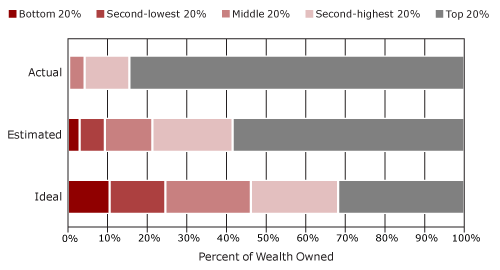
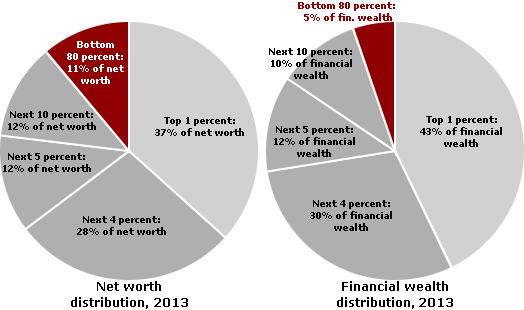
Look at the following graphs:
http://www2.ucsc.edu/whorulesa...
http://www2.ucsc.edu/whorulesa...
http://www2.ucsc.edu/whorulesa...And then...
WIKILEAKS: U.S. Fought To Lower Minimum Wage In Haiti So Hanes And Levis Would Stay Cheap
http://www.businessinsider.com...
https://www.youtube.com/watch?...
Free markets?
https://www.youtube.com/watch?...
http://www.amazon.com/Empire-I...
"We now live in two Americas. One—now the minority—functions in a print-based, literate world that can cope with complexity and can separate illusion from truth. The other—the majority—is retreating from a reality-based world into one of false certainty and magic. To this majority—which crosses social class lines, though the poor are overwhelmingly affected—presidential debate and political rhetoric is pitched at a sixth-grade reading level. In this “other America,” serious film and theater, as well as newspapers and books, are being pushed to the margins of society.
In the tradition of Chr
-
Re:Get real
Here's the thing. What is valuable to you? Dumping lots of mass to the Moon? Or spending a few years extra? Operations (the cost of monitoring and planning an ongoing mission) tends to be rather cheap compared to R&D or the cost of deployment right now. The Moon in particular can host near real time teleoperations meaning that even if labor on the Moon is extraordinarily expense (or even non-existent), any such expedition can tap labor from Earth at vastly lower cost.
Further, there's probably a happy intermediate state where particularly difficult to manufacture, but very low mass stuff like ICs or components made under extreme conditions (like small high temp parts or exotic materials) can be shipped from Earth while most of the mass can be constructed on the Moon.
And it's worth noting here that there are already plans for making a basic machine shop from scratch. One needs to be able to construct a furnace and have access to sufficient metal. You can construct human operated machining tools from a lot less starting technology than what I'm proposing. -
Re:zomg singularity!
The interview is slightly more nuanced than that. Prof. Jordan says that he can take off his academic hat and read musings on a common singularity with ordinary human awe and wonder. It is only in his work as an academic that he doesn't feel Kurzweil's ideas are relevant.
I remain sceptical of the singularity idea myself, though for different reasons. When I read Kurzweil's The Singularity is Near , I was disappointed at how in claiming a never-ending increase in the pace of technological advancement, Kurzweil never dealt with the regulatory and consumer factors, and the whole notion of how humans perceive time in general. The wheels of government can only move so fast, and so mankind's access to radical new technology outside the lab (e.g. self-driving cars, new medical tech) must slow down to match the speed of regulatory agencies. Also, consumers can be convinced to buy new shiny things, but there is still a desire to get one's money's worth out of one's purchases, and lots of people still feel their computer or smartphone from three or four years ago is still good enough. Would the market go for replacing one's tech in the shorter and shorter spans that Kurzweil envisions?
So when I read a computer scientist like Jordan admit that he sees no cause for singularity optimism within his work, I can only feel that Kurzweil's dream is a balloon being stuck with a thousand pins. Still, I continue to enjoy thinking about the subject.