Slashdot Mirror
Domain: amazon.com
Stories and comments across the archive that link to amazon.com.
Comments · 40,271
-
Re:all of it?
That one does look quite competitive(the only detail I'm not sure about is that the one in TFA appears to have a chip antenna onboard, while the one you link to appears to have only an antenna connector).
In part it depends on what you are looking to do: If you are looking to put a brain and a wifi link on top of an existing project, missing connectors aren't a big deal. You patch in +5v, ground, a TTY to the microcontroller, and maybe a few GPIOs for blinkenlights.
If you do have some sort of USB hosting or routing duties in mind, the price of baseboards will end up biting you almost as fast as some of the sillier arduino shield stacks will.
(With RT5350 devices there is one other confounding factor to note when it comes to prices: It's the basis for a lot of deeply-unfamous-name 'mini router' devices: by way of example, I have a "HooToo Tripmate Nano", I think it was on sale for $15 at Newegg when I bought it. Popped it open, RT5350, USB and ethernet already onboard, 3.3v serial pads, actually labelled no less, on the bottom of the board. Less GPIO, and certainly no vendor cooperation in getting the RaMIPS build of OpenWRT installed; but the RT5350 is a very popular part in some very competitively priced devices, largely from vendors who don't exactly bother to lock bootloaders.) -
AWS Support isn't exactly chopped liver
-
Re:But...
Statistics show that you are more likely to be shot to death in the USA than in England. However, statistics show that you are more likely to be beaten to death with fists and boots in the USA than in England. In fact more people are beaten to death per year in the USA than are murdered by all weapons in England. (That's not adjusted for population size, of course; many more people in the USA than in England.)
There is a book called The Samurai, the Mountie, and the Cowboy. It's worth reading, but I can summarize it: violence correlates well with cultural factors and does not correlate well with regulation of weapons. England had low crime rates, then they banned guns, then they had low crime rates. Anti-gunners point to England as a "success story" but it isn't.
And, in the decades since England banned guns, violent crime has gotten much worse. Did banning guns lead to increased crime? Can't say because correlation does not prove causation. But definitely we can't say that banning guns made England less violent.
And the majority of states in the USA now allow concealed carry of firearms. Violent crime has not increased; it has decreased. Again, we cannot prove that concealed carry caused the decrease; but we can trivially disprove the claims by the anti-gunners that letting people carry firearms will lead to horrible bloodbaths of violence. http://www.thenewamerican.com/usnews/crime/item/14859-florida-update-concealed-carry-permits-up-violent-crime-down
The perfect world would have all the bad guys disarmed, and all the good guys well-protected somehow. The real world shows that the bad guys are all armed, no matter what, full stop. Thus you have your choice: bad guys armed and good guys disarmed, or everybody armed. I'll take the latter, thank you. Statistics show that ordinary citizens are not likely to misuse firearms, and do in fact use them to stop crime (often without anyone being hurt; bad guys would rather surrender and have the police take them away, than be shot).
The best we can do, as a society, is to provide a robust economy full of opportunity, combined with locking up those few who are violent repeat offenders. The vast majority of people, including the poor and including minorities, are decent people who don't commit crimes. There are a few people who cause a great deal of havoc and the best we can do is to lock them up.
But we absolutely should allow the law-abiding to protect themselves. Not only is it common sense, but the Second Amendment protects that right in the USA. (If you are going to claim that the Second Amendment is limited to things like the National Guard, I will ask you why it is the only Amendment in the Bill of Rights that doesn't protect an individual right, and why you think your opinion carries more weight than the Supreme Court's opinion.)
-
Re:Samsung UD590 is nice...
I've been thinking about getting one of those 39" seiki 4K monitor/tvs for ~$450. They only do 30FPS, but for programming that's fine. I see it as a reverse of a multi-monitor set-up - consolidating my 3 monitors onto one screen.
But what I am wondering about is if there are window managers that know how to handle that kind of real-estate. Right now I can dedicate an app to a specific monitor and unless I deliberately drag a window over to a different monitor they don't interfere with each other. If I maximize a window, it only expands to fit the monitor. Etc.
I want a window manager that lets me define regions of a display as "virtual monitors." For example, split the display into 3 regions and if I maximize a window it only fills up that one region.
Can anyone recommend a window manager that provides that sort of functionality? And not in a kludgey tacked on after the fact way, I want something that is "native" to the design of the window manager.
-
Why aren't you talking about database?
The R3 is just an "instance". Sure it's a memory optimized instance, but it's not even their relational instances or mapreduce databases.
-
Why aren't you talking about database?
The R3 is just an "instance". Sure it's a memory optimized instance, but it's not even their relational instances or mapreduce databases.
-
Re:Samsung UD590 is nice...
I bought one of these for my office:
http://www.amazon.com/Seiki-SE...The pixel density is perfect for the opposite side of my desk, and since it's the office, being restricted to 30Hz doesn't hurt anything. At $400 it's a great place to get started with 4k computing. I agree that programming in 4k changes your entire way of working.
-
hilariously old news
Release: Amazon Relational Database Service
Release Date: October 22, 2009 -
What a disappointment!Just an updraft tower?
Here I thought we were going to see something along the lines of Siva!.
-
Re:Time to become a better shopper
eBooks are a bonanza for publishers and authors right now. They're pretty good for the minor players in the eBookstore market (ie: BN.com, the iBookstore, etc.), but terrible for Amazon. Why? Amazon discounts, and the discount comes entirely from Amazon's margin.
The publisher's recommended price for an eBook is called the list price. The way a company like Amazon get eBooks is that it decides how many copies it's likely to sell, and then send the publisher 70% of list price times the number of copies. An eBook I was recently interested in purchasing, for example, is Firethorn by Sarah Micklem. List price is $16.99, which is the price both Apple and BN charge. This means that Amazon is paying $11.89 per copy. If they give a 20% discount off list price they would only charge $13.79, which would mean all their overhead (including Jeff Bezos salary) would have to be covered by $1.90. And 20% discounts are quite common. My current read ("Like a Mighty Army," by David Weber) is listed at $14.99, but Amazon sells it for $12.99. But Firethorn is a bit different.
Their price? $6.83. They lose $5.06 whenever anybody buys that book. It's a 60% discount, and 30 of those percentage points are a loss to Amazon. I wouldn't be surprised to find out they're getting a special deal of some sort with this book, but OTOH I also wouldn't be surprised if they're just eating the five bucks.
If Amazon can convince Hachette to reduce their portion of the sale to 60% then Amazon can increase it's standard discount to 25% and still increase eBook revenue by roughly a third (it goes from 10% of list price to 15%). Then they could seriously consider doing things Wall Street loves like paying dividends.
-
Re:Ai is inevitable
> While there is more to be determined about physics, there is no sign of irreproducible magic, which is what luddites must invoke to declare AI "impossible" or even "unlikely."
The problem with current physics is that there are ZERO equations to describe consciousness. Go ahead, I'll wait for you to list them
Yet somehow consciousness "magically" appears out of the fundamental particles as some "emergent" property.
Scientists don't know:
a) how to measure it,
b) what it is composed of, or
c) how to reproduce it.They basically don't know what the fuck it is. They are like a blind man groping around in the dark touching thing trunk of an elephant. All they know is that there is SOMETHING there. (Note that the parallel to Dark Matter (and Dark Energy) being the Aether of the new Millennium isn't ironic.)
The joke that passes for Artificial Ignorance (A.I.) these days will never happen until we first are able to measure and quantify consciousness. Until then, yeah uhm no.
However, with that all said, Actual Intelligence (a.i.) IS eventually coming with silicon consciousness.
Bio-organic computing looks the most promising. Instead of trying to create consciousness from scratch, modify an existing one.
> The brain is an organic machine, no more, no less.
1. The Brain is NOT the Mind. The Mind is _non-local_ -- that is, we are unable to identity WHERE in the brain it is. It appears to be stored holographically in the mind. But just because you can _represent_ something does not imply it is _functional_ at a self-aware level.
An easy to ready description of the various experiments neurologists have performed that shows how confusing the brain mind connection is The Holographic Universe; It is an great succinct summary.
2. Furthermore, Reductionism and Materialism are archaic perspectives. Peter Russell in his brilliant "The Primacy of Consciousness" shows why this "brain = machine" is a complete fallacy.
As Sherlock Homes said famously "When you have eliminated the impossible, whatever remains, however improbable, must be the truth"
-
Re:From the article...
No requirement for artificial intelligence.
While Vinge often treats the Singularity in his fiction like Marooned in Realtime or the Zones of Thought books as a real singularity (civilizations disappear suddenly and it is not clear what happened to them), he strongly hints that there was some sort of merger of man and machine. Once a biological lifeform is so augmented with technological inventions that the biological part fades away, is that not "artificial intelligence"? I think the term "artificial" is fair enough as the resulting lifeform is not the result of slow biological evolution but a technological/industrial development.
-
Re:Minority still have needs
-
Re:Downmod already
http://www.amazon.com/The-Repu...
Review
* ""Drawing on a growing body of empirical research, he provides an intelligent, nuanced and persuasive account of how conservatives and liberals tend to differ at the level of psychology and personality"" (Financial Times, April 2012)From the Inside Flap
Why do so many Republicans believe man-made climate change is a hoax? The two most common explanations are that the deniers are uninformed or that they have been bought off by corporate money. Bestselling author Chris Mooney isn't buying either of those arguments. In fact, as he points out, the better educated a conservative is, the more likely he is to dismiss climate change concerns. How can that be?
Part of the answer lies with motivated reasoning—the psychological phenomenon of preferring only evidence that backs up your belief—but in The Republican Brain, Mooney explains that is just the tip of the cognitive iceberg. There is a growing body of evidence that conservatives and liberals don't just have differing ideologies; they have different psychologies. How could the rejection of mainstream science be growing among Republicans, along with the denial of expert consensus on the economy, American history, foreign policy, and much more? Why won't Republicans accept things that most experts agree on? Why are they constantly fighting against the facts? Increasingly, the answer appears to be: it's just part of who they are.Mooney explores brain scans, polls, and psychology experiments to explain why conservatives today believe more wrong things; appear more likely than Democrats to oppose new ideas; are less likely to change their beliefs in the face of new facts; and sometimes respond to compelling evidence by doubling down on their current beliefs.
The answer begins with some measurable personality traits that strongly correspond with political preferences. For instance, people more wedded to certainty tend to become conservatives; people craving novelty, liberals. Surprisingly, openness to new experiences and fastidiousness are better predictors of political preference than income or education. If you like to keep your house neat and see the world in a relatively black and white way, you're probably going to vote Republican. If you've recently moved to a big city to see what else life has to offer, you're probably going to vote Democrat. These basic differences in openness and curiosity, Mooney argues, fuel an "expertise gap" between left and right that explains much of the battle today over what is true.
Being a good liberal, Mooney also has to explore the implications of these findings for Democrats as well. Are they really wishy-washy flip-floppers? Well, sometimes. Can't they be just as dogmatic about issues close to their hearts, like autism and vaccines, or nuclear power? His research leads to some surprising conclusions.
While the evolutionary advantages of both liberal and conservative psychologies seem obvious, clashes between them in modern life have led to a crisis in our politics. A significant chunk of the electorate, it seems, will never accept the facts as they are, no matter how strong the evidence. Understanding the psychology of the left and the right, Mooney argues, should therefore fundamentally alter the way we approach the he-said-he-said of public debates.
Certain to spark discussion and debate, The Republican Brain also promises to add to the lengthy list of persuasive scientific findings that Republicans reject and deny.
-
Re:Downmod already
http://www.amazon.com/The-Repu...
Read it.
Or prove it. (and/or i should say)
Book description:
Bestselling author Chris Mooney uses cutting-edge research to explain the psychology behind why today’s Republicans reject reality—it's just part of who they are.
From climate change to evolution, the rejection of mainstream science among Republicans is growing, as is the denial of expert consensus on the economy, American history, foreign policy and much more. Why won't Republicans accept things that most experts agree on? Why are they constantly fighting against the facts?Science writer Chris Mooney explores brain scans, polls, and psychology experiments to explain why conservatives today believe more wrong things; appear more likely than Democrats to oppose new ideas and less likely to change their beliefs in the face of new facts; and sometimes respond to compelling evidence by doubling down on their current beliefs.
Goes beyond the standard claims about ignorance or corporate malfeasance to discover the real, scientific reasons why Republicans reject the widely accepted findings of mainstream science, economics, and history—as well as many undeniable policy facts (e.g., there were no “death panels” in the health care bill).
Explains that the political parties reflect personality traits and psychological needs—with Republicans more wedded to certainty, Democrats to novelty—and this is the root of our divide over reality.
Written by the author of The Republican War on Science, which was the first and still the most influential book to look at conservative rejection of scientific evidence. But the rejection of science is just the beginning
Certain to spark discussion and debate, The Republican Brain also promises to add to the lengthy list of persuasive scientific findings that Republicans reject and deny. -
Re:Bling
-
Re:Why can't passengers fly the plane?
There's something fishy about this mower, I just can't put my finger on it.
-
Re:This is a *LIE*
http://en.wikipedia.org/wiki/I...
http://en.wikipedia.org/wiki/F...You have to realize that back then, corporations did private research at their own expense. There's a reason why when you read stuff from back then it's all corporate logos and company PR. RCA, Raytheon, GE, Bell etc all these companies spent their own money.
(Eventually during the 70s and 80s, corporations got smarter, cheaper and greedier: they simply unloaded their R&D to piblic tax-funded universities and let people study at their own expense. Then these people can go beg for jobs from the same corporations who make money immediately from the university research, while the employee still has to pay back his student loans. But that's another story.)
Sure, corporations took money from NASA for the Apollo project. So what? By 1969, all the equipment used by Apollo was completely obsolete. Why? Because there was already a huge market for electronics and computers and people were eagerly developing technologies, not because of space, but because it's fun.
You really need to find a book called "Microelectronic packaging" by Sideris, it's a great time capsule for 1960s technology. It was astonishing what the impetus from WWII gave us, and how small the space race was overall.
http://www.amazon.com/Microele...
Just the fact that the transistor was invented during corporate research to simplify underwater cable repeaters should remove any doubt about who invented what for what reasons.
As for IBM, what the hell exactly do you think tabulators were? Typewriters? Jesus christ.
-
Almost Nobody gets it even Snowden...
... this (mass surveillance) is just more part and parcel of state suppression of dissent against corporate interests. They're worried that the more people are going to wake up and corporate centers like the US and canada may be among those who also awaken. See this vid with Zbigniew Brzezinski, former United States National Security Advisor.
https://www.youtube.com/watch?...
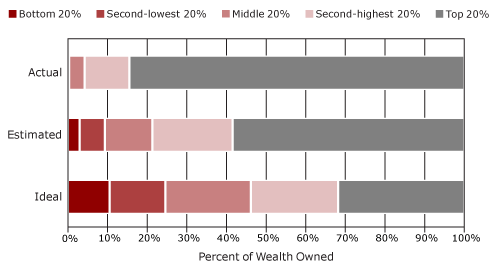
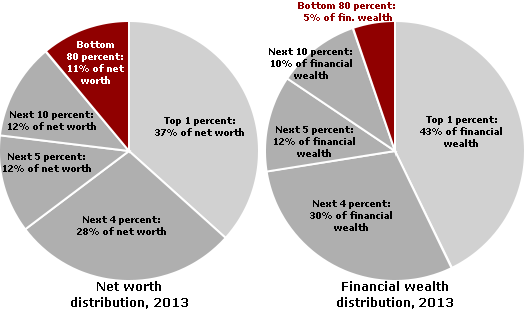
Look at the following graphs:
http://www2.ucsc.edu/whorulesa...
http://www2.ucsc.edu/whorulesa...
http://www2.ucsc.edu/whorulesa...And then...
WIKILEAKS: U.S. Fought To Lower Minimum Wage In Haiti So Hanes And Levis Would Stay Cheap
http://www.businessinsider.com...
https://www.youtube.com/watch?...
Free markets?
https://www.youtube.com/watch?...
http://www.amazon.com/Empire-I...
"We now live in two Americas. One—now the minority—functions in a print-based, literate world that can cope with complexity and can separate illusion from truth. The other—the majority—is retreating from a reality-based world into one of false certainty and magic. To this majority—which crosses social class lines, though the poor are overwhelmingly affected—presidential debate and political rhetoric is pitched at a sixth-grade reading level. In this “other America,” serious film and theater, as well as newspapers and books, are being pushed to the margins of society.
In the tradition of Christopher Lasch’s The Culture of Narcissism and Neil Postman’s Amusing Ourselves to Death, Pulitzer Prize-winner Chris Hedges navigates this culture—attending WWF contests, the Adult Video News Awards in Las Vegas, and Ivy League graduation ceremonies—to expose an age of terrifying decline and heightened self-delusion."
-
Time was...
...when every medical student and intern carried around a copy of "The Merck Manual" http://www.amazon.com/The-Merc...
They even have an on-line version now. Dear gawd why would an MD/DO, or even a wannabe, use the wiki for such things? -
Re:Torching the house rather than lighting a candl
Interesting point.
But that is the same admonition was used when the first ‘Hacking Exposed’ book came out. Which is similar to the argument that terrorists will use strong encryption.
Ultimately, it simply makes it that the white hats should read these books more of an imperative.
Full list of the series here:
-
Re:This is not the tablet you're looking for
Right, more lines is better. More cores is better. Higher numbers are better. Everybody knows that.
Ipad 3 for U. $500. Right, I don't know why either.
-
Re:Amazon is short-sighted
And out of that 70%, the writer now has to supply their own editors, artwork, proof readers and layout specialists.
Or they need to learn to do it themselves, most of which is not too difficult.
My recent book (DRM free on Amazon: http://www.amazon.com/Darwins-...) cost me $200 to produce (assuming my time is worth nothing), which went to pay for the cover art.
If I had wanted to pay an editor it would have cost around $1500--I looked into this, but decided to play with a combination of early-reader feedback (I have a number of friends whom I trust to tell me when things are crap, and believe me, they did), mechanical editing based on research-grade natural-language processing tools, and semi-automated proofreading (which I wrote my own code for using a variety of heuristics tailored to the kinds of errors I'm particularly prone to making.)
I'm sure there are typos and minor grammar issues remaining, but at a level that is not materially worse than many professionally edited books. And this was a first-pass at this method. I'm sure that with more work the process of editing and proof-reading can be much more highly automated, although nothing short of a full AI will be able to replace first readers for basic feedback.
As to design and layout, anyone with a reasonable level of HTML, CSS and LaTeX experience should be able to produce a decent-looking ebook or print book. There are tricks, but it's not rocket science.
We are in the early days of indie publishing, and things are only going to get better as we automate more processes and lower barriers between authors and readers. There is nothing today stopping a writer from producing a professional-quality book with minimal resources, and that's a good thing.
-
Re:DRM or no DRM, pick one
Interestingly, Scalzi's latest publication calls out that it is DRM free in the book description: http://www.amazon.com/Unlocked...
-
Re:Do we really need new books?
The title of this comment may be provocative, but after buying a Kindle Paperwhite, something that Amazon does really well (and just keep it in airplane mode all the time so you don't have to deal with Amazon's ecosystem), I have found myself with such a huge choice of classic literature titles from either Project Gutenberg or pirate ebook sites, that I feel I'll never catch up with all the old stuff, let alone hunger after anything new. For Mr. Stross, I'm sorry, but you're competing with the past, and there are a myriad of science-fiction writers like yourself that already have more books out there than anyone can read.
So, the author decides to stand up for something he believes in, and society's succinct and polite answer to that is "fuck you very much, we'll buy someone else's books."
With mentalities like that, I hope the rest of your favorite authors jump on this bandwagon. Gonna be a bitch when you're facing thousands in fines for pirating books too as **AA mentalities from the entertainment industry bleed over into other industries that are being targeted...
-
Do we really need new books?
The title of this comment may be provocative, but after buying a Kindle Paperwhite, something that Amazon does really well (and just keep it in airplane mode all the time so you don't have to deal with Amazon's ecosystem), I have found myself with such a huge choice of classic literature titles from either Project Gutenberg or pirate ebook sites, that I feel I'll never catch up with all the old stuff, let alone hunger after anything new. For Mr. Stross, I'm sorry, but you're competing with the past, and there are a myriad of science-fiction writers like yourself that already have more books out there than anyone can read.
-
Re:Yes!
...they can't even access their local jobs website...
Meanwhile, it would be better for the environment if rural people moved to the cities. Therefore, it's counterproductive to try to protect people from the consequences of their lifestyle choices, as the FCC is attempting to do by subsidizing broadband for rural residents.
-
Same was true at places like IBM Research
Overheard at lunch there around 2000 (paraphrase): "We hire the most competitive candidates from the most competitive top three schools and then we wonder why they have trouble cooperating and getting along..."
I hope the policy has changed since... It also seemed like they were passing over a lot of interesting people and thus limiting their cognitive diversity.
See also Scott E. Page book "The Difference: How the Power of Diversity Creates Better Groups, Firms, Schools, and Societies"
http://www.amazon.com/Differen...Google probably suffers to a lesser extent from a similar problem as I suggest here:
http://developers.slashdot.org... -
Impressive form factor
Unimpressive specs. 864x480 resolution. 75 lumens.
Yeah, I'm going to wait a few years before getting one of it's descendants.
Especially when you consider the price and specs for this:
http://www.amazon.com/ViewSoni...Or something like it. Because the brix is just a toy right now.
-
Re:Good news for BN?
The article summary appears to misrepresent the situation.
The retailer began refusing orders late Thursday for coming Hachette books, including J.K. Rowling's new novel.
They made it sound like JK Rowling's novel is on the market and Amazon deleted its page. That's not the case. Amazon kept the page intact, but they stopped accepting PRE-ORDERS
The publisher wants them to start taking orders for an item that is not even available to ship yet, because the publisher has not released it yet.
The paperback edition of Brad Stone's The Everything Store: Jeff Bezos and the Age of Amazon — a book Amazon disliked so much it denounced it — is suddenly listed as 'unavailable.
Again.. the page says in stock and available to order.
Anne Rivers Siddons's new novel, The Girls of August, coming in July, no longer has a page for the physical book or even the Kindle edition.
A page for the physical book came right up, when I searched for it; stating unavailable with an option to e-mail me when it becomes available.
I think it's clear that what we have here is a MARKETING dispute. For one reason or another; Amazon has decided to stop collecting pre-orders on some books. Perhaps because the Publisher has not signed the proper contracts or made the proper agreements with Amazon, required for them to offer that publisher's books on a pre-order basis.
-
Re:Good news for BN?
The article summary appears to misrepresent the situation.
The retailer began refusing orders late Thursday for coming Hachette books, including J.K. Rowling's new novel.
They made it sound like JK Rowling's novel is on the market and Amazon deleted its page. That's not the case. Amazon kept the page intact, but they stopped accepting PRE-ORDERS
The publisher wants them to start taking orders for an item that is not even available to ship yet, because the publisher has not released it yet.
The paperback edition of Brad Stone's The Everything Store: Jeff Bezos and the Age of Amazon — a book Amazon disliked so much it denounced it — is suddenly listed as 'unavailable.
Again.. the page says in stock and available to order.
Anne Rivers Siddons's new novel, The Girls of August, coming in July, no longer has a page for the physical book or even the Kindle edition.
A page for the physical book came right up, when I searched for it; stating unavailable with an option to e-mail me when it becomes available.
I think it's clear that what we have here is a MARKETING dispute. For one reason or another; Amazon has decided to stop collecting pre-orders on some books. Perhaps because the Publisher has not signed the proper contracts or made the proper agreements with Amazon, required for them to offer that publisher's books on a pre-order basis.
-
Re:Good news for BN?
The article summary appears to misrepresent the situation.
The retailer began refusing orders late Thursday for coming Hachette books, including J.K. Rowling's new novel.
They made it sound like JK Rowling's novel is on the market and Amazon deleted its page. That's not the case. Amazon kept the page intact, but they stopped accepting PRE-ORDERS
The publisher wants them to start taking orders for an item that is not even available to ship yet, because the publisher has not released it yet.
The paperback edition of Brad Stone's The Everything Store: Jeff Bezos and the Age of Amazon — a book Amazon disliked so much it denounced it — is suddenly listed as 'unavailable.
Again.. the page says in stock and available to order.
Anne Rivers Siddons's new novel, The Girls of August, coming in July, no longer has a page for the physical book or even the Kindle edition.
A page for the physical book came right up, when I searched for it; stating unavailable with an option to e-mail me when it becomes available.
I think it's clear that what we have here is a MARKETING dispute. For one reason or another; Amazon has decided to stop collecting pre-orders on some books. Perhaps because the Publisher has not signed the proper contracts or made the proper agreements with Amazon, required for them to offer that publisher's books on a pre-order basis.
-
Re:Sick
You mean let him express his views that only benefit his rainbow push coalition and his own endeavors? He's an extortionist, plain and simple with a long history of condemning businesses over racial issues and once they pay him off, he shuts up and supports them. Funny how that works. There's an excellent book on the subject.
-
Re:No surprises
Here are an algebra book and a geometry book that I thought were very good. In 7th grade I went to a summer math program that used these. For the upper courses they used all the other books in the series that contains the algebra book, but I haven't checked those out yet.
http://www.amazon.com/Algebra-I-Expressions-Equations-Applications/dp/0201860945/ref=pd_sim_b_5/002-3278004-1006461 http://www.amazon.com/Geometry-McDougal-Littell-Jurgensen/dp/0395977274/ref=pd_sim_b_3?ie=UTF8&refRID=156P3DE9N61MT1DC9G5D
Oddly enough the geometry book was from a different series. My public school used that series for both algebra and geometry, and I did not think highly of the algebra book.
A better resource for you might be to check out a homeschool bookfair if you can. Go now while your child is 4, just to look. Go back next year with a little money, and as your child gets older, go back with more and more money (and you'll have lots of knowledge by then about what you want to buy!)
-
Re:No surprises
Here are an algebra book and a geometry book that I thought were very good. In 7th grade I went to a summer math program that used these. For the upper courses they used all the other books in the series that contains the algebra book, but I haven't checked those out yet.
http://www.amazon.com/Algebra-I-Expressions-Equations-Applications/dp/0201860945/ref=pd_sim_b_5/002-3278004-1006461 http://www.amazon.com/Geometry-McDougal-Littell-Jurgensen/dp/0395977274/ref=pd_sim_b_3?ie=UTF8&refRID=156P3DE9N61MT1DC9G5D
Oddly enough the geometry book was from a different series. My public school used that series for both algebra and geometry, and I did not think highly of the algebra book.
A better resource for you might be to check out a homeschool bookfair if you can. Go now while your child is 4, just to look. Go back next year with a little money, and as your child gets older, go back with more and more money (and you'll have lots of knowledge by then about what you want to buy!)
-
Re:Commodity of the future
Scientists have already found several microbes (fungi mostly) that can break down plastics and other petrochemicals.
And what could go wrong with that?
-
A recovery approach
Have you heard about Dr. Norman Doidge? He is a leading researcher in brain neuroplasticity and wrote a book about it titled The Brain That Changes Itself: Stories of Personal Triumph from the Frontiers of Brain Science. There you will find many cases of surprising recovery where traditional approaches didn't work. I'm not a doctor and I don't have a personal account of how this approach performs, but I thought I would do no harm if I told you about this. I hope all goes well.
-
It didn't take long to leave our mark in the seaThis reminds me of that passage in Gene Wolfe's The Book of the New Sun where the inhabitants of a far-future Earth note how the debris of past ages is all around them:
I have heard those who dig for their livelihood say there is no land anywhere in which they can trench without turning up the shards of the past. No matter where the spade turns the soil, it uncovers broken pavements and corroding metal; and scholars write that the kind of sand that artists call polychrome (because flecks of every color are mixed with its whiteness) is actually not sand at all, but the glass of the past, now pounded to powder by aeons of tumbling in the clamorous sea.
Instead of aeons needed to turn glass to microparticles, humanity has managed to litter the seas with plastic bits in only around a century. If humanity goes extinct, perhaps one day visitors from another planet would know there was once sentient life here from the remains of our PET bottles and beer six-pack rings in the ice?
-
book was out in 1990
http://www.amazon.com/Worlds-W...
My favorite is the Blohm and Voss Bv-141. Symmetry is for weenies.
-
Re:Hell Yes!
-
Multiple fire rocket launcher
Agreed. When "All Night Long" by Lionel Richie comes on the radio, I now can't hear the pseudo-African simlish halfway through that song without thinking of the way that voice says "multiple fire rocket launcher".
But seriously, Forsaken fixed the roll confusion (upside-down play) that plagued many Descent players. And if you like the N64 controller, you can plug it into a USB adapter and use it with many PC games.
-
Commercial-Free Cable Television is a Myth
"I started paying for cable back in the late 70s to early 80s, with the intention that my monthly bill was a replacement for having to watch all those stupid advertisements-- exactly as advertised-- with the perk that I would have more reliable and higher quality of service."
This is getting sad. I see this posted somewhere in the comments of every article about cable television on Slashdot. Aren't people on Slashdot supposed to be smart enough to not accept facts without question simply because they support whatever argument they'd like to make?
It does seem some people on the internet are smart enough to question the story: link and link.
Others seem far too blinded by their desire to believe the story to realize just how likely it is that it is complete bullshit, like this guy who even put "fairy tale" in the title of his story. At first I thought maybe he was presenting it as a fairy tale, but with no argument against the story being presented, I can only conclude that he believes that commercial-free cable television did exist at one time, but has now become a "fairy tale" as it no longer exists.
-
Re:Still
-
Re:USA, the land of freedom
-
Re:Social collapse at Google?
In my opinion, Google seems to be degrading rapidly, along with the other social collapse happening in the U.S., documented in the book, The Unwinding: An Inner History of the New America.
Degrading? LOL Google was always an ad company first and foremost and only fools bought into their "do no evil" marketing.
-
Reminds me of the book Feed
Surprising relevant
From Wikipedia:
Feed (2002) is a young adult science fiction novel written by M. T. (Matthew Tobin) Anderson. The novel focuses on issues such as corporate power, consumerism, information technology, data mining, and environmental decay, occasionally from a sardonic perspective. The novel depicts American society's descent into a culture that revolves entirely around advertising and corporate gain from the perspective of an American teenager and his friends. -
Social collapse at Google?
In my opinion, Google seems to be degrading rapidly, along with the other social collapse happening in the U.S., documented in the book, The Unwinding: An Inner History of the New America.
-
Re:Never a better time to read "Liberal Fascism"
Save your money. If you want it, you can probably pick up a cheap copy at your local thrift store.
-
Never a better time to read "Liberal Fascism"
Just in case you still thought the roots of fascism came from anything other than claiming to care about those they rule over - as the news about the freedom act being gutted shows.
Also think strongly on this the next time you do not vote Libertarian because it's a "wasted vote".
-
Re:Why I Prefer Dumb Displays
It's not hard to find dumb displays; somebody else already posted links to a brand called Seiki that makes several different models (including this kickass retro-themed one!), and they're significantly cheaper than the "smart" versions that other brands are selling.