Slashdot Mirror
Domain: ametsoc.org
Stories and comments across the archive that link to ametsoc.org.
Comments · 141
-
Re:These people scare me
Ah, I see, your objection is informed by your ideology more than science.
Here are some papers that examine the changes in outgoing longwave radiation spectra over time that support the increase in greenhouse forcing:
* Increases in greenhouse forcing inferred from the outgoing longwave radiation spectra of the Earth in 1970 and 1997 – John E. Harries, Helen E. Brindley, Pretty J. Sagoo & Richard J. Bantges; Nature 410, 355-357 (15 March 2001) | doi:10.1038/35066553.
* Comparison of spectrally resolved outgoing longwave data between 1970 and present, J.A. Griggs et al, Proc SPIE 164, 5543 (2004).
* Spectral signatures of climate change in the Earth’s infrared spectrum between 1970 and 2006, Chen et al, (2007)
* Radiative forcing – measured at Earth’s surface – corroborate the increasing greenhouse effect, R. Phillipona et al, Geo Res Letters, v31 L03202 (2004)
* Measurements of the Radiative Surface Forcing of Climate, W.F.J. Evans, Jan 2006
* A method for continuous estimation of clear-sky downwelling longwave radiative flux developed using ARM surface measurements, C. N. Long and D. D. Turner, Journal of Geophysical Research, vol 113, D18206, doi:10.1029/2008JD009936, 2008
* Satellite-Based Reconstruction of the Tropical Oceanic Clear-Sky Outgoing Longwave Radiation and Comparison with Climate Models, Gastineau et al, J Climate, vol 27, 941–957 (2014).
-
Re:No one gets the oil!
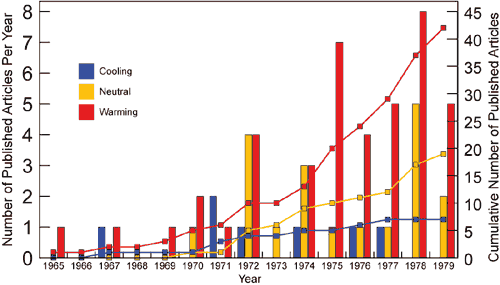
You're regurgitating complete nonsense. Once again, here’s figure 1 from Peterson et al. 2008. Notice that papers predicting warming vastly outnumbered those predicting cooling, even in the 1970s. Ironically:
- The term “global warming” was first used in a 1975 Science article by Wally Broecker called “Are we on the brink of a pronounced global warming?”.
- Sawyer 1972 estimated climate sensitivity as 2.4C, and Schneider 1975 gave a preliminary range of 1.5C to 3.0C.
- Manabe and Wetherald, 1975: “The Effects of Doubling the CO2 Concentration on the climate of a General Circulation Model.”
- In 1977, Freeman Dyson wrote that the “prevailing opinion is that the dangers [of the rise in CO2] greatly outweigh the benefits.”
- In 1977, Robert M. White, the head of the National Oceanic and Atmospheric Administration, wrote a report for the National Academy of Sciences that said “We now understand that industrial wastes, such as the carbon dioxide released in the burning of fossil fuels, can have consequences for climate that pose a considerable risk to future society.” [White, Robert, 1978, Oceans and Climate Introduction, Oceanus, 21:2-3]
- The 1979 JASON report “The long-term impact of atmospheric carbon dioxide on climate” estimated climate sensitivity as 2.4C to 2.8C.
- The National Academy of Science’s 1979 Charney report estimated climate sensitivity as 1.5C to 4.5C and said “If carbon dioxide continues to increase, [we] find no reason to doubt that climate changes will result, and no reason to believe that these changes will be negligible.”
While Jane is reading those papers, he should also consider addressing this issue with his basic thermodynamics:
Your own insistence that power in = power out (assuming perfect conversion and no entropic losses) belies this argument. You are arguing against yourself and you refuse to see that. If power in = power out (your own stipulation)
I'm not the only one insisting that power in = power out through any boundary where nothing inside is changing. Once again, that's a fundamental principle called "conservation of energy". Here are some introductions: example (backup), example (backup), example
-
Re:No one gets the oil!
You're regurgitating complete nonsense. Once again, here’s figure 1 from Peterson et al. 2008. Notice that papers predicting warming vastly outnumbered those predicting cooling, even in the 1970s. Ironically:
- The term “global warming” was first used in a 1975 Science article by Wally Broecker called “Are we on the brink of a pronounced global warming?”.
- Sawyer 1972 estimated climate sensitivity as 2.4C, and Schneider 1975 gave a preliminary range of 1.5C to 3.0C.
- Manabe and Wetherald, 1975: “The Effects of Doubling the CO2 Concentration on the climate of a General Circulation Model.”
- In 1977, Freeman Dyson wrote that the “prevailing opinion is that the dangers [of the rise in CO2] greatly outweigh the benefits.”
- In 1977, Robert M. White, the head of the National Oceanic and Atmospheric Administration, wrote a report for the National Academy of Sciences that said “We now understand that industrial wastes, such as the carbon dioxide released in the burning of fossil fuels, can have consequences for climate that pose a considerable risk to future society.” [White, Robert, 1978, Oceans and Climate Introduction, Oceanus, 21:2-3]
- The 1979 JASON report “The long-term impact of atmospheric carbon dioxide on climate” estimated climate sensitivity as 2.4C to 2.8C.
- The National Academy of Science’s 1979 Charney report estimated climate sensitivity as 1.5C to 4.5C and said “If carbon dioxide continues to increase, [we] find no reason to doubt that climate changes will result, and no reason to believe that these changes will be negligible.”
While Jane is reading those papers, he should also consider addressing this issue with his basic thermodynamics:
Your own insistence that power in = power out (assuming perfect conversion and no entropic losses) belies this argument. You are arguing against yourself and you refuse to see that. If power in = power out (your own stipulation)
I'm not the only one insisting that power in = power out through any boundary where nothing inside is changing. Once again, that's a fundamental principle called "conservation of energy". Here are some introductions: example (backup), example (backup), example
-
Re:No one gets the oil!
No,no. Global cooling. Haven't you read the scientific papers from top agencies and researchers from the 70's. Sheesh
You're regurgitating complete nonsense. Once again, here’s figure 1 from Peterson et al. 2008. Notice that papers predicting warming vastly outnumbered those predicting cooling, even in the 1970s. Ironically:
- The term “global warming” was first used in a 1975 Science article by Wally Broecker called “Are we on the brink of a pronounced global warming?”.
- Sawyer 1972 estimated climate sensitivity as 2.4C, and Schneider 1975 gave a preliminary range of 1.5C to 3.0C.
- Manabe and Wetherald, 1975: “The Effects of Doubling the CO2 Concentration on the climate of a General Circulation Model.”
- In 1977, Freeman Dyson wrote that the “prevailing opinion is that the dangers [of the rise in CO2] greatly outweigh the benefits.”
- In 1977, Robert M. White, the head of the National Oceanic and Atmospheric Administration, wrote a report for the National Academy of Sciences that said “We now understand that industrial wastes, such as the carbon dioxide released in the burning of fossil fuels, can have consequences for climate that pose a considerable risk to future society.” [White, Robert, 1978, Oceans and Climate Introduction, Oceanus, 21:2-3]
- The 1979 JASON report “The long-term impact of atmospheric carbon dioxide on climate” estimated climate sensitivity as 2.4C to 2.8C.
- The National Academy of Science’s 1979 Charney report estimated climate sensitivity as 1.5C to 4.5C and said “If carbon dioxide continues to increase, [we] find no reason to doubt that climate changes will result, and no reason to believe that these changes will be negligible.”
-
Re:No one gets the oil!
No,no. Global cooling. Haven't you read the scientific papers from top agencies and researchers from the 70's. Sheesh
You're regurgitating complete nonsense. Once again, here’s figure 1 from Peterson et al. 2008. Notice that papers predicting warming vastly outnumbered those predicting cooling, even in the 1970s. Ironically:
- The term “global warming” was first used in a 1975 Science article by Wally Broecker called “Are we on the brink of a pronounced global warming?”.
- Sawyer 1972 estimated climate sensitivity as 2.4C, and Schneider 1975 gave a preliminary range of 1.5C to 3.0C.
- Manabe and Wetherald, 1975: “The Effects of Doubling the CO2 Concentration on the climate of a General Circulation Model.”
- In 1977, Freeman Dyson wrote that the “prevailing opinion is that the dangers [of the rise in CO2] greatly outweigh the benefits.”
- In 1977, Robert M. White, the head of the National Oceanic and Atmospheric Administration, wrote a report for the National Academy of Sciences that said “We now understand that industrial wastes, such as the carbon dioxide released in the burning of fossil fuels, can have consequences for climate that pose a considerable risk to future society.” [White, Robert, 1978, Oceans and Climate Introduction, Oceanus, 21:2-3]
- The 1979 JASON report “The long-term impact of atmospheric carbon dioxide on climate” estimated climate sensitivity as 2.4C to 2.8C.
- The National Academy of Science’s 1979 Charney report estimated climate sensitivity as 1.5C to 4.5C and said “If carbon dioxide continues to increase, [we] find no reason to doubt that climate changes will result, and no reason to believe that these changes will be negligible.”
-
Re:We've been doing it for a long time
Since the oceans are warming, it's wrong to say "the globe isn't warming."
Warming, according to whom?
This says long-term trends have not been detected, up to 2000.
This says no warming trend in upper ocean SINCE 2000.
This -- which is the longest and most comprehensive study to date -- says there is no detectable warming in the deep ocean.
So I don't know who you've been listening to, but my sources say it isn't happening to any noticeable degree. -
Re:What happens to that heat?
" and a massive increase in tropical hurricanes."
They have been saying this for YEARS now, and there hasn't been a major hurricane in how many years?
It is predictions and statements like this that have people like me scratching our heads. None of the predictions of doom have happened. Polar Bears are not drowning either. When people are caught lying, repeatedly, people stop believing them. This is what happens when people stop reading fairy tales and start creating them using "Science" as a backdrop.
How do you know polar bears aren't drowning? Who says " and a massive increase in tropical hurricanes."? "Storm frequency decreases in the Southern Hemisphere and north Indian Ocean, increases in the western North Pacific, and is indeterminate elsewhere." http://journals.ametsoc.org/do... for instance.
-
Re:The last sentence in the summary...
No, see, that tiny patch of the globe representing southern canada and northeastern US where the temperature trendline is actually slightly negative is storing so much hidden cold it completely contradicts any observations that the average temperature of the rest of the planet.
Reading between the lines, you have two points to make. One that you could argue that there isn't global warming while the ice sheets are melting so long as there is a large cooling elsewhere. And two that you don't find that this is a very compelling argument because there isn't such a cooling.
And sure. Ice sheet mass loss is indicative of regional warming, not global warming. 500 cubic kilometres represents about 46 trillion kilowatt hours. Incidentally, at current average Australian electricity prices, that would cost about the same as the GDP of the entire country for about 6.8 years.
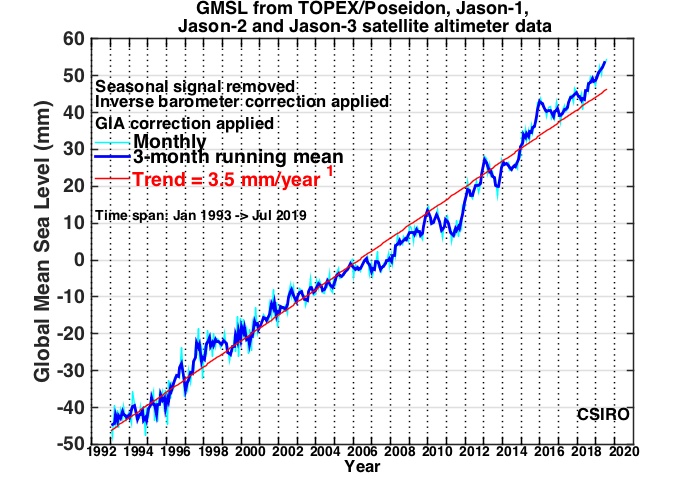
It also represents about 0.01 W/m^2 for one year for the entire surface of the earth, or about 1-2% of the total energy imbalance. Possible to hide in other places, in principle, but you'd probably notice. And continued sea level rise is a bit of a cincher. -
Re:Science creates understanding of a real world.
Personally, I rarely stray from the IPCC reports and the temperature data. Most people are unaware of what the science actually says. It does not support many of the beliefs held by global warming activists.
Much research is done by scientists who don't identify as skeptics, but whose work supports what skeptics have been saying for a long time, such as this paper on climate sensitivity, or this one by Nick Lewis.
I recommend Judith Curry's blog as a good place to start if you are truly interested in engaging with skeptics and lukewarmers. (Judith Curry does "actual research" by the way.) -
Re:Science creates understanding of a real world.
The graph includes the cite, so you can check up on their methodology. The sample size is 5,000, which is actually pretty good for a sample like this. (1,000 is more common, with a 3% margin of error, though since they're breaking it down into three roughly equal subgroups they'd need a larger sample.)
-
Re:Science creates understanding of a real world.
That's fantastic, thanks for the link.
Abstract:
A series of polls provides new tests for how weather influences public beliefs about climate change. Statewide data from 5000 random-sample telephone interviews conducted on 99 days over 2.5 yr (2010–12) are merged with temperature and precipitation indicators derived from U.S. Historical Climatology Network (USHCN) station records. The surveys carry a question designed around scientific consensus statements that climate change is happening now, caused mainly by human activities. Alternatively, respondents can state that climate change is not happening, or that it is happening but mainly for natural reasons. Belief that humans are changing the climate is predicted by temperature anomalies on the interview day and the previous day, controlling for season, survey, and individual characteristics. Temperature effects concentrate among one subgroup, however: individuals who identify themselves as independent, rather than aligned with a political party. Interviewed on unseasonably warm days, independents tend to agree with the scientific consensus regarding anthropogenic climate change. On unseasonably cool days, they tend not to agree. Although temperature effects are sharpest for just a 2-day window, positive effects are seen for longer windows as well. As future climate change shifts the distribution of anomalies and extremes, this will first affect beliefs among unaligned voters.
-
Jane/Lonny Eachus goes Sky Dragon Slayer
... you KNOW Latour was correct. And it isn't just him. TEXTBOOKS about practical applications of thermodynamics say so.
Again, I already showed you that MIT's equation reduces to my Eq. 1 for blackbodies, and is consistent with these equations and Eq. 1 in Goodman 1957. I've stressed that this thought experiment has been tested for decades in the real world. Radiation shields allow for more accurate measurements of gas temperatures using thermocouples:
"The greatest problem with measuring gas temperatures is combatting radiation loss.
These radiation shields have been used since at least Daniels 1968 (PDF), and they work like Dr. Spencer's insulating plate. They slow radiative heat loss from the hotter thermocouple. If Jane and Dr. Latour's Sky Dragon Slayer misinformation is correct, why have accurate thermocouples used radiation shields since at least 1968? Isn't that an example of a "real world" situation that's ultimately what we're talking about?
But its inner temperature ISN'T 149.6F [Jane Q. Public, 2014-08-30]
After twice pretending that I'd claimed the inner temperature wasn't equal to its outer temperature of 149.6F... now you make that incorrect claim yourself? Bizarrely, I have to point out that a thermal superconductor enclosing shell will have an inner temperature equal to its outer temperature, exactly as I originally said.
This reminds me of your other similar mistake that you haven't acknowledged:
A plate near the heat source is NOT even remotely the same as closing the drain on a bathtub, because the total power out of the system (it's a closed system with heat being removed, remember?) remains constant, as you have so conveniently observed. [Jane Q. Public, 2014-08-28]
Completely backwards, as usual. I've never observed any such ridiculous nonsense. That's actually Jane's ridiculous "observation" which I've already tried to correct:
"... Hopefully it's also clear that Jane's also wrong to claim that the power used by the cooler is required to be constant. The chamber wall temperature is held constant, so the power used by the cooler temporarily decreases after the enclosing plate is added, until it reaches equilibrium."
I've repeat
-
Re:
Just to be clear: are you saying that antarctic sea ice decline wasn't a forecast of AGW? How is it the supposedly "pro-science" AGW believers can have their facts so horribly mangled? You probably don't remember the 50 million climate refugees by 2010 either.
An Initial Assessment of Antarctic Sea Ice Extent in the CMIP5 Models "...all of the models have a negative trend in SIE [sea ice extent] since the mid-nineteenth century."
Oops.
As a left-leaning, somewhat green Canadian and former believer in CAGW, I used to think "our side" would come right out and admit it when we were wrong. How wrong I was. -
Re:Science is not consensus
I think I can do better than Judith Curry too. Comment on “Climate Science and the Uncertainty Monster” J. A. Curry and P. J. Webster [PDF] published in the American Meteorological Society Journal, December 2011.
I think you misunderstand the differences in chaos in climate and chaos in weather. Climate describes the boundaries of weather. It contains all of the chaos of weather. Here is a post on the subject.
Imagine a pot of boiling water. A weather forecast is like the attempt to predict where the next bubble is going to rise (physically this is an initial value problem). A climate statement would be that the average temperature of the boiling water is 100C at normal pressure, while it is only 90C at 2,500 meters altitude in the mountains, due to the lower pressure (that is a boundary value problem).
-
Re:Go outside. San Francisco underwater by 2010?
> On balance, scientists aren't entirely sure what effect clouds will have on global warming. Most climate models predict that clouds will amplify global warming slightly.
That sentence lumps professional alarmists in with actual scientists. Never been outside on a cloudy day? Those "scientists" (alarmists) who say clouds make it hot are the same ones who you said San Francisco would be underwater by the year 2010. Don't let their silly pseudo-science make you doubt the obvious facts of your experience. You know that when it's cloudy, it's cooler.
What you may not know not know is that islands near San Francisco have recently re-appeared after having been underwater for the last 60 years, the exact opposite of what the alarmists claimed. There is some important science around climate change. Earth HAS warmed a bit more in the last 100 years than the other planets have. There's also a metric ton of snake oil being sold by alarmists whose pseudoscience is nothing more than patter for their act. Confusing one with the other ends up getting you confused and making you look silly. You end up believing things like "it gets hot when it's cloudy", which is of course ridiculous.
Well, at risk of repeating myself, here's some of those actual scientists who find no negative feedback, and/or some positive feedback from clouds:
http://www.sciencemag.org/cont...
http://rain.atmos.colostate.ed...
http://journals.ametsoc.org/do...
http://journals.ametsoc.org/do...
ftp://eos.atmos.washington.edu...
http://journals.ametsoc.org/do...
http://journals.ametsoc.org/do...
Never been outside on a cloudy night? It's warmer when the heat is reflected back than when it is radiated out into space. Don't let your interests in the islands off San Francisco make you doubt the obvious facts of your experience. You know that when it's cloudy, it's warmer. The thing is, that AGW is primarily an effect of warming the cooler temps; at night, in winter, in higher latitudes, with less change in the tropics, in the day, when it's hot. So, whatever effects might occur from cooling the tropic days (which is apparently none, or close to it, but giving the credit of infinitesimal doubt) is irrelevant because those temps changed the least; the biggest warming, and therefore the most increase in clouds, will be in the winter nights in the high latitudes, where the clouds will be positive feedback.
-
Re:Go outside. San Francisco underwater by 2010?
> On balance, scientists aren't entirely sure what effect clouds will have on global warming. Most climate models predict that clouds will amplify global warming slightly.
That sentence lumps professional alarmists in with actual scientists. Never been outside on a cloudy day? Those "scientists" (alarmists) who say clouds make it hot are the same ones who you said San Francisco would be underwater by the year 2010. Don't let their silly pseudo-science make you doubt the obvious facts of your experience. You know that when it's cloudy, it's cooler.
What you may not know not know is that islands near San Francisco have recently re-appeared after having been underwater for the last 60 years, the exact opposite of what the alarmists claimed. There is some important science around climate change. Earth HAS warmed a bit more in the last 100 years than the other planets have. There's also a metric ton of snake oil being sold by alarmists whose pseudoscience is nothing more than patter for their act. Confusing one with the other ends up getting you confused and making you look silly. You end up believing things like "it gets hot when it's cloudy", which is of course ridiculous.
Well, at risk of repeating myself, here's some of those actual scientists who find no negative feedback, and/or some positive feedback from clouds:
http://www.sciencemag.org/cont...
http://rain.atmos.colostate.ed...
http://journals.ametsoc.org/do...
http://journals.ametsoc.org/do...
ftp://eos.atmos.washington.edu...
http://journals.ametsoc.org/do...
http://journals.ametsoc.org/do...
Never been outside on a cloudy night? It's warmer when the heat is reflected back than when it is radiated out into space. Don't let your interests in the islands off San Francisco make you doubt the obvious facts of your experience. You know that when it's cloudy, it's warmer. The thing is, that AGW is primarily an effect of warming the cooler temps; at night, in winter, in higher latitudes, with less change in the tropics, in the day, when it's hot. So, whatever effects might occur from cooling the tropic days (which is apparently none, or close to it, but giving the credit of infinitesimal doubt) is irrelevant because those temps changed the least; the biggest warming, and therefore the most increase in clouds, will be in the winter nights in the high latitudes, where the clouds will be positive feedback.
-
Re:Go outside. San Francisco underwater by 2010?
> On balance, scientists aren't entirely sure what effect clouds will have on global warming. Most climate models predict that clouds will amplify global warming slightly.
That sentence lumps professional alarmists in with actual scientists. Never been outside on a cloudy day? Those "scientists" (alarmists) who say clouds make it hot are the same ones who you said San Francisco would be underwater by the year 2010. Don't let their silly pseudo-science make you doubt the obvious facts of your experience. You know that when it's cloudy, it's cooler.
What you may not know not know is that islands near San Francisco have recently re-appeared after having been underwater for the last 60 years, the exact opposite of what the alarmists claimed. There is some important science around climate change. Earth HAS warmed a bit more in the last 100 years than the other planets have. There's also a metric ton of snake oil being sold by alarmists whose pseudoscience is nothing more than patter for their act. Confusing one with the other ends up getting you confused and making you look silly. You end up believing things like "it gets hot when it's cloudy", which is of course ridiculous.
Well, at risk of repeating myself, here's some of those actual scientists who find no negative feedback, and/or some positive feedback from clouds:
http://www.sciencemag.org/cont...
http://rain.atmos.colostate.ed...
http://journals.ametsoc.org/do...
http://journals.ametsoc.org/do...
ftp://eos.atmos.washington.edu...
http://journals.ametsoc.org/do...
http://journals.ametsoc.org/do...
Never been outside on a cloudy night? It's warmer when the heat is reflected back than when it is radiated out into space. Don't let your interests in the islands off San Francisco make you doubt the obvious facts of your experience. You know that when it's cloudy, it's warmer. The thing is, that AGW is primarily an effect of warming the cooler temps; at night, in winter, in higher latitudes, with less change in the tropics, in the day, when it's hot. So, whatever effects might occur from cooling the tropic days (which is apparently none, or close to it, but giving the credit of infinitesimal doubt) is irrelevant because those temps changed the least; the biggest warming, and therefore the most increase in clouds, will be in the winter nights in the high latitudes, where the clouds will be positive feedback.
-
Re:Go outside. San Francisco underwater by 2010?
> On balance, scientists aren't entirely sure what effect clouds will have on global warming. Most climate models predict that clouds will amplify global warming slightly.
That sentence lumps professional alarmists in with actual scientists. Never been outside on a cloudy day? Those "scientists" (alarmists) who say clouds make it hot are the same ones who you said San Francisco would be underwater by the year 2010. Don't let their silly pseudo-science make you doubt the obvious facts of your experience. You know that when it's cloudy, it's cooler.
What you may not know not know is that islands near San Francisco have recently re-appeared after having been underwater for the last 60 years, the exact opposite of what the alarmists claimed. There is some important science around climate change. Earth HAS warmed a bit more in the last 100 years than the other planets have. There's also a metric ton of snake oil being sold by alarmists whose pseudoscience is nothing more than patter for their act. Confusing one with the other ends up getting you confused and making you look silly. You end up believing things like "it gets hot when it's cloudy", which is of course ridiculous.
Well, at risk of repeating myself, here's some of those actual scientists who find no negative feedback, and/or some positive feedback from clouds:
http://www.sciencemag.org/cont...
http://rain.atmos.colostate.ed...
http://journals.ametsoc.org/do...
http://journals.ametsoc.org/do...
ftp://eos.atmos.washington.edu...
http://journals.ametsoc.org/do...
http://journals.ametsoc.org/do...
Never been outside on a cloudy night? It's warmer when the heat is reflected back than when it is radiated out into space. Don't let your interests in the islands off San Francisco make you doubt the obvious facts of your experience. You know that when it's cloudy, it's warmer. The thing is, that AGW is primarily an effect of warming the cooler temps; at night, in winter, in higher latitudes, with less change in the tropics, in the day, when it's hot. So, whatever effects might occur from cooling the tropic days (which is apparently none, or close to it, but giving the credit of infinitesimal doubt) is irrelevant because those temps changed the least; the biggest warming, and therefore the most increase in clouds, will be in the winter nights in the high latitudes, where the clouds will be positive feedback.
-
Re:shocked to learn nature is full of balancing me
This is just another one of the many, many balancing mechanisms in nature. Another obvious one is that more heat causes more evaporation, which causes more clouds, which causes less heat. Mother nature I has thousands of such negative feedback cycles that tend to buffer against changes.
That's Lindzen's "iris hypothesis", basically (in case you didn't know). Unfortunately, there isn't any evidence for it, http://www.sciencemag.org/cont... http://rain.atmos.colostate.ed... http://journals.ametsoc.org/do... http://journals.ametsoc.org/do... ftp://eos.atmos.washington.edu... http://journals.ametsoc.org/do... http://journals.ametsoc.org/do...
-
Re:shocked to learn nature is full of balancing me
This is just another one of the many, many balancing mechanisms in nature. Another obvious one is that more heat causes more evaporation, which causes more clouds, which causes less heat. Mother nature I has thousands of such negative feedback cycles that tend to buffer against changes.
That's Lindzen's "iris hypothesis", basically (in case you didn't know). Unfortunately, there isn't any evidence for it, http://www.sciencemag.org/cont... http://rain.atmos.colostate.ed... http://journals.ametsoc.org/do... http://journals.ametsoc.org/do... ftp://eos.atmos.washington.edu... http://journals.ametsoc.org/do... http://journals.ametsoc.org/do...
-
Re:shocked to learn nature is full of balancing me
This is just another one of the many, many balancing mechanisms in nature. Another obvious one is that more heat causes more evaporation, which causes more clouds, which causes less heat. Mother nature I has thousands of such negative feedback cycles that tend to buffer against changes.
That's Lindzen's "iris hypothesis", basically (in case you didn't know). Unfortunately, there isn't any evidence for it, http://www.sciencemag.org/cont... http://rain.atmos.colostate.ed... http://journals.ametsoc.org/do... http://journals.ametsoc.org/do... ftp://eos.atmos.washington.edu... http://journals.ametsoc.org/do... http://journals.ametsoc.org/do...
-
Re:shocked to learn nature is full of balancing me
This is just another one of the many, many balancing mechanisms in nature. Another obvious one is that more heat causes more evaporation, which causes more clouds, which causes less heat. Mother nature I has thousands of such negative feedback cycles that tend to buffer against changes.
That's Lindzen's "iris hypothesis", basically (in case you didn't know). Unfortunately, there isn't any evidence for it, http://www.sciencemag.org/cont... http://rain.atmos.colostate.ed... http://journals.ametsoc.org/do... http://journals.ametsoc.org/do... ftp://eos.atmos.washington.edu... http://journals.ametsoc.org/do... http://journals.ametsoc.org/do...
-
Re: Burn the Climate Deniers
Most reasonable folks don't believe all the doomsday is impending scenarios because many have already been proven wrong
Oh, really? Name three. Please provide citations of peer reviewed scientific research, not whatever bullshit you read in the popular press.
Don't worry, I'll wait.
I know you're just trying to build a straw man, but I'll bite anyway.
Next shows that prevalent climate models (CCSM3) cannot accurately model the climate observations influenced by Atlantic sea currents, Hence, although there is some potential climate predictability in CCSM3, it is not realistic.
Finally, a big nail in the coffin is this paper published in Nature, which demonstrates that "semi-arid ecosystems in the Southern Hemisphere may be largely responsible for changes in global concentrations of atmospheric CO2." The authors find links between the land CO2 sink in these semi-arid ecosystems "are currently missing from many major climate models." In addition, they find that land sinks for CO2 are keeping up with the increase in CO2 emissions, thus modeled projections of exponential increases of CO2 in the future are likely exaggerated.
-
unlikely
The reasoning behind this "expert's" opinion seems to be that higher temperatures lead to more drought and thereby to more wildfires. But that's far from certain:
-
Re:Translation...
You mean like the overall long-term increase in Antarctic ice mass, despite breakups in the Western sheet?
False. Antarctic land ice mass is decreasing, and reliable estimates of Antarctic sea ice volume (or mass) aren't available.
Even if you meant to refer to Antarctic sea ice extent (not mass), you already ignored me when I told you that this is consistent with Manabe et al. 1991 page 811: " sea surface temperature hardly changes and sea ice slightly increases near the Antarctic Continent in response to the increase of atmospheric carbon dioxide."
But maybe you'll listen to the National Academy of Sciences, if you honestly don't think the National Academy of Sciences is "alarmist". Again, their recent report is educational. They address Antarctic sea ice in question 12.
The gradual, long-term non-warming that has occurred over the last 15-17 years, depending on who you ask?
Jane and Lonny Eacus have repeatedly ignored me whenever I've told you that there's been no statistically significant change in the surface warming rate. But if you honestly doesn't think the NAS is alarmist, you might learn something from their answers to questions 9 and 10. This point is particularly relevant: "More than 90% of the heat added to Earth is absorbed by the oceans and penetrates only slowly into deep water. A faster rate of heat penetration into the deeper ocean will slow the warming seen at the surface and in the atmosphere, but by itself will not change the long-term warming that will occur from a given amount of CO2."
I agree: science is a wonderful thing. You can appear to "prove" almost anything you want if you restrict your study to relatively isolated phenomena, and ignore the bigger picture.
No, that's not science the way it's practiced by the National Academy of Sciences, the National Center for Atmospheric Research, the American Geophysical Union, the American Institute of Physics, the American Physical Society, the American Meteorological Society, the American Statistical Association, the American Association for the Advancement of Science, the Federation of American Scientists, the American Quaternary Association, the American Society of Agronomy, the
-
Re:Translation...
You mean like the overall long-term increase in Antarctic ice mass, despite breakups in the Western sheet?
False. Antarctic land ice mass is decreasing, and reliable estimates of Antarctic sea ice volume (or mass) aren't available.
Even if you meant to refer to Antarctic sea ice extent (not mass), you already ignored me when I told you that this is consistent with Manabe et al. 1991 page 811: " sea surface temperature hardly changes and sea ice slightly increases near the Antarctic Continent in response to the increase of atmospheric carbon dioxide."
But maybe you'll listen to the National Academy of Sciences, if you honestly don't think the National Academy of Sciences is "alarmist". Again, their recent report is educational. They address Antarctic sea ice in question 12.
The gradual, long-term non-warming that has occurred over the last 15-17 years, depending on who you ask?
Jane and Lonny Eacus have repeatedly ignored me whenever I've told you that there's been no statistically significant change in the surface warming rate. But if you honestly doesn't think the NAS is alarmist, you might learn something from their answers to questions 9 and 10. This point is particularly relevant: "More than 90% of the heat added to Earth is absorbed by the oceans and penetrates only slowly into deep water. A faster rate of heat penetration into the deeper ocean will slow the warming seen at the surface and in the atmosphere, but by itself will not change the long-term warming that will occur from a given amount of CO2."
I agree: science is a wonderful thing. You can appear to "prove" almost anything you want if you restrict your study to relatively isolated phenomena, and ignore the bigger picture.
No, that's not science the way it's practiced by the National Academy of Sciences, the National Center for Atmospheric Research, the American Geophysical Union, the American Institute of Physics, the American Physical Society, the American Meteorological Society, the American Statistical Association, the American Association for the Advancement of Science, the Federation of American Scientists, the American Quaternary Association, the American Society of Agronomy, the
-
Re:Translation...
You mean like the overall long-term increase in Antarctic ice mass, despite breakups in the Western sheet?
False. Antarctic land ice mass is decreasing, and reliable estimates of Antarctic sea ice volume (or mass) aren't available.
Even if you meant to refer to Antarctic sea ice extent (not mass), you already ignored me when I told you that this is consistent with Manabe et al. 1991 page 811: " sea surface temperature hardly changes and sea ice slightly increases near the Antarctic Continent in response to the increase of atmospheric carbon dioxide."
But maybe you'll listen to the National Academy of Sciences, if you honestly don't think the National Academy of Sciences is "alarmist". Again, their recent report is educational. They address Antarctic sea ice in question 12.
The gradual, long-term non-warming that has occurred over the last 15-17 years, depending on who you ask?
Jane and Lonny Eacus have repeatedly ignored me whenever I've told you that there's been no statistically significant change in the surface warming rate. But if you honestly doesn't think the NAS is alarmist, you might learn something from their answers to questions 9 and 10. This point is particularly relevant: "More than 90% of the heat added to Earth is absorbed by the oceans and penetrates only slowly into deep water. A faster rate of heat penetration into the deeper ocean will slow the warming seen at the surface and in the atmosphere, but by itself will not change the long-term warming that will occur from a given amount of CO2."
I agree: science is a wonderful thing. You can appear to "prove" almost anything you want if you restrict your study to relatively isolated phenomena, and ignore the bigger picture.
No, that's not science the way it's practiced by the National Academy of Sciences, the National Center for Atmospheric Research, the American Geophysical Union, the American Institute of Physics, the American Physical Society, the American Meteorological Society, the American Statistical Association, the American Association for the Advancement of Science, the Federation of American Scientists, the American Quaternary Association, the American Society of Agronomy, the
-
Re:So how many of them are actually qualified
Please. Must we all be climate scientists? or just accept the verdict of 99.8% of them? I didn't design the bicycle I ride. Should I trust it?
99.8% of climate scientists don't have any agreement on what we should do about AGW, or even that we should do anything. See recent studies coming out like this one, which shows much less than 99.8%.
-
Re:Projections
"You keep trotting out that invisionfree list of selected papers, as if that somehow invalidates the entire body of work on climate science over the last few decades ((tens of thousands of papers)"
If you think so, then you have reading comprehension issues. Because when I have cited it, I have clearly stated that what it is refuting is that bullshit "97% consensus" claim made recently. I did not claim it says anything about the science itself, except that the survey purporting to show that "97%" was a BS parody of responsible statistics.
"Maybe you should try analysing the data yourself instead of parroting someone else's misinformation; I did."
So did I. The data you cite was cherry-picked, so of course it supports your conclusion. Naomi Oreskes tried the same kind of literature cherry-picking about 10 years ago, and the method is no more statistically valid now than it was then. Get real.
Dude, shoving cherry picked selection of literature from an explicit searched for the phrase "climate change" just won't wash as science. I don't know why you think I'm stupid, but in my engineering statistics classes in college I learned better than to fall for that kind of BS."If you truly believe this is not an accurate survey of the state of climate science, despite similar results to half a dozen other surveys"
Please cite these half-dozen other surveys. Hell... while most meteorologists are not "climate researchers" per se, they are professionals in the climate field, and their own survey of the members of their own professional association found a "consensus" of only 52%... but that isn't even the most interesting part. That was (from the linked abstract) that 2 of the top 3 predictors for belief in AGW were "perceived scientific consensus" and "liberal political ideology".
No surprise here.
The point being: I don't have to have access to contrary surveys to know that a particular survey was done using improper statistical methods. Suggesting that I do demonstrates a weak understanding of science. -
Re:Go after em Nate
"I never know if you are lying or just confused. But what you say is not correct. Neither that there is any dispute, nor that you've ever pointed me to any page that says otherwise.
Confused or lying? Lying or confused? All in a single post."Okay. On the outrageously infinitesimal probability that you have argued with me so frequently but missed the hundreds of links I have posted, here are just a few of them. First, about the physics. (If you are unfamiliar with how this relates to AGW, I suggest you look up some of the discussions of the physics of CO2-based AGW according to climate scientists, including the Stefan-Boltzmann law.)
No, Virginia, Cooler Objects Cannot Make Warmer Objects Warmer Still.
Then, let's see... there are so many to choose from. I have 120 bookmarks of these from just the last couple of years... most of which I've linked to here. And more written down from years prior. Hey, here's one. About that "97% consensus". (Note here: this information did not come from Christopher Monckton, but he did write about it. The same points are available in more painstaking detail elsewhere. I linked to this same information from a different source a few days ago. The point being: don't try shooting the messenger. I'll just laugh at you. If you can refute the message, go ahead.)
"That's a 0.3% consensus, not 97%"
Because, you see, according to an actual survey of AMS members, it turns out that their opinion of AGW is actually based more on their "perception of consensus" (rather than science) and their "political ideology" (rather than science). Wow. I would never would have guessed that latter. Just kidding. I most certainly would have. But isn't that what you accused ME of? What a coincidence!
If you don't like reading about it on WUWT, here is a link so you can download the paper directly from the American Meteorological Society's own website.
How about some information regarding the actual CO2-based-warming climate models?
Hmm. How about: how IPCC has deliberately mislead the public.
And more of that: "IPCC Scientists Knew Data and Science Inadequacies Contradicted..."
Yet another reason bogus claims about expensive storms have been bogus...
How 114 out of 117 climate models studied exaggerated warming by a mean of over 100% (pdf). That one is from Nature.
No dispute? Hahahaha.
Wait... this wouldn't be complete (it isn't anyway, not by a long shot) without just a hint of the boatload of evidence that Steve Goddard has been compiling about dishonest temperature information being fed to us by our erstwhile "authorities" on the matter.
Well, hell. I could do this all day. So here's a list of more references you can read for yourself, all peer-reviewed. I'm not going to count them. -
Re:Should be easy to prove or dis-prove
Well, here is a major study: 19 different peer-reviewed analyses by 70 climate scientists in 18 separate research groups. Brief summary of their findings:
- * Climate change helped raise the temperatures during the run of 100F days in 2012’s American heat wave;
- * drove the record loss of Arctic sea ice;
- * fueled the devastating storm surge of hurricane Sandy;
- * heatwaves are now four times as likely;
However, they also found there are of course still natural events that climate change has not affected, such as:
- * Britain’s miserable summer in 2012, which was the rainiest in a century;
- * the Netherlands’ cold spell in 2012;
- * the drought that devastated America’s corn belt;
- * the droughts in Kenya and Somalia.
TL;DR: Climate change IS affecting our weather, but only some things.
-
Re:Which shows that people don't understand
Interesting quote regarding California rainfall from one of your search results.
"Results show that mean regionwide precipitation during the last 100 yr has been unusually high and less variable compared to other periods in the past."
So, is what we're presently experiencing an unusually dry period brought on by climate change, or just a return to historically normal conditions?
-
Re:Cheers to my old teacher
Do you have any links from actual scientists, not corporate shill skeptics?
How about Bulletin of the American Meteorological Society
http://journals.ametsoc.org/doi/pdf/10.1175/2008BAMS2370.1 -
Re: Correlation is not causation, FFS.
Item the second; "this feedback" has already "kicked in"; the eenergy received from the sun is only enough to support a blackbody temperature of approximately minus eighteen degrees C, in the absence of atmosphere. CO2 alone is only enough to raise the global average temperature to about ten below; other gases raise it another few degrees but the feedback effect of water vapor raises the average temperature to positive 14 degrees C. Your vision of clouds as the negative feedback which will kick in at some unspecified point in the future to limit temperature rise to some magic number that will be low enough to save us from trouble violates observed reality; both anecdotal, most people having noticed that a cloudy night retains warmth better than a clear one when heat is radiated into space, and precisely quantified studies:
http://journals.ametsoc.org/doi/abs/10.1175/2010JCLI3666.1
http://www.sciencemag.org/content/330/6010/1523.short
http://www.sciencemag.org/cgi/content/full/325/5939/376
http://www.ncbi.nlm.nih.gov/pubmed/19628865 -
No ice age [Re:When I was a Kid]
All I can say about global warming is that when I was a kidd these same people where saying we where headed to and Ice Age.
No, they weren't. Nobody was ever seriously predicting we were heading into an ice age. That "next ice age" played well in the media-- it made Time and Newsweek--but it was never a scientific consensus. Check out "The myth of the 1970s global cooling scientific consensus" in Bulletin of the American Meteorological Society, or the discussion and links here: http://scienceblogs.com/stoat/2008/09/18/now-out-in-bams-the-myth-of-th/
-
Re:Global warming
No, it wasn't "the same so-called scientists," it was a couple of guys who were out of the mainstream, although it got some sensationalist play in the mainstream media. Even back then, the consensus favored warming due to CO2 release, although there was a lot more uncertainty about how much. Anybody who cares about facts rather than propaganda can easily verify this for themselves--the original scientific literature of the time is available in any major university library and much of it, or at least the abstracts, is available online.
-
Re:Dog and cats! Living together! Mass hysteria!!!
Wrong. There was one article. One. That's not harping. If there were more than one, then surely they would have been escavated by the denialists by now. Yet they cling to that Newsweek article as if it were referenced by everyone else, every day.
As for scientific articles, you've got access to Google Scholar right now, and guess what? It's got year delimiters. If you want to "teach the controversy", at least use readily available data. Here is a review article to get you started. It's a review article, an overview of the then current research on the subject, so you'll see that it actually has something to say about soot and aerosols:
Several studies in the past have concluded that if these aerosols were distributed uniformly over the earth they would increase the earth's overalll albedo by scattering sunlight and thereby cause a general cooling (Rasool & Schneider 1971, Yamamoto & Tanaka 1972, Bryson & Wendland 1975, Budyko 1977). The reason why this is almost surely not the case are summarized by Kellogg, Coakley & Grams (1975) (see also Kellogg 1977), and they are briefly restated. First, such industrial aerosols (and the same would apply to agricultural slash-and-burn smoke) do not remain airborne in the lower levels of the atmosphere for more than about five days on average (Moore, Poet & Martell 1973). That means they are a regional phenomenon and are limited for the most part to the land areas where they were created.
I'm a bit impressed that the referenced article by Yamamoto and Tanaka (1972) is also freely available on the interwebs, and can be found here. And even that one accepts global warming due to CO2, and the local variability of aerosols.
-
Re: Have these people never heard of IEEE754????
Ah, jeez. If you think this is the first time someone noticed that different computers give different results,
Well, apparently the people who wrote the software that this whole article was about did not know that their software was broken because of this. http://journals.ametsoc.org/doi/abs/10.1175/MWR-D-12-00352.1
-
Re:Less water
Rubbish. Newer data suggests the sensitivity is much lower, for example here , here and here.
You climate botherers can't have it both ways. Many of you refuse to even accept there's a debate (the science is settled, right?) and accuse sceptics of ignoring the peer reviewed literature. Yet you ignore the peer reviewed literature when it contradicts your opinions. -
Re:More Big Scare
Back in 1975 we were supposed to be freezing by now. Anyone remember that?
No, and neither do you, because it never happened.
-
Re:how many predictions have come true?
"There was no scientific consensus in the 1970s that the Earth was headed into an imminent ice age. Indeed, the possibility of anthropogenic warming dominated the peer-reviewed literature even then."
-THE MYTH OF THE 1970s GLOBAL COOLING SCIENTIFIC CONSENSUS http://journals.ametsoc.org/doi/pdf/10.1175/2008BAMS2370.1 -
Re:How does it affect models?
-
No ice age [Re:The political construct...]
The only reason people like you think climate change is politically driven myth is because you weren't paying attention *before* it became a political issue.
Nope. The political angle has been apparent for quite some time - I figured it was an attempt to stop the developing world from advancing. Say to prevent China and India from becoming the dominant players on the world stage.
So, to be clear: you believe that Manabe and Wetherald's landmark 1967 paper (which built on Manabe and Strickler 1964) that calculated the amount of warming due to anthropogenic greenhouse gasses, was work that was actually done "to prevent China and India from becoming the dominant players on the world stage"? Do you have any evidence for this whatsoever? Can you find some 1964 references saying that politicians were seriously worried about "China and India becoming the dominant players on the world stage," much less were instructing scientists to make up data to prevent it?
... I recall in the 1970's when we were all headed to the next ice age - the computer models all kept falling into something called "white earth" and never warmed up again.
That's been debunked ages ago. The "next ice age" played well in the media-- it made Time and Newsweek--but it was never a scientific consensus. Check out "The myth of the 1970s global cooling scientific consensus" in Bulletin of the American Meteorological Society http://journals.ametsoc.org/doi/pdf/10.1175/2008BAMS2370.1 , or the discussion and links here: http://scienceblogs.com/stoat/2008/09/18/now-out-in-bams-the-myth-of-th/
...One of the reasons people are skeptical or even deniers is all this bullshit that they can't get the models and prediction straight. If you keep changing your story, people won't believe you. It's that simple.
Sorry, but this is the way science happens: the overall physics is understood, and then the details are slowly filled and the error bars are refined and the calculations get better.
Let me remind you that the overall physics of the effect of carbon dioxide in the atmosphere had been remarkably constant. Today's best estimate of the warming effect is still within the error bars of Manabe and Wetherald's original 1967 calculation, and if you plot their predictions against the actual measured temperatures, using the measured values of carbon dioxide in the atmosphere, the data fits perfectly.
We have pretty good confidence that we know the physics of the greenhouse effect. Scientists has not been "keeping changing your story"-- it's been physics that's been well understood for over a hundred years, and the same overall calculation with the same net result, to within the error bars, for close to fifty years.
-
Re:The political construct is unraveling
Perhaps you recall the media making a big deal of global cooling, but the scientific community was not. The story isn't changing nearly so much as people say it is. Popular media is doing a hell of a job of making it sound like this is a controversy. It isn't. There is a great graphic here. Source
Climate skeptics have played the media and the general populace like a fiddle. They point to the relatively small number of scientists who speculated on global cooling, and then say, "they can't make up their minds". They pick the -
Re:My two cents...
What the heck? What is this nonsense? If it can't exist, why is it possible to measure it? Here's a paper that first did it back in 1954: http://journals.ametsoc.org/doi/abs/10.1175/1520-0469(1954)011%3C0121%3AAIDFMO%3E2.0.CO%3B2
How gullible does someone have to be to believe that back radiation is a violation of the 2nd law of thermodynamics? Do you even know what the 2nd law is?
-
Re:Some observations
1 B tonnes (1 billion, I assume) into 1012 kg
The dumbfucks who wrote the article copypasted the 10^12kg without copying the font. In the original abstract, the 12 was a superscript, indicating exponentiation.
Skip the article and read the abstract directly:
http://journals.ametsoc.org/doi/abs/10.1175/JAMC-D-12-0110.1
-
Re:Hansen is delusional
Another paper, published in the same journal, concluded that "the heat wave falls within the realm of natural variability
That quote neither appears in the paper you reference (M. Matsueda, "Predictability of Euro-Russian blocking in summer of 2010", Geophys. Res. Lett. 38: L06801, 2011) nor the NOAA press release.
Also, some researchers in Germany analyzed the data and published a paper, entitled "Large scale flow and the long-lasting blocking high over Russia", which says that the heat wave "appears as a result of natural atmospheric variability".
The quote taken from (the abstract of) that paper, by Schneidereit et al., was in reference to R. Dole, et al. ("Was there a basis for anticipating the 2010 Russian heat wave", Geophys. Res. Lett. 38: L06702, 2011). Schneidereit et al. also mentioned, citing a study by Schar et al. ("The role of increasing temperature variability in European summer heatwaves", Nature 427: 332-336, 2004), that a long-lasting blocking high could occur more often with climate change and the expected change in the year-to-year variability.
-
Hansen is delusional
Yet more scaremongering from the statistically-incompetent Jim Hansen. Regarding the heat wave in Russia, the National Oceanic and Atmospheric Administration issued a press release entitled "Natural Variability Main Culprit of Deadly Russian Heat Wave That Killed Thousands"; the press release is based on a paper that was published in Geophysical Research Letters. Another paper, published in the same journal, concluded that "the heat wave falls within the realm of natural variability
In short, the claim about Russia is false. The claim about the European summer of 2003 is also debunked. (I am not familiar with Texas.) And why does Hansen not mention extreme cold recently in Alaska?—is that also due to global warming? Bad weather has always existed. -
It Seems Dubious on Physical Grounds
I looked into the literature on supernovas and carbon-14 and found this: http://ntrs.nasa.gov/archive/nasa/casi.ntrs.nasa.gov/19690024196_1969024196.pdf also see: http://journals.ametsoc.org/doi/abs/10.1175/1520-0469(1964)021%3C0134%3APOCBSP%3E2.0.CO%3B2
The 775 C-14 spike is 20 times the normal level. According to this paper the closest recent supernova (the Crab Nebula supernova in 1054) was only capable of producing a spike 8% more than normal.
To get a 2000% increase over normal you need a supernova 16 times closer, about 400 light years away, and 250 times brighter than 1054. The angular diameter of such a remnant today would be larger than the full moon, it seems unlikely that there are any dense dust clouds of this visible size for an object like this to hide behind. An obscure reference in the Anglo Saxon Chronicle does no a credible supernova make.
-
Here Is Some Useful Data
The original article links don't provide any useful data to assess the likelihood of either suggested potential cause (supernova or solar flare).
Here is a nice report that does:
http://ntrs.nasa.gov/archive/nasa/casi.ntrs.nasa.gov/19690024196_1969024196.pdf also see: http://journals.ametsoc.org/doi/abs/10.1175/1520-0469(1964)021%3C0134%3APOCBSP%3E2.0.CO%3B2What one finds is that the normal rate of C-14 production is around 2.5 C-14 atoms cm^2/sec, normally 95% of it from solar protons. The large solar flare of 1956 Feb 23, if at an opportune time of reduced shielding (the effective shielding fluctuates), would produce an annualized equivalent of 2.33, which would about double the normal production. The closest recent supernova of 1054 on the other hand is only capable of producing up to perhaps 0.2, only 8% more than normal.
To get a 2000% increase over normal you either need a supernova 16 times closer and 250 times brighter than 1054, or you need one 20-fold super-solar flare, or 20 big normal solar flares at an opportune low shielding period. Whether or not anyone saw or recorded a supernova this close, the remnant would be glaring obvious today - it would be a naked eye object larger than the full moon. On the other hand no one even noticed a solar flare before 1857, except for the auroras seen. It suggests a rare abnormal solar flare, or a rare abnormal series of more typical solar flares is by far the most likely candidate.
As others have noted on this thread, records do exist of strange events in the sky from that time, which might possibly refer to unusual auroras, and records from that time are terribly spotty anyway so the evidence would be expected to be thin, if present at all.