Slashdot Mirror
Domain: anandtech.com
Stories and comments across the archive that link to anandtech.com.
Comments · 3,318
-
Re:Can anybody read the schedule data?
I just did a search on google for GuidePlus and came up with this AnandTech review for the ATI All-in-Wonder Radeon, which comes with the GuidePlus software.
-
Re:AMD's advantage
I'm sorry, Intel taken down? Are you smoking turpentine laced crack?
I hate to say it, but Intel never got 'taken down', and how much more progress do you think AMD is going to make now that they have finally have the slower processors?
Sorry for the offtopic, but I have to blast these bizarre, dreamy head in the clouds claims when I see them. -
Related links
There's a Distributed Computing Forum over at Anandtech
-
Re:pushing MHz
Opening and surfing through your picture collection is totatly dependent on your HD speed
It probably isn't, although it depends on what browser you're using. For example, since we're talking Windows, JASC's Paint Shop Pro has a very very fast image browser, rendering a whole directory of 100-200 MB worth of pictures into thumbnails in under ten seconds or so. That browser is probably fairly HDD-bound.
The thumbnail browser built into Windows Explorer, at least in Win2K, is dog-slow by comparison. It slowly renders the thumbnails one-by-one, and is clearly 6-7 times slower (total estimates here! I'm not at my home computer). I don't know what Word's image browser is like, but if it's anything like 2K Explorer's, then it's absolutely, positively not HDD-bound.
Now, I'm not saying a faster HDD won't speed up your system- of course it will. But it's not even close to the limiting factor in everyday use, which the original post ridiculously claimed was the "number one" bottleneck or something like that. It probably "feels" faster to you because you're expecting it to be faster.
Benchmarks generally blow your statements out of the water and back up what I'm saying. Look at overall system benchmarks comparing slower and faster HDD's, like this one, which is a roundup of 5400rpm and 7200rpm drives. There's not much difference in overall system performance. -
Karma whoring off
from Voodoo Extreme:
Intel 2.4 GHz Pentium 4 CPU
Intel 2.4 GHz Pentium 4 CPU
Intel 2.4 GHz Pentium 4 CPU
Intel 2.4 GHz Pentium 4 CPU
Intel 2.4 GHz Pentium 4 CPU
Intel 2.4 GHz Pentium 4 CPU
Intel 2.4 GHz Pentium 4 CPU
Intel 2.4 GHz Pentium 4 CPU
Intel 2.4 GHz Pentium 4 CPU
Intel 2.4 GHz Pentium 4 CPU
Intel 2.4 GHz Pentium 4 CPU
Intel 2.4 GHz Pentium 4 CPU
-
PR Rating Stupidity
When AMD released the Athlon XP 1800+, every reviewer on the planet ran a battery of benchmarks and concluded that for most applications, the XP 1800+ not only beat the P4 1800 MHz, but also the P4 2000 MHz.
When AMD released the Athlon XP 1900+, every reviewer on the planet ran a battery of benchmarks and concluded that for most applications, the XP 1900+ not only beat the P4 1900 MHz, but also the P4 2000 MHz.
When Intel released the Northwood 2000 and 2200 MHz P4s and AMD released the XP 2000+, every reviewer on the planet ran a battery of benchmarks and concluded that for most applications the XP 2000+ beat the P4 2.0A but could not quite beat the P4 2.2A
Then when AMD released the XP 2100+, many reviewers concluded that it tied or beat the P4 2.2A, although I really think that the 2.2A has the edge.
Based on this data, what really happened, what is really happening, and what disinterested parties seem to believe, I would conclude that the AMD PR Rating system provides a very nice comparison of Athlon performance relative to P4 performance at the clockspeed of the PR rating. Even though AMD says the rating is to compare the Athlon XP to other AMD products, it is incredible how well it scales athlon performance to the P4 performance at the clockspeed of the rating.
Therefore, if I wished to buy a machine, as a general purpose user, I think the best way to compare prices would be to match the AMD PR Rating against the Intel P4 clockspeed.
OTOH, comparing raw clockspeeds would give a false conclusion that an Athlon XP 2000+ would not outperform a P4 1.7 GHz. Sure, this is true if you plan on using Newtek Lightwave (where all P4s beat all Athlons), but for most tasks you would be horribly in error.
It would seem fairly obvious, that for this point in time, and with the current set of processors available, for the user who uses a variety of applications, the consumer would be better informed by using the AMD rating system than by just about any other comparison (other than carefully studying a battery of 30 different benchmarks)
However, there has been a flurry of criticism of the PR rating.
As much as I hate to cheerlead corporations, I just have to yell...
FUD!
...and anyone who disagrees with me is invited to study any of the following review sites:
Tom's Hardware
Anandtech
XBitLabs
Sharky Extreme
Lost Circuits
etc... etc... etc... -
Re:No! No! OpenBeos! OpenBeos!
why the hell is everybody so intent on making some sort of BE/Linux hybrid?
Not to "save" the BeOS legacy/religion/apps obiously, but to save the linux kernel with all its drivers/features/fans/developers/sponsors/bouty from becoming a platform used for running nothing but posix webservers on headless pc hardware while it can be better (in design) then OSX for (even old) pc hardware.
This BefrankensteinAtOS is just a step toward what is my dreamworld:
- a cheap Nforce like mainbord with onboard graphics(nvidia, nuff said),audio(dolby 5.1 encoder),network(100mbit is 100mbit) and firewire (usb is now a "legacy connector"
- A dvb-c card
- two or four Clawhammer cpu`s
- Cooling that makes sense, not noise
- a linux-based kernel that loads directly from eeprom instead of an ugly old bios that doesn`t even understand todays harddrives. but still load ms-dos 3.00
- no more X, just every bit of experiance nvidia has with performace drivers
- A really fast gui, just try going back from Be`s Beos to windows
- a simple gui and cli shell that doesn`t eat more reasorces then it offers functinality but has a noice look and feel
- configurable translators
A filesystem that is fast, doen`t need complex journaling couse the oswrites metadata in a recoverable order and the hardware is fast enough to offer reasonable fast recovery anyway and has optional metadata (like the BeFS mime filetype)
I think this is really close to what others on slashdot want, note the lack of "evil" technology (except for perhaps nvidia).
After reading it back I found it also lacks girls and a social life but then again you can`t have it all
I guess for now I will have to do with the dano leak.... -
Re:Good point....
I'd say Intel is equally guilty of marketing BS. Their P4-1.5Ghz can barely keep up with a PIII-1.0Ghz. That's the only reason AMD went with the stupid PR rating. In fact, reviews like this one have shown that AMD has been very conservative with the PR ratings, and the Athlon XP regularly spanks the equivalently rated P4 in speed tests.
-
Re:For those of us...
I thought that Serial ATA 1 would not support daisy chain. As far as I know you need as many Serial ATA ports on the motherboard/controller as drives you want to use.
For more information go to here -
Re:Number Nine
Greetings,
3DFx (now owned by nVidia) made the daughter-cards that could be daisy-chained.
I don't believe #9 ever got past 32MB onboard. They widened their data path to 128bits for faster access, but I don't think they ever saw a need for large memory (usually used for texturing), as they were 2D-oriented. Most of their cards used S3 chips, but later on they developed their own. Much of this is also in the article that we're responding to...
Check out the last (only)
#9 card Anandtech has reviewed, it was back in 1998, and it had 32MB of memory... They were dead before cheap large memory became common.
-- Cyberfox! -
Re:How fast do we really need to go?
Sound like flamebait but I'll reply anyway.
Granted, you won't notice any difference past your monitors refresh rate. But there are a lot of reasons to have a much higher frame rate. When you do a benchmark you are getting the AVERAGE framerate, there are times when the actual framerate is much lower than this. I figure if I can keep my average framerate above 100fps then it shouldn't dip below my refresh rate.
One other things is that you might be able to get 200-300fps in quake3 right now, but some benchmarks of the new Unreal engine on anandtech show that those same cards that are spanking the q3 engine will be spanked by the new unreal engine. And I don't imagine the new Doom engine will be any easier. Having extra horsepower now helps when the newer games come out. -
Re:How fast do we really need to go?
Sound like flamebait but I'll reply anyway.
Granted, you won't notice any difference past your monitors refresh rate. But there are a lot of reasons to have a much higher frame rate. When you do a benchmark you are getting the AVERAGE framerate, there are times when the actual framerate is much lower than this. I figure if I can keep my average framerate above 100fps then it shouldn't dip below my refresh rate.
One other things is that you might be able to get 200-300fps in quake3 right now, but some benchmarks of the new Unreal engine on anandtech show that those same cards that are spanking the q3 engine will be spanked by the new unreal engine. And I don't imagine the new Doom engine will be any easier. Having extra horsepower now helps when the newer games come out. -
Re:This proves little.
At Anandtech they managed to get a dual Duron system run well under Windows 2000 and it really gave better performance than a their Single Duron benchmarks.
-
Re:Property Questions
I think this is the one:
href=http://slashdot.org/article.pl?id=01/07/08/21 53206
A better article is here:
http://www.anandtech.com/news/shownews.html?i=1444 8&t=an -
Nvidia Feeling left out ...
Lets not forget the new nForce chipset based on DDR333 capible of up to 5.33GB/s. This is probably now the fastest chipset availible (soon to be) for socket A. This with the new GeForce 4 and the new Athlon XP should make for some interesting benchmarks.
-
Re:Shuttle already using it?
the correct link
-
Re:This article is a perfect example...
The Reg usually makes for an interesting read
The Inquirer is a good source for AMD/Intel roadmaps and bleeding edge tech news.
Anandtech is not updated that often but the often have the best coverag and reviews of new products and technologies.
I don't visit Toms Hardware often but it is another good source for benchmarks and reviews. -
This article sums it up nicely...
I think Slashdot should give up on tech articles and stick with networking equipment in stuffed animals.
-
Good review on Backdoors & Honeypots...
This article has a good explaination on honeypots and backdoors in security devices.
-
A much better firewall...
This firewall keeps almost everyone away from my home network -
In case /. got /.ed
adpowers writes: "Anandtech is running an article about their preview of AMD's Hammer. They had one machine running 32-bit Windows and the other running 64-bit Linux. The Linux machine had a 32 bit program and an identical program that was compiled for 64-bit processor support. Both processors were less than 30 days old and running without any crashes, but they weren't at full speed." We did one Hammer story a day or two ago, but there have been several more posted since then (wild guess: the NDA expired). Tom's Hardware has a story, so does Gamespot.
-
In case /. got /.ed
adpowers writes: "Anandtech is running an article about their preview of AMD's Hammer. They had one machine running 32-bit Windows and the other running 64-bit Linux. The Linux machine had a 32 bit program and an identical program that was compiled for 64-bit processor support. Both processors were less than 30 days old and running without any crashes, but they weren't at full speed." We did one Hammer story a day or two ago, but there have been several more posted since then (wild guess: the NDA expired). Tom's Hardware has a story, so does Gamespot.
-
Anandtech article with pictures!
Anandtech has posted an article with lots of information and pictures Right here.
-
Re:x86-64 ISA
Take a look at this anandtech article ; it has many details.
-
Re:Absurd
Your link to anantech's "Intel 845 DDR Motherboard Roundup - December 2001" is JUST i845 boards. They were not compared to the P4X266 at all.
You must have meant to show this article, where it is clearly shown that the VIA P4X266 has twice the memory bandwidth of the crippled i845. Or this page, that clearly shows the P4X266 outperforming the crippled i845 by 12%, on par with the Intel's RDRAM solution.
This article shows Intel stands to gain considerably from every rimm sold.
You said it yourself, Intel had an existing chipset in june of last year supporting DDR but would not allow motherboard manufacturers to use DDR with it. That means they crippled it themselves to make RDRAM look better.
Their deal did not end, it's just that Rambus's stock price dropped to less than $6 a share making Intel's options to buy Rambus at $10 a share look a little weak
Since Rambus's stock at one time traded at over $100 they could have seen a ten fold increase in their investment. But since rambus stayed so expencive, and offered no performance advantage over the Athlon, their GREED caused their own loss of market share.
You may also note I am keeping tabs on IDF and also mentioned Intel's DDR chipset but I am begining to think you don't read. Take note: "The fact is, a dual channel DDR chipset from Intel may be available for the Pentuim 4, but only for the Xeon, a processor not available except from Intel's favored OEM Parteners, such as Dell.
"Your entire post is full of inaccurate information and typical anti-Intel garbage. Don't take me as pro-Intel, but anyone can see right through your crap if they looked at it."
Why do you waffle here? We can certainly see through your crap, why be such a fence sitter about it? I take you as pro-intel with no spine. If you could stand up for them with a spine I would at least respect you, but as it is you post a few incorrect links and restate my point for me then roll around about what you like.
Dammit I told you to post Intelligently.
-
Re:Absurd
Your link to anantech's "Intel 845 DDR Motherboard Roundup - December 2001" is JUST i845 boards. They were not compared to the P4X266 at all.
You must have meant to show this article, where it is clearly shown that the VIA P4X266 has twice the memory bandwidth of the crippled i845. Or this page, that clearly shows the P4X266 outperforming the crippled i845 by 12%, on par with the Intel's RDRAM solution.
This article shows Intel stands to gain considerably from every rimm sold.
You said it yourself, Intel had an existing chipset in june of last year supporting DDR but would not allow motherboard manufacturers to use DDR with it. That means they crippled it themselves to make RDRAM look better.
Their deal did not end, it's just that Rambus's stock price dropped to less than $6 a share making Intel's options to buy Rambus at $10 a share look a little weak
Since Rambus's stock at one time traded at over $100 they could have seen a ten fold increase in their investment. But since rambus stayed so expencive, and offered no performance advantage over the Athlon, their GREED caused their own loss of market share.
You may also note I am keeping tabs on IDF and also mentioned Intel's DDR chipset but I am begining to think you don't read. Take note: "The fact is, a dual channel DDR chipset from Intel may be available for the Pentuim 4, but only for the Xeon, a processor not available except from Intel's favored OEM Parteners, such as Dell.
"Your entire post is full of inaccurate information and typical anti-Intel garbage. Don't take me as pro-Intel, but anyone can see right through your crap if they looked at it."
Why do you waffle here? We can certainly see through your crap, why be such a fence sitter about it? I take you as pro-intel with no spine. If you could stand up for them with a spine I would at least respect you, but as it is you post a few incorrect links and restate my point for me then roll around about what you like.
Dammit I told you to post Intelligently.
-
Re:Absurd
Intel castrated it their selves. Compare its performance to VIA's P4X266 Chipset's performance and you will see that Intel crippled it to prevent it from competing with Intel's Rambus chipset.
Can you explain to me the logic in thinking Intel wants to have everyone use RDRAM? They don't make any money on every RDRAM RIMM sold. They have a contract with RAMBUS, which is why they pushed it. The contract is expired now.
What're you talking about with the performance? It seems to be about the same as all of the other chipsets, but sometimes a bit slower as the Intel chips usually are as they try to go for stability over raw speed.
Your entire post is full of inaccurate information and typical anti-Intel garbage. Don't take me as pro-Intel, but anyone can see right through your crap if they looked at it.
You base most of your rant on the fact that Intel's part of this elaborate conspiracy to make RDRAM look way better than DDR. They were, that's true, back when they had a contract with Rambus. Now that expired (Jan 01, 2002). They're releasing dual-channel DDR SDRAM solutions, and made the 845 allow for DDR too.
It's outrageous the parent got modded up like it did. Obviously a lot of blind zealotry going on here as usual. -
Re:Absurd
Intel castrated it their selves. Compare its performance to VIA's P4X266 Chipset's performance and you will see that Intel crippled it to prevent it from competing with Intel's Rambus chipset.
Can you explain to me the logic in thinking Intel wants to have everyone use RDRAM? They don't make any money on every RDRAM RIMM sold. They have a contract with RAMBUS, which is why they pushed it. The contract is expired now.
What're you talking about with the performance? It seems to be about the same as all of the other chipsets, but sometimes a bit slower as the Intel chips usually are as they try to go for stability over raw speed.
Your entire post is full of inaccurate information and typical anti-Intel garbage. Don't take me as pro-Intel, but anyone can see right through your crap if they looked at it.
You base most of your rant on the fact that Intel's part of this elaborate conspiracy to make RDRAM look way better than DDR. They were, that's true, back when they had a contract with Rambus. Now that expired (Jan 01, 2002). They're releasing dual-channel DDR SDRAM solutions, and made the 845 allow for DDR too.
It's outrageous the parent got modded up like it did. Obviously a lot of blind zealotry going on here as usual. -
A more reasonable prediction...At the Intel developper forum, Craig Barrett of Intel gave his predictions for what will happen with real-world CPU's in the next 15 years. Intel has historically come pretty close to fulfilling their "predictions", so I have at least a little confidence in this. The details are at the bottom of this page, but here are some tidbits:
- 2 billion transistors
- 30GHz clock frequencies
- 10nm (0.01-micron) transistors
- Processing power of 1 trillion instructions per second
- Built on 300nm (12") wafers eventually moving to 18" wafers and beyond
steve -
What was accomplished in a year
Compare those results with what was there a year ago.
I had ALi Magic1 board for almoust a year and I'm quite happy with it (I run Linux 24/7 on it). I recently bought VIA266A board for another computer. Good stability, more features (on-board NIC, 6-channel sound, AGPpro, on-board IDE RAID), perfomance gains still look marginal to me though. -
More Reviews
There's a bunch of other good reviews of the set in all its forms and splendor.
Digit-Life
HardOCP
AnandTech
AMDDb
Via Hardware
</karmawhoring> -
More on this elite chipset...
Tom's Hardware has a good article up.
"A total of 26 various benchmark tests clearly shows that the VIA KT333 chipset the best and most capable chipset for AMD CPUs. With only a few exceptions, not even the Nvidia nForce with its expensive dual-channel technology (DDR266) can put up a real fight against the newcomer KT333. With the launch of the KT333, the KT266A will become a thing of the past - you simply won't want to miss out on all the new features such as ATA/133, USB 2.0 or DDR333 support."
So does Anandtech: here.
"When the KT266A was launched it completely blew us away; the performance of the chipset was spectacular and it was clear that it would quickly become a top pick for all Athlon owners. The KT333 doesn't have nearly as great of an impact but the reasons behind that are understandable; both new features supported by the chipset, DDR333 and Ultra ATA 133 aren't features that will result in tangible improvements in performance today. Instead the KT333 is more of a technology enabling platform for VIA. The chipset will not cost any more to manufacture than the KT266A and thus motherboards won't increase in price. While DDR333 SDRAM isn't officially available today (the specification isn't complete), when it is first made available it will carry a price premium over DDR266 SDRAM." -
Re:upgrades?
I doubt it...
Haven't you seen the anandtech piece on it? The thing is t-i-n-y...
here's a site where they actually crack one open.
maybe they'll offer it in other revisions (like how the N64 had that expansion port), but I doubt it... I'm sure the new board they're working on won't be compatible with the rest of the GC hardware... but we could get lucky... -
Not really the "first look" (more info)
Posted 1/14 on anandtech:
http://www.anandtech.com/cpu/showdoc.html?i=1576 -
Re:Man...
To view this article in one page, try this...
http://www.anandtech.com/printarticle.html?i=1584
Should we feel guilty about this tho, since they write such good articles, and miss out on add revenue? -
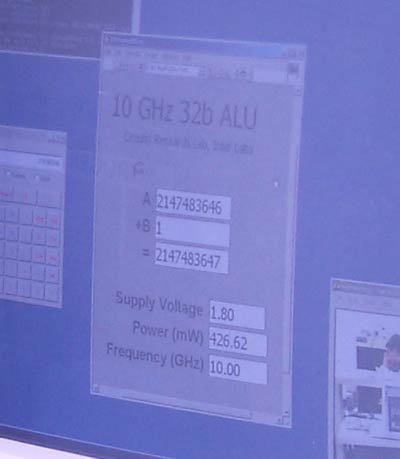
My favorite picture
is the picture of the 10 GHz ALU test screen here. I just like the way they have the Windows Calculator next to the test screen, in order to check whether 2147483646 + 1 really is equal to 2147483647.
-
Unrelated Story
In other unrelated news today, AMD engineers were caught lifting a giant object from Intel's lab. Camera man caught special footage of the object here.
-
Interesting
I would like to have something like this in my house just to scare people who come over. Its almost my dream.
-
Improve that image quality, boyo!
Check out this article here:
http://www.anandtech.com/showdoc.html?i=1577
It's all about the board manufacturers putting crap low-pass filters on the boards. Solution: rip those suckers off! -
Re:Geforce4... Wowee...Ok I'll bite.
Did you even look at any of the links? TBR like it or not has to be implemented at some stage as theoretical DDR/Rambus/Embedded Sram memory bandwidth only takes fillrate so far. When overdraw is taken into account and corrected for a hard fillrate can act like a much larger one. The point is that Nvidia and ATI use far more bandwidth/cost to get the same performance as a kyro. Therefore when powervr uses higher spec memory and design they can take that performance gain along with them.
Anandtech disagrees with you and your pushing for the overused ad hominem label here is baffling as you have not commented on my content at all but have pulled rabbits and god knows what else out of your ass.
-
Anandtech's review
-
Anandtech's review
-
Another articleThere is another article at Anandtech too, it's quite a good read. Contains pictures, benchmarks, etc.
-
Re:Controllers and USB... the really are USB!
AnandTech ran an article on the XBOX some time ago, and it was on slashdot too.
As you can see in the pics, they ARE really hacked USB ports tucked into a cable. -
Re:Redundancy?
Read the article. it sais "RAID5". Do you know what RAID5 is?
-
Mis-information for the masses
That's fast. I just love the details behind the facts: Pentiums suck, I'll take 1 G4 over a P4 at ANY speed. Anyway, enough trolling, if you click on the processors link [apple.com] in the article, apple gives a pretty nice overview of why their dual processor G4's are really, really nice.
You actually admit to buying into Apple.com rants?
Pentium 3s and Pentium 4s can both perform four 32-bit floating point operations in a single cycle via SSE/SSE2, like the G4 does theirs with Altivec. What's more, the Pentium 4 can ALSO do 2 64-bit floating point operations per cycle, while the G4 can't. Pentium 4s can do double-precision SIMD, Altivec cannot, to put pt bluntly. The '8' figure for 32-bit fp calculations comes from having dual processors. Maybe Intel should start advertising the Pentium 3s as doing up to 128 fp ops per second, because you can get ones that work in groups of 32 CPUs?
It really bugs me how Apple makes blanket statements like that, comparing Altivec on the G4 to non-SSE/SSE2 Pentium systems, then claiming it's an advantage. It's blatantly false advertising, why hasn't anyone busted them?
The G4 isn't fast at all compared to the modern PC processors, honestly. The G5 may indeed turn the table...but the G4 can't keep ramping up like the P4/Athlon have.
My favorite part on their site is the Quake 3 Benchmarks. A Dual 1GHz G4 system with a GeForce 4 MX gets 115fps in 1024x768. Compare that to PC performance: A 2.0GHz P4 (one CPU, and this isn't even a Northwood) gets 127.3 fps with a GeForce 2 Pro, and 233.7 fps with a GeForce 3 Ti500.
That's pretty pathetic, given how much you're paying for it. I guess most Mac users aren't gamers anyway, but it's still fascinating when the Mac users brag their systems are faster these days. -
How did they make the graphics perform so badly?
The graph here shows the dual GHz G4 with GeForce4 MX scoring 115fps at 1024x768 on Quake 3. How on earth did they get such dreadful performance?? The first benchmark I turned up on AnandTech has a 1.2GHz Athlon (way, way behind current top of the line) with a GeForce3 (not even a GeForce3 Ti) pulling 168fps. Could this be related to djohnsto's comment about the parlous state of Apple's OpenGL implementation?
-
Speed
Now compare these speeds:
New Mac Quake III
PC Quake III Speed
You can notice that an AMD Athlon XP1800+ with a generation 3 card (Radeon or GeForce 3) is about twice as fast a the new dual 1Ghz Mac with the GeForce4MX.
The only possible explanation is the relative low memory bandwidth of the card, that cripples the performance. -
Jackson
How is what you're suggesting different from Hyper-Threading or "Jackson" technology?
-
Re:Why DDR on P4?
The chance of a heatsink falling off completely is pretty small.
Depends on how you use your PC, IMO. It's not a problem with my 1.4 TBird at home, because I assembled the system at home and do not plan to move it around.
If you want to ship the box, or even take it to a LAN party in your car over bumpy roads, you better think about removing the heatsink - especially if you have one as heavy as this beast or one with a high center of gravity like this one. Unfortunately, removing the heat sink without damaging the processor die or popping off a few SMD resistors with a badly designed clip isn't exactly trivial in many cases, not to mention that there's also the issue of correct handling of thermal paste/tape involved.
In my PC, there are only two flimsy plastic noses on the CPU socket securing the heat sink clip, and the sink is quite heavy. I shudder at the thought of the havoc the heat sink could wreak if it should come loose during transport. And should I inadvertently turn on the system without heat sink in place, the CPU would be toast before I even had time to notice something is wrong (the BIOS doesn't start at a 'safe speed' for all I know).
AMD has to do three things in my opinion:
1. Provide an internal (fast) thermal diode similar to the one used in the P4, throttling the CPU down to a safe speed if temperatures get too high.
2. Provide a heat-spreader which protects the CPU die. My local PC parts dealer has half a shoebox full of AMD CPUs with broken dies. It's not really a problem for him, because it's not the dealer who pays for a new CPU if the customer screws up heatsink assembly, but it doesn't generate happy AMD customers.
3. Redesign and standardize the heat-sink/motherboard attachment and provide mandatory design guides for mainboard manufacturers. There are too many clip designs around, some sinks cannot be mounted at all in some motherboards, etc.
Raymond