Slashdot Mirror
Domain: archive.org
Stories and comments across the archive that link to archive.org.
Comments · 7,005
-
The Home Electrical
Washing machine, dryers, dishwashers, vacuum cleaners, central heating and AC: these are important time and laborsaving devices that were unheard of 100 years ago, but taken for granted today.
In this silent short, ca 1915 produced and distributed by General Electric, a middle class homeowner introduces his neighbor to such new-found conveniences as:
an electric car
a central vacuum cleaning system
an electric washing machine
an electric range and oven
an electric toaster and other small kitchen appliances
an electric sewing machine and iron
electric space heatersGensets for rural use became available about the same time. Radio is less than ten years off. The Sears kit homes of 1926 are recognizably modern throughout, though the furnace will most likely burn coal not natural gas.
-
Skeptic here..
I'm a bit skeptical about this claim about tangodropbox. If I check their website from archive, what it gives are snapshots beginning from 2011. [archive.org] Okay, perhaps there weren't any snapshots taken before then.
Again, there is the question of lack of google search results.OTOH, I do see an archive for candyswipe (which is actually taken on Jan 2nd 2011, with a copyright showing 2010).
-
Its all about sex emerging 600 million years ago
The difference between groups and individuals is sexual individuals specialize to create asexual groups and asexual cells specialize to create sexual individuals. http://archive.org/stream/Huma...
-
Re:I guess they have never heard of two factor aut
Also, this is relevant:
https://web.archive.org/web/20...It's a shame that the original web site for this is gone.
-
"We've had only a few major redesigns since 1997"
Check out Slashdot from May 1998:
http://web.archive.org/web/199...The way the landing page looks hasn't changed much since then. Dice says "it's time for a redesign". Why? The site has never had such a significant change in the way it looks like Beta is trying to pull off. If it isn't broken, don't touch it! Fix the old bugs and let us carry on.
-
Re:Not with a bang, but with a Beta.
It's a pump and dump from the inside. Dice wants out so they're trying to pump up the cash value of the site as much as possible, and cash value = advertisers. Who cares if the sucker they unload it onto loses their shirt when they find out the advertisers won't pay for ads on a site nobody uses.
Just for giggles, I loaded up The Consumerist for the first time in years. Years ago it was a respectable community with tens if not hundreds of comments on its posts. Then they went and completely wrecked their comment system. Today? The top post on page one has NINE comments. Out of 18 posts, there are 8 with ZERO comments.
Slashdot: THIS IS YOUR FUTURE. Nobody will click 45% of your stories!
Now true, they're a special case since they don't do advertising, so nobody cares if nobody has a reason to ever click through their story to read the comments, but it's proof that it has happened before and it WILL happen again if Slashdot continues on this path. By destroying the comment system Slashdot won't just decimate their pageviews, they'll obliterate them. The only way they'd be able to try to get people to click through to the story page is if they disabled the original article links in the main page, and that will completely ruin them as a news aggregator.
-
Correction:
Before I get slammed, let me correct myself: He did shut it down due to slow traffic first time around, though he blamed his own lack of tine and also refused to allow others to carry it forward. https://web.archive.org/web/20... Second time he blamed low traffic and "Certain elements of the community that developed here, unfortunately, creep me out". https://web.archive.org/web/20... Still, I don't think he can be trusted a third time to not just shut it down when he feels like it.
-
Correction:
Before I get slammed, let me correct myself: He did shut it down due to slow traffic first time around, though he blamed his own lack of tine and also refused to allow others to carry it forward. https://web.archive.org/web/20... Second time he blamed low traffic and "Certain elements of the community that developed here, unfortunately, creep me out". https://web.archive.org/web/20... Still, I don't think he can be trusted a third time to not just shut it down when he feels like it.
-
Feature request
There's a perfectly valid alternate design for Slashdot already:
http://web.archive.org/web/20000305021033/http://slashdot.org/
Still looks great -- I prefer it to this design and to Beta. Admins, please bring back the design used around 2000. There is little whitespace, so little wasted space, larger clearer fonts, and still a lot on each page, and little or no JavaScript cruft. Besides those significant improvements, it looks warmer and more classic.
BETA SUCKS. FUCK BETA.
Dear Slashdot management,
Can we please get a button, located at the top of each thread next tot he 'Post' button, that filters out any posts with the word 'Beta' in them when you press it?Sincerely,
Those rest of us. -
Re:Just be honest - it's not for *US*
If you were browsing through modern news sites and you stumbled across this, would it not give you pause?
The BBC site from that link looks designed to be viewed on a small monitor so has a fixed width. Current slashdot doesn't have that so it isn't an issue.
The BBC site from that link also looks cluttered and is more like the slashdot beta site (which is cluttered) compared to the current slashdot site. If you are using the BBC site from 2001 as an example of how not to design a news site, why is the new slashdot beta moving more towards it?
-
Re:In otherwards
It's too bad so much iconic dystopic science fiction was written or cinematized in the 80s (Nineteen Eighty-Four and Bladerunner, to name but two film examples), since it means that all you need to trick people into thinking it's impossible is a bright and cheery computer interface.
Nah... it isn't that.
It's the awareness on some level that both -topias are broken and based on faulty logic.Only it is more obvious in utopias - which is why few writers dare to wax poetic about utopias.
With two exceptions - a flawed or in some way threatened utopia (so not really an utopia) and short fairy tales for small children.It's easier to hide the fallacy the whole that thing hinges on when describing a dystopia - as much of the story is usually anchored in reality.
Just keep piling on examples of human monstrosity from known history and you're set.And yet... the fallacy is quite glaring once seen.
Ah! Here it is. Heh... no wonder it was memorable. Neil Gaiman wrote it. Completely missed that all these years.It's a Matrix story.
And without spoiling too much if you haven't read it, it kicks the -topia concept in the balls and leaves it lying quivering on the floor as soon as you give it any thought.See... both -topias rely on two basic concepts.
One - the present -topia will last FOREVER. Boot stamping on a human face... blah-blah. They lived happily... blah-blah.
Clearly, those are out the window before the line is even said.
"Really guys? You got a boot that lasts FOREVER? Fuck me! You just killed off entropy. And a bunch of other things."The other being that the U or Dys -topia exists ONLY from the human perspective. And often not even every human's but only from the main protagonist's perspective.
Most characters in Brazil don't live in a dystopia from their point of view. And even the ending has Sam "escaping" into a "happily ever after" - from his perspective.In other words, for a -topia to work one must ignore and wall off the entirety of the Universe forever and concentrate on as few humans as possible.
And that's a pretty big elephant to ignore.On some level, we know that instinctively.
That's why when presented with a U or Dys-topia we go "Naaah... this can't really happen this way."
The fault is not in the cheery interface OR us, it's in the concept of the -topias. -
Re:They've responded!
There's a perfectly valid alternate design for Slashdot already:
http://web.archive.org/web/20000305021033/http://slashdot.org/
Still looks great -- I prefer it to this design and to Beta. Admins, please bring back the design used around 2000. There is little whitespace, so little wasted space, larger clearer fonts, and still a lot on each page, and little or no JavaScript cruft. Besides those significant improvements, it looks warmer and more classic.
BETA SUCKS. FUCK BETA.
-
Re:Just be honest - it's not for *US*
Well, those few needed tweaks never stop piling up. On top of that, UX research and (more importantly) user expectations continue to evolve.
What research? Which users? "Users" aren't a monolithic group, you know. Slashdot attracts a very different crowd from, say, espn.com.
And "UX" is a stupid buzzword. When I go to a website--any website--I'm not looking for an "experience." I'm looking for something that loads quickly, renders readably, and provides the functionality I expect.
To keep up with that, websites either need to constantly change in small increments, or to do it in big chunks.
Or not change at all. That's an option. It really is.
The classic design in 2014? Not too bad. The classic design in 2018? Probably not going to cut it.
It's been "cutting it" for fifteen years, more or less; it's certainly changed some during that time, but it's still recognizably the same site. Why shouldn't it be good for (at least) another four?
In another post, you wrote:
For example, fire up the Wayback Machine and look at some popular sites from a decade ago. Many of them look radically different. Can you honestly say they wouldn't look out of place alongside modern sites? If you were browsing through modern news sites and you stumbled across this, would it not give you pause? At some point, your website just looks old and unmaintained -- that's why virtually every major website updates their design.
That BBC page isn't bad. Not great, but at least as good as the current one. And really, a decade ago was when the web was at its best. The browser wars were over, and it was reasonably easy to code a standards-compliant page that rendered well in the major browsers of the day. Sites offered all the functionality you expected, and still managed to load quickly even when a lot of people were still on dial-up (often faster than they do now over DSL and cable).
And for the most part, they looked great! I was a regular Salon reader in those days; please don't try to tell me that the current crapflood looks better. Yahoo was still a useful web index in those days, as opposed to
-
Re:Just be honest - it's not for *US*
Well, those few needed tweaks never stop piling up. On top of that, UX research and (more importantly) user expectations continue to evolve.
What research? Which users? "Users" aren't a monolithic group, you know. Slashdot attracts a very different crowd from, say, espn.com.
And "UX" is a stupid buzzword. When I go to a website--any website--I'm not looking for an "experience." I'm looking for something that loads quickly, renders readably, and provides the functionality I expect.
To keep up with that, websites either need to constantly change in small increments, or to do it in big chunks.
Or not change at all. That's an option. It really is.
The classic design in 2014? Not too bad. The classic design in 2018? Probably not going to cut it.
It's been "cutting it" for fifteen years, more or less; it's certainly changed some during that time, but it's still recognizably the same site. Why shouldn't it be good for (at least) another four?
In another post, you wrote:
For example, fire up the Wayback Machine and look at some popular sites from a decade ago. Many of them look radically different. Can you honestly say they wouldn't look out of place alongside modern sites? If you were browsing through modern news sites and you stumbled across this, would it not give you pause? At some point, your website just looks old and unmaintained -- that's why virtually every major website updates their design.
That BBC page isn't bad. Not great, but at least as good as the current one. And really, a decade ago was when the web was at its best. The browser wars were over, and it was reasonably easy to code a standards-compliant page that rendered well in the major browsers of the day. Sites offered all the functionality you expected, and still managed to load quickly even when a lot of people were still on dial-up (often faster than they do now over DSL and cable).
And for the most part, they looked great! I was a regular Salon reader in those days; please don't try to tell me that the current crapflood looks better. Yahoo was still a useful web index in those days, as opposed to
-
Re:Just be honest - it's not for *US*
Well, those few needed tweaks never stop piling up. On top of that, UX research and (more importantly) user expectations continue to evolve.
What research? Which users? "Users" aren't a monolithic group, you know. Slashdot attracts a very different crowd from, say, espn.com.
And "UX" is a stupid buzzword. When I go to a website--any website--I'm not looking for an "experience." I'm looking for something that loads quickly, renders readably, and provides the functionality I expect.
To keep up with that, websites either need to constantly change in small increments, or to do it in big chunks.
Or not change at all. That's an option. It really is.
The classic design in 2014? Not too bad. The classic design in 2018? Probably not going to cut it.
It's been "cutting it" for fifteen years, more or less; it's certainly changed some during that time, but it's still recognizably the same site. Why shouldn't it be good for (at least) another four?
In another post, you wrote:
For example, fire up the Wayback Machine and look at some popular sites from a decade ago. Many of them look radically different. Can you honestly say they wouldn't look out of place alongside modern sites? If you were browsing through modern news sites and you stumbled across this, would it not give you pause? At some point, your website just looks old and unmaintained -- that's why virtually every major website updates their design.
That BBC page isn't bad. Not great, but at least as good as the current one. And really, a decade ago was when the web was at its best. The browser wars were over, and it was reasonably easy to code a standards-compliant page that rendered well in the major browsers of the day. Sites offered all the functionality you expected, and still managed to load quickly even when a lot of people were still on dial-up (often faster than they do now over DSL and cable).
And for the most part, they looked great! I was a regular Salon reader in those days; please don't try to tell me that the current crapflood looks better. Yahoo was still a useful web index in those days, as opposed to
-
Re:Just be honest - it's not for *US*
Well, those few needed tweaks never stop piling up. On top of that, UX research and (more importantly) user expectations continue to evolve.
What research? Which users? "Users" aren't a monolithic group, you know. Slashdot attracts a very different crowd from, say, espn.com.
And "UX" is a stupid buzzword. When I go to a website--any website--I'm not looking for an "experience." I'm looking for something that loads quickly, renders readably, and provides the functionality I expect.
To keep up with that, websites either need to constantly change in small increments, or to do it in big chunks.
Or not change at all. That's an option. It really is.
The classic design in 2014? Not too bad. The classic design in 2018? Probably not going to cut it.
It's been "cutting it" for fifteen years, more or less; it's certainly changed some during that time, but it's still recognizably the same site. Why shouldn't it be good for (at least) another four?
In another post, you wrote:
For example, fire up the Wayback Machine and look at some popular sites from a decade ago. Many of them look radically different. Can you honestly say they wouldn't look out of place alongside modern sites? If you were browsing through modern news sites and you stumbled across this, would it not give you pause? At some point, your website just looks old and unmaintained -- that's why virtually every major website updates their design.
That BBC page isn't bad. Not great, but at least as good as the current one. And really, a decade ago was when the web was at its best. The browser wars were over, and it was reasonably easy to code a standards-compliant page that rendered well in the major browsers of the day. Sites offered all the functionality you expected, and still managed to load quickly even when a lot of people were still on dial-up (often faster than they do now over DSL and cable).
And for the most part, they looked great! I was a regular Salon reader in those days; please don't try to tell me that the current crapflood looks better. Yahoo was still a useful web index in those days, as opposed to
-
Re:Just be honest - it's not for *US*
Well, those few needed tweaks never stop piling up. On top of that, UX research and (more importantly) user expectations continue to evolve.
What research? Which users? "Users" aren't a monolithic group, you know. Slashdot attracts a very different crowd from, say, espn.com.
And "UX" is a stupid buzzword. When I go to a website--any website--I'm not looking for an "experience." I'm looking for something that loads quickly, renders readably, and provides the functionality I expect.
To keep up with that, websites either need to constantly change in small increments, or to do it in big chunks.
Or not change at all. That's an option. It really is.
The classic design in 2014? Not too bad. The classic design in 2018? Probably not going to cut it.
It's been "cutting it" for fifteen years, more or less; it's certainly changed some during that time, but it's still recognizably the same site. Why shouldn't it be good for (at least) another four?
In another post, you wrote:
For example, fire up the Wayback Machine and look at some popular sites from a decade ago. Many of them look radically different. Can you honestly say they wouldn't look out of place alongside modern sites? If you were browsing through modern news sites and you stumbled across this, would it not give you pause? At some point, your website just looks old and unmaintained -- that's why virtually every major website updates their design.
That BBC page isn't bad. Not great, but at least as good as the current one. And really, a decade ago was when the web was at its best. The browser wars were over, and it was reasonably easy to code a standards-compliant page that rendered well in the major browsers of the day. Sites offered all the functionality you expected, and still managed to load quickly even when a lot of people were still on dial-up (often faster than they do now over DSL and cable).
And for the most part, they looked great! I was a regular Salon reader in those days; please don't try to tell me that the current crapflood looks better. Yahoo was still a useful web index in those days, as opposed to
-
Re:Just be honest - it's not for *US*
User expectations change; it's the nature of the web.
For example, fire up the Wayback Machine and look at some popular sites from a decade ago. Many of them look radically different. Can you honestly say they wouldn't look out of place alongside modern sites? If you were browsing through modern news sites and you stumbled across this, would it not give you pause? At some point, your website just looks old and unmaintained -- that's why virtually every major website updates their design.
It's not necessarily a lightswitch moment, and you personally may not care. But a lot of people do.
-
Re:security?
-
Funny mention of "nothing to hide":
In "The Skills of Xanadu": https://archive.org/details/pr...
-
Re:Wine is not an emulator
Wine: an emulator of the win32 API+ABI on POSIX+X. WinXP/Vista/7/8: an emulator of the win32 API+ABI on NT.
Neither is native in this sense.
That reminds me of this gem from the Cygwin FAQ (through Dec 2009, since removed for political correctness):
Windows 9x: n. 32 bit extensions and a graphical shell for a 16 bit patch to an 8 bit operating system originally coded for a 4 bit microprocessor, written by a 2 bit company that can't stand 1 bit of competition.
-
Re:Can someone please kill the fucker
Oh, no, it's much older than that.
Originally, many site owners didn't want links to their website to appear on other websites. They saw that linking as copyright infringement or, in cases of popular articles, encouraging a DoS attack. They posted the information on their websites for the people they wanted to see it and the people they gave the links to and nobody else. This was all before ad revenue became a thing, and before web branding and popularity was important. Before people saw that websites were something more than a novelty, or more useful than a phone number. Before websites really did anything but provide phone and address listings. Before people even knew what to do with websites. Before the Internet was business.
-
Re:Interview in English without geoblocking
and here https://archive.org/details/sn...
-
Re:Precisely
Using the "wayback machine" feature at archive.org, we can look at old GNU web pages.
Here is a link to a January 2007 version of a GNU web page that describes the "License of Guile".
https://web.archive.org/web/20...
License of Guile
This consists of the GNU GPL plus a special statement giving blanket permission to link with non-free software. As a result, it is not a strong copyleft, and it is compatible with the GNU GPL. We recommend it for special circumstances only--much the same circumstances where you might consider using the LGPL[1].
[1] In the original, the word LGPL links to a page called "Why not LGPL". Here is an archive.org link that goes to that page as it was in January 2007: https://web.archive.org/web/20070105122245/http://www.gnu.org/philosophy/why-not-lgpl.html
-
Re:Precisely
Using the "wayback machine" feature at archive.org, we can look at old GNU web pages.
Here is a link to a January 2007 version of a GNU web page that describes the "License of Guile".
https://web.archive.org/web/20...
License of Guile
This consists of the GNU GPL plus a special statement giving blanket permission to link with non-free software. As a result, it is not a strong copyleft, and it is compatible with the GNU GPL. We recommend it for special circumstances only--much the same circumstances where you might consider using the LGPL[1].
[1] In the original, the word LGPL links to a page called "Why not LGPL". Here is an archive.org link that goes to that page as it was in January 2007: https://web.archive.org/web/20070105122245/http://www.gnu.org/philosophy/why-not-lgpl.html
-
Re:Work on the basics
I stand corrected.
-
Re:Assault on free speech.
The Internet Archive grabbed the page, but I don't think the video was preserved (Iassume not):
http://wayback.archive.org/web...
(Ican't get any of the BBC's videos to appear for me, so Ihave no way of telling for sure either way.)In case it won't show up for you (it only did for me for a split-second) it did save an image from the video:
http://wayback.archive.org/web... -
Re:Assault on free speech.
The Internet Archive grabbed the page, but I don't think the video was preserved (Iassume not):
http://wayback.archive.org/web...
(Ican't get any of the BBC's videos to appear for me, so Ihave no way of telling for sure either way.)In case it won't show up for you (it only did for me for a split-second) it did save an image from the video:
http://wayback.archive.org/web... -
Re:The old-time capitalists were smarter than toda
I agree. We could use more Henry Fords.
-
Re:what internet archive needs
There's one on their main page. Google site:archive.org works, too.
-
Re:Please no?
Methinks a moderator needs more coffee, that wasn't offtopic. Let me explain the parent's point, since at least one person was too dense to understand.
The GP said "when a page is gone it should be gone", WHY? That's insane. Say you want to get out that old Quake game and want to look up console commands. You're not going to find that great site because it lapsed a decade ago (the parent used beermaking as his example).
Archive.org to the rescue.
The suggestion is that when you click that bookmark you saved a decade ago, rather than a 404 you get archive.org's copy. However, this might not work in some situations, like when a site is abandoned and someone else registers the name.
If you don't want your site archived, they'll take their copy down.
-
It's being done without paying to begin with
Wonder no more, temporary code testing pages can be archived permanently, using the wayback machine kind of like version control.
-
Re:Ugly as sin...
Seriously, guys... get it together.
-
Re:Captain Kangaroo
And if you should want a particular reason, feel free to choose from msversus.org
Note that the newest shenanigans like OOXML and "secure boot" are not even included in that list. Yes we hate Micro$oft but we do have plenty of particular reasons to do so!
-
Re:Comparison to Chess?
A machine operating at the rate of one variation per micro-second would require over 1090 years to calculate the first move
I'm guessing that we have gotten a little faster since then with our current peta and soon to be exascale machines... micro-second? An eternity. Recalculate that spreadsheet, professor.
Shannon -- the "professor" -- was simply taking into account the technology available at the time.
Hans-Joachim Bremermann has also made an interesting argument:
"Speed, memory, and processing capacity of any possible future computer equipment are limited by specific physical barriers: the light barrier, the quantum barrier, and the thermodynamical barrier. These limitations imply, for example, that no computer, however constructed, will ever be able to examine the entire tree of possible move sequences of the game of chess.
-
Re:Irritated Dungeon Master
-
Re:buy a copy?
Well, from the linked resource, you can download the whole thing as a PDF. The rest is left as an exercise for the reader.
archive.org has several different formats as well.
-
Re:Massively useless article
Speaking of things which lack substance, your post is a prime offender. You make claims without support, which in this case turn out to be false as I was able to do some quick searching and found some the patents in question: # 6,557,054 and # 6,658,464. I was also able to locate the actual document filed with the court that lists the other four patents.
You're certainly entitled to your own opinions about the patent system, and while I'm sure I probably would agree with you on several points, your post is nothing more than a lazy attempt at preaching to the crowd that is wrought with inaccuracies or outright falsehoods. The OP is right that the linked article isn't very good and leaves out a lot of important information that would be useful to readers. It didn't take more than 10 minutes to dig up this information, so I question why the author of the actual article couldn't be bothered to find out this information.
Personally I doubt that these will hold up. I haven't specifically gone over all of the claims, but the abstracts make it appear as though there's likely prior art. One of the patents in question seems like little more than a description of a screen. -
Re:Everything about this mission is a miracle
AKA the billion Euro gamble. The Mars flyby was (if a much shorter blackout) considerably more dicey.
-
Burglars Who Took On F.B.I. Abandon Shadows
Burglars Who Took On F.B.I. Abandon Shadows
By MARK MAZZETTIJAN. 7, 2014
PHILADELPHIA â" The perfect crime is far easier to pull off when nobody is watching.
So on a night nearly 43 years ago, while Muhammad Ali and Joe Frazier bludgeoned each other over 15 rounds in a televised title bout viewed by millions around the world, burglars took a lock pick and a crowbar and broke into a Federal Bureau of Investigation office in a suburb of Philadelphia, making off with nearly every document inside.
They were never caught, and the stolen documents that they mailed anonymously to newspaper reporters were the first trickle of what would become a flood of revelations about extensive spying and dirty-tricks operations by the F.B.I. against dissident groups.
The burglary in Media, Pa., on March 8, 1971, is a historical echo today, as disclosures by the former National Security Agency contractor Edward J. Snowden have cast another unflattering light on government spying and opened a national debate about the proper limits of government surveillance. The burglars had, until now, maintained a vow of silence about their roles in the operation. They were content in knowing that their actions had dealt the first significant blow to an institution that had amassed enormous power and prestige during J. Edgar Hooverâ(TM)s lengthy tenure as director.
âoeWhen you talked to people outside the movement about what the F.B.I. was doing, nobody wanted to believe it,â said one of the burglars, Keith Forsyth, who is finally going public about his involvement. âoeThere was only one way to convince people that it was true, and that was to get it in their handwriting.â
Mr. Forsyth, now 63, and other members of the group can no longer be prosecuted for what happened that night, and they agreed to be interviewed before the release this week of a book written by one of the first journalists to receive the stolen documents. The author, Betty Medsger, a former reporter for The Washington Post, spent years sifting through the F.B.I.â(TM)s voluminous case file on the episode and persuaded five of the eight men and women who participated in the break-in to end their silence.
Unlike Mr. Snowden, who downloaded hundreds of thousands of digital N.S.A. files onto computer hard drives, the Media burglars did their work the 20th-century way: they cased the F.B.I. office for months, wore gloves as they packed the papers into suitcases, and loaded the suitcases into getaway cars. When the operation was over, they dispersed. Some remained committed to antiwar causes, while others, like John and Bonnie Raines, decided that the risky burglary would be their final act of protest against the Vietnam War and other government actions before they moved on with their lives.
âoeWe didnâ(TM)t need attention, because we had done what needed to be done,â said Mr. Raines, 80, who had, with his wife, arranged for family members to raise the coupleâ(TM)s three children if they were sent to prison. âoeThe â(TM)60s were over. We didnâ(TM)t have to hold on to what we did back then.â
A Meticulous Plan
The burglary was the idea of William C. Davidon, a professor of physics at Haverford College and a fixture of antiwar protests in Philadelphia, a city that by the early 1970s had become a white-hot center of the peace movement. Mr. Davidon was frustrated that years of organized demonstrations seemed to have had little impact.
In the summer of 1970, months after President Richard M. Nixon announced the United Statesâ(TM) invasion of Cambodia, Mr. Davidon began assembling a team from a group of activists whose commitment and discretion he had come to trust.
The group
-
These Guys Are Creating a Brain Scanner
These Guys Are Creating a Brain Scanner You Can Print Out at Home
- http://www.wired.com/wiredenterprise/2014/01/openbci/
-- http://www.openbci.com/
-- https://github.com/OpenBCI"Bootstrapped with a little funding help from DARPA â" the research arm of the Department of Defense â" the device is known as OpenBCI. It includes sensors and a mini-computer that plugs into sensors on a black skull-grabbing piece of plastic called the âoeSpider Claw 3000,â which you print out on a 3-D printer. Put it all together, and it operates as a low-cost electroencephalography (EEG) brainwave scanner that connects to your PC."
Archived: http://web.archive.org/web/20140113131516/http://www.wired.com/wiredenterprise/2014/01/openbci/
-
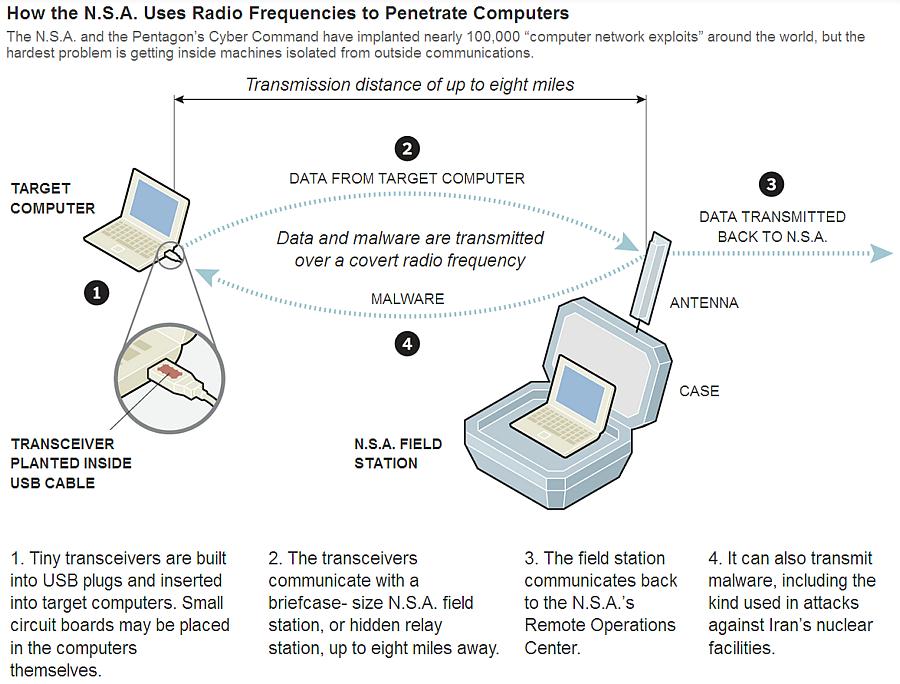
N.S.A. Devises Radio Pathway Into Computers
By david e. sanger and thom shanker = jan. 14, 2014
= URL: http://www.nytimes.com/2014/01/15/us/nsa-effort-pries-open-computers-not-connected-to-internet.html
=Image: http://cryptome.org/2014/01/nsa-quantum-radio.jpg
== Coverage #1: http://news.slashdot.org/story/14/01/15/1324216/nyt-nsa-put-100000-radio-pathway-backdoors-in-pcs
== Coverage #2: http://cryptome.org/2014/01/nsa-quantum-radio.htm
== Coverage #3: http://rt.com/usa/nsa-radio-wave-cyberattack-607/
=== Archive: http://web.archive.org/web/20140116010210/http://www.nytimes.com/2014/01/15/us/nsa-effort-pries-open-computers-not-connected-to-internet.html"WASHINGTON - The National Security Agency has implanted software in nearly 100,000 computers around the world that allows the United States to conduct surveillance on those machines and can also create a digital highway for launching cyberattacks.
While most of the software is inserted by gaining access to computer networks, the N.S.A. has increasingly made use of a secret technology that enables it to enter and alter data in computers even if they are not connected to the Internet, according to N.S.A. documents, computer experts and American officials.
The technology, which the agency has used since at least 2008, relies on a covert channel of radio waves that can be transmitted from tiny circuit boards and USB cards inserted surreptitiously into the computers. In some cases, they are sent to a briefcase-size relay station that intelligence agencies can set up miles away from the target.
The radio frequency technology has helped solve one of the biggest problems facing American intelligence agencies for years: getting into computers that adversaries, and some American partners, have tried to make impervious to spying or cyberattack. In most cases, the radio frequency hardware must be physically inserted by a spy, a manufacturer or an unwitting user.
The N.S.A. calls its efforts more an act of "active defense" against foreign cyberattacks than a tool to go on the offensive. But when Chinese attackers place similar software on the computer systems of American companies or government agencies, American officials have protested, often at the presidential level.
Among the most frequent targets of the N.S.A. and its Pentagon partner, United States Cyber Command, have been units of the Chinese Army, which the United States has accused of launching regular digital probes and attacks on American industrial and military targets, usually to steal secrets or intellectual property. But the program, code-named Quantum, has also been successful in inserting software into Russian military networks and systems used by the Mexican police and drug cartels, trade institutions inside the European Union, and sometime partners against terrorism like Saudi Arabia, India and Pakistan, according to officials and an N.S.A. map that indicates sites of what the agency calls "computer network exploitation."
"Whatâ(TM)s new here is the scale and the sophistication of the intelligence agencyâ(TM)s ability to get into computers and networks to which no one has ever had access before," said James Andrew Lewis, the cybersecurity expert at the Center for Strategic and International Studies in Washington. "Some of these capabilities have been around for a while, but the combination of learning how to penetrate systems to insert software and learning how to do that using radio frequencies has given the U.S. a win
-
ACLU app lets Androidusers secretly tape thepolice
The free app records video and audio, hides when requested and lets users send backup copies of recordings to the ACLU for safekeeping.
http://news.cnet.com/8301-1009_3-57467073-83/aclu-app-lets-android-users-secretly-tape-the-police/
http://www.aclu-nj.org/yourrights/the-app-place/
http://download.cnet.com/ACLU-NJ%20Police%20Tape/3000-2094_4-75742382.html
-
now go and get some snatch!
These Guys Are Creating a Brain Scanner You Can Print Out at Home
- http://www.wired.com/wiredenterprise/2014/01/openbci/
-- http://www.openbci.com/
-- https://github.com/OpenBCI"Bootstrapped with a little funding help from DARPA â" the research arm of the Department of Defense â" the device is known as OpenBCI. It includes sensors and a mini-computer that plugs into sensors on a black skull-grabbing piece of plastic called the âoeSpider Claw 3000,â which you print out on a 3-D printer. Put it all together, and it operates as a low-cost electroencephalography (EEG) brainwave scanner that connects to your PC."
Archived: http://web.archive.org/web/20140113131516/http://www.wired.com/wiredenterprise/2014/01/openbci/
-
N.S.A. Devises Radio Pathway Into Computers
By david e. sanger and thom shanker = jan. 14, 2014
= URL: http://www.nytimes.com/2014/01/15/us/nsa-effort-pries-open-computers-not-connected-to-internet.html
= Image: http://cryptome.org/2014/01/nsa-quantum-radio.jpg
== Coverage #1: http://news.slashdot.org/story/14/01/15/1324216/nyt-nsa-put-100000-radio-pathway-backdoors-in-pcs
== Coverage #2: http://cryptome.org/2014/01/nsa-quantum-radio.htm
== Coverage #3: http://rt.com/usa/nsa-radio-wave-cyberattack-607/
== Coverage #4: http://arstechnica.com/security/2014/01/nsa-uses-covert-radio-transmissions-to-monitor-100000-bugged-computers/
=== Archive: http://web.archive.org/web/20140116010210/http://www.nytimes.com/2014/01/15/us/nsa-effort-pries-open-computers-not-connected-to-internet.html"WASHINGTON - The National Security Agency has implanted software in nearly 100,000 computers around the world that allows the United States to conduct surveillance on those machines and can also create a digital highway for launching cyberattacks.
While most of the software is inserted by gaining access to computer networks, the N.S.A. has increasingly made use of a secret technology that enables it to enter and alter data in computers even if they are not connected to the Internet, according to N.S.A. documents, computer experts and American officials.
The technology, which the agency has used since at least 2008, relies on a covert channel of radio waves that can be transmitted from tiny circuit boards and USB cards inserted surreptitiously into the computers. In some cases, they are sent to a briefcase-size relay station that intelligence agencies can set up miles away from the target.
The radio frequency technology has helped solve one of the biggest problems facing American intelligence agencies for years: getting into computers that adversaries, and some American partners, have tried to make impervious to spying or cyberattack. In most cases, the radio frequency hardware must be physically inserted by a spy, a manufacturer or an unwitting user.
The N.S.A. calls its efforts more an act of "active defense" against foreign cyberattacks than a tool to go on the offensive. But when Chinese attackers place similar software on the computer systems of American companies or government agencies, American officials have protested, often at the presidential level.
Among the most frequent targets of the N.S.A. and its Pentagon partner, United States Cyber Command, have been units of the Chinese Army, which the United States has accused of launching regular digital probes and attacks on American industrial and military targets, usually to steal secrets or intellectual property. But the program, code-named Quantum, has also been successful in inserting software into Russian military networks and systems used by the Mexican police and drug cartels, trade institutions inside the European Union, and sometime partners against terrorism like Saudi Arabia, India and Pakistan, according to officials and an N.S.A. map that indicates sites of what the agency calls "computer network exploitation."
"What's new here is the scale and the sophistication of the intelligence agency's ability to get into computers and networks to which no one has ever had access before," said James Andrew Lewis, the cybersecurity expert at the Center for Strategic and Interna
-
N.S.A. Devises Radio Pathway Into Computers
N.S.A. Devises Radio Pathway Into Computers
By david e. sanger and thom shanker = jan. 14, 2014
= URL: http://www.nytimes.com/2014/01/15/us/nsa-effort-pries-open-computers-not-connected-to-internet.html
= Image: http://cryptome.org/2014/01/nsa-quantum-radio.jpg
== Coverage #1: http://news.slashdot.org/story/14/01/15/1324216/nyt-nsa-put-100000-radio-pathway-backdoors-in-pcs
== Coverage #2: http://cryptome.org/2014/01/nsa-quantum-radio.htm
== Coverage #3: http://rt.com/usa/nsa-radio-wave-cyberattack-607/
== Coverage #4: http://arstechnica.com/security/2014/01/nsa-uses-covert-radio-transmissions-to-monitor-100000-bugged-computers/
=== Archive: http://web.archive.org/web/20140116010210/http://www.nytimes.com/2014/01/15/us/nsa-effort-pries-open-computers-not-connected-to-internet.html"WASHINGTON - The National Security Agency has implanted software in nearly 100,000 computers around the world that allows the United States to conduct surveillance on those machines and can also create a digital highway for launching cyberattacks.
While most of the software is inserted by gaining access to computer networks, the N.S.A. has increasingly made use of a secret technology that enables it to enter and alter data in computers even if they are not connected to the Internet, according to N.S.A. documents, computer experts and American officials.
The technology, which the agency has used since at least 2008, relies on a covert channel of radio waves that can be transmitted from tiny circuit boards and USB cards inserted surreptitiously into the computers. In some cases, they are sent to a briefcase-size relay station that intelligence agencies can set up miles away from the target.
The radio frequency technology has helped solve one of the biggest problems facing American intelligence agencies for years: getting into computers that adversaries, and some American partners, have tried to make impervious to spying or cyberattack. In most cases, the radio frequency hardware must be physically inserted by a spy, a manufacturer or an unwitting user.
The N.S.A. calls its efforts more an act of "active defense" against foreign cyberattacks than a tool to go on the offensive. But when Chinese attackers place similar software on the computer systems of American companies or government agencies, American officials have protested, often at the presidential level.
Among the most frequent targets of the N.S.A. and its Pentagon partner, United States Cyber Command, have been units of the Chinese Army, which the United States has accused of launching regular digital probes and attacks on American industrial and military targets, usually to steal secrets or intellectual property. But the program, code-named Quantum, has also been successful in inserting software into Russian military networks and systems used by the Mexican police and drug cartels, trade institutions inside the European Union, and sometime partners against terrorism like Saudi Arabia, India and Pakistan, according to officials and an N.S.A. map that indicates sites of what the agency calls "computer network exploitation."
"What's new here is the scale and the sophistication of the intelligence agency's ability to get into computers and networks to which no one has ever had access before," said James Andrew Lewis, the cybersecur
-
#BADBIOS IS FUCKING YOU AND STILL YOU DISBELIEVE
N.S.A. Devises Radio Pathway Into Computers
By david e. sanger and thom shanker = jan. 14, 2014
= URL: http://www.nytimes.com/2014/01/15/us/nsa-effort-pries-open-computers-not-connected-to-internet.html
= Image: http://cryptome.org/2014/01/nsa-quantum-radio.jpg
== Coverage #1: http://news.slashdot.org/story/14/01/15/1324216/nyt-nsa-put-100000-radio-pathway-backdoors-in-pcs
== Coverage #2: http://cryptome.org/2014/01/nsa-quantum-radio.htm
== Coverage #3: http://rt.com/usa/nsa-radio-wave-cyberattack-607/
== Coverage #4: http://arstechnica.com/security/2014/01/nsa-uses-covert-radio-transmissions-to-monitor-100000-bugged-computers/
=== Archive: http://web.archive.org/web/20140116010210/http://www.nytimes.com/2014/01/15/us/nsa-effort-pries-open-computers-not-connected-to-internet.html"WASHINGTON - The National Security Agency has implanted software in nearly 100,000 computers around the world that allows the United States to conduct surveillance on those machines and can also create a digital highway for launching cyberattacks.
While most of the software is inserted by gaining access to computer networks, the N.S.A. has increasingly made use of a secret technology that enables it to enter and alter data in computers even if they are not connected to the Internet, according to N.S.A. documents, computer experts and American officials.
The technology, which the agency has used since at least 2008, relies on a covert channel of radio waves that can be transmitted from tiny circuit boards and USB cards inserted surreptitiously into the computers. In some cases, they are sent to a briefcase-size relay station that intelligence agencies can set up miles away from the target.
The radio frequency technology has helped solve one of the biggest problems facing American intelligence agencies for years: getting into computers that adversaries, and some American partners, have tried to make impervious to spying or cyberattack. In most cases, the radio frequency hardware must be physically inserted by a spy, a manufacturer or an unwitting user.
The N.S.A. calls its efforts more an act of "active defense" against foreign cyberattacks than a tool to go on the offensive. But when Chinese attackers place similar software on the computer systems of American companies or government agencies, American officials have protested, often at the presidential level.
Among the most frequent targets of the N.S.A. and its Pentagon partner, United States Cyber Command, have been units of the Chinese Army, which the United States has accused of launching regular digital probes and attacks on American industrial and military targets, usually to steal secrets or intellectual property. But the program, code-named Quantum, has also been successful in inserting software into Russian military networks and systems used by the Mexican police and drug cartels, trade institutions inside the European Union, and sometime partners against terrorism like Saudi Arabia, India and Pakistan, according to officials and an N.S.A. map that indicates sites of what the agency calls "computer network exploitation."
"What's new here is the scale and the sophistication of the intelligence agency's ability to get into computers and networks to which no one has ever had access before," said James Andrew Lewis, the cybersecur
-
N.S.A. Devises Radio Pathway Into Computers
N.S.A. Devises Radio Pathway Into Computers
By david e. sanger and thom shanker = jan. 14, 2014
= URL: http://www.nytimes.com/2014/01/15/us/nsa-effort-pries-open-computers-not-connected-to-internet.html
= Image: http://cryptome.org/2014/01/nsa-quantum-radio.jpg
== Coverage #1: http://news.slashdot.org/story/14/01/15/1324216/nyt-nsa-put-100000-radio-pathway-backdoors-in-pcs
== Coverage #2: http://cryptome.org/2014/01/nsa-quantum-radio.htm
== Coverage #3: http://rt.com/usa/nsa-radio-wave-cyberattack-607/
=== Archive: http://web.archive.org/web/20140116010210/http://www.nytimes.com/2014/01/15/us/nsa-effort-pries-open-computers-not-connected-to-internet.html"WASHINGTON - The National Security Agency has implanted software in nearly 100,000 computers around the world that allows the United States to conduct surveillance on those machines and can also create a digital highway for launching cyberattacks.
While most of the software is inserted by gaining access to computer networks, the N.S.A. has increasingly made use of a secret technology that enables it to enter and alter data in computers even if they are not connected to the Internet, according to N.S.A. documents, computer experts and American officials.
The technology, which the agency has used since at least 2008, relies on a covert channel of radio waves that can be transmitted from tiny circuit boards and USB cards inserted surreptitiously into the computers. In some cases, they are sent to a briefcase-size relay station that intelligence agencies can set up miles away from the target.
The radio frequency technology has helped solve one of the biggest problems facing American intelligence agencies for years: getting into computers that adversaries, and some American partners, have tried to make impervious to spying or cyberattack. In most cases, the radio frequency hardware must be physically inserted by a spy, a manufacturer or an unwitting user.
The N.S.A. calls its efforts more an act of "active defense" against foreign cyberattacks than a tool to go on the offensive. But when Chinese attackers place similar software on the computer systems of American companies or government agencies, American officials have protested, often at the presidential level.
Among the most frequent targets of the N.S.A. and its Pentagon partner, United States Cyber Command, have been units of the Chinese Army, which the United States has accused of launching regular digital probes and attacks on American industrial and military targets, usually to steal secrets or intellectual property. But the program, code-named Quantum, has also been successful in inserting software into Russian military networks and systems used by the Mexican police and drug cartels, trade institutions inside the European Union, and sometime partners against terrorism like Saudi Arabia, India and Pakistan, according to officials and an N.S.A. map that indicates sites of what the agency calls "computer network exploitation."
"What's new here is the scale and the sophistication of the intelligence agency's ability to get into computers and networks to which no one has ever had access before," said James Andrew Lewis, the cybersecurity expert at the Center for Strategic and International Studies in Washington. "Some of these capabilities have been around for a while, but the combination of learning how to penetrate systems to insert software and learning how to do that using radio fre
-
N.S.A. Devises Radio Pathway Into Computers
N.S.A. Devises Radio Pathway Into Computers
By david e. sanger and thom shanker = jan. 14, 2014
= URL: http://www.nytimes.com/2014/01/15/us/nsa-effort-pries-open-computers-not-connected-to-internet.html
=Image: http://cryptome.org/2014/01/nsa-quantum-radio.jpg
== Coverage #1: http://news.slashdot.org/story/14/01/15/1324216/nyt-nsa-put-100000-radio-pathway-backdoors-in-pcs
== Coverage #2: http://cryptome.org/2014/01/nsa-quantum-radio.htm
== Coverage #3: http://rt.com/usa/nsa-radio-wave-cyberattack-607/
=== Archive: http://web.archive.org/web/20140116010210/http://www.nytimes.com/2014/01/15/us/nsa-effort-pries-open-computers-not-connected-to-internet.html"WASHINGTON - The National Security Agency has implanted software in nearly 100,000 computers around the world that allows the United States to conduct surveillance on those machines and can also create a digital highway for launching cyberattacks.
While most of the software is inserted by gaining access to computer networks, the N.S.A. has increasingly made use of a secret technology that enables it to enter and alter data in computers even if they are not connected to the Internet, according to N.S.A. documents, computer experts and American officials.
The technology, which the agency has used since at least 2008, relies on a covert channel of radio waves that can be transmitted from tiny circuit boards and USB cards inserted surreptitiously into the computers. In some cases, they are sent to a briefcase-size relay station that intelligence agencies can set up miles away from the target.
The radio frequency technology has helped solve one of the biggest problems facing American intelligence agencies for years: getting into computers that adversaries, and some American partners, have tried to make impervious to spying or cyberattack. In most cases, the radio frequency hardware must be physically inserted by a spy, a manufacturer or an unwitting user.
The N.S.A. calls its efforts more an act of "active defense" against foreign cyberattacks than a tool to go on the offensive. But when Chinese attackers place similar software on the computer systems of American companies or government agencies, American officials have protested, often at the presidential level.
Among the most frequent targets of the N.S.A. and its Pentagon partner, United States Cyber Command, have been units of the Chinese Army, which the United States has accused of launching regular digital probes and attacks on American industrial and military targets, usually to steal secrets or intellectual property. But the program, code-named Quantum, has also been successful in inserting software into Russian military networks and systems used by the Mexican police and drug cartels, trade institutions inside the European Union, and sometime partners against terrorism like Saudi Arabia, India and Pakistan, according to officials and an N.S.A. map that indicates sites of what the agency calls "computer network exploitation."
"Whatâ(TM)s new here is the scale and the sophistication of the intelligence agencyâ(TM)s ability to get into computers and networks to which no one has ever had access before," said James Andrew Lewis, the cybersecurity expert at the Center for Strategic and International Studies in Washington. "Some of these capabilities have been around for a while, but the combination of learning how to penetrate systems to insert software and learning how to do tha
-
Re:"Next" Step?Yup. This has been around for at least 15 years:
What you can do with Micro Scribe. Digitize complex 3D objects in minutes. Create realistic models as lines, polygons, splines, or NURBs. - http://archive.org/stream/NewTekniques_Volume_2_No._02_1998-04_Advanstar_Communications_US/NewTekniques_Volume_2_No._02_1998-04_Advanstar_Communications_US_djvu.txt