Slashdot Mirror
Domain: arstechnica.com
Stories and comments across the archive that link to arstechnica.com.
Stories · 4,420
-
German Police Arrest Admin of Tor Anonymity Server
An anonymous reader writes "In a recent blog posting, a German operator of a Tor anonymous proxy server revealed that he was arrested by German police officers at the end of July. Showing up at his house at midnight on a Sunday night, police cuffed and arrested him in front of his wife and seized his equipment. In a display of both bitter irony and incompetence, the police did not take or shut-down the Tor server responsible for the traffic they were interested in, which was located in a data center, over 500km away. In the last year, Germany has passed a draconian new anti-security research law and raided seven different data centers to seize Tor servers. While back in 2003, A German court ordered the developers of a different anonymity network to build a back-door into their system." -
Science vs. Homeopathy
Mr. E writes "Ars Technica has an interesting look at pseudoscience as it applies to homeopathy. While most discussions about what science is get derailed by the larger controversies surrounding them, Ars chose a relatively uncontroversial pseudo-science to examine so that they could examine the factors which make homeopathy a psuedo-science: ignoring settled issues in science, misapplication of real science, rejection of scientific standards, claims of suppression, large gaps between the conclusion and evidence, and a focus only on the fringes of what we currently understand." -
Sony Clarifies Details About PS3 Home
Ars Technica's Opposable Thumbs blog has a few new details on the future of the Home project, as gleaned from the ThreeSpeech website. Among the tidbits of information: they'll be rolling out the service slowly, ramping up the number of servers as gradually as possible. They're really looking to make money with this, via advertising and microtransactions. And they're not really worried about porn. "For instance, a casino or even somewhere you can go and see 18-rated trailers for games. That isn't anything particularly sinister, but obviously, you'd have to prevent 12-year-olds going in there. Obviously, there are other 18-plus areas that you could imagine, but some of those might not come to fruition." -
Verizon Sues FCC over 700MHz Open Access Rules
Carterfone writes "Verizon is upset at the open access conditions for the 700MHz spectrum auction, and they're going to court to get them overturned. The company has filed a lawsuit in the Court of Appeals for the DC Circuit, urging the court to overturn the rules. 'In its petition for review, Verizon argues that the FCC exceeded its authority in mandating the two open access conditions, accusing the Commission of being "arbitrary" and "capricious," and saying that the rules are "unsupported by substantial evidence and otherwise contrary to law." Google is critical of Verizon's lawsuit: 'It's regrettable that Verizon has decided to use the court system to try to prevent consumers from having any choice of innovative services. Once again, it is American consumers who lose from these tactics.'" -
Compiz Gets Thumbs-Up for Gutsy Gibbon
Da Chronic writes "After a vigorous debate at the last Ubuntu Technical Board meeting, the board decided to ship Ubuntu 7.10 with Compiz enabled by default. The decision was made despite the fact that Compiz still has some significant issues relating to drivers and Xorg. 'For instance, there are some problems — like accelerated video playback issues with Intel drivers — that can only be resolved by using the EXA accelerated rendering framework which is still not ready yet. When asked why Intel isn't addressing the driver issue, technical board member Mathew Garrett explained that "Intel are working on the basis that composited desktops won't be ready for rolling out until EXA is stable enough anyway, so it's not a concern [for them].' In the end, all but one member voted to include Compiz in Gutsy." -
FCC Says Analog TV Lives Until 2012
walterbays writes ""The FCC voted 5-0 to require that cable operators must continue to make all local broadcasts available to their users, even those with analog televisions." I don't understand how AT&T manages to deliver U-verse without any analog channels. Did they get it classified as not-cable and exempt from existing rules? Or as a result of this vote, will they suddenly have to drop 50 SD channels to make room for 5 NTSC channels?" -
Tor Used To Collect Embassy Email Passwords
Several readers wrote in to inform us that Swedish security researcher Dan Egerstad has revealed how he collected 100 passwords from embassies and governments worldwide, without hacking into anything: he sniffed Tor exit routers. Both Ars and heise have writeups on Egerstad's blog post, but neither adds much to the original. It's not news that unencrypted traffic exits the Tor network unencrypted, but Egerstad correctly perceived, and called attention to, the lack of appreciation for this fact in organizations worldwide. -
Wii Zapper To Have Zelda Pack-In Title
The Wii Zapper, announced during Nintendo's keynote at this year's E3 Media event, will be released with a Zelda-themed pack-in title. Called Link's Crossbow Training, it will train up players on skills with the add-on before big-league titles aimed at the device are released. "Nintendo also announced that the Zapper will work with EA's Medal of Honor Heroes, which will feature an 'arcade mode' to make the game accessible to all age groups and skill levels, as well as 32-player multiplayer. Nintendo also dropped a reminder that the upcoming Resident Evil: The Umbrella Chronicles will take advantage of the Zapper, as will Sega's Ghost Squad. The Zapper looks like it will have quite a selection of strong franchises to grab gamer interest when it launches." -
RIAA Trying To Avoid a Jury Trial
Joe Elliot writes "Faced with a jury trial set to begin on October 1, the RIAA has filed a motion for summary adjudication of specific facts: that the RIAA owns the copyrights to the songs in a file-sharing case; that the registration is proper; and that the defendant wasn't authorized to copy or distribute the recordings. If the judge rules in their favor, Ars notes that it may turn into a Novell v SCO situation where the only thing left to be decided are the damages. There are some significant problems with the copyright registrations — they don't match up. 'Thomas argues that since she lacks the financial means to conduct a thorough examination of the ownership history (e.g., track the ownership of "Hysteria" from Mercury to UMG) for the songs she is accused of infringing the copyright to, her only opportunity to determine their true ownership is either via discovery or cross-examination at trial.' Ars also notes that the RIAA's biggest fear is of losing a case. 'A loss at trial would be catastrophic for the RIAA. It would give other defense attorneys a winning template while exposing the weaknesses of the RIAA's arguments. It would also prove costly from a financial standpoint, as the RIAA would have to foot the legal expenses for both itself and the defendant. Most of all, it would set an unwelcomed precedent: over 20,000 lawsuits filed and the RIAA loses the first one to go to a jury.'" -
AO-Rated Manhunt 2 Leaked To Warez Sites
Ars Technica's Opposable Thumbs blog is reporting that an apparently 'AO' rated version of Rockstar's Manhunt 2 has made its way to warez sites across the internet. "There have been a few videos posted on YouTube that seem to come from this version of the game, which the release notes warn may be a beta version, 'so no crying if it ***** up on you.' That inspires confidence. While this scene-release is being talked about in multiple places, fansite Project Manhunt has a warning: '...remember downloading this game is only going to slimming [sic] the already slim chance of Manhunt 3 ever happening,' they tell fans." -
Opera 9.5 Beats Firefox and IE7 As Fastest Browser
Abhinav Peddada writes "Ars Technica takes Opera 9.5, the latest from Opera's stable, for a test run and finds some interesting results, including it being a 'solid improvement to an already very strong browser.' On the performance front, Ars Technica reports 'Opera 9.5 scored slightly higher (281ms) than the previous released version, 9.23 (546ms). And Opera 9.x, let it be known, smacks silly the likes of Firefox and Internet Explorer, which tend to have results in the 900-1500ms range on this test machine (a 1.8 GHz Core 2 Duo with 2GB RAM). Opera was 50 percent faster on average than Firefox, and 100 percent faster than IE7 on Windows Vista, for instance.'" -
Copyright Alliance Says Fair Use Not a Consumer Right
KingSkippus writes "In response to a complaint to the FCC filed by the Computer and Communications Industry Association (CCIA) to change copyright warnings before movies and sporting events, Executive Director Patrick Ross of the Copyright Alliance tells us in an editorial that 'fair use is not a consumer right.' The Copyright Alliance is backed by such heavy-hitters as the MPAA, RIAA, Disney, Business Software Alliance, and perhaps most interestingly, Microsoft, who is also backing the CCIA's complaint." -
Companies Offer AAA Games For 'Free'
Both Ubisoft and EA are offering up free games to cash-conscious gamers this week. For the low, low cost of nothing you can play titles like Command and Conquer Gold, Prince of Persia: Sands of Time, and Far Cry. The catch? Well, EA's offering is totally gratis; 1995's C&C Gold is a gift to gamers for supporting the series for all these years. The Ubisoft games, though, are only "free". They're available from Fileplanet in ad-supported format. -
WGA Meltdown Blamed On Human Error
Erris writes "As commentators like Ars Technica slam WGA as deeply flawed, Microsoft is blaming human error and swears it won't happen again. 'Alex Kochis, Microsofts senior WGA product manager, wrote in a blog posting that the troubles began after preproduction code was installed on live servers. ... rollback fixed the problem on the product-activation servers within 30 minutes ... but it didnt reset the validation servers. ... "we didnt have the right monitoring in place to be sure the fixes had the intended effect"' Critics were not impressed. 'A system thats not totally reliable really should not be so punitive, said Gartner Inc. analyst Michael Silver. Michael Cherry, an analyst at Directions on Microsoft in Kirkland, Wash., said he was surprised that it was even possible to accidentally load the wrong code onto live servers ... [and asks], "what other things have they not done?' This is not the first time this has happened, either." -
New Failsafe Graphics Mode For Ubuntu
ianare sends us to Ars Technica for news of the Ubuntu Xorg BulletProof-X feature, coming soon to a 7.10 (Gutsy) build near you. "It provides a failsafe mode that will ensure that users never have to manually configure their graphics hardware settings from the command line. If Xorg fails to start,the failsafe mode will initiate with minimalistic settings, low resolution, and a limited number of colors. The failsafe mode also automatically runs Ubuntu's new GTK-based display configuration utility so that users can easily test various display settings and choose a configuration that will work properly with their hardware." -
Entering Passwords Through Eye Movement
Stu Dennison writes "Ars Technica has a post up on a new service called EyePassword. EyePassword is a system that attempts to mitigate the issues of shoulder-surfing via a novel approach to user input: no hands required. With EyePassword, a user enters their password using an on-screen keyboard that detects the orientation of their pupils. From the article: 'The gaze-tracking system functions by shining an invisible infrared beam on a user's face. The beam produces a tiny reflection in the eyes that stays put, no matter where a person looks (provided they do not move their head too much). By tracking the stable position of this reflection and the relative position of a person's pupils, the system is able to calculate which keys or buttons a user wishes to input, and interpret the information accordingly ... more than 80 percent of those tested preferred the EyePassword method. Additionally, when testing EyePassword input using an input method where users visually "dwell" on the characters they wish to input, error rates were comparable to keyboarding.'" -
PAX 2007 In A Nutshell
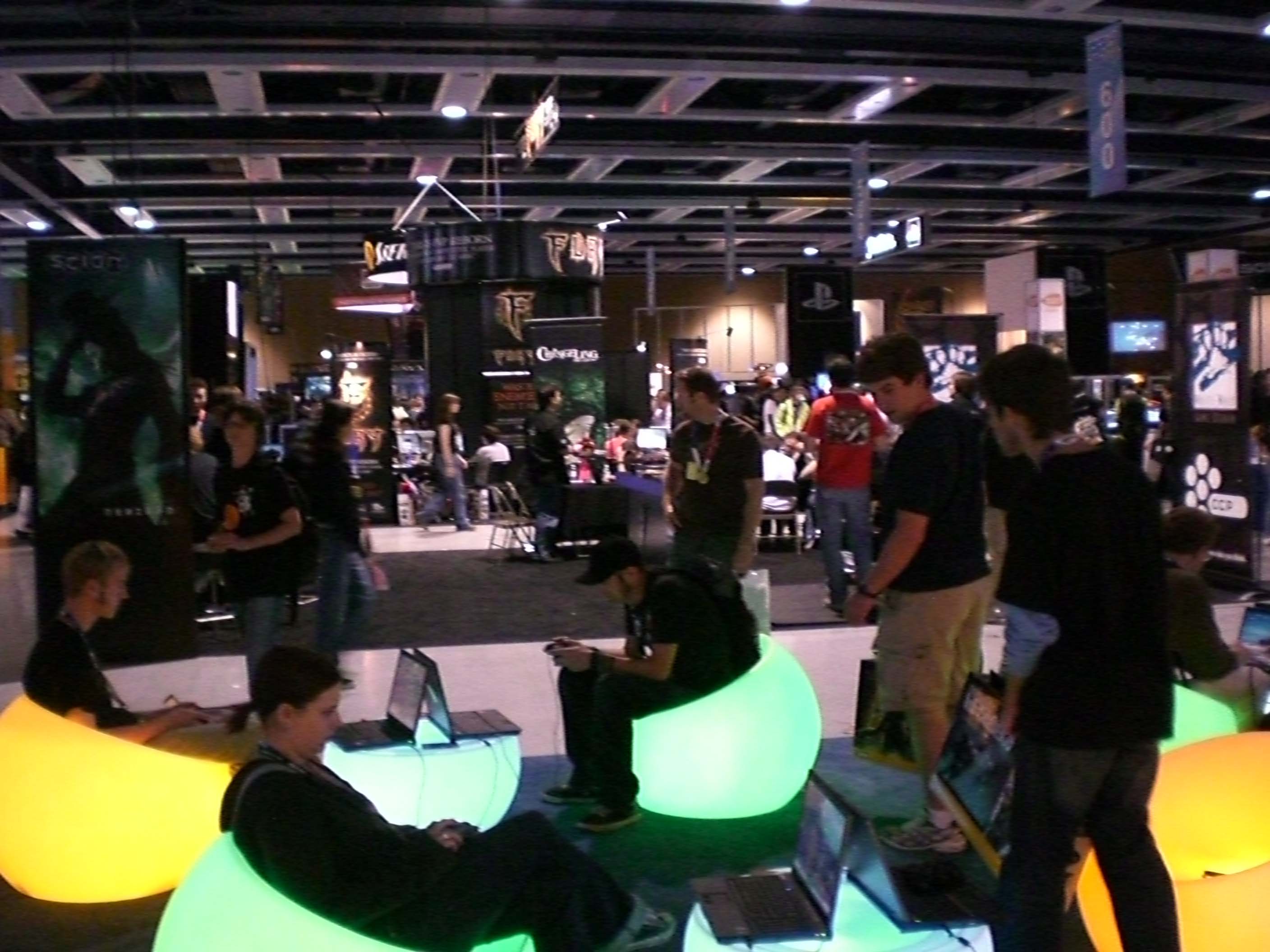
Last weekend the dark horde of nerddom descended on Seattle, entering the heart of the 'Emerald City' to gorge itself on the music, culture, and humor of gaming. The Penny Arcade Expo (PAX) once again brought together fans of the influential webcomic for a festival that, without even trying, seems to be taking the place of old E3. Though they were expecting around 30,000 people, the word was that by early Sunday they'd already gone through some 40,000 badges. There were DSes everywhere, concerts at night, a packed exhibit hall, and benchmark comic strips created by Mike Krahulik and Jerry Holkins adorned almost every wall. Despite all the people and the noise, somehow the event had a community feel to it that was hard to understand ... and even harder to describe. I'll try, though, along with impressions from games on the show floor and the incredible music of folks like Jonathan Coulton and the Minibosses. Read on, and All Hail Ball. The Early Weekend
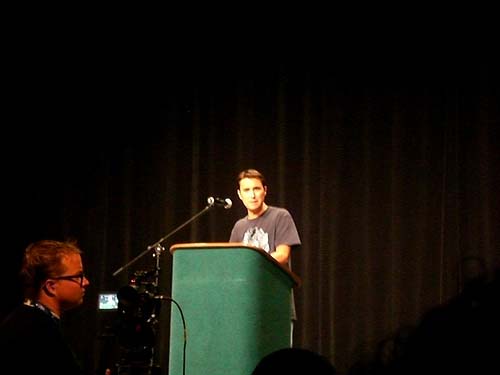
If you missed my discussion of Friday's events, it's understandable; it went up this past Saturday. Suffice it to say that Wil Wheaton's keynote speech was the highlight of the evening. His praise of social gaming, and the relationship-building power of the PAX-goer's favorite pastime resonated incredibly well with the packed theatre. The after-action report on his blog says it all: "My keynote went perfectly, and the audience (and the gaming press online) responded to it in ways I never dreamed possible. I didn't think there would be slightly more than 5000 people in the room when I spoke ..."
The first Penny Arcade Panel featured a lot of middlin' questions, highlighted by the incredible singing power of Jerry Holkins. A description of his performance is in my weekend update, but the real surprise didn't come until after the questions were done. The end of the panel turned ugly when the PA gents left the stage for Uwe Boll to have a chance at the mike. Gabe said later that weekend that he was surprised by the crowd reaction. "You can tell when a crowd is angry, and this was the first time I've felt that at at PAX." The unapologetic Boll was screamed at fairly mercilessly by the attendees.
Other events from the early weekend included a discussion of modern storytelling in videogames. Luminaries Ron Gilbert (Monkey Island), Dave Grossman (Sam and Max) and Nate Fox (Sly Cooper) came together to jaw on a topic near to their hearts. The group discussed linear stories vs. sandbox-style gameplay, user-created content, kids games, and the importance of theme even if your core story isn't all that great: "Grossman [said], 'Well, story isn't just about dialogue and narrative, right - I mean really you want to learn something about the human experience. I think that if I weren't doing adventure games I wouldn't think of myself as a narrator, but rather as the hand of fate. I'm going to kind of let you run around and do what you want and everything. Just to let the player go around and do what they want - they can feel like it's the good hand of fate or the bad hand of fate, but not that they're completely being controlled.'"
The Rain-Slick Precipice of Darkness, the Penny Arcade videogame currently in development, was a visible presence at the show all weekend. The Friday unveiling of a new game demo to the media at a special Q&A event was followed by a weekend's worth of running through the game for attendees on the show floor. Most everyone got to see the title, and hear the news that it will be coming to Xbox Live alongside its PC distribution avenues. The opening, grim, text still makes me smile: "Four gods wait on the windowsill / Where once eight gods did war and will / And if the gods themselves may die / What does that say for you and I?"
PA Panel II
While the first PA Q&A panel was entertaining just to hear Holkins and Krahulik talk, the second panel actually had a number of insightful questions, touching statements, and funny moments. And, thankfully, there were no stoned guys rambling about their paranoid fantasies at the microphone; always a plus. Long queues formed at the two microphones to question the gents, and here are some highlights:- Paul Barnett, Design Manager for the Warhammer Online Massively Multiplayer game, drew applause for his short advertisement during a trailers reel before the event started. He used his clipped British wit to compare Warhammer to World of Warcraft like so: If you're going up against the Beatles, don't try to be the Beatles. You'll end up looking like the Monkees. Instead, we're going to be Led Zeppelin.
- A question about the changes to the primary characters over the year led Mike Krahulik to discuss his influences, such as Stan Sakai. He's essentially 'never finished' with the characters, and we can expect to see further changes to his art style in the coming years.
- Drawings of Gabe and Tycho in ping pong outfits prompted readers to ask if we would ever see that as a project down the road. They're enthusiastic about it and would love to do it, as up until now readers have just seen a few simple images. To further tease us, they described the backstory to the piece: Set in the 80s, a cold war US is still facing down Russia. A little-known clause in the UN charter states that table tennis can be used to decide grudges; the loser forfeits their country. The US table tennis team is slain, and so a group of four people at ping pong camp (including our protagonists) are drawn into international excitement.
- A question about the appeal of the Halo franchise has the gents noting that the series has grown on them considerably.
- In negotiating the price for the XBLA version of the Rain-Slick Precipice of Darkness, they feel they'll have a good deal of leverage as regards pricing (and content as well).
- Several great ideas for projects and future PAX ideas are mentioned, including support of a nerdcore show currently touring the area and an Indie Games FreePlay area.
- When asked about origins of the hobos in Precipice of Darkness, Tycho notes that the game is a 'hobage' of different sources. The Achievement for 100 hobo kills? Hobicide.
- A reader challenges the two to a thumb war, which Jerry wins quite promptly by kicking Gabe in the nuts. He declines to continue, saying he 'values his beanbag.'
- When asked to endorse some games on the exhibit show floor, both gentlemen put their weight behind Eye of Judgement and Sega Rally.
- Someone notes that the current in-the-works game is very much a 'Tycho' game ... lots of words. He wonders what kind of 'Gabe' game they'd like to make. Mike ponders the concept of a brawler, or perhaps something not unlike Turtles in Time.
- The idea of making sure the ball comes back to PAX every year, 'to recharge' is brought up. It could then be sold on eBay to help fund the annual Child's Play charity. They both really like this idea.
- A reader asks what the 'worst thing' either of them have ever done is. Mike tells the story of a time when he set a trap for his family's cat in the backyard, and ended up stringing up the pet by the neck into a tree. It survived, but he has always felt terribly. Jerry, on the other hand, equivocates. When Mike gets tired of it, he tells a story of Jerry drinking a glass of Chai and finding a bug near the bottom of his glass ... which he then upended and finished after fishing out the bug.
Having had a good look at the game at Gen Con, I used my PAX chance to talk to the folks at EA Mythic to dig a little bit deeper on one of the game's claims to fame: Realm vs. Realm combat. Just hours before I spoke to the folks at EA, a team from their company had announced professions from the High Elf and Dark Elf factions for the very first time. I tried to glean just a little bit more PvP-specific information about these races for you, but it was not to be.
Just the same Ryan Barnard (game designer) and Eric Correll (producer on the game) were very forthcoming. The pair was happy to discuss different elements of their signature game feature. For example, new players will have the PvP-focused game introduced to them gradually at low levels. There's a soft introduction, beginning that portion of the title's seamless integration into the overall gameplay. Open-world PvP in specific parts of the starting zones will most likely be their first exposure. Quests will lead them to RvR areas, and eventually will direct them to the instanced 'Scenario'-style missions. Throughout the game, the portion of land that is focused on these activities starts small, but eventually dominates gameplay; the RvR 'city capture' system is Warhammer's 'end game'.
Warhammer Online's unique systems, like the Tome of Knowledge and the Public Quest, also touch on RvR. The Tome will explain elements of Player vs. Player combat, and will record your successes in battle. RvR Public Quests, meanwhile, are currently undergoing retooling. They want them 'right', and currently have taken them all out of the game to make sure they're just so; they hope to have them back into the game by launch.
This feel of 'rightness' is something they're aiming for in their scenarios as well, with the goal of integrating these instances not only into PvP progression, but the ongoing story of the game as well. Each is themed to the area they're in, and tells the tale of a specific conflict between the Order and Chaos armies.
Introducing players who might not otherwise participate in RvR into the fundamentals of that gameplay style is also something the team is focusing on. While they acknowledge that some people just don't want to play against other players, they see folks who are hard and fast about that rule as the minority. They're looking to make PvP a core part of the game, and as such they'll be approaching it differently than a primarily PvE focused game might. This affects multiple game design elements, all the way down to the 'hook' of Public Quests, which gets folks who might not even ever group thinking more favorably about gaming with others. Racial pride is also a factor; by priming characters from low levels to be 'pro-Dwarf', or whatever, players will be more likely to come to their society's aid. They're all steps in a chain, the team hopes, to changing outlooks soured by less focused titles.
On the other side of the equation, the end-game city capture system sees factions sacking the racial homes of their opponents. Though reluctant to use the term 'end game' specifically, the team members were happy to admit that it will be the focus at max-levels. RvR combat will funnel players towards the opposing side, hoping to push the 'antagonists' back to their city walls. They also pointed out, however, that there are other elements in play at that high level. PvE content and public quests are still around, though diminished, and they have plans to further expand both sides of the max-level content once the game is released.
Organized Play, as featured in Guild Wars and now World of Warcraft, is not something they're currently planning for. They'd love to eventually do tournaments for RvR teams at some point, but they're so focused on getting it out the door in a timely fashion that it's not particularly on their radar. As they put it, "we hope we have that problem".
The cutting edge of their work is, obviously, on the Elves at the moment. They're still working to tune the scenarios and open-world play for the Elven areas, and are always working to ensure that classes are balanced and the 'fun' is present.
This cutting edge blends well with some of the surprises that the team had in store for them when masses of people finally entered the Beta. Probably the most surprising for the RvR team: their carefully crafted points of control battlefield objective system, which requires holding targets in open-world PvP, are almost completely being ignored. While they worked hard on this mechanic, the players are more interested in the actual act of combat when in an open-world environment. Scenario tactics are welcomed, but outside of those instances the two sides really just want to enter the fray. The team hopes to have them in the game in some capacity, but they're going to undergo heavy retooling before that happens.
As we wrapped things up, we discussed the reflection this decision has on their overall attitude towards the game: if it's not working, it needs to go/be fixed/tuned/rehashed/whatever. Killing what you thought was going to be the end-all be-all is not outside the realm of possibility, even this late in the game. RvR, and the game in general, has to be fun. No exceptions.
Fury
I'll be honest: Fury came at me from nowhere. I'd read about it before coming to the show, knew that it was approaching an Open Beta, and that it was a free-to-play PvP title. That was just about all I knew when I sat down to play and chat with Fury's lead designer Adam Carpenter.
When you're trying to quantify Fury's gameplay type, it's better to think less about online RPGs and more about first-person shooters. Fury has essentially taken the swords and sorcery milieu and dropped that whole cloth into an FPS schema. In each match, players spawn in, rush out, and slam into each other in extremely fast altercations. Everything is fast; from character creation to combat can be just a few minutes.
This is the underpinning of developer Auran's outlook: fun, fast, and free. Instead of grinding through a PvE component, Fury characters are built entirely around a series of abilities and equipment available at character creation. Each character can play whatever role you want them to in a given match, and their role can be changed freely between altercations. Want to act as a support class in one match? You put on your gear that aids healing type abilities, load those healing abilities into your hotbar , and go. Want to act as a ranged DPS class? Swap those healing bits out for the appropriate gear and powers. Players will never have to whine about not having the right class for a fight, as everyone has flexibility.
Gameplay itself, character abilities, focuses on colors. Your ability bar is full of various attacks, and they are themed around different colors. Each player has a small gauge on their screen to help ascertain how many color points they have built up. These points are gained by using 'low level' colored abilities. A basic blue attack, for example, might give you one blue point. As you move through combat, your gauge will fill with colored points. Higher points unlock the use of more powerful abilities on your hotbar, which in turn use up your points. Fascinatingly, each ability color has a diametric opposite; red points counter blue points and players with red points in their bar will actually be less effective with blue abilities. This led the designers to create special point-manipulating abilities; in the middle of the fight you can switch a player's point colors. You can also steal points, leading to the 'change-their-color-steal-their-points' combo move, leaving your opponent defenseless and cold in the world.
Each color has a sort of 'theme', with green abilities having a sort of nature-y feel to it, while blue abilities being sort of icey. There are ranged and melee abilities in all colors, so there won't be any particular demanded role for a color ability. For most players the only real constraint will be up to what abilities you have on hand as a result of previous accomplishments. While most common abilities will be available by default when you purchase the game, new powers will be unlocked via achievements as you succeed in combat. Achievements include everything from taking the most objectives during a match, to killing the most people, to healing the most ... and your rewards are appropriate for what you accomplish.
Rewards on the equipment side are a bit more random. After completing a match, random loot is generated for the party, and people /roll for it. That's pretty much 'the way it is', going right around the usual sort of arguments at pick up group might have when dealing with looted gear. Gold is equally distributed, of course, and both items and gold are commensurate with your success in the just-completed mission.
It's worth noting here that Fury will have a for-pay option, allowing you to slap down a subscription fee if you want ... but it will have nothing to do with the quality of your in-game items. Money is only given to the Auran folks for the addition of convenience and depth. I should say there is some overlap with items: one of the for-pay conveniences is the ability to roll on three items instead of two. A for-pay player has a bit more in the way of item space, some options for purchasing things from vendors, and other simple things that makes the game just a little bit easier for having forked over your cash. Depth, in this case, is all about in-game ladders. While free players will compete on ladders of various types, paying players will have a long list of different ladder types to participate in. Server, guild, and individual progress will all be tracked for various rewards and bragging rights.
Those bragging rights will come in the form of an online representation of your character's escapades. Kill counts, 'flag' steals, and other metrics will be tracked on an official page for your character, and viewable by anyone. Guilds with an interest in going deeper into min-maxing can make use of the human-readable stats that will be generated locally by the client in a text file. Officers can collect these document to see which builds are working, which aren't, and where the group as a whole needs to focus.
The game build playable on the PAX show floor was already five months old, and showed it. There were server problems a few times, and the game looked more than a little bit jaggy. Even through the cruft, though, there was a lot of promise showing through. The settings were gorgeous despite the outdated rendering model, and the fun factor of actual play was very high. Fury is a simple, brutal combat game, and it makes no pretensions about it. With the promise of free online play for the price of a PC game title, this seems like a pretty nice package. It's definitely not going to be for everyone; there's none of the painstaking polish of Guild Wars, or the deep PvE experience of World of Warcraft. For folks looking for a quick, focused good time Fury may just be what you're looking for.
Jonathan Coulton, Frontalot, Minibosses Concert
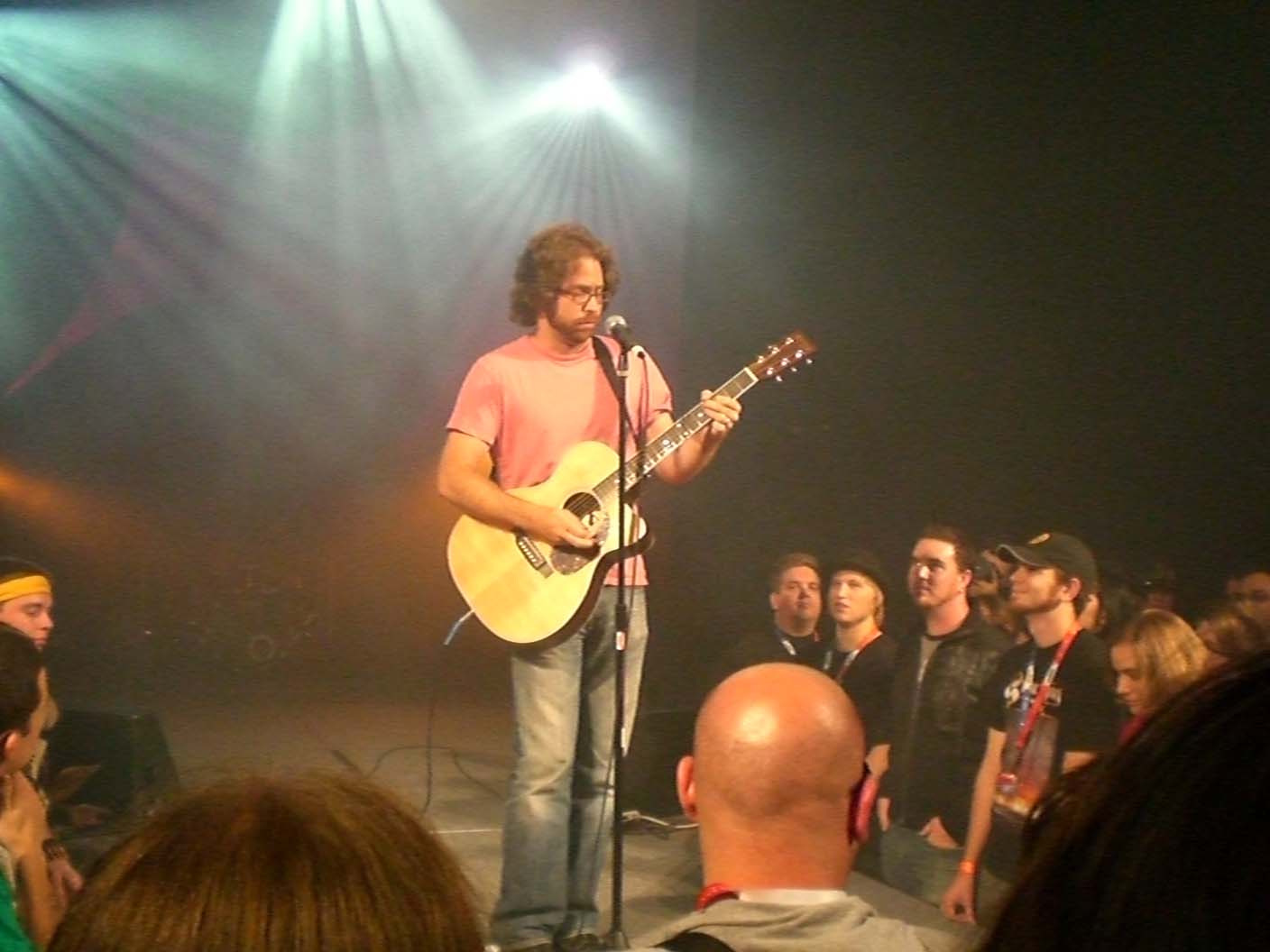
I'm sure many of you could have told me how transcendent Jonathan Coulton's music is, but when I entered the theatre on Saturday night for the triple-headed mega-show I was something of a Coulton newb. I'd heard Code Monkey, of course, but I'd never made much of an effort to seek out his music. Whether it was his intent to really reach the audience that night or not, he made a convert out of me. His haunting lyrics about superficiality, squid, cybernetics, robotics, technology, programming, and zombies were funny, touching, and thought provoking. I asked a friend who followed his music to confirm for me that he usually doesn't play terribly large venues. I had to ask because it was only really apparent during the few moments when he paused to take in the size of the audience. He was really, very good. Coulton had easily the largest crowd of the night, with his mass dwarfing even the groups on hand later for MC Frontalot and the Minibosses. His final song for the night, re: Your Brains was tremendous to experience in the midst of thousands of hand-waving flesh-craving growl/singing faux undead. Both Frontalot and the Minibosses put on amazing shows as well, of course, showing off their polished shows and firm grasp of their material. Frontalot was in rare form, with several new songs of his most recent album. Just the same ... Coulton was the show of the night for me, and it was a privilege to be able to see such a great act in person.
The Games And Panels of PAX
There were so many events and games, demos and panels, at the event that I couldn't make it to every interesting experience. Thankfully, other sites can pick up the slack.
The panel on licensed games explored the pros and cons of using someone else's IP to make a title. "Too many cooks in the kitchen" was seen as the primary problem, with the high cost associated with such a deal a close second.
"Pitch Your Game Idea" is always a very well-attended panel, and this year was no exception. Dozens and dozens of people lined up to present their game ideas to a panel of industry veterans. They were then 'cut', American Idol style, working through less solid game ideas towards the pearly center. There were apparently a surprising number of women there, and the contestant that won was one of them. Her simple, Pong-like concept had a graphical background that became more complicated as the game went on.
That showing would have been a relief to the folks at the very well attended "Women in Games" panel. The event focused around the challenges of entering the industry, and the issues associated with working the day to day grind once you're in.
A number of folks had hands-on time with titles I didn't get to, including Haze, Tabula Rasa -
PAX 2007 In A Nutshell
Last weekend the dark horde of nerddom descended on Seattle, entering the heart of the 'Emerald City' to gorge itself on the music, culture, and humor of gaming. The Penny Arcade Expo (PAX) once again brought together fans of the influential webcomic for a festival that, without even trying, seems to be taking the place of old E3. Though they were expecting around 30,000 people, the word was that by early Sunday they'd already gone through some 40,000 badges. There were DSes everywhere, concerts at night, a packed exhibit hall, and benchmark comic strips created by Mike Krahulik and Jerry Holkins adorned almost every wall. Despite all the people and the noise, somehow the event had a community feel to it that was hard to understand ... and even harder to describe. I'll try, though, along with impressions from games on the show floor and the incredible music of folks like Jonathan Coulton and the Minibosses. Read on, and All Hail Ball. The Early Weekend
If you missed my discussion of Friday's events, it's understandable; it went up this past Saturday. Suffice it to say that Wil Wheaton's keynote speech was the highlight of the evening. His praise of social gaming, and the relationship-building power of the PAX-goer's favorite pastime resonated incredibly well with the packed theatre. The after-action report on his blog says it all: "My keynote went perfectly, and the audience (and the gaming press online) responded to it in ways I never dreamed possible. I didn't think there would be slightly more than 5000 people in the room when I spoke ..."
The first Penny Arcade Panel featured a lot of middlin' questions, highlighted by the incredible singing power of Jerry Holkins. A description of his performance is in my weekend update, but the real surprise didn't come until after the questions were done. The end of the panel turned ugly when the PA gents left the stage for Uwe Boll to have a chance at the mike. Gabe said later that weekend that he was surprised by the crowd reaction. "You can tell when a crowd is angry, and this was the first time I've felt that at at PAX." The unapologetic Boll was screamed at fairly mercilessly by the attendees.
Other events from the early weekend included a discussion of modern storytelling in videogames. Luminaries Ron Gilbert (Monkey Island), Dave Grossman (Sam and Max) and Nate Fox (Sly Cooper) came together to jaw on a topic near to their hearts. The group discussed linear stories vs. sandbox-style gameplay, user-created content, kids games, and the importance of theme even if your core story isn't all that great: "Grossman [said], 'Well, story isn't just about dialogue and narrative, right - I mean really you want to learn something about the human experience. I think that if I weren't doing adventure games I wouldn't think of myself as a narrator, but rather as the hand of fate. I'm going to kind of let you run around and do what you want and everything. Just to let the player go around and do what they want - they can feel like it's the good hand of fate or the bad hand of fate, but not that they're completely being controlled.'"
The Rain-Slick Precipice of Darkness, the Penny Arcade videogame currently in development, was a visible presence at the show all weekend. The Friday unveiling of a new game demo to the media at a special Q&A event was followed by a weekend's worth of running through the game for attendees on the show floor. Most everyone got to see the title, and hear the news that it will be coming to Xbox Live alongside its PC distribution avenues. The opening, grim, text still makes me smile: "Four gods wait on the windowsill / Where once eight gods did war and will / And if the gods themselves may die / What does that say for you and I?"
PA Panel II
While the first PA Q&A panel was entertaining just to hear Holkins and Krahulik talk, the second panel actually had a number of insightful questions, touching statements, and funny moments. And, thankfully, there were no stoned guys rambling about their paranoid fantasies at the microphone; always a plus. Long queues formed at the two microphones to question the gents, and here are some highlights:- Paul Barnett, Design Manager for the Warhammer Online Massively Multiplayer game, drew applause for his short advertisement during a trailers reel before the event started. He used his clipped British wit to compare Warhammer to World of Warcraft like so: If you're going up against the Beatles, don't try to be the Beatles. You'll end up looking like the Monkees. Instead, we're going to be Led Zeppelin.
- A question about the changes to the primary characters over the year led Mike Krahulik to discuss his influences, such as Stan Sakai. He's essentially 'never finished' with the characters, and we can expect to see further changes to his art style in the coming years.
- Drawings of Gabe and Tycho in ping pong outfits prompted readers to ask if we would ever see that as a project down the road. They're enthusiastic about it and would love to do it, as up until now readers have just seen a few simple images. To further tease us, they described the backstory to the piece: Set in the 80s, a cold war US is still facing down Russia. A little-known clause in the UN charter states that table tennis can be used to decide grudges; the loser forfeits their country. The US table tennis team is slain, and so a group of four people at ping pong camp (including our protagonists) are drawn into international excitement.
- A question about the appeal of the Halo franchise has the gents noting that the series has grown on them considerably.
- In negotiating the price for the XBLA version of the Rain-Slick Precipice of Darkness, they feel they'll have a good deal of leverage as regards pricing (and content as well).
- Several great ideas for projects and future PAX ideas are mentioned, including support of a nerdcore show currently touring the area and an Indie Games FreePlay area.
- When asked about origins of the hobos in Precipice of Darkness, Tycho notes that the game is a 'hobage' of different sources. The Achievement for 100 hobo kills? Hobicide.
- A reader challenges the two to a thumb war, which Jerry wins quite promptly by kicking Gabe in the nuts. He declines to continue, saying he 'values his beanbag.'
- When asked to endorse some games on the exhibit show floor, both gentlemen put their weight behind Eye of Judgement and Sega Rally.
- Someone notes that the current in-the-works game is very much a 'Tycho' game ... lots of words. He wonders what kind of 'Gabe' game they'd like to make. Mike ponders the concept of a brawler, or perhaps something not unlike Turtles in Time.
- The idea of making sure the ball comes back to PAX every year, 'to recharge' is brought up. It could then be sold on eBay to help fund the annual Child's Play charity. They both really like this idea.
- A reader asks what the 'worst thing' either of them have ever done is. Mike tells the story of a time when he set a trap for his family's cat in the backyard, and ended up stringing up the pet by the neck into a tree. It survived, but he has always felt terribly. Jerry, on the other hand, equivocates. When Mike gets tired of it, he tells a story of Jerry drinking a glass of Chai and finding a bug near the bottom of his glass ... which he then upended and finished after fishing out the bug.
Having had a good look at the game at Gen Con, I used my PAX chance to talk to the folks at EA Mythic to dig a little bit deeper on one of the game's claims to fame: Realm vs. Realm combat. Just hours before I spoke to the folks at EA, a team from their company had announced professions from the High Elf and Dark Elf factions for the very first time. I tried to glean just a little bit more PvP-specific information about these races for you, but it was not to be.
Just the same Ryan Barnard (game designer) and Eric Correll (producer on the game) were very forthcoming. The pair was happy to discuss different elements of their signature game feature. For example, new players will have the PvP-focused game introduced to them gradually at low levels. There's a soft introduction, beginning that portion of the title's seamless integration into the overall gameplay. Open-world PvP in specific parts of the starting zones will most likely be their first exposure. Quests will lead them to RvR areas, and eventually will direct them to the instanced 'Scenario'-style missions. Throughout the game, the portion of land that is focused on these activities starts small, but eventually dominates gameplay; the RvR 'city capture' system is Warhammer's 'end game'.
Warhammer Online's unique systems, like the Tome of Knowledge and the Public Quest, also touch on RvR. The Tome will explain elements of Player vs. Player combat, and will record your successes in battle. RvR Public Quests, meanwhile, are currently undergoing retooling. They want them 'right', and currently have taken them all out of the game to make sure they're just so; they hope to have them back into the game by launch.
This feel of 'rightness' is something they're aiming for in their scenarios as well, with the goal of integrating these instances not only into PvP progression, but the ongoing story of the game as well. Each is themed to the area they're in, and tells the tale of a specific conflict between the Order and Chaos armies.
Introducing players who might not otherwise participate in RvR into the fundamentals of that gameplay style is also something the team is focusing on. While they acknowledge that some people just don't want to play against other players, they see folks who are hard and fast about that rule as the minority. They're looking to make PvP a core part of the game, and as such they'll be approaching it differently than a primarily PvE focused game might. This affects multiple game design elements, all the way down to the 'hook' of Public Quests, which gets folks who might not even ever group thinking more favorably about gaming with others. Racial pride is also a factor; by priming characters from low levels to be 'pro-Dwarf', or whatever, players will be more likely to come to their society's aid. They're all steps in a chain, the team hopes, to changing outlooks soured by less focused titles.
On the other side of the equation, the end-game city capture system sees factions sacking the racial homes of their opponents. Though reluctant to use the term 'end game' specifically, the team members were happy to admit that it will be the focus at max-levels. RvR combat will funnel players towards the opposing side, hoping to push the 'antagonists' back to their city walls. They also pointed out, however, that there are other elements in play at that high level. PvE content and public quests are still around, though diminished, and they have plans to further expand both sides of the max-level content once the game is released.
Organized Play, as featured in Guild Wars and now World of Warcraft, is not something they're currently planning for. They'd love to eventually do tournaments for RvR teams at some point, but they're so focused on getting it out the door in a timely fashion that it's not particularly on their radar. As they put it, "we hope we have that problem".
The cutting edge of their work is, obviously, on the Elves at the moment. They're still working to tune the scenarios and open-world play for the Elven areas, and are always working to ensure that classes are balanced and the 'fun' is present.
This cutting edge blends well with some of the surprises that the team had in store for them when masses of people finally entered the Beta. Probably the most surprising for the RvR team: their carefully crafted points of control battlefield objective system, which requires holding targets in open-world PvP, are almost completely being ignored. While they worked hard on this mechanic, the players are more interested in the actual act of combat when in an open-world environment. Scenario tactics are welcomed, but outside of those instances the two sides really just want to enter the fray. The team hopes to have them in the game in some capacity, but they're going to undergo heavy retooling before that happens.
As we wrapped things up, we discussed the reflection this decision has on their overall attitude towards the game: if it's not working, it needs to go/be fixed/tuned/rehashed/whatever. Killing what you thought was going to be the end-all be-all is not outside the realm of possibility, even this late in the game. RvR, and the game in general, has to be fun. No exceptions.
Fury
I'll be honest: Fury came at me from nowhere. I'd read about it before coming to the show, knew that it was approaching an Open Beta, and that it was a free-to-play PvP title. That was just about all I knew when I sat down to play and chat with Fury's lead designer Adam Carpenter.
When you're trying to quantify Fury's gameplay type, it's better to think less about online RPGs and more about first-person shooters. Fury has essentially taken the swords and sorcery milieu and dropped that whole cloth into an FPS schema. In each match, players spawn in, rush out, and slam into each other in extremely fast altercations. Everything is fast; from character creation to combat can be just a few minutes.
This is the underpinning of developer Auran's outlook: fun, fast, and free. Instead of grinding through a PvE component, Fury characters are built entirely around a series of abilities and equipment available at character creation. Each character can play whatever role you want them to in a given match, and their role can be changed freely between altercations. Want to act as a support class in one match? You put on your gear that aids healing type abilities, load those healing abilities into your hotbar , and go. Want to act as a ranged DPS class? Swap those healing bits out for the appropriate gear and powers. Players will never have to whine about not having the right class for a fight, as everyone has flexibility.
Gameplay itself, character abilities, focuses on colors. Your ability bar is full of various attacks, and they are themed around different colors. Each player has a small gauge on their screen to help ascertain how many color points they have built up. These points are gained by using 'low level' colored abilities. A basic blue attack, for example, might give you one blue point. As you move through combat, your gauge will fill with colored points. Higher points unlock the use of more powerful abilities on your hotbar, which in turn use up your points. Fascinatingly, each ability color has a diametric opposite; red points counter blue points and players with red points in their bar will actually be less effective with blue abilities. This led the designers to create special point-manipulating abilities; in the middle of the fight you can switch a player's point colors. You can also steal points, leading to the 'change-their-color-steal-their-points' combo move, leaving your opponent defenseless and cold in the world.
Each color has a sort of 'theme', with green abilities having a sort of nature-y feel to it, while blue abilities being sort of icey. There are ranged and melee abilities in all colors, so there won't be any particular demanded role for a color ability. For most players the only real constraint will be up to what abilities you have on hand as a result of previous accomplishments. While most common abilities will be available by default when you purchase the game, new powers will be unlocked via achievements as you succeed in combat. Achievements include everything from taking the most objectives during a match, to killing the most people, to healing the most ... and your rewards are appropriate for what you accomplish.
Rewards on the equipment side are a bit more random. After completing a match, random loot is generated for the party, and people /roll for it. That's pretty much 'the way it is', going right around the usual sort of arguments at pick up group might have when dealing with looted gear. Gold is equally distributed, of course, and both items and gold are commensurate with your success in the just-completed mission.
It's worth noting here that Fury will have a for-pay option, allowing you to slap down a subscription fee if you want ... but it will have nothing to do with the quality of your in-game items. Money is only given to the Auran folks for the addition of convenience and depth. I should say there is some overlap with items: one of the for-pay conveniences is the ability to roll on three items instead of two. A for-pay player has a bit more in the way of item space, some options for purchasing things from vendors, and other simple things that makes the game just a little bit easier for having forked over your cash. Depth, in this case, is all about in-game ladders. While free players will compete on ladders of various types, paying players will have a long list of different ladder types to participate in. Server, guild, and individual progress will all be tracked for various rewards and bragging rights.
Those bragging rights will come in the form of an online representation of your character's escapades. Kill counts, 'flag' steals, and other metrics will be tracked on an official page for your character, and viewable by anyone. Guilds with an interest in going deeper into min-maxing can make use of the human-readable stats that will be generated locally by the client in a text file. Officers can collect these document to see which builds are working, which aren't, and where the group as a whole needs to focus.
The game build playable on the PAX show floor was already five months old, and showed it. There were server problems a few times, and the game looked more than a little bit jaggy. Even through the cruft, though, there was a lot of promise showing through. The settings were gorgeous despite the outdated rendering model, and the fun factor of actual play was very high. Fury is a simple, brutal combat game, and it makes no pretensions about it. With the promise of free online play for the price of a PC game title, this seems like a pretty nice package. It's definitely not going to be for everyone; there's none of the painstaking polish of Guild Wars, or the deep PvE experience of World of Warcraft. For folks looking for a quick, focused good time Fury may just be what you're looking for.
Jonathan Coulton, Frontalot, Minibosses Concert
I'm sure many of you could have told me how transcendent Jonathan Coulton's music is, but when I entered the theatre on Saturday night for the triple-headed mega-show I was something of a Coulton newb. I'd heard Code Monkey, of course, but I'd never made much of an effort to seek out his music. Whether it was his intent to really reach the audience that night or not, he made a convert out of me. His haunting lyrics about superficiality, squid, cybernetics, robotics, technology, programming, and zombies were funny, touching, and thought provoking. I asked a friend who followed his music to confirm for me that he usually doesn't play terribly large venues. I had to ask because it was only really apparent during the few moments when he paused to take in the size of the audience. He was really, very good. Coulton had easily the largest crowd of the night, with his mass dwarfing even the groups on hand later for MC Frontalot and the Minibosses. His final song for the night, re: Your Brains was tremendous to experience in the midst of thousands of hand-waving flesh-craving growl/singing faux undead. Both Frontalot and the Minibosses put on amazing shows as well, of course, showing off their polished shows and firm grasp of their material. Frontalot was in rare form, with several new songs of his most recent album. Just the same ... Coulton was the show of the night for me, and it was a privilege to be able to see such a great act in person.
The Games And Panels of PAX
There were so many events and games, demos and panels, at the event that I couldn't make it to every interesting experience. Thankfully, other sites can pick up the slack.
The panel on licensed games explored the pros and cons of using someone else's IP to make a title. "Too many cooks in the kitchen" was seen as the primary problem, with the high cost associated with such a deal a close second.
"Pitch Your Game Idea" is always a very well-attended panel, and this year was no exception. Dozens and dozens of people lined up to present their game ideas to a panel of industry veterans. They were then 'cut', American Idol style, working through less solid game ideas towards the pearly center. There were apparently a surprising number of women there, and the contestant that won was one of them. Her simple, Pong-like concept had a graphical background that became more complicated as the game went on.
That showing would have been a relief to the folks at the very well attended "Women in Games" panel. The event focused around the challenges of entering the industry, and the issues associated with working the day to day grind once you're in.
A number of folks had hands-on time with titles I didn't get to, including Haze, Tabula Rasa -
PAX 2007 In A Nutshell
Last weekend the dark horde of nerddom descended on Seattle, entering the heart of the 'Emerald City' to gorge itself on the music, culture, and humor of gaming. The Penny Arcade Expo (PAX) once again brought together fans of the influential webcomic for a festival that, without even trying, seems to be taking the place of old E3. Though they were expecting around 30,000 people, the word was that by early Sunday they'd already gone through some 40,000 badges. There were DSes everywhere, concerts at night, a packed exhibit hall, and benchmark comic strips created by Mike Krahulik and Jerry Holkins adorned almost every wall. Despite all the people and the noise, somehow the event had a community feel to it that was hard to understand ... and even harder to describe. I'll try, though, along with impressions from games on the show floor and the incredible music of folks like Jonathan Coulton and the Minibosses. Read on, and All Hail Ball. The Early Weekend
If you missed my discussion of Friday's events, it's understandable; it went up this past Saturday. Suffice it to say that Wil Wheaton's keynote speech was the highlight of the evening. His praise of social gaming, and the relationship-building power of the PAX-goer's favorite pastime resonated incredibly well with the packed theatre. The after-action report on his blog says it all: "My keynote went perfectly, and the audience (and the gaming press online) responded to it in ways I never dreamed possible. I didn't think there would be slightly more than 5000 people in the room when I spoke ..."
The first Penny Arcade Panel featured a lot of middlin' questions, highlighted by the incredible singing power of Jerry Holkins. A description of his performance is in my weekend update, but the real surprise didn't come until after the questions were done. The end of the panel turned ugly when the PA gents left the stage for Uwe Boll to have a chance at the mike. Gabe said later that weekend that he was surprised by the crowd reaction. "You can tell when a crowd is angry, and this was the first time I've felt that at at PAX." The unapologetic Boll was screamed at fairly mercilessly by the attendees.
Other events from the early weekend included a discussion of modern storytelling in videogames. Luminaries Ron Gilbert (Monkey Island), Dave Grossman (Sam and Max) and Nate Fox (Sly Cooper) came together to jaw on a topic near to their hearts. The group discussed linear stories vs. sandbox-style gameplay, user-created content, kids games, and the importance of theme even if your core story isn't all that great: "Grossman [said], 'Well, story isn't just about dialogue and narrative, right - I mean really you want to learn something about the human experience. I think that if I weren't doing adventure games I wouldn't think of myself as a narrator, but rather as the hand of fate. I'm going to kind of let you run around and do what you want and everything. Just to let the player go around and do what they want - they can feel like it's the good hand of fate or the bad hand of fate, but not that they're completely being controlled.'"
The Rain-Slick Precipice of Darkness, the Penny Arcade videogame currently in development, was a visible presence at the show all weekend. The Friday unveiling of a new game demo to the media at a special Q&A event was followed by a weekend's worth of running through the game for attendees on the show floor. Most everyone got to see the title, and hear the news that it will be coming to Xbox Live alongside its PC distribution avenues. The opening, grim, text still makes me smile: "Four gods wait on the windowsill / Where once eight gods did war and will / And if the gods themselves may die / What does that say for you and I?"
PA Panel II
While the first PA Q&A panel was entertaining just to hear Holkins and Krahulik talk, the second panel actually had a number of insightful questions, touching statements, and funny moments. And, thankfully, there were no stoned guys rambling about their paranoid fantasies at the microphone; always a plus. Long queues formed at the two microphones to question the gents, and here are some highlights:- Paul Barnett, Design Manager for the Warhammer Online Massively Multiplayer game, drew applause for his short advertisement during a trailers reel before the event started. He used his clipped British wit to compare Warhammer to World of Warcraft like so: If you're going up against the Beatles, don't try to be the Beatles. You'll end up looking like the Monkees. Instead, we're going to be Led Zeppelin.
- A question about the changes to the primary characters over the year led Mike Krahulik to discuss his influences, such as Stan Sakai. He's essentially 'never finished' with the characters, and we can expect to see further changes to his art style in the coming years.
- Drawings of Gabe and Tycho in ping pong outfits prompted readers to ask if we would ever see that as a project down the road. They're enthusiastic about it and would love to do it, as up until now readers have just seen a few simple images. To further tease us, they described the backstory to the piece: Set in the 80s, a cold war US is still facing down Russia. A little-known clause in the UN charter states that table tennis can be used to decide grudges; the loser forfeits their country. The US table tennis team is slain, and so a group of four people at ping pong camp (including our protagonists) are drawn into international excitement.
- A question about the appeal of the Halo franchise has the gents noting that the series has grown on them considerably.
- In negotiating the price for the XBLA version of the Rain-Slick Precipice of Darkness, they feel they'll have a good deal of leverage as regards pricing (and content as well).
- Several great ideas for projects and future PAX ideas are mentioned, including support of a nerdcore show currently touring the area and an Indie Games FreePlay area.
- When asked about origins of the hobos in Precipice of Darkness, Tycho notes that the game is a 'hobage' of different sources. The Achievement for 100 hobo kills? Hobicide.
- A reader challenges the two to a thumb war, which Jerry wins quite promptly by kicking Gabe in the nuts. He declines to continue, saying he 'values his beanbag.'
- When asked to endorse some games on the exhibit show floor, both gentlemen put their weight behind Eye of Judgement and Sega Rally.
- Someone notes that the current in-the-works game is very much a 'Tycho' game ... lots of words. He wonders what kind of 'Gabe' game they'd like to make. Mike ponders the concept of a brawler, or perhaps something not unlike Turtles in Time.
- The idea of making sure the ball comes back to PAX every year, 'to recharge' is brought up. It could then be sold on eBay to help fund the annual Child's Play charity. They both really like this idea.
- A reader asks what the 'worst thing' either of them have ever done is. Mike tells the story of a time when he set a trap for his family's cat in the backyard, and ended up stringing up the pet by the neck into a tree. It survived, but he has always felt terribly. Jerry, on the other hand, equivocates. When Mike gets tired of it, he tells a story of Jerry drinking a glass of Chai and finding a bug near the bottom of his glass ... which he then upended and finished after fishing out the bug.
Having had a good look at the game at Gen Con, I used my PAX chance to talk to the folks at EA Mythic to dig a little bit deeper on one of the game's claims to fame: Realm vs. Realm combat. Just hours before I spoke to the folks at EA, a team from their company had announced professions from the High Elf and Dark Elf factions for the very first time. I tried to glean just a little bit more PvP-specific information about these races for you, but it was not to be.
Just the same Ryan Barnard (game designer) and Eric Correll (producer on the game) were very forthcoming. The pair was happy to discuss different elements of their signature game feature. For example, new players will have the PvP-focused game introduced to them gradually at low levels. There's a soft introduction, beginning that portion of the title's seamless integration into the overall gameplay. Open-world PvP in specific parts of the starting zones will most likely be their first exposure. Quests will lead them to RvR areas, and eventually will direct them to the instanced 'Scenario'-style missions. Throughout the game, the portion of land that is focused on these activities starts small, but eventually dominates gameplay; the RvR 'city capture' system is Warhammer's 'end game'.
Warhammer Online's unique systems, like the Tome of Knowledge and the Public Quest, also touch on RvR. The Tome will explain elements of Player vs. Player combat, and will record your successes in battle. RvR Public Quests, meanwhile, are currently undergoing retooling. They want them 'right', and currently have taken them all out of the game to make sure they're just so; they hope to have them back into the game by launch.
This feel of 'rightness' is something they're aiming for in their scenarios as well, with the goal of integrating these instances not only into PvP progression, but the ongoing story of the game as well. Each is themed to the area they're in, and tells the tale of a specific conflict between the Order and Chaos armies.
Introducing players who might not otherwise participate in RvR into the fundamentals of that gameplay style is also something the team is focusing on. While they acknowledge that some people just don't want to play against other players, they see folks who are hard and fast about that rule as the minority. They're looking to make PvP a core part of the game, and as such they'll be approaching it differently than a primarily PvE focused game might. This affects multiple game design elements, all the way down to the 'hook' of Public Quests, which gets folks who might not even ever group thinking more favorably about gaming with others. Racial pride is also a factor; by priming characters from low levels to be 'pro-Dwarf', or whatever, players will be more likely to come to their society's aid. They're all steps in a chain, the team hopes, to changing outlooks soured by less focused titles.
On the other side of the equation, the end-game city capture system sees factions sacking the racial homes of their opponents. Though reluctant to use the term 'end game' specifically, the team members were happy to admit that it will be the focus at max-levels. RvR combat will funnel players towards the opposing side, hoping to push the 'antagonists' back to their city walls. They also pointed out, however, that there are other elements in play at that high level. PvE content and public quests are still around, though diminished, and they have plans to further expand both sides of the max-level content once the game is released.
Organized Play, as featured in Guild Wars and now World of Warcraft, is not something they're currently planning for. They'd love to eventually do tournaments for RvR teams at some point, but they're so focused on getting it out the door in a timely fashion that it's not particularly on their radar. As they put it, "we hope we have that problem".
The cutting edge of their work is, obviously, on the Elves at the moment. They're still working to tune the scenarios and open-world play for the Elven areas, and are always working to ensure that classes are balanced and the 'fun' is present.
This cutting edge blends well with some of the surprises that the team had in store for them when masses of people finally entered the Beta. Probably the most surprising for the RvR team: their carefully crafted points of control battlefield objective system, which requires holding targets in open-world PvP, are almost completely being ignored. While they worked hard on this mechanic, the players are more interested in the actual act of combat when in an open-world environment. Scenario tactics are welcomed, but outside of those instances the two sides really just want to enter the fray. The team hopes to have them in the game in some capacity, but they're going to undergo heavy retooling before that happens.
As we wrapped things up, we discussed the reflection this decision has on their overall attitude towards the game: if it's not working, it needs to go/be fixed/tuned/rehashed/whatever. Killing what you thought was going to be the end-all be-all is not outside the realm of possibility, even this late in the game. RvR, and the game in general, has to be fun. No exceptions.
Fury
I'll be honest: Fury came at me from nowhere. I'd read about it before coming to the show, knew that it was approaching an Open Beta, and that it was a free-to-play PvP title. That was just about all I knew when I sat down to play and chat with Fury's lead designer Adam Carpenter.
When you're trying to quantify Fury's gameplay type, it's better to think less about online RPGs and more about first-person shooters. Fury has essentially taken the swords and sorcery milieu and dropped that whole cloth into an FPS schema. In each match, players spawn in, rush out, and slam into each other in extremely fast altercations. Everything is fast; from character creation to combat can be just a few minutes.
This is the underpinning of developer Auran's outlook: fun, fast, and free. Instead of grinding through a PvE component, Fury characters are built entirely around a series of abilities and equipment available at character creation. Each character can play whatever role you want them to in a given match, and their role can be changed freely between altercations. Want to act as a support class in one match? You put on your gear that aids healing type abilities, load those healing abilities into your hotbar , and go. Want to act as a ranged DPS class? Swap those healing bits out for the appropriate gear and powers. Players will never have to whine about not having the right class for a fight, as everyone has flexibility.
Gameplay itself, character abilities, focuses on colors. Your ability bar is full of various attacks, and they are themed around different colors. Each player has a small gauge on their screen to help ascertain how many color points they have built up. These points are gained by using 'low level' colored abilities. A basic blue attack, for example, might give you one blue point. As you move through combat, your gauge will fill with colored points. Higher points unlock the use of more powerful abilities on your hotbar, which in turn use up your points. Fascinatingly, each ability color has a diametric opposite; red points counter blue points and players with red points in their bar will actually be less effective with blue abilities. This led the designers to create special point-manipulating abilities; in the middle of the fight you can switch a player's point colors. You can also steal points, leading to the 'change-their-color-steal-their-points' combo move, leaving your opponent defenseless and cold in the world.
Each color has a sort of 'theme', with green abilities having a sort of nature-y feel to it, while blue abilities being sort of icey. There are ranged and melee abilities in all colors, so there won't be any particular demanded role for a color ability. For most players the only real constraint will be up to what abilities you have on hand as a result of previous accomplishments. While most common abilities will be available by default when you purchase the game, new powers will be unlocked via achievements as you succeed in combat. Achievements include everything from taking the most objectives during a match, to killing the most people, to healing the most ... and your rewards are appropriate for what you accomplish.
Rewards on the equipment side are a bit more random. After completing a match, random loot is generated for the party, and people /roll for it. That's pretty much 'the way it is', going right around the usual sort of arguments at pick up group might have when dealing with looted gear. Gold is equally distributed, of course, and both items and gold are commensurate with your success in the just-completed mission.
It's worth noting here that Fury will have a for-pay option, allowing you to slap down a subscription fee if you want ... but it will have nothing to do with the quality of your in-game items. Money is only given to the Auran folks for the addition of convenience and depth. I should say there is some overlap with items: one of the for-pay conveniences is the ability to roll on three items instead of two. A for-pay player has a bit more in the way of item space, some options for purchasing things from vendors, and other simple things that makes the game just a little bit easier for having forked over your cash. Depth, in this case, is all about in-game ladders. While free players will compete on ladders of various types, paying players will have a long list of different ladder types to participate in. Server, guild, and individual progress will all be tracked for various rewards and bragging rights.
Those bragging rights will come in the form of an online representation of your character's escapades. Kill counts, 'flag' steals, and other metrics will be tracked on an official page for your character, and viewable by anyone. Guilds with an interest in going deeper into min-maxing can make use of the human-readable stats that will be generated locally by the client in a text file. Officers can collect these document to see which builds are working, which aren't, and where the group as a whole needs to focus.
The game build playable on the PAX show floor was already five months old, and showed it. There were server problems a few times, and the game looked more than a little bit jaggy. Even through the cruft, though, there was a lot of promise showing through. The settings were gorgeous despite the outdated rendering model, and the fun factor of actual play was very high. Fury is a simple, brutal combat game, and it makes no pretensions about it. With the promise of free online play for the price of a PC game title, this seems like a pretty nice package. It's definitely not going to be for everyone; there's none of the painstaking polish of Guild Wars, or the deep PvE experience of World of Warcraft. For folks looking for a quick, focused good time Fury may just be what you're looking for.
Jonathan Coulton, Frontalot, Minibosses Concert
I'm sure many of you could have told me how transcendent Jonathan Coulton's music is, but when I entered the theatre on Saturday night for the triple-headed mega-show I was something of a Coulton newb. I'd heard Code Monkey, of course, but I'd never made much of an effort to seek out his music. Whether it was his intent to really reach the audience that night or not, he made a convert out of me. His haunting lyrics about superficiality, squid, cybernetics, robotics, technology, programming, and zombies were funny, touching, and thought provoking. I asked a friend who followed his music to confirm for me that he usually doesn't play terribly large venues. I had to ask because it was only really apparent during the few moments when he paused to take in the size of the audience. He was really, very good. Coulton had easily the largest crowd of the night, with his mass dwarfing even the groups on hand later for MC Frontalot and the Minibosses. His final song for the night, re: Your Brains was tremendous to experience in the midst of thousands of hand-waving flesh-craving growl/singing faux undead. Both Frontalot and the Minibosses put on amazing shows as well, of course, showing off their polished shows and firm grasp of their material. Frontalot was in rare form, with several new songs of his most recent album. Just the same ... Coulton was the show of the night for me, and it was a privilege to be able to see such a great act in person.
The Games And Panels of PAX
There were so many events and games, demos and panels, at the event that I couldn't make it to every interesting experience. Thankfully, other sites can pick up the slack.
The panel on licensed games explored the pros and cons of using someone else's IP to make a title. "Too many cooks in the kitchen" was seen as the primary problem, with the high cost associated with such a deal a close second.
"Pitch Your Game Idea" is always a very well-attended panel, and this year was no exception. Dozens and dozens of people lined up to present their game ideas to a panel of industry veterans. They were then 'cut', American Idol style, working through less solid game ideas towards the pearly center. There were apparently a surprising number of women there, and the contestant that won was one of them. Her simple, Pong-like concept had a graphical background that became more complicated as the game went on.
That showing would have been a relief to the folks at the very well attended "Women in Games" panel. The event focused around the challenges of entering the industry, and the issues associated with working the day to day grind once you're in.
A number of folks had hands-on time with titles I didn't get to, including Haze, Tabula Rasa -
Swede Hacks Embassy Account Information From Around the World
paulraps writes "A Swedish IT consultant has caused a stir in diplomatic circles after publishing a list of secret log-in details belonging to 100 embassies, public authorities and political parties around the world. Dan Egerstad said he wasn't trying to earn money, gain publicity or get a name for himself in hacking circles. Instead he claimed that publishing the list was easier than contacting the organizations individually — and that if he had handed it to the Swedish authorities then that would have been spying." -
Google and Microsoft Help To Defend Fair Use
An anonymous reader writes "The Computer & Communications Industry Association filed a complaint this month with the FTC 'alleging that professional sports leagues, Hollywood studios, and book publishers were all using copyright notices that misrepresented the law'. That is, they were aggressively pursuing 'right' that they were not entitled to. Now a group, backed by companies like Oracle, Microsoft, Google, Yahoo, Sun, and Red Hat, has launched a web site called Defend Fair Use that shows they are serious about making the complaint stick. From the article: 'In contrast to copyright notices that take no account of fair use and claim control over "all accounts and descriptions" of a game, the CCIA offers a different copyright notice of its own. "We recognize that copyright law guarantees that you, as a member of the public, have certain legal rights," it says, "You may copy, distribute, prepare derivative works, reproduce, introduce into an electronic retrieval system, perform, and transmit portions of this publication provided that such use constitutes 'fair use' under copyright law, or is otherwise permitted by applicable law."'" -
TorrentSpy Must Preserve Data In RAM For MPAA
Transient writes "Reaffirming a magistrate's earlier decision, a federal judge has ordered TorrentSpy to begin keeping server logs as it defends itself against an MPAA lawsuit. In her opinion, Judge Florence-Marie Cooper interpreted federal discovery rules broadly. ' Judge Cooper took issue with TorrentSpy's argument that data in RAM is not "stored." She noted RAM's function as primary storage and that the storage of data in RAM — even if not permanently archived — makes it electronically stored information governed by federal discovery rules.' Given that TorrentSpy has limited access for users in the US, the ruling may be moot. But it does set a precedent for other, similar cases. 'Under this interpretation, any data stored in RAM could be subject to a subpoena, as at a basic level it is a "medium from which information can be obtained" just like a hard drive. '" -
Judge — "Making Available" Is Stealing Music
JonathanF writes "If you were hoping judges would see reason and realize that just using a program that could violate copyright law is about as illegal as leaving your back door unlocked, think again. An Arizona district judge has ruled that a couple who hosted files in KaZaA is liable for over $40K in damages just because they 'made available' songs that could have been pirated by someone, somewhere. There's legal precedent, but how long do we have before the BitTorrent crew is sued?" The New York case testing the same theory is still pending. -
Windows Genuine Advantage Servers Out
krewemaynard writes to let us know that Microsoft has been having major problems with its WGA servers since at least Friday evening. Quoting Ars: "Users of both Windows XP and Windows Vista were writing to say that they could not validate their installations using WGA, and one user even said that his installation was invalidated by the service... The Microsoft WGA Forums are full of problem reports, and Microsoft WGA Program Manager Phil Liu has acknowledged that there is a problem, and that MS is investigating." Update: 07/25 22:10 GMT by KD :Microsoft has identified and fixed the problem and posted instructions for anyone whose system mistakenly failed a WGA check. (The link posted earlier was to a 2006 article.) -
Gamma Ray Anomaly Could Test String Theory
exploder writes "String theory is notorious for its lack of testable predictions. But if the MAGIC gamma-ray telescope team's interpretation is correct, then a delay in the arrival of higher-energy gamma rays could point to a breakdown of relativity theory. A type of 'quantum lensing effect' is postulated to cause the delay, which is approximately four minutes over a half-billion year journey." Ars's writeup is a little more fleshed-out than the Scientific American blog posting. -
SoundExchange Backs Off DRM for Webcasters
Radio Free Europe writes "The big news is not that SoundExchange has repackaged the same royalty proposal that small webcasters rejected in May, but that SoundExchange has dropped its previous insistence that DRM be a part of any agreement. 'On the bright side, it doesn't appear as if DRM is part of the terms this time around. Previously, SoundExchange stated that webcasters who agree to the deal must actively "work to stop users from engaging in 'streamripping'." This began a war of words between the Digital Media Association (DiMA) and SoundExchange, with DiMA accusing SoundExchange of using rate negotiations to push mandatory DRM. SoundExchange's letter leaves the much-maligned streamripping issue out of the discussion, clearing at least that hurdle.'" -
Latest Music Piracy Study Overstates Effect of P2P
Blackbeard writes "A new study from pro-business think tank Institute for Policy Innovation claims that music piracy accounts for $12.5 billion in lost output to the US economy. That includes 71,060 lost jobs and $422 million in lost tax revenues... if the figures are accurate. Ars Technica's write-up points out a number of flaws in the IPI's reasoning. 'The study makes for some alarming reading, but it suffers from a few significant flaws. First and foremost, it appears to fall into the "illicit downloads = lost sales" fallacy, the view that each song obtained over a P2P network is a lost purchase.' There's more: 'The IPI study also assesses the increased demand for music if piracy didn't exist and assumes the market would remain as "intensely competitive" as it is today. The problem is that music fans are largely disenchanted with the market. By and large, music fans think that music is too expensive, and that much of what is available isn't very good.'" -
Google Ready to Bid on 700 MHz
Seppanen Style writes "The 700MHz spectrum auction looks like it's going to be heated. Google CEO Eric Schmidt has all but confirmed that Google will make a play for the spectrum that will be on offer next January. 'In effect, this could give Google control of the entire pipe between customers and Google servers, a move that could be very good for business strategy, even if the wireless network is not a major profit center. Companies never like to be at the mercy of other companies, and Google is no exception.'" -
MTV Bails on Microsoft's URGE Store
Marlowe writes "MTV's once-ballyhooed partnership with Microsoft appears to be all but dead. MTV is teaming up with RealNetworks to form Rhapsody America, with Verizon handling wireless distribution. It's a big blow to Microsoft, too. 'With the creation of Rhapsody America, the writing is on the wall for MTV and Microsoft's Urge music store partnership. Although the Microsoft-MTV marriage was announced with great fanfare, it was likely headed for divorce court right from the start due to Microsoft's plans to turn PlaysForSure into a second-class citizen with the launch of the Zune — and its self-contained music ecosystem.' When asked about the future of Urge, MTV Music Group President Toffler was terse. 'We are in discussions with Microsoft now and will be on Windows Media Player 11 until further notice,' he said. While the Urge brand will ultimately disappear, Toffler said that 'a lot' of Urge's elements will live on in Rhapsody America." -
Wal-Mart Ditches DRM, Keeps Censorship
Smiley Face writes "Wal-Mart has hopped on the DRM-free bandwagon with today's announcement that it will be participating in Universal's DRM-free sales pilot. The quality looks good: 256Kbps MP3 for 94 cents apiece, but customers are likely to be turned off by the retail chain's continued censorship. 'It's a bit hard to believe that all the customers who shop at the world's largest retailer want censored versions of music, though, but that's what they get. Only edited versions of albums with parental advisories are available, just as they are in Wal-Mart's offline stores. This isn't a new policy; Wal-Mart's online music store has carried only edited versions for years, but it's worth pointing out to potential new users tempted by the lower prices and lack of DRM.'" -
The ESRB Doesn't Take Games Seriously?
Eurogamer has word of comments by the president of developer Factor 5, Julian Eggebrecht. The veteran game developer had some extremely pointed things to say about the ESRB, an organization he painted as 'not taking games seriously'. Says Eggebrecht, "I would be happy if in games we could talk about homosexuality, but we're not even at the point where we can admit that humans have heterosexual relationships, and that is a real problem - and it tends to show that games are not being seen, even by our own ratings boards, as an artform ... It's a flat out bizarre system...It makes it even harder for games than movies because we don't have the intermediate ratings. They don't really tell you what they will object to - they just say 'well, follow the standards that have been set before', which is a problem if you want to push the envelope." There's further discussion of this issue at Ars' Opposable Thumbs blog, which points out that the console makers hold some responsibility here too. Meanwhile, Rockstar is asking for help from the wider games industry to help them to fight the ESRB/BBFC rulings. -
ISP Guarantees Net Neutrality, For a Fee
greedyturtle writes "Ars Technica has up an interesting article on the first ISP to guarantee network neutrality. It's called COmmunityPOwered Internet, aka Copowi. The offer of neutrality comes at a higher price — mostly due to uncompetitive telco line pricing schemes — $34 for 256K DSL, $50 for 1.5 Mbs, and $60 for 7 Mbps. The owner claims to need only 5,000 subscribers to move his ISP into the national arena from the 12 Western states where it now operates. Would you be willing to spend the extra bucks for network neutrality?" -
PC Bioshock Demo Now Available
Dr. Eggman writes "Valve announced today that their digital distribution system, Steam, is now hosting Irrational Games-turned-2K Boston's soon to be released title, Bioshock. The game will appear on Steam and the US August 21st and in Europe on the 24th. If you don't enjoy pipes, perhaps you'd like to utilize the tubes at 3DDownloads, Worthplaying, FilePlanet, or Gamer's Hell." -
MIT Startup Unveils New 64-Core CPU
single-threaded writes "Tilera, a startup out of MIT, has announced that it is shipping a 64-core CPU. Called the TILE64, the CPU is fabbed on a 90nm process and is clocked at anywhere from 600MHz to 900MHz. 'What will make or break Tilera is not how many peak theoretical operations per second it's capable of (Tilera claims 192 billion 32-bit ops/sec), nor how energy-efficient its mesh network is, but how easy it is for programmers to extract performance from the device. That's the critical piece of TILE64's launch story that's missing right now, and it's what I'll keep an eye out for as I watch this product make its way in the market. Though there are any number of questions about this product that remain to be answered, one thing is for certain: TILE64 has indeed brought us into the era of 64 general-purpose, mesh-networked processor cores on a single chip, and that's a major milestone.'" -
AppleWorks/ClarisWorks Dies Quietly
Several readers noted that Apple has quietly discontinued AppleWorks, in the week that the company's spreadsheet solution, Numbers, debuted in its iWork suite. The AppleWorks website now directs users to the iWork section of the Apple site. AppleWorks was introduced — before the Macintosh — in 1984 and began its long twilight as abandonware in 1999. -
Bandwidth Crunch Looms for Cable Companies
coax4life writes "While Verizon and AT&T lay fiber, cable companies are looking at a huge bandwidth crunch according to a new report. Increased demand for high-def programming on the TV side and faster download speeds on the ISP side of the business will leave cable companies in a rough spot — after spending over $100 billion in the last decade on infrastructure improvements. Jumping on the fiber bandwagon may help. 'Upgrading to a fiber infrastructure is a much more expensive proposition, and one more likely to occur in areas where the cable companies are facing more competition. It can happen, though — several years ago, Comcast's predecessor on the northwest side of Chicago laid fiber on top of its existing coaxial installation. The payoff is good for both cable companies and users, as it can result in more programming choices and faster Internet access.' Moving to switched digital video solutions will also help." -
BBC's iPlayer's Prospects Looking Bleak
An anonymous reader writes "The future of iPlayer, the BBC's new online on-demand system for delivering content, is continuing to look bleaker. With ISPs threatening to throttle the content delivered through the iPlayer, consumers petitioning the UK government and the BBC to drop the DRM and Microsoft-only technology, and threatened legal action from the OSC, the last thing the BBC wanted to see today was street protests at their office and at the BBC Media Complex accompanied by a report issued by DefectiveByDesign about their association with Microsoft." -
Yahoo Edges out Google in Customer Satisfaction
athloi writes "The University of Michigan's American Consumer Satisfaction Index shows some significant shifts this year in consumer satisfaction among several major online players: Google, Yahoo, Ask, and AOL. For one, Google no longer holds first place. 'The ACSI report notes that Yahoo's jump into first place was a 4 percent increase over its score from last year, while Google saw a 4 percent decrease during the same time period. ACSI says that to the untrained eye, Google's home page today looks almost identical to the way it looked years ago. This is where Google's simplicity is apparently hurting it in the long-term, as new users just aren't seeing Google's new offerings--such as increased storage options, additions to Google Maps, and tweaks to Google Image Search--right in front of their faces like they do with other sites.'" -
In-Game Ads Make Products More Appealing
Opposable Thumbs has the gist of a report indicating that in-game ads really are successful at increasing consumer interest in a product. "In a study that began in 2004 and included 600 gamers, gaming-advertisement firm Massive Inc.--a subsidiary of Microsoft--found that in-game advertising increased average brand familiarity as much as 64 percent. The study included two groups: a control group and a test group. Both played Need for Speed: Carbon, but only the test group was exposed to ads from Massive Inc. The study showed a 69 percent increase in automotive purchase consideration between the test and control groups made up of men between 18 and 24. The respondents also indicated that 'quick service restaurant' brands were 'cool' because they were advertised in games ('cool' is left undefined)." -
Schwarzenegger's Appeal of CA Games Bill Under Fire
The CA games bill struck down last week to cheers is currently in a holding pattern as Governor Schwarzenegger works on an appeal. His decision to fight the judiciary is coming under fire from several sources. The ESA has mounted a campaign against the initiative through its Videogame Voters Network. Even the media is objecting, with an opinion in the LA Times telling the governor not to bother. "Having made a career off fantasy violence, Gov. Arnold Schwarzenegger is an odd advocate for the regulation of violent video games. After all, his face (and, sometimes, his voice) helps to sell a number of electronic kill-fests. Yet there he was last week, pledging to appeal a federal judge's decision against a state law banning the sale of such games to minors." -
Investors Bailing On SCO Stock, SCOX Plummets
HailDorothy writes "SCO's stock price is plummeting in the aftermath of Judge Kimball's ruling that Novell owns the UNIX copyrights, as we discussed earlier. '[W]e will continue to explore our options with respect to how we move forward from here,' SCO said in a public statement issued in a futile attempt to calm investors. SCO's stock price has fallen 70 percent during trading today, reaching a 52-week low. It looks like the end is near for SCO, which still owes Novell 95 percent of the SVRX UNIX royalties it collected from Microsoft and Sun through the SCOsource program. As Judge Kimbell noted in his ruling, it's unlikely that Novell will ever be able to collect on those royalties." -
Investors Bailing On SCO Stock, SCOX Plummets
HailDorothy writes "SCO's stock price is plummeting in the aftermath of Judge Kimball's ruling that Novell owns the UNIX copyrights, as we discussed earlier. '[W]e will continue to explore our options with respect to how we move forward from here,' SCO said in a public statement issued in a futile attempt to calm investors. SCO's stock price has fallen 70 percent during trading today, reaching a 52-week low. It looks like the end is near for SCO, which still owes Novell 95 percent of the SVRX UNIX royalties it collected from Microsoft and Sun through the SCOsource program. As Judge Kimbell noted in his ruling, it's unlikely that Novell will ever be able to collect on those royalties." -
iPhone Bill a Whopping 52 Pages Long
PoliTech writes "iPhone bills are surprisingly large - 'Xbox Large', according to Ars technica: 'AT&T's iPhone bills are quite impressive in their own right. We're starting to get bills for the iPhone here at Ars, and while many of us have had smartphones for some time, we've never seen a bill like this. One of our bills is a whopping 52 pages long, and my own bill is 34 pages long. They're printed on both sides, too. What gives? The AT&T bill itemizes your data usage whenever you surf the Internet via EDGE, even if you're signed up for the unlimited data plan. AT&T also goes into an incredible amount of detail to tell you; well, almost nothing. For instance, I know that on July 27 at 3:21 p.m. I had some data use that, under the To/From heading, AT&T has helpfully listed as Data Transfer. The Type of file? Data. My total charge? $0.00. This mind-numbing detail goes on for 52 double-sided pages (for 104 printed pages!) with absolutely no variance except the size of the files.' You would think that a data company would have a more efficient billing process." -
iPhone Bill a Whopping 52 Pages Long
PoliTech writes "iPhone bills are surprisingly large - 'Xbox Large', according to Ars technica: 'AT&T's iPhone bills are quite impressive in their own right. We're starting to get bills for the iPhone here at Ars, and while many of us have had smartphones for some time, we've never seen a bill like this. One of our bills is a whopping 52 pages long, and my own bill is 34 pages long. They're printed on both sides, too. What gives? The AT&T bill itemizes your data usage whenever you surf the Internet via EDGE, even if you're signed up for the unlimited data plan. AT&T also goes into an incredible amount of detail to tell you; well, almost nothing. For instance, I know that on July 27 at 3:21 p.m. I had some data use that, under the To/From heading, AT&T has helpfully listed as Data Transfer. The Type of file? Data. My total charge? $0.00. This mind-numbing detail goes on for 52 double-sided pages (for 104 printed pages!) with absolutely no variance except the size of the files.' You would think that a data company would have a more efficient billing process." -
OOXML Won't Get Fast-Track ISO Standardization
realdodgeman writes "The International Committee for Information Technology Standards (INCITS) recently held an internal poll to determine the position that the United States should take on Microsoft's request for Office Open XML (OOXML) approval. With eight votes in favor, seven against, and one abstention, the group was one vote short of the nine votes required for approving OOXLM ISO standardization. This will mean a huge slowdown to the standardization to the OOXML format. 'Given the controversial nature, relative complexity, and significant importance of the standard, the results of INCIT's vote is unsurprising. An INCITS technical committee also voted against fast-track OOXML approval last month prior to the executive board's vote. Further deliberation is clearly needed as well as further refinement of the format. It seems as though many of the organizations participating in the approval process are generally supportive of the standard itself, but are unwilling to voice unconditional support until their concerns are resolved. OOXML may be down, but it's certainly not out.'" -
Music DRM in Critical Condition?
ianare writes "Universal Music Group, the largest music company on the planet, has announced that the company is going to sell DRM-free music. The test will see UMG offering a portion of its catalog — primarily its most popular content — sold without DRM between August 21 and January 31 of next year. The format will be MP3, and songs will sell for 99 each, with the bitrate to be determined by the stores in question. RealNetwork's Rhapsody service will offer 256kbps tracks, the company said in a separate statement. January 31 is likely more of a fire escape than an end date. If UMG doesn't like what they're seeing, they'll pull the plug. UMG says that it wants to watch how DRM-free music affects piracy rates." -
RIAA Campaign Against Students Hits Stormier Seas
NewYorkCountryLawyer writes "It's been astutely observed that the RIAA's "ex parte" campaign against "John Doe" college students seems to have run into much stormier waters than its campaign against regular folks. Discovery motions were thrown out by the judges in cases involving the University of New Mexico and the College of William and Mary, and motions to quash have been made by students at Boston University, Oklahoma State University, and the University of South Florida. The RIAA might find it particularly troubling that the students are coming in armed with substantial expert witness declarations attacking the entire underpinning of the RIAA's case, that the students are finding each other and banding together, and that the Chairman of Boston University's Computer Science Department went to bat — as an expert witness — for the BU students." -
Gamers Don't Know Their Own Consoles
deadmantyping writes "Ars Technica reports on a survey of 6,260 responses which indicates that only 40 percent of PS3 owners knew that their console included Bluray. Apparently a large portion of gamers aren't aware of the non-gaming capabilities of their systems. Ars speculates that this might help explain Nintendo's apparent dominance in the console market since their introduction of the Wii." -
Dell Considers Bundling Virtualization on Mobos
castrox writes "Ars Technica is reporting that Dell may be considering bundling virtualization on some of their motherboards. No more dual boot or VMs inside the running OS? 'Any way you slice it, though, putting the hypervisor in a chunk of flash and letting it handle loading the OS is the way forward, especially for servers and probably even for enterprise desktops. Boot times, power consumption, security, and flexibility are all reasons to do this ... The big question is: which hypervisor will Dell bundle with its machines? Vance suggests hypervisors from XenSource and VMware as two options, but I think that VMware is the most likely candidate since it seems to be the x86 virtualization solution of choice for the moment. However, if Dell doesn't try too hard to lock it down, this system could easily be modified in an aftermarket fashion to include almost any hypervisor that could fit on the flash chip.'" -
Patent Lawsuits Galore
eldavojohn writes "Guess who owns the patent on the touch-screen keyboard. Not Apple — SP Technologies has filed a suit based on just that. Ars brings out the intriguing detail that the founder of the patent troll company is serving prison time for health-care fraud." Read on for four more patent developments in the day's news.
Today the news broke that Aloft is suing Microsoft and Adobe for deliberately violating the patent entitled 'Network Browser Window with Adjacent Identifier Selector.' Qualcomm had a bad day as the US Trade Representative advised the President not to intervene in the patent beef it is losing against Broadcom. Today we found out Sharp is suing Samsung for an LCD infringement. Ending an eventful day on a note of sanity, a judge today threw out the jury verdict on Alcatel-Lucent vs. Microsoft and Microsoft no longer has to pony up $1.5 billion.