Slashdot Mirror
Domain: astrobio.net
Stories and comments across the archive that link to astrobio.net.
Stories · 147
-
Scientist Says Potential Signs of Ancient Life in Mars Rover Photos
mpicpp notes that a scientist named Nora Noffke says she thinks that the Curiosity rover may have found fossils on Mars. "Time and time again, as we carefully scrutinize the amazing high-resolution imagery flowing to Earth from NASA’s Mars rover Curiosity, we see weird things etched in Martian rocks. Most of the time our brains are playing tricks on us. At other times, however, those familiar rocky features can be interpreted as processes that also occur on Earth. Now, in a paper published in the journal Astrobiology, a geobiologist has related structures photographed by Curiosity of Martian sedimentary rock with structures on Earth that are known to be created by microbial lifeforms." -
New Spacecraft Set For Dangerous Jupiter Trip
solaGratia passes along word of the equipping of Juno, the most heavily armored craft ever to be launched to another planet. The launch is scheduled for a year from now. "In a specially filtered cleanroom in Denver, where Juno is being assembled, engineers recently added a unique protective shield around its sensitive electronics. ... 'For the 15 months Juno orbits Jupiter, the spacecraft will have to withstand the equivalent of more than 100 million dental X-rays,' said... Juno's radiation control manager... [The] titanium box — about the size of an SUV's trunk — encloses Juno's command and data handling box..., power and data distribution unit..., and about 20 other electronic assemblies. The whole vault weighs about 200 kilograms (500 pounds)." -
Methane-Eating Bacteria May Presage ET Life
asukasoryu sends along an intriguing piece in light of our recent discussion of possible signs of life on Saturn's moon Titan. "Researchers have discovered that methane-eating bacteria survive in a unique spring located on Axel Heiberg Island in Canada's extreme north. The subzero water is so salty that it doesn't freeze despite the cold, and it has no consumable oxygen in it. There are, however, big bubbles of methane that come to the surface. Lyle Whyte, McGill University microbiologist, explains that the so-called Lost Hammer spring supports microbial life, that the spring is similar to possible past or present springs on Mars, and that therefore they too could support life." -
The Mystery of the Missing Methane
Hugh Pickens writes "Astrobiology Magazine reports that NASA's Spitzer Space Telescope has discovered something odd about GJ 436b, a planet about the size of Neptune located 33 light-years away, circling the star Gliese 436. The mystery? GJ 436b lacks methane, an ingredient common to many of the planets in our solar system. Methane is present on our life-bearing planet, manufactured primarily by microbes living in cows, and all of the giant planets in our solar system have methane too, despite their lack of cows. Spitzer was able to detect the faint glow of GJ 436b by watching it slip behind its star, an event called a secondary eclipse. As the planet disappears, the total light observed from the star system drops, and the diference is then measured to find the brightness of the planet at various wavelengths. Eventually, a larger space telescope could use the same kind of technique to search smaller, Earth-like worlds for methane and other chemical signs of life, such as water, oxygen and carbon dioxide. Adam Showman, a planetary scientist at the University of Arizona, says the 'provocative result' raises questions about the evolution of this planet, as well as the possibility that its atmosphere might represent an entirely new class of atmospheres that has never been explored." -
The Mystery of the Missing Methane
Hugh Pickens writes "Astrobiology Magazine reports that NASA's Spitzer Space Telescope has discovered something odd about GJ 436b, a planet about the size of Neptune located 33 light-years away, circling the star Gliese 436. The mystery? GJ 436b lacks methane, an ingredient common to many of the planets in our solar system. Methane is present on our life-bearing planet, manufactured primarily by microbes living in cows, and all of the giant planets in our solar system have methane too, despite their lack of cows. Spitzer was able to detect the faint glow of GJ 436b by watching it slip behind its star, an event called a secondary eclipse. As the planet disappears, the total light observed from the star system drops, and the diference is then measured to find the brightness of the planet at various wavelengths. Eventually, a larger space telescope could use the same kind of technique to search smaller, Earth-like worlds for methane and other chemical signs of life, such as water, oxygen and carbon dioxide. Adam Showman, a planetary scientist at the University of Arizona, says the 'provocative result' raises questions about the evolution of this planet, as well as the possibility that its atmosphere might represent an entirely new class of atmospheres that has never been explored." -
NASA Reproduces a Building Block of Life In the Lab
xp65 writes "NASA scientists studying the origin of life have reproduced uracil, a key component of our hereditary material, in the laboratory. They discovered that an ice sample containing pyrimidine exposed to ultraviolet radiation under space-like conditions produces this essential ingredient of life. 'We have demonstrated for the first time that we can make uracil, a component of RNA, non-biologically in a laboratory under conditions found in space,' said Michel Nuevo, research scientist at NASA's Ames Research Center, Moffett Field, Calif. 'We are showing that these laboratory processes, which simulate occurrences in outer space, can make a fundamental building block used by living organisms on Earth.'" -
Algae First To Recover After Asteroid Strike
pickens writes "The asteroid that impacted earth 65 million years ago killed off dinosaurs, but microalgae bounced back from the global extinction in about 100 years or less. Julio Sepúlveda, a geochemist at MIT, studied the molecular remains of microorganisms by extracting organic residues from rocks dated to the K-T extinction (in this research referred to as Cretaceous-Paleogene), and his results show that the ocean algae community greatly shrunk in size but only for about a century. 'We found that primary production in this part of the ocean recovered extremely rapidly after the impact,' says Julio Sepúlveda. Algae leave certain signatures of organic compounds and isotopes of carbon and nitrogen; bacteria leave different signatures. In the earliest layers after the asteroid impact, the researchers found much evidence for bacteria but little for algae, suggesting that right after the impact, algae production was greatly reduced. But the chemical signs of algae start to increase immediately above this layer. A full recovery of the ocean ecosystem probably took about a million years, but the quick rebound of photosynthesizing algae seems to confirm models that suggest the impact delivered a swift, abrupt blow to the Earth's environment." -
NASA Produces Rap Video On Astrobiology
An anonymous reader writes "You've seen the Large Hadron Rap by Kate 'Alpinekat' McAlpine. Now a NASA magazine has commissioned an astrobiology rap. Jonathan Chase, aka 'Oort Kuiper', produced a six-minute YouTube rap video on astrobiology, the scientific search for extraterrestrial life. The lyrics include: 'We've been on Earth for many years and we are still producing answers; as time passes, collective knowledge advances.' This epic rap battle sees Alpinekat/CERN on top with over three million views on YouTube compared with about ten thousand for Oort Kuiper/NASA." -
Could There Be Life On Titan?
Adam Korbitz writes "Astrobiology Magazine reports on new research indicating extremophile microbes may be able to live on Titan, the sixth and largest moon of Saturn — in spite of the fact that the moon is largely ice and covered with lakes of liquid methane. Titan joins Mars, Venus, Europa and Enceladus as a potential home to extremophile life in our solar system." -
Could There Be Life On Titan?
Adam Korbitz writes "Astrobiology Magazine reports on new research indicating extremophile microbes may be able to live on Titan, the sixth and largest moon of Saturn — in spite of the fact that the moon is largely ice and covered with lakes of liquid methane. Titan joins Mars, Venus, Europa and Enceladus as a potential home to extremophile life in our solar system." -
Aftermath of Distant Planetary Collision?
gazurtoid writes "Astrobiology Magazine is reporting that astronomers have announced a mystery object orbiting the 8-million-year-old brown dwarf 2M1207 170 light-years from Earth might have formed from the collision and merger of two protoplanets. The object, known as 2M1207B, has puzzled astronomers since its discovery because it seems to fall outside the spectrum of physical possibility. Its combination of temperature, luminosity, and age do not match up with any theory. 'Hot, post-collision planets might be a whole new class of objects we will see with the Giant Magellan Telescope', said Eric Mamajek of the Harvard-Smithsonian Center for Astrophysics." -
Swarming And Hopping Planetary Robots
An anonymous reader writes "Recently Dr. Penelope Boston (U. New Mexico) and Dr. Steven Dubowsky (MIT) discussed their NASA advances to develop 'hopping microbots' capable of exploring hazardous terrain, including underground caves and planetary extremes. 'We came up with the idea of many, many, tiny little spheres, about the size of tennis balls (slide show), that essentially hop, almost like Mexican jumping beans. They store up muscle energy, so to speak, and then they boink themselves off in various directions. That's how they move...They behave as a swarm [of 1000s]. They relate to each other using very simple rules, but that produces a great deal of flexibility in their collective behavior that enables them to meet the demands of unpredictable and hazardous terrain.' Test prototypes available in March will initially explore terrestrial lava tubes." -
Swarming And Hopping Planetary Robots
An anonymous reader writes "Recently Dr. Penelope Boston (U. New Mexico) and Dr. Steven Dubowsky (MIT) discussed their NASA advances to develop 'hopping microbots' capable of exploring hazardous terrain, including underground caves and planetary extremes. 'We came up with the idea of many, many, tiny little spheres, about the size of tennis balls (slide show), that essentially hop, almost like Mexican jumping beans. They store up muscle energy, so to speak, and then they boink themselves off in various directions. That's how they move...They behave as a swarm [of 1000s]. They relate to each other using very simple rules, but that produces a great deal of flexibility in their collective behavior that enables them to meet the demands of unpredictable and hazardous terrain.' Test prototypes available in March will initially explore terrestrial lava tubes." -
Acetylene Based Life on Titan?
mindpixel writes "Astrobiology Magazine's Leslie Mullen has a fascinating interview with funky science dude David Grinspoon about the possibility that there may exist a whole new biology on Titan where the extreme cold slows normally explosive reactions to a biologically useful pace." From the article: "What's really new in our paper is that we go into the question of energy sources. If there's life there, what's it going to eat? What kind of food is there? And it turns out there's abundant food because of all this photochemistry in the upper atmosphere, where methane is being turned into other organic molecules. Some of those organic molecules are very energy-rich, and one that we consider in the paper is acetylene. We know it's being made in the atmosphere, we know it's raining down on the surface, and it's been detected at the surface with the Huygens probe. We calculated that, if acetylene is reacting with the hydrogen gas to turn it back into methane, quite a bit of energy is being released. So that's our basis for saying there is something to eat on Titan. We don't know if there are any customers, but there's something on the menu." -
Acetylene Based Life on Titan?
mindpixel writes "Astrobiology Magazine's Leslie Mullen has a fascinating interview with funky science dude David Grinspoon about the possibility that there may exist a whole new biology on Titan where the extreme cold slows normally explosive reactions to a biologically useful pace." From the article: "What's really new in our paper is that we go into the question of energy sources. If there's life there, what's it going to eat? What kind of food is there? And it turns out there's abundant food because of all this photochemistry in the upper atmosphere, where methane is being turned into other organic molecules. Some of those organic molecules are very energy-rich, and one that we consider in the paper is acetylene. We know it's being made in the atmosphere, we know it's raining down on the surface, and it's been detected at the surface with the Huygens probe. We calculated that, if acetylene is reacting with the hydrogen gas to turn it back into methane, quite a bit of energy is being released. So that's our basis for saying there is something to eat on Titan. We don't know if there are any customers, but there's something on the menu." -
Titan Moon's Bright Hot Spot
An anonymous reader writes "Saturn's largest moon, Titan, has been the target of great interest because of its unusual pre-biotic chemistry and thick atmosphere. The Colorado-Boulder Space Science Institute announced a new mystery today involving a persistently bright spot, perhaps one of four possibilities. The spot could be a surface coloration, a mountain range, a cloud, or a hot spot." -
First Image of Extrasolar Planet Confirmed
An anonymous reader writes "The year-long controversy about whether the European Southern Observatory had indeed captured the first picture of an extrasolar planet has apparently been resolved. Journal publication today of a fuzzy image of this Jupiter-sized, extrasolar planet led Christophe Dumas, a member of the discovery team, to say enthusiastically: 'The thrill of seeing this faint source of light in real-time on the instrument display was unbelievable. Although it is surely much bigger than a terrestrial-size object, it is a strange feeling that it may indeed be the first planetary system beyond our own ever imaged.'" -
First Image of Extrasolar Planet Confirmed
An anonymous reader writes "The year-long controversy about whether the European Southern Observatory had indeed captured the first picture of an extrasolar planet has apparently been resolved. Journal publication today of a fuzzy image of this Jupiter-sized, extrasolar planet led Christophe Dumas, a member of the discovery team, to say enthusiastically: 'The thrill of seeing this faint source of light in real-time on the instrument display was unbelievable. Although it is surely much bigger than a terrestrial-size object, it is a strange feeling that it may indeed be the first planetary system beyond our own ever imaged.'" -
Autonomous Robot Finds Life in Atacama Desert
Neil Halelamien writes "Nature and the Pittsburgh Post-Gazette report that a NASA-funded "robotic astrobiologist" named Zoë (a successor to the Hyperion rover) has found life in Chile's Atacama desert. The Atacama is the Earth's driest desert, with steep slopes and rugged terrain. This is the first robot to remotely detect life, finding bacteria (and lichens, in the less dry areas) by using a fluorescent imager. The robot could also spray special dyes to detect life signatures like DNA, protein, lipids, and carbohydrates. Zoë's next assignment will be to autonomously sample soil over 50 kilometers of the Atacama. The Atacama desert is thought to be similar to Mars; instruments similar to those used on the 1970s Viking missions have previously failed to detect life there." -
Triple Eclipse on Jupiter
An anonymous reader writes "The Hubble Space Telescope captured a stunning image of a rare triple eclipse. Three of Jupiter's three big moons--Io, Ganymede and Callisto--eclipsed large portions of face of the giant planet. Such an event happens about once a decade." -
Triple Eclipse on Jupiter
An anonymous reader writes "The Hubble Space Telescope captured a stunning image of a rare triple eclipse. Three of Jupiter's three big moons--Io, Ganymede and Callisto--eclipsed large portions of face of the giant planet. Such an event happens about once a decade." -
Oldest Animal: Fossilized While Hatching
An anonymous reader writes "Thousands of 600 million years old embryo microfossils have been found in China that may be among the first animals. It is a case of preserving the seemingly unpreserveable. The Precambrian coral-like animals seem to have spiral patterns that show some were preserved at the moment of hatching, according to the researchers: 'These organisms lived 600 million years ago -- before big animals. This would be the very first moment of animal evolution preserved in the fossil record.'" -
Oldest Animal: Fossilized While Hatching
An anonymous reader writes "Thousands of 600 million years old embryo microfossils have been found in China that may be among the first animals. It is a case of preserving the seemingly unpreserveable. The Precambrian coral-like animals seem to have spiral patterns that show some were preserved at the moment of hatching, according to the researchers: 'These organisms lived 600 million years ago -- before big animals. This would be the very first moment of animal evolution preserved in the fossil record.'" -
Marsquakes, Add Water and Shake
An anonymous reader writes "Analysis of Mars orbital data shows northern pit chains as evidence for relatively recent seismic activity. If marsquakes release water-ice to the surface, then such young features may be reshaping and eroding the landscape from below. No modern volcanic or seismic activity has ever been confirmed before. A long-standing mystery is why the northern hemisphere is smooth, while the martian south is so rugged." -
Titan's Alien Thunder
An anonymous reader writes "What is not being reported much about the fascinating Huygens descent to the surface of Saturn's largest moon, Titan, is its remarkable microphone. In the silence of space, the probe offers a platform for listening to alien thunder while watching the lightning strike on this alien world--the only moon with an atmosphere thicker than our terrestrial one. The probe detaches from Cassini on Christmas for its atmospheric entry on 14 January 2005. The landing target on Titan borders a bright-dark region thought to be an oil-rich shoreline. Huygens can float for a few hours while still broadcasting if it lands in a lake of oil." -
Making Tracks on Mars
An anonymous reader writes "In a remarkable series of orbital pictures, the Mars Global Surveyor's cameras have imaged the tracks of the Spirit rover on the surface. Individual debris pieces including the backshell and lander are visible with remarkable clarity using an innovative roll of the satellite." -
Making Tracks on Mars
An anonymous reader writes "In a remarkable series of orbital pictures, the Mars Global Surveyor's cameras have imaged the tracks of the Spirit rover on the surface. Individual debris pieces including the backshell and lander are visible with remarkable clarity using an innovative roll of the satellite." -
Making Tracks on Mars
An anonymous reader writes "In a remarkable series of orbital pictures, the Mars Global Surveyor's cameras have imaged the tracks of the Spirit rover on the surface. Individual debris pieces including the backshell and lander are visible with remarkable clarity using an innovative roll of the satellite." -
Sound To Power Space Probes
An anonymous reader writes "The old adage that 'no one can hear you scream in space' seems to have its own variant when Los Alamos scientists announced today their latest designs for the 'traveling wave engine', a derivative of the classic, pistonless Stirling device. Because it uses helium as an oscillating gas in a long tube, the design works kind of like a high-pitched loudspeaker at maximum efficiency. Another description combines a refrigerator and whistle to make an engine." -
NASA Genesis Reentry Visible from Oregon to Utah
An anonymous reader writes "The Genesis spacecraft will be visible as an artificial meteor starting in early morning over Oregon until its spectacular helicopter capture above the Utah desert (11 AM EST in the US). Although today's reentry simulates meteor physics, the valuable payload for Genesis is a billion billion atoms on semiconductor wafers now showered with solar wind particles. Unlike the Russian space program, few American capsules have tried overland reentries until the two extraterrestrial sample return missions, Genesis today and Stardust in 2006." Update: 09/08 16:04 GMT by T : RossCarlson writes "Stuck at work today and can't watch Nasa capture the Genesis probe live on TV? You can stream it in both Windows Media and Real (Video | Audio) formats from Nasa TV. Looks like the estimated capture time is around 10:10 a.m. PST. I for one can't wait to see them capture it!" -
NASA Genesis Reentry Visible from Oregon to Utah
An anonymous reader writes "The Genesis spacecraft will be visible as an artificial meteor starting in early morning over Oregon until its spectacular helicopter capture above the Utah desert (11 AM EST in the US). Although today's reentry simulates meteor physics, the valuable payload for Genesis is a billion billion atoms on semiconductor wafers now showered with solar wind particles. Unlike the Russian space program, few American capsules have tried overland reentries until the two extraterrestrial sample return missions, Genesis today and Stardust in 2006." Update: 09/08 16:04 GMT by T : RossCarlson writes "Stuck at work today and can't watch Nasa capture the Genesis probe live on TV? You can stream it in both Windows Media and Real (Video | Audio) formats from Nasa TV. Looks like the estimated capture time is around 10:10 a.m. PST. I for one can't wait to see them capture it!" -
SETI Finds Interesting Signal
Several readers sent in notes about an interesting signal discovered by SETI. No real evidence of Someone Out There, but not fully explainable either. Another reader submits a blurb suggesting that aliens should send spacemail, not signals: "Rutgers electrical engineering professor, Christopher Rose, has an article on Nature magazine's cover today describing the most efficient way for our civilization to be discovered by aliens. On this question of better to 'write or radiate', his conclusions: better not to send radio transmission, when physical media like DNA on an asteroid can declare a terrestrial presence. Similar to what motivated Voyager scientists to attach a plaque for the outbound trip. Rose has some great information payload sizes as examples (like the entire information equivalent for our global genome fitting on a 100 pound laptop!)." -
Rosetta Comet Chaser Images Earth and Moon
An anonymous reader writes "Using its navigation cameras at the end of July, the comet chasing probe, Rosetta, captured this photograph while looking back towards Earth. From a distance of over 42 million miles, the Earth and Moon look faintly like two headlights on a deserted road. The larger image particularly seems to underscore why Carl Sagan reflected (PDF) on all the battles fought for what?--to become 'the momentary masters of a fraction of a tiny dot.'" -
Rosetta Comet Chaser Images Earth and Moon
An anonymous reader writes "Using its navigation cameras at the end of July, the comet chasing probe, Rosetta, captured this photograph while looking back towards Earth. From a distance of over 42 million miles, the Earth and Moon look faintly like two headlights on a deserted road. The larger image particularly seems to underscore why Carl Sagan reflected (PDF) on all the battles fought for what?--to become 'the momentary masters of a fraction of a tiny dot.'" -
Tiny Moon is No Space Station
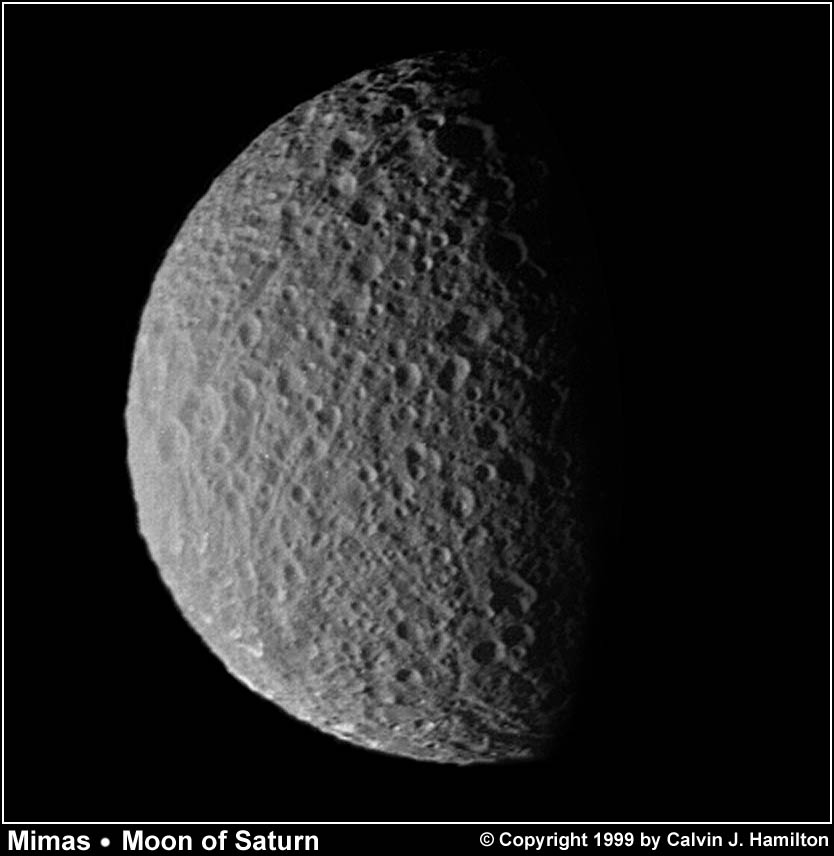
An anonymous reader writes "With today's image release, Cassini's tour of Saturn's remarkable system of 31 moons has taken the probe past one of the ringed planet's natural wonders: Mimas. The 250 mile wide satellite suffered a catastrophic impact that opened a wound one third of its diameter and nearly split the moon in half. Today, Mimas bears a striking resemblance to the original Star Wars' Death Star, which wreaked havoc on planets using its laser-focusing dish. In place of the laser dish, Mimas carries a crater peak the size of Mount Everest." -
Martian Racetracks
An anonymous reader writes "The European Mars Express spacecraft has released stunning images of 'yardangs': racetrack-like grooves eroded from an otherwise flat plain without obstacles. The terrain in high resolution is shown near the largest volcano in our solar system, Olympus Mons. Notable in the image is an abrupt left turn like the beginnings of a curved terrace." -
Martian Racetracks
An anonymous reader writes "The European Mars Express spacecraft has released stunning images of 'yardangs': racetrack-like grooves eroded from an otherwise flat plain without obstacles. The terrain in high resolution is shown near the largest volcano in our solar system, Olympus Mons. Notable in the image is an abrupt left turn like the beginnings of a curved terrace." -
Terraform Humans First, Then Mars?
An anonymous reader writes "Related to the future of Mars, NASA released the transcript of an expert panel which debated terraforming the red planet. Planetary scientists including NASA's Planetary Protection Officer, John Rummel, and science fiction writers (Kim Robinson, Arthur C. Clarke, and Greg Bear) chimed in. When asked if Mars should be transformed to a place where humans could walk without life support suits ("naked"), Sir Clarke responded, "Perhaps we should ask the Martians first." Can it be done quickly-- or at all? Is terraforming ethical? If humans colonize, are the colonists on a one-way trip akin to exile?" Read on for a bit more."A consensus seemed to be that like waking a sleeping giant, planet building seems possible if oxygen is not a requirement and some microbial life is dormant underground. But the question of making a planet suitable for plants alone seems to span tens of thousands of years. The remaining science fiction notion was terraforming humans, instead of planets, and making us survive on what is now a very alien world."
-
Terraform Humans First, Then Mars?
An anonymous reader writes "Related to the future of Mars, NASA released the transcript of an expert panel which debated terraforming the red planet. Planetary scientists including NASA's Planetary Protection Officer, John Rummel, and science fiction writers (Kim Robinson, Arthur C. Clarke, and Greg Bear) chimed in. When asked if Mars should be transformed to a place where humans could walk without life support suits ("naked"), Sir Clarke responded, "Perhaps we should ask the Martians first." Can it be done quickly-- or at all? Is terraforming ethical? If humans colonize, are the colonists on a one-way trip akin to exile?" Read on for a bit more."A consensus seemed to be that like waking a sleeping giant, planet building seems possible if oxygen is not a requirement and some microbial life is dormant underground. But the question of making a planet suitable for plants alone seems to span tens of thousands of years. The remaining science fiction notion was terraforming humans, instead of planets, and making us survive on what is now a very alien world."
-
Dog Trained on 200-Word Vocabulary
An anonymous reader writes "The Max Planck Institute for Evolutionary Anthropology in Leipzig, Germany is reporting in Science Magazine today on an example of successful human to non-human communication: Rico, a collie trained on a vocabulary of 200 words. Their conclusion is that 'brain structures that support this kind of learning are not unique to humans...[Rico has a] retrieval rate comparable to the performance of three-year-old toddlers'. In case you ever wondered if your dog understands what you are saying, Rico 'can learn the names of unfamiliar toys after just one exposure to the new word-toy combination.'" -
Mars Rovers on New Missions
mycro writes "According to CNN, the Mars rovers are on a brand new mission. Because the Mars Spirit and Opportunity rovers are in such great condition and 'keep going and going', NASA will be using them for a longer period of time to study water, rocks, and formations on Mars." An anonymous reader writes "Today NASA has given its Opportunity rover a green light to enter the steep Endurance crater. Looking at deeper martian bedrock layers is considered now a rich enough science payoff to weigh favorably against the real chance that the rover cannot get back out of the crater." -
Hayabusa Earth Flyby Swings Toward Asteroid
An anonymous reader writes "As the first of its kind to return asteroid samples to Earth, the Japanese Hayabusa mission took pictures this week during its successful Earth flyby. Eventually headed to the asteroid belt, the probe will feature a novel sample collection 'horn' which hops around on the asteroid's surface and lands intermittently for only a second at a time. The samples will be dust clouds fired up from repeated bullet impacts, since the asteroid's low gravity makes it difficult to 'land' on. When faced with a similar problem, the European Rosetta mission alternatively will harpoon the surface to hang on while also touching down on another small-mass asteroid." -
Hayabusa Earth Flyby Swings Toward Asteroid
An anonymous reader writes "As the first of its kind to return asteroid samples to Earth, the Japanese Hayabusa mission took pictures this week during its successful Earth flyby. Eventually headed to the asteroid belt, the probe will feature a novel sample collection 'horn' which hops around on the asteroid's surface and lands intermittently for only a second at a time. The samples will be dust clouds fired up from repeated bullet impacts, since the asteroid's low gravity makes it difficult to 'land' on. When faced with a similar problem, the European Rosetta mission alternatively will harpoon the surface to hang on while also touching down on another small-mass asteroid." -
Ray Bradbury's Reasons to Go to Mars
An anonymous reader writes "Ray Bradbury's testimony to the Presidential blue-ribbon Commission, 'Moon to Mars and Beyond', covers a range of rather optimistic space-related topics, including why three Italians should be the first on Mars. But at age 83, Bradbury's next book, entitled 'Too Soon From the Cave, Too Far From the Stars' seems to set an overall vision that this is an in-between generation caught between the brutal and primitive and the advanced." -
Vatican Astronomer Comments On Extraterrestrials
An anonymous reader writes "There's an Astrobiology.net interview up with a Vatican astronomer, Guy Consolmagno, who also curates one of the world's largest meteorite collections. On the possibility of a non-terrestrial lifeform, he says initially 'I don't know', followed by three scenarios. First, he argues: 'We find an intelligent civilization and there's no way in creation we can communicate with them because they're so alien to us. We can't talk to dolphins now. In which case, we'll never know.' Secondly, he suggests: 'We find the intelligent civilization. We can communicate.' As agents of free-will, the aliens are self-aware of good and evil, thus convertible to some terrestrial religion. Thirdly: 'We find a dozen civilizations out there, and a bunch of Jehovah's witnesses go up and convert them all.' The question of whether an alien civilization might convert Earth to their religion, or become a religion unto themselves, is left unconsidered. This compares to the many reasons people give for hosting a SETI@home client, including that ET contact would unite humanity, challenge religion, or all of the above." -
Second Opportunity For Mars Rover
An anonymous reader writes "The Mars Opportunity rover faces a challenging survey around the rim of the stadium-sized Endurance Crater. In addition to what was previously described as the critical choice to go into the steep crater at the risk of not being able to get back out, this "most spectacular view we've seen of the Martian surface" may aid in answering how deep an ancient sea or lake might have been and how long it lasted. Endurance Crater appears much older and thus may pre-date arrival of significant standing water." -
Going Back to the Moon and Mars
An anonymous reader writes "An interesting three-part interview with author Dr. Andrew Chaikin discusses whether humans or machines could best explore the moon or Mars and even whether a crew could get along with each other for three years on an extended mission. His Mars planning draws on Apollo mission transcripts, and he cites mishaps with the Apollo 15 lunar rover almost sliding catastrophically down a mountain, an astronaut argument as to who took the most famous earthrise picture and what after 14 months in space, the Russian record-holder uses to recover his land legs: 'One vodka, one sauna'." -
Going Back to the Moon and Mars
An anonymous reader writes "An interesting three-part interview with author Dr. Andrew Chaikin discusses whether humans or machines could best explore the moon or Mars and even whether a crew could get along with each other for three years on an extended mission. His Mars planning draws on Apollo mission transcripts, and he cites mishaps with the Apollo 15 lunar rover almost sliding catastrophically down a mountain, an astronaut argument as to who took the most famous earthrise picture and what after 14 months in space, the Russian record-holder uses to recover his land legs: 'One vodka, one sauna'." -
Meteor May Be From Martian Moon Phobos
An anonymous reader writes "Russian and NASA scientists published in the March journal of Solar System Research, the proposition that a 1980 Yemenite meteorite originated from the martian moon, Phobos. It would be the first moon rock from another planet. New Scientist has a short description and Astrobiology Magazine has the picture. Unique among the 20,000 meteorites collected, this is similar to heat-shocked charcoal and shows several mineral phases not found terrestrially." -
Messenger Spacecraft Prepared for Mercury
An anonymous reader writes "NASA's first orbiter to the planet Mercury is shown today in cut-away, revealing the parasol design that will protect it from intense heat. Twenty layers of aluminized Kapton will be its sunshade. Curiously since the innermost planet is so close to the Sun, the Mercury mission itself will look for (cometary) water-ice preserved on the less baked north pole."