Slashdot Mirror
Domain: astronomynotes.com
Stories and comments across the archive that link to astronomynotes.com.
Comments · 24
-
Re:I agree - moon first
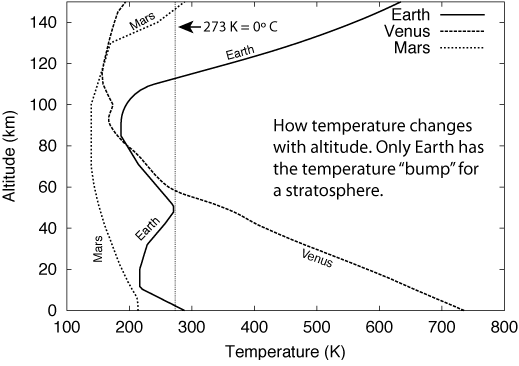
ED: That should read "there's not even a large thermosphere temperature spike" like there is on Earth. You can see the temperature profiles here (I can dig up some graphics for higher up if you'd like)
-
Re: Great news everyone
Because there are other star systems and a huge black hole making everything in the Solar system ROUGHLY homogenous.
A. Being 'homogeneous' would only affect the things within the bulk of the galaxy, while, as you pointed out, it's the farthest objects that have the most unexplained speed. (Just as things weigh slightly less in deep mines because there's less mass below them and more above, but outside the atmosphere it falls off almost exactly with r^2.)
B: You really think that every scientist studying the problem, every college student that takes astronomy or advanced physics, in every country on earth wouldn't come up with that if it were the correct solution? At least have the decency to phrase it as a suggestion.
Why not start here.
-
Really it took a rock?
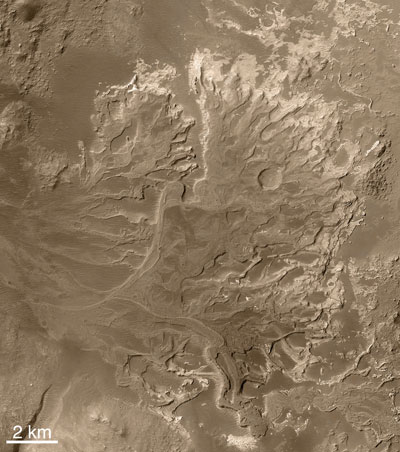
I gathered there was flowing water there from this photo. http://www.astronomynotes.com/solarsys/pics/eberswalde_deltasm.jpg
-
Re:Religious implications
10 AD is outside the range of dates in which the birth of Jesus could have happened. At that time, Herod was already dead for over a decade.
If you are interested in a good overview on the theories about the star of Bethlehem, I've found this page quite informative.
-
Re:N.America shifted South 400 miles in last 11yrs
Sure, I don't live in Europe. I have read of headline news about serious flights delays aout of UK the last few years because of snow storms "worse" than usual.
Perhaps your location already have all the equipments to deal with such storms, and 5-10 year swing in weather patterns may not be too noticable for your location.
I suppose we should watch out for the other places in Europe and Northen Asia having mild weather now starting to have to deal with some cooling effects.
I already quoted this link
http://www.astronomynotes.com/solarsys/s7.htm
Again, I believe the radiation belt from the illustration may be keeping or affecting the heat relative to the magnetic poles of the planet, in addition to direct Sun radiation during the day, of course.
-
Re:N.America shifted South 400 miles in last 11yrs
Here's a picture for you
http://www.astronomynotes.com/solarsys/s7.htm
See the radiation belt? Could it be trapping various radiating heat energies with respect to the Magnetic Poles, not the rotational poles? The radiation belts could easily warm up locations further away from the Magnetic Poles.
-
Re:it IS mind-smashing
I mean it took billion years for that light to get here, but who knows what could have happend in the meantime.
Given a known mass, we can predict how long a star will burn. A star with a mass roughly that of the sun will burn for about 10 billion years. So any young suns in this cluster will have burned out by now. Anything less massive will burn more slowly, and anything more massive will burn much faster.
-
Re:Protection?
Untrapped helium floats to the top of our atmosphere and a fair bit of it will leave the earth - because it can attain escape velocities at that point.
http://www.astronomynotes.com/solarsys/s3.htm
Recovering the helium that's floating up there will be very expensive.
-
Re:So there's more dust than previously thought...
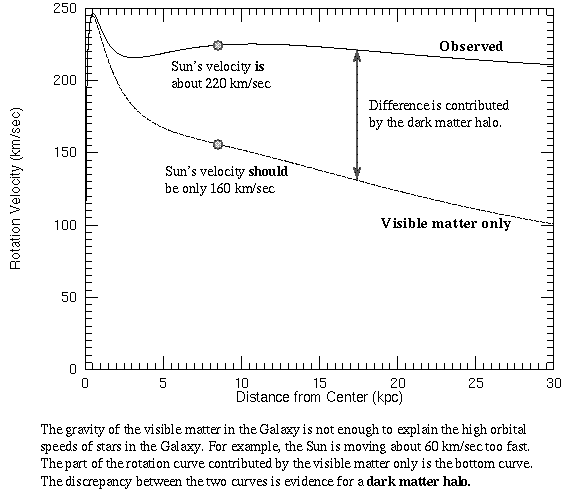
It's also a thing with the mass distribution. With a system where things rotate around a central mass (ie. the solar system) the speed of the objects can be easily estimated. Now, in a galaxy, if all the mass is in the objects we can see we should be able to deduct the speeds of the objects (faster near the center, slower in the edges). This is not the case. The stars seem to be rotating around the center of the galaxy with nearly equal velocities. This can thus far only be explained by a dark matter halo that gives additional speed to the outer stars.
Example -
Re:Hey, it makes a prediction, that's REAL science
Hmmm.... The Scientific Method may be more accurately summarized as follows:
1. Observe
2. Develop Hypothesis
3. Make predictions based on hypothesis
4. Test predictions by experimentation
Remember: a Hypothesis is not the same as Theory -
Re:He's not a climatologist :/
Stability of the Sun's thermal output
The only way to reliably test the so-called "solar constant," whose value at the mean Sun-Earth distance is a little over 1 1/3 kilowatts per square meter of surface, is from outer space. Atmosphere and other factors are going to vary any measurement too much.
Here is a web site that talks about changes in this Solar Constant, measured since 1979. The greatest has been about
http://www.gcrio.org/CONSEQUENCES/winter96/article 3-fig2.html
Why is the Sun stable?
1) if the Sun's output weren't stable, temperatures would fluctuate so fast life on Earth wouldn't be in its present form.
2) We are here -- hence things must have been stable.
3) Follow the following physics I dug up about Hydrostatic Equilibrium:
http://www.astronomynotes.com/starsun/s3.htm
Solar Luminosity---huge energy output!
The first basic question about the Sun is how bright is it? It puts out A LOT of energy every second. How much? The answer from our measurements is 4 × 1026 watts. Such a large number is beyond most of our comprehension, so let's put the Sun's total energy output (ie., its luminosity) in more familiar units. It is equal to 8 × 10¹⁶ of the largest power plants (nuclear or hydroelectric) on the Earth. Our largest power plants now can produce around 5,000 Megawatts of power. Another way to look at this is that the sun puts out every second the same amount of energy as 2.5 × 10⁹ of those large power plants would put out every year---that's over two billion!
Hydrostatic Equilibrium Controls the Reaction Rates
Hydrostatic equilibrium is the balance between the thermal pressures from the heat source pushing outwards and gravity trying to make the star collapse to the very center. I will discuss hydrostatic equilibrium in more depth (no pun intended) in a later section. The nuclear fusion rate is very sensitive to temperature. It increases as roughly temperature4 for the proton-proton chain and even more sharply (temperature15) for the Carbon-Nitrogen-Oxygen chain. So a slight increase in the temperature causes the fusion rate to increase by a large amount and a slight decrease in the temperature causes a large decrease in the fusion rate.
Now suppose the nuclear fusion rate speeds up for some reason. Then the following sequence of events would happen: 1) the thermal pressure would increase causing the star to expand; 2) the star would expand to a new point where gravity would balance the thermal pressure; 3) but the expansion would lower the temperature in the core---the nuclear fusion rate would slow down; 4) the thermal pressure would then drop and the star would shrink; 5) the temperature would rise again and the nuclear fusion rate would increase. Stability would be re-established between the nuclear reation rates and the gravity compression.
Personally, I think there are fluctuations --from minute to minute. Kind of like the waves on the ocean can make the water level change dramatically at small samples. But the Level of the ocean as an average is very, very stable. So I think that the thermal output of the Sun is very, very stable -- sunspot activity on 11 year cycles or not. There are a lot of dynamic forces that very constantly and very quickly in the 4-stage fusion process of the sun, but they all average out. Any drastic change over time would be huge. Since it has been here 4 Billion years -- the Net process has to be stable. Right? In our Stratosphere, Ozone atmosphere convert much of the Ulraviolet light into Infrared light -- heat. Out magnetosphere is created by our earth's metal core. This creates a giant electrical generator that keeps producing lightning (interaction between magnetic field and charged particles from sun) so a more energetic Sun would produce more lighting and more Ozone co -
Re:forget Mars...
Venus only rotates once every 243 days. You'd have to speed it up quite a bit or you'd just have huge temperature differences between the day and night sides and giant wind storms in between. Approximating Venus as a sphere of uniform density, it has a moment of inertia of and a rotational kinetic energy of 3.19 * 10^24 J. To accelerate it to the same rotation rate as Earth, you would have to raise that to 1.88 * 10^29 J. On the other hand a typical comet has a mass of up to 10^15 kg. They do move very fast, though, due to their highly eccentric orbits. That pages quotes Halley's comet as having an orbital velocity near its perihelion of 68 km/s. Using that velocity and the 10^15 kg mass figure, one comet would have a kinetic energy of about 2 * 10^24 J. In other words, even if you could couple the comits' energy into Venus' rotation with 100% efficiency (yeah, right), you would still need to hit it with about 150,000 comets to get it up to Earth-like rotation rates. This does not strike me as a particularly practical plan.
-
Re:Not an issue...
You are incorrect. Since the Earth is not a perfectly rigid solid body the moon's orbit is affected by things like friction, specifically the friction between the Earth's water and its crust and, to a lesser extent, internal friction from the crust itself.
So that you may learn. Scroll down a bit to the sections on "Tides Slow Earth Rotation" and "Tides Enlarge Moon Orbit."
The poster you replied to is entirely correct. In answer to his question, tidal generators will not slow down this effect, but increase it. Tidal generators in effect increase the friction between the Earth's crust and the oceans which will both cause the planet's rotation to slow more quickly and also increase the rate at which the Moon's orbit increases in size.
The moon is affected by the Earth's gravity, which is affected by deformations in the Earth, which are affected by gravity. -
Re:I doubt this a a triple star system
IIRC that's why the moon is slowly pulling away from the earth -- the sun is slowly pulling the earth and the moon apart.
I thought that was due to the tidal action of the moon on Earth's oceans. -
Ring Object SizeWhile I understand your concept, another poster suggested the rings are made of smoke sized particles. Actually, the particles are sometimes quite large according to this page:
More recently, astronomers bouncing radar off the rings and analyzing the reflected signal found that ring particles must be from a few centimeters to a few meters across. When the Voyager spacecraft went behind the rings with respect to the Earth, astronomers could measure the particles sizes from how Voyager's radio signal scattered off the particles and from how sunlight scattered through the rings. The ring particles range in size from the size of a small grain of sand to the size of a large house, but on average, they are about the size of your clenched fist. Spectroscopy of the rings shows that the particles are made of frozen water. Collisions between the ring particles keeps the ring system very flat and all of the particle orbits circular.
from http://www.astronomynotes.com/solarsys/s16.htm
though there may be other information available which I am unaware of, of course. But if this particle size stands, it seems a fairly simple explaination that a meteroid could hit a large ring object and cascade debris and impact effects throughout the rings themselves...
free music downloads, recipes, games, and more -
Re:I don't understand how this works.Can anyone he
There are many ways to calibrate the distance scale.
First - there is a strong relationship between the absolute magnitudes of stars and their spectral classess (Hertzsprung-Russell or "spectrum-luminosity" diagram). Knowing star spectrum it is possible to calculate star luminosity, and this gives the distance from the star to the observer. But this works only for relatively close stars...
For more distant objects, variable stars come to the rescue. There is an interesting relationship between period of pulsation of particular class of variable stars (cepheid) pulsation and their luminosity. That is how, in fact, the first distance to galaxies were measured... (more here) -
Re:Neutrino Detector...
I can't estimate that as any useful number. But the reason it takes photons so long to get to the surface of a star is because they keep hitting things. It takes about a million years for a photon from the center of the sun to get out. Here's a link: http://www.astronomynotes.com/starsun/s7.htm
The neutrino gets out pretty much at the speed of light.
The problem is, you're talking about a different reaction. It's dependent on whatever reaction is causing the gamma-ray burst. Ask a physist how long the collision takes.
If we really are talking a collision, though, I'd say there's also a possiblity of gravity waves getting out well before the gamma ray burst. Another indicator that somethings about to pop. And another technology that's on the verge of being possible. -
Re:Contradictory?
-
Re:Food for thought..
It really bugs me to compare scientific theory and religious theory as being the same thing.
A scientific theory must be testable. When something in the scientific community becomes theory it is nearly fact. See here
On the other hand religous theory is just that. Some guy's idea while he was smoking a little pot. -
Re:Interesting for different reasons:
There are three planets generally ignored by scientists because they are dead and orbit a neutron star. However they are Earth sized and there is a possibility that in the distant past they may have harbored life.
I'd say that possibility is nonexistent, if our current theories about the evolution of stars are at least approximately correct.
The neutron star must have once been a red supergiant (which then underwent a supernova explosion). The orbits of these planets are much smaller than the size the star must have had at the supergiant stage. This means these planets must have formed after the star became a neutron star, perhaps from the remains of the supernova. -
Re:How do they reduce gravity?
Free fall = orbit = Effect of gravity is negated by the centripital force. ( things do not orbit around something else, they both orbit around a common mass point ) For the Gravity Vector and Centripital vector, If equal, then object stays in sky, due to orbit. Zero gravity = stuff flies off into space. Escape velocity = sustained centripital force nessesary to overcome force of gravity. Free fall in vomit_Comet is a type of orbit. ( kind of like the orbit of a comet crashing into the earth ). http://www.astronomynotes.com/gravappl/s3.html ( as long as the distance is finite, there is some gravitational force ) Henry Cavendish measured the gravitational constant with freaking CANDLES! http://scienceworld.wolfram.com/biography/Cavendi
s h.html http://www.geocities.com/neveyaakov/electro_scienc e/cavendish.html -
Re:What gas clouds!?
They say "gas clouds" like there are known clouds of gas following the earth. I am certainly a neophyte when it comes to astronomy, but I would have thought SOMEONE would have mentioned this to me at SOME point.
The science curriculum in a lot of schools doesn't seem to have changed much since the 19th century. (Interstellar gas was discovered in 1904.) These pages will get you current. -
Re:Are all of you retarded?
Unlike yourself, I've actually been to Sellafield. So stuff that up your jumper. The tour there actually features a history of the power plant, including the fact that it partially melted down a few decades ago (when it was called Windscale).
And I thought Americans were arrogant. You, sir, take the cake. How can you be struggling with problems from Sellafield when you are in Norway? Please don't give me some bullshit about the water somehow carrying contaminants a thousand miles across the ocean to you -- it's just too stupid an idea to comprehend.
>NJ sounds like a really shitty place to live, and the way this guy's been treated doesn't surprise me one bit. If the easiest way to handle a problem is to resign, then people will very often do that! As seems to be the case with the whole of NJ.
Yeah, I was right. You are the most arrogant person I've met in a long time. Making assumptions on how "shitty" a place is before being there. I can assure you that after having visited both places, I'd rather live in Shithole, NJ than anywhere in Europe.
>Here in Europe at least more and more people are reacting to electromagnetic radiation.
WHAT? Dear lord, that has to be the stupidest pile of crap I've ever read. Do you even know what EM is? Assuming you can actually see, you're enjoying the benefits of EM right now. Hooo boy you have a lot of high school physics to complete.
>A cellphone nearby can be enough to cause illness!
Show me a non-biased, non-bullshit study about this. Have you ever heard of the law of squares for radio distribution? The only way you're going to get "irradiated" in any meaningful manner by a cellphone is if you jam it up your ass.
I bet you're just mad because you clicked all my DHMO links and only figured it out on the last one...
>insulation is a whole book in itself on chemical hell
Insulation is glass fibre! That's it! It's that simple! Ever burnt any? It turns into... GLASS! What a surprise! What's the chemical hell? The fact that it comes baled in plastic wrap?
>I hope you guys don't consider general pollution a figment of imagination too? Go suck on the tailpipe of your car for an hour or so after a good run in the park!
Asphyxiation and pseudo-science are two totally unrelated matters.
>It's just plain scary when you start to realise what steps people are willing to take just to make money. Killing a few people is low on the list.
That is nothing new. The Crusades, Jesus, Roman Empire, Egyptians. People have been killing people for as long as I can think of in an attempt to "better" themselves. This isn't anything new, and it certainly isn't related to modern, "chemical", living.
>I'm not really sure where I'm going with all this, but please, sit down and think!!
I did, and I did it a long time ago, and that's why I know most everything you're talking about is a steaming pile of junk science.
You have something on the pollution angle, though. But you're being too vague on it, so I'm really not sure what, exactly. Pollution covers so much, from annoying sounds, to second hand smoke, to antrhax sprays, it's hard to tell what the discussion is on when people bandy the term about so loosely. -
Re:Acceleration, etc.I am sorry. It is my turn to disagree.
Simply put, accelerometers tell you if you are accelerating and it says nothing about applying different forces to particular sensor elements and not others. Consider the simplest of accelerometers: a flashlight. Shine a flashlight across a room and the beam travels a straight line. Now constantly accelerate the room and the beam "falls." No moving parts. This is a very nice Newtonian argument that you can find all over the place (such as here). If you invoke the Equivalence Principle, then this says that your flashlight beam will bend when you are in the constant accelerating field of the Earth. This is a nice General Relativity argument which you will find in pretty much all GR books (it will be referred to as the Einstein Elevator).
Rotation is something else that is very easy to detect, even if you are out in free space with no points of reference (such as a star field). Simply hold a ring laser gyro. This whole device relys on the Sagnac Effect which will tell you whether you are rotating (i.e., accelerating) or not. Rotation is just as easy to detect because it is involves acceleration.
As an aside, inertial reference frames do not depend on special relativity (SR), it is SR that depends on interial reference frames (this is the first of Einstein's three postulates). In the context of this discussion intertial reference frames have everything to do with it, and it doesn't mean we have to be talking about SR when we talk about inertial reference frames. The whole point of my previous post is that you can always tell that you are accelerating even if you are falling in the potential well of a planet or any other scenario you can dream up. Just use your flashlight (a finite speed of light is a wonderful thing, even in the Newtonian world). If you want to live only in a Newtonian world and you don't have a flashlight, then perform some intro physics conservation of momentum experiments on those noisy airtracks to see that you are not conserving momentum in your uniformly accelerating reference frame you say you cannot detect.
You also need to be careful about associating acceleration with motion. The can in the previous example does not crush because the bottom of the can is not accelerating while the top does, the whole can is accelerating (and uniformly (20g), I might add). Right now you are accelerating in your chair, but you don't move because the Earth is pushing back on you, but that doesn't mean you aren't accelerating. Remember, your weight is a force, and the force is proportional to your acceleration; no acceleration, no force holding you to your chair, and you would fly away.