Slashdot Mirror
Domain: berkeley.edu
Stories and comments across the archive that link to berkeley.edu.
Comments · 3,539
-
Remember that time...
This reminds me of.... 2002.... http://www.berkeley.edu/news/media/releases/2002/
0 3/28_solar.htmlsame idea, 2002 -
"further besmirching the once-revered title"
Revisionist history a little?
There is no revision of history when someone points out hackers ARE NOT criminals nor that they intentionally damage systems. The first tyme "hacker" was used derogatorily was in the 1980s, before then Hacker meant "simply referred to a person who was capable of creating hacks, or elegant, unusual, and unexpected uses of technology."
The concept of hacking entered the computer culture at the Massachusetts Institute of Technology in the 1960s...
But there are standards for success as a hacker, just as grades form a standard for success as a tool. The true hacker can't just sit around all night; he must pursue some hobby with dedication and flair. It can be telephones, or railroads (model, real, or both), or science fiction fandom, or ham radio, or broadcast radio. It can be more than one of these. Or it can be computers.Steven Levy has written a good book on what and who hackers are, Hackers: Heroes of the Computer Revolution
Falcon -
I've been thinking...
This is somewhat OT, but the "haha" tag should get a picture attributed to it; and I know just the one!
http://inverse.physics.berkeley.edu/archives/nelso n.gif -
Stardust @ Home
Reminds me of Stardust@Home ( http://science.slashdot.org/article.pl?sid=06/01/
1 1/069248 / http://stardustathome.ssl.berkeley.edu/ )
Funny how human eyes are still needed for these tasks -
Re:Huh?
One of the best introductions to AI is Artificial Intelligence: A Modern Approach.
Indeed Russell & Norvig is a very good book, well worth a read if you're interested in AI. All the same, when I did my BSc in Artificial Intelligence I found Rich & Knight a much better, more understandable book for the purposes of an introductory text. It is a little dated now, but so is Russell & Norvig, to be honest. -
Re:Huh?
Compression is searching for a minimal representation of information. Along with representation of knowledge you add other things such as learning strategies, inference systems, and planning systems to round-out your AI. One of the best introductions to AI is Artificial Intelligence: A Modern Approach.
-
PS3 discount coupons for refurbed Xbox360?
With all the problems the Xbox360 is having, I would think that it would be a great time for someone( Sony/etc ) to offer a $100-$200 discount in an exchange program to 'help' those poor Xbox360 users get a more stable console.
After the third exchange with Microsoft, you'd think people would be tossing these things off the roof. Why not offer a $100-$200 discount coupon to help them with their problems? After 1.5 years of this, Microsoft is only now offering a three year cycle of exchange for another bad unit and for many, there's only 1.5 years left.
And while you're at it, build a Linux Custer of all those Xbox360's and find ET already( Seti - http://setiathome.ssl.berkeley.edu/ ).
LoB -
Re:You're too kind.Contradictory fact - Japanese Kamikazes.
You left out the first sentence of that section which frames the rest of the argument:
Suicide missions are not always religiously motivated, but according to Oxford University sociologist Diego Gambetta, editor of Making Sense of Suicide Missions, when religion is involved, the attackers are always Muslim.But religion was - profoundly - a part of the Kamikaze experience. The "Divine Wind." The Last Notes of the Kamikaze Pilots and the Japanese View of Death and Afterlife
-
moving at the speed of government
First, I am a tremendous supporter of OSS, but historically there has been a learning curve for OSS development as the early developers were breaking new ground in terms of organizing contributions in a completely asynchronous manner. Until recently, open source development practices have been umm... lacking somewhat in coherence... The folks at UC Davis, Berkeley, and UMD-College Park used their constraint-based, context-aware program call flow graph analysis package to uncover what they refer to as bug churn within the Linux kernel over several successive versions... I.e. they observed previously quashed bugs resurface in later versions. Link to pdf preso: http://cents.cs.berkeley.edu/retreats/winter_2005
/ cukwip.pdf So, not to be too much of an apologist for the FCC, but in the past there was significant justification for the OSS==insecure perspective and as we all know, government is always the first to identify new trends. -
more links
Some more links:
A lot of very good Berkeley lectures http://webcast.berkeley.edu/
Lectures and science videos http://freescienceonline.blogspot.com/ -
Really innovative work at Berkeley
Here's the webiste of a class at Berkeley that is designing totally new chip architecture, something actually innovative and quite interesting in my opinion. http://research.cs.berkeley.edu/class/fleet/ It's still a few years away from being practical, but they are hoping to have in-silicon test chips very soon now.
-
Re:Star WarsWhat happened ? It worked. It broke the economy of the Soviet Union. My god! That's some Cold War Reagan is Genius bullshit.
SDI was laughable at the time, because the fundamental problems of Rods for God, Brilliant Pebbles, space and ground based lasers, and kinetic kill vehicles were unsolvable at the time, and easily defeated by incredibly inexpesive counter-measures (everything from mylar baloon decoys, to liquid nitrogen jackets, to -- my personal favorite -- simply detonating one warhead in space, and then sending the rest through. Most importantly to this conversation, is that the Soviet Union realized this, and so did NOTHING!
The idea that Gorbechev ramped up military spending to counter the perceived threat from SDI is simply untrue. The Soviet Union's military spending growth held steady at 1.3% per year since 1975. In 1985, spending increased to 4.3% per year for two years. During the growth, offsenive strategic weapon spending only grew at 1.4%. By 1988, the Soviet defense budget had dropped to 1980 levels. Meanwhile, the Reagan instituted the largest peastime military spending in history, growing the DOD at 8% per year, leading to the largest budget deficits and national debt in the history of the United States. In the words of Rush Limbaugh, "Reagan left us a debt we can never repay."
So, what caused the collapse of the Soviet Union? Simple. The economy collapsed -- completely unexpected by the West mind you -- due to structural deficencies in the command economy of the Soviet Union. The American Enterprise Institute (hardly a "leftist" organization) recently outlined the economic collapse of the USSR. Far from being the imminent threat and the power hourse conservatives were saying the Soviet Union was, the Soviet Union was falling apart as early as the 1970s. They produced no finished goods, save for weapons, that could be sold on the world market. Instead they relied on selling raw materials, most importantly oil. The Soviet economy was on the virge of collapse since the 1970s, however whenever the situation looked the most dire, the oil market managed pickup just in time, and bail them out. Eventually, their luck ran out.
If you want to thank anyone for the West winning the Cold War without firing a shot, thank Josef Stalin. His nationalization of the agricultural sector of the Soviet economy set the country on the course to ruin. -
Re:Lovely.
Getting pretty fast to the top ranking of SETI?
Is there any other meaningful purpose for super-computers when you use them in mom's basement? -
Re:Why is it not based on Cell?
Perhaps these CPUs have better hardware floating-point support than Cell? IIRC Cell has limited double-precision support, though some enterprising folks have found ways to work around it and put Cell to good use..
And upgrading PPC cores is the easier way to go, being able to reuse plenty of existing firmware and associated hardware. Not to mention that IBM probably committed Cell to PS3 for quite awhile, and maybe they don't have the capacity to start spinning custom revs (say with more SPEs or with extended double support) with PS3 demand. -
Re:Damned inefficient
If I had a sniper rifle, every last son of a bitch with a Harley modded for sound would have it shot out from under them as they rounded the corner to my house.
I know a woman named Mercedes who, last I checked, rode a Honda or something. Her response to "loud pipes save lives" is "why don't you just tape down the horn button then?"
Harleys are the biggest festering piece of shit bikes on the road. They have no torque and get super shit mileage compared to even the most powerful imports. It's too bad they didn't just go out of business instead of getting rescued by a sports equipment company. They're also some of the least reliable vehicles around. At least as of about 2003, every single Buell (Harley's sport bike) ever made had a life-threatening safety recall. Not something minor like "turn signals fail" but something serious like "bike has tendency to disintegrate at high speeds".
Anyway, end rant, back on topic:
We have allowed our world to become polluted with more than just chemicals - we let the noise in too. I am willing to bet it has as much an impact on our long term health.
Don't forget light! We are sensitive to certain frequencies of light and some of them are put out by shit like streetlamps and passing cars, which interrupts our sleep cycle. Actually, right now my big issue is that half the fucking county (Lake) is being inundated from light from The Geysers. I'm not sure precisely where it is coming from (I could tell if I spent some time with a map, you can see clearly where it comes from at one point on your trip on Bottle Rock Road, which goes up one side of Cobb Mountain) but it must have something to do with US Renewables Group. Yeah, sure, renewable, but they don't give a fuck about wasting shitloads of power on lighting which is going into the sky instead of onto the ground and the work they're ostensibly doing.
But anyway, light pollution is a serious issue not just for astronomers, but for all of us - and not just because we can't see the milky way.
-
Re:Losing their way?
Piratebay are trying to be the guardians while acting like anarchists. They will do more harm than good.
I hope you don't mean to imply that Anarchists have done more harm than good.
http://sunsite.berkeley.edu/Goldman/Writings/Anarc hism/anarchism.html -
Re:Slashdot exercise: prove it was an "obvious ide
Well, from 5 minutes in google, here's a paper that touches on several similar topics, published in 1996. Here's another one by Larson, published in 1995 (look up the title: "Geographic Information Retrieval and Spatial Browsing" and you'll find citations to it that indicate a publication date of 1995). The relevant process even has a term: Geographical Information Retrieval (GIR). Larson's paper also makes mention of a system called "Virtual Tourist" for finding and browsing web sites by their geographic location.
About the only aspect of the claims that is superficially novel is putting together a geographic location from IP address algorithm with a search engine, but that falls into the "Duh, obvious!" category.
Something tells me that searching for more than 5 minutes might yield *alot* more. -
Re:Noisy clickstream
Actually, there are several available programs to do this kind of search. Here's a list. Ignore the first three that do performance statistics; there are better ones below them.
If you want a single specific, easy-to-use app, I'd suggest DepSpid. (I haven't used it specifically, but all projects on the BOINC platform are very similar.) -
Re:Einsteins view at least
"Poke one subatomic-particle and the other one instantly changes spin!"
No, it's more like "Poke one sub-atomic particle and the spin of the other one is instantly defined".
I recommend for anyone trying to understand this to read about Bell's Inequalities. I found the Wikipedia article on it very confusing (actually, it's good for getting the big picture, but the explanation of the details assumes vast prior knowledge). I finally understood it reading this:
It's a little heavy on the math (well, just a little bit of linear algebra), and starts from the very beginning. In the end of the lecture (section 5) it has an experiment that shows how this "spooky action" works. Be warned that it has a couple of typos in some equations -- but if you follow closely from the beginning, they're not hard to spot.
To get a real explanation about quantum teleportation (which seems to be what the article is about), see the section 1.1 of this one:
But that requires a little more math (tensor products).
These both seem to be part of this quantum computing course:
-
Re:Einsteins view at least
"Poke one subatomic-particle and the other one instantly changes spin!"
No, it's more like "Poke one sub-atomic particle and the spin of the other one is instantly defined".
I recommend for anyone trying to understand this to read about Bell's Inequalities. I found the Wikipedia article on it very confusing (actually, it's good for getting the big picture, but the explanation of the details assumes vast prior knowledge). I finally understood it reading this:
It's a little heavy on the math (well, just a little bit of linear algebra), and starts from the very beginning. In the end of the lecture (section 5) it has an experiment that shows how this "spooky action" works. Be warned that it has a couple of typos in some equations -- but if you follow closely from the beginning, they're not hard to spot.
To get a real explanation about quantum teleportation (which seems to be what the article is about), see the section 1.1 of this one:
But that requires a little more math (tensor products).
These both seem to be part of this quantum computing course:
-
Re:Einsteins view at least
"Poke one subatomic-particle and the other one instantly changes spin!"
No, it's more like "Poke one sub-atomic particle and the spin of the other one is instantly defined".
I recommend for anyone trying to understand this to read about Bell's Inequalities. I found the Wikipedia article on it very confusing (actually, it's good for getting the big picture, but the explanation of the details assumes vast prior knowledge). I finally understood it reading this:
It's a little heavy on the math (well, just a little bit of linear algebra), and starts from the very beginning. In the end of the lecture (section 5) it has an experiment that shows how this "spooky action" works. Be warned that it has a couple of typos in some equations -- but if you follow closely from the beginning, they're not hard to spot.
To get a real explanation about quantum teleportation (which seems to be what the article is about), see the section 1.1 of this one:
But that requires a little more math (tensor products).
These both seem to be part of this quantum computing course:
-
Re:Studebaker Nuclear Reactors
I have yet to see any scientific papers that agree with your statement in any of the online Energy journals.
Would UC Berekeley's Nuclear Engineering department be a reputable enough source for you?
They quote less than a ton of waste per GW-year. Conventional is about 35 tons per GW-year.
I'll make a note to find the reports from the Argonne Labs prototype when I get some library time in. -
Re:Yes and No
What we need is more advanced primitives. Here are my 2 or 3 top likely suspects:
I think you'll find that while they work well for some parallel problems, for others they suck. The problem is that there are quite a few different general parallel computing model problems and it's not at all clear that the same approach will work well for all of them. Indeed, there remain problems that are "embarrassingly serial" and there are also a great many other things where working out how to parallelise them is itself an open research question; it's not even sure whether the list of "dwarfs" in that article is itself complete... -
Re:ATTENTION CREATIONISTS!!!
"You could assist me by denying that evolution deals with Fact, and I will feel much more relaxed about it. I'll settle for "evolution (in the sense of molecules-to-man) is a theory based on an assumption of naturalism". If you can assent to that, we have no disagreement about the nature of evolution itself."
If you require that facts not have the "assumption of naturalism," then fine, don't call evolution a fact. However logical consistency demands that you no longer consider "the sky is blue" to be a fact for the exact same reason. Really none of our interactions with the entire, everyday world can be considered factual without methodological naturalism. After all, a supernatural entity could be tricking us in ways that we could not possibly even imagine. Maybe this morning I ate my Cheerios with a fork because Loki tricked me into thinking it was a spoon. But such speculation I'll cheerfully leave to the sophists and postmodernists. Also, we must be very careful with our terms. Science is not possible without methodological naturalism, for the reasons in my previous post as well as the above. Philosophical naturalism on the other hand is irrelevant to science as the supernatural can't be studied using science. For somebody who says they've got a graduate degree in philosophy, your posts read messily on this distinction. Also I urge you to better inform yourself on what evolution actually says. "Molecules to man" is a phrase that instantly tells me that you've read little about evolution from pro-science sources. I recommend Berkeley's evolution website and talk.origins as good starting off places, wikipedia's got a decent page as well.
"As to explaining your "enzymes" and their behaviour, you are merely using the accepted terminology of your field. That paradigm includes "amino acids" and "protons" and other such mythical elements. Whether you believe in those or "bond pixies" doesn't really matter much if the predictions and whatnot come out the same. Whether you say, "an amino acid pops a proton off a substrate carbon," or, "a bond pixie smacks a frobnockle off a slithy tove," matters only in that the former language is that which your peers speak. If, on the other hand, you felt that you had a better model for enzyme behaviour which involved differently behaved basic entities and operations, you'd best present those ideas using new words. Good luck with that: paradigm shifting is backbreaking work."
Yes if I replaced "abstract a proton from the terminal methyl group" it wouldn't be any different than "a bond pixie smacks a frobnockle off a slithy tove" provided "The Famous Brett Wat speak" could be translated into acceptable terms. You've missed the argument completely. The argument is that just in my little field a whole host of observations using a great many different techniques done by a great many different individuals over the course of many decades have been done. It all builds on itself, it all interrelates, and major contradictions are not seen. The explanatory and predictive power is enormous. Along comes somebody who wants to know why supernatural Bond Pixies haven't been considered. Yet who and what Bond Pixies are, and how/when/why they make an enzyme work, how this is different from the established view, and what exactly are the predictive and explanatory powers of this concept are not defined, nor is any observed evidence presented. Until those terms are defined, and somebody comes up with an objective way to detect and measure Bond Pixies and how they make an enzyme function, they are not a useful concept. Same goes for evolution, cosmology, dermatology, or any other field of scientific inquiry and any other undefined supernatural entity acting in any undefined way.
As you say paradigm shifting is hard work. But instead doing any work at all, creationists come in claiming without evidence -
Re:romantic and calvinistic notions?
It is a well known fact in science that depriving yourself of calories (1200-1400 a day for a sedentary lifestyle instead of 2000) is one of the surest ways of extending your life and living healthy. That means kicking out caloric drinks.
Look what up? This is the Age of the Internet man, with hyperlinking! Throw us a bone, especially when making claims about scienfitic studies that seem like they could be interesting if we only knew where to look.Look it up.
Anyway I'll let you off easy this time and do it for you.
-
Re:Macs for artists
D'oh! I got teh numbers wrong: the human eye can discern about 350,000 colors (warning: MS Word file).
My point, though, was that it's a silly lawsuit. As someone who spends hours in Photoshop doing color correction I know the monitor is, at best, a blunt instrument. That's why we have matchprints and digital color proofs and the like.
-
Re:Corn-based Ethanol is a Tragedy
I'm sick of seeing links related to Paztek's paper. It's junk. Here's a link to the source that several other articles quote from: http://petroleum.berkeley.edu/papers/patzek/CRPS4
1 6-Patzek-Web.pdf I agree with his bashing of corn production in the US (government subsidies, etc). But on the input side of his energy calculations, he includes: * human energy (labor), * energy for the humans to commute to the field, * energy used to make hybrid seeds, * solar energy that the field receives! Let me reiterate that last one. He adds solar energy, the entire amount of energy in the form of sunlight that fell on the plot of land during the growing season, as an input. That means that photosynthesis is part of his efficiency calculation. He completely discounts the energy that could be gained from the byproducts, and includes energy costs associated with transportation and disposal of the byproducts as if they were waste. Plus, many of the energy inputs he calculates are based on corn destined for human consumption -- many of these inputs would be left out of corn grown for ethanol. He claims that more CO2 is produced by the ethanol cycle than would be produced by burning the equivalent amount of gasoline. BUT, he doesn't discount the CO2 consumed by the corn plants! To be fair, maybe this analysis is complete and accurate. If so, I would like to see the same analysis performed on gasoline -- and please include all the solar energy that went into the biomass that eventually became petroleum, include the energy from heat and pressure from the earth, etc etc. Then one could make a fair comparison. -
Re:It is also national security ...
We are NOT using a gallon of petroleum to produce a gallon (of less then a gallon if you believe the FUD) of ethanol. Not all energy in the world comes from petroleum. Most of the fuel used to produce Ethanol comes from Coal or Natural Gas. http://rael.berkeley.edu/ebamm/summary.html Your other statement about fuel mileage is also inaccurate. Yes ethanol has less energy per unit then petroleum but it also has a higher octane. For those not understanding octane, this means the fuel can withstand higher pressures before being ignited giving it an efficiency boost(think turbo or super charger). My understanding is an ethanol engine can be toned to have the same gas mileage as as gasoline engine. The reason why flex fuel cars get the lower mpg is because they are toned for gasoline and not ethanol. I'll try to quickly address your other FUD. The production of ethanol involves growing plants which reduce smog and CO2 while the production of gasoline only produces smog while never contributing to the reduction of it, that is simple common knowledge that you don't need a PHD to understand. As many have said corn prices are influenced by other things and 60% of the bi product of ethanol production can be used as feed for livestock. We don't need to retrofit or replace engines to handle ethanol because gasoline is not going away in any near future. Gasoline engines will be replaced when they die of old age and then replaced by a new cars that can handle ethanol or other biofuels. Do you have anymore FUD that you've been swallowing from Big Oil without researching?
-
Re:Corn-based Ethanol is a Tragedy
Some people should be shot for the FUD they post. As somebody else posted the report you linked to is from one professor that used decades old data to come up with his numbers. You probably should have atleast posted the link to the real report instead of a news report where the Media just hunts for the most striking headline.
I can at least point you to reports from our own government that say there is a 1.34 ratio of return from corn crops:
http://www1.eere.energy.gov/biomass/net_energy_bal ance.html
Or if you continue to believe that the agriculture buisness has more pull then Big Oil then check out this report from UC Berkeley that says it has a 1.30 ratio of return from corn crops:
http://rael.berkeley.edu/ebamm/summary.html
I don't think the corn ethanol is the fuel of the future. But I think it is a stepping stone in the correct direction towards other alternatives like Algae or Switch grass which is cheaper, easier to grow, and produces many more gallons per acre. Corn based ethanol will first establish the infrastructure for ethanol then these better alternatives will hopefully take over. -
OT: The size of the internet
Okay, the Library of Congress has been estimated to contain about 10 Terabyte, so I buy the 1000 * LoC = 15 Petabyte. But archive.org alone expanded its storage capacity to 1 Petabyte in 2005, so the CERN is not going to generate anything near "22 Internet" (whatever that might be). This estimate from 2002 calculates the size of the internet as about 530 Exabyte, 440 Exabyte of which are email, 157 Petabyte for the "surface web"
-
My H-1B study
Last year, I took an undergraduate Labor Economics seminar and wrote a paper on H-1B program's impact on domestic labor force. You can find it here:
http://panic.berkeley.edu/~akopps/paper/paper.pdf
I looked at the correlation between the relative supply of H-1B workers and the wages of IT workers. Surprisingly, I found no significant correlation between the presence of H-1B workers and labor market outcomes. However, surprisingly, if you look at the impact at the impact on the wages of only male workers, then there is a slight but a very clear (statistically significant) 'impact' on their earnings. Even more surprisingly, if you also look at the correlation between the earnings of female domestic workers and the relative supply of H-1B workers, then there is a POSITIVE impact on their earnings.
Of course, I concede that there could be a A LOT of problems with the methodology I used and with the data employed in this study. My methodology was basically constrained by whatever data I had access to. However, if we assume for a moment that the data and methodology were more or less reliable, then I suspect that what's happening is that the IT labor market is somewhat segregated by genders (someone needs to test this hypothesis). E.g. the female workers tend to be employed in occupations that are complimentary to occupations that are dominated by male workers (e.g. QA, testing, etc). If this assumption is correct, then the H-1B workers (who are predominantly male) might indeed depress the earnings of male domestic workers a little bit, but at the same time the increase supply of male workers boots the demand for occupations that tend to employ female IT workers. So, if you look at the overall effect on earnings, there is no relationship, but there is clearly something going on once you break down the earnings data by genders. -
Re:What?!Some schools used it to teach programing, and there is a multi volume textbook by Brian Harvey called "Computer Science - Logo Style", and it can be used that way if it is done well, but there isn't really anything that would make it somehow better than other languages for that purpose. It should be noted that this textbook is available for free (for personal use)
-
Re:Logo? Meh.
Well, obviously you need a good teacher if you expect to teach anything. A tool alone doesn't teach. But in the hands of oa teacher who understands it, Logo is a great tool for teaching everything from beginning programming to AI and natural language processing. Read Seymour Papert's 1980 book Mindstorms for a description of how Logo worked when it was used well, as opposed to how it works when used poorly.
-
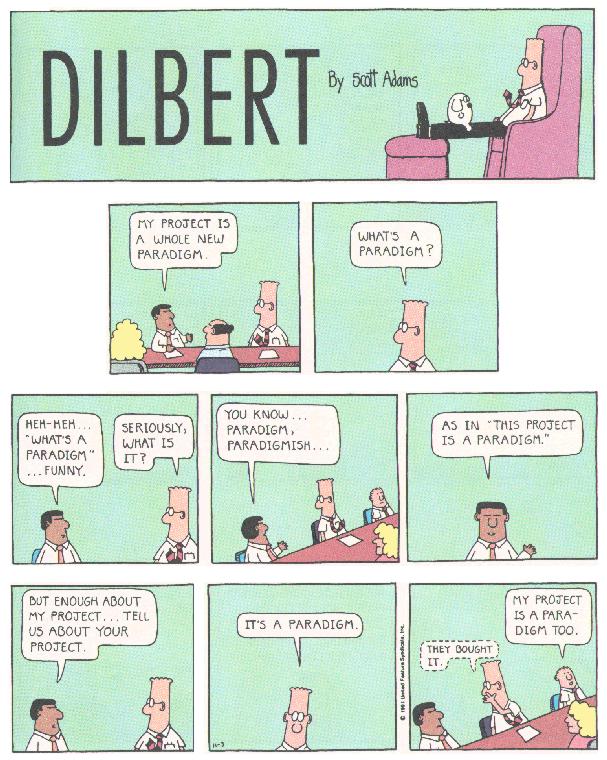
Re:Paradigm Secure Communications?
-
Pretty Low I Would Say ... What Motive Is There?
What's the over/under that this technology will be bought by ford / gm and killed in development?
Probably pretty low probability of that happening since a lot of people are working on it.
It's not just Purdue working on this, nor is it cutting edge. The idea of variable valve actuation has been around for a while as well as HCCI, which has some problems that are yet to be overcome. One of the notable ones that I recall is simple power. As the Wikipedia article notes, in a gasoline engine, you increase the fule/air charge to increase power. In a diesel engine, you just inject more fuel. In an HCCI engine, it's tough because "many of the viable control strategies for HCCI require thermal preheating of the charge which reduces the density and hence the mass of the air/fuel charge in the combustion chamber, reducing power. These factors makes increasing the power in HCCI inherently challenging."
For more info, the Wikipedia page has some great references:- Research, publications at Lund University
- Research at Chalmers University of Technology
- Research at Stanford University
- Research, publications at University of Wisconsin, Madison
- Research at University of California, Berkeley
-
Re:interesting
As a matter of fact, there are several experiments looking for dark matter from the sun. Yes, there could be some dark matter loosely bound to the sun's gravitational potential. I can not give a comprehensive list here but a good example is CAST . There are other dark matter experiments which may be sensitive to a signal from the sun such as CRESST and CDMS.
-
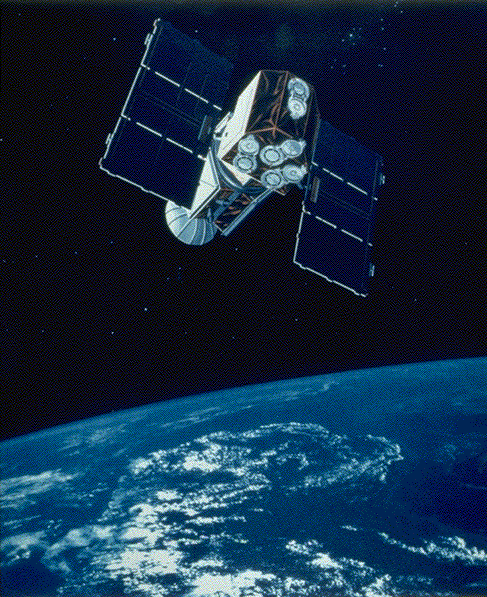
Censorship of satellite photos?
-
Re:Eta Carinae
Pair creation supernovae were predicted decades ago. The conditions for their formation are a bit strict and they do not appear to be very common at this point. Black hole creation is probably must more common.
If you neglect angular momentum (i.e., for only moderately rotating stars), the current predictions are that pair creation supernovae are the normal mechanism for stars with a low metalicity and immediately pre-supernova mass from about 140 to about 260 solar masses. If you look at the webpage in the summary http://astro.berkeley.edu/~soffner/imgsf8.html it shows the metalicity / mass behavior estimates. Also see http://www.ucolick.org/~alex/firststars/, particularly the diagram at the bottom. It shows the no angular momentum low metalicity stellar behavior: 8-25 Solar Masses, you get a neutron star. 25-50ish, you get a neutron star that then reabsorbs enough of the source star's mass via fallback to become a black hole. 50-100, you get a direct collapse to a black hole. From 100 to 130 solar masses, the pair production mechanism kicks in and pulses a few times, ejecting mass, and then it falls below 100 SM from the ejections and should collapse to a black hole on the next pulse. From 130 or 140 up to about 250 or 260 (depends on whose paper/numbers), pair production doesn't pulse, it goes bang, and the explosion generates enough energy to gravitationally unbind the whole star (blow it completely apart, no or little remnant). Above the 250/260 point, they predict that pair production happens but it just direct collapses essentially the whole star to a black hole, not fusions off to explosion as in the slightly smaller ones. -
Re:What is this, another FUD article?!
who's to say deelopers can't create a program what can cure cancer ? a distributed computing project like http://boinc.berkeley.edu/
-
Not the only one
I found this which seems to be the same thing. http://guir.berkeley.edu/projects/tinymotion/
-
Sigh...
Kind of old news. A friend of mine built one of these using the 1.6 ghz
chips and is using it for doing all kinds of things but is currently using
it to run Seti @ Home.
Here's his url:
http://setiathome.berkeley.edu/show_host_detail.ph p?hostid=3131492 -
Re:I/O prioritisation
Actually, that was the Mars Pathfinder. It was running VxWorks, and the effect of the priority inversion was that the stall timer would trip and reset the whole system. The problem was that VxWorks, like QNX, lets you turn off "priority inheritance" on a mutex. This is usually a bad decision, but that was done on the Mars Pathfinder, and created the possibility of a livelock.
So they uploaded a patch to change that mutex to "priority inheritance on", and it worked consistently thereafter.
-
Re:Difficult concept: that more complex != better
I wasn't talking about your other point about lineages, I was responding to your specific point where you said "You seem to be presuming that people are incredibly stupid. Given that it is common knowledge that there are things like bacteria, mice, earthworms and mosquitoes in existence, it should be fairly clear to anyone that nobody is proposing a theory in which bigger brains are an inevitable outcome. (Maybe you can demonstrate that there are people who do believe this.)"
I demonstrated by refering to a popular reference work that the common understanding of evolution is that things evolve into better versions, and so most people assume that biological evolution means that "bigger brains are an inevitable outcome".
I'm surprised that you should be arguing that this understanding of evolution is anything other than common. It's difficult to find good sources amongst all the pro/anti-creationism sites, but the key term to search for references to this as a common misunderstanding is the "Ladder of Progress" which finds amongst others:
- http://evolution.berkeley.edu/evosite/misconceps/I Bladder.shtml
- http://www.talkorigins.org/faqs/evolphil/teleology .html
Interestingly, I read on one site that Darwin refused to use the term evolution because of these implications, preferring "descent with modification" which implied no direction. -
Attribution?!
Kris Pister, an EECS professor in MEMS at Berkeley, coined the term "Smart Dust" and has done a ton of work on it. I remember him mentioning the goals of the project in a class in 1999, and he touched upon all the accomplishments mentioned in the article, most of which were achieved. If you search on "Smart Dust" in Google, his research project site is the first that comes up. So how can their be no mention of Pister, his research, his company "Dust Networks", or Berkeley in the entire article? http://robotics.eecs.berkeley.edu/~pister/SmartDu
s t/ Just wondering. -
Wonder if UC Berkeley has anything to say...
Since this "Smart Dust" concept was introduced in 2001 by UC Berkeley, I'm waiting for them so say something. It has been a pretty popular term over the past years in the Wireless Sensor Network community, but always referred to the Berkeley work. However in the article they do not mention anything. Or maybe the journalist skipped that part?
-
Re:Difficult concept: that more complex != better
I think the trouble comes about when we start to think of evolution as a "force". Evolution is not the driving force behind change; instead, outside forces in the environment (temperature, weather, resources, competitors, etc.) create natural selection, which drives change. Evolution is merely the description of that change.
What kind of force? A bangy force? A pushy force? A growy force? A forcy force force? A magic man dunnit
No-one thinks of evolution as a force, except those that don't understand it. Your final comment is true - evolution is the result of Natural Selection, and that is the real beauty of Darwin's insight. He proposed a machanism to explain diversity beyond the then-prevalent magic man dunnit hypothesis. Others had played with the idea of evolution, but no-one really saw how it could occur. Lamarck was famously wrong on this count, and even Linnaeus got caught up in the magic man. -
Re:Difficult concept: that more complex != better
I think the trouble comes about when we start to think of evolution as a "force". Evolution is not the driving force behind change; instead, outside forces in the environment (temperature, weather, resources, competitors, etc.) create natural selection, which drives change. Evolution is merely the description of that change.
What kind of force? A bangy force? A pushy force? A growy force? A forcy force force? A magic man dunnit
No-one thinks of evolution as a force, except those that don't understand it. Your final comment is true - evolution is the result of Natural Selection, and that is the real beauty of Darwin's insight. He proposed a machanism to explain diversity beyond the then-prevalent magic man dunnit hypothesis. Others had played with the idea of evolution, but no-one really saw how it could occur. Lamarck was famously wrong on this count, and even Linnaeus got caught up in the magic man. -
Re:Any structural engineers around?
or use OpenSEES which is free and open source
http://opensees.berkeley.edu/index.php or http://sokocalo.engr.ucdavis.edu/~jeremic/PDD/ -
Re:AMD.
Everybody is jumping on the DRM bandwagon to some extent. If they don't, the big media companies will shun them, and they'll lose a lot of potential market.
The part that worries me most about DRM is that I don't see any point at which it can stop (the slippery-slope problem). For example---what if we could imprint an experience upon your nervous system via EM fields? That closes the "analog hole"---the content goes straight from the media to the brain. (You can argue that the reverse process could be used to hijack the data stream: in short, a highly-advanced brain scanner (which of course would be illegal to own under some futuristic DMCA).) Another idea: we don't want people to have the potential to infringe on intellectual property, so we design movies to have a hypnotic effect that causes mild amnesia; you can't remember all the parts of the plot, but you remember loving the film. So, you pay to see it again and again...
I'm not trying to troll. I'm just scared, in a I-just-read-1984 kind-of way.
My examples above aren't too far-fetched. We can already beam picturesbeam an image straight into someone's retina, and there was a recent slashdot article about audio transmission through bone. Highly selective amnesia through hypnosis is possible, so there's a real possibility that, in the future, you will love a movie but not quite remember how it goes, so you will have to see it again (and again.. and again... and again...) -
Re:Sure there is
Can you show me any open source project where massive parallelism is being exploited? I'm not sure I can think of any.
BOINC?