Slashdot Mirror
Domain: bikexprt.com
Stories and comments across the archive that link to bikexprt.com.
Comments · 24
-
AMERICANS, READ THIS
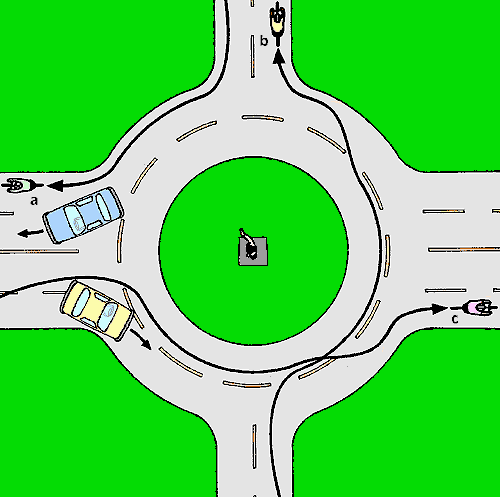
What you think is a roundabout probably isn't.
Notice the difference in shape? The roundabout has a geometry that is designed to point vehicles into the circle. The traffic circle is just a round road with four T-intersections.
Also, roundabouts always have a Yield-on-Entry rule.
http://en.wikipedia.org/wiki/Roundabout#Difference_from_traffic_circles
Now pardon me while I get that damned Yes song out of my head.
-
Re:"Everyone's situation is different"
What you say is not true anywhere that I have ever lived (FL, TX, CA, MA). Except in business districts (in some states), not one of your assertions is true; cars need to provide a few feet (3 or 4, I think it depends on jurisdiction), it is legal for a bike to pass on the right or the left (and between lanes would be lane-splitting, also apparently legal in CA and MA), and in most cases, riding on the sidewalk, though unwise, is legal. I've only ever seen it banned in business districts (which is pretty common).
Source (for most of it): http://www.massbike.org/bikelaw/statelaws.htm
And http://bikexprt.com/massfacil/laws/drivmanl.htm
And also http://www.bikexprt.com/massfacil/laws/passright.htm .
Interestingly, at the time this was written, Uniform Vehicle Code generally allowed bikes to pass on the right at their own risk, where Massachusetts, technically speaking, only allows it if the car is also moving. This is not the sort of thing that keeps me up late at night worrying; Massachusetts has many quaint laws, which are appropriately (un)enforced (read the first of the two bikexprt pages for amusing details). -
Re:"Everyone's situation is different"
What you say is not true anywhere that I have ever lived (FL, TX, CA, MA). Except in business districts (in some states), not one of your assertions is true; cars need to provide a few feet (3 or 4, I think it depends on jurisdiction), it is legal for a bike to pass on the right or the left (and between lanes would be lane-splitting, also apparently legal in CA and MA), and in most cases, riding on the sidewalk, though unwise, is legal. I've only ever seen it banned in business districts (which is pretty common).
Source (for most of it): http://www.massbike.org/bikelaw/statelaws.htm
And http://bikexprt.com/massfacil/laws/drivmanl.htm
And also http://www.bikexprt.com/massfacil/laws/passright.htm .
Interestingly, at the time this was written, Uniform Vehicle Code generally allowed bikes to pass on the right at their own risk, where Massachusetts, technically speaking, only allows it if the car is also moving. This is not the sort of thing that keeps me up late at night worrying; Massachusetts has many quaint laws, which are appropriately (un)enforced (read the first of the two bikexprt pages for amusing details). -
Re:Bicycling is my magic bullet...
Never, never, *never* ride within a car-door's width of a stopped car.
I've heard a few people say--oh, just ride along beside the parked cars, and if you keep an eye through the windows you'll be able to see the problem coming. But the expert advice I've seen (example) tells you to just stay out of the "door zone" completely, and that's what I've always done.
-
Re:I couldn't agree more
a) Um, let's not forget that a good proportion of the 750 annual bicycle deaths are probably due to head or neck injuries that often would be reduced by a bicycle helmet.
b) If costs for brain injuries are much higher than other hospital-worthy injuries (say >$1Million over the life of the cyclist vs. $2000 - it's probably even more dramatic if you count lost productivity) then that could still significantly offset its relatively low probability.
c) People break hips and bones in bathtubs. They don't tend to cause serious brain injuries as much because the speeds of impact/accelerations involved in bathtub falls are relatively low as compared to bicycle accidents. There are a number who die from drowning from falling - or just falling asleep - in a full tub (personally, I take showers in the bathtub so I'm not too worried). That also doesn't mean you shouldn't be careful in the bathtub, just that your risks of lifelong traumatic brain injury with a high cost to society are lower. Bathtub accidents also happen more often to people with poor balance (i.e. sick or older folks, pregnant women) whom you can target for extra precautions.
The argument is that most bone and soft tissue damage heals over time and teaches the injured party to be more careful next time. Brain injuries often have severe, long lasting effects that impact productivity, earning potential, and long term costs to society if extended medical care is required.
Look at it this way, bicycle riding, like driving a car, is an activity that has certain risks with expensive long term consequences. 70% of 300 million people in the US have driver's licences, about 3 times the number of cyclists. Now, certainly there's a lot more motor vehicle fatalities than bicycle fatalities (50 times at 40,000 vs 750) but it's worthwhile mandating $1500 worth of seatbelts and airbag additions to each car to reduce those fatalities and injuries in millions of others. That's >50 times more expensive than the $25 bike helmet you and your kid are expected to wear for a lower expected value return in terms of cost savings to society.
So by your argument, the government shouldn't mandate seatbelts or airbags (or motorcycle helmets) either. You are welcome to that opinion, but I don't think those ideas would get much traction these days among educated people either, thank goodness. Fortunately, those making those decisions don't share your opinion.
See more here -
Re:Oh my god
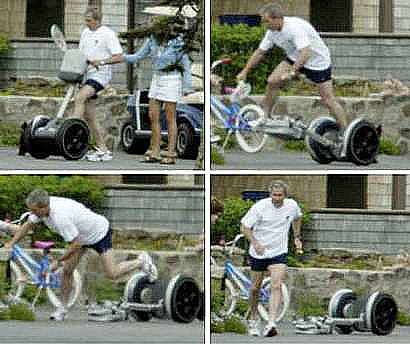
If this suit gets a short while somebody is in mid-lift I hope it makes it on YouTube.
I'll give you a hint of what it would look like:
http://www.bikexprt.com/witness/product/bushfalls. htm -
Please, MOD PARENT UP
The League of American Bicyclists have put together excellent courses on the safest way to cycle based upon research done by people like Forester and John Allen.
Reading the original post I wonder if it is a deliberate troll. My reasons for that suspicion are that the poster says that the lane was narrow. Now, according to the drivers handbooks of most states and a considerable body of case law it is not recommended to pass another road user with less than 4 feet of clearance. I would suspect that the cyclist knew that this was not possible and did not want to take the chance of a judgement-impaired driver trying to "squeeze past". I find it hard to believe that the OP would not be aware of that. Sit back dude, and relax, you won't get anywhere faster (except prison) by rushing around.
-
Biking
Bike lanes are often way more dangerous than riding in the street. Read:
http://www.bikexprt.com/massfacil/cambridge/doorzo ne/laird1.htm
Here in California the law recognizes that lots of bike lanes are substandard and can be legally ignored:
http://www.dmv.ca.gov/pubs/vctop/d11/vc21208.htm
As for your feelings about erratic sidewalk cycling, I'm with you. Bicycles belong out in the traffic lane. -
Re:At speed should be able to steer by leaning, to> It's hard to get a bike going fast enough to do this.
No it isn't. It's basically the way to turn sharply at any sort of decent speed. Nor is it necessarily a gyroscopic effect. See Bicycling Street Smarts.
-
Re:Sure we've all seen the Segway, but have you se
Its a pretty dangerous machine, I'm not sure how you consider it so simple. See for example, http://www.bikexprt.com/witness/product/images/bu
s hfalls.jpg -
Re:Bike helmetsActually, I'm one to advocate bike helmets for the same reason I advocate seat belts. There's often some fairly high speeds involved and there's a lot of concrete around these days for kids to ram their heads into.
Helmets are great; I'm a convert (especially since I like my helmet-mount mirror). But proper riding techniques are better. The helmet's the last line of defense in safety and sadly over-emphasized. With kids, who are more likely to fall and still developing both motor skills and interaction with other traffic, they're most important.
To get back on topic, depending on temperment of the kid and financial situation, a bike can be a great gift.
-
Re:just in case...
Someone actually studied the pictures and published a quasi-analysis of the scenario. The "Mystery Object" in the pictures is actually Bush's Scottish Terrier Barney. Remember when he dropped Barney?
-
Another 'Just In Case' Reason
-
Re:Oh well...It's true... How many Segways have you seen going down the street (not in some publicity stunt). I have seen exactly ONE. And to be honest, a grown man looks odd on these, much like when they ride any other type of scooter.
They'd be great for kids, but how many parents are going to get their kids $5,000 toys, especially ones that crash as much as these.
These things get much more press than they deserve. I think it comes from guilty media trying to live up to buying into the "It" hype. Remember in 1999 months of hype. " 'It' is going to change how cities are built," I recall. It's just a scooter.
-
Re:Big cultural differences between us and the Jap
Or maybe it'll be impossible to tip over like a Segway.
I take it you haven't seen our illustrious president trying to ride one?
Kamen just wishes it was crash-proof.
Any two wheeled vehicle (inline or side by side) can be made to crash.
Run it into a pothole at 12mph as see how fast you're picking gravel out of your teeth. -
Re:What's so wrong with what we HAVE?Now, cycling has the same problem as Segways, to some degree; cycles are too slow for the road and too fast for the sidewalks. I usually end up on sidewalks because there are no bike lanes in my commute (or really anywhere in my city) and it's far too dangerous on the road.
Disagree with both statements
And, except in certain circumstances, the road is safer than the sidewalk by a good margin. Most cycle/car collisions occur at crossings, intersections, driveways, etc., where the sidewalk is far more dangerous. Read Bicycling Street Smarts to learn how to ride safely and legally.
-
Here's what I do...
It's all about a combination of things. As LOTS of people have said, cut out soda. My main replacement is iced tea (technically sun tea). Cheaper (box of twenty teabags is three or four bucks; use about four or five bags per quart of tea). Every day or two I throw a jar on the porch to brew. Zero calories, plenty of anti-oxidants. You might be able to get away with keeping a jar in the fridge at work (if not, well, just use it at home).
I bought a weight machine. This isn't really for building mass or for losing weight, it's for curbing the incessant pain in my back. $200 machine; takes me fifteen or twenty minutes a day to do thirty or forty reps of five exercises (lat pulldown, ab crunch, back extension, butterfly, and the good ol' bench, for the curious).
And, bike to work if you can. If you can't (and by "can't" I mean over five miles--ten's really doable, too), try to bike for short trips. You've got to go a mile to get a gallon of milk; just ride. Save on car wear and tear and serious emissions, too. Massbike has lots of good info on riding in city traffic that's by no means Boston-specific; see also John Allen's page. For short trips, especially in urban or semi-urban areas, it's no slower than a car and may be faster. -
Re:When terrorists hack
-
Re:Bezos isn't the only one
Have a gander at John Allen's analysis of the fall. Somewhat tongue-in-cheek of course.
-
Re:People's Republic of Boulder
I'd seriously consider riding a bike on an everyday basis if I didn't have to worry about being run over by a car. AND, for most trips, riding a bike would actually be faster!
Yup. And the risk of getting run over by a car, while not zero (everything has *some* risk), is greatly exaggerated. A couple good sites for tips on riding in traffic:
It's scary the first few times you do it (so was learning to, say, merge onto a freeway in a car, if you remember learning that), but once you learn to do it it really works very well.
--Bruce Fields
-
Re:Problem: car-free is very expensive
The biggest problem with non-car methods of transportation is that it is very expensive to build.
No, it's cheap as all get-out. You replace those $20,000 cars by $400 bikes and use all the same road infrastructure. The roads still cost money, but at least they hold up a little better without the cars pounding on it, and less pavement is required to support the same throughput of bike traffic as for car traffic. Plus you can stop spending so much money on parking structures in high-rent downtown areas.
This doesn't solve the problem of inter-city transportation, or deliveries, etc.--motor vehicles still make sense for some things--but most car trips involve just a single car driver going a couple of miles--which you can easily do just as quickly (if not more so) on a bike.
If you want the cheapest, most efficient transportation system money can buy, work on achieving a more balanced mixture of cars, bikes, and peds. Yeah, that means that if you're a car driver you'll occasionally lose a few seconds waiting to pass a slower bike. And if you're a bike rider you'll have to learn to share your space safely with the big stinking automobiles (come on, it's not as hard as you think). Learn to love it. It's the best. And you can do it right now, without waiting for some sort of tremendous revolution in the infrastructure.
--Bruce Fields
-
Re:I hope they banned bikes on their sidewalks too
I will ride on the footpath in the city, especially on a Friday or Saturday night, when there are a lot of stupid drivers around. I have been hit by eight cars in my life, starting to get a bit sick of it.
Ouch, yes, I can believe it. But has riding on the footpath prevented you from having accidents with cars? It certainly doesn't sound like it.
The conventional wisdom among cyclists is that riding on sidewlkas increases your chance of having a collision with cars, because you put yourself in places where they just don't expect to see you: even the most contentious drivers usually don't scan sidewalks or crosswalks for bicycle-speed traffic before crossing them. And in fact there are studies which confirm that sidewalk cyclists in general have significantly more bike-car crashes than cyclists who ride in the road.
Even if you're skeptical, I'd highly recommend checking out bicycling street smarts or a local bike safety course if there's one available. I know many people (myself included) who've ridden as vehicles for years without incident, so you can certainly afford to try it for a month or two. And after you do, I suspect you won't want to go back. Nevermind the safety advantages, it's just much faster and more convenient.
--Bruce F.
-
Re:I hope they banned bikes on their sidewalks too
When I ride my bike in a downtown area where there are lots of cars parked on the side of the street, I get on the sidewalk and ride slowly. The reason is that I can't rely on the drivers watching before they slam open a car door. Technically I'm not supposed to do it but I've had conversations with cops about it and they mostly agree that I'm better off on the sidewalk as long as I'm going slow. Same will probably be true for segway.
You're completely right about the car doors--that's a big risk. There's another way to avoid the accident, though: just stay in the street, and move further away from the cars. This'll put you in the regular car lane, but that's OK. If you're on a street with only one lane and you're holding up people behind you (this'll happen less often than you think), then pull over every now and then and let them by. But don't let them intimidate you out of using the street completely.
If you ride on the sidewalk and ride at walking speed (which is really slow), then you're probably reasonably safe, but there's a lot of unpredictability on the sidewalk--cars pulling in and out of driveways, pedestrians entering and exiting buildings--and none of them are looking out for you, because they don't think they're going to meet anyone with nonzero stopping distance on a sidewalk.
For excellent coverage of these issues, John S. Allen's excellent manual Bicycling Street Smarts is available in its entirety online, or you can order it in print for very cheap. Highly recommended.
--J. Bruce Fields
-
Re:exercise??
A bicycle is a vehicle. As such, it is entitled and subject to the same rules of the road as any other vehicle. Specifically, you are entitled to an entire lane of traffic. Don't let a car try and convince you otherwise.
You are correct about that...but would you bet your life on getting some random asshole to believe you?
I'd rather bet on the random asshole not running into someone directly in front of him than I would bet on him not breezing by me on my left and then immediately right-hooking me at the next driveway. The latter accident is more common and hugging the curb puts you at more of a risk for it.
Correct bicycle lane-positioning requires more than a slashdot post to do it justice, though; see John Allen's Bicycling Street Smarts (read it online or order it for cheap) for a good concise summary of the standard advice on this subject.
--Bruce Fields