Slashdot Mirror
Domain: blogspot.com
Stories and comments across the archive that link to blogspot.com.
Comments · 20,258
-
Re:Next on the list...
I think that's a good idea (the "bookmarked UI" for GIMP); GIMP in particular has an easy way to suggest such things, and I suggest submitting that to the visual brainstorm page here:
http://gimp-brainstorm.blogspot.com/
I wish all free software projects (or heck, all software in general) had such a page -- it's a really good way for people as non-technical as I am to suggest changes in a way that's easier to grasp than a detailed text description.
Cheers,
timothy
-
Re:Android
You're kiding right ? There are several readers out there including for jailbroken phones and open source. Then there's a couple of options to self publish through some vendors or as an independant straight through Apple.
Sure there are times when making app might provide some added value but to call it the easiest way is simply not true.
-
hema
-
Re:The details are clear
The article says Google has been "less than clear", but that just for people who don't understand the technology. Exactly what data Google collects, and how they use it, is obvious for anybody who understands the technology. A good explanation of that technology is here: http://erratasec.blogspot.com/2010/05/technical-details-of-street-view-wifi.html
This is just another example of people being scared of "witchcraft". In this case, so many people (even Slashdot readers) don't understand WiFi technology, so the witchhunt is more persistent.
The real issue here is not that the data is easy to collect, or that collecting it is part of how the technology works. This is really a matter of data retention.
Clearly they retain this data long enough to later perform analysis on it. To say "it's public information that you are broadcasting" misses the point and wastes time affirming a fact that is not in question (which is in fact is a clear sign that the point has been missed).
It's the difference between me someone down a public street and happening to see that you entered a particular store that you frequent, versus someone holding a pen and a notepad so you can see that he recorded your location with timestamps. The first event is not noteworthy in any way. The second event might make you question whether his intentions are in your interests. To be fair, it is rather hard to come up with scenarios where you would benefit from someone who does not personally know you but feels a need to record your comings and goings. Again it's the recording and retention that is the problem; no claim is being made that there is anything wrong with being observed in a public place by someone who is also in a public place.
By recording physical data over time concerning a person's whereabouts, especially with a device they tend to carry around and use frequently (like a Wi-Fi-enabled phone, netbook, or laptop), you can learn quite a bit about someone. If there is a Gmail account used or a browser cookie transferred over that Wi-Fi signal, Google can cross-reference their physical whereabouts with all the other information they've gathered. This could include things like their real name and identity especially if they have used Google Checkout or Google Product Search, their browsing history as provided by tracking tools, their e-mail data if they use Gmail, their search history, the news items that interest them, etc.
Combining all the other data Google gathers with recent or current data on physical location amounts to a powerful collection. The abuse potential is great. That abuse may not even have to come from Google itself as an intentional act. A database like that for many thousands of people is a tempting target for spammers and criminals, for the same reasons they sometimes manage to steal credit card numbers and Social Security numbers. Can you name a government that wouldn't like easy access to that kind of surveillance information, perhaps in the name of fighting terrorism, or did you think their ambitions stopped with projects like Carnivore, warrantless wiretaps, and mandatory access to telecommunications infrastructure?
The disclosures about "we gather data on Wi-Fi signals" or "we record search terms and IP addresses" don't even begin to address the power of cross-referencing multiple databases. Therefore it's not really full disclosure at all. The average person doesn't remotely understand what can be learned about them from multiple sets of data and this reductionist approach to disclosure isn't helping. Each data set seems like a minor thing and a fair price to pay for using a free service. It's the whole picture from the combination of all of those data sets, something easily achievable with modern databases, that poses the real privacy issue. None of the privacy policies and press releases have anything to say about -
The details are clear
The article says Google has been "less than clear", but that just for people who don't understand the technology. Exactly what data Google collects, and how they use it, is obvious for anybody who understands the technology. A good explanation of that technology is here:
http://erratasec.blogspot.com/2010/05/technical-details-of-street-view-wifi.htmlThis is just another example of people being scared of "witchcraft". In this case, so many people (even Slashdot readers) don't understand WiFi technology, so the witchhunt is more persistent.
-
This Was More Fun
Dirty Stacey Needs Registry Cleaner 5.4
http://maximumhoyt.blogspot.com/2010/04/dirty-stacey-needs-registry-cleaner-54.html
-
iOS Development
Many people on this thread have a very skewed picture of iOS development. I have released three fairly large iOS projects (i.e. months to years of development rather than a few days or weeks like so many toy apps). The first was a smashing success and our 3-person development company was acquired for it. The acquiring company is now my employer so I won't name specifics in this case. The second was an independent iPhone app I wrote that was a total flop. The third is my new independent iPad project called Stash that's doing pretty well so far: http://stash.hedonicsoftware.com/
Just the existence of Stash on the App Store - basically an app for porn, though it doesn't provide the explicit content - is evidence that Apple isn't nearly as draconian and capricious as many in this thread are portraying them to be. If you create a high-quality app (or hell, even a low-quality one so long as it doesn't crash) that follows their general guidelines and doesn't try to take over basic functions of the iPhone, you won't generally have a problem. Sure, there are famous counter-examples, and I really feel for those developers. I can't imagine a more frustrating experience then pouring your time into something that's rejected outright. But it doesn't change the fact that these are the few exceptions in a vast sea of approvals or justified rejections (based on the three points that Jobs outlined). Moreover, in my experience Apple is getting much better about working with developers to get apps their approved. It's still a slow process - the last release of Stash was delayed without feedback for over 2 weeks, which felt interminable - but they eventually call and tell you about any solvable issues and give you a chance to correct them.
I'd also like to point out that outside the pain of dealing with the review process, iOS development is a lot of fun. Someone on this thread said no one is in the App Store simply for the love of programming, but I strongly disagree. Apple provides some really nice APIs, and it's relatively easy to create something that looks and feels smooth and professional. I'm currently working on an Android project for my employer, and it's a real chore compared to iOS dev. I don't care how "open" the market is or even how powerful the SDK is if I hate coding for it and need a graphic design team to make it look decent. People forget that Apple/NeXT has been in the GUI framework business for a long time. They know what they're doing. They also seem to be good at letting their internal APIs fully bake before including them in the SDK, which results in a much higher signal-to-noise ratio than in Android, where everything feels over-engineered. I recently read an article by another iOS developer that sums up my feelings pretty much exactly: http://iphonedevelopment.blogspot.com/2010/03/android-sdk-from-iphone-developer.html
That's my 2 cents. YMMV. But if you're interested in mobile development at all, you owe it to yourself to give iOS development a shot.
-
Re:Treason is lying to the american public about W
Because the Democratic half of the single party that runs the country ALSO lied, does not relive the Republican half of that same party from their lies.
And best evidence? Are you as stupid as our government thinks you are?
Well cited summary: http://www.georgewashington2.blogspot.com/2009/11/everyone-knew-that-iraq-didnt-have-wmds.html -
Re:face for radio
Mod parent up. Case in point.
-
Unlimited mobile data
Given the large amount of bandwidth available to share in Finland, this sounds like an unlimited data plan for cell phones with wifi capability. Sounds like a smart way to go. I suppose I shouldn't be surprised.
-
BTRFS = somewhat suitable for this
I tried figuring out how to do something like this a couple months ago: got something going with BTRFS. http://unquietwiki.blogspot.com/2010/03/quick-local-backup-with-rsync-btrfs.html
-
Re:Not IIS (directly) ... could it happen to anybo
Thanks for that. But it seems my rant was pointless and irrelevant. Turns out this is, in fact, just another MS SQL injection exploit after all.
http://nsmjunkie.blogspot.com/2010/06/anatomy-of-latest-mass-iisasp-infection.html
The analysis is very good and even I could follow it -- and believe me, I'm not all that good at following things like that. And discussion also spells out why this wouldn't likely happen in a LAMP scenario -- no multiple query commands by default. It would seem to me that Microsoft could put out a patch that does the same thing, but they would break the code of nearly every site using their technology in the process. Once again, they created the culture that created the mess and now they are in no position to set the cultural problem straight.
And as humorously pointed out here:
The idea of cleansing and verifying input before sending it out into a database would seem like a simple and fundamental thing to do. Where I grew up, input was always validated. I used to write input functions that were designed to input only that which the program expected. For example, numbers... only numeric characters were allowed... words... only text allowed... phone numbers, only specific lengths and formats were framed. To me, it was both normal and a hallmark of a really good, slick and solid program. Seems to me, that particular fundamental was forgotten and brushed aside as "old fashioned" and yet here we are with unvalidated input being used to corrupt other data and such. Is it HARD to write a routine to cleanse data? No. Pretty simple in my view -- no complex math, usually a simple loop structure at most, a table lookup or some sort of prohibited characters scanning. "Oh, but it would just slow the program down!" So?! What's worse? Slow or INFECTED?
Okay, so maybe my rant wasn't so irrelevant after all. It's still about sloppy programming and the culture created by Microsoft.
I still can't get over how lessons in data validation have escaped people who write code for a profession?! To me a professional is supposed to be an expert in the field who has a firm grasp in fundamental concepts. Didn't everyone's second program after "hello world" go like this?
What's your name? *CurseWord*
Hello, *CurseWord*! How are you today?To me, that was the key lesson in input validation. Why? As you can see, I can submit a curse word instead of my name in there and have the program return a curse word instead of proper input. How embarrassing that I could write code to enable this type of behavior?! Lesson learned! I guess the people with SQL injection troubles haven't learned that basic lesson now have they?
-
Re:Gained respect for NYT
Es ist us, ze Germans!
It’s unsere WUNDABAR revenge, for die Deppenleerzeichen!
Zey spread like wir did back zen! Now we are kämpfen back like you did!
VERBOTEN!
JAHAHA! -
Re:I suspect....Technically, you are correct. But in this incident, the web server being used IS relevant.
1. The payload is IIS/MSSQL specific. The author WANTS that platform.
2. The method of injection normally doesn't work on mySQL. jameswilkes over at http://nsmjunkie.blogspot.com/2010/06/anatomy-of-latest-mass-iisasp-infection.html stated it quite well:"Also, the SQL contains multiple SQL statements. I use PHP and MySQL databases which by default will only execute one command. That makes it much harder to hack. So switching to PHP and MySQL might be a good security choice."
-
Re:Poor Adobe...
Disagree. Adobe's work in porting Flash to Linux has made the Linux browsing experience as similar to the Windows one as we would ever wish it to be. Adobe has made Linux more usable, because most websites now "just work" on Linux, even when they rely on Flash.
Linux users such as myself (13+ years of desktop use) cannot expect the rest of the world to give up Flash just because it's a non-free application. Someday, HTML5 and Javascript may be so much better than Flash that the switchover occurs naturally, like the transition from IE to Firefox. Until then, there will be lots of Flash, and we cannot get around that by evangelising about how nobody should use Flash because although it's free, it isn't Free. Most people do not care about this ideological distinction. They just want things to work. If Youtube and Facebook games don't work, then they assume Linux is at fault.
And you know, sometimes it is a problem with Linux. The very worst thing we can be doing is making technical decisions that deliberately make life difficult for Adobe (and other commercial software vendors). Like the decision not to make a 32-bit web browser the default in 64-bit Linux distributions, when 32-bit browsers are always the default on Windows and Mac, the 32-bit compatibility libraries are useful for other things too, and there's no reason why a browser needs to be 64-bit anyway. Or things like this:
The issue between Flash, Alsa and Pulse is a known one that seems to be mostly located in Flash, and hence is rather difficult for anyone except Adobe to resolve
Reading stuff like this is just amazing. Reminds me of the old saying attributed to Microsoft, "DOS ain't done till Lotus won't run". If a software vendor isn't doing things your way, then break the APIs until the vendor complies or (more likely) just gives up in disgust.
-
Re:In Other news, China...
They have already tested theirs multiple times. It is amazing what you can accomplish in a one-side cold war, when the other side is working hard to avoid one, thinking that they can change things. The advantage to the one side is that they can steal tech at will, and build up loads of weapons.
-
Re:I applaud this hacker group
Yeah, typical. AT&T are the victims of brutal cyberweapons.
-
Re:Windows, vs. LINUX, vs. MacOS X (security vulnsIf the source is available it is for the good and the bad guys. It the source isnt available and is protected by licenses, patents and so on, debugging, analyzing, reverse engineering,getting in black market portions and so on is not available for the good guys... but still is for the bad ones.
That could make the problem far worse... could be a lot of exploits to vulnerabilities that could not be announced nor reported as doing so would put in legal troubles.
And the desktop is a big trouble. I think it was desktop what was used in Google intrusion, same for this bank intrusion. The biggest vulnerabilty of any system is the people that works on it.
-
No suprise
Of course they are the weak link in loss in the financial aspects of the "Cyber war", but that isn't the only aspect of the "Cyber War". There are many factors, from how secure the system is (read my blog post on how secure Microsoft really is), to what the settings of the machine are, to other issues, such as how many people use bittorrent softwares that enforce verification requirements. But yes, they have alot to lose, because 1. they're microsoft and 2. they cost money to get their software. Don't take it as a surprise. Linux is probibillly just as vulnerable. Its just that people haven't been able to find those vulnerabilities. But mark my words, they are there.
-
Re:Color me skeptical.
Do you have an actual example?
Here's some cut-n-paste action and some additional reading.
Join removal -- this is a feature that will remove joins from the execution plans where they are not needed. For example where you have a left join that doesn't appear in a where or as a column in select. This is important for people like us that rely on views to allow less skilled users to be able to write meaningful queries without knowing too much about joins or creating ad-hoc query tools that allow users to pick from multiple tables
And it continues with:
When people talk to me about the (limited implementation of) join removal that will be part of PostgreSQL 9.0, the conversation usually goes in two ways. Some people ask how the feature works and then say something like "oh, I guess that could be useful every once in a while". Other people already know exactly how the feature works and usually say some variant of "this is an amazingly wonderful feature that I am looking forward to with great enthusiasm".
The difference between these two groups of people (I think) is not so much their level of technical knowledge or how closely they've been following pgsql-hackers, but their use case. If your database is primarily a data warehouse, my guess is that you won't have many occasions to benefit from join removal. Where this feature really comes in handy is in OLTP workloads with highly normalized data, in situations where users are generating queries against views (perhaps through some sort of reporting interface) and expecting to get results back immediately.
Let's take an example...
You can read more about Why Join Removal is Cool as well as lots more general information on the new PostgreSQL features at Planet PostgreSQL.
-
Link to blog post
Since neither the summary nor the story link to the actual source:
Mobile advertising and the iPhoneAlso:
the head of Google's mobile ad service, Admob,
Really? Google acquired AdMob only a little over two weeks ago.
-
Re:Altavista
Google would argue that the fade in speeds up user interaction in the vast majority of cases by not distracting users from the search box. Actually, they did argue that. And their justification did not come from a marketing VP like you imagine but from benchmarking real users. It's as if they consider actual results a better metric than childish rants posted on a forum somewhere.
-
Re:Well
On a related note, Aaron Seigo had an interesting post on his blog (http://aseigo.blogspot.com/2010/05/i-dont-need-no-stinking-nepomuk-right.html) where he struggled (mostly in vain) to explain to people why akonadi and nepomuk were needed or even useful. A lot of comments were similar to yours... basically, just give us a stable KDE desktop to run apps and stop messing around with whizzbang buggy features and eye-candy.
-
Re:Join removal is cool
Robert Haas comments on this in one of the blog posts linked in the article:
In some cases you can prove that the inner join can't affect the row count - foreign keys are an essential part of deducing this.
-
Re:Pfff...
I didn't realize that the circle with the Windows logo in upper left was a menu for almost a month.
It's Office logo, by the way, not Windows one - the latter you see on Start button in Vista.
But it's a very real UI discoverability problem. Which is why in Office 2010, this button was 1) labeled "File" rather than a logo, and 2) moved down from titlebar area, so now it's the leftmost button in the horizontal list of Ribbon tabs. Here is how this looks now.
-
Re:Join removal is coolActually, here are the entire conditions for join removal (from Robert Hass's blog):
(1) it's a left join, (2) there is a unique index on all or a subset of the join columns, and (3) none of the attributes from the nullable side of the join are used elsewhere in the query
-
Re:Civil war?
It might be a professional organization, but it's still an organization made up of nerds.
Funnily enough, this isn't the first time this happened. The first nerd war was when the X3 committee was trying to standardize on 7-bit ASCII. They chose a number of characters over a tortuous process involving about a dozen countries, managed to get agreement, and promptly found that the IBM Computer Group (also known as SHARE) were going to boycott the standard. This forced the X.3.2 working group to do a humiliating backdown and make changes which included, amongst other things, putting a break in the "|" character.
Sadly, I know this because I was trying to understand Unicode, got a little bit too interested and wrote a blog article on the precursors of that standard. Which I guess makes me a bigger nerd than anyone. But I swear I haven't fought anyone yet!
-
There Is A Second Leak In The Gulf Of Mexico
Skytruth is a great organization that has been buying Satellite time to survey the area. Turns out that while surveying the oil spill from DWH they found another leak in the Gulf of Mexico. The story was confirmed this morning. Makes you wonder how many leaks have occurred that have been "small enough" that they are simply forgotten about for years.
-
JackOfKent looks at this from a lawyer perspective
Most of what you think you know about this case is wrong. Forget about UFOs.
Also, what Gary did is trivial, barely even worth the term "hacking" (summary: he used an off-the-shelf product called RemotelyAnywhere to access completely open internet-connected Windows desktops that had the default password set).
If you want to go back to the source legal materials, this set of articles is particularly interesting:
There is a final part coming too.
-
JackOfKent looks at this from a lawyer perspective
Most of what you think you know about this case is wrong. Forget about UFOs.
Also, what Gary did is trivial, barely even worth the term "hacking" (summary: he used an off-the-shelf product called RemotelyAnywhere to access completely open internet-connected Windows desktops that had the default password set).
If you want to go back to the source legal materials, this set of articles is particularly interesting:
There is a final part coming too.
-
JackOfKent looks at this from a lawyer perspective
Most of what you think you know about this case is wrong. Forget about UFOs.
Also, what Gary did is trivial, barely even worth the term "hacking" (summary: he used an off-the-shelf product called RemotelyAnywhere to access completely open internet-connected Windows desktops that had the default password set).
If you want to go back to the source legal materials, this set of articles is particularly interesting:
There is a final part coming too.
-
More RIAA news...
RIAA Sues Pet-Owners for $250 Trillion
RIAA Sues Earth for $3.3 Quintillion
http://postpicayune.blogspot.com/2010/06/this-week-in-news.html
-
Re:Remember their motto...
Obsidian's games tend to be flawed, but that's still a bit unfair.
Speaking only of the official campaign, BioWare's NWN is not even comparable to what Obsidian did with NWN2 (the only real appeal of the first game was the multiplayer.)
The problem with your analysis here is that NWN's was something very much more than the official campaign -- from the get go it was designed to be a tool for people to make their own adventures and play together. The OC was only supposed to be little more than a demo of what might be done. When Bioware lost the Baldur's Gate franchise through the legal battles with Interplay (parent of Black Isle who's remnants are now Obsidian) they had to scramble to try to turn it into something also that served the player looking for more "Baldur's Gate type of play". In short, Bioware lost their showcase RPG story telling product and then needed to shoe horn that feature into the NWN's package. So, simply comparing official campaigns isn't exactly fair in terms of a complete analysis of the two products -- one was an afterthought born of necessity and the other (NWN2's) was designed from the get go to be the main product on offer. Also, I take issue with the only real appeal of NWN1 being multiplayer -- the toolset (building) and custom content were huge aspects of the game with many 10's of thousands of downloads of user created modules designed for single player use only.
Obsidian took a deliberate design decision to focus on the campaign and as a result they made some dubious technical decisions with regard to the entire package. Multiplayer, the toolset and custom content all took a back seat to the OC, so it's not surprising that it surpassed Bioware's OC which was, effectively, an afterthought. The longevity and heart of the original game, however, was down to the entire package (and ongoing support from Bioware) -- and this is where NWN2 fell down. NWN1 corrected it's deficiencies with its OC's in the subsequent expansions, but Obsidian couldn't effectively fix what it had broken in a timely and coherent manner which led to the game fading out and not enduring as the original has done.
It's certainly not entirely Obsidian's fault -- I'm sure dealing with near broke Atari as publisher didn't make things easy on them in the least. I'm sure they were pressured to release before ready, etc. etc. They gave it a valiant effort given what looked to be an extremely limited (possibly nonexistent?) after ship support budget. They also tried to keep the community engaged, appointed a community manager, had a technical blog by one of the programmers for the building community http://oeiprogrammer.blogspot.com/ and generally tried to make all the right noises. In the end, having a good OC was just not enough to have the same kind of enduring legacy that NWN1's enjoys, however -- the whole package is needed for that and they didn't deliver it. -
Re:FINALLY! A solution to my pain...
Are you the butterfly ballot election guy from Florida's recount? http://3.bp.blogspot.com/_sHB-X1i5MOU/SKIH1_P7gCI/AAAAAAAAAWY/b7t-bPpashA/s400/florida_hanging_chad_recount.jpg And you thought you faded into obscurity.
-
Also: venture investors of eBay, Twitter, Skype
In 2005, venture capital investors who had backed (among others) eBay and Skype - and meanwhile also Twitter - supported my last-minute lobbying effort in the European Parliament against the EU software patent directive. The related press release mentioning Benchmark Capital (eBay, and more recently Twitter) and Danny Rimer of Index Ventures (Skype) is still online on the MySQL website although Oracle and Sun certainly do favor software patents. Guess they forgot to delete it. Other references to MySQL's position on software patents disappeared after Sun bought the company in 2008.
Those venture investors had previously supported an open letter to EU decision-makers warning against the possible consequences of an adoption of the proposed bill (which ultmately got thrown out, fortunately).
However, I also got turned down by many venture investors whom I asked to support such initiatives against software patents. I don't think the resistance movement is strong enough in economic and political terms to achieve the abolition of software patents anytime soon. I regret to say so but the hurdle is high and politicians won't be convinced if it's basically just the Free and Open Source Software movement that takes political action against software patents. A few venture capitalists won't tilt the scales either. There would have to be broadbased support. In Europe, the leading venture capital organization (EVCA) actually lobbied for the legislative proposal we fought against. I guess the major American venture capital associations would take similar positions.
In the near to mid term, I believe the Defensive Patent License (DPL) could have a very positive effect.
-
How to turn off the tap
http://kiloseven.blogspot.com/2010/06/open-letter-to-keith-olbermann-on-being.html explains succinctly, with references, how to shut down the leak.
-
Re:Explanation:
Or maybe the bird fell over.
-
Re:This is simpky made up news
Which part? It is the best selling newspaper in the UK, and has a strong effect on public opinion. I think that qualifies it as a "major" (I'll grant that some people may object to the term "news"-paper here but I don't think that was your point).
As for veracity, here's a website abut the sun's dishonesty. -
Re:Debate?
Is that so ?
There may be something I don't understand by the driver is facing the forward direction, right ? picture -
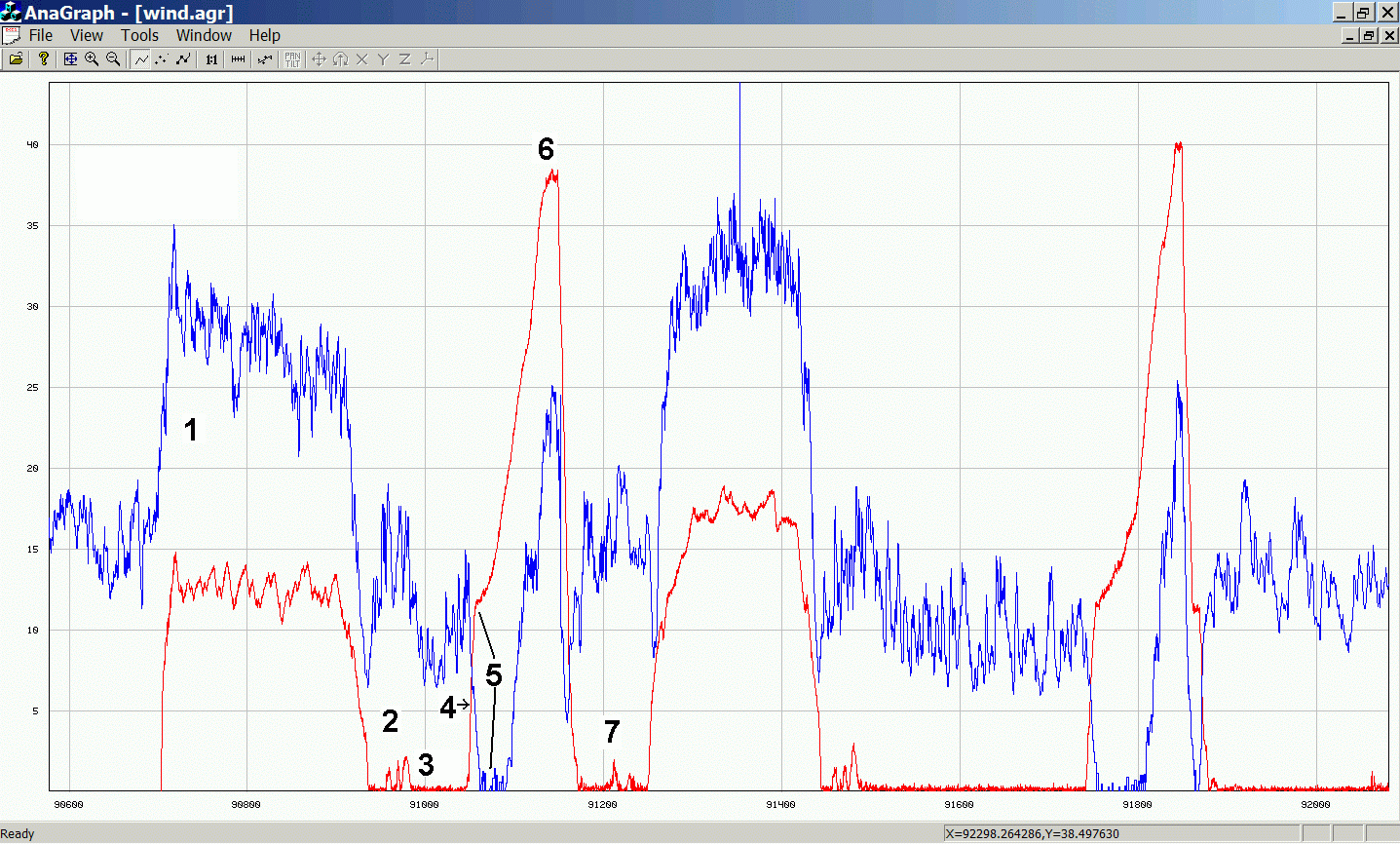
Summary, article wrong: only 1.85 times fasterIf the wind was moving at 13.5 MPH during the test run for which there is a graph (point 6, red line), the vehicle was only moving 1.85 times faster than the wind (38 MPH), not 52 MPH as suggested by the summary and article. If the article wanted to use the largest-seeming number, it should have stated "The vehicle moves at 2.85 times the speed of the wind." This is correct; 2.85 * 13.5 = ~38, which matches the value on the graph.
If you think I'm wrong, just consider the example from the article (and I've got plenty more to back up my case, not just this): if 38 is 2.85 times greater than 13.5, what number is two times greater? 27, you say? OK, what number is one time greater? Oh, only 13.5? I thought we said it was greater? OK, what number is ZERO times greater? Surely it can't be zero, since we're just saying it's no greater, not that it's lesser. Basically, "X is N times greater than Y" means "X = N*Y + Y" (the plus is what greatER means). The article thinks it means "X = N*Y". What really does mean that is "X is N times Y".
-
you mean your propaganda?
But the banks are able to borrow money from the Federal Reserve, itself an extension of the government, and must endure heavy regulation from the government. There's no way to separate that intusive meddling from the decisions made by banks, because there's no way to hypothetically determine what decisions the banks would have made were there no regulation. So your argument against lack of government regulation cannot be true --- it has never been tried and cannot be implicated by this crisis.
Check out this posting on the Recourse Rule, which was an international regulation set up by the Federal Reserve and international banking circles that gave a financial incentive to banks to hold tripe-A rated mortgage backed securities.
The ratings agencies didn't do a very good job of rating MBS's. The Recourse Rule encouraged banks to hold those faulty assets by allowing banks that held those particular assets to have more leverage (to lend more). This meant that those banks that held those securities would be disproportionately profitable until confidence in their balance sheets were shaken by the loss of confidence in MBS's.
By encouraging banks to hold MBS's, the government, through the Federal Reserve, precipitated the crisis. It was like a virus that infected the US financial system and funneled capital to mortgage brokers like Countrywide to make bad mortgages. But they couldn't have made those mortgages if they didn't have the capital --- and this rule provided banks with incentive to provide them that capital.
-
Re:don't be such an idiot
the law is your data is protected on any network - from been kept by a 3rd party.
A question might be asked about who did the code review and then signed off that it was ok.
"given that the data protection agency is now getting this data" after Google stonewalled.
Google was clear on "German privacy law" as noted
http://googlepolicyeurope.blogspot.com/2010/04/data-collected-by-google-cars.html
Is it, as the German DPA states, illegal to collect WiFi network information?
"We do not believe it is illegal--this is all publicly broadcast information which is accessible to anyone with a WiFi-enabled device. "
Fine if its just mapping, not so good if your collecting data packets too. As for a search through data, I am sure a BND like entity have that covered for internal and external data flows of interest (like the NSA).
But you do bring up a great point. Now that the German gov has the data, its open to discovery. A great reason why you dont want any company keeping data they just stumble over.
We will learn more as this flows out in the press.
Will the data "really be of no value to anyone" and it was all just a code/setting error?
Just another company paying a fine until lobbying clarifies the issue and long term projects can be marketed?
A "State Secrets Privilege" solution and it all just ends with a press release that the data was destroyed. That would be interesting. -
Reminds me of New Zealand Kereru
A national news story about local Kereru ( http://en.wikipedia.org/wiki/New_Zealand_Pigeon ) being drunk, and flying low over roads.
http://www.3news.co.nz/Motorists-warned-to-be-wary-of-low-flying-kereru/tabid/423/articleID/155234/Default.aspx
Birds get drunk everywhere. I suppose it is an interesting story though, I covered the Kereru on my Animal Rights podcast. http://coexistingwithnonhumananimals.blogspot.com/2010/05/episode-27-drunk-kereru-and-humane-calf.html -
Re:This is just what I need.
It may not be M$ fanbois, corps and the government has hired ppl
to monitor and counter and down mod posts that paint them
in a bad light.http://iaindale.blogspot.com/2007/08/government-to-monitor-blogs.html
http://forums.digitalpoint.com/showthread.php?t=337848
So when you see ppl mod you down they actually may be getting "paid" to do it.
Even if they ACTUALLY agree with you.
Brave new world indeed, "groupthink" via an ink and paper leash.
-
Still no patent-related indemnification
There's no doubt that Google has made an effort to make its licensing terms more consistent and compatible with existing FOSS licenses. Maybe some of this could have been resolved beforehand if Google had talked to such organizations as the OSI and FSF.
But one important problem remains even with the new licensing terms: there's no indemnification or holding harmless in the event of patent-related problems. I asked at the end of this blog post whether it would be fair for Google to reap most of the rewards if WebM becomes a success while the commercial adopters of WebM would bear the risk in case things go wrong on the patent front. By not even providing some basic indemnification, Google calls into question that it's really sure there aren't going to be any problems.
-
Re:Great
According to google they reused some code from another project but failed to disable an irrelevant part of the old project that collected traffic. Seems plausible to me. Without any proof of intent it's just down to how malevolent you feel Google are I suppose. I personally don't see what incentive Google have to shoot themselves in the foot like this. They make too much money out of the data they collect from willing punters to throw it all away risking illegal shit like this.
-
Re:The steady slide to Police State continues
you're a retard who only sees what he wants. yes there are tea-partiers who are too trusting of their local police. however, most are mistrusting of any government power.
http://freedominourtime.blogspot.com/2010/05/kill-them-all-for-god-will-know-his-own.html
there. a "teabagger" who is extremely skeptical of police power.
http://www.lewrockwell.com/blog/
or there, the most prominent tea-party related blog which is across-the-board skeptical of government power. at least they're consistent.
here's a recent one on police:
http://www.lewrockwell.com/blog/lewrw/archives/58090.htmlbut noo... only good Democrats are skeptical of police power. Like this guy:
http://en.wikipedia.org/wiki/Eliot_Spitzer
give me a break.
-
Re:Time machine
Taking the 15x performance increase over the 1979 Cray, we find that there are about 4 doublings to get 15x (16x) meaning that the android phone roughly compares to a 1985 Supercomputer, which doesn't surprise me at all. My cheap, now antiquated WinMo smart phone easily plays 486-era DOS games in a virtual box emulator, despite being a radically different chipset. (Arm, not x86) So factor in approximately 50% cut in performance due to emulation, and you have my phone demonstrably comparing to (at least!) a midlevel Pentium, and that's a minimum.
Honestly, sometimes it's astounding to me just how much processing power we throw away because it's just so cheap. When you read just how much performance this guy gets out of a single-core Dothan it just blows the mind. Underscoring my point: did you know that Mailinator runs entirely on one, not-so-impressive 2 Ghz AMD Athlon and a whopping 1 GB of RAM?
-
Re:big waste of time
Doctors have no idea how busy lab staff can be, and they're short staffed on the weekends as well.
And I simply don't believe the bit about having to say "please". It's not true. The Sun lied (again). -
Re:Fragmentation is mostly FUD
I have an ADP1 (aka G1), it's very limited hardware wise, making it hard to support the latest OS version. I could say I almost got burned.
But thanks to the open nature of Android and the XDA community, I am able to upgrade to 2.1 and soon 2.2: http://db.androidspin.com/androidspin_developer_display.asp?developerid=105
> The problem with that argument is these support
> periods aren't currently transparentThat's what I said. We need one manufacturer to take the risk and take this market by saying something like: we support 2 years upgrades on our devices. It shouldn't be too hard, they could pay one or 2 of these hackers from XDA to work on it full time. Today, some have to rely on donations to replace their phone when they fry it.
http://twitter.com/ChiefzReloaded/status/14681541487
> fragmentation
'fragmentation' isn't an issue, it's an enabler. In my case a lot of innovation comes to the OS to be able to support older devices. That's good for everyone.
See also http://android-developers.blogspot.com/2010/05/on-android-compatibility.html