Slashdot Mirror
Domain: blogspot.com
Stories and comments across the archive that link to blogspot.com.
Comments · 20,258
-
Context: overall EU intellectual property agenda
For those who are interested in what kinds of initiatives the EU is planning to take in connection with intellectual property rights beyond that new patent and patent court system, here's a summary of a speech by the Commission official driving the "patent reform" effort. Keywords: data retention, ACTA, Digital Agenda, aftermath of Microsoft case, Google Street View, open standards, open content, criminal prosecution of IPR infringers, trademarks, AdWords.
-
Report on European Commission agenda and criticismI listened to a European Commission official (the one who's considered the driving force behind the "patent reform" effort in question) as well as to Benjamin Henrion, the president of the FFII and submitter of this slashdot story, at a conference in Vienna, Austria, a week ago. On my FOSS Patents blog, I have published a report juxtaposing what the EU official said with the FFII's criticism.
It's probably easy to figure out where I personally stand, given that I founded and ran the European NoSoftwarePatents campaign and that I also opposed the original proposal named EPLA (European Patent Litigation Agreement). Nevertheless I tried my best to give both sides of the argument fair and accurate representation of their statements and views on my blog.
There are indeed reasons to be concerned about a drift toward software patents in Europe, not only at the legislative level but also in terms of judicial decisions. In the past, the highest German court in such matters applied tough tests such as the controllable-forces-of-nature criterion to distinguish software patent applications from technical inventions. However, a few weeks ago it upheld one of Microsoft's FAT patents, as this slashdot article also mentions. As I explained on my blog, this could be but need not be a "FATal patent ruling". The detailed decision must be analyzed once available in order to understand whether the ruling related to the question of patentable subject matter. It's possible that it was only about inventiveness/prior art, given that the relevant court is an appeals court to which typically only certain (but very rarely all) aspects of a case are referred. In that case, the appeals court would not have been allowed to comment on non-referred issues (no matter how striking those might have been). Patent attorneys in Europe often try not to raise the question of patentable subject matter in their appeals because they would bite the hand that feeds them if they achieved rulings restricting the scope of patentable subject matter. They generally prefer to make invalidation cases on such grounds as "not inventive [as compared to prior art]", "not new [due to prior art]", "not sufficiently disclosed".
Another example of software patents that are already (unfortunately) quite enforceable in Europe are multimedia codec patents, such as MP3 and MP4 patents. It's become an annual ritual at CeBIT that dozens of confiscations of "pirated product", of which MP3 players are probably the largest group, take place on the first day of the show. I mentioned this in a recent blog post on multimedia patents.
-
Report on European Commission agenda and criticismI listened to a European Commission official (the one who's considered the driving force behind the "patent reform" effort in question) as well as to Benjamin Henrion, the president of the FFII and submitter of this slashdot story, at a conference in Vienna, Austria, a week ago. On my FOSS Patents blog, I have published a report juxtaposing what the EU official said with the FFII's criticism.
It's probably easy to figure out where I personally stand, given that I founded and ran the European NoSoftwarePatents campaign and that I also opposed the original proposal named EPLA (European Patent Litigation Agreement). Nevertheless I tried my best to give both sides of the argument fair and accurate representation of their statements and views on my blog.
There are indeed reasons to be concerned about a drift toward software patents in Europe, not only at the legislative level but also in terms of judicial decisions. In the past, the highest German court in such matters applied tough tests such as the controllable-forces-of-nature criterion to distinguish software patent applications from technical inventions. However, a few weeks ago it upheld one of Microsoft's FAT patents, as this slashdot article also mentions. As I explained on my blog, this could be but need not be a "FATal patent ruling". The detailed decision must be analyzed once available in order to understand whether the ruling related to the question of patentable subject matter. It's possible that it was only about inventiveness/prior art, given that the relevant court is an appeals court to which typically only certain (but very rarely all) aspects of a case are referred. In that case, the appeals court would not have been allowed to comment on non-referred issues (no matter how striking those might have been). Patent attorneys in Europe often try not to raise the question of patentable subject matter in their appeals because they would bite the hand that feeds them if they achieved rulings restricting the scope of patentable subject matter. They generally prefer to make invalidation cases on such grounds as "not inventive [as compared to prior art]", "not new [due to prior art]", "not sufficiently disclosed".
Another example of software patents that are already (unfortunately) quite enforceable in Europe are multimedia codec patents, such as MP3 and MP4 patents. It's become an annual ritual at CeBIT that dozens of confiscations of "pirated product", of which MP3 players are probably the largest group, take place on the first day of the show. I mentioned this in a recent blog post on multimedia patents.
-
Report on European Commission agenda and criticismI listened to a European Commission official (the one who's considered the driving force behind the "patent reform" effort in question) as well as to Benjamin Henrion, the president of the FFII and submitter of this slashdot story, at a conference in Vienna, Austria, a week ago. On my FOSS Patents blog, I have published a report juxtaposing what the EU official said with the FFII's criticism.
It's probably easy to figure out where I personally stand, given that I founded and ran the European NoSoftwarePatents campaign and that I also opposed the original proposal named EPLA (European Patent Litigation Agreement). Nevertheless I tried my best to give both sides of the argument fair and accurate representation of their statements and views on my blog.
There are indeed reasons to be concerned about a drift toward software patents in Europe, not only at the legislative level but also in terms of judicial decisions. In the past, the highest German court in such matters applied tough tests such as the controllable-forces-of-nature criterion to distinguish software patent applications from technical inventions. However, a few weeks ago it upheld one of Microsoft's FAT patents, as this slashdot article also mentions. As I explained on my blog, this could be but need not be a "FATal patent ruling". The detailed decision must be analyzed once available in order to understand whether the ruling related to the question of patentable subject matter. It's possible that it was only about inventiveness/prior art, given that the relevant court is an appeals court to which typically only certain (but very rarely all) aspects of a case are referred. In that case, the appeals court would not have been allowed to comment on non-referred issues (no matter how striking those might have been). Patent attorneys in Europe often try not to raise the question of patentable subject matter in their appeals because they would bite the hand that feeds them if they achieved rulings restricting the scope of patentable subject matter. They generally prefer to make invalidation cases on such grounds as "not inventive [as compared to prior art]", "not new [due to prior art]", "not sufficiently disclosed".
Another example of software patents that are already (unfortunately) quite enforceable in Europe are multimedia codec patents, such as MP3 and MP4 patents. It's become an annual ritual at CeBIT that dozens of confiscations of "pirated product", of which MP3 players are probably the largest group, take place on the first day of the show. I mentioned this in a recent blog post on multimedia patents.
-
Nothing new, fb's been there did that
Just like http://facebookiswatchingyou.blogspot.com/2010/04/what-you-say-now-on-facebook-can-go-to.html Facebook "privacy.".. Hopefully, all products with such antics will die out once people are pi**ed enough. And after some survive consequences of being too openminded in her notes/thoughts... Like, denied XY visa because on your fb page you've being critical of AB policy of XY country .
-
Re:Opinionated Article is ConfusingMaybe that was their story on 2/10, but by 4/12 they had a change of heart. http://googledocs.blogspot.com/2010/04/new-google-docs.html
Please note, these new editors are not compatible with Gears (the technology that powers offline access), so they do not have offline support today. However, we plan to bring back offline support in the future, taking advantage of new technologies like HTML5 and advancements in modern browsers.
-
Re:Opinionated Article is Confusing
No, they'll support Gears until HTML5 is ready, except in Safari: http://gearsblog.blogspot.com/2010/02/hello-html5.html
-
In fairness to the cronies...
The summary and the article linked within are (purposely) doing a poor job of representing the actual position of the attorneys. I wasn't comfortable thinking they were that blatantly stupid and greed, and so dug a little deeper:
(From http://copyrightsandcampaigns.blogspot.com/2010/05/viacoms-friends-lend-support-in-youtube.html)
Viacom's friends lend support in YouTube case
Two groups supporting major copyright owners have filed amicus briefs in support of Viacom in its copyright suit against Google and YouTube.
The first, filed on behalf of a coalition including ASCAP, BMI, SESAC, Disney, NBC Universal, Warner Bros., and others, makes three main points:
- Congress enacted the DMCA to combat -- not protect -- copyright infringement;
- The DMCA Section 512(c) safe harbor does not provide a defense to inducement liability;
and- Section 512(c)(1)(B)'s language denying the safe harbor where a site derives "a financial benefit directly attributable to the infringing activity, in a case in which the service
provider has the right and ability to control such activity," should be interpreted consistent with the "right and ability to control" standard from common law vicarious liability.The second, from the free market-oriented Washington
Legal Foundation, focuses on the legislative history and purpose of the DMCA's safe harbors, arguing that the law mandates a "shared responsibility" among copyright owners and online service providers in addressing infringement, and does not relieve sites like YouTube of all obligations to fight illegal use of others' works, especially while profiting from it.So their argument goes a little deeper than 'waaaaaaaa' as some of my fellow slashdotters have summarized it.
Against the actual argument, however, I think YouTube's most logical response would be to stop policing the content themselves at all. The position here seems to be that YouTube is a facilitator by not completely blocking copywritten content. A fair response would be for YouTube to step out of that role and give the content providers the power to do this directly. Vis-a-vi, allow the big media companies to sue those providers directly. By the way, if you haven't noticed, the providers are the individuals making content and posting it to YouTube... you know, the end users.
-
In fairness to the cronies...
The summary and the article linked within are (purposely) doing a poor job of representing the actual position of the attorneys. I wasn't comfortable thinking they were that blatantly stupid and greed, and so dug a little deeper:
(From http://copyrightsandcampaigns.blogspot.com/2010/05/viacoms-friends-lend-support-in-youtube.html)
Viacom's friends lend support in YouTube case
Two groups supporting major copyright owners have filed amicus briefs in support of Viacom in its copyright suit against Google and YouTube.
The first, filed on behalf of a coalition including ASCAP, BMI, SESAC, Disney, NBC Universal, Warner Bros., and others, makes three main points:
- Congress enacted the DMCA to combat -- not protect -- copyright infringement;
- The DMCA Section 512(c) safe harbor does not provide a defense to inducement liability;
and- Section 512(c)(1)(B)'s language denying the safe harbor where a site derives "a financial benefit directly attributable to the infringing activity, in a case in which the service
provider has the right and ability to control such activity," should be interpreted consistent with the "right and ability to control" standard from common law vicarious liability.The second, from the free market-oriented Washington
Legal Foundation, focuses on the legislative history and purpose of the DMCA's safe harbors, arguing that the law mandates a "shared responsibility" among copyright owners and online service providers in addressing infringement, and does not relieve sites like YouTube of all obligations to fight illegal use of others' works, especially while profiting from it.So their argument goes a little deeper than 'waaaaaaaa' as some of my fellow slashdotters have summarized it.
Against the actual argument, however, I think YouTube's most logical response would be to stop policing the content themselves at all. The position here seems to be that YouTube is a facilitator by not completely blocking copywritten content. A fair response would be for YouTube to step out of that role and give the content providers the power to do this directly. Vis-a-vi, allow the big media companies to sue those providers directly. By the way, if you haven't noticed, the providers are the individuals making content and posting it to YouTube... you know, the end users.
-
Re:The Summary Lies!
break scraping.
Scraping is inherently unreliable. Particularly if you're scraping without the data source's permission or cooperation. It's what you do with the bottom of the barrel.
If you want reliable, you won't be doing any scraping. If you're doing scraping, don't get bent out of shape with it suddenly stops working. By choosing a scraping solution, you've committed yourself to intermittent service and a continual race to keep up with target interface changes.
Of you can use the provided API? Yes, it has limitations. But one of them isn't "brittle, unreliable, and subject to complete failure without notice".
-
Re:"the faster it will seem" ?
In its last several releases, everyone's favorite Open Source browser has become an unstable mess of add-ons, plugins, and other hacks that chew up memory like a fat kid with a chocolate-dipped corn dog. In fact, just last week, SecurityFocus released news of a devastating exploit in Firefox 3.5.5 that they blame squarely on its unstable architecture.
From its infancy Firefox has been the product of collaborative effort, unifying code from hackers worldwide. But thanks to the Hayes Law, we see that there is a "sweet spot" to such a development style, and that Firefox has long since left it behind. In the chart below, we can see that the number of Firefox developers has increased exponentially since 2002, and that number will more than double in 2010.
But it's time to be honest: either Firefox, as a modern web browser, will have killer performance on 64-bit, multicore Intel chips or it's not worth downloading and installing. And since, as we have seen in the recent past, that Firefox is actually getting slower with each release, Firefox is certainly a waste of time for anyone who takes their web browsing seriously.
The Hayes Law states that, given a specific type of software project, there is a certain complexity associated with it, and with that complexity an optimal number of developers. It's actually a little more complicated than that, taking into account development model, coding platform, programming language, and code repository platform, but in the end it's easy to plug in the numbers and see where a project's headed.
Against the Hayes Law, Firefox appears to have jumped the shark sometime after the Firefox 2.0 in 2006. The next major release, Firefox 3.0 in 2008, introduced many issues users today complain about: bloat, sloth, instability, and insatiable hunger for memory. Firefox user complaints increased in tandem, all syncing up with the jump in developers. Ergo Firefox's problem: too many cocks in the kitchen.
To further underline this growing problem, Firefox completely falls down in Acid3: Firefox 3.5 scores 93/100, and Firefox 3.6 scores only 87/100. Needless to say, Firefox 4.0 mockups score 0/100. Sadly, this is a continuation of a trend: Firefox took the longest of all browsers to beat Acid2. And don't even think about Acid4. Firefox is collapsing under its own weight.
The core of this problem looms: the number of developers, as seen in the chart above, will only continue to skyrocket for Firefox 3.6 and beyond. By the time Firefox 4.0 is released, sometime in December 2010, the number of developers will be nearly 4,000, almost a full magnitude greater than the optimal 445 or so in 2006. Clearly, Firefox is about to capsize.
So what is to be done? Users can petition the Mozilla Corporation and the Mozilla Foundation to rethink their development model, focus on optimization instead of new features, and perhaps backpedaling on some of the less sensible projects like Mozilla Mobile and the non-standard XUL interface. Concerned individuals should log into Mozill
-
And I'M nervous about Kagan's fair-use views......because of the last line in the summary:
On the minus side, Kagan has surrounded herself with entertainment industry advocates in the Justice Department.
-
Re:So I didn't RTFA
What happens if they don't find anything?
Then it re-enforces the notion that we're living in universe that cheats. Like a simulation would.
We already have data that fits the theory so perhaps this space probe could show that it was wrong, somehow. It seems better to spend money chasing promising results, though.
Noting for reference that said link has nothing to do with simulated reality (e.g. The Matrix).
-
Re:probably a bit ignorant here
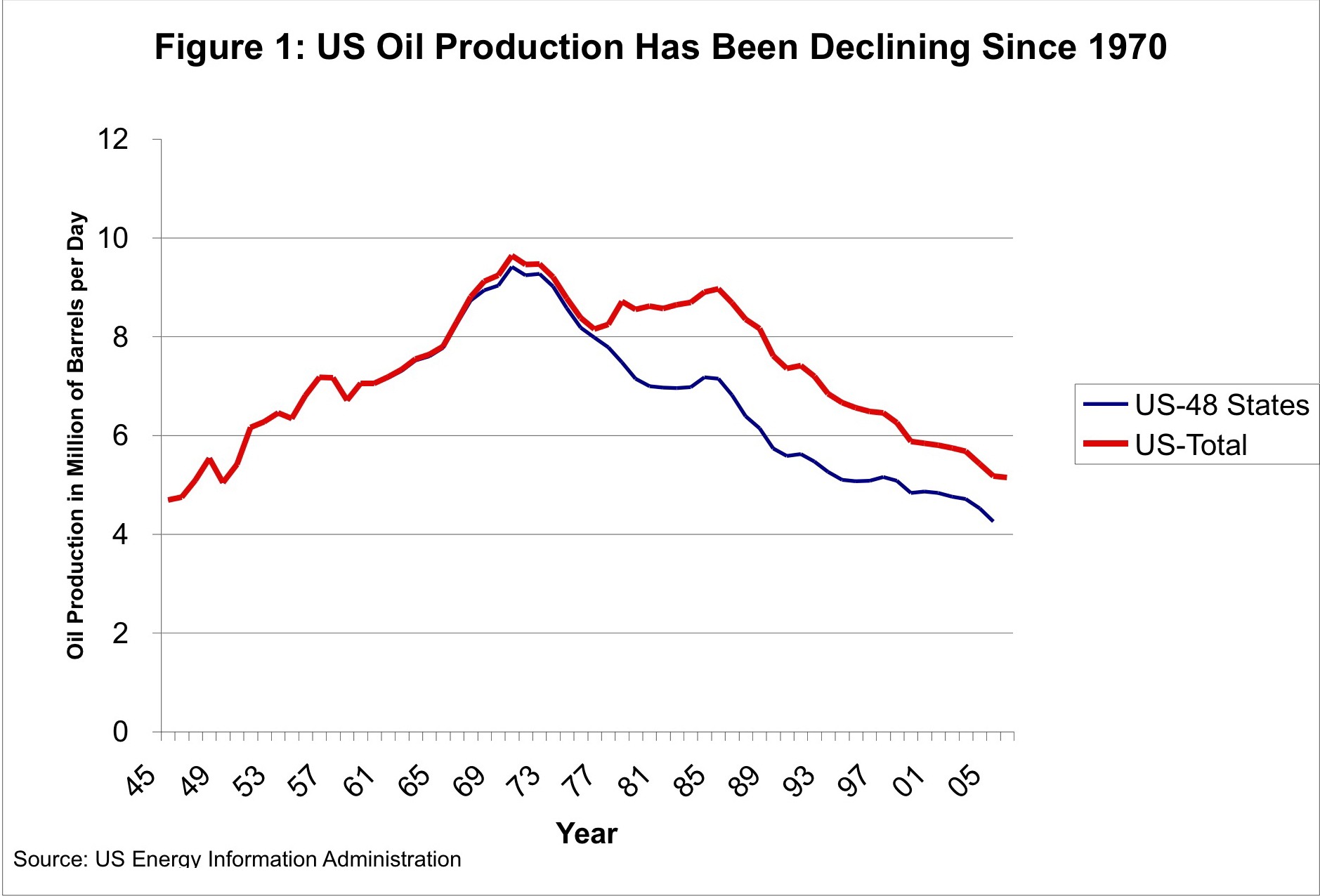
"Wacko environmentalists" have absolutely nothing to do with it. The big problem with doing that is, unfortunately, there's precious little oil left close to shore. You could fill the entire U.S. coast so full of wells it looks like a pin cushion and it would hardly make a dent in the oil price. You can see the chart right here, U.S. oil production has been on a steady decline for decades and will never, ever recover, it doesn't matter how many wells you drill. Even the discovery of the north slope of Alaska and building the pipeline never got the U.S. production to recover from its 1972 peak. ANWR? Forget about it, ANWR's a blip that's laughably too little, too late. This is why the Republican chant of "drill baby drill" is so ridiculous, drilling is pointless without oil to find. We've used up most of the oil near shore, which is why BP was drilling in 5000 feet of water, it has nothing to do with environmentalists.
-
Re:So I didn't RTFA
What happens if they don't find anything?
Then it re-enforces the notion that we're living in universe that cheats. Like a simulation would.
We already have data that fits the theory so perhaps this space probe could show that it was wrong, somehow. It seems better to spend money chasing promising results, though.
-
Re:Arctic?
This doesn't really answer why it's not a problem in Alaska, but the temperatures aren't actually much different. Alaskan offshore drilling is in relatively shallow water, which at those latitudes is somewhere in the low single digits C once you get below the ice pack; while this operation in the Gulf was at about 1700 meters depth, where the temperatures are also in the low single digits C. (There's lots of complicating factors, but this graph of depth v. temperature for three different latitudes gives an idea.) There's differences in pressure, which might matter, but also big differences in geology.
-
Kagan and Net Neutrality
With reference to net neutrality, Kagan appears to be arguing on behalf of cable companies in private writings when saying: that the "Buckley principle" states that government may not "restrict the speech of some elements of our society [think: powerful corporations] in order to enhance the relative voice of others [think: average individuals]." Her viewpoint on the Buckley principle is almost the opposite of what Obama said: "powerful interests must not be allowed to drown out the voices of ordinary citizens.". Kagan suggested that the Buckley principle "could summarize the view" of the Turner dissenters, who sided with the cable companies. This also would seem to at odds with the president's public statements in support of net neutrality.
More info here: http://balkin.blogspot.com/2010/05/does-elena-kagan-disagree-with-justice.html -
Re:Silly Brits
Here's a visualization which shows what the result would have been if the same votes had been used to decide the number of seats (a simple version of proportional representation):
http://alexbowyer.blogspot.com/2010/05/what-would-have-happened-last-night-if.html
Also, here's some visualizations of alternative Proportional Representation systems and the effects they'd have:
http://www.flickr.com/photos/25541021@N00/4594758955/ -
Re:Bloatware?
Add
Last bit is this (sorry for ma poor Engrish).
To lesser extent, but yes, VIM is slowly getting more and more bloated - more and more time one has to invest into disabling all the annoyances. Though it is still worth it. (Unlike Emacs, where you can't configure much. You either take it as a whole or look for another editor.)
-
Re:!newsfornerds
If you want a nerd angle, consider the word "cyberterror."
You can do far better than that actually. With reference to net neutrality, Kagan appears to be arguing on behalf of cable companies in private writings when saying: that the "Buckley principle" states that government may not "restrict the speech of some elements of our society [think: powerful corporations] in order to enhance the relative voice of others [think: average individuals]." Her Buckley principle is almost the opposite of the Obama statement that "powerful interests must not be allowed to drown out the voices of ordinary citizens." and then saying that the Buckley principle "could summarize the view" of the Turner dissenters, who sided with the cable companies. This also would seem to at odds with the president's public statements in support of net neutrality. More info here: http://balkin.blogspot.com/2010/05/does-elena-kagan-disagree-with-justice.html
Kagan also appears to be a corporatist, which is probably why our corprate media is predicting that she will be confirmed without much republican protest despite the fact that she is a social liberal. If you read the material in the link I provided, you will find that even though Kagan was tasked to support the govt in the CU case which the govt lost (and Obama chastized the SCOTUS on TV over), Kagan expressed views contrary to the principles that she was charged to support in arging the govt's case. The case Kagan argued against the CU decision was poorly made and she could have invoked supreme court precedent to make a much stronger case for the govt, but failed to do so. Again Obama looks to be a hypocrit; this time when he said he would nominate someone who would follow in Steven's footsteps WRT the CU case, that certainly doesn't seem to be the case with Kagan.
It's not that there isn't alot on Kagan out there, it's that the liberal corprate media doesn't want to report it. -
Re:The last straw...
-
Re:Preparing for 2012?? probably!
Someone said redundant so I shouldn't let them down but rather make the post connection they broke, while being almost redundant about the following.
hmmm, so quick to judge, no surprise here on slashdot.
then someone asks what is my source. Only if they would have read the blog entries and accessed the links given on the blogs.
But then who here thinks NOVA (pbs) or scientist using the Large Hardon Collider have any clue what they are talking about?Oh wait, such fast judgements and quick comments haven't taken the time to review the sources....
Go figure....
There is actually a good bit happening in and around 2012, from a science POV. But to many maybe caught up in a fictional movie by that name.but not completely redundant:
What else is happening in 2012.
http://abstract-beliefs.blogspot.com/2010/04/big-picture.htmlAnd the evidence of organic life from outer space fits in this big picture in expected ways..... shrug...
-
Preparing for 2012?? probably!
Organic material from space... of course...
Looking way out in space and back in time :
http://abstract-beliefs.blogspot.com/2010/04/how-big-is-universe-or-how-small-are-we.htmlLooking at the very small to see further:
http://abstract-beliefs.blogspot.com/2010/04/how-small-can-we-see-or-how-big-we-are.htmlAlmost full circle
http://abstract-beliefs.blogspot.com/2010/04/almost-full-circle-through-science.htmlThe relevant part of the the first blog post mentioned in the above link (completing the circle):
"Whats to believe?When the void became aware of itself a split happened into two, consciousness and existence. Two things that either are or they are not but they are symbiotic, given their origin. What exist in consciousness and in existence, are variables. Things change in the content of both. If you are all that exist, how do you know you will continue to exist? You must expand, so to know new and different. The religion of survival, we all have it, even god, where it comes from.
A way of knowing you exist, is to create life that will allow viewing and experiencing the contents of existence and consciousness in part, blind to the whole. We are but recorders that will someday report back to the whole. And what of our purpose, each one of us? To contribute to the insurance of survival. So of what use are you to the whole, if you don't? Why bring or allow you back if you are not going to help survival insurance? When you die and return to the whole, you judge yourself.
The survival instinct, built into all living things. Religion's a word that wouldn't exist without separation of beliefs. But all religions know survival.
The closer you are to knowing what is, the more control you have over what can be.
Made in god's image, we are. But we are in part, not whole. So it is even written, the flaw of god. The split of the void, birth of god. But purity whole is only the void. All outside is in part, including god. So sin but like god, to create, not destroy, as nothing is something to avoid!
Whats to come, perhaps by late 2012.
http://abstract-beliefs.blogspot.com/2010/04/let-there-be-light.html -
Preparing for 2012?? probably!
Organic material from space... of course...
Looking way out in space and back in time :
http://abstract-beliefs.blogspot.com/2010/04/how-big-is-universe-or-how-small-are-we.htmlLooking at the very small to see further:
http://abstract-beliefs.blogspot.com/2010/04/how-small-can-we-see-or-how-big-we-are.htmlAlmost full circle
http://abstract-beliefs.blogspot.com/2010/04/almost-full-circle-through-science.htmlThe relevant part of the the first blog post mentioned in the above link (completing the circle):
"Whats to believe?When the void became aware of itself a split happened into two, consciousness and existence. Two things that either are or they are not but they are symbiotic, given their origin. What exist in consciousness and in existence, are variables. Things change in the content of both. If you are all that exist, how do you know you will continue to exist? You must expand, so to know new and different. The religion of survival, we all have it, even god, where it comes from.
A way of knowing you exist, is to create life that will allow viewing and experiencing the contents of existence and consciousness in part, blind to the whole. We are but recorders that will someday report back to the whole. And what of our purpose, each one of us? To contribute to the insurance of survival. So of what use are you to the whole, if you don't? Why bring or allow you back if you are not going to help survival insurance? When you die and return to the whole, you judge yourself.
The survival instinct, built into all living things. Religion's a word that wouldn't exist without separation of beliefs. But all religions know survival.
The closer you are to knowing what is, the more control you have over what can be.
Made in god's image, we are. But we are in part, not whole. So it is even written, the flaw of god. The split of the void, birth of god. But purity whole is only the void. All outside is in part, including god. So sin but like god, to create, not destroy, as nothing is something to avoid!
Whats to come, perhaps by late 2012.
http://abstract-beliefs.blogspot.com/2010/04/let-there-be-light.html -
Preparing for 2012?? probably!
Organic material from space... of course...
Looking way out in space and back in time :
http://abstract-beliefs.blogspot.com/2010/04/how-big-is-universe-or-how-small-are-we.htmlLooking at the very small to see further:
http://abstract-beliefs.blogspot.com/2010/04/how-small-can-we-see-or-how-big-we-are.htmlAlmost full circle
http://abstract-beliefs.blogspot.com/2010/04/almost-full-circle-through-science.htmlThe relevant part of the the first blog post mentioned in the above link (completing the circle):
"Whats to believe?When the void became aware of itself a split happened into two, consciousness and existence. Two things that either are or they are not but they are symbiotic, given their origin. What exist in consciousness and in existence, are variables. Things change in the content of both. If you are all that exist, how do you know you will continue to exist? You must expand, so to know new and different. The religion of survival, we all have it, even god, where it comes from.
A way of knowing you exist, is to create life that will allow viewing and experiencing the contents of existence and consciousness in part, blind to the whole. We are but recorders that will someday report back to the whole. And what of our purpose, each one of us? To contribute to the insurance of survival. So of what use are you to the whole, if you don't? Why bring or allow you back if you are not going to help survival insurance? When you die and return to the whole, you judge yourself.
The survival instinct, built into all living things. Religion's a word that wouldn't exist without separation of beliefs. But all religions know survival.
The closer you are to knowing what is, the more control you have over what can be.
Made in god's image, we are. But we are in part, not whole. So it is even written, the flaw of god. The split of the void, birth of god. But purity whole is only the void. All outside is in part, including god. So sin but like god, to create, not destroy, as nothing is something to avoid!
Whats to come, perhaps by late 2012.
http://abstract-beliefs.blogspot.com/2010/04/let-there-be-light.html -
Preparing for 2012?? probably!
Organic material from space... of course...
Looking way out in space and back in time :
http://abstract-beliefs.blogspot.com/2010/04/how-big-is-universe-or-how-small-are-we.htmlLooking at the very small to see further:
http://abstract-beliefs.blogspot.com/2010/04/how-small-can-we-see-or-how-big-we-are.htmlAlmost full circle
http://abstract-beliefs.blogspot.com/2010/04/almost-full-circle-through-science.htmlThe relevant part of the the first blog post mentioned in the above link (completing the circle):
"Whats to believe?When the void became aware of itself a split happened into two, consciousness and existence. Two things that either are or they are not but they are symbiotic, given their origin. What exist in consciousness and in existence, are variables. Things change in the content of both. If you are all that exist, how do you know you will continue to exist? You must expand, so to know new and different. The religion of survival, we all have it, even god, where it comes from.
A way of knowing you exist, is to create life that will allow viewing and experiencing the contents of existence and consciousness in part, blind to the whole. We are but recorders that will someday report back to the whole. And what of our purpose, each one of us? To contribute to the insurance of survival. So of what use are you to the whole, if you don't? Why bring or allow you back if you are not going to help survival insurance? When you die and return to the whole, you judge yourself.
The survival instinct, built into all living things. Religion's a word that wouldn't exist without separation of beliefs. But all religions know survival.
The closer you are to knowing what is, the more control you have over what can be.
Made in god's image, we are. But we are in part, not whole. So it is even written, the flaw of god. The split of the void, birth of god. But purity whole is only the void. All outside is in part, including god. So sin but like god, to create, not destroy, as nothing is something to avoid!
Whats to come, perhaps by late 2012.
http://abstract-beliefs.blogspot.com/2010/04/let-there-be-light.html -
Re:"Intangible products"?
Doesn't bother me any. In the end, writing, acting, and directing are important. The rest of it is nice, but not essential.
I couldn't agree more (mod parent up xP), I've been wanting to say precisely this in other copyright related slashdot threads but JS bugs kept gagging me.
I am beginning to think I'm only one in 10% of the population not dazzled by Avatar's popcorn factor. And the only one who willfully hasn't seen it yet. (Yeah, can you imagine? I've downloaded it and everything, but can't be arsed to spend the block of time required to watch it!) I'm not that enthused by another rehash of Pocahontas or The Smurfs. 8I
I've watched 2 movies in "3d" in the theaters. I barely even go to the theaters anymore because the price is so high to begin with, why would I want to pay 50% more for eyestrain and a headache? Is the "future of entertainment" really that objects flying at your head gimmick that was done to death in the 50's with Anaglyph? Does anyone really believe this is the most important improvement to home entertainment since color television? How can a generation of people who couldn't figure out Magic Eye decouple their monocular focus from their binocular so easily without an aneurysm?
And the funny thing is, I wouldn't give a damn if the rest of the world wanted to waste their money on bullshit, except that I'll be dragged into court should I chose to download ineffable information just to keep track of what everyone else is talking about, or if I produce a video of my own that coincidentally contains four bars from some 1963 crooner off of the ice cream truck passing outside.
Copyright has absolutely nothing to do with compensation. I'd like one copyright holder to come forward and tell me when they've ever had to sue someone, and then perhaps illustrate how the court costs actually shielded their bottom line without dipping into the unprovable "lost sales" schtick. "Oh, anyone could have gotten my material for free had I not acted quickly!" Of course, anyone CAN get your material for free right now, so that argument is not admissible.
No. Copyright is only used in today's society — and only by very wealthy interests with the resources to invoke it indiscriminately — for the sole purpose of laying land rights over every permutation of thoughts individuals are allowed to think so that they can charge a toll. Our natural evolution as a society is driving us to communicate in memes. Name dropping, movie quoting, television show referencing, and textbook citing have become the new parable. Today's copyright industry exists solely to force us to pay to participate in this new language.
So I back kangarooski in saying, bring on the copyright free world where "no content will ever be created again". Seriously, I'm calling your bluff. Because if none of y'all will create anything without charging per view, then I will and I don't mind being the only one at the mic. There is value in creating beyond tithing your audience. Anyone who doesn't see that can go without and leave more room for people with vision.
-
9/11 just showed us what happen when you steal..
Leading up to 9/11 was a motive and facts that allowed terrorist to gain self sacrificing followers.
Wanna win out over terrorist? Simply stop giving them reasons to do what they do.
-
Re:No Winner
I wouldn't have mentioned it if it wasn't pure shit that. 1.5 seconds for a query that should be 3-4 disk blocks at max?
-
Re:what are the chemical dispersants?
Since nobody's posted any links:
http://switchboard.nrdc.org/blogs/lspeer/oil_dispersants_spell_trouble.htmlThe best solution seems to be to burn it off.
http://echinoblog.blogspot.com/2010/05/spiny-skinned-canaries-in-coal-mine.html -
Sea floor is NOT a desert
The sea floor is a veritable desert compared to the ocean surface. The food chain starts in the first 10' of water, where plankton have access to sunlight.
Absolutely wrong. Anybody who has ever gone diving or fishing knows that the bottom is where all the action is. A reference: http://www.fathom.com/course/10701050/session2.html
While the food chain starts at the top, the biodiversity is accumulated near the bottom. Even if you might not care about biodiversity, commercial crab, shrimp, and lobster fisheries will depend on organisms on the sea floor to be uncontaminated, even if they do survive.There are creatures that will be effected by oil on the sea floor like crabs and such, but it's still better than letting it run ashore.
Better for whom? The tourist industry?
Briefly, oil on the ocean floor or dispersed in the water column is bad. Oil on the ocean surface is worse. And oil on the ocean surface at the shoreline and in the estuaries is an ecological catastrophe.
Still wrong. As far as animal life is concerned, each is bad for its own reasons. Surface oil may affect animals that are visually more photogenic--birds, dolphins, seals--but oil on the bottom will make life difficult for the myriads of bottom-dwellers. Sea urchins and starfish are especially sensitive. http://echinoblog.blogspot.com/2010/05/spiny-skinned-canaries-in-coal-mine.html
(yeah, I know I'm posting two days later)
-
Re:PREDICTIONS ARE IN
Because it is? Certainly it is in this case.
I don't know how long you've been paying attention, but media organizations have fought to control nearly every single advancement in the content distribution arena. Their insanity has derailed or generally fucked up a number of great technologies. They've sued their own customers. They've pushed ridiculous monitoring overhead off on people in the business of just carrying packets. They've invaded privacy. They've lied about you to authorities. They've bought laws.
But when I read stories like this its like 10 years ago and I'm watching Cops and here is some beaten housewife, face bruised, blubbering through her bloody lips that even though her husband beats her and drinks to much and she knows he is a degenerate piece shit, she still loves him and does he really have to go to jail? Like her, people like you complain about the transgressions above but you reliably choose them over 'nothing'. No music no movies No TV.
The media organizations do not believe that you are unhappy with them. When they look at their monthly reports they see you still give them your money. It isn't like they have demonstrated particularly clear and forward looking vision.
-
The plunge (partly) explained
WSJ is reporting that the trigger was a very large sell order for P&G coupled with unchecked computer trading and some inherent flaws in the current system of fragmented exchanges.
Felix Salmon also did a good explanatory post that pulled in work from other writers about what might have happened and why.
Mr. Salmon's post links to a thought provoking post by a blogger named Kid Dynamite, who posits that it's a really bad precedent to cancel the erroneous trades because it lets the program traders off the hook for the consequences of their computer mess-up. -
Re:good idea there, buddy
Yeah right. Celebrities won't be forced to go through these things.
Depends on your definition of a celebrity, being the Indian equivalent of Richard Gere is apparently not enough.
Of course the airport denied it happened by simply claiming it was "impossible" and refusing to investigate - never mind the "test mode" that does allow printing or that anyone with a cell phone can take a picture of the screen and print that.
-
Re:good idea there, buddy
What most people here seem to be missing is that this incident didn't happen out of thin air (incidents like these almost never do). A SUPERVISOR was harassing him on the job, and instead of the supervisor being fired and arrested, the police, like is usual in cases of harassment, arrest the victim. According to the victim,
he had been made fun of by coworkers on a daily basis
Of course the victim of the harassment could have filed a formal complaint, but everybody knows how that always turns out. At the most he would be laughed at, but really, it's the harassers word against the harassed.
It's sad and pathetic that everybody here on Slashdot seems to be pointing the blame on the victim, like is always the case when it comes to school shootings and workplace shootings. When everybody is against you then violence almost always seems the logical solution. Of course I don't expect the supervisor or the Human Resource Manager who carefully selected these assholes to be fired or charged with harassment or human rights violations, because it's not the neoconservative thing to do. Violence is cool and if you can't take daily jokes then... you must be weak in the head. But that logic, in my experience, comes from hypocrisy.
Those co-workers should just be glad that he didn't show up the next day with an automatic rifle and a duffel bag full of ammunition. What goes around comes around. Work place mobbing should not be tolerated, and the supervisor and HR Manager should, at the VERY LEAST, be fired immediately.
-
Re:Ice Giants
JPL is in the process of trying to decide where to send probes next. Both Uranus and Neptune are on the table:
http://futureplanets.blogspot.com/2009/05/minimalistic-uranus-orbiter.html
http://futureplanets.blogspot.com/2009/08/white-paper-argo-mission-to-neptune.html
Realistically, neither of these will occur. Not enough money to persue these along with all the Moon, Mars, Jupiter and Titan probes that have priority. -
Re:Ice Giants
JPL is in the process of trying to decide where to send probes next. Both Uranus and Neptune are on the table:
http://futureplanets.blogspot.com/2009/05/minimalistic-uranus-orbiter.html
http://futureplanets.blogspot.com/2009/08/white-paper-argo-mission-to-neptune.html
Realistically, neither of these will occur. Not enough money to persue these along with all the Moon, Mars, Jupiter and Titan probes that have priority. -
Re:See, this is what I've been saying on Slashdot
Four lice love no cows?
No, it is much more beautiful in the original Klingon...
-
Re:javascript vs flash
One is compiled then executed in a VM; the other is already compiled and executed in a VM. In the optimal version of each, Javascript will be slower.
Presumably you have the benchmarks to validate your claims? JavaScript was beating Flash two years ago:
http://fupeg.blogspot.com/2008/09/javascript-faster-than-flash.html
Plenty of people are actively migrating away from Flash. Here's an example:
http://github.com/blog/621-bye-bye-flash-network-graph-is-now-canvas
The problem for Flash is that it's going up against browsers with highly optimised JavaScript engines with soon to be hardware accelerated render engines (see Firefox's progress for example). It's all looking a bit grim for Flash.
-
Re:does Wales still have any authority?
I think the linked blog post about Wales paying for massage parlor trips with money donated to the foundation is a bit more damning than helping his girlfriend edit her wikipedia page.
-
Re:Uh, cause that's where everyone's headed?
My cell phone has hardware acceleration for h264. OGG? no. VP8? no. Can the CPU do it? no.
Your misconceptions are maximal. To correct them:
1. Ogg is a container format, not a codec.
2. My cell phone has hardare acceleration for Theora video: http://blog.mjg.im/2010/04/16/theora-on-n900.html. Depending on your model, yours might too.
3. If Theora can be hardware accelerated, so can VP8.
4. Yes, the CPU can do it too. See TheorARM in the previous link and see: http://google-opensource.blogspot.com/2010/04/interesting-times-for-video-on-web.html
Open video is where it's going. It's not a question of if, but when. The 19th of May is when Google is expected to release VP8 on a royalty-free basis. Let's see if they do.
-
Re:Was the witness a dead salmon?
Without proper correction, fMRI has been shown to detect brain activity in a dead fish. Next up, trial lawyers.
Umm... I think those would be dead sharks.
-
Was the witness a dead salmon?
Without proper correction, fMRI has been shown to detect brain activity in a dead fish. Next up, trial lawyers.
-
Re:EEeesshh
-
Re:Free =/= Fun
OTOH sizeable number of people would never call WoW "fun".
That's because WoW is actually several games bundled together.
- Quest & Farm - this is actually work, if you think about it, and you need to do a lot of this to get to the interesting part
- Economy - Buy low, sell high, and you can avoid some or all of the above after a while; the auction house is basically economic PvP, with your progress measured in cash flow
- Kill the dragon with your friends - most fun for most people, progress measured by your equipped items; probably most successful because you show off your progress at all times
- E-Peen Hunting - all of the above: achievements, non-combat pets, mounts, titles, etc. Basically collecting random stuff you can show off.And then there are the people who make their own games in it. Most people don't see past the farming part.
-
Re:Free =/= Fun
OTOH sizeable number of people would never call WoW "fun".
That's because WoW is actually several games bundled together.
- Quest & Farm - this is actually work, if you think about it, and you need to do a lot of this to get to the interesting part
- Economy - Buy low, sell high, and you can avoid some or all of the above after a while; the auction house is basically economic PvP, with your progress measured in cash flow
- Kill the dragon with your friends - most fun for most people, progress measured by your equipped items; probably most successful because you show off your progress at all times
- E-Peen Hunting - all of the above: achievements, non-combat pets, mounts, titles, etc. Basically collecting random stuff you can show off.And then there are the people who make their own games in it. Most people don't see past the farming part.
-
Re:Oh, good Lord.
My job at Sun was to document their x86 servers, and it was my perception that Sun's were much better than Dell's. Obviously I was biased
http://sharikou.blogspot.com/2006/07/sun-x4600-x4500-servers-and-8000.html
-
Re:Sadly...Consider Judith Curry's recent remarks:
Criticisms of the Oxburgh report that have been made include: bias of some of the members including the Chair, not examining the papers that are at the heart of the controversies, lack of consideration of the actual criticisms made by Steve McIntyre and others, and a short report with few specifics that implies a superficial investigation. When I first read the report, I thought I was reading the executive summary and proceeded to look for the details; well, there weren't any. And I was concerned that the report explicitly did not address the key issues that had been raised by the skeptics.
My thoughts indeed, and here we have a post that trumpets CRU as exonerated. The post gives two links one leading to a CRU press release and the second to a scant five page report.
Elsewhere Professor Curry continues:
The primary frustration with these investigations is that they are dancing around the principal issue that people care about: the IPCC and its implications for policy. Focusing only on CRU activities (which was the charge of the Oxbourgh panel) is of interest mainly to UEA and possibly the politics of UK research funding (it will be interesting to see if the U.S. DOE sends any more $$ to CRU). Given their selection of CRU research publications to investigate (see Bishop Hill), the Oxbourgh investigation has little credibility in my opinion.
-
Re:GUI Noise
Hollywood computers obviously only use a user interface designed by Wiley Coyote.
-
Re:when you complain about the men
This blog post on the ACSOR polls is interesting, though of course you will be suspicious of the source.