Slashdot Mirror
Domain: boardgamegeek.com
Stories and comments across the archive that link to boardgamegeek.com.
Comments · 469
-
Re:Tabletop games instead
Consult the geek
-
Re:So, in other words
Indeed, it is.
-
Quite a portfolio
A listing of games (sorted by rank) that BoardGameGeek shows as published by Mayfair Games
-
Milton Bradley game--
Wow, I didn't think anybody still remembered "Game of Life".
-
Re:Gnip?
Indeed. There was an old game from the 70s that was called, "GNIP GNOP". Obviously, they were playing on "Ping Pong". heh
-
Re:Designers ! Publishers
I have some first hand experience at this. More years ago than I care to remember, I designed and self published a game (just googled it and came with an entry for it at Board Game Geek at https://boardgamegeek.com/boar...)
It was a very educational experience and lots of fun, but you have to treat it as a hobby. Nowadays, I'm striclty into putting games up via the web -- no printing costs, no distribution problems (uhm, also no money
-
for more information
check out BoardGameGeek.com, it contains a list of nearly 80,000 games/components/expansions.
http://www.boardgamegeek.com/b... -
Re:World of Warcraft Munchkin???
Blizzard's already published a World of Warcraft board game so they might be up for the idea. Or they may have signed away the rights to whoever made the board game. Or they might just consider Hearthstone to be close enough and leave it at that.
-
Not the first person to have this idea
-
Start of a FAQ for /.
Can we get a FAQ please? Here are the common answers:
* Visually with Angry Birds characters: http://learn.code.org/hoc/1
* Scratch
* http://coderdojo.com/
* Minecraft mods
* http://www.learntomod.com./
* https://pragprog.com/book/ahmi...
* http://codecombat.com/
* http://boardgamegeek.com/board...
* http://boardgamegeek.com/board...
* http://www.gamebooks.org/show_...
* http://venturebeat.com/2014/06...
* http://meetedison.com/
* BASIC
* Vic-20 C64 Compute! magazine
* Raspberry Pi
* Arduino
* Logo -
Start of a FAQ for /.
Can we get a FAQ please? Here are the common answers:
* Visually with Angry Birds characters: http://learn.code.org/hoc/1
* Scratch
* http://coderdojo.com/
* Minecraft mods
* http://www.learntomod.com./
* https://pragprog.com/book/ahmi...
* http://codecombat.com/
* http://boardgamegeek.com/board...
* http://boardgamegeek.com/board...
* http://www.gamebooks.org/show_...
* http://venturebeat.com/2014/06...
* http://meetedison.com/
* BASIC
* Vic-20 C64 Compute! magazine
* Raspberry Pi
* Arduino
* Logo -
Board Games!
Robo Rally is like a multiplayer boardgame version of LOGO...
Robot Turtles is even better for younger players
Micro Adventures were some of the books that I started with as a kid
-
Board Games!
Robo Rally is like a multiplayer boardgame version of LOGO...
Robot Turtles is even better for younger players
Micro Adventures were some of the books that I started with as a kid
-
Robo Rally!
Robo Rally would be a great place to start teaching programming basics (i.e. programming steps and timing.)
Earliest computer/electronic experiment that really struck me as a kid (1st or 2nd grade) was 'decoding' circuits with a logic probe: we had rectangles of construction paper, half of which had two rows of hole-punched holes on opposite ends, and we taped tin foil paths between them, including bogus foil under the 'dead' holes. After making a half dozen of these each, we traded and logic probed someone else's circuits. Lots of fun!
-
Re:Essential design elements
I enjoy many, many games which don't follow many of these rules, but if these are essential for you (though they seem to be written in such a way that "Go" is the only game really matching them), then I'd recommend looking into all of the Project GIPF games, primarily YINSH.
-
Re:Essential design elements
I enjoy many, many games which don't follow many of these rules, but if these are essential for you (though they seem to be written in such a way that "Go" is the only game really matching them), then I'd recommend looking into all of the Project GIPF games, primarily YINSH.
-
The right amount of randomness
The best trade-off I have found is a game with a little randomness but not too much
I concur.
I have played some games with very little randomness, and for me at least they become "brain-burners" where I try to think three or four moves ahead. When I tried Caragena I had this problem. If there is some randomness, I can relax until it's my turn.
Also, some games that seem to contain a whole lot of randomness can become statistically predictable. If a game has you rolling a set of dice a dozen times in your turn, each roll is random but over all the rolls it averages out. In games like Can't Stop there is an undeniable element of luck, but it's less than a game that puts a great deal of importance on a single toss of the dice.
-
The right amount of randomness
The best trade-off I have found is a game with a little randomness but not too much
I concur.
I have played some games with very little randomness, and for me at least they become "brain-burners" where I try to think three or four moves ahead. When I tried Caragena I had this problem. If there is some randomness, I can relax until it's my turn.
Also, some games that seem to contain a whole lot of randomness can become statistically predictable. If a game has you rolling a set of dice a dozen times in your turn, each roll is random but over all the rolls it averages out. In games like Can't Stop there is an undeniable element of luck, but it's less than a game that puts a great deal of importance on a single toss of the dice.
-
Re:Casual games with strategic depth
what [is] the optimum number of players
Any time you have questions like that, first thing to do is check BoardGameGeek and see what it says.
http://boardgamegeek.com/boardgame/2651/power-grid
Best with 4, 5 players
Recommended with 3, 4, 5, 6 players -
cooperative game
I spend a lot of time with my wife playing Pandemic. We love the fact that it is hard to win, but a cooperative rather than competitive play.
-
Game Design resource idea: BoardGameGeek?
I know exactly where this kid is coming from! In high school, I filled notebooks with pseudocode for how I wanted some of my game ideas to work. Getting into Dungeons and Dragons was a helpful experience as well, especially in the Dungeon Master role. If you want to deal with lore or game balancing, there's the perfect opportunity! I know from experience that finding resources on game DESIGN, as opposed to game PROGRAMMING, can be difficult. I spent a semester at university minoring in their brand-new Game Design program that was exactly not that, and was highly disappointed. Fortunately since you seem to be talking about games in general and not just video games, there's a wonderfully accepting and active community of designers and playtesters at BoardGameGeek.com: https://www.boardgamegeek.com/... There are frequent design competitions there as well, and board games are certainly an easier jumping-off point than most video games in terms of complexity. There are tons of excellent game design articles on BGG, as well as at GamaSutra, Polygon, and yes, MagicTheGathering.com as mentioned above. It might also be enlightening to study the well-documented changes over time to the other long-lived juggernaut of gaming, World Of Warcraft, with over a decade of design changes for various reasons, but then again it may take more subject knowledge to really understand why that game evolved the way it did. MTG is a much more self-contained study, but I would say also less dynamic and interesting in its changes. The recent announcement to remove the summer Core Set and have 2 2-set Blocks per year is a good example of a thoughtful change, though. A big part of good design is finding what parts of your creation don't work as well as they could, then ripping them out and fixing them. Finally, the world's best prototyping tool for most games may well be Microsoft Excel. If you want to quickly see how ideas interact, finding a way to describe and model them mathematically can be very useful.
-
Re:Oh I've seen this before...
Getting severely off topic here, but in response to the parenthetical remark: yes, there is a tabletop game called Pandemic. It's not related at all: the tabletop game is all about a group of medical researchers (up to four) working together to discover cures for four diseases that are ravaging the world before one of several things happen: time runs out (you went through the deck of cards and didn't manage to get the cures); a disease rampages unchecked (you run out of cubes for a disease of a particular colour); or too many outbreaks of disease. Fun game, pure cooperative (unless you're playing one of the variations introduced in the "On the Brink" expansion; I've never played the "In the Lab" expansion so don't know how that changes the gameplay.)
-
Re:Yes, after all...
http://www.applerecords.com/ (yes, I chose that one ironically)
http://boardgamegeek.com/board...
http://en.wikipedia.org/wiki/W...
http://www.thepalm.com/
http://www.niagaraparksgolf.co......okay, you win on Whole Foods.
-
Gateway games!
For quite some time my gateway game has been Ticket to Ride. Easy to learn how to play. Doesn't take hours to finish and the game has a good visual aspect. For a more fun party time, I would say Apples to Apples or Cards Against Humanity. Just taking a quick look at my collection http://boardgamegeek.com/colle... , another good one to have is Acquire, plays quick and easy rules. I also like to pull out 7 Wonders for light gaming. For more involved games my go to's are either Eclipse or Twilight Imperium. Just depends, 2-3 hours or 10+ available?
-
Board games
For group get-togethers, here are some great board games to have on hand.
Can't Stop -- 2 to 4 players. An elegantly simple "push your luck" game. You only need to make one decision: keep going, or stop?
http://boardgamegeek.com/boardgame/41/cant-stopIncan Gold -- 3 to 8 players. This is a reworked version of a classic called Diamonte. It's another "push your luck" game, but it's very different from Can't Stop in that it's group game. The whole group plays in parallel: they all decide whether to keep going, or stop, and all reveal their choice simultaneously. This means that the 8-player game doesn't really take longer than the 3-player game!
http://boardgamegeek.com/boardgame/37759/incan-goldI'll second the vote for Pandemic. But if you want something a little simpler than Pandemic, with a less depressing theme, you can play Forbidden Island (2-4 players). Forbidden Island was designed by the same guy who designed Pandemic, and uses many of the same game mechanics. I love the art, which reminds me of Myst; and it is inexpensive and doesn't take up much space in your closet. Very suitable for kids.
http://boardgamegeek.com/boardgame/65244/forbidden-islandAll of these suggestions are good for convincing non-gamers to try playing a board game.
P.S. When I was a teenager, some friends and I used to play Wiz-War, and had a blast. It's a simple game: either steal two treasures from other players, or be the last player standing. There is a deck of cards, which includes all kinds of crazy spells you can cast.
Once when I was playing, another player hit me with Slow Death, which makes you lose one hit point for each card you draw; I countered with Reversal, which reverses the effects of a spell, and started drawing two cards each turn (the max). I thought this was a good thing, but the other players were now very worried about me, and they all ganged up on me and just killed me. So the Slow Death worked after all, in a fashion.
The game is now available in a deluxe edition (which I haven't played yet).
http://boardgamegeek.com/boardgame/104710/wiz-war-eighth-edition -
Board games
For group get-togethers, here are some great board games to have on hand.
Can't Stop -- 2 to 4 players. An elegantly simple "push your luck" game. You only need to make one decision: keep going, or stop?
http://boardgamegeek.com/boardgame/41/cant-stopIncan Gold -- 3 to 8 players. This is a reworked version of a classic called Diamonte. It's another "push your luck" game, but it's very different from Can't Stop in that it's group game. The whole group plays in parallel: they all decide whether to keep going, or stop, and all reveal their choice simultaneously. This means that the 8-player game doesn't really take longer than the 3-player game!
http://boardgamegeek.com/boardgame/37759/incan-goldI'll second the vote for Pandemic. But if you want something a little simpler than Pandemic, with a less depressing theme, you can play Forbidden Island (2-4 players). Forbidden Island was designed by the same guy who designed Pandemic, and uses many of the same game mechanics. I love the art, which reminds me of Myst; and it is inexpensive and doesn't take up much space in your closet. Very suitable for kids.
http://boardgamegeek.com/boardgame/65244/forbidden-islandAll of these suggestions are good for convincing non-gamers to try playing a board game.
P.S. When I was a teenager, some friends and I used to play Wiz-War, and had a blast. It's a simple game: either steal two treasures from other players, or be the last player standing. There is a deck of cards, which includes all kinds of crazy spells you can cast.
Once when I was playing, another player hit me with Slow Death, which makes you lose one hit point for each card you draw; I countered with Reversal, which reverses the effects of a spell, and started drawing two cards each turn (the max). I thought this was a good thing, but the other players were now very worried about me, and they all ganged up on me and just killed me. So the Slow Death worked after all, in a fashion.
The game is now available in a deluxe edition (which I haven't played yet).
http://boardgamegeek.com/boardgame/104710/wiz-war-eighth-edition -
Board games
For group get-togethers, here are some great board games to have on hand.
Can't Stop -- 2 to 4 players. An elegantly simple "push your luck" game. You only need to make one decision: keep going, or stop?
http://boardgamegeek.com/boardgame/41/cant-stopIncan Gold -- 3 to 8 players. This is a reworked version of a classic called Diamonte. It's another "push your luck" game, but it's very different from Can't Stop in that it's group game. The whole group plays in parallel: they all decide whether to keep going, or stop, and all reveal their choice simultaneously. This means that the 8-player game doesn't really take longer than the 3-player game!
http://boardgamegeek.com/boardgame/37759/incan-goldI'll second the vote for Pandemic. But if you want something a little simpler than Pandemic, with a less depressing theme, you can play Forbidden Island (2-4 players). Forbidden Island was designed by the same guy who designed Pandemic, and uses many of the same game mechanics. I love the art, which reminds me of Myst; and it is inexpensive and doesn't take up much space in your closet. Very suitable for kids.
http://boardgamegeek.com/boardgame/65244/forbidden-islandAll of these suggestions are good for convincing non-gamers to try playing a board game.
P.S. When I was a teenager, some friends and I used to play Wiz-War, and had a blast. It's a simple game: either steal two treasures from other players, or be the last player standing. There is a deck of cards, which includes all kinds of crazy spells you can cast.
Once when I was playing, another player hit me with Slow Death, which makes you lose one hit point for each card you draw; I countered with Reversal, which reverses the effects of a spell, and started drawing two cards each turn (the max). I thought this was a good thing, but the other players were now very worried about me, and they all ganged up on me and just killed me. So the Slow Death worked after all, in a fashion.
The game is now available in a deluxe edition (which I haven't played yet).
http://boardgamegeek.com/boardgame/104710/wiz-war-eighth-edition -
Board games
For group get-togethers, here are some great board games to have on hand.
Can't Stop -- 2 to 4 players. An elegantly simple "push your luck" game. You only need to make one decision: keep going, or stop?
http://boardgamegeek.com/boardgame/41/cant-stopIncan Gold -- 3 to 8 players. This is a reworked version of a classic called Diamonte. It's another "push your luck" game, but it's very different from Can't Stop in that it's group game. The whole group plays in parallel: they all decide whether to keep going, or stop, and all reveal their choice simultaneously. This means that the 8-player game doesn't really take longer than the 3-player game!
http://boardgamegeek.com/boardgame/37759/incan-goldI'll second the vote for Pandemic. But if you want something a little simpler than Pandemic, with a less depressing theme, you can play Forbidden Island (2-4 players). Forbidden Island was designed by the same guy who designed Pandemic, and uses many of the same game mechanics. I love the art, which reminds me of Myst; and it is inexpensive and doesn't take up much space in your closet. Very suitable for kids.
http://boardgamegeek.com/boardgame/65244/forbidden-islandAll of these suggestions are good for convincing non-gamers to try playing a board game.
P.S. When I was a teenager, some friends and I used to play Wiz-War, and had a blast. It's a simple game: either steal two treasures from other players, or be the last player standing. There is a deck of cards, which includes all kinds of crazy spells you can cast.
Once when I was playing, another player hit me with Slow Death, which makes you lose one hit point for each card you draw; I countered with Reversal, which reverses the effects of a spell, and started drawing two cards each turn (the max). I thought this was a good thing, but the other players were now very worried about me, and they all ganged up on me and just killed me. So the Slow Death worked after all, in a fashion.
The game is now available in a deluxe edition (which I haven't played yet).
http://boardgamegeek.com/boardgame/104710/wiz-war-eighth-edition -
Re:Dominion & Munchkin
maybe you should try out ghost stories http://www.boardgamegeek.com/b... and yggdrasil http://www.boardgamegeek.com/b... . those are "easier". *cough* *cough*. (so I lied, sue me
-
Re:Dominion & Munchkin
maybe you should try out ghost stories http://www.boardgamegeek.com/b... and yggdrasil http://www.boardgamegeek.com/b... . those are "easier". *cough* *cough*. (so I lied, sue me
-
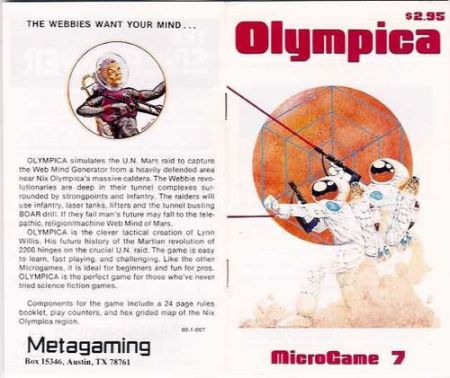
The Webbies Want Your Mind!
Infamous reference to Metagaming's game "Olympica" (c) 1977 top back cover subtitle:
https://whatarmy.files.wordpre...
From the back cover of the rule book:
"THE WEBBIES WANT YOUR MIND...
OLYMPICA simulates the U.N. Mars raid to capture the Web Mind Generator from a heavily defended area near Nix Olympica's massive caldera. The Webbie revolutionaries are deep in their tunnel complexes surrounded by strong points and infantry. The raiders will use infantry, laser tanks, lifters and the tunnel blasting BOAR drill. If they fail man's future may fall to the telepathic, religion/machine Web Mind of Mars.
OLYMPICA is the clever tactical creation of Lynn Willis. His future history of the Martian revolution of 2206 hinges on the crucial U.N. raid. The game is easy to learn, fast playing, and challenging. Like the other Microgames, it is ideal for beginners and fun for pros. OLYMPICA is the perfect game for those who've never tried science fiction games.
Components for the game include a 24 page rules booklet, play counters, and hex gridded map of the Nix Olympica region."
-
Extension to games...
I have to wonder how/if this research translates into the games arena. Recently, there have been several attempts to make games playable by humans but which negate the computer's advantage of massive search. These games include Arimaa, Octi, and Havannah. One speculates whether it would be possible to design a game that is equally difficult, and a fair contest, between humans and computers.
-
Extension to games...
I have to wonder how/if this research translates into the games arena. Recently, there have been several attempts to make games playable by humans but which negate the computer's advantage of massive search. These games include Arimaa, Octi, and Havannah. One speculates whether it would be possible to design a game that is equally difficult, and a fair contest, between humans and computers.
-
Extension to games...
I have to wonder how/if this research translates into the games arena. Recently, there have been several attempts to make games playable by humans but which negate the computer's advantage of massive search. These games include Arimaa, Octi, and Havannah. One speculates whether it would be possible to design a game that is equally difficult, and a fair contest, between humans and computers.
-
Re: "Board game designer"?
Believe it or not, some people do still buy and play board games.
And believe it or not, they've been gaining in popularity lately.
It's been a long time coming, but the Monopoly Stigma is slowly dissipating. I think Monopoly was the Mt. Saint Hellens of board games. It blew up, left a swath of scorched earth and desolation in a generation of people who grew up thinking games were stupid, pointless and nothing but dumb luck followed by three hours of a runaway winner forcing everyone else to keep playing. Over time, that desolation becomes fertilizer for the next generation.
If you're interested in giving a post-Monopoly tabletop world a look, there are a couple of key resources:
TabletopA bi weekly show hosted by Wil Wheaton showcasing a host of "gateway games". He gets three other internet famous (and sometimes proper famous) people to come play a game with him. He lightly goes over the rules, and they play.
A lot of effort goes into showing the fun interactions between the players that happens over the table - truly the best part of tabletop gaming. These are 30 minutes each, professionally produced and great fun to watch with the whole family. Overall, it's a great resource for finding something that may appeal to you and your friends/family.
The best part is watching Wil repeatedly lose episode after episode.
Board Game GeekAn extremely thorough, mature and self-built resource of pretty much all things tabletop game related. The community here is one of the best I've ever seen on the internet. Seriously, flame wars so germane and polite that they're helpful. Games are well reviewed, well discussed, and ranked overall.
The rankings are generally pretty spot on, but there is an overall tendency to devalue lighter games making it a bit difficult to find good gateway games. Be careful with this one if you have a tendency to lose hours whenever you land on IMDB, Wikipedia or TVTropes.
You almost always have to go to a solid game shop to get decent ones, but they exist.
I have yet to need to do anything other than order things from Amazon. Granted, if you're looking for some obscure Euro that's out of print, Amazon probably doesn't have it (or it's $300) - but then again, neither does your Friendly Local Game Shop.
-
Re:"Board game designer"?
I suppose this site is just a figment of my imagination, then.
-
Yavalath
There is at least one board game that was computer designed: Yavalath. Yavalath was designed algorithmically by Cameron Browne, as described in his PhD thesis "Automatic Generation and Evaluation of Recombination Games". See his publications here:
-
Not too impressed
It's not too difficult to conceptualize people creating a computer that can design games based upon numerical or statistical elements, such as a deck of 52 cards divided into numbers and sets. Show me a computer than can take a theme (let's say, WWII tactical), create abstract mechanics that reflect playable functionality within that theme (let's say combat rules for historically accurate factions/units/weapons) and then make it fun (Combat Commander anyone?)....well, then I will bow to our new artificial overlords.
-
Re:Never get that 3 garbage plant.
Damn. Beaten to the obvious punch. (For those who don't get it: have a look.)
I was going to say that Oslo obviously needs to manoeuvre itself into last place in turn order, to get the cheap resources. And to be able to get its pick of new power plants.
-
Re:Works just fine
1) Give intern new shiny bomb detector
2) Send intern to walk around field for a while
3) Intern blows up
4) Success - bomb detected!
5) Added bonus - bomb removed!That's the premise of the game Unexploded Cow, only instead of interns, it's cows with Mad Cow Disease.
-
Roborally - play w/ your kids
Page on it here:
-
Board game
There was a very interesting board game called "Fortress America." The design was such that invading forces could care less about our states' boundaries, but only geographical features. Boardgamegeek has some photos. I still have this game. http://boardgamegeek.com/image/761195/fortress-america?size=original
-
Well, to me it means...
... I'll have to dig up my old copy of GDW's Triplanetary to help with navigation. Gimme a military Corsair and I'll overload an extra hex to my vector and mine those asteroids before anyone.
-
Good 2-player games
They're not easy to find.
At one extreme, you have the zero-sum pure competition games. Chess and Go are classic examples, but the most cutthroat one I've come across is Caesar and Cleopatra. Divorce in a box, if you ask me.
At the other extreme, you have the "family game" type, which is pretty much random who wins and who loses. The card game Fluxx is the best example I can think of here. I've played Fluxx while actively trying to lose, and won despite my best efforts. These can be fun, but they're not intellectually stimulating.
The good two-player games are in a sweet spot between those two extremes. The perfect 2-player game has enough randomness that you won't feel bad if you lose, but enough strategy to make you feel like your actions mattered when you win.
Lost Cities, Odin's Ravens, and Jaipur are three such games. They are all card games, and what cards you get is significant in all three games. But all 3 games let you manage your luck in different ways, so having a good strategy is essential. -
Good 2-player games
They're not easy to find.
At one extreme, you have the zero-sum pure competition games. Chess and Go are classic examples, but the most cutthroat one I've come across is Caesar and Cleopatra. Divorce in a box, if you ask me.
At the other extreme, you have the "family game" type, which is pretty much random who wins and who loses. The card game Fluxx is the best example I can think of here. I've played Fluxx while actively trying to lose, and won despite my best efforts. These can be fun, but they're not intellectually stimulating.
The good two-player games are in a sweet spot between those two extremes. The perfect 2-player game has enough randomness that you won't feel bad if you lose, but enough strategy to make you feel like your actions mattered when you win.
Lost Cities, Odin's Ravens, and Jaipur are three such games. They are all card games, and what cards you get is significant in all three games. But all 3 games let you manage your luck in different ways, so having a good strategy is essential. -
Good 2-player games
They're not easy to find.
At one extreme, you have the zero-sum pure competition games. Chess and Go are classic examples, but the most cutthroat one I've come across is Caesar and Cleopatra. Divorce in a box, if you ask me.
At the other extreme, you have the "family game" type, which is pretty much random who wins and who loses. The card game Fluxx is the best example I can think of here. I've played Fluxx while actively trying to lose, and won despite my best efforts. These can be fun, but they're not intellectually stimulating.
The good two-player games are in a sweet spot between those two extremes. The perfect 2-player game has enough randomness that you won't feel bad if you lose, but enough strategy to make you feel like your actions mattered when you win.
Lost Cities, Odin's Ravens, and Jaipur are three such games. They are all card games, and what cards you get is significant in all three games. But all 3 games let you manage your luck in different ways, so having a good strategy is essential. -
Good 2-player games
They're not easy to find.
At one extreme, you have the zero-sum pure competition games. Chess and Go are classic examples, but the most cutthroat one I've come across is Caesar and Cleopatra. Divorce in a box, if you ask me.
At the other extreme, you have the "family game" type, which is pretty much random who wins and who loses. The card game Fluxx is the best example I can think of here. I've played Fluxx while actively trying to lose, and won despite my best efforts. These can be fun, but they're not intellectually stimulating.
The good two-player games are in a sweet spot between those two extremes. The perfect 2-player game has enough randomness that you won't feel bad if you lose, but enough strategy to make you feel like your actions mattered when you win.
Lost Cities, Odin's Ravens, and Jaipur are three such games. They are all card games, and what cards you get is significant in all three games. But all 3 games let you manage your luck in different ways, so having a good strategy is essential. -
Good 2-player games
They're not easy to find.
At one extreme, you have the zero-sum pure competition games. Chess and Go are classic examples, but the most cutthroat one I've come across is Caesar and Cleopatra. Divorce in a box, if you ask me.
At the other extreme, you have the "family game" type, which is pretty much random who wins and who loses. The card game Fluxx is the best example I can think of here. I've played Fluxx while actively trying to lose, and won despite my best efforts. These can be fun, but they're not intellectually stimulating.
The good two-player games are in a sweet spot between those two extremes. The perfect 2-player game has enough randomness that you won't feel bad if you lose, but enough strategy to make you feel like your actions mattered when you win.
Lost Cities, Odin's Ravens, and Jaipur are three such games. They are all card games, and what cards you get is significant in all three games. But all 3 games let you manage your luck in different ways, so having a good strategy is essential. -
Re:Exactly - this is an experience problem.
Forget one specific game. Head to BoardGameGeek and find something cool.
If she studied chemistry, Compounded would be a good start.
If she likes dark tales, Arkham Horror would be good.
San Juan is one of my favorites. It shows you there's about a dozen ways to use a card for a game. It also plays fast.
Try Gulo Gulo for the kids. Get them on board with gaming and she'll have to follow =)If you can get five people together, The Great Dalmuti is good too. It's easy to understand, plays fast, and is based off a card game known as "Asshole". What more can you ask?
-
Re:Exactly - this is an experience problem.
Forget one specific game. Head to BoardGameGeek and find something cool.
If she studied chemistry, Compounded would be a good start.
If she likes dark tales, Arkham Horror would be good.
San Juan is one of my favorites. It shows you there's about a dozen ways to use a card for a game. It also plays fast.
Try Gulo Gulo for the kids. Get them on board with gaming and she'll have to follow =)If you can get five people together, The Great Dalmuti is good too. It's easy to understand, plays fast, and is based off a card game known as "Asshole". What more can you ask?