Slashdot Mirror
Domain: borland.com
Stories and comments across the archive that link to borland.com.
Comments · 464
-
Apple's not the only one that gets the heat
One of the most successful software development firms in history, Borland, was supposed to die multiple times over the past decade. And it's still here, producing incredible development tools.
-
Re:Clear up
Here's what Borland has to say:
The Kylix Open Edition ships with CLX(TM) libraries under the GPL license.
As such, any applications that are built with a CLX library must make their sources freely available and distribute them under the terms of the GPL license as well. For example, any application built with the Kylix Open Edition must link to the BaseCLX(TM) library and will therefore be bound to the GPL. Furthermore, the Open Edition IDE End User License Agreement (EULA) also requires that any software developed with Kylix Open Edition must be released to the general public under the terms of the GPL. Any other use of Kylix Open Edition IDE would be in legal violation of the license agreement.Here's a link. Unforutnately it is a Word document
A little searching will undoubtedly produce others. Basically if the FSF is imagining the bounds of copyright then it is a consensual hallucination with a lot of participants.
-
performance and quality of codeI thinks his comments on dealing with performance problems are especially helpful, even for experienced programmers. Most decent programmers know how to debug, but few programmers excel in tackling performance problems. I've found that profiling is a very fruitful activity even if there are no obvious performance problems, because it provides tremendous insight into the runtime behavior of your applications. Things are often very different from what you would guess intuitively.
If you happen to work with Java, there are quite a few good commercial profilers around that are really easy to setup and use (such as JProfiler or Optimizeit). Try working with one of these for some time and observe how your way of programming changes for the better. Most importantly, you learn not to pre-emptively "improve" performance - one of the deadliest sins of programming which is responsible for a lot of bad and unreadable code.
-
Kylix / DelphiI've used a mixture of Delphi, Kylix, HTML and PERL on a few projects. It's cross-platform, as long as you only need Linux / Windows, and the basic version of Kylix is Open Source as well as free as in beer. You can also choose to code in C++ or Object Pascal.
Here's the link with more info: Borland Kylix Open Edition
-My Karma ran over your Dogma
-
QT convertI developed apps with Delphi for 4 years and was completely sold that Borland had the best solution around.
At my new employment I had a project that needed to be cross platform. I was itching to use Kylix, however it wasn't due to be finished for another 8 months. Looking into the details I saw that they built the corss platform support on QT.
After checking out the QT tutorials I was immediatly hooked. QT is intuitive; I can't think of many other APIs I would grace with this description. In addition to being well thought out it has a superb implementation. I've been using it happily for 2 years.
The only thing I miss is the strong third party component community that Delphi/Kylix has. I'm a huge fan of "buy don't build". You can really put quality touches on your app by finding the right component someone else has already made.
-R
-
Re:What is D?
-
Re:delphi
It's quietly being used by a lot of software development companies, and due to its RAD and straightforward approach to OO, these companies are running circles around their competitors. Read about Delphi 7's features and weep.
-
Re:WOOHOO!Now if we could just get an open-source Delphi-compliant compiler on Linux, I'd be happy.
Have you not heard of Kylix Open Edition? You can't be refusing to use it just because the compiler itself is not open source since you just said you use Delphi. Download it and give it a whirl. The new version lets you program in Object Pascal or C++.
Kylix 3 Open Edition free download -
nails get hammered
add to this a bit of "Microsoft to Buy Rational and/or Borland?" (more informative article article - javatips (66293) ) and you get a better view of the options MS are working on.
Borland are developing their own architectural solution for
-
Re:Schweet!
Excellent! Where can I pre order Visual Pascal?
Don't you mean Delphi? -
No Borland .NET IDE
I was on the Borland Developer Network page yesterday and found this article on Borland's upcoming
"Borland plans to offer an alternative to Microsoft's Visual Studio
The only other -
IMHO, there's no competitionWith Borland Delphi/Kylix, you can
Create any kind of multiplatform (windows/linux) apps.
Use a WAY better RAD tool than VB (I used VB for a while).
Learn and use a full-featured OO language.
As a bonus, you can even generate
I use it since its first version (well, since Turbo Pascal 3.0, actually), and, altough it's not the tool I use most in daily job (I deal with Macs a lot), it's simply the best RAD tool I've seen. Try a free download. After all, you're the kind of guy they're targeting now. -
IMHO, there's no competitionWith Borland Delphi/Kylix, you can
Create any kind of multiplatform (windows/linux) apps.
Use a WAY better RAD tool than VB (I used VB for a while).
Learn and use a full-featured OO language.
As a bonus, you can even generate
I use it since its first version (well, since Turbo Pascal 3.0, actually), and, altough it's not the tool I use most in daily job (I deal with Macs a lot), it's simply the best RAD tool I've seen. Try a free download. After all, you're the kind of guy they're targeting now. -
Re:Wait a minute...
Delphi was rewritten in Delphi as soon as it was powerful enough. You cannot say that about VB (written in C++).
-
Uh... Java?
First, being ashamed of doing VB is silly, don't sweat it, and don't pay attention to idiots who tell you otherwise. I've used VB since it was just 'B' and spent most of my career doing hard-core MS-centric projects and getting paid handsomely for it, thank you. During that decade long period I have:
- Bought a new car every two years
- Met and married a beautiful woman
- Purchased a nice home in an expensive neighborhood
- Bought a sailboat
- Had two wonderful children
That being said, I was finally able to get off the Windows treadmill by adopting Java. I now use Mac OS X exclusively at home.
Java GUIs have a bad rep for being slow, but alot of that is changing, and rapidly. Check out Eclipse and the SWT project. I would easily use even Swing for what you've described. Add in a killer IDE like Borland JBuilder and you have the same things you enjoyed in VB only now its on Windows, Linux, and OS X.
As for compiling, what exactly are you doing? Java now ships with JIT compilers that convert bytecode to native code on-the-fly. Of course you have little control over this process, so it's still not as optimal as hand-optimized C, but hey, what is.
For me, Java has now completely replaced VB, and with a far better, more flexible language to boot. I am completely free of MS constraints as well and the bonanza of open-source Java projects out there just makes the geek in me weep with joy. VB has been good to me, but it just can't compete.
-
Re:Microsoft better be concerned
-
Borland tools
Delphi, C++ Builder and Kylix, together with open-sourced Interbase/Firebird database, make a perfect suite for cross-platform RAD development.
-
Borland tools
Delphi, C++ Builder and Kylix, together with open-sourced Interbase/Firebird database, make a perfect suite for cross-platform RAD development.
-
Borland tools
Delphi, C++ Builder and Kylix, together with open-sourced Interbase/Firebird database, make a perfect suite for cross-platform RAD development.
-
Re:Old hardware, old software and efficiency
1. According to Borland, the name of the language is now simply "Delphi." This changed as of the release of Delphi 7.
2. Borland C++ and Delphi use the same machine code generator engine, so the optimizations are largely the same. The performance is largely the same. As you said, Delphi is single pass, and parses a good bit faster.
3. For those of you out there saying "huh? Pascal??? No one uses THAT??!?!" Guess again. It is used a lot more than you might think, typically by small, lean shops with insane deadlines like mine. -
Re:Old hardware, old software and efficiency
1. According to Borland, the name of the language is now simply "Delphi." This changed as of the release of Delphi 7.
2. Borland C++ and Delphi use the same machine code generator engine, so the optimizations are largely the same. The performance is largely the same. As you said, Delphi is single pass, and parses a good bit faster.
3. For those of you out there saying "huh? Pascal??? No one uses THAT??!?!" Guess again. It is used a lot more than you might think, typically by small, lean shops with insane deadlines like mine. -
Re:And we care because...You choose J2EE because you actually have a choice of:
- Which IDE you want to use, ranging from Open Source $0 IDE to commercial ones.
- Which source control you want to use, ranging from Open Source $0 source control to commercial ones.
- Which middle tier implementation you want to use, ranging from Open Source $0 application servers to commercial ones
- Which database you want to use, ranging from Open Source $0 databases to commercial ones.
In short, you choose J2EE in order to have a choice of what software you want to use within your business and how much you are willing to pay for it, what hardware (Intel, Sun, IBM) and operating systems (Linux, Windows, Solaris, AIX, OS/400) requirements you have, and what requirements you have on the performance (single Intel box to 64 CPU Sun box to IBM mainframe) and scalability of your application.
You make J2EE match your requirements rather than force yourself to match
-
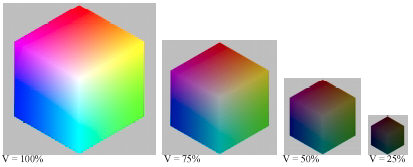
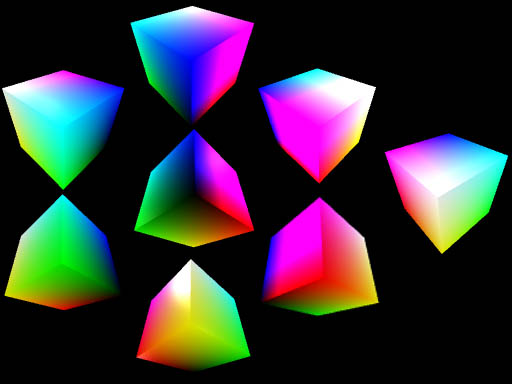
Re:Color dimensions
Then why is it alway represented by a two dimensional pallet?
Always? 2 3 4 5 6 7 8 9 10 11 12 13 14
It is often represented two dimensionally because it is difficult to display it three dimensionally. Two dimensional displays most often display Hue and Saturation and completely discard Value.
Color can be coded as RGB (Red/Rreen/Blue) or HSV (Hue/Saturation/Value) or HSL (Hue/SaturationLightness) or YCbCr aka YUV aka YIQ (used in TV) or CMY (Cyan/Magenta/Yellow) or L*a*b* or XYZ. It always requires exactly three components. Note CMYK uses 4, but K is redundant, it improves the quality of ink printing.
it isn't "exact" either, since many humans are missing at least one of the dimensions.
That is precisely why I included the word "normal" in "normal human vision".
- -
Ever tried Delphi?
When was Pascal ever "alive?"
-
Organizing ImagesYou can create individual files when you need to. But when do you need to? Browsing through them? Printing them out? You don't need them in individual files for that.
It is useful to have individual files to share with other people. But these might not be the same files you originally captured. You'd probably scan in the photos at the highest resolution and color depth your scanner can do. But when you attach an image to an email, you probably need to step it down a bit.
Anyway, you just have to have some kind of organizing software, if you've got so many photos that optimizing scanner time becomes an issue. If I were designing software that did this, I'd use a database, like the biolife example that comes with Delphi and Kylix. But now that I look at what's available, I see that most apps do store images as individual files.
Still, the principles the same. A good organizer can capture new images from your clipboard. So the procedure works out like this:
- Set organizer to automatically capture from clipboard.
- Place a bunch of images on the scanner.
- Scan. (This is the time-consuming part we need to minimize.)
- Drag a rectangle around an image, and click "copy".
- Repeat previous step for all images we just scanned.
- Go to step 2.
-
Pascal replaced by an OO language?
Pascal, being as dead in its pure form as a language can be, was bound to be replaced by some OO language.
Then why not object-oriented Pascal?
-
Re:Okay... and...?
Name 10 applications written in Java that can be bought at the store.
I believe he was talking about business systems (database clients and like ilk). Java clients have been quite successful in that area, there are tons.
Even so, I'm going to give it a shot, just for fun.
- LimeWire
- JBuilder
- Poseidon for UML
- BugSeeker
- IDEA
- ???
- Profit!
Dammit, just five, and using developer tools was kind of cheating.
-
Simple...
Get a near-monopoly on desktop operating systems, expand into developer tools, and push the competition virually out of the marketplace by making people think they have to use your product.
The same technique works well with web browsers and word processors.
-
Re: Software vs. Storage Format
If we ever got legislation mandating open formats for all public documents, Microsoft would be a minor player in the software world within five years.
I doubt that MS would have a problem with this. Look at one of MS's major products, Visual Studio. Anybody could download a copy of DJGPP or Borland's compiler, and just write the code in vim. Instead many people purchase Visual Studio because they prefer the IDE and it's tools. The same with MS Word, you could just as easily write the document in WordPad (of which the source is available). But they don't, because they actually perfer the interface.
A lot of people attribute MS's success to their "closed" formats, but they do actually make some good tools. If there was a mandate for open formats, MS would probably just focus on building better tools to work with those formats.
-
Re:w00t!
I guess its official, according to this article, Object Pascal is now called Delphi (see page 11):
"The Object Pascal language is now called the Delphi language. The online Help and documentation have been updated accordingly."
However, the newsgroup (forums.borland.com) for the language is still public.borland.delphi.objectpascal. -
Price tag is high, but educational discout rulesCheck out this link for educational discount pricing. Borland really gives significant discounts to "faculty, staff, and students of accredited academic institutions."
For example:
Delphi or JBuilder Enterprise
Reg: $2999
w/ Discount: $399
Kylix Enterprise
Reg: $1999
w/ Discount: $399
It really is a great price when you figure in all the the features that you get for $400. I know I'll never get use them all, though I'd like to -
Re:I miss the old Borland
And now you get the same thing for $60 from Borland.
You can download Borland C++ Builder 6 Personal Edition which includes IDE, form designers, compiler, debugger, inline assembler, tons of demos, 1600+ pages of documentation, and an extensive help system.
Sounds like a pretty good bargain to me.
-
Re:Sorry, No Good Linux Debuggers
You may want to take a look at Borland's Kylix, the linux-native port of Borland's respocted IDE's for C, C++, and Delphi (they claim it supports the same features as windows versions). It comes with a high quality debugger/profiler, and, while not free, a trial version is available.
-
Kylix?
Well, I haven't tried it, but what about Borland Kylix? The new version 3 claims to support ANSI/ISO C++ on Linux. And if you read the feature PDF on page 4 they mention many of the features you seek.
It might be worth taking a look.
-
Kylix?
Well, I haven't tried it, but what about Borland Kylix? The new version 3 claims to support ANSI/ISO C++ on Linux. And if you read the feature PDF on page 4 they mention many of the features you seek.
It might be worth taking a look.
-
HomeSite and C++Builder
For anything web related (HTML, CSS, PHP) I use HomeSite. It works. Great editor, nice syntax highlighting, lots of nice features. I haven't found anything even remotely comparable for Linux, unfortunately. For C/C++, C++Builder is excellent. The syntax highlighting works well and the editor is amazingly fast. Works on files of literally any size with no slowdowns.
-
Borland also has free Windows IDE's...
It should be noted that Borland also releases free as in beer "Personal" versions of C++ Builder and Delphi.
Both are similar in features and license to Kylix Open Edition (the Delphi personal description specifically mentions its intended use is to create "non-commercial Windows
In other words, while I wouldn't expect these to provide much of a shot in the arm for schools migrating to Linux, it speaks volumes for Borland and their commitment to Linux (Kylix) and its ideals (the open source-ish license of the Windows-based Personal versions).
-
Borland also has free Windows IDE's...
It should be noted that Borland also releases free as in beer "Personal" versions of C++ Builder and Delphi.
Both are similar in features and license to Kylix Open Edition (the Delphi personal description specifically mentions its intended use is to create "non-commercial Windows
In other words, while I wouldn't expect these to provide much of a shot in the arm for schools migrating to Linux, it speaks volumes for Borland and their commitment to Linux (Kylix) and its ideals (the open source-ish license of the Windows-based Personal versions).
-
Re:This also affects NWN.
I've never used C++ builder 6, but borland's C++ builder page says it uses CLX.
-
Below Borland's Radar...
So ya don't want to register to download the free Open Edition (GPL'd) or the trial version of Kylix 3.0, but you want to know more? Here ya go:
Screenshots of Kylix IDE...(an alpha version)
http://www.drbob42.com/kylix/hotshot.htm
Features of Kylix 3.0...
http://borland.com/kylix/pdf/kyl3_feamatrix.pdf
Or, go here and take the Product TOUR (if you have time to view their Flash 5 presentation and get all the sales-speak you can swallow i.e. good to show to boss). -
Below Borland's Radar...
So ya don't want to register to download the free Open Edition (GPL'd) or the trial version of Kylix 3.0, but you want to know more? Here ya go:
Screenshots of Kylix IDE...(an alpha version)
http://www.drbob42.com/kylix/hotshot.htm
Features of Kylix 3.0...
http://borland.com/kylix/pdf/kyl3_feamatrix.pdf
Or, go here and take the Product TOUR (if you have time to view their Flash 5 presentation and get all the sales-speak you can swallow i.e. good to show to boss). -
Re:screenshots?
Screenshots of Kylix IDE...(an alpha version)
http://www.drbob42.com/kylix/hotshot.htm
Features of Kylix 3.0...
http://borland.com/kylix/pdf/kyl3_feamatrix.pdf -
Re:screenshots?
yeah, it is strange they don't have a better tour of the IDE. Perhaps they do want people to download the trail version (and therefore require registration with them so they can sick their sales team on you...)
The best alternative (instead of registering and downloading Kylix 3.0 trial or Open Edition) I found on Borland's site is to take the Product Tour of Kylix. It's a Flash 5 presentation and provides quick glimpses of the IDE, and goes into much detail why Kylix should be considered as development package. Although it's geared more for the Enterprise-level manager than for the greater audience which would be us, the typical software developer.
Please post if you find screenshots! -
Re:How seemless will it be
You can already find out how seemless the Object Pascal/C++ integration will be, Borland C++ Builder
I've used BCB, and it's a quality product. It's not as clean as Delphi, but some PHB's I've seen get scared when you tell them you're going to write software in *shock* something other than C/C++.
When it comes to working with databases it's just hard to beat the usefullness and quality of the Borland database components. You just have to do so much less work when you use them.
-
Re:Delphi?
-
Free Downloadheise [1] writes that there is a free version of Kylix [2] avaiable within the next few days. Its free and may only be used to develop Open Source applications.
-
Kylix 3 just released with c++ and OP
borland has Just released Kylix 3with C++ and Object Pascal support in one product.
Don't know why this hasn't made it to -
Ahem. Pascal!
-
Re:Big differences I know of
Other than Oracle and Postgresql, I don't think any other database uses MVCC.
Interbase, Firebird and Solid also use versioning for concurrency control.Postgresql is BSD style (do what you will) while SAP was released under the GPL.
The SAP DB license isn't really onerous. The database kernel is under the GPL, so if you distribute the server on a CD-ROM, you need to put the server's source on the CD. If you allow a download of the server, you need a link to the server source. The programming interfaces and client utilities are under the Lesser GPL, and can be distributed as binaries and linked to closed-source software.
This licensing doesn't restrict my rights to my application software at all. As for letting customers know the identity of the server software, that's no problem because SAP DB is easier to sell than PizzaFace DB. -
Whatever you use, don't use MFC
I have job experience using MFC. I will not describe it in detail. I will just sum it up and say that it is truly the most un-productive horrid framework I have ever used. Also, Microsoft's new WTL is no better. In short, the class wizard helps you half the time (if it aint broke when you modify some code) and the message maps are a nightmare. This automatic code generation you speak of is not all that glamorous. All that code generation gives you is a cryptic program that comiles to be Notepad. You're on your own after that. The Document/View architecuture is bad and seems to be a perversion of the Model/View/Controller architecture. Doc/View can be good for small scale, but will break down and give you nightmares on large scale projects.
I started using two pieces of technology, Delphi and Qt, and I have never looked back. At work I use Visual C++ to program DLL's (using STL and no MFC classes at all) and I use Delphi to front end, as well as write the back end stuff too! If I had my choice I would ditch Visual C++ altogether, I think it gives C++ a bad name. I wish most companies would not buy Microsoft Visual C++.
I have never used wxWindows, but I can assume that it is better than MFC. As for cross platform needs MFC still is the worst choice. At one of my previous jobs they had a person that programmed a project for both Windows and Mac OS. There is MFC for the Mac platform. However, this programmer was frustrated by the details because what worked on MFC for Windows worked differently (or not at all) for MFC on Mac OS.
For cross platform I would say check out Qt and check out Delphi / C++ Builder. Qt was one of the best C++ libraries I have ever used and I wish I could use it on Windows at work. Delphi kicks ass in all aspects. IMHO Delphi is the only technology I know that can truly claim the title of being a RAD tool. Kylix is Delphi for Linux. C++ Builder should be ported to Linux by Borland soon enough.