Slashdot Mirror
Domain: brasslantern.org
Stories and comments across the archive that link to brasslantern.org.
Comments · 20
-
Interactive Fiction
There is actually a fairly large community for games similar to this in the English-speaking world, where it is known as interactive fiction (or by it's old-fashioned name, text adventure). Infocom produced some of the most famous games in this genre, including Zork and the Hitchhiker's Guide to the Galaxy, but there's now a very active community of (mostly) amateurs creating these games just for fun and to explore the artistic possibilities of interactivity in storytelling.
Most interactive fiction these days is purely text based, as that can be easily created by one or two people who have more experience with writing and programming than graphics and multimedia, and doesn't require a large budget or time investment, though you do occasionally see games with graphics. It has become common to write these games to run on a virtual machine, so that they can be run on all kinds of different platforms. The two most common virtual machines are the Z-machine, which has actually been reverse-engineered from Infocom's virtual machine and thus is compatible with most of their old games and tons of old computers, and the TADS VM. Likewise, there are two common authoring environments, which target these machines; Inform targets the Z-machine, and TADS targets, well, the TADS VM. Both have recently released innovative new systems; Inform 7 uses a natural language syntax (similar to the natural language input that controls the game), and TADS 3 is designed to be aggressively object-oriented.
For anyone who is new to these sorts of games, there are a few games that have been designed specifically for beginners. I would recommend Andrew Plotkin's Dreamhold or Emily Short's City of Secrets. You can find lots more games, along with capsule reviews of some of them, at Baf's Guide to the Interactive Fiction Archive. In order to play these games, you'll need an interpreter for the virtual machine. On Windows or Unix/Linux I would recommend Gargoyle, as it's an interpreter that has nice typography and supports many different virtual machines. On the Mac, I would recommend either Zoom (for Z-machine, with support for some other interpreters in beta) or Spatterlight (which supports many different machines).
There is also a large community interested in developing, playing, criticizing, and discussing these games. Some of the best places to go for discussion are the interactive fiction newsgroups, rec.arts.int-fiction (for discussion of interactive fiction programming, game design, and topics about the field as a whole) and rec.games.int-fiction (for announcement and discussion of particular games). There is also an interactive fiction MUD (mostly a fancy chat-room), several contests for developing the best interactive fiction, plenty of reviews and other articles online. There are several good beginner's guides to the format as well.
Anyhow, I thought that since this review made it sounds like interactive novels were mostly a Japanese thing, I thought I'd point out a bit of what is available in the English speaking world. As I mentioned, these are mostly text based, both due to the preferences of the authors and lack of budget, unlike the graphical Jap
-
Interactive Fiction
There is actually a fairly large community for games similar to this in the English-speaking world, where it is known as interactive fiction (or by it's old-fashioned name, text adventure). Infocom produced some of the most famous games in this genre, including Zork and the Hitchhiker's Guide to the Galaxy, but there's now a very active community of (mostly) amateurs creating these games just for fun and to explore the artistic possibilities of interactivity in storytelling.
Most interactive fiction these days is purely text based, as that can be easily created by one or two people who have more experience with writing and programming than graphics and multimedia, and doesn't require a large budget or time investment, though you do occasionally see games with graphics. It has become common to write these games to run on a virtual machine, so that they can be run on all kinds of different platforms. The two most common virtual machines are the Z-machine, which has actually been reverse-engineered from Infocom's virtual machine and thus is compatible with most of their old games and tons of old computers, and the TADS VM. Likewise, there are two common authoring environments, which target these machines; Inform targets the Z-machine, and TADS targets, well, the TADS VM. Both have recently released innovative new systems; Inform 7 uses a natural language syntax (similar to the natural language input that controls the game), and TADS 3 is designed to be aggressively object-oriented.
For anyone who is new to these sorts of games, there are a few games that have been designed specifically for beginners. I would recommend Andrew Plotkin's Dreamhold or Emily Short's City of Secrets. You can find lots more games, along with capsule reviews of some of them, at Baf's Guide to the Interactive Fiction Archive. In order to play these games, you'll need an interpreter for the virtual machine. On Windows or Unix/Linux I would recommend Gargoyle, as it's an interpreter that has nice typography and supports many different virtual machines. On the Mac, I would recommend either Zoom (for Z-machine, with support for some other interpreters in beta) or Spatterlight (which supports many different machines).
There is also a large community interested in developing, playing, criticizing, and discussing these games. Some of the best places to go for discussion are the interactive fiction newsgroups, rec.arts.int-fiction (for discussion of interactive fiction programming, game design, and topics about the field as a whole) and rec.games.int-fiction (for announcement and discussion of particular games). There is also an interactive fiction MUD (mostly a fancy chat-room), several contests for developing the best interactive fiction, plenty of reviews and other articles online. There are several good beginner's guides to the format as well.
Anyhow, I thought that since this review made it sounds like interactive novels were mostly a Japanese thing, I thought I'd point out a bit of what is available in the English speaking world. As I mentioned, these are mostly text based, both due to the preferences of the authors and lack of budget, unlike the graphical Jap
-
Yea, verilyInteractive fiction has lived on, but kept a low profile after its commercial heyday. As of April 2006, the new authoring system has (IMHO) vastly increased the possibilities for creating interactive fiction for the general population.
A good example of what will be easier to write in the next generation of interactive fiction is Galatea, and some of the worked examples that come with inform 7 really showcase its power. I defy you to read through the manual and not come up with an idea for at least one story to implement.
One great article I read that actually made me stop, reread the paragraph, and put down my pilot (I read it in plucker) and think about the implications was in SPAG issue 44. Another couple good articles are in http://brasslantern.org/writers/howto/i7intro.htm
l and http://brasslantern.org/writers/iftheory/i7observa tions.html . Without spoiling the latter article, I'll mention that one of the paragraphs under the 'relations' section blew my mind. -
Yea, verilyInteractive fiction has lived on, but kept a low profile after its commercial heyday. As of April 2006, the new authoring system has (IMHO) vastly increased the possibilities for creating interactive fiction for the general population.
A good example of what will be easier to write in the next generation of interactive fiction is Galatea, and some of the worked examples that come with inform 7 really showcase its power. I defy you to read through the manual and not come up with an idea for at least one story to implement.
One great article I read that actually made me stop, reread the paragraph, and put down my pilot (I read it in plucker) and think about the implications was in SPAG issue 44. Another couple good articles are in http://brasslantern.org/writers/howto/i7intro.htm
l and http://brasslantern.org/writers/iftheory/i7observa tions.html . Without spoiling the latter article, I'll mention that one of the paragraphs under the 'relations' section blew my mind. -
No graphics needed for next gen gamesInteractive fiction has lived on, but kept a low profile after its commercial heyday. As of April 2006, the new authoring system has (IMHO) vastly increased the possibilities for creating interactive fiction for the general population.
A good example of what will be easier to write in the next generation of interactive fiction is Galatea, and some of the worked examples that come with inform 7 really showcase its power. I defy you to read through the manual and not come up with an idea for at least one story to implement.
One great article I read that actually made me stop, reread the paragraph, and put down my pilot (I read it in plucker) and think about the implications was in SPAG issue 44. Another couple good articles are in http://brasslantern.org/writers/howto/i7intro.htm
l and http://brasslantern.org/writers/iftheory/i7observa tions.html . Without spoiling the latter article, I'll mention that one of the paragraphs under the 'relations' section blew my mind. -
No graphics needed for next gen gamesInteractive fiction has lived on, but kept a low profile after its commercial heyday. As of April 2006, the new authoring system has (IMHO) vastly increased the possibilities for creating interactive fiction for the general population.
A good example of what will be easier to write in the next generation of interactive fiction is Galatea, and some of the worked examples that come with inform 7 really showcase its power. I defy you to read through the manual and not come up with an idea for at least one story to implement.
One great article I read that actually made me stop, reread the paragraph, and put down my pilot (I read it in plucker) and think about the implications was in SPAG issue 44. Another couple good articles are in http://brasslantern.org/writers/howto/i7intro.htm
l and http://brasslantern.org/writers/iftheory/i7observa tions.html . Without spoiling the latter article, I'll mention that one of the paragraphs under the 'relations' section blew my mind. -
Re:Trolls.
You should check out some more modern games. The form has come a long way in the almost 30 years since Zork.
http://www.brasslantern.org/
http://www.ifcomp.org -
Re:Good Idea?
Hmm. I may be missing something, but I think you're confusing Choose Your Own Adventure type multiple choice games with the more simulationist, finer-grained parser-based text adventures; the grand-parent post quoted the very first of the latter - the venerable (if primitive) Adventure/Colossal Cave from 1975 (or one of its various, er, mods.)
Popular companies were Infocom, Magnetic Scrolls and Level 9, among others; these days, the form is kept alive by enthusiasts and frequently taken into directions more experimental and/or literary than throw the axe at the dwarf then pick up the gold.
Baf's Guide to the IF-Archive is a good place to start searching; as is the IF Review Conspiracy. Poke around and you'll notice most good games require either a "Z-Code" or "TADS" interpreter (VM); refer to the Inform homepage for a list of UNIX Z-Code interpreters or just go with Zoom right away (link has pretty picture). As for TADS games, here're the Linux TADS 2/3 Playkit and, alternatively, a QT-based TADS 2/3 interpreter.
TADS and Inform, incidentally, are the two most widely used Interactive Fiction programming languages. And although that's not their intended purpose, both have also been used for multiple choice games on occasion.
If you're interested, Brass Lantern has a collection of articles for beginners. If you're not, oh well -
For the electronic kind
The beta of Inform 7 (A.k.a Natural Language Inform) has already had two extensions written to write Choose-your-own-adventure type games.
There's the simpler one from Emily Short: http://emshort.home.mindspring.com/CYOA.txt
And a more powerful, but more complex one from Mark Tillford: http://www.glpics.com/ralphmerridew/Simple%20CYOA
Inform 7 is a pretty nifty language, and I'm surprised
There's also an overview of Inform 7 language and what it gets you over at http://www.brasslantern.org/ -
Not newPeople creating Text-Adventures have been around a long time, they were never gone, so to speak.
- http://www.tads.org/
- http://brasslantern.org/
- http://www.xyzzynews.com/
- http://www.ifcomp.org/
- http://www.ifarchive.org/
And, for the more graphically inclined, check out these: -
Re:Nostalgia
You're misremembering somewhat.
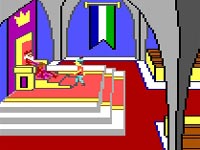
The original King's Quest (1983) was one of the very first games released for the (at the time) brand-new IBM PC. It was fantastic for the time, but looking back it's painfully obvious that it was sixteen colours. (Screenshot)
Several years later (1990), they re-released it with newer graphics, but it was still 16 colours. This is probably the one you're thinking of. 1990 was also about the time they switched over to VGA (256 colours), so all subsequent Sierra remakes got the VGA treatment. (Screenshot) -
Re:Um...
-
Re:Lose your data to DMCA ?
This issue is usually called the "abandonware debate". Here's some more reading:
Wired News: Nostalgia Keeps Games Afloat
Home of the Underdogs
Abandonware from back before 1986
Abandonware - Wikipedia, the free encyclopedia
Brass Lantern Warez Abandonware and the Software Industry
When you finish reading some of this stuff, you really start thinking the current length of copyright is really, really out of hand (as if there wasn't enough evidence of that already.) -
Additional (positive) Reviews
All of the reviews I've seen, including my own, have been uniformly positive. You can see some of those reviews listed on the author's page about the books. It's an extremely accessible book, which isn't easy to do, and the highest praise I can give it is that I wish I'd written it.
-
Re:classic games?
The underdogs site, from what I can tell, only (knowingly) distributes games that are not still being sold by the publisher. It deals purely in abandonware which admittedly isn't strictly legal(well, read not legal). There are a fair few arguments for and against the free distribution of such software, some of which may be read here, and here,.
-
Re:Actually it is from Zork...
Greetings,
Well... To get this right would take a while, and is massively off-topic, but IIRC, the original Colossal Caves (Adventure, by Crowther and Woods) was written in Fortran, and had a twisty maze of passages, which was also used in Dungeon/Zork, which was very heavily influenced by Adventure.
The commercial (Infocom) Zork series is a splitting up of the Dungeon/Zork program, which was not originally written in Fortran, it was in fact originally written in MDL by Marc Blank and Dave Lebling, and translated to Fortran by a 'somewhat paranoid DEC engineer who prefers to remain anonymous'.
Zork took the Dungeon world, split it up into three worlds, and then added a bunch more stuff to each part of it, although most additions were to Zork II and III, IIRC. Zork I was mostly identical to the early part of Dungeon.
The Adventure versions are are also known by their point values (330, 551, etc.). There are modified versions of Adventure which add large amounts of other areas, and up the points to as many as 1000 points. I've played Adventure on machines ranging from my PalmPilot to PC's of all shades, to Vaxen and even a Prime mini/mainframe which had the largest and highest point version I'd ever seen. (>1000 points, iirc).
The names Zork and Dungeon have been completely intermingled. I was under the impression it was originally named Dungeon, and then later named Zork, but many of the history pages have it the other way around.
The original Dungeon/Zork had 'GDT', a 'Grand (Game?) Debugging Tool', that let you examine objects, and rooms, in the world. Getting to it required knowing some magic way of translating a key that was printed when you typed in 'GDT'. In my case, it meant teaching myself VAX assembly language, so I could debug and patch the binary, so whatever I typed was accepted...
Some more information is available here (Colossal Caves), and here (Dungeon/Zork), and you can find out more about Interactive Fiction's history as well.
I'm a terribly long-standing fan of IF, even before it had that moniker, having learned a lot about programming by writing text adventure games, parsers, and all the database-like coding needed to make a good text adventure game.
I can still lose myself in the games, just like I can lose myself in a really good book. It's a different world, and a lot of fun as long as you're okay letting your imagination provide all the graphics.
-- CyberFOX! -
Re:These aren't really independent genres per se
One example that they have is "Text adventure". Well, obviously, people are not interested text games any more but it doesn't mean that the niche is gone, it has just been filled with games with more technical capabilities but which still satisfy the same needs and appeal to the same types of people.
There is still a very much alive and kicking text adventure scene. Even the Infocom Z machine is still around and you can write your own games for it (I even did a multiplayer IF project myself a while back).
Check out:
rec.arts.int-fiction rec.games.int-fiction Brass Lantern -
A Note from the Organizer
Hi, I'm the competition organizer. A few words of instruction and explanation. The basic idea is that you're to download and play at least five of the forty games, and then rate them on a scale of 1 to 10, where 10 is the best. Full instructions are in the competition readme file.
Most of the games run in a virtual machine, so you'll need to download interpreters for those machines. For the TADS 2 and 3 games, grab the unified TADS 2 and 3 source tarball for Unix. For the z-code games, try Nitfol or Unix Frotz. For the Glulx game, try Linux Glulxe or Solaris Glulxe. For the ALAN games, grab GlkALAN for Linux.
You've got until November 15th to vote. Even if you don't want to vote, feel free to play the games anyway. And if this really gets you jonesing to play more of the recently-released interactive fiction, stop by Baf's Guide to the IF Archive for reviews of many of the games on the IF Archive. Oh, and a minor plug for my IF site, Brass Lantern.
Stephen
-
Re:bust out the infocom parser
Actually, there are plenty of "Infocom-like" games still being made, though the games I'm talking about range from the traditional to the not so traditional.
If you're interested in finding out more, I'd suggest reading reviews of recent text adventures from a site or two and then downloading the games from the Interactive Fiction Archive.
-
A Rundown of the Judging
Hi. I'm the competition organizer for this year. I suspect the competition web server is going to get hammered, so I'll give a rundown of what's going on and what you can do to enter.
Zeroth, your source for most everything I'm going to talk about is the IF Archive. Reach it at http://ifarchive.org, or at the mirror http://mirror.ifarchive.org.
First, you'll need interpreters, since most of the games are written for specific interactive fiction virtual machines. I'm guessing plenty of you have Linux boxes; I'll try to get my old article on Linux interpreters up at my personal IF site, Bras Lantern, later today. It should have more bandwidth than the competition site.
Second, the games. This directory on the IF Archive has all of the games, either unpacked or in a big
Third, choosing which games to play. You only have to play five of them to judge. If you think you'll only be able to play a handful of games, I ask that you play a random selection. There's a front-end to the competition, Comp01.z5, which is structured like a text adventure. It will randomize the list of games, sorted by which ones you can play, and even give you a nice voting form to fill out if you're so inclined.
Fourth, judge. You can play games for a maximum of two hours before giving it a rating. Note that you don't have to play for two hours. We only set a maximum play time, not a minimum one. To rate a game, give it a score from 1 to 10. 10 is good. 1 is not good. Use whatever criteria you wish.
Fifth, vote. You can mail your votes to the competition vote-counter or visit the web site to record your votes there.
Sixth, and optional, we've got competition t-shirts for your wearing pleasure.
All of this is detailed in the README which comes with the competition games packages. Enjoy.