Slashdot Mirror
Domain: brookings.edu
Stories and comments across the archive that link to brookings.edu.
Stories · 19
-
Only 25 Percent of Occupations In US Are At 'High Risk' For Losing Jobs From Automation, Study Finds
An anonymous reader quotes a report from Quartz: Automation is coming, but not for everyone. Researchers at the Brookings Institution estimate just 25% of occupations in the US -- in production, food service, and transportation -- are at "high risk" for losing jobs from the advance of automation. "Automation is not the end of work," said Mark Muro, policy director for the Brookings Institution's program on urban economies and co-author of a study published Jan. 24. Most occupations will see specific tasks assumed by machines, but much of their labor will likely be enhanced, rather than fully replaced, through automation, the study found. That's because automation rarely replaces entire jobs, but instead handles specific tasks in occupations that often require hundreds of them.
To forecast the effects, Brookings researchers looked at thousands of specific tasks within each occupation, and the degree to which automation could handle them, coming up with a risk rating for each occupation. The workers most vulnerable are in transportation, production, food preparation, and office administration, which, combined, make up about 36 million jobs, or 25% of the total jobs in the US today. In these occupations, roughly 70% of tasks were considered routine and predictable, prime targets to be managed by machines. The most vulnerable were "packaging and filling machine operators" (100% exposure to automation), food preparation workers (91%), payroll and timekeeping clerks (87%), and light-truck and delivery drivers (78%). -
Half the World Is Now Middle Class Or Wealthier, Says Brookings Institution (brookings.edu)
schwit1 shares a report from the Brookings Institution: Something of enormous global significance is happening almost without notice. For the first time since agriculture-based civilization began 10,000 years ago, the majority of humankind is no longer poor or vulnerable to falling into poverty. By our calculations, as of this month, just over 50 percent of the world's population, or some 3.8 billion people, live in households with enough discretionary expenditure to be considered "middle class" or "rich." About the same number of people are living in households that are poor or vulnerable to poverty. So September 2018 marks a global tipping point. After this, for the first time ever, the poor and vulnerable will no longer be a majority in the world. Barring some unfortunate global economic setback, this marks the start of a new era of a middle-class majority.
In most countries, there is a clear relationship between the fate of the middle class and the happiness of the population. According to the Gallup World Poll, new entrants into the middle class are noticeably happier than those stuck in poverty or in vulnerable households. Conversely, individuals in countries where the middle class is shrinking report greater degrees of personal stress. The middle class also puts pressure on governments to perform better. They look to their governments to provide affordable housing, education, and universal health care. They rely on public safety nets to help them in sickness, unemployment or old age. But they resist efforts of governments to impose taxes to pay the bills. This complicates the politics of middle-class societies, so they range from autocratic to liberal democracies. Many advanced and middle-income countries today are struggling to find a set of politics that can satisfy a broad middle-class majority. The tipping point in the world today offers opportunities for business but complications for policymakers. -
The Gig Economy Keeps Growing, But Worker Benefits Aren't (technologyreview.com)
An anonymous reader quotes a report from MIT Technology Review: According to a new report out from Brookings, the number of non-employer firms -- primarily incorporated freelancers and gig-economy workers -- has grown 2.6 percent every year since 1997. By contrast, payroll employment has grown by only 0.8 percent annually in that time. That means a growing number of people lack employer-sponsored benefits like paid leave, health care, and retirement assistance. The Aspen Institute has proposed a system of portable benefits that are not tied to one job. Companies would make contributions to a worker's benefits on the basis of how much the employee works for them. To date, the U.S. government has not been helpful. House and Senate bills supporting gig-worker benefits have died in committee. But state and local governments are taking action. Washington, California, New York, and New Jersey are exploring avenues to provide benefits to their gig workers. -
Empirical Research Reveals Three Big Problems With How Patents Are Vetted (arstechnica.com)
An anonymous reader quotes a report from Ars Technica: If you've read our coverage of the Electronic Frontier Foundation's "Stupid Patent of the Month" series, you know America has a patent quality problem. People apply for patents on ideas that are obvious, vague, or were invented years earlier. Too often, applications get approved and low-quality patents fall into the hands of patent trolls, creating headaches for real innovators. Why don't more low-quality patents get rejected? A recent paper published by the Brookings Institution offers fascinating insights into this question. Written by legal scholars Michael Frakes and Melissa Wasserman, the paper identifies three ways the patent process encourages approval of low-quality patents:
-The United States Patent and Trademark Office (USPTO) is funded by fees -- and the agency gets more fees if it approves an application.
-Unlimited opportunities to refile rejected applications means sometimes granting a patent is the only way to get rid of a persistent applicant.
-Patent examiners are given less time to review patent applications as they gain seniority, leading to less thorough reviews.
None of these observations is entirely new. But what sets Frakes and Wasserman's work apart is that they have convincing empirical evidence for all three theories. They have data showing that these features of the patent system systematically bias it in the direction of granting more patents. Which means that if we reformed the patent process in the ways they advocate, we'd likely wind up with fewer bogus patents floating around. -
Governments Shut Down the Internet More Than 50 Times in 2016 (thewire.in)
An anonymous reader writes: Governments around the world shut down the internet more than 50 times in 2016 -- suppressing elections, slowing economies and limiting free speech. In the worst cases internet shutdowns have been associated with human rights violations, Deji Olukotun, senior global advocacy manager at digital rights organisation Access Now told IPS. "What we have found is that internet shutdowns go hand in hand with atrocities," said Olukotun. "In Ethiopia there's been consistent blocking this year of social media and internet." Dozens of people have died in protests in Ethiopia in 2016, "many of them during the kind of blackout where it's difficult to report on what's happening," he said. Several leaders used internet shutdowns to affect democratic processes, including elections. "In Uganda in February 2016 there was a shutdown of social media networks by President Museveni and that again happened in Gambia (in December) surrounding the election," Olukotun added. In other cases, three governments chose to shut down the internet because they thought that it would stop students from cheating on their exams, he said. "On the whole most governments want to expand internet access," said Olukotun. However governments do not seem to have taken into account the potential repercussions of the shutdowns, beyond the limits of free speech. According to an estimate, internet shutdowns resulted in a loss of $2.4 billion in 2015. -
Purdue Experiments With Income-Contingent Student Loans
HughPickens.com writes: Danielle Douglas-Gabriel writes in the Washington Post that Purdue University is partnering with Vemo Education, a Reston-based financial services firm, to create income-share agreements, or ISAs, that its students can tap to pay for tuition, room and board. In return, students would pay a percentage of their earnings after graduation for a set number of years, replenishing the fund for future investments. Purdue president Mitch Daniels calls the contracts a constructive addition to today's government loan programs and perhaps the only option for students and families who have low credit ratings and extra financial need. "From the student's standpoint, ISAs assure a manageable payback amount, never more than the agreed portion of their incomes. Best of all, they shift the risk of career shortcomings from student to investor: If the graduate earns less than expected, it is the investors who are disappointed; if the student decides to go off to find himself in Nepal instead of working, the loss is entirely on the funding providers, who will presumably price that risk accordingly when offering their terms. This is true "debt-free" college."
However some observers worry that students pursuing profitable degrees in engineering or business would get better repayment terms than those studying to become nurses or teachers. "Income share agreements have the potential to create another option for students looking to pay for college while seeking assurances they will not be overwhelmed by future payments," says Robert Kelchen. "However, given the current generosity of federal income-based repayment programs and the likely hesitation of those who expect six-figure salaries to sign away a percentage of their income for years to come, the market for these programs may be somewhat limited." -
Microsoft-Backed Think Tank: K-12 CS Education Cure For Sagging US Productivity
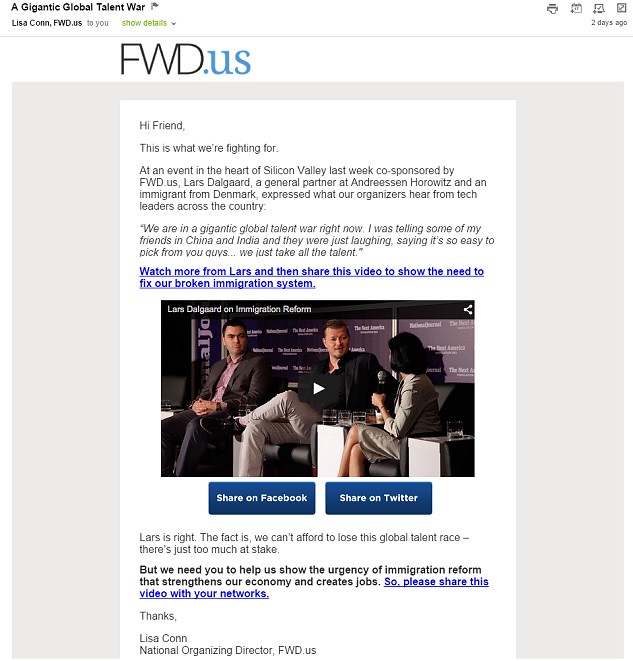
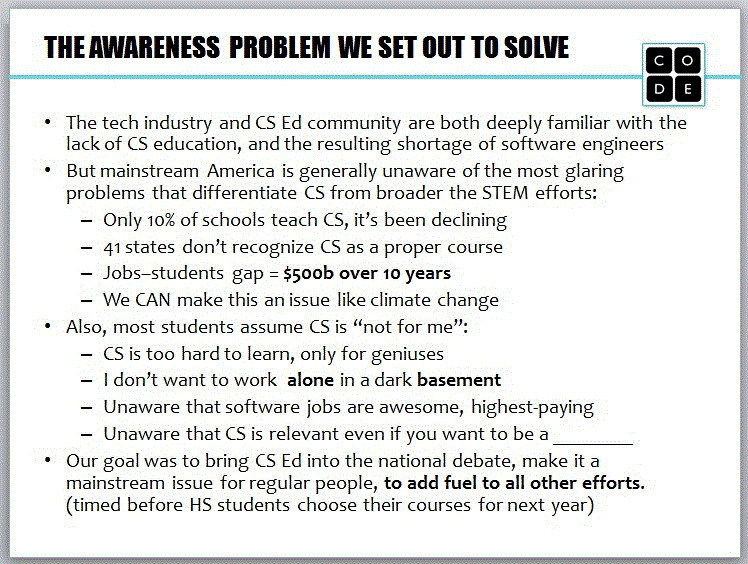
theodp writes: On May 6, notes think tank Brookings, the Department of Labor released labor productivity data showing that output per worker fell by 1.9 percent during the first quarter of 2015. But fear not — the Metropolitan Policy Program of [Microsoft-backed] Brookings says K-12 computer science education is the cure for what ails U.S. productivity: "So how can the United States reverse this trend? First, states, metropolitan areas, and school districts must recognize that basic digital literacy is no longer sufficient preparation for the 21st century workforce. Familiarity with higher-level skills such as coding will be critical as the role of technology continues to grow. The 60-plus school districts that have partnered with [Microsoft-backed] Code.org have already begun to move in this direction. By introducing students to computer science fundamentals early on, Code.org and its partner districts will help get more people on pathways to well-paying jobs in computer programming and other fields." Creating a national K-12 CS and tech immigration crisis was proposed as Microsoft introduced its 'two-pronged' National Talent Strategy to increase K-12 CS education and the number of H-1B visas at a Brookings event in 2012. While creating a K-12 CS crisis fell to Code.org, fanning the flames of a tech immigration crisis is the purvey of [Microsoft exec-backed] FWD.us, the PAC formed by Facebook CEO Mark Zuckerberg, which recently sent an email blast warning U.S. citizens they're in 'A Gigantic Global Talent War', adding that China and India citizens are "just laughing [at the US], saying it's so easy to pick from you guys... we just take all the talent." -
Microsoft-Backed Think Tank: K-12 CS Education Cure For Sagging US Productivity
theodp writes: On May 6, notes think tank Brookings, the Department of Labor released labor productivity data showing that output per worker fell by 1.9 percent during the first quarter of 2015. But fear not — the Metropolitan Policy Program of [Microsoft-backed] Brookings says K-12 computer science education is the cure for what ails U.S. productivity: "So how can the United States reverse this trend? First, states, metropolitan areas, and school districts must recognize that basic digital literacy is no longer sufficient preparation for the 21st century workforce. Familiarity with higher-level skills such as coding will be critical as the role of technology continues to grow. The 60-plus school districts that have partnered with [Microsoft-backed] Code.org have already begun to move in this direction. By introducing students to computer science fundamentals early on, Code.org and its partner districts will help get more people on pathways to well-paying jobs in computer programming and other fields." Creating a national K-12 CS and tech immigration crisis was proposed as Microsoft introduced its 'two-pronged' National Talent Strategy to increase K-12 CS education and the number of H-1B visas at a Brookings event in 2012. While creating a K-12 CS crisis fell to Code.org, fanning the flames of a tech immigration crisis is the purvey of [Microsoft exec-backed] FWD.us, the PAC formed by Facebook CEO Mark Zuckerberg, which recently sent an email blast warning U.S. citizens they're in 'A Gigantic Global Talent War', adding that China and India citizens are "just laughing [at the US], saying it's so easy to pick from you guys... we just take all the talent." -
Think Tanks: How a Bill [Gates Agenda] Becomes a Law
theodp writes: The NY Times' Eric Lipton was just awarded a 2015 Pulitzer Prize for investigative reporting that shed light on how foreign powers buy influence at think tanks. So, it probably bears mentioning that Microsoft's 'two-pronged' National Talent Strategy (PDF) to increase K-12 CS education and the number of H-1B visas — which is on the verge of being codified into laws — was hatched at an influential Microsoft and Gates Foundation-backed think tank mentioned in Lipton's reporting, the Brookings Institution. In 2012, the Center for Technology Innovation at Brookings hosted a forum on STEM education and immigration reforms, where fabricating a crisis was discussed as a strategy to succeed with Microsoft's agenda after earlier lobbying attempts by Bill Gates and Microsoft had failed. "So, Brad [Microsoft General Counsel Brad Smith]," asked the Brookings Institution's Darrell West at the event, "you're the only [one] who mentioned this topic of making the problem bigger. So, we galvanize action by really producing a crisis, I take it?" "Yeah," Smith replied (video). And, with the help of nonprofit organizations like Code.org and FWD.us that were founded shortly thereafter, a national K-12 CS and tech immigration crisis was indeed created. -
Think Tanks: How a Bill [Gates Agenda] Becomes a Law
theodp writes: The NY Times' Eric Lipton was just awarded a 2015 Pulitzer Prize for investigative reporting that shed light on how foreign powers buy influence at think tanks. So, it probably bears mentioning that Microsoft's 'two-pronged' National Talent Strategy (PDF) to increase K-12 CS education and the number of H-1B visas — which is on the verge of being codified into laws — was hatched at an influential Microsoft and Gates Foundation-backed think tank mentioned in Lipton's reporting, the Brookings Institution. In 2012, the Center for Technology Innovation at Brookings hosted a forum on STEM education and immigration reforms, where fabricating a crisis was discussed as a strategy to succeed with Microsoft's agenda after earlier lobbying attempts by Bill Gates and Microsoft had failed. "So, Brad [Microsoft General Counsel Brad Smith]," asked the Brookings Institution's Darrell West at the event, "you're the only [one] who mentioned this topic of making the problem bigger. So, we galvanize action by really producing a crisis, I take it?" "Yeah," Smith replied (video). And, with the help of nonprofit organizations like Code.org and FWD.us that were founded shortly thereafter, a national K-12 CS and tech immigration crisis was indeed created. -
Study Predicts 9% Drop In Salaries of New CS Grads This Year
Jim_Austin writes: The first report on the class of 2015 from the respected National Association of Colleges and Employers (NACE), which conducts surveys of employers' hiring intentions throughout the year, projects a 9% drop in the salaries of new computer science bachelor's degree graduates, from $67,300 in 2014 to $61,287 this year. Reader phantomfive sends this news on a related subject: The Brookings Institute has released a report showing where the tech jobs are in the United States. Of course, San Jose comes in first, but Kansas is high up in the list. Michigan and Utah also were surprisingly high. On the other hand, if you live in Minnesota and you think there are no tech jobs, you are probably right. -
The Case For a Federal Robotics Commission
New submitter hmcd31 writes: In a new paper for Brookings' series on the future of civilian robotics, University of Washington Law Professor Ryan Calo argues the need for a Federal Robotics Commission. With advancements such as driverless cars and drones taking to the roads and skies, Calo sees a need for a government agency to monitor these changes. His paper details many benefits a robotics commission could bring, from funding to assisting in law and policy issues. The policies developed by this FRC are argued to be particularly important, as their impact in creating an early infrastructure for robotics could create an environment that lets the technology grow even more. -
Brookings Study Calls Solar, Wind Power the Most Expensive Fossil Alternatives
turkeydance (1266624) writes A new study [PDF] from the Brookings Institution, a Washington think tank, argues that using solar and wind energy may be the most expensive alternatives to carbon-based electricity generation, even though they require no expenditures for fuel.....Specifically, this means nuclear power offers a savings of more than $400,000 worth of carbon emissions per megawatt of capacity. Solar saves only $69,000 and wind saves $107,000. An anonymous reader points out that the Rocky Mountain Institute finds the Brookings study flawed in several ways, and offers a rebuttal. -
H-1B Cap Reached Today; Didn't Get In? Too Bad
First time accepted submitter Dawn Kawamoto writes "Employers stampeding into the U.S. Citizenship and Immigration Service to get their H-1B petitions filed before the cap is reached are getting the door slammed in their face today. The cap was hit in near record time of 5 days, compared to the 10 weeks it took last year to have more than enough petitions to fulfill the combined cap of 85,000 statutory and advanced degree H-1B petitions. While U.S. tech workers scream that they're losing out on jobs as H-1B workers are hired, employers are countering that the talent pool is lacking and they need to increase the cap. Of course, Congress is wrangling in on this one as to whether it's time to raise the bar." -
We Don't Need More Highways
Hugh Pickens writes "When it comes to infrastructure, politicians usually prefer shiny new projects over humdrum repairs. A brand-new highway is exciting: There's a ribbon-cutting, and there's less need to clog up existing lanes with orange cones and repair crews. So it's not surprising that 57 percent of all state highway funding goes toward new construction, often stretching out to the suburbs, even though new roads represent just 1.3 percent of the overall system. Now Brad Plumer writes in the Washington Post that many transportation reformers think this is a wrong-headed approach and that we should focus our dollars on fixing and upgrading existing infrastructure rather than continuing to build sprawling new roads). UCLA economist Matthew Kahn and the University of Minnesota's David Levinson made a more detailed case for a 'fix-it first' strategy. They noted that, at the moment, federal highway spending doesn't get subjected to strict cost-benefit analysis, and governments often build new roads when they arguably shouldn't (PDF). And that's to say nothing of data suggesting that poor road conditions are a 'significant factor' in one-third of all fatal crashes, and cause extra wear and tear on cars." -
Romney Taps Wisconsin Congressman Paul Ryan As Running Mate
Shortly after 9 a.m. Eastern time Saturday, Republican candidate Mitt Romney officially announced (via phone app) his selection of 42-year-old Wisconsin Congressman Paul Ryan as running mate for the 2012 U.S. presidential race. Ryan's selection was announced by the Romney campaign to various media outlets earlier this morning. Ryan is considered popular among a wide range of Republican voters, being a budget hawk who favors less liberal laws concerning abortion. Ryan's lauded popularity among Tea Party voters is mixed; some reports describe him as a Tea Party favorite, others as a far-right imposter. -
Coming Soon: Ubiquitous Long-Term Surveillance From Big Brother
alphadogg writes "As the price of digital storage drops and the technology to tap electronic communication improves, authoritarian governments will soon be able to perform retroactive surveillance on anyone within their borders, according to a Brookings Institute report. These regimes will store every phone call, instant message, email, social media interaction, text message, movements of people and vehicles and public surveillance video and mine it at their leisure, according to 'Recording Everything: Digital Storage as an Enabler of Authoritarian Government,' written by John Villaseno, a senior fellow at Brookings and a professor of electrical engineering at UCLA." -
An Argument Against Software Patents
clndnng writes "Roughly 90% of web content consists of discussions of software patents, so it's a little surprising that Ben Klemens has written what may be the first dead-trees book analyzing their validity. It has a lot of ground to cover: you could approach the topic from the perspective of the geeks, the lawyers, the economists, or the businessmen. Klemens is equal-opportunity, addressing every perspective." Read the rest of the review. Math You Can't Use: Patents, Copyright and Software author Ben Klemens pages publisher Brookings Instituion Press rating 9/10 reviewer ISBN 0-8157-4942-2 summary Explains why patents don't make sense for software
The first question you are probably asking yourself is whether this book says anything that you haven't already read on Slashdot's pages. Barring any omniscient readers, the answer is probably yes, because the book covers so many different angles. You might already know what he will say about the Church-Turing Thesis, but you probably don't know the law of scènes à faire or contributory infringement. Slashdot chestnuts like Amazon.com's one-click patent and the SCO v IBM case make only passing appearances, leaving room for more interesting examples about Garbage Pail Kids and Banana Protective Devices.
Chapter two of the book gives a quick-and-dirty overview of the economic motivations for patent law. I should tell you that Ben Klemens and I were both students at Caltech's PhD program for Social Sciences, so I was half expecting him to whip out the infinite sequences of integrals over a Riemann manifold here. But he either didn't think the Greek relevant or chose to spare us mere mortals, because he keeps the theory pretty simple: patents are supposed to maximize the size of the market. If nobody is providing a good, patents should induce somebody to provide, but if many people are providing the good, then a good patent regime shouldn't diminish that number of providers to one.
You can see where this is going: patents on software are often not necessary to induce code-writing, and when they do exist they seriously diminish what could have been a crowded market. He ties this to finding the optimal breadth of a patent, because a too-broad patent gives the owner a cheap monopoly over a range that could have held a large number of competitors.
The next chapter is the computer science chapter. He goes into detail about how we go from transistors to instruction sets, which turns out to be important in the next chapter when patent examiners try to draw a line between the two. He also talks about how one could write up a symbol table to translate any given program into lambda calculus expressions, which are pure math by any definition of the term. If pure math isn't patentable, and a program can be translated into a pure mathematical expression, then where does the program get off being patentable?
Chapter four shows how U.S. law went from disallowing software patents to letting through patents on anything sort of techy-sounding. The first alibi by the courts is that code may be pure math, but a machine on which is programmed pure math is a physical device, just like a toaster. Klemens tries to address this via the discussion above about how the transistors are soldered on at the factory, but the programs coded onto them are just states on a state machine. He brings up the breadth problem above: a patent for an algorithm on any general-purpose computer is a patent of huge breadth.
The second alibi by the courts is that the application of an equation to a useful purpose is distinct from the equation itself. As tenuous as such a distinction is, it hasn't held, so there are now patents on the books for math applied to useful purposes like a "Method for performing complex fast Fourier transforms," a "Method of efficient gradient computation," and a "Cosine algorithm for relatively small angles."
That's the thrust of the theory that Klemens covers. Most of the rest of the book shows how software patents in the real world create problems. He cites interviews with venture capitalists by a University of Texas researcher in which they say that they just expect to be violating patents left and right in the normal course of business. He cites another set of researchers who surveyed technologists in a variety of fields, and found that companies in most fields mostly patent in order to protect their inventions, while computing companies are most likely to patent so they can game the system.
Klemens seems to be downplaying the role of open source in all of this. In Chapter 6, he points out that the U.S. software market is evenly split between software companies (32.6%), consultants (36.4%), and in-house software (31.0%). That is, most software isn't written by software companies, and some of that not-software-company software is OSS. It's the decentralization, not the openness, that matters. Patents have never been applied to a decentralized industry before, and they don't work there because independent invention is not a valid defense against claims of patent infringement, and independent invention is inevitable in such a decentralized industry.
Finally, the book covers copyright, which makes sense because if patents really are going to be thrown out, then coders will be relying on copyright more. For example, the GPL is based on copyright protection. The recommendation here is that copyright be aimed at detecting plagiarism anywhere along the line, so if you cut and paste my FORTRAN code and run it through f2c, your C code is still infringing my copyrights. He points out that software is uniquely well-suited to enforcing copyright all along the development process, because coders have backups and RCS repositories that poets don't keep.
Klemens's anti-software patent position happens to be the position I believed when I started reading, so I can't say that he changed my mind. But he did point out many arguments, stories, and facts that I hadn't known (or had misheard) beforehand.
Klemens covers a lot of ground in an ADD-friendly manner, and if you don't like one of his arguments against software patents, he has ten more for you to try out. For me, he made the injustice in software patents salient, and by the end of the book I wanted to find a machine to rage against—or to at least send my copy of the book to my Congressman. In fact, on the Brookings Institution website, Klemens suggests political action, because Congress has patent reforms in process that won't fix software patents without a push from the rest of us. Hopefully, this book will be a step in the right direction.
You can purchase Math You Can't Use: Patents, Copyright and Software from bn.com. Slashdot welcomes readers' book reviews -- to see your own review here, read the book review guidelines, then visit the submission page. -
FTC Asks To Regulate Privacy; Doubleclick Hires PR Team
Both the Washington Post and the New York Times have stories about the FTC's decision to ask Congress for the authority to regulate online privacy. The FTC had recently completed yet another privacy survey that showed companies were doing little to protect privacy on the Internet, even after several years of dire warnings. In other news, Doubleclick named a "No-Privacy Board" -- errr, a "Privacy Board." Its members are listed below, along with my notes on their backgrounds.It is important to keep in mind what this is being billed as: Doubleclick calls this, in their press release, a "Consumer Privacy Advocacy Board." Supposedly this board is set up to, you know, advocate consumer privacy. So, let's take a look at its composition.
Robert Abrams, former attorney general of New York: hired because of his connections in New York State, which threatened to file suit against Doubleclick. His role will be to lobby his buddies in various government agencies to prevent privacy lawsuits.
Robert Litan, vice president and director of economic studies at the Brookings Institution: supports "opt-out" marketing and notification of privacy policies, as opposed to actual privacy. (Which is exactly Doubleclick's position, of course.)
Harriet Pearson, director of public affairs at International Business Machines Corp.: Pearson is one of the people behind the Online Privacy Alliance, a corporate front group working to attack privacy on the Internet. Pearson has moderated seminars on how to profile users without seeming to be Big Brother; her job is to make you feel good about not having any privacy. Every group needs a PR flack.
Lori Fena, chairman of Web privacy organization TrustE: Fena is an advertising executive by trade. And obviously, having her on board means that TrustE won't exactly be cracking down on any of Doubleclick's practices.
Daniel Weitzner, an executive at the World Wide Web Consortium: Weitzner's main job at W3C is promoting P3P, a protocol designed to automatically give out your name, address, phone number, credit card information, Social Security number, and other personal data to Web sites as you browse -- a sort of hyper-invasive universal cookie. Need I say more?
Elizabeth Lascoutx, a director and vice president at the Council of Better Business Bureaus: Lascoutx's work at the BBB used to center around children's advertising -- she sought to have commercial messages on children's Web sites set off from the rest of the content in the same manner as television advertising ("after these messages, we'll be right back").
David Stazer, vice president and co-founder of PlanetOut.com: I don't know of any qualifications Stazer might have with regard to privacy.
Stewart Baker, a partner at the law firm of Steptoe & Johnson: Baker used to be the general counsel of the National Security Agency, probably not the first people you'd think of when you think "privacy"; he's an influential Washington lobbyist now. Baker publicly attacked the efforts to boycott Intel and Microsoft over the Pentium-III processor ID and the GUID embedded in MSOffice documents -- he stated that if all machines on the Internet were authenticated and identified, things like denial of service attacks could be prevented (which is true enough, if you don't mind a total loss of privacy).
No one from EPIC? No one from the ACLU? You can draw your own conclusions about whether this "Consumer Privacy Protection Board" (sic) is intended to actually help Doubleclick change its ways, or whether it is merely intended to help protect the company from lawsuits and adverse governmental action, like, say, the FTC wanting the authority to force companies to respect privacy concerns.