Slashdot Mirror
Domain: ca.gov
Stories and comments across the archive that link to ca.gov.
Comments · 2,038
-
Re:WHERE CAN I CHECK MY WHITE PRIVILEGE?!?
-
It's a NEV, it's not allowed over 25mph
Since the vehicle is classified as a NEV, it's not allowed to drive over 25mph. If NEV is permitted on a road with a 35mph speed limit,then it's not impeding traffic at 25mph, it's traveling at its maximum legal speed.
https://www.dmv.ca.gov/portal/...
V C Section 385.5 Low Speed Vehicle
Low Speed Vehicle
385.5. (a) A "low-speed vehicle" is a motor vehicle that meets all of the following requirements:
(1) Has four wheels.(2) Can attain a speed, in one mile, of more than 20 miles per hour and not more than 25 miles per hour, on a paved level surface.
(3) Has a gross vehicle weight rating of less than 3,000 pounds.
(b) (1) For the purposes of this section, a "low-speed vehicle" is not a golf cart, except when operated pursuant to Section 21115 or 21115.1.
(2) A "low-speed vehicle" is also known as a "neighborhood electric vehicle."
-
Re:Slow-poke pull-aside laws
I believe there's a CA law that says if you are holding up 3 or more cars, you must pull over at the earliest safe turn-out and let them pass. However, I cannot find the text of that law at the moment.
That's CVC 21656, but it's 5 or more vehicles, and it's only applicable on 2-lane highways.
Related laws are CVC 22400 and CVC 21654.
It may be tricky to detect 3 or more cars computationally, as the view of those further back is often blocked.
And on freeway onramps where 2 vehicles are permitted for each green light.
-
Re:Slow-poke pull-aside laws
I believe there's a CA law that says if you are holding up 3 or more cars, you must pull over at the earliest safe turn-out and let them pass. However, I cannot find the text of that law at the moment.
That's CVC 21656, but it's 5 or more vehicles, and it's only applicable on 2-lane highways.
Related laws are CVC 22400 and CVC 21654.
It may be tricky to detect 3 or more cars computationally, as the view of those further back is often blocked.
And on freeway onramps where 2 vehicles are permitted for each green light.
-
Re:Slow-poke pull-aside laws
I believe there's a CA law that says if you are holding up 3 or more cars, you must pull over at the earliest safe turn-out and let them pass. However, I cannot find the text of that law at the moment.
That's CVC 21656, but it's 5 or more vehicles, and it's only applicable on 2-lane highways.
Related laws are CVC 22400 and CVC 21654.
It may be tricky to detect 3 or more cars computationally, as the view of those further back is often blocked.
And on freeway onramps where 2 vehicles are permitted for each green light.
-
Re:Ask me, I work there
1) Sure, that would be great, I know nothing about the editing process so I will just post up links in this comment, thanks for dealing with it. Main Page: http://www.cdph.ca.gov/program... 2) I know there is some way to look up your information, it is generally only easily accessible within 5 years of birth. Frankly, getting records for most of the readers here would be an annoying process on our end since those old records are somewhere outside of the central system (I've looked for my own). 3a) Opt-out, if you are giving birth you can opt out, but I would note that the benefits of this testing are really immense, the diseases screened for will cause mental and physical handicap. I would say opting out of this is like opting out of vaccinations. 3b) I don't know about data or sample control. I do know that there is an involved process for researchers to get samples (and they do not get anything identifying). The samples cannot effectively be used by law enforcement for purposes of human identification forensics, they are instead used for trying to identify the remains of missing people. No other agencies care about our info, though there is a ton of interesting data inside it that can be mined.
-
Re:You realize the U.S. is ~4.5% of the population
Fix the problems in China and India first.
So you think the USA should be a follower and not a leader?
Environmental policy in the U.S. is generally led by California, and the rest of the nation adopts their standards.
So do I think they should lead the way by not using natural gas to produce almost 50% (49.3%) of their electricity? Yeah, I think it'd be *great* if they'd get off their asses and build more nuclear plants, and use the night reduction on load to desalinate water for the Southern Californians who insist on living in a freaking desert, and growing food there for export to other countries.
And do I think they should use nuclear, rather than burning coal and importing electricity from coal generators in other state for another 28% of their electricity? You betcha.
Source for energy production by resource type: http://energyalmanac.ca.gov/el...
But since California is our leader, and they are sitting on their hands instead of leading... meh. Let the other countries who are *vastly* ramping up their use of fossil fuels to achieve a higher standing of living for their people (China, India) take the lead, if they want to.
I'm OK with them leading, as long as *someone* does it. The U.S. certainly isn't doing it.
-
And then there's california...
Although CA governor Jerry Brown just signed a bill requiring warrants to search electronic devices (and has signed simular such laws in the past), there's still that dumbass Proposition 69 bill that the CA public actually voted into law-- an unforced error-- in 2004. It basically says that if you are ARRESTED (not convicted, arrested), when they do the whole fingerprint thing, they can also grab your DNA and add it to their database. So you know, arrested for political protesting? All your DNA belongs to US.
-
Re:Sincerely, good luck
His spending is part of the public record; as is required by law for campaign contributions in California. The LA Times has an easily-searchable database of contributors showing his spending:
http://projects.latimes.com/pr...
If you prefer to go straight to the source, the government's own database is searchable here:
http://dbsearch.ss.ca.gov/Cont...
I can't provide a direct link to Eich's money on the Secretary of State website. It's not exactly a user-friendly design and doesn't support permalink to specific contributions. But it's easy enough to search for his data there as well.
-
Re:Just
I thinks its BS, unless people are factoring in some massive incentives in special case scenarios
-
Re:CRAP! I have one of those.
When did California start requiring smog checks on diesels?
AFAIK, since 2010, CA has required diesels newer than 1998 model year to go to smog check stations. I think they just check the OBDC and to a visual inspection (EVAP and smoke).
-
Re:Whoa! Consider the Law
The number who agree on human causes and extent is nowhere near that high, though.
OK then, try the number of Scientific Organizations That Hold the Position That Climate Change Has Been Caused by Human Action. Try to find one that doesn't.
-
What's ethics in software engineering worth?
Apparently about $18,000,000,000.00 What could California do with $18,000,000,000.00 windfall? They could pay down about 10% of the outstanding debt and liabilities. http://www.ebudget.ca.gov/2015...
-
Re:Cyclists DON'T obey the law!
...here in California everyone is required to pull over to permit passing when possible if there are five or more vehicles being held up by them.
You are mistaken. Please read the code and educate yourself.
-
Re: Naw, it's Doctors
Actual laws vary from state to state, but some states (like California) actually suggest riding closer to the center of the lane when there isn't a separate bicycle lane and the traffic lane isn't wide enough for a car to safely pass. From the California DMV website:
Many roads do not have designated bicycle traffic lanes, so bicyclists share the traffic lane to the left of the white line. If there is no shoulder or bicycle lane and the traffic lane is narrow, ride closer to the center of the lane. This will prevent motorists from passing you when there is not enough room.
There's more extensive details in the formal traffic code as well. Of course this probably varies from state to state (California law also indicates that a car can only pass a bicycle if it can give three feet of room, so "enough room" is at least well-defined); don't assume the same expectations applies elsewhere without checking first.
I do agree that there are a lot of idiots on bikes out there doing really stupid/dangerous things (biking the wrong direction in bike lanes, biking at night without lights, etc.) and a surprising amount of the time it's because they never bothered to learn the part of the traffic code that deals with bicycles. We only let people drive cars and motorcycles on roads if they pass a test and earn a license . . . it seems like we really need similar requirements for anyone operating a bicycle on on public roads as well. It certainly wouldn't eliminate all of the idiots who shouldn't be on a bike (just as DMV tests today don't eliminate all of the idiot drivers), but it would hopefully help.
-
Re:Cyclists DON'T obey the law!
California requires signaling lane changes:
[ https://www.dmv.ca.gov/portal/... ] -
Re:Same old story...
You do NOT live on a flood plain.
According to the government, I live on a flood plain. In fact, most of Silicon Valley is a flood plain.
-
Re:culture dependent
Amber means stop [if] you can do so safely
In the USA, it means nothing more than the light is about to change to red (CVC 21452).
-
Re:we can fix this
I think it depends on where you are and what is being done. Some places have restrictions on what companies can deny responsibility for, so there is usually (not bothering to look it up this time) a clause in the EULA saying the if part of it is invalidated, the rest still applies.
"There should be a law" is, perhaps, a better starting point. I've thought on this topic for a while and have some ideas about what should happen and how and when, but I am sure I'm missing some important issues and my wording needs improvement. Feel free to take my ideas and improve on them and pass them on to the appropriate agencies. Since "Comments owned by the poster" is clearly indicated, I hereby release this post and any of my comments related specifically to this post into the public domain.
Fast changes are bad for business so I believe this first part of my suggestion for new laws should be discussed now with an intent to have the laws become binding in 2025 at a state level.
BMC software law provision one.
The state of [insert state here] shall create and fund an agency with a free and public interface so that any software which is used to provide service or sold may be reported by the buyer as having a security vulnerability with replaceable results. If the buyer submits such a vulnerability to the state agency, there will be posted a public notice that the vulnerability has been reported which the software or software service vendor must review and patch in ninety days from the date of public notice. Software and software service vendors may request automatic notice by email or letter with proof of identity, of such public notices. Should a software or software service vendor fail to patch, and offer the patch without additional cost to all users of the software or software service vendor, the state of [insert state here] shall grant a permanent license to use the software or software service to the first reporter, individual or company or organization, of the vulnerability. The software vendor who fails to offer a free upgrade to all users of the software or software service without charge, shall be required to provide the software or software service without charge to the individual who first reported the vulnerability so long a the company continues to offer that software, software service or derivations on that software or software service commercially. This requirement shall apply to all sellers and buyers who reside or are conducting business within [insert state here] with the provision that if one of the entities involved in the transaction is outside of the jurisdiction of [insert state here] then all other commercial interactions by the entity outside of the jurisdiction of [insert state here] shall be prohibited within [insert state here] until the terms of this law are fulfilled.Ten years is plenty of time for a state government agency to be formed and for companies and software developers to adjust to their business models to the first provision of of my proposed legislation. I think with that in mind, fifteen years is enough for the second provision of my proposed laws, and I think this should be at a federal level. I'd suggest that the NSA is the appropriate agency, but I'm open to a new federal agency being created or assignment to a better suited agency.
BMC software law provision two.
The federal government shall mandate [insert agency here] to provide a publicly accessible interface for the submission of software source code in the state used for development and production of the software and replicable instructions for any binary program produced using that source code which is offered for sale or as part of a paid service, hereafter referred to as replicable programming. Any person, company or organization offering software or service utilizing software for a fee must submit the replicable programming to the [insert agency here] interfa -
Re:A service is a service
Private hire cars still require commercial insurance and have to be inspected for safety, at least in California.
-
Re:To Fight Car Theft
If there was ONE state I thought you *might* be able to get an anti-government-monitoring consensus in....
Perhaps you should acquaint yourself with Proposition 69, passed by the California voters in 2004.
It's the one that lets the government collect DNA from people at the time of their arrest, not even waiting for a conviction.
-
Re:Nonsense
the biggest change they can cite is that in some areas the average water consumption per person went from 170 gallons to 150 gallons... and that's only a in a couple places
Bullshit.
"Two water distributors in San Francisco and one in East Los Angeles recorded the lowest average totals, 46, 46 and 48, respectively. In Santa Cruz, which has some of the toughest conservation measures in the state, residents used an average of 49 gallons per person a day." "on average, Southern California residents used 119 gallons per person a day". http://www.latimes.com/local/c...
"The population of the U.S. has grown by more than 81 million people since 1975, but total water use has declined. As a result, our per-person water use is almost 30% lower than it was 30 years ago" http://pacinst.org/news/397/
California's "TOTAL WATER USE has been DECLINING since 1980"
"Water used for urban and agricultural purposes has generally remained stable, and has even declined at times, even though population has increased." http://www.lao.ca.gov/2008/rsr...
I won't be responding to you again in this thread.
Well that is a reasonable response when you've been making stupid statements that you can't possibly support. I would have suggested keeping your mouth shut after my first reply demonstrated how baseless and ignorant your statements were.
-
time to burn Hollywood down
not for that, I just like to burn things.
Oh wait, looks like somebody already took care of that... -
Re:For the last goddamn time
Drought is killing hydro. Reduced H2O levels reduce the hrs a plant can run and the capacity it can run at. This drives up the cost of hydro power. http://www.energy.ca.gov/droug...
The drought in California is decreasing hydro-generated electricity. It's a good thing that solar is increasing at a fast rate, and is in fact playing a role in making up for the hydro shortfall.
-
Re:quickly to be followed by self-driving cars
At least in some states, if you had the money, you *could* do without insurance. For example, in CA, you can have one of the following:
* Motor vehicle liability insurance policy.
* Cash deposit of $35,000 with DMV.
* DMV-issued self-insurance certificate.
* Surety bond for $35,000 from a company licensed to do business in California.from:
https://www.dmv.ca.gov/portal/...That's only feasible if you have so few assets that you have little to lose, or have so many assets that you can absorb a large liability claim. In today's litigation heavy environment, it's not hard to rack up a huge claim even for a relatively minor accident.
For those of us in the middle, it makes sense to have insurance so we don't lose our house or retirement savings after an accident.
-
Re:quickly to be followed by self-driving cars
At least in some states, if you had the money, you *could* do without insurance. For example, in CA, you can have one of the following:
* Motor vehicle liability insurance policy.
* Cash deposit of $35,000 with DMV.
* DMV-issued self-insurance certificate.
* Surety bond for $35,000 from a company licensed to do business in California. -
Re:Yep
No ordinary multi-rotor drone (or model glider) could even fly anywhere near a full sized helicopter
Most of the aircraft used in California are fixed-wing aircraft (apparently, 14 spotter planes, 11 helicopters, and 23 tanker planes). Some quadcopters apparently have no trouble flying over wildfires.
Its a natural instinct of law enforcement officials or firemen to want to curtail the publics (or journalists) rights to be in the same space and take pictures of them working..
I'm not going to actually disagree with that, but I don't think that's a sufficient explanation for why they'd want to curtail flights in places with an unknown pilot flying through the same airspace that the larger aircraft would also like to occupy.
-
Re:The. ignorance is strong in this one.
If I had to guess, this isn't a case of "government tapping into my bank account", but rather a case of having previously given them payment information tied to this account, and as a "courtesy", they auto-renewed the registration when it was due. Heck, an "auto-renew" setting may have even been turned on and forgotten about...
I would not be surprised if you were guessing incorrectly. The California DMV website makes no mention of auto renewal. Part of your registration fee is a "Vehicle License Fee", which is a tax on the vehicle's value. Since it is a tax (and deductible from your federal taxes), the California State Franchise Tax Board probably uses its authority to automatically take it's money from your bank account directly. I could be wrong, however.
Anyway, when I left the state of California I found that California gave me one of two options: A) Pay income tax for the year you give up your residency at the non-resident rate, even if you did not work a single day in the state of California. B) pay state income tax on my out of state income even for tax years where I was no longer living in the state until I forsake my residency. They'll do whatever they can to get as much money as possible from you.
-
Re:The. ignorance is strong in this one.
If I had to guess, this isn't a case of "government tapping into my bank account", but rather a case of having previously given them payment information tied to this account, and as a "courtesy", they auto-renewed the registration when it was due. Heck, an "auto-renew" setting may have even been turned on and forgotten about...
I would not be surprised if you were guessing incorrectly. The California DMV website makes no mention of auto renewal. Part of your registration fee is a "Vehicle License Fee", which is a tax on the vehicle's value. Since it is a tax (and deductible from your federal taxes), the California State Franchise Tax Board probably uses its authority to automatically take it's money from your bank account directly. I could be wrong, however.
Anyway, when I left the state of California I found that California gave me one of two options: A) Pay income tax for the year you give up your residency at the non-resident rate, even if you did not work a single day in the state of California. B) pay state income tax on my out of state income even for tax years where I was no longer living in the state until I forsake my residency. They'll do whatever they can to get as much money as possible from you.
-
Re: Why do this?
The flashing red is the yellow phase.
Where is that true? Not in California.
-
Illegal use of hazard flashers...
It looks as though the developers haven't read the CA vehicle code -- the video at around 00:29 seems to show a failure to comply with section 22108 -- "Any signal of intention to turn right or left shall be given continuously during the last 100 feet traveled by the vehicle before turning".
Also, at about 00:52 the car appears to have its hazard lights going as it drives through the neighborhood -- California Vehicle Code sections 25250-25251 says that flashing lights are prohibited on vehicles except as otherwise permitted, and goes on to detail these situations... which don't include just driving around normally, even if the car is operating autonomously.
-
Illegal use of hazard flashers...
It looks as though the developers haven't read the CA vehicle code -- the video at around 00:29 seems to show a failure to comply with section 22108 -- "Any signal of intention to turn right or left shall be given continuously during the last 100 feet traveled by the vehicle before turning".
Also, at about 00:52 the car appears to have its hazard lights going as it drives through the neighborhood -- California Vehicle Code sections 25250-25251 says that flashing lights are prohibited on vehicles except as otherwise permitted, and goes on to detail these situations... which don't include just driving around normally, even if the car is operating autonomously.
-
Re:Sure ...
Dude, if they're on the I5 Right of Way the are turning in 3D too much. It's got a legendary "grapevine grade" in Kern County.
If they take over a lane, or the median, and build a viaduct a couple stories high, they may be able to beat things like the Grapevine Grade. But then they have to deal with mountains and hills the I5 tunneled through, overpasses, etc. And it's kinda easy to say "we'll take over the median," but I suspect the supports for the huge towers you'd need to make the grapevine grade survivable are gonna be pretty damn expensive.
I'd be a whole lot more sympathetic to their arguments if they didn't boil down to "we costed out the stuff that doesn't cost much, and it doesn't cost much; and clearly nothing else will be relevant because we don;t want it to be relevant."
-
Re:Not so fast, ...
In California, there is - see 21950 (b).
-
Re:Not so fast, ...
What is your state? In mine (California) there is an old wive's tale to the effect that a driver has to wait till the pedestrian gets all the way across the street, and must similarly stop (and wait) for a pedestrian who steps off the far curb, even if they won't be crossing the driver's lane for several seconds. In fact, the driver must yield the right of way to the pedestrian, but is free to pass in front of (or behind) the pedestrian if it is safe to do so.
-
Re:The problem is that landfills are too cheap
The problem comes when recyclers from Nevada/Arizona (neighboring states) bring in truckloads of e-waste, just to get the deposit fees.
It happens.
It may happen, but it isn't legal - from EWasteRegulations:
(1) Only CEWs resulting from a California source are eligible for recovery, recycling, or manufacturer payments.
-
Re:What would Monderman say?
this doesn't make it easy to navigate traffic in a busy city where you are trying to pay attention to 1000 things on the road at once.
When you have trouble paying attention to your surroundings, you should slow down to a reasonable and prudent speed for conditions. That's the law.
-
Re:Ignorant Comment
Why Fedex's $228 million settlement may dent Uber, Lyft, Postmates, Homejoy and Caviar (Video)
The employee distinction is important. The appeals court ruled the workers weren't independent contractors because Fedex controlled the manner in which the drivers did their jobs, including scheduling, appearance and equipment requirements. At Uber, drivers must pay for their fuel and the maintenance of their own vehicles.
Independent contractor versus employee
1. Whether the person performing services is engaged in an occupation or business distinct from that of the principal;
2. Whether or not the work is a part of the regular business of the principal or alleged employer;
3. Whether the principal or the worker supplies the instrumentalities, tools, and the place for the person doing the work;
4. The alleged employee’s investment in the equipment or materials required by his or her task or his or her employment of helpers;
5. Whether the service rendered requires a special skill;
6. The kind of occupation, with reference to whether, in the locality, the work is usually done under the direction of the principal or by a specialist without supervision;
7. The alleged employee’s opportunity for profit or loss depending on his or her managerial skill;
8. The length of time for which the services are to be performed;
9. The degree of permanence of the working relationship;
10. The method of payment, whether by time or by the job; and
11. Whether or not the parties believe they are creating an employer-employee relationship may have some bearing on the question, but is not determinative since this is a question of law based on objective tests.Going to check out some of this. https://cbsla.files.wordpress.com/2015/06/268946016-uber-v-berwick.pdf
Look at page 8-9, which are pages 14-15 out of 21.I'm guessing it's a bunch of things. But still, they're going to appeal anyway.
I'm not a lawyer, but I guess there are some things they can do to get them back as independent contractors.
I hear that drivers can be kicked off if they drop below 4.6 stars. It'd be better if they let prospective passengers decide. That is, set it up so they can filter out drivers with lower ratings. They should allow tipping via the app (can't be done currently, can it?). They may also want to rethink vehicle age requirements and allow prospective passengers to decide if they want to filter out vehicles older than 10 years old.I don't know if I agree with some of the ruling. But it's California for an individual person there. It's going to be appealed.
I am not a lawyer.
-
Re:Water for people
California uses very little coal. Most power is generated by natural gas, renewable sources (hydroelectric, solar, wind, geothermal, biomass) with very little coal power generation in the state. Electricity in California is also about the most expensive electricity in the country, which doesn't make a lot of sense to me other than the fact that the California Public Utilities Commission is corrupt and gives utilities cart blanche to raise rates whenever they want.
-
Did anyone read the actual bill?
I realize I'm going to be attacked for this (maybe not, it's already 5 days old). Add that anyone searching for my name will see I'm vegan too and think I'm double-crazy and I should just not make this comment, but here it goes anyway.
Vaccines are good. Yes. They have prevented a lot of disease and saved lots of lives. Yes. Yet no one can explain to me why we need this bill.
1) Most cases of diseases on the vaccination schedule appearing in the U.S. come from travel to foreign lands (there are sources, I'm too lazy, use Google), 80% or so for measles, if I'm not mistaken. Why is this law so important while foreign travel is completely ignored? Okay, fine, do both, whatever, but the actual impact of this bill is going to be pretty small (point 2 below feeds this as well).
2) What of our current vaccine practices is failing so badly that requires this law? Vaccine rates are currently pretty darn high in California. Should we really sacrifice an education for underprivileged children for this relatively minor threat? Deaths from measles is at exactly 0 for the last 10 years. I think the status quo is okay, at least as far as school-aged children are concerned.
3) Yes, underprivileged children are the ones who will suffer. Everyone bandies about the personal belief exemption and Jenny McCarthy (McCarthyism irony?), but if you look at the California state data, conditional enrollees are the biggest unvaccinated population, twice that of personal belief. Conditional enrollees are ones who haven't provided records, but swear they will (but usually don't). Where are these conditional enrollees concentrated? In underprivileged areas (see http://www.cdph.ca.gov/program... for data, though you'll need to know your california neighborhoods to make sense of the info), at least that's the case in Los Angeles County. Malibu isn't the problem; south, central and east L.A. are. And if you think this law will actually make those conditional enrollees get vaccinated to go to school, you don't know Angelenos, at least not the ones I know who are underprivileged.
Also, I'm surprised that such an open-source happy community isn't requesting that government-required vaccines be open-sourced. If the government is going to force something upon me, I'd at least like to know the profit motive is removed. Senator Pan's most relied-upon person during all the hearings has been a paid Merck lobbyist after all. If this is really about public health, make Mr. Rotavirus-vaccine charge less than $500 a pop or at least discover there's a good reason it's so expensive. -
Re:You're dying off
You don't legally own the car until the title is transferred.
Transferred to whom? I guess it depends on where you live, but I get the title, and it's in my name. The bank never sees the Title. The title is issued to me directly from the state, usually in a couple weeks from when I get the car from the dealership.
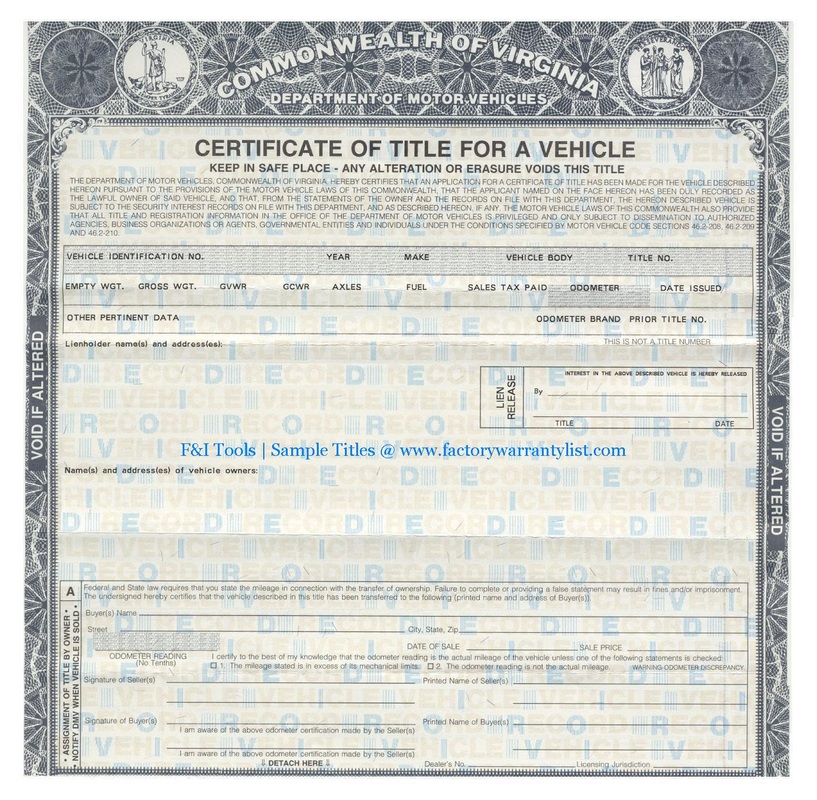
Umm, I think you are confusing the vehicle Registration with the vehicle Title. If you buy a car and have car payments, whatever institution you're paying that money to holds the Title for the vehicle until the loan is paid off. That means the institution actually OWNS the vehicle as they hold the Title. The Title is then transferred to you once the vehicle is paid off and you then own the vehicle. I don't know a single country, let alone state, that issues a Title to the person that is making payments on a vehicle. Doesn't work that way. You don't own the car until it's completely paid for. You do receive vehicle registration in your name, but that's not the same as the Title. In order to sell the vehicle and prove ownership you have to have a Title (like a property Deed), and that Title is signed over to the new owner and that owner takes the Title to the DMV to have a new Title issued in their name to show that they now own the vehicle. You cannot sell a vehicle with just the registration. To tell the difference, a Title usually looks like a fancy certificate with anti-forgery mechanisms in the paper and printing just like money, while a vehicle registration is usually printed on simple card stock or plain paper and may be just black and white or include some colors.
Actually, many states issue you the title, but with a Lien attached. Such as NY.
Until the lien is released, you cannot do anything without the lienholder's permission, but you do have the title in your possession.
-
Re:You're dying off
You don't legally own the car until the title is transferred.
Transferred to whom? I guess it depends on where you live, but I get the title, and it's in my name. The bank never sees the Title. The title is issued to me directly from the state, usually in a couple weeks from when I get the car from the dealership.
Umm, I think you are confusing the vehicle Registration with the vehicle Title. If you buy a car and have car payments, whatever institution you're paying that money to holds the Title for the vehicle until the loan is paid off. That means the institution actually OWNS the vehicle as they hold the Title. The Title is then transferred to you once the vehicle is paid off and you then own the vehicle. I don't know a single country, let alone state, that issues a Title to the person that is making payments on a vehicle. Doesn't work that way. You don't own the car until it's completely paid for. You do receive vehicle registration in your name, but that's not the same as the Title. In order to sell the vehicle and prove ownership you have to have a Title (like a property Deed), and that Title is signed over to the new owner and that owner takes the Title to the DMV to have a new Title issued in their name to show that they now own the vehicle. You cannot sell a vehicle with just the registration. To tell the difference, a Title usually looks like a fancy certificate with anti-forgery mechanisms in the paper and printing just like money, while a vehicle registration is usually printed on simple card stock or plain paper and may be just black and white or include some colors.
-
Re:Oh lord...
Oh, it probably does cause cancer in California.
-
Re:Nothing. It is a stupid system
As to airports being shit, what is easier... buying land in a strip from LA to SF, hiring thousands of engineers, laying hundreds of miles of precision track, buying lots of bullet trains, running power and maintenance access to the track because bullet trains are electric, dealing with the political NIMYism crap, and then maintaining this uneconomical monstrosity in perpetuity... or fixing the airport so the TSA doesn't waste our time?
Funny you should suggest this comparison. A report suggested that building the roads and airport expansions to replace the CHSR would end up costing between $158 and $186 billion. CHSR is currently budgeted at $68 billion.
If you choose the bullet train it means you're clueless or it means you're a corrupt politicians sucking off the federal tit.
Which would never happen when it comes to road or air infrastructure, right?
And there's no reason why the innards of the airport have to be so fucked up. So, unfuck them. Any twat could do it.
Let me fix that for you: Any twat with tens of billions of dollars could do that.
1. You get a Federal security pass... I forget what they're called, but they cost about 50 bucks and require you to go to a federal building and get interviewed by some government people. And when they conclude that you're not a terrorist, they give you an ID that lets you bypass the TSA pretty much entirely. So if you hate the TSA, you get one of those.
2. Just like rush hour, you understand when the airport is really busy and when it is not. Try to time your movements around that. It isn't hard and it isn't especially inconvenient. It requires that your plane take off an hour early sometimes if you need to get out of a really busy airport before it locks up.
3. If you travel a lot with any airline, they put you on their frequent flyer program. And pretty much all of them get you preferential treatment from that airline. That means not waiting in lines, access to special luxury waiting rooms with full service bars and no screaming children, and of course when it comes time to board you tend to get on the plane before or immediately after they get the handicapped people on the plane.These solutions either have their own caveats or they wouldn't work for millions of casual travelers.
And here is the thing I really really like about airplanes - They go EVERYWHERE. Your train is point to point. Utterly inflexible. My plane... Goes ANYwhere.
Sure they do. But then you need adequate road infrastructure to connect to the airport. The airport itself takes a huge tract of land and then you either need to decide to have it located far away from a city (to save on land costs), which requires more road infrastructure and is inconvenient, or spend vast sums to buy up expensive land closer to the center of a city. The rail line distributes these land purchases more evenly across rural and urban areas.
For fast passenger transport over long distances, nothing competes with airplanes. Nothing comes even remotely close.
Yes, but over medium-range distances trains make a lot of sense. Nobody is talking about building an HSR line from LA to NY.
Many other commenters have given good reasons why they prefer travelling by train. For me, if given a choice between a plane or a train that takes one hour longer, I would choose the train every time. The seats are huge (compared to flying economy), the restrooms are larger, the aisles are wider, bringing luggage is both easier and cheaper, I don't get groped in security, there aren't any long lines. Trains, including the CHSR, get passengers right into city centers. -
Re:What is the cost of NOT doing it?
CAHSR projects running about 8 trains per hour during peak hours, carrying about 6000 people per hour in each direction. That is about the capacity of a 3 lane freeway. So basically the alternative to HSR in California is building another freeway along the whole length of the state.
-
Re:Gamechanger
There are some efficiencies of scale but not a factor of two.
Not quite...
The cost of residential (less than 10kw) is $5.47
Larger systems (more than 10kw) drop the price to $4.92 -
Re:A glimpse into our future
there's a need for things like this so family who lives far away can still make sure parents are OK.
Actually, in Asia, elderly parents usually live with their kids. That something like this is needed is more a sign of the rising number of dual income households where the elderly parents are left home alone during the day.
California (which has a high Asian immigrant population who didn't budget for nursing home expenses) tried to tackle this with Adult Day Health Care - basically day care for the elderly. Your parents live at home, you drop them off at the ADHC during the day while you and your spouse work, and you pick them up when you get off work. But the program got sharply curtailed during the recent budget cuts. -
Re:What am I missing?
That was my thought too. $38 mil is nothing for california, and given the upside (lots of people not dying horribly), it seems worth funding.
To put in perspective, last year CA made $82m on cigarette taxes alone and plans to spend about 10.3 billion in public safety spending 2015. I think $36m for this cause could easily be raised and appropriated.
Hell, just fully legalize pot and let the taxes on that pay for it. Who's onboard?
while it is a nice thought I seriously doubt 10 seconds is going to stop many, if any, from dying. It would take a person the best part of that 10 seconds just to realize what was happening as it happens so infrequently OR if the alarm is to sensitive that it goes off all the time for minor tremors then it would be just like a car alarm where people barely even realize one is going off and again still won't react in time.
-
Re:What am I missing?
That was my thought too. $38 mil is nothing for california, and given the upside (lots of people not dying horribly), it seems worth funding.
To put in perspective, last year CA made $82m on cigarette taxes alone and plans to spend about 10.3 billion in public safety spending 2015. I think $36m for this cause could easily be raised and appropriated.
Hell, just fully legalize pot and let the taxes on that pay for it. Who's onboard?
while it is a nice thought I seriously doubt 10 seconds is going to stop many, if any, from dying. It would take a person the best part of that 10 seconds just to realize what was happening as it happens so infrequently OR if the alarm is to sensitive that it goes off all the time for minor tremors then it would be just like a car alarm where people barely even realize one is going off and again still won't react in time.
-
Re:What am I missing?
That was my thought too. $38 mil is nothing for california, and given the upside (lots of people not dying horribly), it seems worth funding.
To put in perspective, last year CA made $82m on cigarette taxes alone and plans to spend about 10.3 billion in public safety spending 2015. I think $36m for this cause could easily be raised and appropriated.
Hell, just fully legalize pot and let the taxes on that pay for it. Who's onboard?