Slashdot Mirror
Domain: catb.org
Stories and comments across the archive that link to catb.org.
Comments · 2,698
-
Re:Watch list?
I am certain that this is already a feature of existing luggage routing software.
It's not a misfeature, it's a Bohr bug.
-
Re:"Playing Nice" is Not Considered a Virtue
Really? In the engineering education I've been exposed to (I'm in a Canadian engineering program right now) they heavily play up the importance of eliminating bias and groupthink to find the "best" option. There's an immense stress on the idea that there is no "right" option, and that even the option you choose to be right has to be properly sourced and cited with a fully documented process, so you are accountable for your decisions. In fact, that accountability is an immense part of the "professional" part of the education, and I'd argue that's why engineers wouldn't make good extremists; they'd be looking for the kind of backup that just isn't there with some religious beliefs.
Add that to the fact that hackers and nerds, more so than other groups I've seen, tend to be more questioning of traditional religions than the average person - and it's not just me who notices.
-
Re:This may be off topic
Yeah, it looks like that to me too. But a team leader position with a group of OSS bashers is probably the wrong way to go. Probably involves some input to the scripts for the blog center in Bangalore. I hope they get somebody good for that - the astroturf has been pretty weak the last few years.
They really need several people for this gig. A cuddler or two to get up close to the community, a handler to dump their data, some "perception change agents" (PCAs) to pump the results to their pets in the press. Maybe a blogging coach to fly to Bangalore and teach people not to paste all of their talking points into every post or ask obviously knowledgable people to cite. They're probably trying to hire the handler, but don't know what they need.
I'd probably add to that a whole herd of temps from the local LUGs in focal regions as focus groups to laugh at the pitches the PCAs come up with and so refine them -- you could probably get those guys for pizza and Bawlz, and a tour of the Campus of Serene Giving.
If they don't structure this so that some of these folks are consultants who provide input as "consultancy" under their own corps and deliver the rest gratis, they're going to get outed through lack of plausible deniability and a few years from now the next version of the Halloween Documents or Comes Documents will burn them yet again. They're really flailing up there. Since BillG left the subtlety just isn't there, which is probably why the stock is flat over the last decade.
Hey, maybe I'd be good at this - except for the whole dancing with the devil part.
For sure the HR department needs a performance review - "MICROSOFT NEEDS A MACHIAVELLIAN JERK TO BEAT OPEN SOURCE SOFTWARE" isn't really the type of job ad you want to hang out there where everyone can see it.
-
How To Teach a 12-Year-Old To Program?
Firstly he has to want to do it, I mean really want to because it is hard. Show him this its pretty inspirational (what ever you think of the author), this got me into programming.
Peter Norvig says Python or Scheme (he's an old lisp guy) but he needs to get to the point of codding his own apps ASAP so a language with lots of examples is good (Python has the oreilly publishers cookbook and numerous applications out there). -
Re:Wouldn't be necessary if...
But, website operators that aren't idiots don't change URLs.
Yes they do. Everyone does it. Nobody likes to do it, but inevitably it eventually happens to some pages. Furthermore, what if I'm not linking a specific site, but just an article that I happened to find on that site? Then that's where you really want something descriptive in the title. Just because a website ceases to exist doesn't necessarily mean the content I was linking to is gone.
Here's an example, though obviously this is unlikely to ever disappear:
http://catb.org/esr/writings/cathedral-bazaar/On the other hand, say it did disappear. Then you would have everything you needed to know about what I'm linking to. And I think that links should describe everything you need to know about the content so that you could conceivably figure out what it was if the content is still available somewhere.
-
Re:I smell DRM
Are you serious? I wonder, have you ever heard of:
* The AARD code?
* OOXML?
* The Halloween documents?
* Embrace, extend and extinguish?
* Samizdat?"Have some faith", you say? Indeed, to trust Microsoft to act ethically is a matter of faith: to believe in something incredible against all evidence.
-
Re:misuse of the term 'hacker'
from the jargon file:
[long definition]
Note that the perjorative use has been deprecated.
I thought dictionaries were supposed to be descriptive, not prescriptive.
-
misuse of the term 'hacker'
from the jargon file:
hacker: n.
[originally, someone who makes furniture with an axe]
1. A person who enjoys exploring the details of programmable systems and how to stretch their capabilities, as opposed to most users, who prefer to learn only the minimum necessary. RFC1392, the Internet Users' Glossary, usefully amplifies this as: A person who delights in having an intimate understanding of the internal workings of a system, computers and computer networks in particular.
2. One who programs enthusiastically (even obsessively) or who enjoys programming rather than just theorizing about programming.
3. A person capable of appreciating hack value.
4. A person who is good at programming quickly.
5. An expert at a particular program, or one who frequently does work using it or on it; as in ‘a Unix hacker’. (Definitions 1 through 5 are correlated, and people who fit them congregate.)
6. An expert or enthusiast of any kind. One might be an astronomy hacker, for example.
7. One who enjoys the intellectual challenge of creatively overcoming or circumventing limitations.
8. [deprecated] A malicious meddler who tries to discover sensitive information by poking around. Hence password hacker, network hacker. The correct term for this sense is cracker.
The term ‘hacker’ also tends to connote membership in the global community defined by the net (see the network. For discussion of some of the basics of this culture, see the How To Become A Hacker FAQ. It also implies that the person described is seen to subscribe to some version of the hacker ethic (see hacker ethic).
It is better to be described as a hacker by others than to describe oneself that way. Hackers consider themselves something of an elite (a meritocracy based on ability), though one to which new members are gladly welcome. There is thus a certain ego satisfaction to be had in identifying yourself as a hacker (but if you claim to be one and are not, you'll quickly be labeled bogus). See also geek, wannabee.
This term seems to have been first adopted as a badge in the 1960s by the hacker culture surrounding TMRC and the MIT AI Lab. We have a report that it was used in a sense close to this entry's by teenage radio hams and electronics tinkerers in the mid-1950s.
Note that the perjorative use has been deprecated.
-
Re:Not mutually exclusive.
I don't know about you, but if I were new to Linux, 'man' wouldn't exactly be the first command I'd think of if I wanted help.
I don't mean that it's a good choice for a command name. I mean that the concept works -- if you've been told about man and apropos, they work well.
If you haven't been told, I suppose the question is, how did you end up at the commandline as a complete newbie without any direction at all? We don't sit someone down in a car and expect them to just know where the gearshift is (or what it does), or how the turn signal works, or which pedal is the break and which is the gas.
So the first thing you say to a newbie command-line user needing help is 'JFGI'?
No, I would say 'LMGTFY' -- maybe obnoxious, but it's at least informative. I try not to tell them to Google it unless I'm sure they'll actually find what they're looking for that way.
On the other hand, it really is the responsibility of the person asking the question to at least make an effort to solve it themselves before asking me -- especially when they are perfectly capable of Googling it themselves. It's kind of rude to ask me to do that for them.
No wonder people don't like it.
It's part of being self-sufficient. Google is a way to access the sum total of human knowledge, so hell yes, that's going to be the first place I send someone asking obvious questions about any system.
Actually, the first place I'll send them is here -- but the idea is the same. It only takes a tiny amount of effort to learn to do this, and the payoff is enormous.
Teach a man to fish...
Yes, I realize people don't like that, in the short term. The number of times I hear people say, "I just want to do X! Why does this have to be so complicated?" But it pays off in the long run.
Now, if I was being paid to handhold them through every process, things might be different. But chances are, this is IRC or a forum, so try to meet us halfway.
-
Re:Of course it is.
Well man just confused me more than anything else.... just listing out a whole bunch of switches with some description of what they do that itself doesn't actually mean anything to me, isn't enough.
As a newbie, I remember man actually being useful, sometimes. First, read the name and the description -- these will generally tell you what the command does. In general, if you don't understand at least the name, you don't need to use that program -- for example:
gcc - GNU project C and C++ compiler
If you know what C and C++ are, and what a compiler is, that makes sense. If you don't know what they are, do you need to be using gcc at all?
Once you've got that, usually the synopsis will give you an idea of how it should be used, and what options to look at. If not, look for the examples.
And try info, not just man. It takes just a bit more effort to learn info, and you'd be much better off finding some sort of web-based info browser, but if the program does have an info page, that's likely to be much better organized and easier to understand.
At least, I think that's what worked for me. I actually learned how to use things like gcc and tar from man and info, and I didn't find it particularly difficult.
On the other hand, I was 15, so I'm not really sure how I did it, and it's possible 15-year-olds are just better at learning these things, when motivated.
Google reveals a lot of very helpful and well-written newbie guides though. Perhaps the best of those should be adapted and built-in to the documentation shipping with new distros?
I'd argue they should be mirrored, perhaps absorbed into version control and/or the wiki of the project in question, but I don't see how including them on the CD is that helpful. What would be much more helpful are some meta-tutorials, like how to Google intelligently, how to find the project mailing list -- or failing that, an email address of someone responsible -- and how to ask smart questions -- though it might be easier to start here.
The reason is that no distro could ever include every possible tutorial, or keep them entirely up to date, though it would still be useful to try. It would be much more useful to train users to find the best possible documentation, and when that fails them, ask the best possible questions.
-
Re:Old OS
Actually, there is something similar that occurs in software, called "bit rot". The older a piece of software is, the more security vulnerabilities have likely been found in it, making it a bigger and bigger target so long as it is in continued use...
That is entirely not what bit rot means. The canonical definition is here. You may be referring to software rot, but it doesn't really mean that either, since both refer to software that hasn't been used for a while and obviously does not apply to Windows.
-
Re:Old OS
Actually, there is something similar that occurs in software, called "bit rot". The older a piece of software is, the more security vulnerabilities have likely been found in it, making it a bigger and bigger target so long as it is in continued use...
That is entirely not what bit rot means. The canonical definition is here. You may be referring to software rot, but it doesn't really mean that either, since both refer to software that hasn't been used for a while and obviously does not apply to Windows.
-
Re:New Moon?
Huh? Joking that a bug depends on the phase of the moon is old as time itself.
-
Re:When Signed/Unsigned Strikes
Sounds like something to add to the jargon file
-
Re:Still behind id
No. Bad design makes it really easy to make cheats. A server naive enough to trust the clients makes it really easy to make cheats. A well designed multiplayer game is no easier to cheat in with or without the source code. If releasing the source code makes it easier to cheat, the game was poorly designed. Conversely, if a developer knows the source code will be available, they may be motivated to do the job right. Since people can make cheats for a poorly designed game anyway, regardless of whether you release the source code or not, a game that releases the source code and is designed to be secure anyway is certainly going to be harder to make cheats for than games which mistakenly think if they don't release the source code, their game will be more secure, a fact proven wrong again and again and again.
The same thing was said by open source supporters when Quake 1 source code was released and cheating went rampant. It's, of course, absolutely true, if you desing so that automating your input doesn't give you an advantage, and so that having the information that your RAM hides doesn't give you an advantage, then there's no cheating problem! The catch? This involves adding auto aim into a FPS game and not hiding players behind walls, which would make them flicker on sight, degrading severely the gaming experience. And yes, open source supporters said this. I'm quoting from here, for example: http://catb.org/esr/writings/quake-cheats.html
If Quake had been designed to be open-source from the beginning, the performance hack that makes see-around-corners possible could never have been considered and either the design wouldn't have depended on millisecond packet timing at all, or aim-bot recognition would have been built in to the server from the beginning.
Yeah, that would be really fun. Carmack himself, the guy that gave you the GPL'd quake code said that the only solution to the cheating problem is a little closed source program that verifies the binaries, i.e: closed source.
-
Re:PEBAAC
The problem, IMO, is likely that drive-by-wire systems have too much unnecessary complication. Now, I know absolutely nothing about cars, so I could be completely wrong here, but based on how these things happen in other industries, I would imagine that general-purpose microcontrollers are far cheaper than building their own, so that's what they're using, and they're doing everything in software. That's fine in theory, but when you throw in general purpose hardware like that, you introduce a huge number of unnecessary systems that have the potential to interfere with the control system. Sure, nothing _should_ go wrong....but that just reminds me of a story in The Jargon File ("A story about 'Magic'") http://www.catb.org/~esr/jargon/html/magic-story.html
-
Openness sells itself
(Before modding this post as Offtopic, please read it to the end. It is relevant; you just need to read the whole thing in order to see how it is)
Just in the last 24 hours, on another forum site that I read regularly, I know a guy who has private messaged me about migrating to FreeBSD.
He has done that because, in the past, he was using either Windows, or certain Linux distributions which were heavily GUI oriented and which, for various reasons, had a much less transparent and orthogonal design. He was having a lot of problems with those systems, in terms of both hardware driver and application stability.
He has started, as I mentioned, using FreeBSD, but despite X, he is also now using primarily text-based applications as well. One of his messages to me about this expressed his degree of happiness at having found such a greater level of reliability, speed, and flexibility, and thanking me for gradually causing him to become interested in FreeBSD.
My point, quite simply, is this. Openness, and openness as it specifically applies to UNIX design philosophy, has visible, tangible, practical benefits, and ultimately sells itself.
Corporations and government institutions can say whatever they want; we don't need to worry about it one way or the other. There is a certain demographic of users, who are increasingly becoming more and more derisive of every element of the practice of open source methodolgy, as well. Compilation from source, and use of text-based applications are considered by that group, to be anachronisms from the 1970s.
The point is, that when the proverbial crunch comes, FOSS proves itself, and suddenly the laughing stops; to generally be replaced by mute awe. Whether it's backpackers setting up an emergency c3 system in southeast Asia with gnuSense after the latest tsunami, Helios continuing, day in and day out, to build free PCs with Mint for underpriveleged kids, or a corporate sysadmin with a lone OpenBSD box, who along with his boss, watches Puffy dive into a phone booth and save the day when the local intranet has gone feet first, and business is threatening to grind to a halt entirely.
So if the EU's government have somehow been living in caves for the last two decades, it's not something any of us really need to get upset about. Let them voice whatever skepticism, or even outright condemnation they want.
If they want to find out the actual truth for themselves, however, the web and FTP sites are there, and they can replicate the benefits that other people have derived from FOSS UNIX, for themselves.
-
Not influential to me
I either haven't heard of these people, or I don't care about them. Also, nearly everyone listed is either a CEO or board member of a corporation.
First, the hall of fame:-
- Eric Raymond. The Art of UNIX Programming has a permanently open tab in Firefox for me.
"And these words, which I command thee this day, shall be in thine heart: And thou shalt teach them diligently unto thy children, and shalt talk of them when thou sittest in thine house, and when thou walkest by the way, and when thou liest down, and when thou risest up. And thou shalt bind them for a sign upon thine hand, and they shall be as frontlets between thine eyes. And thou shalt write them upon the posts of thy house, and on thy gates."
-- Deuteronomy, 6:6 - Jordan Hubbard. He was the initial author of the ports system for FreeBSD. He was also, I believe, the leader of that project before going to work for Apple.
- Marshall Kirk McKusick. Author of both the first and second filesystems for FreeBSD, and designer of the Beastie mascot.
- Patrick Volkerding. He is the leader of the Slackware Linux project, which was the first Linux distribution I ever used, and still, I believe, the finest in existence.
- William and Lynn Jolitz. The co-authors of the 386BSD project, and in that sense, Computer Science's answer to the Curies.
- Bill Joy. Author of the original vi.
- Bram Moolenaar. Founder and maintainer of the Vim project.
- Gerard Beekmans. Founder of the Linux From Scratch project.
- Linus Torvalds. I don't need to mention who Linus is. However, I'm also not mentioning him purely because it is politically correct to do so. I mention him here because I've looked through the code of his 0.1 Linux release. Linux might be a bloated horror now, but back then, it was poetry.
- Bob Young, and Marc Ewing. The founders of Red Hat. Red Hat eventually abandoned the end user market for the enterprise sector, but they made a game try at creating an end user distribution first. Red Hat contributed a number of key programs to early Linux distributions, including the RPM package manager, and Anaconda hardware detection software. They also now largely fund the continued development of the GNU project.
- Ulrich Drepper. I will admit that I think Glibc is a bloated mess, but Ulrich displayed courage in once drawing attention to the megalomania of Richard Stallman. For that, I admire him.
- Daniel Robbins. Founder of both the Gentoo and Funtoo projects, and an awesome bash scripter.
- Theo de Raadt. Leader of the OpenBSD project. Theo is an individual who understands what both the correct philosophy and methods are, behind developing software, and is not afraid to continue to follow said beliefs, irrespective of the project's detractors. His manner might, at times, emulate that of Erin Brockovich, but I still admire him despite that, and believe that his intelligence is matched only by his tenacity.
And now, the hall of shame:-
- Richard Stallman. This is an individual who scarcely needs introduction on Slashdot, either; however I consider him the Magneto to Raymond's Xavier. The Free Software Foundation is the archetypical destructive cult, and Stallman has become as much a bane to Free and Open Source Software as he ever may have originally been a blessing. The savagery that I will likely be shown by his followers, for placing him here, will only further prove that point.
- Bradley Kuhn. He has stated that his ideal is a scenario where the GPL is the only FOSS license in existence.
- Ian Murdock. Founder of the Debian project, which is, after Stallman and his drone army, the single greatest source of emotional pain for me, where FOSS is concerned. His original intentions might have been good, but I continue to consider Debian a titanically bloated, excessively complex obscenity, in both technical and social terms. It is the worst Linux distributio
- Eric Raymond. The Art of UNIX Programming has a permanently open tab in Firefox for me.
-
Re:Privacy and the real-time web
1. Don't be fucking stupid.
I'm not.
XML needs replacing. I know you won't listen to me alone when I say that, however, but fortunately you don't have to. There's a replacement that you can read about here.
My own document format is a little less complex than YAML, but YAML is more thoroughly developed, and is intended to do more things.
2. It's XML. They can document it as well as they like; but said documentation is as long as I knew it was going to be. Anything written in XML is unavoidably difficult to read, by design. It isn't a format with which transparency is really possible.
3. If you're afraid of complex things, you really shouldn't be on the internet. I imagine you'd be happy living in a tent on the side of the mountain, but us societal folk like our technology.
This is garbage. The Internet's original application protocols are all (with the single exception of FTP) text-based.
I love technology, too. I just prefer it to be well designed. That means a couple of things.
a) That it's text based, and more purely text-based than XML. It doesn't need, at a fundamental level, to be anything other than text based, either. When I say that, I'm not saying that there shouldn't be support for multimedia; but protocols should be written in a purely textual way.
b) That it complies, broadly speaking, with what is written here.
Complexity also *is* a bad thing, yes. There was a time when computer programmers actually understood that. I'm not sure what's happened in the intervening few decades.
The waves are persistent, accessible to anyone who's added to them, and include the ability to track changes, so they ultimately work quite well as a medium for the non-tactical parts of an RPG.
IRC channels are entirely persistent. I regularly visit one that has existed for nearly 15 years now.
In terms of the ability to track changes, I'm assuming they mean something like CVS, but IRC can use date-stamped log files, as well.
IRC isn't less popular because it was a bad protocol. It's become somewhat less popular because corporations have marketed proprietary alternatives, and people have believed the claims about them supposedly being more capable, when in reality they aren't at all.
6. Another prejudice! Wooo! Some people would be ashamed to let the world know that they think that one, single word typed by one, single marketing droid determines the overall quality of the finished product... but not you! Fuck in-depth analysis! All you need is ONE WORD!
It might be a prejudice, but it's an accurate one. Go and find me a single case of the word, "richness," having been used, where the marketing droid in question actually bothers to define exactly what the word means. They never do. It's there purely to make what they're hyping sound good.
I really, really hope I was trolled, because knowing I wasted a bit of my time makes me feel MUCH better than knowing that someone as bitter and backwards as you is allowed to roam the internet.
I am in the ongoing process of attempting to learn to control my temper, and to avoid allowing quite so much bitterness to creep into what I write. Unfortunately, I didn't succeed in doing that in my last post. I'm hoping this one is a bit more clear.
-
Re:clearview
!X id1
id1: Friar Tuck... I am under attack! Pray save me!
id1: Off (aborted)
id2: Fear not, friend Robin! I shall rout the Sheriff of Nottingham's men!
id1: Thank you, my good fellow!
http://catb.org/jargon/html/meaning-of-hack.html -
Re:This is off-topic and I appologize...You do realize, he could have figured that out by typing it into google, and reading the first link? e.g. http://en.wikipedia.org/wiki//dev/null
This entity is a common inspiration for technical jargon expressions and metaphors by Unix programmers, e.g. "please send complaints to
This is slashdot, not "ubuntuforums.org". They actually reference the sort of stuff he alludes to in the FAQ, which you can click from this very page. That's why there is no place to complain to about getting bad Karma, and why I made the (probably bad) joke about directing complaints to
Karma is used to remove risky users from the moderator pool, and to assign a bonus point to users who have contributed positively to Slashdot in the past. It is not your IQ, dick length/cup size, value as a human being, or a score in a video game. It does not determine your worth as a Slashdot reader. It does not cure cancer or grant you a seat on the secret spaceship that will be traveling to Mars when the Krulls return to destroy the planet in 2012. Karma fluctuates dramatically as users post, moderate, and meta-moderate. Don't let it bother you. It's just a number in the database.
If he can't do a simple task like read a FAQ or google random jargon, perhaps he should first contemplate why he is contributing posts to a site that bills itself as "news for nerds..."? Maybe he should consider reading http://catb.org/~esr/faqs/smart-questions.html first (a great idea for any nerd in training), and perhaps participate in a more newb targeted web forum first?
And btw I do not have any issues with the OP, and as far as I know, I have not modded the OP's posts one way or another. I just saw the opportunity for the gag so I went for it. I'm fairly sure I have had people do the exact same targeted moderation towards myself as the OP, but they always lose interest if you don't acknowledge them. And who cares, really? A lot of people browse at -1, and will read your posts regardless. -
Backdoor
IEEE Spectrum properly refers to the attack on the Syrian hardware as a "back door". The New York Times not only failed to use the Hacker's Dictionary, it failed to use the terminology from IEEE Spectrum, which it even hyperlinked to.
-
Re:ESR
I consider myself a libertarian and from what I know of ESR, I would consider him a libertarian.
He's actually an anarchist.
-
Market capitalization
This is not off-topic.
I happened to notice today that Apple surpassed IBM in market capitalization (the total value of their stock) about a month ago. Apple has been on a tear for the last five years, growing about 24x. Even though IBM has a valued brand, a deep patent portfolio, committed customers and a broad portfolio they haven't kept up with that pace. I think that the last technology company Apple has to surpass in company value is Microsoft - and they're closing in. Apple's executing well not just in PC Hardware (where they've cornered the market on premium PCs at over 80%), but in media where they've pretty much taken all of the market for online distribution of music (and they're working on video), and in cellular phones where they're a serious threat to Blackberry. So Apple is not just in a wider base of markets than IBM and Microsoft - they're winning in all the markets they're in. They're executing well.
Microsoft wants to be Apple but Zune, Plays For Now and the Microsoft Danger FaceKick isn't going to gain them new customers in the new markets they need to win. The have a considerable negative partnering history to overcome. If Steve Jobs got a good stock incentive to come back and rescue Apple in 1996 he should die the world's richest man. Since I'm talking about how smart he is, here's a quote:
"There's an old Wayne Gretzky quote that I love. 'I skate to where the puck is going to be, not where it has been.' And we've always tried to do that at Apple. Since the very very beginning. And we always will."
IBM could do these things and the fine article is an indication that they're slowly interested in doing so. I wish them well - I prefer committed open source to Apple's exploitation of BSD's liberal terms, though I have to admit it's more of a personal bias than a difference in utility. I don't think IBM can pull this off without outside help. The Boys From Boca thing was, as far as I can tell from subsequent history, a one-off incident of accidental genius.
-
Re:Programming in general, is a lost art for Linux
Above all, more than anything else, there needs to be a return to implementation, rather than interface, simplicity. As priorities, faddishness, popularity, and most of all, the end user, need to die.
If you're trolling, that's brilliant.
If not, then... WTF! Even ESR, the craziest of the crazy, has written articles about how much open source usability sucks shit. Like this article: http://catb.org/esr/writings/cups-horror.html
-
Re:Experts everywhere are bound to be weird...
Old news, old news. The portrait of J. Random Hacker from way back still holds true.
http://catb.org/jargon/html/appendixb.html
I find, however, that my best understanding of programmers and other computer gurus is by visualizing them as the intersection of several descriptions:
Asperger's intersecting J. Random Hacker intersecting the local definitions of "weird", "geeky", and "nerdy". Usually, no one of us fits any one of these definitions exactly, but in that confluence of them, a very real commonality emerges. -
Programming in general, is a lost art for Linux
I've looked at GNOME, I've looked at ALSA, (indeed, Ubuntu in particular in general terms) I've looked at the bloated instability of Compiz, I've looked at FreeBSD by comparison, (which I use on a daily basis) and at some of OpenBSD's source...and I've come to an important realisation.
When it comes to both design philosophy and code quality, Linux developers suck; and I'm talking black hole level, here. The BSDs leave Linux so far behind that it isn't funny.
What is even worse than the poor code quality, is the level of denial. The GNOME developers in particular have been told on numerous occasions what an abomination their baby is, yet they continue to insist on defending it, rather than actually listening to the feedback they are given, and trying to improve.
The single main problem is what I called the Starbucks generation; self-righteous, latte-sipping yuppie CS graduates, who as said in another post, worship C++ and various hell-spawned forms of RPC, and use such to code bloated monoliths of a magnitude that would give Microsoft nightmares.
They think they know better than the 30 years of UNIX experience that has come before them, including the very authors of the initial operating system itself.
Although I haven't used Pulse, I have used ALSA, and I've used enough other Linux software to know that the Pulse author most likely shouldn't be defending himself; but should be humbly acknowledging that his software is terrible, and appealing to the community for help and insight into how he can do better.
He can start by reading this, and gaining a real appreciation of the system he is writing for.
There are a lot of programmers in the Linux community who badly need some humility. They need to study the designers and authors of early UNIX; they need to learn how those people thought, and they need to emulate said designers' thinking and behaviour.
Above all, more than anything else, there needs to be a return to implementation, rather than interface, simplicity. As priorities, faddishness, popularity, and most of all, the end user, need to die.
-
Re:Pedantic
A lot of software is just a variant on a theme though
...which is why I qualified my statement to "significant" programs.
Yes, code monkeys who spend their entire careers doing integration work and minor variations can get by with just the detail-oriented side of thinks, but a hacker is a creative type.
-
Re:My H1-B was rejected.
I'm really sorry to hear about your H1-B issue. I'm a citizen, but my girlfriend is not. She was recently hired as a university professor, but almost didn't make it because the H1-B process got screwed up. Her PhD is in operations research with a concentration in project management; the RFI included questions such as "why is her PhD appropriate for teaching project management and operations research". It is obvious to even a casual observer that the question was not asked in earnest, but instead was a delaying tactic for some reason. So we had to get lawyers involved (since her university was basically worthless in helping the situation get sorted). Our lawyer told us the government was issuing significantly more RFIs, most of which were ludicrous such as yours.
The way my government treats "foreigners" is enough to make me seditious. You say the US is the greatest place on Earth. Obviously that's a judgment call and I'm not going to argue. But certainly the volume of bogons the USA is emitting these days is unforgivably pathetic.
I hope you can find a way to make it back to the US, because you sound like the kind of person that we want living and working here.
-
Re:A matter of credibility
The SCO lawsuit was perpetrated by SCO, not Microsoft. While MS was happy to see it happen, they weren't behind it, and contrary to some
That's more than
http://catb.org/~esr/halloween/halloween10.html -
This is how Microsoft wins, kids
This is something else I just thought of. Microsoft are going to destroy Linux. Matter of fact, they pretty much already have.
How? By conditioning the majority of the non-technical user population in terms of how to think.
The ideas in this don't get used for writing software any more, and 50 WoW gold says that I'll get a reply to this very post from a Windows refugee, calling me an idiot for even bringing that up.Microsoft has made it so that unless Linux is a clone of Windows, Linux doesn't have a prayer, cos the users don't want anything else, and won't accept anything else. The UNIX philosophy was about how to design genuinely stable software that didn't just fall apart or turn to shit, but you can't write that any more, because like I said, nobody wants it now.
So as a result, Ubuntu has an interface that looks just like Windows, but crashes if someone gives it a hard look, just like Windows.
The idiot end users don't remember the fact that Linux's extra stability was what caused them to leave Windows in the first place. Ubuntu is so much like Windows now, that it also has Windows' problems. In the end the Windows refugees are going to wonder why they bothered switching, because Linux will be exactly the same; viruses everywhere, and it crashing all the time, etc.
The UNIX philosophy could have meant that things were different, and software was more stable. But nobody wants that; because it wouldn't be just like Windows.
So even though Microsoft probably are still going to die now themselves, when they go, they will take Linux down with them.
-
Re:Brand identity
Linux is the operating system with no understanding of SYSTEMS
Actually, completely the opposite is true, although I'm not judging you for not having known that. Read this.
UNIX in an older sense (and ergo Linux) had a number of incredibly well-functioning, mutually independent frameworks; truthfully they worked sufficiently well that they mimicked ecological functions normally found in nature. However, the difference between Windows or the Mac is, that the one thing which they all relied on, was plain text.
Not XML. Not binary RPC. Plain text, often between networked applications. Why text? Because it's a lot more easily editable and viewable (ergo, transparent) than binary data streams.
Learn some shell scripting. If you do, you'll start discovering much simpler and cleaner methods of software development. You can still design a nice, shiny user interface for the end users, but you'll save yourself a lot of headaches as well, if you can design an application as a client/server or engine/user interface pair, with the two cleanly seperated but communicating via an easily readable/editable text stream.
This has a lot of advantages. The single main one is that if anything ever breaks, it makes it a lot easier to actually go and find where the problem is and fix it, than if everything is written monolithically, or communicating via some binary abomination. You can debug it by watching the protocol's messages as it runs.
Another major advantage is that it means a system can often end up being used, and used well, in novel or unexpected scenarios. The IRC protocol is a good example. IRC's developers probably weren't expecting people to do things like running lagless DCC botnets on top of it, but said people did do that, and it worked fine. IRC can actually be jerry rigged to interface directly with the mail protocol as well if you are so inclined, so you can send messages from within the IRC client.
-
Re:Really Open Source?
Doesn't look like it captures the OSS development spirit, to me...
That's probably because it isn't supposed to. It's supposed to allow Microsoft and any other companies who sign on to support it the ability to say "We like open source. We're spending eleventy-billion dollars on supporting an independent open source foundation." By calling it "open source" even if it's not, it succeeds at its PR purpose.
Remember the Halloween Documents? I don't think we have any reason to think that Microsoft has suddenly decided that they should become the next Red Hat.
-
Re:Pedantic Note: Troll Vs Trawl
Having done a lot of fishing in my youth this is a common mistake and I actually thought that internet 'trolling' was called that because it's like fishing for a response in the open waters of the internet. I know that's not the case but it seems a more appropriate origin than some fantasy description of a grotesque creature.
Hm? That's exactly what trolling on the 'net means - "trolling for newbies", as in fishing. Linky.
-
Oh, no no no -- you must reference Mel
I can't believe Mel is fading from slashdot consciousness so quickly.
-
Re:Should have been Oct 31...
No, Oct 31 is the day we celebrate the Sacred Documents.
-
Re:The cool kids don't care
Sounds like you haven't read this essay yet.
-
Re:Coal.. Kettle?
"How have they actually attacked Linux?"
-
32bit to 64bit transition
Eric Raymond has an interesting article (2006) where he argues that big changes on the software market can only occur when there is an industry-wide switch in the hardware. According to Eric Raymond the window of opportunity created by the transition to 64bit platforms closes (has closed) in 2008. However I still see Windows Vista PCs on sale with 3GByte of memory because 64bit Windows lacks driver support and 32bit Windows can only address 4GByte of memory (minus 1GByte to address the graphics card AFAIK).
-
Re:Linux on the Dekstop
Exactly. Regrettably, many of Microsoft's talking points here are quite salient for those users who need out-of-the-box functionality, without investing more of their own time. I love Linux and would rest easy if Windows—and the need for it—were scoured from the Earth, but this Microsoft training course is not all lies and FUD (although there's plenty of that too). There is a reason that Microsoft is winning the usability battle and I wish more OSS developers would react to it.
Here, let's pretend I'm a typical non-technical user reading this article.
No iPod support? Really? And the Zune doesn't work on the Mac either although there has been some progress from the Linux community. And I've never had any problems pulling pictures from cameras.
Will it recognize the device as an MP3 player as soon as I plug it in? Will it sync with my desktop media player? If so, how much reading and work is required? 'Cause my maximum is three clicks through the default options of a wizard.
I've yet to see a printer that doesn't have a driver. You might have to download it from the products website though (gasp!).
What's a driver? How do I find the website? Is there just one kind of driver, or does it vary with the kind of printer? How many things do I have to know to configure the driver? Three clicks, remember.
Yeah yeah. Software. Although WINE has been vastly improving lately (we even got around that stupid Secu-ROM).
What is WINE? I put the CD in the drive and I'm not seeing an "install" window.
There are free alternatives to all of the Windows Live "essentials".
What are they? I have to read product descriptions in the package manager to figure out what does what? I have to use different software from all of my Windows-using friends? I have to figure out which features are matched one-for-one and where there will be file-compatability issues?
WOW. Of all the games to mention, they mention World of Warcraft. I wrote a tutorial on how to get WoW running on Linux not to long ago. Its probably the easiest game to set up with in WINE.
This article is trying to get me drunk again.
Remember, "lusers" may frustrate you, but they are the people you are courting when you talk about the year of Linux on the desktop. They are nice people and deserve the ability to be lazy and ignorant about computers. As a developer, it is your responsibility to try to give them that luxury.
-
Re:Nice HW though!
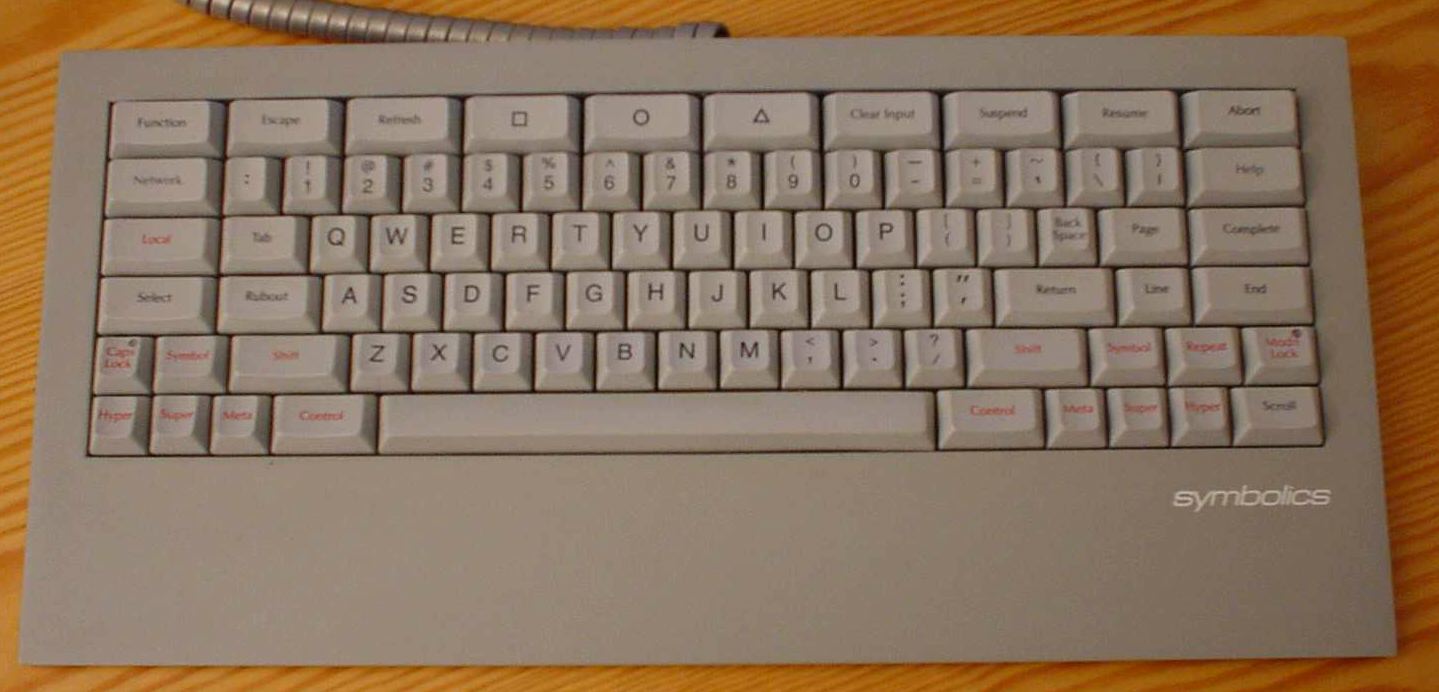
... and the keyboard was a real work of art! You had to stare at it for a while just to notice the QWERTY part floating in the ocean of other keys. The UI was pretty slick too. If only there were something like this for a language I *liked*.
Hyper, Super, Meta, Symbol, Select, Local, Network, and a few others,
as well as keys with a circle, triangle, and square. Fun! But no rows of function
keys at the top, and no arrow keys (they used emacs style control sequences
to move around) and no number pad, so it was really smaller than all modern
full-sized keyboards. See: http://www.catb.org/~esr/jargon/html/graphics/symbolics-keyboard-fullsize.jpgI used Symbolics when I worked at an AI company, 1996-2000, long after the Symbolics company itself was
out of business. Some were big space heaters the size of end tables. The newer ones were like the original
Sun pizza boxes. They were practically supercomputers when they were built (and had a comparable
price tag) but by the time I was using them they were stuggling to keep up with cheap PCs.I never drank the Lisp Kool-Aid so I wasn't into lispms
Lisp is super cool, drink the Kool-Aid. Not so practical for lots of things, but cool.
-
Re:First .COM, not First Domain
-
Re:Thanks!
But, the Schneier chapter isn't meant to piss him off, I have no beef with him whatsoever. I just think the fanboys do the world a disservice by not thinking for themselves, especially when they draw from material that's a decade old.
The thing is, you're not convincing me that the book is out of date. There is plenty of material in the Internet that is over a decade old and is still relatively current. I read the Cathedral and the Bazaar for the first time last month, and drew a good amount of benefit from its words, even if I'm not ready to swallow it whole. The Mythical Man Month shed quite a bit of perspective on project management in a field that our industry has fifty or so years of experience in, and yet we still do terribly at.
The principles of cryptography are still the same today as they were in the days of the Roman Empire and the Caesar Cipher, with all the bits about Alice and Bob with Mallory in the middle. Our toys are much more advanced today, and their rate of advance continues to increase, but just what is it that makes our pulling of information from a 10+-year-old book harmful?
I'm no Schneier "fanboy", and haven't actually read the book; I just genuinely want to know.
-
Re:Age is irrelevant, resistance is futile.
"The Mythical Man Month" deals with keeping software projects on schedule. It notes that adding developers to a project will not speed up development and, in fact, will slow it down. I'm not sure this is the same thing.
The "...all bugs are shallow" phrase comes from The Cathedral and the Bazaar and is an informal summery of the following:
8. Given a large enough beta-tester and co-developer base, almost every problem will be characterized quickly and the fix obvious to someone.
It's not necessarily saying one puts large numbers of developers on bug hunts and implementing fixes. Simply auditing code could be part of this process (or pen-testing, beta-testing, etc.).
As for why companies don't do this? Because being "bug free" isn't as important as other considerations. Heck, some companies ship code with known bugs. Schedules (development, marketing, sales, etc.), development costs, feature sets, etc. tend to push software release as much, if not more, than bug counts. Even OSS pundits preach "release early, release often"; from the very same document that claims we can achieve a point where "all bugs are shallow."
-
Re:Kudos to Nokia
PyQt is open source. Or isn't the GPL considered open anymore?
Version 2 I consider borderline. Version 3 isn't. It's a legal minefield; a poison pill in exactly the same sense that Microsoft's "Shared Source," was when Eric Raymond called it that.
Stallman corrupts everything he touches. The MIT/BSD license, without restriction or bias, entirely perpetuate the type of gift culture described here. With the GPL, Stallman created a mean spirited, twisted mockery of that, and version 3 has only made it worse. The other disastrous effect that Stallman has had, is to further muddying the waters by entangling the political doctrine(s) of Trotskyite Communism with software development.
The GPL's (and FSF's) influence on the Linux user and development community is plain to see. Its' most vocal members are avaricious, paranoid, howling fanatics who are terrified beyond all reason of Microsoft, and who spend far more of their time engaging in further paranoia about the amount that other people, "give back," than they devote to their own programming efforts.
The GPL and the organisation that spawned it are an infernal scourge; a pestilence on the face of Linux and greater UNIX, and it would do the world good if we could entirely get rid of both.
-
Re:seen some bad shit.
Reminds me of the old http://catb.org/jargon/html/magic-story.html.
-
Someone /has/ to mention Mel...
-
Re:Parent is insightful, not funny
Events where your friends are saying "Where is better unix than unix?" and the response is "Oh, Better is not on Facebook."
I don't really think betterunixthanunix would care; I can't speak for him, but I can speak for myself. I don't use Facebook because it's largely a waste of my time. I have a blog, a small message board, and keep in touch with most of my friends via IM, e-mail, or telephone. I think many of the original points betterunixthanunix raised are correct. Most people probably don't bother keeping in touch with various people they have known over the years. I certainly know I'm one of them. Your particular situation is probably more of an exception than a rule.
The other issue is that most Slashdotters are of an MBTI (personality type) called INTJ. I suspect we're alien to you, and here's why:
[I]f I had to call 350 of my closest friends...
I don't understand that. I'm an INTJ, and "closest friends" to me are limited to about three people. It is honestly impossible for me to understand how someone can have 30 close friends much less 350 of them. Likewise, I imagine it is impossible for you to understand the case of the INTJ; how can he possible have only 3 close friends? It's easy when you're of one particular personality type to assume anyone else can be exactly like you (I've certainly fallen into that trap before!). The MBTI exists for a reason, and I think it's an excellent means of quantifying differences and similarities among the various type traits people exhibit.
Back to Slashdot, it is no surprise then that a significant number of posters agree that Facebook is a waste of time. According to Eric Raymond, a majority of "hacker" types tend toward the INTJ and INTP MBTI types. That means we tend to be antisocial (that's not a bad thing, no matter how the media portrays it) and we prefer our own company over that of others. It doesn't mean we're weird. It doesn't mean there's something wrong with us. We'd rather curl up with a good book or sit in front of a screen writing code than goplacesdothingskeepbusy.
Then again, social networking wasn't written for people like us, and that's fine. We don't really care whether someone uses it--most of us won't--but when pressed for an opinion, we'll be more than happy to share. I think that was betterunixthanunix's point. Then there's the obvious point that a majority of people may simply contact old friends and acquaintances for the novelty alone. Once the novelty has evaporated, it's back to the vacuum of normal life. There's nothing wrong with that, either. Most socialites tend to enjoy novelty. It's just that the novelty of rediscovering old friendships seldom lasts. This doesn't mirror your case, of course, but it is a pretty good parallel to what I think is the norm.
-
Re:GPUs are dying - the cycle continues
And so, the wheel starts another turn.
-
So? They acknowledged the threat in 1998!
From the article:
Microsoft for the first time has named Linux distributors Red Hat and Canonical as competitors to its Windows client business in its annual filing to the U.S. Securities and Exchange Commission.
Yeah, there are lots of pointless legal disclaimers in 10-K filings to cover respective companies' own asses.
It's not the first time that Microsoft has acknowledged Linux as a threat to their business model. It might be the first time they have put it in their 10-K report, but I don't consider legal disclaimers in an annual SEC filing to be newsworthy.
Has anyone read the Red Hat, Inc. 10-K report. Anyone take the time to count the number of competitors, listed by name, in there? Now ask yourself, is that newsworthy?