Slashdot Mirror
Domain: catb.org
Stories and comments across the archive that link to catb.org.
Comments · 2,698
-
Re:hm
not-inexpensive? I know slashdot editors aim for obscurity, but what's wrong with "expensive"?
Read this for enlightenment.
-
Re:the Linux kernel is no longer essentialAnd even if I don't agree with everything he says I think that you need people who doggedly stick to their guns the way he does.
Yeah, but Eric Raymond sticks to his guns too, but I like his philosophy better.
Indeed, how are you gonna fight against Microsoft if your only weapon is a cream pie? Guns are much more effective!
-
Re:Why GNU/"Linux" is so popular.... maybe
If you look at the two personalities that are most influential in the GNU/Linux combination, RMS and Linus (just my opinion of course), I think it's the individual personas of these two individuals that form a striking combination that makes "Linux" (as RMS is loth to call it) so popular.
If you look at the surge of "Linux" popularity over the last decade, it's primarily been the GNU/Linux combination that RMS refers to (although other combinations of GNU/* exist). I would think that it takes this combination of individuals to have this happen --- the idealistic evangelist in RMS, and the pragmatic engineer in Linus.
Of course, all of this discounts the contributions of ESR. If you were going to quickly generalize: RMS is a pot-smoking hippie, Linus is an indifferent capitalist, and ESR is a gun-toting libertarian. They all have their place; they all contribute.
-
Re:I still don't get the allure of Java
-
What about Aunt Tillie?
Aunt Tillie wants to know if she will be able to use this. Also Penelope, who would like to ditch Melvin.
-
Some good reading about the topic
I personally find A Portrait of J. Random Hacker by Eric Raymond, especially the part entitled Weaknesses of the Hacker Personality, very interesting. A Portrait of the Hacker as a Young Man, from Free as in Freedom by Sam Williams is also certainly worth suggesting. Most of people don't know that, but Richard Stallman, the author of GNU, considers himself afflicted, to some degree, by autism, which makes it difficult for him to interact with people. I can honestly say I understand him.
-
Some good reading about the topic
I personally find A Portrait of J. Random Hacker by Eric Raymond, especially the part entitled Weaknesses of the Hacker Personality, very interesting. A Portrait of the Hacker as a Young Man, from Free as in Freedom by Sam Williams is also certainly worth suggesting. Most of people don't know that, but Richard Stallman, the author of GNU, considers himself afflicted, to some degree, by autism, which makes it difficult for him to interact with people. I can honestly say I understand him.
-
Plan 9 from Bell Labs
These news are funny when Slashdot's poll is "Worst Sci-Fi Movie Ever".
ESR has some info on Plan9 OS, wich include this footnote:
The name is a tribute to the 1958 movie that has passed into legend as âoethe worst ever madeâ, Plan 9 from Outer Space. The legend is, unfortunately, incorrect, as the few who have seen an even worse stinkeroo from 1966 called Manos: the Hands of Fate can attest.
-
Re:Plan 9?
-
Re:What this does mean...
Throwing more programmers at a project often times makes the project LATER, not earlier. Please take a look at Frederick Brooks' classic Mythical Man Month for a discussion of a real world example showing your claim to be false.
Next time you "quote" a respected source, try quoting properly. You omitted the word "late". To join yours and FB's statements together while retaining his meaning, throwing more manpower at a late software project makes it later.
(The Jargon file entry for Brooks' Law is here).
There's a good reason for this - coders who are new to a project in full swing need to catch up to take some of the work on, and in doing so they sap some of the attention and effort of the coders who are already in the middle of their work.
However, a properly planned project can scale to hundreds or thousands of developers, and it so happens that all of Frederick Brooks' examples (and his experience) support that view, not your shallower misinterpretation.
-
people's homepages...i think there must be a good selection of useful user "home" pages. would make a good thread, or posting in itself. from mine:
--webcurrency converter - findsounds.com
rebecca's reference - tom mayo's links
-words:acronym/abbr -lookup -finder -bm
trans -babelfish -worldlingo -google bm
jargon file
--musicgnod - audioquarium --books:
amazon - abebooks - bookfinder
-
It's unsurprising
In any other career, it is expected that you will move into management. Teacher? Become a principal. Lawyer? Become a partner in the firm. Doctor? Manage a department and eventually a hospital. Academic? Supervise graduate students and write grant proposals. Marine? Get promoted onto the General Staff, leave the running through the mud to the young officers. See where I'm going with this?
But "geeks" don't want to do that. "But I'm a hacker!" they say, and insist on remaining on the bottom rung of the organization. But the people on the bottom rung are the ones with the lowest pay and the least job security in any organization! But, geeks expect to have the pay and the security without taking on the responsibility that traditionally comes with it.
The answer is clear - geeks need to start taking their careers seriously and stop idolizing people like ESR. For all his skill with termcap, ESR knows nothing about Corporate America(tm) and taking advice from the Hacker's Dictionary on what to aspire to is professional suicide. -
In defense of tech ageism, sortof
I'm a programmer. Or a software engineer. Whatever. (I prefer hacker, but not all potential employers will appreciate what I mean by it.)
I understand one place where the ageism comes from.
The specific example cited above is just stupid, but there is a reasonable reason to prefer younger techies.
Remember Sturgen's Law, 90% of everything crap. This includes techies. Sure, you may work at some company that only hires smart techies who care about their work. But many companies (especially larger companies) are stuck with what they can get. If you need 200 programmers to write insurance and banking application, chances are that many of them are going to suck. Some are actually bad. Some want to be good, but need time to get there. Some just don't care.
As a result, you take steps to make the most use of these crappy techies. This is part of the reason that some companies have overly complex planning, design, and revision systems. Sure, it prevents a truly skilled and inspired person from being really efficient, but they can help keep those people not so blessed on track and getting work down (however slowly). (By way of an example, a friend complained that he was on a project to do some file conversions. It would take him one or two weeks to whip it up in Perl and carefully test it. Instead there were two dozen people working on it for six months. A waste of skilled, dedicated manpower, but in the absence of someone my friend, probably the only way to get it done at all.)
Now, all that said, maybe the better solution is to fire all of the not-so-good techies and invest heavily in the skilled ones. After all, the skilled ones can often replace many less skilled ones. Ultimately this is a financial decision (which is the better payoff for investment), and I don't know the answer. Personally I would go with fewer and better techies, but I don't get to make that choice.
So, some companies, especially large ones, take steps that optimize for the non-so-good techies, even if those steps harm good ones.
Ageism is just such a case. The more general case is a refusal to hire someone who doesn't have either 5+ years of experience in the technology they'll be working with, or just graduated with education focusing on the technology. The reason, many of the not-so-good techies aren't too keen on learning new things. After all, many of them just want to do their job and coast on by. Even if trained they'll take a long, long time to get up to speed. However, if a not-so-good techie already has real experience or just graduated with that experience they start up time is (in theory) much lower. Ageism just takes the reasonable fact that many techies will not learn new tech and applies it in a very conservative way to hiring. Of course, this bones the good techies who learn quickly and like learning. It leads to silly cases where a company will spend a full year failing to hire someone with experience in FooTech instead of just hiring someone and allocating time for them to learn.
Of course, all of this is just one of the reasons for ageism. There are others. I just wanted to offer up an explaination of one on the possible reasons.
Another popular reason for ageism is that fresh college grads are used to working long hours and don't expect alot of money. In this economy they're even more desperate, I know several recent grads willing to take extremely low paid jobs to gain needed experience (Which working as a waiter or a receptionist doesn't give). Unfortunately this can lead to situations where people get burned out and knowledge leaves the industry. The lack of long term stability means fewer people are willing to enter the industry. Older employees expect to be treated like the professionals that they are, they want reasonable professional salaries and reasonable working hours (you can raise the hours, but the salary better match). I think it is often a reasonable investment, but companies are often only as smart as the dumbest link in their chain of command (thus, ageism might come from the top, or from a HR person).
-
In defense of tech ageism, sortof
I'm a programmer. Or a software engineer. Whatever. (I prefer hacker, but not all potential employers will appreciate what I mean by it.)
I understand one place where the ageism comes from.
The specific example cited above is just stupid, but there is a reasonable reason to prefer younger techies.
Remember Sturgen's Law, 90% of everything crap. This includes techies. Sure, you may work at some company that only hires smart techies who care about their work. But many companies (especially larger companies) are stuck with what they can get. If you need 200 programmers to write insurance and banking application, chances are that many of them are going to suck. Some are actually bad. Some want to be good, but need time to get there. Some just don't care.
As a result, you take steps to make the most use of these crappy techies. This is part of the reason that some companies have overly complex planning, design, and revision systems. Sure, it prevents a truly skilled and inspired person from being really efficient, but they can help keep those people not so blessed on track and getting work down (however slowly). (By way of an example, a friend complained that he was on a project to do some file conversions. It would take him one or two weeks to whip it up in Perl and carefully test it. Instead there were two dozen people working on it for six months. A waste of skilled, dedicated manpower, but in the absence of someone my friend, probably the only way to get it done at all.)
Now, all that said, maybe the better solution is to fire all of the not-so-good techies and invest heavily in the skilled ones. After all, the skilled ones can often replace many less skilled ones. Ultimately this is a financial decision (which is the better payoff for investment), and I don't know the answer. Personally I would go with fewer and better techies, but I don't get to make that choice.
So, some companies, especially large ones, take steps that optimize for the non-so-good techies, even if those steps harm good ones.
Ageism is just such a case. The more general case is a refusal to hire someone who doesn't have either 5+ years of experience in the technology they'll be working with, or just graduated with education focusing on the technology. The reason, many of the not-so-good techies aren't too keen on learning new things. After all, many of them just want to do their job and coast on by. Even if trained they'll take a long, long time to get up to speed. However, if a not-so-good techie already has real experience or just graduated with that experience they start up time is (in theory) much lower. Ageism just takes the reasonable fact that many techies will not learn new tech and applies it in a very conservative way to hiring. Of course, this bones the good techies who learn quickly and like learning. It leads to silly cases where a company will spend a full year failing to hire someone with experience in FooTech instead of just hiring someone and allocating time for them to learn.
Of course, all of this is just one of the reasons for ageism. There are others. I just wanted to offer up an explaination of one on the possible reasons.
Another popular reason for ageism is that fresh college grads are used to working long hours and don't expect alot of money. In this economy they're even more desperate, I know several recent grads willing to take extremely low paid jobs to gain needed experience (Which working as a waiter or a receptionist doesn't give). Unfortunately this can lead to situations where people get burned out and knowledge leaves the industry. The lack of long term stability means fewer people are willing to enter the industry. Older employees expect to be treated like the professionals that they are, they want reasonable professional salaries and reasonable working hours (you can raise the hours, but the salary better match). I think it is often a reasonable investment, but companies are often only as smart as the dumbest link in their chain of command (thus, ageism might come from the top, or from a HR person).
-
Re:It is not bad to learn QBasic...
Yes, availability was the issue in those days. For alot of us, the internet hadn't exploded yet when we were poking around the contents of the Win3 install, so besides BBSes (I never got into that), we were cut off from other sources of instruction. All there was was that help file (I think QB4.5 had a better help file and everything else).
After my first few years in QB in Jr. high, I stumbled on 4.5 and a SVGA graphics library that among other things had easy-to-use 3-d projection. Talk about fun stuff when 3-d accelerators or opengl/directx hadn't gotten big yet (I am not sure if they had been introduced yet).
Now there are better languages and we are not all so isolated, so self-teaching is not an option anyone has to resort to anymore. For that reason, I would not recommend that anyone run off and learn QB unless all they ever want to do is write better VB. In that case, I am sure there are good VB books. BASIC in general makes it too easy to learn bad techniques and could cripple someone hoping to go further in the field. Try to explain OO to someone who only knows GOTO and GOSUB. QB was good back in the day, but it should be only be a display at a museum today, and not in actual use. -
Re:Go, go, Apple, go!
Lemme guess---your good friend is ESR, right?
-
Re:Apple should pay up.
The question to be asked is, "Are trademarks case-sensitive?" Considering the will of the original author arguably >genetic Unix is "Unix" as I have written it here, while UNIX applies to the Open Group's trademark.
-
Re:In other News...
Please permit me to attempt to influence your views on the issue of the capitalization of ""Unix".
Meanwhile the Open Group is the owner of UNIX(tm), as sold by Novell (in the past), SCO, and of course IBM. Also, Digital, yes? They even used to call it Digital UNIX. Say, does anyone know the direct descendance of Digital UNIX? Did it just come from the OSF/1 sources or what? I'm missing that piece of the puzzle.
Anyway, what with the desire of the original author to call it Unix, and the fact that the Open Group posesses a copyright on UNIX anyway... Well, that's how I feel about it anyway.
-
"4.2 V" Poster from Mt. Xinu
-
Re:MS Going downGandhi, not Ghandi.
The Jargon file get it right, at least. -
Re:Dangerous
ESR demonstrates the proper technique in another picture.
-
Re:Newsflash: this guy's a dickheadasteinberg said:
I would be shocked if anyone tried to claim that the software ESR has written is even comparable in importance to the software RMS has written.
Then prepare to be shocked
He was also a primary developer on ncurses, and nethack... he's contributed to python... he's contributed quite a bit to the GNU/FSF project in general. Note: "I was one of the original GNU contributors back in 1982-83, and I've been at it ever since." And fetchmail and CML2 are by no means insignificant.
Fetchmail vs. the entire GNU collection [snip]; it's clear which is more important.
Did you seriously think that RMS wrote all of the GNU software himself???? The two most important projects that I believe RMS originated were GCC and of course Emacs (and probably GLibc and the GDB). But a hell of a lot of people have contributed to those (including ESR) - and I don't think RMS has done anything significant on most of them for a while.
I know it's nice and easy to give one high-profile developer all the credit for projects they originated... but that's just not the case here. RMS is an uber-hacker and has worked on a hell of a lot of great stuff - but so has ESR. I think the main distinction between the two is that while RMS originated more major software projects than ESR, Raymond's probably contributed to more.
Pete.
-
Re:Newsflash: this guy's a dickheadasteinberg said:
I would be shocked if anyone tried to claim that the software ESR has written is even comparable in importance to the software RMS has written.
Then prepare to be shocked
He was also a primary developer on ncurses, and nethack... he's contributed to python... he's contributed quite a bit to the GNU/FSF project in general. Note: "I was one of the original GNU contributors back in 1982-83, and I've been at it ever since." And fetchmail and CML2 are by no means insignificant.
Fetchmail vs. the entire GNU collection [snip]; it's clear which is more important.
Did you seriously think that RMS wrote all of the GNU software himself???? The two most important projects that I believe RMS originated were GCC and of course Emacs (and probably GLibc and the GDB). But a hell of a lot of people have contributed to those (including ESR) - and I don't think RMS has done anything significant on most of them for a while.
I know it's nice and easy to give one high-profile developer all the credit for projects they originated... but that's just not the case here. RMS is an uber-hacker and has worked on a hell of a lot of great stuff - but so has ESR. I think the main distinction between the two is that while RMS originated more major software projects than ESR, Raymond's probably contributed to more.
Pete.
-
Re:Newsflash: this guy's a dickheadasteinberg said:
I would be shocked if anyone tried to claim that the software ESR has written is even comparable in importance to the software RMS has written.
Then prepare to be shocked
He was also a primary developer on ncurses, and nethack... he's contributed to python... he's contributed quite a bit to the GNU/FSF project in general. Note: "I was one of the original GNU contributors back in 1982-83, and I've been at it ever since." And fetchmail and CML2 are by no means insignificant.
Fetchmail vs. the entire GNU collection [snip]; it's clear which is more important.
Did you seriously think that RMS wrote all of the GNU software himself???? The two most important projects that I believe RMS originated were GCC and of course Emacs (and probably GLibc and the GDB). But a hell of a lot of people have contributed to those (including ESR) - and I don't think RMS has done anything significant on most of them for a while.
I know it's nice and easy to give one high-profile developer all the credit for projects they originated... but that's just not the case here. RMS is an uber-hacker and has worked on a hell of a lot of great stuff - but so has ESR. I think the main distinction between the two is that while RMS originated more major software projects than ESR, Raymond's probably contributed to more.
Pete.
-
Re:Newsflash: this guy's a dickheadasteinberg said:
I would be shocked if anyone tried to claim that the software ESR has written is even comparable in importance to the software RMS has written.
Then prepare to be shocked
He was also a primary developer on ncurses, and nethack... he's contributed to python... he's contributed quite a bit to the GNU/FSF project in general. Note: "I was one of the original GNU contributors back in 1982-83, and I've been at it ever since." And fetchmail and CML2 are by no means insignificant.
Fetchmail vs. the entire GNU collection [snip]; it's clear which is more important.
Did you seriously think that RMS wrote all of the GNU software himself???? The two most important projects that I believe RMS originated were GCC and of course Emacs (and probably GLibc and the GDB). But a hell of a lot of people have contributed to those (including ESR) - and I don't think RMS has done anything significant on most of them for a while.
I know it's nice and easy to give one high-profile developer all the credit for projects they originated... but that's just not the case here. RMS is an uber-hacker and has worked on a hell of a lot of great stuff - but so has ESR. I think the main distinction between the two is that while RMS originated more major software projects than ESR, Raymond's probably contributed to more.
Pete.
-
Re: List of Jargon File changesThe Jargon File itself contains a list of changes since version 4.0 (current version is 4.4.2).
I don't know if there's any list of things cut out before version 4.0, but if you want to compare the current version with older ones, there are three print versions from before 4.0 that should still be available from libraries. They are listed in the Jargon File's revision history.
-
Re: List of Jargon File changesThe Jargon File itself contains a list of changes since version 4.0 (current version is 4.4.2).
I don't know if there's any list of things cut out before version 4.0, but if you want to compare the current version with older ones, there are three print versions from before 4.0 that should still be available from libraries. They are listed in the Jargon File's revision history.
-
Re:Newsflash: this guy's a dickhead
I can remember vividly a few years ago that he published "10 Sex Tips for Geeks" on Valentines day. If you have ever layed eyes on the man, you know that he is the last person you would ever want to be accepting sex tips from.
No, he is the first person you would accept sex tips from, since he claims to be able to channel Pan, the God of Sex.
Here's a quote from his description of his "amazing transformation":
Until I realized, finally, belatedly, what had been happening to me. Until the Great God Pan reached out of my hindbrain and thundered "YOU!" And his gift is music and his chosen instruments the pipes and flutes. And his, too the power of joy; magic so strong that when it flowed out of me, even before I knew what I was doing, it amazed people into awe and incoherence and poetry.
That day I was reborn; from a skinny lame kid with a flute into a shaman and a vessel of the Goat-Foot God, the Piper at the Gates of Dawn, the Horned Lord. And the music was my first power, but not my last.
(And, oh, yes. The first time I handled a set of pan-pipes I could play them. Fluently. Effortlessly. And knew I could before I touched them.)
During the next several months I went through a wrenching re-adjustment of my world-view as I assimilated what I have just related here. There was simply no way it would fit in either the religious categories I'd grown up with or the comfortable, naive materialism I had constructed for myself. I clung to the conviction that I live in a rational, explicable universe -- but the Gods had spoken and after that transforming moment of realization I could no more go back than a butterfly could crawl back into its cocoon.
I knew I wasn't crazy, even by my own rather strict definition of sanity. I was coping pretty well -- in fact, I was becoming a whole human being for the first time in my life. Opening up emotionally. Playing beautiful music. And
Yes, ESR is not just an egotistical dickhead, he is totally mad as well. You can read more of this crap, as well as his recollections about channelling Thor and forming his own Wiccan cult here.
-
Re:Nah ...
Watch out! He's gonna throw us a Windows XP CD!!!!
-
HAHAHAHA
Raymond, Eric S. Raymond. master spy..
See, he's so ugly no one would suspect a thing. -
Re:Not surprisingalways found his weird rant rather amusing.
Well, at least we know that you aren't astroturfing. What a great link! Thanks for the href!
-
tuxedo.org
Actually, the fellow who was giving space on tuxedo.org for Eric kicked him off in the obviously impolite manner that you can see from your link. Rather than insert a redirect to catb.org, or put in his own explanation for why he broke all of Eric's URLs, he's just redirecting to J. Random pages. Jerk. Eric is in fact still hosting the definitive version.
-
Not surprisingI always found his weird rant rather amusing. For example:
Bill Gates has pissed me off from day one. [...]when his track record suggests that he wouldn't know a decent design idea or a well-written hunk of code if it bit him in the face. He's made his billions selling elaborately sugar-coated crap that runs like a pig on Quaaludes, crashes at the drop of an electron, and has set the computing world back by at least a decade.
Especially amusing is the fact that the "sugar coated crap that runs like a pig on Quaaludes" and "crashes at the drop of an electron" could be applied to Linux (and Unix and the *BSDs) just as well, especially if the user doesn't know what he's doing. Oh, but wait - "has set the computing world back by at least a decade". We're not talking mom and pop users here, now are we? What is "the computing world"? Not the rarefied heights of academic computing, surely?And where was the open/free graphical OS back in 1991? To compete with Windows 3.1 and the Mac? With things like PageMaker and WordPerfect and Excel and so on?
Especially amusing is this:
but I do mind that he peddles himself as the ultimate hacker and God's own gift to technology
It always seemed to me that he's describing himself. -
Re: This is the subject line.
He's Eric Steven Raymond. Here's the Politics entry btw. So nice of the editors to link those two.
-
Re: This is the subject line.
He's Eric Steven Raymond. Here's the Politics entry btw. So nice of the editors to link those two.
-
Nah ...
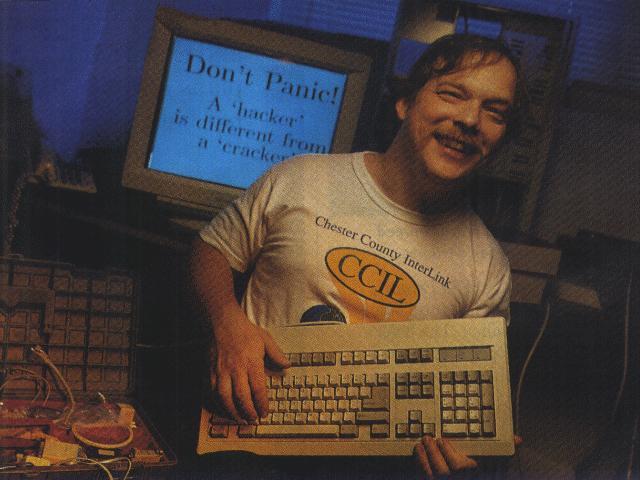
Nah, that's just plain old ESR (a bit younger and thinner, though).
I'd say this picture shows more of a metamorphosis.
z -
...horrible, recent metamorphosis?
-
Re:I met him at ALS
Just in case he does in case of ESR's incapacity...
The Jargon File
Editorial rights and privileges, ownership of the Jargon File Resource Page, and the copyright of "The New Hacker's Dictionary", are to revert to Guy Steele , or with Guy Steele's consent to John Cowan or a third party agreeable to both. -
"GandhiCon"
Once again, it's Gandhi, not Ghandi.
Also, while the changelog spells it correctly, the link there again points to the "Ghandi" spelling. This is the correct link.
And for the curious and lazy, this is the corresponding entry:
GandhiCon
There is a quote from Mohandas Gandhi, describing the stages of establishment resistence to a winning strategy of nonviolent activism, that partisans of open source and especially Linux have embraced as almost an explanatory framework for the behaviors they observe while trying to get corporations and other large institutions to take new ways of doing things seriously:
First they ignore you. Then they laugh at you. Then they fight you. Then you win.
In hacker usage this quote has miscegenated with the U.S military's DefCon terminology describing âdefense conditionsâ(TM) or degrees of war alert. At GhandiCon One, you're being ignored. At GhandiCon Two, opponents are laughing at you and dismissing the idea that you could ever be a threat. At GhandiCon Three, they're fighting you on the merits and/or attempting to discredit you. At GhandiCon Four, you're winning and they are arguing to save face or stave off complete collapse of their position. -
"GandhiCon"
Once again, it's Gandhi, not Ghandi.
Also, while the changelog spells it correctly, the link there again points to the "Ghandi" spelling. This is the correct link.
And for the curious and lazy, this is the corresponding entry:
GandhiCon
There is a quote from Mohandas Gandhi, describing the stages of establishment resistence to a winning strategy of nonviolent activism, that partisans of open source and especially Linux have embraced as almost an explanatory framework for the behaviors they observe while trying to get corporations and other large institutions to take new ways of doing things seriously:
First they ignore you. Then they laugh at you. Then they fight you. Then you win.
In hacker usage this quote has miscegenated with the U.S military's DefCon terminology describing âdefense conditionsâ(TM) or degrees of war alert. At GhandiCon One, you're being ignored. At GhandiCon Two, opponents are laughing at you and dismissing the idea that you could ever be a threat. At GhandiCon Three, they're fighting you on the merits and/or attempting to discredit you. At GhandiCon Four, you're winning and they are arguing to save face or stave off complete collapse of their position. -
"GandhiCon"
Once again, it's Gandhi, not Ghandi.
Also, while the changelog spells it correctly, the link there again points to the "Ghandi" spelling. This is the correct link.
And for the curious and lazy, this is the corresponding entry:
GandhiCon
There is a quote from Mohandas Gandhi, describing the stages of establishment resistence to a winning strategy of nonviolent activism, that partisans of open source and especially Linux have embraced as almost an explanatory framework for the behaviors they observe while trying to get corporations and other large institutions to take new ways of doing things seriously:
First they ignore you. Then they laugh at you. Then they fight you. Then you win.
In hacker usage this quote has miscegenated with the U.S military's DefCon terminology describing âdefense conditionsâ(TM) or degrees of war alert. At GhandiCon One, you're being ignored. At GhandiCon Two, opponents are laughing at you and dismissing the idea that you could ever be a threat. At GhandiCon Three, they're fighting you on the merits and/or attempting to discredit you. At GhandiCon Four, you're winning and they are arguing to save face or stave off complete collapse of their position. -
Re:Am I the only one here...
ESR is Eric S. Raymond, author of "The Cathedral and the Bazaar", the essay which was cited as a prime reason for Netscape's decision to release their browser source, and many other essays on Open Source. He was a co-founder of the OSI, and is the long-time maintainer of
His website is here.
Of course, a google search would have told you all of this.
-
Re:Am I the only one here...
ESR is Eric S. Raymond, author of "The Cathedral and the Bazaar", the essay which was cited as a prime reason for Netscape's decision to release their browser source, and many other essays on Open Source. He was a co-founder of the OSI, and is the long-time maintainer of
His website is here.
Of course, a google search would have told you all of this.
-
Irony is ..
Just glancing over the site I see that the first entry in the changelog is the Entry called '404' - clicking upon that entry gives you what?
A 404 - page not found error.
I wonder how that'll be represented in the paper version of the book, perhaps listing it in the index as page 2.5?
-
Irony is ..
Just glancing over the site I see that the first entry in the changelog is the Entry called '404' - clicking upon that entry gives you what?
A 404 - page not found error.
I wonder how that'll be represented in the paper version of the book, perhaps listing it in the index as page 2.5?
-
Re:Same comments in code?
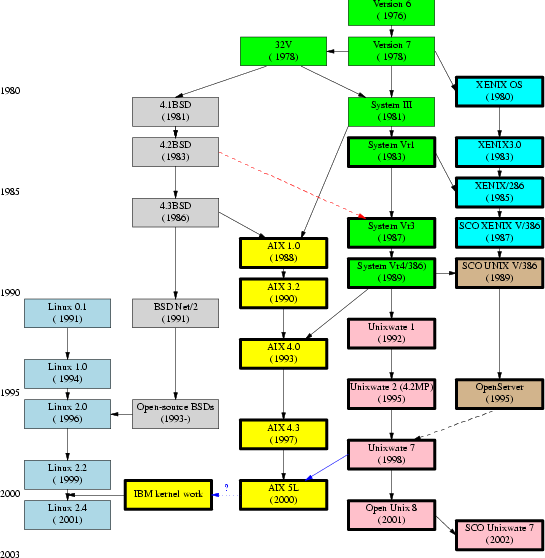
I believe the consensus is that both borrowed some code from BSD, hence the repeated comments. See here for a diagram.
-
Re:BSD code?
ESR's paper on the SCO thing shows how the relationships between several unixes. Given the large amount of intermingling, it's not surprising at all to find common pieces of code in different versions of unix.
-
Re:BSD code?
ESR's paper on the SCO thing shows how the relationships between several unixes. Given the large amount of intermingling, it's not surprising at all to find common pieces of code in different versions of unix.
-
There's a lot to be said for plain text
- It's universal. Everything supports it, from PDAs to supercomputers.
- It's versatile. If properly formatted, it's reflowable on different screen sizes, fonts, layouts, &c. And it's perfect for other access methods.
- It supports most characters you'd find in books. The de facto standard is the Windows Latin-1 encoding, which has all the punctuation as well as accented characters. (Yes, I know, I know. But it's not just on Windows -- both my Mac and my Psion use it, for example.)
- It's editable. There are tons of tools already available, from spell-checkers in editors to complex analysis. I've written some of my own, for instance; one converts from American to British spelling, which is how I like to read my books.
- It has conventions for
- It's compact. Plain text files are smaller than HTML, PDF, RTF &c, sometimes by a lot; and when compressed in formats like PalmDOC (pdb) or TCR, they can be made even smaller and still usable directly.
- It's future-proof. Plain text has been around for decades, and will be with us for many more, long after DRM keys have been lost and proprietary apps have died.
Yes, of course some spiffy new format will have other advantages. But it's unlikely to gain quick acceptance. Plain text documents are everywhere, as are readers and other software. There are even online publishers selling text files. In fact, ASCII text is arguably the most successful electronic standard there is!
-
Re:It's pulling AN SCO
Wrong. Linux is named after a person. It is ethnocentrist to intentionally bastardize the pronunciation of someone's name into your language. Since Linus Torvald's first name is pronounced Leenuhs, it follows that the kernel named after him is pronounced Leenuhks. Linus also expressly allows the pronunciation Linuhks (soft `i').
But you don't have to take my word for it:
Linux Jargon File Entry
torvalds-says-linux.wav (81kB)