Slashdot Mirror
Domain: cepr.net
Stories and comments across the archive that link to cepr.net.
Comments · 59
-
Re:I've been seening a lot of these stories lately
I averred:
The only even-faintly-legitimate source you cite is cepr.net, which is a self-described "progressive" think tank.
Prompting Can'tNot to object:
I'm shocked. I know that the Center for Economic and Policy Research has been described by others as progressive, but I can't imagine them describing themselves that way. That just isn't done.
Technically speaking, you are correct. However, On CEPR's About us page, under the heading Affiliations, they list only one link, to EARN, which describes itself as "a nationwide network of research, policy, and public engagement organizations fighting, state by state, for an economy that works for everyone."
So, although you're correct that CEPR does not explicitly describe itself as a progressive organization, the fact that their only affiliate link is to an organization whose mission statement is an unqualified commitment to one of the key goals of U.S. progressives (and one that is absolutely not shared by any rightist organization), that seems to me to be a sufficiently-clear statement of an underlying progressivist philosophy on CEPR's part to leave no doubt about their willingness overtly to embrace it.
But, you are correct that they don't explicitly state that they consider themselves to be a progressive organization, so, in fairness, I'm compelled to withdraw that statement, and I thank you for pointing out my overreach in that regard.
FWIW - I identify as a "radical centrist" - and given that, when I lived in the SF Bay Area, I was called a fascist on more than one occasion, yet, now that I live in the heart of Trump country, I've been called a commie more than once, I think that self-ascribed "radical centrist" label is pretty much bang on
-
Re:I've been seening a lot of these stories lately
drinkypoo opined:
America is responsible to a large extent for what is happening in Venezuela and has long been the driving force in regime change in Iran, often through extremely direct intervention. We can't fix China (although we could stop enabling them so much) but we are responsible for much of the mess in the other countries you mentioned.
Let's see now:
According to Wikipedia, venezuelanalysis.com has been funded by the Venezuelan goverment since it was founded in 2007 (when Hugo Chavez was president), despite claiming on its website since 2014 (after Maduro took over) that it is funded exclusively via donations from its readers. And the wife of its founder, Greg Wilpert, was appointed Consul General of Venezuela's New York consulate in 2008. So, it's hardly an objective or disinterested source.
Wikipedia's article on mintpressnews.com highlights several ongoing controversies over issues of journalistic integrity (including falsely attributing co-authorship of an article on nerve gas attacks on Syrian citizens to a respected journalist who denies having co-written that article, and who has repeatedly demanded her name be removed from it, as well as falsely reporting an annual Shiite religious pilgrimage to Kerbala as a "march against ISIS"). The publication's masthead prominently features conspiracy mongers (including a strident proponent of the false and defamatory claim that the Sandy Hook shooting was staged, with actors hired to play the part of grieving parents, and that no children were actually killed there). Its sources of funding are undisclosed, although Mnar Muhawesh, its editor, now claims to be its sole investor, and that it is self-financing, via ad revenue (an extremely dubious claim, as anyone who is familiar with the paucity of legitimate advertising income available for online-only journalism ventures will attest). Her claims in this regard are impossible to verify, because, since 2015, she's made it impossible to contact her.
The only even-faintly-legitimate source you cite is cepr.net, which is a self-described "progressive" think tank. But the actual link you provide is to an editorial piece, which is, by definition, an expression of the author's personal opinion, not actual reportage.
In sum, you give us two propaganda outlets and an opinion piece in support of your argument that the USA is the party most responsible for "repressing" the people of Venezuela.
Now, I'll grant you that we embargo oil imports from Venezuela, in continuation of a policy that dates back to the G. W. Bush administration. That, in itself really doesn't affect the country's economy, because it has plenty of other customers elsewhere. What does, very much, affect it is the crash in world oil prices over the past 3 years or so - and that is entirely due to Arab countries (led by Saudi Arabia) overproducing. So, supply and demand is the cause of Venezuela's financial woes.
Well, that, and Maduro's insistence on printing money in an attempt to make up for the revenue shortfall, which has resulted in a disastrous hyperinflationary spiral that rivals Weimar Germany or modern Zimbabwe.
Chavez was a charismatic charlatan, who was able to provide Venezuela's poor with a whole range of "free" benefits only because oil revenues were at historic highs during his reign (again, driven purely by supply and demand - although rampant speculation by commodity traders had a significant hand in that). Maduro, by contr
-
Re:I've been seening a lot of these stories lately
What annoys me is seeing folks call for "Regime Change" in Venezuela and Iran while they ignore China
China is a superpower. America is responsible to a large extent for what is happening in Venezuela and has long been the driving force in regime change in Iran, often through extremely direct intervention. We can't fix China (although we could stop enabling them so much) but we are responsible for much of the mess in the other countries you mentioned.
-
Re: What complete nonsense
A little under $22 dollars an hour is what the minimum wage was in 1968 when adjusted for inflation and increases in productivity http://cepr.net/documents/publ... So to increase beyond what was in the 1960s we would have to go up higher than that.
-
Re:So, No?
What we try to do is to calculate what amount of money allow somebody to cover the basic necessities.
Whom is to say what the basic necessities are? They can't be the same for everyone, everywhere, right? Should minimum wage be the same for New York City, San Francisco, Fargo, and Kansas City?
Why even base it on basic necessities at all? Why not productivity / worker output?
http://cepr.net/documents/publ...
At this point $30 sounds more reasonable, doesn't it? But why stop there? Don't you want more people in the middle class? Wouldn't a $50 help lift people out of poverty? I mean, $30 is just enough to live on, right? What about all the poor, single mothers who have to provide for their whole family. Don't they deserve more? Isn't $50 really the right amount?
You can make an argument that any amount is the correct amount. I'm not sure why you think cost of living is the *correct* assessment for minimum wage.
If you want to help people, futzing around with the cost of labor isn't the way to do it. Just do a minimum income / reverse income tax and be done with it.
-
Re:Hold Ma Beer and Watch This!
And, unsurprisingly, the source you quoted is a BANKER operation uninterested in jobs
As opposed to, say, Dept of labor
Minimum wage mythbuster, for instance. or Center for Economic Progress demonstrating that no such job loss exists and why the Bankers keep repeating the lie and...seriously. Do try some actual research for like, 3 seconds. -
Re:Yeah right
The real numbers paint a picture close to what you are suggesting
So all that was your roundabout way of agreeing with me?
It will harm the economy (mainly more unemployment and higher costs),
There have been 22 increases in the minimum wage. Not a single one of them was followed by higher unemployment. In fact, history shows exactly the opposite:
-
Re:Republican Hypocrits
And a significant portion of the population is now an ex-prisoner or ex-felon. "In 2008, about one in 33 working-age adults was an ex-prisoner, and about one in 15 working-age adults was an ex-felon. Among working-age men in that same year, about one in 17 was an ex-prisoner and one in eight was an ex-felon." http://www.cepr.net/press-cent... [cepr.net]
I would expect that, but that's not how it's going down. We should all boycott things like TPP, if we're not allowed to know what is in them, then chances are we won't like it and should be saying no.
-
Re:Not the Issue
And a significant portion of the population is now an ex-prisoner or ex-felon. "In 2008, about one in 33 working-age adults was an ex-prisoner, and about one in 15 working-age adults was an ex-felon. Among working-age men in that same year, about one in 17 was an ex-prisoner and one in eight was an ex-felon." http://www.cepr.net/press-cent...
It's dramatically worse for black men. In some cities, a third of the young black men are in jail or otherwise in the criminal justice system. That seriously affects the marriage rates among black women.
A criminal record takes away opportunities for work, education, housing, and welfare.
It's like bringing back slavery.
-
Re:Not the Issue
"I personally don't care about your well being because you fucked up and I'm scared of you" mentality would be like saying, "Why should I pay taxes for public schools if I don't have kids?"
No, I'm happy to pay my taxes to put them in jail and pay for their life in jail. Once they get out my debt to them ends, I would rather they lived somewhere else. A better analogy is I'll pay for your kids to go to school, but once they graduate they're on their own.
And a significant portion of the population is now an ex-prisoner or ex-felon. "In 2008, about one in 33 working-age adults was an ex-prisoner, and about one in 15 working-age adults was an ex-felon. Among working-age men in that same year, about one in 17 was an ex-prisoner and one in eight was an ex-felon." http://www.cepr.net/press-cent... [cepr.net]
If your point is that perhaps we have too many laws, that some of our laws penalize people for dubious crimes, I agree. I would like to see some of those laws (i.e. marijuana) removed. That said, it's still the law in most places and if you can't or won't follow the law, you clearly don't have good impulse control and I find it hard to trust you. It's not hard to not smoke pot, it's easier still to not deal pot. Just don't do it, problem solved. Feel free to campaign to get the laws changed so you can, I've got your back. Until then don't get all whiney about how unfair it is that you get branded a criminal for breaking the law, that's the definition of the word.
-
Re:Not the Issue
It's not like convicts get out of prison and they're reset to a neutral state and can try hard and do ok in life.
Ex-convicts are actively persecuted by society. It'd be like if you fell off the wagon and then a buffalo decided to sit on you.
It's not just "on you" to get back on the wagon.And a significant portion of the population is now an ex-prisoner or ex-felon. "In 2008, about one in 33 working-age adults was an ex-prisoner, and about one in 15 working-age adults was an ex-felon. Among working-age men in that same year, about one in 17 was an ex-prisoner and one in eight was an ex-felon." http://www.cepr.net/press-cent...
Millions of people. Your short sighted "I personally don't care about your well being because you fucked up and I'm scared of you" mentality would be like saying, "Why should I pay taxes for public schools if I don't have kids?"
-
Re:Stupid reasoning.
Two important things to consider: 1. It will increase prices of products as well, so at the end of the day it's just a cycle where nothing really happens. 2. Do you actually think the same amount of employees will be employed if companies are mandated to pay them more? Many of them will lose jobs.
Your statements contradict each other - the first trivializes the benefits saying "nothing really happens" and the second turns around and says a serious negative impact is the actual result. There are positive and negative consequences to raising the minimum wage but the effects are very real on both sides, your post is obviously biased towards negative outcomes. Raising the minimum wage by 67%, for a city where a third of the population makes less than 15$ an hour, makes a huge difference for those who retain their jobs. Price inflation will not feedback through all goods and services, because not everything is made with minimum wage workers, and it takes time for prices to feed through. The effect will be very real and very positive for those who keep their jobs. Now there are potentially serious negative consequences of this raise, it would seem possible to destroy some jobs - either to automation, or moving them elsewhere (US or overseas), as it changes the relative price of labor and capital, and between labor markets. It is no panacea, but statistical studies comparing past minimum wage studies have generally indicated minimal actual negative effects, see this study for representative example: http://www.cepr.net/documents/...
-
Re:Minimum Wage
...and not being able to learn from THE REALITY OF WHAT ACTUALLY HAPPENS isn't ignorance.... it's fucking stupidity.
http://www.cepr.net/blogs/cepr... -
Re: Minimum Wage
So the mistake your side makes is misunderstanding that at every incremental raise of the min wage, jobs are lost. It doesn't matter that workers have more money to spend, unless that increase in volume leads to inflation of prices, this resulting in Sally's output being worth $14+ from inflation. But your side insists min wage increases do not cause inflation and only lead to higher demand (volume). If volume demanded increases without inflation, that actually has no impact because Sally's company will not produce more units at negative margin. In fact Sally's company will produce less than before the increase in demand.
And if it does lead to inflation, Sally may not get canned, but that is a regressive cost that will hurt many lower wage workers and definitely the unemployed, whose benefits are not indexed to local inflation.
http://www.seattletimes.com/se...
http://www.cepr.net/blogs/cepr... -
Re: get rid of the H-1B job lock and set a higher
The literature is mixed on minimum wage rise effects on total job numbers, but in general job losses have been small to none. Most "natural experiments" are small increases in the minimum wage, so perhaps it is not surprising that the measurable effects have been small.
But what should be kept in mind is that total number of jobs is only one factor. For example, a company facing higher salary costs may cut back on non-wage benefits (such as sick/vacation, uniform costs, free food, etc.).
Also the comany may hire a different kind of person for the same job, one who is more productive and reliable. This may not show up in total job numbers, but may show up in higher youth unemployment rates and lower labor force participation rates.
For a great analysis of the minimum wage literature, see this paper.
-
Re:get rid of the H-1B job lock and set a higher m
It is not immediate, it is economic growth. Every time the minimum goes up the economy gets a boost which leads to more jobs. That growth stagnates and declines when inflation overtakes the gains. Inflation has shown NO change to its rate of growth in relation to minimum wage hikes. Ever. it grows whether or not wages keep up- but the economy suffers if wages do not keep up.
http://www.dol.gov/minwage/myt...
http://www.cepr.net/documents/... -
Re:An Illiberal's solution to every problem - taxe
The USPS hasn't raised prices several-fold. The price for a stamp has gone down in inflation adjusted terms since 1975. And we all know WHY the USPS is broke. Not because it can't deliver letters, but because it's being forced by Congress to prefund its pension/healthcare/workers comp funds to an absurd extent, and not permitted to invest in anything but government bonds.
Why can't bridges compete with each other?
Bridges have a natural monopoly over their local environment. In fact, in NYC there are completely free options to get out of the city, but most people still use the toll bridges because time equals money, and most people aren't willing to drive five miles out of their way in traffic to save $7.50 or $10.00. With that in mind, why would a private bridge owner have any incentive to lower prices? They would be like cable companies, using their monopoly to gauge consumers to the greatest extent possible. Prices would likely go up since the owners would be completely unaccountable to their customers.
And btw it might be decent in some parts of the country but $30/hr is a shitty wage in NYC.
-
Re:Theory vs reality?
"By virtually every measure - per capita living space, number of bathrooms, number of cars, air conditioning, heating, gasoline cost, number of tvs, indoor plumbing, hot water, disposable income, cost of food"
The gasoline cost in the Europe is because of taxes, same for the VAT on cars. But in most places, public transport is so good that most don't really need to drive, let alone own more than 1 car. US building standards, while getting better, have been shite for a long time and leaky buildings cost a lot to heat or cool.
All those gas guzzlers that Americans have enjoyed driving since forever hasn't helped. And it's put a lot of money in the hands of people who'd just as soon see it wiped off the map."This is especially true for the poor with people whom the U.S. government defines as below the poverty line enjoying a standard of living that is comparable to a middle class standard of living in Europe"
For any one of the advanced Euro nations, it's nearly the opposite. Also there are a lot of EMPLOYED Americans who are deathly afraid of asking for a vacation whereas any working European can happily take 3-5 weeks off. A couple places even pay your MORE during your vacation to help defray vacation-related expenses
http://www.forbes.com/sites/ta...
http://www.cepr.net/documents/...And don't even try to bring up parental leave & childcare.
"America is about the cleanest producer in the world, much cleaner than Europe. The key measure is emission per unit of industrial production, not the total emissions"
""the U.S. has only 4% of the world's population, but it produces 25% of greenhouse gases". What the educators leave out is that the U.S. produces 35% of the world's GNP so actually the U.S. is a very clean producer"Have a look at this graph
In terms of CO2 emissions per purchasing power parity of GDP, it's well behind France, Spain, Switzerland, Austria, Germany......
If you don't like that graph, you can try sorting this table".....but the U.S. is still virtuous in its production and the way it guards the environment. The U.S. has nothing to be ashamed of on that front"
Only because a lot of people put their asses on the line to change the way things used to be - and still are.
There are still many oil spills and much coal sludge contamination to this day. Not to mention the fuckton of elected officials, mostly in "business-friendly" states who would change all that in a heartbeat and continually work to undermine the virtuous stewardship of the environment.I'm pleased to have given you the chance to rant & rag about NY & CA but the truth is both have been very good at keeping down the per-capita energy use for several decades.
As to your point about the USA raising it's standard of living, so has everyone else - but no other advanced country in the G20 has done so by making workers find an extra 160 hours per year ( effectively adding a 13th month of full-time work ) since the 70s. In some, they work fewer hours than they did 40 yrs ago.And number of TVs?? Really? Why not add cellphones to the list? Except there are lots of other places where the phones & service are better & cheaper, right?
-
Re:This is silly
> Never mind that states with higher minimum wage have higher job growth.
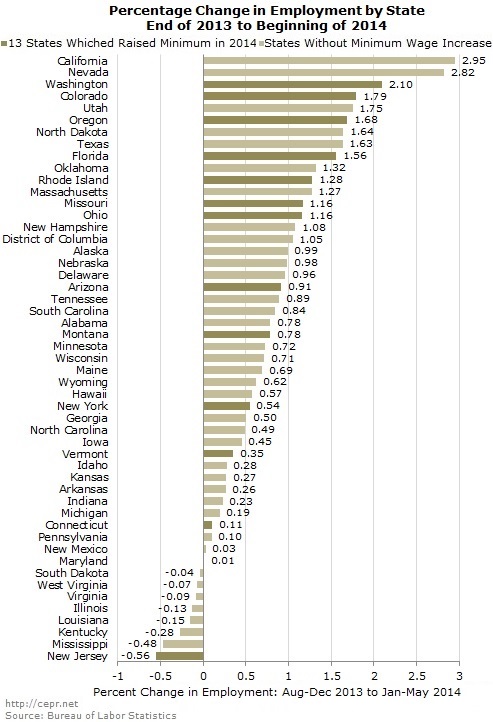
Yeah, not so much. There were 13 states whose minimum wage was counted as having increased. 4 of those were deliberate increases due to new legislation (the four: Connecticut, New Jersey, New York, and Rhode Island) but the other 9 were insignificant cost-of-living inflation adjustments. If your theory is that minimum wage increases lead to job growth you ought to be able to scatter-plot the two variables and find a positive relationship. We should expect to see that MORE minimum wage increase leads to MORE job growth. Right?
But we don't see that at all in the data.
In fact, the four states that made a substantial deliberate increase in the minimum wage collectively did WORSE than average at job growth. The biggest percentage increases in minwage led to the LEAST job growth.
Of the four aforementioned states New Jersey did the worst, managing to combine its hefty minimum wage increase with literally the WORST job LOSSES of any state in the union. Connecticut's job growth was anemic/flat. New York's was well below average. Of the four states, only Rhode Island did okay (not stellar, but a decent upper-middle-of-the-pack showing).
From these stats we should actually conclude that noticeably raising minimum wage does NOT increase job growth.
(The chart showing the various states and their job growth is here: http://www.cepr.net/index.php/... )
-
Re:9 States automatically increased
Actually, that is the interesting bit.
Of the 9 states that increased automatically, 8 are in the top half of the growth league - conversely 3 out of 4 of the states that voted an increase are in the bottom half.
(link to chart: http://www.cepr.net/images/sto...)The thing about that correlation is that there is actually a plausible mechanism for causation - predictability. When a business decides to invest in hiring more people, you want to try and work out the costs, the potential for profit and the risk of failure. If you are hiring at or near minimum wage, then the level of minimum wage comes into that business plan. If any increase is automatic then you can simply add it in to costs (based on inflation assumptions which you need elsewhere anyway) - it will go up, but that can be accounted for. If any increase is _not_ automatic, then it becomes an unknown in your costs, a _risk_, dependent on politicians. Even in states that did _not_ raise it but _might_ have, that unknown, political risk, may have adversely affected investment decisions.
Businesses like a predictable environment more than anything.
If my suggested effect is real, then there is also a flip side - it will work like this in an expanding economy, but if the economy is contracting then having an automatic minimum wage increase could conceivably accelerate firing decisions - minimum wage jobs might be lost faster because of the known future costs.
-
A bit high
- Studies estimate the 2012 minimum wage should be $10.52: http://www.cepr.net/documents/...
- Average inflation rate for US is 2-3%: http://www.usinflationcalculat...
- If they set it to $11/hr now, 2015-2020 = 5 years @ 3% inflation, $11 * 1.15 = $12.65. $15/hr is a bit high.
Both of my in-laws own small businesses. True small businesses with less than 10 employees and their takehome pay combined is about the median income of the average US household. They both would have to close shop if this happened. Good luck to small business owners in Seattle.
Mega-corps in Seattle I have no doubt will find a way to abuse this. -
Re:Customers may benefit... maybe
Increasing the minimum wage will do a few things:
1) Drive the economics of automation and productivity increases which will create more unemployment of unskilled workers, not less. Although this might be good for the economy broadly but its not good for the group minimum wage increase advocates claim to seek to help.
2) It will raise costs which will be reflected in consumer prices, effectively raising the cost of living. Lowering the quality of life the slightly more successful enjoy. In otherwords its an attack on the middle class.
Nice try, except there is no evidence for either of those things happening when reviewing past minimum wage increases. Try using facts & real math instead of right-wing talking points.
http://www.cepr.net/documents/...
http://www.bloomberg.com/news/...
"The studies find minimum-wage increases even provide an economic boost, albeit a small one, as strapped workers immediately spend their raises. A 2011 paper by economists at the Federal Reserve Bank of Chicago found that a $1 minimum-wage increase lifts household income by about $250 and increases spending by about $700 a quarter in the following year. The spending increase is driven by a small number of households that primarily buy vehicles. "
http://www.americanprogress.or...
"There is no evidence to support the claim that a higher minimum wage will lead to less employment. Businesses can easily absorb a higher minimum wage—with a small price increase or a small reduction in already very high profits, for example. The argument that a higher minimum wage will be a job killer simply doesn’t pass the sniff test of basic economic arithmetic, and is contradicted by reams of serious economic research."
-
Re: Ridiculous.
See Table 6: Ex-Offenders and the Labor Market
At least according to one study, race is a big part of it. It's not the only part - level of education appears to have as big an effect - but it's clear that a black felon is much less employable than a white felon.
-
The One True Wanker of the Decade
Relevant [cepr.net] to the linked article.
-
The real problem is with Pharma/Biotech/etc
In the 1990s, there was still demand for biology PhDs in the private sector, which has significantly dried up since. It's not GONE, but it's greatly reduced. That's why the emergency-of-people-whining (because couldn't get professorships, had to work in industry) is now an emergency-of-people-in-serious-trouble (because can't get JOBS AT ALL.) For the balance, I'll be using the terms Pharma, Biotech and Industry interchangeably - they're not exactly the same thing but the basic argument applies whether the company is making drugs or medical devices or developing new diagnostic biomarkers or whatever they do employing PhDs in the life sciences.
On top of this, the research that the biotech companies are doing is mostly me-too research which doesn't benefit the public. In spite of this, industry is continuing to milk the public of their subsidy from patent protection on products that were ~50% developed at public expense anyway. The solution to this is a fairly simple reallocation:
* End patent protections for medical technologies. Because of capitalism, and markets, and other realities which sensible people accept, this will drive prices through the floor.
* Take the savings to the rest of the economy, and raise people's taxes (should be balance-sheet-neutral on average for the general population)
* Give the extra tax revenue to the NIH, and expand the NIH mission to include drug development, medical device development, etc. as needed to bring such to market.To be blunt, I do not respect the opinion of people who defend drug patents at this point, especially since such people are generally ideologically committed (as opposed to persuaded on relative merits, no the same thing), to "capitalism". The commitment of "capitalists" to intellectual property protection (instead of market competition) shows them to be craven, deceptive and fraudulent: they're really committed to oligarchy and to the preservation of privilege, not to the market as an instrument of efficient allocation of economic resources. Such people are deeply shameful and depraved - they are not worthy of respect out of any need to promote ideological balance.
Anyway, even during the 90s, the price paid by the public for patented medical treatments was not really justified given the amount that the Pharma industry spent on R&D:
http://www.cepr.net/index.php/press-releases/press-releases/cepr-releases-report-on-prescription-drug-research/Now a days, with drug expenditures being a larger share of GNP, and pharmaceutical R&D being a smaller share of GNP, the cost:benefit relationship is even more drastic. To put it another way - biotechnology patents, generally speaking, do not meet the constitutional test of being beneficial to the public or of promoting the useful arts. So they should be done away with, and the public sector (which is far more efficient at funding scientific research than the private sector, due primarily to the better information available to the people making decisions) should simply assume that function, producing a significant cost savings for the general public as well as accelerating the pace of research and finding useful employment for our best and brightest.
-
Re:Duh?
The centre for economic and policy research postulates a tax deductable "artistic freedom voucher":
http://www.cepr.net/index.php/publications/reports/the-artistic-freedom-voucher-internet-age-alternative-to-copyrightsThen there is Kickstarter.
Or you could look to how artistic works got created in the past - patronage.
Wanna know where that movie or music money goes? Well sometimes it goes to the star (McCartney is worth almost $800 mil, Cruise around $250 mil). But a huge wedge goes to the publishers and distributors.
The future for music may be a mix of live concerts and possible fan funded development. The film industry spending $250 million on a film may be doomed, but the quality and diversity of the films is likely to go up as a result. Super Size Me cost $65k to make and netted 30 million (although to be fair I don't know how much marketing cost). Source http://www.the-numbers.com/movies/records/budgets.php
-
Impact: Addt'l 50% of GDP per year for 40 yearsThis post from economist Dean Baker's blog at CEPR does some analysis that shows that extraction of $1 trillion in minerals over the next 40 years would add $300-$400 per capita per year. Current Afghanistan per-capita GDP is about $800 per year.
---
"How Much Is $1 Trillion in Afghanistan?
Source: CEPR.net / Dean Baker's 'Beat the Press' blog
http://www.cepr.net/index.php/blogs/beat-the-press/how-much-is-1-trillion-in-afghanistan/"The media have been highlighting projections produced by the military that show that Afghanistan may have $1 trillion of mineral wealth. It would be helpful to put this figure in some context. The NYT helpfully described this sum as being equal to $38,482.76 for every person in Afghanistan."
"It would be useful to note that this is a gross number, it does not subtract the cost of extracting the minerals nor does it consider that these resources would likely be extracted over many decades. If we assume that the cost of extracting the minerals (e.g. foreign produced equipment, foreign trained technicians, profits of foreignh companies and environmental damage -- not counting domestic Afghan labor) is between 25 and 50 percent of the value of the minerals, then the money going to Afghanis would be between $500 billion and $750 billion."
"If this money is earned over a 40-year period (Saudi Arabia has been producing oil for 80 years), then it comes to between $12.5 billion and $18.8 billion a year. Afghanistan's population is currently 29.1 million, but it is growing at the rate of 2.5 percent annually. Assuming the growth rate slows, Afghanistan's population will average about 40 million over this period. This means that the revenue from the minerals will average between $312.50 and $470 per person per year. This is still likely to have a substantial impact on Afghanistan's economy, since its current GDP per capita is just $800 on a purchasing power parity basis."
-
Impact: Addt'l 50% of GDP per year for 40 yearsThis post from economist Dean Baker's blog at CEPR does some analysis that shows that extraction of $1 trillion in minerals over the next 40 years would add $300-$400 per capita per year. Current Afghanistan per-capita GDP is about $800 per year.
---
"How Much Is $1 Trillion in Afghanistan?
Source: CEPR.net / Dean Baker's 'Beat the Press' blog
http://www.cepr.net/index.php/blogs/beat-the-press/how-much-is-1-trillion-in-afghanistan/"The media have been highlighting projections produced by the military that show that Afghanistan may have $1 trillion of mineral wealth. It would be helpful to put this figure in some context. The NYT helpfully described this sum as being equal to $38,482.76 for every person in Afghanistan."
"It would be useful to note that this is a gross number, it does not subtract the cost of extracting the minerals nor does it consider that these resources would likely be extracted over many decades. If we assume that the cost of extracting the minerals (e.g. foreign produced equipment, foreign trained technicians, profits of foreignh companies and environmental damage -- not counting domestic Afghan labor) is between 25 and 50 percent of the value of the minerals, then the money going to Afghanis would be between $500 billion and $750 billion."
"If this money is earned over a 40-year period (Saudi Arabia has been producing oil for 80 years), then it comes to between $12.5 billion and $18.8 billion a year. Afghanistan's population is currently 29.1 million, but it is growing at the rate of 2.5 percent annually. Assuming the growth rate slows, Afghanistan's population will average about 40 million over this period. This means that the revenue from the minerals will average between $312.50 and $470 per person per year. This is still likely to have a substantial impact on Afghanistan's economy, since its current GDP per capita is just $800 on a purchasing power parity basis."
-
Re:Curious
Requesting "statistical evidence" is the last refuge of someone who can't reason. 2 years ago you could have asked 'what statistical reason do you have to believe the current housing/credit/overextension bubble will crash?'. It's a meaningless question.
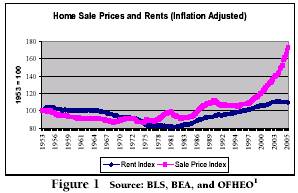
Actually, had you asked Dean Baker this question in 2006, he would have showed you this graph, based on historical norms of housing values adjusted for inflation. I believe this would be called statistical analysis. Perhaps it's something you should look into.
Corporate tax is a scam. When corporations take in a profit, they do what with it? They invest it back into the company, they expand, they pay it out as a dividend, or they pay it to their workers. All but one of those directly benefit society. The last one gets taxed already. Those "fat cats" you rabble rousers love to harp on pay a shitload of taxes on that money already.
Corporations have the privilege of limited liability and funding through stock offerings. If they don't want to pay corporate tax rates, they can form business partnerships which don't offer these benefits, and don't require them to pay corporate tax rates. But you ain't even on my level. I'm going to let my homie Reagan ride on your bitch ass.
Millions of working poor will be dropped from the tax rolls altogether, and families will get a long-overdue break with lower rates and an almost doubled personal exemption. We're going to make it economical to raise children again. Flatter rates will mean more reward for that extra effort, and vanishing loopholes and a minimum tax will mean that everybody and every corporation pay their fair share. And that's why I'm certain that the bill I'm signing today is not only an historic overhaul of our tax code and a sweeping victory for fairness, it's also the best antipoverty bill, the best profamily measure, and the best job-creation program ever to come out of the Congress of the United States.
-Ronald Reagan, before signing the 1986 Tax Reform ActI know when a Democrat says the same thing it's socialist. As usual, modern right wing rhetoric is so blatantly hypocritical it's become a comedy.
Effectively when you tax a corporation, you're taking money away from the entities most likely to create jobs and expand the economy, and you give it to the entity most proven to waste money.
Oh, damn, I forgot. Military spending is a total waste of money. What are your plans for reducing that? It represents the largest slice of federal spending.
You are taking the absolutely most valuable money in the economy and destroying it.
I know! If we invest in education or health care, it's just like lighting the bills on fire. Whereas every time a tax break is given to a company already profiting billions, another angel gets its wings.
I don't agree with whining about the "super rich" either, as they pay most of this country's tax burden, but at least that's not as absolutely destructive as going after corporations and large businesses.
They have a majority of the country's wealth. Why shouldn't they pay a majority of it's taxes?
So please, spend your proletariat rage on the rich people, not the corporations. Having a tax revenue highly susceptible to boom and bust cycles is a lesser evil than slowing down the cornerstone of the modern economy.
It's adorable. Asking a corporation to pay it's fair share of taxes is "proletariat rage," and programs that help people like the Earned Income Tax Credit are socialist. So much for principles, huh?
-
Re:Drugs Are Bad, mmmkay?
-
Re:Election Fraud
Sorry, but the Employee Free Choice Act would NOT get rid of secret-ballot elections for unionization. That particular talking point is just an anti-labor scare tactic.
Under current law, unions can be certified by either secret-ballot elections or majority sign-up (also called card check). The EFCA would maintain both options.
But currently the employer (and only the employer) can demand an election if he/she wants to. So, in practice, most union drives end in elections. The EFCA would change the law so that employees, rather than employers, get the decision whether they will unionize by election or card check.
Why would workers prefer majority sign-up? Well, among other reasons, to avoid illegal harrasment and firing by employers. And this is a serious problem: according to a recent CEPR study, almost one in five union organizers are fired by their employers during union drives.
It's not the secret-ballot election itself that gets workers fired; it's the inevitable campaigning, where management can spend enormous amounts of time and resources doing anti-union 'education', but union organizers who do anything out in the open get fired. The system is vastly asymmetrical, and the EFCA is aiming to help redress that asymmetry, by giving employees the CHOICE to unionize by majority sign-up if they want to.
-
Re:Huh?
All the "efficiency" concerns you're talking about come from free market stuff as well...Frankly, I've never seen it from Union work, because usually when it's Union work they demand the solution that will employ the most people, not the "best" solution.
As for the robotics, sure, fine, but if your protective tariffs were lower, those goods could be made elsewhere at a fraction of the cost, and that would benefit the consumers in Sweden and it would benefit the workers in other parts of the world. Hell, if the unions weren't so strong you could probably replace those robots with actual people and maybe reduce that 17% unemployment rate you guys like to pretend you don't have.
Face it, robots aren't as cheap as people, and I can't remember the last time I saw something with "Made in Sweden" stamped on it, so clearly they're not churning out a massive surplus.
-
Re:meanwhile abroad...
Even if it's only an extra few hundred thousand barrels of oil, it behooves us (and the entire world) to have that capacity online and ready to go. Because if we see the day that demand exceeds capacity, even by a few barrels per day, get ready for some truly high prices.
It doesn't work that way. The tighter the capacity, the higher the prices. There's no sudden point where oil jumps from $100 a barrel to $1000 a barrel because someone consumed an extra gallon. The tighter the capacity, even if there's potentially excess, the harder it becomes to keep all markets supplied.
Also, I've seen that claim of 200,000 barrels per day but I haven't seen the source material. Do you have a link handy?
This cites an EIA (DOE) study on the subject.
And you want to bank our future on the bet that the national and worldwide economic recession will be bad forever?
It's going to be bad as long as energy costs are high. You seem to be having trouble with the fact that there's no sudden tipping point when consumption surpasses production and prices suddenly make a gigantic spike. High oil prices hinder economic growth. Increased supply can help, but decreased consumption is far more effective in the short term; you can decrease consumption far faster than you can add supply.
Two answers: 1) The "5-10 years" is not accurate. When an oil company decides to drill, it doesn't take that long to deploy. 2-3 years is more accurate.
According to my father, who is a president of an oil supermajor's US division, when I asked him about how long it'd take for a new offshore facility (especially the deepwaters, as we're talking about in a lot of these places) to come online, his estimate was about 7 years. So, let's see. Oil company president or random slashdot poster, who to believe here...
Are you even aware of the rig and drillship shortage that's causing problems for the industry right now?
2) We need a long-term solution, not just a quick fix.
No, we need *both*.
No-one is saying that it doesn't make sense to conserve, too.
*You* are. You were making fun of Obama for calling for conservation as though it was the only element of his energy plan, which is what ticked me off enough to write my initial post.
But, short-term economic problems notwithstanding, the long-term trend of the country and for the world is growth.
That's because the long-term price for resources is downwards. When, in the short or mid-term it's not, the economic trend is for stagnation or recession.
Even if save 600,000 barrels of oil inflating our tires, the economy will still eventually grow and need more than those 600,000 barrels--even if we keep inflating our tires. We STILL need to drill to prepare for the future.
You seem to have gotten the wrong impressison here. I'm not against all drilling. I'm pointing out how ridiculous it is that you're making fun of Obama for advocating something *completely reasonable*, and for your treatment of drilling as a short term solution, especially when we're talking about such a small amount of capacity. I actually see trading trilling for repealed tax incentives as a reasonable compromise. And, apparently, so does Obama.
We're talking about capacity, not the amount produced. As the report itself says on page 31: "Tight spare capacity is another supportive factor, especially against the background of rising tension over Iranâ(TM)s nuclear activities." Spare capacity means there's still an ability to produce more than we need, and that's all that's necessary to keep prices in check. When we no longer have that ability, we're toast.
Sorry, but it doesn't work that way. The tigher the capacity, the harder it is to get it where you need it, and the more prices rise. The more prices rise, the more the world economy slows There's no magical tipping point when pric
-
Lots of problems left.
Bankers have been saved without relief for debtors (another source). It's a good idea to prevent a general collapse because we use a fiat currency but leaving thousands of people ruined won't do enough. Trickle down has made a lot of executives very rich while leveling US manufacturing and consolidating all other commerce. The people responsible for the predatory lending crisis deserve to be treated like criminals. Many of the debtors are the victims of some very shady deals, which include intentionally inflating the value of property in cooperation with lenders. There's a lot of scandal here from top to bottom.
-
Re:humanity vs capitalism
... but it took capitalism to create the formula for the drug in the first place
Here's some basic reading for you on how Big Pharma is gaming the patent system for their own short-sighted gain:
http://www.nationmultimedia.com/2007/04/21/opinion /opinion_30032324.php
http://www.nybooks.com/articles/17244
http://archive.salon.com/tech/htww/2006/01/13/drug _patents/index.html
http://www.cepr.net/index.php?option=com_content&t ask=view&id=1065&Itemid=8 -
Re:humanity vs capitalismYes, because it didn't cost anything to do all the tons and tons of research and testing (not to mention the cost of education for all the scientists) to produce the drug. Let's turn that around: Merck did not pay one single dime for the education of those scientists. The US taxpayers did. Merck did not pay one single dime for all the basic research needed to develop the drug. The US taxpayers did. Why should Merck be allowed to steal money from the US taxpayers?
Here's some basic reading for you:
http://www.nationmultimedia.com/2007/04/21/opinion /opinion_30032324.php
http://www.nybooks.com/articles/17244
http://archive.salon.com/tech/htww/2006/01/13/drug _patents/index.html
http://www.cepr.net/index.php?option=com_content&t ask=view&id=1065&Itemid=8 -
Re:Next headline...
The NIH has done alot of research and publishes much of it in the interest of common good. The NIH (and related organisations in other countries) are not at all the problem however.
Bear in mind also that a cure can be published in detail while also remaining patented: don't get patentability mixed up with copyright.
As a medical researcher, you mind find it interesting - perhaps disturbing - to read the following:
Stagnation in the Drug Development Process: Are Patents the Problem?
TRIPS and pharmaceutical patents: fact sheet
Patents, Pharmaceuticals and the Third World
There is much more out there on this problem. I suggest you look around. -
Re:Wrong arguments....Do you even understand why the USPTO was created? To regulate congress' and the constitution's goal of promoting the sciences and the useful arts. They have failed miserably, don't you think? you will find a wealth of economic professor papers on this symbiosis between incentive and creation in _any_ Industry. Ah, but are copyrights (and patents, for that matter) actually incentives, or are they barriers? The answer to THAT question may surprise you.
The Computer Science and Telecommunications Board (CSTB) of the National Academy of Sciences writes in their report The Digital Dilemma: Intellectual Property in the Information Age:Recommendation: The committee suggests exploring whether or not the notion of copy is an appropriate foundation for copyright law, and whether a new foundation can be constructed for copyright, based on the goal set forth in the Constitution ("promote the progress of science and the useful arts") and a tactic by which it is achieved, namely, providing incentive to authors and publishers. In this framework, the question would not be whether a copy had been made, but whether a use of a work was consistent with the goal and tactic (i.e., did it contribute to the desired "progress" and was it destructive, when taken alone or aggregated with other similar copies, of an author's incentive?). This concept is similar to fair use but broader in scope, as it requires considering the range of factors by which to measure the impact of the activity on authors, publishers, and others.
The Economist writes:Copyright was originally the grant of a temporary government-supported monopoly on copying a work, not a property right. Its sole purpose was to encourage the circulation of ideas by giving creators and publishers a short-term incentive to disseminate their work. Over the past 50 years, as a result of heavy lobbying by content industries, copyright has grown to such ludicrous proportions that it now often inhibits rather than promotes the circulation of ideas, leaving thousands of old movies, records and books languishing behind a legal barrier.
But I'm sure you know better than them, right?
I'm feeling generous, so I'll give you a metric ass-load of other links for free, just in case you have problems learning Google:
http://www.iht.com/articles/2005/10/07/opinion/eds miers.php
http://www.gnu.org/philosophy/motivation.html
http://www.mises.org/journals/jls/15_2/15_2_1.pdf
http://libertariannation.org/a/f31l1.html
http://www.dklevine.com/general/intellectual/again st.htm
http://www.gseis.ucla.edu/~howard/Papers/pw-public -spaces.html
http://www.dontpanicmedia.com/xarpages/article?id= 1069
http://www.cepr.net/publications/textbook_2005_09. pdf
http://www.cepr.net/publications/ip_2003_11.htm
Maybe I get to keep my $50, but for other reasons than you thought. -
Re:Wrong arguments....Do you even understand why the USPTO was created? To regulate congress' and the constitution's goal of promoting the sciences and the useful arts. They have failed miserably, don't you think? you will find a wealth of economic professor papers on this symbiosis between incentive and creation in _any_ Industry. Ah, but are copyrights (and patents, for that matter) actually incentives, or are they barriers? The answer to THAT question may surprise you.
The Computer Science and Telecommunications Board (CSTB) of the National Academy of Sciences writes in their report The Digital Dilemma: Intellectual Property in the Information Age:Recommendation: The committee suggests exploring whether or not the notion of copy is an appropriate foundation for copyright law, and whether a new foundation can be constructed for copyright, based on the goal set forth in the Constitution ("promote the progress of science and the useful arts") and a tactic by which it is achieved, namely, providing incentive to authors and publishers. In this framework, the question would not be whether a copy had been made, but whether a use of a work was consistent with the goal and tactic (i.e., did it contribute to the desired "progress" and was it destructive, when taken alone or aggregated with other similar copies, of an author's incentive?). This concept is similar to fair use but broader in scope, as it requires considering the range of factors by which to measure the impact of the activity on authors, publishers, and others.
The Economist writes:Copyright was originally the grant of a temporary government-supported monopoly on copying a work, not a property right. Its sole purpose was to encourage the circulation of ideas by giving creators and publishers a short-term incentive to disseminate their work. Over the past 50 years, as a result of heavy lobbying by content industries, copyright has grown to such ludicrous proportions that it now often inhibits rather than promotes the circulation of ideas, leaving thousands of old movies, records and books languishing behind a legal barrier.
But I'm sure you know better than them, right?
I'm feeling generous, so I'll give you a metric ass-load of other links for free, just in case you have problems learning Google:
http://www.iht.com/articles/2005/10/07/opinion/eds miers.php
http://www.gnu.org/philosophy/motivation.html
http://www.mises.org/journals/jls/15_2/15_2_1.pdf
http://libertariannation.org/a/f31l1.html
http://www.dklevine.com/general/intellectual/again st.htm
http://www.gseis.ucla.edu/~howard/Papers/pw-public -spaces.html
http://www.dontpanicmedia.com/xarpages/article?id= 1069
http://www.cepr.net/publications/textbook_2005_09. pdf
http://www.cepr.net/publications/ip_2003_11.htm
Maybe I get to keep my $50, but for other reasons than you thought. -
15% to research, 85% to other stuff
what do you think the ratio of new drug research is to profits? For a major drug company? Conversely, what do you think the ratio of marketing vs profits? Got a clue? No? Feel free to go do a little googling.
In case the grandparent poster is Google impaired - a condition that medical science has yet to find a cure forHere are the Financial Highlights from the annual reports of Novartis, Pfizer and AstraZeneca. They all spend around 15% of their revenues on research. The number is typical for the industry. The other 85% go to other things, according to their own figures. More than half their revenues are spent on marketing and profits.
So the standard argument for granting patent monopolies and allowing the pharma companies to charge whatever they want for the patented drugs - that they spend the excess revenues on research for new drugs - is simply not true.
The organization Doctors Without Borders gives an example of how pharmaceutical patents affect prices i a recent press release:
The case of AIDS illustrates the trend. While fierce generic competition has helped prices for first-line AIDS drug regimen to fall by 99% from $10,000 to roughly $130 per patient per year since 2000, prices for second-line drugs - which patients need as resistance develops naturally - remain high due to increased patent barriers in key generics producing countries like India.
In this particular case, the price with patents was a hundred times the price without patents. How can 15% spent on R&D justify a markup by 10,000% on the final product?To the western world, pharmaceutical patents mean an enormous waste of money. In the third world, it's lives that are wasted instead. It's time to think about an alternative.
And alternatives exist - plenty of them, in fact. Nobel prize winner Joseph E Stiglitz has made one proposal. The Swedish Pirate Party has made another (or essentially the same, actually). Economist Dean Baker has collected four others, that also run along the same lines.
It's time to open up a global discussion about the effects of pharmaceutical patents, and the alternatives. Today's system is not only grossly immoral, it is also expensive and wasteful. It's time for a better way. Pharmaceutical patents kill.
-
Re:Taco's EvaluationIt's not just Taco. Take a look at a ten year history of the Nasdaq and tell me we're in a bubble like 1999.
If tech stocks are overvalued now, it's nothing like they were then. Now let's talk about housing, shall we?
-
Re:Patent economics 101
sure that they would be able to recover thoses costs by haveing the right to control how and by whom it is produced
This is a fallacy. Revenue is not magically generated by having control over production, nor is control over production a guarantee of profit.
Explain to me how even the current patent system hurts the inventor.
In many ways, but mainly because the patent system has become a game for the Big Guys who can afford the law suits or defend themselves by using their own patents. Small inventors with one or two patents don't stand a chance. This article is but one example of this scenario. The way the multi-nationals use cross-licensing as a legal way of creating cartels is also pretty sickening (I recommend the excellent book Information Feudalism by Peter Drahos and John Braithwaite for more on that).
For a more general discussion around the patent system and some of it's problems, I direct you to a few references on the topic:
http://wiki.ffii.org/Martin041109En
http://www.quebecoislibre.org/000902-3.htm
http://www.guardian.co.uk/globalisation/story/0,73 69,665969,00.html
http://www.thenation.com/doc/20020805/newman200207 25
http://www.iht.com/articles/2006/05/21/business/wh o.php
http://www.dklevine.com/general/intellectual/again st.htm
http://www.cepr.net/publications/intellectual_prop erty_2004_09.htm -
Re:The truth about "poverty" in the US.
Very few people in this country are giving a TON of money to "help others". We all pay taxes for various shared services, services which we couldn't do on our own. As someone else said, unless you want to pay a per-use fee every time you drive, pay a monthly security fee to your own private police officer, pay a private militia to protect you from the bad guys and so on, you need a government, and they need your money to run. Compared to similar nations, we have a much lower tax burden: http://www.ppionline.org/documents/ACFAVUvce4Tc.p
d f "It is also worth noting that most other industrialized nations face far higher tax burdens than the United States. According to OECD data, the 2000 tax share of GDP in the United States, Belgium, and Norway were 29.6, 45.6, and 40.3% respectively. These higher tax burdens have not prevented the economies of these nations from continuing to grow and prosper. Belgium, France and Norway enjoyed higher productivity levels than the United States throughout the 1990s, despite their higher tax rates.[4] Many countries with far higher tax burdens than the United States, such as Denmark, Sweden, and the Netherlands, enjoy lower unemployment rates." - http://www.cepr.net/publications/deficit_scare.htm #_ftn4 The simple fact is that we are just about the *least* taxed modern nation on the planet. And yet people who live extremely comfortable lives, with amenities that 99.9% of humanity could only dream of, all because they won the socioeconomic lottery to be born middle class in America, spend much of their time complaining that what they *do* give back is too much. All while suggesting that the poor should be satisfied that they are not even poorer. I know you probably won't, but you should look at the work of Jeffrey Sachs, a brilliant man with decades of on-the-ground experience around the world. When will the giving stop, you ask? His latest book describes how developed nations giving 0.7% of GDP to targeted programs could solve a whole raft of problems the world over, from unclean water to famine to disease to a lack of basic education. So. Less than 1%. Sounds reasonable to me. -
How Baker proposes to keep up-front costs low
In his weekly economic reporting reviews Baker is a regular advocate of allowing unlimited numbers of computer programmers into the country to drive down the wages of software engineers:
This article reports on a new World Bank study that shows that many developing countries are harmed by the loss of highly educated workers to rich countries. At one point the article asserts that the United States and other rich countries have an immigration policy that is intended to attract highly educated workers from the developing workers.
This is not true. While the United States allows in millions of less-skilled workers to work as custodians, restaurant workers, and cab drivers, it sharply limits the number of more highly skilled workers who can work in the country. These restrictions take a variety of forms. Professional and licensing restrictions in occupations like medicine and law make it very difficult for foreign educated workers to fill these positions. These restrictions were quite consciously designed to protect U.S. professionals who fear foreign competition.
Standard U.S. restrictions on immigrant workers also protect higher educated workers more than less educated workers. While restaurants know that they can hire as many undocumented workers as they want with impunity, a major corporation like IBM or Microsoft would never hire large numbers of undocumented software engineers in complete disregard of the law. This is because software engineers have considerably more political power than restaurant workers. While these companies may bring in immigrant workers on H1-B visas, and similar programs, the number of highly-skilled workers who enter the country this way is a tiny fraction of the number who would enter in a free market.
It is worth noting that it would be easy to design a policy that would ensure that developing countries share in the benefits from freer trade in more highly skilled professional services. If a tax were imposed on the earnings of these workers in the United States, which would reimburse developing countries for the expenses associated with educating these workers, then both rich countries and poor countries would benefit.
Economists who support "free trade" would be pushing hard for such policies, since they would take advantage of the comparative advantage that developing countries enjoy in educating highly skilled workers. It is far cheaper to educate doctors, lawyers, and economists in the developing world than in the United States. The world economy would experience enormous gains if educated workers in developing countries could freely work in the United States (vastly reducing the cost of health care and other services provided by highly educated professionals) and their home countries were compensated for educating these workers. The political power of the professionals in the rich countries who would have to accept lower pay in this scenario keeps rich country protectionist barriers in place.
He regularly overstates the political power of software engineers, and singles them out despite the fact that H-1B visas explicitly target the profession. He doesn't seem to understand the practice or business of software engineering particularly well. It's unfortunate because much of his analysis regarding the stock bubble and housing bubble is accurate.
-
Re:Since when is that the job of the gov't? Yeah!
Take a look at their website, and they do appear to have some left-of-center tendencies. They talk up the housing bubble, defend the economic effectiveness of Pres. Hugo Chavez, and reject the IMF's mantra of "privatization, deregulation, and free trade".
I like them already. -
Baker's paper
Dean Baker, Bird Flu Fears: Is There a Better Way to Develop Drugs? (pdf)
-
Re:I don't blame them.
This is drug industry propoganda.
The majority of the expenses associated with new drug discovery are actually made in the public sector - by Universities and so forth. In broad outline the story is very similar to the Internet, also developed at public expense.
Now, the private sector does contribute significant additional resources to drug development. HOWEVER, these additional resources are a *fraction* of the total increase in drug prices that result from the patents they are awarded (vs. what the same drugs would cost if prices were governed by a free market.)
The upshot is that if you look at it over the long run, we would be much better off if we violated all the patents, let the patent-dependent drug companies go out of business, and funded an equivalent amount of research in the public sector, making the results available to anyone who wished to sell the resulting drugs on the market.
The research I'm citing here was done by a fellow named Dean Baker. I'll dig up an exact ref if you like. -
Re:The whole system will crumble
> Drug development is a hugely expensive process.
That's true, and over 50% of this comes from public funds currently. http://www.cepr.net/publications/patents_what_are_ the_issues.htm 50% -
Re:Key questions.Well from the thinking I've done on the subject, I've come up with/come across 8 different schemes that seem viable, to varying extents. They all have their own unique problems and advantages. Briefly, these are some possibility that I would consider 'fair' (although I know that many slashdotters are not as socialist as I, and would not agree with some of these):
1. Government Funding for the ArtsTaxes are increased, and a government body redistributes money to content producers (authors, movie studios, etc.). This would be very similar to how academic research is currently funded. 'Reasonable' prices would be put on content. This would probably mean that Hollywood actors would not longer be able to demand big salaries. For those of us who don't trust the government, perhaps the system could have, on the tax form, an ability to select which artist or content producer you wanted to send some of your tax dollars to. That way, the people could still use their money to fund projects they liked.
2. Artistic Freedom VoucherSimilar to #1, artists are supported by tax-exemption coupons, similar to charitable donations. This is not my idea, please refer to Dean Bakers's text.
3. AwardsAs a variant of #1, perhaps an annual awards ceremony could be held where substantial awards are given to the content that was most highly acclaimed, appreciated, and voted for by the public. This system could exist alongside traditional copyright, if the rule was that only works released under creative commons are eligible for these awards. Essentially this would be an incentive to release work into the public.
4. Funding AmalgamationPerhaps the onus could be put on the people? Instead of legally forcing people to pay for work (via copyright), companies could produce content, and demand a certain fee before it is released into the commons. The people who care would then just pay into an intermediary company, that would negotiate the cost of the work. Yes, I know that the Star Trek fans were not able to save Enterprise via amalgamating their funds... but if this system were fully implemented, people would take a more active role in helping decide what content is created... and perhaps less crap would be produced, since no one would bother buying it.
5. DonationsDonations are always an acceptable model for paying for work. Open source software seems to do well with that model.
6. Service Business ModelCopyrighted works could be considered services instead of products. Basically, we pay for convenient access to a database of works, rather than buying each work one at a time. People pay for timely access to new artistic works, but there is nothing that prevents works from being copied. The viability of this model has been analyzed, I refer you to this MIT report.
7. Limited CopyrightModern technology has made everything in life more rapid... yet copyright still lasts (effectively) forever! Why should Windows 95 be protected for 75 years when it is replaced within 3 years and obsolete within 5 years? Perhaps the timescales should be 'fair.' Like news stories are protected for 2 weeks, movies and video games for 6 years, software for 4 years, books for 10 years. In the current system, the copyright effectively NEVER expires.
8. CombinationsNo single solution will work for every industry... and indeed many of the proposals I've outlined above are not mutually exclusive. Careful combinations could yield best results. Or perhaps it could be up to the copyright holder what they wanted to select.
Okay, I know I'm hopelessly idealistic to think that any of these could ever be implemented... but I'm still interested to hear any criticisms or comments... -
Poppycock
The most disturbing thing about this article is it's point of view on social security. It shows a compleate lack of understanding and total disreguard for reality.
Social Security wasn't created to be retirement program. It was put into effect to keep old folks from dying in the streets, and evaluated on that criteria, it has been very successful.
And fear moners and profit mongers nonwithstanding, social security is still in solid health. By the most pessimistic of predictions, the program is slated to take in more revenue than pay out for another 15 years. And every year the CBO and Social Security Trustees release their report, that number gets bumped up (previous years accounting showed 2017 as the year where payouts finally match revenues).
According to the latest trustee report, 2053 is the year where full scheduled payments may be impacted. But again, every year the trustees produce their report, the margin from the current date increases.
The scare is a manufactured one, a campaign of Wall Street making to get their grubby hands all over lucrative administrative fees for such a regulated, bureaucratic alternate privately funded looting.