Slashdot Mirror
Domain: cnet.com
Stories and comments across the archive that link to cnet.com.
Stories · 2,482
-
IBM To Invest $3 Billion For Semiconductor Research
Taco Cowboy points out that many news outlets are reporting that IBM plans to spend $3 billion on semiconductor research and development in the next five years. The first goal is to build chips whose electronic components, called transistors, have features measuring just 7 nanometers, the company announced Wednesday. For comparison, that distance is about a thousandth the width of a human hair, a tenth the width of a virus particle, or the width of 16 potassium atoms side by side. The second goal is to choose among a range of more radical departures from today's silicon chip technology -- a monumental engineering challenge necessary to sustain progress in the computing industry. Among the options are carbon nanotubes and graphene; silicon photonics; quantum computing; brainlike architectures; and silicon substitutes that could run faster even if components aren't smaller. "In the next 10 years, we believe there will be fundamentally new systems that are much more efficient at solving problems or solving problems that are unsolvable today," T.C. Chen, IBM Research's vice president of science and technology, told CNET -
Google Reader: One Year Later
Nate the greatest (2261802) writes "Just over a year has passed since Google closed Google Reader; have your reading habits changed? When Google announced in March 2013 that Google Reader would close, a number of pundits saw it as a sign of the imminent death of RSS feeds as redundant tech. But 15 months has gone by and I can't see that very much has changed. Former Google Reader users fled to any number of smaller competitors, including Feedly, which as a result quadrupled its userbase from around 4 million users to around 15 million users and 24,000 paying customers in February 2014. I can't speak for you but I am still getting my news from RSS feeds, just like I did before the Readerpocalypse. Zite might be gone and Pulse might belong to LinkedIn but RSS feeds are still around." -
Google Acquires Curated Music Service Songza
mpicpp (3454017) writes with news that Google is expanding its online music services through acquisition. From the article: Songza focuses on playlists curated by music experts that are designed for specific activities or occasions and then suggested to specific listeners based on seven points of context: day of week, time of day, the device used being used, weather, location, what the particular listener has done before with the service considering those previous five points, and then what all other Songza listeners have done before given the first five context points. -
Julian Assange Plans Modeling Debut At London Fashion Show
An anonymous reader writes with news about a possible new direction for Julian Assange. Julian Assange is expected to make his London Fashion Week debut this September. The Australian WikiLeaks founder will reportedly model for Vivienne Westwood’s son, Ben Westwood, at a fashion show staged at the Ecuadorean Embassy, where he has been seeking refuge for the past two years. He is avoiding extradition to Sweden, where he is wanted for questioning over claims of sex offences. “Julian’s been in the embassy for two years and it’s important that he doesn’t slip into obscurity,” said Ben Westwood. “I want to highlight Julian Assange’s plight. What happened to him is totally unfair.” -
Google Is Offering Free Coding Lessons To Women and Minorities
redletterdave writes: According to a blog post from Gregg Pollack, CEO of the Code School, Google is paying for three free months for any women and minorities interested in tech to expand their skills. The offer is part of Google's $50 million "Made With Code" initiative, which aims to help close the gender gap in tech. While Google is also offering the same vouchers to the women in attendance at its annual I/O developers conference this week, the search giant has released an online application that's available to women everywhere. Google says its available vouchers for women number in the "thousands." -
SpaceX Shows Off 7-Man Dragon V2 Capsule
As promised, SpaceX has unveiled its design for a 7-passenger space capsule, intended for carrying astronauts to the International Station or other missions. Writes the L.A. Times: "SpaceX's Dragon V2 spacecraft looks like a sleek, modern-day version of the Apollo capsules that astronauts used in trips to the moon in the 1960s. Those capsules splashed down in the ocean and couldn't be reused. SpaceX builds its Dragon capsules and Falcon 9 rockets in a vast complex in Hawthorne, where fuselage sections for Boeing's 747 jumbo jets once were built. The company is expanding its complex, near Los Angeles International Airport, and has more than 3,000 employees."
NBC News offers more pictures and description of what conditions aboard the Dragon would be like, while astronaut Chris Hadfield says that for all its good points, the Dragon won't eliminate the need for international cooperation in space: "The United States cannot fly to the Space Station without Russia, and Russia can't fly to the Space Station without the United States. It's a wonderful thing to have. If you look at the whole life of the Space Station, think of all the tumult, with the fall of the Soviet Union, and the devaluation of the Ruble in 1998, and other countries backing out of it, the Columbia accident, which would have left us completely helpless if we hadn't had the international commitment. It's easy to have a one-month attention span, but that's just not how you build spaceships, or how you explore the rest of the universe." -
YouTube Releases the Google Video Quality Report
mpicpp (3454017) writes "YouTube has released a tool that can show you how your video-streaming quality compares to your neighbor's. 'The Google Video Quality Report is available to people in the U.S. and Canada, where it launched in January. It compares your streaming video quality to three standards: HD Verified, when your provider can deliver HD video consistently at a resolution of at least 720p without buffering or interruptions; Standard Definition, for consistent video streaming at 360p; and Lower Definition, for videos that regularly play at less than 360p or often are interrupted." -
Facebook Refuses To Share Employee Race and Gender Data
theodp writes "Back in 2007, Representative Maxine Waters asked Google's HR Chief, "How many [of Google's employees] are African-American?" After 7+ years of stonewalling, Google has pledged to finally divulge diversity data on its workforce for the first time. While the U.S. government requires all major employers to file diversity statistics with the EEOC, Google convinced the Dept. of Labor that the race and gender of its work force is a trade secret that should not have to be released to the public. Google now concedes that it has been 'reluctant to divulge that data' and 'quite frankly, we are wrong about that.' Interestingly, Facebook apparently has no such compunctions about refusing to disclose data on the racial and gender makeup of its employees, even as CEO Mark Zuckerberg lobbies Congress for changes to the makeup of the U.S. workforce. Pressed on the matter by the Rev. Jesse Jackson at Facebook's annual shareholder meeting, the WSJ reports that COO and gender equality advocate Sheryl Sandberg rebuffed Jackson's request, saying, 'It's really important to share [the Facebook diversity numbers] internally, and eventually externally.'" -
With the Surface Pro, Microsoft Is Trying To Recreate the PC Market
An anonymous reader writes "An opinion piece at ReadWriteWeb makes an interesting suggestion: Microsoft's efforts in the tablet market aren't aimed at competing with the iPad or any of the Android tablets, but rather inventing a new facet of the PC market — one Microsoft alone is targeting. Quoting: 'Microsoft wants everyone to think the Surface Pro 3 is a tablet, but its pricing gives the game away. Microsoft wants to recreate the lucrative PC market that made the company billions of dollars by repackaging a PC into tablet clothing and then hammering away at the Surface product line until everybody believes that PCs never really went anywhere, they just got a touchscreen and a cellular connection.' This is also supported by the lack of a smaller Surface tablet, which many analysts were predicting before this week's press conference. Microsoft is clearly not pursuing the tablet-for-everyone approach, but instead focusing on users who want productivity out of their mobile computing device. The Surface Pros are expensive, but Microsoft is hoping people will balance that cost against the cost of a work laptop plus a personal tablet." -
Americans Hate TV and Internet Providers More Than Other Industries
An anonymous reader writes "According to a new report by the American Customer Satisfaction Index, subscription TV providers and ISPs were the industries Americans disliked the most over the past year. 'Over-the-top video services, like Netflix and Hulu, threaten subscription TV providers and also put pressure on ISP network infrastructure. Customers question the value proposition of both, as consumers pay for more than they need in terms of subscription TV and get less than they want in terms of Internet speeds and reliability.' Unsurprisingly, Time Warner Cable and Comcast are the companies with the most dissatisfied customers. The ACSI said, '[I]t's a concern whenever two poor-performing service providers combine operations. ACSI data consistently show that mergers in service industries usually result in lower customer satisfaction, at least in the short term. It's hard to see how combining two negatives will be a positive for consumers.'" -
Interviews: Ask Travis Kalanick About Startups and Uber
samzenpus (5) writes "Travis Kalanick founded Scour, where he had the distinction of being sued for $250 billion by more than 30 media companies, and peer-to-peer file-sharing company Red Swoosh, but he is probably best known for co-founding transportation network company Uber. Seeking to be 'Everyone's Private Driver', Uber operates in a number of cities world-wide but has met with some regulation issues, and controversy. Travis has agreed to take a break from arranging rides and answer your questions. Normal Slashdot interview rules apply." -
FCC Chairman Will Reportedly Revise Broadband Proposal
An anonymous reader writes "FCC Chairman Tom Wheeler has said he will revise proposed rules for regulating broadband Internet, and is offering assurances that the agency won't allow companies to segregate Web traffic into fast and slow lanes. From the article: 'The new language by FCC Chairman Tom Wheeler to be circulated as early as Monday is an attempt to address criticism of his proposal unveiled last month that would ban broadband providers from blocking or slowing down websites but allow them to strike deals in which content companies could pay them for faster delivery of Web content to customers.'" -
Anti-Surveillance Mask Lets You Pass As Someone Else
SonicSpike (242293) points out this article about a mask that can foil surveillance cameras and provide fuel for nightmares. "If the world starts looking like a scene from Matrix 3 where everyone has Agent Smith's face, you can thank Leo Selvaggio. His rubber mask aimed at foiling surveillance cameras features his visage, and if he has his way, plenty of people will be sporting the Personal Surveillance Identity Prosthetic in public. It's one of three products made by the Chicago-based artist's URME Surveillance, a venture dedicated to 'protecting the public from surveillance and creating a safe space to explore our digital identities.' 'Our world is becoming increasingly surveilled. For example, Chicago has over 25,000 cameras networked to a single facial recognition hub,' reads the URME (pronounced U R Me) site. 'We don't believe you should be tracked just because you want to walk outside and you shouldn't have to hide either. Instead, use one of our products to present an alternative identity when in public.'" -
The Mere Promise of Google Fiber Sends Rivals Scrambling
Hugh Pickens DOT Com (2995471) writes "Marguerite Reardon writes at Cnet that within a week of Google's declaration last spring that it planned to build a fiber network in the city of Austin, AT&T announced its own Austin fiber network and in less than a year's time, AT&T and local cable operator Grande Communications have beaten Google to market with their own ultra-high speed services using newly built fiber networks. AT&T maintains it has been planning this fiber upgrade for a long time, and that Google's announcement didn't affect the timing of its network but Rondella Hawkins, the telecommunications and regulatory affairs officer for the city of Austin, said she had never heard about AT&T's plans before Google's news came out. Hawkins was part of the original committee that put together Austin's application to become the first Google Fiber city. 'Our application for Google would have been a good tip-off to the incumbents that we were eager as a community to get fiber built,' says Hawkins. 'But we never heard from them. Until Google announced that it was going to deploy a fiber network in Austin, I was unaware of AT&T's plans to roll out gigabit fiber to the home.' Grande Communications' CEO Matt Murphy admits that without Google in the market, his company wouldn't have moved so aggressively on offering gigabit speeds. It also wouldn't be offering its service at the modest price of $65 a month, considering that the average broadband download speed sold in the US is between 20Mbps and 25Mbps for about $45 to $50 a month.
It's not surprising, then, that in every city in AT&T's 22-state footprint where Google is considering deploying fiber, AT&T also plans to bring GigaPower. That's a total of 14 markets, including Austin, the Triangle region of North Carolina, and Atlanta, home to AT&T's mobility division. While AT&T refuses to acknowledge that its gigabit fiber plans are answering the competitive challenge posed by Google Fiber, others say that Kansas City may have been a wake-up call. 'I think all the providers have learned some valuable lessons from Google's Kansas City deployment,' says Julie Huls, president and CEO of the Austin Technology Council. 'What Google did instead was say, "We're going to build you a Lamborghini, but price it at the same price as a Camry,"' says Blair Levin. 'And that's what's so disruptive about it.'" -
The Mere Promise of Google Fiber Sends Rivals Scrambling
Hugh Pickens DOT Com (2995471) writes "Marguerite Reardon writes at Cnet that within a week of Google's declaration last spring that it planned to build a fiber network in the city of Austin, AT&T announced its own Austin fiber network and in less than a year's time, AT&T and local cable operator Grande Communications have beaten Google to market with their own ultra-high speed services using newly built fiber networks. AT&T maintains it has been planning this fiber upgrade for a long time, and that Google's announcement didn't affect the timing of its network but Rondella Hawkins, the telecommunications and regulatory affairs officer for the city of Austin, said she had never heard about AT&T's plans before Google's news came out. Hawkins was part of the original committee that put together Austin's application to become the first Google Fiber city. 'Our application for Google would have been a good tip-off to the incumbents that we were eager as a community to get fiber built,' says Hawkins. 'But we never heard from them. Until Google announced that it was going to deploy a fiber network in Austin, I was unaware of AT&T's plans to roll out gigabit fiber to the home.' Grande Communications' CEO Matt Murphy admits that without Google in the market, his company wouldn't have moved so aggressively on offering gigabit speeds. It also wouldn't be offering its service at the modest price of $65 a month, considering that the average broadband download speed sold in the US is between 20Mbps and 25Mbps for about $45 to $50 a month.
It's not surprising, then, that in every city in AT&T's 22-state footprint where Google is considering deploying fiber, AT&T also plans to bring GigaPower. That's a total of 14 markets, including Austin, the Triangle region of North Carolina, and Atlanta, home to AT&T's mobility division. While AT&T refuses to acknowledge that its gigabit fiber plans are answering the competitive challenge posed by Google Fiber, others say that Kansas City may have been a wake-up call. 'I think all the providers have learned some valuable lessons from Google's Kansas City deployment,' says Julie Huls, president and CEO of the Austin Technology Council. 'What Google did instead was say, "We're going to build you a Lamborghini, but price it at the same price as a Camry,"' says Blair Levin. 'And that's what's so disruptive about it.'" -
The Mere Promise of Google Fiber Sends Rivals Scrambling
Hugh Pickens DOT Com (2995471) writes "Marguerite Reardon writes at Cnet that within a week of Google's declaration last spring that it planned to build a fiber network in the city of Austin, AT&T announced its own Austin fiber network and in less than a year's time, AT&T and local cable operator Grande Communications have beaten Google to market with their own ultra-high speed services using newly built fiber networks. AT&T maintains it has been planning this fiber upgrade for a long time, and that Google's announcement didn't affect the timing of its network but Rondella Hawkins, the telecommunications and regulatory affairs officer for the city of Austin, said she had never heard about AT&T's plans before Google's news came out. Hawkins was part of the original committee that put together Austin's application to become the first Google Fiber city. 'Our application for Google would have been a good tip-off to the incumbents that we were eager as a community to get fiber built,' says Hawkins. 'But we never heard from them. Until Google announced that it was going to deploy a fiber network in Austin, I was unaware of AT&T's plans to roll out gigabit fiber to the home.' Grande Communications' CEO Matt Murphy admits that without Google in the market, his company wouldn't have moved so aggressively on offering gigabit speeds. It also wouldn't be offering its service at the modest price of $65 a month, considering that the average broadband download speed sold in the US is between 20Mbps and 25Mbps for about $45 to $50 a month.
It's not surprising, then, that in every city in AT&T's 22-state footprint where Google is considering deploying fiber, AT&T also plans to bring GigaPower. That's a total of 14 markets, including Austin, the Triangle region of North Carolina, and Atlanta, home to AT&T's mobility division. While AT&T refuses to acknowledge that its gigabit fiber plans are answering the competitive challenge posed by Google Fiber, others say that Kansas City may have been a wake-up call. 'I think all the providers have learned some valuable lessons from Google's Kansas City deployment,' says Julie Huls, president and CEO of the Austin Technology Council. 'What Google did instead was say, "We're going to build you a Lamborghini, but price it at the same price as a Camry,"' says Blair Levin. 'And that's what's so disruptive about it.'" -
Steve Jobs Defied Convention, and Perhaps the Law
Hugh Pickens DOT Com (2995471) writes "James B. Stewart writes in the NYT that recent revelations that Steve Jobs was the driving force in a conspiracy to prevent competitors from poaching employees raises the question: If Steve Jobs were alive today, should he be in jail? Jobs 'was a walking antitrust violation. I'm simply astounded by the risks he seemed willing to take,' says Herbert Hovenkamp, a professor at the University of Iowa College of Law and an expert in antitrust law. 'Didn't he have lawyers advising him? You see this kind of behavior sometimes in small, private or family-run companies, but almost never in large public companies like Apple.' In 2007, Jobs threatened Palm with patent litigation unless Palm agreed not to recruit Apple employees, even though Palm's then-chief executive, Edward Colligan, told him that such a plan was 'likely illegal.' That same year, Jobs wrote Eric E. Schmidt, the chief executive of Google at the time, 'I would be extremely pleased if Google would stop doing this,' referring to its efforts to recruit an Apple engineer. When Jobs learned that the Google recruiter who contacted the Apple employee would be 'fired within the hour,' he responded with a smiley face. 'How could anyone have approved that?' says Hovenkamp. 'Any competent antitrust counsel would know that's illegal. And they had to know they'd get caught eventually.'" (Read more, below.) Pickens continues: "But the anti-poaching pact was hardly Jobs's only brush with the law. Jobs behavior was at the center of an e-book price-fixing conspiracy with major publishers where a federal judge ruled that "Apple played a central role in facilitating and executing that conspiracy." (Apple has appealed the decision. The publishers all settled the case.) Jobs also figured prominently in the options backdating scandal that rocked Silicon Valley eight years ago. An investigation by Apple's lawyers cleared Jobs of wrongdoing, saying he didn't understand the accounting implications but five executives of other companies went to prison for backdating options, while Jobs was never charged.
There's no way of knowing whether Jobs, had he lived and been healthy, would have faced charges, especially since he was a recidivist. Given Jobs's immense popularity, prosecutors might not have wanted to risk a trial, says Hovenkamp. Jobs probably came closest to being prosecuted in the backdating scandal, but by then he was already known to have pancreatic cancer. Jobs' biographer Walter Isaacson notes that 'over and over, people referred to his reality distortion field.' Isaacson added, 'The rules just didn't apply to him, whether he was getting a license plate that let him use handicapped parking or building products that people said weren't possible. Most of the time he was right, and he got away with it.'" -
Nasty Security Flaw In OAuth, OpenID
jones_supa writes: "A notable security vulnerability has been discovered which impacts both OAuth and OpenID, which are software packages that provide a secure delegated access to websites. Wang Jing, a Ph.D student at the Nanyang Technological University in Singapore, discovered that the 'Covert Redirect' flaw can masquerade as a login popup based on an affected site's domain. Covert Redirect is based on a well-known exploit parameter. For example, someone clicking on a malicious phishing link will get a popup window in Facebook, asking them to authorize the app. Instead of using a fake domain name that's similar to trick users, the Covert Redirect flaw uses the real site address for authentication. If a user chooses to authorize the login, personal data will be released to the attacker instead of to the legitimate website. Wang did already warn a handful of tech giants about the vulnerability, but they mostly dodged the issue. In all honesty, it is not trivial to fix, and any effective remedies would negatively impact the user experience. Users who wish to avoid any potential loss of data should be careful about clicking links that immediately ask you to log in to Facebook or Google, and be aware of this redirection attack." -
3 Former Astronauts: Earth-Asteroid Collisions Are a Real But Preventable Danger
Three former astronauts — Ed Lu, Tom Jones, and Bill Anders — say that reassuring figures about the rarity of asteroid collisions with Earth are perhaps too reassuring. The B612 Foundation, of which Lu is a director, has been established to draw public awareness to the risks of a large asteroid hitting a population center -- which these three men say is a far more serious public danger than has been acknowledged by NASA and other agencies. And beyond awareness, the Foundation's immediate goal is to raise money to " design and build an asteroid-finding space telescope and launch it by 2017," and then, Armageddon-style, to follow that up with technology to divert any asteroids whose path would threaten earth. -
Amazon Reportedly Launching Smartphone This Year
According to a report in the Wall Street Journal, Amazon is working on a smartphone for release in the second half of the year. They're currently aiming to announce it by July and launch the end of September. One of the differentiating features of the phone is its capability to display 3-D images. "..the phone would employ retina-tracking technology embedded in four front-facing cameras, or sensors, to make some images appear to be 3-D, similar to a hologram." However, it may not be just a gimmick for 3-D movies and TV shows: "Sources tell Re/code that one advantage of this display will supposedly be that the phone can be moved from right to left to navigate, so a user can interact with the interface with only one hand." The report's sources say Amazon has been demonstrating the phone for developers in San Francisco and Seattle, but they're likely to have difficulty luring developers away from established platforms. -
Commenters To Dropbox CEO: Houston, We Have a Problem
theodp (442580) writes "On Friday, Dropbox CEO Drew Houston sought to quell the uproar over the appointment of former Secretary of State Condoleezza Rice to the company's board of directors, promising in a blog post that Rice's appointment won't change its stance on privacy. More interesting than Houston's brief blog post on the method-behind-its-Condi-madness (which Dave Winer perhaps better explained a day earlier) is the firestorm in the ever-growing hundreds of comments that follow. So will Dropbox be swayed by the anti-Condi crowd ("If you do not eliminate Rice from your board you lose my business") or stand its ground, heartened by pro-Condi comments ("Good on ya, DB. You have my continued business and even greater admiration")? One imagines that Bush White House experience has left Condi pretty thick-skinned, and IPO riches are presumably on the horizon, but is falling on her "resignation sword" — a la Brendan Eich — out of the question for Condi?" -
Typo Keyboard For iPhone Faces Sales Ban
time_lords_almanac (3527081) writes "BlackBerry is trying to put the kibosh on the Typo, a physical keyboard attachment for iPhone. And they've won the first round, in the form of a sales ban on the attachment. From the article: '"BlackBerry is pleased that its motion for a preliminary injunction against Typo Products LLC was granted. This ruling will help prevent further injury to BlackBerry from Typo's blatant theft of our patented keyboard technology," a spokeswoman for BlackBerry told the news agency in an email.'" -
Alibaba Confirms Plans To Offer IPO In US
hackingbear writes "China e-commerce giant Alibaba Group confirmed early Sunday that it plans to become a public company in the US. The proposed US IPO, which is expected to raise more than $15 billion, is a bid winning over Hong Kong stock exchange, which had been competing for the offering with US stock exchanges but objected to some of Alibaba's proposed listing terms. Founded in 1999 by former English teacher Jack Ma, the Hangzhou, China company, of which Yahoo owns 24%, provides marketplace platforms that allow merchants to sell goods directly to consumers controlling 80% of Internet e-commerce market in China." -
NASA Offers Bounty For Improved Asteroid Detection Algorithms
Hugh Pickens DOT Com writes "Dara Kerr reports at CNET that NASA is launching an 'Asteroid Data Hunter' contest to inspire the creation of algorithms that identify asteroids in images captured by ground-based telescopes. ... The winning solution must increase the detection sensitivity, minimize the number of false positives, ignore imperfections in the data, and run effectively on all computer systems. 'Current asteroid detection initiatives are only tracking one percent of the estimated objects that orbit the Sun,' says Chris Lewicki. 'We are excited to partner with NASA in this contest to help increase the quantity and knowledge about asteroids that are potential threats, human destinations, or resource rich.' NASA's goal is to discover those unknown asteroids and then track and characterize them. For the contest, citizen scientists will be allowed to study images taken from ground-based telescopes to see if they can develop improved algorithms for identifying asteroids. If dangerous asteroids are found, NASA could determine if they'd be viable for a re-direction into a lunar orbit. 'For the past three years, NASA has been learning and advancing the ability to leverage distributed algorithm and coding skills through the NASA Tournament Lab to solve tough problems,' said Jason Crusan, NASA Tournament Lab director. 'We are now applying our experience with algorithm contests to helping protect the planet from asteroid threats through image analysis.'" -
NASA Offers Bounty For Improved Asteroid Detection Algorithms
Hugh Pickens DOT Com writes "Dara Kerr reports at CNET that NASA is launching an 'Asteroid Data Hunter' contest to inspire the creation of algorithms that identify asteroids in images captured by ground-based telescopes. ... The winning solution must increase the detection sensitivity, minimize the number of false positives, ignore imperfections in the data, and run effectively on all computer systems. 'Current asteroid detection initiatives are only tracking one percent of the estimated objects that orbit the Sun,' says Chris Lewicki. 'We are excited to partner with NASA in this contest to help increase the quantity and knowledge about asteroids that are potential threats, human destinations, or resource rich.' NASA's goal is to discover those unknown asteroids and then track and characterize them. For the contest, citizen scientists will be allowed to study images taken from ground-based telescopes to see if they can develop improved algorithms for identifying asteroids. If dangerous asteroids are found, NASA could determine if they'd be viable for a re-direction into a lunar orbit. 'For the past three years, NASA has been learning and advancing the ability to leverage distributed algorithm and coding skills through the NASA Tournament Lab to solve tough problems,' said Jason Crusan, NASA Tournament Lab director. 'We are now applying our experience with algorithm contests to helping protect the planet from asteroid threats through image analysis.'" -
Google Blocking Asus's Android-Windows "Duet"?
theodp writes "Android is free and open," reiterated Google Android Chief Andy Rubin in 2010 as Microsoft launched Windows Phone 7. Rubin added, 'Competition is good for the consumer and if somebody has an idea for a feature or a piece of functionality in their platform and Android doesn't do it, great. I think it's good to have the benefit of choice, but in the end I don't think the world needs another platform.' But now, CNET and Digitimes report that Google is holding up the Asus Transformer Book Duet TD300 (specs), a laptop-tablet hybrid that can instantly switch between Android and Windows 8.1. A source familiar with the Asus Duet told CNET that Google is the one that has not favored the idea, while Microsoft has not, to date, been actively opposed to the idea. 'If true,' reports Apple Insider, 'it may not be the first time Google has helped to quash such a product.' South Korean electronics giant Samsung quietly canceled plans for its hybrid Ativ Q tablet last year, and Digitimes notes that Asus may not be the only company to bow to Google's wishes." -
NASA Wants To Go To Europa
MightyMartian writes "'NASA and the White House are asking Congress to bankroll a new intrastellar road trip to a destination that's sort of like the extraterrestrial Atlantis of our solar system — Jupiter's intriguing moon, Europa.' Since Europa seems one of the most likely worlds in the Solar System other than Earth where we have some hope of finding extant life, let's hope Congress gives the green light to this project." -
Tim Cook: If You Don't Like Our Energy Policies, Don't Buy Apple Stock
Hugh Pickens DOT Com writes "Nick Statt reports at Cnet that at Apple's annual shareholder meeting Friday, Apple CEO Tim Cook shot down the suggestion from a conservative, Washington, DC-based think tank that Apple give up on environmental initiatives that don't contribute to the company's bottom line. The National Center for Public Policy Research (NCPPR), hasn't taken kindly to Apple's increasing reliance on green energy and said so in a statement issued to Apple ahead of the meeting. 'We object to increased government control over company products and operations, and likewise mandatory environmental standards,' said NCPPR General Counsel Justin Danhof demanding that the pledge be voted on at the meeting. 'This is something [Apple] should be actively fighting, not preparing surrender.' Cook responded that there are many things Apple does because they are right and just, and that a return on investment (ROI) was not the primary consideration on such issues. 'When we work on making our devices accessible by the blind. I don't consider the bloody ROI,' said Cook. 'We do a lot of things for reasons besides profit motive, We want to leave the world better than we found it.' Danhof's proposal was voted down and to any who found the company's environmental dedication either ideologically or economically distasteful, Cook advised 'if you want me to do things only for ROI reasons, you should get out of this stock.'" -
Steve Jobs To Appear On US Postage Stamp
Hugh Pickens DOT Com writes "Steven Musil writes at Cnet that the US Postal Service hopes Steve Jobs can do for it what he once did for Apple as the late Apple co-founder will be featured on a commemorative US postage stamp along with Johnny Carson, Ingrid Bergman, Elvis Presley, and James Brown. The former Apple CEO's stamp is still in the design stages and will be released at some point in 2015. Jobs, who passed away in 2011 after a battle with pancreatic cancer, has also been posthumously honored for his visionary achievements with a special Grammy Merit Award and a Disney Legends Award. Jobs was also inducted into the Bay Area Business Hall of Fame, has had a building at Pixar named after him, and was featured in an exhibit at the US Patent Office Museum. "The profitable first class mail business has been decimated by email over the past decade, thanks in no small part to the contributions of Steve Jobs and Apple," writes Derek Kessler. "It's no small feat to be so impactful that the USPS feels compelled to honor you despite the fact that the work that you've done is dismantling the core of their business."" -
UAE Clerics' Fatwa Forbids Muslims From Traveling To Mars
PolygamousRanchKid writes "The Khaleej Times of Dubai reports that a fatwa committee has forbidden Muslims from taking a one-way trip to the Red Planet. At the moment, there is no technology available that would allow for a return trip from Mars, so it is truly a one-way ticket for the colonists, who may also become reality TV stars in the process. The committee of the General Authority of Islamic Affairs and Endowment in the United Arab Emirates that issued the fatwa against such a journey doesn't have anything against space exploration, Elon Musk's Mars visions, or anything like that. Rather, the religious leaders argue that making the trip would be tantamount to committing suicide, which all religions tend to frown upon." -
Paralyzed Woman Walks Again With 3D-Printed Robotic Exoskeleton
Zothecula writes "3D Systems, in collaboration with Ekso Bionics, has created a 3D-printed robotic exoskeleton that has restored the ability to walk in a woman paralyzed from the waist down. The Ekso-Suit was trialled and demonstrated by Amanda Boxtel, who was told by her doctor that she'd never walk again after a skiing accident in 1992. 'Designers from 3D Systems scanned her body, digitizing the contours of her spine, thighs, and shins, a process that helped them mold the robotic suit to her. Then they combined the suit with a set of mechanical actuators and controls made by EksoBionics. ... One problem that the designers faced in this case was that a paralyzed person like Boxtel often can't know that bruising is happening because she can't feel it. That's dangerous, Summit said, because undetected bruises or abrasions can become infected. "So we had to be very careful with creating geometry that would dodge the parts of the body that it had to dodge...[designing] parts that wouldn't impede circulation or cause bruising."'" -
12-Year-Old Builds Lego Braille Printer
An anonymous reader writes "Shubham Banerjee, a seventh grader in California, has developed a braille printer made from a $350 Lego Mindstorms EV3 kit and some simple hardware. He calls the science fair project the Braigo. 'The Braigo's controller is set up to scroll through the alphabet. You choose a letter and it prints it out with tactile bumps on a roll of calculator paper. The print head is actually a thumbtack, which Banerjee settled on after also testing a small drill bit and a mechanical pencil. The first prototype isn't terribly fast, but it proves the concept works. Banerjee is working on improvements that will allow it to print full pages of text.'" -
Google's Definition of 'Open'
An anonymous reader writes "One of Android's biggest draws is its roots in open source. It enables a broad range of device manufacturers to work from the same code base, and provides app developers with more insight into the platform they're building on. But openness isn't a binary condition — there are many shades of gray. While Android is technically very open, from a practical standpoint it's much more difficult for device makers to distance themselves from Google, if that's their preference. 'Phone manufacturers and carriers that want to use Google's services must conform to Google's device standards, a stricter requirement than what basic AOSP requires. For some, this is a catch. For others, it's merely the cost of doing business. ... [Dianne Hackborn, one of Android's tech leads,] defends Google's right to include proprietary services, and to keep them proprietary, saying that its no different than any other proprietary app on Android. That's not entirely true, since Google does keep some API development to itself, but to its credit the company does open-source most of the new APIs introduced to Android.'" -
Five Easy Pieces: Short Product Presentations from CES 2014 (Video)
At CES and other big trade shows, small companies and start-ups are often overshadowed by industry giants whose huge promotional budgets let them dominate a show's exhibit area. In this video, Tim Lord asked the spokespeople for five small companies exhibiting at CES whose products interested him to give one-minute presentations about their products. So take a quick look at the ZeroHour USB "tactical grade" battery backup flashlight; MadeSolid, a 3-D printing material company; TangoPC, "the world’s most powerful Pocketable, Officeable, Entertainmentable, Gameable, Windowsable, Linuxable PC; Google Glass competitor GlassUp; and DoorBot, "the doorbell for smartphones," which was featured on the ABC TV show Shark Tank in November, 2013. DoorBot got no investment from the "sharks," but managed to raise $1 million from "traditional technology investors." DoorBot's fundraising success aside, today's video is about companies that are unlikely to get much coverage from "mainstream" news channels that cover CES. If you don't see the video (probably because you're enjoying the thrill of Slashdot Beta), you can view it here. -
First New Generic Top Level Domains Opening
umdenken points out that the first batch of generic Top Level Domains will go live within the next several days, including .bike, .guru, .clothing, .holdings, .singles, .plumbing, and .ventures. (Early access began Jan. 29th.) ICANN CEO Fadi Chehade says there is currently huge demand for ICANN to reopen their program to let companies run their own gTLD. He said, "Many, many brands and many, many communities didn't know about the GTLD program. I get significant amounts of questions about when can we open the next round, because certainly there is a bit of angst that if Canon [who applied for the .canon gTLD] uses this to do an incredible mass customization campaign to win users to their product, I'm sure the brand next to them will say "Why aren't we doing this?" So I do believe this will snowball. But many will find a .com or whatever they have now will be good enough, and I believe that one excludes the other." He also said the $185,000 price tag to do so is likely to drop. -
Pending Apple Patent For 'Inferring User Mood'
theodp writes: "Apple has recently disclosed a pending patent for Inferring User Mood Based on User and Group Characteristic Data, which has received surprisingly scant attention from the press even though it ups the ante for privacy intrusion. The brainchild of iAd team members, Apple boasts its invention will make it possible to 'charge a higher rate for mood based content delivery' by scrutinizing 'channel characteristics, demographic characteristics, behavioral characteristics, spatial-temporal characteristics, and mood-associated characteristics.' Apple further explains: 'Mood-associated physical characteristics can include heart rate; blood pressure; adrenaline level; perspiration rate; body temperature; vocal expression, e.g. voice level, voice pattern, voice stress, etc.; movement characteristics; facial expression; etc. Mood-associated behavioral characteristics can include sequence of content consumed, e.g. sequence of applications launched, rate at which the user changed applications, etc.; social networking activities, e.g. likes and/or comments on social media; user interface (UI) actions, e.g. rate of clicking, pressure applied to a touch screen, etc.; and/or emotional response to previously served targeted content. Mood-associated spatial-temporal characteristics can include location, date, day, time, and/or day part. The mood-associated characteristics can also include data regarding consumed content, such as music genre, application category, ESRB and/or MPAA rating, consumption time of day, consumption location, subject matter of the content, etc. In some cases, a user terminal can be equipped with hardware and/or software that facilitates the collection of mood-associated characteristic data. For example, a user terminal can include a sensor for detecting a user's heart rate or blood pressure. In another example, a user terminal can include a camera and software that performs facial recognition to detect a user's facial expressions.' Your move, Google!" -
HP Brings Back Windows 7 'By Popular Demand' As Buyers Shun Windows 8
Hugh Pickens DOT Com writes "Gregg Keizer reports at Computerworld that Hewlett-Packard has stuck their finger in Microsoft's eye by launching a new promotion that discounts several consumer PCs by $150 when equipped with Windows 7, saying the four-year-old OS is 'back by popular demand.' 'The reality is that there are a lot of people who still want Windows 7,' says Bob O'Donnel. 'This is a twist, though, and may appeal to those who said, "I do want a new PC, but I thought I couldn't get Windows 7."' The promotion reminded O'Donnell and others of the dark days of Windows Vista, when customers avoided Windows 7's predecessor and instead clamored for the older Windows XP on their new PCs. Then, customers who had heard mostly negative comments about Vista from friends, family and the media, decided they would rather work with the devil they knew rather than the new one they did not. 'It's not a perfect comparison,' says O'Donnell, of equating Windows 8 with Vista, 'but the perception of Windows 8 is negative. I said early on that Windows 8 could clearly be Vista Version 2, and that seems to have happened.' HP has decided that the popularity of Windows 7 is its best chance of encouraging more people to buy new computers in a declining market and is not the first time that HP has spoken out against Microsoft. 'Look at the business model difference between Intel and ARM. Look at the operating systems. In today's world, other than Microsoft there's no one else who charges for an operating system,' said HP executive Sridhar Solur in December, adding that that the next generation of computers could very well not be dominated by Microsoft." Also at SlashCloud. -
CES 2014: HAL© is a Voice- and Gesture-Operated Remote (Video)
According to the company's website, "HAL© is the future of television and media management. Using proprietary gesture and voice control technology..." In this case, HAL© stands for “Human Algorithm LTE.” It looks like it's a lot safer than the original HAL 9000, anyway. Is it ready for prime time? If their CES demo is any indication, not quite. They say HAL© is going to ship in the fall of 2014. The technology? They won't say beyond, "It's proprietary." Ah! Then it must be good, right? Another voice-operated remote control -- that's already available for purchase from major retailers -- is the Ivee Sleek. There are other HALs out there, too. Like this one. And this one, which is a home automation server that costs $2499.00 (& up). Anyway, the retail price for HAL(circle-C) is supposed to be $199 when it hits the streets. And even though it doesn't look like HAL© can do much that I can't already do with my Android phone, Skyvi, and a Chromecast, it might be fun to test and review once it's in production. -
Smart Toothbrush Aims For Better Brushing Habits
Hugh Pickens DOT Com writes "These days, it seems just about every imaginable thing is 'connected.' There's connected thermostats, locks, refrigerators, forks, and so many more. Now we can add toothbrushes to the list. Brandon Griggs reports at CNN that the Kolibree toothbrush syncs wirelessly with an iPhone or an Android device to track brushing habits, announce whether you have brushed thoroughly enough and reward you for good oral hygiene. 'It works just like a regular toothbrush,' says Renee Blodgett. 'The only difference is that all the data is stored on your phone so you can see how you're brushing.' Users download a mobile app and connect via Bluetooth, and the Kolibree documents every brushing via three sensors that record 1) how long you brush, 2) whether you brush all four quadrants of your mouth, and 3) whether you brush up and down (good) instead of just side to side (bad). 'Before Kolibree, the issue is that there has been no easy and quick way to monitor whether you're doing an A+ job or a C- one when you brush, so how can you improve on a habit you don't have any data about?.' There's a bit of gameplay built in, which challenges users to do better next time, and the company has created an API, hoping that third-party developers will come up with additional apps that will inspire users to brush more and more effectively writes Daniel Terdiman. 'With individual health getting more attention than ever, it's certainly possible people will see the benefit of something that keeps a close eye on how well they're treating their teeth, and which challenges them to do better.'" -
Security Experts Call For Boycott of RSA Conference In NSA Protest
Hugh Pickens DOT Com writes "ZDNet reports that at least eight security researchers or policy experts have withdrawn from RSA's annual security conference in protest over the sponsor's alleged collaboration with the National Security Agency. Last month, it was revealed that RSA had accepted $10 million from the NSA to use a flawed default cipher in one of its encryption tools. The withdrawals from the highly regarded conference represent early blowback by experts who have complained that the government's surveillance efforts have, in some cases, weakened computer security, even for innocent users. Jeffrey Carr, a security industry veteran who works in analyzing espionage and cyber warfare tactics, took his cancellation a step further calling for a boycott of the conference, saying that RSA had violated the trust of its customers. 'I can't imagine a worse action, short of a company's CEO getting involved in child porn,' says Carr. 'I don't know what worse action a security company could take than to sell a product to a customer with a backdoor in it.' Organizers have said that next month's conference in San Francisco will host 560 speakers, and that they expect more participants than the 24,000 who showed up last year. 'Though boycotting the conference won't have a big impact on EMC's bottom line, the resulting publicity will,' says Dave Kearns. 'Security is hard enough without having to worry that our suppliers — either knowingly or unknowingly — have aided those who wish to subvert our security measures.'" -
Yahoo Advertising Serves Up Malware For Thousands
wjcofkc writes "Thousands of users have been affected by malicious advertisements served by ads.yahoo.com. The attack, which lasted several days, exploited vulnerabilities in Java and installed malware. The Netherlands based Fox-IT estimates that the infection rate was at about 27,000 infections per hour. In response to the breach in security, Yahoo issued the following statement, 'At Yahoo, we take the safety and privacy of our users seriously. We recently identified an ad designed to spread malware to some of our users. We immediately removed it and will continue to monitor and block any ads being used for this activity.' While the source of the attack remains unknown, Fox-IT says it appears to be 'financially motivated.' The Washington Post cites this incident as a reminder that Java has become an Internet security menace." -
Augmented-Reality Contact Lens Prototype Coming To CES
schwit1 writes with news that one of the big presentations at next week's Consumer Electronics Show will be a set of contact lenses that are designed to augment a user's vision. A company called iOptik will be demonstrating a functioning prototype. The lenses themselves are actually only part of the display — they're paired with eyeglasses that are fitted with micro-projectors which generate the imagery shown on the lenses. "[B]y utilizing the specialized lenses to help users focus on both close and faraway objects — an issue when putting panoramic images inches from the eyes — in conjunction with the glasses to project the media and overlays, Innovega is able to do two things when most wearables do just one. First, it can project 'glance-able' displays, like Google Glass does exclusively where data is pushed to the periphery. But by utilizing the contact lenses with the glasses, it can also project a full-screen HUD, in other words operate in a heads-up display mode similar to what goggle wearables like the gaming-focused Oculus Rift offer. ... 'All the usual optics in the eyewear are taken away and there is a sub-millimeter lens right in the center,' [iOptik CEO Stephen Willey] explained. 'It's shaped, so the outside of the lens is shaped to your prescription if you need one and the very center of the lens is a bump that allows you to see incredibly well half an inch from your eye.' The second component involved is the optical filter that directs light. 'Light coming from outside the world is shunted to your normal prescription. Light from that very near display goes through the center of the lens, the optical filter,' Willey said." -
Whatever Happened To Sanford "Spamford" Wallace?
Tackhead writes "People of a certain age — the age before email filters were effective, may remember a few mid-90s buzzwords like 'bulletproof hosting' and 'double opt-in.' People may remember that Hormel itself conceded that although 'SPAM' referred to their potted meat product, the term 'spam' could refer to unsolicited commercial email. People may also remember AGIS, Cyberpromo, Sanford 'Spam King' Wallace, and Walt Rines. Ten years after a 2003 retrospective on Rines and Wallace, Ars Technica reminds us that the more things change, the more they stay the same." -
Google Helps Celebrate 100 Years of Cr_sswo_ds
Hugh Pickens DOT Com writes "Google recently helped celebrate the 100th anniversary of the first "word cross" puzzle (the name soon changed), which appeared in the New York World on Dec. 21, 1913. Credited to cruciverbalist Arthur Wynne they soon spread to other papers and by the 1920s, the decade of fads and fashions, crossword puzzles were up there with flagpole sitting, goldfish swallowing, raccoon coats, monkey gland implants, Charleston contests and ukuleles as the very embodiment of mad, reckless youth on its never-ending quest for novelty. When crossword puzzles were at the height of popularity, they spawned a cadre of haters — mostly self-styled intellectuals, who found them idiotic, exasperating, even alarming. The sight of a dozen commuters doing crossword puzzles on the morning train was as irritating to some cranky people, then, as the sight of a dozen teens absorbed in their iPhones might seem today. These days, crossword puzzles are the highly respectable pastime of brainy people. The New York Times runs crosswords that increase in difficulty throughout the week; its crosswords editor, Will Shortz, is a minor celebrity. Champions vie to out-cross each other in the American Crossword Puzzle Tournament. Merl Reagle, who creates crosswords for the Washington Post, believes that while puzzles have changed over the years, their basic appeal remains the same. 'My theory is that it's because of their interlocking nature. Unlike a lot of other kinds of puzzles, every answer you get helps you get the next one.' Bernice Gordon, a 99-year-old crossword constructor who designs puzzles for The New York Times and other publications, says she owes her longevity in part to crosswords. 'I couldn't live without them,' says Gordon. 'It's my lifeblood. I don't sleep at night because I think, 'What rhymes with "ritz" and "sits" and "pits"?' I do my best work from 2 a.m. to 6 a.m.'" -
Putting a Panic Button In Smartphone Users' Hands
theodp writes "If you own an Android phone, you may have inadvertently butt-dialed 911 from time-to-time. So, wonders Kix Panganiban, why don't our phones come with a universal 'Panic Button', that would make it just as easy to intentionally dial the police when it's truly needed? Panganiban envisions "a smartphone app that when triggered, would discreetly send out a distress message to contacts of your choice, and perhaps do some other functions that can get you out of bad (and maybe even life-threatening) situations." While a quick search reveals that some have taken a crack at apps that put a Panic Button in smartphone users' hands, are there good reasons why such a feature isn't just standard on mobile devices? And, with GPS and always-watching and always-listening tech only becoming cheaper and more ubiquitous, how far out in the future is it before your person can be continuously remotely monitored like your residence, even while mobile, and what might that look like?" -
BlackBerry Posts $4.4 Billion Loss, Will Outsource To Foxconn
iONiUM writes "Today BlackBerry announced a $4.4 billion loss, and a deal with Foxconn to outsource hardware manufacturing. One interesting stat is that 75% of sales were actually older BB7 devices. That said, CEO John Chen says, 'We are very much alive, thank you.' He adds, 'Our "for sale" sign has been taken down and we are here to stay. BlackBerry recently announced it has entered into an agreement to receive a strategic investment from Fairfax Financial and other institutional investors, which represents a vote of confidence in the future of BlackBerry.'" -
BlackBerry Posts $4.4 Billion Loss, Will Outsource To Foxconn
iONiUM writes "Today BlackBerry announced a $4.4 billion loss, and a deal with Foxconn to outsource hardware manufacturing. One interesting stat is that 75% of sales were actually older BB7 devices. That said, CEO John Chen says, 'We are very much alive, thank you.' He adds, 'Our "for sale" sign has been taken down and we are here to stay. BlackBerry recently announced it has entered into an agreement to receive a strategic investment from Fairfax Financial and other institutional investors, which represents a vote of confidence in the future of BlackBerry.'" -
Bill Gates Plays Secret Santa To Reddit User
An anonymous reader writes "Gates fulfilled a Reddit users wish-list by buying several items and donating to a listed charity organization, although he did pass on getting the iPad on the list. From the article: 'The true identity of Rachel's Secret Santa was finally revealed when she found a photo of Gates holding the stuffed animal and the signed donation sent to Heifer International. An inscription in the book with a "really nice message" and note from Gates wishing Rachel a Merry Christmas and a Happy Birthday was the topper.'" -
Google Brings AmigaOS to Chrome Via Native Client Emulation
First time accepted submitter LibbyMC writes "Google's approach to bringing older C software to the browser is demonstrated in bringing the '80s-era AmigaOS to Chrome. 'The Native Client technology runs software written to run on a particular processor at close to the speeds that native software runs. The approach gives software more direct access to a computer's hardware , but it also adds security restrictions to prevent people from downloading malware from the Web that would take advantage of that power.'" Chrome users can go straight to the demo. -
Code.org: More Money For CS Instructors Who Teach More Girls
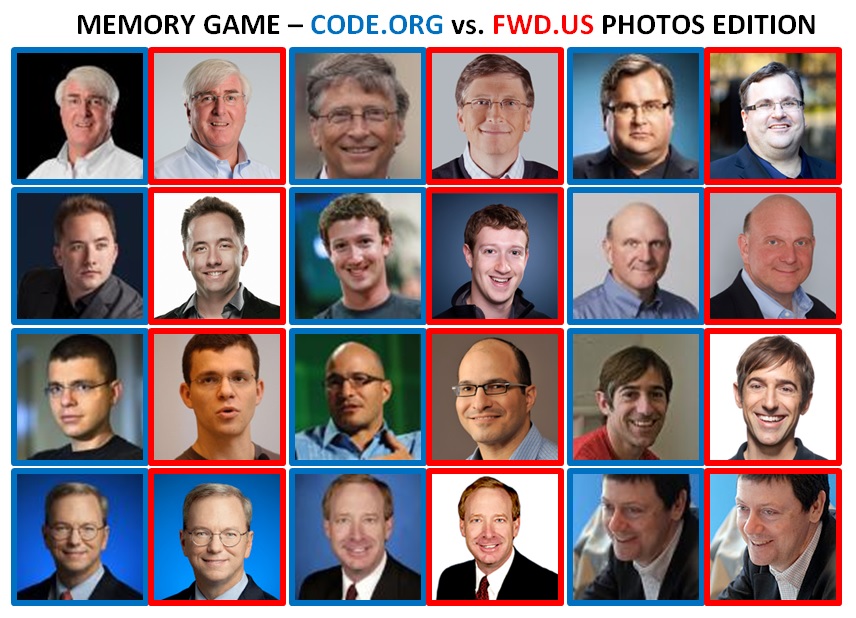
theodp writes "The same cast of billionaire characters — Mark Zuckerberg, Bill Gates, Steve Ballmer, Eric Schmidt — is backing FWD.us, which is lobbying Congress for more visas to 'meet our workforce needs,' as well as Code.org, which aims to popularize Computer Science education in the U.S. to address a projected CS job shortfall. In laying out the two-pronged strategy for the Senate, Microsoft General Counsel and Code.org Board member Brad Smith argued that providing more kids with a STEM education — particularly CS — was 'an issue of critical importance to our country.' But with its K-8 learn-to-code program which calls for teachers to receive 25% less money if fewer than 40% of their CS students are girls, Smith's Code.org is sending the message that training too many boys isn't an acceptable solution to the nation's CS crisis. 'When 10 or more students complete the course,' explains Code.org, "you will receive a $750 DonorsChoose.org gift code. If 40% or more of your participating students are female, you'll receive an additional $250, for a total gift of $1,000 in DonorsChoose.org funding!" The $1+ million Code.org-DonorsChoose CS education partnership appears to draw inspiration from a $5 million Google-DoonorsChoose STEM education partnership which includes nebulous conditions that disqualify schools from AP STEM funding if projected participation by female students in AP STEM programs is deemed insufficient. So, are Zuckerberg, Gates, Ballmer, and Schmidt walking-the-gender-diversity-talk at their own companies? Not according to the NY Times, which just reported that women still account for only about 25% of all employees at Code.org supporters Apple, Google, Facebook, and Microsoft. By the way, while not mentioning these specific programs, CNET reports that Slashdot owner Dice supports the STEM efforts of Code.org and Donors Choose."