Slashdot Mirror
Domain: daviddarling.info
Stories and comments across the archive that link to daviddarling.info.
Comments · 94
-
Warp drive isn't here yet, but...
Science fiction is a fun place to go fishing for ideas. It's fiction now, but at one point, so were organ transplants and personal communicators.
-
Homebrew SETI?
Imagine a not-quite-Beowulf cluster of these -- your own homebrewed VLA. It'll receive in the "waterhole band", and VLBI ain't too hard to figure out. Set up enough ground stations and switch between them as-needed to compensate for what you're viewing and the rotation of the Earth, and you've got a fulltime radio telescope with a dish effectively as large as the earth, whenever you want it...
Open source radio astronomy anyone? -
Re:Prior Art!
TFA doesn't mention that this is merely a variation on the Project Daedalus spacecraft, which used fusion devices instead of fission devices, as in the original Project Orion design; Frederick's spacecraft, from the image in the article, looks to be missing many of the important components -- radiation shielding, shock dampers, etc. -- that the Orion and Daedalus spacecraft had.
-
Re:Prior Art!
TFA doesn't mention that this is merely a variation on the Project Daedalus spacecraft, which used fusion devices instead of fission devices, as in the original Project Orion design; Frederick's spacecraft, from the image in the article, looks to be missing many of the important components -- radiation shielding, shock dampers, etc. -- that the Orion and Daedalus spacecraft had.
-
Re:Don't you mean 62 miles?
balloons do NOT get above "99.9%" of the atmposphere.
You know, would you please make sure you know what you're talking about first? Because maybe, just maybe, the person you're talking to has built something which went up on a balloon to over 99.9% of the atmosphere. Ever think about that?
And I have, for the record. Technically it was an LDB balloon, but the float altitudes are basically the same. It's just a question of whether or not the atmosphere was pressurized or not.
That site says 99%, but that's actually a little low (they're simplifying it). The height for an LDB flight is about 40 km. Atmospheric density there is about 1 to 2 x 10^-6 g/cm^3. Atmospheric density at ground level is 1.2E-3 g/cm^3.
Dividing, I get that the atmospheric density at float is - gasp one part in a thousand, or 99.9% of the atmosphere is below you.
Do you even have any idea how high up that is?
Yah. 40 km. -
Re:Don't you mean 62 miles?
If balloons can get us out of the atmosphere
They do.
why not use balloons to make a very fast form of transit that is made possible by having very little air friction?
Because you still have to go up, and then down. The economics of something like that completely don't work.
Plus, people didn't pay to travel in a supersonic plane, much less anything faster. Conventional travel is fast enough. -
Re:Hmm
Strange but true:
Some early russian rockets were fuled by ethanol (R2, copy of the german WW2 V2 rockets). In those days, the problem was the troups mixing the rocket fuel into their vodka. (or just drinking it neat, when the vodka rations ran out)
http://www.daviddarling.info/encyclopedia/R/R_seri es.html -
Re:Not really a surprise
Actually, you can, and NASA does, throttle the SRB's. Actually, throttling isn't really the correct word, but by changing the shape of the solid fuel, SRB thrust is reduced by about 33% 50 seconds into the burn. After MAX Q, it is returned to maximum thrust.
See the section on SRB's here http://www.daviddarling.info/encyclopedia/S/Space_ Shuttle.html -
Re:Space travel isn't feasible
you forgot space cannons. http://www.daviddarling.info/encyclopedia/S/space
c annon.html hello 1950's technology we need your help again -
Re:Warp drive?
In this article, it says that the original Orion design was large enough for 150 people but would have used less than 2,000 bombs to reach escape velocity. If they used fusion bombs instead of fission bombs, there would be much less radioactive waste and much higher yield per explosion. It also mentions that the testing proccess for the entire project, despite using thousands of bombs, would increase the total atmospheric contamination by less than 1%.
---
If nobody notices, it's not illegal.
Generated by SlashdotRndSig via GreaseMonkey -
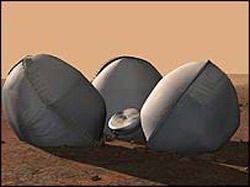
Re:UhhhWasn't the probe mounted inside three large inflated airbags? It was supposed to use a 'hit, bounce and roll' landing technique so surley it should have been capable of withstanding a controlled impact on any point of the airbag.
I think it's more likely either the parachutes failed, leading to higher landing speeds than the airbags could cushion, or the air bags themselves failed to inflact
-
Re:duh
A nuke can be used for only one thing - cause destruction. The only positive use it might have is to threaten the other person with destruction. It has been created with the specific purpose and intent of causing mass destruction, and nothing else.
That's not true. That's simply not true. You can blow up nukes for peaceful purposes. For instance, you can excavate harbors in Alaska with nukes. You can also use them to launch spaceships. Mmm, Specific Impulse... Of course, the naysayers do tend to complain about fallout... -
peaceful nukesUsing a nuke is evil. Period. It does not matter what your justifications are, unless you're blowing an asteroid out of orbit or something equally improbable, the nuke has been built with the explicit goal of threatening people with destruction.
How about a Project Orion spaceship?
-
Re:The light of a planet
Not to nitpick - but according to Celestia (take it with a grain of salt, of course) Epsilon Eridani (Gliese 144) is closer than Gliese 876 (10.5 ly as opposed to 15.3 ly) and it has at least 2 known planetary satellites. See here: http://www.daviddarling.info/encyclopedia/E/EpsEr
i .html or google for "Epsilon Eri."
On a side note, Eps Eri C (the smaller planet) seems to orbit about 28 au from its parent star - I would think this would be a perfect candidate for this technology! (I'm too lazy to work out the math right now, however, bonus points to anyone who does.) -
Re:Double standards from the ID nuts
This certainly underlines the double standards of the ID right. They want religious criticism of evolution put in science classes, and are using the ID trojan horse to do so, while trying to silence those who point this out in those self same classes.
Disclaimer: I am not a proponent of ID, and do not support its teaching in schools.
But it's rare that anyone in a rancorous debate won't have double standards. Narrowing the field to abiogenesis for a moment -- when respected nonreligious scientists espouse speculative, largely unfalsifiable hypotheses of origins that have no evidentiary basis other than (hmm) the lack of evidence for abiogenesis, they are welcome to speak publicly, and write for journals and magazines. Where is the outcry?
And you certainly can't wave your arms and yell "ID is the end of science in America!" when by far the greatest threat to science today is radical postmodernism, whose adherents thrive in overwhelming numbers on university campuses, enjoying secure and unassailable academic respectability, and teaching both implicitly and explicitly that all "so-called facts," science included, are subjective social constructions with no true validity. Where is the outcry?
Here's a personal observation. Although it's unfortunately true that most ID activists are motivated by a prior agenda, in my experience (of moderate sample size) most evolution activists are motivated by a prior agenda as well. Such people tend to be quite surprised when I tell them that I'm a Christian and that I have no overall problem with evolution -- and it is very revealing that this is often considered an insufficient response. They are ultimately satisfied only if I renounce religion entirely. Of course, I am not allowed to have an outcry.
--
Dum de dum. -
We all know
that someone just wanted to say "panspermia."
-
Re:Has Anyone Considered...
SETI's search parameters are based on some really well though out assumptions about how ET civilizations might try communicating.
You wish. There are two groups that dominate the public arguments for passive SETI: those who directly anthropomorphize alien civilizations and those that use a thought-out logic that is still steeped in assumptions of human-like intelligence. While this may be reasonable both are really large asumptions that limit our search. The anthro's are screwed becuase any signals using channels of the EM spetrum that we like will have to compete with cellphones, radios random electronics - even those in the detector.
The reasonable logic fellows, such as Carl Sagan, simply look at what parts of the radio spectrum that has no significant natural sources of interference. This is the dominate method in current projects. However, there are many of these dead spots. The most prominate quiet channel to a human being the channels surrounding the frequency of hydrogen's spectrum (aka the 'watering hole.') It is in this streach of frequencies that projects like SETI@home are looking for signals.
The deafing silence of this area should be telling: there seems to be Nothing - natural or artificial - at those frequencies. Like looking for lost keys by researching the same empty spots, SETI carefully combs these small streaches frequencies for any possible signal. This technique is not problematic becuase of focusing on parts of the Electromatnetic (EM) spectrum that humans find economicaly and technically useful but becuase the eschew those spans of spectrum on purpose. Instead of assuming human-like intellegence, the watering-hole gazers are assuming a (still) human-like intellegence acting in the opposite fashion that a human would.
In a technological society where eletromagnetic radition is reasonably well understood it shouldn't take too long to figure out that the radio portion of the EM spectrum is really useful, especially if their physiology remotely resembles anything on Earth.
Considering that if the anthropomorphism above is plausible then they would use similar channels that we use. Not the 'water hole' or other quiet parts of the EM spectrum, but transmissions in area that we find usefull. In the end, we may be getting detectably strong ET signals right now. But, we cannot hear them for the chatter of our own civilization which prefers to use the same channel for repeating Brittney Spears' 3 top selling songs.
Either purposfully sent of just radio chatter, any signal is so attenuated at stellar distances that you must search for the precise signal used in the transmission. Both group assumes that a society would setup and transmit for thousands if not millions of years a steady and powerfull signal or set of targets signals. There is a huge cost for powering and maintaining such equipment over such a timespan. There is very little payback on the timescales of our societies for performing such an ET-friendly transmission. This means billions of channels in the spread of frequencies the FCC allocates to 1 station to play Brittney Spears music. And any signal is likely to be little more than a carrier signal for the local pop-music or military radar. Hence the huge processing requirements for projects like SETI@home to sift such needles in the radio haystack.
To the benefit of both, the encyclopedia galactica may be being beemed at us right now. We just may have the dial on the wrong station. -
Re:Non-chemical rockets
The pulse detonation model was initially proposed by those good ol' boys back in the fifties (Project Orion, see below for link) as a cheap means to reach space. It was proposed that a shell of heavy metal be built and nukes would be released beneath it to get a ship to orbit. This was quashed by the first nuclear proliferation treaties. It is sad that it was quashed, however, as it would have provided the most efficient space travel in history. The problem with the current models of PD is that you can't use gyro's to stabilize a vertically moving PD vehicle in a gravity well as influential as that of Earth's. Also, it is a supersonic jet, above and beyond what the Xraces are looking for, same as NASA's Hyper-X (http://news.bbc.co.uk/1/hi/sci/tech/4115156.stm)
. The link for Orion is: http://www.daviddarling.info/encyclopedia/O/OrionP roj.html -
Re:SpeedAlong that note there are scales at which the elements can support an 'organic' life form, one of which is our definition of carbon based, the next level theoretically would be silicon based. This has to do with atomic structure and related harmonics of the periodic table.
I wonder if the environment on Titan would have the ability to support life on a different atomic scale. Ammonia seems to be a promising candidate on Titan.
I love this stuff!
-
Re:SpeedAlong that note there are scales at which the elements can support an 'organic' life form, one of which is our definition of carbon based, the next level theoretically would be silicon based. This has to do with atomic structure and related harmonics of the periodic table.
I wonder if the environment on Titan would have the ability to support life on a different atomic scale. Ammonia seems to be a promising candidate on Titan.
I love this stuff!
-
MSWord & Storing Negative Information & An
The Fine Article doesn't mention one exciting development in the field of information theory, related to negative information, which may one day tie it to Vacuum Energy or Zero Point physics in a grand unified theory that, once we come to understand it, could form the basis of a star drive to power star ships.
It seems that virtual particles of antimatter and exotic particles of normal matter that spontaneously emerge from the void, and then disappear without interacting with anything. [1] The theoretical potential of tapping this particle flux has brought vacuum energy to the fore of research by the NSA into Quantum Information Theory.
Experiments conducted by the NSA and the DOE on large data samples gathered in large bureaucracies (both public and private) indicate that Microsoft Word Documents are effective containers for Negative Information, which hitherto had been considered a transient phenomenon, almost impossible to store given our current understanding of physics. The phenomenon of massive amounts of stored negative informisinformation, as it turns out, makes the typical corporate or government intranet much more resiliant to cyber terrorist attack than previously predicted -- nearly as resiliant as the typical government organization to a FOIA request today, for comparison.
It is expected that once we understand the characteristics of MS Word Documents which allow them to efficiently store negative information in a stable form, Quantum Physicists and Information Theorists should be able to get together, perhaps over a nice hot cup of tea, and stitch the two branches together, getting us one step closer to faster than light travel, finally bringing the stars within reach -- except it won't really be FTL, it will be something that we don't presently understand. [2]
Only the humor-impaired need read this bootnote.
[1]Yes, I see the grammar error. I've intentionally borrowed a pattern, common in conspiracy theory writing, of constructing a complex sentence, perhaps full of objects, perhaps full of verbs, perhaps full of nouns, on the theory that it might amuse, whereas it normally serves to confuse, as sometimes subjects or verbs may go missing. Oops I did it again! Or did I?
[2]Yes, I realize I mention antimatter only in the title, and not in the text.
[3]Yes, I realize there are 3 bootnotes, not a single bootnote as referenced above.
[4]Yes, I realize that only 2 of the bootnotes are indicated by reference numbers in the text. (Absurd bootnotes are also common in conspiracy theorist writings.) -
Re:impractical, to say the leastActually heavy shielding makes radiation exposure worse in space!
- High-Z sheilding amplifies spallation due to cosmic rays which increases bremstrahlung total dose radiation levels. You get the least exposure from using less or lighter shielding, though for humans, that may still be over a lethal dose!
Humans face a significant radiation paradox in space travel.
-
Re:impractical, to say the leastActually heavy shielding makes radiation exposure worse in space!
- High-Z sheilding amplifies spallation due to cosmic rays which increases bremstrahlung total dose radiation levels. You get the least exposure from using less or lighter shielding, though for humans, that may still be over a lethal dose!
Humans face a significant radiation paradox in space travel.
-
Re:If they want to find water on mars...
From this encyclopedia
In 2003, California Institute of Technology researchers Andy Ingersoll and Shane Byrne argued, on the basis of high-resolution and thermal images from Mars Global Surveyor and Mars Odyssey, respectively, that the Martian polar ice caps are made almost entirely of water ice - with just a smattering of frozen carbon dioxide at the surface.
Even if they are water, however, the climate at the caps is much to harsh to support human life, too damn cold, and too much seasonal change. That's the primary reason why we don't head to the poles. -
Re:Yes, but..
Its highly probable that life is based on carbon, but other forms of life have been suggested such as silicon based and ammonia based
http://www.daviddarling.info/encyclopedia/A/altern ative_forms_of_life.html
Even here on earth we have sulphur based ecosystems. These still have carbon-based lifeforms I think, but the energy is derived from sulphur rather than from the sun.
http://www.chm.bris.ac.uk/webprojects1997/ClaireO/ Welcome.htm -
Re:Direct Link
I don't think this has anything to do with power generation, regardless of the blurb at the NIF. It's about researching better bombs.
That's right. It has nothing to do with power generation. Neither does a fusion drive for a spacecraft. That's about throwing fuel in an expended form out the back of a 'rocket'. Project Daedalus is a good example. The NIF, if it produces fusion, will have the basic concept down. True, there's still a repetitive way of doing this is short times and all that (gun like feeds for propellant pellets, frex) and some impressive gains in reliability. But getting the fusion at all is more than half way there.Sorry this is so late. Work, babies, and all of that.
-
Re:Burt Rutan: 4 Days. NASA: 2 Years
No, you're wrong.
Here is a school bus http://www.solectria.com/products/buses.html Length = 12.19m.
Here is the shuttle http://www.daviddarling.info/encyclopedia/S/Space_ Shuttle.html Length = 23.79m
Also, for a better intutitve understanding, here is the shuttle piggybacking on a 747 http://www.pd.com/rww/graphics/3d/shuttle_747.jpg and the 747 has a length of 70.7m http://larsholst.info/blog/2005/01/20/airbus-a380- vs-boeing-747/ -
Re:Basic Science!
-
Web sites of interest
Griffin is currently the head of the Space Department at the Johns Hopkins University Applied Physics Laboratory. Previously, he was at In-Q-Tel, Orbital Sciences Corporation, NASA and the Strategic Defense Initiative Organization.
-
Re:Intelligent Life!
...or they could be a Type III civilization, capturing the energy output of that entire galaxy with one giant device.
-
Re:Energy Conversion
You had to ask didn't you? Well, I asked google how many burning libraries of congress(es?) in one gram of antimatter... And google was stumped
So, here we go... 1 gram of antimatter -> burning libraries of congress(es?):
For the sake of argument, lets assume that the Library of Congress is entirely non-flamable and only the books contribute to the heat. Furthermore, lets assume that all the books are made of 100% wood or equivilant.
Now, 1 gram of wood when completely burned produces 3000 calories.
The Library of Congress contains approximately 128 million items. Again, some of these are recordings of various natures and will not burn as well as books... so to compensate we'll deviate from our initial assumptions and assume that the burning of the 530 miles of bookshelves compensate for any lack of flamability of the old records.
So... our average paperback weighs under 1lb and our average hardcover book weighs between 1 and 2lbs. Seems reasonable enough. Lets assume a distribution between hardcover and paperbacks so as the average book weight in the LOC is 1lb.
Now, Google can help us some more here. Our friendly search engine lets us know that one pound is 453.59237 grams. We'll round that off to 453 grams, since we're averaging book weight anyway.
So, the LOC has (453*128,000,000) or 57,984,000,000 grams worth of books. At 3000 calories per gram, burning down the LOC would produce 173,952,000,000,000 calories of energy. For the sake of sanity, lets convert that to joules. Google says that 173 952 000 000 000 calories = 7.27815168 × 10^14 Joules
Now, our space shuttle main tank (and engines, NOT including boosters which are more powerful) produce 1,987,500,000 Watts of energy, and burn for 8.5 minutes. That's (510*1,987,500,000) 1013625000000 Watt/seconds of energy. Converted to joules, that is remarkably 1013625000000 Joules.
So.. One space shuttle fuel tank of energy is 1013625000000 Joules. 23 space shuttle tanks of energy is 23313375000000 Joules. For convienence, one space shuttle tank is 0.23313375x10^14 joules.
So... it comes down to one burning LOC is 7.27815168 × 10^14 joules. 23 space shuttle fuel tanks are 0.23313375*10^14 joules. So, one gram of antimatter combining with one gram of matter is approximately 0.032 Burning Libraries of Congress(es?). I actually expected it to be more.
Now how do I get Google to include space shuttle fuel tanks and burning libraries of Congress(es?) as acceptable measurements?
-
Space and survival: links
CNN is also covering the story.
More information:
The relationship between space and survival has been expressed by many others, such as Carl Sagan, Stephen Hawking, Martin Rees, William Burrows and Robert Shapiro.
-
Stromatolite ?
Could that "lumpy" rock be a fossil of a ?
-
Re:Would it be simpler in natural vacuum?
The first question that comes to mind is, does plasma research benefit from being carried out in a natural vacuum environment rather than needing apparatus to create one artificially? How does the degree of evacuation inside a fusion containment vessel compare with that in LEO, far orbit, or on the Moon?
This page states a typical pressure of 10^-7 atm for the interior of an operating fusion containment vessel. It refers to this condition as a hard vacuum, which this page defines as "a vacuum that approximates the vacuum of space." This page states an atmospheric pressure of 3*10^-9 atm at an altitude of 150 km, which isn't even LEO. (Al Shepard went more than 3x higher, and that was still a suborbital flight.) IANAHEP, but this would seem to indicate that taking advantage of the vacuum of space wouldn't be a bad idea. (The sticking point would be getting the other heavy equipment up there, along with a power supply.)
-
Existance of Life
"This would seem to substantially increase the chance that life once existed on the red planet" I think a more accurate statement would be that this increases the chances that we might find evidence of carbon based life forms having existed at some point on mars. It is theoretically possible for life to exist without water by using another liquid solvent as a substitute. One often proposed substitute is ammonia (see article http://www.daviddarling.info/encyclopedia/A/ammon
i alife.html/ ). People seem to think narrowly about the possibilities of life, and often constrain their thought process to life that is, at a very basic level, similar to life on earth. Granted, since carbon is fairly prevalent throughout the universe there is certainly a good chance of it forming life in areas other than earth, but we should keep in mind that it is not (at least theoretically) the only option. -
Re:More contractor patty-cake mastrubation
What is really interesting is that back in the 1960's NASA had plans for an even bigger rocket than the Saturn V. I think it was called the Jupiter rocket or something like that. About 5x-10x the lift capacity of the Saturn V.
I think you're a bit confused. "Jupiter" was the name of some ICBMs of the time. As a fast track to building one of the biggest rockets of all time, the engines from these ICBMs were clustered together into a single shell known as "Juno V". Believe it or not "Juno V" eventually took us to the moon! You see, Von Braun had suggested a name change after the Juno V diverged enough from the original rocket platform. The new name? Saturn V. (See: http://www.daviddarling.info/encyclopedia/S/Saturn _rocket.html)
The experiments were so successful that clustered rockets are still a common way to launch payloads. From the small Deltas, to the large Energias, they all provide more power and greater mission flexibility by offering a larger number of rocket engines instead of a few very large engines.
Here's what I know about Von Braun's future plans for space travel: Von Braun wanted to launch an Orion on the back of a Saturn V. This would allow the Saturn V to continue as a practical launch solution, and allow the Orion to become a practical form of interplanetary travel. (Actually, the Orion they would have launched would have been the least efficient design, but it still would have been a significant improvement over chemical rockets.) About that time, the government told NASA to shut down the Saturn V program and Von Braun left in disgust.
Now the Sea Dragon was a super-simple rocket that could have carried a massive tonnage (~550 metric tons) for about 1/4th the cost of the Saturn V. It was conceived of in 1962 as a study on how to make rocket launches cheaper. Again, by the time the study was taken seriously, the US was already winding down its production of large rockets. (The concept was later proven as the "Excalibur" rocket, but was largely ignored.)
Following the rise of the Regean era of space travel, NASA began research into using the Shuttle's engines as a massive booster. (The Shuttle's engines are currently some of the most powerful rockets in use today.) The result was the Shuttle C program; a pure cargo Shuttle.
With Clinton's Presidency, plans for space stations, moon bases, and Mars missions were all scaled back or put on hold. It wasn't until Clinton's term was up that NASA again began looking at ways of getting to Mars. Their current design is the Magnum launch vehicle which looks suspiciously like everything the Energia program was trying to accomplish. -
Re:Feasibility of the Space Elevator
While Arthur C. Clarke certainly popularized the idea of a space elevator in his science fiction novel "The Fountains of Paradise", the original concept is credited to the Russian engineer Yuri Artsutanov, who published it in 1960. See, for example, here
-
Re:Fun ride
Rollercoasters regularly hit 6G's or more without people suffering blackouts. Prolonged 6G force could cause a blackout but people can handle transient G forces much higher. John Stapp (biography exposed himself to as much as 45G without permanent injury (though the 45G experiment did cause him to black out).
-
Re:The next Martian Rovers
should have wings so they can fly
Should be pretty big wings, with an average 7 millibars pressure at ground level. -
Re:Almost first post
For those who, like me, aren't astrophysicists and had to look up an RTG, it's a Radioisotope Thermoelectric Generator. Basically a nuclear power source for the rover.
-
Some more links
-
Re:Water coming from cometsCould it be that without an atmosphere on Mars...
Who said Mars had no atmosphere? Any object with a gravitational pull that exceeds the mean escape velocity of gas molecules (over-simplifying here - better explanation here) will have an atmosphere. The moon has a gravity below that mean (think of it as a vertical line on a bell curve, but before the bell), hence it has little/no atmosphere.
Mars, on the other hand, is a much larger body and hence has enough gravity to retain an atmoshphere of about 1-9 millibars, depending on altitude. Indeed, it's the very existence of this atmosphere that allowed the lander to slow from 12,000mph to 1000mph before the parachute opens.
-
Re:Double edged sword
Century 2: Arrive at destination, Great-great-great grandchildren colonize planet.
-
Vegitation Photos LinkHere is a link to the vegitation photos that he seems to be talking about. It also includes a breif description of what it might be
My questions is, why hasn't this been bigger news? Did it come out and I just missed it?