Slashdot Mirror
Domain: ed.gov
Stories and comments across the archive that link to ed.gov.
Stories · 42
-
Bill and Melinda Gates: Textbooks Are Becoming Obsolete
Reader theodp writes: Thanks to software, Bill and Melinda Gates report in their 2019 Annual Letter, textbooks are becoming obsolete. Bill writes: "I read more than my share of textbooks. But it's a pretty limited way to learn something. Even the best text can't figure out which concepts you understand and which ones you need more help with. It certainly can't tell your teacher how well you grasped last night's assigned reading. But now, thanks to software, the standalone textbook is becoming a thing of the past" (if so, it'll be a 60-year overnight success!). The Gates are putting their money where their mouths are -- their education investments include look-Ma-no-textbooks Khan Academy and Code.org. Code.org, whose AP Computer Science Principles course for high schools "does not require or follow a textbook", boasted in its just-released Annual Report that 38% of all AP CS exam takers in 2018 came from "Code.org Computer Science Principles classrooms," adding that it had spent $24.2 million of its donors' money on curriculum and its Code Studio learning platform (30,300 hours of coursework), another $46.7 million to prepare 87,000 new K-12 CS teachers, $12.4 million on Marketing, and $6.9 million on Government Affairs. So, do we still need textbooks? -
What Happened When Automation Came To General Motors? (qz.com)
General Motors was once the world's most profitable company -- for two decades -- and by 1970 its revenue was $22.8 billion (or $152 billion in today's dollars). But five weeks ago GM announced that it was finally ending small-car production and closing its Lordstown Assembly plant in Youngstown, Ohio.
So what went wrong? Quartz argues that GM's decline "began with its quest to turn people into machines," as "the company turned assembly work into an interlocking chain of discrete tasks, to be executed by robots whenever possible." In an article shared by Slashdot reader reporter, Quartz argues that seen in that light, the company's response to a 1972 strike "marked the beginning of the company's long but uneven descent, which would be characterized by a repeated impulse to bet on fancy, futuristic but unproven technologies while undervaluing its workers."
But the strike also raised larger issues for "a massive special task force" issuing a federal report on the quality of working life in 1972, titled Work in America... [T]echnology had failed in its promise to free humans from drudgery and wring profit from their talents, the authors said. On the contrary, the new jobs created generally required minimal expertise and therefore prevented workers from honing their skills. That stymied career mobility and left people mired in the same torpor of boredom for decades. Despite this, America continued to offer its young people increasingly rigorous education -- even as work life left little opportunity to apply it.... The larger hopes and ambitions of Work in America -- the vision that saw satisfying work itself as essential to the health of American society and democracy -- exists now as little but a curio in the footnotes of academic journals....
Meanwhile, GM continued to lavish spending on big capital investments, confident that the secret to competitiveness lay in replacing humans with technology. But as in Lordstown, the spending bore little fruit. As automotive analyst Maryann Keller recounted in her 1989 book Rude Awakening, one GM executive observed that, between 1980 and 1985, the company shelled out an eye-popping $45 billion in capital investment. Despite that spending, its global market share rose by but a single percentage point, to 22%. "For the same amount of money, we could buy Toyota and Nissan outright," said the executive -- which would have instantly bumped GM's market share to 40%.
At GM quality suffered because "Instead of making flawless cars, workers simply did their assigned jobs," Quartz argues. "Workers had no big-picture goal of building cars together to motivate them."
The 7,000-word article concludes by noting that Youngstown residents still hope that their car factory will re-open. But it's also possible that instead Lordstown Assembly "will remain standing, but empty, a vast roadside reminder of a corporate elite's doomed quest to cheapen labor by stripping the human need for skill, learning, independence, and purpose out of production, by reimagining people as machines." -
Four Code Bootcamps Are Now Eligible For Government Financial Aid (hackeducation.com)
Long-time Slashdot reader theodp notes a pilot program for improving computer science education which includes financial aid for students at four code bootcamps: In this week's Hack Education Weekly News, Audrey Watters writes, "The US Department of Education has selected eight higher ed institutions and eight 'non-traditional providers' that will work as partners to pilot the DoE's new EQUIP experiment, meaning that students will be able to receive federal financial aid for coding bootcamps, MOOCs, and the like...
"Good thing there haven't been any problems with for-profit higher ed and exploitation of financial aid, otherwise this would all seem like a terrible idea."
The original submission has more details on the participants (including the four code bootcamps). Ultimately the program involves pairing "non-traditional" providers with higher education institutions -- and then monitoring their results with a third-party "quality assurance entity" -- to improve the ways we measure a school's performance, but also testing new ways to fund training for computer careers. (I'm curious how Slashdot's readers feel about government loans for attendees at code bootcamps...) -
Personalized Learning: the Best Education Or the Worst?
theodp writes: In an exclusive interview with Education Week, Facebook CEO Mark Zuckerberg talked about why he is shifting his K-12 giving priorities to personalized learning. While acknowledging that there's not yet any independent, large-scale research to show personalized learning's effectiveness, Zuck argues that "the model just intuitively makes sense." But just days later, Fordham University professor Mark Naison wrote in the Washington Post about why the personalized learning efforts of 'a growing number of those with investment capital seeking profitable outlets,' which presumably includes Zuck, make him 'incredibly pessimistic' about the future of public education. That Zuck — like fellow personalized learning cheerleaders/funders Bill Gates and former U.S. Education Chief Arne Duncan — seemed to be unaware of studies on personalized learning studies that date back to the '70s is troubling. But people don't "Like" 40+ year-old Ed.gov papers, so Zuck could be forgiven for not seeing them and, as a result, believing that the personalized learning plan dashboard his Facebook engineers knocked out truly is the ground-breaking solution to 'one of education's biggest problems' that Melinda Gates cracks it up to be. -
Personalized Learning: the Best Education Or the Worst?
theodp writes: In an exclusive interview with Education Week, Facebook CEO Mark Zuckerberg talked about why he is shifting his K-12 giving priorities to personalized learning. While acknowledging that there's not yet any independent, large-scale research to show personalized learning's effectiveness, Zuck argues that "the model just intuitively makes sense." But just days later, Fordham University professor Mark Naison wrote in the Washington Post about why the personalized learning efforts of 'a growing number of those with investment capital seeking profitable outlets,' which presumably includes Zuck, make him 'incredibly pessimistic' about the future of public education. That Zuck — like fellow personalized learning cheerleaders/funders Bill Gates and former U.S. Education Chief Arne Duncan — seemed to be unaware of studies on personalized learning studies that date back to the '70s is troubling. But people don't "Like" 40+ year-old Ed.gov papers, so Zuck could be forgiven for not seeing them and, as a result, believing that the personalized learning plan dashboard his Facebook engineers knocked out truly is the ground-breaking solution to 'one of education's biggest problems' that Melinda Gates cracks it up to be. -
K12CS.org: Microsoft, Google, Apple Identifying What 1st Graders Should Know
theodp writes: On Sunday, The Simpsons declared computer coding class the nation's latest educational fad (script). Proving Principal Skinner's point, K12CS.org on Thursday announced a New Framework to Define K-12 Computer Science Education, the collaboration of participants from a number of states (MD, CA, IN, IA, AR, UT, ID, NE, GA, WA), large school districts (NYC, Chicago, San Francisco), technology companies (Microsoft, Google, Apple), organizations (Code.org, ACM, CSTA, ISTE, MassCAN, CSNYC), and individuals (higher ed faculty, researchers, K-12 teachers, and administrators). "A steering committee initially comprised of the Computer Science Teachers Association, the Association for Computing Machinery, and [tech bankrolled and led] Code.org will oversee this project," explained a CSTA blog post. "Funding for the project will be provided by Code.org and the ACM. The framework will identify key K-12 computer science concepts and practices we expect students exiting grades 2, 5, 8, and 12 to know."
In a FAQ, K12CS.org envisions a Programming and Algorithms standard for 1st Graders that calls for the 5-year-olds to "Work collaboratively in clear roles (e.g., pair programming) to construct a problem solution of a sequence of block-based programming commands." A day before the announcement, Politico reported that K-12 CS education is expected to get a State of the Union mention this year, and that the White House and U.S. Dept. of Education have been trolling for CS success stories in conjunction with the announcement of a broad set of new commitments to CS Education in early 2016. -
Khan Academy Seeks Patent On Education A/B Testing
theodp writes: The Education Revolution will be patented. USPTO records show that Khan Academy is seeking a patent for Systems and Methods for Split Testing Educational Videos. From the patent application: "Systems and methods are provided for comparing different videos pertaining to a topic. Two different versions of an educational video may be compared using split comparison testing. A set of questions may be provided along with each video about the topic taught in the video. Users may view one of the videos and answer the questions. Data about the user responses may be aggregated and used to determine which video more effectively conveys information to the viewer based on the question responses." Now it's up to the USPTO to decide if something like the test and control studies conducted 40+ years ago (pdf) by the PLATO system to measure the effectiveness of different teaching methods would count as prior art. In response to an earlier post on Khan Academy's pending patents on learning computer programming and 'social programming,' Slashdot user Khan Academy said that the nonprofit is using patents for good, so not to worry. -
US Dept. of Ed: English, History, and Civics Teachers Good Enough For CS Class
theodp writes: In A New Chapter for Computer Science Education, the U.S. Department of Education explained earlier this month that the federal STEM Education Act of 2015 'provides an unprecedented opportunity to fully leverage federal resources' to address large gaps in students' participation in Advanced Placement (AP) computer science classes based on gender and race. "In three states," lamented the DOE, "not a single female student took the AP computer science exam" (that only 8 boys took the AP CS exam in those same 3 states was apparently not a concern). And the DOE has good news for those hoping to tap Title I and II funds for CS, but don't have any computer science teachers. "A background in math or science isn't necessarily a requirement to teach CS," explains the Dept. of Ed, "as disciplines like English, history and civics can also provide a solid foundation for teaching CS concepts." -
Did Google and the Hour of Code Get "Left" and "Right" Wrong?
theodp writes: Command the dancers to "point left" in Google's dance-themed Code Boogie learn-to-code tutorial on the Santa Tracker website, and the dancers actually point to their own right. The lesson seems to reinforce a common mistake made by younger children learning to code in LOGO, which is to use their own or the display screen's frame of reference rather than the turtle's frame of reference. "These misconceptions," explained Richard E. Mayer, "may be due to the knowledge that the child brings with him or her to the programming environment. For example, children who possess an egocentric conception of space (Piaget & Inhelder, 1956) would fail to recognize that when the turtle is at a 180-degree orientation, its right corresponds to the child's left." So, it should probably be asked if the learn-to-code tutorials from Lucasfilm, Code.org, and Google that are being used to teach the world's K-12 schoolchildren to code might be making the same mistake as 4-7 year-olds. In this year's flagship flagship Lucasfilm/Code.org Star Wars Hour of Code tutorial, for example, command the droid BB-8 to move left and it could move to either its own left or right depending on what direction it's pointed in. So, did the "Largest Learning Event in History" also get "left" and "right" wrong? -
Study: Standardized Tests Overwhelming Public Schools (washingtonpost.com)
An anonymous reader writes: A new study examined the amount of time U.S. public schools spend on government-mandated standardized tests, and found that the requirements are detrimental to both students and teachers. On average, students will take 112 standardized tests during their K-12 education. From grades 3-11, students spend over 20 hours per year on standardized tests alone. "It portrays a chock-a-block jumble, where tests have been layered upon tests under mandates from Congress, the U.S. Department of Education and state and local governments, many of which the study argues have questionable value to teachers and students. Testing companies that aggressively market new exams also share the blame, the study said."
The U.S. Department of Education has issued an action plan to school districts outlining ways to reduce useless tests and eliminate redundant ones. President Obama even posted a video pledging to reduce the test load of American students. "Standardized testing has caused intense debate on Capitol Hill as lawmakers work to craft a replacement for No Child Left Behind. Testing critics tried unsuccessfully to erase the federal requirement that schools test in math and reading. Civil rights advocates pushed back, arguing that tests are an important safeguard for struggling students because publicly reported test scores illuminate the achievement gap between historically underserved students and their more affluent peers." -
Global Learning XPRIZE Senior Director Matt Keller Answers Your Questions
A couple of weeks ago you had a chance to ask former Vice President of One Laptop per Child, and current Senior Director of the Global Learning XPRIZE Matt Keller about education and the competition. The XPRIZE challenges teams from around the world to develop open source software that will allow children in developing countries to teach themselves basic reading, writing and arithmetic with a Grand Prize of $10 million. Below you will find his answers to your questions. Teachers?
by itzly
Why can't the kids learn basic reading, writing and arithmetic from regular teachers?
Keller: About 60 million children worldwide – primarily in developing countries – have no access to school of any kind. Another 200 million children attend school for several years and leave without ever having learned to read or write a word. This represents an epic market failure in the realm of education. We believe that while more teachers must be trained, and more schools need to be built, technology offers a way to reach those children who are being failed by the current system.
Has this ever worked before?
by nbauman
Has this ever worked before? Has anyone ever shown that it's possible for children in developing countries to teach themselves basic reading, writing and arithmetic? And have they published their results in peer-reviewed journals? I thought that most of the research found that computers weren't too useful in teaching basic reading, writing and arithmetic, even when students had assistance.
Keller: There has been minimal research on the impact of technology on learning, especially within impoverished and illiterate communities. The few studies that have been done tend to be on teacher-led programs. We want to address the millions of children who do not have access to teachers or schools and engage the best minds to find out if software can help solve this crisis in learning. Reports on literacy software, such as the recent report on an ABRA literacy software program in Kenya, show significant learning improvement.Similarly, a recent report by the University of Nottingham demonstrates the incredible progress children can achieve through learning software. These are exciting and encouraging studies, yet they were conducted in the classroom. We are seeking an answer to a question on a much larger scale, and the research has simply not yet been done.
We want to find out how to reach and empower millions of children who do not have access to a classroom.How can children in Ebola-stricken areas avoid an interruption in their schooling? How can children in illiterate communities without teachers learn basic arithmetic? How can girls learn to read when they cannot safely get to a classroom? What we are setting out to prove has not been tested before, especially not at this scale. We hope that the collective brainpower called upon to develop open source learning software for the Global Learning XPRIZE will create a new field of study. The success of this competition will just be the beginning of unlocking how technology can be leveraged to reach all children, no matter their circumstance.
Breaking the Cycle of Hype
by Anonymous Coward
There is a cycle with technology in education. Next technologies or approaches are develop. We are promised they will revolutionize education. The hype builds. Everyone shells out cash. Research kicks in. Research shows only small gains were made in small populations. Look the next great thing is here to save education. This cycle has been going at least since the invention of the radio and likely before. What have you seen as Senior Director that gives you hope that we will eventually break free from this cycle and actually see significant gains in education?
Keller: I agree, the hype can be very different from the actual results in the education and technology space. I attended an international education technology conference this year and saw first hand the level of hype around the promise of technology and education. There are a lot of promises, yet not the same level of longitudinal studies to back it up. What works? What doesn’t? Educators and administrators are constantly being bombarded by marketing and public relations campaigns designed to sell products, and the overwhelming majority of these products/systems/technologies are aimed at students and classrooms in the developed world. But, it’s very difficult to know what measures up against current/accurate research. A good resource to help fact check is the U.S. Department of Education’s website.
In terms of this promise, there has been interesting work done by MIT, One Laptop per Child and Tufts University on basic reading in remote Ethiopia showing that children – on their own and with each other – can teach themselves the basics of reading and writing. Tufts, MIT and Georgia State University are doing similar studies in rural Georgia with children of migrant farmworkers who have no or limited access to schools. The early results are encouraging, and much of the work I just mentioned has been foundational for the development of the Global Learning XPRIZE.
We also believe that open source is a key component in this case. A principal reason why we wanted this competition to be open source, is that we believe the community will help the best ideas bubble up to the surface.
This prize should provide a unique opportunity for rapid prototyping in which multiple teams and external participants can all be involved. This will not only result in an educational solution that teaches kids basic literacy, but also create a set of open source components and developer communities that will go on to benefit other projects after the competition concludes.
Re: Computer Cost and Support?
by Anonymous Coward
I'm assuming these people don't have the money for computers either. Assuming that someone comes up with a great software solution, how are these people going to get computers to use it, a network, or even electricity?
Keller: Excellent point. The hardware is not here yet. For this competition, we are providing the hardware (tablets and solar charging stations). The price of technology has plummeted in recent years, and by the time this competition concludes in 2019 it will be far more affordable, much in the way cell phones are. If we can prove that the software/content enables children to teach themselves basic reading, writing and arithmetic on their own and with each other, it will expedite the hardware needed to reach the poorest children in the world. In the coming years, advances in technology and the reduction of hardware costs will make tablet-based learning more available, and it’s my great hope that a tablet will be created specifically with this demographic in mind. Incredibly low power requirements, self-charging, self-healing and rugged—all the specifications one would like to see in a tablet designed for children living in remote areas.
Working with governments
by Anonymous Coward
Lots of these developing countries aren't known for being very stable or have issues with educating portions of their population (girls for example). Do you work directly with the governments in these developing areas? Do they seem enthusiastic to your goal?
Keller: Choosing a host country to partner with is an important decision and one that required a great deal of research. I can tell you that country ultimately chosen will be stable, supportive and eager to work with us throughout the implementation/testing phase of the Global Learning XPRIZE. One of our criteria for country selection was that there was equal access to both education and technology for girls and boys. This is a priority for us, and one that is non-negotiable.
We will also be working very closely with the host country’s government on all aspects of the implementation phase, specifically the Ministry of Education and the Ministry of Communications, Science and Technology.
Working with governments
by Anonymous Coward
If the goal is to come up with a free software solution for people who can't afford an education why charge $500 to register? Wouldn't this preclude people in these areas from competing? It seems to me that these people might have the best ideas of what might work since they live there.
We absolutely agree that education should be affordable and accessible to all. While the $500 registration fee may be a challenge for some, it demonstrates a serious commitment to the competition. The winning solutions, however, will be free to everyone, everywhere. This is the primary reason we made this an open source competition.
Judges
by Anonymous Coward
Who is on the judging panel? Is it just educators or do you have people with other areas of expertise like economists, programmers, or people with specific knowledge of these developing areas?
Keller: The judging panel will include experts from a broad range of industries and disciplines, from teachers and neuroscientists to designers and programmers.
Although, as a reminder, there are other ways to participate in the competition, even without being part of a team. We have a wonderful community that is forming around this prize, a community of developers, designers, scientists and more, who are discussing ideas for solutions, collaborating around common pieces of code and more. Come and join us here.
Re: Why not just wait for a solution to emerge?
by Anonymous Coward
Since this seems to be a program trying to reach the same goal as OLPC, just from a software angle, what experience with OLPC is the most helpful for you? Is there a plan to partner up?
Keller: One Laptop per Child distributed laptops through existing educational infrastructures in various countries. During the last two years of its existence, OLPC, in conjunction with MIT and Tufts, began to test the supposition that children could teach themselves and each other how to read. The initial findings proved interesting and promising enough that this supposition is now being tested on a broader scale. OLPC was a pioneering program that leveraged the unique characteristics of computers to help children learn how to learn, and we believe that this initial step will help the Global Learning XPRIZE take this discovery to new heights. -
Education Chief Should Know About PLATO and the History of Online CS Education
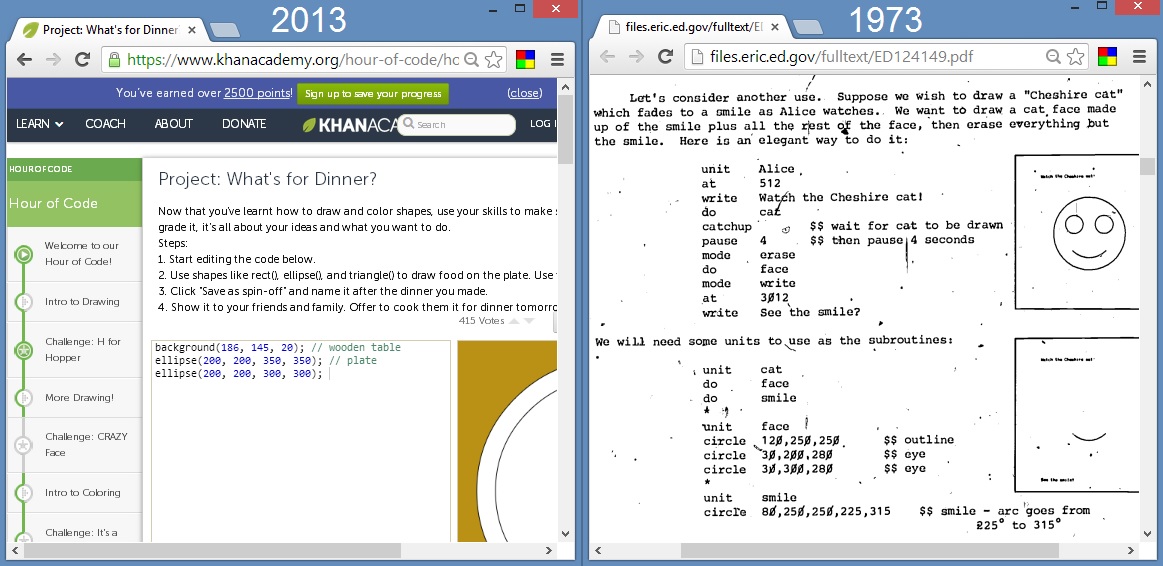
theodp writes Writing in Vanity Fair, U.S. Secretary of Education Arne Duncan marvels that his kids can learn to code online at their own pace thanks to "free" lessons from Khan Academy, which Duncan credits for "changing the way my kids learn" (Duncan calls out his kids' grade school for not offering coding). The 50-year-old Duncan, who complained last December that he "didn't have the opportunity to learn computer skills" while growing up attending the Univ. of Chicago Lab Schools and Yale, may be surprised to learn that the University of Illinois was teaching kids how to program online in the '70s with its PLATO system, and it didn't look all that different from what Khan Academy came up with for his kids 40 years later (Roger Ebert remarked in his 2011 TED Talk that seeing Khan Academy gave him a flashback to the PLATO system he reported on in the '60s). So, does it matter if the nation's education chief — who presides over a budget that includes $69 billion in discretionary spending — is clueless about The Hidden History of Ed-Tech? Some think so. "We can't move forward," Hack Education's Audrey Watters writes, "til we reconcile where we've been before." So, if Duncan doesn't want to shell out $200 to read a 40-year-old academic paper on the subject (that's a different problem!) to bring himself up to speed, he presumably can check out the free offerings at Ed.gov. A 1975 paper on Interactive Systems for Education, for instance, notes that 650 students were learning programming on PLATO during the Spring '75 semester, not bad considering that Khan Academy is boasting that it "helped over 2000 girls learn to code" in 2014 (after luring their teachers with funding from a $1,000,000 Google Award). Even young techies might be impressed by the extent of PLATO's circa-1975 online CS offerings, from lessons on data structures and numerical analysis to compilers, including BASIC, PL/I, SNOBOL, APL, and even good-old COBOL. -
Education Chief Should Know About PLATO and the History of Online CS Education
theodp writes Writing in Vanity Fair, U.S. Secretary of Education Arne Duncan marvels that his kids can learn to code online at their own pace thanks to "free" lessons from Khan Academy, which Duncan credits for "changing the way my kids learn" (Duncan calls out his kids' grade school for not offering coding). The 50-year-old Duncan, who complained last December that he "didn't have the opportunity to learn computer skills" while growing up attending the Univ. of Chicago Lab Schools and Yale, may be surprised to learn that the University of Illinois was teaching kids how to program online in the '70s with its PLATO system, and it didn't look all that different from what Khan Academy came up with for his kids 40 years later (Roger Ebert remarked in his 2011 TED Talk that seeing Khan Academy gave him a flashback to the PLATO system he reported on in the '60s). So, does it matter if the nation's education chief — who presides over a budget that includes $69 billion in discretionary spending — is clueless about The Hidden History of Ed-Tech? Some think so. "We can't move forward," Hack Education's Audrey Watters writes, "til we reconcile where we've been before." So, if Duncan doesn't want to shell out $200 to read a 40-year-old academic paper on the subject (that's a different problem!) to bring himself up to speed, he presumably can check out the free offerings at Ed.gov. A 1975 paper on Interactive Systems for Education, for instance, notes that 650 students were learning programming on PLATO during the Spring '75 semester, not bad considering that Khan Academy is boasting that it "helped over 2000 girls learn to code" in 2014 (after luring their teachers with funding from a $1,000,000 Google Award). Even young techies might be impressed by the extent of PLATO's circa-1975 online CS offerings, from lessons on data structures and numerical analysis to compilers, including BASIC, PL/I, SNOBOL, APL, and even good-old COBOL. -
Education Chief Should Know About PLATO and the History of Online CS Education
theodp writes Writing in Vanity Fair, U.S. Secretary of Education Arne Duncan marvels that his kids can learn to code online at their own pace thanks to "free" lessons from Khan Academy, which Duncan credits for "changing the way my kids learn" (Duncan calls out his kids' grade school for not offering coding). The 50-year-old Duncan, who complained last December that he "didn't have the opportunity to learn computer skills" while growing up attending the Univ. of Chicago Lab Schools and Yale, may be surprised to learn that the University of Illinois was teaching kids how to program online in the '70s with its PLATO system, and it didn't look all that different from what Khan Academy came up with for his kids 40 years later (Roger Ebert remarked in his 2011 TED Talk that seeing Khan Academy gave him a flashback to the PLATO system he reported on in the '60s). So, does it matter if the nation's education chief — who presides over a budget that includes $69 billion in discretionary spending — is clueless about The Hidden History of Ed-Tech? Some think so. "We can't move forward," Hack Education's Audrey Watters writes, "til we reconcile where we've been before." So, if Duncan doesn't want to shell out $200 to read a 40-year-old academic paper on the subject (that's a different problem!) to bring himself up to speed, he presumably can check out the free offerings at Ed.gov. A 1975 paper on Interactive Systems for Education, for instance, notes that 650 students were learning programming on PLATO during the Spring '75 semester, not bad considering that Khan Academy is boasting that it "helped over 2000 girls learn to code" in 2014 (after luring their teachers with funding from a $1,000,000 Google Award). Even young techies might be impressed by the extent of PLATO's circa-1975 online CS offerings, from lessons on data structures and numerical analysis to compilers, including BASIC, PL/I, SNOBOL, APL, and even good-old COBOL. -
Colleges Face New 'Gainful Employment' Regulations For Student Loans
HughPickens.com writes: Education Secretary Arne Duncan says the Education Department wants to make sure loan programs that prey on students don't continue their abusive practices. Now Kimberly Hefling reports that for-profit colleges who are not producing graduates capable of paying off their student loans could soon stand to lose access to federal student-aid programs. In order to receive federal student aid, the law requires that most for-profit programs, regardless of credential level, and most non-degree programs at non-profit and public institutions, including community colleges, prepare students for "gainful employment in a recognized occupation" (PDF). To meet these "gainful employment" standards, a program will have to show that the estimated annual loan payment of a typical graduate does not exceed 20 percent of his or her discretionary income or 8 percent of total earnings.
"Career colleges must be a stepping stone to the middle class. But too many hard-working students find themselves buried in debt with little to show for it. That is simply unacceptable," says Duncan. "These regulations are a necessary step to ensure that colleges accepting federal funds protect students, cut costs and improve outcomes. We will continue to take action as needed."
But not everyone is convinced the rules go far enough. "The rule is far too weak to address the grave misconduct of predatory for-profit colleges," writes David Halperin. "The administration missed an opportunity to issue a strong rule, to take strong executive action and provide real leadership on this issue." The final gainful employment regulations follow an extensive rulemaking process involving public hearings, negotiations and about 95,000 public comments and will go into effect on July 1, 2015. -
Colleges Face New 'Gainful Employment' Regulations For Student Loans
HughPickens.com writes: Education Secretary Arne Duncan says the Education Department wants to make sure loan programs that prey on students don't continue their abusive practices. Now Kimberly Hefling reports that for-profit colleges who are not producing graduates capable of paying off their student loans could soon stand to lose access to federal student-aid programs. In order to receive federal student aid, the law requires that most for-profit programs, regardless of credential level, and most non-degree programs at non-profit and public institutions, including community colleges, prepare students for "gainful employment in a recognized occupation" (PDF). To meet these "gainful employment" standards, a program will have to show that the estimated annual loan payment of a typical graduate does not exceed 20 percent of his or her discretionary income or 8 percent of total earnings.
"Career colleges must be a stepping stone to the middle class. But too many hard-working students find themselves buried in debt with little to show for it. That is simply unacceptable," says Duncan. "These regulations are a necessary step to ensure that colleges accepting federal funds protect students, cut costs and improve outcomes. We will continue to take action as needed."
But not everyone is convinced the rules go far enough. "The rule is far too weak to address the grave misconduct of predatory for-profit colleges," writes David Halperin. "The administration missed an opportunity to issue a strong rule, to take strong executive action and provide real leadership on this issue." The final gainful employment regulations follow an extensive rulemaking process involving public hearings, negotiations and about 95,000 public comments and will go into effect on July 1, 2015. -
Solving the Mystery of Declining Female CS Enrollment
theodp writes After an NPR podcast fingered the marketing of computers to boys as the culprit behind the declining percentages of women in undergraduate CS curricula since 1984 (a theory seconded by Smithsonian mag), some are concluding that NPR got the wrong guy. Calling 'When Women Stopped Coding' quite engaging, but long on Political Correctness and short on real evidence, UC Davis CS Prof Norm Matloff concedes a sexist element, but largely ascribes the gender lopsidedness to economics. "That women are more practical than men, and that the well-publicized drastic swings in the CS labor market are offputting to women more than men," writes Matloff, and "was confirmed by a 2008 survey in the Communications of the ACM" (related charts of U.S. unemployment rates and Federal R&D spending in the '80s). Looking at the raw numbers of female CS grads instead of percentages, suggests there wasn't a sudden and unexpected disappearance of a generation of women coders, but rather a dilution in their percentages as women's growth in undergrad CS ranks was far outpaced by men, including a boom around the time of the dot-com boom/bust. -
How Many Members of Congress Does It Take To Pass a $400MM CS Bill?
theodp writes: Over at Code.org, they're celebrating because more than 100 members of Congress are now co-sponsoring the Computer Science Education Act (HR 2536), making the bill designed to"strengthen elementary and secondary computer science education" the most broadly cosponsored education bill in the House. By adding fewer than 50 words to the Elementary and Secondary Education Act of 1965, HR 2536 would elevate Computer Science to a "core academic subject" (current core academic subjects are English, reading or language arts, mathematics, science, foreign languages, civics and government, economics, arts, history, and geography), a status that opens the doors not only to a number of funding opportunities, but also to a number of government regulations. So, now that we know it takes 112 U.S. Representatives to make a CS education bill, the next question is, "How many taxpayer dollars will it take to pay for the consequences?" While Code.org says "the bill is cost-neutral and doesn't introduce new programs or mandates," the organization in April pegged the cost of putting CS in every school at $300-$400 million. In Congressional testimony last January, Code.org proposed that "comprehensive immigration reform efforts that tie H-1B visa fees to a new STEM education fund" could be used "to support the teaching and learning of more computer science in K-12 schools," echoing Microsoft's National Talent Strategy. -
Average HS Student Given Little Chance of AP CS Success
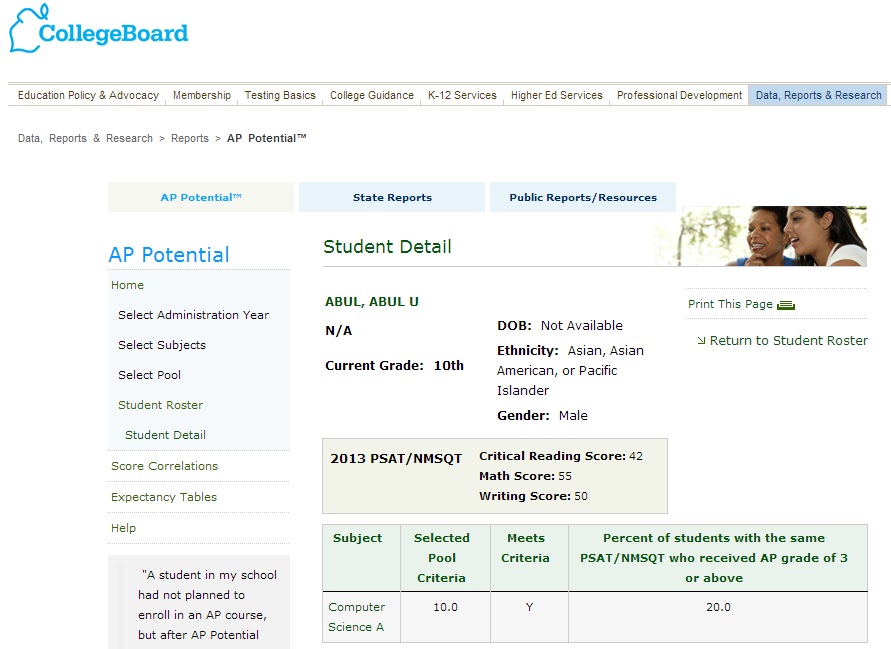
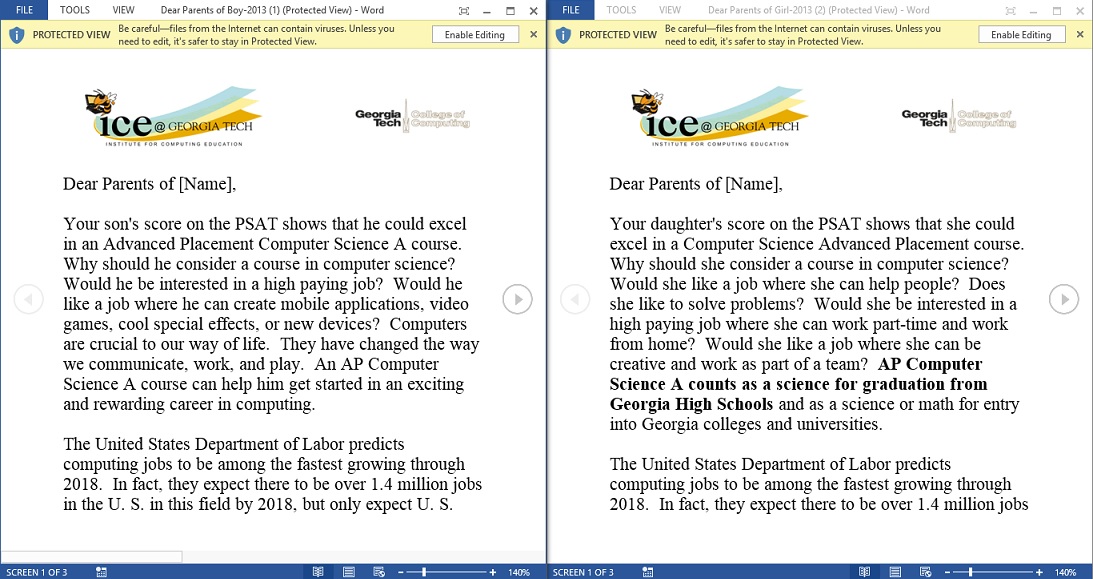
theodp (442580) writes AP Computer Science is taught in just 10% of our high schools," lamented The White House last December as President Obama kicked off CSEdWeek. "China teaches all of its students one year of computer science." And the U.S. Dept. of Education has made the AP CS exam its Poster Child for inequity in education (citing a viral-but-misinterpreted study). But ignored in all the hand-wringing over low AP CS enrollment is one huge barrier to the goal of AP-CS-for-all: College Board materials indicate that the average 11th grader's combined PSAT/NMSQT score of 96 in reading and math gives him/her only a 20%-30% probability of getting a score of '3' on the AP CS exam (a score '4' or '5' may be required for college credit). The College Board suggests schools tap a pool of students with a "60-100% likelihood of scoring 3 or higher", so it's probably no surprise that CS teachers are advised to turn to the College Board's AP Potential tool to identify students who are likely to succeed (sample Student Detail for an "average" kid) and send their parents recruitment letters — Georgia Tech even offers some gender-specific examples — to help fill class rosters. -
Finding the Next Generation of Teachers With "Innovative Microsoft Ads"
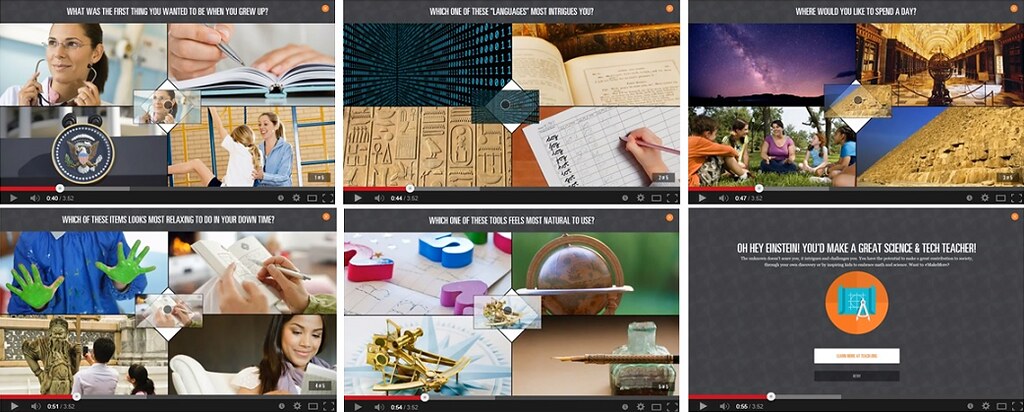
theodp (442580) writes "Back in 2011, the U.S. Dept. of Education delegated teacher recruitment to Microsoft (RFP, pdf). 'The decision to turn over TEACH to [Microsoft] Partners in Learning serves to expand the already outsized influence Gates and his fortune have on public education,' wrote the Washington Post at the time. So, 'what happens when a public institution in a democracy — the US Department of Education — outsources its goal of recruiting good teachers to a private industry?' Well, in addition to Teach.org and redundant social media efforts on Twitter, Facebook, Tumblr, Instagram, Linkedin, and YouTube, the U.S. is now relying on 'Innovative Microsoft Advertising to Recruit the next Generation of Teachers'. From the press release, 'The Ad Council and TEACH have formed a unique outreach campaign with Microsoft's Advertising team in an effort to recruit the next generation of teachers who will drive innovation and redefine teaching in K-12 classrooms. Microsoft donated over 125 million impressions across Xbox 360, Windows 8, and MSN in order to encourage consumers to rediscover teaching through interactive ad units. This media effort is an extension of the Ad Council and TEACH's public service advertising (PSA) campaign, Make More...Throughout March, consumers were able to engage with TEACH "NUads on Xbox", via gesture, voice or controller on their Xbox 360 consoles...Most recently, Microsoft leveraged their Windows 8 platform to provide a unique experience to consumers, enabling them to navigate through a series of questions to help "discover their true passion," along with the opportunity to play challenging mind and word games, such as a word scramble and tangrams.' Check out the demo of the Windows 8 platform experience [YouTube], in which a person is advised 'You'd Make a Great Science & Tech Teacher,' on the basis of a 'Personality Quiz' consisting of five dragged-and-dropped photos." -
Federal Student Aid Requirements At For-Profit Colleges Overhauled
An anonymous reader writes "The U.S. Department of Education has released a proposal for new regulations that would hold colleges that receive federal student aid accountable for the employment success of their graduates. The overhaul is prompted by the fact that students from for-profit colleges account for nearly 50% of all loan defaults yet only account for about 13% of the total higher education population. '[O]f the for-profit gainful employment programs the Department could analyze and which could be affected by [the proposed regulations], the majority--72%--produced graduates who on average earned less than high school dropouts.'" -
The Whole Story Behind Low AP CS Exam Stats
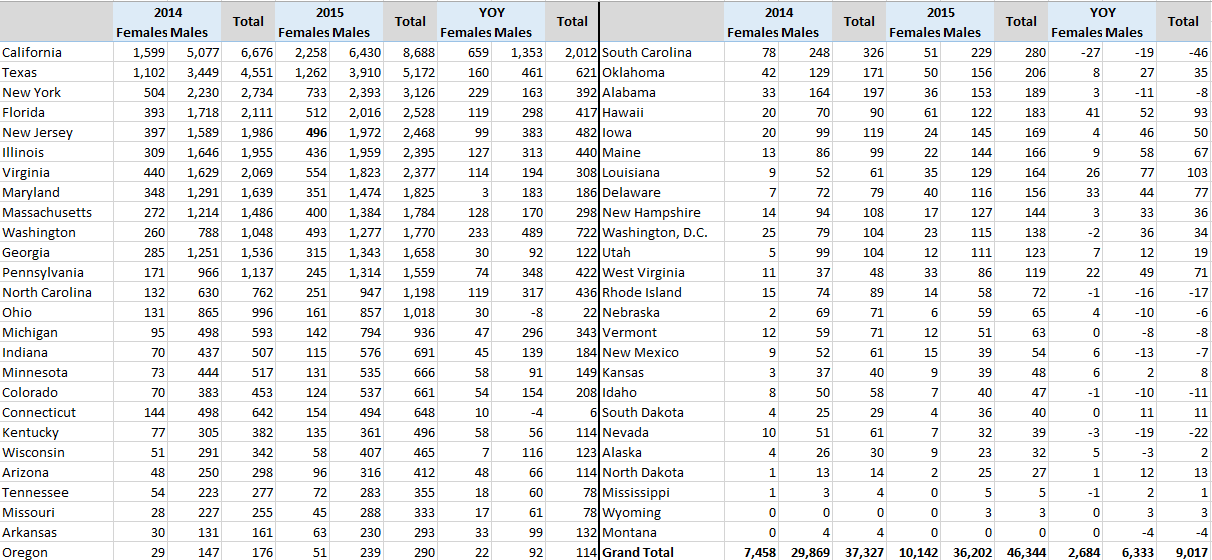
theodp writes "At first glance, the headline in The Salt Lake Tribune — Very Few Utah Girls, Minorities Take Computer Science AP Tests — appears to be pretty alarming. As does the headline No Girls, Blacks, or Hispanics Take AP Computer Science Exam in Some States over at Education Week. Not One Girl Took The AP Computer Science Test In Some States warns a Business Insider headline. And so on and so on and so on. So how could one quibble with tech-giant backed Code.org's decision to pay teachers a $250 "Female Student Bonus", or Google's declaration that 'the ultimate goal of CS First is to provide proven teaching materials, screencasts, and curricula for after-school programs that will ignite the interest and confidence of underrepresented minorities and girls in CS,' right? But the thing is, CollegeBoard AP CS exam records indicate that no Wyoming students at all took an AP CS exam (xls) in 2013, and only a total of 103 Utah students (xls) had reported scores. Let's not forget about the girls and underrepresented minorities, but since AP CS Exam Stats are being spun as a measure of CS education participation (pdf) and equity, let's not forget that pretty much everyone has been underrepresented if we look at the big AP CS picture. If only 29,555 AP CS scores were reported (xls) in 2013 for a HS population of about 16 million students, shouldn't the goal at this stage of the game really be CS education for all?" -
Questions Raised By Education Dept's Road Show On College Value
lpress writes "Department of Education officials, led by Under Secretary of Education Martha Kanter, were on our campus last week, soliciting input on The President's College Value and Affordability plan. The discussion focused primarily on the design of a system for rating colleges and to a lesser extent on innovation and improvement. While the feedback was constructive, many attendees pointed out difficulties and limitations of any college rating system. One solution is to open the process by having the Department of Education gather and post data and provide a platform and tools for all interested parties to analyze, visualize and discuss it. Similarly, open innovation should be encouraged, for example, by providing a hosted version of the open source education platform MOOC.ORG." -
No Child Left Untableted
theodp writes "Made possible by a $30 million grant from the Dept. of Education's Race to the Top program, the NY Times reports that every student and teacher in 18 of Guilford County's (NC) middle schools is receiving a tablet created and sold by Amplify, a division of Rupert Murdoch's News Corporation. The tablets — 15,450 in all — are to be used for class work, homework, educational games — just about everything. With a total annual per unit lease cost of $214, Amplify was the low bidder of those responding to Guilford's Race-to-the-Top RFP, including Apple. Touted by Amplify as one of the largest tablet deployments in K-12 education, the deal raised some eyebrows, since Guilford's School Superintendent once reported to an Amplify EVP when the latter was the superintendent of Charlotte-Mecklenburg schools, coincidentally a proving ground of the Gates Foundation. Amplify and the Gates Foundation are partners on a controversial national K-12 student tracking database that counts the Guilford County Schools among its guinea pigs. Getting back to the hardware, after putting their John Hancock on a Student Tablet Agreement and the Acceptable Use Guidelines for Tablet, students are provided with an ASUS-made tablet "similar to ASUS MeMO Pad ME301T" ($279 at Wal-Mart). The News & Record reports on some glitches encountered in the first week of the program, including Internet connectivity issues affecting about 5% of the tablets." -
What Works In Education: Scientific Evidence Gets Ignored
nbauman writes "According to Gina Kolata in the New York Times, The Institute of Education Sciences in the Department of Education Sciences, U.S. Department of Education, has supported 175 randomized controlled studies, like the studies used in medicine, to find out what works and doesn't work, which are reported in the What Works Clearinghouse. Surprisingly, the choice of instructional materials — textbooks, curriculum guides, homework, quizzes — can affect achievement as much as teachers; poor materials have as much effect as a bad teacher, and good materials can offset a bad teacher's deficiencies. One popular math textbook was superior to 3 competitors. A popular computer-assisted math program had no benefit. Most educators, including principals and superintendents, don't know the data exists. 42% of school districts had never heard of the clearinghouse. Up to 90% of programs that seemed promising in small studies had no effect or made achievement scores worse. For example a program to increase 7th-grade math teachers' understanding of math increased their understanding but had no effect on student achievement. Upward Bound had no effect." -
What Works In Education: Scientific Evidence Gets Ignored
nbauman writes "According to Gina Kolata in the New York Times, The Institute of Education Sciences in the Department of Education Sciences, U.S. Department of Education, has supported 175 randomized controlled studies, like the studies used in medicine, to find out what works and doesn't work, which are reported in the What Works Clearinghouse. Surprisingly, the choice of instructional materials — textbooks, curriculum guides, homework, quizzes — can affect achievement as much as teachers; poor materials have as much effect as a bad teacher, and good materials can offset a bad teacher's deficiencies. One popular math textbook was superior to 3 competitors. A popular computer-assisted math program had no benefit. Most educators, including principals and superintendents, don't know the data exists. 42% of school districts had never heard of the clearinghouse. Up to 90% of programs that seemed promising in small studies had no effect or made achievement scores worse. For example a program to increase 7th-grade math teachers' understanding of math increased their understanding but had no effect on student achievement. Upward Bound had no effect." -
What Works In Education: Scientific Evidence Gets Ignored
nbauman writes "According to Gina Kolata in the New York Times, The Institute of Education Sciences in the Department of Education Sciences, U.S. Department of Education, has supported 175 randomized controlled studies, like the studies used in medicine, to find out what works and doesn't work, which are reported in the What Works Clearinghouse. Surprisingly, the choice of instructional materials — textbooks, curriculum guides, homework, quizzes — can affect achievement as much as teachers; poor materials have as much effect as a bad teacher, and good materials can offset a bad teacher's deficiencies. One popular math textbook was superior to 3 competitors. A popular computer-assisted math program had no benefit. Most educators, including principals and superintendents, don't know the data exists. 42% of school districts had never heard of the clearinghouse. Up to 90% of programs that seemed promising in small studies had no effect or made achievement scores worse. For example a program to increase 7th-grade math teachers' understanding of math increased their understanding but had no effect on student achievement. Upward Bound had no effect." -
Let Them Eat Teslas
theodp writes "If you're a bright kid who wants to prepare for the 21st century workforce (PDF) by studying engineering at Purdue, the government will help your parents pay the $100,000 or so tuition tab with a 7.9% interest loan (plus 4% fees) that's likely to be non-dischargeable in bankruptcy and paid back with after-tax money. If, on the other hand, you want to buy a tricked-out $100,000 Model S, Tesla has teamed up with the government, Wells Fargo, and U.S. Bank on what it calls a 'Revolutionary New Finance Product' that enables those who play the game right to avoid paying sales tax, get the government to pick up the first $15,000 (no down payment needed!), and also receive a 2.95% bankruptcy-dischargeable loan for the balance, the payments for which could be tax-deductible. Yep, 'Revolutionary' may be about right!" -
Tech Firms Keep Piles of 'Foreign Cash' In US
theodp writes "There's a funny thing about the estimated $1.7 trillion that American companies say they have indefinitely invested overseas,' reports the WSJ's Kate Linebaugh (reg. or the old Google trick). 'A lot of it is actually sitting right here at home.' And if tech companies like Google and Microsoft want to keep more than three-quarters of the cash owned by their foreign subsidiaries at U.S. banks, held in U.S. dollars or parked in U.S. government and corporate securities, Linebaugh explains, this money is still overseas in the eyes of the IRS and isn't taxed as long as it doesn't flow back to the U.S. parent company. Helping corporations avoid the need to tap their foreign-held cash are low interest rates at home, which have allowed U.S. companies to borrow cheaply. Oracle, for instance, raised $5 billion last year, paying an interest rate roughly two-thirds of a percentage point above the low post-crash Treasury yield, about 2.5% at the time (by contrast, grad students and parents pay 6.8%-7.9% for Federal student loans). Were the funds it manages to keep in the hands of its foreign subsidiaries brought home and subjected to U.S. income tax, Oracle estimated it could owe Uncle Sam about $6.3 billion." -
U.S. Students Struggle With Reasoning Skills
sciencehabit writes "The first-ever use of interactive computer tasks on a national science assessment suggests that most U.S. students struggle with the reasoning skills needed to investigate multiple variables, make strategic decisions, and explain experimental results. The results (PDF) are part of the National Assessment of Educational Progress that was given in 2009 to a representative sample of students in grades four, eight, and 12. What the vast majority of students can do, the data show, is make straightforward analyses. More than three-quarters of fourth grade students, for example, could determine which plants were sun-loving and which preferred the shade when using a simulated greenhouse to determine the ideal amount of sunlight for the growth of mystery plants. When asked about the ideal fertilizer levels for plant growth, however, only one-third of the students were able to perform the required experiment, which featured nine possible fertilizer levels and only six trays. Fewer than half the students were able to use supporting evidence to write an accurate explanation of the results. Similar patterns emerged for students in grades 8 and 12." -
India's Schooling Experiment Tests Rich and Poor
theodp writes "Passed in 2009, India's Right to Education Act mandates that private schools set aside 25% of admissions for low-income, underprivileged and disabled students. Many of the world's top private schools offer scholarships to smart poor kids, but India's plan is more sweeping in that the rules prohibit admission-testing of students. 'Over the years schooling offered by these two systems [public and private] has become increasingly disparate and unequal,' explained Anshu Vaish of the Dept. of Human Resource Development. But the most notable results of the experiment thus far, reports the WSJ, are frustration and disappointment as separations that define Indian society are upended, leading even some supporters to conclude that the chasm between the top and bottom of Indian society is too great to overcome. Hey, at least we don't have these kinds of problems in the US, right? BTW, about 30% of this year's Intel Science Talent Search 2011 Finalists hailed from private schools, where annual tuition ranges from $15,750 at Ursuline Academy (the alma mater of Melinda Gates) to $37,020 at Groton School (the alma mater of FDR). Some 10% of all elementary and secondary school students were in private schools in 2009-2010, according to the US Dept. of Education." -
Gates' Future of Education Straight Out of '60s
theodp writes "Bill Gates really should have talked more with ex-Microsoft CTO Ray Ozzie. While Khan Academy's new self-paced exercises, coach management options, and game mechanics (merit badges/points) prompted Gates to gush to the high-rollers at Salman Khan's TED Talk that they 'just got a glimpse of the future of education,' Ozzie's seen this movie before, having written similarly-featured PLATO courseware as a student at Illinois. In the '70s. On plasma terminals. With touch screens. Fifty years ago last Friday, 27-year-old EE PhD whiz kid Don Bitzer and partner Peter Braunfeld demonstrated the nascent PLATO system to assembled dignitaries at the 'President's Faculty Conference on Improving Our Educational Aims in the Sixties.' Hey, everything old is new again! Gates is hardly the only tech luminary who don't-know-much-about-PLATO-history — CS Prof Daniel Sleator felt compelled to school the Web's founders on PLATO in '94." -
How Much Math Do We Really Need?
Pickens writes "G.V. Ramanathan, a professor emeritus of mathematics, statistics and computer science at the University of Illinois at Chicago, writes in the Washington Post that although a lot of effort and money has been spent to make mathematics seem essential, unlike literature, history, politics and music, math has little relevance to everybody's daily life. 'All the mathematics one needs in real life can be learned in early years without much fuss,' writes Ramanathan. 'Most adults have no contact with math at work, nor do they curl up with an algebra book for relaxation.' Ramanathan says that the marketing of math has become similar to the marketing of creams to whiten teeth, gels to grow hair and regimens to build a beautiful body, but even with generous government grants over the past 25 years, countless courses, conferences, and books written on how to teach teachers to teach, where is the evidence that these efforts have helped students? A 2008 review by the Education Department found that the nation is at 'greater risk now' than it was in 1983, and the National Assessment of Educational Progress math scores for 17-year-olds have remained stagnant since the 1980s (PDF). Meanwhile those who do love math and science have been doing very well and our graduate schools are the best in the world. 'As for the rest, there is no obligation to love math any more than grammar, composition, curfew or washing up after dinner. Why create a need to make it palatable to all and spend taxpayers' money on pointless endeavors without demonstrable results or accountability?'" -
Should Professors Be Required To Teach With Tech?
An anonymous reader writes "Are professors who don't update their teaching methods like doctors who fail to keep up with the latest ways to treat disease? Or are professors better off teaching old-school? From the article: 'It is tough to measure how many professors teach with technology or try other techniques the report recommends, such as group activities and hands-on exercises. (Technology isn't the only way to improve teaching, of course, and some argue that it can hinder it.) Though most colleges can point to several cutting-edge teaching experiments on their campuses, a recent national assessment called the Faculty Survey of Student Engagement suggests that old-school instruction remains the norm. Only 13 percent of the professors surveyed said they used blogs in teaching; 12 percent had tried videoconferencing; and 13 percent gave interactive quizzes using 'clickers,' or TV-remotelike devices that let students respond and get feedback instantaneously. The one technology that most teachers use regularly — course-management systems — focuses mostly on housekeeping tasks like handing out assignments or keeping track of student grades.'" -
Is Early Childhood Education Technology Moving Backwards?
theodp writes "Four decades ago, the NSF-sponsored PLATO Elementary Reading Curriculum Project (pdf) provided Illinois schoolchildren with reading lessons and e-versions of beloved children's books that exploited networked, touch-sensitive 8.5"x8.5" bit-mapped plasma screens, color images, and audio. Last week, the Today Show promoted the TeacherMate — a $100 gadget that's teaching Illinois schoolchildren to read and do math using its 2.5" screen and old-school U-D-L-R cursor keys — as a revolution in education. Has early childhood education managed to defy Moore's Law?" -
FBI Data Mining Students' Financial Aid Records
crumley writes "The U.S. Department of Education has been running a program that data mines student financial aid records for the FBI. The program, now five years old, is known as Project Strike Back. It trolls for names of suspected terrorists through the Education Department's database of information, which is derived from students who fill out the Free Application for Federal Student Aid (FAFSA). The discovery of this program by Northwestern University journalism student Laura McGann has added fuel to the debate about the Education Department's proposal to start a new database tracking the academic progress of all students." -
Evolution No Longer Worth Learning, Says Government
Davemania writes "New York Times reports that the Evolution biology subject has disappeared from a list of acceptable fields of study for recipients of a federal education grant for low-income college students. The Education department has described this as a Clerical Mistake but others are skeptical about this. 'Scientists who knew about the omission also said they found the clerical explanation unconvincing, given the furor over challenges by the religious right to the teaching of evolution in public schools. "It's just awfully coincidental," said Steven W. Rissing, an evolutionary biologist at Ohio State University.'" As someone who made use of one of those grants to study Evolutionary Biology, I find this more than a little galling. -
Nations Report Card For Science
quakeaddict writes: "The US Dept of Education released the Nations Report Card for Science. Compared to 1996, it seems as if we as a nation are doing worse.The site also has cool tools to see how various states performed in other subjects.. There is also a very cool interactive tool that provides a wealth of information about how well kids did in all the subjects crossed with all sorts of questions (e.g. What was Johnnys score if he says he watched 1, 2 or 3 hours of TV a day etc...)." -
Nations Report Card For Science
quakeaddict writes: "The US Dept of Education released the Nations Report Card for Science. Compared to 1996, it seems as if we as a nation are doing worse.The site also has cool tools to see how various states performed in other subjects.. There is also a very cool interactive tool that provides a wealth of information about how well kids did in all the subjects crossed with all sorts of questions (e.g. What was Johnnys score if he says he watched 1, 2 or 3 hours of TV a day etc...)." -
Nations Report Card For Science
quakeaddict writes: "The US Dept of Education released the Nations Report Card for Science. Compared to 1996, it seems as if we as a nation are doing worse.The site also has cool tools to see how various states performed in other subjects.. There is also a very cool interactive tool that provides a wealth of information about how well kids did in all the subjects crossed with all sorts of questions (e.g. What was Johnnys score if he says he watched 1, 2 or 3 hours of TV a day etc...)." -
Slashback: Unenforceability, Conflagration, Cans
This is Slashback for the evening. Please be advised, through the following items, about ... how to turn that extra Pentium into a firewall running iptables; the state of the Symantec patent on software updates (uughh!); more on can satellites, and more.a filtration system for your 2.4 goldfish Jay Beale points to this followup to his "Why iptables rocks" article of a few weeks ago: "It fulfills my promise to show how to actually build a home/SOHO firewall with Linux 2.4's iptables aka Netfilter. It contains the full code, explained piece by piece, to build a working firewall with 2.4, including all kinds of cool packet mangling for load balancing, redirecting stuff to transparent proxies, or avoiding nmap stealth scans ..."
Out of embarrassment, perhaps? An unnamed correspondent points out this bit of news regarding Symantec's patent on software updates. The upshot is, without pointing out that updating software incrementally is not a patent likely to win them a lot of favor from the industry they have simply decided not to enforce it. Smart move.
Not yet in the can, or the cube either Casey Ho of San Jose's Leland High wrote with some interesting information for those interested in tiny amateur satellites; Leland is one of the handful of schools whose students are designing experimental payloads for inclusion on an upcoming launch.
[We] are focusing on making a CubeSat. Leland High school officially has one satellite to launch, and there are four teams now competing to make a design that will be approved by CalPoly technicians. My own group will attempt to broadcast a powerful long term signal using only a small satellite. The project is not easy since there are a lot of scientific guidelines we must meet. We are discussing how to create a reliable circuit and transmitter that will function in extreme temperatures, vacuum, radiation, and most importantly, after an extra powerful rocket launch. The requirements are available here.
Machinima makes the grade ILL Robinson writes: "Wanted you guys to know that our Quake II-based machinima film, Hardly Workin', received top honors at Showtime Networks' Alternative Media Festival - alt.sho.com. In an awards ceremony on February 8th at MTV Studios, Showtime awarded The ILL Clan with awards in both Best Experimental Short as well as Best of SHO for the festival. Using Machinima (films created with a PC game that can be modified with users' assets), The ILL Clan's film gained notice from the festival's judges - citing Hardly Workin' as a short with a high degree of innovation, design & creativity. We're pretty excited to receive the recognition, all the way from fans of ours who had been following us from the beginning and now, from a top-tier cable TV network. Cruise on over to our site for the official announcement, or to Machinima.com for more machinima works. And thanks also to the Slashdot readers, as they helped spread the word of what Machinima is all about."For some of you posters out there, sorry, no living organisms or explosives are allowed on the satellites. ;)"
Congatulations!
-
Statistics On The Degrees People Earn
Xzzy writes: "Over on NASA's space science page, they recently posted a link to a PDF file with a bunch of numbers from the National Center for Education Statistics, focusing on geekly-type jobs. Interesting numbers noted were ones pointing out that over the past ten or so years, degrees earned in electrical engineering have steadily declined.. while degrees focused on fitness studies and recreation have sharply increased."