Slashdot Mirror
Domain: eia.gov
Stories and comments across the archive that link to eia.gov.
Comments · 833
-
Well duh
Federal tax subsidies for renewables exploded starting in 2006. Of course any projections made in 2006 based on extrapolating 2000-2005 subsidy levels would be inaccurate.
For solar in particular, it got just $174 million in subsidies in 2007. By 2010 it got $1.1 billion. And in 2013 it received $5.3 billion. Or to put it as TFA does, it received 3046% more in subsidies in 2013 than it did in 2007.
You increase subsidies by 30x over 7 years, the story would've been if growth hadn't increase by more than 40x over 10 years. -
Re:Scotland's homes don't use much electricity
They were being conservative. 30 MW / 20,000 homes = 1500 Watts per home.
That's higher than the average U.S. home's consumption. 10812 kWh per year / 8766 hours per year = 1233 Watts per home. -
Re:The key is not getting caught
You don't need to cherry pick data because you're obviously starting with the conclusion and not bothering to even look at the data.
I don't know why India is building more power plants, but I suspect part of the motivation is politics. Toshiba filed for bankruptcy after buying Westinghouse because of cost overruns in Georgia and SC. The US Department of Energy says that for new energy generation before subsidies wind energy is comparable to natural gas production, solar is about 20% more expensive, and new nuclear and coal plants are about 80% more expensive than wind and natural gas. https://www.eia.gov/outlooks/aeo/pdf/electricity_generation.pdf (note: had to go to 2015 to get coal).
-
Re:Coal Powered Cars...
If you want to drive electric cars, you'll need electricity. Consider every time you charge your Tesla, 32-33% of that charge comes from coal, in the US. Can't have it both ways. Morons.
Well if you want to be precise, how about 30.4 % from coal. https://www.eia.gov/tools/faqs..., at least for 2016. Expect it to be a little lower in 2017.
Well, that just totally upends his point
-
Re:So is the situation dire enough to
So far, you haven't provided any evidence whatsoever, only made a bunch of unfounded claims, so there's nothing to refute.
You mean like you made unfounded claims? How you provided no evidence? Is it that hard to click on the link I gave and then click on the results?
https://www.iaea.org/sites/def...
https://www.fool.com/investing...Let me guess, because the data comes from the International Atomic Energy Agency and World Nuclear Association it cannot be trusted? I tried to find similar data from someone that might be more neutral on the topic. Why could that be? Perhaps because wind and solar aren't that safe.
Also, you didn't answer my question before. It should be easy enough to find. What is the price of solar power at midnight in Michigan? In January? I found the price for nuclear, about 16 cents per kilowatt hour.
https://www.eia.gov/state/rank... -
Re:What's next?
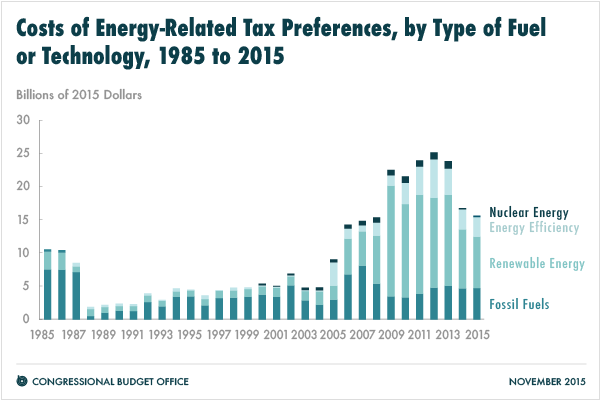
Here's an EIA report listing the amounts and types of direct subsidies and tax incentives in 2013 specific to the energy industry, for both renewables and fossil fuels, broken down by type.
It does not include any incentives that are also available to other industries, nor does it go into any detail about past subsidies (obviously fossil fuels have been receiving these subsidies a lot longer than renewables).
-
Re:Coal Powered Cars...
If you want to drive electric cars, you'll need electricity. Consider every time you charge your Tesla, 32-33% of that charge comes from coal, in the US. Can't have it both ways. Morons.
Well if you want to be precise, how about 30.4 % from coal. https://www.eia.gov/tools/faqs..., at least for 2016. Expect it to be a little lower in 2017.
-
Re:Opportunity
I think most people are well aware that Puerto Rico is in no position to pay for an island wide solar power. Consider that an island of 3.4 million people recently declared bankruptcy on $70 billion of debt. This was in the news and people are well aware just how destitute they are, therefore they realize just how absurd it is for the island to pay for solar power.
There is also the matter of looking at their power needs. The people their can't afford the cost of solar energy as they already pay higher electrical costs than 49 out of 50 states. They pay these costs when making far less money than people in the United States - and that's before the hurricane wiped out far too many jobs.
https://www.eia.gov/state/anal...
Their problem isn't their power plants, they are largely intact. Their problem is the power lines, lines that would still have to be rebuilt even if they did use solar.
https://www.theverge.com/2017/...
Even MIT has debunked the ludicrous idea of Puerto Rico rebuilding with solar. In short they need about 20 billion megawatt hours per year. Tesla's south Australia facility will produce 129 million megawatt hours. The two are an order of magnitude apart in scale.
https://www.technologyreview.c...
To quote MIT on the matter "And given estimates that restoring the grid could take up to six months (not including Teslaâ(TM)s involvement), one is left wondering if the cost, complexity, and longevity issues donâ(TM)t make the suggestions rather more bluster than substance."
To say that Tesla could or would actually build out something that would meet the needs of Puerto Rico is absurd for anyone other than Tesla to say.
-
Re:Huh?
I...wouldn't exactly...want to be Puerto Rico trying to float the bonds required to build that shiny new infrastructure; but it is worth noting that their current(or pre-getting-destroyed) grid was actually absurdly skewed toward expensive fuels. Per EIA electricity production was almost 50% oil, 34% natural gas, 17% coal, 2% misc renewables. That is a really, really, lousy set of numbers when you are already a poor island with relatively high transportation costs. Even if you don't give a damn about the environment, oil is silly expensive compared to coal as a base load option; and natural gas has always been quite versatile in terms of spinup/spindown and plant construction; plus it has gotten crazy cheap of late. Aside from trying to get the anachronistic legal situation that ruins their transport costs sorted out; that's a generating situation ripe to be replaced by something cheaper; and a time when it already needs substantial repair and/or replacement is a convenient opportunity.
I was trying to be sarcastic there but apparently there are a lot of people on Slashdot today who need to look sarcasm up on Wikipedia. My point is that if your energy infrastructure is a smouldering pile of ruins you are going to have to buy a shiny new infrastructure anyway so why not go for Musk's option? If any of these corporate types can be persuaded to do this at a price that Puerto Rico's purse can handle it is Musk. In fact I think Musk might be persuaded to do the whole thing at something close to cost just so he can use Puerto Rico as a showcase for what his tech can do on a large scale. I somehow don't see Big Coal, Oil & Gas doing anything other than profiting massively off of any reconstruction in Puerto Rico with the usual corruption and massive waste of taxpayer money. Either way, Puerto Ricans are going to have to rebuild their infrastructure. The problem with that is that in many ways Puerto Rico is the USA's Greece and the US has made the same mistake as the EU did dealing with Greece which is that they saddled the taxpayers there with massive debts in order to ensure that a bunch of bankers don't have to suffer the consequences of making stupid investments. In order for reconstruction in Puerto Rico to happen the US Government is first going to have to see to it that a substantial part of Puerto Ricos debt is written off and that means (Shock!! HORROR!!!) that the carrion eaters of Wall Street will finally have to be punished for making stupid investment decisions a-la the old Republicam mantra: 'Let fail what is destined to fail'. Not that I'm holding my breath expecting a bunch of Republicans to live up to their own ideals (any more than I'd trust the Corporate Democrats to do that, but It's the Reps. not the Dems. who own Congress and the White House at the moment so the onus is on the Reps.). If there is no debt write-off, all Puerto Ricans can look forward to is a few decades of Baghdad style electricity rationing and exorbitant bills for maintaining and feeding antiquated and patched up petroleum and coal plants with fuel so that Wall Street bankers and Big Coal, Oil and Gas can profit from Puerto Rico's misery.
-
Re:Huh?
I...wouldn't exactly...want to be Puerto Rico trying to float the bonds required to build that shiny new infrastructure; but it is worth noting that their current(or pre-getting-destroyed) grid was actually absurdly skewed toward expensive fuels.
Per EIA electricity production was almost 50% oil, 34% natural gas, 17% coal, 2% misc renewables.
That is a really, really, lousy set of numbers when you are already a poor island with relatively high transportation costs. Even if you don't give a damn about the environment, oil is silly expensive compared to coal as a base load option; and natural gas has always been quite versatile in terms of spinup/spindown and plant construction; plus it has gotten crazy cheap of late.
Aside from trying to get the anachronistic legal situation that ruins their transport costs sorted out; that's a generating situation ripe to be replaced by something cheaper; and a time when it already needs substantial repair and/or replacement is a convenient opportunity. -
Re:Total Sales
See what is happening to incandescents? Same thing will happen to ICE. You will buy an electric car in your lifetime, mark my word.
-
Re:Capacity != generated
In the 12 months ending July, 2017, solar supplied 70.1 TWh out of the 4058 TWh used in the United States. This is 1.73%, and is triple the value from calendar 2015 (23.0 TWh). I'm not sure what level you consider "down in the noise", but it has reached a quarter of hydroelectric, which surely you consider a major power producer.
Source: https://www.eia.gov/electricit... (last row, last column)
-
Re:A great start...
Wind and solar are a tiny fraction of our supply at 2%, hydro 7%, and nuclear 4%. We have a long ways to go, but this is great news, hopefully the scale is now tipped to solar.
Where the hell are you? That's even worse than the USA. We're running at 6% wind and solar, 7% hydro, and 20% nuclear.
-
Re:If they ban existing vehicles I will sue
4) Enact some kind of incentives to move to electric motors for lawn equipment.
This is a good point, but why stop there? Norway has the highest amount of electric vehicles on the planet per capita even though they're a major oil producer because they pay no taxes on EVs, meaning no VAT and no additional vehicle taxes that normal cars are subject to. Additionally, electric vehicles are not subject to road tolls. AT the same time, gas costs 2 dollars a litre, meaning 7,5 dollars a gallon, and that's cheap for Norway, the last time I was there it was higher.
This isn't rocket science, the 2 primary factors affecting the adoption rate of electric vehicles are: the prices of the vehicles themselves, and the price of gas. Both can be heavily affected by taxes (and tax-breaks) I understand that in the current American context where you're used to having gas that's dirt cheap (don't get me wrong, the Norwegian prices are high as hell even for a European standard, but even here in Finland we pay around 6,10 $ a gallon, (E9510 which is 10 % ethanol) raising the tax on gas is probably a political no-go for several reasons, but even just giving significant tax-breaks on the electric vehicles will increase adoption rates significantly.
Secondly: start putting pressure on the oil companies themselves to create less polluting fuels that can be used to power conventional ICEs. You could set a goal of: by the year NNNN X % of all fuel produced most come from non-fossil sources. You currently produce around 140 million gallons of biodiesel a month (figures from june), with the yearly total capacity being around 2,3 billion gallons, which is less than 1 % of all the oil you currently consume. You can do a lot better, as can the rest of us..
The thing is, we (as in, the globe) don't have a lot of time to react if we wish to keep the warming below 2 degrees celsius, after which point it starts getting beyond our control due to feedback-effects from the glaciers melting as well as methane starting to be released from the permafrost, after which we're royally screwed. This means drastic actions are needed from everyone, so focusing on lawn mover engines is putting a bandaid a paper cut while the body is suffering from cancer that needs immediate treatment.
The good things is we can do this, we (the advanced economies) have both the money and the technological knowhow to ditch fossil fuels at a rapid pace, and we should, but for that to happen we need large players like the US, together with EU and China to start actually doing large scale systemic changes in the ways energy is both produced, used and taxed. Emission costs are currently heavily externalized, in that fossil fuels are waaaaaay cheaper than the should be considering the damage being done to everyone by their continued use, but as the effects only appear years after the stuff has been burned, they've managed to remain as cheap as they have. This needs to change in the relatively near-future, because the economy will naturally reroute to low-emission alternatives once fossils become economically inefficient. However we cannot wait for that to happen naturally (ie. waiting for the oil to start running out) because at that point it's likely going to be too late, so really, a carbon tax of some description, together with other sensible policies like those mentioned above by you, me and others, is the way to go.
You can't raise the price of gas (yet) with so many people dependent on it, but if you aggressively push for adoption of EVs not with bans, but with sensible market policies, once the price of an EV is below the price of an equivalent ICE vehicle you can start to increase gas price at which point it will only further increase
-
Re:If they ban existing vehicles I will sue
4) Enact some kind of incentives to move to electric motors for lawn equipment.
This is a good point, but why stop there? Norway has the highest amount of electric vehicles on the planet per capita even though they're a major oil producer because they pay no taxes on EVs, meaning no VAT and no additional vehicle taxes that normal cars are subject to. Additionally, electric vehicles are not subject to road tolls. AT the same time, gas costs 2 dollars a litre, meaning 7,5 dollars a gallon, and that's cheap for Norway, the last time I was there it was higher.
This isn't rocket science, the 2 primary factors affecting the adoption rate of electric vehicles are: the prices of the vehicles themselves, and the price of gas. Both can be heavily affected by taxes (and tax-breaks) I understand that in the current American context where you're used to having gas that's dirt cheap (don't get me wrong, the Norwegian prices are high as hell even for a European standard, but even here in Finland we pay around 6,10 $ a gallon, (E9510 which is 10 % ethanol) raising the tax on gas is probably a political no-go for several reasons, but even just giving significant tax-breaks on the electric vehicles will increase adoption rates significantly.
Secondly: start putting pressure on the oil companies themselves to create less polluting fuels that can be used to power conventional ICEs. You could set a goal of: by the year NNNN X % of all fuel produced most come from non-fossil sources. You currently produce around 140 million gallons of biodiesel a month (figures from june), with the yearly total capacity being around 2,3 billion gallons, which is less than 1 % of all the oil you currently consume. You can do a lot better, as can the rest of us..
The thing is, we (as in, the globe) don't have a lot of time to react if we wish to keep the warming below 2 degrees celsius, after which point it starts getting beyond our control due to feedback-effects from the glaciers melting as well as methane starting to be released from the permafrost, after which we're royally screwed. This means drastic actions are needed from everyone, so focusing on lawn mover engines is putting a bandaid a paper cut while the body is suffering from cancer that needs immediate treatment.
The good things is we can do this, we (the advanced economies) have both the money and the technological knowhow to ditch fossil fuels at a rapid pace, and we should, but for that to happen we need large players like the US, together with EU and China to start actually doing large scale systemic changes in the ways energy is both produced, used and taxed. Emission costs are currently heavily externalized, in that fossil fuels are waaaaaay cheaper than the should be considering the damage being done to everyone by their continued use, but as the effects only appear years after the stuff has been burned, they've managed to remain as cheap as they have. This needs to change in the relatively near-future, because the economy will naturally reroute to low-emission alternatives once fossils become economically inefficient. However we cannot wait for that to happen naturally (ie. waiting for the oil to start running out) because at that point it's likely going to be too late, so really, a carbon tax of some description, together with other sensible policies like those mentioned above by you, me and others, is the way to go.
You can't raise the price of gas (yet) with so many people dependent on it, but if you aggressively push for adoption of EVs not with bans, but with sensible market policies, once the price of an EV is below the price of an equivalent ICE vehicle you can start to increase gas price at which point it will only further increase
-
Re:6 billion?
Oh, and the average PV capacity factor in the US is 27,2%. A 700MW PV plant at average capacity factor is equivalent to 206MW of nuclear. So yes, there is a 10x difference in total generation; however, it more closely follows the demand curve, meaning that you can wholesale the power for significantly more per MWh, and the price you get for your power is the figure that really matters, not the total generation. Nuclear plants spend half their time generating dirt-cheap nighttime power.
Also it's worth noting that Duke's pricing on this solar plant is abnormally expensive; new plants in the desert southwest are coming in as low as $1,50/W (half as much). Florida's insolation is worse, but I'm not sure that fully explains the difference.
-
Re:Not real useful
For people talking about the "time wasted stopping to charge", several important points.
I've read that argument several times on this forum. While true, it seems like a minor factor.
Presumably the reason that trucking companies keep their trucks driving all the time (using teams of drivers) is because "time is money", and stopping the truck means paying interest on an asset which is doing nothing. However, that's a fairly minor consideration. Even 4 hours of additional downtime per day (for recharging) would cost less than $30,000 in additional interest over the lifetime of the tesla semi. That's minor compared to the money saved on fuel.
Obviously the thing that matters here is total cost of ownership (TCO). If I do some back-of-the-envelope calculations, it appears that an electric semi is cheaper to operate when diesel costs more than $4/gal. Diesel already costs more than that in many parts of Europe. Here in California, diesel costs about $3/gal, but the price of diesel is heading upwards over time, whereas the price of batteries is heading downwards. (The price of electricity in the US is about the same as it was in 1975 when adjusted for inflation, and has never varied by much: https://www.eia.gov/totalenerg... ).
Another important consideration is that diesel has a very volatile price, and volatility costs money by itself. Large transportation companies buy futures contracts in order to insulate themselves against possible diesel price increases. Not long ago, oil costed more than $100/bbl, and it could return there soon. There are also plausible geopolitical events (such as war in the middle east) which could send oil prices above $120/bbl overnight. As a result, large trucking companies require "insurance" against price increases and spend money on futures contracts for that. If small trucking companies buy diesel trucks but don't buy futures contracts, then they are taking an uncompensated risk.
-
Re:This is what happens when you can't raise taxes
You need some citations that contain actual statistics for your "facts". The green jobs lie was just that, a lie. Coal jobs were lost because Obama essentially banned coal fired power plants via regulations making them cost negative to operate. Not even gassfied coal plants could operate at a profit.
Well let's see, the price of natural gas plummetted in 2008 which is a direct result of Bush's 2005 energy policy which exempted natural gas from just about all regulation. However, feel free to point out which executive order he made to make this happen before he came into office.
CO2 is produced by every living organism, and plants need it to live.
Interesting fact, plants absorb and expel it. Until recently, animal life has been living in the margins of what could be absorbed.
It has historically been at higher levels pre industrial revolution, http://drtimball.com/2012/pre-... [drtimball.com] it already blocks all the IR bands at 100%, and adding more will not change that (don't try to feed me that speculative BS about upper vs lower atmospheric diffraction, that is pure speculative BS with zero science to back it up), but somehow we are teetering on the apocalypse, never mind the science and historical evidence.
Adding more will make it more difficult to extract CO2 from the atmosphere which is something that must be done lest we become the next Venus. So if in if fact the we are blocking 100% of the IR, it will make it that much more difficult to undo the damage done. Secondly, the increased level of CO2 in the atmosphere is causing the oceans to become increasingly acidic. This in itself is causing rapid ecological changes.
As far as the ACA goes, the Repubicans only got 90% consensus in their own party, while not a single democrat voted for the repeal/replace,
Well, i suppose you'd be surprised to learn how the ACA actually got passed in the first place. https://www.govtrack.us/congre...
so Republicans have decided to let the ACA explode (which it is)
According to who? The mago-in-chief? Please link a CBO document.
and let the Dims ride that sinking ship into oblivion in the next election.
Reforming it is a much better idea than repealing it. If you want to replace it, it has to be a better for the people involved, which i recall Trump promising (“insurance for everybody.” comes to mind). Needless to say, the ACA isn't perfect. Frankly, it seems like a single unified national health care system would be a better and cheaper solution.
You might want to learn some actual facts before you spout off.
Take your own advice.
For example, the state of California spends ~42% of all funds on education, yet private schools produce better results with less than half the funding that public schools get. Clearly room for improvement and reform. We could get far better results cutting the budget in half, privatizing all schools and giving parents a portable voucher every year
LOL! Well, you obviously haven't taken a close look because it's hit-or-miss on both sides of public/private schools. I do not deny that education needs to be reformed but full privatization is exceptionally problematic.
7% of the entire state budget is spent on corrections and rehabilitation of criminals. In the past it was much lower because they used to execute those on death ro
-
Re:Government doing business...
any of those links adequately address the original point
I couldn't find anything relevant there, sorry. If you have, quote it here.
renewable generation gets a tiny fraction
Renewable energy, according to the link I found, gets not "a tiny fraction", but 27% of all electricity-production subsidies. That's despite producing only 14% of the country's electricity.
As I said, it wouldn't survive without government's subsidies, whereas the traditional means would do just fine.
And that takes us back to the original point — even with all of these subsidies, adopters of solar panels would barely break even in the best of circumstances. Which is similar to chasing foreign factories with specially-sweetened deals.
-
Re: Electric cars going the way of 3D TV and RoR
national average is ~.11 with Colorado being
In addition, we stop at c.springs and charge for free at Tesla SC site. So it is typically 40-50 kwh that we add at
Sadly, astroturfers always way overestimate. -
Re:An even better punishment..
The normal charging power of a current Tesla vehicle is about 7 kW. According to https://www.eia.gov/tools/faqs..., a typical US home in 2015 used about 901 kWh / month. That averages out to a home power consumption of roughly 1.2 kW. Increasing the precentage of electrical vehicle users to any significant level is going to create a _tremendous_ burden on the electrical infrastructure.
It won't, because the home power consumption doesn't average out. It has peaks and valleys, and one of the valleys is at night, when people aren't using their cars. You can fill in the valley with quite a number of EVs; you can get well up over 10% penetration without making any changes to the grid.
We couldn't replace 100% of our transportation needs with electric without upgrading the grid, but so what? The installed base can more than triple before we run into capacity problems. Meanwhile, we're going to need grid upgrades to make the most of wind power anyway.
-
Re:An even better punishment..
> Charging infrastructure is expanding exponentially
I'm afraid that all growth curves can seem exponential when they start. There are some very real limits with existing power grids that will come into play if and as such vehicles become commonplace. The normal charging power of a current Tesla vehicle is about 7 kW. According to https://www.eia.gov/tools/faqs..., a typical US home in 2015 used about 901 kWh / month. That averages out to a home power consumption of roughly 1.2 kW. Increasing the precentage of electrical vehicle users to any significant level is going to create a _tremendous_ burden on the electrical infrastructure.
A well built, robust, stable system can absorb a few exceptional users without too much difficulty. But it cannot absorb a quintupling of peak consumption without a great deal of re-engineering.
-
Re:Everyone is missing the forest for the trees
ICEs are not 30% efficient. Also, no new coal plants are being built or even planned in America, so all new capacity will come from gas or renewables. In 2016 more than half of new capacity was wind or solar. None was coal.
-
Re:Lost 2 out of three here as well - 1980
Areas of the US with a lot of nuclear have historically also had the lowest rates.
Not in my experience. Illinois has had some of the largest percent of electrical power as nuclear, but has had above average rates, for residential customers like me, at least. state-by-state rates state-by-state fuel types
Compared with similar demographics, your power has been relatively cheap. It has been dominated by coal pricing, then gas pricing. Nuclear pricing has rarely driven retail pricing upward. The Southeast is where they've been nuclear dominated the most, and their rates remain low.
-
Re:Lost 2 out of three here as well - 1980
Areas of the US with a lot of nuclear have historically also had the lowest rates.
Not in my experience. Illinois has had some of the largest percent of electrical power as nuclear, but has had above average rates, for residential customers like me, at least.
state-by-state rates
state-by-state fuel types -
Re: Short-sighted view
Wow you don't understand the oil industry at all.
Let me put this as simplify this as much as I can:In 2008, oil hit a peak price of $144/barrel. At the time the US produced 1.8B barrels and imported 3.6B barrels of oil of which 0.7B came from Canada. At 1.8B, it was also the lowest amount of US oil production in the last 60 years.
According to you, the US has plenty of oil. Yet the US imported twice as much oil as they produced. Yet the US produced the lowest amount of oil in the last 60 years during an oil boom. Yet they imported 20% of their oil from Canada who somehow was making lots of money on their expensive oil sands oil. Yet they didn't start drilling into this cheap oil shale reservoir (and every single reservoir) that they had. Every single US oil company decided not to make lots of money during that time period when they should have been tapping into all reserves and preferred to import 20% of their oil from Canada.
OR
You have no idea of how the oil industry works. -
Re: Short-sighted view
Wow you don't understand the oil industry at all.
Let me put this as simplify this as much as I can:In 2008, oil hit a peak price of $144/barrel. At the time the US produced 1.8B barrels and imported 3.6B barrels of oil of which 0.7B came from Canada. At 1.8B, it was also the lowest amount of US oil production in the last 60 years.
According to you, the US has plenty of oil. Yet the US imported twice as much oil as they produced. Yet the US produced the lowest amount of oil in the last 60 years during an oil boom. Yet they imported 20% of their oil from Canada who somehow was making lots of money on their expensive oil sands oil. Yet they didn't start drilling into this cheap oil shale reservoir (and every single reservoir) that they had. Every single US oil company decided not to make lots of money during that time period when they should have been tapping into all reserves and preferred to import 20% of their oil from Canada.
OR
You have no idea of how the oil industry works. -
Re: Short-sighted view
Wow you don't understand the oil industry at all.
Let me put this as simplify this as much as I can:In 2008, oil hit a peak price of $144/barrel. At the time the US produced 1.8B barrels and imported 3.6B barrels of oil of which 0.7B came from Canada. At 1.8B, it was also the lowest amount of US oil production in the last 60 years.
According to you, the US has plenty of oil. Yet the US imported twice as much oil as they produced. Yet the US produced the lowest amount of oil in the last 60 years during an oil boom. Yet they imported 20% of their oil from Canada who somehow was making lots of money on their expensive oil sands oil. Yet they didn't start drilling into this cheap oil shale reservoir (and every single reservoir) that they had. Every single US oil company decided not to make lots of money during that time period when they should have been tapping into all reserves and preferred to import 20% of their oil from Canada.
OR
You have no idea of how the oil industry works. -
Re:Short-sighted view
Considering that the US is currently pumping more oil than it can use, and is actively selling it on the foreign market...I seriously doubt what you say would happen in my lifetime.
Er what? Where do you get your figures? Right now the US is extracting less than 10M barrels of oil per week (1.4M bbl/day). Current US oil consumption is almost 20 million barrels per day. That's a difference 18M bbl/day.
Refinery capacity is slightly different because the US can refine more than 10M bbl/day but (and this is distinction), not all of that oil is US oil. For example, one reason for the Keystone Pipeline was so that oil from Canada could be transported cheaper than by rail or truck through the US. It goes to Houston where it is refined then shipped overseas. So in essence, the pipeline was never about getting more gasoline or oil products for the US. It was about the US subsidizing Canadian oil costs for the worldwide market.
If the foreign market dried up, we'd stop selling our excess and enjoy it for many, many years to come.
There is no excess. You've not been told the truth.
-
Re:Short-sighted view
Considering that the US is currently pumping more oil than it can use, and is actively selling it on the foreign market...I seriously doubt what you say would happen in my lifetime.
Er what? Where do you get your figures? Right now the US is extracting less than 10M barrels of oil per week (1.4M bbl/day). Current US oil consumption is almost 20 million barrels per day. That's a difference 18M bbl/day.
Refinery capacity is slightly different because the US can refine more than 10M bbl/day but (and this is distinction), not all of that oil is US oil. For example, one reason for the Keystone Pipeline was so that oil from Canada could be transported cheaper than by rail or truck through the US. It goes to Houston where it is refined then shipped overseas. So in essence, the pipeline was never about getting more gasoline or oil products for the US. It was about the US subsidizing Canadian oil costs for the worldwide market.
If the foreign market dried up, we'd stop selling our excess and enjoy it for many, many years to come.
There is no excess. You've not been told the truth.
-
Re:grain of salt
70% according to the coal lobby https://www.worldcoal.org/coal...
And even if you total "all other industrial" use of coal other than power, that's only 15% of the total coal being used in the US: https://www.eia.gov/totalenerg...
The other 85% was to produce 1/3 of US power, and that use is on the slide.
If you lose the power production, it won't even be economically viable to mine the 15%, it would be cheaper to buy it in from China.
-
Re:Double Checking
First, we need to drop our average per capita energy usage from 250 kWh/day to 125 kWh/day.
That number seems wrong. I looked at his website (the design is Geocities, circa 1998 - nice!) and it's not immediately obvious where that number came from, but it appears to be too high. In 2015 the US generated 4,077.6 TWh of electricity so that's around 35 kWh per capita per day. That year 3.22 trillion miles were driven, if everyone magically had a Telsa Model S (which uses 340 wh/mi, smack dab in the middle in efficiency for electric cars listed by the EPA) instead of their current car that would be another 9.3 KWh per day per capita.
So that's around 45 kWh for electricity and transportation, where does the other 205 kWh come from? Heating? The electricity number already includes all the electric heating (as well as commercial and industrial use) so it would just be oil and natural gas - do those really add up to 205 kWh? We used 27.3 trillion cubic feet of natural gas, but a ton of that is already included in the electric number. According to the EIA it was closer to 15 trillion for residential, commercial and industrial use. That would be another 38 kWh. We burned around 390 billion gallons of heating oil, that's another 1.5 kWh. I don't necessarily think that converting the total heat available in those substances to kWh is a valid comparison but let's ignore that for now. We are still only to 84 kWh per person per day, where is the missing 166 kWh?
Looking further on his site I think I see what the issue is. He just makes up numbers and then adds those to his total. For example, on this page he guesses at a number for kWh per airline passenger and then rather than using data like actual miles flown he just assumes every person makes exactly one intercontinental trip (from London to Cape Town) per year and extrapolates a 30 kWh usage for that. He does similar things throughout the site, instead of using actual consumption data he makes estimates based on broad assumptions. I'm sure he has interesting things to say but there's certainly no rigor in his numbers and it's a poor site on which to base a numbers post.
-
Re:no such thing as a zero emission automobileI notice you jump around comparing coal vs fossil fuel as a direct comparison wouldn't look so good. Plus you are using very old numbers for China's coal use. Much closer to 60% (2016) and decreasing every year.
China coal + gas = 65%
America coal+gas = 65%
https://en.wikipedia.org/wiki/...
https://www.eia.gov/tools/faqs... -
Re:Probably not
This.
Check the facts, readers. While coal doesn't lead all energy production it still dwarfs all renewables put together. Morons like Picodon would have you think that you can just pull the plug on all coal tomorrow and nothing will change. The facts are not on his side. Just like his made up dreams of "extremism" in "coal country" there is nothing to see here but another guy who likes to think the world works in a way in which it doesn't.
I'm all for renewables, I really am but the GPs post is just a sign of how ugly and out of touch some people are about the truth here. Follow the science. If you want renewables today you're going to have to pony up to get them. I don't mind it, early adoption carries a higher price tag but also allows for newer technologies to come to fruition faster. But let's not have some SJW sit there and vilify a people because he doesn't like their industry, an industry the he fed off for years and, in all likeliness, still gets energy from today. -
Re:Bye bye, Middle East
Except that is bulshit
https://www.eia.gov/tools/faqs...
In the USA in 2016, 48% for motor gasoline aka what goes in cars, 20% was distillate fuel aka heating oil and diesel fuel, and 8% was jet fuel. That makes at least 74% being burnt for fuel.
Only about 5% of oil is used to produce petrochemicals. Stop using oil for transportation and domestic production more than covers usage in both North America and Europe (even excluding all the ex USSR states). At that point the middle east is largely fucked.
-
Still Need Oil
-
Re: Heat pumps? Not happening
Electricity is not particularly expensive in the USA either.
https://www.eia.gov/electricit...
Google tells me that one euro equals about $1.13. If the average in the USA is $0.10. then that's about 0.09 euro per kWh. Norway pays what? The chart is hard to read but it looks like about 0.16 or 0.17, with the EU average above 0.20. The US government makes sure people are warm too, you think we don't subsidize energy here? I thought energy subsidies were a bad thing, judging by so many comments on here lately.
Tell me something, what do you think would happen to our electricity prices if the government said that Americans could no longer use cheap natural gas to heat their homes? Would not rates go up? How is this not different than anticipating the electric rates would go up if people were barred from using natural gas heat in Norway? While natural gas heating is rare now the elimination of the competition from natural gas heating by government fiat will mean that the electricity sector will lose a very important incentive to keep prices low.
-
Re:Inconvenient truth about solar
1 kilowatt per square meter is a huge amount of power. Assuming the sun only shines 6 hours a day (it's more of course, but less intense towards sunrise and sunset), that means each square meter gets 6 kWh of energy per day. Average consumption for a US home is about 30 kWh per day. So just 5 square meters of perfectly-efficient panels is enough to satisfy their power needs. In short, there is no shortage of solar energy.
-
Re:30 MW for $256M
You are completely full of crap. Nuclear and fossil plants need maintenance all the time. Furthermore, nuclear plants also have refueling outages.
-
Arguing with facts.
$10 * 40 hours per week * 52 weeks per year (no vacations) = $20,800
$20,800- 2,000 for average federal taxes = $18,800
$18,800 - median gross rent of 959 * 12 months = $11,508
$11,508 - rough average utilities * 12 months = $10,248
$10,248 - $2,641 for food = $7,607
$7,607 - rough average of health insurance per individual mandate of $3,000 = $4,607
$4,607 - annual average cost of transportation of $9,004 = -$4,397
Let's stop there. Now that person that "could live pretty well on $10 an hour" still has state and city taxes to attend to, general maintenance costs like clothing, a cellphone bill that needs to be paid (good luck getting a job without having a phone number), has no retirement, has no savings in the case of actually needing to use their health insurance, will never see a vacation, and is increasing their debt by $12 per day.
Do you understand why the average American has $16,000 in credit card debt?
That debt only covers four years of living expenses. Why could that be? Because that is how long many people live the way you describe as being "could live pretty well on $10 an hour" in order to attend higher education and seek out a better life. They rack up an average $37,172 of student loans during that time.
Now they have no savings, no assets, have never known a vacation, couldn't possibly afford to use their health insurance, have no credit, and have $53,172 in debt but finally have an opportunity to get a better job: "If you can keep up with the bots, you can stay."
How is that for living pretty well on $10 an hour?
-
Peak Management
Energy usage is not constant. We use about 50% more power during waking hours, which correlates with the best generating times for renewables. Including about 33% solar and wind in the mix is likely the sweet spot for minimizing daytime the peak problem. The world generates about 14% by renewable today, so we do have quite a way to go before we need to focus on energy storage to minimize a newfound nighttime peak.
Of course, your mileage may vary as Africa, India and Brazil are already at 33%.
-
Re:A Red is Wind Blowing
Yes this is a small milestone. The rate-of-growth for this realm is on an exponential curve (see: https://www.forbes.com/sites/r... ). Perhaps the 10% that would impress you for Kansas will take some time, but globally generation is increasing quickly. The EIA projects the next 2 years to be steady at 10% (see: https://www.eia.gov/outlooks/s... )
Percentage of load is a different stat entirely. There, it may be better to look at the conversion channels of energy (fuel vs electricity) via something like https://flowcharts.llnl.gov/ which show large opportunities for renewables. Load is increasing each year, so this skews all percentage claims.
-
Re:Perfectly foreseeable
Oil and gas pays far more taxes each year than the ~$150mil it gets per year. This myth needs to die. https://www.eia.gov/analysis/r... The numbers are all there, take a look.
-
please not this again
Solar and wind sound great until you eliminate the subsidies. Take away those subsidies and they become far more expensive. Once that happens, nobody will want to pay the extra costs and renewables will decline again. Like everything with the climate change agenda, it's a house of cards built on deception and lies.
Fresh meat! Give me a list of the energy sources that do not get subsidized.
Oil - yes, Gas yes, Nuclear? Bitch, please.
Come back and make your argument when the only energy source left that is getting any form of subsidy is alternative.
So tired of this ignorant argument. Check the EIA website. In their latest report (2013) Coal, gas, and nuclear combined received less than $200 million in direct expenditures, Renewables received $8,363 million in direct expenditures. Pretty big difference.
You're probably looking at the tax expenditures column, which means tax breaks for asset depreciation, not spending. In any case, the tally for tax expenditures reaches $5,453 million for renewables and $4,128 for everything else combined (the everything else produces the vast majority of our energy and is a bargain compared to solar).
Please read this and get back to us: https://www.eia.gov/analysis/r...
This is in no way intended to diminish the undeniable fact that solar and wind are really great for a variety of reasons, but if you think nuclear and fossil fuels are subsidized anywhere near as much as renewables you are deluded.
-
Re:What happens when you eliminate subsidies?
Here, the Energy Information Administration publishes an annual forecast on the costs of different sources of energy.
That report is pretty much useless since it does not take into account price of keeping alternative sources ready for generation when wind is not blowing or when it is cloudy.
-
Re:What happens when you eliminate subsidies?
Where does this subsidies rumor keep coming from? Yes the subsidies may have been the deciding factor at first, but they did their job and drove down costs as the new technologies gained wider adoption. It's been years now since then. Here, the Energy Information Administration publishes an annual forecast on the costs of different sources of energy. You can see that the cost ($/MWh) before subsidies is lower for onshore wind than anything save geothermal and basically tied with natural gas (but only natural gas plants which do not capture carbon emissions). And the cost for photovoltaic solar before subsidies is just above that, more expensive than hydroelectric but still cheaper than nuclear, biomass, etc.
There's some variation there depending on how you measure, you can see there are multiple charts, but in none of those are solar or wind dependent on subsidies to be more cost effective than most of their competition. -
Re:Would have nothing to do with electric cars...
Any same, intelligent human would prefer electric cars to what we have now.
Because burning natural gas and coal to produce power, transmit it over wires (losing about 10% on the way), charge a battery (losing at least another 8%), and then discharge the battery, is better than burning oil on the spot?
Ah, yes, the cars' engines aren't very efficient — true. But the powerplants also aren't very good — losing about 65% right there at generation. Add to that the listed transmission, distribution, and transition losses, and electric cars become a questionable proposition. One a sane, intelligent human (rather than an arrogant idiot pretending) may very well reject...
-
Re:The fix is in
The fact that maintenance cost is a 1/5 or 1/3 of revenue is irrelevant. What anyone serious about a non-bullshit analysis would do is look at the Levelized Cost of Energy (LCOE), which the IRENA study has a section covering that. The reason this is needed is because you have to look at the entire margin structure, for example wind has no marginal costs to run, while fossil fuel and nuclear plants do.
When you look at LCOE, combined cycle natural gas units and renewables come out ahead of coal.
-
Re:Why has electric use increased since 1990?
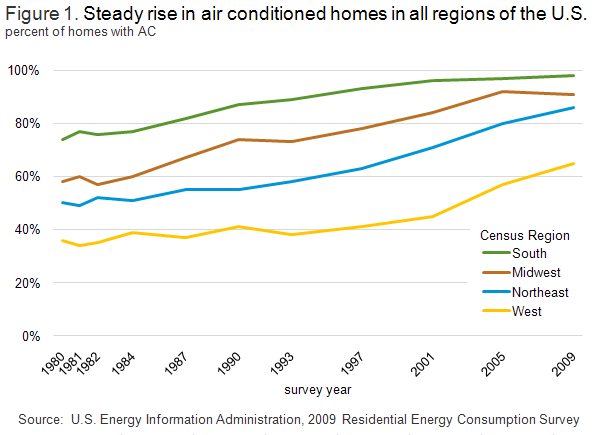
You would think that everyone wanting central A/C by 1990 would have central A/C?
You might think that. Or you might google it and find out in less time than it takes you type all that.
Spoiler Alert: You are wrong. There has been strong growth in A/C installations since 1990.
Probably because the cost of the hardware got cheaper because NAFTA and China MFN. -
Re:BS Bills Are Still The Same Amount
Here is a chart of electricity prices in America since 1960. When corrected for inflation, prices today are about the same as 50 years ago. So, no, I don't think there has been any vast conspiracy to raise prices.
I have cut my consumption by about 40% in the last ten years. Since California has tiered pricing, and all my consumption is in the bottom tier (about 10 cents/kw-hr), my electricity bill is less than half what it was in 2007.
All my lights are LED.
All TVs and monitors went from CRT to flatscreen.
New more efficient refrigerator.
New dishwasher with air drying.
Attic fan to reduce need for A/C.
Ceiling fans in all bedrooms.
Clip fans under every desk.
All outside lights triggered by motion sensors.And by far the biggest energy saver: Teenage daughter moved and and went to college.