Slashdot Mirror
Domain: eia.gov
Stories and comments across the archive that link to eia.gov.
Comments · 833
-
Re: 6 megawatts of energy
The 4000GW would supposedly be the generating capacity at any given point in time, so it doesn't have a time component. The EIA as of a few years ago put the generating needs of the country at just under 1000GW during peak summer consumption.
-
Re:Driving yes, but charging?
Currently, power consumption ramps up around 8 AM and peaks around 8 PM. An EV in every garage would invert that so the peak would occur overnight between 8 PM and 8 AM (certain industrial use which runs 24/7 keeps current overnight use around 67% that of day use). Consequently, electricity prices would go from being lowest overnight, to highest overnight. (This is also why the idea of using the battery in your EV to store up cheap overnight power for use during the day is never going to go anywhere.)
If this happens and the price difference will be too big I foresee someone making a cheap set of batteries connected to a system which monitors the electricity price and charges the battery bank when the price is at the lowest point, using that battery bank to charge the EV in return. These batteries can be cheap and heavy, since they don't need to be moved around. If you live in a moderately sunny place, hook up some solar cells and perhaps you don't even need to top off your bank from the grid at all.
If there is money in it, there will be a solution.
-
Re:Get ready
an internal combustion engine - as used in a petrol-driven vehicle - gets around 20% efficiency
Actually, the engines themselves are 30% to 40% efficient on modern gasoline-powered cars. There are some additional losses in the transmission, which is something like 95 to 98% efficient. Running outside the optimal load range also makes the engine a lot less efficient, but that's only relevant in stop-and-go traffic, and hybrid electric systems largely solve the issue. Even non-hybrid cars do a lot better in this respect than they used to, by automatically stopping and starting the engine at lights, and having more gears.
The efficiency of the complete drivetrain of a new ICE vehicle is 20% (standard) to 35% (efficient hybrid) for stop-and-go, and considerably better on the highway.
That's 6.189km per kWh, or about 162 grams of carbon dioxide of emissions - using worst case carbon generation - per km travelled.
Electric cars aren't 100% efficient, either; total up the losses in charging and discharging (86% efficient), power conversion (97%), and the motor(s) themselves (91%), and the total efficiency of the drive train is more like 76%.
An electric car? The infrastructure is already in place; there is negligible marginal cost in getting the power from the plant to the car.
That's not true. Even in the USA, grid transmission is only about 94% efficient. (It's much worse in developing countries; for India it's estimated at 70%. The huge difference is because building and maintaining reliable, efficient power transmission and distribution is not cheap, and some places are too poor to do it well.)
So best case, with a diesel S-class vehicle, you're about one third better than the Model S; worst case (5+ litre petrol engine), you're 50% worse.
We must adjust your 162 g/km estimate upward by 40% to account for the EV inefficiencies that you ignored, which gives us a revised estimate of 227 g/km - worse than all but the most over-powered of the four Mercedes models found in the document that you linked.
Another factor to consider as well is the cost of transporting the fuel: trucks have to carry that fuel (diesel, petrol, etc.) to the station, and you have to drive to the station to refuel.
You can't pretend this is a useful or fair comparison if you only consider the supply chain for the contents of the ICE car's gas tank, and ignore everything else. Mining and moving coal has a substantial environmental and economic impact as well. So does mining Lithium for batteries, or refining and doping Silicon for solar panels, etc.
There are really only two reasonable ways to estimate the true environmental impact of a product:
1) Start from nothing but labour and raw natural resources (think minerals still in the ground, not steel) and work your way up every stage of the production, supply, and maintenance chain - you can't assume trains are moving coal, until you've figured out the full impact of making and running trains from scratch.
2) Or, assume that the selling price of an item already accounts for its environmental impact (partially true).(1) is probably more accurate, but if you're going to do it you need to do it for everything, or at least apply
-
Re:Driving yes, but charging?
And the cost of electricity is about 70 to 80% less than the equivalent cost of a gasoline car per mile.
This is true right now because electricity use overnight is low, so the power companies charge lower rates. So if you're one of the few people with an EV, charging it overnight means you're paying discounted electricity prices. That's going to change if everyone gets an EV.
Current U.S. household electricity use is about 900 kWh per month. A Nissan Leaf is rated at 30 kWh/100 miles. Average vehicle miles traveled per household has been inching towards 60 miles (it dipped to 54 in 2009 - page 10). So driving those miles in EVs like the Leaf would result in about 550 kWh/mo of additional electricity consumption. Factor in charging efficiency (about 75%-80% from the numbers I've seen from Tesla and plug-in Prius owners), and it works out to closer to 700 kWh/mo. So adding an EV to the house will nearly double it's electricity use, with all of that additional consumption falling in the overnight period.
Currently, power consumption ramps up around 8 AM and peaks around 8 PM. An EV in every garage would invert that so the peak would occur overnight between 8 PM and 8 AM (certain industrial use which runs 24/7 keeps current overnight use around 67% that of day use). Consequently, electricity prices would go from being lowest overnight, to highest overnight. (This is also why the idea of using the battery in your EV to store up cheap overnight power for use during the day is never going to go anywhere.)
An EV is still cheaper to operate per mile than an ICE vehicle (because per Joule, gasoline is about 10x more expensive than coal). But instead of 70%-80% less cost per mile than an ICE, you're probably going to be in the neighborhood of 50%-60% less. -
Re:Driving yes, but charging?
And the cost of electricity is about 70 to 80% less than the equivalent cost of a gasoline car per mile.
This is true right now because electricity use overnight is low, so the power companies charge lower rates. So if you're one of the few people with an EV, charging it overnight means you're paying discounted electricity prices. That's going to change if everyone gets an EV.
Current U.S. household electricity use is about 900 kWh per month. A Nissan Leaf is rated at 30 kWh/100 miles. Average vehicle miles traveled per household has been inching towards 60 miles (it dipped to 54 in 2009 - page 10). So driving those miles in EVs like the Leaf would result in about 550 kWh/mo of additional electricity consumption. Factor in charging efficiency (about 75%-80% from the numbers I've seen from Tesla and plug-in Prius owners), and it works out to closer to 700 kWh/mo. So adding an EV to the house will nearly double it's electricity use, with all of that additional consumption falling in the overnight period.
Currently, power consumption ramps up around 8 AM and peaks around 8 PM. An EV in every garage would invert that so the peak would occur overnight between 8 PM and 8 AM (certain industrial use which runs 24/7 keeps current overnight use around 67% that of day use). Consequently, electricity prices would go from being lowest overnight, to highest overnight. (This is also why the idea of using the battery in your EV to store up cheap overnight power for use during the day is never going to go anywhere.)
An EV is still cheaper to operate per mile than an ICE vehicle (because per Joule, gasoline is about 10x more expensive than coal). But instead of 70%-80% less cost per mile than an ICE, you're probably going to be in the neighborhood of 50%-60% less. -
Re:Driving yes, but charging?
And the cost of electricity is about 70 to 80% less than the equivalent cost of a gasoline car per mile.
This is true right now because electricity use overnight is low, so the power companies charge lower rates. So if you're one of the few people with an EV, charging it overnight means you're paying discounted electricity prices. That's going to change if everyone gets an EV.
Current U.S. household electricity use is about 900 kWh per month. A Nissan Leaf is rated at 30 kWh/100 miles. Average vehicle miles traveled per household has been inching towards 60 miles (it dipped to 54 in 2009 - page 10). So driving those miles in EVs like the Leaf would result in about 550 kWh/mo of additional electricity consumption. Factor in charging efficiency (about 75%-80% from the numbers I've seen from Tesla and plug-in Prius owners), and it works out to closer to 700 kWh/mo. So adding an EV to the house will nearly double it's electricity use, with all of that additional consumption falling in the overnight period.
Currently, power consumption ramps up around 8 AM and peaks around 8 PM. An EV in every garage would invert that so the peak would occur overnight between 8 PM and 8 AM (certain industrial use which runs 24/7 keeps current overnight use around 67% that of day use). Consequently, electricity prices would go from being lowest overnight, to highest overnight. (This is also why the idea of using the battery in your EV to store up cheap overnight power for use during the day is never going to go anywhere.)
An EV is still cheaper to operate per mile than an ICE vehicle (because per Joule, gasoline is about 10x more expensive than coal). But instead of 70%-80% less cost per mile than an ICE, you're probably going to be in the neighborhood of 50%-60% less. -
Re:Get ready
And what of it?
Coal fired plants are typically around 33% efficient - meaning that one third of the energy they release as heat is converted into mechanical (and hence into electrical - that conversion is nearly 100% efficient) energy. In comparison, an internal combustion engine - as used in a petrol-driven vehicle - gets around 20% efficiency. That gives a bit of room for electric cars to potentially emit less carbon dioxide than a petrol driven vehicle, even allowing for the greater carbon efficiency of hydrocarbons compared with coal.
Here's a nice little chart, showing you the carbon dioxide emitted per kWh of electricity produced. Let's take lignite: 2.17 pounds (about 1kg) of carbon dioxide for each kWh produced.
Now. The Tesla Model S has a range of 557km (90 kWh), 480km (75 kWh) or 400km (60 kWh). Let's take the 557km option (which gives the worst case figure). That's 6.189km per kWh, or about 162 grams of carbon dioxide of emissions - using worst case carbon generation - per km travelled.
One specific model that is sometimes cited as equivalent to the Model S is the Mercedes S-class. This, based upon Mercedes' own figures, has CO2 emissions ranging from 118g to 239g carbon dioxide per km. So best case, with a diesel S-class vehicle, you're about one third better than the Model S; worst case (5+ litre petrol engine), you're 50% worse. And this is assuming that the owner of the Model S isn't paying a premium for renewable energy, and/or doesn't have solar panels on the roof, and that the electricity generation in the area is all coal-based.
But. Another factor to consider as well is the cost of transporting the fuel: trucks have to carry that fuel (diesel, petrol, etc.) to the station, and you have to drive to the station to refuel. An electric car? The infrastructure is already in place; there is negligible marginal cost in getting the power from the plant to the car. Also the energy required to refine crude oil into usable fuel is not insignificant - the equivalent of 6 kWh of electricity is lost for each gallon of gasoline refined. That effectively adds 6 kWh per km to the S-class diesel, automatically putting it in the "worse than the Model S" class!
Then, too, converting a centralised power plant from coal to something greener (gas, geothermal, nuclear) is a lot easier than converting millions of privately owned vehicles.
In other words: even allowing for greater use of coal fired plants, electric cars are still a net carbon dioxide win, thanks to greater efficiency in the energy generation and transportation process (end to end).
-
Re:a maintenance nightmare
Nope. Just google it. Here's EIA: https://www.eia.gov/electricit... - pick the lowest monthly number because you actually have to build out with it in mind.
-
Re:Hydrogen is not gold
You are just repeating the same nonsensical Musk advertising about "fool cells" for 12 year olds.
Please do reading of some studies on the subject.
Storing energy for many months works just fine and essential part of this civilization. Never heard of natural gas storage? Please read here:
http://ir.eia.gov/ngs/ngs.html
Basically the same storage can be applied to hydrogen:
http://www.h2fc-fair.com/hm13/...
It is the only scaleable way to store energy for long term that is necessary both for electric grid and seasonal thermal energy usage. Batteries are fine for short term storage, grid balancing, but suggesting that they are suitable for everything in the world like long term storage or kitchen sink replacement is plain silly. Neither hydro nor many alternative energy storage options are even close to being significant for that purpose at wide scale. And you can't use any solar/wind energy for electric grid without long term storage, it is useless for grid at wide scale with random 20%-30% availability that varies by seasons. Once you are at it, hydrogen is intermediate step in renewable energy path, whatever way you choose - using it in fuel cell cars directly, providing dispatchable electricity to grid from fuel cell plants, or mixing it with natural gas and burning together. -
Re:title seems to be misleading, at best.
I don't buy into the projected increasing amounts of coal usage. As the Chinese discovered, one pays a heavy price burning coal, (pollution of water, soil, air), and India will soon learn this lesson first hand.
Coal in the USA maybe a NOP by 2027, where coal generation peaked near 49% (2007), 33%(2015) and is still dropping like a rock 31% (April 2016).
As for the so called base-load argument, is a fool's argument, eventually we will need to use renewable's to provide more than 150% of our overall demand, using excess energy production to put Carbon back into the ground. Preferably in the form of Methane(CH4), which we can later tap to stabilize the grid when needed.
.
-
Re:Australia had the UNESCO report censored.
Interesting to hear your perspective. Do you have any references that show more general examples? I'm going on the various LCoE studies that all show onshore wind to be already competitive with coal and gas, even without any carbon price, which would appear to contradict your experiences. These tables show that while wind maintenance is indeed more than coal or gas, this is more than offset by the savings on fuel and other variable costs.
Solar PV is not far behind, and is already considerably cheaper than solar thermal (and getting cheaper still -"Capital costs have fallen 60% in the past four years and could drop a further 40% reports Deutsche Bank"). Small-scale solar PV is of course less efficient, but still provides attractive payback times to consumers and free power for many years to come - while coal LCoEs are only projected to increase, especially if carbon costs are considered (as they need to be).
-
Is this even possible?
It is increasingly plausible to foresee a future in which cheap renewable electricity becomes the world's primary power source and fossil fuels are relegated to a minority status.
Hmm...This article just begs the question: Does the US have a power grid that can provide enough sustainable power to meet that demand? Doing some Googling & some math gets us...
A) 2.5 trillion miles driven annually in the US
B) "Electricity becomes the world's primary power source", so we'll call that a majority of miles driven, or 50%, or 1.25 trillion miles
C) If everyone drove the Tesla Model S, they would get 240 miles on a 70kWh battery, or about 3.43 miles / kWh.
D) In order to drive 1.25 trillion miles, we need to have available 1.25 trillion miles / 3.43 miles/kWh = 364.4 billion kWh.
E) The US generates 4 trillion kWh of electricity per year.
F) The US consumes 3.8 trillion kWh of electricity per year. (Worksheet 7.6.)
So, it looks like we have about 200 billion kWh to spare, which is, I'm sorry to say, not enough.
So, how does anyone expect to achieve such a lofty goal if we don't have the infrastructure in place to make it happen? (And if anyone else in the world knows that their nation has the capacity to make it happen within their country, I'd love to know.)
-
Is this even possible?
It is increasingly plausible to foresee a future in which cheap renewable electricity becomes the world's primary power source and fossil fuels are relegated to a minority status.
Hmm...This article just begs the question: Does the US have a power grid that can provide enough sustainable power to meet that demand? Doing some Googling & some math gets us...
A) 2.5 trillion miles driven annually in the US
B) "Electricity becomes the world's primary power source", so we'll call that a majority of miles driven, or 50%, or 1.25 trillion miles
C) If everyone drove the Tesla Model S, they would get 240 miles on a 70kWh battery, or about 3.43 miles / kWh.
D) In order to drive 1.25 trillion miles, we need to have available 1.25 trillion miles / 3.43 miles/kWh = 364.4 billion kWh.
E) The US generates 4 trillion kWh of electricity per year.
F) The US consumes 3.8 trillion kWh of electricity per year. (Worksheet 7.6.)
So, it looks like we have about 200 billion kWh to spare, which is, I'm sorry to say, not enough.
So, how does anyone expect to achieve such a lofty goal if we don't have the infrastructure in place to make it happen? (And if anyone else in the world knows that their nation has the capacity to make it happen within their country, I'd love to know.)
-
Re:of course it will burn.... IF
Carbon dioxide emissions from electricity generation in 2015 were lowest since 1993 and Projected growth in CO2 emissions driven by countries outside the OECD so at best your preaching to the choir.
-
Re:of course it will burn.... IF
Carbon dioxide emissions from electricity generation in 2015 were lowest since 1993 and Projected growth in CO2 emissions driven by countries outside the OECD so at best your preaching to the choir.
-
Re:This was published in Nature?
Why would that be realistic? The data says we are pretty much flat at this point, as one would expect. As a country modernizes it tends to stabilize its population growth and becomes more efficient in operations - both of which would flatten (or, in the case of oil, actually decrease) use of fuels. In another 2 generations I expect the same flattening will occur in China and India as well, in which case we'll have 75% of the world's population with a flat fossil fuel consumption rate.
-
Re:wireless power- scamming rich guys since 1891
Solar is "practical" in Hawaii because the electrical grid there is powered by burning oil, which is shipped in from the mainland. Consequently Hawaii's electricity price is roughly 3x the national average. It's even higher if you're not on Oahu. So it's not really that solar is practical, it's that the other choices which work in most of the rest of the world are impractical due to geography.
-
Re:Renewable energy can work.I think that those numbers must include industrial users.
For example, another page breaks down "retail" prices by US state, but the price for California electricity is too low to be an average price for residential users. The price quoted for California is close to the "Tier 1" rate charged by PG&E (who serve much of the state), but a large proportion of the population pay for electricity at "Tier 2" to "Tier 4" rates. These rates are much higher.
-
So, if subsidization of renewable energy,
when combined with constraints on non-renewable energy, were to be as projected in the study (i.e., per present policies), by 2040 fossil fuel and nuclear might constitute only about
(wait for it)...
83% of the world energy usage.That is, by 2040, renewables might then manage to constitute a whopping 16-17% of world energy usage, skyrocking up from some 13% in 2016, under their assumptions.
The authors of the study do not even attempt to estimate the likelihood of those assumptions, which is prudent considering how costly the renewable energy subsidies and fossil fuel limitation policies are.
The following is a link to the study that the ComputerWorld article is attempting to summarize:
http://www.eia.gov/forecasts/i... -
Re:Fortunately, Obama has orderd four new hydrodam
Net hydro capacity slated to increase by 300MW in the next year.
http://www.eia.gov/electricity...
+6.8GW of new wind, and 8.9GW of new solar
vs. 3.9GW net addition of fossils, and 1.1GW of nuclear.
Captcha: torment
-
Re:Thats really cheap
First US usage of power is about 4 times higher per household than Germany, possibly due to Germans mostly not having or using AC in the warmer months. This makes summer the power usage low in Germany. In the US the summer months are the usage high.
http://shrinkthatfootprint.com...
https://www.eia.gov/electricit...The government (ie taxpayers) subsidize the tune of 20 billion Euros per year and rising (hiding the actual cost)
http://www.bloomberg.com/view/...
http://www.greentechmedia.com/...
http://www.seia.org/research-r...German prices per kwh are higher (~.34 per kwh) vs US (~.15) mostly due to tax/tariff on energy, and regulatory procedures related to the infrastructure payments of solar and other renewables. The prices are rising so fast the government has had to begin a more restrictive path on new solar.
https://www.eia.gov/electricit...
https://www.cleanenergywire.or...Based solely on price per kwh and predictable capacity, solar is awful. More specifically awful for germany, because of geography and weather trends.
http://www.forbes.com/sites/qu...This unpredictability is causing massive new production plants using coal. This is a reult of shutting down nuclear and building solar which only generates an average of >10% of potential capacity. Altogether the solar plan's end result is not bringing them closer to meeting their climate pollution goals.
https://carboncounter.wordpres..."when the wind suddenly stops blowing, and in particular during the cold season, supply becomes scarce. That's when heavy oil and coal power plants have to be fired up to close the gap, which is why Germany's energy producers in 2012 actually released more climate-damaging carbon dioxide into the atmosphere than in 2011. If there is still an electricity shortfall, energy-hungry plants like the ArcelorMittal steel mill in Hamburg are sometimes asked to shut down production to protect the grid. Of course, ordinary electricity customers are then expected to pay for the compensation these businesses are entitled to for lost profits."
-
Re:Thats really cheap
First US usage of power is about 4 times higher per household than Germany, possibly due to Germans mostly not having or using AC in the warmer months. This makes summer the power usage low in Germany. In the US the summer months are the usage high.
http://shrinkthatfootprint.com...
https://www.eia.gov/electricit...The government (ie taxpayers) subsidize the tune of 20 billion Euros per year and rising (hiding the actual cost)
http://www.bloomberg.com/view/...
http://www.greentechmedia.com/...
http://www.seia.org/research-r...German prices per kwh are higher (~.34 per kwh) vs US (~.15) mostly due to tax/tariff on energy, and regulatory procedures related to the infrastructure payments of solar and other renewables. The prices are rising so fast the government has had to begin a more restrictive path on new solar.
https://www.eia.gov/electricit...
https://www.cleanenergywire.or...Based solely on price per kwh and predictable capacity, solar is awful. More specifically awful for germany, because of geography and weather trends.
http://www.forbes.com/sites/qu...This unpredictability is causing massive new production plants using coal. This is a reult of shutting down nuclear and building solar which only generates an average of >10% of potential capacity. Altogether the solar plan's end result is not bringing them closer to meeting their climate pollution goals.
https://carboncounter.wordpres..."when the wind suddenly stops blowing, and in particular during the cold season, supply becomes scarce. That's when heavy oil and coal power plants have to be fired up to close the gap, which is why Germany's energy producers in 2012 actually released more climate-damaging carbon dioxide into the atmosphere than in 2011. If there is still an electricity shortfall, energy-hungry plants like the ArcelorMittal steel mill in Hamburg are sometimes asked to shut down production to protect the grid. Of course, ordinary electricity customers are then expected to pay for the compensation these businesses are entitled to for lost profits."
-
Re:During a mild Sunday, I'd hope so.
The answer is that the cost of industrial electricity goes so high that industrial users shut down. Residential users are so used to fixed rates that we are mentally divorced from energy market realities. Industrial users actually have a *lower* average cost than residential due to their ability to moderate usage. The fixed-retail price that we pay comes with a huge cost in the from of higher average prices. https://www.eia.gov/electricit...
-
Re:daily mail reporting
The simplest science tells us the entire premise of this article is a bunch of baloney. A gallon of gasoline produces about 20 pounds of CO2 emissions -- http://www.eia.gov/tools/faqs/... This comes simply from burning the carbon in the fuel with oxygen in the air. One carbon atom plus two oxygen atoms, simple chemistry.
Being too lazy to find a non pay walled copy of the paper abstract makes it brutally clear this isn't in any way shape or form about CO2 pollution. This is about particulate pollution. https://en.wikipedia.org/wiki/...
This is a nonsense paper appealing to poor, uneducated people without the analytical context -- or, more fairly to intelligent people without higher education credentials, just the simple, plain common sense -- necessary to recognize a propaganda job of absurd proportions. There is no science or fact behind this article.
Have you even read it?
There is no science or fact behind this article. It is a pack of lies designed to anger people as much as necessary to hold their attention long enough to make a few more cents showing them advertising. The Dailymail is beyond shameful -- to the extent it tries to pass off this drivel as truth, it is an affront to human decency itself.
Most media tries to pass off drivel as truth.
It's absolute nonsense.
Your post shoots the messenger, appeals to intellect, relies straw man arguments about CO2 pollution and invalid analogies stemming from initial failure to understand nature (PM != CO2) of the topic.
This paper may in fact be absolute nonsense yet you have failed to deliver evidence commensurate with your claim.
-
Re:SAVE THE BAGS
The US EIA doesn't break down the costs to sufficient detail. The Association for Convenience and Fuel Retailing claims that the markup on a gallon of gas is approximately 2 to 3 cents per gallon averaged over a five year period across all retail outlets. Even so, that 2-3 percent markup is not profit. The retailer still has to cover utilities, staff, rent, etc.
It's unusual for gas prices to consistently vary by 40 cents between two stations in close proximity. Most stations will vary by less than 10 cents. The most significant cost variation is driven by variations in rent. Higher traffic=higher rent. The next most significant factor is the retailer's strategy. Some stations will accept a lower margin in the hope they will make money on other products and services. A station with a lower price can sell more lottery tickets, cigarettes, and beer. Those stations make less per gallon but more total sales may add up to the same return on gas.
http://www.eia.gov/energyexpla... http://www.nacsonline.com/your...
-
Re:daily mail reporting
It's absolute nonsense. About Dailymail.co.uk, according to Wikipedia: "The Daily Mail is a British daily conservative, middle-market[2][3] tabloid newspaper owned by the Daily Mail and General Trust." The simplest science tells us the entire premise of this article is a bunch of baloney. A gallon of gasoline produces about 20 pounds of CO2 emissions -- http://www.eia.gov/tools/faqs/... This comes simply from burning the carbon in the fuel with oxygen in the air. One carbon atom plus two oxygen atoms, simple chemistry. The amount of "emissions" from driving 20 to 40 miles (the typical range a gallon of fuel will get you) can be measured directly -- it's how much weight the tire loses. A fraction of a gram, perhaps? And the brakes? Some number of tens of milligrams of brake dust? Similarly the "emissions" from the road idea is pure nonsense. If the roads "lost" a few hundred pounds of material every time an electric car used up a charge, we'd have heard about it. Since it is weight-based, we could safely assume an 18-wheeler would vaporize a couple of TONS of asphalt every few hundred miles. This is a nonsense paper appealing to poor, uneducated people without the analytical context -- or, more fairly to intelligent people without higher education credentials, just the simple, plain common sense -- necessary to recognize a propaganda job of absurd proportions. There is no science or fact behind this article. It is a pack of lies designed to anger people as much as necessary to hold their attention long enough to make a few more cents showing them advertising. The Dailymail is beyond shameful -- to the extent it tries to pass off this drivel as truth, it is an affront to human decency itself.
-
Re:If you know Elon Musk, please pass this along
You are conveniently ignoring fracking fossil product that is the reason coal is pushed out in the US. Coal creates around 40% world electricity production, and natural gas (another fossil fuel) around 20%. Nuclear doesn't qualify as "clean" either even if it doesn't emit much carbon dioxide after construction phase. Total coal burning is going to increase for foreseeable future, even if its share may drop a bit *. And Musk is not going to stop selling his electron guzzlers in China even if it is truly powered by coal.
-
Re:If you know Elon Musk, please pass this along
I don't even want to go into the fact that his cars are, for the most part, coal powered.
That's wise of you because your claim is false. Coal powers only 33% of the national grid.
-
Re:What about
I agree with Musk that we need to move away from fossil fuels, but gasoline vehicles have a net tax, not a subsidy. Going through the first page of Google hits, the biggest figure for oil industry subsidies in the U.S. I can find is $37.5 billion/yr. (Note that the dollar amount of a tax exemption or a deduction is not equal to the subsidy dollar amount.)
The U.S. uses about 140 billion gallons of gasoline each year. So even if you assumed the entirety of that subsidy were on gasoline (less than half of a barrel of oil becomes gasoline), that works out to a subsidy of just 26.8 cents per gallon.
The average fuel tax on gasoline in the U.S. is 48.7 cents/gallon. So gasoline has a net tax on it - it is taxed more than the subsidy it receives.
The difference is even starker in other OECD countries, where gasoline is taxed to the tune of several dollars a gallon. We are addicted to gasoline and fossil fuels because the easy access to energy acts as a multiplier for our productivity, allowing us to increase our standard of living relatively cheaply (in terms of financial cost). Even with the net tax, we are still addicted to it. So even if all the complaining about oil subsidies works and they're completely rescinded, it won't make a dent in our oil consumption. The price of gasoline has fluctuated more this year due to market forces, than the above calculated subsidy amount. -
Re:What about
I agree with Musk that we need to move away from fossil fuels, but gasoline vehicles have a net tax, not a subsidy. Going through the first page of Google hits, the biggest figure for oil industry subsidies in the U.S. I can find is $37.5 billion/yr. (Note that the dollar amount of a tax exemption or a deduction is not equal to the subsidy dollar amount.)
The U.S. uses about 140 billion gallons of gasoline each year. So even if you assumed the entirety of that subsidy were on gasoline (less than half of a barrel of oil becomes gasoline), that works out to a subsidy of just 26.8 cents per gallon.
The average fuel tax on gasoline in the U.S. is 48.7 cents/gallon. So gasoline has a net tax on it - it is taxed more than the subsidy it receives.
The difference is even starker in other OECD countries, where gasoline is taxed to the tune of several dollars a gallon. We are addicted to gasoline and fossil fuels because the easy access to energy acts as a multiplier for our productivity, allowing us to increase our standard of living relatively cheaply (in terms of financial cost). Even with the net tax, we are still addicted to it. So even if all the complaining about oil subsidies works and they're completely rescinded, it won't make a dent in our oil consumption. The price of gasoline has fluctuated more this year due to market forces, than the above calculated subsidy amount. -
Re:Yeah, Everyone Under Thirty
This is very true. The problem is that the system is very fragile and neither the corporations or the people are thinking about this. Everyone wants everything fixed now, but they aren't looking at the big picture/real problem. As an example. People want to stop climate change. Most peoples' answer to this is to stop using fossil fuels, and convert everything to electric. Although this is a good answer in theory the problem is where do people think that Electricity comes from for the most part? Electricity isn't some magical power-source with no detrimental effects on the climate. Most electricity is still generated the old fashioned way...by burning coal...which for those of you who don't know is a fossil fuel. Sure there are wind turbines, and dams that produce electricity but those amount to a minuscule amount of power generation compared to the number of fossil fuel based electrical generation plants. 66% of our nations electricity comes from fossil fuels: https://www.eia.gov/tools/faqs... So, even if we were to convert all our cars, and homes to pure electric we would still be using fossil fuels. Not to mention that we don't have enough land or water resources to convert to whole nation to Nuclear and Hydro power. You can only use so much Nuclear power because of it's half-life, the dangers associated with it, and the disposal of waste water. Look at what happened in Japan and at Chernobyl. Nuclear is too risky, and there aren't enough waterways to dam to convert the whole country to Hydro. There really is no viable solution with today's technology. We have to innovate to find a solution, and those of us that think enough to find a solution are mostly too underpaid, or too old to care at this point. Oh, and don't think that the selfish Millennials are ever going to do anything. They are too busy wining about not getting enough free stuff, and not getting paid $15/hr at their dead end job that they will never get out of because they have no initiative. I'm glad I'll be dead long before any of this mess comes to fruition...LOL! Suck to be you millennials!
-
Re:pretty poor science
I get where you are coming from and it SOUNDS good. But the burden of proof for all of these tax benefits for oil companies is on the people making the claim on these trillions. The IMF link you cite certainly gives data for huge subsidies, but they count global warming, air pollution, and other externalities as "subsidies." And not only do they count it, but based on the graphs, it's the lion's share of their trillions estimates.
Most of this arises from countries setting energy taxes below levels that fully reflect the environmental damage associated with energy consumption.
Based on that logic doctors get tax subsidies for making medical mistakes that kill people if they don't get sued for it. You can't realistically count estimates of global or local damages as a tax subsidy or the words tax and subsidy have no meaning anymore. Going into the actual data for the USA from the IMF citation provided, the actual pre-tax subsidies totals $10.94 billion. The remainder is global warming (185 billion), air pollution (180 billion), congestion (120 billion), accidents (48 billion), road damage (8 billion) and forgone consumption tax revenue (52 billion). So yes, they are actually counting road accidents as a subsidy and even worse, ROAD DAMAGE which fuel tax pay for maintenance of whereas ELECTRIC CARS DO NOT. If anything road damage "subsidies" should be negative as carbon fuel taxes pay for road maintenance.
So back to the $11 billion of direct tax subsidies. In 2015 according to the EIA https://www.eia.gov/tools/faqs... the USA consumed 7.08 billion barrels of petroleum products. Ignoring the fact that a barrel of oil yields more than a barrel of products and ignoring all other fossil fuel energy sources (natural gas and coal primarily), that amounts to a tax subsidy of 3.7c per gallon of fuel (42 gallons per barrel). Are we really claiming that the huge tax subsidies oil companies get is that extreme vs the federal fuel taxes of 18.4c per gallon of gasoline or 24.4 for diesel?
-
power plants
Note that these prices are for solar power plants, not for household solar. Here's a comparison with prices for some other types of electricity generation.
Still solar plants have been popping up all over, and this will only encourage more of them, which is a good thing because coal pollution sucks. -
Re: Cost?
Exactly my point. Hence kWh is useless for what you seek.
Tell all of these organizations that their approach is useless;
https://www.eia.gov/forecasts/...
http://energyinnovation.org/20...
http://www.renewable-energysou...
http://about.bnef.com/press-re...
https://www.google.com/url?sa=...
Or maybe you know more than them. Methinks you just want to avoid proper comparisons.
If you want to compare the cost of energy, use MWh. A MW is not energy. A MWh is energy. And finally, a nice easy to read statement from wikipedia;
In electrical power generation, the distinct ways of generating electricity incur significantly different costs. Calculations of these costs at the point of connection to a load or to the electricity grid can be made. The cost is typically given per kilowatt-hour or megawatt-hour. It includes the initial capital, discount rate, as well as the costs of continuous operation, fuel, and maintenance. This type of calculation assists policy makers, researchers and others to guide discussions and decision making.
The levelized cost of electricity (LCOE) is a measure of a power source which attempts to compare different methods of electricity generation on a comparable basis. It is an economic assessment of the average total cost to build and operate a power-generating asset over its lifetime divided by the total energy output of the asset over that lifetime. The LCOE can also be regarded as the minimum cost at which electricity must be sold in order to break-even over the lifetime of the project.
If you want to refute, provide a source instead of meandering rationalizations. -
Re:Finances actually make sense
Yes, for this plant, there will be many refurbishments along the way, however the highest cost components such as the RPV will not be replaced. That cost is included in the lifetime O&M cost profile, so be careful not to double dip and add it again on the side. It is certainly an important factor to consider, and is included the levelized energy cost evaluations.
Historically, your doubts are proven wrong as refurbishment of existing nuclear has payed off greatly.
https://www.eia.gov/forecasts/... -
Re: Cost?
Yes, plants are listed at full capacity ratings in MW, but that does not tell us the cost of energy, so that is not used to compare the cost of energy. You CAN compare capacity, but that is of little use, on its own, when comparing different energy sources because of the exact variables you stated. And while plants are and will always have KW capacity ratings, the measure for comparing energy cost is, has been, and will always be $/MWh.
Which is why any credible reference for energy cost uses $/MWh.
http://www.nrel.gov/analysis/t...
https://www.eia.gov/forecasts/...
https://en.wikipedia.org/wiki/...
http://www.renewable-energy-ad...
I could provide many more examples. Maybe you should write to all these and tell them they don't know what they are doing. Note that some of these references are renewables organizations. Now, please provide one credible reference that uses $/MW to compare energy cost. (Not some article written by some ignorant yahoo). But instead, I expect you will just blabber on about how using $/MWh is some sort of anti-renewable conspiracy. -
Re: Cost?
You make no sense, I don't think you realize what you just said. I am just stating facts, not coordinating anything. There is a reason why credible comparisons of energy cost are done per MWh . If you are not comparing levelized cost per MWh, you are not comparing the cost of energy produced.
KW is a rate of energy production, like Mile per Hour (MPH) is a rate of distance travel. If you want to know how many miles you traveled, you need MPH times hours, and if you want to know how much energy you produce, you need to know KW times hours, of KWh. Its simple math.
Again, KW does not represent an amount of energy, KWH does. Its easy to look up how this works.
http://www.eia.gov/tools/faqs/...
https://www.eia.gov/forecasts/... -
Re: Cost?
You make no sense, I don't think you realize what you just said. I am just stating facts, not coordinating anything. There is a reason why credible comparisons of energy cost are done per MWh . If you are not comparing levelized cost per MWh, you are not comparing the cost of energy produced.
KW is a rate of energy production, like Mile per Hour (MPH) is a rate of distance travel. If you want to know how many miles you traveled, you need MPH times hours, and if you want to know how much energy you produce, you need to know KW times hours, of KWh. Its simple math.
Again, KW does not represent an amount of energy, KWH does. Its easy to look up how this works.
http://www.eia.gov/tools/faqs/...
https://www.eia.gov/forecasts/... -
Re:No, not happening
Right now, over half of each barrel of oil goes for about 6,000 non-fuel products:
Incorrect. Half of it goes to something other than road gasoline and that half contains a lot of other fuels.
Once you account for aviation gasoline, diesel, jet fuel, propane, heating oil, etc. you end up about 7% of it going to non-fuel uses.
-
Re:Coal provides 33% of the US electricity generat
[coal] is still the dominant energy source in the US
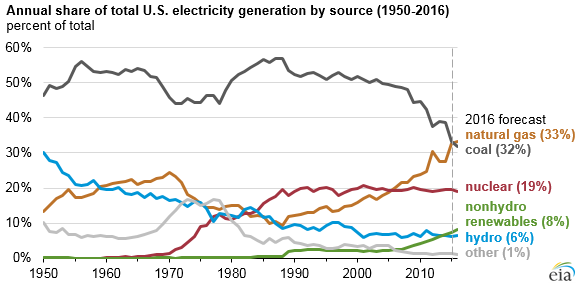
Natural gas surpasses coal for electricity generation, July 2015
Now just for a month, but coal has been declining in it's percentage.
in 2010 coal was 50%. Dropping to 30% in just 5 years? that's not a 'dominant' player, that's a dead albatross on it's way down. -
Coal provides 33% of the US electricity generation
As of 2015, 33% of the United States' electricity was produced from coal.
Coal might not be used as much as it once was, but it's still among the dominant energy sources in the US and many other nations.
In many regions we didn't really see a shift away from coal. Instead of the coal being directly used on-premise to heat buildings, it was centralized at large coal burning plants. The plants would then provide the coal-derived energy to power the electrical heating of these buildings.
This is what we're seeing with electrically powered vehicles, too. The end user only thinks they're using electricity, often not realizing that this energy came from burning coal. They think they're being "green" when they're indirectly powering their vehicles using coal!
-
Re:Yes, but will it be chap 11?
Obligatory xkcd.
If you look at the EIA data, you'll see the coal generation percentages by year (if you manually compute them from the data).
2010: 45%
2011: 42%
2012: 37%
2013: 39%
2014: 38%
2015: 32%That 6% drop from 2014 to 2015 was due mostly to many units closing due to the MATS EPA requirements (the Supreme Court ended up issuing a stay on that regulation, but only after generators had spent the money to upgrade the units they decided to keep open, and after many of the units were retired). There are some significant MATS-related retirements in 2016, but I would expect the retirements to drop off dramatically after that since the remaining units will have made those significant capital investments to meet the MATS requirements.
If the Clean Power Plan survives and natural gas prices stay low that will likely lead to significant retirements by the early 2020's.
-
Re:Cheap natural gas and expensive regulations...
https://www.eia.gov/forecasts/...
Levelized cost, which includes the cost of building, operating, maintaining and decommissioning the facility.
This may not bear any sensible correlation to the price your utility charges you, depending on how dickish they feel that can get away with being.
=Smidge= -
progress
While switching to natural gas isn't a sustainable option, it is forward progress because coal makes the worst pollution. Coal had it's day and natural gas is currently the top dog but renewable energy sources have drastically increased lately and will eventually take the cake. Just take a look at this graph.
-
Re:Coal Powered Cars Are Awesome. /s
Electric Vehicles are just playing a sly shell game with gas & particulate emission, shuffling it across town to the coal fired electric plant
No, actually that is incorrect. As of 2015, 31% of all electrical power generated in the USA was generated by zero emission sources (nuclear, hydro, wind, solar, and geothermal). Another 33% was from natural gas, which generates very little particulate emissions, substantially reduced CO2, and reduced NOX. Only 34% was from coal and petroleum.
Petroleum's share is actually down to a minuscule 1%, and coal is shrinking all the time.
So gas and particulate emissions are greatly cut for every car converted from gasoline or diesel to battery-electric.
-
Re:Combustion Engines Are Inefficient
No it is not. Most of the stuff involved is 99% efficient, so I simply averaged it to 90%.
Sources? Here are mine:
1) In the USA, transmission and distribution losses are estimated at 6% by the EIA. However, India (the subject of the original post) has really bad infrastructure, in comparison. Their losses are estimated at about 30% by the World Energy Council. So, I was actually way too generous when I said "90% efficient" for this part.
2) The Tesla Roadster is said to have a battery pack charge/discharge efficiency of 86% in an article from Stanford University, which claims to be drawing from a source published by Tesla itself.
3) The National Electrical Manufacturers Association requires a minimum efficiency of about 92% for some large induction motors. However, I found an answer on the Electrical Engineering Stack Exchange site indicating that Tesla uses a slightly less efficient type of motor, and also that a ~97% efficient power controller is required, which brings the real efficiency down to ~88%.
Using the exact numbers I sourced, above: 88% of 86% of 70% of 42% = 22%, which is even worse for a coal-powered electric car than what I originally posted (because I was intentionally rounding up a bit to allow for future improvements).
That link about the Prius Engine is nice! However keep in mind: that would require all new cars to use engines like this. Which they hopefully do in not to distant future.
The extremely aggressive CAFE standards recently set by the Obama administration are already pushing things hard in that direction in the USA. Admittedly, India probably won't be buying many ICE cars produced for the US market in the next decade - but then, they won't be buying fancy electrics like a Tesla, either.
-
Reserves [Re:buy oil]
With no new exploration, oil production would eventually decline... but not "within 2-3 years, 5 years tops". It currently takes typically ten years to go from discovery to production! Oil exploration now won't have any effect whatsoever for ten years (although if the incentive were high, it could be shorter).
In any case, proved reserves (the oil that we already know is there, no exploration needed) are currently estimated at 1656 billion barrels, while world usage is 96 billion barrels per year. So with no new oil fields developed at all, it would take 17 years for production to stop.data:
Reserves: https://www.eia.gov/cfapps/ipd...
world consumption: https://www.iea.org/aboutus/fa... -
Re:That's nice
One reference claims China consumed 5130 billion kilowatt hours in 2014. Which is a really stupid way of saying terawatt hours. Divided by time, that is roughly 585 gigawatts continuous energy drain in 2014.
So, 20/585 (assuming no increase in demand, ever) comes out to slightly over 3%.
-
Re:What is it per person?
39% is close enough to 40% for most people.
In 2014, the last year we have numbers for, it was 39%
https://www.eia.gov/tools/faqs...
It is worth noting that coal has been dropping due to the challenge of building new plants and the low wholesale price of power. There isn't much margin in coal power right now, making it hard to keep up with all the government mandates on coal plants.
It is worth noting that much of the drop in coal has been made up for by natural gas.
https://en.wikipedia.org/wiki/...
According to the US Energy Information Administration, in 1980 the world had enough proved gas reserves to last 48 years at the 1980 rate of production. Cumulative world gas production from 1980 through 2011 was greater than the proved gas reserves in 1980. In 2011, world proved gas reserves were enough to last 58 years at 2011 production levels, even though the 2011 production rate was more than double the 1980 rate.
So in 1980, we had 48 years of gas left, at 1980 production levels. At that rate, we ran dry in 2028, just 12 years from now.
In 2011, we now have 58 years of gas at 2011 production levels, which are more than DOUBLE the rate of 1980, putting the "end" at 2069.
So for all the doom and gloom of "peak oil" and "peak gas", we added 41 years to the "end" date while doubling production. And it just keeps going up. Now it won't continue forever of course, it has to stop at some time (there is some specific total amount of gas in the ground after all), but it won't be by 2050, and frankly I'll be shocked if it is by 2100.
Current estimates (~November 2015) has coal around 33.6% of US electricity generation (and dropping quickly).
Lets assume that is true. So what replaced the missing 6% of power? It wasn't wind and solar. They went up slightly, maybe half a percent each. So lets say 1% of the missing 6% is wind/solar. Where did the other 5% come from? Natural gas.
Better than coal, but not really a solution if AGW is your concern.
---
Anyway, all of that is beside the point. I pointed out that oil was such a low total number to make the point that we aren't fighting wars overseas to protect oil because we need it to power our homes (it is actually far less than 5%, as noted in the link I provided). It is to power our cars.
-
Re:What is it per person?
So my question for wind is - why is a tower and some blades and some brakes and what should be a trivially simple control system so expensive compared to a combustion machine?
It isn't, for one of them.
Have you done the math for how much power an average coal plant puts out, how much land it uses, vs. the same amount of power from wind, and how much land it uses and how many you need?
In Texas for example, an average coal plant might put out 1,500 MW of power. Compare that to an average wind farm that may put out 500 MW of power. To make that power requires about 300 wind turbines.
https://upload.wikimedia.org/w...
^ Example of such a turbine.
Now find land for 300 of those, wire them up, install and maintain them, and there you go.
The actual cost of fuel for a coal plant is not really that big of a deal. It isn't free, but it isn't massive either.
https://www.eia.gov/tools/faqs...
It takes about 1 pound of coal to make 1 KWh.
http://www.eia.gov/Energyexpla...
Coal costs about $45 per ton delivered to a power plant, or about 2.25 cents per pound, or about 2.2 cents per KWh for the fuel.
Once you have built the plant, selling the power for 3.5 cents per KWh wholesale can work, if you control your costs. It doesn't make building new coal plants very exciting for investors, which is why new coal isn't being built much, but existing coal, with existing plants, makes a lot of economic sense.