Slashdot Mirror
Domain: epa.gov
Stories and comments across the archive that link to epa.gov.
Comments · 1,291
-
Re:Cutting who? The massively inflated?
From 1972 to today, the EPA has grown by 115%.
Gosh, you mean that Nixon's initial EPA budget isn't enough to pay for all this country's environmental protection needs almost 40 years later?
Funding for the EPA is up 51% during just the Obama administration.
From the EPA:
(Funding and Employees)
FY 2016 $8,139,887,000 15,376 FY 2015 $8,139,887,000 14,725 FY 2014 $8,200,000,000 15,408 FY 2013 $7,901,104,000 15,913
FY 2012 $8,449,385,000 17,106 FY 2011 $8,682,117,000 17,359 FY 2010 $10,297,864,000 17,278 FY 2009 $7,643,674,000 17,049
FY 2008 $7,472,324,000 16,916 FY 2007 $7,725,130,000 17,072 FY 2006 $7,617,416,000 17,355 FY 2005 $8,023,483,000 17,495
FY 2004 $8,365,420,000 17,611 FY 2003 $8,078,703,000 17,741 FY 2002 $8,078,813,000 17,590 FY 2001 $7,832,211,000 17,558
FY 2000 $7,562,811,000 17,726 FY 1999 $7,590,352,000 18,110 FY 1998 $7,363,046,000 17,739 FY 1997 $6,799,393,000 17,152
FY 1996 $6,522,953,000 17,082 FY 1995 $7,240,887,000 17,508 FY 1994 $6,658,927,000 17,106 FY 1993 $6,892,424,000 17,280
FY 1992 $6,668,853,000 17,010 FY 1991 $6,094,287,000 16,415 FY 1990 $5,461,808,000 16,318 FY 1989 $5,155,125,000 14,370
FY 1988 $5,027,442,000 14,442 FY 1987 $5,364,092,000 13,442 FY 1986 $3,663,841,000 12,892 FY 1985 $4,353,655,000 12,410
FY 1984 $4,067,000,000 11,420 FY 1983 $3,688,688,000 10,832 FY 1982 $3,676,013,000 11,402 FY 1981 $3,030,669,000 12,667
FY 1980 $4,669,415,000 13,078 FY 1979 $5,402,561,000 12,160 FY 1978 $5,498,635,000 11,986 FY 1977 $2,763,745,000 11,315
FY 1976 $771,695,000 9,481 FY 1975 $698,835,000 10,438 FY 1974 $518,348,000 9,743 FY 1973 $2,377,226,000 9,077
FY 1972 $2,447,565,000 8,358 FY 1971 $1,288,784,000 5,744 FY 1970 $1,003,984,000 4,084Gosh, with all that money, why haven't they fixed the environment completely? Shouldn't we all be living in some sort of weather-controlled paradise?
Where are our flying cars?
But no, your claim doesn't add up. Sorry. Even the largest year increase was only temporary, and that was the ARRA which was short-lived.
The total number of employees "reduced" over the last 40 years is almost all in military service personal cuts.
Gosh, I wonder why the Military got cut. Whatcould have been behind that. What indeed. (Oh and side note, Trump has called for more cuts in that area, hasn't he? Huh.)
Every other agency has grown, as have their budgets.
Yeah, terrible thing, population has grown, inflation, more tasks, it's like we're expecting them to not shrink, and do more with less. What a terrible world it is, isn't it?
The EPA, as an easy target, has projects and funding for things like "clean energy" redundant with at least a dozen other agencies. That is just one area of dozens of redundant projects and redundant bureaucrats handing out tax payer money to pet projects.
Oh, but Trump is cutting those clean energy programs, in fact, he appointed a guy who declared he was going to cut the Department of Energy to run the Department of Energy. Brilliant.
Citation and first interesting quote. "From 1972 until 2011, the number of EPA employees increased by 107 percent while the n
-
Reduce, Reuse, Recycle [but not Repair]
The US Government (the UK's too) says "Reduce, Reuse, Recycle" to save the planet.
Conspicuous by its absence is "Repair", despite the fact that it would have made a nice 4th "R". A lot of the problem is that politicians are the sort of people (PPE graduates mostly) who have never repaired anything in their lives and regard repairing as doing something dodgy and disreputable
-
Re:first
Too much gets said about how great electrically powered vehicles are, but they're only zero emission at point o suse. Not enough gets said about where the electricity to charge those batteries comes from - unless it's wind/solar/wave, then it's actually quite a lot of emissions in the overall system.
Why do you believe that? It seems every Slashdot article about electric vehicles has someone making this point. However, converting all of the world's power grids to renewable energy only solves 30% of the problem. By converting transportation to electricity and converting the power grids to renewable energy eliminates the majority of carbon emissions. We should do both.
You appear to be completely dismissing the value of electric vehicles because our electric grid doesn't have enough renewable energy. However, we have the resources to tackle both of these issues at once, and it seems to me we are succeeding.
Slashdot is not ignoring renewable energy, but electric transportation is important too. -
Hello, China!
When the PCBs ceased production, the 750,000 transformers containing PCBs were subsequently discarded as useless in the years 1980 to 1990.
Currently, most of them are being dumped and sealed in caves or in cellars. However, due to the long term storage, the rotting process and other damages, PCBs leakages occurred. The soil surrounding the dumping site has been found to have a higher content of PCBs.
Although, we can't blame it all on lax Chinese cleanup processes. We can probably blame the rest on maritime decomissioning.
-
Re:What are the known risks
From the EPA: (site includes links to some presumably relevant publications)
These chemicals are persistent, and resist degradation in the environment. They also bioaccumulate, meaning their concentration increases over time in the blood and organs. At high concentrations, certain PFAS have been linked to adverse health effects in laboratory animals that may reflect associations between exposure to these chemicals and some health problems such as low birth weight, delayed puberty onset, elevated cholesterol levels, and reduced immunologic responses to vaccination.
-
Re:more disguised opinion
If the facts are so important, why don't you present facts?
We do, we present facts on a regular basis. That's our job.
Problem is, the regular person doesn't spend much time reading academic journals. They'd rather get their news from Facebook or Twitter. So we've created these sensationalist measures to call attention and stir debate on the real facts that otherwise might go unnoticed by the general population.
-
Re:And you would know because?
I hope this is not true. A strong president should not fear an informed electorate. The pages are still up now. This is the space to watch: https://www.epa.gov/climatecha... and https://www.epa.gov/climatecha...
-
Re:And you would know because?
I hope this is not true. A strong president should not fear an informed electorate. The pages are still up now. This is the space to watch: https://www.epa.gov/climatecha... and https://www.epa.gov/climatecha...
-
Re:Trumped up..
That, and save billions. For example, the EPA air rules cost $11.3 billion, saved $55–146 billion annually, including 6,800 to 17,000 lives. From 1990 to 2020, that's an expected $65 billion spent to save $2 trillion.
The White House's Office of Management and Budget found that the annual benefits of major federal rules over a decade ranged between $193 billion to $800 billion, with costs of only $57 billion to $84 billion (EPA air regulations were the greatest source of these benefits). Google cache link, because Trump deleted the original.
-
Methane is not irrelevant at all
"For example, for methane (CH4), which has a short lifetime, the 100-year Global Warming Potential of 28–36 (x CO2 effect) is much less than the 20-year GWP of 84–87 (x CO2 effect)." https://www.epa.gov/ghgemissio...
Note: Better cache that page before dipshit and deputy disphit EPA guy have it removed.
If the methane clathrates in permafrost regions and arctic seabed etc are released due to GW, it will be the "polar" opposite of irrelevant.
If that happens, almost nothing else will be relevant.
https://en.wikipedia.org/wiki/... -
Re:Politically driven pseudo-science garbage
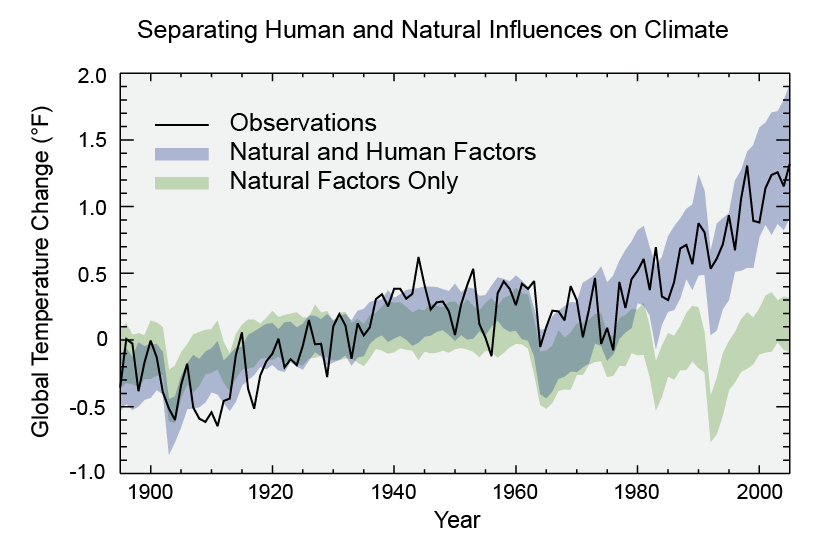
Solar output in fact has decreased since the early 60s.
Also according to the Milankovitch cycles we should be in the middle of a cooling period, although the actual effect is quite complex (e.g. it makes a difference whether perihelion occurs in the austral or boreal summer). So it is also possible that we might be in for slight warming over the next twenty thousand years. But even if we were in for dramatic warming due to orbital resonance, that would be on the order of 0.1C/century, much lower than the changes we've observed.
You left out volcanoes, which are a natural source of CO2 (as well as cooling particulates).
If you add up all the known sources of natural climate variation you end up with no warming trend since 1900 (source).
-
Re:It's about landmass
Have you actually calculated the amount of CO2 released per distance traveled for a car powered by gasoline, versus one powered by electricity from a coal plant?
(data showing Coal produced electric releasing about half of the gas-ICE's CO2 cut)
Even that's way worst-case though. Who gets all their electricity from coal these days? Here in fossil-fueled Oklahoma, my Electricity is barely half coal. Natural Gas plants (about a third here) are still carbon-producing true, but much less than coal. The remainder is downright green solar, wind, and hydro (remember hydro, the other carbon-free power tech?)
The little tool on that website figures I release about 20lbs (9kg) of CO2 per KWH here. My math is probably off here, but it looks like when I plug that number into what you did ( *1.2 to account for charge efficiency, ignore line losses because that should already be in the reported number), I get about 10.8kg CO2 per 100km traveled (vs gasoline's 22). Smaller, but a similar amount.
-
Re:double standards
I suppose you may have already found out about this one.
-
Re:must be the lead
It's possible. Lead is a neurotoxin which crosses the blood-brain barrier with ease. According to Wikipedia, "Lead causes loss of neurons' myelin sheaths, reduces numbers of neurons, interferes with neurotransmission, and decreases neuronal growth" (references a medical textbook), and "Long-term exposure of adults can result in decreased performance in some tests that measure functions of the nervous system" (references the EPA website). Nasty stuff.
Canada severely limited the use of leaded gasoline since 1990 though, while this study looked at data from 2001 to 2012. So either this is a latent effect from before leaded gasoline was limited, which is possible given how slowly dementia develops, or something else is going on. Either way, Lancet has a good reputation, so the methodology in this study is probably solid.
As others have pointed out, poverty could be a factor too. People prefer living further away from highways if they can afford to. Therefore property prices tend to be lower close to highways, which makes these places more affordable for poorer people. That confounds the issue with all sorts of other lifestyle factors. Do poor people eat less fresh fruit and vegetables? Do poor people exercise less? Do poor people smoke more cigarettes or drink more alcohol? Are there other factors we aren't even aware of?
-
Re:Outlaw Diesel Cars.
Totally right.
lets get this into perspective:
The entire transportation sector only accounts for about 27% of the total man-made greenhouse gas (MMGG) emissions:
http://www3.epa.gov/climatecha...Of that 27%, Road transport accounts for 72%,
http://www3.epa.gov/climatecha...
the rest is aviation and marine. That means about 19% of all MMGG is road vehicles.
From http://www3.epa.gov/otaq/clima...
About 23% of that 19% is from heavy duty vehicles (so 18 wheelers etc are responsible for 4.37% of all MMGG), which means that all the millions of family cars/motorbikes on the road are actually only responsible for 14.6%.
Clearly we need to target electricity generation (31%) and industry (21%) long before just beating up on car drivers more. -
Re:Outlaw Diesel Cars.
Totally right.
lets get this into perspective:
The entire transportation sector only accounts for about 27% of the total man-made greenhouse gas (MMGG) emissions:
http://www3.epa.gov/climatecha...Of that 27%, Road transport accounts for 72%,
http://www3.epa.gov/climatecha...
the rest is aviation and marine. That means about 19% of all MMGG is road vehicles.
From http://www3.epa.gov/otaq/clima...
About 23% of that 19% is from heavy duty vehicles (so 18 wheelers etc are responsible for 4.37% of all MMGG), which means that all the millions of family cars/motorbikes on the road are actually only responsible for 14.6%.
Clearly we need to target electricity generation (31%) and industry (21%) long before just beating up on car drivers more. -
Re:Outlaw Diesel Cars.
Totally right.
lets get this into perspective:
The entire transportation sector only accounts for about 27% of the total man-made greenhouse gas (MMGG) emissions:
http://www3.epa.gov/climatecha...Of that 27%, Road transport accounts for 72%,
http://www3.epa.gov/climatecha...
the rest is aviation and marine. That means about 19% of all MMGG is road vehicles.
From http://www3.epa.gov/otaq/clima...
About 23% of that 19% is from heavy duty vehicles (so 18 wheelers etc are responsible for 4.37% of all MMGG), which means that all the millions of family cars/motorbikes on the road are actually only responsible for 14.6%.
Clearly we need to target electricity generation (31%) and industry (21%) long before just beating up on car drivers more. -
That's nice
Kudos for finding a new use for some of the excess CO2, but it's still only a tiny fraction of the plant's CO2 output.
Given an estimated 13 million tonnes of CO2 emitted annually (based on the 14.9 million tonnes emitted by the 1200 MW Chandrapur plant), then capturing 66 kilotonnes still allows 99.5% of the CO2 to escape.
-
Re: It doesn't work that way.
Accepting the estimate you cite (only for the sake of making the point even more thoroughly - in fact, the estimate you cite is absurd; there's been barely any deviation in rate of sea level rise at all - most estimates are looking at 1/3 meter or so, it's only been about 25 cm in the last 140 years), let's say we have a meter and a half of sea level rise by the end of the century. That's 150 centimeters (5x-ish the actual estimates, BTW). The end of the century is 83 years away. Now. Here comes the sea. At what point do you imagine this raging, foaming, salty encroachment, (averaging about
Drowning from "sea level rise threat" == purest hysteria. Living where you're going to get flooded or swamped by coastal events is stupid. Likewise staying there if you are suddenly made aware of same. Yes, lots of people are stupid. Any other points you'd like to help me make?
-
Re:A .000002% incrase in something we didn't track
A few ppb makes a large difference when the optical pathlength through the atmosphere is so long. You don't need much CH4 to make a big difference in light absorption. In this case it went up 10 ppb in two years, out of 1800, so it's a 0.5% increase. Much more than 0.000002%.
To be clear, methane has been monitored for more than a few years. See here
It is also been indirectly measured via ice cores back hundreds of thousands of years.
In addition the the current surge, what should be alarming is the following:
In the past 100 years, the concentration of atmospheric methane has nearly doubled from 925 ppb in 1916 to >1800 ppb now. In the past 250 years it's nearly tripled. That's very fast and very far outside of statistical variation and is clearly not slowing down.
-
Re:It helps the economy too
You're right about the double-wall tanks and I glossed over some details in my post above. The problem isn't so much the tank but the parts connected to the tank. Leaks will most likely occur in places like fuel pumps connections or fill ports/spill buckets (which you also point out); and ethanol exacerbates those problem points requiring different parts and maintenance than non-ethanol gas. Ethanol can also cause in-tank fuel inventory monitoring systems to corrode and give bad readings that might not be immediately obvious to the operator, which is important, because fuel monitoring is one way tank owners indirectly detect potential leaks. I'm not making this up... Even the US EPA says tank systems are being corroded by ethanol and low-sulfur diesel : https://www.epa.gov/ust/altern... (ironically, while they mandate more ethanol be added to gasoline)
And yes... ethanol's hydroscopic properties (i.e. pulls water our of the air) is another problem tank owners wrestle with.
-
Re:20% of GHGs not from ruminant animals really
Most of their diet is grass while in pasture, hay over the winter, and grain when fattening them up for slaughter. Grass and corn grow very well with little help beyond planting and limited watering...the cows get most of that water from eating grass in their pasture and drinking from ponds in the pasture.
This is a romantic view of how cows are reared. The cows in our food chains are in fact fed almost entirely on corn and soy, and they don't have any pasture or ponds to drink from. Animal agriculture is in fact an industrial commodity produced using factory farming methods. The water problem lies in the fact that it takes all the fresh water that a cow drinks, plus all the water used to irrigate the 10-40 pounds of feed (for each pound of meat), plus the loss of fresh water in the supply that is polluted with their sewage. The EPA themselves estimate that 2,500 head of cattle produce the same amount of raw sewage as 411,000 people.
-
Re: Deniers
>> There's no evidence that humans are causing global warming or that the warming is due to anything other than poorly sited instruments. Grow up.
How about you get a clue instead of just brainlessy insulting people as AC because you're too gutless to post as yourself and stand by your own words.
http://climate.nasa.gov/eviden...
https://www.skepticalscience.c...
http://www.ucsusa.org/global_w...
https://www.nwf.org/Wildlife/T...
https://www.epa.gov/climate-ch... -
Re:Show me the data
As elementary knowledge of the world and well reasoned argument still haven't clued you in to the fact that a $7bn value for a single human life is obviously completely ridiculous, here's a link to the EPA website. No doubt you will be the only one to be surprised to find that the figure is indeed $7 million. $7.4 million in 2006 dollars, to be precise.
-
Re:Too early to celebrate
While that may be so, methane was only 11% of the greenhouse gas composition in 2014, while CO2 was 81%.
-
Re:Love it
Transport contributes to about a quarter of our CO2 emissions and personal transport accounts for maybe 63% of that as far as I can tell. So cars are not the cause of nor the solution to climate change. After cars, what next? Agriculture contributes a lot, I suppose you'd argue they should grow their own food. Power is another big contributor, so they should go without power.
You and I both know that some activists HAVE probably "put their money where their mouth is" and surprisingly climate change isn't solved. They're ignored as whackos which they are, and they lack any power to actually do more than pat themselves on the back. Real solutions will require more than voluntary personal lifestyle changes. -
Re: bull
-
Re: bull
-
Greenhouse gas
The real polluter is China, at an official 1/3, and far more likely to be close to 50%.
China 28%, the United States next at 16%. Since America has less than 1/4 the population of China, though, we're still putting out 2.5 times more greenhouse gas per person. Source: https://www.epa.gov/ghgemissio... alternate source: http://www.ucsusa.org/global_w...
Even now, America is under 33% coal for their electricity, Sadly, theirs continues to rise, while America's continues to drop.
yep, America is about a third: http://www.eia.gov/energy_in_b... That's primarily because of the drop in cost of petroleum and natural gas. I don't have good numbers for China, but they do burn a lot of coal.
The one that should be putting their money into dramately lowering their emissions is China.
The answer is "both". Since China already uses only 40% as much fossil fuel per person than the US does, it's going to be 2.5 times easier to reduce the US emissions, of course. But, this is exactly why it is a wicked hard problem : no single actor, no single organization, no single country can solve the problem on its own. The problem is global in scale.
-
Re:Correct me if I'm wrong, but...
> Don't the mileage and emissions numbers come from tests performed by the vehicle manufacturer themselves,
https://www3.epa.gov/otaq/test...
Not sure about Japan, but US does have the manufactures report the tests and results to the EPA, and the EPA reviews, and will then test 15%-20% of the vehicles themselves.
Issue is that manufactures need to advertise cars in advance of when they go on sale, with Fuel economy posted. So they are not production models, but prototypes. So they will change things, remove add extra features, so different tires different weights... So even the EPA tested ones are easily fudged if they specially prepare the vehicle they send.
The EPA does say it has started testing used vehicles, not sure when they started doing that, and what they do with the results...
-
Re:Shhh
Not true, according to EPA.
-
Re:Witch hunt
If only there was a way to stop all sales of VW products until they passed regulatory levels. I mean, $15 billion MAY hurt, but something like losing ALL sales until you have 100% compliance would really be a kick in the nuts.
-
Re:Witch hunt
Ok, I totally get your point, and I agree with you. I just don't $15 billion fine agree with you.
It's hard to engage in jury nullification when there's no jury involved. Even more so when you'd be hard pressed to assemble 9-12 random people who'd agree with you.
Did you object to the BP settlements as well, or is your issue merely that NOx pollution isn't as gross as oil-coated animals and shorelines? They get an "orange haze is pretty" discount?
-
I Swear to God...
Every time one of these "pedestrian hit/almost hit" stories is posted a bunch of people come out of the woodwork claiming that it's their constitutional right to put on black jeans, a black t-shirt, and a black hoodie then run across dark streets and if they get hit it the driver's fault, physics be damned, we all just need to creep along in our cars at walking speed any time it's dark or there are trees or parked cars along the side of the road.
I suspect this is all just part of the larger War on Cars wherein a bunch of leftwing environazis decided it's absolutely intolerable that transportation is responsible for a whopping 31% of carbon emissions (note that figure is ALL transportation, including cars, semitrucks, trains, boats, and planes--I'd be surprised if cars were even half of that 31%), so we have to make life as miserable as possible for anyone who drives a car. I've seriously asked a bunch of my liberal friends what sort of sense does it make to harass people just trying to get to their jobs when, even if you completely eliminated cars, you'd still have, at best, 70% of present carbon emissions being spewed out by other sources, only to be met with blank stares. The current crop of environmentalist fedora-tippers do not care about facts or logic--they only care about feels, and their feels tell them that cars are the most horrible thing for the environment ever. Clearly the best way to combat climate change is to make our transportation system even more inefficient with road diets, bus-only lanes, and expensive toll roads. After all, cars sitting idling in traffic or creeping along at 5 mph is great for the environment, right guys?
For the record, I actually care about the environment and think we shouldn't fuck it up for future generations. But the current left wing in this country are a bunch of useful idiots that will cheer on government subsidies for absolutely moronic ideas because, to them, the environment is just a bit of bait to be used to get closer to their real goal--more government control. Try suggesting to one these people that market-based solutions can actually work (like, hey, you know one of the reasons electronics, cars, and residential/commercial HVAC have gotten incredibly more efficient in recent decades is because it benefits consumers by saving them money), and be prepared to be met with open hostility for having the gaul to suggest that corporations are anything but cartoon-caricature villains twirling their mustaches as smoke pours out of their factories.
I'll continue driving my car where I need to go, thanks very much. Your attempts to give me an "incentive" (hey, maybe if you use economic-related words people will actually think you know something about economics) to take the bus or ride a bike will fail because, to put it frankly, even sitting in my car crawling along at 5 mph is preferable to the government-run joke of a public transportation system:
- In my car, I don't have to worry about crackheads asking me for cigarettes or money and flipping their shit when I tell them "no". When did it become fucking acceptable for people to feel they're entitled to my hard-earned property?
- In a similar vein, my car doesn't smell like piss and shit.
- Literally every parking spot in every park&ride near me will be full before 7 am, and I'm not leaving three hours before I actually have to be somewhere.
- I recently took the bus into downtown to go to the Pride festival, on a Sunday (you can probably guess which city I'm in), you would think that the bus system might add some extra routes given that they know there's this huge festival that a lot of people are going to, right? Nope! Standing room only, ass-to-crotch on the way there and back. I feel bad for the peopl -
What the EPA test really measures
The EPA tests were originally developed to quantify pollution generated by cars in the L.A. area, and using those tests to quantify gas mileage came later.
The EPA city cycle was not meant to represent the stop-and-go driving in Manhattan during rush hour. Rather, it was intended to be typical of an automobile trip in the L.A. area conducted on "surface streets", meaning major arterial roads that have stop lights and are not freeways. The average speed of that cycle is about 20 MPH. The EPA highway cycle was not meant to represent bombing down an open Interstate at 10-over a 70 MPH speed limit. Instead, it was to represent a trip on the 405 freeway in Los Angeles in the days before that road became a parking lot -- the test was meant to represent "moderate traffic" levels where the average speed is about 50 MPH.
Not only may your miles-per-gallon vary, the amount of BTUs in a gallon of gas can also vary downward from an alcohol-free summer blend that was probably the standard for the test -- the test conducted on rollers somewhere in Ann Arbor, MI doesn't actually measure the quantity of fuel used but instead measures the combustion products out the tailpipe and performs a mass balance with that standardized gasoline.
Taking the lower BTU fuel you may be getting into account, if you start the car engine from cold on a 70 deg-F day, don't run the A/C, and drive for about 10 miles in traffic where you average 20 MPH, you will roughly reproduce a city test, and I have found that the reading on a Scan Gauge, calibrated to tank fills, will get within 5 percent of the raw city numbers available here https://www3.epa.gov/otaq/tcld.... These numbers are considerable higher than the window sticker MPG rating available here https://www.fueleconomy.gov/. Driving on a not-that-hilly road (do this in both directions and take a harmonic average to compensate for net elevation change) on a 70-deg calm-wind day with the A/C off at a constant 55 MPH, if you can do that with angering other drivers, is a good proxy for the EPA highway test and will also get you within 5 percent.
"But no one drives that way!" someone will shout at you, and this may be true, but if you want to reproduce the EPA test conditions to see if you can match the (raw) EPA numbers, this is the way to check that.
The sticker MPG at fueleconomy.gov has had more than one "adjustment" performed to down rate it from the raw MPG. This was done because the published EPA ratings made people who considered themselves to be "good drivers" feel bad about themselves and their expensive new car purchases, and we cannot have any of that. Or rather, the "consumer" gas mileage numbers were proportionately reduced to "better reflect how real-world driving conditions on more congested city streets and with higher speed limits on highways affect mileage" whereas the Federal Test Procedure and the raw numbers for computing CAFE (corporate average fuel economy) were left the same so as to not keep changing the rules to which the car companies had to comply.
Now the down-adjusting is based on fleet averages, and your car may vary. A case in point is that Consumer Reports praised the Ford C-Max hybrid as being a lot more "fun to drive" than the Toyota Prius but slammed it for being much further off the EPA sticker in real-world driving than the Prius. Well, duh, Consumer Reports! Were you to drive both vehicles in a true "EPA city granny cycle", they probably would get proportionately higher than the window sticker as is the raw "test car" number. But left to the lead foot of a "normal driver", the C-Max with its bigger gas engine will indeed accelerate better yet use more gas than the small-engine sluggish Prius.
I also expect "eco-cars" like the Prius to suffer more from "normal driver" in relation to EPA test cycle driving because their power plants are more matched to the "granny cycle." A real "muscle car" may suffer le
-
Re:"one of the key benefits of GMO is increased cr
all I could find is that the _sewage_ cannot be used in _organic_ plants. So I call bull
Before making a fool of yourself, you should be looking for the opposite... ANYONE who says human excrement CAN be used on food crops. You won't find it.
But I can give you a start:
(a) Humus from composting toilets may be used around ornamental shrubs, flowers, trees, or fruit trees and shall be buried under at least twelve inches of soil cover. Deposit of humus from any compost toilet around any edible vegetable or vegetation shall be prohibited;
http://arcweb.sos.state.or.us/...You'll find mostly the same restrictions, in almost every state.
Federal rules are... less concise. They require permitting, long time periods between last applying waste and when crops can be harvested, lots of remediation steps, etc., etc.:
Food, feed, or fiber crops may not be grown on an active biosolids unit unless the owner or operator of the surface disposal site can demonstrate to the permitting authority that through management practices public health and the environment are protected from any reasonably anticipated adverse effects of certain pollutants that may be present in biosolids.
https://www.epa.gov/biosolids/... -
Water contamination risk, see EPA and PNAS reportsEPA
PNASOrganic compounds found in drinking water aquifers above the Marcellus Shale and other shale plays could reflect natural geologic transport processes or contamination from anthropogenic activities, including enhanced natural gas production. Using analyses of organic compounds coupled with inorganic geochemical fingerprinting, estimates of groundwater residence time, and geospatial analyses of shale gas wells and disclosed safety violations, we determined that the dominant source of organic compounds to shallow aquifers was consistent with surface spills of disclosed chemical additives. There was no evidence of association with deeper brines or long-range migration of these compounds to the shallow aquifers (emphasis added). Encouragingly, drinking water sources affected by disclosed surface spills could be targeted for treatment and monitoring to protect public health.
-
Re:Meanwhile ...
For example, if you operate a coal power plant and do nothing other than routine maintenance, then you are grandfathered to whatever environmental standards were in effect when it went into operation.
Not true. All units had to be MATS-compliant. MATS is caught up in the courts right now, but only after most of the compliance work by generators was already completed. There were quite a few old generators that closed down rather than invest the hundreds of millions of dollars to upgrade their environmental controls. Almost all US coal units still operating are now MATS-compliant (there were some units that had applied for an additional year to meet compliance goals).
-
Re:States
OK, rant over... gotta go mow the stupid lawn now. Unless there is some Federal law against that I don't know about.
Not so fast, citizen. Have you read and complied with the relevant regulations, citizen? The EPA is only concerned with what's best for all of us, citizen. You do want to be a good citizen, don't you, citizen? Now pick up that can.
To anyone who scoffs at this: ask yourself: "Why should the federal government be concerned with how I mow my lawn that I paid for and continue to pay taxes for?" -
Re:States
OK, rant over... gotta go mow the stupid lawn now. Unless there is some Federal law against that I don't know about.
Not so fast, citizen. Have you read and complied with the relevant regulations, citizen? The EPA is only concerned with what's best for all of us, citizen. You do want to be a good citizen, don't you, citizen? Now pick up that can.
To anyone who scoffs at this: ask yourself: "Why should the federal government be concerned with how I mow my lawn that I paid for and continue to pay taxes for?" -
Re:How to collect "atmospheric" CO2?
CO2 can be extracted from the atmosphere for about $160/ton.
Gasoline emits 8.887 kg of CO2 per gallon of gasoline, so that's 112.5 gallons of gasoline for one ton of CO2. At current prices, that's about $225 worth of gasoline, so this process is "worth it" in terms of recapturing CO2 produced by burning gasoline (basically stick a $1.42/gal tax on gasoline to pay for it).
Electricity generation results in 0.703 kg of CO2 per kWh (same EPA source), so that's 1422 kWh per ton of CO2. At a U.S. average of $0.115/kWh, that's $163.50 worth of electricity. So it would basically double the average price of electricity in the U.S. Still doable, although the similarity of the price means this is getting close to the break-even point where the energy cost to recapture the CO2 approaches the energy gained by producing it (by burning fuel) in the first place.
Cost of sequestration would have to be added on top of this though. -
Re:I hate bad journalism like this...
Huh ?...in Australia they have clean air laws, unlike the USA.
Try not speaking out of your anus next time.
https://en.wikipedia.org/wiki/...
https://www.epa.gov/laws-regul... -
Re:Once again, hydrogen looks to be the future
If you paid attention to actual time scales in actual published scientific papers instead of sexed up headlines you wouldn't be saying that.
The predicted high rate of warming from the early work of NASA and the IPCC has already been falsified. This is why more recent IPCC reports forecast much lower rates of warming (while still predicting catastrophe).
For instance observed sea level rise has always been faster than predicted in any of the IPCC reports.
The sea level is hardly rising at all right now; it is plain to see from the actual data that a massive acceleration in the rise would be required to fulfil the predictions of flooded cities and so forth. Moreover, those dramatic predictions come from sensational numbers like 7 meters, but these days the IPCC is predicting a rise of less than 1 meter over the next century, which would be more than usual, but still not terribly exciting in the grand scheme of things.
-
Re:Lies
Sorry, I forgot the post I linked doesn't include the link to the EPA graph which is my actual source: https://www3.epa.gov/climatechange/science/indicators/oceans/sea-level.html
-
Re:Lies
...five of the Solomon Islands have completely submerged underwater due to man-made climate change...
That's a bold-faced lie. The total global sea level rise since 1880 is less than 25 cm (10 inches), according to the EPA. The natural tidal range of the oceans is of the order of one metre (several feet). Any island that has "submerged" during that time period did so primarily because of other factors, such as the ground subsiding, or erosion driven by the wind and the waves.
This is especially obvious when you consider that anthropogenic global warming is not believed to have reached significant levels until around 1950 (if then).
As for houses washing away and such - any land that can be "submerged" solely by a sea level change of 25 cm was already getting scoured regularly by waves, storm surges, etc.
Read the paper. It is short, linked, and not technical.
They aren't claiming that the island got submerged due to sea level changes. They are claiming that it got eroded.
As sea levels go up, erosion (in the form of waves) gets worse. They claim that the increased erosion has completed wiped out the islands. This is a separate effect from your silly claim of a lie. You can read the paper for how they try and separate the erosion from other effects like El Nino and tides.
-
Lies
...five of the Solomon Islands have completely submerged underwater due to man-made climate change...
That's a bold-faced lie. The total global sea level rise since 1880 is less than 25 cm (10 inches), according to the EPA. The natural tidal range of the oceans is of the order of one metre (several feet). Any island that has "submerged" during that time period did so primarily because of other factors, such as the ground subsiding, or erosion driven by the wind and the waves.
This is especially obvious when you consider that anthropogenic global warming is not believed to have reached significant levels until around 1950 (if then).
As for houses washing away and such - any land that can be "submerged" solely by a sea level change of 25 cm was already getting scoured regularly by waves, storm surges, etc.
-
Re:And better for the enviroment
The answer is we don't know, and those who say "no way" and those that say "absolutely" have little evidence to support or contradict them, since it's all speculation.
However, according to the EPA humans have been producing between 5 and 6 GT (billion metric tonnes) or CO2 a year form quite some time. Trying to grow meat in a laboratory and make it scalable like this likely produces less than a few tonnes, so less than 0.0000001% increase. Estimates of the animal agriculturla contribution to this seem to average around 5% (World Resources Institute, UN Food and Agriculture Organization, and Pitesky et al. 2009) [NB: I just eyeballed this, didn't actually pull out a spreadsheet].so about 300,000,000T.
If we "spend" 2-6T of CO2 for a mere 1% chance that if adopted widely it will save emissions from meat production by an ultra-paltry 1 in 10,0000 (300,000T/year), even factoring the risk, it's a really smart investment. So do it. Once you're done, then let's talk about how it will save the world from Global Warming.
-
Re:Fuck the rest of the world.
Your comment indicates you don't even understand the point I was making.
The huge expense is trying to cut CO2 by 20-30%, while the planet needs 80%.Electricity production accounts for 37% of man made CO2 and growing. This will increase with the move towards electric vehicles and the increased demand for power.
https://www3.epa.gov/climatech...The other issue is methane which is can occur in large quantities when fracking. Methane particle are significantly worst than CO2 in the same quantities.
The changes won't stop runaway global warming, but will still cost a huge sum of money.
You are only taking the portion of the equation that fits your arguments. In all your previous posts you never bring up the cost of doing nothing. The ongoing cost of doing nothing continues to increase and it doesn't come cheaper with time.
You tell me what cost of doing nothing is? I can tell you there are estimates in the 10s of trillions just to displace people from the coast due to rising sea levels.
Additionally, moving towards innovative technologies will promote growth in many other areas. There's a price for being pioneers but there's also a huge reward.
-
Re:Taxing CO2
In the US, transportation makes up 27% of all CO2 emissions. Of this, passenger cars and light trucks make up 60%, and medium and heavy duty trucks another 23%.
Source: US Transportation Sector Greenhouse Gas Emissions 2000-2013, EPA. -
Re:Fuck the rest of the world.
I found 2014 data:
https://www3.epa.gov/climatech...
US population was about 319 000 000.6870/319 = 21.5 eCO2 tons/person/year