Slashdot Mirror
Domain: epi.org
Stories and comments across the archive that link to epi.org.
Comments · 165
-
Re:Math, do it...Really?
http://www.epi.org/publication/ib330-productivity-vs-compensation
Seems like they're very productive. Deal with it.
-
Re:What about all the new jobs in the "digital" ag
Very true. With companies not "sharing the wealth" and favoring owners over employees in almost every case....
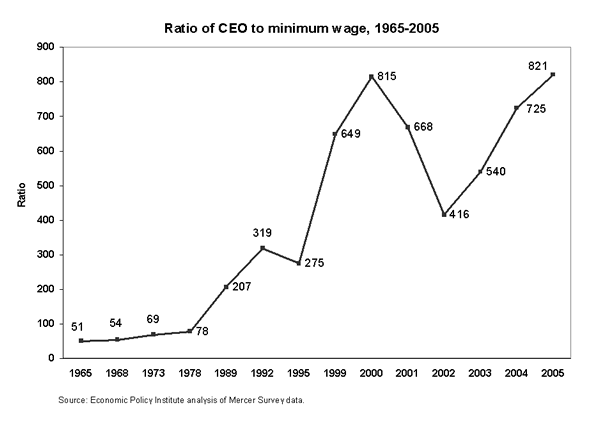
Not quite. With publicly traded companies in almost every case the corporations are favoring the executives, over the stock-holders (aka "owners"), who are in turn favored over the employees: http://www.epi.org/publication/ib331-ceo-pay-top-1-percent/
-
there's no "I" in "team", but a "you" in "FU"
To put a finer point upon it, it's 38 years of Capital keeping 100% of gains from productivity improvements and giving NONE of it to Labor.
In a non-pathaological society, government would step in to make things more fair before the hoi polloi start sharpening the machetes.
In our society, we have the GOP and Fox News to keep the rabble distracted with straw men like abortion and to accuse anyone who finally notices what's going on of "class warfare". -
Re:^This
A professionally trained, well-paid human teacher eh?
If this is true, then how come our schools are so awful?
We the people have been throwing more and more money at schoolteachers, and requiring ever-increasing levels of training and education to maintain their license to teach, yet the educational achievments of our students have been flatlined for 40 years, and have even fallen dramatically in some districts.
this is nothing but a red herring argument foisted by fiscal conservatives to continue to destroy the public school system and to concentrate resources in elite public schools. for a nation whose economic engine relies on advanced knowledge and high literacy, we should be treasuring our teachers. teaching should be one of the highest-paid professions, and people should be beating down the doors to try to become a teacher.
instead, people have bought the line that teachers are "overpaid" and don't bother to realize that teachers earn incredibly low salaries for the education and professional level of their work. that is insane.
at the very least, please stop repeating the blatant lie that teachers are overpaid. there could be nothing farther from the truth.
-
Re:Please notice the per employee amount.
His point is that despite all the doom and gloom stories about excess CEO pay, the amount of money the CEOs are making compared to the entire economy is peanuts. Here's a commonly cited paper" on CEO pay in the U.S. The average CEO here makes 273x more than the typical worker, with an average compensation of $14.1 million/yr. The horror!
But if you read the fine print, you see that it only looked at the top 350 companies. If we were to cut these CEOs down to size and confiscated all the money they made last year and redistributed it to the 145 million workers in the U.S., each worker would end up getting ($14.1 million)*(350 CEOs)/(145 million workers) = $34 each. If you divide it by the number of workers in the Fortune 500 (24 million), it's $205 each.
The authors of the paper came up with the methodology for tracking trends in CEO pay over the years. Unfortunately it's been hijacked and misreported to fit the narrative that CEOs in general are siphoning off substantial amounts of money our economy is generating, and if it were fixed everything would be much better. That simply isn't the case. While the top CEOs may make enough money to afford themselves a lavish lifestyle, in terms of the overall economic output of their companies it's peanuts.
If you want a better, broader measure of income inequality, you should be looking at things like Gini coefficient. But "Income inequality 50% worse in U.S. than other Western countries" isn't as great a headline as "CEOs make 273x more than their workers." -
I have changed the agreement. Pray I don't change
-
Re:States really need revenue
States are spending more than ever.
It's interesting to see folks talking about "OMG, the government is spending so much!!!!" when in fact it's been dropping like a rock since about 2009-ish. What actually happened was pretty simple to understand: In the fall of 2008 the economy took a nose-dive, shrinking the GDP and causing a lot more people to qualify for SNAP and unemployment insurance and SS disability and TANF and Medicaid and a few other programs. The cost of those programs predictably skyrocketed despite no new laws passing. Since then, as fewer and fewer people have qualified, the costs have been shrinking. Meanwhile, all the budgetary belt-tightening that had happened elsewhere in the budget is still in effect, so in fact government spending is shrinking fairly rapidly.
Also, tax revenue is the lowest it's been since 1941, so complaints about taxes being unusually high are also wrong.
-
Re:Of course...
Thank you for those links. I should have qualified, I'd heard employers whining about difficulty finding employees in the media, but not much for numbers to back it up.
developers can demand salaries that many segments of the market cannot afford.
Corporations have been making record profits. Wages have not increased significantly. Something is out of whack.
this link lays out what I would say is a decent rebuttal:
http://www.epi.org/files/2013/bp359-guestworkers-high-skill-labor-market-analysis.pdfsome of the most telling statistics (IMO):
-For every two students that U.S. colleges graduate with STEM degrees, only one is hired into a STEM job.
-Wages have remained flat, with real wages hovering around their late 1990s levels.
-The annual inflows of guestworkers amount to one-third to one-half the number of all new IT job holders. -
survivor? of the class wars
Now we just need our safety nets to keep up with the fact that a large percentage of the population will probably be working less than 40 hours per week in the future.
Welfare programs have to be paid for by taking money from somebody.
I know, we can take some of gains from improved productivity and automation over the last 40 years and use that to shore up social safety nets while still reducing the average work week to 30 hours!
Oh, wait, somehow every last bit of that got snorked up by capital, there's nothing left over for labor. How about "FUCK YOU" instead? -
Re:How is this legal?
Evidence says otherwise: Hard to refute numbers
-
Re:How is this legal?
1. GDP per capita is not the same as income
Duh, that was the point of that statement. Thank you for pointing out that entirely true fact.
2. Whether or not employees can be forced to join a union is not the only variable affecting income levels. Because you have not isolated that variable, your statement is meaningless.
Cheers!
Ah, but if you look at the link I've posted elsewhere in this thread, methodological tactics to isolate the phenomenon from other factors, like location and industry, enhance it's apparent effect by several percent.
So... your objects are poorly considered.
-
Re:How is this legal?
in states that don't engage in unions...wages are higher
I also fixed that for you.
Unions only live by sucking funds from workers, remember.
Oops, it looks like you posted the opposite of reality. Would you like help writing a letter?
-
Re:How is this legal?
Seriously, Detroit isn't a state, and right-to-work West Virginia lost the same quantity of coal-related jobs when the U.S. de-industrialized a bit over the last decades. There are multiple factors in play, which makes cherry picking easy, and people in union allowing states are better off on average.
A bit more detail on just how dramatic the difference in wages is, and yes, there is a rising tide effect where non-union employees earn more in a union state: Not just an opinion
-
Re:Remember how low the US is ranked
That US education is in decline (entirely due to needlessly low funding) seems clearly true to me, from my vantage point at a state school in California. Nevertheless, US higher education is undoubtedly the best in the world. As my (Indian) professor once pointed out, even 2nd and 3rd tier US institutions have at least one professor among the best in their field.
Our primary and secondary education is probably more heavily criticized, but reports of its demise are greatly exaggerated.
-
Re:Something is wrong
Meanwhile the average CEO wage has not just kept up with inflation, but doubled.
Doubled?
From 1978 to 2011, CEO compensation increased more than 725 percent, a rise substantially greater than stock market growth and the painfully slow 5.7 percent growth in worker compensation over the same period.
Source: Economic Policy Institute
-
Re: meritocracy and backrgound investigatios"In fact, I'm one of those meritocratic boogeymen that thinks our borders should be open with nothing more than a background check into your criminal record before you're granted entrance to the United States"
...Meritocracy would be a big improvement, but the execs (business and academia) have been resisting that mightily. They don't want any solid, objective, enforceable minimal (intelligence, knowledge, work experience...) standards for the low-skill E-3, H-1B, J, and L visas for cheap, young, pliant labor with flexible ethics.
None of the cheap labor crowd want proper background investigations of visa applicants. A lot of politicians think it's wunnnnderful that the US government has signed onto "visa waiver" pacts.
While reading the EPI report Low-skill H-1B guest-workers in the US STEM job market I was prompted to dig up the latest DoS statistics. 135,991 H-1B (including the H-1B1s set aside for Chile and Singapore) were issued through consular offices in FY2012 (so much for all the propaganda of an annual limit of 65K or 85K). My main complaint with the EPI report is that they fail to include a precise definition of "IT work-force" and "IT occupations" that they're using, though they talk around it a bit.
-
Re:FWD.us?
Zuckerberg, Melissa Mayer, Bill Gates, John Chambers and the rest of that crowd PROFIT by encouraging this race to the bottom. It's disgusting, and a blatant betrayal of the American worker. These people made billions off the backs of American high tech workers, and they are using blatant deception and outright lies to support their cause to bring in more H-1B workers.
Here are some references that *accurately* put the lie to the claims made by these lying SOBs. Does that sound harsh? It's meant to. These so-called "American leaders" are betraying the very workers who helped them make their unreal wealth. They need to be called out.
http://www.epi.org/publication/bp356-foreign-students-best-brightest-immigration-policy/
http://www.thesocialcontract.com/artman2/publish/tsc_23_2/tsc_23_2_nelson_printer.shtml
http://www.motherjones.com/politics/2013/02/silicon-valley-h1b-visas-hurt-tech-workers
What's little known is that American corporations are using large-scale outright deception and manipulation in an attempt to displace American Workers.
Some of the information presented in the following links will shock most Americans, because American corporate leaders don't want us to know the truth, and they are paying off policy makers with contributions to keep the truth from us. The H-1B fiasco has cost Americans $10TRILLION dollars, since 1975. For anyone who wants to know the truth, read on.
Watch this attorney and his consultants teach corporations how to manipulate the law to replace qualified American workers: http://www.youtube.com/watch?v=TCbFEgFajGU
Here's more abuse of the L-1 Visa (H1-B's are only the tip of the iceberg http://economyincrisis.org/content/l-visa-programs-brimming-abuses
Professor Norman Matloff's extremely well documented studies: http://heather.cs.ucdavis.edu/h1b.html
-
Re:But...
I know everybody loves to bash Walmart, but is really justified? At the risk of greatly oversimplifying, you can help poor people by 1. getting them more money, or 2. making the things they need to buy cost less. Walmart is working very hard at doing thing 2. Do you think Walmart's margins are higher or lower than the retail industry average?
There are other sides to this, though, such as employment. It is taken as a given that Walmart's entry into a market places downward pressure on prices, and that there are benefits from this. However, their entry into a market also places downward pressure on wages. Making things cost less only helps if it isn't outweighed by reductions in pay. The price reductions from Walmart (generally a good thing) end up being distributed across the income scale, but the lower-income segments alone face the decrease in pay to low-paying jobs that accompany Walmart's entry into a market. Walmart is an income re-distribution machine, providing most of its benefit to people with higher incomes, and most of its downside to people with low incomes. See: http://laborcenter.berkeley.edu/research/walmart.shtml for (much) more on this. There may also be more of a wage-depressing effect than a price-depressing effect, which would make the bargain bad for the economy overall, let alone its redistributing effects. Let's also look at what Walmart's margins actually are, and whether or not they could be lower, as well as where they come from. This article examines those questions, and finds evidence that Walmart could both remain competitive and pay employees more: http://www.epi.org/publication/ib223/ .
-
Re:Can we speak in clear terms?
It means that if we pretend that we don't have a massive income disparity in this country, and that this disparity is causing our educational system to fail, we can then pretend that everything is just fine, right up until the resulting educational problems start causing our national economy to falter and our democratic institutions to become non-functional.
I think what it's intended to mean is, as per the conclusions in the paper, that if we ignore differences in the level of inequality, and assume that the problem is solely that "our schools are failing" (other than "failing" to sufficiently compensate for inequality), we're not necessarily going to be able to improve our standing - maybe we should be spending more effort elsewhere. (The Economic Policy Institute's about page indicates that they're a center-left think tank, so that's not a surprising message.)
-
Re:Can we speak in clear terms?
It means that if we pretend that we don't have a massive income disparity in this country, and that this disparity is causing our educational system to fail, we can then pretend that everything is just fine, right up until the resulting educational problems start causing our national economy to falter and our democratic institutions to become non-functional.
I think what it's intended to mean is, as per the conclusions in the paper, that if we ignore differences in the level of inequality, and assume that the problem is solely that "our schools are failing" (other than "failing" to sufficiently compensate for inequality), we're not necessarily going to be able to improve our standing - maybe we should be spending more effort elsewhere. (The Economic Policy Institute's about page indicates that they're a center-left think tank, so that's not a surprising message.)
-
And here's the paper in HTML
If one were to rank comparable classes between the U.S. and the rest of the world, U.S. scores would rise to 4th from 14th in reading (PDF) and to 10th from 25th in math."
Or, if you prefer:
If one were to rank comparable classes between the U.S. and the rest of the world, U.S. scores would rise to 4th from 14th in reading (HTML) and to 10th from 25th in math."
The HTML version includes some links, including a link to a response to a PISA response to the paper, including the PISA response itself (PDF).
(I didn't check all the pages to make sure the HTML version was complete - the last page of the PDF says "page 99" - but I did a quick-and-dirty hack, wherein I selected all the text in the HTML version, copied it and pbpasted it to a file, did the same with the PDF version, applied a tr hack (tr -cs "[:alpha:]" "\n", as per the man page), and then ran wc -w on both files; it reported 45040 for the HTML version and 45596 for the PDF version, so, unless one of those steps severely mangled the document, they're probably the same.)
-
And here's the paper in HTML
If one were to rank comparable classes between the U.S. and the rest of the world, U.S. scores would rise to 4th from 14th in reading (PDF) and to 10th from 25th in math."
Or, if you prefer:
If one were to rank comparable classes between the U.S. and the rest of the world, U.S. scores would rise to 4th from 14th in reading (HTML) and to 10th from 25th in math."
The HTML version includes some links, including a link to a response to a PISA response to the paper, including the PISA response itself (PDF).
(I didn't check all the pages to make sure the HTML version was complete - the last page of the PDF says "page 99" - but I did a quick-and-dirty hack, wherein I selected all the text in the HTML version, copied it and pbpasted it to a file, did the same with the PDF version, applied a tr hack (tr -cs "[:alpha:]" "\n", as per the man page), and then ran wc -w on both files; it reported 45040 for the HTML version and 45596 for the PDF version, so, unless one of those steps severely mangled the document, they're probably the same.)
-
And here's the paper in HTML
If one were to rank comparable classes between the U.S. and the rest of the world, U.S. scores would rise to 4th from 14th in reading (PDF) and to 10th from 25th in math."
Or, if you prefer:
If one were to rank comparable classes between the U.S. and the rest of the world, U.S. scores would rise to 4th from 14th in reading (HTML) and to 10th from 25th in math."
The HTML version includes some links, including a link to a response to a PISA response to the paper, including the PISA response itself (PDF).
(I didn't check all the pages to make sure the HTML version was complete - the last page of the PDF says "page 99" - but I did a quick-and-dirty hack, wherein I selected all the text in the HTML version, copied it and pbpasted it to a file, did the same with the PDF version, applied a tr hack (tr -cs "[:alpha:]" "\n", as per the man page), and then ran wc -w on both files; it reported 45040 for the HTML version and 45596 for the PDF version, so, unless one of those steps severely mangled the document, they're probably the same.)
-
being oppressed all the way to the bank
yeah, class warfare.
And you berate the losing side for starting to notice and complain after 40 years.
Stay classy, job creator. -
Re:Compare the costs of social programs to researc
I am confused by your statement "I don't understand austerity". From my viewpoint, it is simple: pay for the programs you implement, don't leave it to your grandkids to pay for. In my country, we have Social Security. I like Social Security, it is a good idea. yet we ahve this notion that seniors have paid for their benefits. The reality is that the current generation of recipients paid between 50-70 cents on the dollar for the benefit they are receiving. My generation will likely be in the 70-75 percent range. At some point, someone has to pay for the shortfall, and it will likely be my kids and grandkids. That is a horrible sign of selfishness and immaturity.
I assume you live in the USA. One way to permanently fund Social Security [1] would be to remove the limits on the tax (which is currently limited to an arbitrary $106k) so millionaires (who do receive SS benefits when they retire) have to pay the same overall % of income as middle-class and the poor.
This is but one of the more well known ways to fix shortfalls in government without having "our kids and grandkids pay". Perhaps we should remove corporate loopholes that allow companies to essentially pay no tax? The fact is, many corporations [2] and wealthy people [3] have lower tax rates than folks who are scraping to get by. I pay a significantly higher rate than Romney.
[1] http://www.epi.org/publication/webfeatures_snapshots_20050217/
[2] http://communities.washingtontimes.com/neighborhood/ad-lib/2011/apr/10/tax-evaders-wall-shame/
[3] http://money.cnn.com/2012/09/21/pf/taxes/romney-tax-return/index.html -
Re:Misdirection
If trickle-down worked, explain this graph:
http://www.epi.org/m/?src=http://www.epi.org/files/2012/ib330-figureA.png&w=550
In this graph, the economic output is measured by productivity, while the benefits trickling down to the masses shows up as hourly compensation. Do you see a match between the higher economic output and higher pay for workers (which would also be a signal of higher demand for workers)? I sure can't.
An illustrative example of wealth not trickling down: Caterpillar Inc just announced record profits. The upper management, in response, gave their executives a giant bonus, then went to their employees and demanded they accept a 55% wage cut.
-
Re:O RLY?
there are jobs to be had..plenty of them.
Except there aren't, that's the problem. There are four times as many unemployed people as there are jobs, so odds are you have to be in the top 25% of your field just to qualify for the lowest possible wage.
In fact, more often than not, you have to have a job already in order to get a job.
-
Re:Because insurance pays for them
I think you miss the point. When Joe Sixpack doesn't have to pay for Product X, he doesn't care whether Product X costs $10 or $10,000,000.
Health insurers pass the cost on to employers, who have to keep paying the increased premiums to keep their employees happy. If Joe Sixpack had to pay for their own health insurance, then he would object when they doubled the premiums to cover those $10,000,000 products that could have been bought in a free market for $10.
Maybe you've been out of the job market for a while, but where are these happy employees?
Employers Push Higher Health Insurance Costs Onto Workers
Employees Get Pinched: Health Insurance Costs More
-
Re:just like communism...
Here's an interesting graph, the hocky stick change in rates happens to coincide with Reagen's second election, the first to involve large donations (Carter and Reagan both took only public funds in 80).
-
Re:A novel concept ...
Social Security well prepared for retirement of baby boomers in 2016
According to the latest annual report of the Social Security trustees, 2016 is the first year in which Social Security will no longer receive more in taxes than it pays out in benefits (SSA 2001). Yet from 2016 to 2024, the Social Security trust fund will actually continue to grow as its assets earn interest. Then, from 2025 to 2038, Social Security will be able to meet its obligations to retired baby boomers by selling its accumulated assets. This is, in fact, why the assets were accumulated in the first place.SS is running out of money the same as you are dying. Except that between now and 2038 SS will have plenty of time to make small changes that ensure it continues to pay its way. The changes I propose do not mean anyone receives less benefits. They simply shift the burden out of the absurd current system that is harder for the poorer onto a system that actually taxes the richest the same as everyone but the poorest. Only the richest (over $105K:year income) will pay more, and not much more; everyone else will pay less.
Privately operated insurance corps are allowed to do whatever they damn please. The CDSes that crashed the economy were insurance products. The health insurers that are robbing Americans while the HCR law waits to kick in can do whatever they damn please. The Social Security fund is by far the most reliable retirement fund, because it is allowed to invest in only the safest investment that actually grows: Treasury bonds.
It's strange that you have noticed that the political class and their media servants is on a terror campaign against Social Security, but that you seem to be buying into so much of the fear they're inventing.
-
Re:Rewrite the Constitution or face default!
And the people talking about "tax cuts for billionaires" routinely forget to include the fact that the Bush tax cuts cut taxes for _everyone_. In fact, the bulk of the expense of those tax cuts is coming from the lower brackets, not the highest.
Sigh. Another misinformed, deliberately moronic Tea Partier on the loose.
The Bush tax cuts disproportionately benefited the wealthy, plain and simple.
This is confirmed years later. The top 1% of earners laughed all the way to the bank taking a WHOPPING 38% of the benefit from the Bush tax cuts.
So no, the "bulk" of the expense is not coming from those lower brackets. Feel free to go fuck yourself.
-
Re:If you are at work
I was saying you can use averages for dissimilar work to make the claim that the public sector is better paid, or you can pick and choose positions to use as case studies. Both are misleading. One compares apples to oranges. The other makes the case that the outlying exception is a rule. Neither proves your point. And counter points based on better data are easy to come by. For example this and this.
*Those* are your cites?
Take a look at the people on the board of directors here: http://www.epi.org/pages/board/
I pretty much dismissed it after seeing all the union people on the board like this one:
Anna Burger
Service Employees International Union (SEIU) and Change-to-WinAnna Burger is both a top ranking officer at SEIU, the nation's largest and fastest growing union, and chair of the Change-to-Win Labor federation.
Yeah, that's a non-biased source.
And the study cited in the Times-Union article you linked? Looked at who the people are behind that?
http://www.nirsonline.org/index.php?option=com_content&task=view&id=13&Itemid=42
Another stellar source of non agenda-driven information.
The least you could do is cite something that isn't completely discredited with only a single Google search and one or two mouse-clicks. What you cited is an intellectual insult to anyone that bothers to check.
C'mon. Ya gotta at least make taking apart your arguments take more effort than a half-dozen mouse clicks. I feel like you're not really trying. Long week, perhaps?
Ah well. I'm wasting my time. Your mind is obviously not open. I wish it were. For your own sake, not mine. Things are going to be awfully tough for you in the near future.
Good luck.
Strat
-
Re:If you are at work
I was saying you can use averages for dissimilar work to make the claim that the public sector is better paid, or you can pick and choose positions to use as case studies. Both are misleading. One compares apples to oranges. The other makes the case that the outlying exception is a rule. Neither proves your point. And counter points based on better data are easy to come by. For example this and this.
-
wrong wrong wrong... all the way wrong
Try re-reading GP. GP actually tries to compress the "worth" and societal laws governing economics along with what you refer to as the natural laws of economics. GP states that "They aren't worth what they think they are". This is nonsensical as it is society, and their collective decisions regarding the intrinsic value of an individual that governs the so called "worth" of the individual.
Additionally, GP states that "China has shown they are happy to provide manpower at a rate thats appropriate for the supply". This further serves my point as the emergence of world markets, and global economic systems have NOT kept pace with enforcing a standardized subset of worker/individual rights. Its not a fair game, and is contributing to much of the current economic issues being experienced across the globe.
Economics is NOT a naturally occurring phenomenon. The observations regarding economic function as opposed to the laws governing the execution of an economic model ARE different, but nonetheless related. Laws governing economic models are easily influenced. Worker rights, and the rights of individuals can be and often are in so called ""enlightened civilized" society considered and enforced on any economic model, forcing conformity among membership.
In fact, it is this very principle of influencing economic systems via enforcement of said rights that allows for a stronger, more robust economic model, with more persistent periods of growth[PDF].
Worshipers of so called "free market principles" without acknowledgment or consideration of a baseline subset of the rights for the individuals making up the society in which an economic model is employed is actually backward thinking. It is only when a consistent, managed economic model with a full consideration and equitable distribution of basic rights is employed that one can truly expect to witness sustained growth and prolonged prosperity.
-
Re:WTF?
Over 78% of the teachers in our school district make over $50K a year for 9 months of work.
And I'm getting sick of this.
9 months of work? Seriously? I call bunk. Teachers are underpaid compared to other professionals with similar credentials. Teachers have at least a bachelor's degree and starting salaries range from mid 20's to mid 30's. I can make that at McDonald's. Most teachers have advanced degrees, which should put them in the 60-70k salary range. With experience, that should put them well over 80k, but it doesn't. Your "averages" include teachers with 10-20 years of experience, which clearly commands a higher wage, but doesn't approach what similarly experienced, degreed professionals make in other fields, even if you account for a smaller number of days worked.
What's my fault is allowing my state and school district to foist their expensive "programs" that don't work on a society that doesn't give a rip about education. I say abandon state sponsored education and let the free market work it out. At least I won't be paying for idiot administrators to pander to the loudest parents about their lazy kids
.
-
Re:They don't seem to have a problem with CEO pay
It's not so much the CEO pay that concerns me as it is the ratio to everyone else in the company.
-
Re:Never mind.
There's not a lot of evidence that it does any good in the modern world
There's tremendous evidence that union workers are better off in today's Western world. There's also a lot of evidence that unionization does not undermine competitiveness (see how high unionization rates are outside the US?).
Collective bargaining should only be legal if there's some good that comes from it that outweighs its downsides.
So, let me repeat the question: What part of the bargaining do you think should be outlawed - the bit where employees are allowed to express their views? The bit where people are allowed to not work if they so choose?
The workers should not have the power to undermine the will of the voters as a whole.
The will of the voter is to not impose slavery and to not restrict speech (well, OK, it's the will of a Democratic Republic). This means that a man cannot be compelled to work for a particular employer (no slavery), which means he is welcome to chat with his colleagues about what conditions are acceptable (freedom of speech) and together decide not to work (no slavery) if his employer does not provide those conditions.
-
Re:Never mind.
There's not a lot of evidence that it does any good in the modern world
There's tremendous evidence that union workers are better off in today's Western world. There's also a lot of evidence that unionization does not undermine competitiveness (see how high unionization rates are outside the US?).
Collective bargaining should only be legal if there's some good that comes from it that outweighs its downsides.
So, let me repeat the question: What part of the bargaining do you think should be outlawed - the bit where employees are allowed to express their views? The bit where people are allowed to not work if they so choose?
The workers should not have the power to undermine the will of the voters as a whole.
The will of the voter is to not impose slavery and to not restrict speech (well, OK, it's the will of a Democratic Republic). This means that a man cannot be compelled to work for a particular employer (no slavery), which means he is welcome to chat with his colleagues about what conditions are acceptable (freedom of speech) and together decide not to work (no slavery) if his employer does not provide those conditions.
-
Re:Not going to fix the problem
A) nothing I can address here.
B) This is really common knowledge. Yahoo had a big piece on 10 areas who are hit really hard by the double whammy. Large liabilities committed to on the assumption that the good times would not end, high unemployment, no demand for new housing (so no new housing jobs). Many houses under water, being foreclosed).
C) First-- are you really that out of the loop? This has been commonly known for over a decade. But okay.. I'll google it for you.
http://www.epi.org/economic_snapshots/entry/webfeatures_snapshots_20060621/
The wealthy pay a lower tax *rate* than everyone else at this point too. The secret is "fixed" state taxes like auto fees, property tax, etc. run 12% on poorest but only comprise
http://sociology.ucsc.edu/whorulesamerica/power/wealth.html"As of 2007, the top 1% of households (the upper class) owned 34.6% of all privately held wealth, and the next 19% (the managerial, professional, and small business stratum) had 50.5%, which means that just 20% of the people owned a remarkable 85%, leaving only 15% of the wealth for the bottom 80% (wage and salary workers)."
I can't find it now, but a later source (2008, 2009) said the top 1% now owned 42.7% (and the next had 42.3%) putting the top 20% at an incredble 95% of the wealth.
Our GINI index is close to most 3rd world countries now.
D) Again, this is fairly common knowledge. Surprised you are ignorant of it.
http://uchicagolaw.typepad.com/beckerposner/2010/04/american-wage-stagnationposner.html
"Between 1997 and 2008, median U.S. household income fell by 4 percent after adjustment for inflation. It presumably did not rise in 2009, and may not in 2010 either. A median is not an average; average income rose because the incomes of high earners rose, and so the effect was to increase the inequality of the income distribution..."E) If you can buy a device that can do any manual labor that a human can do for $100,000, then why hire a human. We are very close. You don't have to pay social security taxes for the work it does. It doesn't call in sick (it may break once in a while but will probably be modular and easy to fix). It's close. A decade. They can already pick random objects out of bins, toss things in the air and catch them, assemble things faster than humans.
We are running out of jobs to step up to. Most of the jobs we can step up to based on intellect or training. Many of those jobs have a couple billion new humans who are smart enough to do those jobs and happy to do them for under $30,000 a year. It could be a paradise-- no need for most to work, essentially free food and lodging- or it could be pretty hellish.
-
Re:I always got paid internships
http://www.epi.org/publications/entry/pm160/
Internships—the vast majority of which are unpaid—have become a staple of the college experience. In 1992, only 9% of graduating college students had participated in internships; by 2006 that figure increased nine-fold to 83% (Ortner 1997/1998; NACE 2008), representing at least 2.5 million student workers each year
People are desperate, and companies know they can do this. Note that that 83% figure is for 2006. If it isn't close to 100 percent now I'd be shocked. -
Re:Hmm...
Our national debt is nearly $130,000 per American home* and projected by Obama's budget to increase +$10,000 more each year. We. Need. To Stop. Spending. Otherwise we'll have ~$200,000/home by the end of this decade, and all go bankrupt. As Cosby might say, "C'mon people! This isn't hard to figure out."
Pick your poison, it's either federal debt or higher unemployment. Having able-bodied people sit at home when they could be doing something productive is incredibly wasteful - US GDP Per Worker is about $70K.
At some point, yes, deficit spending must be stopped. But it's not as if that makes the problem go away. Shutting down schools and public transit, for instance, may have longer term costs that outweigh the short-term savings.
-
Re:Right of free speech + right of association
This is why I love right-to-work states, where no one can make me join a union.
As an employer I love them too. I can pay those idiots substantially less to do the same work.
-
Re:Free trade of ideas, anyone?
Over the last 10 years, there has been a roaring trade between the west and China. Ordinarily, this would be a great thing, but so far trade has been completely one sided. The fact is, the west has very little that the Chinese actually want to buy, or cannot manufacture themselves. Individual companies have been making short term gains by relocating their businesses to China; but in the long term, Chinese competitors (generally state subsidised) quickly emerge and dominate the local market and then the export market. For short term gain, western companies essentially write their own death warrants.
But don't you know, a huge trade imbalance is a good thing! Yeah, and monopolies offer choice, and real income decline and a widening income gap is a sign of a healthy economy and democracy.
-
Re:Paging Mr. Vader - something slipping through
The Bush administration didn't get that memo.
-
Re:Entitlements= unemployment= lower quality of li
(minimum wage = minimum productivity for obvious reasons) will cause staggering numbers of layoffs. Raising minimum productivity by 5% would certainly kill over 20%-30% of jobs, nationwide.
Bullshit. The minimum wage has been raised many times, and such massive job losses never occured. The impact on employment is small and diminishes to insignificance over time.
Needless to say, [taxes are] seriously above that level for the moment, and Obama's done nothing but raise them.
In fact, our taxes are near historically low levels, and are low compared to other industrialized nations.
So. Any other ahistorical claims you'd like to make?
-
Re:What's in it?
Have you calculated how much it would cost to let the nation's health care issues continue to go unaddressed?
I'm not saying let it go unaddressed. I am saying that this bill and the approach the government is currently taking should be a last resort, not a first step, and certainly not taken right now.
Perhaps, and perhaps [taxes/borrowing/inflation] is the lesser of two evils.
Which is where I have a hard time understanding the position, and why I posed the thought experiment. If our money was handled in a responsible way, there would be little objection to this sort of plan. Even flaws would be overlooked because the money would be available even to cover overages.
But the money isn't available. The United States government is insolvent and quickly moving towards default.
I mean, let's take it to the other extreme. Assume that our debt was 100 times what it is now. The interest alone would be able to cover what will be spent via this plan. Would it make sense then to try to reduce the debt in order to be able to afford programs such as this? If not, why not? At what point do you prioritize the debt over more social programs?
I fervently believe that it is irresponsible to take on more spending when the debt service is so high. Reduce it now, balance the books, and then come talk to us about more social programs.
Adequate health care is not a luxury item like digital cable and magazine subscriptions. It's a matter of life and death for tens of thousands of Americans. In the balance between saving their lives and lowering your taxes (or the national debt), they win.
(I'll skip over the obvious question about why health-care is more important than food since that has been debated elsewhere)
I disagree that this is of such urgency now we can't stop and take a little time to reduce the amount we currently owe. As I mentioned before, there are other steps that can be taken which haven't even been tried.
I appreciate your even-tempered response. The other guy accused me of being a Republican shill, which is absurd (but he doesn't know me, so it's hard to tell either way). If you could explain your logic behind "why now?" and "why this instead of reducing the debt?" in more detail, I'd be very grateful.
Cheers.
-
Re:College students?
Big problem with how those sources get their data. I'd suggest reading up on their methodology.
You may want to review these locations:
http://www.epi.org/publications/entry/book_grad_rates/
http://www.nber.org/reporter/2008number1/heckman.html
http://www.nytimes.com/2008/03/20/education/20graduation.html -
Re:Funny
As for the cost, almost anyone who works has health insurance in the U.S.
This is patently untrue. Only ~70% of employed persons had employer provided health insurance as of 2006, down from ~75% in 2000. That leaves 30% of employed persons scrambling to cover the cost on their own. Since most of the non-covered employees are in the lower income ranks, they simply can't afford private coverage.
And, a state hospital will not turn them away.
Of course, they'll get care on a par with what Canada offers.
-
Re:Funny
As for the cost, almost anyone who works has health insurance in the U.S.
This is patently untrue. Only ~70% of employed persons had employer provided health insurance as of 2006, down from ~75% in 2000. That leaves 30% of employed persons scrambling to cover the cost on their own. Since most of the non-covered employees are in the lower income ranks, they simply can't afford private coverage. -
Re:Seriously?
Very highly paid people do very little work for each dollar they earn. This is not my opinion, it is simple mathematics. The average CEO "earns" 250 times as much as the average worker. Let's assume the average worker is an overpaid, underworked union slob (as "wealth=merit" types tend to believe) and does only 10 minutes of actual productive work per day. The CEO would still have to work 104 hours per day to work equally for each dollar. Not even Ayn Rand can fail to see that logic. So you need to switch to something else, like "they're smarter and more disciplined than you and I," or, "sitting around in meetings is much harder than backbreaking repetitive labor," or something like that.